
| |
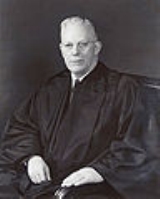
Earl Warren (March 19, 1891 July 9, 1974) was the 14th Chief Justice of the United States and the only person ever elected three times as Governor of California. Prior to holding these positions, Warren served as a California district attorney for Alameda County and Attorney General of California.
His tenure in his two highest offices were marked by extreme contrast. As governor of California, Warren's conduct of office made him very popular across party lines, so much so that in the 1946 election he won the nominations of both the Democratic and Republican parties.

Discussion
Ask a question about 'Earl Warren'
Start a new discussion about 'Earl Warren'
Answer questions from other users
|
Quotations
We may not know the whole story in our lifetime.
On the assassination of President John F. Kennedy, quoted in Minute by Minute (1985)
Legislators represent people, not trees or acres. Legislators are elected by voters, not farms or cities or economic interests.

Encyclopedia
Earl Warren (March 19, 1891 July 9, 1974) was the 14th Chief Justice of the United States and the only person ever elected three times as Governor of California. Prior to holding these positions, Warren served as a California district attorney for Alameda County and Attorney General of California.
His tenure in his two highest offices were marked by extreme contrast. As governor of California, Warren's conduct of office made him very popular across party lines, so much so that in the 1946 election he won the nominations of both the Democratic and Republican parties. But his tenure as Chief Justice was as divisive as his governorship was unifying. Liberals generally hailed the landmark rulings issued by the Warren Court, rulings affecting, among other things, the legal status of racial segregation, civil rights, separation of church and state, and police arrest procedure in the United States. But conservatives decried the Court's rulings, particularly in areas affecting criminal proceedings. In the years that followed, the Warren Court became recognized as a high point in the use of the judicial power in the effort to effect social progress in the U.S.; Warren himself became widely regarded as one of the most influential Supreme Court justices in the history of the United States and perhaps the single most important jurist of the 20th century.
In addition to the constitutional offices he held, Warren was also the vice-presidential nominee of the Republican Party in 1948, and chaired the Warren Commission, which was formed to investigate the 1963 assassination of President John F. Kennedy.
Warren was the last Chief Justice born in the 19th century.
Education, early career, and military service
Earl Warren was born in Los Angeles, California, to Methias H. Warren, a Norwegian immigrant, and Crystal Hernlund, a Swedish immigrant. Methias Warren was a longtime employee of the Southern Pacific Railroad. Earl grew up in Bakersfield, California where he attended Washington Junior High and Kern County High School (now called Bakersfield High School). It was in Bakersfield that Warren's father was murdered during a robbery by an unknown killer. Warren went on to attend the University of California, Berkeley, both as an undergraduate (B.A. 1912) in Legal Studies and as a law student at Boalt Hall earning his Juris Doctor in 1914. While at Berkeley, Warren joined the Sigma Phi Society, a fraternal organization with which he maintained lifelong ties. Warren was admitted to the California bar in 1914.
Warren worked a year for the Associated Oil Co. in San Francisco and then joined a private law firm in Oakland named Robinson & Robinson. The younger partner, Bestor Robinson, whose father became a California Superior Court Justice, was very active in the Sierra Club and conservationism and was an avid rock climber. In August 1917, Warren enlisted in the U.S. Army for World War I service. Assigned to the 91st Division at Camp Lewis, Washington, 1st Lieutenant Earl Warren was discharged in 1918. He served as a clerk of the Judicial Committee for the 1919 Session of the California State Assembly (1919–1920), deputy city attorney of Oakland (1920–1925), he served as deputy district attorney of Alameda County. At this time Warren came to the attention of powerful Republican Joseph R. Knowland, publisher of The Oakland Tribune. In 1925, Warren was appointed as district attorney of Alameda County, the incumbent, Ezra Decoto resigned to become Railroad Commissioner. Earl Warren was re-elected to three four-year terms. Serving Alameda County as D.A. (1925–1939) as a tough-on-crime district attorney and reformer who professionalized the DA's office, Warren had a reputation for high-handedness; however, none of his convictions were ever overturned on appeal.
Family
Warren married a young Swedish-born widow named Nina Elisabeth Palmquist on October 4, 1925 and had six children. Mrs. Warren died in Washington, D.C. at age 100 on April 24, 1993. Warren is the father of Virginia Warren, who married veteran radio and television newsman and host of What's My Line?, John Charles Daly, on December 22, 1960. They had three children, two boys and a girl.
Attorney General of California
Nominated by the Democratic Party, the Progressive Party, and his own Republican Party, Warren was elected Attorney General of the State of California in 1938. Once elected he organized state law enforcement officials into regions and led a statewide anti-crime effort. One of his major initiatives was to crack down on gambling ships operating off the coast of Southern California. Following the United States entry into World War II after the Japanese Attack on Pearl Harbor, Warren organized the state's civilian defense program. As Attorney General, Warren is most remembered for his support of Japanese internment, which was the policy of placing Japanese Americans in internment camps during World War II. Throughout his lifetime, Warren maintained that this seemed to be the right decision at the time. He did, however, admit that it was a mistake in his memoirs.
Governor of California Running as a Republican, Warren was elected Governor of California on November 3, 1942, defeating Democratic incumbent Culbert Olson. California law at the time allowed individuals to run in any primary election they chose. In 1946, attesting to his wide popularity, Warren managed the singular feat of winning the Republican, Democratic, and Progressive primary elections and thus ran virtually unopposed in the 1946 general election. He was elected to a third term (as a Republican) in 1950. He is the only governor of California to have been elected to three terms of office.
As with his predecessor Olson, Warren's governorship was marked by his support for the internment of Japanese and Americans of Japanese descent during World War II. It was also marked by laying the infrastructure to support a two-decade boom that lasted from the end of World War II until the mid-1960s. In particular, Warren and University of California President Robert G. Sproul presided over construction of a large public university system that provided education to two generations of Californians.
In 1946 Warren appointed William F. Knowland to the U.S. Senate. Democrats claimed it was political payback, as Knowlands father Joseph R. Knowland and his paper The Oakland Tribune supported the political career of Warren. On June 14, 1947, Governor Earl Warren signed a law repealing school segregation statutes in the California Education Code after the California Supreme Court upheld a lower court ruling banning the practice of school segregation [Mendez v. Westminster School District, 64 F.Supp. 544 (C.D. Cal. 1946), aff'd, 161 F.2d 774 (9th Cir. 1947) (en banc)]
Warren ran for Vice President of the United States in 1948 on a ticket with Thomas Dewey. They lost to Harry Truman and Alben Barkley.
U.S. Supreme Court
Nomination and confirmation
In 1952 Warren stood as a "favorite son" candidate of California for the Republican nomination for President, but withdrew in support of Eisenhower. Warren was reported to have offered to support Eisenhower's campaign in return for an appointment to the Supreme Court at the first possible opportunity. In 1953, Warren was appointed Chief Justice of the United States by President Dwight D. Eisenhower, who wanted a conservative justice and commented that "he represents the kind of political, economic, and social thinking that I believe we need on the Supreme Court.... He has a national name for integrity, uprightness, and courage that, again, I believe we need on the Court". Warren resigned from the governorship shortly afterwards, replaced by Lieutenant Governor Goodwin Knight.
Warren also provided crucial campaigning service to Eisenhower in California after Vice Presidential candidate Richard Nixon was weakened by controversy over an alleged "slush fund".
The Warren Court
Warren was a vastly more liberal justice than had been anticipated. Consequently, President Eisenhower is perhaps apocryphally said to have remarked that nominating Warren for the Chief Justice seat was "the biggest damned-fool mistake I ever made." Warren was able to craft a long series of landmark decisions including:
- Brown v. Board of Education , which banned the segregation of public schools;
- the "one man, one vote" cases of 19621964, which dramatically altered the relative power of rural regions in many states;
- Gideon v. Wainwright, , which held that the Sixth Amendment required that indigent non-capital criminal defendants receive publicly-funded counsel (the law to that point requiring the assignment of free counsel only to indigent capital defendants);
- Miranda v. Arizona, , which required that certain rights of a person being interrogated while in police custody be clearly explained, including the right to an attorney (often called the "Miranda warning").
- Loving v. Virginia, (1967), which allowed inter-racial marriage, over turning the Racial Integrity Act of 1924.
After the assassination of Robert Kennedy in 1968, Warren announced that due to his advanced age, he would be retiring from the Court, "effective at [Johnson's] pleasure." Johnson wrote back that he would accept Warren's resignation upon finding a "qualified" successor. This prompted Senator Sam Ervin to ask whether Warren even planned to leave if a liberal justice was not confirmed as his replacement, and The Washington Post said that Warren should release a more definitive letter of resignation. Although Warren denied it, this was seen by observers as a preemptive move by Warren to keep Richard Nixon from naming his successor; he believed Nixon would win the presidency after Kennedy's death. Warren and Nixon had a tense relationship after Warren declined to endorse Nixon during his first campaign for Congress in 1946. This tension gave way to animosity starting in 1952 at the Republican Convention, where Warren was a candidate; Warren believed Nixon undermined his nomination.
President Lyndon B. Johnson nominated Associate Justice Abe Fortas, but after his confirmation hearing went badly, Fortas was forced to withdraw his nomination. As a result, Warren was forced to stay on as Chief Justice. Both he and Fortas returned to the court for the 1969 session as a result. Warren swore in Nixon as President. Nixon then nominated Warren E. Burger a man Warren did not hold in high regard to replace Earl Warren as Chief Justice.
"To conservatives, the Warren Court converted constitutional law into ordinary politics," according to Mark Tushnet in Constitutional Interpretation, Character and Experience. "The Warren Court justices saw their service on the Supreme Court as just another job on the national political scene."
His critics found him a boring person. "Although Warren was an important and courageous figure and although he inspired passionate devotion among his followers...he was a dull man and a dull judge," wrote Dennis J. Hutchinson.
Warren retired from the Supreme Court in 1969. He was affectionately known by many as the "Superchief", although he became a lightning rod for controversy among conservatives: signs declaring "Impeach Earl Warren" could be seen around the country throughout the 1960s. The unsuccessful impeachment drive was a major focus of the John Birch Society. In 1977, Fourth College, one of the six undergraduate colleges at the University of California, San Diego, was renamed Earl Warren College in his honor. A middle school in Solana Beach, California, high schools in San Antonio, Texas (Earl Warren High School) and Downey, California, and a building at the high school he attended (Bakersfield High School) are named for him, as are the showgrounds in Santa Barbara, California. The freeway portion of State Route 13 in Alameda County is the Warren Freeway.
As Chief Justice, he swore in Presidents Eisenhower (in 1957), Kennedy (in 1961), Johnson (in 1965) and Nixon (in 1969).
Warren Commission
At the direct request of President Lyndon B. Johnson, Warren headed what became known as the Warren Commission to investigate the assassination of President John F. Kennedy. The Commission eventually concluded that the assassination was the result of a single individual, Lee Harvey Oswald, acting alone. The Commission's findings have long been controversial.
Legacy
Earl Warren had a profound impact on the Supreme Court and United States of America. He is most remembered for his leadership in obtaining a unanimous decision in Brown v. Board of Education. As Chief Justice, his term of office was marked by numerous rulings on civil rights, separation of church and state, and police arrest procedure in the United States. Various things are named in his honor, including Earl Warren College (as part of University of California, San Diego) and the Earl Warren Showgrounds in Santa Barbara, California.
Death
Five and a half years after his retirement, Warren died in Washington, D.C., on July 9, 1974. His funeral was held at Washington National Cathedral and his body was buried at Arlington National Cemetery.
Honors
On December 5, 2007, California Governor Arnold Schwarzenegger and First Lady Maria Shriver inducted Warren into the California Hall of Fame, located at The California Museum for History, Women and the Arts.
The Earl Warren Bill of Rights Project is named in his honor. He was awarded the Presidential Medal of Freedom posthumously in 1981. An extensive collection of Warren's papers, including case files from his Supreme Court service, is located at the Manuscript Division of the Library of Congress in Washington, D.C. Most of the collection is open for research.
Earl Warren Junior High located Bakersfield.
Earl Warren College, an undergraduate college of the University of California, San Diego was named in honor of the former governor and U.S. Supreme Court Justice.
Earl Warren High School, located in San Antonio, Texas, was named in honor of the late Supreme Court Justice in 2002. The school was the Northside Independent School District's seventh high school to be named in honor of a U.S. Supreme Court Justice.
Earl Warren Middle School, located in Solana Beach, California, was named in honor of Supreme Court Justice. The school is part of the San Dieguito Union High School District.
Electoral history
|
Earl Warren electoral history |
|---|
California Republican presidential primary, 1936:
- Earl Warren 350,917 (57.43%)
- Alf Landon 260,170 (42.58%)
1936 Republican presidential primaries:
Republican primary for Governor of California, 1942:
Democratic primary for Governor of California, 1942:
- Culbert Olson (inc.) 513,244 (51.98%)
- Earl Warren 404,778 (41.00%)
- Roy G. Owens 50,780 (5.14%)
- Nathan T. Porter 11,302 (1.15%)
- Alonzo J. Riggs 7,231 (0.73%)
California gubernatorial election, 1942:
- Earl Warren (R) 1,275,237 (57.07%)
- Culbert Olson (D) (inc.) 932,995 (41.75%)
California Republican presidential primary, 1944
- Earl Warren 594,439 (100.00%)
1944 Republican presidential primaries:
- Douglas MacArthur 662,127 (28.94%)
- Earl Warren 594,439 (25.99%)
- John W. Bricker 366,444 (16.02%)
- Thomas E. Dewey 278,727 (12.18%)
- W. Chapman Revercomb 91,602 (4.00%)
- Unpledged 87,834 (3.84%)
- Harold Stassen 67,508 (2.95%)
- Riley A. Bender 37,575 (1.64%)
- Charles A. Christopherson 33,497 (1.46%)
- Wendell Willkie 27,097 (1.19%)
Republican primary for Governor of California, 1946:
Democratic primary for Governor of California, 1946]:
California gubernatorial election, 1946:
- Earl Warren (R, D) (inc.) 2,344,542 (91.64%)
- Henry R. Schmidt (Prohibition) 180,579 (7.06%)
- Archie Brown (Communist) 22,606 (0.88%)
- James Roosevelt (D) (write-in) 3,210 (0.13%)
1948 Republican presidential primaries:
- Earl Warren 771,295 (26.99%)
- Harold Stassen 627,321 (21.96%)
- Robert Taft 464,741 (16.27%)
- Thomas E. Dewey 330,799 (11.58%)
- Riley A. Bender 324,029 (11.34%)
- Douglas MacArthur 87,839 (3.07%)
- Leverett Saltonstall 72,191 (2.53%)
- Herbert E. Hitchcock 45,463 (1.59%)
- Edward Martin 45,072 (1.58%)
- Unpledged 28,854 (1.01%)
- Arthur H. Vandenberg 18,924 (0.66%)
- Dwight D. Eisenhower 5,014 (0.18%)
- Harry S. Truman 4,907 (0.17%)
- Henry A. Wallace 1,452 (0.05%)
- Joseph William Martin, Jr. 974 (0.03%)
- Alfred E. Driscoll 44 (0.00%)
- Others 5,939 (0.21%)
1948 Republican National Convention (Presidential tally)
1948 Republican National Convention (Vice Presidential tally):
- Earl Warren 1,094 (100.00%)
United States presidential election, 1948
California gubernatorial election, 1950:
- Earl Warren (R) (inc.) 2,461,754 (64.85%)
- James Roosevelt (D) 1,333,856 (35.14%)
1952 Republican presidential primaries:
- Robert Taft 2,794,736 (35.84%)
- Dwight D. Eisenhower 2,050,708 (26.30%)
- Earl Warren 1,349,036 (17.30%)
- Harold Stassen 881,702 (11.31%)
- Thomas H. Werdel 521,110 (6.68%)
- George T. Mickelson 63,879 (0.82%)
- Douglas MacArthur 44,209 (0.57%)
- Grant A. Ritter 26,208 (0.34%)
- Edward C. Slettedahl 22,712 (0.29%)
- Riley A. Bender 22,321 (0.29%)
- Mary E. Kenny 10,411 (0.13%)
- Wayne Morse 7,105 (0.09%)
- Perry J. Stearns 2,925 (0.04%)
- William R. Schneider 580 (0.01%)
1952 Republican National Convention (1st ballot)
1952 Republican National Convention (2nd ballot)
| |
Footnotes
See also
Further reading
- Abraham, Henry J., Justices and Presidents: A Political History of Appointments to the Supreme Court. 3d. ed. (New York: Oxford University Press, 1992). ISBN 0-19-506557-3.
- Belknap, Michael R. The Supreme Court under Earl Warren, 1953–1969 (Columbia, SC: University of South Carolina Press, 2005) ISBN 1570035636
- Conmy, Peter T. (1961) The Beginnings of Oakland California
- Cray, Ed. Chief Justice: A Biography of Earl Warren (New York: Simon & Schuster. ISBN 0684808529.
- Cushman, Clare, The Supreme Court Justices: Illustrated Biographies,1789-1995 (2nd ed.) (Supreme Court Historical Society), (Congressional Quarterly Books, 2001) ISBN 1568021267; ISBN 9781568021263.
- Frank, John P., The Justices of the United States Supreme Court: Their Lives and Major Opinions (Leon Friedman and Fred L. Israel, editors) (Chelsea House Publishers, 1995) ISBN 0791013774, ISBN 978-0791013779.
- Hall, Kermit L., ed. The Oxford Companion to the Supreme Court of the United States. New York: Oxford University Press, 1992. ISBN 0195058356; ISBN 9780195058352.
- Martin, Fenton S. and Goehlert, Robert U., The U.S. Supreme Court: A Bibliography, (Congressional Quarterly Books, 1990). ISBN 0871875543.
- Melendy, H. Brett and Benjamin F. Gilbert The Governors of California: Peter H. Burnett to Edmund G. Brown (Georgetown, CA: Talisman Press, 1965)
- Newton, Jim. Justice for All: Earl Warren and the Nation He Made (Riverhead Hardcover, 2006) ISBN 1594489289
- Orvis, Nathaniel O. (2008) "A History Project"
- Powe, Lucas A., Jr. The Warren Court and American politics (Cambridge, MA: Belknap Press of Harvard University Press, 2000) ISBN 0674000951
- Schwartz, Bernard. Super Chief: Earl Warren and his Supreme Court (New York: New York University Press, 1983) ISBN 0814778259
- Urofsky, Melvin I., The Supreme Court Justices: A Biographical Dictionary (New York: Garland Publishing 1994). 590 pp. ISBN 0815311761; ISBN 978-0815311768.
- Warren, Earl. The Memoirs of Earl Warren (Garden City, NY: Doubleday, 1977) ISBN 0385128351
- White, G. Edward. Earl Warren, a public life (New York: Oxford University Press, 1982) ISBN 0195031210
- Woodward, Robert and Armstrong, Scott. The Brethren: Inside the Supreme Court (1979). ISBN 9780380521838; ISBN 0380521830. ISBN 9780671241100; ISBN 0671241109; ISBN 0743274024; ISBN 9780743274029.
External links
- , 9/21/71, by Joe B. Frantz, Internet Copy, LBJ Library. Accessed April 3, 2005.
- , source courtesy
- . A speech by Earl Warren from the at the .
|