


Warren E. Burger

Encyclopedia
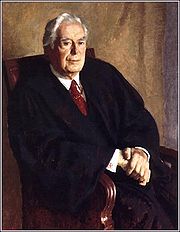
Warren Earl Burger was the 15th Chief Justice of the United States
from 1969 to 1986. Although Burger had conservative leanings, the U.S. Supreme Court delivered a variety of transformative and controversial decisions on abortion
, capital punishment
, religious establishment, and school desegregation
during his tenure.
, one of seven children. His parents were of Swiss German
descent. His grandfather, Joseph Burger, had emigrated from Switzerland
and joined the Union Army
when he was 14. Joseph Burger fought and was wounded in the Civil War
, and was awarded the Medal of Honor
.
Burger grew up on the family farm near the edge of Saint Paul. He attended John A. Johnson High School
, where he was president of the student council. He competed in hockey, football, track, and swimming. While in high school, he wrote articles on high school sports for local newspapers. He graduated in 1925.
That same year, Burger also worked with the crew building the Robert Street Bridge
, a crossing of the Mississippi River
in Saint Paul that still exists. Concerned about the number of deaths on the project, he asked that a net be installed to catch anyone who fell, but was rebuffed by managers. In later years, Burger made a point of visiting the bridge whenever he came back to town.
while selling insurance for Mutual Life Insurance. Afterward, he enrolled at William Mitchell College of Law
(then the St. Paul College of Law), receiving his degree magna cum laude in 1931. He took a job at the firm of Boyensen, Otis and Faricy, now known as Moore, Costello & Hart. In 1937, Burger served as the eighth president of the Saint Paul Jaycees. He also taught for twelve years at William Mitchell.
Governor Harold E. Stassen's unsuccessful pursuit of the Republican
nomination for President in 1948. In 1952, at the Republican convention, he played a key role in Dwight D. Eisenhower
's nomination by delivering the Minnesota delegation. After he was elected, President Eisenhower appointed Burger as the Assistant Attorney General
in charge of the Civil Division
of the Justice Department
.
In this role, he first argued in front of the Supreme Court. The case involved John P. Peters, a Yale University
professor who worked as a consultant to the government. He had been discharged from his position on loyalty grounds. Supreme Court cases are usually argued by the Solicitor General
, but he disagreed with the government's position and refused to argue the case. Burger lost the case. Shortly after, Burger appeared in a case defending the U.S. against claims from the Texas City ship explosion disaster
, successfully arguing that the Federal Tort Claims Act
of 1947 did not allow a suit for negligence in policy making; the U.S. won the case (Dalehite, et al., vs. United States 346 U.S. 15 (1953)). In 1956, Eisenhower appointed him to the U.S. Court of Appeals for the District of Columbia Circuit. He remained on the Court of Appeals for thirteen years.
 In 1968, Chief Justice Earl Warren
announced his retirement after 15 years on the Court, effective on the confirmation of his successor. President Lyndon B. Johnson
nominated sitting Associate Justice Abe Fortas
to the position, but a Senate filibuster
blocked his confirmation. With Johnson's term as President about to expire before another nominee could be considered, Warren remained in office for another Supreme Court term.
In 1969, President Richard M. Nixon nominated Burger to the Chief Justice position. Burger had first caught Nixon's eye when the magazine U.S. News and World Report had reprinted a 1967 speech that Burger had given at Ripon College
, in which he compared the United States judicial system to those of Norway
, Sweden
, and Denmark
:
Through speeches like this, Burger became known as a critic of Chief Justice Warren and an advocate of a literal, strict-constructionist
reading of the U.S. Constitution. Nixon's agreement with these views, being expressed by a readily confirmable, sitting federal appellate judge, led to the appointment. The Senate confirmed Burger to succeed Warren, who in turn swore in the new chief on June 23, 1969. In his presidential campaign, Nixon had pledged to appoint a strict constructionist as Chief Justice.
According to President Nixon's memoirs, he had asked Justice Burger in the spring of 1970 to be prepared to run for President
in 1972 if the political repercussions of the Cambodia invasion were too negative for him to endure. A few years later, in 1971 and 1973, Burger was on Nixon's short list of vice-presidential replacements for Vice President Spiro Agnew
, along with John Connally
, Ronald Reagan
, and Nelson Rockefeller
.
The Court issued a unanimous ruling, Swann v. Charlotte-Mecklenburg Board of Education
(1971) supporting busing
to reduce de facto racial segregation
in schools. In United States v. U.S. District Court
(1972) the Burger Court issued another unanimous ruling against the Nixon
Administration's desire to invalidate the need for a search warrant and the requirements of the Fourth Amendment
in cases of domestic surveillance. Then, only two weeks later in Furman v. Georgia
(1972) the court, in a 5-4 decision, invalidated all death penalty laws
then in force, although Burger dissented from the decision. In the most controversial ruling of his term, Roe v. Wade
(1973), Burger voted with the majority to recognize a broad right to privacy
that prohibited states from banning abortion
s. However, Burger abandoned Roe v. Wade by the time of Thornburgh v. American College of Obstetricians and Gynecologists
.
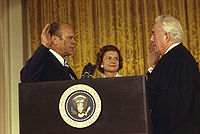
On July 24, 1974, Burger led the court in a unanimous 8-0 decision in United States v. Nixon
. This was President Nixon's attempt to keep several memos and tapes relating to the Watergate Affair private. As documented in Woodward and Armstrong's The Brethren and elsewhere, Burger's original feelings on the case were that Watergate was merely a political battle; he "didn't see what they did wrong." The actual final opinion was largely Justice Brennan's work, though each justice wrote at least a rough draft of a particular section. Burger was originally to vote in favor of Nixon, but tactically changed his vote in order to assign the opinion to himself, and to restrain the opinion's rhetoric. Burger's first draft of the opinion wrote that Executive Privilege could be invoked when it dealt with a "core function" of the Presidency, that in some cases the Executive could be supreme. However, the other justices in the Supreme Court were able to convince Burger to excise that language from the opinion - the judicial branch alone would have the power to determine whether something qualifies to be shielded under executive privilege.
Burger was opposed to gay rights as he wrote a famous concurring opinion in the Court's 1986 decision upholding a Georgia law criminalizing sodomy (Bowers v. Hardwick
), in which Burger purported to marshal historical evidence that laws criminalizing homosexuality were of ancient vintage. Chief Justice Burger pointed out that the famous legal author William Blackstone
wrote that sodomy was a "'crime against nature'... of 'deeper malignity than rape', a heinous act 'the very mention of which is a disgrace to human nature' and 'a crime not fit to be named'" (106 S. Ct. at 2841).
 Burger also emphasized the maintenance of Checks and Balances between the branches of government. In the 1983 case of Immigration and Naturalization Service v. Chadha, he held, for the majority, that Congress could not reserve a legislative veto over executive branch actions.
On issues involving criminal law and procedure, Burger remained reliably conservative. He joined the Court majority in voting to reinstate the death penalty in Gregg v. Georgia
(1976), and, in 1983, he vigorously dissented from the Court's holding in the case of Solem v. Helm
that a sentence of life imprisonment for issuing a fraudulent check in the amount of $100 constituted cruel and unusual punishment
.
http://www.ncsconline.org, which is now located in Williamsburg
, Virginia
, the Institute for Court Management, and National Institute of Corrections to provide professional training for judges, clerks, and prison guards. He initiated the annual State of the Judiciary speech given by the Chief Justice to the American Bar Association
. Some detractors thought his emphasis on the mechanics of the judicial system trivialized the office of Chief Justice.
Burger was the subject of internal controversy on the Supreme Court throughout his tenure. Although, in the words of Senator Everett Dirksen
, Burger "looked, sounded, and acted like a Chief Justice," Woodward and Armstrong's The Brethren
depicted Burger as a weak chief justice who was not seriously respected by his colleagues due to alleged personal eccentricity and lack of legal acumen. Woodward and Armstrong's sources (including Associate Justice Potter Stewart
) indicated that some of the other justices were annoyed by Burger's practice of switching his vote in conference, or simply not announcing his vote, in order that he be able to control opinion assignments. "Burger repeatedly irked his colleagues by changing his vote to remain in the majority, and by rewarding his friends with choice assignments and punishing his foes with dreary ones." Burger would also try to influence the course of events in a case by circulating a preemptive opinion.
Consequently, the Burger Court was described as his "in name only." TIME Magazine would call him "plodding" and "standoffish," as well as "pompous," "aloof," and unpopular. Burger was a constant irritant on the Court's group dynamic, according to The New York Times Linda Greenhouse. Jeffrey Toobin
wrote in his book The Nine that by the time of his departure in 1986, Burger had alienated all of his colleagues to one degree or another. In particular, Potter Stewart
(who had been considered a candidate to follow Warren as Chief Justice) was so discontented with Burger that he became the primary source for Woodward and Armstrong when writing The Brethren.
Greenhouse points to the case of Immigration and Naturalization Service v. Chadha
as evidence of Chief Justice Burger's "foundering leadership". Burger would cause the case to be delayed for over twenty months, despite there having been five votes to affirm the appeals court's finding of unconstitutionality after the case was argued before the Supreme Court: Blackmun, Marshall, Brennan, Powell, and Stevens. Burger did not allow an opinion to be assigned, first by asking for a special conference on the case, and then by delaying the case for reargument when that conference fell through (even though he never held a formal vote on holding the case over for reargument).
, at which time he commissioned the construction of the Constitution Bicentennial Monument (The National Monument to the U.S. Constitution). He had served longer than any other Chief Justice appointed in the 20th century. In 1988, he was awarded the prestigious United States Military Academy's Sylvanus Thayer Award
as well as the Presidential Medal of Freedom
.
Burger died in 1995 of congestive heart failure
at the age of 87 in Washington, D.C.
He drafted his own one-page will. All of his papers were donated to the College of William and Mary
, where he formerly served as Chancellor
; however, they will not be open to the public until 2026. Burger’s casket was displayed in the Great Hall of the U.S. Supreme Court Building. His remains are interred at Arlington National Cemetery
.
As Chief Justice, Burger was instrumental in founding the Supreme Court Historical Society
and was its first president. Burger is often cited as one of the foundational proponents of Alternative Dispute Resolution
(ADR), particularly in its ability to ameliorate an overloaded justice system. In a speech given in front of the American Bar Association
, Justice Burger lamented the state of the justice system in 1984, "Our system is too costly, too painful, too destructive, too inefficient for a truly civilized people. To rely on the adversary process as the principal means of resolving conflicting claims is a mistake that must be corrected." The Warren E. Burger Federal Courthouse in St. Paul, Minnesota and the Warren E. Burger Library at his alma mater William Mitchell College of Law
are named in his honor.
Chief Justice of the United States
The Chief Justice of the United States is the head of the United States federal court system and the chief judge of the Supreme Court of the United States. The Chief Justice is one of nine Supreme Court justices; the other eight are the Associate Justices of the Supreme Court of the United States...
from 1969 to 1986. Although Burger had conservative leanings, the U.S. Supreme Court delivered a variety of transformative and controversial decisions on abortion
Abortion in the United States
Abortion in the United States has been legal in every state since the United States Supreme Court decision in Roe v. Wade, on January 22, 1973...
, capital punishment
Capital punishment in the United States
Capital punishment in the United States, in practice, applies only for aggravated murder and more rarely for felony murder. Capital punishment was a penalty at common law, for many felonies, and was enforced in all of the American colonies prior to the Declaration of Independence...
, religious establishment, and school desegregation
Desegregation
Desegregation is the process of ending the separation of two groups usually referring to races. This is most commonly used in reference to the United States. Desegregation was long a focus of the American Civil Rights Movement, both before and after the United States Supreme Court's decision in...
during his tenure.
Early years
Burger was born in Saint Paul, MinnesotaSaint Paul, Minnesota
Saint Paul is the capital and second-most populous city of the U.S. state of Minnesota. The city lies mostly on the east bank of the Mississippi River in the area surrounding its point of confluence with the Minnesota River, and adjoins Minneapolis, the state's largest city...
, one of seven children. His parents were of Swiss German
Swiss German
Swiss German is any of the Alemannic dialects spoken in Switzerland and in some Alpine communities in Northern Italy. Occasionally, the Alemannic dialects spoken in other countries are grouped together with Swiss German as well, especially the dialects of Liechtenstein and Austrian Vorarlberg...
descent. His grandfather, Joseph Burger, had emigrated from Switzerland
Switzerland
Switzerland name of one of the Swiss cantons. ; ; ; or ), in its full name the Swiss Confederation , is a federal republic consisting of 26 cantons, with Bern as the seat of the federal authorities. The country is situated in Western Europe,Or Central Europe depending on the definition....
and joined the Union Army
Union Army
The Union Army was the land force that fought for the Union during the American Civil War. It was also known as the Federal Army, the U.S. Army, the Northern Army and the National Army...
when he was 14. Joseph Burger fought and was wounded in the Civil War
American Civil War
The American Civil War was a civil war fought in the United States of America. In response to the election of Abraham Lincoln as President of the United States, 11 southern slave states declared their secession from the United States and formed the Confederate States of America ; the other 25...
, and was awarded the Medal of Honor
Medal of Honor
The Medal of Honor is the highest military decoration awarded by the United States government. It is bestowed by the President, in the name of Congress, upon members of the United States Armed Forces who distinguish themselves through "conspicuous gallantry and intrepidity at the risk of his or her...
.
Burger grew up on the family farm near the edge of Saint Paul. He attended John A. Johnson High School
Johnson Senior High School (St. Paul, Minnesota)
Johnson Senior High School is a comprehensive high school for grades 9 to 12 in Saint Paul, Minnesota, USA. Originally named Cleveland High School, the school was renamed after Minnesota governor John A. Johnson in 1911. Johnson is the second oldest high school in the Saint Paul Public Schools...
, where he was president of the student council. He competed in hockey, football, track, and swimming. While in high school, he wrote articles on high school sports for local newspapers. He graduated in 1925.
That same year, Burger also worked with the crew building the Robert Street Bridge
Robert Street Bridge
The Robert Street Bridge is a reinforced concrete multiple-arch bridge that spans the Mississippi River in downtown St. Paul, Minnesota. The bridge is notable for its complex design that was required to accommodate river traffic, the St. Paul Union Pacific Vertical-lift Rail Bridge crossing...
, a crossing of the Mississippi River
Mississippi River
The Mississippi River is the largest river system in North America. Flowing entirely in the United States, this river rises in western Minnesota and meanders slowly southwards for to the Mississippi River Delta at the Gulf of Mexico. With its many tributaries, the Mississippi's watershed drains...
in Saint Paul that still exists. Concerned about the number of deaths on the project, he asked that a net be installed to catch anyone who fell, but was rebuffed by managers. In later years, Burger made a point of visiting the bridge whenever he came back to town.
Education and early career
Burger attended night school at the University of MinnesotaUniversity of Minnesota
The University of Minnesota, Twin Cities is a public research university located in Minneapolis and St. Paul, Minnesota, United States. It is the oldest and largest part of the University of Minnesota system and has the fourth-largest main campus student body in the United States, with 52,557...
while selling insurance for Mutual Life Insurance. Afterward, he enrolled at William Mitchell College of Law
William Mitchell College of Law
William Mitchell College of Law, or WMCL, is a private, independent law school located in St. Paul, Minnesota. Accredited by the American Bar Association , it offers full and part-time legal education in pursuit of the Juris Doctor degree....
(then the St. Paul College of Law), receiving his degree magna cum laude in 1931. He took a job at the firm of Boyensen, Otis and Faricy, now known as Moore, Costello & Hart. In 1937, Burger served as the eighth president of the Saint Paul Jaycees. He also taught for twelve years at William Mitchell.
Politics
His political career began uneventfully, but he soon rose to national prominence. He supported MinnesotaMinnesota
Minnesota is a U.S. state located in the Midwestern United States. The twelfth largest state of the U.S., it is the twenty-first most populous, with 5.3 million residents. Minnesota was carved out of the eastern half of the Minnesota Territory and admitted to the Union as the thirty-second state...
Governor Harold E. Stassen's unsuccessful pursuit of the Republican
Republican Party (United States)
The Republican Party is one of the two major contemporary political parties in the United States, along with the Democratic Party. Founded by anti-slavery expansion activists in 1854, it is often called the GOP . The party's platform generally reflects American conservatism in the U.S...
nomination for President in 1948. In 1952, at the Republican convention, he played a key role in Dwight D. Eisenhower
Dwight D. Eisenhower
Dwight David "Ike" Eisenhower was the 34th President of the United States, from 1953 until 1961. He was a five-star general in the United States Army...
's nomination by delivering the Minnesota delegation. After he was elected, President Eisenhower appointed Burger as the Assistant Attorney General
United States Assistant Attorney General
Many of the divisions and offices of the United States Department of Justice are headed by an Assistant Attorney General.The President of the United States appoints individuals to the position of Assistant Attorney General with the advice and consent of the Senate...
in charge of the Civil Division
United States Department of Justice Civil Division
The United States Department of Justice Civil Division represents the United States, its departments and agencies, Members of Congress, Cabinet officers and other Federal employees...
of the Justice Department
United States Department of Justice
The United States Department of Justice , is the United States federal executive department responsible for the enforcement of the law and administration of justice, equivalent to the justice or interior ministries of other countries.The Department is led by the Attorney General, who is nominated...
.
In this role, he first argued in front of the Supreme Court. The case involved John P. Peters, a Yale University
Yale University
Yale University is a private, Ivy League university located in New Haven, Connecticut, United States. Founded in 1701 in the Colony of Connecticut, the university is the third-oldest institution of higher education in the United States...
professor who worked as a consultant to the government. He had been discharged from his position on loyalty grounds. Supreme Court cases are usually argued by the Solicitor General
United States Solicitor General
The United States Solicitor General is the person appointed to represent the federal government of the United States before the Supreme Court of the United States. The current Solicitor General, Donald B. Verrilli, Jr. was confirmed by the United States Senate on June 6, 2011 and sworn in on June...
, but he disagreed with the government's position and refused to argue the case. Burger lost the case. Shortly after, Burger appeared in a case defending the U.S. against claims from the Texas City ship explosion disaster
Texas City Disaster
The Texas City Disaster was the deadliest industrial accident in U.S. history. The incident took place on April 16, 1947, and began with a mid-morning fire on board the French-registered vessel SS Grandcamp which was docked in the Port of Texas City...
, successfully arguing that the Federal Tort Claims Act
Federal Tort Claims Act
The Federal Tort Claims Act or "FTCA", , is a statute enacted by the United States Congress in 1948. "Federal Tort Claims Act" was also previously the official short title passed by the Seventy-ninth Congress on August 2, 1946 as Title IV of the Legislative Reorganization Act, 60 Stat...
of 1947 did not allow a suit for negligence in policy making; the U.S. won the case (Dalehite, et al., vs. United States 346 U.S. 15 (1953)). In 1956, Eisenhower appointed him to the U.S. Court of Appeals for the District of Columbia Circuit. He remained on the Court of Appeals for thirteen years.
National prominence
Earl Warren
Earl Warren was the 14th Chief Justice of the United States.He is known for the sweeping decisions of the Warren Court, which ended school segregation and transformed many areas of American law, especially regarding the rights of the accused, ending public-school-sponsored prayer, and requiring...
announced his retirement after 15 years on the Court, effective on the confirmation of his successor. President Lyndon B. Johnson
Lyndon B. Johnson
Lyndon Baines Johnson , often referred to as LBJ, was the 36th President of the United States after his service as the 37th Vice President of the United States...
nominated sitting Associate Justice Abe Fortas
Abe Fortas
Abraham Fortas was a U.S. Supreme Court associate justice from 1965 to 1969. Originally from Tennessee, Fortas became a law professor at Yale, and subsequently advised the Securities and Exchange Commission. He then worked at the Interior Department under Franklin D...
to the position, but a Senate filibuster
Filibuster
A filibuster is a type of parliamentary procedure. Specifically, it is the right of an individual to extend debate, allowing a lone member to delay or entirely prevent a vote on a given proposal...
blocked his confirmation. With Johnson's term as President about to expire before another nominee could be considered, Warren remained in office for another Supreme Court term.
In 1969, President Richard M. Nixon nominated Burger to the Chief Justice position. Burger had first caught Nixon's eye when the magazine U.S. News and World Report had reprinted a 1967 speech that Burger had given at Ripon College
Ripon College (Wisconsin)
Ripon College is a liberal arts college in Ripon, Wisconsin, USA. It offers small class sizes and intensive mentoring to students. Ripon has a chapter of Phi Beta Kappa--one of the nation's most prestigious honor societies. Alumni have high rates of success in the workforce as well as acceptance...
, in which he compared the United States judicial system to those of Norway
Norway
Norway , officially the Kingdom of Norway, is a Nordic unitary constitutional monarchy whose territory comprises the western portion of the Scandinavian Peninsula, Jan Mayen, and the Arctic archipelago of Svalbard and Bouvet Island. Norway has a total area of and a population of about 4.9 million...
, Sweden
Sweden
Sweden , officially the Kingdom of Sweden , is a Nordic country on the Scandinavian Peninsula in Northern Europe. Sweden borders with Norway and Finland and is connected to Denmark by a bridge-tunnel across the Öresund....
, and Denmark
Denmark
Denmark is a Scandinavian country in Northern Europe. The countries of Denmark and Greenland, as well as the Faroe Islands, constitute the Kingdom of Denmark . It is the southernmost of the Nordic countries, southwest of Sweden and south of Norway, and bordered to the south by Germany. Denmark...
:
Through speeches like this, Burger became known as a critic of Chief Justice Warren and an advocate of a literal, strict-constructionist
Strict constructionism
In the United States, Strict constructionism refers to a particular legal philosophy of judicial interpretation that limits or restricts judicial interpretation. The phrase is also commonly used more loosely as a generic term for conservatism among the judiciary.- Strict sense of the term :Strict...
reading of the U.S. Constitution. Nixon's agreement with these views, being expressed by a readily confirmable, sitting federal appellate judge, led to the appointment. The Senate confirmed Burger to succeed Warren, who in turn swore in the new chief on June 23, 1969. In his presidential campaign, Nixon had pledged to appoint a strict constructionist as Chief Justice.
According to President Nixon's memoirs, he had asked Justice Burger in the spring of 1970 to be prepared to run for President
President
A president is a leader of an organization, company, trade union, university, or country.Etymologically, a president is one who presides, who sits in leadership...
in 1972 if the political repercussions of the Cambodia invasion were too negative for him to endure. A few years later, in 1971 and 1973, Burger was on Nixon's short list of vice-presidential replacements for Vice President Spiro Agnew
Spiro Agnew
Spiro Theodore Agnew was the 39th Vice President of the United States , serving under President Richard Nixon, and the 55th Governor of Maryland...
, along with John Connally
John Connally
John Bowden Connally, Jr. , was an influential American politician, serving as the 39th governor of Texas, Secretary of the Navy under President John F. Kennedy, and as Secretary of the Treasury under President Richard M. Nixon. While he was Governor in 1963, Connally was a passenger in the car in...
, Ronald Reagan
Ronald Reagan
Ronald Wilson Reagan was the 40th President of the United States , the 33rd Governor of California and, prior to that, a radio, film and television actor....
, and Nelson Rockefeller
Nelson Rockefeller
Nelson Aldrich Rockefeller was the 41st Vice President of the United States , serving under President Gerald Ford, and the 49th Governor of New York , as well as serving the Roosevelt, Truman and Eisenhower administrations in a variety of positions...
.
Jurisprudence
When Burger was nominated for the Chief Justiceship, conservatives in the Nixon Administration expected that the Burger Court would rule markedly differently from the Warren Court and might, in fact, overturn controversial Warren Court era precedents. By the early 1970s, however, it became apparent that the Burger Court was not going to reverse the rulings of the Warren Court and in fact might extend some Warren Court doctrines.The Court issued a unanimous ruling, Swann v. Charlotte-Mecklenburg Board of Education
Swann v. Charlotte-Mecklenburg Board of Education
Swann v. Charlotte-Mecklenburg Board of Education, 402 U.S. 1 was an important United States Supreme Court case dealing with the busing of students to promote integration in public schools...
(1971) supporting busing
Desegregation busing
Desegregation busing in the United States is the practice of assigning and transporting students to schools in such a manner as to redress prior racial segregation of schools, or to overcome the effects of residential segregation on local school demographics.In 1954, the U.S...
to reduce de facto racial segregation
Racial segregation
Racial segregation is the separation of humans into racial groups in daily life. It may apply to activities such as eating in a restaurant, drinking from a water fountain, using a public toilet, attending school, going to the movies, or in the rental or purchase of a home...
in schools. In United States v. U.S. District Court
United States v. U.S. District Court
United States v. U.S. District Court, 407 U.S. 297 , also known as the Keith case, was a landmark United States Supreme Court decision that upheld, in a unanimous 8-0 ruling, the requirements of the Fourth Amendment in cases of domestic surveillance targeting a domestic threat.-The case:The United...
(1972) the Burger Court issued another unanimous ruling against the Nixon
Richard Nixon
Richard Milhous Nixon was the 37th President of the United States, serving from 1969 to 1974. The only president to resign the office, Nixon had previously served as a US representative and senator from California and as the 36th Vice President of the United States from 1953 to 1961 under...
Administration's desire to invalidate the need for a search warrant and the requirements of the Fourth Amendment
Fourth Amendment to the United States Constitution
The Fourth Amendment to the United States Constitution is the part of the Bill of Rights which guards against unreasonable searches and seizures, along with requiring any warrant to be judicially sanctioned and supported by probable cause...
in cases of domestic surveillance. Then, only two weeks later in Furman v. Georgia
Furman v. Georgia
Furman v. Georgia, was a United States Supreme Court decision that ruled on the requirement for a degree of consistency in the application of the death penalty. The case led to a de facto moratorium on capital punishment throughout the United States, which came to an end when Gregg v. Georgia was...
(1972) the court, in a 5-4 decision, invalidated all death penalty laws
Capital punishment in the United States
Capital punishment in the United States, in practice, applies only for aggravated murder and more rarely for felony murder. Capital punishment was a penalty at common law, for many felonies, and was enforced in all of the American colonies prior to the Declaration of Independence...
then in force, although Burger dissented from the decision. In the most controversial ruling of his term, Roe v. Wade
Roe v. Wade
Roe v. Wade, , was a controversial landmark decision by the United States Supreme Court on the issue of abortion. The Court decided that a right to privacy under the due process clause in the Fourteenth Amendment to the United States Constitution extends to a woman's decision to have an abortion,...
(1973), Burger voted with the majority to recognize a broad right to privacy
Privacy
Privacy is the ability of an individual or group to seclude themselves or information about themselves and thereby reveal themselves selectively...
that prohibited states from banning abortion
Abortion
Abortion is defined as the termination of pregnancy by the removal or expulsion from the uterus of a fetus or embryo prior to viability. An abortion can occur spontaneously, in which case it is usually called a miscarriage, or it can be purposely induced...
s. However, Burger abandoned Roe v. Wade by the time of Thornburgh v. American College of Obstetricians and Gynecologists
Thornburgh v. American College of Obstetricians and Gynecologists
Thornburgh v. American College of Obstetricians and Gynecologists, was a United States Supreme Court case involving a challenge to Pennsylvania's Abortion Control Act of 1982....
.
On July 24, 1974, Burger led the court in a unanimous 8-0 decision in United States v. Nixon
United States v. Nixon
United States v. Nixon, , was a landmark United States Supreme Court decision. It was a unanimous 8-0 ruling involving President Richard Nixon and was important to the late stages of the Watergate scandal. It is considered a crucial precedent limiting the power of any U.S. president.Chief Justice...
. This was President Nixon's attempt to keep several memos and tapes relating to the Watergate Affair private. As documented in Woodward and Armstrong's The Brethren and elsewhere, Burger's original feelings on the case were that Watergate was merely a political battle; he "didn't see what they did wrong." The actual final opinion was largely Justice Brennan's work, though each justice wrote at least a rough draft of a particular section. Burger was originally to vote in favor of Nixon, but tactically changed his vote in order to assign the opinion to himself, and to restrain the opinion's rhetoric. Burger's first draft of the opinion wrote that Executive Privilege could be invoked when it dealt with a "core function" of the Presidency, that in some cases the Executive could be supreme. However, the other justices in the Supreme Court were able to convince Burger to excise that language from the opinion - the judicial branch alone would have the power to determine whether something qualifies to be shielded under executive privilege.
Burger was opposed to gay rights as he wrote a famous concurring opinion in the Court's 1986 decision upholding a Georgia law criminalizing sodomy (Bowers v. Hardwick
Bowers v. Hardwick
Bowers v. Hardwick, , is a United States Supreme Court decision that upheld, in a 5-4 ruling, the constitutionality of a Georgia sodomy law criminalizing oral and anal sex in private between consenting adults when applied to homosexuals. Seventeen years after Bowers v. Hardwick, the Supreme Court...
), in which Burger purported to marshal historical evidence that laws criminalizing homosexuality were of ancient vintage. Chief Justice Burger pointed out that the famous legal author William Blackstone
William Blackstone
Sir William Blackstone KC SL was an English jurist, judge and Tory politician of the eighteenth century. He is most noted for writing the Commentaries on the Laws of England. Born into a middle class family in London, Blackstone was educated at Charterhouse School before matriculating at Pembroke...
wrote that sodomy was a "'crime against nature'... of 'deeper malignity than rape', a heinous act 'the very mention of which is a disgrace to human nature' and 'a crime not fit to be named'" (106 S. Ct. at 2841).
On issues involving criminal law and procedure, Burger remained reliably conservative. He joined the Court majority in voting to reinstate the death penalty in Gregg v. Georgia
Gregg v. Georgia
Gregg v. Georgia, Proffitt v. Florida, Jurek v. Texas, Woodson v. North Carolina, and Roberts v. Louisiana, 428 U.S. 153 , reaffirmed the United States Supreme Court's acceptance of the use of the death penalty in the United States, upholding, in particular, the death sentence imposed on Troy Leon...
(1976), and, in 1983, he vigorously dissented from the Court's holding in the case of Solem v. Helm
Solem v. Helm
Solem v. Helm, , was a United States Supreme Court case concerned with the scope of the Eighth Amendment protection from cruel and unusual punishment. Mr. Helm, who had written a check from a fictitious account and had reached his seventh nonviolent felony conviction since 1964, received a...
that a sentence of life imprisonment for issuing a fraudulent check in the amount of $100 constituted cruel and unusual punishment
Cruel and unusual punishment
Cruel and unusual punishment is a phrase describing criminal punishment which is considered unacceptable due to the suffering or humiliation it inflicts on the condemned person...
.
Leadership
Rather than dominating the court, Burger poured his energy into the other role of the Chief Justice, administering the nation's legal system. He initiated the National Center for State CourtsNational Center for State Courts
The National Center for State Courts is a non-profit organization charged with improving judicial administration in the United States and around the world...
http://www.ncsconline.org, which is now located in Williamsburg
Williamsburg, Virginia
Williamsburg is an independent city located on the Virginia Peninsula in the Hampton Roads metropolitan area of Virginia, USA. As of the 2010 Census, the city had an estimated population of 14,068. It is bordered by James City County and York County, and is an independent city...
, Virginia
Virginia
The Commonwealth of Virginia , is a U.S. state on the Atlantic Coast of the Southern United States. Virginia is nicknamed the "Old Dominion" and sometimes the "Mother of Presidents" after the eight U.S. presidents born there...
, the Institute for Court Management, and National Institute of Corrections to provide professional training for judges, clerks, and prison guards. He initiated the annual State of the Judiciary speech given by the Chief Justice to the American Bar Association
American Bar Association
The American Bar Association , founded August 21, 1878, is a voluntary bar association of lawyers and law students, which is not specific to any jurisdiction in the United States. The ABA's most important stated activities are the setting of academic standards for law schools, and the formulation...
. Some detractors thought his emphasis on the mechanics of the judicial system trivialized the office of Chief Justice.
Burger was the subject of internal controversy on the Supreme Court throughout his tenure. Although, in the words of Senator Everett Dirksen
Everett Dirksen
Everett McKinley Dirksen was an American politician of the Republican Party. He represented Illinois in the U.S. House of Representatives and U.S. Senate...
, Burger "looked, sounded, and acted like a Chief Justice," Woodward and Armstrong's The Brethren
The Brethren (Bob Woodward book)
The Brethren is a 1979 book by Bob Woodward and Scott Armstrong. It gives a "behind-the-scenes" account of the United States Supreme Court during Warren Burger's early years as Chief Justice of the United States....
depicted Burger as a weak chief justice who was not seriously respected by his colleagues due to alleged personal eccentricity and lack of legal acumen. Woodward and Armstrong's sources (including Associate Justice Potter Stewart
Potter Stewart
Potter Stewart was an Associate Justice of the United States Supreme Court. During his tenure, he made, among other areas, major contributions to criminal justice reform, civil rights, access to the courts, and Fourth Amendment jurisprudence.-Education:Stewart was born in Jackson, Michigan,...
) indicated that some of the other justices were annoyed by Burger's practice of switching his vote in conference, or simply not announcing his vote, in order that he be able to control opinion assignments. "Burger repeatedly irked his colleagues by changing his vote to remain in the majority, and by rewarding his friends with choice assignments and punishing his foes with dreary ones." Burger would also try to influence the course of events in a case by circulating a preemptive opinion.
Consequently, the Burger Court was described as his "in name only." TIME Magazine would call him "plodding" and "standoffish," as well as "pompous," "aloof," and unpopular. Burger was a constant irritant on the Court's group dynamic, according to The New York Times Linda Greenhouse. Jeffrey Toobin
Jeffrey Toobin
Jeffrey Ross Toobin is an American lawyer, author, and legal analyst for CNN and The New Yorker.-Early life and education:...
wrote in his book The Nine that by the time of his departure in 1986, Burger had alienated all of his colleagues to one degree or another. In particular, Potter Stewart
Potter Stewart
Potter Stewart was an Associate Justice of the United States Supreme Court. During his tenure, he made, among other areas, major contributions to criminal justice reform, civil rights, access to the courts, and Fourth Amendment jurisprudence.-Education:Stewart was born in Jackson, Michigan,...
(who had been considered a candidate to follow Warren as Chief Justice) was so discontented with Burger that he became the primary source for Woodward and Armstrong when writing The Brethren.
Greenhouse points to the case of Immigration and Naturalization Service v. Chadha
Immigration and Naturalization Service v. Chadha
Immigration and Naturalization Service v. Chadha, 462 U.S. 919 , was a United States Supreme Court case ruling in 1983 that the one-house legislative veto violated the constitutional separation of powers.-Parties:...
as evidence of Chief Justice Burger's "foundering leadership". Burger would cause the case to be delayed for over twenty months, despite there having been five votes to affirm the appeals court's finding of unconstitutionality after the case was argued before the Supreme Court: Blackmun, Marshall, Brennan, Powell, and Stevens. Burger did not allow an opinion to be assigned, first by asking for a special conference on the case, and then by delaying the case for reargument when that conference fell through (even though he never held a formal vote on holding the case over for reargument).
Retirement, death and legacy
Burger retired on September 26, 1986, in part to lead the campaign to mark the 1987 bicentennial of the United States ConstitutionUnited States Constitution
The Constitution of the United States is the supreme law of the United States of America. It is the framework for the organization of the United States government and for the relationship of the federal government with the states, citizens, and all people within the United States.The first three...
, at which time he commissioned the construction of the Constitution Bicentennial Monument (The National Monument to the U.S. Constitution). He had served longer than any other Chief Justice appointed in the 20th century. In 1988, he was awarded the prestigious United States Military Academy's Sylvanus Thayer Award
Sylvanus Thayer Award
The Sylvanus Thayer Award is an award that is given each year by the United States Military Academy at West Point. Sylvanus Thayer was the fifth superintendent of that academy and in honor of his achievements, the award was created...
as well as the Presidential Medal of Freedom
Presidential Medal of Freedom
The Presidential Medal of Freedom is an award bestowed by the President of the United States and is—along with thecomparable Congressional Gold Medal bestowed by an act of U.S. Congress—the highest civilian award in the United States...
.
Burger died in 1995 of congestive heart failure
Congestive heart failure
Heart failure often called congestive heart failure is generally defined as the inability of the heart to supply sufficient blood flow to meet the needs of the body. Heart failure can cause a number of symptoms including shortness of breath, leg swelling, and exercise intolerance. The condition...
at the age of 87 in Washington, D.C.
Washington, D.C.
Washington, D.C., formally the District of Columbia and commonly referred to as Washington, "the District", or simply D.C., is the capital of the United States. On July 16, 1790, the United States Congress approved the creation of a permanent national capital as permitted by the U.S. Constitution....
He drafted his own one-page will. All of his papers were donated to the College of William and Mary
College of William and Mary
The College of William & Mary in Virginia is a public research university located in Williamsburg, Virginia, United States...
, where he formerly served as Chancellor
Chancellor (education)
A chancellor or vice-chancellor is the chief executive of a university. Other titles are sometimes used, such as president or rector....
; however, they will not be open to the public until 2026. Burger’s casket was displayed in the Great Hall of the U.S. Supreme Court Building. His remains are interred at Arlington National Cemetery
Arlington National Cemetery
Arlington National Cemetery in Arlington County, Virginia, is a military cemetery in the United States of America, established during the American Civil War on the grounds of Arlington House, formerly the estate of the family of Confederate general Robert E. Lee's wife Mary Anna Lee, a great...
.
As Chief Justice, Burger was instrumental in founding the Supreme Court Historical Society
Supreme Court Historical Society
The Supreme Court Historical Society is a private, non-profit organization dedicated to preserving and communicating the history of the U.S. Supreme Court.-History:...
and was its first president. Burger is often cited as one of the foundational proponents of Alternative Dispute Resolution
Alternative dispute resolution
Alternative Dispute Resolution includes dispute resolution processes and techniques that act as a means for disagreeing parties to come to an agreement short of litigation. ADR basically is an alternative to a formal court hearing or litigation...
(ADR), particularly in its ability to ameliorate an overloaded justice system. In a speech given in front of the American Bar Association
American Bar Association
The American Bar Association , founded August 21, 1878, is a voluntary bar association of lawyers and law students, which is not specific to any jurisdiction in the United States. The ABA's most important stated activities are the setting of academic standards for law schools, and the formulation...
, Justice Burger lamented the state of the justice system in 1984, "Our system is too costly, too painful, too destructive, too inefficient for a truly civilized people. To rely on the adversary process as the principal means of resolving conflicting claims is a mistake that must be corrected." The Warren E. Burger Federal Courthouse in St. Paul, Minnesota and the Warren E. Burger Library at his alma mater William Mitchell College of Law
William Mitchell College of Law
William Mitchell College of Law, or WMCL, is a private, independent law school located in St. Paul, Minnesota. Accredited by the American Bar Association , it offers full and part-time legal education in pursuit of the Juris Doctor degree....
are named in his honor.
Personal life
Burger married Elvera Stromberg in 1933. They had two children, Wade Allen Burger and Margaret Elizabeth Burger. Elvera Burger died on May 30, 1994 at the age of 86.See also
- Demographics of the Supreme Court of the United StatesDemographics of the Supreme Court of the United StatesThe demographics of the Supreme Court of the United States encompass the gender, ethnic, religious, geographic, and economic backgrounds of the 112 justices appointed to the Supreme Court. Certain of these characteristics have been raised as an issue since the Court was established in 1789. For its...
- List of Justices of the Supreme Court of the United States
- List of Justices of the Supreme Court of the United States by court composition
- List of Justices of the Supreme Court of the United States by education
- List of law clerks of the Supreme Court of the United States
- List of United States Chief Justices by time in office
- List of U.S. Supreme Court Justices by time in office
- United States Supreme Court cases during the Burger Court
External links
- Ariens, Michael, Warren E. Burger.
- Warren E. Burger memorial at Find a GraveFind A GraveFind a Grave is a commercial website providing free access and input to an online database of cemetery records. It was founded in 1998 as a DBA and incorporated in 2000.-History:...
. - OyezOyez.orgThe Oyez Project at the Chicago-Kent College of Law is an unofficial online multimedia archive of the Supreme Court of the United States, especially audio of oral arguments...
, Supreme Court Media, Warren E. Burger. - Warren E. Burger at Supreme Court Historical SocietySupreme Court Historical SocietyThe Supreme Court Historical Society is a private, non-profit organization dedicated to preserving and communicating the history of the U.S. Supreme Court.-History:...
- Supreme Court History, the Burger Court at Supreme Court Historical Society.