


Castile-La Mancha

Encyclopedia
Castile-La Mancha is an autonomous community of Spain
. Castile-La Mancha is bordered by Castile and León
, Madrid, Aragon
, Valencia, Murcia
, Andalusia
, and Extremadura
. It is one of the most sparsely populated of Spain's autonomous communities. Its capital city is Toledo
, and its most populous city is Albacete
.
Castile-La Mancha was formerly grouped with the province
of Madrid into New Castile (Castilla la Nueva), but with the advent of the modern Spanish system of autonomous regions (Estado de las autonomías), it was separated due to great demographic disparity between the capital and the remaining New-Castilian provinces. Also, compared to the former New Castile, Castile-La Mancha add the province of Albacete
, which had been part of Murcia
; adding Albacete placed all of La Mancha
within this single region.
It is mostly in this region where the story of the famous Spanish novel Don Quixote by Miguel de Cervantes
is situated - due to which La Mancha is internationally well-known. Although La Mancha is a windswept, battered plateau, it remains a symbol of the Spanish culture with its vineyards, sunflowers, mushrooms, oliveyards, windmills, Manchego cheese
, and Don Quixote.
and Aragon
were unified in 1492 under Queen Isabel and King Ferdinand
.
Castile-La Mancha is the successor to New Castile
(Castilla la Nueva), which in turn traces back to the Muslim
Taifa of Toledo
, one of the taifa
s of Al Andalus. Alfonso VI conquered the region from the Muslims, taking Toledo
in 1085. The Reconquista
("Reconquest") took Cuenca
in 1177. Other provinces to the south—the Campo de Calatrava, the Valle de Alcudia, and the Alfoz de Alcaraz (Campo de Montiel
and Sierra de Alcaraz
)—were consolidated during the reign of Alfonso VIII
(reigned 1158–1214), whose conquests were completed by the Battle of Las Navas de Tolosa
(1212). That victory assured Castilian domination of the region and hastened the decline of the Almohad Dynasty. From the time of the Reconquista, Castilla-La Mancha formed part of the Kingdom of Castile
. Four centuries later, in 1605, Cervantes' Don Quixote gave the world an indelible picture of La Mancha
.
In 1785, the territorial organization by the reformer Floridablanca
divided the region into the provinces of Cuenca, Guadalajara, Madrid, La Mancha, and Toledo, while Albacete, Chinchilla
, Almansa
, Hellín
and Yeste
became part of Murcia. In 1833 Javier de Burgos
modified the provincial borders
; most of the province of La Mancha was transferred to the province of Ciudad Real, with smaller parts incorporated into the provinces of Cuenca, Toledo and the newly created province of Albacete. Albacete, in turn, also incorporated parts of the territories of the old provinces of Cuenca and Murcia. Albacete was administered as part of the Region of Murcia until the 1978 configuration of autonomous regions. Nonetheless, during the First Spanish Republic
, Albacete was one of the signatories to the Pacto Federal Castellano (1869) and in 1924 its deputation favored the formation of a "Comunidad Manchega" that would have recognized La Mancha (including Albacete) as a region.
The Autonomous Community of Castile-La Mancha dates from November 15, 1978, as one of the many autonomous regions defined by the Spanish central government. (More precisely, each of these regions was initially a preautonomía, a "pre-autonomous" region, until establishing its Statute of Autonomy
). The new, hyphenated name constituted an effort to bridge two distinct regionalisms: that of the larger Castile (extending beyond this autonomous region) and that of the smaller onetime province of La Mancha
. The Statute of Autonomy of Castile-La Mancha was approved August 10, 1982 and took effect August 17, 1982.
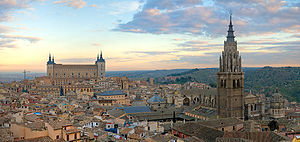 Castile-La Mancha is divided into 5 provinces named after their capital cities. The following category includes:
According to the official data of the INE
, Castile-La Mancha consists of 919 municipalities, which amount to 11.3 percent of all the municipalities in Spain. 496 of these have less than 500 inhabitants, 231 have between 501 and 2,000 inhabitants, 157 between 2,000 and 10,000 inhabitants, and only 35 have more than 10,000 inhabitants. The municipalities in the north are small and numerous, while in the south they are larger and fewer. This reflects different histories of how these sub-regions were repopulated during the Reconquista.
The 25 most populous municipalities of Castile-La Mancha according to the INE (2008) are:
s of political/juridical significance, this has never been followed through at the level of the entire region, and there are no comarcas in Castile-La Mancha with political or juridical functions. Individual provinces of Castile-La Mancha have performed comarcalizations for administrative, economic and touristic purposes. Many Castilian-Manchegan comarcas important traditional significance, with some figuring in history well beyond their respective provinces.
Ramón José Maldonado. This was made official in Article 5 of the Statute of Autonomy:
The coat of arms
of Castile-La Mancha is based on the flag of the region, and not vice versa, as is more typical in heraldry. Article 1 of the law 1/1983 describes it as follows:
Some institutions of the region have adopted this coat of arms as part of their own emblem, among these the Cortes of Castile-La Mancha, the Consultative Council and the University of Castile-La Mancha.
La rosa del azafrán by Jacinto Guerrero
, the "Canto a la Mancha" ("Song of La Mancha") by Tomás Barrera, and many others, such as one presented by a group of citizens from Villarrobledo
with the title "Patria sin fin" ("Fatherland without end").
through 49 deputies elected by universal adult suffrage through the secret ballot
. They are elected for a term of four years under a proportional
system intended to guarantee representation to the various territorial zones of Castile-La Mancha. The electoral constituency is at the level of each province
, with provinces being assigned the following number of deputies as of 2009: Albacete, 10; Ciudad Real, 11; Cuenca, 8; Guadalajara, 8; and Toledo, 12. Article 10 of the Statute of Autonomy states that elections will be convoked by the President of the Junta of Communities, following the General Electoral Regime (Régimen Electoral General), on the fourth Sunday in May every four years. This stands in contrast to the autonomous communities of the Basque Country
, Catalonia
, Galicia, Andalusia
and the Valencian Community
where the president has the power to convoke elections at any time. (In the Valencian Community that power has never been exercised. Elections there have, in practice, taken place on a four-year cycle.)
Since the Spanish regional elections of 2007
, the Cortes of Castile-La Mancha has consisted of 28 deputies from the socialist PSOE
and 21 from the conservative People's Party
. The Cortes sits in the former Franciscan
convent in Toledo, the Edificio de San Gil ("San Gil building").
, the Statute of Autonomy, and the laws of the nation and region. The Council of Government consists of the president, vice presidents (if any) and the Councilors.
, occupying the greater part of the Submeseta Sur, the vast plain composing the southern part of the Meseta Central. The Submeseta Sur (and the autonomous community) is separated from the Submeseta Norte (and the community of Castile and León
) by the mountain range known as the Sistema Central
. Despite this, the region has no shortage of mountain landscapes: the southern slopes of the aforementioned Sistema Central in the north, the Sistema Ibérico
in the northeast, and the Sierra Morena
and Montes de Toledo
in the south.
Castile-La Mancha is the third largest of Spain's autonomous regions, with a surface area of 79463 square kilometres (30,680.8 sq mi), representing 15.7 percent of Spain's national territory.
, with peaks such as La Villuerca (1601 metres (5,252.6 ft)), the highest peak of the Montes de Toledo range, and Rocigalgo (1447 metres (4,747.4 ft)).
At the south of that system are the Montes de Toledo, which cross the region from west to east, dividing the Tagus
(Tajo) and Guadiana
drainage basin
s, forming the southern slope of the basin of the former and the northern slope of the latter.
In contrast, a more mountainous zone surrounds the Meseta and serves as the region's natural border. In the north of the Province of Guadalajara, bordering Madrid and Segovia
, is a mountain range forming part of the Sistema Central
, among which can be distinguished the mountain ranges Pela, Ayllón, Somosierra, Barahona and Ministra, with the headwaters of the rivers Jarama
, Cañamares and Henares
. The Sistema Central also penetrates the Province of Toledo, which intersects a southerly part of the Sierra de Gredos
, known as the Sierra de San Vicente, delimited on the north by the river Tiétar
and on the south by the Alberche
and the Tagus.
On the northwest is the Sistema Ibérico
, where there is important fluvial and especially karst
ic activity, which has given rise to such landscapes as the Ciudad Encantada
, the Callejones de Las Majadas and the Hoces del Cabriel.
In the southeast is the ridge of the Sierra Morena, the southern border of the Meseta Central and the region's border with Andalusia
. Within the Sierra Morena, distinction can be made between the Sierra Madrona
, Sierra de Alcudia and Sierra de San Andrés. At the other southern extreme of Castile-La Mancha, the Sierra de Alcaraz
and Sierra del Segura form part of the Sistema Bético.
drain into the Atlantic Ocean and the Júcar
and Segura
into the Mediterranean. The Tagus provides water for some 587,000 inhabitants in a watershed of 26699 square kilometres (10,308.5 sq mi). It includes the entire province of Guadalajara and the greater part of the province of Toledo, including the two largest cities of the latter province: the capital, Toledo, and the slightly larger city of Talavera de la Reina.
The Guadiana watershed extends 26646 square kilometres (10,288.1 sq mi) in Castilla-La Mancha, 37 percent of that river's entire watershed, with a population of 583,259 inhabitants. It includes the southern part of the province of Toledo, nearly all of the province of Ciudad Real (except the very south), the southwest of the province of Cuenca and the northwest of the province of Albacete. The Guadalquivir watershed extends over 5.17 percent of the surface area of the autonomous community, extending 4100 square kilometres (1,583 sq mi) through the southern parts of the provinces of Ciudad Real and Albacete, including such important population center as Puertollano
.
The Júcar watershed had, in 2006, 397,000 inhabitants in an area of 15737 square kilometres (6,076.1 sq mi), 19.86 percent of the Castillian-Manchegan territory and 36.61 percent of total of the Júcar watershed. It includes the eastern parts of the provinces of Cuenca and Albacete, including their respective capitals. Finally, the 34 municipalities of southeastern Albacete fall in the Segura watershed, with an extent of 4713 square kilometres (1,819.7 sq mi).
with a marked character of a continental climate
. The continentalized Mediterranean climate is similar to a typical Mediterranean climate, but with more extreme temperatures typical of a continental climate. Lack of a marine influence leads to much more extreme temperatures: hotter summers and quite cold winters, with a daily oscillation of 18.5 °C (33.3 °F). Summer is the driest season, with temperatures often exceeding 30 °C (86 °F), sometimes reaching and exceeding 35 °C (95 °F). In winter, temperatures often drop below 0 °C (32 °F), producing frosts on cloudy nights, and occasional snow.
Castile-La Mancha is part of what has traditionally been called España Seca ("Dry Spain"). There is relatively little precipitation
, much as in a typical Mediterranean climate. Precipitation presents a notable gradient from the center of the region, where it does not surpass 400 millimetres (15.7 in) per year, to the mountains where it can exceed 1000 millimetres (39.4 in) per year, on the slopes of the Sierra de Gredos and the Serranía de Cuenca. The greater part of the region has less than 600 millimetres (23.6 in) of rain annually. The driest part of the region is along the Albacete-Hellín
axis, with less than 300 millimetres (11.8 in) per year.
Castile-La Mancha has 2,043,100 inhabitants in its five provinces. Despite being the third largest of Spains communities by surface area (after Castile and León and Andalusia, it is only the ninth most populous. Castile-La Mancha has 4.42 percent of Spain's population.
of 25.71 /sqkm, Castile-La Mancha has the least dense population in all of Spain: the national average is 88.6 /sqkm. Industrialized zones such as the Henares Corridor (along the river Henares
, a tributary of the Jarama) with a density of 126 /sqkm, the comarca
of la Sagra or the industrial zone of Sonseca
are dramatically more dense than the region as a whole.
of Castile-La Mancha is typical for a developed region, with the central zone wider than the base or the upper zone. The population between 16 and 44 years of age represents about 44 percent, from 45 to 64 about 21.3 percent, with those 15 and under constituting 15 percent and those over 65, 18 percent. These data show the progressive aging of the Castilian-Manchegan population.
The region has about 9,000 more males than females; in percentage terms, 50.25 percent versus 49.75 percent. This is opposite to Spain as a whole, where women constitute 50.57 percent of the population.
in Castile-La Mancha is 10.21 per thousand inhabitants, lower than the national average of 10.92 per thousand. The death rate is 8.83 per thousand inhabitants, higher than the national average of 8.42 per thousand.
Life expectancy
at birth is one of the highest in Spain: 83.67 years for women and 77.99 years for men.
s (a type of limited access highway) and autovías dual carriageways, with a total of 2790 kilometres (1,733.6 mi). The most heavily trafficked of these are the radial routes surrounding Madrid and the routes in and out of the city, but there are also routes within Castile-La Mancha, and national and international routes that pass through the province, including highways in the International E-road network
.
The regional government put into action a Plan Regional de Autovías with the objective that all municipalities with 10,000 or more inhabitants would be connected to an autovía. If it is completed, 96 percent of the region's population will live within 15 minutes of a high-capacity road. Among the developed projects of this plan are:
The red autonómica—the road network of the autonomous community—currently extends 7900 kilometres (4,908.8 mi), of which 1836 kilometres (1,140.8 mi) correspond to the basic network, 5314 kilometres (3,302 mi) to the comarcal networks and 750 kilometres (466 mi) to local networks.
, Spain's state-owned national passenger railway network has numerous lines and stations throughout Castile-La Mancha.
):
Normal Largo Recorrido trains
High velocity AVE trains
) pass through Castile-La Mancha. The C-2 line stops in Azuqueca de Henares
in the province of Guadalajara and in the city of Guadalajara itself. The C-3 to Aranjuez
used to stop at Seseña
, but service to that station was discontinued in April 2007.
The Albacete Airport
is 4 kilometres (2.5 mi) south of Albacete, connected by the CM-3203 highway. It has been a civilian airport since July 1, 2003, sharing facilities with the military airbase of Los Llanos. The Ciudad Real Central Airport is located between Ciudad Real and Puertollano and is Spain's largest private airport. Located adjacent to the A-43 highway (Autovía Extremadura-Comunidad Valenciana) and a short distance from the AP-41 toll highway (Autovía Ciudad Real - Puertollano), it is projected to have a connection to the Madrid-Seville AVE line, which will make it the first Spanish airport accessed via the AVE system.
and the raising of livestock
, but industry is continually more present, including the processing of agricultural goods. In recent years, tourism has been increasingly important, with the growth of agritourism
in the form of casas rurales, and the establishment of the Ruta de Don Quijote, a campaign of tourism to the locations mentioned in Cervantes novel.
in the province of Toledo several times had the highest per capita income in Spain.
In 2005 the Castilian-Manchegan GDP broke down by productive sectors as follows:
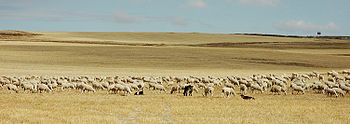 Agriculture and husbandry, still the foundation of the Castilian-Manchegan economy, constitutes 11.64 percent of regional GDP, and employs 9.9 percent of the active workforce.
52 percent of the soil of Castile-La Mancha is considered "dry". Agricultural activities have historically been based on the cultivation of wheat
(37 percent), grape
s (17.2 percent) and olive
s (6.6 percent). Castile-La Mancha has some of the most extensive vineyards in Europe, nearly 700000 hectares (1,729,736.1 acre). The vineyards are predominantly, but by no means exclusively, in the west and southwest of La Mancha. In 2005 the region produced 3074462 metric tons (3,389,014.2 ST) of grapes, constituting 53.40 percent of Spain's national production. After grapes, the next most important agricultural product is barley
, 2272007 metric tons (2,504,459 ST), 25 percent of the national total.
In terms of agricultural productivity and income, since Spain's incorporation into the European Union
(EU) the primary sector of the regional economy has evolved dynamically. Among the reasons for this are growth rates higher than the national average, as well as increased capitalization fostering specialization and modernization, including the integration an externalization of the sector, whereby activities previously performed on the farm are now performed elsewhere. These changes have been fostered by the regional articulation of the EU's Common Agricultural Policy
. Since 1986, subsidies have played a significant role in this sector.
Animal husbandry
plays a lesser, but not negiglible, role in the regional economy. 2005 statistics show 3,430,501 head of sheep, 1,602,576 pigs, 405,778 goats and 309,672 cattle; these last produce 224692000 litres (59,357,343.4 US gal) of milk each year. Apiculture (bee-keeping) is also important, with 180,000 hives.
The greatest obstacles to industrial growth in the region have been:
The principal industrial areas within the region are Sonseca
and its comarca, the Henares Corridor, Puertollano
, Talavera de la Reina, La Sagra y Almansa
, as well as all of the provincial capitals.
As throughout Spain in recent decades, the construction sector is one of the strongest. It employs 15.6 percent of the work force and produces 10.06 percent of regional GDP. It is one of the fastest-growing sectors of the economy: growth in 2006 was 13.6 percent. Most of the construction sector, is housing, including a new city of 30,000 inhabitants, Ciudad Valdeluz in Yebes
, Guadalajara; 13,000 dwellings in Seseña
, Toledo and the Reino de Don Quijote complex in the province of Ciudad Real, with 9,000 dwellings and 4,000 hotel beds.
and solar energy have been playing increasingly important roles in Castile-La Mancha, the majority of the energy generated in the region comes from the region's large thermal power station
s:
Also in Castile-La Mancha is the Trillo Nuclear Power Plant
near Trillo, Guadalajara
.
As of 2009, thermosolar plants are under development in Puertollano (being built by Iberdrola Renovables
, as well as two more in Cinco Casas, province of Ciudad Real (called Manchasol, being built by Grupo ACS
) .
In the area of tourism, there has been a great deal of growth, with Castile-La Mancha becoming in recent decades one of the principal tourist destinations in the Spanish interior. During 2006 the region had more than 2 million tourists (3 percent more than the previous year) for a total of 3,500,000 overnight hotel stays. Rural tourism
increased 14 percent in overnight stays in a single year. From 2000 to 2005 the number of hotel beds increased 26.4 percent to 17,245 beds in 254 hotels. In the same period, the number of casas rurales (for farm stays) increased 148 percent to 837 and the number of beds in such facilities 175 percent to 5,751.
The decentralized University of Castile-La Mancha was formally established in 1982 and has operated since 1985.
There are four main campus
es, one each at Albacete, Ciudad Real, Cuenca and Toledo, with classes also offered in Almadén, Talavera de la Reina and Puertollano. The university offers 54 degree programs (titulaciones). The province of Guadalajara stands outside the regional university, with its own University of Alcalá
offering degrees in education, business, tourism, technical architecture, and nursing. The National University of Distance Education also offers services in the region through five affiliated centers, one in each province: Albacete (with an extension in Almansa), Valdepeñas, Cuenca, Guadalajara, and Talavera de la Reina. Finally, the Menéndez Pelayo International University
has a location in Cuenca.
In the 2005–2006 school year, the region had 30,632 students matriculated at universities, down 1.01 percent from the previous year.
Historically, the region has had other universities, but these no longer exist. The present University of Castile-La Mancha uses one of the buildings of the Royal University of Toledo (1485–1807). Other former universities in the region were the Royal and Pontifical University of Our Lady of Rosario in Almagro (1550–1807) and the University of San Antonio de Porta Coeli in Sigüenza
founded in the 15th century by Cardinal Pedro González de Mendoza
and, like the others, closed in the Napoleonic era
.
Spain
Spain , officially the Kingdom of Spain languages]] under the European Charter for Regional or Minority Languages. In each of these, Spain's official name is as follows:;;;;;;), is a country and member state of the European Union located in southwestern Europe on the Iberian Peninsula...
. Castile-La Mancha is bordered by Castile and León
Castile and León
Castile and León is an autonomous community in north-western Spain. It was so constituted in 1983 and it comprises the historical regions of León and Old Castile...
, Madrid, Aragon
Aragon
Aragon is a modern autonomous community in Spain, coextensive with the medieval Kingdom of Aragon. Located in northeastern Spain, the Aragonese autonomous community comprises three provinces : Huesca, Zaragoza, and Teruel. Its capital is Zaragoza...
, Valencia, Murcia
Region of Murcia
The Region of Murcia is an autonomous community of Spain located in the southeast of the country, between Andalusia and Valencian Community, on the Mediterranean coast....
, Andalusia
Andalusia
Andalusia is the most populous and the second largest in area of the autonomous communities of Spain. The Andalusian autonomous community is officially recognised as a nationality of Spain. The territory is divided into eight provinces: Huelva, Seville, Cádiz, Córdoba, Málaga, Jaén, Granada and...
, and Extremadura
Extremadura
Extremadura is an autonomous community of western Spain whose capital city is Mérida. Its component provinces are Cáceres and Badajoz. It is bordered by Portugal to the west...
. It is one of the most sparsely populated of Spain's autonomous communities. Its capital city is Toledo
Toledo, Spain
Toledo's Alcázar became renowned in the 19th and 20th centuries as a military academy. At the outbreak of the Spanish Civil War in 1936 its garrison was famously besieged by Republican forces.-Economy:...
, and its most populous city is Albacete
Albacete
Albacete is a city and municipality in southeastern Spain, 258 km southeast of Madrid, the capital of the province of Albacete in the autonomous community of Castile-La Mancha. The municipality had a population of c. 169,700 in 2009....
.
Castile-La Mancha was formerly grouped with the province
Provinces of Spain
Spain and its autonomous communities are divided into fifty provinces .In other languages of Spain:*Catalan/Valencian , sing. província.*Galician , sing. provincia.*Basque |Galicia]] — are not also the capitals of provinces...
of Madrid into New Castile (Castilla la Nueva), but with the advent of the modern Spanish system of autonomous regions (Estado de las autonomías), it was separated due to great demographic disparity between the capital and the remaining New-Castilian provinces. Also, compared to the former New Castile, Castile-La Mancha add the province of Albacete
Albacete (province)
Albacete is a province of central Spain, in the southern part of the autonomous community of Castile-La Mancha. It is bordered by the provinces of Granada, Murcia, Alicante, Valencia, Cuenca, Ciudad Real and Jaén....
, which had been part of Murcia
Region of Murcia
The Region of Murcia is an autonomous community of Spain located in the southeast of the country, between Andalusia and Valencian Community, on the Mediterranean coast....
; adding Albacete placed all of La Mancha
La Mancha
La Mancha is a natural and historical region or greater comarca located on an arid, fertile, elevated plateau of central Spain, south of Madrid, stretching between the Montes de Toledo and the western spurs of the Serrania de Cuenca. It is bounded on the south by the Sierra Morena and on the north...
within this single region.
It is mostly in this region where the story of the famous Spanish novel Don Quixote by Miguel de Cervantes
Miguel de Cervantes
Miguel de Cervantes Saavedra was a Spanish novelist, poet, and playwright. His magnum opus, Don Quixote, considered the first modern novel, is a classic of Western literature, and is regarded amongst the best works of fiction ever written...
is situated - due to which La Mancha is internationally well-known. Although La Mancha is a windswept, battered plateau, it remains a symbol of the Spanish culture with its vineyards, sunflowers, mushrooms, oliveyards, windmills, Manchego cheese
Manchego cheese
Manchego is a cheese made in the La Mancha region of Spain from the milk of sheep of the Manchega breed, which is aged for between 60 days and two years....
, and Don Quixote.
History
The history of Castile-La Mancha has been significant. Its origin lay in the Muslim period between the 8th and 14th century. Castile-La Mancha was the region of many historical battles between Christian crusaders and Muslim forces during the period from 1000 to the 13th century. It was also the region where the Crown of CastileCrown of Castile
The Crown of Castile was a medieval and modern state in the Iberian Peninsula that formed in 1230 as a result of the third and definitive union of the crowns and parliaments of the kingdoms of Castile and León upon the accession of the then King Ferdinand III of Castile to the vacant Leonese throne...
and Aragon
Crown of Aragon
The Crown of Aragon Corona d'Aragón Corona d'Aragó Corona Aragonum controlling a large portion of the present-day eastern Spain and southeastern France, as well as some of the major islands and mainland possessions stretching across the Mediterranean as far as Greece...
were unified in 1492 under Queen Isabel and King Ferdinand
Catholic Monarchs
The Catholic Monarchs is the collective title used in history for Queen Isabella I of Castile and King Ferdinand II of Aragon. They were both from the House of Trastámara and were second cousins, being both descended from John I of Castile; they were given a papal dispensation to deal with...
.
Castile-La Mancha is the successor to New Castile
New Castile
New Castile is a historic region of Spain. It roughly corresponds to the southern part of the Castile, taken during the Reconquista of the peninsula by Christian kings from Muslim rulers. Some notable achievements in this reconquest were the capture of Toledo in 1085, ending the Taifa's Kingdom of...
(Castilla la Nueva), which in turn traces back to the Muslim
Muslim
A Muslim, also spelled Moslem, is an adherent of Islam, a monotheistic, Abrahamic religion based on the Quran, which Muslims consider the verbatim word of God as revealed to prophet Muhammad. "Muslim" is the Arabic term for "submitter" .Muslims believe that God is one and incomparable...
Taifa of Toledo
Taifa of Toledo
The taifa of Toledo was a Muslim medieval kingdom located in what is now central Spain. It existed from the fracturing of the long-eminent Muslim Caliphate of Córdoba in 1035 until the Christian conquest in 1085.-History:...
, one of the taifa
Taifa
In the history of the Iberian Peninsula, a taifa was an independent Muslim-ruled principality, usually an emirate or petty kingdom, though there was one oligarchy, of which a number formed in the Al-Andalus after the final collapse of the Umayyad Caliphate of Córdoba in 1031.-Rise:The origins of...
s of Al Andalus. Alfonso VI conquered the region from the Muslims, taking Toledo
Toledo, Spain
Toledo's Alcázar became renowned in the 19th and 20th centuries as a military academy. At the outbreak of the Spanish Civil War in 1936 its garrison was famously besieged by Republican forces.-Economy:...
in 1085. The Reconquista
Reconquista
The Reconquista was a period of almost 800 years in the Middle Ages during which several Christian kingdoms succeeded in retaking the Muslim-controlled areas of the Iberian Peninsula broadly known as Al-Andalus...
("Reconquest") took Cuenca
Cuenca (province)
Cuenca is a province of central Spain, in the eastern part of the autonomous community of Castile-La Mancha.-Guide to the area:Located in a natural setting of beauty, the Old Town of Cuenca occupies a superb site between two river gorges. Famous are its 15th Century "hanging houses" , that appear...
in 1177. Other provinces to the south—the Campo de Calatrava, the Valle de Alcudia, and the Alfoz de Alcaraz (Campo de Montiel
Campo de Montiel
Campo de Montiel is a comarca in Castile-La Mancha, Spain....
and Sierra de Alcaraz
Sierra de Alcaraz
Sierra de Alcaraz is a comarca of the Province of Albacete, Spain....
)—were consolidated during the reign of Alfonso VIII
Alfonso VIII of Castile
Alfonso VIII , called the Noble or el de las Navas, was the King of Castile from 1158 to his death and King of Toledo. He is most remembered for his part in the Reconquista and the downfall of the Almohad Caliphate...
(reigned 1158–1214), whose conquests were completed by the Battle of Las Navas de Tolosa
Battle of Las Navas de Tolosa
The Battle of Las Navas de Tolosa, known in Arab history as the Battle of Al-Uqab , took place on 16 July 1212 and was an important turning point in the Reconquista and in the medieval history of Spain...
(1212). That victory assured Castilian domination of the region and hastened the decline of the Almohad Dynasty. From the time of the Reconquista, Castilla-La Mancha formed part of the Kingdom of Castile
Kingdom of Castile
Kingdom of Castile was one of the medieval kingdoms of the Iberian Peninsula. It emerged as a political autonomous entity in the 9th century. It was called County of Castile and was held in vassalage from the Kingdom of León. Its name comes from the host of castles constructed in the region...
. Four centuries later, in 1605, Cervantes' Don Quixote gave the world an indelible picture of La Mancha
La Mancha
La Mancha is a natural and historical region or greater comarca located on an arid, fertile, elevated plateau of central Spain, south of Madrid, stretching between the Montes de Toledo and the western spurs of the Serrania de Cuenca. It is bounded on the south by the Sierra Morena and on the north...
.
In 1785, the territorial organization by the reformer Floridablanca
José Moñino y Redondo, conde de Floridablanca
José Moñino y Redondo, Count of Floridablanca , Spanish statesman. He was the reformist chief minister of King Charles III of Spain, and also served briefly under Charles IV. He was arguably Spain's most effective statesman in the eighteenth century...
divided the region into the provinces of Cuenca, Guadalajara, Madrid, La Mancha, and Toledo, while Albacete, Chinchilla
Chinchilla de Monte-Aragón
Chinchilla de Monte-Aragón, more commonly just Chinchilla, is a municipality in the province of Albacete in Castile-La Mancha, in the region of La Mancha Montearagón.-Description:This town is located 15 km from the capital of the province...
, Almansa
Almansa
Almansa is a Spanish town and municipality in the province of Albacete, part of the autonomous community of Castile-La Mancha. The municipality borders with Alicante, Valencia and Murcia...
, Hellín
Hellín
Hellín is a town and municipality located in the south of the province of Albacete, in Castile-La Mancha, Spain. , it has a population of 31,109....
and Yeste
Yeste
Yeste may refer to:*Francisco Javier Yeste Navarro, a Spanish footballer*Yeste municipality, Albacete , Spain*Yeste village located in Las Peñas de Riglos municipality, Huesca , Spain...
became part of Murcia. In 1833 Javier de Burgos
Javier de Burgos
Francisco Javier de Burgos y del Olmo was a Spanish jurist, politician, journalist, and translator.-Early life and career:...
modified the provincial borders
1833 territorial division of Spain
The 1833 territorial division of Spain divided Spain into provinces, classified into "historic regions" . on the official web site of the government of the Canary Islands, accessed 2009-12-31...
; most of the province of La Mancha was transferred to the province of Ciudad Real, with smaller parts incorporated into the provinces of Cuenca, Toledo and the newly created province of Albacete. Albacete, in turn, also incorporated parts of the territories of the old provinces of Cuenca and Murcia. Albacete was administered as part of the Region of Murcia until the 1978 configuration of autonomous regions. Nonetheless, during the First Spanish Republic
First Spanish Republic
The First Spanish Republic was the political regime that existed in Spain between the parliamentary proclamation on 11 February 1873 and 29 December 1874 when General Arsenio Martínez-Campos's pronunciamento marked the beginning of the Bourbon Restoration in Spain...
, Albacete was one of the signatories to the Pacto Federal Castellano (1869) and in 1924 its deputation favored the formation of a "Comunidad Manchega" that would have recognized La Mancha (including Albacete) as a region.
The Autonomous Community of Castile-La Mancha dates from November 15, 1978, as one of the many autonomous regions defined by the Spanish central government. (More precisely, each of these regions was initially a preautonomía, a "pre-autonomous" region, until establishing its Statute of Autonomy
Statute of Autonomy
Nominally, a Statute of Autonomy is a law hierarchically located under the constitution of a country, and over any other form of legislation...
). The new, hyphenated name constituted an effort to bridge two distinct regionalisms: that of the larger Castile (extending beyond this autonomous region) and that of the smaller onetime province of La Mancha
La Mancha
La Mancha is a natural and historical region or greater comarca located on an arid, fertile, elevated plateau of central Spain, south of Madrid, stretching between the Montes de Toledo and the western spurs of the Serrania de Cuenca. It is bounded on the south by the Sierra Morena and on the north...
. The Statute of Autonomy of Castile-La Mancha was approved August 10, 1982 and took effect August 17, 1982.
Regional divisions
- AlbaceteAlbacete (province)Albacete is a province of central Spain, in the southern part of the autonomous community of Castile-La Mancha. It is bordered by the provinces of Granada, Murcia, Alicante, Valencia, Cuenca, Ciudad Real and Jaén....
- Ciudad RealCiudad Real (province)The province of Ciudad Real is a province of South-central Spain, in the southwestern part of the autonomous community of Castile-La Mancha. It is bordered by the provinces of Cuenca, Albacete, Jaén, Córdoba, Badajoz, and Toledo. Its extent is effectively that of the old province of La Mancha...
- CuencaCuenca (province)Cuenca is a province of central Spain, in the eastern part of the autonomous community of Castile-La Mancha.-Guide to the area:Located in a natural setting of beauty, the Old Town of Cuenca occupies a superb site between two river gorges. Famous are its 15th Century "hanging houses" , that appear...
- GuadalajaraGuadalajara (province)Guadalajara is a province of central/north-central Spain, in the northern part of the autonomous community of Castile-La Mancha. It is bordered by the provinces of Cuenca, Madrid, Segovia, Soria, Zaragoza, and Teruel...
- ToledoToledo (province)Toledo is a province of central Spain, in the western part of the autonomous community of Castile-La Mancha. It is bordered by the provinces of Madrid, Cuenca, Ciudad Real, Badajoz, Cáceres, and Ávila....
According to the official data of the INE
Instituto Nacional de Estadística (Spain)
The National Institute of Statistics is the official organisation in Spain that collects statistics about demography, economy, and Spanish society. Every 10 years, this organisation conducts a national census. The last census took place in 2001....
, Castile-La Mancha consists of 919 municipalities, which amount to 11.3 percent of all the municipalities in Spain. 496 of these have less than 500 inhabitants, 231 have between 501 and 2,000 inhabitants, 157 between 2,000 and 10,000 inhabitants, and only 35 have more than 10,000 inhabitants. The municipalities in the north are small and numerous, while in the south they are larger and fewer. This reflects different histories of how these sub-regions were repopulated during the Reconquista.
The 25 most populous municipalities of Castile-La Mancha according to the INE (2008) are:
| Most populous municipalities of Castile-La Mancha | |||
|---|---|---|---|
| Rank | Municipality | Province | Population |
| 1 | Albacete Albacete Albacete is a city and municipality in southeastern Spain, 258 km southeast of Madrid, the capital of the province of Albacete in the autonomous community of Castile-La Mancha. The municipality had a population of c. 169,700 in 2009.... |
Albacete | 166,909 |
| 2 | Talavera de la Reina | Toledo | 87,763 |
| 3 | Guadalajara Guadalajara, Spain Guadalajara is a city and municipality in the autonomous community of Castile-La Mancha, Spain, and in the natural region of La Alcarria. It is the capital of the province of Guadalajara. It is located roughly 60 km northeast of Madrid on the Henares River, and has a population of 83,789... |
Guadalajara | 81,221 |
| 4 | Toledo Toledo, Spain Toledo's Alcázar became renowned in the 19th and 20th centuries as a military academy. At the outbreak of the Spanish Civil War in 1936 its garrison was famously besieged by Republican forces.-Economy:... |
Toledo | 80,810 |
| 5 | Ciudad Real Ciudad Real Ciudad Real is a city in Castile-La Mancha, Spain, with a population of c. 74,000. It is the capital of the province of Ciudad Real. It has a stop on the AVE high-speed rail line and has begun to grow as a long-distance commuter suburb of Madrid, located 115 miles to the north. A high capacity... |
Ciudad Real | 72,208 |
| 6 | Cuenca Cuenca, Spain -History:When the Iberian peninsula was part of the Roman Empire there were several important settlements in the province, such as Segóbriga, Ercávica and Gran Valeria... |
Cuenca | 54,600 |
| 7 | Puertollano Puertollano Puertollano is an industrial city in province of Ciudad Real, Castile-La Mancha, Spain. It is situated on the AVE High Speed Train line linking Madrid and Seville . The city has a population of 51,842 .- Legend of the lie :... |
Ciudad Real | 51,305 |
| 8 | Tomelloso Tomelloso Tomelloso is a municipality in the province of Ciudad Real, Castile-La Mancha, Spain. It has a population of 33,548 .-Main sights:*Posada de los Portales *Town Hall, rebuilt in 1904... |
Ciudad Real | 37,532 |
| 9 | Hellín Hellín Hellín is a town and municipality located in the south of the province of Albacete, in Castile-La Mancha, Spain. , it has a population of 31,109.... |
Albacete | 31,054 |
| 10 | Azuqueca de Henares Azuqueca de Henares Azuqueca de Henares is a municipality located in the province of Guadalajara, Castile-La Mancha, Spain. According to the 2008 census , the municipality has a population of 30,794 inhabitants.-History of Azuqueca:... |
Guadalajara | 30,794 |
| 11 | Alcázar de San Juan Alcázar de San Juan Alcázar de San Juan is a town and municipality in the province of Ciudad Real, part of the autonomous community of Castile-La Mancha, Spain... |
Ciudad Real | 30,408 |
| 12 | Valdepeñas Valdepeñas Valdepeñas is a municipality in the province of Ciudad Real, in the autonomous community of Castile-La Mancha, Spain. It is also the seat of the judicial district that covers the localities of Moral de Calatrava, Santa Cruz de Mudela, Viso del Marqués, Torrenueva, Castellar de Santiago and... |
Ciudad Real | 30,255 |
| 13 | Villarrobledo Villarrobledo Villarrobledo is a Spanish city and municipality in the province of Albacete, part of the autonomous community of Castile-La Mancha.Villarrobledo has the world's largest area covered by vineyards as well as the world's greatest production of La Mancha wine, called in Spanish Denominación de Origen)... |
Albacete | 26,311 |
| 14 | Almansa Almansa Almansa is a Spanish town and municipality in the province of Albacete, part of the autonomous community of Castile-La Mancha. The municipality borders with Alicante, Valencia and Murcia... |
Albacete | 25,591 |
| 15 | Illescas Illescas -Places:* Illescas, San Luis Potosí, Mexico* Illescas Peninsula, Peru* Cerro Illescas, Peru* Illescas, Toledo, Spain* Illescas, Florida, village in Uruguay* Illescas, Lavalleja, village in Uruguay-People:*Gonzalo de Illescas - Spanish historian... |
Toledo | 19,167 |
| 16 | Manzanares Manzanares, Ciudad Real Manzanares, Ciudad Real is a municipality in Ciudad Real, Castile-La Mancha, Spain. It has a population of 19,186 . It is located near the Autovía A-4 .... |
Ciudad Real | 19,027 |
| 17 | Daimiel Daimiel Daimiel is a municipality in Ciudad Real, Castile-La Mancha, Spain. It has a population of 17,342. The Tablas de Daimiel National Park, a well-known natural reserve, lies partly within the boundaries of the town.-Spanish Civil War:... |
Ciudad Real | 18,389 |
| 18 | La Solana La Solana La Solana is a municipality in Ciudad Real, Castile-La Mancha, Spain. It has a population of 15,340.The Language spoken is Castellano. It has a very arid climate. It is located in a zone of Spain that produces large quantities of Wine and Olive Oil.... |
Ciudad Real | 16,392 |
| 19 | La Roda La Roda La Roda is a village located in the autonomous community of Castile-La Mancha, Province of Albacete, Spain.-Description:The village has a population of around 15000 people. It is an important industrial town. Its most famous building is the church which dates from the 15th century.Its main culinary... |
Albacete | 16,034 |
| 20 | Tarancón Tarancón Tarancón is a municipality located in the province of Cuenca, Castile-La Mancha, Spain. According to the 2004 census , the municipality has a population of 12,696 inhabitants.... |
Cuenca | 14,962 |
| 21 | Campo de Criptana Campo de Criptana Campo de Criptana is a municipality and town in the province of Ciudad Real in the autonomous community of Castilla-La Mancha . It is found in the region known as La Mancha.-Historical development:... |
Ciudad Real | 14,870 |
| 22 | Seseña Seseña Seseña is a municipality located in the province of Toledo, Castile-La Mancha, Spain. According to the 2009 census , the municipality had a population of 16,231.-Residencial Francisco Hernando:... |
Toledo | 13,843 |
| 23 | Miguelturra | Ciudad Real | 13,582 |
| 24 | Socuéllamos | Ciudad Real | 13,357 |
| 25 | Torrijos Torrijos - People :*Omar Torrijos was a Panamanian army officer, de facto leader of Panama from 1968 to 1981, and co-negotiator of the Torrijos-Carter Treaties.... |
Toledo | 12,674 |
Comarcas
Although the Statute of Autonomy allows for comarcaComarca
A comarca is a traditional region or local administrative division found in parts of Spain, Portugal, Panama, Nicaragua, and Brazil. The term is derived from the term marca, meaning a "march, mark", plus the prefix co- meaning "together, jointly".The comarca is known in Aragonese as redolada and...
s of political/juridical significance, this has never been followed through at the level of the entire region, and there are no comarcas in Castile-La Mancha with political or juridical functions. Individual provinces of Castile-La Mancha have performed comarcalizations for administrative, economic and touristic purposes. Many Castilian-Manchegan comarcas important traditional significance, with some figuring in history well beyond their respective provinces.
- Comarcas of Albacete:
- Campos de HellínCampos de HellínCampos de Hellín is a comarca of the Province of Albacete, Spain....
- Llanos de AlbaceteLlanos de AlbaceteLlanos de Albacete is a comarca of the Province of Albacete, Spain....
- La Mancha del Júcar-Centro
- Manchuela albaceteña
- Monte Ibérico-Corredor de AlmansaMonte Ibérico-Corredor de AlmansaMonte Ibérico-Corredor de Almansa is a comarca of the Province of Albacete, Spain....
- Sierra de Alcaraz y Campo de MontielSierra de Alcaraz y Campo de MontielSierra de Alcaraz y Campo de Montiel is a comarca of the Province of Albacete, Spain....
- Sierra del SeguraMancomunidad de Municipios de la Sierra del SeguraMancomunidad de Municipios de la Sierra del Segura is a comarca of the Province of Albacete, Spain....
- Comarcas of Ciudad Real:
- Alcudia
- Campo de Calatrava
- Mancha
- Montes
- Montiel
- Sierra Morena
- Comarcas of Cuenca:
- La Alcarria conquense
- La Mancha de Cuenca
- Manchuela conquense
- Serranía Alta
- Serranía Media-Campichuelo
- Serranía Baja
- Comarcas of Guadalajara:
- La Alcarria (comarca)
- La Campiña (comarca)
- Señorío de Molina
- La SerraníaLa SerraníaLa Serranía is a comarca in the province of Guadalajara, central Spain, with the capital in the city of Sigüenza. It is one of the less populated regions in Europe. La Serranía is home to monumental villages such as Anguita, Atienza, Luzón, Palazuelos....
- Comarcas of Toledo:
- La Campana de Oropesa
- La Jara
- La Mancha Alta de Toledo
- Mesa de OcañaMesa de OcañaMesa de Ocaña is a comarca in Castilla-La Mancha, Spain, in the province of Toledo. Its capital and administrative center is Ocaña. The comarca is located in the northeast part of the province, and encompasses an area that includes several hundred meters of the Tajo River Valley.The comarca is...
- Montes de Toledo
- La Sagra
- Sierra de San Vicente
- Talavera (co-extensive with the municipality of Talavera de la Reina).
- ToledoToledo, SpainToledo's Alcázar became renowned in the 19th and 20th centuries as a military academy. At the outbreak of the Spanish Civil War in 1936 its garrison was famously besieged by Republican forces.-Economy:...
(co-extensive with the municipality of Toledo). - Torrijos
Official symbols
The Organic Law 9/1982 (August 10, 1982), which is the Statute of Autonomy of Castile-La Mancha establishes the flag of Castile-La Mancha and the law 1/1983 (June 30, 1983) establishes the coat of arms.Flag
Seven different designs for a flag were proposed during the era of the "pre-autonomous" region. The selected design was that of Manchego heraldistHeraldry
Heraldry is the profession, study, or art of creating, granting, and blazoning arms and ruling on questions of rank or protocol, as exercised by an officer of arms. Heraldry comes from Anglo-Norman herald, from the Germanic compound harja-waldaz, "army commander"...
Ramón José Maldonado. This was made official in Article 5 of the Statute of Autonomy:
- One. The flag of the region consists of a rectangle divided vertically into two equal squares: the first, together with the mast, crimson red with a castle of OrOr (heraldry)In heraldry, Or is the tincture of gold and, together with argent , belongs to the class of light tinctures called "metals". In engravings and line drawings, it may be represented using a field of evenly spaced dots...
masoned in sableSable (heraldry)In heraldry, sable is the tincture black, and belongs to the class of dark tinctures, called "colours". In engravings and line drawings, it is sometimes depicted as a region of crossed horizontal and vertical lines or else marked with sa. as an abbreviation.The name derives from the black fur of...
and port and windows of azureAzureIn heraldry, azure is the tincture with the colour blue, and belongs to the class of tinctures called "colours". In engraving, it is sometimes depicted as a region of horizontal lines or else marked with either az. or b. as an abbreviation....
; the second, white. - Two. The flag of the region will fly at regional, provincial, or municipal public buildings, and will appear next to the Spanish flag, which will be displayed in the preeminent place; historic territories [provinces] may also be represented.
Coat of arms
The coat of arms
Coat of arms
A coat of arms is a unique heraldic design on a shield or escutcheon or on a surcoat or tabard used to cover and protect armour and to identify the wearer. Thus the term is often stated as "coat-armour", because it was anciently displayed on the front of a coat of cloth...
of Castile-La Mancha is based on the flag of the region, and not vice versa, as is more typical in heraldry. Article 1 of the law 1/1983 describes it as follows:
- The coat of arms of the Communities of Castile-La Mancha is party per palePale (heraldry)A pale is a term used in heraldic blazon and vexillology to describe a charge on a coat of arms , that takes the form of a band running vertically down the center of the shield. Writers broadly agree that the width of the pale ranges from about one-fifth to about one-third of the width of the...
. On the dexterDexter and sinisterDexter and sinister are terms used in heraldry to refer to specific locations in an escutcheon bearing a coat of arms and by extension also to a crest. "Dexter" means to the right from the viewpoint of the bearer of the arms, to the left of that of the viewer...
[the statute literally says "On the first quarterQuartering (heraldry)Quartering in heraldry is a method of joining several different coats of arms together in one shield by dividing the shield into equal parts and placing different coats of arms in each division....
"], on a field gulesGulesIn heraldry, gules is the tincture with the colour red, and belongs to the class of dark tinctures called "colours". In engraving, it is sometimes depicted as a region of vertical lines or else marked with gu. as an abbreviation....
a castle OrOr (heraldry)In heraldry, Or is the tincture of gold and, together with argent , belongs to the class of light tinctures called "metals". In engravings and line drawings, it may be represented using a field of evenly spaced dots...
, embattled, port and windows of azure and masoned sableSable (heraldry)In heraldry, sable is the tincture black, and belongs to the class of dark tinctures, called "colours". In engravings and line drawings, it is sometimes depicted as a region of crossed horizontal and vertical lines or else marked with sa. as an abbreviation.The name derives from the black fur of...
. On the sinisterDexter and sinisterDexter and sinister are terms used in heraldry to refer to specific locations in an escutcheon bearing a coat of arms and by extension also to a crest. "Dexter" means to the right from the viewpoint of the bearer of the arms, to the left of that of the viewer...
[the statute literally says "The second quarter"], a field argentArgentIn heraldry, argent is the tincture of silver, and belongs to the class of light tinctures, called "metals". It is very frequently depicted as white and usually considered interchangeable with it...
. On the crestCrest (heraldry)A crest is a component of an heraldic display, so called because it stands on top of a helmet, as the crest of a jay stands on the bird's head....
, a royal crown enclosed, which is a circle of Or crimped with precious gems, composed of eight finialFinialThe finial is an architectural device, typically carved in stone and employed decoratively to emphasize the apex of a gable or any of various distinctive ornaments at the top, end, or corner of a building or structure. Smaller finials can be used as a decorative ornament on the ends of curtain rods...
s, of Acanthus mollisAcanthus mollisAcanthus mollis, commonly known as Bear's Breeches or "Oyster Plant", is a herbaceous perennial plant with an underground rhizome in the genus Acanthus.-Etymology:...
, five visible, topped by pearls and whose leaves emerge from diadems, which converge in a globe of azure or blue, with a semimeridian and the equator Or topped by a cross Or. The crown lined with gules or red.
Some institutions of the region have adopted this coat of arms as part of their own emblem, among these the Cortes of Castile-La Mancha, the Consultative Council and the University of Castile-La Mancha.
Anthem
Although Article 5 of the Statute of Autonomy indicates that the region will have its own anthem, after more than 25 years no such anthem has been adopted. Among the proposed anthems have been the "Canción del Sembrador" ("Song of the Sower") from the zarzuelaZarzuela
Zarzuela is a Spanish lyric-dramatic genre that alternates between spoken and sung scenes, the latter incorporating operatic and popular song, as well as dance...
La rosa del azafrán by Jacinto Guerrero
Jacinto Guerrero
Jacinto Guerrero , was a prolific composer of zarzuelas and revues, as well as some orchestral compositions...
, the "Canto a la Mancha" ("Song of La Mancha") by Tomás Barrera, and many others, such as one presented by a group of citizens from Villarrobledo
Villarrobledo
Villarrobledo is a Spanish city and municipality in the province of Albacete, part of the autonomous community of Castile-La Mancha.Villarrobledo has the world's largest area covered by vineyards as well as the world's greatest production of La Mancha wine, called in Spanish Denominación de Origen)...
with the title "Patria sin fin" ("Fatherland without end").
Politics and government
Article 8 of the Statute of Autonomy states that the powers of the region are exercised through the Junta of Communities of Castile-La Mancha (Junta de Comunidades de Castilla-La Mancha). Organs of the Junta are the Cortes of Castile-La Mancha (Cortes de Castilla-La Mancha), the President of the Junta and the Council of Government.Cortes of Castile-La Mancha
The Cortes of Castile-La Mancha represent the popular willPopular sovereignty
Popular sovereignty or the sovereignty of the people is the political principle that the legitimacy of the state is created and sustained by the will or consent of its people, who are the source of all political power. It is closely associated with Republicanism and the social contract...
through 49 deputies elected by universal adult suffrage through the secret ballot
Secret ballot
The secret ballot is a voting method in which a voter's choices in an election or a referendum are anonymous. The key aim is to ensure the voter records a sincere choice by forestalling attempts to influence the voter by intimidation or bribery. The system is one means of achieving the goal of...
. They are elected for a term of four years under a proportional
Proportional representation
Proportional representation is a concept in voting systems used to elect an assembly or council. PR means that the number of seats won by a party or group of candidates is proportionate to the number of votes received. For example, under a PR voting system if 30% of voters support a particular...
system intended to guarantee representation to the various territorial zones of Castile-La Mancha. The electoral constituency is at the level of each province
Province
A province is a territorial unit, almost always an administrative division, within a country or state.-Etymology:The English word "province" is attested since about 1330 and derives from the 13th-century Old French "province," which itself comes from the Latin word "provincia," which referred to...
, with provinces being assigned the following number of deputies as of 2009: Albacete, 10; Ciudad Real, 11; Cuenca, 8; Guadalajara, 8; and Toledo, 12. Article 10 of the Statute of Autonomy states that elections will be convoked by the President of the Junta of Communities, following the General Electoral Regime (Régimen Electoral General), on the fourth Sunday in May every four years. This stands in contrast to the autonomous communities of the Basque Country
Basque Country (autonomous community)
The Basque Country is an autonomous community of northern Spain. It includes the Basque provinces of Álava, Biscay and Gipuzkoa, also called Historical Territories....
, Catalonia
Catalonia
Catalonia is an autonomous community in northeastern Spain, with the official status of a "nationality" of Spain. Catalonia comprises four provinces: Barcelona, Girona, Lleida, and Tarragona. Its capital and largest city is Barcelona. Catalonia covers an area of 32,114 km² and has an...
, Galicia, Andalusia
Andalusia
Andalusia is the most populous and the second largest in area of the autonomous communities of Spain. The Andalusian autonomous community is officially recognised as a nationality of Spain. The territory is divided into eight provinces: Huelva, Seville, Cádiz, Córdoba, Málaga, Jaén, Granada and...
and the Valencian Community
Valencian Community
The Valencian Community is an autonomous community of Spain located in central and south-eastern Iberian Peninsula. Its capital and largest city is Valencia...
where the president has the power to convoke elections at any time. (In the Valencian Community that power has never been exercised. Elections there have, in practice, taken place on a four-year cycle.)
Since the Spanish regional elections of 2007
Spanish regional elections, 2007
A number of elections were held in Spain on 27 May 2007:* municipal elections;* local elections of various types like the elections to the Cabildo on the Canary Islands;* elections to the Assembly of Ceuta and Melilla; and...
, the Cortes of Castile-La Mancha has consisted of 28 deputies from the socialist PSOE
Spanish Socialist Workers' Party
The Spanish Socialist Workers' Party is a social-democratic political party in Spain. Its political position is Centre-left. The PSOE is the former ruling party of Spain, until beaten in the elections of November 2011 and the second oldest, exceeded only by the Partido Carlista, founded in...
and 21 from the conservative People's Party
People's Party (Spain)
The People's Party is a conservative political party in Spain.The People's Party was a re-foundation in 1989 of the People's Alliance , a party led and founded by Manuel Fraga Iribarne, a former Minister of Tourism during Francisco Franco's dictatorship...
. The Cortes sits in the former Franciscan
Franciscan
Most Franciscans are members of Roman Catholic religious orders founded by Saint Francis of Assisi. Besides Roman Catholic communities, there are also Old Catholic, Anglican, Lutheran, ecumenical and Non-denominational Franciscan communities....
convent in Toledo, the Edificio de San Gil ("San Gil building").
Council of Government
The Council of Government is the collegial executive organ of the region. It directs regional political and administrative action, exercises an executive function and regulatory powers under the Spanish Constitution of 1978Spanish Constitution of 1978
-Structure of the State:The Constitution recognizes the existence of nationalities and regions . Preliminary Title As a result, Spain is now composed entirely of 17 Autonomous Communities and two autonomous cities with varying degrees of autonomy, to the extent that, even though the Constitution...
, the Statute of Autonomy, and the laws of the nation and region. The Council of Government consists of the president, vice presidents (if any) and the Councilors.
President of the Junta
The President of the Junta is directs the Council of Government and coordinates the functions of its members. The president is elected by the Cortes from among its members, then formally named by the monarch of Spain. The president's official residence is the Palace of Fuensalida in Toledo.| Presidents of the Junta | |||||
|---|---|---|---|---|---|
| Number | Name | Took office | Left office | Party | Notes |
| 1. | Antonio Fernández-Galiano Fernández | 1978 | 1982 | UCD | Pre-autonomous president until August 16, 1982. |
| 2. | Gonzalo Payo Subiza | 1982 | 1982 | UCD | Pre-autonomous president. He replaced Fernández-Galiano, but left politics the same year. |
| 3. | Jesús Fuentes Lázaro | 1982 | 1983 | PSOE | Last pre-autonomous president. |
| 4. | José Bono Martínez | 1983 | 2004 | PSOE | First president of the autonomous region. He retained the post until 2004, winning all elections for the position by absolute majority, until he resigned his charge to take on the post of defence minister Defence minister A defence minister is a person in a cabinet position in charge of a Ministry of Defence, which regulates the armed forces in some sovereign nations... of Spain. |
| 5. | José María Barreda Fontes José María Barreda José María Barreda Fontes is a Spanish politician and academic. A member of the Spanish Socialist Workers' Party, he was the President of the autonomous community of Castile-La Mancha from 2004 until 2011.-Biography:... |
2004 | 2011 | PSOE | Replaced José Bono when the latter resigned to become defence minister. Elected by an absolute majority after the Spanish regional elections of 2007 |
| 6. | María Dolores de Cospedal María Dolores de Cospedal María Dolores de Cospedal García is a Spanish People's Party politician who is the President of Castile-La Mancha and Secretary-General of the People's Party.... |
2011 | current | PP | Elected by an absolute majority after the Spanish regional elections of 2011 |
Geography
Castile-La Mancha is located in the middle of the Iberian peninsulaIberian Peninsula
The Iberian Peninsula , sometimes called Iberia, is located in the extreme southwest of Europe and includes the modern-day sovereign states of Spain, Portugal and Andorra, as well as the British Overseas Territory of Gibraltar...
, occupying the greater part of the Submeseta Sur, the vast plain composing the southern part of the Meseta Central. The Submeseta Sur (and the autonomous community) is separated from the Submeseta Norte (and the community of Castile and León
Castile and León
Castile and León is an autonomous community in north-western Spain. It was so constituted in 1983 and it comprises the historical regions of León and Old Castile...
) by the mountain range known as the Sistema Central
Sistema Central
The Sistema Central is one of the main systems of mountain ranges in the Iberian Peninsula.-Description:The Sistema Central is a primary feature of the Meseta Central, the inner Iberian plateau, splitting the meseta into two parts...
. Despite this, the region has no shortage of mountain landscapes: the southern slopes of the aforementioned Sistema Central in the north, the Sistema Ibérico
Sistema Ibérico
The Sistema Ibérico or Iberian System is one of the main systems of mountain ranges in Spain.It is a vast and complex system of mountain chains and massifs located in the central regions of the Iberian Peninsula, but reaching almost the Mediterranean coast in the Land of Valencia in the east.From...
in the northeast, and the Sierra Morena
Sierra Morena
The Sierra Morena is one of the main systems of mountain ranges in Spain.It stretches for 400 kilometres East-West across southern Spain, forming the southern border of the Meseta Central plateau of the Iberian Peninsula, and providing the watershed between the valleys of the Guadiana to the...
and Montes de Toledo
Montes de Toledo
The Montes de Toledo are one of the main systems of mountain ranges in Spain. They divide the drainage basin of the Tagus from the basin of the Guadiana.-Description:...
in the south.
Castile-La Mancha is the third largest of Spain's autonomous regions, with a surface area of 79463 square kilometres (30,680.8 sq mi), representing 15.7 percent of Spain's national territory.
Terrain
The region has two distinct types of terrain. The Meseta is a vast, uniform plain with little relief. Within that uniformity, the most outstanding variation in altitude is that of the Montes de ToledoMontes de Toledo
The Montes de Toledo are one of the main systems of mountain ranges in Spain. They divide the drainage basin of the Tagus from the basin of the Guadiana.-Description:...
, with peaks such as La Villuerca (1601 metres (5,252.6 ft)), the highest peak of the Montes de Toledo range, and Rocigalgo (1447 metres (4,747.4 ft)).
At the south of that system are the Montes de Toledo, which cross the region from west to east, dividing the Tagus
Tagus
The Tagus is the longest river on the Iberian Peninsula. It is long, in Spain, along the border between Portugal and Spain and in Portugal, where it empties into the Atlantic Ocean at Lisbon. It drains an area of . The Tagus is highly utilized for most of its course...
(Tajo) and Guadiana
Guadiana
The Guadiana , or Odiana, is an international river located on the Portuguese–Spanish border, separating Extremadura and Andalucia from Alentejo and Algarve...
drainage basin
Drainage basin
A drainage basin is an extent or an area of land where surface water from rain and melting snow or ice converges to a single point, usually the exit of the basin, where the waters join another waterbody, such as a river, lake, reservoir, estuary, wetland, sea, or ocean...
s, forming the southern slope of the basin of the former and the northern slope of the latter.
In contrast, a more mountainous zone surrounds the Meseta and serves as the region's natural border. In the north of the Province of Guadalajara, bordering Madrid and Segovia
Segovia
Segovia is a city in Spain, the capital of Segovia Province in the autonomous community of Castile and León. It is situated north of Madrid, 30 minutes by high speed train. The municipality counts some 55,500 inhabitants.-Etymology:...
, is a mountain range forming part of the Sistema Central
Sistema Central
The Sistema Central is one of the main systems of mountain ranges in the Iberian Peninsula.-Description:The Sistema Central is a primary feature of the Meseta Central, the inner Iberian plateau, splitting the meseta into two parts...
, among which can be distinguished the mountain ranges Pela, Ayllón, Somosierra, Barahona and Ministra, with the headwaters of the rivers Jarama
Jarama
Jarama is a river in central Spain. It flows north to south, and passes east of Madrid when El Atazar Dam is built on a tributary, the Lozoya River. It flows into the river Tagus in Aranjuez...
, Cañamares and Henares
Henares
The Henares is a river in Spain, tributary of the Jarama. It has its source in the Sierra Ministra, in the village of Horna, near Sigüenza, in the province of Guadalajara....
. The Sistema Central also penetrates the Province of Toledo, which intersects a southerly part of the Sierra de Gredos
Sierra de Gredos
The Sierra de Gredos is a mountain range in the centre of the Iberian Peninsula, located between Ávila, Cáceres, Madrid and Toledo. It has been declared a regional park. Its highest point is Pico Almanzor, at 2,592 metres....
, known as the Sierra de San Vicente, delimited on the north by the river Tiétar
Tiétar
Tiétar is a river of Spain. It is a tributary of the Tagus. Its source is in the Sierra de Gredos mountain range and has a length of 170km. It flows into the Tagus at Monfragüe.-External links:*...
and on the south by the Alberche
Alberche
The Alberche is a river in the provinces of Ávila, Madrid and Toledo, central Spain. It begins its course at 1,800 m in Fuente Alberche, San Martín de la Vega del Alberche municipal term, Ávila Province...
and the Tagus.
On the northwest is the Sistema Ibérico
Sistema Ibérico
The Sistema Ibérico or Iberian System is one of the main systems of mountain ranges in Spain.It is a vast and complex system of mountain chains and massifs located in the central regions of the Iberian Peninsula, but reaching almost the Mediterranean coast in the Land of Valencia in the east.From...
, where there is important fluvial and especially karst
KARST
Kilometer-square Area Radio Synthesis Telescope is a Chinese telescope project to which FAST is a forerunner. KARST is a set of large spherical reflectors on karst landforms, which are bowlshaped limestone sinkholes named after the Kras region in Slovenia and Northern Italy. It will consist of...
ic activity, which has given rise to such landscapes as the Ciudad Encantada
Ciudad Encantada
The Ciudad Encantada is a geological site near the city of Cuenca, in Castile La Mancha, Spain in which the erosive forces of weather and the waters of the nearby Júcar river have formed rocks into distinctive and memorable shapes....
, the Callejones de Las Majadas and the Hoces del Cabriel.
In the southeast is the ridge of the Sierra Morena, the southern border of the Meseta Central and the region's border with Andalusia
Andalusia
Andalusia is the most populous and the second largest in area of the autonomous communities of Spain. The Andalusian autonomous community is officially recognised as a nationality of Spain. The territory is divided into eight provinces: Huelva, Seville, Cádiz, Córdoba, Málaga, Jaén, Granada and...
. Within the Sierra Morena, distinction can be made between the Sierra Madrona
Sierra Madrona
Sierra Madrona is a mountain range of the Cordillera Mariánica or Sierra Morena. It is located in Ciudad Real Province, in the region of Castile-La Mancha as well as the Córdoba and Jaén provincial limits, Andalusia, Spain...
, Sierra de Alcudia and Sierra de San Andrés. At the other southern extreme of Castile-La Mancha, the Sierra de Alcaraz
Sierra de Alcaraz
Sierra de Alcaraz is a comarca of the Province of Albacete, Spain....
and Sierra del Segura form part of the Sistema Bético.
Hydrography
The territory of Castile-La Mancha is divided into five principal watersheds. The Tagus, Guadiana, and GuadalquivirGuadalquivir
The Guadalquivir is the fifth longest river in the Iberian peninsula and the second longest river to be its whole length in Spain. The Guadalquivir is 657 kilometers long and drains an area of about 58,000 square kilometers...
drain into the Atlantic Ocean and the Júcar
Júcar
The Júcar or Xúquer is a river on the Iberian Peninsula of Spain. The river runs for approximately 509 km from its source at Ojuelos de Valdeminguete, on the eastern flank of the Montes Universales, Sistema Ibérico...
and Segura
Segura
Segura is a medium-sized river in southeastern Spain.It starts at Santiago Pontones , passes Calasparra, Cieza, Murcia, Beniaján, Orihuela, Rojales and ends in the Mediterranean Sea near Guardamar del Segura in the province of Alicante...
into the Mediterranean. The Tagus provides water for some 587,000 inhabitants in a watershed of 26699 square kilometres (10,308.5 sq mi). It includes the entire province of Guadalajara and the greater part of the province of Toledo, including the two largest cities of the latter province: the capital, Toledo, and the slightly larger city of Talavera de la Reina.
The Guadiana watershed extends 26646 square kilometres (10,288.1 sq mi) in Castilla-La Mancha, 37 percent of that river's entire watershed, with a population of 583,259 inhabitants. It includes the southern part of the province of Toledo, nearly all of the province of Ciudad Real (except the very south), the southwest of the province of Cuenca and the northwest of the province of Albacete. The Guadalquivir watershed extends over 5.17 percent of the surface area of the autonomous community, extending 4100 square kilometres (1,583 sq mi) through the southern parts of the provinces of Ciudad Real and Albacete, including such important population center as Puertollano
Puertollano
Puertollano is an industrial city in province of Ciudad Real, Castile-La Mancha, Spain. It is situated on the AVE High Speed Train line linking Madrid and Seville . The city has a population of 51,842 .- Legend of the lie :...
.
The Júcar watershed had, in 2006, 397,000 inhabitants in an area of 15737 square kilometres (6,076.1 sq mi), 19.86 percent of the Castillian-Manchegan territory and 36.61 percent of total of the Júcar watershed. It includes the eastern parts of the provinces of Cuenca and Albacete, including their respective capitals. Finally, the 34 municipalities of southeastern Albacete fall in the Segura watershed, with an extent of 4713 square kilometres (1,819.7 sq mi).
Climate
Castile-La Mancha has a continentalized Mediterranean climate: a Mediterranean climateMediterranean climate
A Mediterranean climate is the climate typical of most of the lands in the Mediterranean Basin, and is a particular variety of subtropical climate...
with a marked character of a continental climate
Continental climate
Continental climate is a climate characterized by important annual variation in temperature due to the lack of significant bodies of water nearby...
. The continentalized Mediterranean climate is similar to a typical Mediterranean climate, but with more extreme temperatures typical of a continental climate. Lack of a marine influence leads to much more extreme temperatures: hotter summers and quite cold winters, with a daily oscillation of 18.5 °C (33.3 °F). Summer is the driest season, with temperatures often exceeding 30 °C (86 °F), sometimes reaching and exceeding 35 °C (95 °F). In winter, temperatures often drop below 0 °C (32 °F), producing frosts on cloudy nights, and occasional snow.
Castile-La Mancha is part of what has traditionally been called España Seca ("Dry Spain"). There is relatively little precipitation
Precipitation (meteorology)
In meteorology, precipitation In meteorology, precipitation In meteorology, precipitation (also known as one of the classes of hydrometeors, which are atmospheric water phenomena is any product of the condensation of atmospheric water vapor that falls under gravity. The main forms of precipitation...
, much as in a typical Mediterranean climate. Precipitation presents a notable gradient from the center of the region, where it does not surpass 400 millimetres (15.7 in) per year, to the mountains where it can exceed 1000 millimetres (39.4 in) per year, on the slopes of the Sierra de Gredos and the Serranía de Cuenca. The greater part of the region has less than 600 millimetres (23.6 in) of rain annually. The driest part of the region is along the Albacete-Hellín
Hellín
Hellín is a town and municipality located in the south of the province of Albacete, in Castile-La Mancha, Spain. , it has a population of 31,109....
axis, with less than 300 millimetres (11.8 in) per year.
Demography
Number of inhabitants
According to the official January 11, 2008 data of the INEInstituto Nacional de Estadística (Spain)
The National Institute of Statistics is the official organisation in Spain that collects statistics about demography, economy, and Spanish society. Every 10 years, this organisation conducts a national census. The last census took place in 2001....
Castile-La Mancha has 2,043,100 inhabitants in its five provinces. Despite being the third largest of Spains communities by surface area (after Castile and León and Andalusia, it is only the ninth most populous. Castile-La Mancha has 4.42 percent of Spain's population.
Population density
With an average population densityPopulation density
Population density is a measurement of population per unit area or unit volume. It is frequently applied to living organisms, and particularly to humans...
of 25.71 /sqkm, Castile-La Mancha has the least dense population in all of Spain: the national average is 88.6 /sqkm. Industrialized zones such as the Henares Corridor (along the river Henares
Henares
The Henares is a river in Spain, tributary of the Jarama. It has its source in the Sierra Ministra, in the village of Horna, near Sigüenza, in the province of Guadalajara....
, a tributary of the Jarama) with a density of 126 /sqkm, the comarca
Comarca
A comarca is a traditional region or local administrative division found in parts of Spain, Portugal, Panama, Nicaragua, and Brazil. The term is derived from the term marca, meaning a "march, mark", plus the prefix co- meaning "together, jointly".The comarca is known in Aragonese as redolada and...
of la Sagra or the industrial zone of Sonseca
Sonseca
Sonseca is a municipality located in the province of Toledo, Castile-La Mancha, Spain. According to the 2006 census , the municipality has a population of 10685 inhabitants. In Sonseca there are some very famous marzipan's factories: Delaviuda, Donaire....
are dramatically more dense than the region as a whole.
Composition of population by age and sex
La population pyramidPopulation pyramid
A population pyramid, also called an age structure diagram, is a graphical illustration that shows the distribution of various age groups in a population , which forms the shape of a pyramid when the population is growing...
of Castile-La Mancha is typical for a developed region, with the central zone wider than the base or the upper zone. The population between 16 and 44 years of age represents about 44 percent, from 45 to 64 about 21.3 percent, with those 15 and under constituting 15 percent and those over 65, 18 percent. These data show the progressive aging of the Castilian-Manchegan population.
The region has about 9,000 more males than females; in percentage terms, 50.25 percent versus 49.75 percent. This is opposite to Spain as a whole, where women constitute 50.57 percent of the population.
Birth rate, death rate, life expectancy
According to 2006 INE numbers, the birth rateBirth rate
Crude birth rate is the nativity or childbirths per 1,000 people per year . Another word used interchangeably with "birth rate" is "natality". When the crude birth rate is subtracted from the crude death rate, it reveals the rate of natural increase...
in Castile-La Mancha is 10.21 per thousand inhabitants, lower than the national average of 10.92 per thousand. The death rate is 8.83 per thousand inhabitants, higher than the national average of 8.42 per thousand.
Life expectancy
Life expectancy
Life expectancy is the expected number of years of life remaining at a given age. It is denoted by ex, which means the average number of subsequent years of life for someone now aged x, according to a particular mortality experience...
at birth is one of the highest in Spain: 83.67 years for women and 77.99 years for men.
| Castile-La Mancha population 1900-2000 (in thousands) |
|---|
| Smallest unit: 20,000 people. |
| Source: Instituto Nacional de Estadística de España |
| Graphic elaborated by: Wikipedia Wikipedia Wikipedia is a free, web-based, collaborative, multilingual encyclopedia project supported by the non-profit Wikimedia Foundation. Its 20 million articles have been written collaboratively by volunteers around the world. Almost all of its articles can be edited by anyone with access to the site,... |
Highways
Castile-La Mancha has the most kilometres of autopistaAutopista
Autopista refers to a controlled-access highway in various Spanish-speaking countries*Autopistas and autovías of Spain*Autopistas of Mexico*Autopistas of Puerto Rico*Autopistas of Chile...
s (a type of limited access highway) and autovías dual carriageways, with a total of 2790 kilometres (1,733.6 mi). The most heavily trafficked of these are the radial routes surrounding Madrid and the routes in and out of the city, but there are also routes within Castile-La Mancha, and national and international routes that pass through the province, including highways in the International E-road network
International E-road network
The international E-road network is a numbering system for roads in Europe developed by the United Nations Economic Commission for Europe . The network is numbered from E 1 up and its roads cross national borders...
.
The regional government put into action a Plan Regional de Autovías with the objective that all municipalities with 10,000 or more inhabitants would be connected to an autovía. If it is completed, 96 percent of the region's population will live within 15 minutes of a high-capacity road. Among the developed projects of this plan are:
- Autovía de los ViñedosAutovía de los ViñedosThe Autovía de los Viñedos is a motorway in Spain. It passes through the region of Castile-La Mancha....
, 127 kilometres (78.9 mi) connecting Toledo and Tomelloso (completely in service). - Autovía de la Sagra, 85 kilometres (52.8 mi) connecting the Autovía A-5Autovía A-5The Autovía A-5 is a Spanish autovía which starts in Madrid and ends in Badajoz. It is part of the European Road E90.- Sections :- Major cities crossed:*Madrid*Alcorcón*Móstoles*Navalcarnero...
with the Autovía A-4Autovía A-4The Autovía A-4 or Autopista AP-4 is a Spanish autovía and autopista route which starts in Madrid and ends in Cádiz....
(Tranches I and II under way, duplication of highway CM-4001 in the tendering of works phase). - Autovía del IV Centenario, 142 kilometres (88.2 mi) departs Ciudad Real to meet with the future Autovía Linares-Albacete (A-32), passing through ValdepeñasValdepeñasValdepeñas is a municipality in the province of Ciudad Real, in the autonomous community of Castile-La Mancha, Spain. It is also the seat of the judicial district that covers the localities of Moral de Calatrava, Santa Cruz de Mudela, Viso del Marqués, Torrenueva, Castellar de Santiago and...
(first phase partially under way, second currently being studied). - Autovía del Júcar, 130 kilometres (80.8 mi), will connect Albacete to Cuenca (in project).
- Autovía de la Alcarria: although initially contemplated in the Plan Regional de Autovías, the Ministry of Development has taken over the work. It will connect the Autovía del Este (Autovía A-4Autovía A-4The Autovía A-4 or Autopista AP-4 is a Spanish autovía and autopista route which starts in Madrid and ends in Cádiz....
) with the Autovía del Nordeste (Autovía A-2Autovía A-2The Autovía A-2 is a Spanish autovía and autopista route which starts in Madrid and ends in Barcelona. It replaces the former N-II.- Sections :- Major cities crossed:*Madrid*Guadalajara*Zaragoza*Fraga*Lleida...
) (currently being studied).
The red autonómica—the road network of the autonomous community—currently extends 7900 kilometres (4,908.8 mi), of which 1836 kilometres (1,140.8 mi) correspond to the basic network, 5314 kilometres (3,302 mi) to the comarcal networks and 750 kilometres (466 mi) to local networks.
| Name | From/To | Important cities in Castile-La Mancha on route |
|---|---|---|
 |
Madrid - Barcelona Barcelona Barcelona is the second largest city in Spain after Madrid, and the capital of Catalonia, with a population of 1,621,537 within its administrative limits on a land area of... |
Azuqueca de Henares Azuqueca de Henares Azuqueca de Henares is a municipality located in the province of Guadalajara, Castile-La Mancha, Spain. According to the 2008 census , the municipality has a population of 30,794 inhabitants.-History of Azuqueca:... , Guadalajara Guadalajara, Spain Guadalajara is a city and municipality in the autonomous community of Castile-La Mancha, Spain, and in the natural region of La Alcarria. It is the capital of the province of Guadalajara. It is located roughly 60 km northeast of Madrid on the Henares River, and has a population of 83,789... , Alcolea del Pinar Alcolea del Pinar Alcolea del Pinar is a municipality located in the province of Guadalajara, Castile-La Mancha, Spain. According to the 2004 census , the municipality has a population of 406 inhabitants.Its importance is related to its role as main crossroads... |
 |
Madrid - Valencia | Tarancón Tarancón Tarancón is a municipality located in the province of Cuenca, Castile-La Mancha, Spain. According to the 2004 census , the municipality has a population of 12,696 inhabitants.... , La Almarcha La Almarcha La Almarcha is a municipality in Cuenca, Castile-La Mancha, Spain. It has a population of 602.... , Honrubia Honrubia Honrubia is a municipality in Cuenca, Castile-La Mancha, Spain. It has a population of 2,000.... , Motilla del Palancar Motilla del Palancar Motilla del Palancar is a municipality in Cuenca, Castile-La Mancha, Spain. It has a population of 5,224.... , Minglanilla Minglanilla Minglanilla may refer:* Minglanilla, Cebu, Philippines;* Minglanilla, Spain;... |
 |
Madrid - Cádiz Cádiz Cadiz is a city and port in southwestern Spain. It is the capital of the homonymous province, one of eight which make up the autonomous community of Andalusia.... |
Ocaña Ocaña, Spain Ocaña, a town and municipality of central Spain, in the province of Toledo. It is located on the extreme north of the tableland known as the Mesa de Ocaña, and has a station on the railway from Aranjuez to Cuenca.-History:... , Madridejos Madridejos Madridejos may refer to:* Madridejos, Cebu, a 4th class municipality in the province of Cebu, Philippines* Madridejos, Toledo, a town in the province of Toledo, Spain... , Manzanares Manzanares, Ciudad Real Manzanares, Ciudad Real is a municipality in Ciudad Real, Castile-La Mancha, Spain. It has a population of 19,186 . It is located near the Autovía A-4 .... , Valdepeñas Valdepeñas Valdepeñas is a municipality in the province of Ciudad Real, in the autonomous community of Castile-La Mancha, Spain. It is also the seat of the judicial district that covers the localities of Moral de Calatrava, Santa Cruz de Mudela, Viso del Marqués, Torrenueva, Castellar de Santiago and... |
 |
Madrid - Badajoz Badajoz Badajoz is the capital of the Province of Badajoz in the autonomous community of Extremadura, Spain, situated close to the Portuguese border, on the left bank of the river Guadiana, and the Madrid–Lisbon railway. The population in 2007 was 145,257.... |
Talavera de la Reina, Oropesa Oropesa An Oropesa is a streamlined towed body used in the process of minesweeping. The role of the Oropesa is to keep the towed sweep at a determined depth and position from the sweeping ship.... |
 |
Madrid - Guadalajara | Guadalajara |
 |
Madrid - Ocaña Ocaña, Spain Ocaña, a town and municipality of central Spain, in the province of Toledo. It is located on the extreme north of the tableland known as the Mesa de Ocaña, and has a station on the railway from Aranjuez to Cuenca.-History:... |
Seseña Seseña Seseña is a municipality located in the province of Toledo, Castile-La Mancha, Spain. According to the 2009 census , the municipality had a population of 16,231.-Residencial Francisco Hernando:... , Ocaña |
 Autovía de Murcia The Autovía de Murcia is a motorway in Spain. It passes through the region of Castile-La Mancha.... |
Albacete - Cartagena | Albacete, Hellín Hellín Hellín is a town and municipality located in the south of the province of Albacete, in Castile-La Mancha, Spain. , it has a population of 31,109.... |
 Autovía de Alicante The Autovía de Alicante is a motorway in Spain. It passes through the region of Castile-La Mancha.... |
Atalaya del Cañavate Atalaya del Cañavate Atalaya del Cañavate is a municipality in Cuenca, Castile-La Mancha, Spain. It has a population of 130.... - Alicante Alicante Alicante or Alacant is a city in Spain, the capital of the province of Alicante and of the comarca of Alacantí, in the south of the Valencian Community. It is also a historic Mediterranean port. The population of the city of Alicante proper was 334,418, estimated , ranking as the second-largest... |
Atalaya del Cañavate, Sisante Sisante Sisante is a municipality located in the Cuenca Province, Castile-La Mancha, Spain. According to the 2004 census , the municipality has a population of 1,795 inhabitants.... , La Roda La Roda La Roda is a village located in the autonomous community of Castile-La Mancha, Province of Albacete, Spain.-Description:The village has a population of around 15000 people. It is an important industrial town. Its most famous building is the church which dates from the 15th century.Its main culinary... , Albacete, Almansa Almansa Almansa is a Spanish town and municipality in the province of Albacete, part of the autonomous community of Castile-La Mancha. The municipality borders with Alicante, Valencia and Murcia... |
 Autovía Almansa-Játiva The Autovía Almansa-Játiva is a motorway in Spain. It passes through the region of Castile-La Mancha.... |
Almansa Almansa Almansa is a Spanish town and municipality in the province of Albacete, part of the autonomous community of Castile-La Mancha. The municipality borders with Alicante, Valencia and Murcia... - Játiva |
Almansa Almansa Almansa is a Spanish town and municipality in the province of Albacete, part of the autonomous community of Castile-La Mancha. The municipality borders with Alicante, Valencia and Murcia... |
 Autopista Ocaña-La Roda The Autopista Ocaña-La Roda is a motorway in Spain. It passes through the region of Castile-La Mancha.... |
Ocaña - La Roda La Roda La Roda is a village located in the autonomous community of Castile-La Mancha, Province of Albacete, Spain.-Description:The village has a population of around 15000 people. It is an important industrial town. Its most famous building is the church which dates from the 15th century.Its main culinary... |
Ocaña, Corral de Almaguer Corral de Almaguer Corral de Almaguer is a Spanish municipality of Toledo province, in the autonomous community of Castile-La Mancha. Its population is 5.549 and its surface is 329 km², with a density of 16.9 people/km².... , Quintanar de la Orden Quintanar de la Orden Quintanar de la Orden is a municipality located in the province of Toledo, Castile-La Mancha, Spain. According to the 2006 census , the municipality has a population of 10471 inhabitants.... , Mota del Cuervo Mota del Cuervo Mota del Cuervo is a municipality in Cuenca, Castile-La Mancha, Spain. It has a population of 5,693.... , Las Pedroñeras Las Pedroñeras Las Pedroñeras is a small town and municipality in the province of Cuenca, in the central region of the autonomous community of Castile-La Mancha, southwestern Spain.... , San Clemente, La Roda La Roda La Roda is a village located in the autonomous community of Castile-La Mancha, Province of Albacete, Spain.-Description:The village has a population of around 15000 people. It is an important industrial town. Its most famous building is the church which dates from the 15th century.Its main culinary... |
 |
Ciudad Real - Puertollano Puertollano Puertollano is an industrial city in province of Ciudad Real, Castile-La Mancha, Spain. It is situated on the AVE High Speed Train line linking Madrid and Seville . The city has a population of 51,842 .- Legend of the lie :... |
Argamasilla de Calatrava Argamasilla de Calatrava Argamasilla de Calatrava is a municipality in Ciudad Real, Castile-La Mancha, Spain. It has a population of 5,408.... |
 Autopista Madrid-Córdoba The Autopista Madrid-Córdoba is a motorway in Spain. It passes through the region of Castile-La Mancha.... |
Madrid - Toledo | Toledo |
 Autovía de Toledo The Autovía de Toledo is a motorway in Spain. It passes through the region of Castile-La Mancha.... |
Madrid - Toledo | Illescas Illescas -Places:* Illescas, San Luis Potosí, Mexico* Illescas Peninsula, Peru* Cerro Illescas, Peru* Illescas, Toledo, Spain* Illescas, Florida, village in Uruguay* Illescas, Lavalleja, village in Uruguay-People:*Gonzalo de Illescas - Spanish historian... , Toledo |
| Autovía de los Viñedos Autovía de los Viñedos The Autovía de los Viñedos is a motorway in Spain. It passes through the region of Castile-La Mancha.... |
Toledo - Tomelloso | Toledo, Mora Mora, Spain Mora is a town and municipality in Toledo province, in the autonomous community of Castile-La Mancha, Spain. The area is most famous for the abandoned ruins of the San Marcos de Yegros monastery of the Order of Santiago, located northeast of the town of Mora about 10 km on the Calle de los... , Consuegra Consuegra Consuegra is a municipality located in the province of Toledo, Castile-La Mancha, Spain. In 2009 the municipality had a population of 10,932 inhabitants. It is 80 km from Ciudad Real and 60 km from Toledo.... , Madridejos Madridejos Madridejos may refer to:* Madridejos, Cebu, a 4th class municipality in the province of Cebu, Philippines* Madridejos, Toledo, a town in the province of Toledo, Spain... , Alcázar de San Juan Alcázar de San Juan Alcázar de San Juan is a town and municipality in the province of Ciudad Real, part of the autonomous community of Castile-La Mancha, Spain... , Tomelloso Tomelloso Tomelloso is a municipality in the province of Ciudad Real, Castile-La Mancha, Spain. It has a population of 33,548 .-Main sights:*Posada de los Portales *Town Hall, rebuilt in 1904... |
| Name | From/To | Important cities in Castile-La Mancha on route |
|---|---|---|
 |
Linares - Albacete | Albacete |
 |
Ávila - Cuenca | Torrijos Torrijos - People :*Omar Torrijos was a Panamanian army officer, de facto leader of Panama from 1968 to 1981, and co-negotiator of the Torrijos-Carter Treaties.... , Toledo, Ocaña, Tarancón, Cuenca |
 |
Mérida - Atalaya del Cañavate Atalaya del Cañavate Atalaya del Cañavate is a municipality in Cuenca, Castile-La Mancha, Spain. It has a population of 130.... |
Ciudad Real, Almadén Almadén Almadén, Spain, is a town and municipality in the province of Ciudad Real, within the autonomous community of Castile-La Mancha. The town is located at 4° 49' W and 38° 46' N and is 589 meters above sea level. Almadén is approximately 200 km south of Madrid in the Sierra Morena... , Daimiel Daimiel Daimiel is a municipality in Ciudad Real, Castile-La Mancha, Spain. It has a population of 17,342. The Tablas de Daimiel National Park, a well-known natural reserve, lies partly within the boundaries of the town.-Spanish Civil War:... , Manzanares Manzanares, Ciudad Real Manzanares, Ciudad Real is a municipality in Ciudad Real, Castile-La Mancha, Spain. It has a population of 19,186 . It is located near the Autovía A-4 .... , Argamasilla de Alba Argamasilla de Alba Argamasilla de Alba is a municipality in Ciudad Real , Castile-La Mancha, Spain. It has a population of 6,791.Cervantes was held prisoner here and refers to the place in the prologue to Don Quixote.... , Tomelloso, San Clemente, Villarrobledo Villarrobledo Villarrobledo is a Spanish city and municipality in the province of Albacete, part of the autonomous community of Castile-La Mancha.Villarrobledo has the world's largest area covered by vineyards as well as the world's greatest production of La Mancha wine, called in Spanish Denominación de Origen)... |
| Autovía de la Alcarria | Guadalajara - Tarancón | Guadalajara, Mondéjar Mondéjar Mondéjar is a Spanish Denominación de Origen for wines located in the southeast corner of the province of Guadalajara , around the town of Mondéjar... , Tarancón |
| Autovía de la Sagra | A-5 - A-4 | Valmojado Valmojado Valmojado is a municipality located in the province of Toledo, Castile-La Mancha, Spain. According to the 2006 census , the municipality has a population of 3109 inhabitants.... , Illescas Illescas -Places:* Illescas, San Luis Potosí, Mexico* Illescas Peninsula, Peru* Cerro Illescas, Peru* Illescas, Toledo, Spain* Illescas, Florida, village in Uruguay* Illescas, Lavalleja, village in Uruguay-People:*Gonzalo de Illescas - Spanish historian... , Borox Borox Borox is a municipality located in the province of Toledo, Castile-La Mancha, Spain. According to the 2006 census , the municipality has a population of 2640 inhabitants.... , Añover de Tajo Añover de Tajo Añover de Tajo is a municipality located in the province of Toledo, Castile-La Mancha, Spain. According to the 2006 census , the municipality has a population of 5095 inhabitants.... |
| Autovía de la Solana | Manzanares - La Solana La Solana La Solana is a municipality in Ciudad Real, Castile-La Mancha, Spain. It has a population of 15,340.The Language spoken is Castellano. It has a very arid climate. It is located in a zone of Spain that produces large quantities of Wine and Olive Oil.... |
Manzanares Manzanares, Ciudad Real Manzanares, Ciudad Real is a municipality in Ciudad Real, Castile-La Mancha, Spain. It has a population of 19,186 . It is located near the Autovía A-4 .... , La Solana |
| Autovía del IV Centenario | Ciudad Real - Valdepeñas Valdepeñas Valdepeñas is a municipality in the province of Ciudad Real, in the autonomous community of Castile-La Mancha, Spain. It is also the seat of the judicial district that covers the localities of Moral de Calatrava, Santa Cruz de Mudela, Viso del Marqués, Torrenueva, Castellar de Santiago and... |
Ciudad Real, Almagro Almagro Almagro may refer to:*Diego de Almagro , Spanish explorer*Diego Almagro II , assassin of Spanish conquistador Francisco Pizarro*Nicolás Almagro , Spanish tennis player*Almagro, Buenos Aires... , Valdepeñas |
| Autovía del Júcar | Albacete - Cuenca | Cuenca, Motilla del Palancar Motilla del Palancar Motilla del Palancar is a municipality in Cuenca, Castile-La Mancha, Spain. It has a population of 5,224.... , Villanueva de la Jara Villanueva de la Jara Villanueva de la Jara is a municipality in Cuenca, Castile-La Mancha, Spain. It has a population of 2,132.-Situation:It is located in la Manchuela Conquense, in the south of the Cuenca.-History:... , Quintanar del Rey Quintanar del Rey Quintanar del Rey is a municipality in Cuenca, Castile-La Mancha, Spain. It has a population of 8,043.... , Tarazona de la Mancha Tarazona de la Mancha Tarazona de la Mancha is a municipality in Albacete, Castile-La Mancha, Spain. It has a population of 6,308.... , Madrigueras Madrigueras Madrigueras is a municipality in Albacete, Castile-La Mancha, Spain. It has a population of 4,917 according to the official statistics by the National Statistics Institute of Spain . The principal productions of this village are wine, knives and spatulas... , Albacete |
| Autovía Transmanchega | Daimiel Daimiel Daimiel is a municipality in Ciudad Real, Castile-La Mancha, Spain. It has a population of 17,342. The Tablas de Daimiel National Park, a well-known natural reserve, lies partly within the boundaries of the town.-Spanish Civil War:... - Tarancón |
Daimiel Daimiel Daimiel is a municipality in Ciudad Real, Castile-La Mancha, Spain. It has a population of 17,342. The Tablas de Daimiel National Park, a well-known natural reserve, lies partly within the boundaries of the town.-Spanish Civil War:... , Villarrubia de los Ojos Villarrubia de los Ojos Villarrubia de los Ojos is a municipality in Ciudad Real, Castile-La Mancha, Spain. According to the 2010 census the municipality has a population of 11,119 inhabitants.... , Alcázar de San Juan Alcázar de San Juan Alcázar de San Juan is a town and municipality in the province of Ciudad Real, part of the autonomous community of Castile-La Mancha, Spain... , Quintanar de la Orden Quintanar de la Orden Quintanar de la Orden is a municipality located in the province of Toledo, Castile-La Mancha, Spain. According to the 2006 census , the municipality has a population of 10471 inhabitants.... , Villamayor de Santiago Villamayor de Santiago Villamayor de Santiago is a municipality located in the province of Cuenca, Castile-La Mancha, Spain. According to the 2004 census , the municipality has a population of 2,741 inhabitants.... , Horcajo de Santiago Horcajo de Santiago Horcajo de Santiago is a municipality in Cuenca, Castile-La Mancha, Spain. It has a population of 3,517.... , Tarancón |
| Ronda Suroeste de Toledo | CM-42 - A-40 | Burguillos de Toledo Burguillos de Toledo Burguillos de Toledo is a municipality located in the province of Toledo, Castile-La Mancha, Spain. According to the 2006 census , the municipality has a population of 1993 inhabitants.... , Cobisa Cobisa Cobisa is a municipality located in the province of Toledo, Castile-La Mancha, Spain. According to the 2006 census , the municipality has a population of 3207 inhabitants.... , Argés Argés Argés is a municipality located in the province of Toledo, Castile-La Mancha, Spain. According to the 2006 census , the municipality has a population of 4309 inhabitants.... , Bargas Bargas Bargas is a municipality located in the province of Toledo, Castile-La Mancha, Spain. According to the 2006 census , the municipality has a population of 7963 inhabitants.-External links:*... |
| Ronda Este de Toledo | CM-42 - A-40 | Toledo |
Railways
RENFERENFE
Renfe Operadora is the state-owned company which operates freight and passenger trains on the 1668-mm "Iberian gauge" and 1435-mm "European gauge" networks of the Spanish national railway infrastructure company ADIF .- History :The name RENFE is derived from that of the former Spanish National...
, Spain's state-owned national passenger railway network has numerous lines and stations throughout Castile-La Mancha.
Long distance
Numerous long distance rail lines (líneas de largo recorrido) pass through Castile-La Mancha, most of them radiating out of Madrid. Some of these are high-velocity trains (Alta Velocidad Española AVEAVE
Alta Velocidad Española is a service of high-speed rail in Spain operated by Renfe, the Spanish national railway company, at speeds of up to . The name is literally translated from Spanish as "Spanish High Speed", but also a play on the word , meaning "bird".AVE trains run on a network of...
):
Normal Largo Recorrido trains
- AlicanteAlicanteAlicante or Alacant is a city in Spain, the capital of the province of Alicante and of the comarca of Alacantí, in the south of the Valencian Community. It is also a historic Mediterranean port. The population of the city of Alicante proper was 334,418, estimated , ranking as the second-largest...
- AlbaceteAlbaceteAlbacete is a city and municipality in southeastern Spain, 258 km southeast of Madrid, the capital of the province of Albacete in the autonomous community of Castile-La Mancha. The municipality had a population of c. 169,700 in 2009....
- Alcázar de San JuanAlcázar de San JuanAlcázar de San Juan is a town and municipality in the province of Ciudad Real, part of the autonomous community of Castile-La Mancha, Spain...
- Ciudad RealCiudad RealCiudad Real is a city in Castile-La Mancha, Spain, with a population of c. 74,000. It is the capital of the province of Ciudad Real. It has a stop on the AVE high-speed rail line and has begun to grow as a long-distance commuter suburb of Madrid, located 115 miles to the north. A high capacity... - MadridMadridMadrid is the capital and largest city of Spain. The population of the city is roughly 3.3 million and the entire population of the Madrid metropolitan area is calculated to be 6.271 million. It is the third largest city in the European Union, after London and Berlin, and its metropolitan...
- Ciudad RealCiudad RealCiudad Real is a city in Castile-La Mancha, Spain, with a population of c. 74,000. It is the capital of the province of Ciudad Real. It has a stop on the AVE high-speed rail line and has begun to grow as a long-distance commuter suburb of Madrid, located 115 miles to the north. A high capacity...
- JaénJaén, SpainJaén is a city in south-central Spain, the name is derived from the Arabic word Jayyan, . It is the capital of the province of Jaén. It is located in the autonomous community of Andalusia.... - Madrid - Ciudad RealCiudad RealCiudad Real is a city in Castile-La Mancha, Spain, with a population of c. 74,000. It is the capital of the province of Ciudad Real. It has a stop on the AVE high-speed rail line and has begun to grow as a long-distance commuter suburb of Madrid, located 115 miles to the north. A high capacity...
- BadajozBadajozBadajoz is the capital of the Province of Badajoz in the autonomous community of Extremadura, Spain, situated close to the Portuguese border, on the left bank of the river Guadiana, and the Madrid–Lisbon railway. The population in 2007 was 145,257.... - Madrid - Cuenca - Valencia
- Madrid - Guadalajara - SoriaSoriaSoria is a city in north-central Spain, the capital of the province of Soria in the autonomous community of Castile and León. , the municipality has a population of c. 39,500 inhabitants, nearly 40% of the population of the province...
- Madrid - Guadalajara - Arcos de JalónArcos de JalónArcos de Jalón is a municipality located in the province of Soria, Castile and León, Spain. , it has a population of 1,782....
- Madrid - Talavera de la Reina - BadajozBadajozBadajoz is the capital of the Province of Badajoz in the autonomous community of Extremadura, Spain, situated close to the Portuguese border, on the left bank of the river Guadiana, and the Madrid–Lisbon railway. The population in 2007 was 145,257....
High velocity AVE trains
- Madrid - Ciudad RealCiudad RealCiudad Real is a city in Castile-La Mancha, Spain, with a population of c. 74,000. It is the capital of the province of Ciudad Real. It has a stop on the AVE high-speed rail line and has begun to grow as a long-distance commuter suburb of Madrid, located 115 miles to the north. A high capacity...
- PuertollanoPuertollanoPuertollano is an industrial city in province of Ciudad Real, Castile-La Mancha, Spain. It is situated on the AVE High Speed Train line linking Madrid and Seville . The city has a population of 51,842 .- Legend of the lie :...
- Córdoba - SevilleSevilleSeville is the artistic, historic, cultural, and financial capital of southern Spain. It is the capital of the autonomous community of Andalusia and of the province of Seville. It is situated on the plain of the River Guadalquivir, with an average elevation of above sea level...
). - Madrid - ToledoToledo, SpainToledo's Alcázar became renowned in the 19th and 20th centuries as a military academy. At the outbreak of the Spanish Civil War in 1936 its garrison was famously besieged by Republican forces.-Economy:...
- Madrid - Guadalajara - ZaragozaZaragozaZaragoza , also called Saragossa in English, is the capital city of the Zaragoza Province and of the autonomous community of Aragon, Spain...
- BarcelonaBarcelonaBarcelona is the second largest city in Spain after Madrid, and the capital of Catalonia, with a population of 1,621,537 within its administrative limits on a land area of...
. - Madrid - Cuenca - AlbaceteAlbaceteAlbacete is a city and municipality in southeastern Spain, 258 km southeast of Madrid, the capital of the province of Albacete in the autonomous community of Castile-La Mancha. The municipality had a population of c. 169,700 in 2009....
- Valencia (in project). - Madrid - ToledoToledo, SpainToledo's Alcázar became renowned in the 19th and 20th centuries as a military academy. At the outbreak of the Spanish Civil War in 1936 its garrison was famously besieged by Republican forces.-Economy:...
(La SagraLa SagraLa Sagra is a Spanish comarca delineated by natural formations but not legally recognized. The comarca includes localities belonging to both the province of Madrid and the province of Toledo...
) - Talavera de la Reina - Navalmoral de la MataNavalmoral de la MataNavalmoral de la Mata is a municipality located in the province of Cáceres, Extremadura, western Spain. In 2009, the municipality had a population of 17,228 inhabitants.-History:...
- Plasencia - Fuentidueñas - CáceresCáceres, SpainCáceres is the capital of the same name province, in the autonomous community of Extremadura, Spain. , its population was 91,131 inhabitants. The municipio has a land area of 1,750.33 km², and is the largest in geographical extension in Spain....
- Mérida - BadajozBadajozBadajoz is the capital of the Province of Badajoz in the autonomous community of Extremadura, Spain, situated close to the Portuguese border, on the left bank of the river Guadiana, and the Madrid–Lisbon railway. The population in 2007 was 145,257....
- LisbonLisbonLisbon is the capital city and largest city of Portugal with a population of 545,245 within its administrative limits on a land area of . The urban area of Lisbon extends beyond the administrative city limits with a population of 3 million on an area of , making it the 9th most populous urban...
(in project).
Local trains
Two local commuter rail lines out of Madrid (Cercanías MadridCercanías Madrid
Cercanías Madrid is the commuter rail service that serves Madrid, the capital of Spain, and its metropolitan area. It is operated by Cercanías Renfe, the commuter rail division of RENFE, the former monopoly of rail services in Spain. The system is infamous for being the target of the 11 March 2004...
) pass through Castile-La Mancha. The C-2 line stops in Azuqueca de Henares
Azuqueca de Henares
Azuqueca de Henares is a municipality located in the province of Guadalajara, Castile-La Mancha, Spain. According to the 2008 census , the municipality has a population of 30,794 inhabitants.-History of Azuqueca:...
in the province of Guadalajara and in the city of Guadalajara itself. The C-3 to Aranjuez
Aranjuez
Aranjuez is a town lying 48 km south of Madrid, in the southern part of the Community of Madrid. It is located at the confluence of the Tagus and Jarama rivers, 48 km from Toledo. As of 2009, it has a population of 54,055.-History:...
used to stop at Seseña
Seseña
Seseña is a municipality located in the province of Toledo, Castile-La Mancha, Spain. According to the 2009 census , the municipality had a population of 16,231.-Residencial Francisco Hernando:...
, but service to that station was discontinued in April 2007.
Airports
As of 2009, Castile-La Mancha has two airports.The Albacete Airport
Albacete Airport
Albacete Airport is an airport located at the Los Llanos Air Base, about four miles south of the city of Albacete, Spain. The airport is served by road CM-3203. It began operation as a civilian airport on 1 July 2003. The first flight was flown by Hola Airlines to the Balearic Islands...
is 4 kilometres (2.5 mi) south of Albacete, connected by the CM-3203 highway. It has been a civilian airport since July 1, 2003, sharing facilities with the military airbase of Los Llanos. The Ciudad Real Central Airport is located between Ciudad Real and Puertollano and is Spain's largest private airport. Located adjacent to the A-43 highway (Autovía Extremadura-Comunidad Valenciana) and a short distance from the AP-41 toll highway (Autovía Ciudad Real - Puertollano), it is projected to have a connection to the Madrid-Seville AVE line, which will make it the first Spanish airport accessed via the AVE system.
Economy
The economy of Castile-La Mancha continues to be dominated by agricultureAgriculture
Agriculture is the cultivation of animals, plants, fungi and other life forms for food, fiber, and other products used to sustain life. Agriculture was the key implement in the rise of sedentary human civilization, whereby farming of domesticated species created food surpluses that nurtured the...
and the raising of livestock
Livestock
Livestock refers to one or more domesticated animals raised in an agricultural setting to produce commodities such as food, fiber and labor. The term "livestock" as used in this article does not include poultry or farmed fish; however the inclusion of these, especially poultry, within the meaning...
, but industry is continually more present, including the processing of agricultural goods. In recent years, tourism has been increasingly important, with the growth of agritourism
Agritourism
Agritourism, as it is defined most broadly, involves any agriculturally-based operation or activity that brings visitors to a farm or ranch. Agritourism has different definitions in different parts of the world, and sometimes refers specifically to farm stays, as in Italy...
in the form of casas rurales, and the establishment of the Ruta de Don Quijote, a campaign of tourism to the locations mentioned in Cervantes novel.
Gross domestic product
Castile-La Mancha generates a GDP of €33,077,484,000, 3.4 percent of the Spanish GDP, placing it ninth among the 19 Spanish autonomous communities. GDP has been roughly 3.4 percent of the national GDP since at least the year 2000. A per capita GDP of €17,339 places Castile-La Mancha 17th among the 19 communities, with only Andalusia and Extremadura having lower per capita GDP; the national average is €22,152. Nonetheless, in the early to mid-1990s, SonsecaSonseca
Sonseca is a municipality located in the province of Toledo, Castile-La Mancha, Spain. According to the 2006 census , the municipality has a population of 10685 inhabitants. In Sonseca there are some very famous marzipan's factories: Delaviuda, Donaire....
in the province of Toledo several times had the highest per capita income in Spain.
In 2005 the Castilian-Manchegan GDP broke down by productive sectors as follows:
- Agriculture 11.64%
- Industry 14.95%
- Energy 3.44%
- Construction 10.06%
- Services 49.78%
Work force
According to the statistics of the INE's Encuesta de Población Activa for the first trimester of 2007, the active work force of Castile-La Mancha numbered 896,513 persons, of whom 827,113 were employed and 69,900 unemployed, giving a workforce density of 55.5 percent of the population and an unemployment rate of 7.68 percent.Economic sectors
As noted above, for statistcal purposes the economy of Castile-La Mancha is divided into agriculture (including livestock husbandry), industry (including agro-industry), energy, construction, and services (including tourism).Agriculture and husbandry
52 percent of the soil of Castile-La Mancha is considered "dry". Agricultural activities have historically been based on the cultivation of wheat
Wheat
Wheat is a cereal grain, originally from the Levant region of the Near East, but now cultivated worldwide. In 2007 world production of wheat was 607 million tons, making it the third most-produced cereal after maize and rice...
(37 percent), grape
Grape
A grape is a non-climacteric fruit, specifically a berry, that grows on the perennial and deciduous woody vines of the genus Vitis. Grapes can be eaten raw or they can be used for making jam, juice, jelly, vinegar, wine, grape seed extracts, raisins, molasses and grape seed oil. Grapes are also...
s (17.2 percent) and olive
Olive
The olive , Olea europaea), is a species of a small tree in the family Oleaceae, native to the coastal areas of the eastern Mediterranean Basin as well as northern Iran at the south end of the Caspian Sea.Its fruit, also called the olive, is of major agricultural importance in the...
s (6.6 percent). Castile-La Mancha has some of the most extensive vineyards in Europe, nearly 700000 hectares (1,729,736.1 acre). The vineyards are predominantly, but by no means exclusively, in the west and southwest of La Mancha. In 2005 the region produced 3074462 metric tons (3,389,014.2 ST) of grapes, constituting 53.40 percent of Spain's national production. After grapes, the next most important agricultural product is barley
Barley
Barley is a major cereal grain, a member of the grass family. It serves as a major animal fodder, as a base malt for beer and certain distilled beverages, and as a component of various health foods...
, 2272007 metric tons (2,504,459 ST), 25 percent of the national total.
In terms of agricultural productivity and income, since Spain's incorporation into the European Union
European Union
The European Union is an economic and political union of 27 independent member states which are located primarily in Europe. The EU traces its origins from the European Coal and Steel Community and the European Economic Community , formed by six countries in 1958...
(EU) the primary sector of the regional economy has evolved dynamically. Among the reasons for this are growth rates higher than the national average, as well as increased capitalization fostering specialization and modernization, including the integration an externalization of the sector, whereby activities previously performed on the farm are now performed elsewhere. These changes have been fostered by the regional articulation of the EU's Common Agricultural Policy
Common Agricultural Policy
The Common Agricultural Policy is a system of European Union agricultural subsidies and programmes. It represents 48% of the EU's budget, €49.8 billion in 2006 ....
. Since 1986, subsidies have played a significant role in this sector.
Animal husbandry
Animal husbandry
Animal husbandry is the agricultural practice of breeding and raising livestock.- History :Animal husbandry has been practiced for thousands of years, since the first domestication of animals....
plays a lesser, but not negiglible, role in the regional economy. 2005 statistics show 3,430,501 head of sheep, 1,602,576 pigs, 405,778 goats and 309,672 cattle; these last produce 224692000 litres (59,357,343.4 US gal) of milk each year. Apiculture (bee-keeping) is also important, with 180,000 hives.
Industry and construction
Traditionally, Castile-La Mancha has had little industrial production, due to several factors among which are low population density and a shortage of qualified workers. However, since Spain's incorporation into the EU, there has been much progress. Industry has been growing as a sector of the Castelian-Manchegan economy at a faster pace than nationally. July 2006 figures show the region as third among the autonomous communities in the rate of growth of the industrial sector. Regional industrial GDP grew 2.8 percent in 2000-2005, compared to 1 percent nationally for the same period.The greatest obstacles to industrial growth in the region have been:
- Lack of a dense business fabric.
- Undersized industrial enterprises.
- Little specialization of labor.
- Little investment in R & D.
- Poor infrastructure with respect to services to enterprises.
- Little export orientation.
- Inadequate marketing channels and distribution for regional products.
The principal industrial areas within the region are Sonseca
Sonseca
Sonseca is a municipality located in the province of Toledo, Castile-La Mancha, Spain. According to the 2006 census , the municipality has a population of 10685 inhabitants. In Sonseca there are some very famous marzipan's factories: Delaviuda, Donaire....
and its comarca, the Henares Corridor, Puertollano
Puertollano
Puertollano is an industrial city in province of Ciudad Real, Castile-La Mancha, Spain. It is situated on the AVE High Speed Train line linking Madrid and Seville . The city has a population of 51,842 .- Legend of the lie :...
, Talavera de la Reina, La Sagra y Almansa
Almansa
Almansa is a Spanish town and municipality in the province of Albacete, part of the autonomous community of Castile-La Mancha. The municipality borders with Alicante, Valencia and Murcia...
, as well as all of the provincial capitals.
As throughout Spain in recent decades, the construction sector is one of the strongest. It employs 15.6 percent of the work force and produces 10.06 percent of regional GDP. It is one of the fastest-growing sectors of the economy: growth in 2006 was 13.6 percent. Most of the construction sector, is housing, including a new city of 30,000 inhabitants, Ciudad Valdeluz in Yebes
Yebes
Yebes is a municipality located in the province of Guadalajara, Castile-La Mancha, Spain. According to the 2004 census , the municipality has a population of 235 inhabitants....
, Guadalajara; 13,000 dwellings in Seseña
Seseña
Seseña is a municipality located in the province of Toledo, Castile-La Mancha, Spain. According to the 2009 census , the municipality had a population of 16,231.-Residencial Francisco Hernando:...
, Toledo and the Reino de Don Quijote complex in the province of Ciudad Real, with 9,000 dwellings and 4,000 hotel beds.
Energy
Although wind energyWind energy
Wind energy is the kinetic energy of air in motion; see also wind power.Total wind energy flowing through an imaginary area A during the time t is:E = ½ m v2 = ½ v 2...
and solar energy have been playing increasingly important roles in Castile-La Mancha, the majority of the energy generated in the region comes from the region's large thermal power station
Thermal power station
A thermal power station is a power plant in which the prime mover is steam driven. Water is heated, turns into steam and spins a steam turbine which drives an electrical generator. After it passes through the turbine, the steam is condensed in a condenser and recycled to where it was heated; this...
s:
| Nombre | Locale | | Province | Proprietor |
|---|---|---|---|
| Elcogas Thermal Power Station | Puertollano | Ciudad Real | Elcogas |
| Puertollano Thermal Power Station | Puertollano | Ciudad Real | E.ON E.ON E.ON AG, marketed with an interpunct as E•ON, is the holding company of the world's largest investor-owned energy service provider based in Düsseldorf, Germany. The name comes from the Greek word aeon which means eternity.... |
| Aceca Thermal Power Station | Villaseca de la Sagra | Toledo | Iberdrola Iberdrola Iberdrola , headquartered in Bilbao, is a private utility with a global footprint and over 150 years of experience... and Unión Fenosa Unión Fenosa Unión Fenosa, S.A., is a large Spanish company dedicated to the production and distribution to end users of gas and electricity. It has installed capacity of 11,120 megawatts of power and 8.9 million customers. The headquarters are in Madrid and the chairman is Pedro López Jiménez... |
Also in Castile-La Mancha is the Trillo Nuclear Power Plant
Trillo Nuclear Power Plant
Trillo Nuclear Power Plant is a nuclear power station in Spain.It consists of one pressurized water reactor of 1066 MWe. Construction of unit one began in 1979, and first criticality was on 14 May 1988....
near Trillo, Guadalajara
Trillo, Guadalajara
Trillo is a municipality located in the province of Guadalajara, Spain. According to the 2007 census , the municipality has a population of 1,371 inhabitants....
.
As of 2009, thermosolar plants are under development in Puertollano (being built by Iberdrola Renovables
Iberdrola Renovables
- Iberdrola Renovables was a subsidiary of Iberdrola, headquartered in Valencia, Spain, which included companies in the domains of renewable energy, particularly wind power...
, as well as two more in Cinco Casas, province of Ciudad Real (called Manchasol, being built by Grupo ACS
Grupo ACS
Actividades de Construcción y Servicios, S.A. is a Spanish company dedicated to civil and engineering construction, all types services and telecommunications. It is one of the leading construction companies in the world, with projects in many countries around the world...
) .
Service sector
The majority of the Castilian-Manchegan workforce—55.5 percent—is employed in the service sector, generating 49.78 percent of regional GDP, according to Economic and Social Council of Castile-La Mancha (Consejo Económico y Social de Castilla-La Mancha, CES) data for 2006. Although a large sector of the Castilian-Manchegan, it is small by national standards: 67.2 percent of employment in Spain is in the service sector. Counted in the service sector are commerce, tourism, hospitality, finance, public administration, and administration of other services related to culture and leisure.In the area of tourism, there has been a great deal of growth, with Castile-La Mancha becoming in recent decades one of the principal tourist destinations in the Spanish interior. During 2006 the region had more than 2 million tourists (3 percent more than the previous year) for a total of 3,500,000 overnight hotel stays. Rural tourism
Rural tourism
Rural tourism focuses on participating in a rural lifestyle. It can be a variant of ecotourism. Any village can be a tourist attraction, and many villagers are very hospitable. Agriculture is becoming highly mechanized and therefore requires less manual labor...
increased 14 percent in overnight stays in a single year. From 2000 to 2005 the number of hotel beds increased 26.4 percent to 17,245 beds in 254 hotels. In the same period, the number of casas rurales (for farm stays) increased 148 percent to 837 and the number of beds in such facilities 175 percent to 5,751.
Health
The Servicio de Salud de Castilla-La Mancha (SESCAM, "Health Service of Castile-La Mancha"), part of the Consejería de Salud y Bienestar Social ("Council of Health and Social Welfare") is the entity in charge of health in Castile-La Mancha. It is an integral part of Spain's National Health System, based on universal coverage, equal access, and public financing.Education
The Junta of Castile-La Mancha assumed responsibility for education in the autonomous community as of January 1, 2000, directly managing over 1,000 schools, with 22,000 teachers and 318,000 students. In the 2006–2007 school year, the region had 324,904 students below the university level, of whom 17.7 percent were in private schools. In that same year, the region had 1,037 schools and 30,172 schoolteachers; 15.21 percent of the schools were private.The decentralized University of Castile-La Mancha was formally established in 1982 and has operated since 1985.
There are four main campus
Campus
A campus is traditionally the land on which a college or university and related institutional buildings are situated. Usually a campus includes libraries, lecture halls, residence halls and park-like settings...
es, one each at Albacete, Ciudad Real, Cuenca and Toledo, with classes also offered in Almadén, Talavera de la Reina and Puertollano. The university offers 54 degree programs (titulaciones). The province of Guadalajara stands outside the regional university, with its own University of Alcalá
University of Alcalá
The University of Alcalá is a public university located in Alcalá de Henares, a city 35 km northeast of Madrid in Spain. Founded in 1499, it was moved in 1836 to Madrid. In 1977, the University was reopened in its same historical buildings...
offering degrees in education, business, tourism, technical architecture, and nursing. The National University of Distance Education also offers services in the region through five affiliated centers, one in each province: Albacete (with an extension in Almansa), Valdepeñas, Cuenca, Guadalajara, and Talavera de la Reina. Finally, the Menéndez Pelayo International University
Menéndez Pelayo International University
The Menéndez Pelayo International University is a university with its centre in Madrid and branches in :*Santander*Valencia*Barcelona*Cuenca*Fundación Luis Seoane, La Coruña*Granada*Campus de Huesca de la Universidad de Zaragoza*Sevilla*Tenerife...
has a location in Cuenca.
In the 2005–2006 school year, the region had 30,632 students matriculated at universities, down 1.01 percent from the previous year.
Historically, the region has had other universities, but these no longer exist. The present University of Castile-La Mancha uses one of the buildings of the Royal University of Toledo (1485–1807). Other former universities in the region were the Royal and Pontifical University of Our Lady of Rosario in Almagro (1550–1807) and the University of San Antonio de Porta Coeli in Sigüenza
Sigüenza
Sigüenza is a city in the province of Guadalajara in Spain.-History:The site of the ancient Segontia of the Celtiberian Arevaci, now called Villavieja , is half a league distant from the present Sigüenza...
founded in the 15th century by Cardinal Pedro González de Mendoza
Pedro González de Mendoza
Pedro González de Mendoza was a Spanish cardinal and statesman.-Biography:He was born at Guadalajara in New Castile, the chief lordship of his family. He was the fourth son of Íñigo López de Mendoza, marqués de Santillana, deceased 1458, and one of the cadet brothers of Diego Hurtado de Mendoza, 1...
and, like the others, closed in the Napoleonic era
Napoleonic Era
The Napoleonic Era is a period in the history of France and Europe. It is generally classified as including the fourth and final stage of the French Revolution, the first being the National Assembly, the second being the Legislative Assembly, and the third being the Directory...
.
List of cathedrals in Castile-La Mancha
- Cathedral of ToledoCathedral of ToledoThe Primate Cathedral of Saint Mary of Toledo is a Roman Catholic cathedral in Toledo, Spain, seat of the Metropolitan Archdiocese of Toledo....
- Cathedral of SigüenzaCathedral of SigüenzaThe Cathedral of Sigüenza is the seat of the bishop of Sigüenza, in Guadalajara, Spain.-Building:The Cathedral of Sigüenza is built in Romanesque and Gothic style....
- Cathedral of Cuenca
- Cathedral of Albacete
- Cathedral of Ciudad Real
List of castles in Castile-La Mancha
These are some castles of Castile-La Mancha:
|
|
See also
- La ManchaLa ManchaLa Mancha is a natural and historical region or greater comarca located on an arid, fertile, elevated plateau of central Spain, south of Madrid, stretching between the Montes de Toledo and the western spurs of the Serrania de Cuenca. It is bounded on the south by the Sierra Morena and on the north...
- New Castile
- Castile (historical region)Castile (historical region)A former kingdom, Castile gradually merged with its neighbours to become the Crown of Castile and later the Kingdom of Spain when united with the Crown of Aragon and the Kingdom of Navarre...
- Crown of CastileCrown of CastileThe Crown of Castile was a medieval and modern state in the Iberian Peninsula that formed in 1230 as a result of the third and definitive union of the crowns and parliaments of the kingdoms of Castile and León upon the accession of the then King Ferdinand III of Castile to the vacant Leonese throne...
- Castilian-Manchego cuisineCastilian-Manchego cuisineCastilian-Manchego cuisine refers to the typical dishes and ingredients in the cuisine of Castile-La Mancha region of Spain. These include pisto , gazpacho manchego, the famous queso manchego , the white wine of La Mancha, and the red wine from Valdepeñas.The dishes and specialties of the region...
- University of Castilla-La ManchaUniversity of Castilla-La ManchaThe University of Castilla-La Mancha, offers courses in the cities of Albacete, Ciudad Real, Cuenca, Toledo, Almadén, Talavera de la Reina and Puertollano. This university was recognised by law on 39 June 1982, and began to operate three years later....