


Choral symphony

Encyclopedia

Musical composition
Musical composition can refer to an original piece of music, the structure of a musical piece, or the process of creating a new piece of music. People who practice composition are called composers.- Musical compositions :...
for orchestra
Orchestra
An orchestra is a sizable instrumental ensemble that contains sections of string, brass, woodwind, and percussion instruments. The term orchestra derives from the Greek ορχήστρα, the name for the area in front of an ancient Greek stage reserved for the Greek chorus...
, choir
Choir
A choir, chorale or chorus is a musical ensemble of singers. Choral music, in turn, is the music written specifically for such an ensemble to perform.A body of singers who perform together as a group is called a choir or chorus...
, sometimes with solo
Solo (music)
In music, a solo is a piece or a section of a piece played or sung by a single performer...
vocalists, which in its internal workings and overall musical architecture adheres broadly to symphonic
Symphony
A symphony is an extended musical composition in Western classical music, scored almost always for orchestra. A symphony usually contains at least one movement or episode composed according to the sonata principle...
musical form
Musical form
The term musical form refers to the overall structure or plan of a piece of music, and it describes the layout of a composition as divided into sections...
. The term "choral symphony" in this context was coined by Hector Berlioz
Hector Berlioz
Hector Berlioz was a French Romantic composer, best known for his compositions Symphonie fantastique and Grande messe des morts . Berlioz made significant contributions to the modern orchestra with his Treatise on Instrumentation. He specified huge orchestral forces for some of his works; as a...
when describing his Roméo et Juliette
Roméo et Juliette (symphony)
Roméo et Juliette is a "symphonie dramatique", a large-scale choral symphony by French composer Hector Berlioz, which was first performed on 24 November 1839. The libretto was written by Émile Deschamps and the completed work was assigned the catalogue numbers Op. 17 and H.79...
in his five-paragraph introduction to that work. The direct antecedent for the choral symphony is Ludwig van Beethoven
Ludwig van Beethoven
Ludwig van Beethoven was a German composer and pianist. A crucial figure in the transition between the Classical and Romantic eras in Western art music, he remains one of the most famous and influential composers of all time.Born in Bonn, then the capital of the Electorate of Cologne and part of...
's Ninth Symphony
Symphony No. 9 (Beethoven)
The Symphony No. 9 in D minor, Op. 125, is the final complete symphony of Ludwig van Beethoven. Completed in 1824, the symphony is one of the best known works of the Western classical repertoire, and has been adapted for use as the European Anthem...
. Beethoven's Ninth incorporates part of the Ode an die Freude ("Ode to Joy
Ode to Joy
"Ode to Joy" is an ode written in 1785 by the German poet, playwright and historian Friedrich Schiller, enthusiastically celebrating the brotherhood and unity of all mankind...
"), a poem by Friedrich Schiller
Friedrich Schiller
Johann Christoph Friedrich von Schiller was a German poet, philosopher, historian, and playwright. During the last seventeen years of his life , Schiller struck up a productive, if complicated, friendship with already famous and influential Johann Wolfgang von Goethe...
, with text sung by soloists and chorus in the last movement. It is the first example of a major composer's use of the human voice on the same level as instruments in a symphony.Peter von Winter
Peter Winter
Peter Winter was a German opera composer who followed Mozart and preceded Weber, acting as a bridge between the two in the development of German opera....
's Schlacht-Sinfonie also uses a concluding chorus. Written in 1814, it predates Beethoven's Ninth by a decade. However, as an occasional work written in one movement, the Schlacht-Sinfonie "stands outside the generic tradition of the symphony". Bonds, New Grove (2001), 24:836.
A few 19th-century composers, notably Felix Mendelssohn
Felix Mendelssohn
Jakob Ludwig Felix Mendelssohn Barthóldy , use the form 'Mendelssohn' and not 'Mendelssohn Bartholdy'. The Grove Dictionary of Music and Musicians gives ' Felix Mendelssohn' as the entry, with 'Mendelssohn' used in the body text...
and Franz Liszt
Franz Liszt
Franz Liszt ; ), was a 19th-century Hungarian composer, pianist, conductor, and teacher.Liszt became renowned in Europe during the nineteenth century for his virtuosic skill as a pianist. He was said by his contemporaries to have been the most technically advanced pianist of his age...
, followed Beethoven in producing choral symphonic works. Notable works in the genre were produced in the 20th century by Gustav Mahler
Gustav Mahler
Gustav Mahler was a late-Romantic Austrian composer and one of the leading conductors of his generation. He was born in the village of Kalischt, Bohemia, in what was then Austria-Hungary, now Kaliště in the Czech Republic...
, Sergei Rachmaninoff
Sergei Rachmaninoff
Sergei Vasilievich Rachmaninoff was a Russian composer, pianist, and conductor. Rachmaninoff is widely considered one of the finest pianists of his day and, as a composer, one of the last great representatives of Romanticism in Russian classical music...
, Igor Stravinsky
Igor Stravinsky
Igor Fyodorovich Stravinsky ; 6 April 1971) was a Russian, later naturalized French, and then naturalized American composer, pianist, and conductor....
, Ralph Vaughan Williams
Ralph Vaughan Williams
Ralph Vaughan Williams OM was an English composer of symphonies, chamber music, opera, choral music, and film scores. He was also a collector of English folk music and song: this activity both influenced his editorial approach to the English Hymnal, beginning in 1904, in which he included many...
, Benjamin Britten
Benjamin Britten
Edward Benjamin Britten, Baron Britten, OM CH was an English composer, conductor, and pianist. He showed talent from an early age, and first came to public attention with the a cappella choral work A Boy Was Born in 1934. With the premiere of his opera Peter Grimes in 1945, he leapt to...
and Dmitri Shostakovich
Dmitri Shostakovich
Dmitri Dmitriyevich Shostakovich was a Soviet Russian composer and one of the most celebrated composers of the 20th century....
among others. The final years of the 20th century and the opening of the 21st century have seen several new works in this genre, among them compositions by Tan Dun
Tan Dun
Tan Dun is a Chinese contemporary classical composer, most widely known for his scores for the movies Crouching Tiger, Hidden Dragon and Hero.-Early life in China:...
, Philip Glass
Philip Glass
Philip Glass is an American composer. He is considered to be one of the most influential composers of the late 20th century and is widely acknowledged as a composer who has brought art music to the public .His music is often described as minimalist, along with...
, Hans Werner Henze
Hans Werner Henze
Hans Werner Henze is a German composer of prodigious output best known for "his consistent cultivation of music for the theatre throughout his life"...
and Krzysztof Penderecki
Krzysztof Penderecki
Krzysztof Penderecki , born November 23, 1933 in Dębica) is a Polish composer and conductor. His 1960 avant-garde Threnody to the Victims of Hiroshima for string orchestra brought him to international attention, and this success was followed by acclaim for his choral St. Luke Passion. Both these...
.
The term "choral symphony" indicates the composer's intention for the work to be symphonic, even with its fusion of narrative or dramatic elements that stems from the inclusion of words. To this end, the words are often treated symphonically to pursue non-narrative ends, by use of frequent repetition of important words and phrases, and the transposing, reordering or omission of passages of the set text. The text often determines the basic symphonic outline, while the orchestra's role in conveying the musical ideas is similar in importance to that of the chorus and soloists. Even with a symphonic emphasis, a choral symphony is often influenced in musical form and content by an external narrative, even in parts where there is no singing.
History
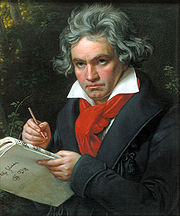
In 1824, Beethoven's Ninth redefined the symphony by introducing text and voice into a previously instrumental genre, thus igniting a debate on the future of the symphony itself. Richard Wagner
Richard Wagner
Wilhelm Richard Wagner was a German composer, conductor, theatre director, philosopher, music theorist, poet, essayist and writer primarily known for his operas...
later claimed that Beethoven's use of words had shown what musicologist Mark Evan Bonds terms "the limits of purely instrumental music and thus marking the end of the symphony as a vital genre". Others were not sure how to proceed—whether to emulate the Ninth by writing symphonies with choral finales, or to develop the symphony genre in a purely instrumental fashion. Eventually, Bonds writes, the symphony was seen "as an all-embracing, cosmic drama that transcended the realm of sound alone".
Some composers both emulated and expanded upon Beethoven's model. Berlioz showed in his choral symphony Roméo et Juliette a fresh approach to the epic nature of the symphony, using voices to blend music and narrative but saving crucial moments of that narrative for the orchestra alone. In doing so, Bonds writes, Berlioz illustrates for subsequent composers "new approaches for addressing the metaphysical in the realm of the symphony". Mendelssohn wrote his Second Symphony
Symphony No. 2 (Mendelssohn)
The Symphony No. 2 in B flat major, op. 52, called the "Lobgesang" Symphony, was composed by Felix Mendelssohn. It was written in 1840 to celebrate the 400th anniversary of the invention of printing, along with the less-known Festgesang "Gutenberg Cantata".The composer's description of the work...
as a work for chorus, soloists and orchestra. Labeling the work a "symphony-cantata", he expanded the choral finale to nine movements
Movement (music)
A movement is a self-contained part of a musical composition or musical form. While individual or selected movements from a composition are sometimes performed separately, a performance of the complete work requires all the movements to be performed in succession...
by including sections for vocal soloists, recitative
Recitative
Recitative , also known by its Italian name "recitativo" , is a style of delivery in which a singer is allowed to adopt the rhythms of ordinary speech...
s and sections for chorus; this made the vocal part longer than the three purely orchestral sections that preceded it. Liszt wrote two choral symphonies, following in these multi-movement forms the same compositional practices and programmatic goals he had established in his symphonic poems
Symphonic Poems (Liszt)
The symphonic poems of Franz Liszt are a series of 13 orchestral works by the Hungarian composer and are numbered S.95–107. The first 12 were composed between 1848 and 1858 ; the last, Von der Wiege bis zum Grabe , followed in 1882...
.
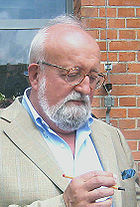
Symphony No. 2 (Mahler)
The Symphony No. 2 by Gustav Mahler, known as the Resurrection, was written between 1888 and 1894, and first performed in 1895. Apart from the Eighth Symphony, this symphony was Mahler's most popular and successful work during his lifetime. It is his first major work that would eventually mark his...
, the "Resurrection". In his Third
Symphony No. 3 (Mahler)
The Symphony No. 3 by Gustav Mahler was written between 1893 and 1896. It is his longest piece and is the longest symphony in the standard repertoire, with a typical performance lasting around ninety to one hundred minutes.- Structure :...
, he wrote a purely instrumental finale following two vocal movements, and in his Fourth
Symphony No. 4 (Mahler)
The Symphony No. 4 by Gustav Mahler was written between 1899 and 1901, though it incorporates a song originally written in 1892. The song, "Das himmlische Leben", presents a child's vision of Heaven. It is sung by a soprano in the work's fourth and last movement...
a vocal finale is sung by a solo soprano
Soprano
A soprano is a voice type with a vocal range from approximately middle C to "high A" in choral music, or to "soprano C" or higher in operatic music. In four-part chorale style harmony, the soprano takes the highest part, which usually encompasses the melody...
. After writing his Fifth
Symphony No. 5 (Mahler)
The Symphony No. 5 in C sharp minor by Gustav Mahler was composed in 1901 and 1902, mostly during the summer months at Mahler's cottage at Maiernigg. Among its most distinctive features are the funereal trumpet solo that opens the work and the frequently performed Adagietto.The musical canvas and...
, Sixth
Symphony No. 6 (Mahler)
The Symphony No. 6 in A minor by Gustav Mahler, sometimes referred to as the Tragische , was composed between 1903 and 1904 . The work's first performance was in Essen, on May 27, 1906, conducted by the composer.The tragic, even nihilistic ending of No...
and Seventh
Symphony No. 7 (Mahler)
Gustav Mahler's Seventh Symphony was written in 1904-05, with repeated revisions to the scoring. It is sometimes referred to by the title Song of the Night , though this title was not Mahler's own and he disapproved of it. Although the symphony is often described as being in the key of 'E minor,'...
Symphonies as purely instrumental works, Mahler returned to the vein of "festival-symphonic ceremonial" in his Eighth Symphony
Symphony No. 8 (Mahler)
The Symphony No. 8 in E-flat major by Gustav Mahler is one of the largest-scale choral works in the classical concert repertoire. Because it requires huge instrumental and vocal forces it is frequently called the "Symphony of a Thousand", although the work is often performed with fewer than a...
, which integrates text throughout the body of the work. After Mahler, the choral symphony became a more common genre, taking a number of compositional turns in the process. Some composers, such as Britten, Rachmaninoff, Shostakovich and Vaughan Williams, followed symphonic form strictly. Others, such as Havergal Brian
Havergal Brian
Havergal Brian , was a British classical composer.Brian acquired a legendary status at the time of his rediscovery in the 1950s and 1960s for the many symphonies he had managed to write. By the end of his life he had completed 32, an unusually large number for any composer since Haydn or Mozart...
, Alfred Schnittke
Alfred Schnittke
Alfred Schnittke ; November 24, 1934 – August 3, 1998) was a Russian and Soviet composer. Schnittke's early music shows the strong influence of Dmitri Shostakovich. He developed a polystylistic technique in works such as the epic First Symphony and First Concerto Grosso...
and Karol Szymanowski
Karol Szymanowski
Karol Maciej Szymanowski was a Polish composer and pianist.-Life:Szymanowski was born into a wealthy land-owning Polish gentry family in Tymoszówka, then in the Russian Empire, now in Cherkasy Oblast, Ukraine. He studied music privately with his father before going to Gustav Neuhaus'...
, chose either to expand symphonic form or to use different symphonic structures altogether.
Throughout the history of the choral symphony, works have been composed that have reflected particular programmatic compositional goals. One of the earliest such symphonies was Mendelssohn's Second Symphony
Symphony No. 2 (Mendelssohn)
The Symphony No. 2 in B flat major, op. 52, called the "Lobgesang" Symphony, was composed by Felix Mendelssohn. It was written in 1840 to celebrate the 400th anniversary of the invention of printing, along with the less-known Festgesang "Gutenberg Cantata".The composer's description of the work...
, commissioned by the city of Leipzig in 1840 to celebrate the 400th anniversary of Johannes Gutenberg's invention of movable type
Movable type
Movable type is the system of printing and typography that uses movable components to reproduce the elements of a document ....
. More than a century later, Henryk Górecki
Henryk Górecki
Henryk Mikołaj Górecki was a composer of contemporary classical music. He studied at the State Higher School of Music in Katowice between 1955 and 1960. In 1968, he joined the faculty and rose to provost before resigning in 1979. Górecki became a leading figure of the Polish avant-garde during...
's Second Symphony
Symphony No. 2 (Górecki)
Symphony No. 2, the "Copernican," Op. 31 is a choral symphony composed by Henryk Górecki in 1972 to celebrate the 500th anniversary of the birth of astronomer Nicolaus Copernicus. Composed in a monumental style for solo soprano, baritone, choir and orchestra, it features text from Psalms no...
, subtitled "Copernican", was commissioned in 1973 by the Kosciuszko Foundation
Kosciuszko Foundation
Kosciuszko Foundation is a charitable foundation based in New York City. It was created by Stephen Mizwa to fund programs that promote Polish-American intellectual and artistic exchange.-History:...
in New York
New York City
New York is the most populous city in the United States and the center of the New York Metropolitan Area, one of the most populous metropolitan areas in the world. New York exerts a significant impact upon global commerce, finance, media, art, fashion, research, technology, education, and...
to celebrate the 500th anniversary of the astronomer Nicolaus Copernicus
Nicolaus Copernicus
Nicolaus Copernicus was a Renaissance astronomer and the first person to formulate a comprehensive heliocentric cosmology which displaced the Earth from the center of the universe....
. In between these two works, in 1930, conductor Serge Koussevitsky commissioned Stravinsky to write the Symphony of Psalms
Symphony of Psalms
The Symphony of Psalms by Igor Stravinsky was written in 1930 and was commissioned by Serge Koussevitzky to celebrate the 50th anniversary of the Boston Symphony Orchestra. This piece is a three-movement choral symphony and was composed during Stravinsky's neoclassical period. The symphony derives...
for the 50th anniversary of the Boston Symphony Orchestra
Boston Symphony Orchestra
The Boston Symphony Orchestra is an orchestra based in Boston, Massachusetts. It is one of the five American orchestras commonly referred to as the "Big Five". Founded in 1881, the BSO plays most of its concerts at Boston's Symphony Hall and in the summer performs at the Tanglewood Music Center...
and, in 1946, composer Henri Barraud, then head of Radiodiffusion Française
Radiodiffusion-Télévision Française
Radiodiffusion-Télévision Française was the French national public broadcasting organization established on 9 February 1949 to replace the post-war "Radiodiffusion Française" , which had been founded in 1945...
, commissioned Darius Milhaud
Darius Milhaud
Darius Milhaud was a French composer and teacher. He was a member of Les Six—also known as The Group of Six—and one of the most prolific composers of the 20th century. His compositions are influenced by jazz and make use of polytonality...
to write his Third Symphony
Symphony No. 3 (Milhaud)
The Symphony No. 3, op. 271, sub-titled Te Deum, is a work for orchestra and chorus by French composer Darius Milhaud. The piece originated in a 1946 request by Radio France for a Te Deum celebrating the allied victory in World War II...
, subtitled "Te Deum", to commemorate the end of World War II
World War II
World War II, or the Second World War , was a global conflict lasting from 1939 to 1945, involving most of the world's nations—including all of the great powers—eventually forming two opposing military alliances: the Allies and the Axis...
.
In the final years of the 20th century and the early years of the 21st century, more choral symphonies were composed as works for special occasions. Krzysztof Penderecki
Krzysztof Penderecki
Krzysztof Penderecki , born November 23, 1933 in Dębica) is a Polish composer and conductor. His 1960 avant-garde Threnody to the Victims of Hiroshima for string orchestra brought him to international attention, and this success was followed by acclaim for his choral St. Luke Passion. Both these...
's Seventh Symphony
Symphony No. 7 (Penderecki)
Krzysztof Penderecki wrote his Seventh Symphony, subtitled "Seven Gates of Jerusalem," in 1996 to commemorate the third millennium of the city of Jerusalem. Originally conceived as an oratorio, this choral symphony was premièred in Jerusalem in January 1997; it was only after the first Polish...
was written to commemorate the third millennium of the city of Jerusalem. Tan Dun
Tan Dun
Tan Dun is a Chinese contemporary classical composer, most widely known for his scores for the movies Crouching Tiger, Hidden Dragon and Hero.-Early life in China:...
's Symphony 1997: Heaven Earth Mankind was composed to commemorate the transfer of sovereignty over Hong Kong that year to the People's Republic of China
People's Republic of China
China , officially the People's Republic of China , is the most populous country in the world, with over 1.3 billion citizens. Located in East Asia, the country covers approximately 9.6 million square kilometres...
. Philip Glass was commissioned to write his Fifth Symphony
Symphony No. 5 (Glass)
Symphony No. 5 is a symphony composed by Philip Glass. It is scored for chorus and orchestra.It was commissioned by the Salzburg Festival, Austria and premiered August 28, 1999 and was conducted by Dennis Russell Davies....
as one of several pieces to celebrate the beginning of the 21st century.
General features
Like an oratorioOratorio
An oratorio is a large musical composition including an orchestra, a choir, and soloists. Like an opera, an oratorio includes the use of a choir, soloists, an ensemble, various distinguishable characters, and arias...
or an opera
Opera
Opera is an art form in which singers and musicians perform a dramatic work combining text and musical score, usually in a theatrical setting. Opera incorporates many of the elements of spoken theatre, such as acting, scenery, and costumes and sometimes includes dance...
, a choral symphony is a musical work for orchestra, choir and (often) solo voices, although a few have been written for unaccompanied voices. Berlioz, who in 1858 first coined the term when describing his work Roméo et Juliette, explained the distinctive relationship he envisaged between voice and orchestra:
Even though voices are often used, it is neither a concert opera nor a cantataCantataA cantata is a vocal composition with an instrumental accompaniment, typically in several movements, often involving a choir....
, but a choral symphony. If there is singing, almost from the beginning, it is to prepare the listener's mind for the dramatic scenes whose feelings and passions are to be expressed by the orchestra. It is also to introduce the choral masses gradually into the musical development, when their too sudden appearance would have damaged the compositions's unity....
Unlike oratorios or operas, which are generally structured dramaturgically
Dramaturgy
Dramaturgy is the art of dramatic composition and the representation of the main elements of drama on the stage. Dramaturgy is a distinct practice separate from play writing and directing, although a single individual may perform any combination of the three. Some dramatists combine writing and...
into aria
Aria
An aria in music was originally any expressive melody, usually, but not always, performed by a singer. The term is now used almost exclusively to describe a self-contained piece for one voice usually with orchestral accompaniment...
s, recitative
Recitative
Recitative , also known by its Italian name "recitativo" , is a style of delivery in which a singer is allowed to adopt the rhythms of ordinary speech...
s and choruses, a choral symphony is structured like a symphony, in movements
Movement (music)
A movement is a self-contained part of a musical composition or musical form. While individual or selected movements from a composition are sometimes performed separately, a performance of the complete work requires all the movements to be performed in succession...
. It may employ the traditional four-movement scheme of a fast opening movement, slow movement, scherzo
Scherzo
A scherzo is a piece of music, often a movement from a larger piece such as a symphony or a sonata. The scherzo's precise definition has varied over the years, but it often refers to a movement which replaces the minuet as the third movement in a four-movement work, such as a symphony, sonata, or...
and finale, or as with many instrumental symphonies, it may use a different structure of movements. The written text in a choral symphony shares equal standing with the music, as in an oratorio, and the chorus and soloists share equality with the instruments. Over time the use of text allowed the choral symphony to evolve from an instrumental symphony with a choral finale, as in the Beethoven's Ninth, to a composition that can use voices and instruments throughout the entire composition, as in Stravinsky's Symphony of Psalms or Mahler's Eighth Symphony.
Sometimes the text can give a basic outline that correlates to the four-movement scheme of a symphony. For instance, the four-part structure of Edgar Allan Poe
Edgar Allan Poe
Edgar Allan Poe was an American author, poet, editor and literary critic, considered part of the American Romantic Movement. Best known for his tales of mystery and the macabre, Poe was one of the earliest American practitioners of the short story and is considered the inventor of the detective...
's The Bells
The Bells
"The Bells" is a heavily onomatopoeic poem by Edgar Allan Poe which was not published until after his death in 1849. It is perhaps best known for the diacopic repetition of the word "bells." The poem has four parts to it; each part becomes darker and darker as the poem progresses from "the jingling...
, a progression from youth to marriage, maturity, and death, naturally suggested the four movements of a symphony
Symphony
A symphony is an extended musical composition in Western classical music, scored almost always for orchestra. A symphony usually contains at least one movement or episode composed according to the sonata principle...
to Sergei Rachmaninoff
Sergei Rachmaninoff
Sergei Vasilievich Rachmaninoff was a Russian composer, pianist, and conductor. Rachmaninoff is widely considered one of the finest pianists of his day and, as a composer, one of the last great representatives of Romanticism in Russian classical music...
, which he followed in his choral symphony of the same name
The Bells (Rachmaninoff)
The Bells , Op. 35, is a choral symphony by Sergei Rachmaninoff, written in 1913. The words are from the poem The Bells by Edgar Allan Poe, very freely translated into Russian by the symbolist poet Konstantin Balmont. The traditional Gregorian melody Dies Irae is used frequently throughout the work...
. The text can encourage a composer to expand a choral symphony past the normal bounds of the symphonic genre, as with Berlioz for his Roméo et Juliette, yet stay within the basic structural or aesthetic intent of symphonic form. It can also influence the musical content in parts where there is no singing, as in Roméo et Juliette. There, Berlioz allows the orchestra to express the majority of the drama in instrumental music and saves words for expository
Exposition (literary technique)
At the beginning of a narrative, the exposition is the author's providing of some background information to the audience about the plot, characters' histories, setting, and theme. Exposition is considered one of four rhetorical modes of discourse, along with argumentation, description, and narration...
and narrative
Narrative
A narrative is a constructive format that describes a sequence of non-fictional or fictional events. The word derives from the Latin verb narrare, "to recount", and is related to the adjective gnarus, "knowing" or "skilled"...
sections of the work.
Relation of words and music
As in an oratorio, the written text in a choral symphony can be as important as the music, and the chorus and soloists can participate equally with the instruments in the exposition and development of musical ideas. The text can also help determine whether the composer follows symphonic form strictly, as in the case of Rachmaninoff, Britten and Shostakovich, or whether they expand symphonic form, as in the case of Berlioz, Mahler and Havergal Brian. Sometimes the choice of text has led the composer to different symphonic structures, as with Szymanowski, Schnittke and, again, Havergal Brian. The composer can also choose to treat the text fluidly, in a manner more like music than narrative. Such was the case with Vaughan Williams, Mahler and Philip Glass.Musical treatment of text
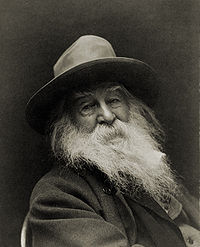
Walt Whitman
Walter "Walt" Whitman was an American poet, essayist and journalist. A humanist, he was a part of the transition between transcendentalism and realism, incorporating both views in his works. Whitman is among the most influential poets in the American canon, often called the father of free verse...
's poems inspired him to write the symphony, and Whitman's use of free verse
Free verse
Free verse is a form of poetry that refrains from consistent meter patterns, rhyme, or any other musical pattern.Poets have explained that free verse, despite its freedom, is not free. Free Verse displays some elements of form...
became appreciated at a time where fluidity of structure was becoming more attractive than traditional, metrical settings of text. This fluidity helped facilitate the non-narrative, symphonic treatment of text that Vaughan Williams had in mind. In the third movement in particular, the text is loosely descriptive and can be "pushed about by the music", some lines being repeated, some not consecutive in the written text immediately following one another in the music, and some left out entirely.
Vaughan Williams was not the only composer following a non-narrative approach to his text. Mahler took a similar, perhaps even more radical approach in his Eighth Symphony, presenting many lines of the first part, "Veni, Creator Spiritus", in what music writer and critic Michael Steinberg
Michael Steinberg (music critic)
Michael Steinberg was an American music critic, musicologist, and writer. Born in Breslau, Germany , Steinberg left Germany as one of the Kindertransport child refugees...
referred to as "an incredibly dense growth of repetitions, combinations, inversions, transpositions and conflations". He does the same with Goethe's text in Part Two of the symphony, making two substantial cuts and other changes.
Other works take the use of text as music still further. Vaughan Williams uses a chorus of women's voices wordlessly in his Sinfonia Antartica, based on his music for the film Scott of the Antarctic
Scott of the Antarctic (1948 film)
Scott of the Antarctic is a 1948 film about Robert Falcon Scott's ill-fated expedition to be the first to the South Pole in Antarctica in 1910-12...
, to help set the bleakness of the overall atmosphere. While a chorus is used in the second and third movements of Glass's Seventh Symphony
Symphony No. 7 (Glass)
A Toltec Symphony is a 2005 symphony by Philip Glass. The National Symphony Orchestra commissioned Glass to write it to commemorate the 60th birthday of conductor Leonard Slatkin...
, also known as A Toltec Symphony, the text contains no actual words; the composer states that it is instead formed "from loose syllables that add to the evocative context of the overall orchestral texture".
Music and words as equals
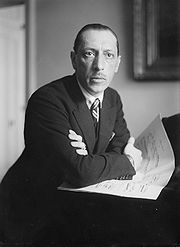
Symphony of Psalms
The Symphony of Psalms by Igor Stravinsky was written in 1930 and was commissioned by Serge Koussevitzky to celebrate the 50th anniversary of the Boston Symphony Orchestra. This piece is a three-movement choral symphony and was composed during Stravinsky's neoclassical period. The symphony derives...
that "it is not a symphony in which I have included Psalms to be sung. On the contrary, it is the singing of the Psalms that I am symphonizing". This decision was as much musical as it was textual. Stravinsky's counterpoint
Counterpoint
In music, counterpoint is the relationship between two or more voices that are independent in contour and rhythm and are harmonically interdependent . It has been most commonly identified in classical music, developing strongly during the Renaissance and in much of the common practice period,...
required several musical voices to function simultaneously, independent melodically
Melody
A melody , also tune, voice, or line, is a linear succession of musical tones which is perceived as a single entity...
and rhythm
Rhythm
Rhythm may be generally defined as a "movement marked by the regulated succession of strong and weak elements, or of opposite or different conditions." This general meaning of regular recurrence or pattern in time may be applied to a wide variety of cyclical natural phenomena having a periodicity or...
ically, yet interdependent harmonically
Harmony
In music, harmony is the use of simultaneous pitches , or chords. The study of harmony involves chords and their construction and chord progressions and the principles of connection that govern them. Harmony is often said to refer to the "vertical" aspect of music, as distinguished from melodic...
. They would sound very different when heard separately, yet harmonious when heard together. To facilitate maximum clarity in this interplay of voices, Stravinsky used "a choral and instrumental ensemble in which the two elements should be on an equal footing, neither of them outweighing the other".
Mahler's intent in writing his Eighth Symphony for exceptionally large forces was a similar balance between vocal and instrumental forces. It was not simply an attempt at grandiose effect, though the composer's use of such forces earned the work the subtitle "Symphony of a Thousand" from his press agent (a soubriquet which has stuck to the symphony to the present day). Like Stravinsky, Mahler makes extensive and extended use of counterpoint, especially in the first part, "Veni Creator Spiritus". Throughout this section, according to music writer Michael Kennedy
Michael Kennedy (music critic)
Dr. George Michael Sinclair Kennedy CBE is an English biographer, journalist and writer on classical music. He joined the Daily Telegraph at the age of 15 in 1941, and began writing music criticism for it in 1948...
, Mahler displays considerable mastery in manipulating multiple independent melodic voices. Musicologist Deryck Cooke
Deryck Cooke
Deryck Cooke was a British musician, musicologist and broadcaster.-Life:Cooke was born in Leicester to a poor and working class family; his father died when he was a child, but his mother was able to afford piano lessons. Cooke acquired a brilliant technique and began to compose...
adds that Mahler handles his huge forces "with extraordinary clarity".
Vaughan Williams also insisted on a balance between words and music in A Sea Symphony, writing in his program note for the work, "It is also noticeable that the orchestra has an equal share with the chorus and soloists in carrying out the musical ideas". Music critic Samuel Langford
Samuel Langford
Samuel Langford was an influential English music critic of the early twentieth century.Trained as a pianist, Langford became chief music critic of The Manchester Guardian in 1906, serving in that post until his death...
, writing about the premiere of the work for The Manchester Guardian, concurred with the composer, writing, "It is the nearest approach we have to a real choral symphony, one in which the voices are used throughout just as freely as the orchestra."
Words determining symphonic form
Spring Symphony
The Spring Symphony is Benjamin Britten's Opus 44. It is dedicated to Serge Koussevitzky and the Boston Symphony Orchestra. It was premiered in the Concertgebouw, Amsterdam on Thursday 14 July 1949 as part of the Holland Festival, when the composer was 35...
, the four sections of the symphony representing, in its composer's words, "the progress of Winter to Spring and the reawakening of the earth and life which that means.... It is in the traditional four movement shape of a symphony, but with the movements divided into shorter sections bound together by a similar mood or point of view".
The gestation of Shostakovich's Thirteenth Symphony
Symphony No. 13 (Shostakovich)
The Symphony No. 13 in B flat minor by Dmitri Shostakovich was first performed in Moscow on 18 December, 1962 by the Moscow Philharmonic Orchestra and the basses of the Republican State and Gnessin Institute Choirs, under Kirill Kondrashin . The soloist was Vitali Gromadsky...
, Babi Yar, was only slightly less straightforward. He set the poem Babi Yar
Babi Yar
Babi Yar is a ravine in the Ukrainian capital Kiev and a site of a series of massacres carried out by the Nazis during their campaign against the Soviet Union. The most notorious and the best documented of these massacres took place on September 29–30, 1941, wherein 33,771 Jews were killed in a...
by Yevgeny Yevtushenko
Yevgeny Yevtushenko
Yevgeny Aleksandrovich Yevtushenko is a Soviet and Russian poet. He is also a novelist, essayist, dramatist, screenwriter, actor, editor, and a director of several films.-Early life:...
almost immediately upon reading it, initially considering it a single-movement composition. Discovering three other Yevtushenko poems in the poet's collection Vzmakh ruki (A Wave of the Hand) prompted him to proceed to a full-length choral symphony, with "A Career" as the closing movement. Musicologist Francis Maes comments that Shostakovich did so by complementing Babi Yar's theme of Jewish suffering with Yevtushenko's verses about other Soviet abuses: "'At the Store' is a tribute to the women who have to stand in line for hours to buy the most basic foods,... 'Fears' evokes the terror under Stalin
Joseph Stalin
Joseph Vissarionovich Stalin was the Premier of the Soviet Union from 6 May 1941 to 5 March 1953. He was among the Bolshevik revolutionaries who brought about the October Revolution and had held the position of first General Secretary of the Communist Party of the Soviet Union's Central Committee...
. 'A Career' is an attack on bureaucrats and a tribute to genuine creativity". Music historian Boris Schwarz adds that the poems, in the order Shostakovich places them, form a strongly dramatic opening movement, a scherzo, two slow movements and a finale.
In other cases, the choice of text has led the composer to different symphonic structures. Havergal Brian allowed the form of his Fourth Symphony, subtitled "Das Siegeslied" (Psalm of Victory), to be dictated by the three-part structure of his text, Psalm 68; the setting of Verses 13–18 for soprano solo and orchestra forms a quiet interlude between two wilder, highly chromatic
Chromaticism
Chromaticism is a compositional technique interspersing the primary diatonic pitches and chords with other pitches of the chromatic scale. Chromaticism is in contrast or addition to tonality or diatonicism...
martial ones set for massive choral and orchestral forces. Likewise, Szymanowski allowed the text by 13th-century Persian poet Rumi to dictate what Dr. Jim Samson calls the "single tripartite movement" and "overall arch structure" of his Third Symphony, subtitled "Song of the Night".
Words expanding symphonic form

Symphonie Fantastique
Symphonie Fantastique: Épisode de la vie d'un Artiste...en cinq parties , Op. 14, is a program symphony written by the French composer Hector Berlioz in 1830. It is one of the most important and representative pieces of the early Romantic period, and is still very popular with concert audiences...
, both a scherzo and a march.... The 'extra' movements are thus the introduction with its potpourri of subsections and the descriptive tomb scene [at the end of the work]."
Mahler expanded the Beethovenian model for programmatic as well as symphonic reasons in his Second Symphony
Symphony No. 2 (Mahler)
The Symphony No. 2 by Gustav Mahler, known as the Resurrection, was written between 1888 and 1894, and first performed in 1895. Apart from the Eighth Symphony, this symphony was Mahler's most popular and successful work during his lifetime. It is his first major work that would eventually mark his...
, the "Resurrection", the vocal fourth movement, "Urlicht", bridging the childlike faith of the third movement with the ideological tension which Mahler seeks to resolve in the finale. He then abandoned this pattern for his Third Symphony
Symphony No. 3 (Mahler)
The Symphony No. 3 by Gustav Mahler was written between 1893 and 1896. It is his longest piece and is the longest symphony in the standard repertoire, with a typical performance lasting around ninety to one hundred minutes.- Structure :...
, as two movements for voices and orchestra follow three purely instrumental ones before the finale returns to instruments alone. Like Mahler, Havergal Brian expanded the Beethovenian model, but on a much larger scale and with far larger orchestral and choral forces, in his First Symphony
Symphony No. 1 (Havergal Brian)
The Symphony No. 1 in D minor by Havergal Brian was composed between 1919 and 1927, and partly owes its notoriety to being perhaps the largest symphony ever composed...
. Subtitled "The Gothic" and written between 1919 and 1927, the symphony was inspired by Goethe's Faust
Faust
Faust is the protagonist of a classic German legend; a highly successful scholar, but also dissatisfied with his life, and so makes a deal with the devil, exchanging his soul for unlimited knowledge and worldly pleasures. Faust's tale is the basis for many literary, artistic, cinematic, and musical...
and Gothic cathedral architecture. The Brian First is in two parts. The first consists of three instrumental movements; the second, also in three movements and over an hour in length, is a Latin setting of the Te Deum
Te Deum
The Te Deum is an early Christian hymn of praise. The title is taken from its opening Latin words, Te Deum laudamus, rendered literally as "Thee, O God, we praise"....
.
Symphonies for unaccompanied chorus
A few composers have written symphonies for unaccompanied chorus, in which the choir performs both vocal and instrumental functions. Granville BantockGranville Bantock
Sir Granville Bantock was a British composer of classical music.-Biography:Granville Ransome Bantock was born in London. His father was a Scottish doctor. He was intended by his parents for the Indian Civil Service but was drawn into the musical world. His first teacher was Dr Gordon Saunders at...
composed three such works—Atalanta in Calydon (1911), Vanity of Vanities (1913) and A Pageant of Human Life (1913). His Atalanta, called by musicologist Herbert Antcliffe "the most important [work of the three] alike in technical experiment and in inspiration", was written for a choir of at least 200, the composer specifying "'not less than 10 voices for each part,'" a work with 20 separate vocal parts. Using these forces, Bantock formed groups "of different weights and colors to get something of the varied play of tints and perspective [of an orchestra]". In addition, the choir is generally divided into three sections, approximating the timbres of woodwinds, brass and strings. Within these divisions, Antcliffe writes,
Almost every possible means of vocal expression is employed separately or in combination with others. To hear the different parts of the choir describing in word and tone "laughter" and "tears" respectively at the same time is to realize how little the possibilities of choral singing have as yet been grasped by the ordinary conductor and composer. Such combinations are extremely effective when properly achieved, but they are very difficult to achieve.
Roy Harris
Roy Harris
Roy Ellsworth Harris , was an American composer. He wrote much music on American subjects, becoming best known for his Symphony No...
wrote his Symphony for Voices in 1935 for a cappella
A cappella
A cappella music is specifically solo or group singing without instrumental sound, or a piece intended to be performed in this way. It is the opposite of cantata, which is accompanied singing. A cappella was originally intended to differentiate between Renaissance polyphony and Baroque concertato...
choir split into eight parts. Harris focused on harmony, rhythm and dynamics, allowing the text by Walt Whitman to dictate the choral writing. "In a real sense, the human strivings so vividly portrayed in Whitman's poetry find a musical analog to the trials to which the singers are subjected", John Profitt writes both of the music's difficulty for performers and of its highly evocative quality. Malcolm Williamson
Malcolm Williamson
Malcolm Benjamin Graham Christopher Williamson AO , CBE was an Australian composer. He was the Master of the Queen's Music from 1975 until his death.-Biography:...
wrote his Symphony for Voices between 1960 and 1962, setting texts by Australian poet James McAuley
James McAuley
James Phillip McAuley was an Australian academic, poet, journalist, literary critic and a prominent convert to Roman Catholicism.-Life and career:...
. Lewis Mitchell writes that the work is not a symphony in any true sense, but rather a four-movement work preceded by an invocation for solo contralto
Contralto
Contralto is the deepest female classical singing voice, with the lowest tessitura, falling between tenor and mezzo-soprano. It typically ranges between the F below middle C to the second G above middle C , although at the extremes some voices can reach the E below middle C or the second B above...
. The text is a combination of poems celebrating the Australian wilderness and visionary Christianity, its jagged lines and rhythms matched by the music. Mitchell writes, "Of all his choral works, with the possible exception of the Requiem for a Tribe Brother, the Symphony is the most Australian in feeling".
Programmatic intent

Hans Werner Henze
Hans Werner Henze is a German composer of prodigious output best known for "his consistent cultivation of music for the theatre throughout his life"...
wrote his 1997 Ninth Symphony
Symphony no. 9 (Henze)
The Ninth Symphony of the German composer Hans Werner Henze was written in 1997.It is a choral symphony, subtitled Den Helden und Märtyrern des deutschen Antifaschismus gewidmet...
in seven movements, basing the structure of the symphony on the novel The Seventh Cross
The Seventh Cross
Anna Seghers' novel The Seventh Cross , is one of the better-known examples of German literature circa World War II. It was published first in America, in an abridged version, in September 1942 by Little, Brown and Company...
by Anna Seghers
Anna Seghers
Anna Seghers was a German writer famous for depicting the moral experience of the Second World War.- Life :...
. The novel recounts the flight of seven fugitives from a Nazi prison camp, the seven crosses symbolizing the seven death sentences; the ordeal of the one prisoner who makes it to freedom becomes the crux of the text. Penderecki's Seventh Symphony, subtitled "Seven Gates of Jerusalem" and originally conceived as an oratorio, is not only written in seven movements but, musicologist Richard Whitehouse writes, is "pervaded by the number 'seven' at various levels." An extensive system of seven-note phrases binds the work together, as well as the frequent use of seven notes repeated at a single pitch. Seven chords played fortissimo bring the work to a close.
Philip Glass's Fifth Symphony, completed in 1999 and subtitled "Requiem
Requiem
A Requiem or Requiem Mass, also known as Mass for the dead or Mass of the dead , is a Mass celebrated for the repose of the soul or souls of one or more deceased persons, using a particular form of the Roman Missal...
, Bardo
Bardo
The Tibetan word Bardo means literally "intermediate state" - also translated as "transitional state" or "in-between state" or "liminal state". In Sanskrit the concept has the name antarabhāva...
and Nirmanakaya
Trikaya
The Trikāya doctrine is an important Mahayana Buddhist teaching on both the nature of reality and the nature of a Buddha. By the 4th century CE the Trikāya Doctrine had assumed the form that we now know...
", is written in 12 movements to fulfill its programmatic intent. Glass writes, "My plan has been for the symphony to represent a broad spectrum of many of the world's great 'wisdom' traditions", synthesizing "a vocal text that begins before the world's creation, passes through earthly life and paradise, and closes with a future dedication". Glass writes that he considered the millennium at the beginning of the 21st century to be a symbolic bridge between past, present and spiritual rebirth.
More recently, Glass based the philosophical and musical structure for his Seventh Symphony on the Wirrarika sacred trinity. Glass wrote about the work’s respective movement headings and their relation to the overall structure of the symphony, "'The Corn' represents a direct link between Mother Earth and the well-being of human beings.... 'The Sacred Root' is found in the high deserts of north and central Mexico, and is understood to be the doorway to the world of the Spirit. 'The Blue Deer' is considered the holder of the Book of Knowledge. Any man or woman who aspires to be a 'Person of Knowledge' will, through arduous training and effort, have to encounter the Blue Deer...."
Words changing programmatic intent
Addition of a text can effectively change the programmatic intent of a composition, as with the two choral symphonies of Franz LisztFranz Liszt
Franz Liszt ; ), was a 19th-century Hungarian composer, pianist, conductor, and teacher.Liszt became renowned in Europe during the nineteenth century for his virtuosic skill as a pianist. He was said by his contemporaries to have been the most technically advanced pianist of his age...
. Both the Faust
Faust Symphony
A Faust Symphony in three character pictures , S.108, or simply the "Faust Symphony", was written by Hungarian composer Franz Liszt and was inspired by Johann von Goethe's drama, Faust...
and Dante
Dante Symphony
A Symphony to Dante's Divine Comedy, S.109, or simply the "Dante Symphony", is a program symphony composed by Franz Liszt. Written in the high romantic style, it is based on Dante Alighieri's journey through Hell and Purgatory, as depicted in The Divine Comedy...
symphonies were conceived as purely instrumental works and only later became choral symphonies. However, while Liszt authority Humphrey Searle
Humphrey Searle
Humphrey Searle was a British composer.-Biography:He was born in Oxford where he was a classics scholar before studying — somewhat hesitantly — with John Ireland at the Royal College of Music in London, after which he went to Vienna on a six month scholarship to become a private pupil of Anton...
asserts that Liszt's later inclusion of a chorus effectively sums up Faust and makes it complete, another Liszt expert, Reeves Shulstad, suggests that Liszt changed the work's dramatic focus to the point of meriting a different interpretation of the work itself. According to Shulstad, "Liszt's original version of 1854 ended with a last fleeting reference to Gretchen
Gretchen
Maria Odete Brito de Miranda, known as Gretchen is a Brazilian singer. She became notorious as the Rainha do Bumbum in the late 1970s...
and an ... orchestral peroration in C major
C (musical note)
C or Do is the first note of the fixed-Do solfège scale. Its enharmonic is B.-Middle C:Middle C is designated C4 in scientific pitch notation because of the note's position as the fourth C key on a standard 88-key piano keyboard...
, based on the most majestic of themes from the opening movement. One might say that this conclusion remains within the persona of Faust and his imagination". When Liszt rethought the piece three years later, he added a "Chorus mysticus", the male chorus singing the final words from Goethe's Faust. The tenor soloist, accompanied by the chorus, sings the last two lines of the text. "With the addition of the 'Chorus Mysticus' text", Shulstad writes, "the Gretchen theme has been transformed and she no longer appears as a masked Faust. With this direct association to the final scene of the drama we have escaped Faust's imaginings and are hearing another voice commenting on his striving and redemption".
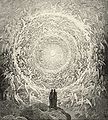
Dante Symphony
A Symphony to Dante's Divine Comedy, S.109, or simply the "Dante Symphony", is a program symphony composed by Franz Liszt. Written in the high romantic style, it is based on Dante Alighieri's journey through Hell and Purgatory, as depicted in The Divine Comedy...
changed both the structural and programmatic intent of the work. Liszt's intent was to follow the structure of the Divina Commedia and compose Dante in three movements—one each for the Inferno, Purgatorio and Paradiso. However, Liszt's son-in-law Richard Wagner persuaded him that no earthly composer could faithfully express the joys of Paradise. Liszt dropped the third movement but added a choral element, a Magnificat
Magnificat
The Magnificat — also known as the Song of Mary or the Canticle of Mary — is a canticle frequently sung liturgically in Christian church services. It is one of the eight most ancient Christian hymns and perhaps the earliest Marian hymn...
, at the end of the second. This action, Searle claims, effectively destroyed the work's formal balance and left the listener, like Dante, to gaze upward at the heights of Heaven
Heaven
Heaven, the Heavens or Seven Heavens, is a common religious cosmological or metaphysical term for the physical or transcendent place from which heavenly beings originate, are enthroned or inhabit...
and hear its music from afar. Shulstad suggests that the choral finale actually helps complete the work's programmatic trajectory from struggle to paradise.
Conversely, a text can also spark the birth of a choral symphony, only for that work to become a purely instrumental one when the programmatic focus of the work changes. Shostakovich originally planned his Seventh Symphony
Symphony No. 7 (Shostakovich)
Dmitri Shostakovich’s Symphony No. 7 in C major, Op. 60 dedicated to the city of Leningrad was completed on 27 December 1941. In its time, the symphony was extremely popular in both Russia and the West as a symbol of resistance and defiance to Nazi totalitarianism and militarism...
as a single-movement choral symphony much like his Second
Symphony No. 2 (Shostakovich)
Dmitri Shostakovich wrote his Symphony No. 2 in B major, Opus 14 and subtitled To October, for the 10th anniversary of the October Revolution. It was first performed by the Leningrad Philharmonic Orchestra and the Academy Capella Choir under Nikolai Malko, on 5 November 1927...
and Third Symphonies
Symphony No. 3 (Shostakovich)
The Symphony No. 3 in E flat major by Dmitri Shostakovich was first performed by the Leningrad Philharmonic Orchestra and Academy Capella Choir under Aleksandr Gauk on 21 January 1930....
. Shostakovich reportedly intended to set a text for the Seventh from the Ninth Psalm, on the theme of vengeance for the shedding of innocent blood. In doing this he was influenced by Stravinsky; he had been deeply impressed with the latter's Symphony of Psalms
Symphony of Psalms
The Symphony of Psalms by Igor Stravinsky was written in 1930 and was commissioned by Serge Koussevitzky to celebrate the 50th anniversary of the Boston Symphony Orchestra. This piece is a three-movement choral symphony and was composed during Stravinsky's neoclassical period. The symphony derives...
, which he wanted to emulate in this work. While the Ninth Psalm's theme conveyed Shostakovich's outrage over Stalin's oppression, a public performance of a work with such a text would have been impossible before the German invasion. Hitler's aggression made the performance of such a work feasible, at least in theory; the reference to "blood" could then be associated at least officially with Hitler. With Stalin appealing to the Soviets' patriotic and religious sentiments, the authorities were no longer suppressing Orthodox
Russian Orthodox Church
The Russian Orthodox Church or, alternatively, the Moscow Patriarchate The ROC is often said to be the largest of the Eastern Orthodox churches in the world; including all the autocephalous churches under its umbrella, its adherents number over 150 million worldwide—about half of the 300 million...
themes or images. Nevertheless, Shostakovich eventually realized that the work encompassed far more than this symbology. He expanded the symphony to the traditional four movements and made it purely instrumental.
Supplanting text wordlessly
While Berlioz allowed the programmatic aspects of his text to shape the symphonic form of Roméo and to guide its content, he also showed how an orchestra could supplant such a text wordlessly to further illustrate it. He wrote in his preface to Roméo:
If, in the famous garden and cemetery scenes the dialogue of the two lovers, Juliet's asides, and Romeo's passionate outbursts are not sung, if the duets of love and despair are given to the orchestra, the reasons are numerous and easy to comprehend. First, and this alone would be sufficient, it is a symphony and not an opera. Second, since duets of this nature have been handled vocally a thousand times by the greatest masters, it was wise as well as unusual to attempt another means of expression. It is also because the very sublimity of this love made its depiction so dangerous for the musician that he had to give his imagination a latitude that the positive sense of the sung words would not have given him, resorting instead to instrumental language, which is richer, more varied, less precise, and by its very indefiniteness incomparably more powerful in such a case.
As a manifesto, this paragraph became significant for the amalgamation of symphonic and dramatic elements in the same musical composition. Musicologist Hugh MacDonald writes that as Berlioz kept the idea of symphonic construction closely in mind, he allowed the orchestra to express the majority of the drama in instrumental music and set expository and narrative sections in words. Fellow musicologist Nicholas Temperley suggests that, in Roméo, Berlioz created a model for how a dramatic text could guide the structure of a choral symphony without circumventing that work from being recognizably a symphony. In this sense, musicologist Mark Evans Bonds writes, the symphonies of Liszt and Mahler owe a debt of influence to Berlioz.
More recently, Alfred Schnittke allowed the programmatic aspects of his texts to dictate the course of both his choral symphonies even when no words were being sung. Schnittke's six-movement Second Symphony
Symphony No. 2 (Schnittke)
Russian composer Alfred Schnittke wrote his Symphony No. 2, subtitled "St. Florian" and "Invisible Mass" in 1979. It is a choral symphony, written for contralto, countertenor, tenor and bass, plus chorus and orchestra. The symphony was written in homage to 19th century Austrian composer and...
, following the Ordinary of the Mass
Ordinary of the Mass
The ordinary, in Roman Catholic and other Western Christian liturgies, refers to the part of the Eucharist or of the canonical hours that is reasonably constant without regard to the date on which the service is performed...
of the Roman Catholic Church
Roman Catholic Church
The Catholic Church, also known as the Roman Catholic Church, is the world's largest Christian church, with over a billion members. Led by the Pope, it defines its mission as spreading the gospel of Jesus Christ, administering the sacraments and exercising charity...
, works programmatically on two levels simultaneously. While soloists and chorus briefly perform the mass, set to chorales taken from the Gradual
Gradual
The Gradual is a chant or hymn in the liturgical celebration of the Eucharist for many Christian denominations. In the Tridentine Mass it was and is sung after the reading or chanting of the Epistle and before the Alleluia, or, during penitential seasons, before the Tract. In the Mass of Paul VI...
, the orchestra provides an extended running commentary that can continue much longer than the section of the mass being performed. Sometimes the commentary follows a particular chorale but more often is freer and wider ranging in style. Despite the resulting stylistic disparity, biographer Alexander Ivashkin comments, "musically almost all these sections blend the choral [sic] tune and subsequent extensive orchestral 'commentary.'" The work becomes what Schnittke called an "Invisible Mass", and Ivashkin termed "a symphony against a chorale backdrop".
The program in Schnittke's Fourth Symphony
Symphony No. 4 (Schnittke)
Russian composer Alfred Schnittke wrote his Symphony No. 4 in 1983. It is a choral symphony, written for tenor, countertenor, chorus, and orchestra. It was first performed on April 12, 1984, in Moscow.-Structure:...
, reflecting the composer's own religious dilemma at the time it was written, is more complex in execution, with the majority of it expressed wordlessly. In the 22 variations that make up the symphony's single movement,The actual number of variations in the Schnittke Fourth Symphony is "a subtle non-synchronicity" of the piece, considering the "3 by 5 scheme" of the Rosary upon which these variations are reportedly based. Weitzman, notes for Chandos 9463, 5. Schnittke enacts the 15 traditional Mysteries of the Rosary, which highlight important moments in the life of Christ. As he did in the Second Symphony, Schnittke simultaneously gives a detailed musical commentary on what is being portrayed. Schnittke does this while using church music from the Catholic, Protestant
Protestantism
Protestantism is one of the three major groupings within Christianity. It is a movement that began in Germany in the early 16th century as a reaction against medieval Roman Catholic doctrines and practices, especially in regards to salvation, justification, and ecclesiology.The doctrines of the...
, Jewish
Judaism
Judaism ) is the "religion, philosophy, and way of life" of the Jewish people...
and Orthodox
Orthodoxy
The word orthodox, from Greek orthos + doxa , is generally used to mean the adherence to accepted norms, more specifically to creeds, especially in religion...
faiths, the orchestral texture becoming extremely dense from the many musical strands progressing at the same time. A tenor
Tenor
The tenor is a type of male singing voice and is the highest male voice within the modal register. The typical tenor voice lies between C3, the C one octave below middle C, to the A above middle C in choral music, and up to high C in solo work. The low extreme for tenors is roughly B2...
and a countertenor
Countertenor
A countertenor is a male singing voice whose vocal range is equivalent to that of a contralto, mezzo-soprano, or a soprano, usually through use of falsetto, or far more rarely than normal, modal voice. A pre-pubescent male who has this ability is called a treble...
also sing wordlessly at two points in the symphony. Words are saved for a finale in which all four types of church music are used contrapuntally
Counterpoint
In music, counterpoint is the relationship between two or more voices that are independent in contour and rhythm and are harmonically interdependent . It has been most commonly identified in classical music, developing strongly during the Renaissance and in much of the common practice period,...
as a four-part choir sings the Ave Maria. The choir can choose whether to sing the Ave Maria in Russian or Latin. The programmatic intent of using these different types of music, Ivashkin writes, is an insistence by the composer "on the idea ... of the unity of humanity, a synthesis and harmony among various manifestations of belief".