

Muhammad Ali Dynasty

Encyclopedia
The Muhammad Ali Dynasty ( Usrat Muhammad 'Ali) was the ruling dynasty of Egypt
and Sudan
, from the 19th to the mid-20th Century. It is named after its progenitor, Muhammad Ali Pasha
, regarded as the founder of modern Egypt. It was also more formally known as the Alawiyya Dynasty ( al-Usra al-'Alawiyya). Because a majority of the rulers from this dynasty bore the title Khedive
, it was often referred to by contemporaries as the 'Khedival Dynasty'.
commander of the Ottoman
army that was sent to drive Napoleon's forces out of Egypt, but upon the French
withdrawal, seized power
himself and forced the Ottoman Sultan Mahmud II
to recognize him as Wāli
, or Governor of Egypt in 1805. Demonstrating his grander ambitions, he took the title of Khedive
; however, this was not sanctioned by the Porte.
Muhammad Ali transformed Egypt
into a regional power which he saw as the natural successor to the decaying Ottoman Empire
. He summed up his vision for Egypt in this way:
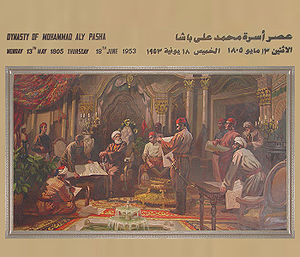 At the height of his power, Muhammad Ali and his son Ibrahim Pasha
's military strength did indeed threaten the very existence of the Ottoman Empire
as he sought to supplant the Osman Dynasty
with his own. Ultimately, the intervention of the Great Powers prevented Egyptian forces from marching on Constantinople
, and henceforth, his dynasty's rule would be limited to Africa
, and Sinai. Muhammad Ali had conquered Sudan
in the first half of his reign and Egyptian control would be consolidated and expanded under his successors, most notably Ibrahim Pasha's son Ismai'l I
.
in preference to the lesser Wāli
, this was not recognized by the Porte until 1867 when Sultan Abdul-Aziz
officially sanctioned its use by Isma'il Pasha
and his successors. In contrast to his grandfather's policy of war against the Porte, Ismai'l sought to strengthen the position of Egypt and Sudan and his dynasty using less confrontational means, and through a mixture of flattery and bribery, Ismai'l secured official Ottoman recognition of Egypt and Sudan's virtual independence. This freedom was severely undermined in 1879 when the Sultan colluded with the Great Powers to depose Ismai'l in favor of his son Tewfik
. Three years later, Egypt and Sudan's freedom became little more than symbolic when the United Kingdom
invaded and occupied the country, ostensibly to support Khedive Tewfik against his opponents in Ahmed Orabi's nationalist government. While the Khedive would continue to rule over Egypt and Sudan in name, in reality, ultimate power resided with the British High Commissioner.
 In defiance of the Egyptians, the British proclaimed Sudan to be an Anglo-Egyptian Condominium
, a territory under joint British and Egyptian rule rather than an integral part of Egypt. This was continually rejected by Egyptians
, both in government and in the public at large, who insisted on the "unity of the Nile Valley", and would remain an issue of controversy and enmity between Egypt and Britain until Sudan's independence in 1956.
sided with the Ottoman Empire which had joined the Central Powers
in the First World War, and was promptly deposed by the British in favor of his uncle Hussein Kamel. The legal fiction of Ottoman sovereignty over Egypt and Sudan, which had for all intents and purposes ended in 1805, was officially terminated, Hussein Kamel was declared Sultan of Egypt and Sudan
, and the country became a British Protectorate. With nationalist sentiment rising, as evidenced by the Revolution of 1919
, Britain formally recognized
Egyptian independence in 1922, and Hussein Kamel's successor, Sultan Fuad I
, substituted the title of King for Sultan. However, British occupation and interference in Egyptian and Sudanese affairs persisted. Of particular concern to Egypt was Britain's continual efforts to divest Egypt of all control in Sudan. To both the King and the nationalist movement, this was intolerable, and the Egyptian Government made a point of stressing that Fuad and his son King Farouk I were "King of Egypt and Sudan".

. All these factors served to terminally undermine Farouk's position and paved the way for the Revolution of 1952
. Farouk was forced to abdicate in favor of his infant son Ahmed-Fuad who became King Fuad II
, while administration of the country passed to the Free Officers Movement
under Muhammad Naguib
and Gamal Abdel Nasser
. The infant king's reign lasted less than a year and on June 18 1953, the revolutionaries abolished the monarchy and declared Egypt a republic
, ending a century and a half of the Muhammad Ali Dynasty's rule.
Khedives (1867–1914)
Sultans (1914–1922)
Kings (1922–1952)
Egypt
Egypt , officially the Arab Republic of Egypt, Arabic: , is a country mainly in North Africa, with the Sinai Peninsula forming a land bridge in Southwest Asia. Egypt is thus a transcontinental country, and a major power in Africa, the Mediterranean Basin, the Middle East and the Muslim world...
and Sudan
Sudan
Sudan , officially the Republic of the Sudan , is a country in North Africa, sometimes considered part of the Middle East politically. It is bordered by Egypt to the north, the Red Sea to the northeast, Eritrea and Ethiopia to the east, South Sudan to the south, the Central African Republic to the...
, from the 19th to the mid-20th Century. It is named after its progenitor, Muhammad Ali Pasha
Muhammad Ali of Egypt
Muhammad Ali Pasha al-Mas'ud ibn Agha was a commander in the Ottoman army, who became Wāli, and self-declared Khedive of Egypt and Sudan...
, regarded as the founder of modern Egypt. It was also more formally known as the Alawiyya Dynasty ( al-Usra al-'Alawiyya). Because a majority of the rulers from this dynasty bore the title Khedive
Khedive
The term Khedive is a title largely equivalent to the English word viceroy. It was first used, without official recognition, by Muhammad Ali Pasha , the Wāli of Egypt and Sudan, and vassal of the Ottoman Empire...
, it was often referred to by contemporaries as the 'Khedival Dynasty'.
Introduction
Muhammad Ali was an AlbanianAlbanians
Albanians are a nation and ethnic group native to Albania and neighbouring countries. They speak the Albanian language. More than half of all Albanians live in Albania and Kosovo...
commander of the Ottoman
Ottoman Empire
The Ottoman EmpireIt was usually referred to as the "Ottoman Empire", the "Turkish Empire", the "Ottoman Caliphate" or more commonly "Turkey" by its contemporaries...
army that was sent to drive Napoleon's forces out of Egypt, but upon the French
France
The French Republic , The French Republic , The French Republic , (commonly known as France , is a unitary semi-presidential republic in Western Europe with several overseas territories and islands located on other continents and in the Indian, Pacific, and Atlantic oceans. Metropolitan France...
withdrawal, seized power
Muhammad Ali's seizure of power
The process of Muhammad Ali's seizure of power in Egypt was a long three way civil war between the Ottoman Turks, Egyptian Mamluks, and Albanian mercenaries. It ended in victory for the Albanians led by Muhammad Ali of Egypt ....
himself and forced the Ottoman Sultan Mahmud II
Mahmud II
Mahmud II was the 30th Sultan of the Ottoman Empire from 1808 until his death in 1839. He was born in the Topkapi Palace, Istanbul, the son of Sultan Abdulhamid I...
to recognize him as Wāli
Wali
Walī , is an Arabic word meaning "custodian", "protector", "sponsor", or authority as denoted by its definition "crown". "Wali" is someone who has "Walayah" over somebody else. For example, in Fiqh the father is wali of his children. In Islam, the phrase ولي الله walīyu 'llāh...
, or Governor of Egypt in 1805. Demonstrating his grander ambitions, he took the title of Khedive
Khedive
The term Khedive is a title largely equivalent to the English word viceroy. It was first used, without official recognition, by Muhammad Ali Pasha , the Wāli of Egypt and Sudan, and vassal of the Ottoman Empire...
; however, this was not sanctioned by the Porte.
Muhammad Ali transformed Egypt
Egypt
Egypt , officially the Arab Republic of Egypt, Arabic: , is a country mainly in North Africa, with the Sinai Peninsula forming a land bridge in Southwest Asia. Egypt is thus a transcontinental country, and a major power in Africa, the Mediterranean Basin, the Middle East and the Muslim world...
into a regional power which he saw as the natural successor to the decaying Ottoman Empire
Ottoman Empire
The Ottoman EmpireIt was usually referred to as the "Ottoman Empire", the "Turkish Empire", the "Ottoman Caliphate" or more commonly "Turkey" by its contemporaries...
. He summed up his vision for Egypt in this way:
"I am well aware that the (Ottoman) Empire is heading by the day toward destruction...On her ruins I will build a vast kingdom...up to the Euphrates and the Tigris."
Ibrahim Pasha of Egypt
Ibrahim Pasha was the eldest son of Muhammad Ali, the Wāli and unrecognised Khedive of Egypt and Sudan. He served as a general in the Egyptian army that his father established during his reign, taking his first command of Egyptian forces was when he was merely a teenager...
's military strength did indeed threaten the very existence of the Ottoman Empire
Ottoman Empire
The Ottoman EmpireIt was usually referred to as the "Ottoman Empire", the "Turkish Empire", the "Ottoman Caliphate" or more commonly "Turkey" by its contemporaries...
as he sought to supplant the Osman Dynasty
Ottoman Dynasty
The Ottoman Dynasty ruled the Ottoman Empire from 1299 to 1922, beginning with Osman I , though the dynasty was not proclaimed until Orhan Bey declared himself sultan...
with his own. Ultimately, the intervention of the Great Powers prevented Egyptian forces from marching on Constantinople
Istanbul
Istanbul , historically known as Byzantium and Constantinople , is the largest city of Turkey. Istanbul metropolitan province had 13.26 million people living in it as of December, 2010, which is 18% of Turkey's population and the 3rd largest metropolitan area in Europe after London and...
, and henceforth, his dynasty's rule would be limited to Africa
Africa
Africa is the world's second largest and second most populous continent, after Asia. At about 30.2 million km² including adjacent islands, it covers 6% of the Earth's total surface area and 20.4% of the total land area...
, and Sinai. Muhammad Ali had conquered Sudan
Sudan
Sudan , officially the Republic of the Sudan , is a country in North Africa, sometimes considered part of the Middle East politically. It is bordered by Egypt to the north, the Red Sea to the northeast, Eritrea and Ethiopia to the east, South Sudan to the south, the Central African Republic to the...
in the first half of his reign and Egyptian control would be consolidated and expanded under his successors, most notably Ibrahim Pasha's son Ismai'l I
Isma'il Pasha
Isma'il Pasha , known as Ismail the Magnificent , was the Khedive of Egypt and Sudan from 1863 to 1879, when he was removed at the behest of the United Kingdom...
.
Khedivate and British Occupation
Though Muhammad Ali and his descendants used the title of KhediveKhedive
The term Khedive is a title largely equivalent to the English word viceroy. It was first used, without official recognition, by Muhammad Ali Pasha , the Wāli of Egypt and Sudan, and vassal of the Ottoman Empire...
in preference to the lesser Wāli
Wali
Walī , is an Arabic word meaning "custodian", "protector", "sponsor", or authority as denoted by its definition "crown". "Wali" is someone who has "Walayah" over somebody else. For example, in Fiqh the father is wali of his children. In Islam, the phrase ولي الله walīyu 'llāh...
, this was not recognized by the Porte until 1867 when Sultan Abdul-Aziz
Abdülâziz
Abdülaziz I or Abd Al-Aziz, His Imperial Majesty was the 32nd Sultan of the Ottoman Empire and reigned between 25 June 1861 and 30 May 1876...
officially sanctioned its use by Isma'il Pasha
Isma'il Pasha
Isma'il Pasha , known as Ismail the Magnificent , was the Khedive of Egypt and Sudan from 1863 to 1879, when he was removed at the behest of the United Kingdom...
and his successors. In contrast to his grandfather's policy of war against the Porte, Ismai'l sought to strengthen the position of Egypt and Sudan and his dynasty using less confrontational means, and through a mixture of flattery and bribery, Ismai'l secured official Ottoman recognition of Egypt and Sudan's virtual independence. This freedom was severely undermined in 1879 when the Sultan colluded with the Great Powers to depose Ismai'l in favor of his son Tewfik
Tewfik Pasha
HH Muhammed Tewfik Pasha ' was Khedive of Egypt and Sudan between 1879 and 1892, and the sixth ruler from the Muhammad Ali Dynasty.-Early life:...
. Three years later, Egypt and Sudan's freedom became little more than symbolic when the United Kingdom
United Kingdom
The United Kingdom of Great Britain and Northern IrelandIn the United Kingdom and Dependencies, other languages have been officially recognised as legitimate autochthonous languages under the European Charter for Regional or Minority Languages...
invaded and occupied the country, ostensibly to support Khedive Tewfik against his opponents in Ahmed Orabi's nationalist government. While the Khedive would continue to rule over Egypt and Sudan in name, in reality, ultimate power resided with the British High Commissioner.
Anglo-Egyptian Sudan
Anglo-Egyptian Sudan referred to the manner by which Sudan was administered between 1899 and 1956, when it was a condominium of Egypt and the United Kingdom.-Union with Egypt:...
, a territory under joint British and Egyptian rule rather than an integral part of Egypt. This was continually rejected by Egyptians
Egyptians
Egyptians are nation an ethnic group made up of Mediterranean North Africans, the indigenous people of Egypt.Egyptian identity is closely tied to geography. The population of Egypt is concentrated in the lower Nile Valley, the small strip of cultivable land stretching from the First Cataract to...
, both in government and in the public at large, who insisted on the "unity of the Nile Valley", and would remain an issue of controversy and enmity between Egypt and Britain until Sudan's independence in 1956.
Sultanate and Kingdom
In 1914, Khedive Abbas IIAbbas II of Egypt
HH Abbas II Hilmi Bey was the last Khedive of Egypt and Sudan .-Early life:...
sided with the Ottoman Empire which had joined the Central Powers
Central Powers
The Central Powers were one of the two warring factions in World War I , composed of the German Empire, the Austro-Hungarian Empire, the Ottoman Empire, and the Kingdom of Bulgaria...
in the First World War, and was promptly deposed by the British in favor of his uncle Hussein Kamel. The legal fiction of Ottoman sovereignty over Egypt and Sudan, which had for all intents and purposes ended in 1805, was officially terminated, Hussein Kamel was declared Sultan of Egypt and Sudan
Sultan of Egypt
Sultan of Egypt was the status held by the rulers of Egypt after the establishment of the Ayyubid Dynasty of Saladin in 1174 until the Ottoman conquest of Egypt in 1517. Though the extent of the Egyptian Sultanate ebbed and flowed, it generally included Sham and Hejaz, with the consequence that the...
, and the country became a British Protectorate. With nationalist sentiment rising, as evidenced by the Revolution of 1919
Egyptian Revolution of 1919
The Egyptian Revolution of 1919 was a countrywide revolution against the British occupation of Egypt and Sudan. It was carried out by Egyptians and Sudanese from different walks of life in the wake of the British-ordered exile of revolutionary leader Saad Zaghlul, and other members of the Wafd...
, Britain formally recognized
Unilateral Declaration of Egyptian Independence
The Unilateral Declaration of Egyptian Independence was issued by the government of the United Kingdom of Great Britain and Ireland on 28 February 1922...
Egyptian independence in 1922, and Hussein Kamel's successor, Sultan Fuad I
Fuad I of Egypt
Fuad I was the Sultan and later King of Egypt and Sudan, Sovereign of Nubia, Kordofan, and Darfur. The ninth ruler of Egypt and Sudan from the Muhammad Ali Dynasty, he became Sultan of Egypt and Sudan in 1917, succeeding his elder brother Sultan Hussein Kamel...
, substituted the title of King for Sultan. However, British occupation and interference in Egyptian and Sudanese affairs persisted. Of particular concern to Egypt was Britain's continual efforts to divest Egypt of all control in Sudan. To both the King and the nationalist movement, this was intolerable, and the Egyptian Government made a point of stressing that Fuad and his son King Farouk I were "King of Egypt and Sudan".
Dissolution
The reign of Farouk was characterized by ever increasing nationalist discontent over the British occupation, royal corruption and incompetence, and the disastrous 1948 Arab-Israeli War1948 Arab-Israeli War
The 1948 Arab–Israeli War, known to Israelis as the War of Independence or War of Liberation The war commenced after the termination of the British Mandate for Palestine and the creation of an independent Israel at midnight on 14 May 1948 when, following a period of civil war, Arab armies invaded...
. All these factors served to terminally undermine Farouk's position and paved the way for the Revolution of 1952
1952 Revolution
The Egyptian Revolution of 1952 , also known as the 23 July Revolution, began on 23 July 1952, with a military coup d'état by the Free Officers Movement, a group of army officers led by Muhammad Naguib and Gamal Abdel Nasser. The revolution was initially aimed at overthrowing King Farouk...
. Farouk was forced to abdicate in favor of his infant son Ahmed-Fuad who became King Fuad II
Fuad II of Egypt
Fuad II was the last King of Egypt and Sudan.- Biography :He ascended the throne on 26 July 1952 upon the abdication of his father King Farouk I following the Egyptian Revolution of 1952...
, while administration of the country passed to the Free Officers Movement
Free Officers Movement
In Egypt, the clandestine revolutionary Free Officers Movement was composed of young junior army officers committed to unseating the Egyptian monarchy and its British advisors...
under Muhammad Naguib
Muhammad Naguib
Muhammad Naguib was the first President of Egypt, serving from the declaration of the Republic on June 18, 1953 to November 14, 1954. Along with Gamal Abdel Nasser, he was the primary leader of the Egyptian Revolution of 1952, which ended the rule of the Muhammad Ali Dynasty in Egypt and Sudan...
and Gamal Abdel Nasser
Gamal Abdel Nasser
Gamal Abdel Nasser Hussein was the second President of Egypt from 1956 until his death. A colonel in the Egyptian army, Nasser led the Egyptian Revolution of 1952 along with Muhammad Naguib, the first president, which overthrew the monarchy of Egypt and Sudan, and heralded a new period of...
. The infant king's reign lasted less than a year and on June 18 1953, the revolutionaries abolished the monarchy and declared Egypt a republic
Republic
A republic is a form of government in which the people, or some significant portion of them, have supreme control over the government and where offices of state are elected or chosen by elected people. In modern times, a common simplified definition of a republic is a government where the head of...
, ending a century and a half of the Muhammad Ali Dynasty's rule.
Reigning members of the Muhammad Ali Dynasty (1805–1952)
Wālis, self-declared as Khedives (1805–1867)- Muhammad AliMuhammad Ali of EgyptMuhammad Ali Pasha al-Mas'ud ibn Agha was a commander in the Ottoman army, who became Wāli, and self-declared Khedive of Egypt and Sudan...
(9 July 1805 – 1 September 1848) - IbrahimIbrahim Pasha of EgyptIbrahim Pasha was the eldest son of Muhammad Ali, the Wāli and unrecognised Khedive of Egypt and Sudan. He served as a general in the Egyptian army that his father established during his reign, taking his first command of Egyptian forces was when he was merely a teenager...
(reigned as Wāli briefly during his father's incapacity) (1 September 1848 – 10 November 1848) - Abbas IAbbas I of EgyptAbbas I , , also known as Abbas Hilmi I Pasha Wāli of Egypt and Sudan, was a son of Tusun Pasha and grandson of Muhammad Ali, founder of the reigning dynasty of Egypt and Sudan at the time...
(10 November 1848 – 13 July 1854) - Sa‘id I (13 July 1854 – 18 January 1863)
- Ismai'l IIsma'il PashaIsma'il Pasha , known as Ismail the Magnificent , was the Khedive of Egypt and Sudan from 1863 to 1879, when he was removed at the behest of the United Kingdom...
(18 January 1863 – 8 June 1867)
Khedives (1867–1914)
- Ismai'l IIsma'il PashaIsma'il Pasha , known as Ismail the Magnificent , was the Khedive of Egypt and Sudan from 1863 to 1879, when he was removed at the behest of the United Kingdom...
(8 June 1867 – 26 June 1879) - Tewfik ITewfik PashaHH Muhammed Tewfik Pasha ' was Khedive of Egypt and Sudan between 1879 and 1892, and the sixth ruler from the Muhammad Ali Dynasty.-Early life:...
(26 June 1879 – 7 January 1892) - Abbas IIAbbas II of EgyptHH Abbas II Hilmi Bey was the last Khedive of Egypt and Sudan .-Early life:...
(8 January 1892 – 19 December 1914)
Sultans (1914–1922)
- Hussein Kamel (19 December 1914 – 9 October 1917)
- Fuad IFuad I of EgyptFuad I was the Sultan and later King of Egypt and Sudan, Sovereign of Nubia, Kordofan, and Darfur. The ninth ruler of Egypt and Sudan from the Muhammad Ali Dynasty, he became Sultan of Egypt and Sudan in 1917, succeeding his elder brother Sultan Hussein Kamel...
(9 October 1917 – 16 March 1922)
Kings (1922–1952)
- Fuad IFuad I of EgyptFuad I was the Sultan and later King of Egypt and Sudan, Sovereign of Nubia, Kordofan, and Darfur. The ninth ruler of Egypt and Sudan from the Muhammad Ali Dynasty, he became Sultan of Egypt and Sudan in 1917, succeeding his elder brother Sultan Hussein Kamel...
(16 March 1922 – 28 April 1936) - Farouk IFarouk of EgyptFarouk I of Egypt , was the tenth ruler from the Muhammad Ali Dynasty and the penultimate King of Egypt and Sudan, succeeding his father, Fuad I, in 1936....
(28 April 1936 – 26 July 1952)- Prince Muhammad Ali TewfikMohammed Ali TewfikPrince Mohammed Ali Tewfik was the heir presumptive of Egypt and Sudan from 1892-1899 and 1936-1952.-Regent:...
(Chairman Council of Regency during Farouk I's minority) (28 April 1936 – 29 July 1937)
- Prince Muhammad Ali Tewfik
- Fuad IIFuad II of EgyptFuad II was the last King of Egypt and Sudan.- Biography :He ascended the throne on 26 July 1952 upon the abdication of his father King Farouk I following the Egyptian Revolution of 1952...
(26 July 1952 – 18 June 1953)- Prince Muhammad Abdel Moneim (Chairman Council of Regency during Fuad II's minority) (26 July 1952 – 18 June 1953)
Non ruling members
- Prince Mustafa Fazl Pasha
- Prince Mohammed Ali TewfikMohammed Ali TewfikPrince Mohammed Ali Tewfik was the heir presumptive of Egypt and Sudan from 1892-1899 and 1936-1952.-Regent:...
- Prince Muhammad Abdul MoneimPrince Muhammad Abdul MoneimHE Damat HH Prince/HRH Prince Muhammad Abdel Moneim Beyefendi was an Egyptian prince and former heir apparent to the throne of Egypt and Sudan from 1899 to 1914...
- Princess Fawzia Fuad
- Muhammad Ali, Prince of SaidMuhammad Ali, Prince of SaidPrince Muhammad Ali, Prince of the Sa'id is the heir apparent to the currently abolished thrones of Egypt and Sudan.He was born in Cairo the grandson of king Farouk and Queen Nariman, and the elder son of Fuad II and his former wife, Fadila...
- Narriman SadekNarriman SadekNarriman Sadek was the daughter of Hussain Fahmi Sadiq Bey, a high-ranking official in the Egyptian government, and his wife Asila Kamil; she was the second wife of King Farouk and the last Queen of Egypt.-Meeting Farouk:Farouk divorced his first wife, Queen Farida, in 1948, after a ten-year...
- Nazli SabriNazli SabriNazli Sabri , was the Queen consort of Egypt, as the second wife of King Fuad.-Early life:...
- Mahmud Dramali PashaMahmud Dramali PashaMahmud Pasha, called Dramalı was a Beyzade, an Ottoman Vizier, Serdar-ı Ekrem, Pasha and governor of Larissa, Drama and the Morea. In 1822, he was tasked with suppressing the Greek Revolution, but was defeated and died shortly after....
See also
- Muhammad Ali Dynasty family treeMuhammad Ali Dynasty family treeThe Muhammad Ali Dynasty ruled Egypt without interruption from Muhammad Ali's seizure of power in 1805 until the proclamation of the Republic in 1953. Eleven individuals ruled Egypt during the dynasty's 148-year lifespan...
- List of monarchs of the Muhammad Ali Dynasty
- History of Egypt under the Muhammad Ali dynasty
- History of Sudan under Muhammad Ali and his successors
- List of Sunni Muslim dynasties