
All Topics  
Skanderbeg


   Email Print
   Bookmark   Link


Skanderbeg


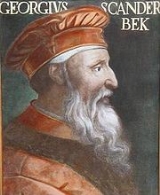
Gjergj Kastrioti Skanderbeg (6 May 1405 – 17 January 1468) (Albanian
Albanian language

Albanian is an Indo-European languages spoken by nearly 6 million people, primarily in Albania and Kosovo but also in other areas of the Balkans in which there is an Albanian population, including the west of the Republic of Macedonia, Montenegro, and southern Serbia....
: Gjergj Kastriot Skėnderbeu, widely known as Skanderbeg, Turkish
Turkish language

Turkish is a language spoken by over 63 million people worldwide, making it the most commonly spoken of the Turkic languages. Its speakers are located predominantly in Turkey and Cyprus, with smaller groups in Iraq, Greece, Bulgaria, the Republic of Macedonia, Kosovo, Albania and other parts of Eastern Europe....
 Iskender
Iskender

Iskender is the Turkish form of the name Alexander, and might refer to;*Iskender Efendi, inventor of the Iskender kebap, a Turkish dish based on d?ner....
 Bey
Bey

Bey is a Turkish language title for "chieftain," traditionally applied to the leaders of small tribal groups. In historical accounts, many Turkey, other Turkic peoples and Iran leaders are titled Baig....
, meaning "Lord or Leader Alexander"), or Iskander Beg, was a prominent historical figure in the history of Albania
Albania

Albania , officially the Republic of Albania , is a country in Balkans. It is bordered by Greece to the south-east, Montenegro to the north, Kosovo to the northeast, and the Republic of Macedonia to the east....
 and of the Albanian people. Known as the Dragon of Albania he is the national hero of the Albanians and initially through the work of his main biographer, Marin Barleti
Marin Barleti

Marin Barleti . Barleti was a Humanism of Albanians descent, the first and greatest Albanian historian, and a Catholic priest.When Barleti lived in Shkod?r, he was a scholar and a clergyman....
, is remembered for his struggle against the Ottoman Empire
Ottoman Empire

The Ottoman Empire , also known by its contemporaries as the Turkish Empire or Turkey , was an empire that lasted from 1299?1923. It was Treaty of Lausanne by the Republic of Turkey, which was officially proclaimed on October 29, 1923....
, whose armies he successfully ousted from his native land for more than two decades.

in Dibėr
Dibėr County

The County of Dib?r is one of the 12 counties of Albania of Albania. It consists of the districts Bulqiz? District, Dib?r District, and Mat District and its capital is Peshkopi....
, Albania, Skanderbeg was a descendant of the Kastrioti
Kastrioti

The Kastriotis were a noble Albanians family in the middle Ages. The Kastrioti dynasty originally hailed from the Mati region, situated in North Albania....
 family.

According to Gibbon, Skanderbeg's father, was Gjon Kastrioti
Gjon Kastrioti

Gjon Kastrioti was the father of Albanian national hero Skanderbeg. Kastrioti was Prince of the region surrounding Kruj?. As was common among nobility on the Ottoman frontier, his sons were taken to the Ottoman court to ensure Kastrioti would be faithful to the Empire....
 (John Castriot), lord of Middle Albania, that included Mat
Mat District

The District of Mat is one of the thirty-six districts of Albania, part of Dib?r County. It is named after the Mat River, that flows through the district....
, Krujė
Krujė

Kruj? is the Capital city of the District of Kruj? in Albania. It is located at and has a population of about 20,000....
, Mirditė and Dibėr.


Discussion
Ask a question about 'Skanderbeg'
Start a new discussion about 'Skanderbeg'
Answer questions from other users
Full Discussion Forum


Quotations


Lirine nuk e solla une, por e gjeta ketu, ne mesin tuaj.

Translation: I have not brought you freedom, I found it here among you.


Encyclopedia


Gjergj Kastrioti Skanderbeg (6 May 1405 – 17 January 1468) (Albanian
Albanian language

Albanian is an Indo-European languages spoken by nearly 6 million people, primarily in Albania and Kosovo but also in other areas of the Balkans in which there is an Albanian population, including the west of the Republic of Macedonia, Montenegro, and southern Serbia....
: Gjergj Kastriot Skėnderbeu, widely known as Skanderbeg, Turkish
Turkish language

Turkish is a language spoken by over 63 million people worldwide, making it the most commonly spoken of the Turkic languages. Its speakers are located predominantly in Turkey and Cyprus, with smaller groups in Iraq, Greece, Bulgaria, the Republic of Macedonia, Kosovo, Albania and other parts of Eastern Europe....
 Iskender
Iskender

Iskender is the Turkish form of the name Alexander, and might refer to;*Iskender Efendi, inventor of the Iskender kebap, a Turkish dish based on d?ner....
 Bey
Bey

Bey is a Turkish language title for "chieftain," traditionally applied to the leaders of small tribal groups. In historical accounts, many Turkey, other Turkic peoples and Iran leaders are titled Baig....
, meaning "Lord or Leader Alexander"), or Iskander Beg, was a prominent historical figure in the history of Albania
Albania

Albania , officially the Republic of Albania , is a country in Balkans. It is bordered by Greece to the south-east, Montenegro to the north, Kosovo to the northeast, and the Republic of Macedonia to the east....
 and of the Albanian people. Known as the Dragon of Albania he is the national hero of the Albanians and initially through the work of his main biographer, Marin Barleti
Marin Barleti

Marin Barleti . Barleti was a Humanism of Albanians descent, the first and greatest Albanian historian, and a Catholic priest.When Barleti lived in Shkod?r, he was a scholar and a clergyman....
, is remembered for his struggle against the Ottoman Empire
Ottoman Empire

The Ottoman Empire , also known by its contemporaries as the Turkish Empire or Turkey , was an empire that lasted from 1299?1923. It was Treaty of Lausanne by the Republic of Turkey, which was officially proclaimed on October 29, 1923....
, whose armies he successfully ousted from his native land for more than two decades.

Service in the Ottoman Army

Born in Dibėr
Dibėr County

The County of Dib?r is one of the 12 counties of Albania of Albania. It consists of the districts Bulqiz? District, Dib?r District, and Mat District and its capital is Peshkopi....
, Albania, Skanderbeg was a descendant of the Kastrioti
Kastrioti

The Kastriotis were a noble Albanians family in the middle Ages. The Kastrioti dynasty originally hailed from the Mati region, situated in North Albania....
 family.

According to Gibbon, Skanderbeg's father, was Gjon Kastrioti
Gjon Kastrioti

Gjon Kastrioti was the father of Albanian national hero Skanderbeg. Kastrioti was Prince of the region surrounding Kruj?. As was common among nobility on the Ottoman frontier, his sons were taken to the Ottoman court to ensure Kastrioti would be faithful to the Empire....
 (John Castriot), lord of Middle Albania, that included Mat
Mat District

The District of Mat is one of the thirty-six districts of Albania, part of Dib?r County. It is named after the Mat River, that flows through the district....
, Krujė
Krujė

Kruj? is the Capital city of the District of Kruj? in Albania. It is located at and has a population of about 20,000....
, Mirditė and Dibėr. His mother was Vojsava from the Tribalda family, (who came from the Pollog valley, north-western part of present-day Republic of Macedonia
Republic of Macedonia

The Republic of Macedonia , , often referred to simply as Macedonia, is a landlocked country on the Balkans in southeastern Europe. It is bordered by Serbia to the north, Bulgaria to the east, Greece to the south and Albania to the west....
), or from the old noble Muzaka(Musachi) family. Gjon Kastrioti was among those who opposed the early incursion of Ottoman Bayezid I
Bayezid I

Bayezid I was the Sultan of the Ottoman Empire, then R?m, from 1389 to 1402. He was the son of Murad I who was of Turkish people origin and Valide Sultan Gulcicek Hatun or G?l?i?ek Hatun who was of ethnic Greek people descent....
, however his resistance was ineffectual. The Sultan, having accepted his submissions, obliged him to pay tribute and to ensure the fidelity of local rulers, George Kastrioti and his three brothers were taken by the Sultan to his court as hostages. After his conversion to Islam
Islam

Islam is a Monotheism, Abrahamic religion originating with the teachings of the Prophets of Islam Muhammad, a 7th century Arab religious and political figure....
, he attended military school in Edirne
Edirne

Edirne is a city in Thrace, the westernmost part of Turkey, close to the borders with Greece and Bulgaria. It is the capital of Edirne Province and its estimated population in 2002 was 128,400, up from 119,298 in 2000....
 and led many battles for the Ottoman Empire
Ottoman Empire

The Ottoman Empire , also known by its contemporaries as the Turkish Empire or Turkey , was an empire that lasted from 1299?1923. It was Treaty of Lausanne by the Republic of Turkey, which was officially proclaimed on October 29, 1923....
 to victory. For his military victories, he received the title Arnavutlu Iskender Bey
Bey

Bey is a Turkish language title for "chieftain," traditionally applied to the leaders of small tribal groups. In historical accounts, many Turkey, other Turkic peoples and Iran leaders are titled Baig....
, (Albanian
Albanian language

Albanian is an Indo-European languages spoken by nearly 6 million people, primarily in Albania and Kosovo but also in other areas of the Balkans in which there is an Albanian population, including the west of the Republic of Macedonia, Montenegro, and southern Serbia....
: Skėnderbe shqiptari, English
English language

English is a West Germanic language that originated in Anglo-Saxon England and has lingua franca status in many parts of the world as a result of the military, economic, scientific, political and cultural influence of the British Empire in the 18th, 19th and early 20th centuries and that of the United States from the mid 20th century onwa...
: Lord Alexander, the Albanian) comparing Kastrioti's military brilliance to that of Alexander the Great
Alexander the Great

Alexander the Great , also known as Alexander III of Macedon was an ancient Greeks King of Macedon . He was one of the most successful military commanders of all time and is presumed undefeated in battle....
.

He was distinguished as one of the best officers in several Ottoman campaigns both in Asia Minor and in Europe, and the Sultan appointed him General. He even fought against Greeks
Greeks

The Greeks , also known as Hellenes, are a nation and ethnic group native to Greece, Cyprus and neighbouring regions, who can also be found in Greek diaspora communities around the world....
, Serbs
Serbs

Serbs are a South Slavs people living in the Balkans and Central Europe, mainly in Serbia, Montenegro, Bosnia-Herzegovina, and, to a lesser extent, in Croatia....
 and Hungarians, and some sources say that he used to maintain secret links with Ragusa
Republic of Ragusa

The Republic of Ragusa, or Republic of Dubrovnik, was a maritime republic centred on the city of Dubrovnik, known also as Ragusa , in Dalmatia, from the 14th century Anno Domini until 1808....
, Venice
Republic of Venice

The Most Serene Republic of Venice or Venetian Republic was a state originating from the city of Venice . It existed for over a millennium, from the late 7th century AD until the year 1797....
, Ladislaus V of Hungary
Kingdom of Hungary

The Kingdom of Hungary , which existed from 1000 to 1918, and then from 1920 to 1946, was a considerable state in Central Europe....
, and Alfonso I
Alfonso V of Aragon

Alfonso the Magnanimous was the King of Aragon , King of Valencia , Kingdom of Majorca, Kingdom of Sardinia , and Kingdom of Sicily and Count of Barcelona from 1416 and King of Naples from 1442 until his death....
 of Naples
Kingdom of Naples

The Kingdom of Naples is the modern day name for a polity which existed on the southern part of the Italian peninsula. Also known contemporaneously, and somewhat confusingly, as the Kingdom of Sicily, this kingdom was founded after the secession of the island of Sicily from the old Kingdom of Sicily as a result of the Sicilian Vespers...
. Sultan Murat II gave him the title Vali
Vali

Vali or Wali can refer to:* Al-Walee, one of the Names of God in the Qur'an* Wali, title meaning governor in Arabic, Turkish and other oriental languages...
 which made him General Governor. Skanderbeg came to lead a cavalry unit of 5,000 men with which he subdued a large part of Anatolia
Anatolia

Anatolia or Asia Minor is a region of Western Asia, comprising most of the modern Republic of Turkey. It is a geographic region bounded by the Black Sea to the north, the Caucasus to the northeast, the Aegean Sea to the west, the Mediterranean Sea to the south, and the Iranian plateau to the east and southeast....
.

Military campaigns in Albania


On November 28, 1443, Skanderbeg saw his opportunity to rebel during a battle against the Hungarians led by John Hunyadi
John Hunyadi

John Hunyadi , nicknamed the White Knight, was a Rulers of Transylvania of Transylvania , captain-general and regent of the Kingdom of Hungary, with a distinguished military career....
 in Niš
Niš

Ni? is a city in Ni?ava District, Serbia situated at 43.3? N 21.9? E, on the Ni?ava River. With more than 250,000 inhabitants it is the largest city of South Serbia and third-largest city in the country, after Belgrade and Novi Sad....
 as part of the Crusade of Varna
Crusade of Varna

The Crusade of Varna was a string of events in 1443–44 between the Kingdom of Hungary, the Serbian Despotate, and the Ottoman Empire. It culminated in a devastating Hungarian loss at the Battle of Varna on November 10, 1444 as Serbia's Brankovic made peace with the Turks ....
. He switched sides along with 300 other Albanians serving in the Ottoman army. After a long trek to Albania he eventually captured Krujė by forging a letter from the Sultan to the Governor of Krujė, which granted him control of the territory. After capturing the castle, Skanderbeg abjured Islam and proclaimed himself the avenger of his family and country. He raised the flag with the Double-headed eagle
Double-headed eagle

The double-headed eagle is a common symbol in heraldry and vexillology. It is most commonly associated with the Holy Roman Empire and with the Byzantine Empire....
, an ancient symbol of the Holy Roman Empire
Holy Roman Empire

The Holy Roman Empire was a union of territories in Central Europe during the Middle Ages and the Early modern Europe under a Holy Roman Emperor....
 and the Byzantine Empire
Byzantine Empire

Byzantine Empire and Eastern Roman Empire are conventional names used to describe the Roman Empire during the Middle Ages, centered on its capital of Constantinople....
, used historically and till today by various states and authorities of the Balkans
Balkans

The Balkans is the historical name of a geographic subregion of southeastern Europe. The region takes its name from the Balkan Mountains, which run through the centre of Bulgaria into eastern Serbia....
, Eastern Europe
Eastern Europe

Eastern Europe is a term that applies to the geopolitical region encompassing the easternmost part of the Europe. Throughout history and to a lesser extent today, parts of Eastern Europe has been distinguishable from Western Europe and other regions due to cultural, religious, economic, and historical reasons, even though there i...
 and Central Europe
Central Europe

Central Europe is the region lying between the variously and vaguely defined areas of Eastern Europe and Western Europe Europe. In addition, Northern Europe, Southern Europe and Southeastern Europe may variously delimit or overlap into Central Europe....
, including Albania (See Albanian flag
Flag of Albania

The national flag of Albania is a red flag with a black two-headed eagle in the center. It is the only red and black flag of a recognized sovereign state....
).

Skanderbeg allied with George Arianiti (born Gjergj Arianit Komneni
Gjergj Arianit Komneni

Gjergj Arianit Komneni was an important Albanian hero and the great uncle of Moisi Arianit Golemi. He was also the father of Gjergj Kastrioti's wife Marina Donika ....
, who shared a distant relation with the Byzantine Komnenos dynasty from one of his great grandmothers) and married his daughter Andronike
Donika Kastrioti

Donika Kastrioti Skanderbeg or Donice Scanderbegi, was the wife of Gjergj Kastrioti Skanderbeg. She was the daughter of Gjergj Arianit Komneni....
 (born Marina Donika Arianiti).

Following the capture of Krujė, Skanderbeg managed to bring together all the Albanian princes in the town of Lezhė
Lezhė

Lezh? is a city in northwest Albania, in the District of Lezh? and County of Lezh? with the same name. It is located at 41.79?N 19.65?E and has a population of about 17,000 ....
 (see League of Lezhė
League of Lezhė

The League of Lezh? was a confederation of all Albanian Principalities, created in the Assembly of Lezha in 2 March 1444. The league was led by Gjergj Kastrioti Skanderbeg and after his death by Lek? Dukagjini....
, 1444). Gibbon reports that the "Albanians, a martial race, were unanimous to live and die with their hereditary prince" and that "in the assembly of the states of Epirus, Skanderbeg was elected general of the Turkish war and each of the allies engaged to furnish his respective proportion of men and money". With this support, Skanderbeg built fortresses and organized a mobile defense force that forced the Ottomans to disperse their troops, leaving them vulnerable to the hit-and-run tactics of the Albanians. Skanderbeg fought a guerrilla war
Guerrilla warfare

Guerrilla warfare is the Irregular warfare warfare and combat with which a small group of combatants use mobile Military tactics to combat a larger and less mobile formal army....
 against the opposing armies by using the mountainous terrain to his advantage. Skanderbeg commanded an army of about 18,000 soldiers, but only had absolute control over 3,500 men from his own dominions and had to convince his colleagues that his policies and tactics were the right ones.

In the summer of 1444, in the field of Torvioll, the united Albanian armies under Skanderbeg faced the Ottomans under direct command of the Turkish general Ali Pasha, with an army composing of 25,000 to 40,000 men. Skanderbeg had under his command 7,000 infantry and 8,000 cavalry. 3,000 cavalry were hidden behind the enemy lines in a nearby forest under the command of John Musachi (Albanian
Albanian language

Albanian is an Indo-European languages spoken by nearly 6 million people, primarily in Albania and Kosovo but also in other areas of the Balkans in which there is an Albanian population, including the west of the Republic of Macedonia, Montenegro, and southern Serbia....
: Gjon Muzaka) . At the given signal, they descended, encircling the Turks and giving Skanderbeg a much needed victory. About 8,000 to 22,000 Turks were killed and 2,000 were captured. His victory echoed across Europe because this was one of the few times that an Ottoman army was defeated in a set place battle on European soil. In the coming years, Skanderbeg defeated the Turks two more times, once in 1445 in Moker (Dibra), and once more in 1447 in Oranik (Dibra).

In 1448, Skanderbeg was also involved in a conflict with Venice, due to a capture of a castle in Northern Albania (Danja) by the Republic of Saint-Marc. During the conflict, Venice invited the Ottomans to attack simultaneously Skanderbeg from east, provoking a double-sided conflict for the Albanians. Skanderbeg, who had sieged a few castles that were possessed by Venice in Albania, was forced to fight an Ottoman Army, under the conduct of Mustafa Pasha. He won the battle, some time after he had won another battle against a Venetian Army led by Andrea Venerio. However, he made a peace treaty with Venice, because he wished to join John Hunyadi in Kosovo.

Although it is commonly believed that Skanderbeg took part in the Second Battle of Kosovo
Battle of Kosovo (1448)

The Second Battle of Kosovo was fought at Kosovo Polje between a Kingdom of Hungary-led Roman Catholic coalition under John Hunyadi against an Ottoman Empire-led coalition under Sultan Murad II....
 in 1448, he actually never arrived. He and his army were en route to reinforce the mainly Hungarian army of John Hunyadi
John Hunyadi

John Hunyadi , nicknamed the White Knight, was a Rulers of Transylvania of Transylvania , captain-general and regent of the Kingdom of Hungary, with a distinguished military career....
, but Hunyadi did not wait for Skanderbeg since he was delayed by Brankovic. About the time of the battle, Mehmed II
Mehmed II

Mehmed II , was Sultan of the Ottoman Empire for a short time from 1444 to September 1446, and later from February 1451 to 1481. At the age of 21, he Fall of Constantinople, bringing an end to the medieval Byzantine Empire....
 also launched an invasion into Albania in order to keep Skanderbeg busy. Although Hunyadi was defeated in the campaign, Hungary successfully resisted and defeated the Ottoman campaigns during Hunyadi's lifetime.

In June 1450, an Ottoman army numbering approximately 100,000 men led by Sultan Murad II
Murad II

Murad II Kodja was the Sultan of the Ottoman Empire from 1421 to 1451 .Murad II's reign was marked by the long war he fought against the Christian peoples of the Balkans and the Turkic peoples emirates in Anatolia, a conflict that lasted 25 years....
 himself laid siege
First Siege of Krujė

The First Siege of Kruj? took place in June 1450 when an Ottoman Empire army of approximately 100,000 men laid siege to Kruj? in Albania.After leaving a protective garrison of 4,000 men under his trusted lieutenant Vrana Konti , Skanderbeg harassed the Ottoman camps around Kruj? and attacked the supply caravans of Ottoman Dynasty Murad II's...
 to Krujė. Leaving a protective garrison of 1,500 men under one of his most trusted lieutenants, Vrana Konti (also known as Kont Urani), Skanderbeg harassed the Ottoman camps around Krujė and attacked the supply caravans of the sultan's army. By September the Ottoman camp was in disarray as morale sank and disease ran rampant. Murad II acknowledged the castle of Krujė would not fall by strength of arms, and, after 4 months, he lifted the siege and made his way to Edirne
Edirne

Edirne is a city in Thrace, the westernmost part of Turkey, close to the borders with Greece and Bulgaria. It is the capital of Edirne Province and its estimated population in 2002 was 128,400, up from 119,298 in 2000....
. Soon thereafter in the winter of 1450–1451, Murad died in Edirne and was succeeded by his son Mehmed II
Mehmed II

Mehmed II , was Sultan of the Ottoman Empire for a short time from 1444 to September 1446, and later from February 1451 to 1481. At the age of 21, he Fall of Constantinople, bringing an end to the medieval Byzantine Empire....
.

For the next five years Albania was allowed some respite as the new sultan set out to conquer the last vestiges of the Byzantine Empire
Byzantine Empire

Byzantine Empire and Eastern Roman Empire are conventional names used to describe the Roman Empire during the Middle Ages, centered on its capital of Constantinople....
, though a couple of minor battles took place in the meanwhile at the Albanian frontiers, all of which were won by the Albanian Army. Christianity in the Balkans was dealt an almost fatal blow when the Byzantine Empire was extinguished after the Fall of Constantinople
Fall of Constantinople

The Fall of Constantinople was a siege in which the Ottoman Empire under the command of Sultan Mehmed II attempted to capture the capital of the Byzantine Empire, Constantinople which was defended by the army of Emperor Constantine XI....
 in 1453. The first real test between the armies of the new sultan and Skanderbeg came in 1455 during the Siege of Berat
Siege of Berat

The Siege of Berat began July, 1455 at the Albanian city of Berat, when the Albanian army of Skanderbeg besieged the fortress held by Ottoman forces....
, and would end in the most disastrous defeat Skanderbeg would suffer. Skanderbeg had sieged the town's castle for months, causing the demoralized Turkish officer in charge of the castle to promise his surrender. At that point Skanderbeg relaxed the grip, split his forces and left the siege location. He left behind one of his generals, Muzake Topia and half of his cavalry at the bank of the river Osum
Osum

The Osum is a river in southern Albania, one of the source rivers of the Seman. Its source is in the southern part of the Kor?? District, near the village Vithkuq....
 to finalize the surrender. It would be a costly error.

The Ottomans saw this moment as an opportunity for attack. They sent a large cavalry force from Anatolia to Berat
Berat

Berat is a town located in south-central Albania. It has a population of around 45,500 people . It is the capital of both the District of Berat and the larger County of Berat....
 as reinforcements. The Albanian forces had become overconfident and had been lulled into a false sense of security. The Ottomans caught the Albanian cavalry by surprise while they were resting in the shores of the Osum. Almost all the 5,000 Albanian cavalry laying siege to Berat were killed.

In 1457, an Ottoman army numbering approximately 70,000 men invaded Albania with the hope of destroying Albanian resistance once and for all; this army was led by Isa beg Evrenoz, the only commanders to have defeated Skanderbeg in battle (Berat), and Hamza Kastrioti
Hamza Kastrioti

Hamza Kastrioti was born in Kruje, Albania and was the nephew of Gjergj Kastrioti Skanderbeg. He led troops in support of the Ottomans against Skanderbeg in 1457....
, Skanderbeg’s nephew. After wreaking much damage to the countryside the Ottoman army set up camp at the Ujebardha field (literally translated as "White water"), halfway between Lezhė and Krujė. After having avoided the enemy for months, building calmly the impression to the Turks and European neighbours that he was defeated, on September 2nd, Skanderbeg attacked the Ottomans in their encampments and defeated them. This was one of the most important and glorious victories of Skanderbeg over the Ottomans, which led to a 5 years peace treaty with Sultan Mehmed II. Hamza was captured and sent to detention in Naples
Naples

Naples is a city in southern Italy, the capital of the region of Campania and of the province of Naples. The city is known for its rich history, art, culture and gastronomy, playing an important role throughout much of its existence; it is over 2,800 years old....
. In 1462, Skanderbeg launched a successful campaign against the Angevin
Angevin

Angevin is the name applied to the residents of Anjou, a former province of the Ancien R?gime in France, as well as to the residents of Angers....
 noblemen and their allies (Francesco Piccinino) who sought to destabilize King Ferdinand I of Naples
Ferdinand I of Naples

Ferdinand I , also called Don Ferrante, was the Monarchs of Naples and Sicily from 1458 to 1494. He was the natural son of Alfonso V of Aragon by Giraldona Carlino....
. For his services he gained the title of Duke of San Pietro in the kingdom of Naples
Kingdom of Naples

The Kingdom of Naples is the modern day name for a polity which existed on the southern part of the Italian peninsula. Also known contemporaneously, and somewhat confusingly, as the Kingdom of Sicily, this kingdom was founded after the secession of the island of Sicily from the old Kingdom of Sicily as a result of the Sicilian Vespers...
. After securing the Neapolitan kingdom, a crucial ally in his struggle, he returned home. In 1464 Skanderbeg fought and defeated Ballaban Badera
Ballaban Badera

Ballaban Badera was a battle-hardened and experienced Ottoman Empire commander from Mat District, Albania.He was a product of the Devshirme system just as was Skanderbeg of the Ottoman Empire Army and one of the best generals on the employee of Sultan Mehmed II....
, an Albanian Ottoman general who had captured a large number of Albanian army commanders, including Moisi Arianit Golemi
Moisi Arianit Golemi

Moisi Arianit Golemi, , the Albanian feudal lord of Dibra, and grandnephew of Gjergj Arianit Komneni.When Skanderbeg came in Albania, Moisi quickly allied with him and became commander of the border guard....
, a cavalry commander; Vladan Giurica, the chief army quartermaster; Muzaka of Angelina, a nephew of Skanderbeg, and 18 other noblemen and army captains. These men were sent immediately to Constandinople (Istanbul
Istanbul

Istanbul is the largest city in Turkey, List of metropolitan areas in Europe by population, and List of cities proper by population in the world with a population of 12.6 million....
) and tortured for fifteen days. Skanderbeg’s pleas to have these men back, by either ransom or prisoner exchange, failed.

In 1466 Sultan Mehmed II personally led an army into Albania and laid siege
Second Siege of Krujė

The Second Siege of Kruj? by the Ottoman Empire took place in 1466 at Kruj? in Albania.In 1466 Ottoman Dynasty Mehmed II led an army into Albania and again laid siege to Kruj? as his father Murad II had attempted sixteen years earlier in the First Siege of Kruj?....
 to Krujė as his father had attempted sixteen years earlier. The town was defended by a garrison of 4,400 men, led by Prince Tanush Topia. After several months of siege and destructions and killings all over the country, Mehmed II (Fatih-The Conqueror), like Murad II, saw that seizing Krujė by force of arms was impossible for him to accomplish. Subsequently, he left the siege to return to Constandinople (Instanbul). However, he left a force of 40,000 men under Ballaban Pasha to maintain the siege, even building a castle in central Albania, which he named Il-basan (the modern Elbasan
Elbasan

Elbasan is a city in central Albania. It is located on the Shkumbin River in the District of Elbasan and the County of Elbasan, at . It is one of the largest cities in Albania, with a population of around 100,000 and an area of 1,290 km?....
), to support the siege. Durrės would be the next target of the sultan, in order to be used as a strong base opposite the Italian coast. Skanderbeg spent the following winter in Italy, seeking unsuccessfully aid in Rome and Naples. However, on his return, his forces attacked Kruja and the second siege of Kruja was eventually broken, resulting in the death of Ballaban Pasha from an arquebus
Arquebus

The arquebus is an early Muzzle -loaded firearm used in the 15th to 17th centuries. In distinction from its predecessor, the hand cannon, it has a matchlock....
.

In early 1467, his forces attacked Elbasan. Mehmed II responded by marching again against Albania. He energetically pursued the attacks against the Albanian strongholds, while sending detachments to raid the Venetian possessions to keep them isolated. The Ottomans failed again to take Kruja, and to subjugate the country, though the mass of destruction was immense. However, the winter brought an outbreak of plague, which would recur annually and sap the strength of the local resistance. Skanderbeg himself died of malaria during a new conference with the princes to discuss a new war strategy in the Venetian stronghold of Lezhė. The Albanians were left to their own devices, and were gradually subdued over the next decade.

Papal relations

Skanderbeg's military successes evoked a good deal of interest and admiration from the Papal States
Papal States

The Papal States, State of the Church or Pontifical States were one of the major historical states of Italy from roughly the 6th century until the Italian peninsula was unified in 1861 by the Kingdom of Piedmont-Sardinia ....
, Venice, and Naples, themselves threatened by the growing Ottoman power across the Adriatic Sea
Adriatic Sea

The Adriatic Sea is a body of water separating the Italian Peninsula from the Balkan peninsula, and the system of the Apennine Mountains from that of the Dinaric Alps and adjacent ranges....
. Skanderbeg managed to arrange for support in the form of money, supplies, and occasionally troops from all three states through his diplomatic skill. One of his most powerful and consistent supporters was Alfonso the Magnanimous
Alfonso V of Aragon

Alfonso the Magnanimous was the King of Aragon , King of Valencia , Kingdom of Majorca, Kingdom of Sardinia , and Kingdom of Sicily and Count of Barcelona from 1416 and King of Naples from 1442 until his death....
, the king of Aragon and Naples, who decided to take Skanderbeg under his protection as a vassal in 1451, shortly after the latter had scored his great victory against Murad II. In addition to financial assistance, the King of Naples supplied the Albanian leader with a few troops, military equipment, and sanctuary for himself and his family if such a need should arise. As an active defender of the Christian cause in the Balkans, Skanderbeg was also closely involved with the politics of four Popes, including Pope Pius II
Pope Pius II

Pope Pius II, born Enea Silvio Piccolomini was Pope from August 19, 1458 until his death in 1464. Pius II, "whose character reflects almost every tendency of the age in which he lived", was born at Corsignano in the Siena territory of a noble but decayed family....
, who hailed him as the Christian Gideon
Gideon

Gideon may refer to:...
.

Profoundly shaken by the fall of Constantinople
Constantinople

Constantinople was the empire capital of the Roman Empire , the Byzantine Empire , the Latin Empire , and the Ottoman Empire . Strategically located between the Golden Horn and the Sea of Marmara at the point where Europe meets Asia, Byzantine Constantinople had been the capital of a Christendom empire, successor to ancient ancient Greece...
 in 1453, Pius II tried to organize a new crusade against the Ottoman Turks, and to that end he did his best to come to Skanderbeg's aid, as his predecessors Pope Nicholas V
Pope Nicholas V

Pope Nicholas V , born Tommaso Parentucelli, was Pope from March 6, 1447 to his death in 1455....
 and Pope Calixtus III had done before him. The latter named him captain general of the Holy See. They gave him the title Athleta Christi
Athleta Christi

Once "Athleta Christi" characterized a class of Early Christian soldier martyrs, of whom the most familiar example is Saint Sebastian. See Military saints....
, or Champion of Christ. But Pius II died in the crucial moment when the crusading armies were gathering and preparing to march in Ancona, on 1462.

After death

Mural
The Albanian resistance went on after the death of Skanderbeg for an additional ten years under the leadership of Dukagjini, though with only moderate success and no great victories. In 1478, the fourth siege of Krujė finally proved successful for the Ottomans; demoralized and severely weakened by hunger and lack of supplies from the year-long siege, the defenders surrendered to Mehmed, who had promised them to leave unharmed in exchange. As the Albanians were walking away with their families, however, the Ottomans reneged on this promise, killing the men and enslaving the women and children.

In 1479 the Ottoman forces captured the Venetian-controlled Shkodėr after a fifteen-month siege. Shkodėr was the last Albanian castle to fall to the Ottomans and Venetians evacuated Durrės in 1501. Albanian resistance continued sporadically until 1912 when Albania was no longer part of the Ottoman Empire.

The union which Skanderbeg had maintained in Albania did not survive him. Without Skanderbeg at their lead, their allegiances faltered and splintered until they were forced into submission. The defeats triggered a great Albanian exodus to southern Italy, especially to the kingdom of Naples, as well as to Sicily, Greece, Romania, and Egypt. Following this, most of its population was forced to convert to Islam
Islam

Islam is a Monotheism, Abrahamic religion originating with the teachings of the Prophets of Islam Muhammad, a 7th century Arab religious and political figure....
. Albania remained a part of the Ottoman Empire
Ottoman Empire

The Ottoman Empire , also known by its contemporaries as the Turkish Empire or Turkey , was an empire that lasted from 1299?1923. It was Treaty of Lausanne by the Republic of Turkey, which was officially proclaimed on October 29, 1923....
 until 1912.

Effects on the Ottoman expansion

The Ottoman Empire's expansion was ground to a halt during the timeframe in which Skanderbeg and his Albanian forces resisted. He has been credited with being the main reason for delaying Ottoman expansion into Western Europe
Western Europe

Western Europe refers to the countries in the western most half of Europe. This concept has had different meanings, political and cultural as well as geographical issues have influenced the area....
, giving the Italian city-states time to better prepare for the Ottoman arrival . While the Albanian resistance certainly played a vital role in this, it was one piece of numerous events that played out in the mid-15th century. Much credit must also go to the successful resistance mounted by Vlad III Dracula in Wallachia
Wallachia

Wallachia or Walachia is a Historical regions of Romania and geographical region of Romania. It is situated north of the Danube and south of the Southern Carpathians....
 and Stephen III the Great of Moldavia
Stephen III of Moldavia

Stephen III of Moldavia or Stephen III , also known as Stephen the Great was List of Moldavian rulers of Principality of Moldavia between 1457 and 1504 and the most prominent representative of the House of Musat....
, who dealt the Ottomans their worst defeat at Vaslui
Battle of Vaslui

The Battle of Vaslui was fought on January 10, 1475, between Stephen III of Moldavia and the Ottoman Empire Beylerbeyi of Rumelia, Had?n Suleiman Pasha....
, among many others, as well as the defeats inflicted upon the Ottomans by Hunyadi and his major Hungarian forces. Stephen III the great and Hunyadi having also achieved the title of Athleti Cristi, Defenders of the Christian faith along with Skanderbeg. The particularity of Skanderbeg was the maintaining of such an important and difficult resistance for a long period of time (25 years) against the strongest power of the 15th century's world, by possessing very limited economical and human resources. His leading, political, diplomatical and military abilities was the main factor for the small Albanian principate to achieve such a success. As Voltaire
Voltaire

Fran?ois-Marie Arouet , better known by the pen name Voltaire, was a French Age of Enlightenment writer, essayist, and philosophy known for his wit, philosophical sport, and defense of civil liberty, including freedom of religion and free trade....
 said: "If the Emperors of Byzantium would have been Skanderbegs, the Roman Empire would have survived."

Descendants

Skanderbeg’s family, the Kastrioti Skanderbeg
Kastrioti

The Kastriotis were a noble Albanians family in the middle Ages. The Kastrioti dynasty originally hailed from the Mati region, situated in North Albania....
, were invested with a Neapolitan dukedom after the Turkish pressure became too strong. They obtained a feudal domain, the Duchy of San Pietro in Galatina and County of Soleto (Lecce, Italy). Two lines of the Castriota Skanderbeg family live onwards in Southern Italy, one of which descends from Pardo and the other from Achille, both being natural sons of Duke Ferrante, son of John and Skanderbeg’s nephew. They are part of the Italian nobility and members of the Sovereign Military Order of Malta with the highest rank of nobility. The only legitimate daughter of Duke Ferrante, Erina, born from Adriana Acquaviva, inherited the paternal estate, bringing the Duchy of Galatina and County of Soleto into the Sanseverino family after her marriage with prince Pietrantonio Sanseverino.

Name

His names have been spelled in a number of ways: George, Gjergj, Giorgi, Giorgia, Giorgio, Castriota, Kastrioti, Castrioti,Castriot, Kastriot, Skanderbeg, Skenderbeg, Scanderbeg, Skėnderbeg, Skenderbeu, Scander-Begh, Skėnderbej or Iskander Bey.

The name, Skanderbeg (pronounced "skander bei") has the following explanation: The name which can also be written "Skenderbeu" is the Albanian way of writing the Greek name Alexander (Skender or Skander from Turkish and Arab "Iskander") and the Turkish Bey (Lord or prince). The last name Kastrioti refers to a toponym in northern Albania called Kastriot in Dibra, where Skanderbeg was born. Because the Albanian language
Albanian language

Albanian is an Indo-European languages spoken by nearly 6 million people, primarily in Albania and Kosovo but also in other areas of the Balkans in which there is an Albanian population, including the west of the Republic of Macedonia, Montenegro, and southern Serbia....
 was not written at that time, the written and used languages were Latin and Greek. His name was Gjergj Kastrioti and "Skander Bey" was not part of his name, "Skender" was given by the Sultan and he later also gave him the "Bey" title as he was awarded by the Turkish Sultan, meaning Lord Alexander, comparing Skanderbeg's military skill to that of Alexander the Great
Alexander the Great

Alexander the Great , also known as Alexander III of Macedon was an ancient Greeks King of Macedon . He was one of the most successful military commanders of all time and is presumed undefeated in battle....
's. Thus his name was Gjerg Kastrioti and his title was "Lord Alexander".

Seal of Skanderbeg

Skanderseal
A seal ascribed to Skanderbeg has been kept in Denmark
Denmark

Denmark is a Scandinavian country in northern Europe and the senior member of the Kingdom of Denmark. It is the southernmost of the Nordic countries....
 since it was discovered in 1634. It was bought by the National Museum in 1839. The seal is made of brass, is 6 cm in length and weighs 280 g. The inscription (laterally reversed) is in Greek
Greek language

Greek is an Indo-European languages native to the southern Balkan peninsula, the language of the Greek people. It forms an independent branch within Indo-European....
 and reads

??S????S.?????????S.???O.T?. ???.?O?.???G. ??T.????.???. S????.????G???.

Several words are abbreviated, but an English translation might be: King. Alexander. By the grace of God. Emperor of the Romans. The Great. Ruler of the Turks. Albanians. Serbs. Bulgarians.

If this seal is authentic, it indicates that George Kastrioti declared himself king, using the name Skender in its Greek form. (Greek or Latin were the customary languages for royal inscriptions in the Middle Ages.) The titles highly exaggerate his actual power, but this was often the case for Medieval rulers. Skanderbeg is apparently seen as a successor of the Byzantine
Byzantine

The word Byzantine may refer to:Topics directly related to the Byzantine Empire* A citizen of Byzantine Empire, or native Greeks during the Middle Ages ....
 emperors, as shown by the title and the double-eagled crest, during this period a symbol of Byzantine power. After the fall of Constantinople
Constantinople

Constantinople was the empire capital of the Roman Empire , the Byzantine Empire , the Latin Empire , and the Ottoman Empire . Strategically located between the Golden Horn and the Sea of Marmara at the point where Europe meets Asia, Byzantine Constantinople had been the capital of a Christendom empire, successor to ancient ancient Greece...
 in 1453 AD, such claims were made also by the Russian Czars.

Legacy as a great warrior

Gjergj Kastrioti has been classified as one of the hundred best generals of the human history.
Kruja
The "Dragon
Dragon

File:Ukiyo-e dragon 2.jpgThe dragon is a legendary creature with serpentine shape or otherwise reptilian traits that features in the mythology of many cultures....
 of Albania
Albania

Albania , officially the Republic of Albania , is a country in Balkans. It is bordered by Greece to the south-east, Montenegro to the north, Kosovo to the northeast, and the Republic of Macedonia to the east....
" Skanderbeg, is also credited with the greatest body count. He is said to have slain three thousand Turks with his own hand during his campaigns. Among stories told about him was that he never slept more than five hours at night and could cut two men asunder with a single stroke of his scimitar, cut through iron helmets, kill a wild boar with a single stroke and cleave the head off a buffalo with another.
As part of his internal policy programs, Skanderbeg issued many edicts, like census of the population and tax collection, during his reign based on Roman
Roman law

Roman law is the law system of ancient Rome. As used in the West the term commonly refers to legal developments prior to the Roman/Byzantine state's adopting Greek language as its official language in the 7th century....
 and Byzantine law
Byzantine law

Byzantine Law was essentially a continuation of Roman Law with Christian influence, however, this is not to doubt its later influence on the western practice of jurisprudence....
.

When the Ottomans found the grave of Skanderbeg in Saint Nicholas
Saint Nicholas

Saint Nicholas is the common name for Nicholas of Myra, a saint and Bishop of Myra . Because of the many miracles attributed to his intercession, he is also known as Nicholas the Wonderworker....
, a church in Lezhė, they opened it and made amulets of his bones, believing that these would confer bravery on the wearer.
Skanderbeg today is the national hero of Albania
Albania

Albania , officially the Republic of Albania , is a country in Balkans. It is bordered by Greece to the south-east, Montenegro to the north, Kosovo to the northeast, and the Republic of Macedonia to the east....
. Many museums and monuments, such as the Skanderbeg Museum
Skanderbeg Museum

The Skanderbeg Museum is in Kruj?, Albania. It honors Skanderbeg , a national hero of Albania. The museum is located inside the Kruja castle and the restored bazaar....
 next to the castle in Krujė, have been raised in his honor around Albania and in predominantly Albanian-populated Kosovo
Kosovo

Kosovo is a disputed region in the Balkans. Its majority is governed by the partially-recognised Republic of Kosovo . Serbia does not recognise the secession of Kosovo and considers it a United Nations-governed entity within its sovereign territory, the Autonomous Province of Kosovo and Metohija that was re-created by Slobodan M...
.
Skanderbeg's struggle against the Ottoman Empire became highly significant to the Albanian people, as it strengthened their solidarity, made them more conscious of their national identity, and served later as a great source of inspiration in their struggle for national unity, freedom, and independence.


A division of the Waffen SS was named after Skanderbeg during the Second World War. The 21st SS Division
21st Waffen Mountain Division of the SS Skanderbeg (1st Albanian)

The 21st SS Division Skanderbeg was a Waffen SS Mountain division set up by Heinrich Himmler in March 1944, officially under the title of the 21st Waffen-Gebirgs Division der SS Skanderbeg ....
 was composed of ethnic Albanians and saw service on the Eastern Front.


James Wolfe
James Wolfe

General James Wolfe was a British Army officer, known for his training reforms but remembered chiefly for Battle of Quebec in Canada and establishing British rule there....
, commander of the British forces at Quebec
Battle of the Plains of Abraham

The Battle of the Plains of Abraham, also known as the Battle of Quebec, was a pivotal battle in the Seven Years' War . The confrontation, which began on 12 September 1759, was fought between the British Army and Royal Navy, and the French Army, on a plateau just outside the walls of Quebec City....
, spoke of Skanderbeg as a commander who "excels all the officers, ancient and modern, in the conduct of a small defensive army".

On October 27, 2005, the United States Congress
United States Congress

The United States Congress is the Bicameralism legislature of the Federal government of the United States of the United States of America, consisting of two houses, the United States Senate and the United States House of Representatives....
 issued a resolution "honoring the 600th anniversary of the birth of Gjergj Castrioti (Scanderbeg), statesman, diplomat, and military genius, for his role in saving Western Europe from Ottoman occupation."

Skanderbeg in literature

Skanderbeg gathered quite a posthumous reputation in Western Europe in the 16th and 17th centuries. With virtually all of the Balkans under Ottoman rule and with the Turks at the gates of Vienna in 1683, nothing could have captivated readers in the West more than an action-packed tale of heroic Christian resistance to the "Moslem hordes".

Books on the Albanian prince began to appear in Western Europe in the early 16th century. One of the earliest of these histories to have circulated in Western Europe about the heroic deeds of Skanderbeg was the
Historia de vita et gestis Scanderbegi, Epirotarum Principis (Rome ca. 1508–1510), published a mere four decades after Skanderbeg's death. This History of the life and deeds of Scanderbeg, Prince of the Epirotes was written by the Albanian historian Marinus Barletius Scodrensis, known in Albanian as Marin Barleti
Marin Barleti

Marin Barleti . Barleti was a Humanism of Albanians descent, the first and greatest Albanian historian, and a Catholic priest.When Barleti lived in Shkod?r, he was a scholar and a clergyman....
, who after experiencing the Turkish occupation of his native Shkodėr at firsthand, settled in Padua where he became rector of the parish church of St. Stephan. Barleti dedicates his work to Donferrante Kastrioti, Skanderbeg's grandchild, and to posterity. The book was first published in Latin and has since been translated in many languages.

The work was widely read in the sixteenth and seventeenth centuries and was translated and/or adapted into a number of foreign language versions: German
German language

German is a West Germanic languages, thus related to and classified alongside English language and Dutch language. It is one of the world's world language and the most widely spoken mother tongue in the European Union....
 by Johann Pincianus (1533), Italian
Italian language

Italian is a Romance languages spoken by about 63 million people as a first language, primarily in Italy. In Switzerland, Italian is one of four Linguistic geography of Switzerlands....
 by Pietro Rocca (1554, 1560), Portuguese by Francisco D'Andrade (1567), Polish by Ciprian Bazylik (1569), French
French language

French is a Romance language spoken around the world by around 80 million people as first language, by 190 million as second language, and by about another 200 million people as an acquired tongue, with significant speakers in 54 countries....
 by Jaques De Lavardin, also known as Jacques de Lavardin, Seigneur du Plessis-Bourrot (
Histoire de Georges Castriot Surnomé Scanderbeg, Roy d'Albanie, 1576), and Spanish by Juan Ochoa de la Salde (1582). The English version, translated from the French of Jaques De Lavardin by one Zachary Jones Gentleman, was published at the end of the 16th century under the title, Historie of George Castriot, surnamed Scanderbeg, King of Albinie; containing his Famous Actes, his Noble Deedes of Armes and Memorable Victories against the Turkes for the Faith of Christ. Gibbon was not the first one who noticed that Barleti is sometimes inaccurate in favour of his hero; for example, Barleti claims that the Sultan was killed by disease under the walls of Kruje.

Kastrioti's biography was also written by Franciscus Blancus
Frang Bardhi

Frang Bardhi , , was an early Albanians church figure and author of note.He was born in Kallmet or N?nshat in the northern Albanian Zadrima region and studied theology in Italy....
, a Catholic bishop born in Albania. His book "Georgius Castriotus, Epirensis vulgo Scanderbegh, Epirotarum Princeps Fortissimus" was published in Latin in 1636.

Voltaire
Voltaire

Fran?ois-Marie Arouet , better known by the pen name Voltaire, was a French Age of Enlightenment writer, essayist, and philosophy known for his wit, philosophical sport, and defense of civil liberty, including freedom of religion and free trade....
 starts his chapter "The Taking of Constantinople" with the phrase

A number of poets and composers have also drawn inspiration from his military career. The French 16th century poet Ronsard wrote a poem about him, as did the 19th century American
United States

The United States of America is a Federal government constitutional republic comprising U.S. state and a federal district. The country is situated mostly in central North America, where its Contiguous United States and Washington, D.C., the Capital districts and territories, lie between the Pacific Ocean and Atlantic Oceans, Borders of the U...
 poet Henry Wadsworth Longfellow
Henry Wadsworth Longfellow

Henry Wadsworth Longfellow was an United States educator and poet whose works include "Paul Revere's Ride ", The Song of Hiawatha, and "Evangeline"....
. Antonio Vivaldi
Antonio Vivaldi

Antonio Lucio Vivaldi , nicknamed il Prete Rosso , was a Baroque music composer and Venice priest, as well as a famous virtuoso violinist, born and raised in the Republic of Venice....
 composed an opera entitled
Scanderbeg
Scanderbeg (opera)

Scanderbeg is a dramma per musica in three acts by Antonio Vivaldi . The Italian language libretto was by Antonio Salvi.The opera was first performed at the Teatro della Pergola in Florence on June 22, 1718....
. For Gibbon, "John Huniades and Scanderbeg... are both entitled to our notice, since their occupation of the Ottoman
Ottoman Empire

The Ottoman Empire , also known by its contemporaries as the Turkish Empire or Turkey , was an empire that lasted from 1299?1923. It was Treaty of Lausanne by the Republic of Turkey, which was officially proclaimed on October 29, 1923....
 arms delayed the ruin of the Greek empire
Greek Empire

Greek Empire can refer to the following:...
."

In 1855, Camille Paganel wrote
Histoire de Scanderbeg, inspired by the Crimean War
Crimean War

The Crimean War, also known in Russia as the Oriental War was fought between the Russian Empire on one side and an alliance of France, the United Kingdom of Great Britain and Ireland, the Kingdom of Sardinia, and the Ottoman Empire on the other....
.

In the lengthy poetic tale Childe Harold's Pilgrimage
Childe Harold's Pilgrimage

Childe Harold's Pilgrimage is a lengthy narrative poem written by the poet George Gordon, Lord Byron when at Kinsham. It was published between 1812 in poetry and 1818 in poetry....
 (1812–1819), which Byron
Büron

B?ron is a Municipalities of Switzerland in the district of Sursee in the Cantons of Switzerland of Lucerne in Switzerland....
 had begun writing while in Albania, Scanderbeg and his warrior nation are described in the following terms:

Canto II, LXV.George Castriot, surnamed Scanderbeg, King of Albania.

Ludvig Holberg
Ludvig Holberg

Ludvig Holberg, Baron of Holberg was a writer, essayist, philosopher, historian and playwright born in Bergen, Norway during the time of the Denmark-Norway, and spent most of his adult life in Denmark....
, a Danish writer and philosopher, claimed that Skanderbeg is one of the greatest generals in history.

Monuments outside Albania

  • The palace in Rome
    Rome

    Rome is the capital city of Italy and Lazio, and is Italy's largest and most populous city, with 2,724,347 residents in an urban area of some ....
     in which Skanderbeg resided in 1465–66 still bears his name. A statue in the city is dedicated to him. The square where the statue resides is named "Piazza Albania
    Piazza Albania

    Piazza Albania is a square in Rome, Italy. The squares name was before Piazza Raudusculana but got its present name 4 july 1940 and was named after the country Albania....
    ".
  • In 2006, a statue of Gjergj Kastrioti Skanderbeg was unveiled on the grounds of St. Paul's Albanian Catholic Community in Rochester Hills, Michigan
    Rochester Hills, Michigan

    Rochester Hills is a city in Oakland County, Michigan of the U.S. state of Michigan. As of the United States 2000 Census, the city had a total population of 68,825....
    , the first Skanderbeg statue in the United States
    United States

    The United States of America is a Federal government constitutional republic comprising U.S. state and a federal district. The country is situated mostly in central North America, where its Contiguous United States and Washington, D.C., the Capital districts and territories, lie between the Pacific Ocean and Atlantic Oceans, Borders of the U...
    .
  • Monuments or statues of Skanderbeg have also been erected in: Skopje
    Skopje

    Skopje is the Capital of and List of cities in the Republic of Macedonia by population in the Republic of Macedonia, with more than a quarter of the population of the country, as well as its political, cultural, economic, and academic centre....
    , Debar
    Debar

    Debar is a city in the western part of the Republic of Macedonia, near the border with Albania, on the road from Struga to Gostivar. It is the seat of Debar Municipality....
    , Pristina
    Pristina

    ||-||-||-||-||-||-||-||-||-||-||-||}Pristina, also spelled Prishtina or Pri?tina is the capital and largest city of Kosovo, a territory in the Balkans that is disputed between the Republic of Kosovo and the Republic of Serbia following a International reaction to the 2008 Kosovo declaration of independen...
    , Geneva
    Geneva

    Geneva is the second-most-populous city in Switzerland and is the most populous city of Romandie . Situated where the Rh?ne River exits Lake Geneva , it is the capital of the Canton of Geneva....
    , Brussels
    Brussels

    Brussels , officially the Brussels Capital-Region, is the de facto capital city of the European Union and the largest urban area in Belgium....
     and various locales throughout southern Italy where the Arbėreshė
    Arbėreshė

    Arb?resh? are an ethnic Albanians community living in Italy, especially the regions of Calabria and Sicily. The Arb?resh? have their own distinct culture and even have been able to keep their Albanian identity over the centuries....
     community dominates.


List of Skanderbeg's battles

Skanderbeg fought 25 battles and 24 of them ended with victory. The one loss was a battle in Berat.
  • Siege of Petrela (1443/1444)
  • Siege of Stelluzi (1443/1444)
  • First Siege of Sfetigrad (1443/1444)
  • Battle of Torvioll
    Battle of Torvioll

    The battle of Torvioll, also known as the battle of Valikardi and the battle of Lower Dibra, was fought on June 29 of 1444 in Albania....
     (1444)
  • Battle of Mokra (1445)
    Battle of Mokra (1445)

    The battle of Mokra took place on October 10, 1445 near the city of Prizren, Kosovo. It was an Ottoman retaliation to a message sent by Skanderbeg to Murad II....
  • Battle of Hotoletė (1446)
  • Battle of Drin (1448)
  • Battle of Oronik (1448)
  • Siege of Sfetigrad (1449)
  • Siege of Krujė (1450)
  • Siege of Berat
    Siege of Berat

    The Siege of Berat began July, 1455 at the Albanian city of Berat, when the Albanian army of Skanderbeg besieged the fortress held by Ottoman forces....
     (1455)
  • Battle of Oronichea (1456)
    Battle of Oronichea (1456)

    The second battle of Oronichea took place in the spring of 1456 in the plains of Oronichea in Albania. Moses of Dibra, one of Skanderbeg's most trusted officers deserts to the Ottoman empire after the Siege of Berat....
  • Battle of Abulena (1457)
  • Battle of Mokrena (Dibra) (1462)
  • Battle of Lower Dibra (1462)
  • Battle of Pollog (1462)
  • Battle of Pollog (1462)
  • Battle of Ohėr (1464)
  • Battle of Kumaniv (1465)
  • Siege of Krujė (1466)
  • Siege of Krujė (1467)


See also

  • Arms of Skanderbeg
    Arms of Skanderbeg

    Skanderbeg was a prominent figure in the history of Albania. His weapons have been subjects of mythical adoration. According to legends his sword was so heavy that only his arm could wield....
  • History of Albania
    History of Albania

    The History of Albania began over four millennia ago with tribes of uncertain origin populating the area. After being conquered by the Roman Empire and later the Ottoman Empire, Albania became an independent state....
  • History of Ottoman Empire
    Ottoman Empire

    The Ottoman Empire , also known by its contemporaries as the Turkish Empire or Turkey , was an empire that lasted from 1299?1923. It was Treaty of Lausanne by the Republic of Turkey, which was officially proclaimed on October 29, 1923....


Gallery of statues commemorating Skanderbeg


Literature

  • Marinus Barletius. Rome: Bernardinus de Vitalibus, 1508-1510. (in Latin) Eng trans: History of the life and deeds of Scanderbeg Prince of the Epirotes. Earliest known published book about Scanderbeg.
  • Jacques de Lavardin and Seigneur du Plessis-Bourrot. Franche-ville: pour Jean Arnauld, 1604. (in French) Based on Marin Barleti
    Marin Barleti

    Marin Barleti . Barleti was a Humanism of Albanians descent, the first and greatest Albanian historian, and a Catholic priest.When Barleti lived in Shkod?r, he was a scholar and a clergyman....
    's book. (
    Google Books, full access)
  • Clement Clarke Moore
    Clement Clarke Moore

    Clement Clarke Moore is the credited author of A Visit from St. Nicholas .Clement Clarke Moore was most famous in his own day as a professor of Oriental and Greek literature at Columbia College of Columbia University ....
    . New York: D. Appleton & Co., 1850. (
    Google Books, full access)
  • James Meeker Ludlow. New York: Harper & brothers, 1890. This is a novel. (Google Books, full access. Also on )
  • Alessandro Laporta. La vita di Scanderbeg di Paolo Angelo (Venezia, 1539). Un libro anonimo restituito al suo autore. Congedo, 2004. ISBN 8880865714, ISBN 9788880865711. (in Italian) Reprint from 1539.
  • Thomas Whincop. London: W. Reeve, 1747. This is a play (a tragedy), the first known of several plays to have been written about Scanderbeg. (Google Books, full access)
  • Henry Wadsworth Longfellow
    Henry Wadsworth Longfellow

    Henry Wadsworth Longfellow was an United States educator and poet whose works include "Paul Revere's Ride ", The Song of Hiawatha, and "Evangeline"....
      and Fan Noli. Boston, 1916. (in both Albanian and English) This is about Scanderbeg, adapted in Albanian and published by Fan Noli. (
    Google Books, full access)
  • Franciscus Blancus. , published in Latin, Venice, 1636.


Additional sources

  • Adapted from Fan S. Noli
    Fan S. Noli

    Theofan Stilian Noli was an Albanian-American writer, scholar, diplomat, politician, and founder of the Albanian Orthodox Church, who served as List of Prime Ministers of Albania and regent of Albania in 1924....
    's biography
    George Castrioti Scanderbeg


External links

  • Benjamin Disraeli, 1833, , (Note this is historical fiction)
  • — trailer of a documentary