


Wyandot

Encyclopedia
The Wyandot are indigenous peoples
of North America
, known in their native language
of the Iroquoian family as the Wendat. The pre-contact
people formed by the 15th century in the area of the north shore of present-day Lake Ontario
, before migrating to Georgian Bay
. It was in their later location that they first encountered the explorer Samuel de Champlain
in 1615.
The modern Wyandot emerged in the late 17th century from the remnants of two earlier groups, the Huron Confederacy and the Tionontate, called the Petun
(tobacco
people) by the French because of their cultivation of the crop. They were located in the southern part of what is now the Canadian
province of Ontario
around Georgian Bay
. Drastically reduced in number by epidemic
diseases after 1634, they were dispersed by war in 1649 from the Iroquois
of the Haudenosaunee, then based in present-day New York
.
Today the Wyandot have a reserve in Quebec, Canada. In addition, they have three major settlements and independently governed, federally recognized tribes in the United States.
and other St. Lawrence Iroquoian peoples, archeological findings since the 1950s have demonstrated conclusively the Wyandot had no habitation there. In 1975 and 1978, archeologists excavated a large 15th-century Huron village, now called the Draper Site
, in Pickering, Ontario
. In 2003 an even larger village was discovered five kilometres away in Whitchurch-Stouffville; it is known as the Mantle Site
. The sites each included a palisade
and the latter site had more than 70 longhouses. The historian
James F. Pendergast states,
In the early seventeenth century, this Iroquoian people called themselves the Wendat, an autonym
which means "Dwellers of the Peninsula" or "Islanders". The Wendat historic territory was bordered on three sides by the waters of Georgian Bay
and Lake Simcoe
. Early French
explorers referred to these natives as the Huron, either from the French huron ("ruffian", "rustic"), or from hure ("boar's head"). According to tradition, French sailors thought that the bristly hairstyle of Wendat warrior
s resembled that of a boar
.
The negative etymology conflicts with the French fur traders and explorers, who considered them the "bon Iroquois." An alternate etymology is from the Algonquin words ronon ("nation"), or Irri-ronon ("Erie Nation"). It was pronounced Hirri-ronon by the French, eventually shortened to Hirr-on, and finally spelled in its present form, Huron. Other etymological possibilities come from the Algonquin words ka-ron and tu-ron ("straight coast" and "crooked coast").
The Wendat were not a tribe, but a confederacy of four or more tribes with a mutually intelligible
languages. According to tradition, this Wendat (or Huron) Constitution was initiated by the Attignawantans (People of the Bear) and the Attigneenongnahacs (People of the Cord), who confederated in the 15th century. They were joined by the Arendarhonons (People of the Rock) about 1590, and the Tahontaenrats (People of the Deer) around 1610. A fifth group, the Ataronchronons (People of the Marshes or Bog), may not have attained full membership in the confederacy, and may have been a division of the Attignawantan.
The largest Wendat settlement, and capital of the confederacy, was located at Ossossane, near modern-day Elmvale
, Ontario
. They called their traditional territory Wendake
.
Closely related to the people of the Huron Confederacy were the Tionontate, a group whom the French called the Petun
(Tobacco People), for their cultivation of that crop. They lived further south and were divided into two groups: the Deer and the Wolves. Considering that they formed the nucleus of the tribe later known as the Wyandot, they too may have called themselves Wendat.
peoples, the Huron were farmers who supplemented their diet with hunting and fishing. The women cultivated varieties of maize
(corn) as the mainstay of their diet, which was supplemented primarily by fish caught by the men. The men also hunted venison
and other meats available during the game seasons. Women did most of the crop planting, cultivation and processing, although men helped in the heaviest work of clearing the fields. This was usually done by the slash and burn
method of clearing trees and brush. Men did most of the fishing and hunting, and constructed the houses, canoes, and tools. Each family owned a plot of land which they farmed; this land reverted to the common property of the tribe when the family no longer used it.
Huron lived in villages spanning from one to ten acres (40,000 m²), most of which were fortified in defense against enemy attack. They lived in longhouses, similar to other Iroquoian cultural groups. The typical village had 900 to 1600 people organized into 30 or 40 longhouses. Villages were moved about every ten years as the soil became less fertile and the nearby forest, which provided firewood, grew thin. The Huron engaged in trade with neighboring tribes, notably for tobacco
with the neighboring Petun and Neutral
nations.
Tuberculosis
(TB) was endemic among the Huron, aggravated by the close and smoky living conditions in the longhouses. Huron on the whole were healthy, however; the Jesuits
wrote that the Huron were "more healthy than we."
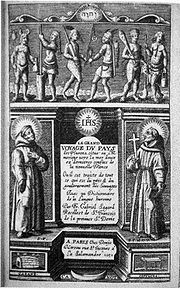 The earliest written accounts of the Huron were made by the French, who began exploring North America in the 16th century. News of the Europeans reached the Huron, particularly when Samuel de Champlain
explored the Saint Lawrence River
in the early 17th century. Some Huron decided to go and meet the Europeans. Atironta, the principal headman of the Arendarhonon tribe, went to Quebec
and made an alliance with the French in 1609.
The total population of the Huron at the time of European contact has been estimated at about 20,000 to 40,000 people. From 1634 to 1640, the Huron were devastated by Eurasia
n infectious disease
s, such as measles
and smallpox
, to which they had no immunity. Epidemiological studies have shown that beginning in 1634, more European children immigrated with their families to the New World from cities in France, England, and the Netherlands
that had endemic
smallpox. Historians believe the disease spread from the children to the Huron and other nations. Numerous Huron villages and areas were permanently abandoned. About two-thirds of the population died in the epidemics, decreasing the population to about 12,000.
Before the French arrived, the Huron had already been in conflict with the Iroquois
nations to the south. Several thousand Huron lived as far south as present-day central West Virginia
along the Kanawha River
by the late 16th century, but they were driven out by the Iroquois' invading from present-day New York
in the 17th century. Once the European powers became involved in trading, the conflict among natives intensified significantly as they struggled to control the fur trade. The French allied with the Huron, because they were the most advanced trading nation at the time. The Iroquois tended to ally with the Dutch
and later English, who settled at Albany and in the Mohawk Valley of their territory.
Introduction of European weapons and the fur trade increased competition and the severity of inter-tribal warfare. On March 16, 1649, an Iroquois war party of about 1000 burned the Huron mission
villages of St. Ignace and St. Louis in present-day Simcoe County Ontario, killing about 300 people. They also killed many of the Jesuit missionaries (see North American Martyrs). Surviving Jesuits burned the mission after abandoning it to prevent its capture. The Iroquois attack shocked the Huron.
By May 1, 1649, the Huron burned 15 of their villages to prevent their stores from being taken and fled as refugees to surrounding tribes. About 10,000 fled to Gahoendoe (Christian Island). Most who fled to the island starved over the winter, as it was a non-productive settlement and could not provide for them. Those who survived were believed to have resorted to cannibalism
to do so. After spending the bitter winter of 1649-50 on Gahoendoe, surviving Huron relocated near Quebec City
, where they settled at Wendake
. Absorbing other refugees, they became the Huron-Wendat Nation
. Some Huron, along with the surviving Petun, whose villages were attacked by the Iroquois in the fall of 1649, fled to the upper Lake Michigan region, settling first at Green Bay, then at Michilimackinac
.
and southern Michigan
in the United States. Some descendants of the Wyandot Nation of Anderdon still live in Ohio
and Michigan
. In 1819, the Methodist Church established its first mission
to Native Americans with a mission to the Wyandot in Ohio.
In the 1840s, most of the surviving Wyandot people were displaced to Kansas
through the US federal policy of forced Indian removal
. Using the funds they received for their lands in Ohio the Wyandot purchased 23000 acres (93.1 km²) of land for $46,080 in what is now Wyandotte County, Kansas
in the Kansas City, Kansas
area from the Delaware
who were grateful for the hospitality the Wyandot had shown them in Ohio. It was a more-or-less square parcel north and west of the junction of the Kansas River
and the Missouri River
.
In June 1853, Big Turtle, a chief of the Wyandot tribe, wrote to the Ohio State Journal regarding the current condition of his tribe. The Wyandot received nearly $127,000 for their lands in 1845. Big Turtle noted that, in the spring of 1850, the tribal chiefs retroceded the granted land to the government. $100,000 of the proceeds was invested in 5% government stock.
Removed from Ohio to the Indian Territory
, the Wyandot tribe had founded good libraries along with two thriving Sabbath Schools. They were in the process of organizing a division of the Sons of Temperance and maintained a sizable Temperance Society. Big Turtle commented on the agricultural yield, which produced an annual surplus for market. He said that the thrift of the Wyandot exceeded that of any tribe north of the Arkansas
line. According to an 1853 New York Times article, the Wyandot nation was "contented and happy", and enjoyed better living conditions in the Indian Territory than formerly in Ohio.
A United States government treaty ceded the Wyandot Nation a small portion of fertile land located in an acute angle of the Missouri River
and Kansas River
which they purchased from the Delaware in 1843. In addition, the government granted thirty-two "floating sections", located on public lands west of the Mississippi River
. By 1855 the number of Wyandot had diminished to 600 or 700. On August 14 of that year the Wyandot nation elected a chief. The Kansas correspondent of the Missouri Republican reported that the judges of the election were three elderly braves who were trusted by their peers. Some of the floating sections of land were offered for sale on the same day at a price of $800. A section was composed of 640 acres (2.6 km²). Altogether 20480 acres (82.9 km²) were sold for $25,600. They were located in Kansas, Nebraska, and unspecified sites. Surveys were not required, with the title becoming complete at the time of location.
The Wyandot played an important role in the politics of Kansas. On July 26, 1853, a Wyandot, William Walker
, was elected provisional governor of the territory of Nebraska (which included Kansas) at a meeting at the Wyandot Council house in Kansas City, Kansas
. The group that elected him were Wyandot, White traders, and outside interests who wished to preempt the federal government’s organization of the territory and to benefit from settlement of Kansas by White settlers. Walker and the others were also promoting Kansas as the route for the proposed trans-continental railroad. Although the federal government did not recognize Walker's election, the Wyandot action prompted the federal government to pass the Kansas-Nebraska Act
to organize Kansas and Nebraska territories.
An October 1855 article in The New York Times
reported that the Wyandot were free (that is, they had been accepted as US citizens) and without the restrictions placed on other tribes. Their leaders were unanimously pro-slavery, which meant 900 or 1,000 additional votes in opposition to the Free State
movement of Kansas.
In 1867 after the American Civil War
, additional members removed from the Midwest to Oklahoma
. Today more than 4,000 Wyandot can be found in eastern Kansas
and Oklahoma
.
The last of the original Wyandot of Ohio was Margaret "Grey Eyes" Solomon, a.k.a. "Mother Solomon". The daughter of Chief John Grey Eyes, she was born in 1816 and departed Ohio in 1843. By 1889 she had returned to Ohio, when she was recorded as a spectator to the restoration of the Wyandot's "Old Mission Church", a Wyandot Mission Church at Upper Sandusky
. She died in Upper Sandusky on August 17, 1890. The last Wyandot to live in Ohio was Bill Moose 1836-1937
law, which required Native Americans to move west of the Mississippi River. Originally the Wyandot were paid 75 cents per acre for land that was worth $1.50 an acre.
In February 1985 the U.S. government agreed to pay descendants of the Wyandot $5.5 million. The decision settled the 143-year-old treaty, which in 1842 forced the tribe to sell their Ohio lands for less than fair value. A spokesman for the Bureau of Indian Affairs
(BIA) said that the government would pay $1,600 each, in July 1985, to 3,600 people in Kansas and Oklahoma who could prove they were Wyandot descendants.
In 1999, representatives of the far-flung Wyandot bands of Quebec, Kansas, Oklahoma and Michigan gathered at their historic homeland in Midland, Ontario. They formally re-established the Wendat Confederacy.
Each modern Wyandot community is an autonomous band:
The Wyandot Nation of Kansas has had legal battles with the Wyandotte Nation of Oklahoma over the Huron Cemetery
in Kansas City, Kansas. It has been a point of contention for more than 100 years. Because of complications from the Indian removal process, the land was legally under control of the Wyandotte Nation of Oklahoma, who wanted to redevelop it for the benefit of its people. Members of the local Kansas Wyandot strongly opposed most such proposals, which would have required reinterment of Indian remains, including many of their direct ancestors. In 1998 the two nations finally agreed to preserve the cemetery for religious, cultural and other uses appropriate to its sacred
history and use.
The approximately 3,000 Wyandot in Quebec
are primarily Catholic
and speak French
as a first language. They have begun to promote the study and use of the Wyandot language
among their children. For many decades, a leading source of income for the Wyandot of Quebec has been selling pottery and other locally produced crafts.
Other
Indigenous peoples of the Americas
The indigenous peoples of the Americas are the pre-Columbian inhabitants of North and South America, their descendants and other ethnic groups who are identified with those peoples. Indigenous peoples are known in Canada as Aboriginal peoples, and in the United States as Native Americans...
of North America
North America
North America is a continent wholly within the Northern Hemisphere and almost wholly within the Western Hemisphere. It is also considered a northern subcontinent of the Americas...
, known in their native language
Wyandot language
Wyandot is the Iroquoian language traditionally spoken by the people known variously as Wyandot, Wyandotte, Wendat, or Huron. It was last spoken primarily in Oklahoma and Quebec...
of the Iroquoian family as the Wendat. The pre-contact
First contact (anthropology)
First contact is a term describing the first meeting of two cultures previously unaware of one another. One notable example of first contact is that between the Spanish and the Arawak in 1492....
people formed by the 15th century in the area of the north shore of present-day Lake Ontario
Lake Ontario
Lake Ontario is one of the five Great Lakes of North America. It is bounded on the north and southwest by the Canadian province of Ontario, and on the south by the American state of New York. Ontario, Canada's most populous province, was named for the lake. In the Wyandot language, ontarío means...
, before migrating to Georgian Bay
Georgian Bay
Georgian Bay is a large bay of Lake Huron, located entirely within Ontario, Canada...
. It was in their later location that they first encountered the explorer Samuel de Champlain
Samuel de Champlain
Samuel de Champlain , "The Father of New France", was a French navigator, cartographer, draughtsman, soldier, explorer, geographer, ethnologist, diplomat, and chronicler. He founded New France and Quebec City on July 3, 1608....
in 1615.
The modern Wyandot emerged in the late 17th century from the remnants of two earlier groups, the Huron Confederacy and the Tionontate, called the Petun
Petun
The Petún , or Tionontati in their language, were an Iroquoian-speaking First Nations people closely related to the Wendat Confederacy. Their homeland was located along the southwest edge of Georgian Bay, in the area immediately to the west of the Huron territory in Southern Ontario of...
(tobacco
Tobacco
Tobacco is an agricultural product processed from the leaves of plants in the genus Nicotiana. It can be consumed, used as a pesticide and, in the form of nicotine tartrate, used in some medicines...
people) by the French because of their cultivation of the crop. They were located in the southern part of what is now the Canadian
Canada
Canada is a North American country consisting of ten provinces and three territories. Located in the northern part of the continent, it extends from the Atlantic Ocean in the east to the Pacific Ocean in the west, and northward into the Arctic Ocean...
province of Ontario
Ontario
Ontario is a province of Canada, located in east-central Canada. It is Canada's most populous province and second largest in total area. It is home to the nation's most populous city, Toronto, and the nation's capital, Ottawa....
around Georgian Bay
Georgian Bay
Georgian Bay is a large bay of Lake Huron, located entirely within Ontario, Canada...
. Drastically reduced in number by epidemic
Epidemic
In epidemiology, an epidemic , occurs when new cases of a certain disease, in a given human population, and during a given period, substantially exceed what is expected based on recent experience...
diseases after 1634, they were dispersed by war in 1649 from the Iroquois
Iroquois
The Iroquois , also known as the Haudenosaunee or the "People of the Longhouse", are an association of several tribes of indigenous people of North America...
of the Haudenosaunee, then based in present-day New York
New York
New York is a state in the Northeastern region of the United States. It is the nation's third most populous state. New York is bordered by New Jersey and Pennsylvania to the south, and by Connecticut, Massachusetts and Vermont to the east...
.
Today the Wyandot have a reserve in Quebec, Canada. In addition, they have three major settlements and independently governed, federally recognized tribes in the United States.
Origin, names and organization
While early theories placed Huron origin in the St. Lawrence Valley, with some arguing for a presence near MontrealMontreal
Montreal is a city in Canada. It is the largest city in the province of Quebec, the second-largest city in Canada and the seventh largest in North America...
and other St. Lawrence Iroquoian peoples, archeological findings since the 1950s have demonstrated conclusively the Wyandot had no habitation there. In 1975 and 1978, archeologists excavated a large 15th-century Huron village, now called the Draper Site
Draper Site, Wendat (Huron) Ancestral Village
The Draper Site is a Precontact period Huron-Wendat ancestral village located on a tributary of West Duffins Creek in present-day Pickering, Ontario, approximately 35 kilometres north-east of Toronto....
, in Pickering, Ontario
Pickering, Ontario
Pickering is a city located in Southern Ontario, Canada immediately east of Toronto in Durham Region. It is part of the Greater Toronto Area, the largest metropolitan area in Canada.- Early Period :...
. In 2003 an even larger village was discovered five kilometres away in Whitchurch-Stouffville; it is known as the Mantle Site
Mantle Site, Wendat (Huron) Ancestral Village
The Mantle site in the town of Whitchurch–Stouffville, north-east of Toronto, is the largest and most complex ancestral Wendat-Huron village to be excavated in the Lower Great Lakes region to date....
. The sites each included a palisade
Palisade
A palisade is a steel or wooden fence or wall of variable height, usually used as a defensive structure.- Typical construction :Typical construction consisted of small or mid sized tree trunks aligned vertically, with no spacing in between. The trunks were sharpened or pointed at the top, and were...
and the latter site had more than 70 longhouses. The historian
Historian
A historian is a person who studies and writes about the past and is regarded as an authority on it. Historians are concerned with the continuous, methodical narrative and research of past events as relating to the human race; as well as the study of all history in time. If the individual is...
James F. Pendergast states,
"Indeed, there is now every indication that the late precontact Huron and their immediate antecedents developed in a distinct Huron homelandHomelandA homeland is the concept of the place to which an ethnic group holds a long history and a deep cultural association with —the country in which a particular national identity began. As a common noun, it simply connotes the country of one's origin...
in southern OntarioOntarioOntario is a province of Canada, located in east-central Canada. It is Canada's most populous province and second largest in total area. It is home to the nation's most populous city, Toronto, and the nation's capital, Ottawa....
along the north shore of Lake OntarioLake OntarioLake Ontario is one of the five Great Lakes of North America. It is bounded on the north and southwest by the Canadian province of Ontario, and on the south by the American state of New York. Ontario, Canada's most populous province, was named for the lake. In the Wyandot language, ontarío means...
. Subsequently they moved from there to their historic territory on Georgian BayGeorgian BayGeorgian Bay is a large bay of Lake Huron, located entirely within Ontario, Canada...
where they were encountered by Champlain in 1615."
In the early seventeenth century, this Iroquoian people called themselves the Wendat, an autonym
Autonym
Autonym may refer to*Autonym, the name used by a people to refer to themselves or their language, synonymous with endonym*Autonym, the true name of an author disclosed by resolving a pseudonym...
which means "Dwellers of the Peninsula" or "Islanders". The Wendat historic territory was bordered on three sides by the waters of Georgian Bay
Georgian Bay
Georgian Bay is a large bay of Lake Huron, located entirely within Ontario, Canada...
and Lake Simcoe
Lake Simcoe
Lake Simcoe is a lake in Southern Ontario, Canada, the fourth-largest lake wholly in the province, after Lake Nipigon, Lac Seul, and Lake Nipissing. At the time of the first European contact in the 17th century the lake was called Ouentironk by the Huron natives...
. Early French
France
The French Republic , The French Republic , The French Republic , (commonly known as France , is a unitary semi-presidential republic in Western Europe with several overseas territories and islands located on other continents and in the Indian, Pacific, and Atlantic oceans. Metropolitan France...
explorers referred to these natives as the Huron, either from the French huron ("ruffian", "rustic"), or from hure ("boar's head"). According to tradition, French sailors thought that the bristly hairstyle of Wendat warrior
Warrior
A warrior is a person skilled in combat or warfare, especially within the context of a tribal or clan-based society that recognizes a separate warrior class.-Warrior classes in tribal culture:...
s resembled that of a boar
Boar
Wild boar, also wild pig, is a species of the pig genus Sus, part of the biological family Suidae. The species includes many subspecies. It is the wild ancestor of the domestic pig, an animal with which it freely hybridises...
.
The negative etymology conflicts with the French fur traders and explorers, who considered them the "bon Iroquois." An alternate etymology is from the Algonquin words ronon ("nation"), or Irri-ronon ("Erie Nation"). It was pronounced Hirri-ronon by the French, eventually shortened to Hirr-on, and finally spelled in its present form, Huron. Other etymological possibilities come from the Algonquin words ka-ron and tu-ron ("straight coast" and "crooked coast").
The Wendat were not a tribe, but a confederacy of four or more tribes with a mutually intelligible
Mutual intelligibility
In linguistics, mutual intelligibility is recognized as a relationship between languages or dialects in which speakers of different but related languages can readily understand each other without intentional study or extraordinary effort...
languages. According to tradition, this Wendat (or Huron) Constitution was initiated by the Attignawantans (People of the Bear) and the Attigneenongnahacs (People of the Cord), who confederated in the 15th century. They were joined by the Arendarhonons (People of the Rock) about 1590, and the Tahontaenrats (People of the Deer) around 1610. A fifth group, the Ataronchronons (People of the Marshes or Bog), may not have attained full membership in the confederacy, and may have been a division of the Attignawantan.
The largest Wendat settlement, and capital of the confederacy, was located at Ossossane, near modern-day Elmvale
Springwater, Ontario
Springwater is a township in central Ontario, Canada, in Simcoe County near Barrie. It includes the former townships of Flos and Vespra. Springwater is the County seat of Simcoe.-Communities:...
, Ontario
Ontario
Ontario is a province of Canada, located in east-central Canada. It is Canada's most populous province and second largest in total area. It is home to the nation's most populous city, Toronto, and the nation's capital, Ottawa....
. They called their traditional territory Wendake
Wendake
Wendake may refer to:* the historical homeland of the Huron/Wendat/Wyandot nation, on the south shore of Georgian Bay in modern-day Simcoe and Grey counties in Ontario,...
.
Closely related to the people of the Huron Confederacy were the Tionontate, a group whom the French called the Petun
Petun
The Petún , or Tionontati in their language, were an Iroquoian-speaking First Nations people closely related to the Wendat Confederacy. Their homeland was located along the southwest edge of Georgian Bay, in the area immediately to the west of the Huron territory in Southern Ontario of...
(Tobacco People), for their cultivation of that crop. They lived further south and were divided into two groups: the Deer and the Wolves. Considering that they formed the nucleus of the tribe later known as the Wyandot, they too may have called themselves Wendat.
Culture
Like other IroquoianIroquoian languages
The Iroquoian languages are a First Nation and Native American language family.-Family division:*Ruttenber, Edward Manning. 1992 [1872]. History of the Indian tribes of Hudson's River. Hope Farm Press....
peoples, the Huron were farmers who supplemented their diet with hunting and fishing. The women cultivated varieties of maize
Maize
Maize known in many English-speaking countries as corn or mielie/mealie, is a grain domesticated by indigenous peoples in Mesoamerica in prehistoric times. The leafy stalk produces ears which contain seeds called kernels. Though technically a grain, maize kernels are used in cooking as a vegetable...
(corn) as the mainstay of their diet, which was supplemented primarily by fish caught by the men. The men also hunted venison
Venison
Venison is the meat of a game animal, especially a deer but also other animals such as antelope, wild boar, etc.-Etymology:The word derives from the Latin vēnor...
and other meats available during the game seasons. Women did most of the crop planting, cultivation and processing, although men helped in the heaviest work of clearing the fields. This was usually done by the slash and burn
Slash and burn
Slash-and-burn is an agricultural technique which involves cutting and burning of forests or woodlands to create fields. It is subsistence agriculture that typically uses little technology or other tools. It is typically part of shifting cultivation agriculture, and of transhumance livestock...
method of clearing trees and brush. Men did most of the fishing and hunting, and constructed the houses, canoes, and tools. Each family owned a plot of land which they farmed; this land reverted to the common property of the tribe when the family no longer used it.
Huron lived in villages spanning from one to ten acres (40,000 m²), most of which were fortified in defense against enemy attack. They lived in longhouses, similar to other Iroquoian cultural groups. The typical village had 900 to 1600 people organized into 30 or 40 longhouses. Villages were moved about every ten years as the soil became less fertile and the nearby forest, which provided firewood, grew thin. The Huron engaged in trade with neighboring tribes, notably for tobacco
Tobacco
Tobacco is an agricultural product processed from the leaves of plants in the genus Nicotiana. It can be consumed, used as a pesticide and, in the form of nicotine tartrate, used in some medicines...
with the neighboring Petun and Neutral
Neutral Nation
The Neutrals, also known as the Attawandaron, were an Iroquoian nation of North American native people who lived near the shores of Lake Ontario and Lake Erie.-Territory:...
nations.
Tuberculosis
Tuberculosis
Tuberculosis, MTB, or TB is a common, and in many cases lethal, infectious disease caused by various strains of mycobacteria, usually Mycobacterium tuberculosis. Tuberculosis usually attacks the lungs but can also affect other parts of the body...
(TB) was endemic among the Huron, aggravated by the close and smoky living conditions in the longhouses. Huron on the whole were healthy, however; the Jesuits
Society of Jesus
The Society of Jesus is a Catholic male religious order that follows the teachings of the Catholic Church. The members are called Jesuits, and are also known colloquially as "God's Army" and as "The Company," these being references to founder Ignatius of Loyola's military background and a...
wrote that the Huron were "more healthy than we."
European contact and Wendat dispersal
Samuel de Champlain
Samuel de Champlain , "The Father of New France", was a French navigator, cartographer, draughtsman, soldier, explorer, geographer, ethnologist, diplomat, and chronicler. He founded New France and Quebec City on July 3, 1608....
explored the Saint Lawrence River
Saint Lawrence River
The Saint Lawrence is a large river flowing approximately from southwest to northeast in the middle latitudes of North America, connecting the Great Lakes with the Atlantic Ocean. It is the primary drainage conveyor of the Great Lakes Basin...
in the early 17th century. Some Huron decided to go and meet the Europeans. Atironta, the principal headman of the Arendarhonon tribe, went to Quebec
Quebec City
Quebec , also Québec, Quebec City or Québec City is the capital of the Canadian province of Quebec and is located within the Capitale-Nationale region. It is the second most populous city in Quebec after Montreal, which is about to the southwest...
and made an alliance with the French in 1609.
The total population of the Huron at the time of European contact has been estimated at about 20,000 to 40,000 people. From 1634 to 1640, the Huron were devastated by Eurasia
Eurasia
Eurasia is a continent or supercontinent comprising the traditional continents of Europe and Asia ; covering about 52,990,000 km2 or about 10.6% of the Earth's surface located primarily in the eastern and northern hemispheres...
n infectious disease
Infectious disease
Infectious diseases, also known as communicable diseases, contagious diseases or transmissible diseases comprise clinically evident illness resulting from the infection, presence and growth of pathogenic biological agents in an individual host organism...
s, such as measles
Measles
Measles, also known as rubeola or morbilli, is an infection of the respiratory system caused by a virus, specifically a paramyxovirus of the genus Morbillivirus. Morbilliviruses, like other paramyxoviruses, are enveloped, single-stranded, negative-sense RNA viruses...
and smallpox
Smallpox
Smallpox was an infectious disease unique to humans, caused by either of two virus variants, Variola major and Variola minor. The disease is also known by the Latin names Variola or Variola vera, which is a derivative of the Latin varius, meaning "spotted", or varus, meaning "pimple"...
, to which they had no immunity. Epidemiological studies have shown that beginning in 1634, more European children immigrated with their families to the New World from cities in France, England, and the Netherlands
Netherlands
The Netherlands is a constituent country of the Kingdom of the Netherlands, located mainly in North-West Europe and with several islands in the Caribbean. Mainland Netherlands borders the North Sea to the north and west, Belgium to the south, and Germany to the east, and shares maritime borders...
that had endemic
Endemic (epidemiology)
In epidemiology, an infection is said to be endemic in a population when that infection is maintained in the population without the need for external inputs. For example, chickenpox is endemic in the UK, but malaria is not...
smallpox. Historians believe the disease spread from the children to the Huron and other nations. Numerous Huron villages and areas were permanently abandoned. About two-thirds of the population died in the epidemics, decreasing the population to about 12,000.
Before the French arrived, the Huron had already been in conflict with the Iroquois
Iroquois
The Iroquois , also known as the Haudenosaunee or the "People of the Longhouse", are an association of several tribes of indigenous people of North America...
nations to the south. Several thousand Huron lived as far south as present-day central West Virginia
West Virginia
West Virginia is a state in the Appalachian and Southeastern regions of the United States, bordered by Virginia to the southeast, Kentucky to the southwest, Ohio to the northwest, Pennsylvania to the northeast and Maryland to the east...
along the Kanawha River
Kanawha River
The Kanawha River is a tributary of the Ohio River, approximately 97 mi long, in the U.S. state of West Virginia. The largest inland waterway in West Virginia, it has formed a significant industrial region of the state since the middle of the 19th century.It is formed at the town of Gauley...
by the late 16th century, but they were driven out by the Iroquois' invading from present-day New York
New York
New York is a state in the Northeastern region of the United States. It is the nation's third most populous state. New York is bordered by New Jersey and Pennsylvania to the south, and by Connecticut, Massachusetts and Vermont to the east...
in the 17th century. Once the European powers became involved in trading, the conflict among natives intensified significantly as they struggled to control the fur trade. The French allied with the Huron, because they were the most advanced trading nation at the time. The Iroquois tended to ally with the Dutch
Netherlands
The Netherlands is a constituent country of the Kingdom of the Netherlands, located mainly in North-West Europe and with several islands in the Caribbean. Mainland Netherlands borders the North Sea to the north and west, Belgium to the south, and Germany to the east, and shares maritime borders...
and later English, who settled at Albany and in the Mohawk Valley of their territory.
Introduction of European weapons and the fur trade increased competition and the severity of inter-tribal warfare. On March 16, 1649, an Iroquois war party of about 1000 burned the Huron mission
Mission (Christian)
Christian missionary activities often involve sending individuals and groups , to foreign countries and to places in their own homeland. This has frequently involved not only evangelization , but also humanitarian work, especially among the poor and disadvantaged...
villages of St. Ignace and St. Louis in present-day Simcoe County Ontario, killing about 300 people. They also killed many of the Jesuit missionaries (see North American Martyrs). Surviving Jesuits burned the mission after abandoning it to prevent its capture. The Iroquois attack shocked the Huron.
By May 1, 1649, the Huron burned 15 of their villages to prevent their stores from being taken and fled as refugees to surrounding tribes. About 10,000 fled to Gahoendoe (Christian Island). Most who fled to the island starved over the winter, as it was a non-productive settlement and could not provide for them. Those who survived were believed to have resorted to cannibalism
Cannibalism
Cannibalism is the act or practice of humans eating the flesh of other human beings. It is also called anthropophagy...
to do so. After spending the bitter winter of 1649-50 on Gahoendoe, surviving Huron relocated near Quebec City
Quebec City
Quebec , also Québec, Quebec City or Québec City is the capital of the Canadian province of Quebec and is located within the Capitale-Nationale region. It is the second most populous city in Quebec after Montreal, which is about to the southwest...
, where they settled at Wendake
Wendake, Quebec
Wendake is the current name for the Huron-Wendat reserve, an enclave within Quebec City, Quebec, Canada. One of the Seven Nations of Canada, this was formerly known as Village-des-Hurons , and also as -Lorette....
. Absorbing other refugees, they became the Huron-Wendat Nation
Huron-Wendat Nation
The Huron-Wendat Nation is a Huron-Wendat First Nation whose community and reserve is at Wendake, Quebec, a municipality now enclosed within Quebec City in Canada. In the French language, used by most members of the First Nation, they are known as the Nation Huronne-Wendat.In 2006, historical...
. Some Huron, along with the surviving Petun, whose villages were attacked by the Iroquois in the fall of 1649, fled to the upper Lake Michigan region, settling first at Green Bay, then at Michilimackinac
Michilimackinac
Michilimackinac is a name for the region around the Straits of Mackinac between Lake Huron and Lake Michigan. Early settlers of North America applied the term to the entire region along Lakes Huron, Michigan, and Superior. Today it is mostly within the boundaries of Michigan, in the United States...
.
Emergence of the Wyandot
In the late 17th century, elements of the Huron Confederacy and the Petun joined together and became known as the Wyandot (or Wyandotte), a variation of Wendat. The western Wyandot eventually re-formed across the border in the area of present-day OhioOhio
Ohio is a Midwestern state in the United States. The 34th largest state by area in the U.S.,it is the 7th‑most populous with over 11.5 million residents, containing several major American cities and seven metropolitan areas with populations of 500,000 or more.The state's capital is Columbus...
and southern Michigan
Michigan
Michigan is a U.S. state located in the Great Lakes Region of the United States of America. The name Michigan is the French form of the Ojibwa word mishigamaa, meaning "large water" or "large lake"....
in the United States. Some descendants of the Wyandot Nation of Anderdon still live in Ohio
Ohio
Ohio is a Midwestern state in the United States. The 34th largest state by area in the U.S.,it is the 7th‑most populous with over 11.5 million residents, containing several major American cities and seven metropolitan areas with populations of 500,000 or more.The state's capital is Columbus...
and Michigan
Michigan
Michigan is a U.S. state located in the Great Lakes Region of the United States of America. The name Michigan is the French form of the Ojibwa word mishigamaa, meaning "large water" or "large lake"....
. In 1819, the Methodist Church established its first mission
Mission (Christian)
Christian missionary activities often involve sending individuals and groups , to foreign countries and to places in their own homeland. This has frequently involved not only evangelization , but also humanitarian work, especially among the poor and disadvantaged...
to Native Americans with a mission to the Wyandot in Ohio.
In the 1840s, most of the surviving Wyandot people were displaced to Kansas
Kansas
Kansas is a US state located in the Midwestern United States. It is named after the Kansas River which flows through it, which in turn was named after the Kansa Native American tribe, which inhabited the area. The tribe's name is often said to mean "people of the wind" or "people of the south...
through the US federal policy of forced Indian removal
Indian Removal
Indian removal was a nineteenth century policy of the government of the United States to relocate Native American tribes living east of the Mississippi River to lands west of the river...
. Using the funds they received for their lands in Ohio the Wyandot purchased 23000 acres (93.1 km²) of land for $46,080 in what is now Wyandotte County, Kansas
Wyandotte County, Kansas
Wyandotte County is a county located in northeast Kansas, in the Central United States. The county's population was 157,505 for the 2010 census. Its county seat and most populous city is Kansas City with which it shares a unified government...
in the Kansas City, Kansas
Kansas City, Kansas
Kansas City is the third-largest city in the state of Kansas and is the county seat of Wyandotte County. It is a suburb of Kansas City, Missouri, and is the third largest city in the Kansas City Metropolitan Area. The city is part of a consolidated city-county government known as the "Unified...
area from the Delaware
Lenape
The Lenape are an Algonquian group of Native Americans of the Northeastern Woodlands. They are also called Delaware Indians. As a result of the American Revolutionary War and later Indian removals from the eastern United States, today the main groups live in Canada, where they are enrolled in the...
who were grateful for the hospitality the Wyandot had shown them in Ohio. It was a more-or-less square parcel north and west of the junction of the Kansas River
Kansas River
The Kansas River is a river in northeastern Kansas in the United States. It is the southwestern-most part of the Missouri River drainage, which is in turn the northwestern-most portion of the extensive Mississippi River drainage. Its name come from the Kanza people who once inhabited the area...
and the Missouri River
Missouri River
The Missouri River flows through the central United States, and is a tributary of the Mississippi River. It is the longest river in North America and drains the third largest area, though only the thirteenth largest by discharge. The Missouri's watershed encompasses most of the American Great...
.
In June 1853, Big Turtle, a chief of the Wyandot tribe, wrote to the Ohio State Journal regarding the current condition of his tribe. The Wyandot received nearly $127,000 for their lands in 1845. Big Turtle noted that, in the spring of 1850, the tribal chiefs retroceded the granted land to the government. $100,000 of the proceeds was invested in 5% government stock.
Removed from Ohio to the Indian Territory
Indian Territory
The Indian Territory, also known as the Indian Territories and the Indian Country, was land set aside within the United States for the settlement of American Indians...
, the Wyandot tribe had founded good libraries along with two thriving Sabbath Schools. They were in the process of organizing a division of the Sons of Temperance and maintained a sizable Temperance Society. Big Turtle commented on the agricultural yield, which produced an annual surplus for market. He said that the thrift of the Wyandot exceeded that of any tribe north of the Arkansas
Arkansas
Arkansas is a state located in the southern region of the United States. Its name is an Algonquian name of the Quapaw Indians. Arkansas shares borders with six states , and its eastern border is largely defined by the Mississippi River...
line. According to an 1853 New York Times article, the Wyandot nation was "contented and happy", and enjoyed better living conditions in the Indian Territory than formerly in Ohio.
A United States government treaty ceded the Wyandot Nation a small portion of fertile land located in an acute angle of the Missouri River
Missouri River
The Missouri River flows through the central United States, and is a tributary of the Mississippi River. It is the longest river in North America and drains the third largest area, though only the thirteenth largest by discharge. The Missouri's watershed encompasses most of the American Great...
and Kansas River
Kansas River
The Kansas River is a river in northeastern Kansas in the United States. It is the southwestern-most part of the Missouri River drainage, which is in turn the northwestern-most portion of the extensive Mississippi River drainage. Its name come from the Kanza people who once inhabited the area...
which they purchased from the Delaware in 1843. In addition, the government granted thirty-two "floating sections", located on public lands west of the Mississippi River
Mississippi River
The Mississippi River is the largest river system in North America. Flowing entirely in the United States, this river rises in western Minnesota and meanders slowly southwards for to the Mississippi River Delta at the Gulf of Mexico. With its many tributaries, the Mississippi's watershed drains...
. By 1855 the number of Wyandot had diminished to 600 or 700. On August 14 of that year the Wyandot nation elected a chief. The Kansas correspondent of the Missouri Republican reported that the judges of the election were three elderly braves who were trusted by their peers. Some of the floating sections of land were offered for sale on the same day at a price of $800. A section was composed of 640 acres (2.6 km²). Altogether 20480 acres (82.9 km²) were sold for $25,600. They were located in Kansas, Nebraska, and unspecified sites. Surveys were not required, with the title becoming complete at the time of location.
The Wyandot played an important role in the politics of Kansas. On July 26, 1853, a Wyandot, William Walker
William Walker (Wyandot leader)
William Walker was a Wyandot Indian leader and the first provisional governor of Nebraska Territory which also encompassed the present-day state of Kansas.-Background:...
, was elected provisional governor of the territory of Nebraska (which included Kansas) at a meeting at the Wyandot Council house in Kansas City, Kansas
Kansas City, Kansas
Kansas City is the third-largest city in the state of Kansas and is the county seat of Wyandotte County. It is a suburb of Kansas City, Missouri, and is the third largest city in the Kansas City Metropolitan Area. The city is part of a consolidated city-county government known as the "Unified...
. The group that elected him were Wyandot, White traders, and outside interests who wished to preempt the federal government’s organization of the territory and to benefit from settlement of Kansas by White settlers. Walker and the others were also promoting Kansas as the route for the proposed trans-continental railroad. Although the federal government did not recognize Walker's election, the Wyandot action prompted the federal government to pass the Kansas-Nebraska Act
Kansas-Nebraska Act
The Kansas–Nebraska Act of 1854 created the territories of Kansas and Nebraska, opening new lands for settlement, and had the effect of repealing the Missouri Compromise of 1820 by allowing settlers in those territories to determine through Popular Sovereignty if they would allow slavery within...
to organize Kansas and Nebraska territories.
An October 1855 article in The New York Times
The New York Times
The New York Times is an American daily newspaper founded and continuously published in New York City since 1851. The New York Times has won 106 Pulitzer Prizes, the most of any news organization...
reported that the Wyandot were free (that is, they had been accepted as US citizens) and without the restrictions placed on other tribes. Their leaders were unanimously pro-slavery, which meant 900 or 1,000 additional votes in opposition to the Free State
Free State
The Free State is a province of South Africa. Its capital is Bloemfontein, which is also South Africa's judicial capital. Its historical origins lie in the Orange Free State Boer republic and later Orange Free State Province. The current borders of the province date from 1994 when the Bantustans...
movement of Kansas.
In 1867 after the American Civil War
American Civil War
The American Civil War was a civil war fought in the United States of America. In response to the election of Abraham Lincoln as President of the United States, 11 southern slave states declared their secession from the United States and formed the Confederate States of America ; the other 25...
, additional members removed from the Midwest to Oklahoma
Oklahoma
Oklahoma is a state located in the South Central region of the United States of America. With an estimated 3,751,351 residents as of the 2010 census and a land area of 68,667 square miles , Oklahoma is the 28th most populous and 20th-largest state...
. Today more than 4,000 Wyandot can be found in eastern Kansas
Kansas
Kansas is a US state located in the Midwestern United States. It is named after the Kansas River which flows through it, which in turn was named after the Kansa Native American tribe, which inhabited the area. The tribe's name is often said to mean "people of the wind" or "people of the south...
and Oklahoma
Oklahoma
Oklahoma is a state located in the South Central region of the United States of America. With an estimated 3,751,351 residents as of the 2010 census and a land area of 68,667 square miles , Oklahoma is the 28th most populous and 20th-largest state...
.
The last of the original Wyandot of Ohio was Margaret "Grey Eyes" Solomon, a.k.a. "Mother Solomon". The daughter of Chief John Grey Eyes, she was born in 1816 and departed Ohio in 1843. By 1889 she had returned to Ohio, when she was recorded as a spectator to the restoration of the Wyandot's "Old Mission Church", a Wyandot Mission Church at Upper Sandusky
Upper Sandusky
Upper Sandusky was a 19th century Wyandot town, near what is now Upper Sandusky, Ohio, in the United States. It was the primary Wyandot town during the American Revolutionary War , and was sometimes also known as Half-King's Town, after Dunquat, the Wyandot "Half-King"...
. She died in Upper Sandusky on August 17, 1890. The last Wyandot to live in Ohio was Bill Moose 1836-1937
20th century to present
A program founded in the 1940s to address grievances filed by various Native American tribes allocated $800 million to rectify promises broken by settlers who invaded their territories. The Wyandot settlement was based on the 1830 Indian RemovalIndian Removal
Indian removal was a nineteenth century policy of the government of the United States to relocate Native American tribes living east of the Mississippi River to lands west of the river...
law, which required Native Americans to move west of the Mississippi River. Originally the Wyandot were paid 75 cents per acre for land that was worth $1.50 an acre.
In February 1985 the U.S. government agreed to pay descendants of the Wyandot $5.5 million. The decision settled the 143-year-old treaty, which in 1842 forced the tribe to sell their Ohio lands for less than fair value. A spokesman for the Bureau of Indian Affairs
Bureau of Indian Affairs
The Bureau of Indian Affairs is an agency of the federal government of the United States within the US Department of the Interior. It is responsible for the administration and management of of land held in trust by the United States for Native Americans in the United States, Native American...
(BIA) said that the government would pay $1,600 each, in July 1985, to 3,600 people in Kansas and Oklahoma who could prove they were Wyandot descendants.
In 1999, representatives of the far-flung Wyandot bands of Quebec, Kansas, Oklahoma and Michigan gathered at their historic homeland in Midland, Ontario. They formally re-established the Wendat Confederacy.
Each modern Wyandot community is an autonomous band:
- Huron-Wendat NationHuron-Wendat NationThe Huron-Wendat Nation is a Huron-Wendat First Nation whose community and reserve is at Wendake, Quebec, a municipality now enclosed within Quebec City in Canada. In the French language, used by most members of the First Nation, they are known as the Nation Huronne-Wendat.In 2006, historical...
, at Wendake, now within the Quebec CityQuebec CityQuebec , also Québec, Quebec City or Québec City is the capital of the Canadian province of Quebec and is located within the Capitale-Nationale region. It is the second most populous city in Quebec after Montreal, which is about to the southwest...
limits, approximately 3,000 members - Wyandot Nation of Anderdon, in Michigan, with headquarters in Trenton, MichiganTrenton, MichiganTrenton is a small city in Wayne County in the southeast portion of the U.S. state of Michigan. As of the 2010 census, the city population was 18,853...
, perhaps 800 members - Wyandot Nation of Kansas, with headquarters in Kansas City, KansasKansas City, KansasKansas City is the third-largest city in the state of Kansas and is the county seat of Wyandotte County. It is a suburb of Kansas City, Missouri, and is the third largest city in the Kansas City Metropolitan Area. The city is part of a consolidated city-county government known as the "Unified...
, perhaps 400 members - Wyandotte Nation, a federally recognized tribe headquartered in Wyandotte, OklahomaWyandotte, OklahomaWyandotte is a town in Ottawa County, Oklahoma, United States. The population was 363 at the 2000 census.The town is the tribal headquarters of the Wyandotte Nation of Oklahoma.-Geography:Wyandotte is located at ....
, with 4,300 members.
The Wyandot Nation of Kansas has had legal battles with the Wyandotte Nation of Oklahoma over the Huron Cemetery
Huron Cemetery
The Huron Indian Cemetery in Kansas City, Kansas, also known as Huron Park Cemetery, is now formally known as the Wyandot National Burying Ground. It was established circa 1843, when Wyandots had first arrived in their removal from Ohio. The tribe settled in the area for years, with many in 1855...
in Kansas City, Kansas. It has been a point of contention for more than 100 years. Because of complications from the Indian removal process, the land was legally under control of the Wyandotte Nation of Oklahoma, who wanted to redevelop it for the benefit of its people. Members of the local Kansas Wyandot strongly opposed most such proposals, which would have required reinterment of Indian remains, including many of their direct ancestors. In 1998 the two nations finally agreed to preserve the cemetery for religious, cultural and other uses appropriate to its sacred
Sacred
Holiness, or sanctity, is in general the state of being holy or sacred...
history and use.
The approximately 3,000 Wyandot in Quebec
Quebec
Quebec or is a province in east-central Canada. It is the only Canadian province with a predominantly French-speaking population and the only one whose sole official language is French at the provincial level....
are primarily Catholic
Catholic
The word catholic comes from the Greek phrase , meaning "on the whole," "according to the whole" or "in general", and is a combination of the Greek words meaning "about" and meaning "whole"...
and speak French
French language
French is a Romance language spoken as a first language in France, the Romandy region in Switzerland, Wallonia and Brussels in Belgium, Monaco, the regions of Quebec and Acadia in Canada, and by various communities elsewhere. Second-language speakers of French are distributed throughout many parts...
as a first language. They have begun to promote the study and use of the Wyandot language
Wyandot language
Wyandot is the Iroquoian language traditionally spoken by the people known variously as Wyandot, Wyandotte, Wendat, or Huron. It was last spoken primarily in Oklahoma and Quebec...
among their children. For many decades, a leading source of income for the Wyandot of Quebec has been selling pottery and other locally produced crafts.
Further reading
- Clarke, Peter Dooyentate. Origin and Traditional History of the Wyandotts, and Sketches of Other Indian Tribes of North America, True Traditional Stories of Tecumseh and His League, Global Language Press, 2006. Reprint of 1870 history written by a Wyandot. ISBN 0-9738924-9-8
External links
Official tribal websites:- Wyandotte Nation of Oklahoma
- Wyandot Nation of Kansas
- Wyandot of Anderdon Nation, Michigan
- Huron-Wendat Nation, Wendake, QuebecWendake, QuebecWendake is the current name for the Huron-Wendat reserve, an enclave within Quebec City, Quebec, Canada. One of the Seven Nations of Canada, this was formerly known as Village-des-Hurons , and also as -Lorette....
Other
- Sagard’s Dictionary of Huron - The earliest and one of the most complete dictionaries of the Huron language
- Agondachia Association, Ossossane Fondation, Wendake, QuebecWendake, QuebecWendake is the current name for the Huron-Wendat reserve, an enclave within Quebec City, Quebec, Canada. One of the Seven Nations of Canada, this was formerly known as Village-des-Hurons , and also as -Lorette....
- The Huron-Wendat Museum, Wendake, QuebecWendake, QuebecWendake is the current name for the Huron-Wendat reserve, an enclave within Quebec City, Quebec, Canada. One of the Seven Nations of Canada, this was formerly known as Village-des-Hurons , and also as -Lorette....
- Mother Solomon 1816-1890
- Bill Moose 1836-1937
- "The Feast of the Dead", Erik R. Seeman, Berfrois, 2 August 2011