

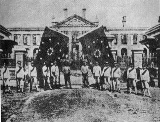
Wuchang Uprising

Encyclopedia
The Wuchang Uprising began with the dissatisfaction of the handling of a railway crisis. The crisis then escalated to an uprising where the revolutionaries went up against Qing
government officials. The uprising was then assisted by the New Army
in a coup
against their own authorities in the city of Wuchang, Hubei province on October 10, 1911. The Battle of Yangxia
led by Huang Xing
would be the major battle in the uprising. These events served as a catalyst to the Xinhai Revolution
, which led to the collapse of the Qing dynasty and the establishment of the Republic of China
(ROC).
many countries saw China as a good target for railway investment. Many countries said they would build railways in areas of their influence even if the Qing government protested. Germany
began building lines in Shandong
, the British
in Yangtze Valley, French
in Kunming
, Russians
in Heilongjiang
and the Japan
ese had the Southern Manchuria Railway company.
In 1905, citizens were locally managing the Canton - Hankou Railway and the Sichuan-Hankou railway (川漢鐵路) by themselves in Guangdong
, Hunan
, Hubei
and Sichuan
. The railways were supposed to link up with the rest of China.
In May 1911 the Qing government officials announced that they would nationalize those two railway lines, that were previously paid for by local private investors. In general, the Qing were under a lot of pressure, having to pay back huge debts for the Boxer protocol
. So an announcement was made to seize the privately funded railways, to pay back debts to the foreigners, mainly Great Britain
, Germany, France and the United States
. Taking away the private railways caused much anger among the people. Protests were held in Changsha, and people in Guangdong boycotted government banknotes. By July the Qing government compensated the private investors, but the amount offered to Sichuan was much lower than all other provinces. This caused more anger.
By August 11 there was a massive strike and rally at Chengdu
Sichuan. Governor official Zhao Erfeng
in a panic, ordered the arrest of the nobles. The New Army in Wuhan were situated in Wuchang, Hankou
and Hanyang at the time.
. The original uprising date was set for October 6 on Mid-Autumn festival
. But some people were not ready on that date, and so it was postponed. On October 9, 1911 Sun Wu was at the Russian concession of Hankou
where bombs were being built. In one accident a bomb exploded causing Sun wu serious injuries. When he was sent to the hospital, the staff discovered the group were revolutionaries and alerted the Qing government.
Duan Zheng (瑞澂) tried to track down the revolutionaries. Jiang Yiwu (蔣翊武) of the Literary society decided to launch an attack that night, but was discovered by the Qing. Several members were arrested and executed.
Xiong Bingkun (熊秉坤) then decided to revolt on the evening of October 10, 1911 at 7pm. The modernized New Army
in Wuchang staged a mutiny
. While the New Army belonged to the Qing government, it has already been infiltrated by the then exiled Sun Yat-sen
's anti-Qing allegiance. This event would takeover the government house office of Duan Zheng, who was terrified and escaped from a dig-tunnel. After fierce fighting, the army captured strategic points in the city. More revolutionaries joined the revolt and the government troops were defeated.
made a sacrifice to Heaven
, Earth
and the Yellow Emperor
. A wide earthen platform was constructed on military parade ground near the government offices. Fire sacrificial offerings were made in an altar
for incense
, wine and an ox
according to tradition. Li and the officers kowtow
ed four times, while a prayer was read that told of the persecution of the Han by the Manchus and called the Yellow Emperor to assist in the establishment of the Republic. At the end, the soldiers raised their guns and shouted Ten thousand years
three times. The ceremony was then over.

and Li Yuanhong
was forced to become the new governor. It took some persuading to get Li to be the governor as one story said he was even hiding under a bed to avoid the position.
Once the army had taken the city, they went to the Yellow Crane Tower
to raise the "Iron blood 18-star flag". This new military government called for other provinces to support the revolution and declared the founding of the Republic of China
. This temporary government was referred to as the "Military Government of Hubei of the Republic of China" (湖北軍政府). By October 12 Hankou
and Hanyang also fell into the hands of the revolutionaries.
and the Beiyang Army
to suppress the uprising in Wuchang. Huang Xing
would arrive in Wuhan early November to take command of the revolutionary army. The revolutionaries and the loyalists fought a protracted battle in Hankou and Hanyang known as the Battle of Yangxia that would last until December 1, 1911. Although the loyalists eventually captured both towns, Yuan Shikai, the commander-in-chief of the Qing forces, halted the advance of loyalist Beiyang Army and agreed to a ceasefire and began negotiations on December 1.
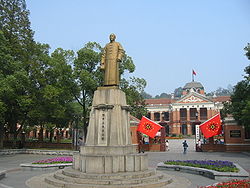 Sun Yat-sen
himself played no direct part with the uprising in Wuchang. He was traveling in the United States
, trying to drum up financial support from overseas Chinese
. At the time he was in Denver at the foot of the Rocky Mountains
. He received a telegram from Huang Xing
that was one week old and could not decipher it because he did not have the secret key with him. The next morning he read in the newspaper headline that the city of Wuchang was occupied by the revolutionaries. After the wuchang uprising, the revolutionaries telegraphed the other provinces asking them to declare their independence, and 15 provinces declared their independence from the Qing dynasty in Southern China and Central China.
Representatives from the seceding provinces met and declared the founding of the Republic of China
on January 1, 1912. Sun Yat-sen would return to China on December 1911 to be elected provisional president of the Republic of China. Sun eventually agreed to cede his provisional presidency to Yuan Shikai, in exchange for Yuan's help in pressuring the Last Emperor to abdicate. On February 12, 1912, Puyi
, the Last Emperor stepped down from the throne. The Qing dynasty could no longer govern itself as it seemed to have forefeited the mandate of heaven
. This brought an end to the imperial era.
, is celebrated as the National Day
of the Republic of China. It is one of the most important national holidays in Taiwan
.
October 10 is not the National Day of the People's Republic of China
, but there may also be memorial activities in mainland China
, usually referring to the day as the Anniversary for the Wuchang Uprising . The equivalent celebration is usually done on October 1 on the National Day of the People's Republic of China
.
Qing Dynasty
The Qing Dynasty was the last dynasty of China, ruling from 1644 to 1912 with a brief, abortive restoration in 1917. It was preceded by the Ming Dynasty and followed by the Republic of China....
government officials. The uprising was then assisted by the New Army
New Army
The New Armies were the modernized Qing armies, trained and equipped according to Western standards...
in a coup
Coup d'état
A coup d'état state, literally: strike/blow of state)—also known as a coup, putsch, and overthrow—is the sudden, extrajudicial deposition of a government, usually by a small group of the existing state establishment—typically the military—to replace the deposed government with another body; either...
against their own authorities in the city of Wuchang, Hubei province on October 10, 1911. The Battle of Yangxia
Battle of Yangxia
The Battle of Yangxia , also known as the Defense of Yangxia was fought from October 18 to December 1, 1911 between the revolutionaries of the Wuchang Uprising and the loyalist armies of the Qing Dynasty...
led by Huang Xing
Huang Xing
Huang Xing or Huang Hsing , was a Chinese revolutionary leader, militarist, and statesman, was the first army commander-in-chief of the Republic of China. As one of the founders of the Kuomintang and the Republic of China, his position was next to Sun Yat-sen. Together they were known as...
would be the major battle in the uprising. These events served as a catalyst to the Xinhai Revolution
Xinhai Revolution
The Xinhai Revolution or Hsinhai Revolution, also known as Revolution of 1911 or the Chinese Revolution, was a revolution that overthrew China's last imperial dynasty, the Qing , and established the Republic of China...
, which led to the collapse of the Qing dynasty and the establishment of the Republic of China
Republic of China (1912–1949)
In 1911, after over two thousand years of imperial rule, a republic was established in China and the monarchy overthrown by a group of revolutionaries. The Qing Dynasty, having just experienced a century of instability, suffered from both internal rebellion and foreign imperialism...
(ROC).
Canton and Sichuan railway crisis
After the Boxer RebellionBoxer Rebellion
The Boxer Rebellion, also called the Boxer Uprising by some historians or the Righteous Harmony Society Movement in northern China, was a proto-nationalist movement by the "Righteous Harmony Society" , or "Righteous Fists of Harmony" or "Society of Righteous and Harmonious Fists" , in China between...
many countries saw China as a good target for railway investment. Many countries said they would build railways in areas of their influence even if the Qing government protested. Germany
Germany
Germany , officially the Federal Republic of Germany , is a federal parliamentary republic in Europe. The country consists of 16 states while the capital and largest city is Berlin. Germany covers an area of 357,021 km2 and has a largely temperate seasonal climate...
began building lines in Shandong
Shandong
' is a Province located on the eastern coast of the People's Republic of China. Shandong has played a major role in Chinese history from the beginning of Chinese civilization along the lower reaches of the Yellow River and served as a pivotal cultural and religious site for Taoism, Chinese...
, the British
United Kingdom
The United Kingdom of Great Britain and Northern IrelandIn the United Kingdom and Dependencies, other languages have been officially recognised as legitimate autochthonous languages under the European Charter for Regional or Minority Languages...
in Yangtze Valley, French
France
The French Republic , The French Republic , The French Republic , (commonly known as France , is a unitary semi-presidential republic in Western Europe with several overseas territories and islands located on other continents and in the Indian, Pacific, and Atlantic oceans. Metropolitan France...
in Kunming
Kunming
' is the capital and largest city of Yunnan Province in Southwest China. It was known as Yunnan-Fou until the 1920s. A prefecture-level city, it is the political, economic, communications and cultural centre of Yunnan, and is the seat of the provincial government...
, Russians
Russians
The Russian people are an East Slavic ethnic group native to Russia, speaking the Russian language and primarily living in Russia and neighboring countries....
in Heilongjiang
Heilongjiang
For the river known in Mandarin as Heilong Jiang, see Amur River' is a province of the People's Republic of China located in the northeastern part of the country. "Heilongjiang" literally means Black Dragon River, which is the Chinese name for the Amur. The one-character abbreviation is 黑...
and the Japan
Japan
Japan is an island nation in East Asia. Located in the Pacific Ocean, it lies to the east of the Sea of Japan, China, North Korea, South Korea and Russia, stretching from the Sea of Okhotsk in the north to the East China Sea and Taiwan in the south...
ese had the Southern Manchuria Railway company.
In 1905, citizens were locally managing the Canton - Hankou Railway and the Sichuan-Hankou railway (川漢鐵路) by themselves in Guangdong
Guangdong
Guangdong is a province on the South China Sea coast of the People's Republic of China. The province was previously often written with the alternative English name Kwangtung Province...
, Hunan
Hunan
' is a province of South-Central China, located to the south of the middle reaches of the Yangtze River and south of Lake Dongting...
, Hubei
Hubei
' Hupeh) is a province in Central China. The name of the province means "north of the lake", referring to its position north of Lake Dongting...
and Sichuan
Sichuan
' , known formerly in the West by its postal map spellings of Szechwan or Szechuan is a province in Southwest China with its capital in Chengdu...
. The railways were supposed to link up with the rest of China.
In May 1911 the Qing government officials announced that they would nationalize those two railway lines, that were previously paid for by local private investors. In general, the Qing were under a lot of pressure, having to pay back huge debts for the Boxer protocol
Boxer Protocol
The Boxer Protocol was signed on September 7, 1901 between the Qing Empire of China and the Eight-Nation Alliance that had provided military forces plus Belgium, Spain and the Netherlands after China's defeat in the intervention to put down the Boxer Rebellion at the hands of the...
. So an announcement was made to seize the privately funded railways, to pay back debts to the foreigners, mainly Great Britain
Great Britain
Great Britain or Britain is an island situated to the northwest of Continental Europe. It is the ninth largest island in the world, and the largest European island, as well as the largest of the British Isles...
, Germany, France and the United States
United States
The United States of America is a federal constitutional republic comprising fifty states and a federal district...
. Taking away the private railways caused much anger among the people. Protests were held in Changsha, and people in Guangdong boycotted government banknotes. By July the Qing government compensated the private investors, but the amount offered to Sichuan was much lower than all other provinces. This caused more anger.
By August 11 there was a massive strike and rally at Chengdu
Chengdu
Chengdu , formerly transliterated Chengtu, is the capital of Sichuan province in Southwest China. It holds sub-provincial administrative status...
Sichuan. Governor official Zhao Erfeng
Zhao Erfeng
Zhao Erfeng was a Qing official and Chinese bannerman, who belonged to the Plain Blue Banner. He is known for being the last amban in Tibet, appointed in March, 1908. Lien Yu , a Manchu, was appointed as the other amban...
in a panic, ordered the arrest of the nobles. The New Army in Wuhan were situated in Wuchang, Hankou
Hankou
Hankou was one of the three cities whose merging formed modern-day Wuhan, the capital of the Hubei province, China. It stands north of the Han and Yangtze Rivers where the Han falls into the Yangtze...
and Hanyang at the time.
The Uprising
Revolutionary groups and bombing incident
The uprising itself broke out by accident. At the time there were two local revolutionary groups ready in Wuhan, the Literary society (文學社) and the Progressive Association (共進會). The two groups worked together led by Chiang Yi-wu (蔣翊武) and Sun wu (孫武). In September 1911 they began collaborating with the TongmenghuiTongmenghui
The Tongmenghui, also known as the Chinese United League, United League, Chinese Revolutionary Alliance, Chinese Alliance and United Allegiance Society, was a secret society and underground resistance movement formed when merging many Chinese revolutionary groups together by Sun Yat-sen, Song...
. The original uprising date was set for October 6 on Mid-Autumn festival
Mid-Autumn Festival
The Mid-Autumn Festival , also known as the Moon Festival or Mooncake Festival or Zhongqiu Festival, is a popular lunar harvest festival celebrated by Chinese and Vietnamese people. A description of the festival first appeared in Rites of Zhou, a written collection of rituals of the Western Zhou...
. But some people were not ready on that date, and so it was postponed. On October 9, 1911 Sun Wu was at the Russian concession of Hankou
Hankou
Hankou was one of the three cities whose merging formed modern-day Wuhan, the capital of the Hubei province, China. It stands north of the Han and Yangtze Rivers where the Han falls into the Yangtze...
where bombs were being built. In one accident a bomb exploded causing Sun wu serious injuries. When he was sent to the hospital, the staff discovered the group were revolutionaries and alerted the Qing government.
New Army mutiny
Facing arrest, and certain execution, the revolutionaries had their identities revealed. They had no choice but to stage a coup. Qing Viceroy of HuguangViceroy of Huguang
The Viceroy of Huguang , fully referred to as the Governor General of the Hubei and Hunan Provinces and surrounding areas; Overseeing Military Affairs, Food Production; Director of Civil Affairs , was one of eight viceroys in China proper during the Qing Dynasty of China. The Viceroy had...
Duan Zheng (瑞澂) tried to track down the revolutionaries. Jiang Yiwu (蔣翊武) of the Literary society decided to launch an attack that night, but was discovered by the Qing. Several members were arrested and executed.
Xiong Bingkun (熊秉坤) then decided to revolt on the evening of October 10, 1911 at 7pm. The modernized New Army
New Army
The New Armies were the modernized Qing armies, trained and equipped according to Western standards...
in Wuchang staged a mutiny
Mutiny
Mutiny is a conspiracy among members of a group of similarly situated individuals to openly oppose, change or overthrow an authority to which they are subject...
. While the New Army belonged to the Qing government, it has already been infiltrated by the then exiled Sun Yat-sen
Sun Yat-sen
Sun Yat-sen was a Chinese doctor, revolutionary and political leader. As the foremost pioneer of Nationalist China, Sun is frequently referred to as the "Father of the Nation" , a view agreed upon by both the People's Republic of China and the Republic of China...
's anti-Qing allegiance. This event would takeover the government house office of Duan Zheng, who was terrified and escaped from a dig-tunnel. After fierce fighting, the army captured strategic points in the city. More revolutionaries joined the revolt and the government troops were defeated.
Sacrificial ceremony
Just one week after the start of the Wuchang uprising, Li YuanhongLi Yuanhong
Li Yuanhong was a Chinese general and political figure during the Qing dynasty and the republican era. He was twice president of the Republic of China.- Early history :...
made a sacrifice to Heaven
Tian
Tian is one of the oldest Chinese terms for the cosmos and a key concept in Chinese mythology, philosophy, and religion. During the Shang Dynasty the Chinese called god Shangdi or Di , and during the Zhou Dynasty Tian "heaven; god" became synonymous with Shangdi...
, Earth
Di
Di may refer to:* The diminutive form of the name Diana, Diane and Dianne. Dai is the Welsh diminutive form of the name David.*Diana, Princess of Wales.*Di , an ancient ethnic group in China....
and the Yellow Emperor
Yellow Emperor
The Yellow Emperor or Huangdi1 is a legendary Chinese sovereign and culture hero, included among the Three Sovereigns and Five Emperors. Tradition holds that he reigned from 2697–2597 or 2696–2598 BC...
. A wide earthen platform was constructed on military parade ground near the government offices. Fire sacrificial offerings were made in an altar
Altar
An altar is any structure upon which offerings such as sacrifices are made for religious purposes. Altars are usually found at shrines, and they can be located in temples, churches and other places of worship...
for incense
Incense
Incense is composed of aromatic biotic materials, which release fragrant smoke when burned. The term "incense" refers to the substance itself, rather than to the odor that it produces. It is used in religious ceremonies, ritual purification, aromatherapy, meditation, for creating a mood, and for...
, wine and an ox
Ox
An ox , also known as a bullock in Australia, New Zealand and India, is a bovine trained as a draft animal. Oxen are commonly castrated adult male cattle; castration makes the animals more tractable...
according to tradition. Li and the officers kowtow
Kowtow
Kowtow is the act of deep respect shown by kneeling and bowing so low as to have one's head touching the ground. An alternative Chinese term is ketou, however the meaning is somewhat altered: kòu originally meant "knock with reverence", whereas kē has the general meaning of "touch upon ".In Han...
ed four times, while a prayer was read that told of the persecution of the Han by the Manchus and called the Yellow Emperor to assist in the establishment of the Republic. At the end, the soldiers raised their guns and shouted Ten thousand years
Ten thousand years
The use of the phrase "ten thousand years" in various East Asian languages originated in ancient China as an expression used to wish long life to the Emperor, and is typically translated as "long live" in English...
three times. The ceremony was then over.
Establishment of Hubei military government
On October 11, the New Army established a military government in HubeiHubei
' Hupeh) is a province in Central China. The name of the province means "north of the lake", referring to its position north of Lake Dongting...
and Li Yuanhong
Li Yuanhong
Li Yuanhong was a Chinese general and political figure during the Qing dynasty and the republican era. He was twice president of the Republic of China.- Early history :...
was forced to become the new governor. It took some persuading to get Li to be the governor as one story said he was even hiding under a bed to avoid the position.
Once the army had taken the city, they went to the Yellow Crane Tower
Yellow Crane Tower
Yellow Crane Tower is a famous and historic tower, first built in the year 223 AD, the current structure however, was rebuilt in 1981. The tower stands on Sheshan , at the bank of Yangtze River in Wuchang District, Wuhan, in Hubei province of central China.-History:- Legend :There are at least two...
to raise the "Iron blood 18-star flag". This new military government called for other provinces to support the revolution and declared the founding of the Republic of China
Republic of China
The Republic of China , commonly known as Taiwan , is a unitary sovereign state located in East Asia. Originally based in mainland China, the Republic of China currently governs the island of Taiwan , which forms over 99% of its current territory, as well as Penghu, Kinmen, Matsu and other minor...
. This temporary government was referred to as the "Military Government of Hubei of the Republic of China" (湖北軍政府). By October 12 Hankou
Hankou
Hankou was one of the three cities whose merging formed modern-day Wuhan, the capital of the Hubei province, China. It stands north of the Han and Yangtze Rivers where the Han falls into the Yangtze...
and Hanyang also fell into the hands of the revolutionaries.
Battle of Yangxia
The Qing government responded in October by ordering Yuan ShikaiYuan Shikai
Yuan Shikai was an important Chinese general and politician famous for his influence during the late Qing Dynasty, his role in the events leading up to the abdication of the last Qing Emperor of China, his autocratic rule as the second President of the Republic of China , and his short-lived...
and the Beiyang Army
Beiyang Army
The Beiyang Army was a powerful, Western-style Chinese military force created by the Qing Dynasty government in the late 19th century. It was the centerpiece of a general reconstruction of China's military system. The Beiyang Army played a major role in Chinese politics for at least three decades...
to suppress the uprising in Wuchang. Huang Xing
Huang Xing
Huang Xing or Huang Hsing , was a Chinese revolutionary leader, militarist, and statesman, was the first army commander-in-chief of the Republic of China. As one of the founders of the Kuomintang and the Republic of China, his position was next to Sun Yat-sen. Together they were known as...
would arrive in Wuhan early November to take command of the revolutionary army. The revolutionaries and the loyalists fought a protracted battle in Hankou and Hanyang known as the Battle of Yangxia that would last until December 1, 1911. Although the loyalists eventually captured both towns, Yuan Shikai, the commander-in-chief of the Qing forces, halted the advance of loyalist Beiyang Army and agreed to a ceasefire and began negotiations on December 1.
Aftermath
Sun Yat-sen
Sun Yat-sen was a Chinese doctor, revolutionary and political leader. As the foremost pioneer of Nationalist China, Sun is frequently referred to as the "Father of the Nation" , a view agreed upon by both the People's Republic of China and the Republic of China...
himself played no direct part with the uprising in Wuchang. He was traveling in the United States
United States
The United States of America is a federal constitutional republic comprising fifty states and a federal district...
, trying to drum up financial support from overseas Chinese
Overseas Chinese
Overseas Chinese are people of Chinese birth or descent who live outside the Greater China Area . People of partial Chinese ancestry living outside the Greater China Area may also consider themselves Overseas Chinese....
. At the time he was in Denver at the foot of the Rocky Mountains
Rocky Mountains
The Rocky Mountains are a major mountain range in western North America. The Rocky Mountains stretch more than from the northernmost part of British Columbia, in western Canada, to New Mexico, in the southwestern United States...
. He received a telegram from Huang Xing
Huang Xing
Huang Xing or Huang Hsing , was a Chinese revolutionary leader, militarist, and statesman, was the first army commander-in-chief of the Republic of China. As one of the founders of the Kuomintang and the Republic of China, his position was next to Sun Yat-sen. Together they were known as...
that was one week old and could not decipher it because he did not have the secret key with him. The next morning he read in the newspaper headline that the city of Wuchang was occupied by the revolutionaries. After the wuchang uprising, the revolutionaries telegraphed the other provinces asking them to declare their independence, and 15 provinces declared their independence from the Qing dynasty in Southern China and Central China.
Representatives from the seceding provinces met and declared the founding of the Republic of China
Republic of China (1912–1949)
In 1911, after over two thousand years of imperial rule, a republic was established in China and the monarchy overthrown by a group of revolutionaries. The Qing Dynasty, having just experienced a century of instability, suffered from both internal rebellion and foreign imperialism...
on January 1, 1912. Sun Yat-sen would return to China on December 1911 to be elected provisional president of the Republic of China. Sun eventually agreed to cede his provisional presidency to Yuan Shikai, in exchange for Yuan's help in pressuring the Last Emperor to abdicate. On February 12, 1912, Puyi
Puyi
Puyi , of the Manchu Aisin Gioro clan, was the last Emperor of China, and the twelfth and final ruler of the Qing Dynasty. He ruled as the Xuantong Emperor from 1908 until his abdication on 12 February 1912. From 1 to 12 July 1917 he was briefly restored to the throne as a nominal emperor by the...
, the Last Emperor stepped down from the throne. The Qing dynasty could no longer govern itself as it seemed to have forefeited the mandate of heaven
Mandate of Heaven
The Mandate of Heaven is a traditional Chinese philosophical concept concerning the legitimacy of rulers. It is similar to the European concept of the divine right of kings, in that both sought to legitimaze rule from divine approval; however, unlike the divine right of kings, the Mandate of...
. This brought an end to the imperial era.
Culture
The date of the uprising, October 10, widely known as Double Ten DayDouble Ten Day
Double Ten Day is the national day of the Republic of China and celebrates the start of the Wuchang Uprising of October 10, 1911, which led to the collapse of the Qing Dynasty in China and establishment of the Republic of China on January 1, 1912...
, is celebrated as the National Day
National Day
The National Day is a designated date on which celebrations mark the nationhood of a nation or non-sovereign country. This nationhood can be symbolized by the date of independence, of becoming republic or a significant date for a patron saint or a ruler . Often the day is not called "National Day"...
of the Republic of China. It is one of the most important national holidays in Taiwan
Taiwan
Taiwan , also known, especially in the past, as Formosa , is the largest island of the same-named island group of East Asia in the western Pacific Ocean and located off the southeastern coast of mainland China. The island forms over 99% of the current territory of the Republic of China following...
.
October 10 is not the National Day of the People's Republic of China
People's Republic of China
China , officially the People's Republic of China , is the most populous country in the world, with over 1.3 billion citizens. Located in East Asia, the country covers approximately 9.6 million square kilometres...
, but there may also be memorial activities in mainland China
Mainland China
Mainland China, the Chinese mainland or simply the mainland, is a geopolitical term that refers to the area under the jurisdiction of the People's Republic of China . According to the Taipei-based Mainland Affairs Council, the term excludes the PRC Special Administrative Regions of Hong Kong and...
, usually referring to the day as the Anniversary for the Wuchang Uprising . The equivalent celebration is usually done on October 1 on the National Day of the People's Republic of China
National Day of the People's Republic of China
The National Day of the People's Republic of China is celebrated every year on October 1. It is a public holiday in the People's Republic of China to celebrate their national day.The PRC was founded on October 1, 1949 with a ceremony at Tiananmen Square...
.