

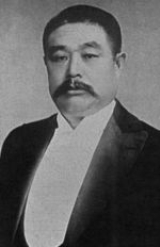
Li Yuanhong

Encyclopedia
Li Yuanhong is a province in Central China. The name of the province means "north of the lake", referring to its position north of Lake Dongting...
, 1864 - Tianjin
Tianjin
' is a metropolis in northern China and one of the five national central cities of the People's Republic of China. It is governed as a direct-controlled municipality, one of four such designations, and is, thus, under direct administration of the central government...
, June 3, 1928) was a Chinese
China
Chinese civilization may refer to:* China for more general discussion of the country.* Chinese culture* Greater China, the transnational community of ethnic Chinese.* History of China* Sinosphere, the area historically affected by Chinese culture...
general
General
A general officer is an officer of high military rank, usually in the army, and in some nations, the air force. The term is widely used by many nations of the world, and when a country uses a different term, there is an equivalent title given....
and political figure during the Qing dynasty
Qing Dynasty
The Qing Dynasty was the last dynasty of China, ruling from 1644 to 1912 with a brief, abortive restoration in 1917. It was preceded by the Ming Dynasty and followed by the Republic of China....
and the republican era
History of the Republic of China
The History of the Republic of China begins after the Qing Dynasty in 1912, when the formation of the Republic of China put an end to over two thousand years of Imperial rule. The Qing Dynasty, also known as the Manchu Dynasty, ruled from 1644 to 1912...
. He was twice president of the Republic of China
President of the Republic of China
The President of the Republic of China is the head of state and commander-in-chief of the Republic of China . The Republic of China was founded on January 1, 1912, to govern all of China...
.
Early history
A native of HuangpiHuangpi District
Huangpi District is a district of Hubei, China. It is under the administration of Wuhan city....
, Hubei
Hubei
' Hupeh) is a province in Central China. The name of the province means "north of the lake", referring to its position north of Lake Dongting...
, he was the son of a Qing veteran of the Taiping Rebellion
Taiping Rebellion
The Taiping Rebellion was a widespread civil war in southern China from 1850 to 1864, led by heterodox Christian convert Hong Xiuquan, who, having received visions, maintained that he was the younger brother of Jesus Christ, against the ruling Manchu-led Qing Dynasty...
. He graduated from Tianjin
Tianjin
' is a metropolis in northern China and one of the five national central cities of the People's Republic of China. It is governed as a direct-controlled municipality, one of four such designations, and is, thus, under direct administration of the central government...
's naval academy in 1889 and served as an engineer in the First Sino-Japanese war
First Sino-Japanese War
The First Sino-Japanese War was fought between Qing Dynasty China and Meiji Japan, primarily over control of Korea...
. His cruiser was sunk and he survived because of his life belt, since he could not swim. He later joined the army and became senior military officer in Hankou. In 1910, he attempted to break up revolutionary rings that infiltrated his 21st Mixed Brigade. He did not arrest anyone caught in subversive activities, but simply dismissed them.
National prominence
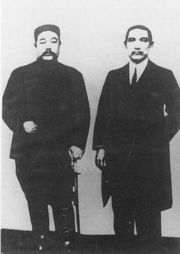
Xinhai Revolution
The Xinhai Revolution or Hsinhai Revolution, also known as Revolution of 1911 or the Chinese Revolution, was a revolution that overthrew China's last imperial dynasty, the Qing , and established the Republic of China...
of 1911 broke out, the Wuchang mutineers
Wuchang Uprising
The Wuchang Uprising began with the dissatisfaction of the handling of a railway crisis. The crisis then escalated to an uprising where the revolutionaries went up against Qing government officials. The uprising was then assisted by the New Army in a coup against their own authorities in the city...
needed a visible high-ranking officer to be their figurehead. Li was well respected, had supported the Railway Protection Movement, and knew English which would be useful in dealing with foreign concerns. He was reportedly dragged from hiding under his wife's bed and forced at gunpoint to be the provisional military governor of Hubei despite killing several of the rebels. Though reluctant at first, he embraced the revolution after its growing momentum and was named military governor of China on November 30. Qing Premier Yuan Shikai
Yuan Shikai
Yuan Shikai was an important Chinese general and politician famous for his influence during the late Qing Dynasty, his role in the events leading up to the abdication of the last Qing Emperor of China, his autocratic rule as the second President of the Republic of China , and his short-lived...
negotiated a truce with him on December 4.
Despite Li commanding the rebel army, Sun Yat-sen
Sun Yat-sen
Sun Yat-sen was a Chinese doctor, revolutionary and political leader. As the foremost pioneer of Nationalist China, Sun is frequently referred to as the "Father of the Nation" , a view agreed upon by both the People's Republic of China and the Republic of China...
of the Revolutionary Alliance became the first provisional president in Nanjing
Nanjing
' is the capital of Jiangsu province in China and has a prominent place in Chinese history and culture, having been the capital of China on several occasions...
on January 1, 1912. Li was made vice president as a compromise and he formed People's Society to campaign for the presidency. Meanwhile, the north was still under the control of the Qing. A negotiation made Sun step down in favor of Yuan Shikai as president with Li keeping his vice-presidency. This ended the Qing dynasty and reunified north and south China. People's Society later merged with the pro-Yuan Republican Party.
In 1913, he combined the Republicans with Liang Qichao
Liang Qichao
Liang Qichao |Styled]] Zhuoru, ; Pseudonym: Rengong) was a Chinese scholar, journalist, philosopher and reformist during the Qing Dynasty , who inspired Chinese scholars with his writings and reform movements...
's Democratic Party to form the Progressive Party
Progressive Party (China)
- Origins :Chinese constitutionalism was a movement that originated after the First Sino-Japanese War . A young group of intellectuals in China led by Kang Youwei argued that China's defeat was due to its lack of modern institutions and legal framework which the Self-Strengthening Movement had...
. The Progressives became the biggest rivals to the opposition Nationalists
Kuomintang
The Kuomintang of China , sometimes romanized as Guomindang via the Pinyin transcription system or GMD for short, and translated as the Chinese Nationalist Party is a founding and ruling political party of the Republic of China . Its guiding ideology is the Three Principles of the People, espoused...
led by Sun. He supported Yuan against Sun during the Second Revolution which earned him the enmity of his former comrades. When Yuan pulled off his presidential coup, Li was viewed as a potential threat and confined in Beijing
Beijing
Beijing , also known as Peking , is the capital of the People's Republic of China and one of the most populous cities in the world, with a population of 19,612,368 as of 2010. The city is the country's political, cultural, and educational center, and home to the headquarters for most of China's...
where he became a passive bystander under Yuan's grip. Yuan could never fully trust Li because he wasn't a protege within the Beiyang Army
Beiyang Army
The Beiyang Army was a powerful, Western-style Chinese military force created by the Qing Dynasty government in the late 19th century. It was the centerpiece of a general reconstruction of China's military system. The Beiyang Army played a major role in Chinese politics for at least three decades...
's inner circle and because of his past association with the revolutionaries. Nevertheless, Yuan married his son to Li's daughter to strengthen their ties. Li kept his office and honors as vice president but had no power. Some factions called on Li to claim the presidency when Yuan crowned himself emperor in 1916. He refused for fear of his life but he also declined aristocratic titles granted by Yuan, a decision which would help his standing later on. Li remained in self-imposed isolation at his residence during the monarchic period, and until the death of Yuan.
President
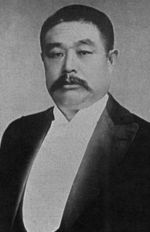
Duan Qirui
Duan Qirui was a Chinese warlord and politician, commander in the Beiyang Army, and the Provisional Chief Executive of Republic of China from November 24, 1924 to April 20, 1926. He was arguably the most powerful man in China from 1916 to 1920.- Early life :Born in Hefei as Duan Qirui , his...
and Xu Shichang. The will was an imperial tradition started by the Kangxi emperor, and was not constitutional in the republic. However, the Beiyang generals pressed Li into office, since he was acceptable to the rebellious southern provinces
National Protection War
The National Protection War , also known as the anti-Monarchy War, was a civil war that took place in China between 1915 and 1916. The cause of this war was Yuan Shikai's proclamation of himself as Emperor. Only three years earlier, the last Chinese dynasty, the Qing Dynasty, had been overthrown...
. Li tried to return to the 1912 constitutional arrangement, but Duan held the real power. The National Assembly of the Republic of China
National Assembly of the Republic of China
The National Assembly of the Republic of China refers to several parliamentary bodies that existed in the Republic of China. The National Assembly was originally founded in 1913 as the first legislature in Chinese history, but was disbanded less than a year later as President Yuan Shikai assumed...
reconvened on August 1, 1916, after having been disbanded over two and a half years earlier. Duan was eager to pull China into World War I
World War I
World War I , which was predominantly called the World War or the Great War from its occurrence until 1939, and the First World War or World War I thereafter, was a major war centred in Europe that began on 28 July 1914 and lasted until 11 November 1918...
but Li was more hesitant. They conflicted greatly over Duan's decision to cut ties with Germany
Germany
Germany , officially the Federal Republic of Germany , is a federal parliamentary republic in Europe. The country consists of 16 states while the capital and largest city is Berlin. Germany covers an area of 357,021 km2 and has a largely temperate seasonal climate...
. Li forced Duan to resign on May 23, 1917, when the premier's secret loans from Japan
Japan
Japan is an island nation in East Asia. Located in the Pacific Ocean, it lies to the east of the Sea of Japan, China, North Korea, South Korea and Russia, stretching from the Sea of Okhotsk in the north to the East China Sea and Taiwan in the south...
were exposed. Duan fled to Tianjin to muster his forces, and most generals abandoned the government. In response, Li asked General Zhang Xun
Zhang Xun (Republic of China)
Zhang Xun was a Qing-loyalist general who attempted to restore the abdicated emperor Puyi in 1917. He supported Yuan Shikai during his time as president....
for assistance. In exchange, Zhang asked for the dissolution of parliament which was granted on June 13. Zhang, who was secretly pro-German, unexpectedly occupied Beijing from June 14 to July 12 of 1917 and kept the president prisoner. Zhang then proceeded with a move that would undermine most of his support when he attempted to restore Emperor Puyi
Puyi
Puyi , of the Manchu Aisin Gioro clan, was the last Emperor of China, and the twelfth and final ruler of the Qing Dynasty. He ruled as the Xuantong Emperor from 1908 until his abdication on 12 February 1912. From 1 to 12 July 1917 he was briefly restored to the throne as a nominal emperor by the...
and the Qing dynasty on July 1. Li was released to the Japanese legation where he asked for Duan's assistance in saving the republic. Duan overthrew Zhang and was reinstated as premier. Vice President Feng Guozhang
Feng Guozhang
Féng Guózhāng, was a key Beiyang Army general and politician in early republican China. He held the office of Vice-President and then President of the Republic of China...
was made acting president in Nanjing. On July 17, distraught from recent events, Li officially resigned from office and moved to Tianjin in retirement.
He served again as president of China between 11 June 1922 and 13 June 1923 after Cao Kun
Cao Kun
|-...
forced out President Xu Shichang. Li was chosen because he was respected by all of the factions and was hoped to reunify the country. He accepted only with the private assurances that warlord
Warlord
A warlord is a person with power who has both military and civil control over a subnational area due to armed forces loyal to the warlord and not to a central authority. The term can also mean one who espouses the ideal that war is necessary, and has the means and authority to engage in war...
forces be disbanded; they were never honored. Like his first term, he called back the original National Assembly but he was even more powerless than before. He organized the "Able Men Cabinet" consisting of prestigious experts but it became undone when he arrested the finance minister for graft after examining rumours and circumstantial evidence; a court threw out the charges. Cao soon harbored presidential ambitions himself and orchestrated strikes to force Li out of office. Cao went as far as trying to bribe the assembly into impeaching him. When Li was vacating the capital, he attempted to take the presidential seal with him but was intercepted. He fled to Japan for medical treatment and returned to Tianjin in 1924 where he later died.
See also
- History of the Republic of ChinaHistory of the Republic of ChinaThe History of the Republic of China begins after the Qing Dynasty in 1912, when the formation of the Republic of China put an end to over two thousand years of Imperial rule. The Qing Dynasty, also known as the Manchu Dynasty, ruled from 1644 to 1912...
|-
|-