

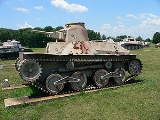
Type 95 Ha-Go

Encyclopedia
The was a light tank
used by the Imperial Japanese Army
in combat operations of the Second Sino-Japanese War
, at Nomonhan
against the Soviet Union
, and in the Second World War. It proved sufficient against infantry, however, like the American M3 Stuart, it was not designed to fight other tanks. Approximately 2,300 units were produced, making it the most numerous Japanese armored fighting vehicle of the time.
unit combining infantry with tanks. However, the Type 89 Medium tank
could not keep pace with the motorized infantry, which could move at 40 km/h by truck. To solve this problem, the Army Technical Bureau proposed a new light tank at 40 km/h speed and started development in 1933. The prototype of the new tank was completed in 1934 at the Army's Sagami Arsenal. It was a high-speed and lightly armored tank comparable to the Soviet
BT-2 tank of 1932.
In 1935, at a meeting in the Army Technical Bureau, the Type 95 was proposed as the main tank for mechanized infantry
units. The infantry had concerns that the armor was insufficient; however, the cavalry
indicated that the improved speed and armament compensated for thin armor. In the end, the infantry agreed, as the Type 95 was still superior to the only available alternative, which was the armored car.
Production was started in 1936 by Mitsubishi Heavy Industries
. By 1939, 100 units had been built. Mitsubishi would go on to build a total of 853 in their own factories, with another 1250 units built by the Sagami Arsenal, Hitachi Industries
, Niigata Tekkoshō, Kobe Seikoshō
, and Kokura Arsenal.
.jpg)


The primary armament of the most produced version was a Type 98 37 mm gun
with the barrel length of 46.1 calibers. It elevated between −15 to +20 degrees. The tank carried two types of 37 mm ammunition, the high-explosive and armor-piercing. For the latter, muzzle velocity
was 675–700 m/s, and the armor penetration was 25 mm at a distance of 500 m.
Secondary armament consisted of two 7.7 mm Type 97 light machine gun
s, one mounted in the hull and the other in the turret, not coaxially with the main gun but facing to the rear right (that is, in the five-o-clock direction).
The most characteristic feature of the Type 95 tank was its simple suspension
system. Two bogie
wheels were suspended on a single bell crank
with two bell cranks per side. The tracks were driven through the front sprockets. There were two return wheels. The suspension had troubles early on, with a tendency to pitch so badly on rough ground that the crew sometimes found it impossible to drive at any speed, and so it was modified with a brace to connect the pairs of bogies. Despite this, the tank continued to give its users a rough ride across any uneven ground. It was provided with an interior layer of asbestos
, primarily to isolate the crew from the sun-heated armor plates, but also to protect from injury when the tank moved at high speed across rough terrain.
Type 95 was fitted with 120 hp (89.5 kW) Mitsubishi NVD 6120 air-cooled diesel engine
.
Some tanks were fitted with two reflectors
in the front of the vehicle for night operations
.


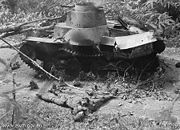
engine. By comparison the US Army's light tanks were armed with machine guns until the M2A4 light tank
was built in 1940 and powered by gasoline. As with most armies in the 1930s, including the US Army, the tank, and the light tank in particular, were used primarily to support infantry or serve as cavalry reconnaissance and to a lesser extent, as raiding vehicles. Its speed was about 18 mph cross country, which was comparable to the Stuart's 20 mph nearly 6 years later in 1941. The five year old Type 95 could compete against the new American M3 Stuart light tanks, which began rolling off the assembly lines in October 1941.
Type 95 proved sufficient against opposing infantry in campaigns in Manchuria
and China
, as the Chinese
National Revolutionary Army
had only three tank battalions consisting of Vickers
export tanks, German PzKpfw I light tanks, and Italian CV33 tankettes to oppose them. However, the Type 95, like the M3 Stuarts of the US Army, were not designed to fight other tanks, they were designed to support the infantry. and due to the IJN
's priority in receiving technology
and steel
for warship
construction, tanks for the IJA
were relegated to receiving what was left. By 1942, Japanese armor remained largely the same as they did in the 1930s, and were regarded as obsolete after 1941. The Type 95 was also used by Imperial Japanese Navy
SNLF
detachments in Pacific areas during the conflict.
was retreating from the Khalkhin Gol (Nomonhan
) region, the IJA
command in Manchuria
transferred the 1st Tank Corps
, under the command of Lt. Gen. Yasuoka Masaomi to Nomonhon; for the purposes of cutting off the retreating Soviets at the Halha River (Khalkhin Gol River). After a two day journey by rail, the 1st Tank Corps began unloading its 3rd and 4th Tank Regiments from their trains at Arshaan in Manchuria
on 22 June 1939. While the 3rd Tank Regiment was composed primarily of the nearly decade old Type 89
medium tanks; the 4th Tank Regiment, commanded by 48 year old Col. Tamada
Yoshio, consisted of 35 Type 95 light tanks, 8 Type 89s, and 3 Type 94s tankettes.
From the beginning of Soviet General
Zhukov's assumption of command at Nomonhan in June 1939, he had deployed his BT-5 & BT-7
light tanks (Bystrokhodnyi tanks, meaning high-speed tank); and incorporated them into all of his combined artillery
, infantry
, and armor attacks. Although in the same light tank category as the Type 95, with the same 3 man crew, and near same dimensions, the BT Tanks were nearly twice as heavy, at 13.8 tons but were highly susceptible to close quarter (tank killer) teams using fire bombs (molotov cocktails); which was primarily due to their gasoline
engines. As such, Japan
ese tankers held a generally low opinion of the Russia
n tanks, but the BT tank's 45 mm gun was an altogether different matter. With a velocity
of over 2,000 feet per second, Soviet tanks were not only punching holes into IJA
tanks, but they were doing it at over a 1,000 meters distance (the Type 95's 37 mm main gun had a maximum effective range of less than 700 meters); as one Type 95 tank officer put it, "...no sooner did we see the flash, then there would be a hole in our tank! And the Russians were good shots too!"
On 2 July 1939, at approximately 1810 hours (6:10 PM), Col. Tamada's 4th Tank Regiment of more mobile Type 95 tanks took the lead in front of the medium tanks of the 3rd Tank Regiment, as the 1st Tank Corps launched its first offensive
against the Soviet forces at Khalkhin Gol. While the 3rd Tank Regiment had passed through Soviet artillery fire, becoming decisively engaged by about 2000 hours (8PM) during their movement forward, the 4th Tank Regiment, while avoiding Soviet artillery barrages had advanced in a southeast direction instead of a due south course, thusly engaging Russia
n forces southwest of Uzuru pond Observing a Russian artillery battery (gun positions) between himself and his objective, a "junction", Col Tamada ordered an attack in the darkness. At about 2300 hours (11PM) the 4th Tank moved towards their objective at about 6 meters between tanks, and 30 meters between companies and platoons. Just after midnight a thunderstorm
struck the battlefield, conveniently exposing the Russian positions, while at the same time masking the advancing 4th Tank Regiment. While at close range, the lightning storm suddenly illuminated the advancing Type 95s, and the Soviet defense line immediately opened fire with heavy machineguns, artillery, BT-7
light tanks, and anti-tank guns. However, since the range was so close, the Russian artillery (guns) could not depress their tubes low enough to hit the tanks, and their artillery shells flew wildly over the advancing armor. At about 0020 Hours (12:20AM) Col. Tamada ordered the 4th Tank Regiment to "charge
", and by 0200 hours (2AM) his light tanks had penetrated over 1,000 yards through Russian lines and knocked out twelve artillery guns.
At a cost of 1 Type 95 light tank, 2 KIA (one officer and one enlisted man) and 8 WIA; the 4th Tank had expended approximately 1,100 37 mm and 129 57 mm tank shells, and 16,000 rounds of machinegun ammunition. After the action, the Soviet command
acknowledged that 1st Tank Corps armor had reached the Russian guns.
military had been operating in the Philippines since at least 1900 (Philippine Insurrection/Philippine War 1900–1902) and Great Britain
had military bases in Singapore
since at least the 1840s; combined, they both had at least one hundred years of "jungle warfare
" experience between them. Which no doubt influenced their beliefs that tanks could not operate in those jungles. On the other hand, the IJA
had always been focused upon Russia
and China
, and had never conducted major campaign
s in jungle (tropical) regions. Facing impenetrable jungle
s, two experienced powerful armies, and lacking any combat jungle experience themselves, the IJA Type 95s led the assault forces into taking Singapore
by 15 February, and Corregidor
by April 1942. By those standards, the Type 95 proved to be an extremely successful light tank during the early campaigns leading into mid 1942. The proper tactical deployment of a war machine is key to any military success, and the Japanese success in Malaya was partly due to the unexpected presence of their tanks in areas where the British did not believe tanks could be used. The wet jungle terrain, although an obstacle, did not stop the twelve Type 95s, taking part in an attack which broke the Jitra line on 11 December 1941; but the military still needed a rugged reliable tank to conduct those tactics with, and the Type 95 was the light tank that successfully completed those missions in 1942. Poor planning on the part of the British Army
resulted in few to none of any type of armor in British Malaya
or Burma in December 1941.
's first tank versus tank battle of World War II
occurred when Type 95 light tanks of the IJA 4th Tank Regiment engaged a US Army tank platoon
, consisting of five brand new M3 Stuart light tanks from "B" company, 192nd Tank Battalion
, on 22 December 1941; north of Damortis during the retreat to the Bataan Peninsula
in 1941. Both the M3 and Type 95 light tanks were armed with a 37 mm gun, but the M3 was better armored, with 32 mm (1¼ inches) thick turret sides, vs the Type 95's 12 mm thick armor; however, based upon the Army's Ballistics Research Lab (BRL) which conducted the first large study of tank vs tank warfare in 1945, the conclusion was that the single most important factor in a tank duel was which side saw first, shot first, and hit first. In this first engagement the IJA reacted first, destroying the lead M3 as it tried to leave the road. The four remaining American tanks all suffered hits as they retreated.
On 06/7 June 1942, the Japanese 3rd Special Naval Landing Forces (SNLF) landed on Kiska Island during the Japanese invasion of the Aleutian Islands, part of today's state of Alaska
. The SNLF
landing was reinforced by Type 95 light tanks from the IJAs 11th Tank Regiment, which became the only enemy tanks to ever land on North American
soil. After the battle, two captured Type 95s were transported to Aberdeen Proving Ground
in Maryland
for study and evaluation; where they rest on display today (see photo United States Army Ordnance Museum
).
Two Type 95 tanks were deployed to support the Japanese landing at Milne Bay
, in late August 1942. Initially, the tanks proved successful against the lightly armed Australian infantry, whose 'sticky bombs' failed to stick due to the humidity. Although the tanks had proved reliable in the tropical conditions of Malaya, they could not handle the volume of mud caused by intense, almost daily rainfall at Milne Bay. Both tanks were bogged down and abandoned a few days after the landing.
infantry tank
s which were deployed against them. The thin armor of the Type 95 made it increasingly vulnerable, as Allied forces realized that standard infantry weapons were capable of penetrating the minimal armor around the engine block, and even its thickest armor could not withstand anything above rifle caliber. By 1944, it was already known that the 10 year old Type 95 light tank's firepower was insufficient to take on "brand new" US medium tank
s, such as the medium M4 Sherman
, or the M5 Stuart light tank, although the Type 95 could still give the M3 Stuart light tank a run for its money.
In August 1942, the US launched its first counter-offensive against Japan, when it landed US Marines on Guadalcanal
. The US Marine Corps deployed its 1st Tank Battalion
, which was equipped with the only M2A4
light tanks to see combat with US forces during World War II. The M2A4 was the foundation for the M3 Stuart, and both vehicles were nearly identical when viewed side by side; with the primary difference being the rear idler wheel lowered to the ground on the M3. Although the M2A4 was newer by five years, being built in 1940, than the Type 95, it was the closest US tank in armament and armor to the Type 95 light tank; with 25 mm (1") thick turret sides vs the 95's 12 mm turret sides; and both tanks were equipped with 37 mm main guns. Several Type 95s were destroyed or captured by the United States Army during the Battle of Biak
in 1943. As the tide of the war turned against Japan, the Type 95s were increasingly expended in banzai charge
s or were dug-in as pillboxes in static defense positions in the Japanese-occupied islands. During the Battle of Tarawa
, seven entrenched Type 95s opposed American landings. More were destroyed on Parry Island and on Eniwetok. On Saipan
, Type 95s attacked the American Marine beachhead on 16 June 1944, and more were used in the largest tank battle in the Pacific the following day.
In the Battle of Guam on 21 July, ten Type 95 were lost to bazooka
fire or M4 tanks. Seven more were destroyed on Tinian
on 24 July, and 15 more on Battle of Peleliu
on 15 September. Likewise, in the Philippines, at least ten Type 95s were destroyed in various engagements on Leyte
, and another 19 on Luzon
. At the Battle of Okinawa
, 13 Type 95s and 14 Type 97
Shihoto medium tanks of the 27th Tank Regiment faced 800 American tanks.
. Type 95 light tanks of the IJA 14th Tank Regiment led the way. They engaged the M3 Stuarts of the British 7th Hussars and 2nd Royal Tank Regiment
, and as the British retreated towards India, the IJA ultimately resupplied their destroyed Type 95's with "some" captured M3's. By 1944, the 14th Tank Regiment was starving to death due to British deep battle tactics of cutting the IJA's logistical lines; and a final push by the IJA was stopped at Imphal
, India.
When the war ended, hundreds of Type 95s were left in China. They were used during the Chinese Civil War
.
 Thailand
 People's Republic of China
Light tank
A light tank is a tank variant initially designed for rapid movement, and now primarily employed in low-intensity conflict. Early light tanks were generally armed and armored similar to an armored car, but used tracks in order to provide better cross-country mobility.The light tank was a major...
used by the Imperial Japanese Army
Imperial Japanese Army
-Foundation:During the Meiji Restoration, the military forces loyal to the Emperor were samurai drawn primarily from the loyalist feudal domains of Satsuma and Chōshū...
in combat operations of the Second Sino-Japanese War
Second Sino-Japanese War
The Second Sino-Japanese War was a military conflict fought primarily between the Republic of China and the Empire of Japan. From 1937 to 1941, China fought Japan with some economic help from Germany , the Soviet Union and the United States...
, at Nomonhan
Nomonhan
Nomonhan is a small village near the border between Mongolia and Inner Mongolia, China south of the Chinese city of Manzhouli.In the summer of 1939 it was the location of the Nomonhan Incident, as it is termed in Japan, or the Battle of Khalkhin Gol as it is known in Soviet and Mongolian People's...
against the Soviet Union
Soviet Union
The Soviet Union , officially the Union of Soviet Socialist Republics , was a constitutionally socialist state that existed in Eurasia between 1922 and 1991....
, and in the Second World War. It proved sufficient against infantry, however, like the American M3 Stuart, it was not designed to fight other tanks. Approximately 2,300 units were produced, making it the most numerous Japanese armored fighting vehicle of the time.
History and development
From early 1930s, the Japanese army began experimenting on a mechanized warfareMechanized Warfare
Mechanized Warfare is the sixth studio album released by American power metal band Jag Panzer, released in 2001. This album is more progressive than the band's previous work...
unit combining infantry with tanks. However, the Type 89 Medium tank
Type 89 I-Go
The was a medium tank used by the Imperial Japanese Army from 1932 to 1942 in combat operations of the Second Sino-Japanese War, at Khalkhin Gol against the Soviet Union, and in the Second World War. The Type 89B model was the world's first mass produced diesel engine tank...
could not keep pace with the motorized infantry, which could move at 40 km/h by truck. To solve this problem, the Army Technical Bureau proposed a new light tank at 40 km/h speed and started development in 1933. The prototype of the new tank was completed in 1934 at the Army's Sagami Arsenal. It was a high-speed and lightly armored tank comparable to the Soviet
Red Army
The Workers' and Peasants' Red Army started out as the Soviet Union's revolutionary communist combat groups during the Russian Civil War of 1918-1922. It grew into the national army of the Soviet Union. By the 1930s the Red Army was among the largest armies in history.The "Red Army" name refers to...
BT-2 tank of 1932.
In 1935, at a meeting in the Army Technical Bureau, the Type 95 was proposed as the main tank for mechanized infantry
Mechanized infantry
Mechanized infantry are infantry equipped with armored personnel carriers , or infantry fighting vehicles for transport and combat ....
units. The infantry had concerns that the armor was insufficient; however, the cavalry
Cavalry
Cavalry or horsemen were soldiers or warriors who fought mounted on horseback. Cavalry were historically the third oldest and the most mobile of the combat arms...
indicated that the improved speed and armament compensated for thin armor. In the end, the infantry agreed, as the Type 95 was still superior to the only available alternative, which was the armored car.
Production was started in 1936 by Mitsubishi Heavy Industries
Mitsubishi Heavy Industries
, or MHI, is a Japanese company. It is one of the core companies of Mitsubishi Group.-History:In 1870 Yataro Iwasaki, the founder of Mitsubishi took a lease of Government-owned Nagasaki Shipyard. He named it Nagasaki Shipyard & Machinery Works, and started the shipbuilding business on a full scale...
. By 1939, 100 units had been built. Mitsubishi would go on to build a total of 853 in their own factories, with another 1250 units built by the Sagami Arsenal, Hitachi Industries
Hitachi, Ltd.
is a Japanese multinational conglomerate headquartered in Marunouchi 1-chome, Chiyoda, Tokyo, Japan. The company is the parent of the Hitachi Group as part of the larger DKB Group companies...
, Niigata Tekkoshō, Kobe Seikoshō
Kobe Steel
, operating worldwide under the brand Kobelco, is a major Japanese steel manufacturer headquartered in Chuo-ku, Kobe. Kobe Steel also has a stake in Osaka Titanium Technologies.It was formed on September 1, 1905...
, and Kokura Arsenal.
Design
The Type 95 was a 7.4-tonne vehicle with a complement of 3 crewmen: a commander, a hull machine gunner, and a driver. Only the commander was seated in the turret, hence he was responsible for observation, loading, aiming, firing the main gun, as well as decision-making and commanding the crew. The hand-operated turret was small and extremely cramped.The primary armament of the most produced version was a Type 98 37 mm gun
Type 94 37 mm Anti-Tank Gun
The was an anti-tank gun developed by the Imperial Japanese Army, and used in combat during the Second Sino-Japanese War and World War II.-History and development:...
with the barrel length of 46.1 calibers. It elevated between −15 to +20 degrees. The tank carried two types of 37 mm ammunition, the high-explosive and armor-piercing. For the latter, muzzle velocity
Muzzle velocity
Muzzle velocity is the speed a projectile has at the moment it leaves the muzzle of the gun. Muzzle velocities range from approximately to in black powder muskets , to more than in modern rifles with high-performance cartridges such as the .220 Swift and .204 Ruger, all the way to for tank guns...
was 675–700 m/s, and the armor penetration was 25 mm at a distance of 500 m.
Secondary armament consisted of two 7.7 mm Type 97 light machine gun
Type 97 Light Machine Gun
The was the standard machine gun used in tanks and armored vehicles of the Imperial Japanese Army during World War II, and also as a light machine gun by infantry forces.-Development:...
s, one mounted in the hull and the other in the turret, not coaxially with the main gun but facing to the rear right (that is, in the five-o-clock direction).
The most characteristic feature of the Type 95 tank was its simple suspension
Suspension (vehicle)
Suspension is the term given to the system of springs, shock absorbers and linkages that connects a vehicle to its wheels. Suspension systems serve a dual purpose — contributing to the car's roadholding/handling and braking for good active safety and driving pleasure, and keeping vehicle occupants...
system. Two bogie
Bogie
A bogie is a wheeled wagon or trolley. In mechanics terms, a bogie is a chassis or framework carrying wheels, attached to a vehicle. It can be fixed in place, as on a cargo truck, mounted on a swivel, as on a railway carriage/car or locomotive, or sprung as in the suspension of a caterpillar...
wheels were suspended on a single bell crank
Bell crank
A bell crank is a type of crank that changes motion through an angle. The angle can be any angle from 0 to 360 degrees, although 90 degrees and 180 degrees are common....
with two bell cranks per side. The tracks were driven through the front sprockets. There were two return wheels. The suspension had troubles early on, with a tendency to pitch so badly on rough ground that the crew sometimes found it impossible to drive at any speed, and so it was modified with a brace to connect the pairs of bogies. Despite this, the tank continued to give its users a rough ride across any uneven ground. It was provided with an interior layer of asbestos
Asbestos
Asbestos is a set of six naturally occurring silicate minerals used commercially for their desirable physical properties. They all have in common their eponymous, asbestiform habit: long, thin fibrous crystals...
, primarily to isolate the crew from the sun-heated armor plates, but also to protect from injury when the tank moved at high speed across rough terrain.
Type 95 was fitted with 120 hp (89.5 kW) Mitsubishi NVD 6120 air-cooled diesel engine
Diesel engine
A diesel engine is an internal combustion engine that uses the heat of compression to initiate ignition to burn the fuel, which is injected into the combustion chamber...
.
Some tanks were fitted with two reflectors
Retroreflector
A retroreflector is a device or surface that reflects light back to its source with a minimum scattering of light. An electromagnetic wave front is reflected back along a vector that is parallel to but opposite in direction from the wave's source. The device or surface's angle of incidence is...
in the front of the vehicle for night operations
Night operations (military)
Night operations are military activity performed in the very low light environments, typically at night. Due to restricted visibility, until recently night operations were among the most difficult for troops to perform tasks and carry out missions, and were rarely undertaken.The shinobi of feudal...
.
Variants
- Type 95 Ha-Gō (early production)
- An early production version that differed from the most produced model by using less powerful armament: the main gun was 37 mm Type 94Type 94 37 mm Anti-Tank GunThe was an anti-tank gun developed by the Imperial Japanese Army, and used in combat during the Second Sino-Japanese War and World War II.-History and development:...
with the barrel length of 36.7 calibers, muzzle velocityMuzzle velocityMuzzle velocity is the speed a projectile has at the moment it leaves the muzzle of the gun. Muzzle velocities range from approximately to in black powder muskets , to more than in modern rifles with high-performance cartridges such as the .220 Swift and .204 Ruger, all the way to for tank guns...
of 575-600 m/s, armor penetration of 45 mm at 300 m. Secondary armament consisted of the Type 91 6.5 mm machine guns. Produced until 1937 with less than 100 made. Used in ManchukuoManchukuoManchukuo or Manshū-koku was a puppet state in Manchuria and eastern Inner Mongolia, governed under a form of constitutional monarchy. The region was the historical homeland of the Manchus, who founded the Qing Empire in China...
and China. Of this variant, the very first production tanks used the older 110 hp (82 kW) Mitsubishi engine (as used in the Type 89 I-GoType 89 I-GoThe was a medium tank used by the Imperial Japanese Army from 1932 to 1942 in combat operations of the Second Sino-Japanese War, at Khalkhin Gol against the Soviet Union, and in the Second World War. The Type 89B model was the world's first mass produced diesel engine tank...
medium tank), and had a top speed of 25 mph (40 km/h).
- Type 95 Ri-Ki Crane Vehicle
- The Type 95 Ri-Ki was an engineering vehicle for field works. It had a 3-ton 4.5 meter boomed crane.
- Type 2 Ka-Mi Amphibious Tank
- This was the first amphibious tank produced in Japan, and was intended for use by the Navy's SNLF. The pontoons could be detached after landing by a fourth crewman from inside the tank. The chassis was based on the Type 95 Ha-Go. It was encountered by the United States Marine CorpsUnited States Marine CorpsThe United States Marine Corps is a branch of the United States Armed Forces responsible for providing power projection from the sea, using the mobility of the United States Navy to deliver combined-arms task forces rapidly. It is one of seven uniformed services of the United States...
in the Marshall IslandsMarshall IslandsThe Republic of the Marshall Islands , , is a Micronesian nation of atolls and islands in the middle of the Pacific Ocean, just west of the International Date Line and just north of the Equator. As of July 2011 the population was 67,182...
and Mariana IslandsMariana IslandsThe Mariana Islands are an arc-shaped archipelago made up by the summits of 15 volcanic mountains in the north-western Pacific Ocean between the 12th and 21st parallels north and along the 145th meridian east...
, particularly on GuamGuamGuam is an organized, unincorporated territory of the United States located in the western Pacific Ocean. It is one of five U.S. territories with an established civilian government. Guam is listed as one of 16 Non-Self-Governing Territories by the Special Committee on Decolonization of the United...
, where it was used in static defense positions. They were made in 1943–1944, with 182 completed.
- Type 3 Ke-Ri proposition
- This was a proposed model with a Type 97 57 mm gun as the main armament. This design never got past testing in 1943.
- Type 4 Ke-Nu conversion
- The conversion that replaced the existing turret with the large turret of Type 97 Chi-HaType 97 Chi-HaThe was a medium tank used by the Imperial Japanese Army during the Second Sino-Japanese War, at Nomonhan against the Soviet Union, and in the Second World War. It was the most widely produced Japanese medium tank of World War II, although the armor protection was considered as average in the 1930s...
, armed with the low-velocity 57 mm gun. The conversion was done in 1944, with approximately 100 units completed.
- Type 5 Ho-Ru prototype
- The Ho-Ru was a light tank destroyerTank destroyerA tank destroyer is a type of armored fighting vehicle armed with a gun or missile launcher, and is designed specifically to engage enemy armored vehicles...
similar to the German HetzerHetzerThe Jagdpanzer 38 , later known as Hetzer , was a German light tank destroyer of the Second World War based on a modified Czechoslovakian Panzer 38 chassis. The project was inspired by the Romanian "Mareşal" tank destroyer.The name Hetzer was at the time not commonly used for this vehicle...
, but armed with weaker 47 mm main gun. The Type 5 Ho-Ru utilized the chassis of the Type 95 Light Tank, but its suspension was enlarged to 350 mm track link width. The wheel guide pins were set in two rows to hold a road wheel between them. The sprocket of the driving wheel was the grating type to gear with the wheel guide pins like on the SovietSoviet UnionThe Soviet Union , officially the Union of Soviet Socialist Republics , was a constitutionally socialist state that existed in Eurasia between 1922 and 1991....
T-34T-34The T-34 was a Soviet medium tank produced from 1940 to 1958. Although its armour and armament were surpassed by later tanks of the era, it has been often credited as the most effective, efficient and influential design of World War II...
. The development of the Type 5 Ho-Ru started in February 1945, only a single prototype was completed.
- Ho-To prototype
- The Ho-To was a Type 38 120 mm howitzerHowitzerA howitzer is a type of artillery piece characterized by a relatively short barrel and the use of comparatively small propellant charges to propel projectiles at relatively high trajectories, with a steep angle of descent...
mounted on the Type 95 Ha-Go chassis. The gun had low velocity but the HEATHigh explosive anti-tankHigh explosive anti-tank warheads are made of an explosive shaped charge that uses the Munroe effect to create a very high-velocity partial stream of metal in a state of superplasticity that can punch through solid armor....
shell could possibly penetrate the American M4 ShermanM4 ShermanThe M4 Sherman, formally Medium Tank, M4, was the primary tank used by the United States during World War II. Thousands were also distributed to the Allies, including the British Commonwealth and Soviet armies, via lend-lease...
tank. This tank destroyerTank destroyerA tank destroyer is a type of armored fighting vehicle armed with a gun or missile launcher, and is designed specifically to engage enemy armored vehicles...
was developed in 1945 along with the Ho-Ru self-propelled gun. None were produced.
Combat history
When the Type 95 entered service in 1935 it was a capable machine, comparable, and in some cases superior to many contemporary light tanks in the world. It was one of the best light tanks in 1935, being armed with a 37 mm cannon, and powered by a dieselDiesel engine
A diesel engine is an internal combustion engine that uses the heat of compression to initiate ignition to burn the fuel, which is injected into the combustion chamber...
engine. By comparison the US Army's light tanks were armed with machine guns until the M2A4 light tank
M2 Light Tank
The Light Tank M2 was an American pre-World War II light tank that saw combat with the US Marine Corps 1st Tank Battalion on Guadalcanal in 1942, during World War II. Its service with the 1st Tank Battalion during the Pacific War was its only U.S...
was built in 1940 and powered by gasoline. As with most armies in the 1930s, including the US Army, the tank, and the light tank in particular, were used primarily to support infantry or serve as cavalry reconnaissance and to a lesser extent, as raiding vehicles. Its speed was about 18 mph cross country, which was comparable to the Stuart's 20 mph nearly 6 years later in 1941. The five year old Type 95 could compete against the new American M3 Stuart light tanks, which began rolling off the assembly lines in October 1941.
Type 95 proved sufficient against opposing infantry in campaigns in Manchuria
Manchuria
Manchuria is a historical name given to a large geographic region in northeast Asia. Depending on the definition of its extent, Manchuria usually falls entirely within the People's Republic of China, or is sometimes divided between China and Russia. The region is commonly referred to as Northeast...
and China
China
Chinese civilization may refer to:* China for more general discussion of the country.* Chinese culture* Greater China, the transnational community of ethnic Chinese.* History of China* Sinosphere, the area historically affected by Chinese culture...
, as the Chinese
Republic of China
The Republic of China , commonly known as Taiwan , is a unitary sovereign state located in East Asia. Originally based in mainland China, the Republic of China currently governs the island of Taiwan , which forms over 99% of its current territory, as well as Penghu, Kinmen, Matsu and other minor...
National Revolutionary Army
National Revolutionary Army
The National Revolutionary Army , pre-1928 sometimes shortened to 革命軍 or Revolutionary Army and between 1928-1947 as 國軍 or National Army was the Military Arm of the Kuomintang from 1925 until 1947, as well as the national army of the Republic of China during the KMT's period of party rule...
had only three tank battalions consisting of Vickers
Vickers
Vickers was a famous name in British engineering that existed through many companies from 1828 until 1999.-Early history:Vickers was formed in Sheffield as a steel foundry by the miller Edward Vickers and his father-in-law George Naylor in 1828. Naylor was a partner in the foundry Naylor &...
export tanks, German PzKpfw I light tanks, and Italian CV33 tankettes to oppose them. However, the Type 95, like the M3 Stuarts of the US Army, were not designed to fight other tanks, they were designed to support the infantry. and due to the IJN
Imperial Japanese Navy
The Imperial Japanese Navy was the navy of the Empire of Japan from 1869 until 1947, when it was dissolved following Japan's constitutional renunciation of the use of force as a means of settling international disputes...
's priority in receiving technology
Technology
Technology is the making, usage, and knowledge of tools, machines, techniques, crafts, systems or methods of organization in order to solve a problem or perform a specific function. It can also refer to the collection of such tools, machinery, and procedures. The word technology comes ;...
and steel
Steel
Steel is an alloy that consists mostly of iron and has a carbon content between 0.2% and 2.1% by weight, depending on the grade. Carbon is the most common alloying material for iron, but various other alloying elements are used, such as manganese, chromium, vanadium, and tungsten...
for warship
Warship
A warship is a ship that is built and primarily intended for combat. Warships are usually built in a completely different way from merchant ships. As well as being armed, warships are designed to withstand damage and are usually faster and more maneuvrable than merchant ships...
construction, tanks for the IJA
Imperial Japanese Army
-Foundation:During the Meiji Restoration, the military forces loyal to the Emperor were samurai drawn primarily from the loyalist feudal domains of Satsuma and Chōshū...
were relegated to receiving what was left. By 1942, Japanese armor remained largely the same as they did in the 1930s, and were regarded as obsolete after 1941. The Type 95 was also used by Imperial Japanese Navy
Imperial Japanese Navy
The Imperial Japanese Navy was the navy of the Empire of Japan from 1869 until 1947, when it was dissolved following Japan's constitutional renunciation of the use of force as a means of settling international disputes...
SNLF
Japanese Special Naval Landing Forces
The Japanese Special Naval Landing Forces , were the marine troops of the Imperial Japanese Navy and were a part of the IJN Land Forces...
detachments in Pacific areas during the conflict.
Khalkhin Gol (Nomonhan) 1939
Under the mistaken belief that the Red ArmyRed Army
The Workers' and Peasants' Red Army started out as the Soviet Union's revolutionary communist combat groups during the Russian Civil War of 1918-1922. It grew into the national army of the Soviet Union. By the 1930s the Red Army was among the largest armies in history.The "Red Army" name refers to...
was retreating from the Khalkhin Gol (Nomonhan
Nomonhan
Nomonhan is a small village near the border between Mongolia and Inner Mongolia, China south of the Chinese city of Manzhouli.In the summer of 1939 it was the location of the Nomonhan Incident, as it is termed in Japan, or the Battle of Khalkhin Gol as it is known in Soviet and Mongolian People's...
) region, the IJA
Imperial Japanese Army
-Foundation:During the Meiji Restoration, the military forces loyal to the Emperor were samurai drawn primarily from the loyalist feudal domains of Satsuma and Chōshū...
command in Manchuria
Manchuria
Manchuria is a historical name given to a large geographic region in northeast Asia. Depending on the definition of its extent, Manchuria usually falls entirely within the People's Republic of China, or is sometimes divided between China and Russia. The region is commonly referred to as Northeast...
transferred the 1st Tank Corps
Tank Corps
Tank Corps may refer to:* Tank Corps, later Royal Tank Corps, early name of the Royal Tank Regiment* Tank Corps , a type of Red Army formation used up to World War II...
, under the command of Lt. Gen. Yasuoka Masaomi to Nomonhon; for the purposes of cutting off the retreating Soviets at the Halha River (Khalkhin Gol River). After a two day journey by rail, the 1st Tank Corps began unloading its 3rd and 4th Tank Regiments from their trains at Arshaan in Manchuria
Manchuria
Manchuria is a historical name given to a large geographic region in northeast Asia. Depending on the definition of its extent, Manchuria usually falls entirely within the People's Republic of China, or is sometimes divided between China and Russia. The region is commonly referred to as Northeast...
on 22 June 1939. While the 3rd Tank Regiment was composed primarily of the nearly decade old Type 89
Type 89
Type 89 may refer to:* Type 89 , a Chinese tank destroyer* Type 89 Chi-Ro, a Japanese World War II medium tank* Type 89 Grenade Discharger, a Japanese World War II grenade discharger* Type 89 machine gun, a Japanese World War II machine gun...
medium tanks; the 4th Tank Regiment, commanded by 48 year old Col. Tamada
Tamada
A tamada is the toastmaster at a Georgian Supra or at a Russian wedding, corresponding to the symposiarch at the Greek symposion or the thyle at the Anglo-Saxon sumbel....
Yoshio, consisted of 35 Type 95 light tanks, 8 Type 89s, and 3 Type 94s tankettes.
From the beginning of Soviet General
General
A general officer is an officer of high military rank, usually in the army, and in some nations, the air force. The term is widely used by many nations of the world, and when a country uses a different term, there is an equivalent title given....
Zhukov's assumption of command at Nomonhan in June 1939, he had deployed his BT-5 & BT-7
BT-7
The BT-7 was the last of the BT tank series of Soviet cavalry tanks that were produced in large numbers between 1935 and 1940. They were lightly armoured, but reasonably well-armed for their time, and had much better mobility than other contemporary tank designs...
light tanks (Bystrokhodnyi tanks, meaning high-speed tank); and incorporated them into all of his combined artillery
Artillery
Originally applied to any group of infantry primarily armed with projectile weapons, artillery has over time become limited in meaning to refer only to those engines of war that operate by projection of munitions far beyond the range of effect of personal weapons...
, infantry
Infantry
Infantrymen are soldiers who are specifically trained for the role of fighting on foot to engage the enemy face to face and have historically borne the brunt of the casualties of combat in wars. As the oldest branch of combat arms, they are the backbone of armies...
, and armor attacks. Although in the same light tank category as the Type 95, with the same 3 man crew, and near same dimensions, the BT Tanks were nearly twice as heavy, at 13.8 tons but were highly susceptible to close quarter (tank killer) teams using fire bombs (molotov cocktails); which was primarily due to their gasoline
Gasoline
Gasoline , or petrol , is a toxic, translucent, petroleum-derived liquid that is primarily used as a fuel in internal combustion engines. It consists mostly of organic compounds obtained by the fractional distillation of petroleum, enhanced with a variety of additives. Some gasolines also contain...
engines. As such, Japan
Japan
Japan is an island nation in East Asia. Located in the Pacific Ocean, it lies to the east of the Sea of Japan, China, North Korea, South Korea and Russia, stretching from the Sea of Okhotsk in the north to the East China Sea and Taiwan in the south...
ese tankers held a generally low opinion of the Russia
Russia
Russia or , officially known as both Russia and the Russian Federation , is a country in northern Eurasia. It is a federal semi-presidential republic, comprising 83 federal subjects...
n tanks, but the BT tank's 45 mm gun was an altogether different matter. With a velocity
Velocity
In physics, velocity is speed in a given direction. Speed describes only how fast an object is moving, whereas velocity gives both the speed and direction of the object's motion. To have a constant velocity, an object must have a constant speed and motion in a constant direction. Constant ...
of over 2,000 feet per second, Soviet tanks were not only punching holes into IJA
Imperial Japanese Army
-Foundation:During the Meiji Restoration, the military forces loyal to the Emperor were samurai drawn primarily from the loyalist feudal domains of Satsuma and Chōshū...
tanks, but they were doing it at over a 1,000 meters distance (the Type 95's 37 mm main gun had a maximum effective range of less than 700 meters); as one Type 95 tank officer put it, "...no sooner did we see the flash, then there would be a hole in our tank! And the Russians were good shots too!"
On 2 July 1939, at approximately 1810 hours (6:10 PM), Col. Tamada's 4th Tank Regiment of more mobile Type 95 tanks took the lead in front of the medium tanks of the 3rd Tank Regiment, as the 1st Tank Corps launched its first offensive
Offensive (military)
An offensive is a military operation that seeks through aggressive projection of armed force to occupy territory, gain an objective or achieve some larger strategic, operational or tactical goal...
against the Soviet forces at Khalkhin Gol. While the 3rd Tank Regiment had passed through Soviet artillery fire, becoming decisively engaged by about 2000 hours (8PM) during their movement forward, the 4th Tank Regiment, while avoiding Soviet artillery barrages had advanced in a southeast direction instead of a due south course, thusly engaging Russia
Russia
Russia or , officially known as both Russia and the Russian Federation , is a country in northern Eurasia. It is a federal semi-presidential republic, comprising 83 federal subjects...
n forces southwest of Uzuru pond Observing a Russian artillery battery (gun positions) between himself and his objective, a "junction", Col Tamada ordered an attack in the darkness. At about 2300 hours (11PM) the 4th Tank moved towards their objective at about 6 meters between tanks, and 30 meters between companies and platoons. Just after midnight a thunderstorm
Thunderstorm
A thunderstorm, also known as an electrical storm, a lightning storm, thundershower or simply a storm is a form of weather characterized by the presence of lightning and its acoustic effect on the Earth's atmosphere known as thunder. The meteorologically assigned cloud type associated with the...
struck the battlefield, conveniently exposing the Russian positions, while at the same time masking the advancing 4th Tank Regiment. While at close range, the lightning storm suddenly illuminated the advancing Type 95s, and the Soviet defense line immediately opened fire with heavy machineguns, artillery, BT-7
BT-7
The BT-7 was the last of the BT tank series of Soviet cavalry tanks that were produced in large numbers between 1935 and 1940. They were lightly armoured, but reasonably well-armed for their time, and had much better mobility than other contemporary tank designs...
light tanks, and anti-tank guns. However, since the range was so close, the Russian artillery (guns) could not depress their tubes low enough to hit the tanks, and their artillery shells flew wildly over the advancing armor. At about 0020 Hours (12:20AM) Col. Tamada ordered the 4th Tank Regiment to "charge
Charge (warfare)
A charge is a maneuver in battle in which soldiers advance towards their enemy at their best speed in an attempt to engage in close combat. The charge is the dominant shock attack and has been the key tactic and decisive moment of most battles in history...
", and by 0200 hours (2AM) his light tanks had penetrated over 1,000 yards through Russian lines and knocked out twelve artillery guns.
At a cost of 1 Type 95 light tank, 2 KIA (one officer and one enlisted man) and 8 WIA; the 4th Tank had expended approximately 1,100 37 mm and 129 57 mm tank shells, and 16,000 rounds of machinegun ammunition. After the action, the Soviet command
Military command
Military command is the principle of the exercise of authority in a military, naval or air force context. The exercise of command is normally articulated in the legal framework which embodies the force concerned....
acknowledged that 1st Tank Corps armor had reached the Russian guns.
British Malaya and Burma 1941
Considering that the United StatesUnited States
The United States of America is a federal constitutional republic comprising fifty states and a federal district...
military had been operating in the Philippines since at least 1900 (Philippine Insurrection/Philippine War 1900–1902) and Great Britain
Great Britain
Great Britain or Britain is an island situated to the northwest of Continental Europe. It is the ninth largest island in the world, and the largest European island, as well as the largest of the British Isles...
had military bases in Singapore
Singapore
Singapore , officially the Republic of Singapore, is a Southeast Asian city-state off the southern tip of the Malay Peninsula, north of the equator. An island country made up of 63 islands, it is separated from Malaysia by the Straits of Johor to its north and from Indonesia's Riau Islands by the...
since at least the 1840s; combined, they both had at least one hundred years of "jungle warfare
Jungle warfare
Jungle warfare is a term used to cover the special techniques needed for military units to survive and fight in jungle terrain.It has been the topic of extensive study by military strategists, and was an important part of the planning for both sides in many conflicts, including World War II and the...
" experience between them. Which no doubt influenced their beliefs that tanks could not operate in those jungles. On the other hand, the IJA
Imperial Japanese Army
-Foundation:During the Meiji Restoration, the military forces loyal to the Emperor were samurai drawn primarily from the loyalist feudal domains of Satsuma and Chōshū...
had always been focused upon Russia
Russia
Russia or , officially known as both Russia and the Russian Federation , is a country in northern Eurasia. It is a federal semi-presidential republic, comprising 83 federal subjects...
and China
China
Chinese civilization may refer to:* China for more general discussion of the country.* Chinese culture* Greater China, the transnational community of ethnic Chinese.* History of China* Sinosphere, the area historically affected by Chinese culture...
, and had never conducted major campaign
Military campaign
In the military sciences, the term military campaign applies to large scale, long duration, significant military strategy plan incorporating a series of inter-related military operations or battles forming a distinct part of a larger conflict often called a war...
s in jungle (tropical) regions. Facing impenetrable jungle
Jungle
A Jungle is an area of land in the tropics overgrown with dense vegetation.The word jungle originates from the Sanskrit word jangala which referred to uncultivated land. Although the Sanskrit word refers to "dry land", it has been suggested that an Anglo-Indian interpretation led to its...
s, two experienced powerful armies, and lacking any combat jungle experience themselves, the IJA Type 95s led the assault forces into taking Singapore
Singapore
Singapore , officially the Republic of Singapore, is a Southeast Asian city-state off the southern tip of the Malay Peninsula, north of the equator. An island country made up of 63 islands, it is separated from Malaysia by the Straits of Johor to its north and from Indonesia's Riau Islands by the...
by 15 February, and Corregidor
Corregidor
Corregidor Island, locally called Isla ng Corregidor, is a lofty island located at the entrance of Manila Bay in southwestern part of Luzon Island in the Philippines. Due to this location, Corregidor was fortified with several coastal artillery and ammunition magazines to defend the entrance of...
by April 1942. By those standards, the Type 95 proved to be an extremely successful light tank during the early campaigns leading into mid 1942. The proper tactical deployment of a war machine is key to any military success, and the Japanese success in Malaya was partly due to the unexpected presence of their tanks in areas where the British did not believe tanks could be used. The wet jungle terrain, although an obstacle, did not stop the twelve Type 95s, taking part in an attack which broke the Jitra line on 11 December 1941; but the military still needed a rugged reliable tank to conduct those tactics with, and the Type 95 was the light tank that successfully completed those missions in 1942. Poor planning on the part of the British Army
British Army
The British Army is the land warfare branch of Her Majesty's Armed Forces in the United Kingdom. It came into being with the unification of the Kingdom of England and Scotland into the Kingdom of Great Britain in 1707. The new British Army incorporated Regiments that had already existed in England...
resulted in few to none of any type of armor in British Malaya
British Malaya
British Malaya loosely described a set of states on the Malay Peninsula and the Island of Singapore that were brought under British control between the 18th and the 20th centuries...
or Burma in December 1941.
America's first clash of armor in WWII
AmericaUnited States
The United States of America is a federal constitutional republic comprising fifty states and a federal district...
's first tank versus tank battle of World War II
World War II
World War II, or the Second World War , was a global conflict lasting from 1939 to 1945, involving most of the world's nations—including all of the great powers—eventually forming two opposing military alliances: the Allies and the Axis...
occurred when Type 95 light tanks of the IJA 4th Tank Regiment engaged a US Army tank platoon
Platoon
A platoon is a military unit typically composed of two to four sections or squads and containing 16 to 50 soldiers. Platoons are organized into a company, which typically consists of three, four or five platoons. A platoon is typically the smallest military unit led by a commissioned officer—the...
, consisting of five brand new M3 Stuart light tanks from "B" company, 192nd Tank Battalion
192nd Tank Battalion
The 192nd Tank Battalion of the United States Army was a federalized Army National Guard unit activated in November 1940. Deployed to the Philippines, the battalion was engaged in combat during the Japanese invasion and the US retreat to the Bataan Peninsula; being part of the force that...
, on 22 December 1941; north of Damortis during the retreat to the Bataan Peninsula
Bataan Peninsula
The Bataan Peninsula is a rocky extension of the Zambales Mountains, on Luzon in the Philippines. It separates the Manila Bay from the South China Sea...
in 1941. Both the M3 and Type 95 light tanks were armed with a 37 mm gun, but the M3 was better armored, with 32 mm (1¼ inches) thick turret sides, vs the Type 95's 12 mm thick armor; however, based upon the Army's Ballistics Research Lab (BRL) which conducted the first large study of tank vs tank warfare in 1945, the conclusion was that the single most important factor in a tank duel was which side saw first, shot first, and hit first. In this first engagement the IJA reacted first, destroying the lead M3 as it tried to leave the road. The four remaining American tanks all suffered hits as they retreated.
On 06/7 June 1942, the Japanese 3rd Special Naval Landing Forces (SNLF) landed on Kiska Island during the Japanese invasion of the Aleutian Islands, part of today's state of Alaska
Alaska
Alaska is the largest state in the United States by area. It is situated in the northwest extremity of the North American continent, with Canada to the east, the Arctic Ocean to the north, and the Pacific Ocean to the west and south, with Russia further west across the Bering Strait...
. The SNLF
Japanese Special Naval Landing Forces
The Japanese Special Naval Landing Forces , were the marine troops of the Imperial Japanese Navy and were a part of the IJN Land Forces...
landing was reinforced by Type 95 light tanks from the IJAs 11th Tank Regiment, which became the only enemy tanks to ever land on North American
North American
North American generally refers to an entity, people, group, or attribute of North America, especially of the United States and Canada together.-Culture:*North American English, a collective term used to describe American English and Canadian English...
soil. After the battle, two captured Type 95s were transported to Aberdeen Proving Ground
Aberdeen Proving Ground
Aberdeen Proving Ground is a United States Army facility located near Aberdeen, Maryland, . Part of the facility is a census-designated place , which had a population of 3,116 at the 2000 census.- History :...
in Maryland
Maryland
Maryland is a U.S. state located in the Mid Atlantic region of the United States, bordering Virginia, West Virginia, and the District of Columbia to its south and west; Pennsylvania to its north; and Delaware to its east...
for study and evaluation; where they rest on display today (see photo United States Army Ordnance Museum
United States Army Ordnance Museum
The U.S. Army Ordnance Museum is a museum that is in the process of being re-located to Fort Lee, in Fort Lee, Virginia. Its previous building—at Aberdeen Proving Ground in Aberdeen, Maryland—was closed in September 2010, although many outdoor exhibits are still accessible to the...
).
Two Type 95 tanks were deployed to support the Japanese landing at Milne Bay
Battle of Milne Bay
The Battle of Milne Bay, also known as Operation RE by the Japanese, was a battle of the Pacific campaign of World War II. Japanese marines attacked the Australian base at Milne Bay on the eastern tip of New Guinea on 25 August 1942, and fighting continued until the Japanese retreated on 5...
, in late August 1942. Initially, the tanks proved successful against the lightly armed Australian infantry, whose 'sticky bombs' failed to stick due to the humidity. Although the tanks had proved reliable in the tropical conditions of Malaya, they could not handle the volume of mud caused by intense, almost daily rainfall at Milne Bay. Both tanks were bogged down and abandoned a few days after the landing.
10 year old warhorse
The Type 95 first began to show its vulnerability during later battles against British/Commonwealth forces, where the tank's 37 mm gun could not penetrate the armor of the British MatildaMatilda tank
The Infantry Tank Mark II known as the Matilda II was a British infantry tank of the Second World War. It was also identified from its General Staff Specification A12....
infantry tank
Infantry tank
The infantry tank was a concept developed by the British and French in the years leading up to World War II. Infantry tanks were tanks designed to support the infantry in the attack. To achieve this they were generally heavily armoured compared to the cruiser tanks, to allow them to operate in...
s which were deployed against them. The thin armor of the Type 95 made it increasingly vulnerable, as Allied forces realized that standard infantry weapons were capable of penetrating the minimal armor around the engine block, and even its thickest armor could not withstand anything above rifle caliber. By 1944, it was already known that the 10 year old Type 95 light tank's firepower was insufficient to take on "brand new" US medium tank
Medium tank
Medium tank was a classification of tanks; the medium being intermediate in size and weight and armament between heavy tanks and light tanks.The medium tank concept has been eclipsed by the main battle tank.-History:...
s, such as the medium M4 Sherman
M4 Sherman
The M4 Sherman, formally Medium Tank, M4, was the primary tank used by the United States during World War II. Thousands were also distributed to the Allies, including the British Commonwealth and Soviet armies, via lend-lease...
, or the M5 Stuart light tank, although the Type 95 could still give the M3 Stuart light tank a run for its money.
In August 1942, the US launched its first counter-offensive against Japan, when it landed US Marines on Guadalcanal
Guadalcanal
Guadalcanal is a tropical island in the South-Western Pacific. The largest island in the Solomons, it was discovered by the Spanish expedition of Alvaro de Mendaña in 1568...
. The US Marine Corps deployed its 1st Tank Battalion
1st Tank Battalion
The 1st Tank Battalion is an armor battalion of the United States Marine Corps which is based out of the Marine Corps Air Ground Combat Center Twentynine Palms, California...
, which was equipped with the only M2A4
M2 Light Tank
The Light Tank M2 was an American pre-World War II light tank that saw combat with the US Marine Corps 1st Tank Battalion on Guadalcanal in 1942, during World War II. Its service with the 1st Tank Battalion during the Pacific War was its only U.S...
light tanks to see combat with US forces during World War II. The M2A4 was the foundation for the M3 Stuart, and both vehicles were nearly identical when viewed side by side; with the primary difference being the rear idler wheel lowered to the ground on the M3. Although the M2A4 was newer by five years, being built in 1940, than the Type 95, it was the closest US tank in armament and armor to the Type 95 light tank; with 25 mm (1") thick turret sides vs the 95's 12 mm turret sides; and both tanks were equipped with 37 mm main guns. Several Type 95s were destroyed or captured by the United States Army during the Battle of Biak
Battle of Biak
The Battle of Biak was part of the New Guinea campaign of World War II. It was fought between the United States Army and the Japanese Army from May 27 to June 22, 1944. It was the first major tactical use of an ambush by the Japanese during the war....
in 1943. As the tide of the war turned against Japan, the Type 95s were increasingly expended in banzai charge
Banzai charge
Banzai charge was a term applied during World War II by the Allied forces to human wave attacks mounted by infantry forces of the Imperial Japanese Army...
s or were dug-in as pillboxes in static defense positions in the Japanese-occupied islands. During the Battle of Tarawa
Battle of Tarawa
The Battle of Tarawa, code named Operation Galvanic, was a battle in the Pacific Theater of World War II, largely fought from November 20 to November 23, 1943. It was the first American offensive in the critical central Pacific region....
, seven entrenched Type 95s opposed American landings. More were destroyed on Parry Island and on Eniwetok. On Saipan
Battle of Saipan
The Battle of Saipan was a battle of the Pacific campaign of World War II, fought on the island of Saipan in the Mariana Islands from 15 June-9 July 1944. The Allied invasion fleet embarking the expeditionary forces left Pearl Harbor on 5 June 1944, the day before Operation Overlord in Europe was...
, Type 95s attacked the American Marine beachhead on 16 June 1944, and more were used in the largest tank battle in the Pacific the following day.
In the Battle of Guam on 21 July, ten Type 95 were lost to bazooka
Bazooka
Bazooka is the common name for a man-portable recoilless rocket antitank weapon, widely fielded by the U.S. Army. Also referred to as the "Stovepipe", the innovative bazooka was amongst the first-generation of rocket propelled anti-tank weapons used in infantry combat...
fire or M4 tanks. Seven more were destroyed on Tinian
Battle of Tinian
The Battle of Tinian was a battle of the Pacific campaign of World War II, fought on the island of Tinian in the Mariana Islands from 24 July 1944 to 1 August 1944.-Background:...
on 24 July, and 15 more on Battle of Peleliu
Battle of Peleliu
The Battle of Peleliu, codenamed Operation Stalemate II, was fought between the United States and the Empire of Japan in the Pacific Theater of World War II, from September–November 1944 on the island of Peleliu, present-day Palau. U.S...
on 15 September. Likewise, in the Philippines, at least ten Type 95s were destroyed in various engagements on Leyte
Leyte
Leyte is a province of the Philippines located in the Eastern Visayas region. Its capital is Tacloban City and occupies the northern three-quarters of the Leyte Island. Leyte is located west of Samar Island, north of Southern Leyte and south of Biliran...
, and another 19 on Luzon
Luzon
Luzon is the largest island in the Philippines. It is located in the northernmost region of the archipelago, and is also the name for one of the three primary island groups in the country centered on the Island of Luzon...
. At the Battle of Okinawa
Battle of Okinawa
The Battle of Okinawa, codenamed Operation Iceberg, was fought on the Ryukyu Islands of Okinawa and was the largest amphibious assault in the Pacific War of World War II. The 82-day-long battle lasted from early April until mid-June 1945...
, 13 Type 95s and 14 Type 97
Type 97
Type 97 may refer:Japanese weapons*Type 97 grenade*Type 97 sniper rifle*Type 97 20mm AT Rifle*Type 97 Light Machine Gun*Type 97 81 mm infantry mortar*Type 97 90mm Infantry Mortar*Type 97 150mm Infantry Mortar*Type 97 Chi-Ha, a medium tank...
Shihoto medium tanks of the 27th Tank Regiment faced 800 American tanks.
China-Burma-India theater of Operations
In 1942 the IJA pushed through Southeast Asia, through Thailand and into Burma, and headed for IndiaIndia
India , officially the Republic of India , is a country in South Asia. It is the seventh-largest country by geographical area, the second-most populous country with over 1.2 billion people, and the most populous democracy in the world...
. Type 95 light tanks of the IJA 14th Tank Regiment led the way. They engaged the M3 Stuarts of the British 7th Hussars and 2nd Royal Tank Regiment
2nd Royal Tank Regiment
The 2nd Royal Tank Regiment is an armoured regiment of the British Army. It is part of the Royal Tank Regiment, itself part of the Royal Armoured Corps...
, and as the British retreated towards India, the IJA ultimately resupplied their destroyed Type 95's with "some" captured M3's. By 1944, the 14th Tank Regiment was starving to death due to British deep battle tactics of cutting the IJA's logistical lines; and a final push by the IJA was stopped at Imphal
Imphal
Imphal is the capital of the Indian state of Manipur.In the heart of the town and surrounded by a moat, are ruins of the old Palace of Kangla. Kangla Fort used to be the home of the Assam Rifles, a paramilitary force and on November 2004 it was handed over to state of Manipur by Prime minister Dr....
, India.
When the war ended, hundreds of Type 95s were left in China. They were used during the Chinese Civil War
Chinese Civil War
The Chinese Civil War was a civil war fought between the Kuomintang , the governing party of the Republic of China, and the Communist Party of China , for the control of China which eventually led to China's division into two Chinas, Republic of China and People's Republic of...
.
Survivors
Although no surviving examples of the Type 95 light tank remain in Japan, a number have been preserved at museums around the world. In about 2007, the Oregon Military Museum sponsored the complete reconstruction of a Type 95 light tank. The 95 is operational except to the armament and runs on its original restored engine.- Bovington Tank MuseumBovington Tank MuseumThe Tank Museum is a collection of armoured fighting vehicles in the United Kingdom that traces the history of the tank. With almost 300 vehicles on exhibition from 26 countries it is the second-largest collection of tanks and armoured fighting vehicles in the world.The Musée des Blindés in France...
, United Kingdom - Kubinka Tank MuseumKubinka Tank MuseumThe Kubinka Tank Museum is a large museum of armoured fighting vehicles in Kubinka, just outside Moscow. It has many famous tanks from World War I, World War II and the Cold War. The museum also houses many unique vehicles, such as the Panzer VIII Maus, Troyanov super-heavy tank and a Karl-Gerät...
, Moscow, Russia - Central Armed Forces MuseumCentral Armed Forces MuseumThe Central Armed Forces Museum also known as the Museum of the Soviet Army, is located in northern Moscow near the Red Army Theater.-History:...
, Moscow, Russia - United States Army Ordnance MuseumUnited States Army Ordnance MuseumThe U.S. Army Ordnance Museum is a museum that is in the process of being re-located to Fort Lee, in Fort Lee, Virginia. Its previous building—at Aberdeen Proving Ground in Aberdeen, Maryland—was closed in September 2010, although many outdoor exhibits are still accessible to the...
, United States - Oregon Military Museum, United States
- General George Patton Museum, United States
- U.S. Army Museum of Hawaii, United States
- Adisorn Cavalry Centre, Saraburi, Thailand
- Australian War MemorialAustralian War MemorialThe Australian War Memorial is Australia's national memorial to the members of all its armed forces and supporting organisations who have died or participated in the wars of the Commonwealth of Australia...
, Australia (undergoing conservation)
Japanese WWII units equipped with Type 95 Ha-Gō
Units equipped with Type 95 Ha-Gō:- 1st Independent Mixed Brigade
- 4th Tank Regiment
- 1st Tank Regiment
- 6th Tank Regiment
- 7th Tank Regiment
- 2nd Tank Regiment
- 1st Company of 2nd Tank Regiment
- 14th Tank Regiment
- 1st Independent Tank Company
- 2nd Battalion of 1st Army Sea-mobile Brigade
- Tank Company of 1st Army Sea-mobile Brigade
- Tank Company of 222nd Infantry Regiment
- 9th Tank Regiment
- Tank Unit of 18th Infantry Regiment
- 1st Company of 9th Tank Regiment
- 2nd Company of 9th Tank Regiment
- Tank Unit of 29th Division
- Tank Unit of 36th Division
- Tank Unit of 14th Division
- 3rd Tank Division
- 7th Independent Tank Company
- 1st Independent Tank Company
- 2nd Independent Tank Company
- 1st Company of 4th Tank Regiment
- 3rd Company of 4th Tank Regiment
- 2nd Tank Division
- 26th Tank Regiment
- 27th Tank Regiment
- 11th Tank Regiment
- Training Group of Kungchuling Army Tank School of Kwantung Army.
- Kamiyoshi Detachment
- Shoji Detachment
- Itoh Detachment (Army Gr.)
- Itoh SNLF Detachment (Navy Gr.)
- Tank Platoon unit of Kure 5th SNLF
- Tank Unit of Sasebo 7th SNLF
- Makin Detachment of 3rd Naval Special Base Force
- 55th Armor Guard Unit of Yokosuka 1st SNLF
- Kwajalein Armor Detachment of Sasebo 7th SNLF
Operators
- Primary Operators.
- South Korean Army operated remaining tanks in Korean War.
- Soviet Army operated some captured tanks after the war.
ThailandThailand
Thailand , officially the Kingdom of Thailand , formerly known as Siam , is a country located at the centre of the Indochina peninsula and Southeast Asia. It is bordered to the north by Burma and Laos, to the east by Laos and Cambodia, to the south by the Gulf of Thailand and Malaysia, and to the...
- In 1940 the Thai army acquired approximately 50 Type 95s. A number of them spearheaded the Thai invasion of Burma's Shan States during the Second World War. In 1952 the tanks were decommissioned.
People's Republic of ChinaPeople's Republic of China
China , officially the People's Republic of China , is the most populous country in the world, with over 1.3 billion citizens. Located in East Asia, the country covers approximately 9.6 million square kilometres...
- The Chinese Red Army captured examples from the National Revolutionary Army (in turn captured from the Japanese) and received others captured by the Soviet Union. They were used in the Chinese Civil WarChinese Civil WarThe Chinese Civil War was a civil war fought between the Kuomintang , the governing party of the Republic of China, and the Communist Party of China , for the control of China which eventually led to China's division into two Chinas, Republic of China and People's Republic of...
and the Korean War alongside the Type 97 Chi-HaType 97 Chi-HaThe was a medium tank used by the Imperial Japanese Army during the Second Sino-Japanese War, at Nomonhan against the Soviet Union, and in the Second World War. It was the most widely produced Japanese medium tank of World War II, although the armor protection was considered as average in the 1930s...
.