

Retroreflector

Encyclopedia
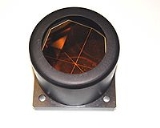
A retroreflector is a device or surface that reflects
light back to its source with a minimum scattering of light. An electromagnetic wave front is reflected back along a vector that is parallel
to but opposite in direction from the wave's source. The device or surface's angle of incidence
is greater than zero. This is unlike a planar mirror
, which does this only if the mirror is exactly perpendicular to the wave front, having a zero angle of incidence.
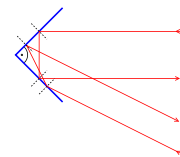
A set of three mutually perpendicular reflective surface, placed to form the corner of a cube, work as a retroreflector. Corner reflectors occur in two varieties. In the more common form, the corner is literally the truncated corner of a cube of transparent material such as conventional optical glass. In this structure, the reflection is achieved either by total internal reflection
or silvering of the outer cube surfaces. The second form uses mutually perpendicular flat mirrors bracketing an air space. These two types have similar optical properties.
A large relatively thin retroreflector can be formed by combining many small corner reflectors, using the standard optimal packing of the plane with congruent triangles.
Another common type of retroreflector consists of refracting optical elements with a reflective surface, arranged so that the focal surface of the refractive element coincides with the reflective surface, typically a transparent sphere and a spherical mirror. This same effect can be achieved with a single transparent sphere provided that the refractive index
of the material is exactly two times the refractive index of the medium from which the radiation is incident. In that case, the sphere surface behaves as a concave spherical mirror with the required curvature for retroreflection.
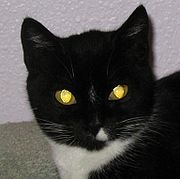
The term cat's eye derives from the resemblance of the cat's eye retroreflector to the optical system that produces the well-known phenomenon of "glowing eyes" or eyeshine
in cats and other vertebrates (which are only reflecting light, rather than actually glowing). The combination of the eye's lens
and the aqueous humor form the refractive converging system, while the tapetum lucidum
behind the retina
forms the spherical concave mirror. Because the function of the eye is to form an image on the retina, an eye focused on a distant object has a focal surface that approximately follows the reflective tapetum lucidum
structure, which is the condition required to form a good retroreflection.
This type of retroreflector can consist of many small versions of these structures incorporated in a thin sheet or in paint. In the case of paint containing glass beads, the paint glues the beads to the surface where retroreflection is required and the beads protrude, their diameter being about twice the thickness of the paint.
phenomenon of phase conjugation. This technique is used in advanced optical
systems such as high-power laser
s and optical transmission lines. Phase-conjugate mirrors require a comparatively expensive and complex apparatus, as well as large quantities of power (as nonlinear optical processes can be efficient only at high enough intensities). However, phase-conjugate mirrors have an inherently much greater accuracy in the direction of the retroreflection, which in passive elements is limited by the mechanical accuracy of the construction.

 Retroreflectors are devices that operate by returning light back to the light source along the same light direction. The coefficient of luminous intensity, RI, is the measure of a reflector performance, which is defined as the ratio of the strength of the reflected light (luminous intensity) to the amount of light that falls on the reflector (normal illuminance). A reflector will appear brighter as its RI value increases.
The RI value of the reflector is a function of the color, size, and condition of the reflector. Clear or white reflectors are the most efficient, and appear brighter than other colors. The surface area of the reflector is proportional to the RI value and increases as the reflective surface increases.
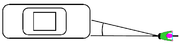
The RI value is also a function of the spatial geometry between the observer, light source, and reflector. Figures 1 and 2 show the observation angle and entrance angle between the automobile's headlights, bicycle, and driver. The observation angle is the angle formed by the light beam and the driver's line of sight. Observation angle is a function of the distance between the headlights and the driver's eye, and the distance to the reflector. Traffic engineers use an observation angle of 0.2 degrees to simulate a reflector target about 800 feet in front of a passenger automobile. As the observation angle increases, the reflector performance decreases. For example, a truck has a large separation between the headlight and the driver's eye compared to a passenger vehicle. A bicycle reflector appears brighter to the passenger car driver than to the truck driver at the same distance from the vehicle to the reflector.
The light beam and the normal axis of the reflector as shown in Figure 2 form the entrance angle. The entrance angle is a function of the orientation of the reflector to the light source. For example, the entrance angle between an automobile approaching a bicycle at an intersection 90 degrees apart is larger than the entrance angle for a bicycle directly in front of an automobile on a straight road. The reflector appears brightest to the observer when it is directly in line with the light source.
The brightness of a reflector is also a function of the distance between the light source and the reflector. At a given observation angle, as the distance between the light source and the reflector decreases, the light that falls on the reflector increases. This increases the amount of light returned to the observer and the reflector appears brighter.
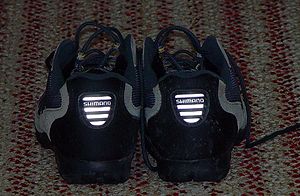 Retroreflection (sometimes called retroflection) is used on road
surfaces, road signs, vehicle
s, and clothing
(large parts of the surface of special safety clothing, less on regular coats). When the headlights of a car illuminate a retroreflective surface, the reflected light is directed towards the car and its driver (rather than in all directions as with diffuse reflection
). However, a pedestrian
can see retroreflective surfaces in the dark only if there is a light source directly between them and the reflector (e.g., via a flashlight they carry) or directly behind them (e.g., via a car approaching from behind). "Cat's eyes
" are a particular type of retroreflector embedded in the road surface and are used mostly in the UK and parts of the United States
.
Corner reflectors are better at sending the light back to the source over long distances, while spheres are better at sending the light to a receiver somewhat off-axis from the source, as when the light from headlights is reflected into the driver's eye
s.
Retroreflectors can be embedded in the road (level with the road surface), or they can be raised above the road surface. Raised reflectors
are visible for very long distances (typically 0.5-1 kilometer or more), while sunken reflectors are visible only at very close ranges due to the higher angle required to properly reflect the light. Raised reflectors are generally not used in areas that regularly experience snow during winter, as passing snowplow
s can tear them off of the roadways. Stress on roadways caused by cars running over embedded objects also contributes to accelerated wear and pothole
formation.
Retroreflective road paint is thus very popular in Canada
and parts of the United States, as it is not affected by the passage of snowplows and does not affect the interior of the roadway. Where weather permits, embedded or raised retroreflectors are preferred as they last much longer than road paint, which is weathered by the elements, can be obscured by sediment or rain, and is ground away by the passage of vehicles.
s on the Apollo 11
, 14
, and 15
missions left retroreflectors on the Moon
as part of the Lunar Laser Ranging Experiment
. They are considered to prove conclusively that man-made equipment is present on the moon and thus disprove some Moon landing hoax accusations
. Additionally the Soviet Lunokhod 1
and Lunokhod 2
rovers carried smaller arrays. Reflected signals were initially received from Lunokhod 1, but no return signals have been detected from 1971 until 2010, at least in part due to some uncertainty in its location on the Moon. In 2010 it was found in Lunar Reconnaissance Orbiter
photographs and the retroreflectors have been used again. Lunokhod 2's array continues to return signals to Earth. Even under good viewing conditions, only a single reflected photon is received every few seconds. This makes the job of filtering laser-generated photons from naturally-occurring photons challenging.
, or Laser Geodynamics Satellites, are a series of scientific research satellites designed to provide an orbiting laser ranging benchmark for geodynamical studies of the Earth. There are two LAGEOS spacecraft: LAGEOS-1 (launched in 1976), and LAGEOS-2 (launched in 1992). They use cube-corner retroreflectors made of fused silica glass. As of 2004, both LAGEOS spacecraft are still in service.
when viewed from a single direction. Reflectin
is a retroreflective material with potential for use in this application.
Inexpensive corner-aiming retroreflectors are used in user-controlled technology as optical datalink devices. Aiming is done at night, and the necessary retroreflector area depends on aiming distance and ambient lighting from street lamps. The optical receiver itself behaves as a weak retroreflector because it contains a large, precisely focused lens
that detects illuminated objects in its focal plane. This allows aiming without a retroreflector for short ranges.
A single biological instance of this is known: in flashlight fish of the family Anomalopidae (see Tapetum lucidum
).
) because of its high reflectivity of both light and radar
signals. Application to life rafts, personal flotation devices, and other safety gear makes it easy to locate people and objects in the water at night. When applied to boat surfaces it creates a much larger radar signature, particularly for fiberglass boats which produce very little radar reflection on their own. It conforms to International Maritime Organization regulation, IMO Res. A.658 (16) and meets U.S. Coast Guard specification 46 CFR Part 164, Subpart 164.018/5/0. Examples of commercially available products are 3M part numbers 3150A and 6750I.
Reflection (physics)
Reflection is the change in direction of a wavefront at an interface between two differentmedia so that the wavefront returns into the medium from which it originated. Common examples include the reflection of light, sound and water waves...
light back to its source with a minimum scattering of light. An electromagnetic wave front is reflected back along a vector that is parallel
Parallel (geometry)
Parallelism is a term in geometry and in everyday life that refers to a property in Euclidean space of two or more lines or planes, or a combination of these. The assumed existence and properties of parallel lines are the basis of Euclid's parallel postulate. Two lines in a plane that do not...
to but opposite in direction from the wave's source. The device or surface's angle of incidence
Angle of incidence
Angle of incidence is a measure of deviation of something from "straight on", for example:* in the approach of a ray to a surface, or* the angle at which the wing or horizontal tail of an airplane is installed on the fuselage, measured relative to the axis of the fuselage.-Optics:In geometric...
is greater than zero. This is unlike a planar mirror
Mirror
A mirror is an object that reflects light or sound in a way that preserves much of its original quality prior to its contact with the mirror. Some mirrors also filter out some wavelengths, while preserving other wavelengths in the reflection...
, which does this only if the mirror is exactly perpendicular to the wave front, having a zero angle of incidence.
Corner reflector
A set of three mutually perpendicular reflective surface, placed to form the corner of a cube, work as a retroreflector. Corner reflectors occur in two varieties. In the more common form, the corner is literally the truncated corner of a cube of transparent material such as conventional optical glass. In this structure, the reflection is achieved either by total internal reflection
Total internal reflection
Total internal reflection is an optical phenomenon that happens when a ray of light strikes a medium boundary at an angle larger than a particular critical angle with respect to the normal to the surface. If the refractive index is lower on the other side of the boundary and the incident angle is...
or silvering of the outer cube surfaces. The second form uses mutually perpendicular flat mirrors bracketing an air space. These two types have similar optical properties.
A large relatively thin retroreflector can be formed by combining many small corner reflectors, using the standard optimal packing of the plane with congruent triangles.
Cat's eye
Another common type of retroreflector consists of refracting optical elements with a reflective surface, arranged so that the focal surface of the refractive element coincides with the reflective surface, typically a transparent sphere and a spherical mirror. This same effect can be achieved with a single transparent sphere provided that the refractive index
Refractive index
In optics the refractive index or index of refraction of a substance or medium is a measure of the speed of light in that medium. It is expressed as a ratio of the speed of light in vacuum relative to that in the considered medium....
of the material is exactly two times the refractive index of the medium from which the radiation is incident. In that case, the sphere surface behaves as a concave spherical mirror with the required curvature for retroreflection.
The term cat's eye derives from the resemblance of the cat's eye retroreflector to the optical system that produces the well-known phenomenon of "glowing eyes" or eyeshine
Tapetum lucidum
The tapetum lucidum is a layer of tissue in the eye of many vertebrate animals....
in cats and other vertebrates (which are only reflecting light, rather than actually glowing). The combination of the eye's lens
Lens (anatomy)
The crystalline lens is a transparent, biconvex structure in the eye that, along with the cornea, helps to refract light to be focused on the retina. The lens, by changing shape, functions to change the focal distance of the eye so that it can focus on objects at various distances, thus allowing a...
and the aqueous humor form the refractive converging system, while the tapetum lucidum
Tapetum lucidum
The tapetum lucidum is a layer of tissue in the eye of many vertebrate animals....
behind the retina
Retina
The vertebrate retina is a light-sensitive tissue lining the inner surface of the eye. The optics of the eye create an image of the visual world on the retina, which serves much the same function as the film in a camera. Light striking the retina initiates a cascade of chemical and electrical...
forms the spherical concave mirror. Because the function of the eye is to form an image on the retina, an eye focused on a distant object has a focal surface that approximately follows the reflective tapetum lucidum
Tapetum lucidum
The tapetum lucidum is a layer of tissue in the eye of many vertebrate animals....
structure, which is the condition required to form a good retroreflection.
This type of retroreflector can consist of many small versions of these structures incorporated in a thin sheet or in paint. In the case of paint containing glass beads, the paint glues the beads to the surface where retroreflection is required and the beads protrude, their diameter being about twice the thickness of the paint.
Phase-conjugate mirror
A third, much less common way of producing a retroreflector is to use the nonlinear opticalNonlinear optics
Nonlinear optics is the branch of optics that describes the behavior of light in nonlinear media, that is, media in which the dielectric polarization P responds nonlinearly to the electric field E of the light...
phenomenon of phase conjugation. This technique is used in advanced optical
Optics
Optics is the branch of physics which involves the behavior and properties of light, including its interactions with matter and the construction of instruments that use or detect it. Optics usually describes the behavior of visible, ultraviolet, and infrared light...
systems such as high-power laser
Laser
A laser is a device that emits light through a process of optical amplification based on the stimulated emission of photons. The term "laser" originated as an acronym for Light Amplification by Stimulated Emission of Radiation...
s and optical transmission lines. Phase-conjugate mirrors require a comparatively expensive and complex apparatus, as well as large quantities of power (as nonlinear optical processes can be efficient only at high enough intensities). However, phase-conjugate mirrors have an inherently much greater accuracy in the direction of the retroreflection, which in passive elements is limited by the mechanical accuracy of the construction.
Operation
The RI value of the reflector is a function of the color, size, and condition of the reflector. Clear or white reflectors are the most efficient, and appear brighter than other colors. The surface area of the reflector is proportional to the RI value and increases as the reflective surface increases.
The RI value is also a function of the spatial geometry between the observer, light source, and reflector. Figures 1 and 2 show the observation angle and entrance angle between the automobile's headlights, bicycle, and driver. The observation angle is the angle formed by the light beam and the driver's line of sight. Observation angle is a function of the distance between the headlights and the driver's eye, and the distance to the reflector. Traffic engineers use an observation angle of 0.2 degrees to simulate a reflector target about 800 feet in front of a passenger automobile. As the observation angle increases, the reflector performance decreases. For example, a truck has a large separation between the headlight and the driver's eye compared to a passenger vehicle. A bicycle reflector appears brighter to the passenger car driver than to the truck driver at the same distance from the vehicle to the reflector.
The light beam and the normal axis of the reflector as shown in Figure 2 form the entrance angle. The entrance angle is a function of the orientation of the reflector to the light source. For example, the entrance angle between an automobile approaching a bicycle at an intersection 90 degrees apart is larger than the entrance angle for a bicycle directly in front of an automobile on a straight road. The reflector appears brightest to the observer when it is directly in line with the light source.
The brightness of a reflector is also a function of the distance between the light source and the reflector. At a given observation angle, as the distance between the light source and the reflector decreases, the light that falls on the reflector increases. This increases the amount of light returned to the observer and the reflector appears brighter.
Retroreflectors on roads
Road
A road is a thoroughfare, route, or way on land between two places, which typically has been paved or otherwise improved to allow travel by some conveyance, including a horse, cart, or motor vehicle. Roads consist of one, or sometimes two, roadways each with one or more lanes and also any...
surfaces, road signs, vehicle
Vehicle
A vehicle is a device that is designed or used to transport people or cargo. Most often vehicles are manufactured, such as bicycles, cars, motorcycles, trains, ships, boats, and aircraft....
s, and clothing
Clothing
Clothing refers to any covering for the human body that is worn. The wearing of clothing is exclusively a human characteristic and is a feature of nearly all human societies...
(large parts of the surface of special safety clothing, less on regular coats). When the headlights of a car illuminate a retroreflective surface, the reflected light is directed towards the car and its driver (rather than in all directions as with diffuse reflection
Reflection (physics)
Reflection is the change in direction of a wavefront at an interface between two differentmedia so that the wavefront returns into the medium from which it originated. Common examples include the reflection of light, sound and water waves...
). However, a pedestrian
Pedestrian
A pedestrian is a person traveling on foot, whether walking or running. In some communities, those traveling using roller skates or skateboards are also considered to be pedestrians. In modern times, the term mostly refers to someone walking on a road or footpath, but this was not the case...
can see retroreflective surfaces in the dark only if there is a light source directly between them and the reflector (e.g., via a flashlight they carry) or directly behind them (e.g., via a car approaching from behind). "Cat's eyes
Cat's eye (road)
The cat's eye is a retroreflective safety device used in road marking and was the first of a range of raised pavement markers. It originated in the UK in 1933 and is today used all over the world....
" are a particular type of retroreflector embedded in the road surface and are used mostly in the UK and parts of the United States
United States
The United States of America is a federal constitutional republic comprising fifty states and a federal district...
.
Corner reflectors are better at sending the light back to the source over long distances, while spheres are better at sending the light to a receiver somewhat off-axis from the source, as when the light from headlights is reflected into the driver's eye
Human eye
The human eye is an organ which reacts to light for several purposes. As a conscious sense organ, the eye allows vision. Rod and cone cells in the retina allow conscious light perception and vision including color differentiation and the perception of depth...
s.
Retroreflectors can be embedded in the road (level with the road surface), or they can be raised above the road surface. Raised reflectors
Raised pavement marker
A raised pavement marker is a safety device used on roads. These devices are usually made with plastic, ceramic, or occasionally metal, and come in a variety of shapes and colors. Many varieties include a lens or sheeting that enhance their visibility by reflecting automotive headlights...
are visible for very long distances (typically 0.5-1 kilometer or more), while sunken reflectors are visible only at very close ranges due to the higher angle required to properly reflect the light. Raised reflectors are generally not used in areas that regularly experience snow during winter, as passing snowplow
Snowplow
A snowplow is a device intended for mounting on a vehicle, used for removing snow and ice from outdoor surfaces, typically those serving transportation purposes...
s can tear them off of the roadways. Stress on roadways caused by cars running over embedded objects also contributes to accelerated wear and pothole
Pothole
A pothole is a type of disruption in the surface of a roadway where a portion of the road material has broken away, leaving a hole.- Formation :...
formation.
Retroreflective road paint is thus very popular in Canada
Canada
Canada is a North American country consisting of ten provinces and three territories. Located in the northern part of the continent, it extends from the Atlantic Ocean in the east to the Pacific Ocean in the west, and northward into the Arctic Ocean...
and parts of the United States, as it is not affected by the passage of snowplows and does not affect the interior of the roadway. Where weather permits, embedded or raised retroreflectors are preferred as they last much longer than road paint, which is weathered by the elements, can be obscured by sediment or rain, and is ground away by the passage of vehicles.
Retroreflectors on the Moon
AstronautAstronaut
An astronaut or cosmonaut is a person trained by a human spaceflight program to command, pilot, or serve as a crew member of a spacecraft....
s on the Apollo 11
Apollo 11
In early 1969, Bill Anders accepted a job with the National Space Council effective in August 1969 and announced his retirement as an astronaut. At that point Ken Mattingly was moved from the support crew into parallel training with Anders as backup Command Module Pilot in case Apollo 11 was...
, 14
Apollo 14
Apollo 14 was the eighth manned mission in the American Apollo program, and the third to land on the Moon. It was the last of the "H missions", targeted landings with two-day stays on the Moon with two lunar EVAs, or moonwalks....
, and 15
Apollo 15
Apollo 15 was the ninth manned mission in the American Apollo space program, the fourth to land on the Moon and the eighth successful manned mission. It was the first of what were termed "J missions", long duration stays on the Moon with a greater focus on science than had been possible on previous...
missions left retroreflectors on the Moon
Moon
The Moon is Earth's only known natural satellite,There are a number of near-Earth asteroids including 3753 Cruithne that are co-orbital with Earth: their orbits bring them close to Earth for periods of time but then alter in the long term . These are quasi-satellites and not true moons. For more...
as part of the Lunar Laser Ranging Experiment
Lunar laser ranging experiment
The ongoing Lunar Laser Ranging Experiment measures the distance between the Earth and the Moon using laser ranging. Lasers on Earth are aimed at retroreflectors planted on the moon during the Apollo program, and the time for the reflected light to return is determined...
. They are considered to prove conclusively that man-made equipment is present on the moon and thus disprove some Moon landing hoax accusations
Apollo Moon Landing hoax accusations
Different Moon landing conspiracy theories claim that some or all elements of the Apollo program and the associated Moon landings were hoaxes staged by NASA and members of other organizations. Various groups and individuals have made such conspiracy claims since the end of the Apollo program in 1975...
. Additionally the Soviet Lunokhod 1
Lunokhod 1
Lunokhod 1 was the first of two unmanned lunar rovers landed on the Moon by the Soviet Union as part of its Lunokhod program. The spacecraft which carried Lunokhod 1 was named Luna 17...
and Lunokhod 2
Lunokhod 2
Lunokhod 2 was the second of two unmanned lunar rovers landed on the Moon by the Soviet Union as part of the Lunokhod program....
rovers carried smaller arrays. Reflected signals were initially received from Lunokhod 1, but no return signals have been detected from 1971 until 2010, at least in part due to some uncertainty in its location on the Moon. In 2010 it was found in Lunar Reconnaissance Orbiter
Lunar Reconnaissance Orbiter
The Lunar Precursor Robotic Program is a program of robotic spacecraft missions which NASA will use to prepare for future human spaceflight missions to the Moon. Two LPRP missions, the Lunar Reconnaissance Orbiter and the Lunar Crater Observation and Sensing Satellite , were launched in June 2009...
photographs and the retroreflectors have been used again. Lunokhod 2's array continues to return signals to Earth. Even under good viewing conditions, only a single reflected photon is received every few seconds. This makes the job of filtering laser-generated photons from naturally-occurring photons challenging.
Retroreflectors in Earth orbit
LAGEOSLAGEOS
LAGEOS, or Laser Geodynamics Satellites, are a series of scientific research satellites designed to provide an orbiting laser ranging benchmark for geodynamical studies of the Earth...
, or Laser Geodynamics Satellites, are a series of scientific research satellites designed to provide an orbiting laser ranging benchmark for geodynamical studies of the Earth. There are two LAGEOS spacecraft: LAGEOS-1 (launched in 1976), and LAGEOS-2 (launched in 1992). They use cube-corner retroreflectors made of fused silica glass. As of 2004, both LAGEOS spacecraft are still in service.
Retroreflectors and invisibility
Retroreflective clothing, combined with a properly set up camera and projector, can be used to achieve the effect of partial invisibilityInvisibility
Invisibility is the state of an object that cannot be seen. An object in this state is said to be invisible . The term is usually used as a fantasy/science fiction term, where objects are literally made unseeable by magical or technological means; however, its effects can also be seen in the real...
when viewed from a single direction. Reflectin
Reflectin
Reflectin is a protein originating from the Hawaiian Bobtail Squid, Euprymna scolopes, which is native to the central Pacific Ocean. Reflectins, a recently identified protein family that is enriched in aromatic and sulphur-containing amino acids, are used by certain cephalopods to manage and...
is a retroreflective material with potential for use in this application.
Retroreflectors and communications
Modulated retroreflectors, in which the reflectance is changed over time by some means, are the subject of research and development for free-space optical communications networks. The basic concept of such systems is that a low-power remote system, such as a sensor mote, can receive an optical signal from a base station and reflect the modulated signal back to the base station. Since the base station supplies the optical power, this allows the remote system to communicate without excessive power consumption. Modulated retroreflectors also exist in the form of modulated phase-conjugate mirrors (PCMs). In the latter case, a "time-reversed" wave is generated by the PCM with temporal encoding of the phase-conjugate wave (see, e.g., SciAm, Oct. 1990, "The Photorefractive Effect," David M. Pepper, et. al).Inexpensive corner-aiming retroreflectors are used in user-controlled technology as optical datalink devices. Aiming is done at night, and the necessary retroreflector area depends on aiming distance and ambient lighting from street lamps. The optical receiver itself behaves as a weak retroreflector because it contains a large, precisely focused lens
Lens (optics)
A lens is an optical device with perfect or approximate axial symmetry which transmits and refracts light, converging or diverging the beam. A simple lens consists of a single optical element...
that detects illuminated objects in its focal plane. This allows aiming without a retroreflector for short ranges.
A single biological instance of this is known: in flashlight fish of the family Anomalopidae (see Tapetum lucidum
Tapetum lucidum
The tapetum lucidum is a layer of tissue in the eye of many vertebrate animals....
).
Retroreflectors and ships, boats, emergency gear
Retroflective tape is recognized and recommended by the International Convention for the Safety of Life at Sea (SOLASInternational Convention for the Safety of Life at Sea
The International Convention for the Safety of Life at Sea is an international maritime safety treaty. The SOLAS Convention in its successive forms is generally regarded as the most important of all international treaties concerning the safety of merchant ships.- History :The first version of the...
) because of its high reflectivity of both light and radar
Radar
Radar is an object-detection system which uses radio waves to determine the range, altitude, direction, or speed of objects. It can be used to detect aircraft, ships, spacecraft, guided missiles, motor vehicles, weather formations, and terrain. The radar dish or antenna transmits pulses of radio...
signals. Application to life rafts, personal flotation devices, and other safety gear makes it easy to locate people and objects in the water at night. When applied to boat surfaces it creates a much larger radar signature, particularly for fiberglass boats which produce very little radar reflection on their own. It conforms to International Maritime Organization regulation, IMO Res. A.658 (16) and meets U.S. Coast Guard specification 46 CFR Part 164, Subpart 164.018/5/0. Examples of commercially available products are 3M part numbers 3150A and 6750I.
Other uses
Retroreflectors are used in the following example applications:- In surveyingSurveyingSee Also: Public Land Survey SystemSurveying or land surveying is the technique, profession, and science of accurately determining the terrestrial or three-dimensional position of points and the distances and angles between them...
with a total stationTotal stationA total station is an electronic/optical instrument used in modern surveying. The total station is an electronic theodolite integrated with an electronic distance meter to read slope distances from the instrument to a particular point....
or robot, the instrument man or robot aims a laserLaserA laser is a device that emits light through a process of optical amplification based on the stimulated emission of photons. The term "laser" originated as an acronym for Light Amplification by Stimulated Emission of Radiation...
beam at a corner cube retroreflector held by the rodman. The instrument measures the propagation time of the light and converts it to a distance. - In CanadaCanadaCanada is a North American country consisting of ten provinces and three territories. Located in the northern part of the continent, it extends from the Atlantic Ocean in the east to the Pacific Ocean in the west, and northward into the Arctic Ocean...
, aerodromeAerodromeAn aerodrome, airdrome or airfield is a term for any location from which aircraft flight operations take place, regardless of whether they involve cargo, passengers or neither...
lighting can be replaced by appropriately coloured retroreflectors, the most important of which are the white retroreflectors that delineate the runway edges, and must be seen by aircraft equipped with landing lights up to 2 nautical miles away. - In common (non-SLR) digital cameras, where the sensor system is retroreflective. Researchers have used this property to demonstrate a system to prevent unauthorized photographs by detecting digital cameras and beaming a highly-focused beam of light into the lens.
- In movie screens to allow for high brilliance under dark conditions.
- Digital compositing programs and chroma environments use retroreflection to replace traditional lit backdrops in composite work as they provide a more solid colour without requiring the backdrop to be lit separately.
See also
- Bicycle reflectorBicycle reflectorThe bicycle reflector or prism reflector is a common safety device found on the rear, front and wheels of bicycles. It uses the principle of retroreflection to alert another road user of the bicycle's presence on the road....
- Corner reflectorCorner reflectorA corner reflector is a retroreflector consisting of three mutually perpendicular, intersecting flat surfaces, which reflects waves back directly towards the source, but shifted . Unlike a simple mirror, they work for a relatively wide-angle field of view. The three intersecting surfaces often have...
- Free space optical communication
- GPS modernizationGPS modernizationThe United States' Global Positioning System , having reached Fully Operational Capability on July 17, 1995, has completed its original design goals. However, additional advances in technology and new demands on the existing system led to the effort to modernize the GPS system. Announcements from...
- HeiligenscheinHeiligenscheinHeiligenschein is an optical phenomenon which creates a bright spot around the shadow of the viewer's head. It is created when the surface on which the shadow falls has special optical characteristics. Dewy grass is known to exhibit these characteristics, and creates a Heiligenschein...
- Modulating retro-reflectorModulating retro-reflectorA modulating retro-reflector system combines an optical retro-reflector and an optical modulator to allow optical communications and sometimes other functions such as programmable signage....
- PentaprismPentaprismA pentaprism is a five-sided reflecting prism used to deviate a beam of light by 90°. The beam reflects inside the prism twice, allowing the transmission of an image through a right angle without inverting it as an ordinary right-angle prism or mirror would.The reflections inside the prism are not...
- ScotchliteScotchliteScotchlite is a retroreflective material made by 3M. Its primary use is in nighttime high-visibility applications, such as 'reflective tape' for cyclists, safety vests for road workers, or the front of many traffic signs...