
All Topics  
Bazooka

 
Bazooka

   Email Print
   Bookmark   Link


Bazooka


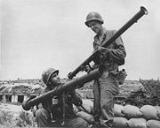
A bazooka is one of a series ("M9 series" variants) of anti-armor and anti-bunker, man-portable rocket launchers that became famous during World War II
World War II

World War II, or the Second World War , was a global military conflict which involved a Participants in World War II, including all of the great powers, organised into two opposing military alliances: the Allies of World War II and the Axis powers....
. Technically named as the M9 Anti-tank Rocket Launcher, it was also called "stovepipe" and used to deliver high explosives into machine gun
Machine gun

A machine gun is a Automatic firearm mounted or portable firearm, usually designed to fire List of rifle cartridgess in quick succession from an Belt or large-capacity Magazine , typically at a rate of several hundred rounds per minute....
 nests and hardened bunkers in all WWII theaters. It was one of the primary infantry anti-tank weapons used by the United States Armed Forces, and was based on the principle of the high explosive anti-tank
High explosive anti-tank

High Explosive Anti-Tank rounds are made of an explosive shaped charge that uses the Neumann effect to create a very high-velocity jet of metal in a state of superplasticity that can punch through solid vehicle armour....
 (HEAT) shell.


Discussion
Ask a question about 'Bazooka'
Start a new discussion about 'Bazooka'
Answer questions from other users
Full Discussion Forum


Encyclopedia


A bazooka is one of a series ("M9 series" variants) of anti-armor and anti-bunker, man-portable rocket launchers that became famous during World War II
World War II

World War II, or the Second World War , was a global military conflict which involved a Participants in World War II, including all of the great powers, organised into two opposing military alliances: the Allies of World War II and the Axis powers....
. Technically named as the M9 Anti-tank Rocket Launcher, it was also called "stovepipe" and used to deliver high explosives into machine gun
Machine gun

A machine gun is a Automatic firearm mounted or portable firearm, usually designed to fire List of rifle cartridgess in quick succession from an Belt or large-capacity Magazine , typically at a rate of several hundred rounds per minute....
 nests and hardened bunkers in all WWII theaters. It was one of the primary infantry anti-tank weapons used by the United States Armed Forces, and was based on the principle of the high explosive anti-tank
High explosive anti-tank

High Explosive Anti-Tank rounds are made of an explosive shaped charge that uses the Neumann effect to create a very high-velocity jet of metal in a state of superplasticity that can punch through solid vehicle armour....
 (HEAT) shell. It impressed the German command as well, so much so they copied it except made it larger. It was nickname
Nickname

A nickname is a descriptive name given in place of or in addition to the official name of a person, place or thing. Another class of nickname is the familiar or truncated form of the proper name, such as Bob, Bobby, Rob, Robbie, and Bert for Robert, more properly called a short name....
d "bazooka" from a vague resemblance to the musical instrument of the same name
Bazooka (instrument)

The bazooka is a rare, novelty brasswind musical instrument which is several feet in length and incorporates telescopic tubing like the trombone....
 invented and used by Bob Burns. The M1A1, M9, and M9A1 rocket launchers saw widespread use throughout WWII.

During the war, German
Nazi Germany

Nazi Germany and the Third Reich are the colloquial English names for Germany under the regime of Adolf Hitler and the Nazi Party , which established a Totalitarianism dictatorship that existed from 1933 to 1945....
 armed forces captured several in early North African encounters and soon copied the U.S. design, increasing the warhead diameter to 8.8 cm (3.46 inches), as well as other slight changes, and issued it as the Raketenpanzerbüchse "Panzerschreck"
Panzerschreck

Panzerschreck was the popular name for the Raketenpanzerb?chse , an 88 mm calibre reusable Anti-tank warfare rocket launcher developed by the Nazi Germany in World War II....
.

The word "Bazooka" is often informally used to refer to any shoulder-launched missile weapon
Shoulder-launched missile weapon

A shoulder-launched missile weapon is a weapon that fires a projectile at a targeting , yet is small enough to be carried by a single person, and fired while held on one's shoulder....
.

Design and development

The development of the bazooka involved the development of two specific lines of technology: the rocket-powered (recoilless) weapon, and the shaped-charge warhead.

Born too late for WWI

The Rocket-Powered Recoilless Weapon was the brainchild of Dr. Robert H. Goddard
Robert H. Goddard

Robert Hutchings Goddard , U.S. professor of physics and scientist, was a pioneer of controlled, liquid rocket rocketry. He launched the world's first liquid-fueled rocket on March 16, 1926....
 as a side project (under Army contract) of his work on rocket propulsion. Goddard, during his tenure
Tenure

Tenure commonly refers to life tenure in a job and specifically to a senior academic's contractual right not to have their position terminated without just cause....
 at Clark University
Clark University

Clark University is a private research university and liberal arts college in Worcester, Massachusetts. Founded in 1887 by the industrialist Jonas Clark, it is the oldest institution founded as an all-graduate university....
, and working at Mount Wilson Observatory
Mount Wilson Observatory

The Mount Wilson Observatory is an astronomical observatory in Los Angeles County, California. The MWO is located on Mount Wilson , a 5,715 foot peak in the San Gabriel Mountains near Pasadena, California, northeast of Los Angeles....
 for security reasons, designed a tube-fired rocket for military use during World War I. He and his co-worker, Dr. Clarence Hickman, successfully demonstrated his rocket to the US Army Signal Corps at Aberdeen Proving Ground
Aberdeen Proving Ground

Aberdeen Proving Ground is a United States Army facility located near Aberdeen, Maryland . Part of the facility is a census-designated place , which had a population of 3,116 at the United States Census, 2000....
, Maryland
Maryland

Maryland is a U.S. state located in the Mid Atlantic States of the United States, bordering Virginia, West Virginia and the Washington, D.C. to the south and west, Pennsylvania to the north, and Delaware to the east....
, on November 6, 1918, but as the Compeigne Armistice
Armistice with Germany (Compiègne)

The armistice treaty between the Allies and German Empire was signed in a railway carriage in Compi?gne Forest on 11 November 1918, and marked the end of the World War I on the Western Front ....
 was signed only five days later, further development was discontinued. The delay in the development of the bazooka was as a result of Goddard's serious bout with tuberculosis. Goddard continued to be a part-time consultant to the US Government at Indian Head
Indian Head

Indian Head can refer to:* Indian Head, Saskatchewan, town in Canada* Indian Head, Maryland, town in the United States* Indian Head, Fraser Island, headland in Australia...
, Maryland
Maryland

Maryland is a U.S. state located in the Mid Atlantic States of the United States, bordering Virginia, West Virginia and the Washington, D.C. to the south and west, Pennsylvania to the north, and Delaware to the east....
, until 1923, but soon turned his focus to other projects involving rocket propulsion.

Combined with Hand grenades

The development of the explosive shaped charge dates back to the work of American
United States

The United States of America is a Federal government constitutional republic comprising U.S. state and a federal district. The country is situated mostly in central North America, where its Contiguous United States and Washington, D.C., the Capital districts and territories, lie between the Pacific Ocean and Atlantic Oceans, Borders of the U...
 physicist
Physicist

A physicist is a scientist who studies or practices physics. Physicists study a wide range of physical phenomena in many Physics#Major fields of physics spanning all length scales: from atom particles of which all ordinary matter is made to the behavior of the material Universe as a whole ....
 Charles Edward Munroe
Charles Edward Munroe

File:Charles Edward Munroe.jpgCharles Edward Munroe was a United States of America chemist, and discoverer of the Munroe effect.He was born in Cambridge, Massachusetts and studied at the Lawrence scientific school of Harvard University, graduating in 1871....
, who did the first practical work on the subject in 1880. This work was augmented in the 1930s by Henry Mohaupt, a Swiss immigrant who worked on shaped-charge explosives design for the War Department (the predecessor of the Department of Defense).

Mohaupt developed a shaped-charge
Shaped charge

A shaped charge is an explosive charge shaped to focus the effect of the explosive's energy. Various types are used to cut and form metal, initiate nuclear weapons, and penetrate armour....
 hand grenade
Hand grenade

A hand grenade is an anti-personnel weapon that explodes a short time after release. The word "grenade" is derived from the French word for pomegranate, as shrapnel reminded soldiers of the seeds....
 for anti-tank use that was effective at defeating up to 60 mm (2.4 in) of vehicle armor, and was thus by far the best such weapon in the world at the time. The grenade was standardized as the M10. However, the M10 grenade weighed 3.5 lb (1.6 kg), was difficult to throw by hand, and too heavy to be launched as a rifle grenade
Rifle grenade

A rifle grenade is a form of grenade that utilizes a rifle as a launch mechanism to increase the effective range of the projectile being launched ....
. The only practical way to use the weapon was for an infantryman to place it directly on the tank
Tank

A tank is a Continuous track, armoured fighting vehicle designed for front-line combat which combines operational mobility and Military tactics Offensive and defence capabilities....
, an unlikely means of delivery in most combat situations. A smaller, less powerful version of the M10, the M9, was then developed, which could be fired from a rifle. This resulted in the creation of a series of rifle grenade launchers, the M1 (Springfield M-1903), M2 (Enfield M-1917), and the M7 and M8 for the M1 Rifle. However, a truly capable anti-tank weapon had yet to be found, and following the lead of other countries at the time, the U.S. Army prepared to evaluate competing designs for a large and powerful anti-tank rifle.

In need of an application

In 1940, U.S. Army Lieutenant Edward G. Uhl, under the command of Colonel
Colonel

Colonel is a military rank of a commissioned officer, with corresponding ranks existing in almost every country in the world. It is also used in some police forces and other paramilitary rank structures....
 Leslie A. Skinner, suggested utilizing the M10 shaped-charge grenade as a warhead attached to a booster rocket, to be fired by an experimental rocket launcher
Shoulder-launched missile weapon

A shoulder-launched missile weapon is a weapon that fires a projectile at a targeting , yet is small enough to be carried by a single person, and fired while held on one's shoulder....
 he had recently developed. Development of the M1 prototype took place in Corcoran Hall at The George Washington University in Washington, D.C.
Washington, D.C.

Washington, D.C. , formally the District of Columbia and commonly referred to as Washington, the District, or simply D.C., is the Capital of the United States, founded on July 16, 1790....
 with the help of Clarence Hickman who had worked for Goddard. The M1 consisted of a sheet metal tube with a simple wooden stock, handgrips, and sights (replaced by metal in production models), into which the 60.07 mm-diameter (officially designated 'M6, 2.36-inch' to avoid confusion with rounds for the 60 mm mortar) rocket grenades were inserted at the rear with trailing electrical leads. A two-cell dry battery in the wood shoulder rest provided a charge to ignite the rocket when the trigger was pulled; the wires sticking out the back of the round having been connected to two contacts by the assisting loader.

Although the weapon had some reliability and accuracy problems, Ordnance officials were greatly pleased with the penetrative effect of the new M1, which blew the turret off a tank during field trials. The weapon's M6 rocket warhead was capable of penetrating roughly 4 inches (100 mm) of armor plate. As a result, the War Department cancelled all plans for anti-tank rifles and in 1942 adopted the M1 rocket launcher and its M6 rocket as standard. The M1 rocket launcher was the first type to see combat use.

By late 1942, the improved Rocket Launcher, M1A1 was introduced. The forward handgrip was deleted, and the design simplified. The production M1A1 was 54 inches (1.37 m) long and weighed only 12.75 pounds (5.8 kg).

The ammunition for the original M1 launcher was the M6, which was notoriously unreliable. The M6 was improved and designated M6A1, and the new ammunition was issued with the improved M1A1 launcher.

The original M1A1 launcher was equipped with a simple hinged rear sight and fixed front sights, and used a launch tube without reinforcements. During the war, the M1A1 received a number of running modifications. The battery specification was changed to a larger, standard battery cell size, resulting in complaints of batteries getting stuck in the wood shoulder rest (the compartment was later reamed out to accommodate the larger cells). This was followed by a new aperture rear sight and a front rectangular "frame" sight positioned at the muzzle. The vertical sides of the frame sight were inscribed with graduations of 100, 200, and 300 yards. On later models, the iron sights were at first replaced by a plastic optical ring sight, which proved unsatisfactory in service, frequently turning opaque after a few days' exposure to sunlight. Later iron sights were hinged to fold against the tube when not in use, and were protected by a cover. The launcher also had an adjustable range scale that provided graduations from 50 to 700 yards (46 to 640 meters) in 50-yard (46 m) increments. An additional strap iron shoulder brace was fitted to the launcher, along with various types of blast deflectors.

Field experience induced changes

In 1943, field reports of rockets sticking and prematurely detonating in M1A1 launch tubes were received by Army Ordnance at Ogden Arsenal and other production facilities. At the U.S. Army's Aberdeen Testing Grounds, various metal collars and wire wrapping were used on the sheet metal launch tube in an effort to reinforce it. However, reports of premature detonation continued until the development of bore slug test gauges to ensure that the rocket did not catch inside the launch tube.

The original M6 and M6A1 rockets used in the M1 and M1A1 launchers had a pointed nose, which was found to cause deflection from the target at low impact angles. In late 1943, another 2.36-in rocket type was adopted, the M6A3, for use with the newly standardized M9 rocket launcher. The M6A3 was 19.4 inches (49.28 cm) long, and weighed 3.38 lb (1.53 kg). It had a blunted nose to improve target effect at low angles, and a new circular fin assembly to improve flight stability. The M6A3 was capable of penetrating five inches (125 mm) of armor plate.

Battery problems in the early bazookas eventually resulted in replacement of the battery-powered ignition system with a magneto sparker system
Magneto (electrical)

This article is about an electrical generator component used in engine and some old telephones. For other uses of the term, see Magneto . A magneto is a device used in the ignition system of gasoline-powered internal combustion engines to provide pulses of high voltage electrical power to the spark plugs....
 operated through the trigger. A trigger safety was incorporated into the design that isolated the magneto, preventing misfires that could occur when the trigger was released and the stored charge prematurely fired the rocket. The final major change was the division of the launch tube into two discrete sections, with bayonet-joint attachments. This was done to make the weapon more convenient to carry, particularly for use by airborne forces. The final two-piece launcher was standardized as the M9A1. However, the long list of incorporated modifications increased the launcher's tube length to 61 inches (1.55 m), with an overall empty weight of 14.3 lb (6.5 kg). From its original conception as a relatively light, handy, and disposable weapon, the final M9A1 launcher had become a heavy, clumsy, and relatively complex piece of equipment.

In October 1944, after receiving reports of inadequate combat effect of the M1A1 and M9 launchers and their M6A1 rockets, and after examining captured examples of the German 8.8 cm RPzB 43 and RPzB 54 Panzerschreck
Panzerschreck

Panzerschreck was the popular name for the Raketenpanzerb?chse , an 88 mm calibre reusable Anti-tank warfare rocket launcher developed by the Nazi Germany in World War II....
, the U.S. Ordnance Corps began development on a new, more powerful anti-tank rocket launcher, the 3.5-inch M20. However, the weapon's design was not completed until after the end of the war.

Operational use


World War II

Secretly introduced via the Russian front and in November 1942 during Operation Torch
Operation Torch

Operation Torch was the United Kingdom-United States invasion of French North Africa in World War II during the North African Campaign, started 8 November 1942....
, early production versions of the M1 launcher and M6 rocket were hastily supplied to some of the US invasion forces during the landings in North Africa
North Africa

North Africa or Northern Africa is the northernmost region of the African continent, separated by the Sahara from Sub-Saharan Africa.Geopolitically, the United Nations subregion of Northern Africa includes the following seven countries or territories:...
. On the night before the landings, Gen. Dwight D. Eisenhower
Dwight D. Eisenhower

Dwight David ?Ike? Eisenhower was the List of Presidents of the United States President of the United States from 1953 until 1961 and a General of the Army in the United States Army....
 was shocked to discover from a subordinate that none of his troops had received any instruction in the use of the bazooka.

Initially supplied with the highly unreliable M6 rocket and without training, the M1 did not play a significant armed role in combat in the North African fighting, but did provide an German intelligence coup
/> when some were captured by the Germans in early encounters with inexperienced US troops. A US general visiting the Tunis
Tunis

Tunis is the Capital of the Tunisian Republic and also the Tunis Governorate, with a population of 1 200,000 in 2008 and over 3,980,500 in the municipal area....
ian front in 1943 after the close of combat operations could not find any soldiers who could report that the weapon had actually stopped an enemy tank.Green, Michael and Green, Gladys, Weapons of Patton's Armies, Zenith Imprint Press (2000) ISBN 0760308217, 9780760308219, pp. 38-39 Further issue of the bazooka was suspended in May 1943.

During the Allied invasion of Sicily, small numbers of the M1A1 bazooka (using an improved rocket, the M6A1) were used in combat by US forces. The M1A1 accounted for four medium German tanks and a heavy Tiger I
Tiger I

The Tiger I was a Nazi Germany heavy tank used in World War II, from late 1942 until the German surrender in 1945. The tank design served as the basis for other armoured vehicles: the Sturmtiger heavy self-propelled gun and the Bergetiger armoured recovery vehicle....
, the latter knocked out by a fortunate hit through the driver's vision slot. A major disadvantage to the bazooka was the large backblast and smoke trail, which gave away the position of the shooter. Moreover, the bazooka fire team often had to expose their bodies in order to obtain a clear field of fire against an armored target. Casualties among bazooka team members were extremely high during the war, and assignment to such duty in the face of German counterfire was typically regarded by other platoon members as not only highly dangerous, but nearly suicidal.

In late 1942, numbers of early-production American M1 bazookas were captured by German troops from Russian forces who had been given quantities of the bazooka under Lend-Lease
Lend-Lease

Lend-Lease was the name of the program under which the United States supplied the United Kingdom, the Soviet Union, Republic of China, Free France and other Allies of World War II with vast amounts of materiel between 1941 and 1945 in return for, in the case of Britain, military bases in Newfoundland and Labrador, Bermuda, and the British W...
 as well as during the Operation Torch invasions in the North African Campaign
/>. The Germans promptly copied the weapon, and increased the diameter of its warhead from 60mm (2.36 in) to 8.8 cm (3.46 in). In German service, the bazooka was popularly known as the Panzerschreck. The German weapon, with its larger, more powerful warhead, had significantly greater armor penetration; ironically, calls for a larger-diameter warhead had also been raised by some ordnance officers during U.S. trials of the M1, but were rejected. After participating in an armor penetration test involving a German Panther tank using both the RPzB 54 Panzerschreck and the US M9 bazooka, Corporal Donald E. Lewis of the U.S. Army informed his superiors that the Panzerschreck was "far superior to the American bazooka"...

Despite the introduction of the M9 bazooka with its more powerful rocket—the M6A3—in late 1943, reports of the weapon's effectiveness against enemy armor decreased alarmingly in the latter stages of World War II, as new German tanks with thicker and better-designed cast armor plate were introduced. This development forced bazooka operators to target less well-protected areas of the vehicle, such as the tracks, bogey wheels, or rear engine compartment. In a letter dated May 20, 1944, Gen. George S. Patton
George S. Patton

George Smith Patton, Jr. was a distinguished though controversial United States Army officer.Commissioned in the army in 1909, Patton participated in the Pancho Villa Expedition to capture Pancho Villa in 1916-17....
 stated to a colleague that "the purpose of the bazooka is not to hunt tanks offensively, but to be used as a last resort in keeping tanks from overrunning infantry. To insure this, the range should be held to around 30 yards."

Use in the Pacific campaign


In the Pacific campaign, as in North Africa, the original bazookas sent to combat often had reliability issues. The battery-operated firing circuit was easily damaged during rough handling, and the rocket motors often failed because of high temperatures and exposure to moisture, salt air, or humidity. With the introduction of the M1A1 and its more reliable rocket ammunition, the bazooka was effective against some fixed Japanese infantry emplacements such as small concrete bunkers and pill boxes
Bunker

A military bunker is a hardened shelter, often buried partly or fully underground, designed to protect the inhabitants from falling bombs or other attacks....
. Against coconut and sand emplacements, the weapon was not always effective, as these softer structures proved too resilient, often absorbing the warhead's impact sufficiently to prevent detonation of the explosive charge. Later in the Pacific war, most infantry and marine units often used the M2 flamethrower
M2 flamethrower

The M2 flamethrower was a man-portable backpack flamethrower that was used in World War II. Although its actual "burn time" was around 7 seconds and the flame was only effective out to around 33 meters, it was still a functional weapon that had many uses in the war....
 to overcome such obstacles. In the few instances in the Pacific where the bazooka was used against tanks and armored vehicles, the rocket's warhead easily penetrated the thin armor plate used by the Japanese, destroying the vehicle.

Overall, the M1A1, M9, and M9A1 rocket launchers were viewed as useful and effective weapons during World War II, though they had been primarily employed against enemy emplacements and fixed fortifications, not as anti-tank weapons. General Dwight Eisenhower later described it as one of the four "Tools of Victory" (together with the atom bomb, Jeep
Jeep

Jeep is an automobile marque of Chrysler. It is the oldest off-road vehicle brand, with Land Rover coming in second. The original vehicle which first appeared as the prototype Bantam GP became the primary light 4-wheel-drive vehicle of the US Army and allies during the World War II and postwar period....
 and the C-47 Skytrain
C-47 Skytrain

The Douglas C-47 Skytrain or Dakota is a military transport that was developed from the Douglas DC-3 airliner. It was used extensively by the Allies during World War II and remained in front line operations through the 1950s with a few remaining in operation to this day....
 transport aircraft) one of the four weapons which won World War II for the Allies.

Korean War

The success of the more powerful German Panzerschreck caused the bazooka to be completely redesigned at the close of World War II. A larger 3.5 in (88.9 mm) model was adopted, the M20 'Super Bazooka', identical in size and power to the WWII German Panzerschreck. The M20 weighed 14.3 pounds (6.5 kg) and fired a hollow shaped-charge 9 lb (4 kg) M28A2 HEAT rocket when used in the anti-tank role. It was also operated by a two-man team and had a claimed rate of fire of six shots per minute.

During the initial stages of the Korean War
Korean War

The Korean War refers to a period of military conflict between North Korea and South Korea regimes, with major hostilities lasting from June 25, 1950 until the armistice signed on July 27, 1953....
, reports again surfaced over the ineffectiveness of the 2.36-in M9 and M9A1 against enemy armor. In one notable incident, infantry blocking forces of the U.S. Army's Task Force Smith were overrun by 33 North Korean T-34 tanks despite repeatedly firing 2.36 in rockets into the rear engine compartments of the vehicles. Supplies of 3.5 in M20 launchers with M28A2 HEAT rocket ammunition were hurriedly airlifted from the United States to South Korea, where they proved very effective against the T-34 and other Soviet tanks.

Vietnam War

The M20 'Super Bazooka' was used in the early stages of the war in Vietnam before gradually being phased out of U.S. service in favor of the M72 LAW
M72 LAW

The M72 LAW is a portable one-shot 66 mm unguided anti-tank weapon, designed in the United States by Paul V. Choate, Charles B. Weeks, and Frank A....
 rocket. While occasions to destroy enemy armored vehicles proved exceedingly rare, it was employed against enemy fortifications and emplacements with success. The M20 remained in service with South Vietnamese and indignenous forces until the late 1960s.

Other conflicts

Portuguese defense forces used quantities of M9A1 and M20 rocket launchers in their overseas departments in Africa against Marxist guerrilla forces during the Portuguese Colonial Wars. The French Army also used the M1A1, M9A1, and M20 launchers in various campaigns in Indochina
Indochina

Indochina, or the Indochinese Peninsula, is a subregion in Southeast Asia. It lies roughly east of India, south of China.The word has French origins, Indochine, and was adopted when French colonizers in Vietnam began expanding their territory to bordering countries....
 and Algeria
Algeria

Algeria , officially the People's Democratic Republic of Algeria, is a country located in North Africa. It is the largest country of the Mediterranean sea, second largest in the Arab World, and the second largest on the African continent and the eleventh-largest country in the world in terms of land area....
.

Variants


Rocket Launcher, M1 "Bazooka"

  • First issued June 14, 1942 by Capt. L.A. Skinner.
  • Uses M6 rocket
  • Could penetrate up to 4 inches (100 mm) of armor plate)


Rocket Launcher, M1A1 "Bazooka"

  • Improved electrical system.
  • Simplified design
  • Uses M6A1 rocket
  • Forward handgrip deleted


Rocket Launcher, M9 "Bazooka"

  • Optical Sight
  • Reinforced launch tube
  • Metal Furniture
  • Uses improved M6A3 rocket
  • Could penetrate up to 5 inches (125 mm) of armor plate
  • Supplanted M1A1 in 1944.
  • Able to fold in half


Rocket Launcher, M9A1 "Bazooka"

  • Could be disassembled into two halves for easier carrying.
  • Battery ignition replaced by trigger magneto
    Magneto (electrical)

    This article is about an electrical generator component used in engine and some old telephones. For other uses of the term, see Magneto . A magneto is a device used in the ignition system of gasoline-powered internal combustion engines to provide pulses of high voltage electrical power to the spark plugs....
    .


Rocket Launcher, M20 "Super Bazooka"

  • Larger 3.5 in (89 mm) diameter warhead.
  • Could penetrate up to 11 inches (280 mm) of armor.
  • Extended range by about 150 m.
  • Entered service at start of Korean War
    Korean War

    The Korean War refers to a period of military conflict between North Korea and South Korea regimes, with major hostilities lasting from June 25, 1950 until the armistice signed on July 27, 1953....


Rocket Launcher, M20B1 "Super Bazooka"

  • Lightweight version with barrels made of cast aluminum, other components simplified
  • Used as a supplement to the M20


Rocket Launcher, M20A1/A1B1 "Super Bazooka"

  • Product improved variant with improved connector latch assembly, entering production in 1952
  • Improved versions of the M20 and M20B1 respectively


Rocket Launcher, M25 "Three Shot Bazooka"

  • Experimental tripod mounted rocket launcher with overhead magazine Circa 1955.


Specifications


M1

  • Length: 54 in (137 cm)
  • Caliber: 60 mm (2.36 in)
  • Weight: 13.00 lb (5.9 kg)
  • Warhead: M6 shaped charge (3.5 lb, 1.59 kg)
  • Range
    • Maximum: 400 yards (365.76 m)
    • Effective: (claimed) 150 yards (137.16 m)
  • Crew: 2, operator and loader


M1A1

  • Length: 54 in (137 cm)
  • Caliber: 60 mm (2.36 in)
  • Weight: 12.75 lb (5.8 kg)
  • Warhead: M6A1 shaped charge (3.5 lb, 1.59 kg)
  • Range
    • Maximum: 400 yards (365.76 m)
    • Effective: (claimed) 150 yards (137.16 m)
  • Crew: 2, operator and loader


M9A1

  • Length: 61 in (155 cm)
  • Caliber: 60 mm (2.36 in)
  • Weight: 14.3 lb (6.5 kg)
  • Warhead: M6A3/C shaped charge (3.5 lb, 1.59 kg)
  • Range
    • Maximum: 400–500 yards (365.76– 457.2 m)
    • Effective: (claimed) 120 yards (109.728 m)
  • Crew: 2, operator and loader(M9) or 1, operator+loader(M9A1)


M20A1/A1B1

  • Length (when assembled for firing): 60 in (1,524 mm)
  • Caliber: 89 mm (3.5 in)
  • Weight (Unloaded): M20A1: 14.3 lb (6.5 kg); M20A1B1: 13 lb (5.9 kg)
  • Warhead: M28A2 HEAT (9 lb) or T127E3/M30 WP (8.96 lb)
  • Range
    • Maximum: 999 yds (913.4856 m)
    • Effective (Stationary Target/Moving Target): 300 yd (274.32 m) /200 yd (182.88 m)
  • Crew: 2, operator and loader)


Users


  • :The Argentine army used The Super-Bazooka, have been withdrawn and replaced by the AT-4
    AT-4

    AT-4 may refer to:* AT4, a Swedish unguided one-shot anti-tank weapon.* AT-4 Spigot, a Russian guided anti-tank missile.* P-1 Hawk U.S. Army biplane advanced trainer of 1927...
  • *


See also


  • Rocket propelled grenade
    Rocket propelled grenade

    A rocket-propelled grenade is any hand-held, Shoulder-launched missile weapon anti-tank weapons capable of firing an unguided rocket equipped with an explosive warhead....
  • PIAT
    PIAT

    The Projector, Infantry, Anti Tank , was one of the earlier anti-tank weapons using a HEAT projectile. It was developed by the United Kingdom starting in 1941, reaching the field in time for the Operation Husky in 1943....
  • Faustpatrone
    Faustpatrone

    File:Bundesarchiv Bild 101I-672-7634-13, Russland, Luftwaffensoldat mit Panzerabwehrwaffe.jpgThe Faustpatrone was a Nazi Germany anti-tank weapon of early World War II and a forerunner of the later Panzerfaust....


External links