


Type 97 Chi-Ha

Encyclopedia
The was a medium tank
used by the Imperial Japanese Army
during the Second Sino-Japanese War
, at Nomonhan
against the Soviet Union
, and in the Second World War. It was the most widely produced Japan
ese medium tank of World War II
, although the armor protection was considered as average in the 1930s. The 57 mm main gun, designed to support the infantry
, was a carry over from the 1933 Type 89 medium tank. Later it was replaced by 47 mm gun more effective against enemy armor. The 170 hp Mitsubishi
engine was a capable engine for the tank in 1938, and – notably for the time – it was a nonflammable diesel
. After 1941, the tank was considered less effective than most Allied
tank designs.
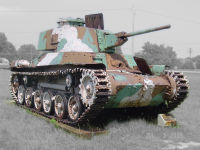
The Type 97's low silhouette and semicircular radio antenna on the turret
distinguished the tank from its contemporaries. The crude suspension
was derived from the Type 95 Ha-Go
light tank, but used six road wheels instead of four.
. Experience of the invasion of Manchuria determined that the Type 89 was too slow to keep up with motorized infantry. The new medium tank was intended to be a scaled-up four-man version of the Type 95 Ha-Go
light tank
, although with a two-man turret, thicker armor, and more power to maintain performance.
The Tokyo
factory of Mitsubishi Heavy Industries
completed a prototype designated Chi-Ha.
The second prototype was completed in June 1937. Although the requirement was for a 47 mm cannon, it retained the same short-barreled 57 mm cannon as the Type 89B tank.
However, at the time IJA was more interested in the lighter Chi-Ni prototype proposed by Osaka Army Arsenal, because it was less expensive and had the same 57 mm gun.
The Second Sino-Japanese War
broke out on 7 July 1937. Peacetime budgetary limitations were removed, and the more expensive Mitsubishi Chi-Ha model was accepted as a new Type 97 medium tank.
. Hence, the "Type 97 Chi-Ha" could be understood as the "1937's medium tank model 3".
The Type 97 was initially equipped with a Type 97 57 mm
main gun, the same caliber as that used for the earlier Type 89 I-Go
tank. The cannon was a short-barreled weapon with a relatively low muzzle velocity
, but sufficient as the tank was intended primarily for infantry support
. The gun had no elevation gear.
The tank carried two 7.7 mm Type 97 machine guns, one on the front left of the hull and the other in a ball mount on the rear of the turret. The latter could not be remounted on top of the turret for anti-aircraft use
. The turret was capable of full 360-degree
traverse, but the main gun had a second pair of trunnion
s, internally allowing a maximum 10-degree traverse independently of the turret.
The thickest armor used was 33 mm on the gun mantlet
and 26 mm on the turret sides.
Power was provided by an air-cooled "V-12 21.7 liter diesel Mitsubishi Type 97" engine, which provided 170 hp (127 kW). The engine designation was SA12200VD.
 The shortcomings of the Type 97, with its low-velocity 57 mm gun, became clear during the 1939 Nomonhan Incident against the Soviet Union
: the 45 mm gun of the Soviet BT-5 and BT-7
tanks outranged the Japanese tank gun, resulting in heavy Japanese losses. This convinced the Army of the need for a more powerful gun, and development of a new 47 mm weapon
began in 1939 and was completed in 1941. The Type 1 47mm tank gun was designed specifically to counter the Soviet tanks. The 47 mm gun's longer barrel generated much higher muzzle velocity
, resulting in armor penetration superior to that of the 57 mm gun. The new version, designated Type 97-Kai Shinhoto Chi-Ha, replaced the original model in production in 1942. It had a new, larger turret – as a side note, a considerable number of existing 57-mm-gun turrets was subsequently re-used to create Type 4 Ke-Nu
light tank.
(1,224 units) and Hitachi
Industries (355 units), as well as some limited production in the Army's Sagami Arsenal. A total of 2,123 vehicles was constructed from 1938 to 1943, of which 1,162 units were the standard Type 97 and 930 units were the improved Type 97-kai version. The remainder were various specialized variants produced in small numbers.
The number of Type 97 medium tanks produced was slightly lower than of the Type 95 Ha-Go
light tanks, but larger than any other tank fielded by Empire of Japan
. The following numbers of units were produced each year:
Type 97 tank (57 mm gun):
Type 97-Kai tank (47 mm gun):
Total production of the 57 mm & 47 mm gun Type 97 medium tanks was 2,092. Although production peaked in 1943 it was the last year any Type 97 was produced, as factories switched to the new tank designs, most notably the Type 1 Chi-He
.
medium tank with a 75 mm main gun of which 144 were built from 1944 to 1945. The Type 4 Chi-To
was a separate design, the last Japanese medium tank design to be completed during the war, considered equivalent to the German Panther tank
, with only two vehicles made by war's end. By the time, the Japanese industry had been badly crippled by the American bombing campaign; as a result, few of these newer vehicles were ever built.
The IJA's need to supplement their tank divisions with artillery led to a need for self-propelled gun
s (SPGs), subsequently, the Type 97's chassis were utilized to manufacture nearly a hundred SPGs, consisting primarily of 75 mm guns. Since the IJA's 1930's era tanks didn't have the firepower to penetrate the 1940s generation of allied armor, a need for tank destroyers arose; and experiments ranging from 47 mm to 120 mm guns were conducted. However, due to naval priorities, raw materials for any IJA's production were limited.
(Manchuria
) and China
in combat operations in the Second Sino-Japanese War
with considerable success, as the ill-equipped National Revolutionary Army
of the Republic of China
forces were limited to only three tank battalions consisting of British
exports of the Vickers
, German
Panzer
Mark I's, and Italian
CV33 tankettes. However, its first real test in combat against opposing armor came with the Nomonhan Incident (also known as the "Battles of Khalkhin Gol") in July 1939 against the Soviet Union
. The IJA
1st Tank Corps consisting of the 3rd and 4th Tank Regiments (Yasuoka Detachment
) had been assigned to the Nomonhan region, under the command of Lt. General Yasuoka Masaomi. Of the two regiments, only the 3rd Tank Regiment had been supplemented with 4 of the new Type 97 medium tanks, of which one was selected as the regimental commander's tank during the Nomonhan campaign. During fierce fighting against the Red Army
, in which the 3rd Tank Regiment was assaulting an objective ringed with strung coiled wire (piano wire), the regimental commander, LTC
Yoshimaru Kiyotake's Type 97 tank had become entangled up to its drive sprockets. Struggling to extract itself from the tank trap, LTC Yoshimaru managed to move his tank only about 40 yards rearward, when his machine became stopped completely. Now exposed to Russia
n defensive positions, Yoshimaru's Type 97 was subjected to the fire of a dozen Soviet BT-7
tanks and anti-tank guns. Russian shells struck the tank's drive gear, hull, and the engine area, causing the vehicle to erupt into flames. When the fire reached the tank ammunition, the tank exploded, throwing the turret several feet away from the hull
(the turret was blown off). Only the tank's gunner survived unwounded, abandoning the tank prior to the explosion. The 3rd Tank Regimental commander's body was recovered after the battle.
and the Battle of Singapore
, Type 97 tanks were used by the 3rd Tank Group's 1st, 6th and 14th Tank Regiments under Lieutenant-General Yamashita
's Army. The 1st Tank Regiment was attached to IJA 5th Division, which was among the first to land at Songkhla
in southern Thailand
. One of its medium tank companies was the 3rd Tank Company under First Lieutenant Yamane (ten Type 97 medium tanks and two Ha-Go light tanks), forming part of Saeki Detachment. The company was in the vanguard of the attack.
One key to the Japanese success in Malaya was the unexpected appearance of their tanks in areas where the British did not believe tanks could be used. The wet jungle terrain did not turn out to be an obstacle. Later, the 2nd and 14th Tank Regiments participated in the Burma Campaign.
The Type 97-kai was first used in combat in the battle of Corregidor
. The updated 47 mm gun was easily capable of dealing with the armor of the American M3 Stuart light tanks, though not with the armor of the M4 Sherman
medium tank.
During the Battle of Saipan
, 36 Type 97s of the 9th Tank Regiment, commanded by Colonel Takashi Goto joined with Type 95s of the 136rd Infantry Regiment commanded by Colonel Yukimatsu Ogawa in an all-out counterattack against the US 6th Marine Regiment. This was one of the largest tank attacks mounted by Japan in the Pacific Theater of Operations
, and was stopped by machine guns, mortars, bazooka
s, artillery, and naval gun fire. However, the Japanese Army seldom made major armored attacks during the Pacific War
, due to the limited maneuvering areas that prevailed on islands in the South
Pacific ocean
. Terrain
dictated the battle, and IJA tanks were emplaced where they could be the most effective, in hull defilade position (that is, buried up to their turrets).
Many Type 97s were retained on the Japanese home islands in anticipation of an American invasion
.
At the final Battle of Okinawa
, 13 Type 95s and 14 Type 97 Shinhoto medium tanks of the 27th Tank Regiment were grossly outnumbered by 800 American tanks. Similar conditions repeated in the Kwantung Army's defense against the Soviet invasion of Manchuria.
Some Japanese tanks remained in use, under new ownership, after the war. As late as 1949, the Chinese People's Liberation Army
still had an appreciable number of Type 97s in its inventory.
Museum at Yasukuni Shrine
in Tokyo
, and at the Wakajishi Shrine in Fujinomiya, Shizuoka
in Japan. The wreck of a Type 97 was found buried in the sand on the beach at Miura, Kanagawa
in 2005. Overseas, preserved examples are at the People's Liberation Army Museum in Beijing
, China and at the United States Army Ordnance Museum
, Aberdeen, Maryland
. Numerous ruined examples of the Type 97 can still be found on Saipan
and on the Kuril Islands
.
Medium tank
Medium tank was a classification of tanks; the medium being intermediate in size and weight and armament between heavy tanks and light tanks.The medium tank concept has been eclipsed by the main battle tank.-History:...
used by the Imperial Japanese Army
Imperial Japanese Army
-Foundation:During the Meiji Restoration, the military forces loyal to the Emperor were samurai drawn primarily from the loyalist feudal domains of Satsuma and Chōshū...
during the Second Sino-Japanese War
Second Sino-Japanese War
The Second Sino-Japanese War was a military conflict fought primarily between the Republic of China and the Empire of Japan. From 1937 to 1941, China fought Japan with some economic help from Germany , the Soviet Union and the United States...
, at Nomonhan
Nomonhan
Nomonhan is a small village near the border between Mongolia and Inner Mongolia, China south of the Chinese city of Manzhouli.In the summer of 1939 it was the location of the Nomonhan Incident, as it is termed in Japan, or the Battle of Khalkhin Gol as it is known in Soviet and Mongolian People's...
against the Soviet Union
Soviet Union
The Soviet Union , officially the Union of Soviet Socialist Republics , was a constitutionally socialist state that existed in Eurasia between 1922 and 1991....
, and in the Second World War. It was the most widely produced Japan
Japan
Japan is an island nation in East Asia. Located in the Pacific Ocean, it lies to the east of the Sea of Japan, China, North Korea, South Korea and Russia, stretching from the Sea of Okhotsk in the north to the East China Sea and Taiwan in the south...
ese medium tank of World War II
World War II
World War II, or the Second World War , was a global conflict lasting from 1939 to 1945, involving most of the world's nations—including all of the great powers—eventually forming two opposing military alliances: the Allies and the Axis...
, although the armor protection was considered as average in the 1930s. The 57 mm main gun, designed to support the infantry
Infantry
Infantrymen are soldiers who are specifically trained for the role of fighting on foot to engage the enemy face to face and have historically borne the brunt of the casualties of combat in wars. As the oldest branch of combat arms, they are the backbone of armies...
, was a carry over from the 1933 Type 89 medium tank. Later it was replaced by 47 mm gun more effective against enemy armor. The 170 hp Mitsubishi
Mitsubishi
The Mitsubishi Group , Mitsubishi Group of Companies, or Mitsubishi Companies is a Japanese multinational conglomerate company that consists of a range of autonomous businesses which share the Mitsubishi brand, trademark and legacy...
engine was a capable engine for the tank in 1938, and – notably for the time – it was a nonflammable diesel
Diesel engine
A diesel engine is an internal combustion engine that uses the heat of compression to initiate ignition to burn the fuel, which is injected into the combustion chamber...
. After 1941, the tank was considered less effective than most Allied
Allies of World War II
The Allies of World War II were the countries that opposed the Axis powers during the Second World War . Former Axis states contributing to the Allied victory are not considered Allied states...
tank designs.
The Type 97's low silhouette and semicircular radio antenna on the turret
Gun turret
A gun turret is a weapon mount that protects the crew or mechanism of a projectile-firing weapon and at the same time lets the weapon be aimed and fired in many directions.The turret is also a rotating weapon platform...
distinguished the tank from its contemporaries. The crude suspension
Suspension (vehicle)
Suspension is the term given to the system of springs, shock absorbers and linkages that connects a vehicle to its wheels. Suspension systems serve a dual purpose — contributing to the car's roadholding/handling and braking for good active safety and driving pleasure, and keeping vehicle occupants...
was derived from the Type 95 Ha-Go
Type 95 Ha-Go
The was a light tank used by the Imperial Japanese Army in combat operations of the Second Sino-Japanese War, at Nomonhan against the Soviet Union, and in the Second World War. It proved sufficient against infantry, however, like the American M3 Stuart, it was not designed to fight other tanks...
light tank, but used six road wheels instead of four.
History and development
With the Type 89 Chi-Ro fast becoming obsolete in the late 1930s, the Imperial Japanese Army (IJA) began a program to develop a replacement tank for infantry supportInfantry tank
The infantry tank was a concept developed by the British and French in the years leading up to World War II. Infantry tanks were tanks designed to support the infantry in the attack. To achieve this they were generally heavily armoured compared to the cruiser tanks, to allow them to operate in...
. Experience of the invasion of Manchuria determined that the Type 89 was too slow to keep up with motorized infantry. The new medium tank was intended to be a scaled-up four-man version of the Type 95 Ha-Go
Type 95 Ha-Go
The was a light tank used by the Imperial Japanese Army in combat operations of the Second Sino-Japanese War, at Nomonhan against the Soviet Union, and in the Second World War. It proved sufficient against infantry, however, like the American M3 Stuart, it was not designed to fight other tanks...
light tank
Light tank
A light tank is a tank variant initially designed for rapid movement, and now primarily employed in low-intensity conflict. Early light tanks were generally armed and armored similar to an armored car, but used tracks in order to provide better cross-country mobility.The light tank was a major...
, although with a two-man turret, thicker armor, and more power to maintain performance.
The Tokyo
Tokyo
, ; officially , is one of the 47 prefectures of Japan. Tokyo is the capital of Japan, the center of the Greater Tokyo Area, and the largest metropolitan area of Japan. It is the seat of the Japanese government and the Imperial Palace, and the home of the Japanese Imperial Family...
factory of Mitsubishi Heavy Industries
Mitsubishi Heavy Industries
, or MHI, is a Japanese company. It is one of the core companies of Mitsubishi Group.-History:In 1870 Yataro Iwasaki, the founder of Mitsubishi took a lease of Government-owned Nagasaki Shipyard. He named it Nagasaki Shipyard & Machinery Works, and started the shipbuilding business on a full scale...
completed a prototype designated Chi-Ha.
The second prototype was completed in June 1937. Although the requirement was for a 47 mm cannon, it retained the same short-barreled 57 mm cannon as the Type 89B tank.
However, at the time IJA was more interested in the lighter Chi-Ni prototype proposed by Osaka Army Arsenal, because it was less expensive and had the same 57 mm gun.
The Second Sino-Japanese War
Second Sino-Japanese War
The Second Sino-Japanese War was a military conflict fought primarily between the Republic of China and the Empire of Japan. From 1937 to 1941, China fought Japan with some economic help from Germany , the Soviet Union and the United States...
broke out on 7 July 1937. Peacetime budgetary limitations were removed, and the more expensive Mitsubishi Chi-Ha model was accepted as a new Type 97 medium tank.
Japanese tank designations
Chi came from Chusen-Sha ("medium tank"). Ha and Ni, in Japanese army nomenclature, refer to model number 3 and 4, respectively. The Type was numbered 97 as an abbreviation of the imperial year 2597, translating to the year 1937 in standard Gregorian calendarGregorian calendar
The Gregorian calendar, also known as the Western calendar, or Christian calendar, is the internationally accepted civil calendar. It was introduced by Pope Gregory XIII, after whom the calendar was named, by a decree signed on 24 February 1582, a papal bull known by its opening words Inter...
. Hence, the "Type 97 Chi-Ha" could be understood as the "1937's medium tank model 3".
Design
Type 97 hull was of riveted construction with the engine in the rear compartment. In the forward compartment, the driver sat on the right, and bow gunner on the left. The commander's cupola was placed atop the turret. Internal communications were by 12 push buttons in the turret, connected to 12 lights and a buzzer near the driver.The Type 97 was initially equipped with a Type 97 57 mm
Type 97 57 mm tank gun
The Type 97 57 mm tank gun was a Japanese gun originally used on the Type 97 Chi-Ha medium tanks during the Second World War. The cannon was a short barrelled weapon with a relatively low muzzle velocity which was sufficient for supporting the infantry...
main gun, the same caliber as that used for the earlier Type 89 I-Go
Type 89 I-Go
The was a medium tank used by the Imperial Japanese Army from 1932 to 1942 in combat operations of the Second Sino-Japanese War, at Khalkhin Gol against the Soviet Union, and in the Second World War. The Type 89B model was the world's first mass produced diesel engine tank...
tank. The cannon was a short-barreled weapon with a relatively low muzzle velocity
Muzzle velocity
Muzzle velocity is the speed a projectile has at the moment it leaves the muzzle of the gun. Muzzle velocities range from approximately to in black powder muskets , to more than in modern rifles with high-performance cartridges such as the .220 Swift and .204 Ruger, all the way to for tank guns...
, but sufficient as the tank was intended primarily for infantry support
Infantry tank
The infantry tank was a concept developed by the British and French in the years leading up to World War II. Infantry tanks were tanks designed to support the infantry in the attack. To achieve this they were generally heavily armoured compared to the cruiser tanks, to allow them to operate in...
. The gun had no elevation gear.
The tank carried two 7.7 mm Type 97 machine guns, one on the front left of the hull and the other in a ball mount on the rear of the turret. The latter could not be remounted on top of the turret for anti-aircraft use
Anti-aircraft warfare
NATO defines air defence as "all measures designed to nullify or reduce the effectiveness of hostile air action." They include ground and air based weapon systems, associated sensor systems, command and control arrangements and passive measures. It may be to protect naval, ground and air forces...
. The turret was capable of full 360-degree
Degree (angle)
A degree , usually denoted by ° , is a measurement of plane angle, representing 1⁄360 of a full rotation; one degree is equivalent to π/180 radians...
traverse, but the main gun had a second pair of trunnion
Trunnion
A trunnion is a cylindrical protrusion used as a mounting and/or pivoting point. In a cannon, the trunnions are two projections cast just forward of the centre of mass of the cannon and fixed to a two-wheeled movable gun carriage...
s, internally allowing a maximum 10-degree traverse independently of the turret.
The thickest armor used was 33 mm on the gun mantlet
Gun mantlet
A gun mantlet is an armour plate or shield attached to an armoured fighting vehicle's gun, protecting the opening through which the weapon's barrel projects from the hull or turret armour and, in many cases, ensuring the vulnerable warhead of a loaded shell does not protrude past the vehicle's...
and 26 mm on the turret sides.
Power was provided by an air-cooled "V-12 21.7 liter diesel Mitsubishi Type 97" engine, which provided 170 hp (127 kW). The engine designation was SA12200VD.
Development of the improved Shinhoto Chi-Ha
Soviet Union
The Soviet Union , officially the Union of Soviet Socialist Republics , was a constitutionally socialist state that existed in Eurasia between 1922 and 1991....
: the 45 mm gun of the Soviet BT-5 and BT-7
BT-7
The BT-7 was the last of the BT tank series of Soviet cavalry tanks that were produced in large numbers between 1935 and 1940. They were lightly armoured, but reasonably well-armed for their time, and had much better mobility than other contemporary tank designs...
tanks outranged the Japanese tank gun, resulting in heavy Japanese losses. This convinced the Army of the need for a more powerful gun, and development of a new 47 mm weapon
Type 1 47 mm Anti-Tank Gun
The was an anti-tank gun developed by the Imperial Japanese Army, and used in combat during World War II.-History and development:The Type 1 47 mm Anti-Tank gun was accepted into service in 1942. The design originated as an improvement to the prototype “Experimental Type 97 47 mm Anti-Tank Gun” ,...
began in 1939 and was completed in 1941. The Type 1 47mm tank gun was designed specifically to counter the Soviet tanks. The 47 mm gun's longer barrel generated much higher muzzle velocity
Muzzle velocity
Muzzle velocity is the speed a projectile has at the moment it leaves the muzzle of the gun. Muzzle velocities range from approximately to in black powder muskets , to more than in modern rifles with high-performance cartridges such as the .220 Swift and .204 Ruger, all the way to for tank guns...
, resulting in armor penetration superior to that of the 57 mm gun. The new version, designated Type 97-Kai Shinhoto Chi-Ha, replaced the original model in production in 1942. It had a new, larger turret – as a side note, a considerable number of existing 57-mm-gun turrets was subsequently re-used to create Type 4 Ke-Nu
Type 4 Ke-Nu
The was a light tank of the Imperial Japanese Army in World War II. It was a conversion of existing hulls of Type 95 Ha-Go light tanks re-fitted with a larger tower of the Type 97 Chi-Ha medium tank.-History and development:...
light tank.
Production
The Type 97 medium tank was manufactured by Mitsubishi Heavy IndustriesMitsubishi Heavy Industries
, or MHI, is a Japanese company. It is one of the core companies of Mitsubishi Group.-History:In 1870 Yataro Iwasaki, the founder of Mitsubishi took a lease of Government-owned Nagasaki Shipyard. He named it Nagasaki Shipyard & Machinery Works, and started the shipbuilding business on a full scale...
(1,224 units) and Hitachi
Hitachi, Ltd.
is a Japanese multinational conglomerate headquartered in Marunouchi 1-chome, Chiyoda, Tokyo, Japan. The company is the parent of the Hitachi Group as part of the larger DKB Group companies...
Industries (355 units), as well as some limited production in the Army's Sagami Arsenal. A total of 2,123 vehicles was constructed from 1938 to 1943, of which 1,162 units were the standard Type 97 and 930 units were the improved Type 97-kai version. The remainder were various specialized variants produced in small numbers.
The number of Type 97 medium tanks produced was slightly lower than of the Type 95 Ha-Go
Type 95 Ha-Go
The was a light tank used by the Imperial Japanese Army in combat operations of the Second Sino-Japanese War, at Nomonhan against the Soviet Union, and in the Second World War. It proved sufficient against infantry, however, like the American M3 Stuart, it was not designed to fight other tanks...
light tanks, but larger than any other tank fielded by Empire of Japan
Empire of Japan
The Empire of Japan is the name of the state of Japan that existed from the Meiji Restoration on 3 January 1868 to the enactment of the post-World War II Constitution of...
. The following numbers of units were produced each year:
Type 97 tank (57 mm gun):
- 1938: 110
- 1939: 202
- 1940: 315
- 1941: 507
- 1942: 28
- Total: 1,162
Type 97-Kai tank (47 mm gun):
- 1942: 503
- 1943: 427
- Total: 930
Total production of the 57 mm & 47 mm gun Type 97 medium tanks was 2,092. Although production peaked in 1943 it was the last year any Type 97 was produced, as factories switched to the new tank designs, most notably the Type 1 Chi-He
Type 1 Chi-He
-External links:***...
.
Further development
The last design that based directly on Type 97 lineage was the Type 3 Chi-NuType 3 Chi-Nu
The was another improvement over the Type 97 Chi-Ha line of medium tanks of the Imperial Japanese Army in World War II. The Type 3 Chi-Nu mounted one Type 3 75 mm Tank Gun, one of the largest guns ever to be fitted on a World War II Japanese tank....
medium tank with a 75 mm main gun of which 144 were built from 1944 to 1945. The Type 4 Chi-To
Type 4 Chi-To
The was one of several new medium tanks developed by the Imperial Japanese Army towards the end of World War II. The Type 4 Chi-To was by far the most advanced Japanese wartime tank to reach the production phase...
was a separate design, the last Japanese medium tank design to be completed during the war, considered equivalent to the German Panther tank
Panther tank
Panther is the common name of a medium tank fielded by Nazi Germany in World War II that served from mid-1943 to the end of the European war in 1945. It was intended as a counter to the T-34, and to replace the Panzer III and Panzer IV; while never replacing the latter, it served alongside it as...
, with only two vehicles made by war's end. By the time, the Japanese industry had been badly crippled by the American bombing campaign; as a result, few of these newer vehicles were ever built.
The IJA's need to supplement their tank divisions with artillery led to a need for self-propelled gun
Self-propelled gun
A self-propelled gun is form of self-propelled artillery, and in modern use is usually used to refer to artillery pieces such as howitzers....
s (SPGs), subsequently, the Type 97's chassis were utilized to manufacture nearly a hundred SPGs, consisting primarily of 75 mm guns. Since the IJA's 1930's era tanks didn't have the firepower to penetrate the 1940s generation of allied armor, a need for tank destroyers arose; and experiments ranging from 47 mm to 120 mm guns were conducted. However, due to naval priorities, raw materials for any IJA's production were limited.
Wars against China and the Soviet Union
The Type 97 was deployed in ManchukuoManchukuo
Manchukuo or Manshū-koku was a puppet state in Manchuria and eastern Inner Mongolia, governed under a form of constitutional monarchy. The region was the historical homeland of the Manchus, who founded the Qing Empire in China...
(Manchuria
Manchuria
Manchuria is a historical name given to a large geographic region in northeast Asia. Depending on the definition of its extent, Manchuria usually falls entirely within the People's Republic of China, or is sometimes divided between China and Russia. The region is commonly referred to as Northeast...
) and China
China
Chinese civilization may refer to:* China for more general discussion of the country.* Chinese culture* Greater China, the transnational community of ethnic Chinese.* History of China* Sinosphere, the area historically affected by Chinese culture...
in combat operations in the Second Sino-Japanese War
Second Sino-Japanese War
The Second Sino-Japanese War was a military conflict fought primarily between the Republic of China and the Empire of Japan. From 1937 to 1941, China fought Japan with some economic help from Germany , the Soviet Union and the United States...
with considerable success, as the ill-equipped National Revolutionary Army
National Revolutionary Army
The National Revolutionary Army , pre-1928 sometimes shortened to 革命軍 or Revolutionary Army and between 1928-1947 as 國軍 or National Army was the Military Arm of the Kuomintang from 1925 until 1947, as well as the national army of the Republic of China during the KMT's period of party rule...
of the Republic of China
Republic of China
The Republic of China , commonly known as Taiwan , is a unitary sovereign state located in East Asia. Originally based in mainland China, the Republic of China currently governs the island of Taiwan , which forms over 99% of its current territory, as well as Penghu, Kinmen, Matsu and other minor...
forces were limited to only three tank battalions consisting of British
United Kingdom
The United Kingdom of Great Britain and Northern IrelandIn the United Kingdom and Dependencies, other languages have been officially recognised as legitimate autochthonous languages under the European Charter for Regional or Minority Languages...
exports of the Vickers
Vickers
Vickers was a famous name in British engineering that existed through many companies from 1828 until 1999.-Early history:Vickers was formed in Sheffield as a steel foundry by the miller Edward Vickers and his father-in-law George Naylor in 1828. Naylor was a partner in the foundry Naylor &...
, German
Germany
Germany , officially the Federal Republic of Germany , is a federal parliamentary republic in Europe. The country consists of 16 states while the capital and largest city is Berlin. Germany covers an area of 357,021 km2 and has a largely temperate seasonal climate...
Panzer
Panzer
A Panzer is a German language word that, when used as a noun, means "tank". When it is used as an adjective, it means either tank or "armoured" .- Etymology :...
Mark I's, and Italian
Italy
Italy , officially the Italian Republic languages]] under the European Charter for Regional or Minority Languages. In each of these, Italy's official name is as follows:;;;;;;;;), is a unitary parliamentary republic in South-Central Europe. To the north it borders France, Switzerland, Austria and...
CV33 tankettes. However, its first real test in combat against opposing armor came with the Nomonhan Incident (also known as the "Battles of Khalkhin Gol") in July 1939 against the Soviet Union
Soviet Union
The Soviet Union , officially the Union of Soviet Socialist Republics , was a constitutionally socialist state that existed in Eurasia between 1922 and 1991....
. The IJA
Imperial Japanese Army
-Foundation:During the Meiji Restoration, the military forces loyal to the Emperor were samurai drawn primarily from the loyalist feudal domains of Satsuma and Chōshū...
1st Tank Corps consisting of the 3rd and 4th Tank Regiments (Yasuoka Detachment
Yasuoka Detachment
Yasuoka Detachment or Yasuoka Task Force, was an armored Japanese Imperial Army unit in 1939. It was commanded by Lt. General Yasuoka Masaomi, composed of 3rd Armored Regiment and 4th Armored Regiment, 64th Infantry Regiment/IJA 23rd Division, 2/28th Infantry Regiment/IJA 7th Division, the 2nd...
) had been assigned to the Nomonhan region, under the command of Lt. General Yasuoka Masaomi. Of the two regiments, only the 3rd Tank Regiment had been supplemented with 4 of the new Type 97 medium tanks, of which one was selected as the regimental commander's tank during the Nomonhan campaign. During fierce fighting against the Red Army
Red Army
The Workers' and Peasants' Red Army started out as the Soviet Union's revolutionary communist combat groups during the Russian Civil War of 1918-1922. It grew into the national army of the Soviet Union. By the 1930s the Red Army was among the largest armies in history.The "Red Army" name refers to...
, in which the 3rd Tank Regiment was assaulting an objective ringed with strung coiled wire (piano wire), the regimental commander, LTC
Lieutenant colonel
Lieutenant colonel is a rank of commissioned officer in the armies and most marine forces and some air forces of the world, typically ranking above a major and below a colonel. The rank of lieutenant colonel is often shortened to simply "colonel" in conversation and in unofficial correspondence...
Yoshimaru Kiyotake's Type 97 tank had become entangled up to its drive sprockets. Struggling to extract itself from the tank trap, LTC Yoshimaru managed to move his tank only about 40 yards rearward, when his machine became stopped completely. Now exposed to Russia
Russia
Russia or , officially known as both Russia and the Russian Federation , is a country in northern Eurasia. It is a federal semi-presidential republic, comprising 83 federal subjects...
n defensive positions, Yoshimaru's Type 97 was subjected to the fire of a dozen Soviet BT-7
BT-7
The BT-7 was the last of the BT tank series of Soviet cavalry tanks that were produced in large numbers between 1935 and 1940. They were lightly armoured, but reasonably well-armed for their time, and had much better mobility than other contemporary tank designs...
tanks and anti-tank guns. Russian shells struck the tank's drive gear, hull, and the engine area, causing the vehicle to erupt into flames. When the fire reached the tank ammunition, the tank exploded, throwing the turret several feet away from the hull
Chassis
A chassis consists of an internal framework that supports a man-made object. It is analogous to an animal's skeleton. An example of a chassis is the underpart of a motor vehicle, consisting of the frame with the wheels and machinery.- Vehicles :In the case of vehicles, the term chassis means the...
(the turret was blown off). Only the tank's gunner survived unwounded, abandoning the tank prior to the explosion. The 3rd Tank Regimental commander's body was recovered after the battle.
World War II
From December 8 1941 and in early 1942, during the Battle of MalayaBattle of Malaya
The Malayan Campaign was a campaign fought by Allied and Japanese forces in Malaya, from 8 December 1941 – 31 January 1942 during the Second World War. The campaign was dominated by land battles between British Commonwealth army units, and the Imperial Japanese Army...
and the Battle of Singapore
Battle of Singapore
The Battle of Singapore was fought in the South-East Asian theatre of the Second World War when the Empire of Japan invaded the Allied stronghold of Singapore. Singapore was the major British military base in Southeast Asia and nicknamed the "Gibraltar of the East"...
, Type 97 tanks were used by the 3rd Tank Group's 1st, 6th and 14th Tank Regiments under Lieutenant-General Yamashita
Tomoyuki Yamashita
General was a general of the Japanese Imperial Army during World War II. He was most famous for conquering the British colonies of Malaya and Singapore, earning the nickname "The Tiger of Malaya".- Biography :...
's Army. The 1st Tank Regiment was attached to IJA 5th Division, which was among the first to land at Songkhla
Songkhla
Songkhla is a city in the Songkhla Province of southern Thailand, near the border with Malaysia. As of 2006 it had a population of 75,048...
in southern Thailand
Thailand
Thailand , officially the Kingdom of Thailand , formerly known as Siam , is a country located at the centre of the Indochina peninsula and Southeast Asia. It is bordered to the north by Burma and Laos, to the east by Laos and Cambodia, to the south by the Gulf of Thailand and Malaysia, and to the...
. One of its medium tank companies was the 3rd Tank Company under First Lieutenant Yamane (ten Type 97 medium tanks and two Ha-Go light tanks), forming part of Saeki Detachment. The company was in the vanguard of the attack.
One key to the Japanese success in Malaya was the unexpected appearance of their tanks in areas where the British did not believe tanks could be used. The wet jungle terrain did not turn out to be an obstacle. Later, the 2nd and 14th Tank Regiments participated in the Burma Campaign.
The Type 97-kai was first used in combat in the battle of Corregidor
Battle of Corregidor
The Battle for Corregidor was the culmination of the Japanese campaign for the conquest of the Philippines. The fall of Bataan on 9 April 1942 ended all organized opposition by the U.S...
. The updated 47 mm gun was easily capable of dealing with the armor of the American M3 Stuart light tanks, though not with the armor of the M4 Sherman
M4 Sherman
The M4 Sherman, formally Medium Tank, M4, was the primary tank used by the United States during World War II. Thousands were also distributed to the Allies, including the British Commonwealth and Soviet armies, via lend-lease...
medium tank.
During the Battle of Saipan
Battle of Saipan
The Battle of Saipan was a battle of the Pacific campaign of World War II, fought on the island of Saipan in the Mariana Islands from 15 June-9 July 1944. The Allied invasion fleet embarking the expeditionary forces left Pearl Harbor on 5 June 1944, the day before Operation Overlord in Europe was...
, 36 Type 97s of the 9th Tank Regiment, commanded by Colonel Takashi Goto joined with Type 95s of the 136rd Infantry Regiment commanded by Colonel Yukimatsu Ogawa in an all-out counterattack against the US 6th Marine Regiment. This was one of the largest tank attacks mounted by Japan in the Pacific Theater of Operations
Pacific Theater of Operations
The Pacific Theater of Operations was the World War II area of military activity in the Pacific Ocean and the countries bordering it, a geographic scope that reflected the operational and administrative command structures of the American forces during that period...
, and was stopped by machine guns, mortars, bazooka
Bazooka
Bazooka is the common name for a man-portable recoilless rocket antitank weapon, widely fielded by the U.S. Army. Also referred to as the "Stovepipe", the innovative bazooka was amongst the first-generation of rocket propelled anti-tank weapons used in infantry combat...
s, artillery, and naval gun fire. However, the Japanese Army seldom made major armored attacks during the Pacific War
Pacific War
The Pacific War, also sometimes called the Asia-Pacific War refers broadly to the parts of World War II that took place in the Pacific Ocean, its islands, and in East Asia, then called the Far East...
, due to the limited maneuvering areas that prevailed on islands in the South
South
South is a noun, adjective, or adverb indicating direction or geography.South is one of the four cardinal directions or compass points. It is the opposite of north and is perpendicular to east and west.By convention, the bottom side of a map is south....
Pacific ocean
Pacific Ocean
The Pacific Ocean is the largest of the Earth's oceanic divisions. It extends from the Arctic in the north to the Southern Ocean in the south, bounded by Asia and Australia in the west, and the Americas in the east.At 165.2 million square kilometres in area, this largest division of the World...
. Terrain
Terrain
Terrain, or land relief, is the vertical and horizontal dimension of land surface. When relief is described underwater, the term bathymetry is used...
dictated the battle, and IJA tanks were emplaced where they could be the most effective, in hull defilade position (that is, buried up to their turrets).
Many Type 97s were retained on the Japanese home islands in anticipation of an American invasion
Operation Downfall
Operation Downfall was the Allied plan for the invasion of Japan near the end of World War II. The operation was cancelled when Japan surrendered after the atomic bombing of Hiroshima and Nagasaki and the Soviet Union's declaration of war against Japan. The operation had two parts: Operation...
.
At the final Battle of Okinawa
Battle of Okinawa
The Battle of Okinawa, codenamed Operation Iceberg, was fought on the Ryukyu Islands of Okinawa and was the largest amphibious assault in the Pacific War of World War II. The 82-day-long battle lasted from early April until mid-June 1945...
, 13 Type 95s and 14 Type 97 Shinhoto medium tanks of the 27th Tank Regiment were grossly outnumbered by 800 American tanks. Similar conditions repeated in the Kwantung Army's defense against the Soviet invasion of Manchuria.
Some Japanese tanks remained in use, under new ownership, after the war. As late as 1949, the Chinese People's Liberation Army
People's Liberation Army
The People's Liberation Army is the unified military organization of all land, sea, strategic missile and air forces of the People's Republic of China. The PLA was established on August 1, 1927 — celebrated annually as "PLA Day" — as the military arm of the Communist Party of China...
still had an appreciable number of Type 97s in its inventory.
Survivors
Restored examples of the Type 97 are on display at the YūshūkanYushukan
The is a Japanese military and war museum located within Yasukuni Shrine in Chiyoda, Tokyo. As a museum maintained by the shrine, which is dedicated to the souls of soldiers who died fighting on behalf of the Emperor of Japan, the museum contains various artifacts and documents concerning Japanese...
Museum at Yasukuni Shrine
Yasukuni Shrine
is a Shinto shrine located in Chiyoda, Tokyo, Japan. It is dedicated to the soldiers and others who died fighting on behalf of the Emperor of Japan. Currently, its Symbolic Registry of Divinities lists the names of over 2,466,000 enshrined men and women whose lives were dedicated to the service of...
in Tokyo
Tokyo
, ; officially , is one of the 47 prefectures of Japan. Tokyo is the capital of Japan, the center of the Greater Tokyo Area, and the largest metropolitan area of Japan. It is the seat of the Japanese government and the Imperial Palace, and the home of the Japanese Imperial Family...
, and at the Wakajishi Shrine in Fujinomiya, Shizuoka
Fujinomiya, Shizuoka
is a city located in central Shizuoka Prefecture, Japan. As of 2010, the city had an estimated population of 122,464 and the density of 389 persons per km². The total area was 314.81 km².-Geography:...
in Japan. The wreck of a Type 97 was found buried in the sand on the beach at Miura, Kanagawa
Miura, Kanagawa
is a city located in central Kanagawa Prefecture, Japan. As of 2010, the city has an estimated population of 44,238 and a population density of 1,490 persons per km²...
in 2005. Overseas, preserved examples are at the People's Liberation Army Museum in Beijing
Beijing
Beijing , also known as Peking , is the capital of the People's Republic of China and one of the most populous cities in the world, with a population of 19,612,368 as of 2010. The city is the country's political, cultural, and educational center, and home to the headquarters for most of China's...
, China and at the United States Army Ordnance Museum
United States Army Ordnance Museum
The U.S. Army Ordnance Museum is a museum that is in the process of being re-located to Fort Lee, in Fort Lee, Virginia. Its previous building—at Aberdeen Proving Ground in Aberdeen, Maryland—was closed in September 2010, although many outdoor exhibits are still accessible to the...
, Aberdeen, Maryland
Aberdeen, Maryland
As of the census of 2000, there were 13,842 people, 5,475 households, and 3,712 families residing in the city. The population density was 2,166.2 people per square mile . There were 5,894 housing units at an average density of 922.4 per square mile...
. Numerous ruined examples of the Type 97 can still be found on Saipan
Saipan
Saipan is the largest island of the United States Commonwealth of the Northern Mariana Islands , a chain of 15 tropical islands belonging to the Marianas archipelago in the western Pacific Ocean with a total area of . The 2000 census population was 62,392...
and on the Kuril Islands
Kuril Islands
The Kuril Islands , in Russia's Sakhalin Oblast region, form a volcanic archipelago that stretches approximately northeast from Hokkaidō, Japan, to Kamchatka, Russia, separating the Sea of Okhotsk from the North Pacific Ocean. There are 56 islands and many more minor rocks. It consists of Greater...
.
See also
- Development of Japanese tanks in World War II
- List of engines and weapons used on Japanese tanks during World War II
- List of Japanese tanks and armoured vehicles of the WWII period