

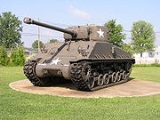
M4 Sherman

Encyclopedia
The M4 Sherman, formally Medium Tank, M4, was the primary tank
used by the United States
during World War II
. Thousands were also distributed to the Allies, including the British Commonwealth and Soviet
armies, via lend-lease
. In the United Kingdom
, the M4 was named after Union
General William Tecumseh Sherman
, following the British practice of naming their American-built tanks after famous American Civil War
generals. Subsequently the British name found its way into common use in the U.S.
The Sherman evolved from the Grant and Lee medium tanks
, which had an unusual side-sponson
mounted 75 mm gun. It retained much of the previous mechanical design, but added the first American main 75 mm gun mounted on a fully traversing turret, with a gyrostabilizer enabling the crew to fire with reasonable accuracy while the tank was on the move. The designers stressed mechanical reliability, ease of production and maintenance, durability, standardization of parts and ammunition in a limited number of variants, and moderate size and weight. These factors made the Sherman superior in some regards to the earlier German light
and medium tank
s of 1939-41, of which the German Army still used-albeit in up-gunned and up-armored variants-through the later stages of the war. The Sherman ended up being produced in large numbers and formed the backbone of most Allied offensives, starting in late 1942.
The original Shermans were able to defeat the relatively small German tanks such as the Panzer III and IV they faced when first deployed in North Africa. Later, they found themselves more evenly matched against the newer up-gunned and up- armored Pz.Kpfw. IV
medium tanks. Shermans were often outmatched by the 45 ton Panther
tank and wholly inadequate against the 56 ton Tiger I
and later 72 ton Tiger II
heavy tanks, suffering high casualties against their heavier armor and more powerful 88 mm L/56 and L/71 cannons. Mobility, mechanical reliability and sheer numbers, supported by growing superiority in supporting fighter-bomber
s and artillery
, helped offset these disadvantages strategically. The relatively lower price of the Sherman allowed huge numbers of this tank to be produced. This allowed many divisions, even many infantry divisions, their own organic Sherman assets. Some infantry divisions had more tanks than German panzer divisions did. This was a huge advantage for the Americans.
Production of the Sherman was favored by the commander of the Armored Ground Forces, albeit controversially, over the heavier M26 Pershing
, which resulted in the latter being deployed too late to play any significant role in the war. In the Pacific Theater
, the Sherman was used chiefly against Japanese infantry and fortifications; in its rare encounters with much lighter Japanese tanks with weaker armor and guns, the Sherman's superiority was overwhelming.
Production of the M4 exceeded 50,000 units, and its chassis also served as the basis for numerous other armored vehicles such as tank destroyer
s, tank retriever
s, and self-propelled artillery
. Only the Soviet T-34
tank was produced in larger numbers during World War II.
The Sherman would finally give way to post-war tanks developed from the M26. Various original and updated versions of the Sherman would continue to see combat effectively in many later conflicts, including the Korean War
, the Arab-Israeli Wars, and Indo-Pakistani War
s into the late 20th century, against the T-34 and sometimes much more modern Soviet tanks.
of 1939, itself derived from the M2 Light Tank
of 1935. The M3 was developed as a stopgap measure until a new turret mounting a 75 mm gun could be devised. While it was a big improvement when tried by the British in Africa against early German panzers, the placement of a 37 mm gun turret on top gave it a very high profile, and the unusual inflexible side-sponson mounted main gun could not be aimed across the other side of the tank.
Detailed design characteristics for the M4 were submitted by the Ordnance Department on 31 August 1940, but development of a prototype had to be delayed while the final production designs of the M3 were finished and the M3 entered full-scale production. On 18 April 1941, the U.S. Armored Force Board chose the simplest of five designs. Known as the T6, the design was a modified M3 hull and chassis, carrying a newly designed turret mounting the Lee's main gun. This became the Sherman.
The Sherman's reliability benefited from many features first developed in U.S. light tanks during the 1930s, including vertical volute spring suspension
, rubber-bushed tracks, and rear-mounted radial engine
with drive sprockets in front. The designated goals were to produce a fast, dependable medium tank able to support infantry, provide breakthrough striking capacity, and defeat any tank then in use by the Axis nations, though it would later fall short against the much heavier tanks deployed by Germany.
The T6 prototype was completed 2 September 1941. Unlike later M4s, the hull was cast and had a side hatch, which was eliminated from production models. The T6 was standardized as the M4 and production began in October.
In other words, the M4 was envisioned to primarily fill the role of a cruiser tank — although the US Army did not use that doctrinal term. The M4 was not primarily intended as an infantry support tank; in fact, FM 100-5 specifically stated the opposite. It placed tanks in the "striking echelon" of the armored division, and placed the infantry in the "support echelon". Neither was the M4 primarily intended for tank versus tank action. Doctrinally, anti-tank engagements were the primary role of tank destroyers. The field manual covering the use of the Sherman (FM 17-33, "The Tank Battalion, Light and Medium" of September 1942) devoted one page of text and four diagrams to tank versus tank action (out of 142 pages). This early armored doctrine was heavily influenced by the sweeping initial successes of the German blitzkrieg tactics. Unfortunately, by the time M4s reached combat in significant numbers, battlefield demands for infantry support and tank versus tank action far outnumbered the occasional opportunities for cruiser tanks.
Although envisioned primarily as a cruiser-type tank, US doctrine did also contemplate the M4's use in other roles. Unlike some other nations, which had separate medium tank designs tailored specifically for anti-tank roles (e.g., the German PzKw III) and support roles (the PzKw IV), the US intended the M4 to fulfill all roles. Although not optimized for tank versus tank engagements or infantry support, the M4 was capable of performing these missions to varying degrees. In the Pacific Theater
, the Sherman was used chiefly against Japanese infantry and fortifications; in their rare encounters with lighter Japanese tanks with weaker armor and guns, the Shermans were vastly superior.
The official doctrine of the time had Shermans as a sort of infantry tank. All anti-tank work was supposed to be done by tank-destroyer crews. Speed was essential in order to bring the tank-destroyers from the rear to destroy incoming tanks. Thankfully, for Sherman crews, this doctrine was not entirely used as it would create a small window of time of weakness in the armored battalion until tank destroyers moved to the front. Obviously this would make it harder for an armored force to achieve a breakthrough, a main objective of armor, if the enemy had tanks. It would also be easier for an opposing armored force to achieve a breakthrough against an American tank battalion which would not have all of its anti-tank assets at the front during the beginning of any attack.
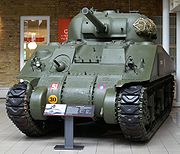 The first production began with the Lima Locomotive Works on the assembly line set for tanks for British use. The first production Sherman was given over to the US Army for evaluation and it was the second tank of the British order that went to London. Named Michael probably after Michael Dewar, head of the British Tank mission in the US, it was displayed in London and is now an exhibit at Bovington Tank Museum
In World War II, the U.S. Army ultimately fielded 16 armored divisions, along with 70 independent tank battalions; the U.S. Marine Corps also fielded six independent Sherman tank battalions for a total of 76, enough for 25 more armored divisions. A third of all Army tank battalions, and all six Marine tank battalions, were deployed to the Pacific Theater of Operations
(PTO). Prior to September 1942, President Franklin D. Roosevelt
had announced a production program calling for 120,000 tanks for the Allied war effort, which would have created 61 armored divisions. Although the American industrial complex was not affected by enemy aerial bombing
nor submarine warfare
as was Japan
, Germany
and, to a lesser degree, Great Britain
, the enormous drain of steel
for tank production had been diverted to warships and other naval vessels. The use of steel for naval construction amounted to the equivalent of approximately 67,000 tanks; and consequently only about 53,500 tanks were produced during 1942 and 1943.
The Army had seven main sub-designations for M4 variants during production: M4, M4A1, M4A2, M4A3, M4A4, M4A5, and M4A6. These designations did not necessarily indicate linear improvement: for example, A4 was not meant to indicate it was better than the A3. These sub-types indicated standardized production variations, which were in fact often manufactured concurrently at different locations. The sub-types differed mainly in engines, although the M4A1 differed from the M4 by its fully cast upper hull; the M4A4 had a longer engine system that required a longer hull, a longer suspension system, and more track blocks; M4A5 was an administrative placeholder for Canadian production; and the M4A6 had an elongated chassis, but fewer than 100 of these were produced.
While most Shermans ran on gasoline, the M4A2 and M4A6 had diesel engines: the M4A2 with a pair of GMC
6-71 straight six engines, the M4A6 a Caterpillar
RD1820 radial. These, plus the M4A4, which used the Chrysler A57 multibank
engine, were mostly supplied to Allied countries under Lend-Lease
. "M4" can refer specifically to the initial sub-type with its Continental radial engine, or generically, to the entire family of seven Sherman sub-types, depending on context. Many details of production, shape, strength and performance improved throughout production, without a change to the tank's basic model number: more durable suspension units, safer "wet" (W) ammunition stowage, and stronger armor arrangements, such as the M4 Composite, which had a cast front hull section mated to a welded rear hull. British nomenclature differed from that employed by the U.S.
A 24-volt electrical system was used in the M4.
Early Shermans mounted a 75 mm medium-velocity general-purpose gun
. Although Ordnance began work on the Medium Tank T20
as a Sherman replacement, ultimately the Army decided to minimize production disruption by incorporating elements of other tank designs into the Sherman. Later M4A1, M4A2, and M4A3 models received the larger T23 turret with a high-velocity 76 mm M1 gun
, which reduced the number of HE and smoke rounds carried and increased the number of anti-tank rounds. Later, the M4 and M4A3 were factory-produced with a 105 mm howitzer and a new distinctive mantlet
in the original turret. The first standard-production 76 mm gun Sherman was an M4A1, accepted in January 1944, and the first standard-production 105 mm howitzer Sherman was an M4 accepted in February 1944.
In June–July 1944, the Army accepted a limited run of 254 M4A3E2 Jumbo Shermans, which had very thick armor, and the 75 mm gun in a new, heavier T23-style turret, in order to assault fortifications. The M4A3 was the first to be factory-produced with the HVSS (horizontal volute spring suspension) suspension with wider tracks to distribute weight, and the smooth ride of the HVSS with its experimental E8 designation led to the nickname Easy Eight for Shermans so equipped. Both the Americans and the British developed a wide array of special attachments for the Sherman; few saw combat, and most remained experimental. Those that saw action included the bulldozer blade for the Sherman dozer tanks
, Duplex Drive for "swimming" Sherman tanks, R3 flamethrower for Zippo flame tank
s, and the T34 60-tube Calliope 4.5" rocket launcher
for the Sherman turret. The British variants (DDs and mine flail
s) formed part of the group of specialized vehicles collectively known as "Hobart's Funnies
" (after Percy Hobart
, commander of the 79th Armoured Division
).
The M4 Sherman's basic chassis was used for all the sundry roles of a modern mechanized force: roughly 50,000 Sherman tanks, plus thousands more derivative vehicles under different model numbers. These included M32 and M74 "tow truck"-style recovery tanks
with winches, booms, and an 81 mm mortar for smoke screens; M34 (from M32B1) and M35 (from M10A1) artillery prime movers
; M7B1
, M12
, M40
, and M43 self-propelled artillery; and the M10 Wolverine
(Achilles, in British service) and M36 Jackson
tank destroyers.
M4A4 Cutaway
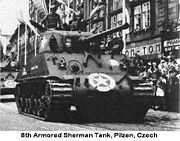
(some of which went to the Canadians and the Free Poles), while the Soviet Union
received 4,102 and an estimated 812 were transferred to China
. These numbers were distributed further to the respective countries' allied nations.
The U.S. Marine Corps used the diesel M4A2 and gasoline-powered M4A3 in the Pacific. However, the Chief of the Army's Armored Force, Lt. Gen. Jacob L. Devers
, ordered no diesel-engined Shermans be used by the Army outside the Zone of Interior (the continental U.S.). The Army used all types for either training or testing within the United States, but intended the M4A2 and M4A4 (with the A57 Multibank engine) to be the primary Lend-Lease exports.
The M4A1 Sherman first saw combat at the Second Battle of El Alamein
in October 1942 with the British 8th Army
. The first U.S. Shermans in battle were M4A1s in Operation Torch
the next month. At this time, Shermans successfully engaged German Panzer III
s with long barreled 50 mm L/60 guns, and Panzer IV
s with short barreled 75 mm L/24 guns. Additional M4s and M4A1s replaced M3 Lees in U.S. tank battalions over the course of the North African campaign. The M4 and M4A1 were the main types in U.S. units until late 1944, when the Army began replacing them with the preferred M4A3 with its more powerful 500 hp engine. Some M4s and M4A1s continued in U.S. service for the rest of the war.
Encounters with a company of Tiger I
s, with their heavier armor and 88 mm L/56 guns, in Tunisia
were typical of the mid-war period: the fearsome quality of a few German heavy tanks and their crews could sometimes be overcome by the quantity and mobility of the Shermans, supported by artillery and airpower, but sometimes at a great cost in U.S. tanks and crewmen. By June 1944, the Panzer IV had been up-gunned with a 75 mm L/48 weapon, and 75 mm Shermans were out-gunned on a regular basis. The first Sherman to enter combat with the 76 mm gun in July 1944 was the M4A1, closely followed by the M4A3. By the end of the war, half the U.S. Army Shermans in Europe had the 76 mm gun. The first HVSS Sherman to see combat was the M4A3E8(76)W in December 1944.
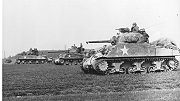 While combat in the European Theater of Operations
(ETO) consisted of high-profile armored warfare, the mainly naval nature of the Pacific Theater of Operations
(PTO) relegated it to secondary status for both the Allies and the Japanese. While the US Army fielded 16 armored divisions and 70 independent tank battalions during the war, only a third of the battalions and none of the divisions were deployed to the Pacific Theater. Indeed, even the Imperial Japanese Army
(IJA) deployed only their 2nd Tank Division to the Pacific during the war. The environment in which armor from both sides had to operate was generally described as tropical rain forests, which most armies simply classified as jungles. For this type of terrain, the Japanese and the Allies
found light tanks easier to transport, maneuver and employ.
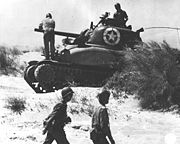
During the early stages of combat in the Pacific, specifically the Guadalcanal Campaign
, the U.S. Marine Corps' M2A4
light tank fought against the equally matched Type 95 Ha-Go
light tank; both were armed with a 37 mm main gun, however the M2 (produced in 1940) was newer by five years. By 1943, the IJA still used the Type 95 and Type 97 Chi-Ha
medium tanks, while Allied forces were quickly replacing their light tanks with 75 mm-armed M4s. The Chinese in India received 100 M4 Shermans and used them to great effect in the subsequent 1943 and 1944 offensives.
Advanced tank designs, such as the IJA's 75 mm-armed Type 3 medium tanks, were saved for islands closer to the empire or for defense of the homeland itself; consequently very few were deployed to the outlying extended islands, again leaving 1930s vintage light and medium tanks to do battle against 1940s built medium Allied armor. During these latter years of the war, General Purpose High Explosive (HE) ammunition was preferred, because armor-piercing rounds, which had been designed for penetrating thicker steel, simply went through the thin armor of Japanese tanks, and often out the other side without stopping. Although the high-velocity guns of the tank destroyers were useful for penetrating fortifications, M4s armed with flamethrowers were often deployed, as direct cannon fire seldom destroyed Japanese fortifications.
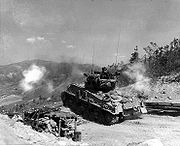 After World War II, the U.S. kept the M4A3E8 Easy Eight in service with either the 76 mm gun or a 105 mm howitzer. The Sherman remained a common U.S. tank in the Korean War
. Despite no longer being the primary US tank it fought alongside the M26 Pershing
and M46 Patton
. Both the Sherman and T-34 were comparable and could destroy each other when hit. The Sherman had better optics, which gave it a better chance of scoring a first round hit.
The Army replaced them with Pattons during the 1950s. The U.S. continued to transfer Shermans to its allies, which contributed to widespread foreign use.
and Panzer IV
, the Sherman's gun could penetrate the armor of these tanks within 1000 yd (914.4 m). U.S. Army Intelligence discounted the arrival of the Tiger I
in late 1942 and the Panther tank
in 1943, predicting the Panther to be a heavy tank like the Tiger, and doubted they would produce many. There were also reports of relatively small British 6 pdr
(57mm) guns being able to take out the Tiger. However, this was only happening at very close ranges and against the thinner side armor. Due to their misconceptions related to this, and also due to tests seeming to prove the 76mm able to take out the Tiger and the Panther without worry, AGF was not worried about the Tiger that much. These tests were later ruled inaccurate, with Eisenhower even remarking he was wrongly told by Ordnance the 76mm could knock out any German tank. The Army also failed to anticipate the Germans would make the Panther the standard tank of their panzer divisions in 1944, supported by numbers of Tigers.
As a result, the Bureau of Ordnance, which had developed new 90mm and 76mm anti-tank guns in 1943, did not provide U.S. armored forces with these guns which were better-suited to engaging the Panther and Tiger. Even in 1943, most German AFVs (later models of the Pzr IV, StuG III, and Marder III
) mounted 7.5 cm KwK 40
. As a result, even weakly armored light German tank destroyers such as the Marder III, which was meant to be a stop-gap measure to fight Soviet tanks in 1942, could destroy Shermans from a distance. The disparity in firepower between the German armored fighting vehicles of 1943 and the 75mm-armed M4 was the impetus to begin production of 76mm-armed M4s in April 1944. The U.S. 76mm proved comparable in penetrating power to the 7.5 cm KwK 40, the most common German tank gun encountered during the fighting in France, however transfer of the tanks to the front started slowly, and most tanks still had M3's, even by Operation Cobra
.
The 76mm gun could penetrate roughly 88mm of armor at 1000 m, just around the average tank engagement range noted by the Canadians. This was enough to penetrate a PzIV reliably. The 76mm was underpowered when faced with the frontal armor of a Panther tank, however. The glacis of the Panther boasted a line-of-sight thickness of 140mm, due to its angling. In order to deal with a Panther, a Sherman would have to get relatively close, due to both the armor and low-flash powder of the Panther. The low-flash powder would make shots harder to spot, making a tank have to come closer to spot it. Sherman crews also had issues with firing from range as the Sherman's high flash powder made their shots easy to spot. Their gun sights also were fixed magnification compared to the German's multiple magnification settings with added anti-glare filter. A good example of this deficiency is in Summer 1944, after breaking out of the bocage and moving into open country, U.S. tank units who were engaged at range from German defensive positions sometimes took 50% casualties before spotting where the fire was coming from.
The Sherman was first equipped with the with the L/40 75mm M3 Gun, which firing the usual M61 round could penetrate 77mm at 100m and 61mm at 1000m. Conditions later in the war necessitated the up-gunning to the L/55 76mm M1A2
, which could penetrate 124mm at 100m and 83mm at 1000m using the usual M79 round. The M1A2 helped to equalize the Sherman and the PzIV in terms of firepower, although the M4 was still under-powered compared to the Panther's much more powerful L/70 75mm gun. The British-developed Sherman Firefly
was up-gunned with the 17 pdr. gun
. The 17 pdr. also was 76mm and had a L/55 barrel, but it introduced a much bigger charge which allowed it to penetrate 140mm at 100m and 120mm at 1000m using Mk.IV shot. This gun allowed the Firefly a slight firepower advantage over the Panther, although the blinding muzzle flash
due to unburnt powder from the increased charge was a handicap.
was head of Army Ground Forces. McNair, an artilleryman, championed the tank destroyer
doctrine within the U.S. Armored Forces. Tanks were to support the infantry, exploit breakthroughs, and avoid tank-to-tank battles. Enemy tanks were to be engaged by the tank destroyer force, composed of a mix self-propelled tank destroyers and towed antitank guns. Self-propelled tank destroyers, called "gun motor carriages", were similar to tanks but were lightly armored with open topped turrets. The tank destroyers were supposed to be faster and carry a more powerful anti-tank gun than tanks; armor was sacrificed for speed. The tank destroyer doctrine played a large role in the lack of urgency in improving the firepower of the M4 Sherman, as the emphasis was on its role as infantry support.
McNair approved the 76mm upgrade to the M4 Sherman and production of the 90 mm M36 tank destroyer, but he staunchly opposed development of the T26 and other proposed heavy tanks during the crucial period of 1943 because he saw no "battle need" for them.
In mid-1943, Lt. General Devers, commander of U.S. forces in the European Theater of Operations
(ETO), asked for 250 T26s for use in the invasion of France
. McNair refused. Devers appealed to General George Marshall
, the Army Chief of Staff. Marshall summarily ordered the tanks to be provided to the ETO as soon as they could be produced. Soon after the Normandy invasion, General Dwight D. Eisenhower
urgently requested heavy tanks (now designated M26 Pershing
), but McNair's continued opposition delayed production. General Marshall intervened again and the tanks were eventually brought into production. However, only a few saw combat on February 25, 1945, too late to have any effect on the battlefield.
s long to 52), which decreased performance by 10%. Mounting this gun in the original M4 turret proved to be problematic, and so the turret for the aborted T23 tank project was used instead for the definitive production version of the 76 mm M4 Shermans.
Although tests against armor plate suggested the new M1A1 76 mm gun would be adequate, testing against captured Panther tanks was never done. This would have shown the gun could not penetrate the glacis plate of the Panther at any distance, and could only penetrate the center of the gun mantlet
at 100 meters.
The 90 mm gun developed by U.S. Ordnance could not be easily installed on the M4, but was installed on the open turreted M36 tank destroyer, and was the main gun for the T26 tank project (which eventually became the M26 Pershing). An attempt to upgrade the M4 Sherman by installing the 90 mm T26 turret on a M4A3 hull in April 1944 was halted after realizing it could not go into production sooner than the T26 and would likely delay T26 development.
In testing prior to the invasion of Normandy, the new 76 mm gun on the M4 Sherman was found to have a undesirable muzzle blast that kicked up dust from the ground and obscured vision for further firing. The addition of a muzzle brake
solved this problem by directing the blast sideways. It also had a much weaker high-explosive shell than the existing 75 mm gun. Standard Army doctrine at the time emphasized the importance of the infantry support role of the tank, and the high-explosive round was considered more important. Hence the 76 mm M4 was not initially accepted by various US Armored Division commanders, even though a number had already been produced and were available. All of the US Army M4s deployed initially in Normandy in June 1944 had the 75 mm gun.
The British were more astute in their anticipation of the future development of German armor — beginning development of a 3 inches (76.2 mm) anti-tank gun even before its predecessor entered service and planning for its use in tanks that would replace the M4. Out of expediency driven by delays in their new tanks designs, they mounted this high-powered Ordnance QF 17-pounder gun in a standard 75 mm M4 Sherman turret. This conversion became the Sherman Firefly
. The 17 pounder still could not penetrate the glacis plate of the Panther but it could easily penetrate the Panther's gun mantlet at combat range; moreover it could penetrate the front and side armor of the Tiger I
at nearly the same range that the Tiger I could penetrate the Sherman. Late in 1944, the British began to produce sabot
rounds for the 17 pounder gun, which could readily penetrate the armor of even the Tiger IIs, but these rounds were not too accurate and were narrowly distributed.
In late 1943, the British offered the 17 pounder to the U.S. Army for use in their M4 tanks. Gen. Devers insisted on comparison tests between the 17 pounder and the U.S. 90 mm gun (even though the 17 pounder could be mounted in a standard M4 turret while the 90 mm gun needed a new turret). The tests were finally done on March 25 and May 23, 1944; they seemed to show that the 90 mm gun was equal to or better than the 17 pounder. By then, production of the 76 mm M4 and the 90 mm M36 tank destroyer were both underway and U.S. Army interest in the 17 pounder waned.
Fighting against Panther tanks in Normandy quickly demonstrated the need for better anti-tank firepower, and the 76 mm M4s were deployed to First Army units in July 1944. General George S. Patton
's Third Army were initially issued 75 mm M4s and accepted 76 mm M4 Shermans only after the Battle of Arracourt
against Panther tanks in late September 1944.
High-Velocity Armor Piercing (HVAP) ammunition, standardized as M93, became available in August 1944 for the 76 mm gun. The projectile contained a tungsten
core penetrator surrounded by a lightweight aluminum body, which gave it a higher velocity and more penetrating power. However, this new projectile was still unable to penetrate the glacis plate of the Panther tank although it could penetrate the turret mantlet of the Panther at longer ranges than standard ammunition; it brought the U.S. 76 mm gun closer in performance to the British 17 pounder using standard APC ammunition. Because of tungsten shortages, HVAP rounds were constantly in short supply. Priority was given to U.S. tank destroyer units; most Shermans carried only a few rounds and some units never received any.
After the heavy tank losses of the Battle of the Bulge
, in January 1945, General Eisenhower asked that no more 75 mm M4s be sent to Europe: only 76 mm M4s were wanted.
Additionally, interest in mounting the British 17-pounder in U.S. Shermans flared anew. In February 1945, the U.S. Army began sending 75 mm M4s to England for conversion to the 17-pounder gun. Approximately 100 tanks were completed by the beginning of May. By then, the end of the war in Europe was clearly in sight, and the U.S. Army decided that the logistics of adding a new ammunition caliber to the supply train was not warranted. None of the converted 17-pounder M4s were deployed by the U.S., and it is unclear what happened to most of them, although some were given to the British as part of Lend-Lease.
The higher-velocity 76 mm M1 gun gave Shermans anti-tank firepower at least equal to most of the German vehicles they encountered, particularly the Panzer IV
, and StuG
. However, with a regular AP (Armor Piercing shot) ammunition (M79) or APCBC (M62) shells, the 76 mm might knock out a Panther only at close range with a shot to its mantlet or flank. At long range, the Sherman was badly outmatched by the Panther's 75 mm gun, which could easily penetrate the Sherman's armor from all angles. This, and the US Army's usual offensive tactical situation, contributed to the losses of Sherman tanks suffered by the U.S. Army in Europe.
The M4 was criticized by its crews for inability to pivot turn (turn in place), limiting its usefulness in urban warfare
against pivot-turning Panthers. This deficiency was partially compensated by the faster traverse of its turret.
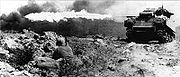 The Sherman was one of the first widely produced tanks to feature a gyroscopic stabilized gun and sight. The stabilization was only in the vertical plane, as the mechanism could not slew the turret. The stabilizer was sufficient to keep the gun within 1/8th of a degree, or 2 mils while crossing moderately rough terrain at 15 miles an hour. This gave a hit probability of 70% on enemy tanks at ranges of 300 to 1200 yards. The utility of the stabilization is debatable, with some saying it was useful for its intended purpose, others only for using the sights for stabilized viewing on the move. Some operators disabled the stabilizer.
The 75mm gun also had an effective canister round that functioned as a large shotgun. In the close fighting of the French Bocage, the 2nd Armored Division tanks used Culin Hedgerow Cutters fitted to their tanks to push three tanks together through a hedgerow. The flank tanks would clear the back of the hedgerow on their side with canister rounds while the center tank would engage and suppress known or suspected enemy positions on the next hedgerow. This approach permitted surprisingly fast progress through the very tough and well defended hedgerows in Normandy. Over 500 sets of these were fitted to US armored vehicles, and many fitted to various British tanks (where they were called "Prongs"). Other units devised other similar devices.
A variant of the M4 Sherman was armed with the 105 mm M4 howitzer
, which provided even more powerful high-explosive armament. This variant was employed in six-vehicle "Assault Gun" platoons in armored battalions to provide close fire support and smoke. The 105mm-armed variants were of limited use against enemy tanks due to the poor anti-armor performance of the howitzer, which was not intended to fight other tanks, though a High Explosive Anti-Tank (HEAT) round for the 105mm howitzer was available for self defense.
The 75 mm gun had a white phosphorus shell originally intended for use as an artillery marker to help with targeting. M4 tank crews discovered that the shell could also be used against the Tiger and Panther — when the burning white phosphorus splattered against the German tank, in addition to blinding the enemy gunner's excellent optics, the acrid smoke would get sucked inside the tank, and together with the fear of the fire spreading inside the tank, cause the crew to abandon the tank. There were several recorded instances where white phosphorus shells "knocked out" German tanks in this fashion.
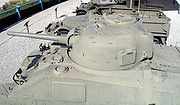 The steel frontal turret armor of the M4 ranged from 64–76 mm (2.5–3 in). The M4’s gun mantlet was also protected by 76 mm (2.99 in) of armor sloped
at 30 degrees, The turret side armor was 50 mm (1.97 in) a 5 degree angle while the rear was 64 mm at a 90 degree angle and the turret roof was 25 mm thick. The hull front sported 51 mm armor. Although the Russian T-34 is often credited for introducing sloped armor in a production tank, the Sherman's upper hull was angled at 56 degrees, while the lower half of the hull was curved. The earlier U.S. M2 and M3 medium tanks also had sloped armor. The hull sides were 38–45 mm (1.5–1.8 in) thick, and vertical. The hull rear—which protected and was offset from the rear radiator on some versions—was 38 mm (1.5 in) to the vertical or sloped to 85 degrees. The hull roof was 25 mm (0.984251968503937 in).
The armor of the M4 was effective against most early war anti-tank weapons, but was easily penetrated by later German tank guns and anti-tank guns. Early versions had unfortunate shot traps, locations where the effect of slope was greatly reduced, located just in front of the driver and assistant driver. The 75 mm L/48 tank guns would penetrate up to a range of 1,370 – 1,500 meters, and larger guns could penetrate past 2,000 metres. Regardless of this vulnerability, historian John Buckley has stated the M4 was "moderately superior" to the relatively small, but older Panzer IV. Although the later modeled medium and heavy tanks were greatly feared, Buckley opinionated "The vast majority of German tanks encountered in Normandy were either inferior, or at least, merely equal to the Sherman." The Sherman, like most Allied vehicles, remained vulnerable to infantry anti-tank weapons such as the Panzerschreck
and Panzerfaust
.
Progressively thicker armor was added to hull front and turret mantlet in various improved models. Many had an additional rectangular patch on each side protecting ammunition storage, others had an additional slanted plate in front of each front crew hatch. Field improvisations included placing sandbags, spare track links, concrete, wire mesh, or even wood for increased protection against shaped-charge rounds, even though it had little effect. Mounting sandbags around a tank had little effect against high-velocity anti-tank gunfire, but was thought to provide standoff protection against HEAT
weapons, primarily the German Panzerfaust and Panzerschreck. By 1945, it was rare to see a Sherman without any field improvisations. In the only study known to have been done to test the use of sandbags, on March 9, 1945, officers of the 1st Armored Group tested standard Panzerfaust 60s against sandbagged M4s; shots against the side blew away the sandbags and still penetrated the side armor, whereas shots fired at an angle against the front plate blew away some of the sandbags but failed to penetrate the armor. Earlier, in the summer of 1944, General Patton, informed by his ordnance officers that sandbags were useless and that the machines' chassis suffered from the extra weight, had forbidden the use of sandbags. Following the clamor for better armor and firepower after the losses of the Battle of the Bulge
, Patton ordered extra armor plates salvaged from knocked-out American and German tanks welded to the front hulls of tanks of his command. Approximately 36 of these up-armored M4s were supplied to each of the armored divisions of the Third Army in the spring of 1945.
The M4A3E2 Sherman Jumbo variant had even thicker frontal armor than the Tiger I. Intended for the assault to break out of the Normandy beachhead, it entered combat in August 1944.
The M4 had an escape hatch on the hull bottom to help the crew survive and, in the Pacific, Marines used this Sherman feature in reverse to recover wounded infantry under fire. Combat experience indicated the single hatch in the three-man turret to be inadequate for timely evacuation, so Ordnance added a loader's hatch beside the commander's. Later M4s also received redesigned hull hatches for better egress.
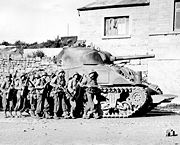 Research conducted by the British No. 2 Operational Research Section
, after the Normandy campaign, concluded a Sherman would be set alight 82% of the time following an average of 1.89 penetrations of the tank’s armor; in comparison they also concluded the Panzer IV would catch fire 80% of the time following an average of 1.5 penetrations, the Panther would light 63% of the time following 3.24 penetrations, and the Tiger would catch fire 80% of the time following 3.25 penetrations. John Buckley, using a case study of the 8th and 29th Armoured Brigades found that of the 166 Shermans knocked out in combat during the Normandy campaign, only 94 were burnt out; 56.6%. Buckley also notes that an American survey carried out concluded that 65% of tanks burnt out after being penetrated. United States Army research proved that the major reason for this was the stowage of main gun ammunition in the sponsons above the tracks. A U.S. Army study in 1945 concluded that only 10–15 percent of wet-stowage Shermans burned when penetrated, compared to 60–80 percent of the older dry-stowage Shermans
At first a partial remedy to ammunition fires in the M4 was found by welding 1 inches (25.4 mm) appliqué armor plates to the sponson sides over the ammunition stowage bins. Later models moved ammunition stowage to the hull floor, with additional water jackets surrounding the main gun ammunition stowage. The practice, known as "wet stowage", reduced the chance of fire after a hit by a factor of four. The Sherman gained grim nicknames like "Tommycooker" (by the Germans, who referred to British soldiers as "Tommies
"; a tommy cooker
was a World War I
era trench stove
). The British took to calling it the "Ronson", the cigarette lighter
which had the slogan "Lights up the first time, every time!" Polish tankers referred to it as "The Burning Grave".
Many think that the fires the Sherman is infamous for was a result of its gasoline engine. Actually, most of the tanks of the time used gasoline engines. Fuel fires occasionally occurred, but such fires were far less common and less deadly than ammunition fires. In many cases the fuel tank of the Sherman was found intact after a fire. Tankers describe "fierce, blinding jets of flame," which is inconsistent with gasoline-related fires but fits cordite
flash.
The armor of the Sherman comparatively to the Panther
can be described by statements used in a report to General Dwight Eisenhower At SHAEF:
 The U.S. Army restricted the Sherman's height, width, and weight so that it could be transported via typical bridges, roads, and railroads. This aided strategic, logistical, and tactical flexibility.
The Sherman had good speed both on- and off-road. Off-road performance varied. In the desert, the Sherman's rubber tracks performed well. In the confined, hilly terrain of Italy, the Sherman could often cross terrain German tanks could not.
Albert Speer
recounted in his autobiography Inside the Third Reich
However, U.S. crews found that on soft ground such as mud or snow, the narrow tracks gave poor ground pressure compared to wide-tracked second-generation German tanks such as the Panther and the Tiger. Soviet experiences were similar and tracks were modified to give better grip in the snow. The U.S. Army issued extended end connectors, "grousers" or "duckbills" to add width to the standard tracks as a stopgap solution. Duckbills were original factory equipment for the heavy M4A3E2 Jumbo to compensate for the extra weight of armor. The M4A3E8 "Easy Eight" Shermans and other late models with wider-tracked HVSS suspension corrected these problems, but formed only a small proportion of the tanks in service even in 1945.
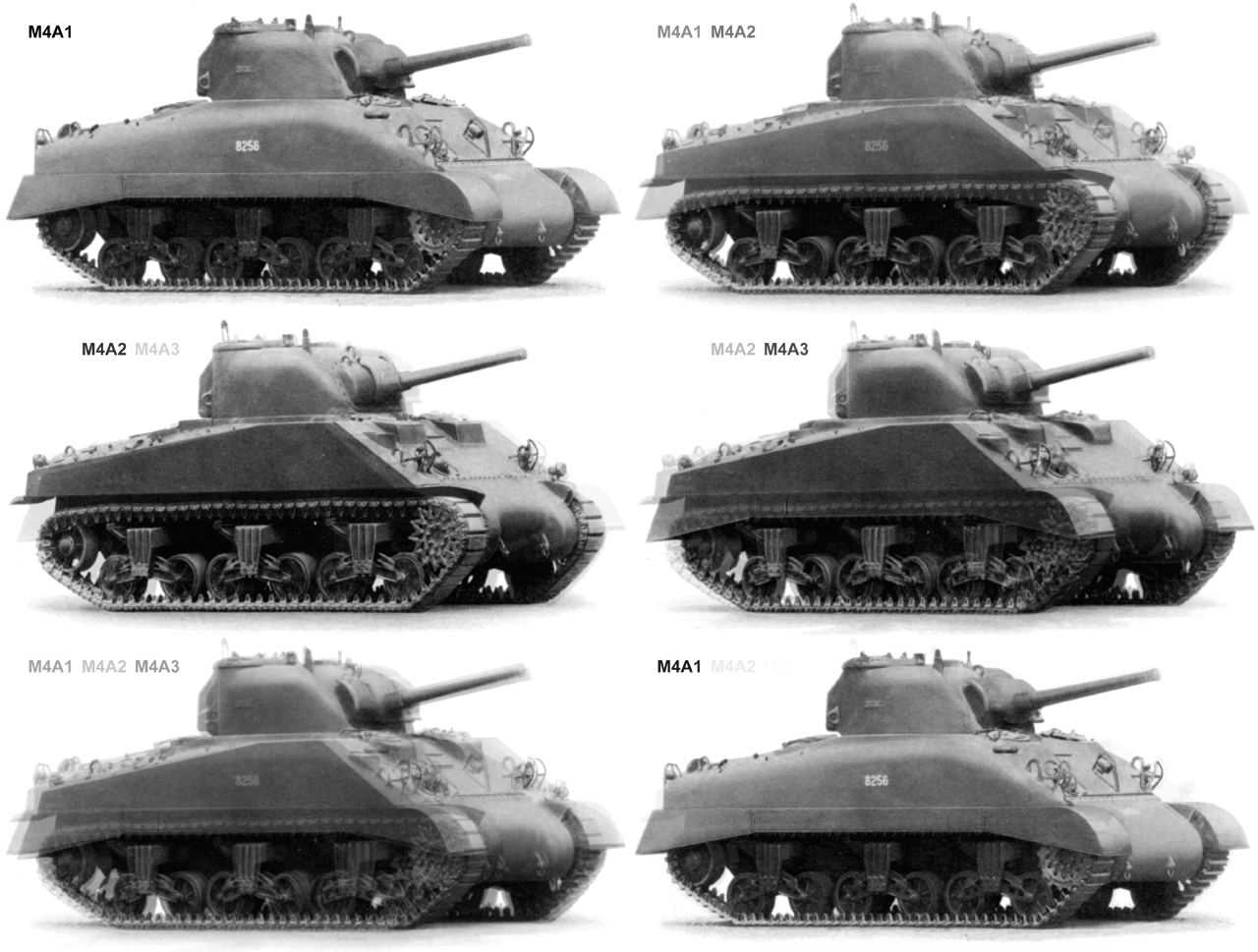
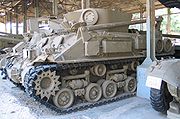
Vehicles that used the M4 chassis or hull:
The Sherman was extensively supplied through Lend-Lease
to Allied countries. Britain took nearly 80% of Lend-Lease deliveries, some of which was passed on to other allies. Soviet Union between 1942 and 1945 years has received 3664 tanks M4A2 with diesel engines.
Some of these remained in service for many years. After World War II, Shermans were supplied to some NATO armies; Shermans were used by U.S. and allied forces in the Korean War
.
Shermans also went to Israel
. The Israeli up-gunned 75 mm M-50 and 105 mm armed M-51 Super Shermans are remarkable examples of how a long obsolete design can be upgraded in front-line use. They saw combat in the 1967 Six-Day War
, fighting Soviet World War II
-era armor like the T34/85, and also in the 1973 Yom Kippur War
, proving effective even against newer, heavier Soviet tanks like the T-54 and T-55.
Foreign users
Tank
A tank is a tracked, armoured fighting vehicle designed for front-line combat which combines operational mobility, tactical offensive, and defensive capabilities...
used by the United States
United States
The United States of America is a federal constitutional republic comprising fifty states and a federal district...
during World War II
World War II
World War II, or the Second World War , was a global conflict lasting from 1939 to 1945, involving most of the world's nations—including all of the great powers—eventually forming two opposing military alliances: the Allies and the Axis...
. Thousands were also distributed to the Allies, including the British Commonwealth and Soviet
Soviet Union
The Soviet Union , officially the Union of Soviet Socialist Republics , was a constitutionally socialist state that existed in Eurasia between 1922 and 1991....
armies, via lend-lease
Lend-Lease
Lend-Lease was the program under which the United States of America supplied the United Kingdom, the Soviet Union, China, Free France, and other Allied nations with materiel between 1941 and 1945. It was signed into law on March 11, 1941, a year and a half after the outbreak of war in Europe in...
. In the United Kingdom
United Kingdom
The United Kingdom of Great Britain and Northern IrelandIn the United Kingdom and Dependencies, other languages have been officially recognised as legitimate autochthonous languages under the European Charter for Regional or Minority Languages...
, the M4 was named after Union
Union (American Civil War)
During the American Civil War, the Union was a name used to refer to the federal government of the United States, which was supported by the twenty free states and five border slave states. It was opposed by 11 southern slave states that had declared a secession to join together to form the...
General William Tecumseh Sherman
William Tecumseh Sherman
William Tecumseh Sherman was an American soldier, businessman, educator and author. He served as a General in the Union Army during the American Civil War , for which he received recognition for his outstanding command of military strategy as well as criticism for the harshness of the "scorched...
, following the British practice of naming their American-built tanks after famous American Civil War
American Civil War
The American Civil War was a civil war fought in the United States of America. In response to the election of Abraham Lincoln as President of the United States, 11 southern slave states declared their secession from the United States and formed the Confederate States of America ; the other 25...
generals. Subsequently the British name found its way into common use in the U.S.
The Sherman evolved from the Grant and Lee medium tanks
M3 Lee
The Medium Tank M3 was an American tank used during World War II. In Britain the tank was called "General Lee", named after Confederate General Robert E. Lee, and the modified version built with a new turret was called the "General Grant", named after U.S. General Ulysses S. Grant.Design commenced...
, which had an unusual side-sponson
Sponson
Sponsons are projections from the sides of a watercraft, for protection, stability, or the mounting of equipment such as armaments or lifeboats, etc...
mounted 75 mm gun. It retained much of the previous mechanical design, but added the first American main 75 mm gun mounted on a fully traversing turret, with a gyrostabilizer enabling the crew to fire with reasonable accuracy while the tank was on the move. The designers stressed mechanical reliability, ease of production and maintenance, durability, standardization of parts and ammunition in a limited number of variants, and moderate size and weight. These factors made the Sherman superior in some regards to the earlier German light
Light tank
A light tank is a tank variant initially designed for rapid movement, and now primarily employed in low-intensity conflict. Early light tanks were generally armed and armored similar to an armored car, but used tracks in order to provide better cross-country mobility.The light tank was a major...
and medium tank
Medium tank
Medium tank was a classification of tanks; the medium being intermediate in size and weight and armament between heavy tanks and light tanks.The medium tank concept has been eclipsed by the main battle tank.-History:...
s of 1939-41, of which the German Army still used-albeit in up-gunned and up-armored variants-through the later stages of the war. The Sherman ended up being produced in large numbers and formed the backbone of most Allied offensives, starting in late 1942.
The original Shermans were able to defeat the relatively small German tanks such as the Panzer III and IV they faced when first deployed in North Africa. Later, they found themselves more evenly matched against the newer up-gunned and up- armored Pz.Kpfw. IV
Panzer IV
The Panzerkampfwagen IV , commonly known as the Panzer IV, was a medium tank developed in Nazi Germany in the late 1930s and used extensively during the Second World War. Its ordnance inventory designation was Sd.Kfz...
medium tanks. Shermans were often outmatched by the 45 ton Panther
Panther tank
Panther is the common name of a medium tank fielded by Nazi Germany in World War II that served from mid-1943 to the end of the European war in 1945. It was intended as a counter to the T-34, and to replace the Panzer III and Panzer IV; while never replacing the latter, it served alongside it as...
tank and wholly inadequate against the 56 ton Tiger I
Tiger I
Tiger I is the common name of a German heavy tank developed in 1942 and used in World War II. The final official German designation was Panzerkampfwagen Tiger Ausf. E, often shortened to Tiger. It was an answer to the unexpectedly formidable Soviet armour encountered in the initial months of...
and later 72 ton Tiger II
Tiger II
Tiger II is the common name of a German heavy tank of the Second World War. The final official German designation was Panzerkampfwagen Tiger Ausf. B,Panzerkampfwagen – abbr: Pz. or Pz.Kfw. Ausführung – abbr: Ausf. .The full titles Panzerkampfwagen Tiger Ausf...
heavy tanks, suffering high casualties against their heavier armor and more powerful 88 mm L/56 and L/71 cannons. Mobility, mechanical reliability and sheer numbers, supported by growing superiority in supporting fighter-bomber
Fighter-bomber
A fighter-bomber is a fixed-wing aircraft with an intended primary role of light tactical bombing and also incorporating certain performance characteristics of a fighter aircraft. This term, although still used, has less significance since the introduction of rockets and guided missiles into aerial...
s and artillery
Artillery
Originally applied to any group of infantry primarily armed with projectile weapons, artillery has over time become limited in meaning to refer only to those engines of war that operate by projection of munitions far beyond the range of effect of personal weapons...
, helped offset these disadvantages strategically. The relatively lower price of the Sherman allowed huge numbers of this tank to be produced. This allowed many divisions, even many infantry divisions, their own organic Sherman assets. Some infantry divisions had more tanks than German panzer divisions did. This was a huge advantage for the Americans.
Production of the Sherman was favored by the commander of the Armored Ground Forces, albeit controversially, over the heavier M26 Pershing
M26 Pershing
The Heavy Tank M26 Pershing was an American heavy tank briefly used in World War II and in the Korean War. It was named after General John Pershing, who led the American Expeditionary Force in Europe in World War I....
, which resulted in the latter being deployed too late to play any significant role in the war. In the Pacific Theater
Pacific War
The Pacific War, also sometimes called the Asia-Pacific War refers broadly to the parts of World War II that took place in the Pacific Ocean, its islands, and in East Asia, then called the Far East...
, the Sherman was used chiefly against Japanese infantry and fortifications; in its rare encounters with much lighter Japanese tanks with weaker armor and guns, the Sherman's superiority was overwhelming.
Production of the M4 exceeded 50,000 units, and its chassis also served as the basis for numerous other armored vehicles such as tank destroyer
Tank destroyer
A tank destroyer is a type of armored fighting vehicle armed with a gun or missile launcher, and is designed specifically to engage enemy armored vehicles...
s, tank retriever
Armoured recovery vehicle
An armoured recovery vehicle is a type of armoured fighting vehicle used to repair battle- or mine-damaged as well as broken-down armoured vehicles during combat, or to tow them out of the danger zone for more extensive repairs...
s, and self-propelled artillery
Artillery
Originally applied to any group of infantry primarily armed with projectile weapons, artillery has over time become limited in meaning to refer only to those engines of war that operate by projection of munitions far beyond the range of effect of personal weapons...
. Only the Soviet T-34
T-34
The T-34 was a Soviet medium tank produced from 1940 to 1958. Although its armour and armament were surpassed by later tanks of the era, it has been often credited as the most effective, efficient and influential design of World War II...
tank was produced in larger numbers during World War II.
The Sherman would finally give way to post-war tanks developed from the M26. Various original and updated versions of the Sherman would continue to see combat effectively in many later conflicts, including the Korean War
Korean War
The Korean War was a conventional war between South Korea, supported by the United Nations, and North Korea, supported by the People's Republic of China , with military material aid from the Soviet Union...
, the Arab-Israeli Wars, and Indo-Pakistani War
Indo-Pakistani War of 1965
The Indo-Pakistani War of 1965 was a culmination of skirmishes that took place between April 1965 and September 1965 between Pakistan and India. This conflict became known as the Second Kashmir War fought by India and Pakistan over the disputed region of Kashmir, the first having been fought in 1947...
s into the late 20th century, against the T-34 and sometimes much more modern Soviet tanks.
U.S. design prototype
The U.S. Army Ordnance Department designed the Medium Tank M4 as a replacement for the M3 Lee and Grant Medium Tanks. The M3 was an up-gunned development of the M2 Medium TankM2 Medium Tank
The Medium Tank M2 was a United States Army tank that was first produced in 1939 by the Rock Island Arsenal, just prior to the commencement of the war in Europe. Production was 18 M2 tanks, and 94 slightly improved M2A1 tanks, for a total figure of 112...
of 1939, itself derived from the M2 Light Tank
M2 Light Tank
The Light Tank M2 was an American pre-World War II light tank that saw combat with the US Marine Corps 1st Tank Battalion on Guadalcanal in 1942, during World War II. Its service with the 1st Tank Battalion during the Pacific War was its only U.S...
of 1935. The M3 was developed as a stopgap measure until a new turret mounting a 75 mm gun could be devised. While it was a big improvement when tried by the British in Africa against early German panzers, the placement of a 37 mm gun turret on top gave it a very high profile, and the unusual inflexible side-sponson mounted main gun could not be aimed across the other side of the tank.
Detailed design characteristics for the M4 were submitted by the Ordnance Department on 31 August 1940, but development of a prototype had to be delayed while the final production designs of the M3 were finished and the M3 entered full-scale production. On 18 April 1941, the U.S. Armored Force Board chose the simplest of five designs. Known as the T6, the design was a modified M3 hull and chassis, carrying a newly designed turret mounting the Lee's main gun. This became the Sherman.
The Sherman's reliability benefited from many features first developed in U.S. light tanks during the 1930s, including vertical volute spring suspension
Vertical volute spring suspension
Vertical volute spring suspension is a type of vehicle suspension. It was chiefly used on US armoured fighting vehicles from the 1930s to after the end of the Second World War.-Development:...
, rubber-bushed tracks, and rear-mounted radial engine
Radial engine
The radial engine is a reciprocating type internal combustion engine configuration in which the cylinders point outward from a central crankshaft like the spokes on a wheel...
with drive sprockets in front. The designated goals were to produce a fast, dependable medium tank able to support infantry, provide breakthrough striking capacity, and defeat any tank then in use by the Axis nations, though it would later fall short against the much heavier tanks deployed by Germany.
The T6 prototype was completed 2 September 1941. Unlike later M4s, the hull was cast and had a side hatch, which was eliminated from production models. The T6 was standardized as the M4 and production began in October.
Doctrine
As the US approached entry in World War II, armored employment was doctrinally governed by FM 100-5 Operations (published May 1941, the month following selection of the M4 tank's final design). That FM stated that:In other words, the M4 was envisioned to primarily fill the role of a cruiser tank — although the US Army did not use that doctrinal term. The M4 was not primarily intended as an infantry support tank; in fact, FM 100-5 specifically stated the opposite. It placed tanks in the "striking echelon" of the armored division, and placed the infantry in the "support echelon". Neither was the M4 primarily intended for tank versus tank action. Doctrinally, anti-tank engagements were the primary role of tank destroyers. The field manual covering the use of the Sherman (FM 17-33, "The Tank Battalion, Light and Medium" of September 1942) devoted one page of text and four diagrams to tank versus tank action (out of 142 pages). This early armored doctrine was heavily influenced by the sweeping initial successes of the German blitzkrieg tactics. Unfortunately, by the time M4s reached combat in significant numbers, battlefield demands for infantry support and tank versus tank action far outnumbered the occasional opportunities for cruiser tanks.
Although envisioned primarily as a cruiser-type tank, US doctrine did also contemplate the M4's use in other roles. Unlike some other nations, which had separate medium tank designs tailored specifically for anti-tank roles (e.g., the German PzKw III) and support roles (the PzKw IV), the US intended the M4 to fulfill all roles. Although not optimized for tank versus tank engagements or infantry support, the M4 was capable of performing these missions to varying degrees. In the Pacific Theater
Pacific War
The Pacific War, also sometimes called the Asia-Pacific War refers broadly to the parts of World War II that took place in the Pacific Ocean, its islands, and in East Asia, then called the Far East...
, the Sherman was used chiefly against Japanese infantry and fortifications; in their rare encounters with lighter Japanese tanks with weaker armor and guns, the Shermans were vastly superior.
The official doctrine of the time had Shermans as a sort of infantry tank. All anti-tank work was supposed to be done by tank-destroyer crews. Speed was essential in order to bring the tank-destroyers from the rear to destroy incoming tanks. Thankfully, for Sherman crews, this doctrine was not entirely used as it would create a small window of time of weakness in the armored battalion until tank destroyers moved to the front. Obviously this would make it harder for an armored force to achieve a breakthrough, a main objective of armor, if the enemy had tanks. It would also be easier for an opposing armored force to achieve a breakthrough against an American tank battalion which would not have all of its anti-tank assets at the front during the beginning of any attack.
U.S. production history
In World War II, the U.S. Army ultimately fielded 16 armored divisions, along with 70 independent tank battalions; the U.S. Marine Corps also fielded six independent Sherman tank battalions for a total of 76, enough for 25 more armored divisions. A third of all Army tank battalions, and all six Marine tank battalions, were deployed to the Pacific Theater of Operations
Pacific Theater of Operations
The Pacific Theater of Operations was the World War II area of military activity in the Pacific Ocean and the countries bordering it, a geographic scope that reflected the operational and administrative command structures of the American forces during that period...
(PTO). Prior to September 1942, President Franklin D. Roosevelt
Franklin D. Roosevelt
Franklin Delano Roosevelt , also known by his initials, FDR, was the 32nd President of the United States and a central figure in world events during the mid-20th century, leading the United States during a time of worldwide economic crisis and world war...
had announced a production program calling for 120,000 tanks for the Allied war effort, which would have created 61 armored divisions. Although the American industrial complex was not affected by enemy aerial bombing
Strategic bombing
Strategic bombing is a military strategy used in a total war with the goal of defeating an enemy nation-state by destroying its economic ability and public will to wage war rather than destroying its land or naval forces...
nor submarine warfare
Submarine warfare
Naval warfare is divided into three operational areas: surface warfare, air warfare and underwater warfare. The latter may be subdivided into submarine warfare and anti-submarine warfare as well as mine warfare and mine countermeasures...
as was Japan
Japan
Japan is an island nation in East Asia. Located in the Pacific Ocean, it lies to the east of the Sea of Japan, China, North Korea, South Korea and Russia, stretching from the Sea of Okhotsk in the north to the East China Sea and Taiwan in the south...
, Germany
Germany
Germany , officially the Federal Republic of Germany , is a federal parliamentary republic in Europe. The country consists of 16 states while the capital and largest city is Berlin. Germany covers an area of 357,021 km2 and has a largely temperate seasonal climate...
and, to a lesser degree, Great Britain
Great Britain
Great Britain or Britain is an island situated to the northwest of Continental Europe. It is the ninth largest island in the world, and the largest European island, as well as the largest of the British Isles...
, the enormous drain of steel
Steel
Steel is an alloy that consists mostly of iron and has a carbon content between 0.2% and 2.1% by weight, depending on the grade. Carbon is the most common alloying material for iron, but various other alloying elements are used, such as manganese, chromium, vanadium, and tungsten...
for tank production had been diverted to warships and other naval vessels. The use of steel for naval construction amounted to the equivalent of approximately 67,000 tanks; and consequently only about 53,500 tanks were produced during 1942 and 1943.
The Army had seven main sub-designations for M4 variants during production: M4, M4A1, M4A2, M4A3, M4A4, M4A5, and M4A6. These designations did not necessarily indicate linear improvement: for example, A4 was not meant to indicate it was better than the A3. These sub-types indicated standardized production variations, which were in fact often manufactured concurrently at different locations. The sub-types differed mainly in engines, although the M4A1 differed from the M4 by its fully cast upper hull; the M4A4 had a longer engine system that required a longer hull, a longer suspension system, and more track blocks; M4A5 was an administrative placeholder for Canadian production; and the M4A6 had an elongated chassis, but fewer than 100 of these were produced.
While most Shermans ran on gasoline, the M4A2 and M4A6 had diesel engines: the M4A2 with a pair of GMC
General Motors
General Motors Company , commonly known as GM, formerly incorporated as General Motors Corporation, is an American multinational automotive corporation headquartered in Detroit, Michigan and the world's second-largest automaker in 2010...
6-71 straight six engines, the M4A6 a Caterpillar
Caterpillar Inc.
Caterpillar Inc. , also known as "CAT", designs, manufactures, markets and sells machinery and engines and sells financial products and insurance to customers via a worldwide dealer network. Caterpillar is the world's largest manufacturer of construction and mining equipment, diesel and natural gas...
RD1820 radial. These, plus the M4A4, which used the Chrysler A57 multibank
Chrysler A57 multibank
Created in 1941 as America entered World War II, the A57 Multibank engine was born out of the necessity for a rear-mount tank engine to be developed and produced, in the shortest time possible for use in M4A4 Medium tank....
engine, were mostly supplied to Allied countries under Lend-Lease
Lend-Lease
Lend-Lease was the program under which the United States of America supplied the United Kingdom, the Soviet Union, China, Free France, and other Allied nations with materiel between 1941 and 1945. It was signed into law on March 11, 1941, a year and a half after the outbreak of war in Europe in...
. "M4" can refer specifically to the initial sub-type with its Continental radial engine, or generically, to the entire family of seven Sherman sub-types, depending on context. Many details of production, shape, strength and performance improved throughout production, without a change to the tank's basic model number: more durable suspension units, safer "wet" (W) ammunition stowage, and stronger armor arrangements, such as the M4 Composite, which had a cast front hull section mated to a welded rear hull. British nomenclature differed from that employed by the U.S.
A 24-volt electrical system was used in the M4.
| Designation | Main Armament | Hull | Engine |
|---|---|---|---|
| M4(105) | 105 mm howitzer | welded | gasoline Continental R975 radial |
| M4 Composite | 75 mm | cast front welded sides | gasoline Continental R975 radial |
| M4A1(76)W | 76 mm | cast | gasoline Continental R975 radial |
| M4A2 | 75 mm | welded | diesel GM General Motors General Motors Company , commonly known as GM, formerly incorporated as General Motors Corporation, is an American multinational automotive corporation headquartered in Detroit, Michigan and the world's second-largest automaker in 2010... 6046 (2x6-71 inline) |
| M4A3W | 75 mm | welded | gasoline Ford GAA V8 Ford GAA engine The Ford GAA engine is an all aluminum, 32 valve, DOHC, 60 degree V8 engine produced by the Ford Motor Company during World War II. It featured twin Stromberg NA-Y5-G carburetors, dual magnetos and twin spark plugs, and crossflow induction.... |
| M4A3E2 "Jumbo" | 75 mm (some 76 mm) | welded | gasoline Ford GAA V8 |
| M4A3E8(76)W "Easy Eight" | 76 mm | welded | gasoline Ford GAA V8 |
| M4A4 | 75 mm | welded lengthened | gasoline Chrysler A57 Chrysler A57 multibank Created in 1941 as America entered World War II, the A57 Multibank engine was born out of the necessity for a rear-mount tank engine to be developed and produced, in the shortest time possible for use in M4A4 Medium tank.... 5x6-cyl inline |
| M4A6 | 75 mm | cast front welded sides lengthened | diesel Caterpillar D200A Wright R-1820 |-See also:-References:* Bridgman, L, Jane's Fighting Aircraft of World War II. Crescent. ISBN 0-517-67964-7* Eden, Paul & Soph Moeng, The Complete Encyclopedia of World Aircraft. Amber Books Ltd. Bradley's Close, 74-77 White Lion Street, London, NI 9PF, 2002, ISBN 0-7607-3432-1), 1152... radial |
Early Shermans mounted a 75 mm medium-velocity general-purpose gun
75 mm Gun (US)
The US 75 mm gun tank gun M2 and the later M3 were the standard American tank guns of the Second World War.Besides use on the two main American medium tanks of the war the M3 Lee and the M4 Sherman . The lightweight M6 and M5 variants were developed to equip the Light Tank M24 and the B-25...
. Although Ordnance began work on the Medium Tank T20
T20 Medium Tank
The Medium Tank T20 was part of a series of medium tanks designed by the United States during the Second World War, to be the successor to the Medium Tank M4 "Sherman", and culminated in the M27.-Design and development:...
as a Sherman replacement, ultimately the Army decided to minimize production disruption by incorporating elements of other tank designs into the Sherman. Later M4A1, M4A2, and M4A3 models received the larger T23 turret with a high-velocity 76 mm M1 gun
76 mm gun M1
The 76 mm Gun M1 was an American Forces World War II-era tank gun, which replaced the 75 mm gun on late Medium tank M4s, and was used for all 76 mm Gun Motor Carriage M18 tank destroyers. The previous 75 mm M3 L/40 gun on the early M4 Sherman variants was designed more as an infantry support...
, which reduced the number of HE and smoke rounds carried and increased the number of anti-tank rounds. Later, the M4 and M4A3 were factory-produced with a 105 mm howitzer and a new distinctive mantlet
Mantlet
A mantlet was a large shield or portable shelter used for stopping arrows or bullets, in medieval warfare. A mantlet could be mounted on a wheeled carriage, and protected one or several soldiers....
in the original turret. The first standard-production 76 mm gun Sherman was an M4A1, accepted in January 1944, and the first standard-production 105 mm howitzer Sherman was an M4 accepted in February 1944.
In June–July 1944, the Army accepted a limited run of 254 M4A3E2 Jumbo Shermans, which had very thick armor, and the 75 mm gun in a new, heavier T23-style turret, in order to assault fortifications. The M4A3 was the first to be factory-produced with the HVSS (horizontal volute spring suspension) suspension with wider tracks to distribute weight, and the smooth ride of the HVSS with its experimental E8 designation led to the nickname Easy Eight for Shermans so equipped. Both the Americans and the British developed a wide array of special attachments for the Sherman; few saw combat, and most remained experimental. Those that saw action included the bulldozer blade for the Sherman dozer tanks
Combat engineering vehicle
Military engineering vehicles are vehicles built for the construction work or for the transportation of combat engineers on the battlefield. These vehicles can range from civilian equipment to purpose built military vehicles....
, Duplex Drive for "swimming" Sherman tanks, R3 flamethrower for Zippo flame tank
Flame tank
A flame tank is a type of tank equipped with a flamethrower, most commonly used to supplement combined arms attacks against fortifications, confined spaces, or other obstacles...
s, and the T34 60-tube Calliope 4.5" rocket launcher
T34 Calliope
The Rocket Launcher T34 was a tank-mounted multiple rocket launcher used by the United States Army during World War II. The launcher was placed atop the Medium Tank M4, and fired a barrage of 4.5 in rockets from 60 launch tubes. It was developed in 1943; small numbers were produced and were...
for the Sherman turret. The British variants (DDs and mine flail
Mine flail
A mine flail is a vehicle-mounted device that makes a safe path through a mine-field by deliberately detonating land mines in front of the vehicle that carries it. They were first used by the British during World War II....
s) formed part of the group of specialized vehicles collectively known as "Hobart's Funnies
Hobart's Funnies
Hobart's Funnies were a number of unusually modified tanks operated during World War II by the United Kingdom's 79th Armoured Division or by specialists from the Royal Engineers. They were designed in light of problems that more standard tanks experienced during the Dieppe Raid, so that the new...
" (after Percy Hobart
Percy Hobart
Major-General Sir Percy Cleghorn Stanley Hobart KBE CB DSO MC , also known as "Hobo", was a British military engineer, noted for his command of the 79th Armoured Division during World War II...
, commander of the 79th Armoured Division
79th Armoured Division
The 79th Armoured Division was a specialist British Army armoured formation created as part of the preparations for the Normandy invasion of 6 June 1944...
).
The M4 Sherman's basic chassis was used for all the sundry roles of a modern mechanized force: roughly 50,000 Sherman tanks, plus thousands more derivative vehicles under different model numbers. These included M32 and M74 "tow truck"-style recovery tanks
Armoured recovery vehicle
An armoured recovery vehicle is a type of armoured fighting vehicle used to repair battle- or mine-damaged as well as broken-down armoured vehicles during combat, or to tow them out of the danger zone for more extensive repairs...
with winches, booms, and an 81 mm mortar for smoke screens; M34 (from M32B1) and M35 (from M10A1) artillery prime movers
Artillery tractor
Artillery tractor is a kind of tractor, also referred to as a gun tractor, a vehicle used to tow artillery pieces of varying weights.-Traction:...
; M7B1
M7 Priest
The 105 mm Howitzer Motor Carriage M7 was an American self-propelled artillery vehicle produced during World War II. It was given the official service name 105 mm Self Propelled Gun, Priest by the British Army, due to the pulpit-like machine gun ring, and following on from the Bishop and...
, M12
M12 Gun Motor Carriage
The 155 mm Gun Motor Carriage M12 was a U.S. self-propelled gun developed during the Second World War. Only 100 were built; 60 in 1942 and a further 40 in 1943. It mounted a 155 mm gun M1917, M1917A1 or M1918 M1, depending upon availability, a weapon derived from the nearly identical...
, M40
M40 GMC
The 155 mm Gun Motor Carriage M40 was a US self-propelled artillery vehicle built on a widened and lengthened Medium Tank M4A3 chassis but with Continental engine and with HVSS that was introduced at the end of the Second World War. Equipped with a 155 mm M2 gun, it was designed to replace the...
, and M43 self-propelled artillery; and the M10 Wolverine
M10 Wolverine
The M10 tank destroyer, formally 3-inch Gun Motor Carriage, M10 was a United States tank destroyer of World War II based on the chassis of the M4 Sherman tank. It was numerically the most important U.S...
(Achilles, in British service) and M36 Jackson
M36 Jackson
The M36 tank destroyer, formally 90 mm Gun Motor Carriage, M36, was an American tank destroyer used during World War II. American soldiers usually referred to them as TDs for 'tank destroyers'...
tank destroyers.
M4A4 Cutaway
- 1 - Lifting ring
- 2 - Ventilator
- 3 - Turret hatch
- 4 - Periscope
- 5 - Turret hatch race
- 6 - Turret seat
- 7 - Gunner's seat
- 8 - Turret seat
- 9 - Turret
- 10 - Air cleaner
- 11 - Radiator filler cover
- 12 - Air cleaner manifold
- 13 - Power unit
- 14 - Exhaust pipe
- 15 - Track idler
- 16 - Single water pump
- 17 - Radiator
- 18 - Generator
- 19 - Rear propeller shaft
- 20 - Turret basket
- 21 - slip ring
- 22 - Front propeller shaft
- 23 - Suspension bogie
- 24 - Transmission
- 25 - Main drive sprocket
- 26 - Driver's seat
- 27 - Machine gunner's seat
- 28 - 75 mm gun
- 29 - Drivers hatch
- 30 - M 1919A4 machine gun
Service history
Allocation
During World War II, approximately 19,247 Shermans were issued to the US Army and about 1,114 to the US Marine Corps. The U.S. also supplied 17,184 to Great BritainGreat Britain
Great Britain or Britain is an island situated to the northwest of Continental Europe. It is the ninth largest island in the world, and the largest European island, as well as the largest of the British Isles...
(some of which went to the Canadians and the Free Poles), while the Soviet Union
Soviet Union
The Soviet Union , officially the Union of Soviet Socialist Republics , was a constitutionally socialist state that existed in Eurasia between 1922 and 1991....
received 4,102 and an estimated 812 were transferred to China
China
Chinese civilization may refer to:* China for more general discussion of the country.* Chinese culture* Greater China, the transnational community of ethnic Chinese.* History of China* Sinosphere, the area historically affected by Chinese culture...
. These numbers were distributed further to the respective countries' allied nations.
The U.S. Marine Corps used the diesel M4A2 and gasoline-powered M4A3 in the Pacific. However, the Chief of the Army's Armored Force, Lt. Gen. Jacob L. Devers
Jacob L. Devers
General Jacob "Jake" Loucks Devers , commander of the 6th Army Group in Europe during World War II. He was the first United States military officer to reach the Rhine after D-Day.-Biography:...
, ordered no diesel-engined Shermans be used by the Army outside the Zone of Interior (the continental U.S.). The Army used all types for either training or testing within the United States, but intended the M4A2 and M4A4 (with the A57 Multibank engine) to be the primary Lend-Lease exports.
First combat
The Sherman was being issued in small numbers for familiarization to US armored Divisions when there was a turn of events in the Western Desert. Rommel had taken Tobruk, and Egypt (and the Suez Canal) was threatened. The US considered collecting all Shermans together so as to be able to send the 2nd Armored Division under Patton to reinforce Egypt, but delivering the Shermans directly to the British was quicker and 300 had arrived there by September 1942.The M4A1 Sherman first saw combat at the Second Battle of El Alamein
Second Battle of El Alamein
The Second Battle of El Alamein marked a major turning point in the Western Desert Campaign of the Second World War. The battle took place over 20 days from 23 October – 11 November 1942. The First Battle of El Alamein had stalled the Axis advance. Thereafter, Lieutenant-General Bernard Montgomery...
in October 1942 with the British 8th Army
Eighth Army (United Kingdom)
The Eighth Army was one of the best-known formations of the British Army during World War II, fighting in the North African and Italian campaigns....
. The first U.S. Shermans in battle were M4A1s in Operation Torch
Operation Torch
Operation Torch was the British-American invasion of French North Africa in World War II during the North African Campaign, started on 8 November 1942....
the next month. At this time, Shermans successfully engaged German Panzer III
Panzer III
Panzer III was the common name of a medium tank that was developed in the 1930s by Germany and was used extensively in World War II. The official German designation was Panzerkampfwagen III translating as "armoured battle vehicle". It was intended to fight other armoured fighting vehicles and...
s with long barreled 50 mm L/60 guns, and Panzer IV
Panzer IV
The Panzerkampfwagen IV , commonly known as the Panzer IV, was a medium tank developed in Nazi Germany in the late 1930s and used extensively during the Second World War. Its ordnance inventory designation was Sd.Kfz...
s with short barreled 75 mm L/24 guns. Additional M4s and M4A1s replaced M3 Lees in U.S. tank battalions over the course of the North African campaign. The M4 and M4A1 were the main types in U.S. units until late 1944, when the Army began replacing them with the preferred M4A3 with its more powerful 500 hp engine. Some M4s and M4A1s continued in U.S. service for the rest of the war.
Encounters with a company of Tiger I
Tiger I
Tiger I is the common name of a German heavy tank developed in 1942 and used in World War II. The final official German designation was Panzerkampfwagen Tiger Ausf. E, often shortened to Tiger. It was an answer to the unexpectedly formidable Soviet armour encountered in the initial months of...
s, with their heavier armor and 88 mm L/56 guns, in Tunisia
Tunisia
Tunisia , officially the Tunisian RepublicThe long name of Tunisia in other languages used in the country is: , is the northernmost country in Africa. It is a Maghreb country and is bordered by Algeria to the west, Libya to the southeast, and the Mediterranean Sea to the north and east. Its area...
were typical of the mid-war period: the fearsome quality of a few German heavy tanks and their crews could sometimes be overcome by the quantity and mobility of the Shermans, supported by artillery and airpower, but sometimes at a great cost in U.S. tanks and crewmen. By June 1944, the Panzer IV had been up-gunned with a 75 mm L/48 weapon, and 75 mm Shermans were out-gunned on a regular basis. The first Sherman to enter combat with the 76 mm gun in July 1944 was the M4A1, closely followed by the M4A3. By the end of the war, half the U.S. Army Shermans in Europe had the 76 mm gun. The first HVSS Sherman to see combat was the M4A3E8(76)W in December 1944.
European and Pacific Theaters
European Theater of Operations
The European Theater of Operations, United States Army was a United States Army formation which directed U.S. Army operations in parts of Europe from 1942 to 1945. It referred to Army Ground Forces, United States Army Air Forces, and Army Service Forces operations north of Italy and the...
(ETO) consisted of high-profile armored warfare, the mainly naval nature of the Pacific Theater of Operations
Pacific Theater of Operations
The Pacific Theater of Operations was the World War II area of military activity in the Pacific Ocean and the countries bordering it, a geographic scope that reflected the operational and administrative command structures of the American forces during that period...
(PTO) relegated it to secondary status for both the Allies and the Japanese. While the US Army fielded 16 armored divisions and 70 independent tank battalions during the war, only a third of the battalions and none of the divisions were deployed to the Pacific Theater. Indeed, even the Imperial Japanese Army
Imperial Japanese Army
-Foundation:During the Meiji Restoration, the military forces loyal to the Emperor were samurai drawn primarily from the loyalist feudal domains of Satsuma and Chōshū...
(IJA) deployed only their 2nd Tank Division to the Pacific during the war. The environment in which armor from both sides had to operate was generally described as tropical rain forests, which most armies simply classified as jungles. For this type of terrain, the Japanese and the Allies
Allies of World War II
The Allies of World War II were the countries that opposed the Axis powers during the Second World War . Former Axis states contributing to the Allied victory are not considered Allied states...
found light tanks easier to transport, maneuver and employ.
During the early stages of combat in the Pacific, specifically the Guadalcanal Campaign
Guadalcanal campaign
The Guadalcanal Campaign, also known as the Battle of Guadalcanal and codenamed Operation Watchtower by Allied forces, was a military campaign fought between August 7, 1942 and February 9, 1943 on and around the island of Guadalcanal in the Pacific theatre of World War II...
, the U.S. Marine Corps' M2A4
M2 Light Tank
The Light Tank M2 was an American pre-World War II light tank that saw combat with the US Marine Corps 1st Tank Battalion on Guadalcanal in 1942, during World War II. Its service with the 1st Tank Battalion during the Pacific War was its only U.S...
light tank fought against the equally matched Type 95 Ha-Go
Type 95 Ha-Go
The was a light tank used by the Imperial Japanese Army in combat operations of the Second Sino-Japanese War, at Nomonhan against the Soviet Union, and in the Second World War. It proved sufficient against infantry, however, like the American M3 Stuart, it was not designed to fight other tanks...
light tank; both were armed with a 37 mm main gun, however the M2 (produced in 1940) was newer by five years. By 1943, the IJA still used the Type 95 and Type 97 Chi-Ha
Type 97 Chi-Ha
The was a medium tank used by the Imperial Japanese Army during the Second Sino-Japanese War, at Nomonhan against the Soviet Union, and in the Second World War. It was the most widely produced Japanese medium tank of World War II, although the armor protection was considered as average in the 1930s...
medium tanks, while Allied forces were quickly replacing their light tanks with 75 mm-armed M4s. The Chinese in India received 100 M4 Shermans and used them to great effect in the subsequent 1943 and 1944 offensives.
Advanced tank designs, such as the IJA's 75 mm-armed Type 3 medium tanks, were saved for islands closer to the empire or for defense of the homeland itself; consequently very few were deployed to the outlying extended islands, again leaving 1930s vintage light and medium tanks to do battle against 1940s built medium Allied armor. During these latter years of the war, General Purpose High Explosive (HE) ammunition was preferred, because armor-piercing rounds, which had been designed for penetrating thicker steel, simply went through the thin armor of Japanese tanks, and often out the other side without stopping. Although the high-velocity guns of the tank destroyers were useful for penetrating fortifications, M4s armed with flamethrowers were often deployed, as direct cannon fire seldom destroyed Japanese fortifications.
Post–World War II
Korean War
The Korean War was a conventional war between South Korea, supported by the United Nations, and North Korea, supported by the People's Republic of China , with military material aid from the Soviet Union...
. Despite no longer being the primary US tank it fought alongside the M26 Pershing
M26 Pershing
The Heavy Tank M26 Pershing was an American heavy tank briefly used in World War II and in the Korean War. It was named after General John Pershing, who led the American Expeditionary Force in Europe in World War I....
and M46 Patton
M46 Patton
The M46 was a medium tank that was designed in the United States. It was the first tank to be named after General George S. Patton, commander of the U.S...
. Both the Sherman and T-34 were comparable and could destroy each other when hit. The Sherman had better optics, which gave it a better chance of scoring a first round hit.
The Army replaced them with Pattons during the 1950s. The U.S. continued to transfer Shermans to its allies, which contributed to widespread foreign use.
Armament
The gun on the original M4 was the short-barreled medium-velocity 75mm M3 gun. When it first saw combat in North Africa in late 1942 against the Panzer IIIPanzer III
Panzer III was the common name of a medium tank that was developed in the 1930s by Germany and was used extensively in World War II. The official German designation was Panzerkampfwagen III translating as "armoured battle vehicle". It was intended to fight other armoured fighting vehicles and...
and Panzer IV
Panzer IV
The Panzerkampfwagen IV , commonly known as the Panzer IV, was a medium tank developed in Nazi Germany in the late 1930s and used extensively during the Second World War. Its ordnance inventory designation was Sd.Kfz...
, the Sherman's gun could penetrate the armor of these tanks within 1000 yd (914.4 m). U.S. Army Intelligence discounted the arrival of the Tiger I
Tiger I
Tiger I is the common name of a German heavy tank developed in 1942 and used in World War II. The final official German designation was Panzerkampfwagen Tiger Ausf. E, often shortened to Tiger. It was an answer to the unexpectedly formidable Soviet armour encountered in the initial months of...
in late 1942 and the Panther tank
Panther tank
Panther is the common name of a medium tank fielded by Nazi Germany in World War II that served from mid-1943 to the end of the European war in 1945. It was intended as a counter to the T-34, and to replace the Panzer III and Panzer IV; while never replacing the latter, it served alongside it as...
in 1943, predicting the Panther to be a heavy tank like the Tiger, and doubted they would produce many. There were also reports of relatively small British 6 pdr
Ordnance QF 6 pounder
The Ordnance Quick-Firing 6-pounder 7 cwt, or just 6 pounder, was a British 57 mm gun, their primary anti-tank gun during the middle of World War II, as well as the main armament for a number of armoured fighting vehicles...
(57mm) guns being able to take out the Tiger. However, this was only happening at very close ranges and against the thinner side armor. Due to their misconceptions related to this, and also due to tests seeming to prove the 76mm able to take out the Tiger and the Panther without worry, AGF was not worried about the Tiger that much. These tests were later ruled inaccurate, with Eisenhower even remarking he was wrongly told by Ordnance the 76mm could knock out any German tank. The Army also failed to anticipate the Germans would make the Panther the standard tank of their panzer divisions in 1944, supported by numbers of Tigers.
As a result, the Bureau of Ordnance, which had developed new 90mm and 76mm anti-tank guns in 1943, did not provide U.S. armored forces with these guns which were better-suited to engaging the Panther and Tiger. Even in 1943, most German AFVs (later models of the Pzr IV, StuG III, and Marder III
Marder III
The Marder III is the name for a series of World War II German tank destroyers built on the chassis of the Panzer 38. The German word Marder means "marten" in English...
) mounted 7.5 cm KwK 40
7.5 cm KwK 40
The 7.5 cm KwK 40 was a German 7.5 cm Second World War era vehicle mounted gun, used as the primary anti-tank weapon of the German medium tank the SdKfz.161 Panzerkampfwagen IV and the SdKfz.142 Sturmgeschütz III assault guns ...
. As a result, even weakly armored light German tank destroyers such as the Marder III, which was meant to be a stop-gap measure to fight Soviet tanks in 1942, could destroy Shermans from a distance. The disparity in firepower between the German armored fighting vehicles of 1943 and the 75mm-armed M4 was the impetus to begin production of 76mm-armed M4s in April 1944. The U.S. 76mm proved comparable in penetrating power to the 7.5 cm KwK 40, the most common German tank gun encountered during the fighting in France, however transfer of the tanks to the front started slowly, and most tanks still had M3's, even by Operation Cobra
Operation Cobra
Operation Cobra was the codename for an offensive launched by the First United States Army seven weeks after the D-Day landings, during the Normandy Campaign of World War II...
.
The 76mm gun could penetrate roughly 88mm of armor at 1000 m, just around the average tank engagement range noted by the Canadians. This was enough to penetrate a PzIV reliably. The 76mm was underpowered when faced with the frontal armor of a Panther tank, however. The glacis of the Panther boasted a line-of-sight thickness of 140mm, due to its angling. In order to deal with a Panther, a Sherman would have to get relatively close, due to both the armor and low-flash powder of the Panther. The low-flash powder would make shots harder to spot, making a tank have to come closer to spot it. Sherman crews also had issues with firing from range as the Sherman's high flash powder made their shots easy to spot. Their gun sights also were fixed magnification compared to the German's multiple magnification settings with added anti-glare filter. A good example of this deficiency is in Summer 1944, after breaking out of the bocage and moving into open country, U.S. tank units who were engaged at range from German defensive positions sometimes took 50% casualties before spotting where the fire was coming from.
The Sherman was first equipped with the with the L/40 75mm M3 Gun, which firing the usual M61 round could penetrate 77mm at 100m and 61mm at 1000m. Conditions later in the war necessitated the up-gunning to the L/55 76mm M1A2
76 mm gun M1
The 76 mm Gun M1 was an American Forces World War II-era tank gun, which replaced the 75 mm gun on late Medium tank M4s, and was used for all 76 mm Gun Motor Carriage M18 tank destroyers. The previous 75 mm M3 L/40 gun on the early M4 Sherman variants was designed more as an infantry support...
, which could penetrate 124mm at 100m and 83mm at 1000m using the usual M79 round. The M1A2 helped to equalize the Sherman and the PzIV in terms of firepower, although the M4 was still under-powered compared to the Panther's much more powerful L/70 75mm gun. The British-developed Sherman Firefly
Sherman Firefly
The Sherman Firefly was a World War II British variant of the American Sherman tank, fitted with the powerful British 17 pounder anti-tank gun as its main weapon...
was up-gunned with the 17 pdr. gun
Ordnance QF 17 pounder
The Ordnance Quick-Firing 17 pounder was a 76.2 mm gun developed by the United Kingdom during World War II. It was used as an anti-tank gun on its own carriage, as well as equipping a number of British tanks. It was the most effective Allied anti-tank gun of the war...
. The 17 pdr. also was 76mm and had a L/55 barrel, but it introduced a much bigger charge which allowed it to penetrate 140mm at 100m and 120mm at 1000m using Mk.IV shot. This gun allowed the Firefly a slight firepower advantage over the Panther, although the blinding muzzle flash
Muzzle flash
Muzzle blast is the term used to describe the release of high temperature, high pressure gases expelled from the muzzle of a firearm when it is discharged. Muzzle flash is the term used to describe the visible light of the muzzle blast. The blast and flash are caused by the combustion products of...
due to unburnt powder from the increased charge was a handicap.
The tank destroyer doctrine
Gen. Lesley J. McNairLesley J. McNair
General Lesley James McNair was an American Army officer who served during World War I and World War II. He was killed by friendly fire when a USAAF Eighth Air Force bomb landed in his foxhole near Saint-Lô during Operation Cobra as part of the Battle of Normandy.McNair, Frank Maxwell Andrews and...
was head of Army Ground Forces. McNair, an artilleryman, championed the tank destroyer
Tank destroyer
A tank destroyer is a type of armored fighting vehicle armed with a gun or missile launcher, and is designed specifically to engage enemy armored vehicles...
doctrine within the U.S. Armored Forces. Tanks were to support the infantry, exploit breakthroughs, and avoid tank-to-tank battles. Enemy tanks were to be engaged by the tank destroyer force, composed of a mix self-propelled tank destroyers and towed antitank guns. Self-propelled tank destroyers, called "gun motor carriages", were similar to tanks but were lightly armored with open topped turrets. The tank destroyers were supposed to be faster and carry a more powerful anti-tank gun than tanks; armor was sacrificed for speed. The tank destroyer doctrine played a large role in the lack of urgency in improving the firepower of the M4 Sherman, as the emphasis was on its role as infantry support.
McNair approved the 76mm upgrade to the M4 Sherman and production of the 90 mm M36 tank destroyer, but he staunchly opposed development of the T26 and other proposed heavy tanks during the crucial period of 1943 because he saw no "battle need" for them.
In mid-1943, Lt. General Devers, commander of U.S. forces in the European Theater of Operations
European Theater of Operations
The European Theater of Operations, United States Army was a United States Army formation which directed U.S. Army operations in parts of Europe from 1942 to 1945. It referred to Army Ground Forces, United States Army Air Forces, and Army Service Forces operations north of Italy and the...
(ETO), asked for 250 T26s for use in the invasion of France
Operation Overlord
Operation Overlord was the code name for the Battle of Normandy, the operation that launched the invasion of German-occupied western Europe during World War II by Allied forces. The operation commenced on 6 June 1944 with the Normandy landings...
. McNair refused. Devers appealed to General George Marshall
George Marshall
George Catlett Marshall was an American military leader, Chief of Staff of the Army, Secretary of State, and the third Secretary of Defense...
, the Army Chief of Staff. Marshall summarily ordered the tanks to be provided to the ETO as soon as they could be produced. Soon after the Normandy invasion, General Dwight D. Eisenhower
Dwight D. Eisenhower
Dwight David "Ike" Eisenhower was the 34th President of the United States, from 1953 until 1961. He was a five-star general in the United States Army...
urgently requested heavy tanks (now designated M26 Pershing
M26 Pershing
The Heavy Tank M26 Pershing was an American heavy tank briefly used in World War II and in the Korean War. It was named after General John Pershing, who led the American Expeditionary Force in Europe in World War I....
), but McNair's continued opposition delayed production. General Marshall intervened again and the tanks were eventually brought into production. However, only a few saw combat on February 25, 1945, too late to have any effect on the battlefield.
Gun development
When the 76 mm gun was first installed in the M4 turret, it was found to unbalance the turret, and the gun barrel was also thought to protrude too far forward, making it more difficult to transport and susceptible to hit the ground on undulating terrain. Ordnance reduced the barrel length by 15 inches (from 57 caliberCaliber (artillery)
In artillery, caliber or calibredifference in British English and American English spelling is the internal diameter of a gun barrel, or by extension a relative measure of the length....
s long to 52), which decreased performance by 10%. Mounting this gun in the original M4 turret proved to be problematic, and so the turret for the aborted T23 tank project was used instead for the definitive production version of the 76 mm M4 Shermans.
Although tests against armor plate suggested the new M1A1 76 mm gun would be adequate, testing against captured Panther tanks was never done. This would have shown the gun could not penetrate the glacis plate of the Panther at any distance, and could only penetrate the center of the gun mantlet
Gun mantlet
A gun mantlet is an armour plate or shield attached to an armoured fighting vehicle's gun, protecting the opening through which the weapon's barrel projects from the hull or turret armour and, in many cases, ensuring the vulnerable warhead of a loaded shell does not protrude past the vehicle's...
at 100 meters.
The 90 mm gun developed by U.S. Ordnance could not be easily installed on the M4, but was installed on the open turreted M36 tank destroyer, and was the main gun for the T26 tank project (which eventually became the M26 Pershing). An attempt to upgrade the M4 Sherman by installing the 90 mm T26 turret on a M4A3 hull in April 1944 was halted after realizing it could not go into production sooner than the T26 and would likely delay T26 development.
In testing prior to the invasion of Normandy, the new 76 mm gun on the M4 Sherman was found to have a undesirable muzzle blast that kicked up dust from the ground and obscured vision for further firing. The addition of a muzzle brake
Muzzle brake
Muzzle brakes and recoil compensators are devices that are fitted to the muzzle of a firearm or cannon to redirect propellant gases with the effect of countering both recoil of the gun and unwanted rising of the barrel during rapid fire...
solved this problem by directing the blast sideways. It also had a much weaker high-explosive shell than the existing 75 mm gun. Standard Army doctrine at the time emphasized the importance of the infantry support role of the tank, and the high-explosive round was considered more important. Hence the 76 mm M4 was not initially accepted by various US Armored Division commanders, even though a number had already been produced and were available. All of the US Army M4s deployed initially in Normandy in June 1944 had the 75 mm gun.
The British were more astute in their anticipation of the future development of German armor — beginning development of a 3 inches (76.2 mm) anti-tank gun even before its predecessor entered service and planning for its use in tanks that would replace the M4. Out of expediency driven by delays in their new tanks designs, they mounted this high-powered Ordnance QF 17-pounder gun in a standard 75 mm M4 Sherman turret. This conversion became the Sherman Firefly
Sherman Firefly
The Sherman Firefly was a World War II British variant of the American Sherman tank, fitted with the powerful British 17 pounder anti-tank gun as its main weapon...
. The 17 pounder still could not penetrate the glacis plate of the Panther but it could easily penetrate the Panther's gun mantlet at combat range; moreover it could penetrate the front and side armor of the Tiger I
Tiger I
Tiger I is the common name of a German heavy tank developed in 1942 and used in World War II. The final official German designation was Panzerkampfwagen Tiger Ausf. E, often shortened to Tiger. It was an answer to the unexpectedly formidable Soviet armour encountered in the initial months of...
at nearly the same range that the Tiger I could penetrate the Sherman. Late in 1944, the British began to produce sabot
Armour-piercing discarding sabot
Armour-piercing discarding sabot is a type of kinetic energy projectile fired from a gun to attack armoured targets. APDS rounds are sabot rounds and were commonly used in large calibre tank guns, but have now been superseded by armour-piercing fin-stabilized discarding sabot projectiles in such...
rounds for the 17 pounder gun, which could readily penetrate the armor of even the Tiger IIs, but these rounds were not too accurate and were narrowly distributed.
In late 1943, the British offered the 17 pounder to the U.S. Army for use in their M4 tanks. Gen. Devers insisted on comparison tests between the 17 pounder and the U.S. 90 mm gun (even though the 17 pounder could be mounted in a standard M4 turret while the 90 mm gun needed a new turret). The tests were finally done on March 25 and May 23, 1944; they seemed to show that the 90 mm gun was equal to or better than the 17 pounder. By then, production of the 76 mm M4 and the 90 mm M36 tank destroyer were both underway and U.S. Army interest in the 17 pounder waned.
Fighting against Panther tanks in Normandy quickly demonstrated the need for better anti-tank firepower, and the 76 mm M4s were deployed to First Army units in July 1944. General George S. Patton
George S. Patton
George Smith Patton, Jr. was a United States Army officer best known for his leadership while commanding corps and armies as a general during World War II. He was also well known for his eccentricity and controversial outspokenness.Patton was commissioned in the U.S. Army after his graduation from...
's Third Army were initially issued 75 mm M4s and accepted 76 mm M4 Shermans only after the Battle of Arracourt
Battle of Arracourt
The Battle of Arracourt was a battle between U.S. and German armored forces during World War II near the town of Arracourt, Lorraine, France, from 18-29 September 1944. As part of a counteroffensive against recent U.S. advances in France, the German 5th Panzer Army had as its objective the...
against Panther tanks in late September 1944.
High-Velocity Armor Piercing (HVAP) ammunition, standardized as M93, became available in August 1944 for the 76 mm gun. The projectile contained a tungsten
Tungsten
Tungsten , also known as wolfram , is a chemical element with the chemical symbol W and atomic number 74.A hard, rare metal under standard conditions when uncombined, tungsten is found naturally on Earth only in chemical compounds. It was identified as a new element in 1781, and first isolated as...
core penetrator surrounded by a lightweight aluminum body, which gave it a higher velocity and more penetrating power. However, this new projectile was still unable to penetrate the glacis plate of the Panther tank although it could penetrate the turret mantlet of the Panther at longer ranges than standard ammunition; it brought the U.S. 76 mm gun closer in performance to the British 17 pounder using standard APC ammunition. Because of tungsten shortages, HVAP rounds were constantly in short supply. Priority was given to U.S. tank destroyer units; most Shermans carried only a few rounds and some units never received any.
After the heavy tank losses of the Battle of the Bulge
Battle of the Bulge
The Battle of the Bulge was a major German offensive , launched toward the end of World War II through the densely forested Ardennes mountain region of Wallonia in Belgium, hence its French name , and France and...
, in January 1945, General Eisenhower asked that no more 75 mm M4s be sent to Europe: only 76 mm M4s were wanted.
Additionally, interest in mounting the British 17-pounder in U.S. Shermans flared anew. In February 1945, the U.S. Army began sending 75 mm M4s to England for conversion to the 17-pounder gun. Approximately 100 tanks were completed by the beginning of May. By then, the end of the war in Europe was clearly in sight, and the U.S. Army decided that the logistics of adding a new ammunition caliber to the supply train was not warranted. None of the converted 17-pounder M4s were deployed by the U.S., and it is unclear what happened to most of them, although some were given to the British as part of Lend-Lease.
The higher-velocity 76 mm M1 gun gave Shermans anti-tank firepower at least equal to most of the German vehicles they encountered, particularly the Panzer IV
Panzer IV
The Panzerkampfwagen IV , commonly known as the Panzer IV, was a medium tank developed in Nazi Germany in the late 1930s and used extensively during the Second World War. Its ordnance inventory designation was Sd.Kfz...
, and StuG
Sturmgeschütz III
The Sturmgeschütz III assault gun was Germany's most produced armoured fighting vehicle during World War II. It was built on the chassis of the proven Panzer III tank...
. However, with a regular AP (Armor Piercing shot) ammunition (M79) or APCBC (M62) shells, the 76 mm might knock out a Panther only at close range with a shot to its mantlet or flank. At long range, the Sherman was badly outmatched by the Panther's 75 mm gun, which could easily penetrate the Sherman's armor from all angles. This, and the US Army's usual offensive tactical situation, contributed to the losses of Sherman tanks suffered by the U.S. Army in Europe.
The M4 was criticized by its crews for inability to pivot turn (turn in place), limiting its usefulness in urban warfare
Urban warfare
Urban warfare is combat conducted in urban areas such as towns and cities. Urban combat is very different from combat in the open at both the operational and tactical level...
against pivot-turning Panthers. This deficiency was partially compensated by the faster traverse of its turret.
Miscellaneous
The 75mm gun also had an effective canister round that functioned as a large shotgun. In the close fighting of the French Bocage, the 2nd Armored Division tanks used Culin Hedgerow Cutters fitted to their tanks to push three tanks together through a hedgerow. The flank tanks would clear the back of the hedgerow on their side with canister rounds while the center tank would engage and suppress known or suspected enemy positions on the next hedgerow. This approach permitted surprisingly fast progress through the very tough and well defended hedgerows in Normandy. Over 500 sets of these were fitted to US armored vehicles, and many fitted to various British tanks (where they were called "Prongs"). Other units devised other similar devices.
A variant of the M4 Sherman was armed with the 105 mm M4 howitzer
M101 howitzer
The 105 mm M2A1 howitzer was the standard light field howitzer for the United States in World War II, seeing action in both European and Pacific theaters. Entering production in 1941, it quickly entered the war against the Imperial Japanese Army in the Pacific, where it gained a reputation...
, which provided even more powerful high-explosive armament. This variant was employed in six-vehicle "Assault Gun" platoons in armored battalions to provide close fire support and smoke. The 105mm-armed variants were of limited use against enemy tanks due to the poor anti-armor performance of the howitzer, which was not intended to fight other tanks, though a High Explosive Anti-Tank (HEAT) round for the 105mm howitzer was available for self defense.
The 75 mm gun had a white phosphorus shell originally intended for use as an artillery marker to help with targeting. M4 tank crews discovered that the shell could also be used against the Tiger and Panther — when the burning white phosphorus splattered against the German tank, in addition to blinding the enemy gunner's excellent optics, the acrid smoke would get sucked inside the tank, and together with the fear of the fire spreading inside the tank, cause the crew to abandon the tank. There were several recorded instances where white phosphorus shells "knocked out" German tanks in this fashion.
Armor
Sloped armour
Sloped armour is armour that is neither in a vertical nor a horizontal position. Such "angled" armour is often mounted on tanks and other armoured fighting vehicles...
at 30 degrees, The turret side armor was 50 mm (1.97 in) a 5 degree angle while the rear was 64 mm at a 90 degree angle and the turret roof was 25 mm thick. The hull front sported 51 mm armor. Although the Russian T-34 is often credited for introducing sloped armor in a production tank, the Sherman's upper hull was angled at 56 degrees, while the lower half of the hull was curved. The earlier U.S. M2 and M3 medium tanks also had sloped armor. The hull sides were 38–45 mm (1.5–1.8 in) thick, and vertical. The hull rear—which protected and was offset from the rear radiator on some versions—was 38 mm (1.5 in) to the vertical or sloped to 85 degrees. The hull roof was 25 mm (0.984251968503937 in).
The armor of the M4 was effective against most early war anti-tank weapons, but was easily penetrated by later German tank guns and anti-tank guns. Early versions had unfortunate shot traps, locations where the effect of slope was greatly reduced, located just in front of the driver and assistant driver. The 75 mm L/48 tank guns would penetrate up to a range of 1,370 – 1,500 meters, and larger guns could penetrate past 2,000 metres. Regardless of this vulnerability, historian John Buckley has stated the M4 was "moderately superior" to the relatively small, but older Panzer IV. Although the later modeled medium and heavy tanks were greatly feared, Buckley opinionated "The vast majority of German tanks encountered in Normandy were either inferior, or at least, merely equal to the Sherman." The Sherman, like most Allied vehicles, remained vulnerable to infantry anti-tank weapons such as the Panzerschreck
Panzerschreck
Panzerschreck was the popular name for the Raketenpanzerbüchse , an 88 mm calibre reusable anti-tank rocket launcher developed by Nazi Germany in World War II. Another popular nickname was Ofenrohr ....
and Panzerfaust
Panzerfaust
The Panzerfaust was an inexpensive, recoilless German anti-tank weapon of World War II. It consisted of a small, disposable preloaded launch tube firing a high explosive anti-tank warhead, operated by a single soldier...
.
Progressively thicker armor was added to hull front and turret mantlet in various improved models. Many had an additional rectangular patch on each side protecting ammunition storage, others had an additional slanted plate in front of each front crew hatch. Field improvisations included placing sandbags, spare track links, concrete, wire mesh, or even wood for increased protection against shaped-charge rounds, even though it had little effect. Mounting sandbags around a tank had little effect against high-velocity anti-tank gunfire, but was thought to provide standoff protection against HEAT
Heat
In physics and thermodynamics, heat is energy transferred from one body, region, or thermodynamic system to another due to thermal contact or thermal radiation when the systems are at different temperatures. It is often described as one of the fundamental processes of energy transfer between...
weapons, primarily the German Panzerfaust and Panzerschreck. By 1945, it was rare to see a Sherman without any field improvisations. In the only study known to have been done to test the use of sandbags, on March 9, 1945, officers of the 1st Armored Group tested standard Panzerfaust 60s against sandbagged M4s; shots against the side blew away the sandbags and still penetrated the side armor, whereas shots fired at an angle against the front plate blew away some of the sandbags but failed to penetrate the armor. Earlier, in the summer of 1944, General Patton, informed by his ordnance officers that sandbags were useless and that the machines' chassis suffered from the extra weight, had forbidden the use of sandbags. Following the clamor for better armor and firepower after the losses of the Battle of the Bulge
Battle of the Bulge
The Battle of the Bulge was a major German offensive , launched toward the end of World War II through the densely forested Ardennes mountain region of Wallonia in Belgium, hence its French name , and France and...
, Patton ordered extra armor plates salvaged from knocked-out American and German tanks welded to the front hulls of tanks of his command. Approximately 36 of these up-armored M4s were supplied to each of the armored divisions of the Third Army in the spring of 1945.
The M4A3E2 Sherman Jumbo variant had even thicker frontal armor than the Tiger I. Intended for the assault to break out of the Normandy beachhead, it entered combat in August 1944.
The M4 had an escape hatch on the hull bottom to help the crew survive and, in the Pacific, Marines used this Sherman feature in reverse to recover wounded infantry under fire. Combat experience indicated the single hatch in the three-man turret to be inadequate for timely evacuation, so Ordnance added a loader's hatch beside the commander's. Later M4s also received redesigned hull hatches for better egress.
Operations research
Operations research is an interdisciplinary mathematical science that focuses on the effective use of technology by organizations...
, after the Normandy campaign, concluded a Sherman would be set alight 82% of the time following an average of 1.89 penetrations of the tank’s armor; in comparison they also concluded the Panzer IV would catch fire 80% of the time following an average of 1.5 penetrations, the Panther would light 63% of the time following 3.24 penetrations, and the Tiger would catch fire 80% of the time following 3.25 penetrations. John Buckley, using a case study of the 8th and 29th Armoured Brigades found that of the 166 Shermans knocked out in combat during the Normandy campaign, only 94 were burnt out; 56.6%. Buckley also notes that an American survey carried out concluded that 65% of tanks burnt out after being penetrated. United States Army research proved that the major reason for this was the stowage of main gun ammunition in the sponsons above the tracks. A U.S. Army study in 1945 concluded that only 10–15 percent of wet-stowage Shermans burned when penetrated, compared to 60–80 percent of the older dry-stowage Shermans
At first a partial remedy to ammunition fires in the M4 was found by welding 1 inches (25.4 mm) appliqué armor plates to the sponson sides over the ammunition stowage bins. Later models moved ammunition stowage to the hull floor, with additional water jackets surrounding the main gun ammunition stowage. The practice, known as "wet stowage", reduced the chance of fire after a hit by a factor of four. The Sherman gained grim nicknames like "Tommycooker" (by the Germans, who referred to British soldiers as "Tommies
Tommy Atkins
Tommy Atkins is a term for a common soldier in the British Army that was already well established in the 19th century, but is particularly associated with World War I. It can be used as a term of reference, or as a form of address. German soldiers would call out to "Tommy" across no man's land if...
"; a tommy cooker
Tommy cooker
A Tommy cooker was a compact, portable, solidified alcohol fuelled stove issued to British troops in World War I. It was notoriously ineffective and a variety of improvised alternatives were in use, but a refined version remained in use during World War II...
was a World War I
World War I
World War I , which was predominantly called the World War or the Great War from its occurrence until 1939, and the First World War or World War I thereafter, was a major war centred in Europe that began on 28 July 1914 and lasted until 11 November 1918...
era trench stove
Stove
A stove is an enclosed heated space. The term is commonly taken to mean an enclosed space in which fuel is burned to provide heating, either to heat the space in which the stove is situated or to heat the stove itself, and items placed on it...
). The British took to calling it the "Ronson", the cigarette lighter
Lighter
A lighter is a portable device used to generate a flame. It consists of a metal or plastic container filled with a flammable fluid or pressurized liquid gas, a means of ignition, and some provision for extinguishing the flame.- History :...
which had the slogan "Lights up the first time, every time!" Polish tankers referred to it as "The Burning Grave".
Many think that the fires the Sherman is infamous for was a result of its gasoline engine. Actually, most of the tanks of the time used gasoline engines. Fuel fires occasionally occurred, but such fires were far less common and less deadly than ammunition fires. In many cases the fuel tank of the Sherman was found intact after a fire. Tankers describe "fierce, blinding jets of flame," which is inconsistent with gasoline-related fires but fits cordite
Cordite
Cordite is a family of smokeless propellants developed and produced in the United Kingdom from 1889 to replace gunpowder as a military propellant. Like gunpowder, cordite is classified as a low explosive because of its slow burning rates and consequently low brisance...
flash.
The armor of the Sherman comparatively to the Panther
Panther tank
Panther is the common name of a medium tank fielded by Nazi Germany in World War II that served from mid-1943 to the end of the European war in 1945. It was intended as a counter to the T-34, and to replace the Panzer III and Panzer IV; while never replacing the latter, it served alongside it as...
can be described by statements used in a report to General Dwight Eisenhower At SHAEF:
Mobility
The Sherman had good speed both on- and off-road. Off-road performance varied. In the desert, the Sherman's rubber tracks performed well. In the confined, hilly terrain of Italy, the Sherman could often cross terrain German tanks could not.
Albert Speer
Albert Speer
Albert Speer, born Berthold Konrad Hermann Albert Speer, was a German architect who was, for a part of World War II, Minister of Armaments and War Production for the Third Reich. Speer was Adolf Hitler's chief architect before assuming ministerial office...
recounted in his autobiography Inside the Third Reich
However, U.S. crews found that on soft ground such as mud or snow, the narrow tracks gave poor ground pressure compared to wide-tracked second-generation German tanks such as the Panther and the Tiger. Soviet experiences were similar and tracks were modified to give better grip in the snow. The U.S. Army issued extended end connectors, "grousers" or "duckbills" to add width to the standard tracks as a stopgap solution. Duckbills were original factory equipment for the heavy M4A3E2 Jumbo to compensate for the extra weight of armor. The M4A3E8 "Easy Eight" Shermans and other late models with wider-tracked HVSS suspension corrected these problems, but formed only a small proportion of the tanks in service even in 1945.
US variants
Vehicles that used the M4 chassis or hull:
- 3in Gun Motor Carriage M10M10 WolverineThe M10 tank destroyer, formally 3-inch Gun Motor Carriage, M10 was a United States tank destroyer of World War II based on the chassis of the M4 Sherman tank. It was numerically the most important U.S...
- Tank DestroyerTank destroyerA tank destroyer is a type of armored fighting vehicle armed with a gun or missile launcher, and is designed specifically to engage enemy armored vehicles... - 90 mm Gun Motor Carriage M36M36 JacksonThe M36 tank destroyer, formally 90 mm Gun Motor Carriage, M36, was an American tank destroyer used during World War II. American soldiers usually referred to them as TDs for 'tank destroyers'...
- Tank Destroyer - 105 mm Howitzer Motor Carriage M7B1M7 PriestThe 105 mm Howitzer Motor Carriage M7 was an American self-propelled artillery vehicle produced during World War II. It was given the official service name 105 mm Self Propelled Gun, Priest by the British Army, due to the pulpit-like machine gun ring, and following on from the Bishop and...
- self-propelled artillerySelf-propelled artillerySelf-propelled artillery vehicles are combat vehicles armed with artillery. Within the term are covered self-propelled guns and rocket artillery...
, aka Priest - 155 mm Gun Motor Carriage M12M12 Gun Motor CarriageThe 155 mm Gun Motor Carriage M12 was a U.S. self-propelled gun developed during the Second World War. Only 100 were built; 60 in 1942 and a further 40 in 1943. It mounted a 155 mm gun M1917, M1917A1 or M1918 M1, depending upon availability, a weapon derived from the nearly identical...
- GMC M12 with Cargo Carrier M30 (both used Sherman components) - 155/203/250 mm Motor CarriagesM40 GMCThe 155 mm Gun Motor Carriage M40 was a US self-propelled artillery vehicle built on a widened and lengthened Medium Tank M4A3 chassis but with Continental engine and with HVSS that was introduced at the end of the Second World War. Equipped with a 155 mm M2 gun, it was designed to replace the...
- 155 mm GMC M40, 8 in. (203 mm) HMC M43, 250 mm (10 inch) MMC T94, and Cargo Carrier T30 - Flame Tank Sherman - M4A3R3 Zippo, M4 Crocodile, and other flame-throwing Shermans
- Rocket Artillery ShermanT34 CalliopeThe Rocket Launcher T34 was a tank-mounted multiple rocket launcher used by the United States Army during World War II. The launcher was placed atop the Medium Tank M4, and fired a barrage of 4.5 in rockets from 60 launch tubes. It was developed in 1943; small numbers were produced and were...
- T34 Calliope, T40 Whizbang, and other Sherman rocket launchers - Amphibious tanks - Duplex Drive (DD) swimming Sherman. A British variant used by U.S. forces.
- Engineer tanksCombat engineering vehicleMilitary engineering vehicles are vehicles built for the construction work or for the transportation of combat engineers on the battlefield. These vehicles can range from civilian equipment to purpose built military vehicles....
- D-8, M1, and M1A1 dozers, M4 Doozit, Mobile Assault Bridge, and Aunt Jemima and other mine-clearers - Recovery tanksArmoured recovery vehicleAn armoured recovery vehicle is a type of armoured fighting vehicle used to repair battle- or mine-damaged as well as broken-down armoured vehicles during combat, or to tow them out of the danger zone for more extensive repairs...
- M32 and M74 TRVs - Artillery tractorArtillery tractorArtillery tractor is a kind of tractor, also referred to as a gun tractor, a vehicle used to tow artillery pieces of varying weights.-Traction:...
s - M34 and M35 prime movers
Foreign variants and use
- Lend-Lease Sherman tanksLend-Lease Sherman tanksThe United States provided tens of thousands of its Medium Tank M4, nicknamed the Sherman, to many of its Allies during the Second World War, under the terms of Lend-Lease Act.-British nomenclature:...
- Postwar Sherman tanksPostwar Sherman tanksSherman tanks saw extensive use around the world after World War II. This article catalogues foreign post–World War II use and conversions of Sherman tanks and variants based on the Sherman chassis.-US foreign aid variants:...
- Sherman FireflySherman FireflyThe Sherman Firefly was a World War II British variant of the American Sherman tank, fitted with the powerful British 17 pounder anti-tank gun as its main weapon...
The Sherman was extensively supplied through Lend-Lease
Lend-Lease
Lend-Lease was the program under which the United States of America supplied the United Kingdom, the Soviet Union, China, Free France, and other Allied nations with materiel between 1941 and 1945. It was signed into law on March 11, 1941, a year and a half after the outbreak of war in Europe in...
to Allied countries. Britain took nearly 80% of Lend-Lease deliveries, some of which was passed on to other allies. Soviet Union between 1942 and 1945 years has received 3664 tanks M4A2 with diesel engines.
Some of these remained in service for many years. After World War II, Shermans were supplied to some NATO armies; Shermans were used by U.S. and allied forces in the Korean War
Korean War
The Korean War was a conventional war between South Korea, supported by the United Nations, and North Korea, supported by the People's Republic of China , with military material aid from the Soviet Union...
.
Shermans also went to Israel
Israel
The State of Israel is a parliamentary republic located in the Middle East, along the eastern shore of the Mediterranean Sea...
. The Israeli up-gunned 75 mm M-50 and 105 mm armed M-51 Super Shermans are remarkable examples of how a long obsolete design can be upgraded in front-line use. They saw combat in the 1967 Six-Day War
Six-Day War
The Six-Day War , also known as the June War, 1967 Arab-Israeli War, or Third Arab-Israeli War, was fought between June 5 and 10, 1967, by Israel and the neighboring states of Egypt , Jordan, and Syria...
, fighting Soviet World War II
World War II
World War II, or the Second World War , was a global conflict lasting from 1939 to 1945, involving most of the world's nations—including all of the great powers—eventually forming two opposing military alliances: the Allies and the Axis...
-era armor like the T34/85, and also in the 1973 Yom Kippur War
Yom Kippur War
The Yom Kippur War, Ramadan War or October War , also known as the 1973 Arab-Israeli War and the Fourth Arab-Israeli War, was fought from October 6 to 25, 1973, between Israel and a coalition of Arab states led by Egypt and Syria...
, proving effective even against newer, heavier Soviet tanks like the T-54 and T-55.
Foreign users


-
 India
India -
 Iran
Iran -
 Israel
 -
 Italy (post war)
 -
 Lebanon
 -
 Netherlands
 -
 New Zealand
 -
 Nicaragua
 -
 Pakistan
 -
 Paraguay
 -
 Peru
Peru -
 Philippines
 -
 Poland
-
 Portugal
 -
 Republic of China
 -
 Saudi Arabia
 -
 South Africa
 -
 South Korea
 -
 Japan (Post War bought and War-Time captured tanks)
 -
 Soviet Union
 -
 Turkey
 -
 United Kingdom
 -
 Kingdom of Yugoslavia
See also
- Detroit Arsenal Tank PlantDetroit Arsenal Tank PlantThe Detroit Arsenal Tank Plant was the first manufacturing plant ever built for the mass production of tanks in the United States. Established in 1940 under Chrysler, this plant was owned by the U.S. government until 1996. It was designed by architect Albert Kahn...
- List of vehicles of the U.S. Armed Forces
- Vickers Tank Periscope MK.IVVickers Tank Periscope MK.IVThe Vickers Tank Periscope MK.IV, invented by Polish engineer Rudolf Gundlach, was first patented in 1936 as Gundlach Peryskop obrotowy. It was the first device to allow the tank commander to have a 360-degree view from his turret, with a single periscope...
- Allied technological cooperation during World War IIAllied technological cooperation during World War IIThe Second World War was not won by one nation; the Allies had to cooperate while fighting on the ground, as well as by sharing technological resources and innovations...
- G-numbers
- M50 Super ShermanM50 Super ShermanThe Sherman M-50 and the Sherman M-51, both known abroad as the Super Sherman, were modified versions of the American M4 Sherman tank that served with the Israel Defense Forces from the mid-1950s to early 1980s. The M-51 was also referred to as the Isherman...
- Ram tankRam tankThe Tank Cruiser, Ram was a cruiser tank designed and built by Canada in the Second World War, based on the U.S. M3 Medium tank. Due to the entrance of the United States into the war and the superior design of the American Sherman, it was used exclusively for training purposes and was never used in...
External links
- M4 Sherman photo galleries at ww2photo.mimerswell.com: Non-English captions M4, Special adaptations, British Shermans
- "Tanks are Mighty Fine Things" (1946) — a 145 page book about the wartime manufacture of tanks by Chrysler Corporation - highly illustrated).
- Interview with Soviet Tanker Dmitriy Loza detailing the comparative utility of Shermans in the 6th Guards Tank Army at www.iremember.ru
- Russian language (translateable) article on Soviet uses
- U.S. 75mm M61 Tank Round - WWII
- M4 Sherman Photos and Walk Arounds on Prime Portal
- Sherman Register
- OnWar
- AFV Database
- World War II vehicles
- israeli-weapons.com
- About.com Military History
- M4 Sherman