


Western concert flute

Encyclopedia
The Western concert flute is a transverse (side-blown) woodwind instrument
made of metal or wood. It is the most common variant of the flute
. A musician who plays the flute is called a flautist
, flutist, or flute player.
This type of flute is used in many ensembles including concert band
s, orchestra
s, flute ensembles
, and occasionally jazz band
s and big band
s. Other flutes in this family include the piccolo
, alto flute
, bass flute
, contrabass flute
and double contrabass flute
.
Millions of works
have been composed for flute.
The standard concert flute is pitched in C and has a range of about three and a half octave
s starting from the musical note C4 (middle C
). In most cases the flute's highest pitch is C7, however more experienced flautists are able to reach up to F7 (and in some cases C8
). Modern flutes may have a longer foot joint (a B-foot), with an extra key to reach B3.
The piccolo
is also commonly used in Western orchestras. Alto flutes, pitched a fourth below the standard flute, and bass flutes, an octave below, are also used occasionally.
) and in "historically informed" performances
of Baroque
(and earlier) music. For flutes in general see flute
. The following section follows a rough sketch history of the western concert flute.
being more prominent. The transverse flute arrived in Europe from Asia, via the Byzantine Empire
, where it migrated to Germany and France. These flutes became known as "German flutes", to distinguish them from others, such as the recorder. The flute became used in court music, along with the viol
, and was used in secular music
, although only in France and Germany. It would not spread to the rest of Europe for nearly a century. The first literary appearance of the transverse flute was made in 1285, by Adenet le Roi in a list of instruments he played. After this, a period of 70 years ensues, where there are few references to the flute.
in Europe led to a revival in the flute. The Swiss army used flutes for signaling, and this helped the flute spread to all of Europe. In the late 16th century, flutes began to be used in court and theatre music (predecessors of the orchestra
), and the first flute solo
s.
Following the 16th century court music, flutes began appearing in chamber ensembles
. These flutes were often used as the tenor
voice. However, flutes varied greatly in size and range. This made transposition
necessary, which led flutists to use Guidonian hexachord
s (used by singers and other musicians since their introduction in the 11th century) to transpose music more easily.
During the 16th and early 17th centuries in Europe, the transverse flute was available in several different sizes, in effect forming a consort much in the same way that recorders and other instrument families were used in consorts. At this stage, the transverse flute was usually made in one section (or two for the larger sizes) and had a cylindrical bore. As a result, this flute had a rather soft sound and limited range, and was used primarily in compositions for the "soft consort".
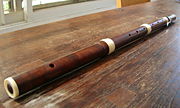 During the Baroque period, the transverse flute was redesigned. Now often called the traverso (from the Italian), it was made in three or four sections, or joints, with a conical bore from the head joint down. The conical bore design gave the instrument a wider range and a more penetrating sound, without sacrificing the softer, expressive qualities of the instrument. In addition to chamber music, the traverso began to be used in orchestral music.
In the baroque era, flutes become used in the scores of opera
, ballet
and chamber music. With this, composers now wrote music for the flute. These included Praetorius
, Schütz, Rebillé and Descoteaux, Quantz, Bach
, Telemann, Blavet
, Vivaldi and Handel
.
Because of the works of such composers, the flute became popular as a solo instrument. However there were few professional flutists who had the instrument as their main instrument (many had oboe
as their main instrument). In 1707, Jacques Martin Hotteterre wrote the first method book on playing the flute: Principes de la flûte traversière. The 1730s brought an increase in operatic and chamber music feature of flutes. The end of this era found the publication of Essay of a Method of Playing the Transverse Flute by Quantz, considered the greatest exposition
on flute method of its time.
and concerto
s. Throughout the rest of the century the interest in flutes increased, and peaked in the early half of the 19th century. During that time, Theobald Boehm began flute making and Friedrich Dülon
was perhaps the first flutist considered to be a great artist. Keys were added to the flute, and the taper was changed to strengthen its lower register.
With the romantic era, flutes begin to lose favor. Symphony orchestras featured brass
and string
s more, and many musicians did not accept Boehm’s new flute design. Flutes grew more popular throughout Europe as the century wore on, By the end of the century the Boehm flute had won favor and a flute revival was spurred by composers like Debussy. The early 19th century saw a great variety in flute designs. Conical bores giving a penetrating sound were used in Vienna
, English flutes had a range to low C and played best in flat keys, French flutes gave a softer tone, and German flutes blended best with orchestras.
. This form had 12 keys, body of wood, head joint of metal and ivory, and was common at the end of the century.
, who patented his system in 1847. It was immediately popular, and spread worldwide in just a few years. Minor additions to and variations on his key system are common but the acoustical structure of the tube remains almost exactly as he designed it. Major innovations were the change to metal instead of wood, large straight tube bore, "parabolic" tapered headjoint bore, very large tone holes covered by keys, and the linked key system which simplified fingering somewhat. The most substantial departures from Boehm's original description are the universal elimination of the "crutch" for the left hand, the almost universal adoption of Briccialdi's thumb key mechanism instead of Boehm's, and the almost universal adoption of a closed-standing G key over an additional G tone hole. Boehm's key system
, with minor variations, continues to be regarded as the most effective system of any modern woodwind, allowing trained players to perform with facility in all keys and with extraordinary velocity and brilliance.
The modern flute has three octaves plus C7-C7-D7 in the fourth octave. Many modern composers used the high D7; while such extremes are not commonly used, the modern flute can perform up to an F7 in its fourth octave.
 With the ability to record sound (beginning in the 1890s), flutes begin to regain a popularity not seen since the classical era. Recordings of flute music became increasingly common, with professional flautists spending a great deal of time recording music. The 20th century brought the first recordings of Baroque music on modern flutes.
modified the Boehm Flute to make playing modern music easier. The flute was tuned to A440, and the embouchure hole was cut in a new way to change the timbre
of the flute. These flutes became the most used flutes by professionals and by amateurs.
and Miyazawa Flutes
.
s. It is essentially a Boehm flute, with the ability to play quarter tones and has better capability of producing multiphonic
s. These abilities are especially useful for those who wish to play eastern music and for jazz flutists. The Kingma system flute is only made by the Brannen Brothers and Sankyo Flutes.
Each of the above instruments has its own range. The piccolo reads music in C like the concert flute but sounds one octave higher. The alto flute is in the key of G, and extends the low register range of the flute to the G below middle C. Its highest note is a high G (4 ledger lines above the treble clef staff). The bass flute is an octave lower than the concert flute, and the contrabass flute is an octave lower than the bass flute.
Less commonly seen flutes include the treble flute
in G, pitched one octave higher than the alto flute; the soprano flute
, between the treble and concert; and the tenor flute or flûte d'amour
in B or A, pitched between the concert and alto.
The lowest sizes (larger than the bass flute) have all been developed in the 20th century; these include the sub-bass flute
, which is pitched in F, between the bass and contrabass; the subcontrabass flute
(pitched in G or C), the contra-alto flute
(pitched in G, one octave below the alto), and the double contrabass flute
in C, one octave lower than the contrabass. The flute sizes other than the concert flute and piccolo are sometimes called harmony flutes.
 Concert flutes have three parts: the headjoint, the body, and the foot joint. The headjoint is sealed by a cork (or plug). It is possible to make fine adjustments to tuning by adjusting the headjoint cork, but usually it is left in the factory-recommended position around 17.3 mm from the centre of the embouchure hole for best scale. Gross, temporary adjustments of pitch are made by moving the headjoint in and out of the headjoint tenon. The player makes fine or rapid adjustments of pitch and timbre by adjusting the embouchure, and/or adjusting the position of the flute in relation to the player, i.e., side and out.
Often, a different head can make the flute play like a different flute. Some flute makers sell both end blown heads and transverse heads that can be interchanged. The same flute body can be used as a whistle/recorder style instrument, or as a transverse flute.
described the shape of the taper as parabolic. Examination of his flutes did not reveal a true parabolic curve, but the taper is more complex than a truncated cone. The head joint is the most difficult part to construct, because the lip plate and tone hole have critical dimensions, edges and angles, which vary slightly both between manufacturers and in individual flutes especially where they are hand-made. Head joint geometry appears particularly critical to acoustic performance and tone, but there is no clear consensus on a particular shape amongst manufacturers. Acoustic impedance of the embouchure hole appears the most critical parameter. Critical variables affecting this acoustic impedance include: chimney length (hole between lip-plate and head tube), chimney diameter, and radiuses or curvature of the ends of the chimney. Generally, the shorter the hole, the more quickly a flute can be played; the longer the hole, the more complex the tone. Finding a particularly good example of a flute is dependent on play testing. Head joint upgrades are usually suggested as a way to improve the tone of an instrument.
, polish
ed and then silver-plated and lacquer
ed to prevent corrosion
or silver-plated nickel silver
(nickel-bronze bell metal (63%Cu, 29%Zn, 5.5%Ni, 1.25%Ag, 0.75%Pb, alloyed:As, Sb, Fe, Sn)). Flutes that are more expensive are usually made of more precious metals, most commonly solid sterling silver
(92.5
% silver), and other alloys including french silver (95%Ag, 5%Cu), "coin silver" (90% silver), or [Britannia silver] (95.8% silver). It is reported that old Louis Lot French flutes have a particular sound by nature of their specific silver alloy. Gold/silver flutes are even more expensive. They can be either gold on the inside and silver on the outside, or vice versa. All gold and all platinum flutes also exist. Density 21.5
is a piece of music for solo flute written by Edgard Varèse
. The piece was composed at the request of Georges Barrère
, an eminent flutist, for the premiere of his platinum flute, the density of platinum being close to 21.5 grammes per cubic centimetre. Flutes can also be made out of wood, with African blackwood (grenadilla or Dalbergia melanoxylon) being the most common today. Formerly cocuswood
was used but this is hard to obtain today.
Wooden flutes were far more common before the early 20th century. The silver flute was introduced by Boehm in 1847 but did not become common until later in the 20th century. Wm. S. Haynes, a flute manufacturer in Boston, told Georges Barrère
that in 1905 he made one silver flute to every 100 wooden flutes but in the 1930s, he made one wooden flute to every 100 silver flutes.
Unusual tubing materials include glass, carbon fiber, and palladium
.
Professionals tend to play more expensive flutes made from more expensive materials. However, the idea that different materials can significantly affect sound quality is under some contention, and some argue that different metals make less difference in sound quality than different flautists playing the same flute. Even Verne Q. Powell, a flute maker, admitted (In Needed: A Gold Flute or a Gold Lip?) that As far as tone is concerned, I contend that 90 percent of it is the man behind the flute.
Most metal flutes are made of alloys that contain significant amounts of copper
or silver
. These alloys are biostatic because of the oligodynamic effect
, and thus suppress growth of unpleasant mold
s, fungi and bacteria
.
Good instruments are designed to prevent or reduce galvanic corrosion between the tube and the key mechanism.
The keywork is constructed by lost-wax castings and machining, with mounting posts and ribs silver-soldered to the tube. On the best flutes, the castings are forged to increase their strength.
Most flute keys have needle springs, made of phosphor bronze, stainless steel, beryllium copper, or a gold alloy. The B thumb keys typically have flat springs. Phosphor bronze is by far the most common material for needle springs because it is relatively inexpensive, makes a good spring, and is resistant to corrosion. Unfortunately, it is prone to metal fatigue. Stainless steel also makes a good spring and is resistant to corrosion. Gold springs are found mostly in high-end flutes because of its cost.
) is practically standard today.
.
Open-hole keys are needed for traditional Celtic music and other ethnic styles and for some modern concert pieces which require the player to produce harmonic overtones or to manipulate "breathy" sounds. They can also facilitate alternate fingerings, "extended technique
s" such as quarter-tones, glissando
, and multiphonics. Closed holes (plateau keys) permit a more relaxed hand position for some players, which can help their playing.
": a device that allows closure of the B tone hole independently of the C and C keys. The gizmo key makes C7 easier to play.
today is A4=440 Hz, many manufacturers optimize the tone hole size/spacings for a higher pitch options such as A4=442 Hz or A4=444 Hz. (As noted above, adjustments to the pitch of one note, usually the A4 fingering, can be made by moving the headjoint in and out of the headjoint tenon, but the point here is that the mechanical relationship of A4 to all other pitches is set when the tone holes are cut. However, small deviations from the objective 'mechanical' pitch (which is related to acoustic impedance of a given fingering) can be made on the fly by embouchure adjustments.)
. Drummer and bandleader Chick Webb
was among the first to use flutes in jazz, beginning in the late 1930s. Frank Wess
was among the first noteworthy flautists in jazz, in the 1940s. Since Boehm
's fingering is used in saxophone
s as well as in concert flutes, many flute players "double" on saxophone for jazz and small ensembles and vice versa.
Since 1950, a number of notable performers have used flutes in jazz. Frank Foster
and Frank Wess
(Basie band
), Jerome Richardson
(Jones/Lewis big band
) and Lew Tabackin
(Akiyoshi/Tabackin big band
) used flutes in big band contexts. In small band contexts notable performers included Bud Shank
, Herbie Mann
, Rahsaan Roland Kirk
, Charles Lloyd, Hubert Laws
and Moe Koffman
. Several modal jazz
and avant-garde jazz
performers have utilized the flute: Eric Dolphy
, Sam Rivers
and James Spaulding.
Jethro Tull
is probably the best-known rock group to make regular use of the flute (played by Ian Anderson
). The flute has a cameo role on You've Got to Hide Your Love Away
by The Beatles (played by John Scott) and Supper's Ready
by Genesis (Peter Gabriel
).
Other groups that have used the flute in their pop/rock songs include the The Moody Blues
, Australian group Men At Work
, the Canadian Prog-Rock
group Harmonium
, and the British groups Traffic
and Van der Graaf Generator
.
Woodwind instrument
A woodwind instrument is a musical instrument which produces sound when the player blows air against a sharp edge or through a reed, causing the air within its resonator to vibrate...
made of metal or wood. It is the most common variant of the flute
Flute
The flute is a musical instrument of the woodwind family. Unlike woodwind instruments with reeds, a flute is an aerophone or reedless wind instrument that produces its sound from the flow of air across an opening...
. A musician who plays the flute is called a flautist
Flautist
A flautist or flutist is a musician who plays an instrument in the flute family. See List of flautists.The choice of "flautist" versus "flutist" is the source of dispute among players of the instrument...
, flutist, or flute player.
This type of flute is used in many ensembles including concert band
Concert band
A concert band, also called wind band, symphonic band, symphonic winds, wind orchestra, wind symphony, wind ensemble, or symphonic wind ensemble, is a performing ensemble consisting of several members of the woodwind instrument family, brass instrument family, and percussion instrument family.A...
s, orchestra
Orchestra
An orchestra is a sizable instrumental ensemble that contains sections of string, brass, woodwind, and percussion instruments. The term orchestra derives from the Greek ορχήστρα, the name for the area in front of an ancient Greek stage reserved for the Greek chorus...
s, flute ensembles
Flute choir
A flute choir is a chamber instrumental ensemble consisting mainly of range extensions of the flute family. The standard instrumentation being:1 Piccolo in c’4 Flutes in c1 Alto Flute in G1 Bass Flute in C...
, and occasionally jazz band
Jazz band
A jazz band is a musical ensemble that plays jazz music. Jazz bands usually consist of a rhythm section and a horn section, in the early days often trumpet, trombone, and clarinet with rhythm section of piano, banjo, bass or tuba, and drums.-Eras:SwingDuring the swing era in the mid-twentieth...
s and big band
Big band
A big band is a type of musical ensemble associated with jazz and the Swing Era typically consisting of rhythm, brass, and woodwind instruments totaling approximately twelve to twenty-five musicians...
s. Other flutes in this family include the piccolo
Piccolo
The piccolo is a half-size flute, and a member of the woodwind family of musical instruments. The piccolo has the same fingerings as its larger sibling, the standard transverse flute, but the sound it produces is an octave higher than written...
, alto flute
Alto flute
The alto flute is a type of Western concert flute, a musical instrument in the woodwind family. It is the next extension downward of the C flute after the flûte d'amour. It is characterized by its distinct, mellow tone in the lower portion of its range...
, bass flute
Bass flute
The bass flute is the bass member of the flute family. It is in the key of C, pitched one octave below the concert flute. Because of the length of its tube , it is usually made with a "J" shaped head joint, which brings the embouchure hole within reach of the player...
, contrabass flute
Contrabass flute
The contrabass flute is one of the rarer members of the flute family. It is used mostly in flute ensembles. Its range is similar to that of the regular concert flute, except that it is pitched two octaves lower; the lowest performable note is two octaves below middle C...
and double contrabass flute
Double contrabass flute
The double contrabass flute is the largest and lowest pitched metal flute in the world...
.
Millions of works
Flute repertory
Flute repertory is the general term for pieces composed for flute and often played by flautists. The following lists are not intended to be complete, but rather to present a representative sampling of the most commonly played and well known works in the genre...
have been composed for flute.
Description
The flute is a transverse (or side-blown) woodwind instrument that is closed at the blown end. The instrument is played by blowing a stream of air over the embouchure hole. The pitch is changed by opening or closing keys that cover circular tone holes (there are typically 16 tone holes). Opening and closing the holes produces higher and lower pitches. The direction and intensity of the air stream also affects the pitch, timbre, and dynamics.The standard concert flute is pitched in C and has a range of about three and a half octave
Octave
In music, an octave is the interval between one musical pitch and another with half or double its frequency. The octave relationship is a natural phenomenon that has been referred to as the "basic miracle of music", the use of which is "common in most musical systems"...
s starting from the musical note C4 (middle C
Middle C
C or Do is the first note of the fixed-Do solfège scale. Its enharmonic is B.-Middle C:Middle C is designated C4 in scientific pitch notation because of the note's position as the fourth C key on a standard 88-key piano keyboard...
). In most cases the flute's highest pitch is C7, however more experienced flautists are able to reach up to F7 (and in some cases C8
Eighth octave C
The musical note C8 is the C two full octaves above soprano high C. The note is one octave above the top of common musical keyboards, but the highest note of an 88-key piano...
). Modern flutes may have a longer foot joint (a B-foot), with an extra key to reach B3.
The piccolo
Piccolo
The piccolo is a half-size flute, and a member of the woodwind family of musical instruments. The piccolo has the same fingerings as its larger sibling, the standard transverse flute, but the sound it produces is an octave higher than written...
is also commonly used in Western orchestras. Alto flutes, pitched a fourth below the standard flute, and bass flutes, an octave below, are also used occasionally.
History
The flute is one of the oldest and most widely used wind instruments. The precursors of the modern concert flute were keyless wooden transverse flutes, similar to modern fifes. These were later modified to include between one and eight keys for chromatic notes. The most common pitch for such flutes was and remains "six-finger" D, but other pitches sometimes occur. These primitive and simple-system flutes continue to be used in folk music (particularly Irish traditional musicFolk music of Ireland
The folk music of Ireland is the generic term for music that has been created in various genres in Ireland.-History:...
) and in "historically informed" performances
Historically informed performance
Historically informed performance is an approach in the performance of music and theater. Within this approach, the performance adheres to state-of-the-art knowledge of the aesthetic criteria of the period in which the music or theatre work was conceived...
of Baroque
Baroque music
Baroque music describes a style of Western Classical music approximately extending from 1600 to 1760. This era follows the Renaissance and was followed in turn by the Classical era...
(and earlier) music. For flutes in general see flute
Flute
The flute is a musical instrument of the woodwind family. Unlike woodwind instruments with reeds, a flute is an aerophone or reedless wind instrument that produces its sound from the flow of air across an opening...
. The following section follows a rough sketch history of the western concert flute.
Medieval flutes (1000–1400)
Throughout the 11th, 12th and 13th centuries, transverse flutes were very uncommon in Europe, with the recorderRecorder
The recorder is a woodwind musical instrument of the family known as fipple flutes or internal duct flutes—whistle-like instruments which include the tin whistle. The recorder is end-blown and the mouth of the instrument is constricted by a wooden plug, known as a block or fipple...
being more prominent. The transverse flute arrived in Europe from Asia, via the Byzantine Empire
Byzantine Empire
The Byzantine Empire was the Eastern Roman Empire during the periods of Late Antiquity and the Middle Ages, centred on the capital of Constantinople. Known simply as the Roman Empire or Romania to its inhabitants and neighbours, the Empire was the direct continuation of the Ancient Roman State...
, where it migrated to Germany and France. These flutes became known as "German flutes", to distinguish them from others, such as the recorder. The flute became used in court music, along with the viol
Viol
The viol is any one of a family of bowed, fretted and stringed musical instruments developed in the mid-late 15th century and used primarily in the Renaissance and Baroque periods. The family is related to and descends primarily from the Renaissance vihuela, a plucked instrument that preceded the...
, and was used in secular music
Secular music
Secular music is non-religious music. "Secular" means being separate from religion.In the West, secular music developed in the Medieval period and was used in the Renaissance. Swaying authority from the Church that focused more on Common Law influenced all aspects of Medieval life, including music...
, although only in France and Germany. It would not spread to the rest of Europe for nearly a century. The first literary appearance of the transverse flute was made in 1285, by Adenet le Roi in a list of instruments he played. After this, a period of 70 years ensues, where there are few references to the flute.
Renaissance (1400–1600) and Baroque flutes (1600–1760)
Beginning in the 1470s, a military revivalMilitary history
Military history is a humanities discipline within the scope of general historical recording of armed conflict in the history of humanity, and its impact on the societies, their cultures, economies and changing intra and international relationships....
in Europe led to a revival in the flute. The Swiss army used flutes for signaling, and this helped the flute spread to all of Europe. In the late 16th century, flutes began to be used in court and theatre music (predecessors of the orchestra
Orchestra
An orchestra is a sizable instrumental ensemble that contains sections of string, brass, woodwind, and percussion instruments. The term orchestra derives from the Greek ορχήστρα, the name for the area in front of an ancient Greek stage reserved for the Greek chorus...
), and the first flute solo
Solo (music)
In music, a solo is a piece or a section of a piece played or sung by a single performer...
s.
Following the 16th century court music, flutes began appearing in chamber ensembles
Chamber music
Chamber music is a form of classical music, written for a small group of instruments which traditionally could be accommodated in a palace chamber. Most broadly, it includes any art music that is performed by a small number of performers with one performer to a part...
. These flutes were often used as the tenor
Tenor
The tenor is a type of male singing voice and is the highest male voice within the modal register. The typical tenor voice lies between C3, the C one octave below middle C, to the A above middle C in choral music, and up to high C in solo work. The low extreme for tenors is roughly B2...
voice. However, flutes varied greatly in size and range. This made transposition
Transposition (music)
In music transposition refers to the process, or operation, of moving a collection of notes up or down in pitch by a constant interval.For example, one might transpose an entire piece of music into another key...
necessary, which led flutists to use Guidonian hexachord
Hexachord
In music, a hexachord is a collection of six pitch classes including six-note segments of a scale or tone row. The term was adopted in the Middle Ages and adapted in the twentieth-century in Milton Babbitt's serial theory.-Middle Ages:...
s (used by singers and other musicians since their introduction in the 11th century) to transpose music more easily.
During the 16th and early 17th centuries in Europe, the transverse flute was available in several different sizes, in effect forming a consort much in the same way that recorders and other instrument families were used in consorts. At this stage, the transverse flute was usually made in one section (or two for the larger sizes) and had a cylindrical bore. As a result, this flute had a rather soft sound and limited range, and was used primarily in compositions for the "soft consort".
In the baroque era, flutes become used in the scores of opera
Opera
Opera is an art form in which singers and musicians perform a dramatic work combining text and musical score, usually in a theatrical setting. Opera incorporates many of the elements of spoken theatre, such as acting, scenery, and costumes and sometimes includes dance...
, ballet
Ballet
Ballet is a type of performance dance, that originated in the Italian Renaissance courts of the 15th century, and which was further developed in France and Russia as a concert dance form. The early portions preceded the invention of the proscenium stage and were presented in large chambers with...
and chamber music. With this, composers now wrote music for the flute. These included Praetorius
Michael Praetorius
Michael Praetorius was a German composer, organist, and music theorist. He was one of the most versatile composers of his age, being particularly significant in the development of musical forms based on Protestant hymns, many of which reflect an effort to make better the relationship between...
, Schütz, Rebillé and Descoteaux, Quantz, Bach
Johann Sebastian Bach
Johann Sebastian Bach was a German composer, organist, harpsichordist, violist, and violinist whose sacred and secular works for choir, orchestra, and solo instruments drew together the strands of the Baroque period and brought it to its ultimate maturity...
, Telemann, Blavet
Blavet
The Blavet river flows from central Brittany and enters the Atlantic Ocean on the south coast near Lorient. The river is canalized for most of its length and is navigable for smaller craft. It is part of Brittany's canal system and became more important when the western half of that system got cut...
, Vivaldi and Handel
HANDEL
HANDEL was the code-name for the UK's National Attack Warning System in the Cold War. It consisted of a small console consisting of two microphones, lights and gauges. The reason behind this was to provide a back-up if anything failed....
.
Because of the works of such composers, the flute became popular as a solo instrument. However there were few professional flutists who had the instrument as their main instrument (many had oboe
Oboe
The oboe is a double reed musical instrument of the woodwind family. In English, prior to 1770, the instrument was called "hautbois" , "hoboy", or "French hoboy". The spelling "oboe" was adopted into English ca...
as their main instrument). In 1707, Jacques Martin Hotteterre wrote the first method book on playing the flute: Principes de la flûte traversière. The 1730s brought an increase in operatic and chamber music feature of flutes. The end of this era found the publication of Essay of a Method of Playing the Transverse Flute by Quantz, considered the greatest exposition
Expository writing
Expository writing is a type of writing where the purpose is to inform, explain, describe, or define the author's subject to the reader. Expository text is meant to deposit information and is the most frequently used type of writing by students in colleges and universities. A well-written...
on flute method of its time.
Classical Flutes (1760–1820) and Romantic flutes (1820–1900)
The orchestras formed in the last half of the 18th century included flutes, which were featured in symphoniesSymphony
A symphony is an extended musical composition in Western classical music, scored almost always for orchestra. A symphony usually contains at least one movement or episode composed according to the sonata principle...
and concerto
Concerto
A concerto is a musical work usually composed in three parts or movements, in which one solo instrument is accompanied by an orchestra.The etymology is uncertain, but the word seems to have originated from the conjunction of the two Latin words...
s. Throughout the rest of the century the interest in flutes increased, and peaked in the early half of the 19th century. During that time, Theobald Boehm began flute making and Friedrich Dülon
Friedrich Dülon
Friedrich Ludwig Dülon , was one of the most prominent and famous flute-virtuoso musicians of the classical era, being one of the first flutists to be considered gifted on flute. At the age of 40 he had acquired more than 300 concerts in his repertoire...
was perhaps the first flutist considered to be a great artist. Keys were added to the flute, and the taper was changed to strengthen its lower register.
With the romantic era, flutes begin to lose favor. Symphony orchestras featured brass
Brass instrument
A brass instrument is a musical instrument whose sound is produced by sympathetic vibration of air in a tubular resonator in sympathy with the vibration of the player's lips...
and string
String instrument
A string instrument is a musical instrument that produces sound by means of vibrating strings. In the Hornbostel-Sachs scheme of musical instrument classification, used in organology, they are called chordophones...
s more, and many musicians did not accept Boehm’s new flute design. Flutes grew more popular throughout Europe as the century wore on, By the end of the century the Boehm flute had won favor and a flute revival was spurred by composers like Debussy. The early 19th century saw a great variety in flute designs. Conical bores giving a penetrating sound were used in Vienna
Vienna
Vienna is the capital and largest city of the Republic of Austria and one of the nine states of Austria. Vienna is Austria's primary city, with a population of about 1.723 million , and is by far the largest city in Austria, as well as its cultural, economic, and political centre...
, English flutes had a range to low C and played best in flat keys, French flutes gave a softer tone, and German flutes blended best with orchestras.
Meyer flute
The Meyer flute was a popular flute in the mid 19th century. Including and derived from the instruments built by H.F. Meyer from 1850 to the late 1890s, it could have up to 12 keys and was built with head joints of either metal-lined ivory or wood. The final form was a combination of a traditional keyed flute and the Viennese flute, and became the most common throughout Europe and AmericaUnited States
The United States of America is a federal constitutional republic comprising fifty states and a federal district...
. This form had 12 keys, body of wood, head joint of metal and ivory, and was common at the end of the century.
Boehm flute
The dimensions and key system of the modern western concert flute and its close relatives are almost completely the work of the great flautist, composer, acoustician and silversmith, Theobald BoehmTheobald Boehm
Theobald Böhm was a German inventor and musician, who perfected the modern Western concert flute and its improved fingering system...
, who patented his system in 1847. It was immediately popular, and spread worldwide in just a few years. Minor additions to and variations on his key system are common but the acoustical structure of the tube remains almost exactly as he designed it. Major innovations were the change to metal instead of wood, large straight tube bore, "parabolic" tapered headjoint bore, very large tone holes covered by keys, and the linked key system which simplified fingering somewhat. The most substantial departures from Boehm's original description are the universal elimination of the "crutch" for the left hand, the almost universal adoption of Briccialdi's thumb key mechanism instead of Boehm's, and the almost universal adoption of a closed-standing G key over an additional G tone hole. Boehm's key system
Boehm System
The Boehm system is a system of keywork for the flute, created by inventor and flautist Theobald Boehm between 1831 and 1847.Prior to the development of the Boehm system, flutes were most commonly made of wood, with an inverse conical bore, eight keys, and tone holes that were small in size, and...
, with minor variations, continues to be regarded as the most effective system of any modern woodwind, allowing trained players to perform with facility in all keys and with extraordinary velocity and brilliance.
The modern flute has three octaves plus C7-C7-D7 in the fourth octave. Many modern composers used the high D7; while such extremes are not commonly used, the modern flute can perform up to an F7 in its fourth octave.
Giorgi flute
Quite at the opposite end of the spectrum, in terms of the complexity of the key system developed by Boehm, was the Giorgi flute, an advanced form of the ancient holed flute. Patented in 1897, the Giorgi flute was designed without any mechanical keys, though the patent allows for the addition of keys as options. Giorgi enabled the performer to play equally true in all musical keys, as does the Boehm system. Giorgi flutes are now rarities, found in museums and private collections. The underlying principles of both flute patterns are virtually identical, with tone holes spaced as required to produce a fully chromatic scale. The player, by opening and closing holes, adjusts the effective length of the tube, and thus the rate of oscillation, which defines the audible pitch.20th century flutes
Boehm-Lot-Cooper flute
In the 1950s, Albert CooperAlbert Cooper (flute maker)
Albert Cooper was a British flute maker who apprenticed at Rudall Carte until the war. After discharge, he returned to Rudall Carte but left in 1959 and set himself up as flute maker.-Flutes manufactured:*C flutes - 80...
modified the Boehm Flute to make playing modern music easier. The flute was tuned to A440, and the embouchure hole was cut in a new way to change the timbre
Timbre
In music, timbre is the quality of a musical note or sound or tone that distinguishes different types of sound production, such as voices and musical instruments, such as string instruments, wind instruments, and percussion instruments. The physical characteristics of sound that determine the...
of the flute. These flutes became the most used flutes by professionals and by amateurs.
Brögger flute
In the 1980s, Johan Brögger modified the Boehm-Lot-Cooper flute, by fixing two major problems that had existed for nearly 150 years: maladjustument between certain keys, and problems between the G key and the B♭ key. The result was non-rotating shafts, which gave a quieter sound and less friction on moving parts. Also the modifications allowed for springs to be adjusted individually, and the flute was strengthened. The Brögger flute is only made by the Brannen BrothersBrannen Brothers
Brannen Brothers Flutemakers, Inc is a manufacturer of custom flutes, located in Woburn, Massachusetts, USA. Founded in 1978, Brannen Brothers makes each flute by hand . In 2007, the company was sold by its founders to a trio of managers....
and Miyazawa Flutes
Miyazawa Flutes
Miyazawa is a Japanese company that produces hand crafted professional flutes. Its instruments are distributed worldwide and played by such musicians as Ian Clarke, Tadeu Coelho, Pierre-Yves Artaud, Jill Felber, Clare Southworth, Mihi Kim, Moshe Aron Epstein and Helen Manente.Miyazawa flutes are...
.
Kingma flute
The Kingma flute was developed at the end of the 20th century by Eva Kingma and Bickford Brannen to allow the use of quarter toneQuarter tone
A quarter tone , is a pitch halfway between the usual notes of a chromatic scale, an interval about half as wide as a semitone, which is half a whole tone....
s. It is essentially a Boehm flute, with the ability to play quarter tones and has better capability of producing multiphonic
Multiphonic
Multiphonics is an extended technique in instrumental music in which a monophonic instrument is made to produce several notes at once....
s. These abilities are especially useful for those who wish to play eastern music and for jazz flutists. The Kingma system flute is only made by the Brannen Brothers and Sankyo Flutes.
Linear chromatic flute
The linear chromatic flute was developed by California instrument maker Jim Schmidt with a chromatic and linear fingering system.Members of the concert flute family
From high to low, the members of the concert flute family include:- PiccoloPiccoloThe piccolo is a half-size flute, and a member of the woodwind family of musical instruments. The piccolo has the same fingerings as its larger sibling, the standard transverse flute, but the sound it produces is an octave higher than written...
in C or D - Treble fluteTreble fluteThe treble flute is a member of the flute family. It is in the key of G, pitched a fifth above the concert flute and is a transposing instrument, sounding a fifth up from the written note. The instrument is rare today, only occasionally found in flute choirs, some marching bands or private...
in G - Soprano fluteSoprano fluteThe soprano flute is a type of flute, a musical instrument in the woodwind family. A few American publications for flute choir currently include a part for E flute, an instrument pitched a minor third higher than the standard C flute and is rather rarely found at present. In these publications, an...
in E - Concert flute (also called C flute, Boehm flute, silver flute, or simply flute)
- Flûte d'amourFlûte d'amourThe flûte d'amour or flauto d'amore is pitched in either A or B and is intermediate in size between the modern C concert flute and the alto flute in G. It is the mezzo soprano member of the flute family. It is also sometimes called a tenor flute...
(also called tenor flute) in B or A - Alto fluteAlto fluteThe alto flute is a type of Western concert flute, a musical instrument in the woodwind family. It is the next extension downward of the C flute after the flûte d'amour. It is characterized by its distinct, mellow tone in the lower portion of its range...
in G - Bass fluteBass fluteThe bass flute is the bass member of the flute family. It is in the key of C, pitched one octave below the concert flute. Because of the length of its tube , it is usually made with a "J" shaped head joint, which brings the embouchure hole within reach of the player...
in C - Contra-alto fluteContra-alto fluteThe contra-alto flute is one of the largest instruments in the flute family.It is in the key of G , pitched one octave below the alto flute, and a fourth below the bass flute...
in G - Contrabass fluteContrabass fluteThe contrabass flute is one of the rarer members of the flute family. It is used mostly in flute ensembles. Its range is similar to that of the regular concert flute, except that it is pitched two octaves lower; the lowest performable note is two octaves below middle C...
in C (also called octobass flute) - Subcontrabass fluteSubcontrabass fluteThe subcontrabass flute is one of the largest instruments in the flute family, measuring over long. The instrument can be made in the key of G, pitched a fourth below the contrabass flute in C and two octaves below the alto flute in G; which is sometimes also called double contra-alto flute, or in...
in G (also called double contra-alto flute) or C (also called double contrabass flute) - Double contrabass fluteDouble contrabass fluteThe double contrabass flute is the largest and lowest pitched metal flute in the world...
in C (also called octocontrabass flute or subcontrabass flute) - Hyperbass fluteHyperbass fluteThe hyperbass flute is the largest and lowest pitched instrument in the flute family, with tubing reaching over 8 metres in length. It is pitched in C, four octaves below the concert flute , with its lowest note being C0), one octave below the lowest C on a...
in C
Each of the above instruments has its own range. The piccolo reads music in C like the concert flute but sounds one octave higher. The alto flute is in the key of G, and extends the low register range of the flute to the G below middle C. Its highest note is a high G (4 ledger lines above the treble clef staff). The bass flute is an octave lower than the concert flute, and the contrabass flute is an octave lower than the bass flute.
Less commonly seen flutes include the treble flute
Treble flute
The treble flute is a member of the flute family. It is in the key of G, pitched a fifth above the concert flute and is a transposing instrument, sounding a fifth up from the written note. The instrument is rare today, only occasionally found in flute choirs, some marching bands or private...
in G, pitched one octave higher than the alto flute; the soprano flute
Soprano flute
The soprano flute is a type of flute, a musical instrument in the woodwind family. A few American publications for flute choir currently include a part for E flute, an instrument pitched a minor third higher than the standard C flute and is rather rarely found at present. In these publications, an...
, between the treble and concert; and the tenor flute or flûte d'amour
Flûte d'amour
The flûte d'amour or flauto d'amore is pitched in either A or B and is intermediate in size between the modern C concert flute and the alto flute in G. It is the mezzo soprano member of the flute family. It is also sometimes called a tenor flute...
in B or A, pitched between the concert and alto.
The lowest sizes (larger than the bass flute) have all been developed in the 20th century; these include the sub-bass flute
Contrabass flute
The contrabass flute is one of the rarer members of the flute family. It is used mostly in flute ensembles. Its range is similar to that of the regular concert flute, except that it is pitched two octaves lower; the lowest performable note is two octaves below middle C...
, which is pitched in F, between the bass and contrabass; the subcontrabass flute
Subcontrabass flute
The subcontrabass flute is one of the largest instruments in the flute family, measuring over long. The instrument can be made in the key of G, pitched a fourth below the contrabass flute in C and two octaves below the alto flute in G; which is sometimes also called double contra-alto flute, or in...
(pitched in G or C), the contra-alto flute
Contra-alto flute
The contra-alto flute is one of the largest instruments in the flute family.It is in the key of G , pitched one octave below the alto flute, and a fourth below the bass flute...
(pitched in G, one octave below the alto), and the double contrabass flute
Double contrabass flute
The double contrabass flute is the largest and lowest pitched metal flute in the world...
in C, one octave lower than the contrabass. The flute sizes other than the concert flute and piccolo are sometimes called harmony flutes.
Construction and materials
Often, a different head can make the flute play like a different flute. Some flute makers sell both end blown heads and transverse heads that can be interchanged. The same flute body can be used as a whistle/recorder style instrument, or as a transverse flute.
Head joint shape
The head-joint tube is tapered slightly towards the closed end. BoehmTheobald Boehm
Theobald Böhm was a German inventor and musician, who perfected the modern Western concert flute and its improved fingering system...
described the shape of the taper as parabolic. Examination of his flutes did not reveal a true parabolic curve, but the taper is more complex than a truncated cone. The head joint is the most difficult part to construct, because the lip plate and tone hole have critical dimensions, edges and angles, which vary slightly both between manufacturers and in individual flutes especially where they are hand-made. Head joint geometry appears particularly critical to acoustic performance and tone, but there is no clear consensus on a particular shape amongst manufacturers. Acoustic impedance of the embouchure hole appears the most critical parameter. Critical variables affecting this acoustic impedance include: chimney length (hole between lip-plate and head tube), chimney diameter, and radiuses or curvature of the ends of the chimney. Generally, the shorter the hole, the more quickly a flute can be played; the longer the hole, the more complex the tone. Finding a particularly good example of a flute is dependent on play testing. Head joint upgrades are usually suggested as a way to improve the tone of an instrument.
Tubing materials
Less expensive flutes are usually constructed of brassBrass
Brass is an alloy of copper and zinc; the proportions of zinc and copper can be varied to create a range of brasses with varying properties.In comparison, bronze is principally an alloy of copper and tin...
, polish
Metal polishing
Polishing and buffing are finishing processes for smoothing a workpiece's surface using an abrasive and a work wheel. Technically polishing refers to processes that use an abrasive that is glued to the work wheel, while buffing uses a loose abrasive applied to the work wheel...
ed and then silver-plated and lacquer
Lacquer
In a general sense, lacquer is a somewhat imprecise term for a clear or coloured varnish that dries by solvent evaporation and often a curing process as well that produces a hard, durable finish, in any sheen level from ultra matte to high gloss and that can be further polished as required...
ed to prevent corrosion
Corrosion
Corrosion is the disintegration of an engineered material into its constituent atoms due to chemical reactions with its surroundings. In the most common use of the word, this means electrochemical oxidation of metals in reaction with an oxidant such as oxygen...
or silver-plated nickel silver
Nickel silver
Nickel silver, also known as German silver, Argentann, new silver, nickel brass, albata,, or alpacca, is a copper alloy with nickel and often zinc. The usual formulation is 60% copper, 20% nickel and 20% zinc. Nickel silver is named for its silvery appearance, but it contains no elemental silver...
(nickel-bronze bell metal (63%Cu, 29%Zn, 5.5%Ni, 1.25%Ag, 0.75%Pb, alloyed:As, Sb, Fe, Sn)). Flutes that are more expensive are usually made of more precious metals, most commonly solid sterling silver
Sterling silver
Sterling silver is an alloy of silver containing 92.5% by mass of silver and 7.5% by mass of other metals, usually copper. The sterling silver standard has a minimum millesimal fineness of 925....
(92.5
% silver), and other alloys including french silver (95%Ag, 5%Cu), "coin silver" (90% silver), or [Britannia silver] (95.8% silver). It is reported that old Louis Lot French flutes have a particular sound by nature of their specific silver alloy. Gold/silver flutes are even more expensive. They can be either gold on the inside and silver on the outside, or vice versa. All gold and all platinum flutes also exist. Density 21.5
Density 21.5
Density 21.5 is a piece of music for solo flute written by Edgard Varèse in 1936 and revised in 1946. The piece was composed at the request of Georges Barrère for the premiere of his platinum flute, the density of platinum being close to 21.5 grammes per cubic centimetre .Allmusic's Sean Hickey...
is a piece of music for solo flute written by Edgard Varèse
Edgard Varèse
Edgard Victor Achille Charles Varèse, , whose name was also spelled Edgar Varèse , was an innovative French-born composer who spent the greater part of his career in the United States....
. The piece was composed at the request of Georges Barrère
Georges Barrère
Georges Barrère was a French flautist.-Early life:Georges Barrère was the son of a cabinetmaker, Gabriel Barrère, and Marie Périne Courtet, an illiterate farmer's daughter from Guilligomarc'h. They married in 1874. They had previously had a son Étienne, out of wedlock, in 1872...
, an eminent flutist, for the premiere of his platinum flute, the density of platinum being close to 21.5 grammes per cubic centimetre. Flutes can also be made out of wood, with African blackwood (grenadilla or Dalbergia melanoxylon) being the most common today. Formerly cocuswood
Cocuswood
Cocuswood is one of the classic woods, one of the first exports from the West Indies to Europe. It is sometimes called Jamaican ebony....
was used but this is hard to obtain today.
Wooden flutes were far more common before the early 20th century. The silver flute was introduced by Boehm in 1847 but did not become common until later in the 20th century. Wm. S. Haynes, a flute manufacturer in Boston, told Georges Barrère
Georges Barrère
Georges Barrère was a French flautist.-Early life:Georges Barrère was the son of a cabinetmaker, Gabriel Barrère, and Marie Périne Courtet, an illiterate farmer's daughter from Guilligomarc'h. They married in 1874. They had previously had a son Étienne, out of wedlock, in 1872...
that in 1905 he made one silver flute to every 100 wooden flutes but in the 1930s, he made one wooden flute to every 100 silver flutes.
Unusual tubing materials include glass, carbon fiber, and palladium
Palladium
Palladium is a chemical element with the chemical symbol Pd and an atomic number of 46. It is a rare and lustrous silvery-white metal discovered in 1803 by William Hyde Wollaston. He named it after the asteroid Pallas, which was itself named after the epithet of the Greek goddess Athena, acquired...
.
Professionals tend to play more expensive flutes made from more expensive materials. However, the idea that different materials can significantly affect sound quality is under some contention, and some argue that different metals make less difference in sound quality than different flautists playing the same flute. Even Verne Q. Powell, a flute maker, admitted (In Needed: A Gold Flute or a Gold Lip?) that As far as tone is concerned, I contend that 90 percent of it is the man behind the flute.
Most metal flutes are made of alloys that contain significant amounts of copper
Copper
Copper is a chemical element with the symbol Cu and atomic number 29. It is a ductile metal with very high thermal and electrical conductivity. Pure copper is soft and malleable; an exposed surface has a reddish-orange tarnish...
or silver
Silver
Silver is a metallic chemical element with the chemical symbol Ag and atomic number 47. A soft, white, lustrous transition metal, it has the highest electrical conductivity of any element and the highest thermal conductivity of any metal...
. These alloys are biostatic because of the oligodynamic effect
Oligodynamic effect
The oligodynamic effect was discovered in 1893 by the Swiss Karl Wilhelm von Nägeli as a toxic effect of metal ions on living cells, algae, molds, spores, fungi, viruses, prokaryotic and eukaryotic microorganisms, even in relatively low concentrations...
, and thus suppress growth of unpleasant mold
Mold
Molds are fungi that grow in the form of multicellular filaments called hyphae. Molds are not considered to be microbes but microscopic fungi that grow as single cells called yeasts...
s, fungi and bacteria
Bacteria
Bacteria are a large domain of prokaryotic microorganisms. Typically a few micrometres in length, bacteria have a wide range of shapes, ranging from spheres to rods and spirals...
.
Good instruments are designed to prevent or reduce galvanic corrosion between the tube and the key mechanism.
Pad materials
Tone holes are stopped by pads constructed of fish skin (gold-beater's skin) over felt, or in some very low-cost or “ruggedized” flutes, silicone rubber. Accurate shimming of pads on professional instruments to ensure pad sealing is very demanding of technician time. In the time-honored method, pads are seated on paper shims sealed with shellac. A recent development is "precision" pads fitted by a factory-trained technician. Student model flutes are more likely to have pads bedded in thicker materials like wax or hot melt glue. Larger sized closed hole pads are also held in with screws and washers. Synthetic pads appear more water resistant but may be susceptible to mechanical failure (cracking).Key work
The keys can be made of the same or different metals as the tubing, nickel silver keys with silver tubing, for example. Flute key axles (or "steels") are typically made of drill rod or stainless steel. These mechanisms need periodic disassembly, cleaning, and relubrication, typically performed by a trained technician, for optimal performance. James Phelan, a flute maker and engineer, recommends single-weight motor oil (SAE 20 or 30) as a key lubricant demonstrating superior performance and reduced wear, in preference to commercial key oils).The keywork is constructed by lost-wax castings and machining, with mounting posts and ribs silver-soldered to the tube. On the best flutes, the castings are forged to increase their strength.
Most flute keys have needle springs, made of phosphor bronze, stainless steel, beryllium copper, or a gold alloy. The B thumb keys typically have flat springs. Phosphor bronze is by far the most common material for needle springs because it is relatively inexpensive, makes a good spring, and is resistant to corrosion. Unfortunately, it is prone to metal fatigue. Stainless steel also makes a good spring and is resistant to corrosion. Gold springs are found mostly in high-end flutes because of its cost.
B thumb key
The B thumb key (invented and pioneered by BriccialdiGiulio Briccialdi
Giulio Briccialdi was an Italian flautist and composer.Briccialdi was born in Terni. His contributions include inventing the B-flat thumb key for the Boehm flute. He died in Florence.- External links :...
) is practically standard today.
Open hole keys versus plateau keys
Open-hole "French model" flutes have circular holes in the centers of five of the keys. These holes are covered by the fingertips when the keys are depressed. Open-hole flutes are frequently chosen by concert-level players, although this preference is less prevalent in Germany, Italy, and Eastern Europe. Students may use temporary plugs to cover the holes in the keys until they can reliably cover the holes with the fingertips. Some players claim that open-hole keys permit louder and clearer sound projection in the flute's lower registerRegister (music)
In music, a register is the relative "height" or range of a note, set of pitches or pitch classes, melody, part, instrument or group of instruments...
.
Open-hole keys are needed for traditional Celtic music and other ethnic styles and for some modern concert pieces which require the player to produce harmonic overtones or to manipulate "breathy" sounds. They can also facilitate alternate fingerings, "extended technique
Extended technique
Extended techniques are performance techniques used in music to describe unconventional, unorthodox, or non-traditional techniques of singing, or of playing musical instruments to obtain unusual sounds or instrumental timbres....
s" such as quarter-tones, glissando
Glissando
In music, a glissando is a glide from one pitch to another. It is an Italianized musical term derived from the French glisser, to glide. In some contexts it is distinguished from the continuous portamento...
, and multiphonics. Closed holes (plateau keys) permit a more relaxed hand position for some players, which can help their playing.
Offset G versus in-line G keys
All of Boehm’s original models had offset G keys, which are mechanically simpler, and permit a more relaxed hand position, especially for younger players or those with small hands. Some players prefer the hand position of the in-line G. For many years, there was a misperception that inline G was for "professional" flutes while offset G was for "student" models, but this stereotype is largely debunked.Split E
The split E modification makes the third octave E (E6) easier to play for some players. A less expensive option is the "low G insert".B foot
The B foot extends the range of the flute down one semitone to B3 (the B below middle C).Gizmo key
Some flutes with a B foot have a "gizmo keyGizmo key
The gizmo key is a key commonly found on the B foot joint of certain models of flute that closes the low B tone hole without closing the low C or C# hole. This facilitates the performance of a fourth octave C and makes convenient fingering for high C....
": a device that allows closure of the B tone hole independently of the C and C keys. The gizmo key makes C7 easier to play.
Trill keys
The three standard trill keys permit rapid alternation between two notes with disparate standard fingerings: lowest, middle, and highest trill keys ease C-D, C-D, and B-A, respectively. Some higher notes (third octave B and B and most fourth octave notes) also require use of the two lower trill keys. A fourth so-called C trill key is an increasingly popular option available on many flutes. It is named after one of its uses (to ease the B to C trill) but it also allows some trills and tremolos that are otherwise be very difficult indeed, such as high G to high A. Another way of trilling G6-A6 is a dedicated high G-A trill key.D roller
Some models offer a D roller option (or even an optional pair of parallel rollers on both the D and C keys) which eases motion of the right pinky on, for example, low C to D.Soldered tone holes
Tone-holes may be either drawn (by pulling the tube material outwards) or soldered (cutting a hole in the tube and soldering an extra ring of material on). Soldered tone-holes are thought by some to improve tone but generally cost more.Scale and pitch
The standard pitch has varied widely over history, and this has affected how flutes are made. Although the standard concert pitchConcert pitch
Concert pitch refers to the pitch reference to which a group of musical instruments are tuned for a performance. Concert pitch may vary from ensemble to ensemble, and has varied widely over musical history...
today is A4=440 Hz, many manufacturers optimize the tone hole size/spacings for a higher pitch options such as A4=442 Hz or A4=444 Hz. (As noted above, adjustments to the pitch of one note, usually the A4 fingering, can be made by moving the headjoint in and out of the headjoint tenon, but the point here is that the mechanical relationship of A4 to all other pitches is set when the tone holes are cut. However, small deviations from the objective 'mechanical' pitch (which is related to acoustic impedance of a given fingering) can be made on the fly by embouchure adjustments.)
In jazz and rock
Flutes were rarely used in early jazzJazz
Jazz is a musical style that originated at the beginning of the 20th century in African American communities in the Southern United States. It was born out of a mix of African and European music traditions. From its early development until the present, jazz has incorporated music from 19th and 20th...
. Drummer and bandleader Chick Webb
Chick Webb
William Henry Webb, usually known as Chick Webb was an American jazz and swing music drummer as well as a band leader.-Biography:...
was among the first to use flutes in jazz, beginning in the late 1930s. Frank Wess
Frank Wess
Frank Wess is an American jazz musician, who has played saxophone and flute.-Biography:...
was among the first noteworthy flautists in jazz, in the 1940s. Since Boehm
Theobald Boehm
Theobald Böhm was a German inventor and musician, who perfected the modern Western concert flute and its improved fingering system...
's fingering is used in saxophone
Saxophone
The saxophone is a conical-bore transposing musical instrument that is a member of the woodwind family. Saxophones are usually made of brass and played with a single-reed mouthpiece similar to that of the clarinet. The saxophone was invented by the Belgian instrument maker Adolphe Sax in 1846...
s as well as in concert flutes, many flute players "double" on saxophone for jazz and small ensembles and vice versa.
Since 1950, a number of notable performers have used flutes in jazz. Frank Foster
Frank Foster (musician)
Frank Foster was an American tenor and soprano saxophonist, flautist, arranger, and composer. Foster collaborated frequently with Count Basie and worked as a bandleader from the early 1950s.-Biography:...
and Frank Wess
Frank Wess
Frank Wess is an American jazz musician, who has played saxophone and flute.-Biography:...
(Basie band
Count Basie
William "Count" Basie was an American jazz pianist, organist, bandleader, and composer. Basie led his jazz orchestra almost continuously for nearly 50 years...
), Jerome Richardson
Jerome Richardson
Jerome Richardson was an American jazz musician, tenor saxophonist, and flute player, who also played alto sax, baritone sax, clarinet and piccolo...
(Jones/Lewis big band
Thad Jones/Mel Lewis Big Band
The Thad Jones / Mel Lewis Jazz Orchestra was a jazz big band formed by trumpeter Thad Jones and drummer Mel Lewis around 1965. The band performed for twelve years in its original incarnation, and included a 1972 tour of the Soviet Union during the height of the Cold War. The band won a 1978...
) and Lew Tabackin
Lew Tabackin
Lew Tabackin is a jazz flautist and a tenor saxophonist. He is married to Toshiko Akiyoshi, who is a jazz pianist and a composer/arranger.-Biography:...
(Akiyoshi/Tabackin big band
Toshiko Akiyoshi – Lew Tabackin Big Band
The Toshiko Akiyoshi – Lew Tabackin Big Band was a 16 piece jazz big band created by pianist Toshiko Akiyoshi and tenor saxophone / flutist Lew Tabackin in Los Angeles in 1973. In 1982 the principals moved from Los Angeles to New York city and re-formed the group with new members under the name,...
) used flutes in big band contexts. In small band contexts notable performers included Bud Shank
Bud Shank
Clifford Everett "Bud" Shank, Jr. was an American alto saxophonist and flautist. He rose to prominence in the early 1950s playing lead alto and flute in Stan Kenton's Innovations in Modern Music Orchestra and throughout the decade worked in various small jazz combos. He spent the 1960s as a first...
, Herbie Mann
Herbie Mann
Herbert Jay Solomon , better known as Herbie Mann, was a Jewish American jazz flutist and important early practitioner of world music...
, Rahsaan Roland Kirk
Rahsaan Roland Kirk
Rahsaan Roland Kirk was an American jazz multi-instrumentalist who played tenor saxophone, flute and many other instruments...
, Charles Lloyd, Hubert Laws
Hubert Laws
Hubert Laws is an American flutist and saxophonist with a 40+ year career in jazz, classical, and other music genres. Alongside Herbie Mann, Laws is probably the most recognized and respected jazz flutist...
and Moe Koffman
Moe Koffman
Moe Koffman, OC was a Canadian jazz musician and composer. He played the flute, soprano, alto and tenor saxophone and clarinet...
. Several modal jazz
Modal jazz
Modal jazz is jazz that uses musical modes rather than chord progressions as a harmonic framework. Originating in the late 1950s and 1960s, modal jazz is characterized by Miles Davis's "Milestones" Kind of Blue and John Coltrane's classic quartet from 1960–64. Other important performers include...
and avant-garde jazz
Avant-garde jazz
Avant-garde jazz is a style of music and improvisation that combines avant-garde art music and composition with jazz. Avant-jazz often sounds very similar to free jazz, but differs in that, despite its distinct departure from traditional harmony, it has a predetermined structure over which ...
performers have utilized the flute: Eric Dolphy
Eric Dolphy
Eric Allan Dolphy was an American jazz alto saxophonist, flutist, and bass clarinetist. On a few occasions he also played the clarinet and baritone saxophone. Dolphy was one of several multi-instrumentalists to gain prominence in the 1960s...
, Sam Rivers
Sam Rivers
Samuel Carthorne Rivers , is an American jazz musician and composer. He performs on soprano and tenor saxophones, bass clarinet, flute, harmonica and piano....
and James Spaulding.
Jethro Tull
Jethro Tull (band)
Jethro Tull are a British rock group formed in 1967. Their music is characterised by the vocals, acoustic guitar, and flute playing of Ian Anderson, who has led the band since its founding, and the guitar work of Martin Barre, who has been with the band since 1969.Initially playing blues rock with...
is probably the best-known rock group to make regular use of the flute (played by Ian Anderson
Ian Anderson (musician)
Ian Scott Anderson, MBE is a Scottish singer, songwriter and multi-instrumentalist, best known for his work as the leader and flautist of British rock band Jethro Tull.-Early life:...
). The flute has a cameo role on You've Got to Hide Your Love Away
You've Got to Hide Your Love Away
"You've Got to Hide Your Love Away" is a song by The Beatles. It was written and sung by John Lennon and released on the album Help! in August 1965.-Composition and recording:...
by The Beatles (played by John Scott) and Supper's Ready
Supper's Ready
"Supper's Ready" is a song by the band Genesis. A recorded version appeared on their 1972 album Foxtrot, and the band performed the song regularly on stage for several years following this...
by Genesis (Peter Gabriel
Peter Gabriel
Peter Brian Gabriel is an English singer, musician, and songwriter who rose to fame as the lead vocalist and flautist of the progressive rock group Genesis. After leaving Genesis, Gabriel went on to a successful solo career...
).
Other groups that have used the flute in their pop/rock songs include the The Moody Blues
Ray Thomas
Ray Thomas is an English musician, best known as the flautist and as a singer and composer in the rock band, The Moody Blues.-Career:...
, Australian group Men At Work
Men at Work
Men at Work are an Australian rock band who achieved international success in the 1980s. They are the only Australian artists to have a simultaneous #1 album and #1 single in the United States . They achieved the same distinction of a simultaneous #1 album and #1 single in the United Kingdom...
, the Canadian Prog-Rock
Progressive rock
Progressive rock is a subgenre of rock music that developed in the late 1960s and early 1970s as part of a "mostly British attempt to elevate rock music to new levels of artistic credibility." John Covach, in Contemporary Music Review, says that many thought it would not just "succeed the pop of...
group Harmonium
Harmonium (band)
Harmonium was a Canadian progressive rock band from Montreal, Quebec.-History:Lead vocalist and guitarist Serge Fiori met Michel Normandeau in a theatre music meeting on November 1972. Later on in 1973 they met bassist Louis Valois and became Harmonium. In November 1973 the group performed their...
, and the British groups Traffic
Traffic (band)
Traffic were an English rock band whose members came from the West Midlands. The group formed in April 1967 by Steve Winwood, Jim Capaldi, Chris Wood and Dave Mason...
and Van der Graaf Generator
Van der Graaf Generator
Van der Graaf Generator are an English progressive rock band, formed in 1967 in Manchester. They were the first act signed to Charisma Records. The band achieved considerable success in Italy during the 1970s...
.
Flute terms
- FlautistFlautistA flautist or flutist is a musician who plays an instrument in the flute family. See List of flautists.The choice of "flautist" versus "flutist" is the source of dispute among players of the instrument...
(also "flutist" or "flute player") — one who plays the flute. - Crown — the cap at the end of the head joint that unscrews to expose the cork, and which helps keep the head joint cork positioned at the proper depth.
- Lip plate — the part of the head joint which contacts the player's lower lip, allowing positioning and direction of the air stream.
- Riser — the metal section that raises the lip plate from the head joint tube.
- Head joint — the top section of the flute, has the tone hole/lip plate where the player initiates the sound by blowing air across the opening.
- Body — the middle section of the flute with the majority of the keys.
- Closed-hole — a finger key which is fully covered.
- Open-hole — a finger key with a perforated center.
- Pointed arms — arms connecting the keys to the rods which are pointed and extend to the keys' centers; found on more expensive flutes.
- French model — a flute with pointed French-style arms and open-hole keys, as distinguished from the plateau style with closed holes.
- Inline G — the standard position of the left-hand G (third-finger) key — in line with the first and second keys.
- Offset G — a G key which is extended to the side of the other two left-hand finger keys (along with the G key), making it easier to reach and cover effectively.
- Split E mechanism — a system whereby the second G key (positioned below the G key) is closed when the right middle-finger key is depressed, enabling a clearer third octave E; standard on most flutes, but omitted from many intermediate- and professional-grade flutes, as it can reduce the tonal quality of 3rd octave F.
- Trill Keys — two small, teardrop shaped keys between the right-hand keys on the body; the first enables an easy C-D trill, and the second enables C-D. A-B lever or "trill" key is located in line directly above the right first-finger key. An optional C trill key which facilitates the trill from B to C is sometimes found on intermediate- and professional-quality flutes. The two trill keys are also used in playing the high B and B.
- Foot joint — the last section of the flute (played farthest towards the right).
- C foot — a foot joint with a lowest note of middle C (C4); typical on student model flutes.
- B foot — a foot joint with a lowest note of B below middle C (B3), which is an option for intermediate and professional-grade flutes.
- D roller — an optional feature added to the E key on the foot joint, facilitating the transition between E/D and D/C, and C.
- "Gizmo keyGizmo keyThe gizmo key is a key commonly found on the B foot joint of certain models of flute that closes the low B tone hole without closing the low C or C# hole. This facilitates the performance of a fourth octave C and makes convenient fingering for high C....
" — an optional key on the B foot joint which can assist in playing C7.
External links
- FluteHistory.com A comprehensive history of the transverse flute in Western music
- The Dayton C. Miller Flute Collection, many pictures of flutes through the ages, among other useful information
- Sir James Galway's Flute Chat Moderated flute discussion forum
- Larry Krantz Flute Pages, wide range of flute related information contributed by many professional flute players
- Jennifer Cluff Flute Articles, extensive list of articles on hard-to-find flute topics
- Nina Perlove YouTube Channel, teaching tips, performances, vlogs, etc.
- FluteInfo Contains fingering charts, performance articles, free sheet music and other musical information
- The Woodwind Fingering Guide, large, easy-to-navigate listing of flute fingerings
- Flute Acoustics, a scientific explanation of flute acoustics
- The Virtual Flute, immense database of standard and alternative fingerings, including quarter-tones and multiphonics
- Vibrato, an essay including a collection of normal speed and slowed down audio clip of various vibrato techniques.
- An Illustrated Basic Flute Repair Manual for Professionals PDF of Thesis for Doctor of Musical Arts by Horng-Jiun Lin, M.Mus
- FluteTunes.com Database of free sheet music for the flute
- IMSLP/Petrucci Music Library Public domain sheet music - Scores featuring the Flute