
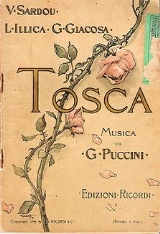
Tosca (ˈtɔska) is an
operaOpera is an art form in which singers and musicians perform a dramatic work combining text and musical score, usually in a theatrical setting. Opera incorporates many of the elements of spoken theatre, such as acting, scenery, and costumes and sometimes includes dance...
in three acts by
Giacomo PucciniGiacomo Antonio Domenico Michele Secondo Maria Puccini was an Italian composer whose operas, including La bohème, Tosca, Madama Butterfly, and Turandot, are among the most frequently performed in the standard repertoire...
to an
ItalianItalian is a Romance language spoken mainly in Europe: Italy, Switzerland, San Marino, Vatican City, by minorities in Malta, Monaco, Croatia, Slovenia, France, Libya, Eritrea, and Somalia, and by immigrant communities in the Americas and Australia...
librettoA libretto is the text used in an extended musical work such as an opera, operetta, masque, oratorio, cantata, or musical. The term "libretto" is also sometimes used to refer to the text of major liturgical works, such as mass, requiem, and sacred cantata, or even the story line of a...
by
Luigi IllicaLuigi Illica was an Italian librettist who wrote for Giacomo Puccini , Alfredo Catalani, Umberto Giordano, Baron Alberto Franchetti and other important Italian composers. His most famous opera librettos are those for La bohème, Tosca, Madama Butterfly and Andrea Chénier.Illica was born at...
and
Giuseppe GiacosaGiuseppe Giacosa was an Italian poet, playwright and librettist.He was born in Colleretto Parella, now Colleretto Giacosa, near Turin. His father was a magistrate. Giuseppe went to the University of Turin, studying in the University of Turin, Faculty of Law...
. It premiered at the
Teatro CostanziThe Teatro dell'Opera di Roma is an opera house in Rome, Italy. Originally opened in November 1880 as the 2,212 seat Costanzi Theatre, it has undergone several changes of name as well modifications and improvements...
in
RomeRome is the capital of Italy and the country's largest and most populated city and comune, with over 2.7 million residents in . The city is located in the central-western portion of the Italian Peninsula, on the Tiber River within the Lazio region of Italy.Rome's history spans two and a half...
on 14 January 1900. The work, based on
Victorien Sardou'sVictorien Sardou was a French dramatist. He is best remembered today for his development, along with Eugène Scribe, of the well-made play...
1887 French-language dramatic play,
La ToscaLa Tosca is a five-act drama by the 19th-century French playwright Victorien Sardou. It was first performed on 24 November 1887 at the Théâtre de la Porte Saint-Martin in Paris, with Sarah Bernhardt in the title role...
, is a
melodramaThe term melodrama refers to a dramatic work that exaggerates plot and characters in order to appeal to the emotions. It may also refer to the genre which includes such works, or to language, behavior, or events which resemble them...
tic piece set in Rome in June 1800, with the
Kingdom of NaplesThe Kingdom of Naples, comprising the southern part of the Italian peninsula, was the remainder of the old Kingdom of Sicily after secession of the island of Sicily as a result of the Sicilian Vespers rebellion of 1282. Known to contemporaries as the Kingdom of Sicily, it is dubbed Kingdom of...
's control of Rome threatened by
Napoleon'sNapoleon Bonaparte was a French military and political leader during the latter stages of the French Revolution.As Napoleon I, he was Emperor of the French from 1804 to 1815...
invasion of Italy. It contains depictions of torture, murder and suicide, yet also includes some of Puccini's best-known lyrical arias, and has inspired memorable performances from many of opera's leading singers.
Puccini saw Sardou's play when it was touring Italy in 1889 and, after some vacillation, obtained the rights to turn the work into an opera in 1895. Turning the wordy French play into a succinct Italian opera took four years, during which the composer repeatedly argued with his librettists and publisher. Tosca premiered at a time of unrest in Rome, and its first performance was delayed for a day for fear of disturbances. Despite indifferent reviews from the critics, the opera was an immediate success with the public.
Musically, Tosca is structured as a
through-composedThrough-composed music is relatively continuous, non-sectional, and/or non-repetitive. A song is said to be through-composed if it has different music for each stanza of the lyrics. This is in contrast to strophic form, in which each stanza is set to the same music...
work, with
ariaAn aria in music was originally any expressive melody, usually, but not always, performed by a singer. The term is now used almost exclusively to describe a self-contained piece for one voice usually with orchestral accompaniment...
s,
recitativeRecitative , also known by its Italian name "recitativo" , is a style of delivery in which a singer is allowed to adopt the rhythms of ordinary speech...
, choruses and other elements musically woven into a seamless whole. Puccini used
WagnerianWilhelm Richard Wagner was a German composer, conductor, theatre director, philosopher, music theorist, poet, essayist and writer primarily known for his operas...
leitmotifs (short musical statements) to identify characters, objects and ideas. While critics have frequently dismissed the opera as a facile melodrama with confusions of plot—musicologist
Joseph KermanJoseph Wilfred Kerman is an American critic and musicologist. One of the leading musicologists of his generation, his 1985 book Contemplating Music: Challenges to Musicology was described by Philip Brett in The Grove Dictionary of Music and Musicians as "a defining moment in the field." He is...
famously called it a "shabby little shocker"—the power of its score and the inventiveness of its orchestration have been widely acknowledged. The dramatic force of Tosca and its characters continues to fascinate both performers and audiences, and the work remains one of the most frequently performed operas. Many recordings of the work have been issued, both of studio and live performances.
Background
The French playwright
Victorien SardouVictorien Sardou was a French dramatist. He is best remembered today for his development, along with Eugène Scribe, of the well-made play...
wrote more than 70 plays, almost all of them successful, and none of them performed today. In the early 1880s Sardou began a collaboration with the immensely popular actress
Sarah BernhardtSarah Bernhardt was a French stage and early film actress, and has been referred to as "the most famous actress the world has ever known". Bernhardt made her fame on the stages of France in the 1870s, and was soon in demand in Europe and the Americas...
, whom he provided with a series of historical melodramas. He reached his greatest glory with the third Bernhardt play, La Tosca, which premiered in Paris on 1887, and in which she starred throughout Europe. The play was an outstanding success, with more than 3,000 performances in France alone.
Puccini had seen La Tosca at least twice, in Milan and Turin. On 1889 he wrote to his publisher,
Giulio RicordiGiulio Ricordi was an Italian editor and musician.-Biography:Ricordi was born in Milan, where he also died....
, begging him to get Sardou's permission for the work to be made into an opera: "I see in this Tosca the opera I need, with no overblown proportions, no elaborate spectacle, nor will it call for the usual excessive amount of music." Ricordi sent his agent in Paris, Emanuele Muzio, to negotiate with Sardou, who preferred that his play be adapted by a French composer. He complained about the reception La Tosca had received in Italy, particularly in Milan, and also warned that other composers were interested in the piece. Nonetheless, Ricordi reached terms with Sardou, and assigned the librettist
Luigi IllicaLuigi Illica was an Italian librettist who wrote for Giacomo Puccini , Alfredo Catalani, Umberto Giordano, Baron Alberto Franchetti and other important Italian composers. His most famous opera librettos are those for La bohème, Tosca, Madama Butterfly and Andrea Chénier.Illica was born at...
to write a scenario for an adaptation. In 1891, however, Illica advised Puccini against the project, most likely because he felt the play could not be successfully adapted to a musical form. When Sardou indicated his unease at entrusting his most successful work to the as-yet-unproven Puccini, whose music he did not like, Puccini took offence. He withdrew from the agreement, which Ricordi then assigned to
Alberto FranchettiAlberto Franchetti was an Italian opera composer.-Biography:Alberto Franchetti was born in Turin, a Jewish nobleman of independent means. He studied first in Venice, then in Dresden under Felix Draeseke, and finally at the Munich Conservatory under Josef Rheinberger. His first major success...
.
Illica wrote a libretto for Franchetti who, however, was never at ease with the assignment. There are several versions of how Ricordi got Franchetti to surrender the rights so he could recommission Puccini, who had again become interested. By some accounts, Ricordi convinced Franchetti that the work was too violent to be successfully staged. Franchetti family tradition holds that Franchetti gave the work back as a grand gesture, "He has more talent than I do." American scholar
Deborah BurtonDeborah Burton is an American music theorist, pianist, and academic. She is particularly known for her publications on Giacomo Puccini and his works, including the 2004 book Tosca's Prism: Three Moments of Western Cultural History...
contends that Franchetti gave it up simply because he saw little merit in it and could not feel the music in the play. Franchetti surrendered the rights in May 1895, and in August Puccini signed a contract to resume control of the project.
Roles
| Role |
Voice type |
Premiere Cast, 14 January 1900 (Conductor: Leopoldo MugnoneLeopoldo Mugnone was an Italian conductor, especially of opera, whose most famous work was done in the period 1890-1920, both in Europe and South America... ) |
| Floria Tosca, a celebrated singer |
soprano A soprano is a voice type with a vocal range from approximately middle C to "high A" in choral music, or to "soprano C" or higher in operatic music. In four-part chorale style harmony, the soprano takes the highest part, which usually encompasses the melody...
|
Hariclea Darclée Hariclea Darclée was a celebrated Romanian operatic soprano. She possessed an agile, powerful, and beautiful voice that was wielded with a fine technique. An extremely beautiful woman, Darclée's stage presence was as elegant and refined as her singing...
|
| Mario Cavaradossi, a painter |
tenor The tenor is a type of male singing voice and is the highest male voice within the modal register. The typical tenor voice lies between C3, the C one octave below middle C, to the A above middle C in choral music, and up to high C in solo work. The low extreme for tenors is roughly B2...
|
Emilio de Marchi Emilio De Marchi was an Italian operatic tenor. He had a significant career during the late 19th century and early 20th century, appearing at major theatres on both sides of the Atlantic. In 1900, he entered the annals of musical history as the creator of the role of Cavaradossi in Giacomo...
|
| Baron Scarpia, chief of police |
baritoneBaritone is a type of male singing voice that lies between the bass and tenor voices. It is the most common male voice. Originally from the Greek , meaning deep sounding, music for this voice is typically written in the range from the second F below middle C to the F above middle C Baritone (or...
|
Eugenio Giraldoni Eugenio Giraldoni was an Italian operatic baritone who enjoyed a substantial international career. In 1900, he created the role of Baron Scarpia....
|
| Cesare Angelotti, former Consul of the Roman Republic |
bass |
Ruggero Galli Ruggero Galli was an Italian operatic bass who had an active career during the late 19th century and early 20 century. He created roles in several world premieres, including Menico in Antonio Smareglia's Nozze istriane , Cesare Angelotti in Giacomo Puccini's Tosca , and Pantalone De' Bisognosi in...
|
| A Sacristan |
baritone |
Ettore Borelli |
| Spoletta, a police agent |
tenor |
Enrico Giordano |
| Sciarrone, a gendarme |
bass |
Giuseppe Gironi |
| A Jailer |
bass |
Aristide Parassani |
| A Shepherd boy |
alto Alto is a musical term, derived from the Latin word altus, meaning "high" in Italian, that has several possible interpretations.When designating instruments, "alto" frequently refers to a member of an instrumental family that has the second highest range, below that of the treble or soprano. Hence,...
|
Angelo Righi |
| Soldiers, police agents, altar boys, noblemen and women, townsfolk, artisans |
Historical context
According to the libretto, the action of Tosca occurs in June 1800. Sardou, in his play, dates it more precisely; La Tosca takes place in the afternoon, evening, and early morning of 17 and 1800.
Italy had long been divided into a number of small states, with the Pope in Rome ruling the
Papal StatesThe Papal State, State of the Church, or Pontifical States were among the major historical states of Italy from roughly the 6th century until the Italian peninsula was unified in 1861 by the Kingdom of Piedmont-Sardinia .The Papal States comprised territories under...
in the area of central Italy. Following the
French RevolutionThe French Revolution , sometimes distinguished as the 'Great French Revolution' , was a period of radical social and political upheaval in France and Europe. The absolute monarchy that had ruled France for centuries collapsed in three years...
, a French army under Napoleon invaded Italy in 1796, entering Rome almost unopposed on 1798 and establishing a
republicThe Roman Republic was proclaimed on February 15, 1798 after Louis Alexandre Berthier, a general of Napoleon, had invaded the city of Rome on February 10....
there. This republic was ruled by seven consuls; in the opera this is the former office of Angelotti, whose character may be based on the real-life consul Libero Angelucci. In September 1799 the French, who had protected the republic, withdrew from Rome. As they left, troops of the
Kingdom of NaplesThe Kingdom of Naples, comprising the southern part of the Italian peninsula, was the remainder of the old Kingdom of Sicily after secession of the island of Sicily as a result of the Sicilian Vespers rebellion of 1282. Known to contemporaries as the Kingdom of Sicily, it is dubbed Kingdom of...
occupied the city.
In May 1800 Napoleon, by then the unquestioned leader of France, brought his troops across the Alps to Italy once again. On his army met the Austrian forces at the Battle of Marengo (near
Alessandria-Monuments:* The Citadel * The church of Santa Maria di Castello * The church of Santa Maria del Carmine * Palazzo Ghilini * Università del Piemonte Orientale-Museums:* The Marengo Battle Museum...
). Austrian troops were initially successful; by mid-morning they were in control of the field of battle, and their leader,
Michael von MelasMichael Friedrich Benedikt Baron von Melas was a Transylvanian-born field marshal of Greek descent for the Austrian Empire during the Napoleonic Wars....
sent this news south towards Rome. However, fresh French troops arrived in late afternoon, and Napoleon attacked the tired Austrians. As Melas retreated in disarray with the remains of his army, he sent a second courier south with the revised message. The Neapolitans abandoned Rome, and the city spent the next fourteen years under French domination.
Act 1
- Scene: Inside the church of Sant'Andrea della Valle
Sant'Andrea della Valle is a basilica church in Rome, Italy, in the rione of Sant'Eustachio. The basilica is the general seat for the religious order of the Theatines.-Overview:...
in Rome, 1800
Cesare Angelotti, former consul of the Roman Republic and then a political prisoner, runs into the church and hides in the Attavanti private chapel—his sister is the Marchesa Attavanti. The painter Mario Cavaradossi arrives to continue work on his picture of
Mary MagdaleneMary Magdalene was one of Jesus' most celebrated disciples, and the most important woman disciple in the movement of Jesus. Jesus cleansed her of "seven demons", conventionally interpreted as referring to complex illnesses...
. He exchanges banter with an elderly
sacristanA sacristan is an officer who is charged with the care of the sacristy, the church, and their contents.In ancient times many duties of the sacristan were performed by the doorkeepers , later by the treasurers and mansionarii...
, before singing of the "hidden harmony" (
Recondita armoniaRecondita Armonia is the first romanza in the opera Tosca, by Giacomo Puccini. It is sung by the painter, Mario Cavaradossi, when comparing his love, Tosca, to a lady he was painting.-Libretto:...
) in the contrast between the blonde beauty of his painting and that of his dark-haired lover, the singer Floria Tosca. The sacristan mumbles his disapproval before leaving.
Angelotti emerges and tells Cavaradossi, an old friend who has republican sympathies, that he is being pursued by the royalist police chief Scarpia. Cavaradossi promises to assist him, before Angelotti hurriedly returns to his hiding place as Tosca arrives. After enquiring suspiciously of the painter what he has been doing, Tosca sings of her desire for a night of mutual passion: Non la sospiri, la nostra casetta ("Do you not long for our little house"). She then expresses jealousy over the woman in the painting whom she recognises as the Marchesa. Cavaradossi explains the likeness; he has merely observed the Marchesa at prayer in the church. He reassures Tosca of his fidelity before she leaves. Angelotti reappears, and discusses with the painter his plan to flee disguised as a woman, using clothes left in the chapel by his sister.
The sound of a cannon signals that Angelotti's escape has been discovered. As he and Cavaradossi rapidly leave the church the sacristan re-enters with groups of choristers, celebrating the news that Napoleon has apparently been defeated at Marengo. The celebrations cease abruptly with the entry of Scarpia, who is searching for Angelotti. He questions the sacristan, and his suspicions are aroused when he learns that Cavaradossi has been in the church; Scarpia mistrusts the painter, and believes him complicit in Angelotti's escape. When Tosca arrives looking for her lover, Scarpia artfully arouses her jealous instincts by implying a relationship between the painter and the Marchesa. He draws Tosca's attention to a woman's fan, found in the chapel, and suggests that someone must have surprised the lovers there. Tosca falls for his deceit; enraged, she rushes off to confront Cavaradossi. Scarpia orders his agents to follow her, assuming she will lead them to Cavaradossi and Angelotti, and privately gloats as he reveals his intentions to ravish Tosca and hang Cavaradossi. A procession enters the church singing the
Te DeumThe Te Deum is an early Christian hymn of praise. The title is taken from its opening Latin words, Te Deum laudamus, rendered literally as "Thee, O God, we praise"....
; finally Scarpia's reverie is broken and he joins the chorus in the prayer.
Act 2
- Scene: Scarpia's apartment in the Palazzo Farnese
Palazzo Farnese is a High Renaissance palace in Rome, which currently houses the French embassy and the Ecole Française de Rome ....
, that evening
Scarpia, at supper, sends a note to Tosca asking her to join him. His henchman Spoletta announces the arrest of Cavaradossi, who is brought in to be questioned about the location of Angelotti. As the painter is questioned, the voice of Tosca, singing in a celebratory
cantataA cantata is a vocal composition with an instrumental accompaniment, typically in several movements, often involving a choir....
offstage, can be heard. Cavaradossi denies knowing anything about the escape, and, after Tosca arrives, is taken to an antechamber to be tortured. He is able to speak briefly with her, telling her to say nothing. Tosca is told by Scarpia that she can save her lover from indescribable pain if she reveals Angelotti's hiding place. She resists, but hearing Cavaradossi's cries, eventually yields the secret.
Cavaradossi is brought back to the apartment where he recovers consciousness and, learning of Tosca's betrayal, is initially furious with her. Then news arrives of Napoleon's victory at Marengo; Cavaradossi gives a defiant "victory" shout before being taken away. Scarpia, left with Tosca, proposes a bargain: if she gives herself to him, Cavaradossi will be freed. She is revolted, and repeatedly rejects his advances. Outside she hears the drums which announce an execution; as Scarpia awaits her decision, she sings a fervent prayer:
Vissi d'arte"Vissi d'arte" is a soprano aria from act II of the opera Tosca by Giacomo Puccini. It is sung by Tosca as she thinks of her fate and how the life of her beloved, Mario Cavaradossi, is at the mercy of Baron Scarpia.-Libretto:-External links:*...
("I lived for art, I lived for love, never did I harm a living creature ... why, O Lord, why dost thou repay me thus?"). Scarpia remains adamant despite her pleas. When Spoletta brings news that Angelotti has killed himself, Scarpia announces that Cavaradossi must face a firing squad the next morning. He tells Tosca that if she will submit to him, he will arrange for this to be a mock execution. Scarpia tells his deputy the execution is to be simulated. He stresses that it will be "as we did with Count Palmieri", and Spoletta states that he understands his instructions.
Tosca, in despair, agrees, on condition that Scarpia will provide a safe-conduct for herself and her lover. Scarpia assents, and signs the document. As he approaches to embrace her she stabs him to death with a knife she has taken from the supper table. After cursing him and securing the safe-conduct, in a gesture of piety she lights candles and places a crucifix on the body before leaving quietly.
Act 3
- Scene: The upper parts of the Castel Sant' Angelo, early the following morning
Offstage, a shepherd boy sings (in
RomanescoRomanesco or Romanesque is a regional language or sociolect subsumed within the Italian language spoken in Rome. It is part of the Central Italian dialects and is thus genetically closer to the Tuscan dialect and Standard Italian....
dialect) Io de' sospiri ("I give you sighs") as church bells sound for
matinsMatins is the early morning or night prayer service in the Roman Catholic, Anglican, Lutheran and Eastern Orthodox liturgies of the canonical hours. The term is also used in some Protestant denominations to describe morning services.The name "Matins" originally referred to the morning office also...
. In the Castel Cavaradossi is informed that he has one hour to live. He refuses the offer of a priest but is allowed to write a letter which he begins, but is soon overwhelmed by his memories of Tosca:
E lucevan le stelle"E lucevan le stelle" is the romanza of Mario Cavaradossi , a painter in love with Tosca, in the third act of Puccini's opera Tosca, composed in 1900 to an Italian libretto by Luigi Illica and Giuseppe Giacosa...
("And the stars shone"). Tosca enters and shows him the safe-conduct. She reveals that she has killed Scarpia, and that the imminent execution is a sham; Cavaradossi must feign death, but afterwards they can leave Rome together, before the discovery of Scarpia's body. Cavaradossi is amazed at the courage shown by one so tender: O dolci mani ("Oh sweet hands pure and gentle"). They then sing of the life they will share, though Tosca is worried whether Cavaradossi can play his part in the mock execution convincingly.
Cavaradossi is led away, and Tosca watches with increasing impatience as the final rituals are carried out. After a volley of shots, Cavaradossi falls, and Tosca exclaims Ecco un artista! ("What an actor!"). When the soldiers have all left, she hurries towards Cavaradossi, to find that he is dead; Scarpia has betrayed his word. Heartbroken, she throws herself across the body. Off-stage voices indicate that Scarpia's body has been found, and that Tosca's guilt is known. As Spoletta and the soldiers rush in, Tosca rises, evades their clutches, and runs to the parapet. With a last cry that Scarpia will answer before God, she hurls herself over the edge.
Adaptation and writing
Sardou's five-act play La Tosca contains a large amount of dialogue and exposition. While the broad details of the play are present in the opera's plot, the original work contains many more characters and much detail not present in the opera. In the play the lovers are portrayed as though they were French: the character Floria Tosca is closely modelled on Bernhardt's personality, while her lover Cavaradossi, of Roman descent, is born in Paris. Illica and
Giuseppe GiacosaGiuseppe Giacosa was an Italian poet, playwright and librettist.He was born in Colleretto Parella, now Colleretto Giacosa, near Turin. His father was a magistrate. Giuseppe went to the University of Turin, studying in the University of Turin, Faculty of Law...
, the playwright who joined the project to polish the verses, needed not only to cut back the play drastically, but to make the characters' motivations and actions suitable for Italian opera. Giacosa and Puccini repeatedly clashed over the condensation, with Giacosa feeling that Puccini did not really want to complete the project.
The first draft libretto that Illica produced for Puccini resurfaced in 2000 after being lost for many years. It contains considerable differences from the final libretto, relatively minor in the first two acts but much more appreciable in the third, where the description of the Roman dawn that opens the third act is much longer, and Cavaradossi's tragic aria, the eventual E lucevan le stelle, has different words. The 1896 libretto also offers a different ending, in which Tosca does not die but instead goes mad. In the final scene, she cradles her lover's head in her lap and hallucinates that she and her Mario are on a gondola, and that she is asking the gondolier for silence. Sardou refused to consider this change, insisting that as in the play, Tosca must throw herself from the parapet to her death. Puccini agreed with Sardou, telling him that the mad scene would have the audiences anticipate the ending and start moving towards the cloakrooms. Puccini pressed his librettists hard, and Giacosa issued a series of melodramatic threats to abandon the work. The two librettists were finally able to give Puccini what they hoped was a final version of the libretto in 1898.
Little work was done on the score during 1897, which Puccini devoted mostly to performances of
La bohèmeLa bohème is an opera in four acts,Puccini called the divisions quadro, a tableau or "image", rather than atto . by Giacomo Puccini to an Italian libretto by Luigi Illica and Giuseppe Giacosa, based on Scènes de la vie de bohème by Henri Murger...
. The opening page of the autograph Tosca score, containing the
motifIn music, a motif or motive is a short musical idea, a salient recurring figure, musical fragment or succession of notes that has some special importance in or is characteristic of a composition....
that would be associated with Scarpia, is dated January 1898. At Puccini's request, Giacosa irritably provided new lyrics for the Act 1 love duet. In August, Puccini removed several numbers from the opera, according to his biographer, Mary Jane Phillips-Matz, "cut
[ting] Tosca to the bone, leaving three strong characters trapped in an airless, violent, tightly wound melodrama that had little room for lyricism". At the end of the year, Puccini wrote that he was "busting his balls" on the opera.
Puccini asked clerical friends for words for the congregation to mutter at the start of the Act 1
Te DeumThe Te Deum is an early Christian hymn of praise. The title is taken from its opening Latin words, Te Deum laudamus, rendered literally as "Thee, O God, we praise"....
; when nothing they gave him satisfied him, he supplied the words himself. For the Te Deum music, he investigated the melodies to which the hymn was set in Roman churches, and sought to reproduce the cardinal's procession authentically, even to the uniforms of the
Swiss GuardSwiss Guards or Schweizergarde is the name given to the Swiss soldiers who have served as bodyguards, ceremonial guards, and palace guards at foreign European courts since the late 15th century. They have had a high reputation for discipline, as well as loyalty to their employers...
s. He adapted the music to the exact pitch of the great bell of
St. Peter's BasilicaThe Papal Basilica of Saint Peter , officially known in Italian as ' and commonly known as Saint Peter's Basilica, is a Late Renaissance church located within the Vatican City. Saint Peter's Basilica has the largest interior of any Christian church in the world...
, and was equally diligent when writing the music that opens Act 3, in which Rome awakens to the sounds of church bells. He journeyed to Rome and went to the Castel Sant'Angelo to measure the sound of
matinsMatins is the early morning or night prayer service in the Roman Catholic, Anglican, Lutheran and Eastern Orthodox liturgies of the canonical hours. The term is also used in some Protestant denominations to describe morning services.The name "Matins" originally referred to the morning office also...
bells there, as they would be heard from its ramparts. Puccini had bells for the Roman dawn cast to order by four different foundries. This apparently did not have its desired effect, as Illica wrote to Ricordi on the day after the premiere, "the great fuss and the large amount of money for the bells have constituted an additional folly, because it passes completely unnoticed". Nevertheless, the bells provide a source of trouble and expense to opera companies performing Tosca to this day.
In Act 2, when Tosca sings offstage the cantata that celebrates the supposed defeat of Napoleon, Puccini was tempted to follow the text of Sardou's play and use the music of
Giovanni PaisielloGiovanni Paisiello was an Italian composer of the Classical era.-Life:Paisiello was born at Taranto and educated by the Jesuits there. He became known for his beautiful singing voice and in 1754 was sent to the Conservatorio di S. Onofrio at Naples, where he studied under Francesco Durante, and...
, before finally writing his own
imitation of Paisello's styleA pastiche is a literary or other artistic genre or technique that is a "hodge-podge" or imitation. The word is also a linguistic term used to describe an early stage in the development of a pidgin language.-Hodge-podge:...
. It was not until 1899 that Puccini was able to mark the final page of the score as completed. Despite the notation, there was additional work to be done, such as the shepherd boy's song at the start of Act 3. Puccini, who always sought to put local colour in his works, wanted that song to be in
Roman dialectRomanesco or Romanesque is a regional language or sociolect subsumed within the Italian language spoken in Rome. It is part of the Central Italian dialects and is thus genetically closer to the Tuscan dialect and Standard Italian....
. The composer asked a friend to have a "good romesco poet" write some words; eventually the well-known poet and folklorist, Luigi Zanazzo wrote the verse which, after slight modification, was placed in the opera.
In October 1899 Ricordi realized that some of the music for Cavaradossi's Act 3 aria, O dolci mani was borrowed from music Puccini had cut from his early opera,
EdgarEdgar is an operatic dramma lirico in three acts by Giacomo Puccini to an Italian libretto by Ferdinando Fontana, freely based on the play in verse La Coupe et les lèvres by Alfred de Musset...
and demanded changes. Puccini defended his music as expressive of what Cavaradossi must be feeling at that point, and offered to come to Milan to play and sing Act 3 for the publisher. Ricordi was overwhelmed by the completed Act 3 prelude, which he received in early November, and softened his views, though he was still not completely happy with the music for O dolci mani. In any event time was too short before the scheduled January 1900 premiere to make any further changes.
Premiere
By December 1899, Tosca was in rehearsal at the Teatro Costanzi. Because of the Roman setting, Ricordi arranged a Roman premiere for the opera, even though this meant that
Arturo ToscaniniArturo Toscanini was an Italian conductor. One of the most acclaimed musicians of the late 19th and 20th century, he was renowned for his intensity, his perfectionism, his ear for orchestral detail and sonority, and his photographic memory...
could not conduct it as Puccini had hoped—Toscanini was fully engaged at
La ScalaLa Scala , is a world renowned opera house in Milan, Italy. The theatre was inaugurated on 3 August 1778 and was originally known as the New Royal-Ducal Theatre at La Scala...
in Milan.
Leopoldo MugnoneLeopoldo Mugnone was an Italian conductor, especially of opera, whose most famous work was done in the period 1890-1920, both in Europe and South America...
was appointed to conduct. The accomplished (but temperamental) soprano
Hariclea DarcléeHariclea Darclée was a celebrated Romanian operatic soprano. She possessed an agile, powerful, and beautiful voice that was wielded with a fine technique. An extremely beautiful woman, Darclée's stage presence was as elegant and refined as her singing...
was selected for the title role;
Eugenio GiraldoniEugenio Giraldoni was an Italian operatic baritone who enjoyed a substantial international career. In 1900, he created the role of Baron Scarpia....
,
whose fatherLeone Giraldoni was a celebrated Italian operatic baritone. He created the title roles of Gaetano Donizetti's Il duca d'Alba and Verdi's Simon Boccanegra as well as the role of Renato in Verdi's Un ballo in maschera .Giraldoni studied in Florence with Luigi Ronzi and made his début as the High...
had originated multiple
VerdiGiuseppe Fortunino Francesco Verdi was an Italian Romantic composer, mainly of opera. He was one of the most influential composers of the 19th century...
roles, became the first Scarpia. The young Enrico Caruso had hoped to create Cavaradossi, but was passed over in favour of the more experienced
Emilio de MarchiEmilio De Marchi was an Italian operatic tenor. He had a significant career during the late 19th century and early 20th century, appearing at major theatres on both sides of the Atlantic. In 1900, he entered the annals of musical history as the creator of the role of Cavaradossi in Giacomo...
. The performance was to be directed by Nino Vignuzzi, with stage designs by
Adolfo HohensteinAdolfo Hohenstein was a German painter, advertiser, illustrator, set designer and costume designer. He's considered the father of the Italian poster art and an exponent of the Stile Liberty, the Italian Art Nouveau...
.
At the time of the premiere, Italy had experienced political and social unrest for several years. The start of the Holy Year in December 1899 attracted the religious to the city, but also brought threats from anarchists and other anticlericals. Police received warnings of an anarchist bombing of the theatre, and instructed Mugnone (who had survived a theatre bombing in Barcelona), that in an emergency he was to strike up the
royal marchThe Marcia Reale d'Ordinanza or Fanfara Reale was the official national anthem of Kingdom of Italy between 1861 and 1946...
. The unrest caused the premiere to be postponed by one day, to .
By 1900, the premiere of a Puccini opera was a national event. Many Roman dignitaries attended, as did
Queen MargheritaMargherita of Savoy , was the Queen consort of the Kingdom of Italy during the reign of her husband, Umberto I.-Family:...
, though she arrived late, after the first act. The
Prime Minister of ItalyThe Prime Minister of Italy is the head of government of the Italian Republic...
,
Luigi PellouxLuigi Gerolamo Pelloux was an Italian general and politician, born of parents who retained their Italian nationality when Savoy was annexed to France....
was present, with several members of his cabinet. A number of Puccini's operatic rivals were there, including Franchetti,
Pietro MascagniPietro Antonio Stefano Mascagni was an Italian composer most noted for his operas. His 1890 masterpiece Cavalleria rusticana caused one of the greatest sensations in opera history and single-handedly ushered in the Verismo movement in Italian dramatic music...
,
Francesco CileaFrancesco Cilea was an Italian composer. Today he is particularly known for his operas L'arlesiana and Adriana Lecouvreur.-Biography:...
and
Ildebrando PizzettiIldebrando Pizzetti was an Italian composer of classical music.- Biography :Pizzetti was born in Parma in 1880. He was part of the "Generation of 1880" along with Ottorino Respighi and Gian Francesco Malipiero. They were among the first Italian composers in some time whose primary contributions...
. Shortly after the curtain was raised there was a disturbance in the back of the theatre, caused by latecomers attempting to enter the auditorium, and a shout of "Bring down the curtain!", at which Mugnone stopped the orchestra. A few moments later the opera began again, and proceeded without further disturbance.
The performance, while not quite the triumph that Puccini had hoped for, was generally successful, with numerous encores. Much of the critical and press reaction was lukewarm, often blaming Illica's libretto. In response, Illica condemned Puccini for treating his librettists "like stagehands" and reducing the text to a shadow of its original form. Nevertheless, any public doubts about Tosca soon vanished; the premiere was followed by twenty performances, all given to packed houses.
Subsequent productions
The Milan premiere at La Scala took place under Toscanini on 1900. Darclée and Giraldoni reprised their roles; the prominent tenor
Giuseppe BorgattiGiuseppe Borgatti was an Italian dramatic tenor with an outstanding voice...
replaced de Marchi as Cavaradossi. The opera was a great success at La Scala, and played to full houses. Puccini travelled to London for the British premiere at the
Royal Opera HouseThe Royal Opera House is an opera house and major performing arts venue in Covent Garden, central London. The large building is often referred to as simply "Covent Garden", after a previous use of the site of the opera house's original construction in 1732. It is the home of The Royal Opera, The...
, Covent Garden, on , with
Milka TerninaMilka Ternina was a Croatian dramatic soprano who enjoyed a high reputation in major American and European opera houses...
and
Fernando De LuciaFernando De Lucia was an Italian opera tenor and singing teacher who enjoyed an international career....
as the doomed lovers and
Antonio ScottiAntonio Scotti was an Italian baritone. He was a principal artist of the New York Metropolitan Opera for more than 33 seasons, but also sang with great success at London's Royal Opera House, Covent Garden, and Milan's La Scala.-Life:Antonio Scotti was born in Naples, Italy...
as Scarpia. Puccini wrote that Tosca was "
[a] complete triumph", and Ricordi's London representative quickly signed a contract to take Tosca to New York. The premiere at the
Metropolitan OperaThe Metropolitan Opera is an opera company, located in New York City. Originally founded in 1880, the company gave its first performance on October 22, 1883. The company is operated by the non-profit Metropolitan Opera Association, with Peter Gelb as general manager...
(the "Met") was on 1901, with De Lucia's replacement by
Giuseppe CremoniniGiuseppe Cremonini was an Italian operatic tenor who had a prominent opera career in Europe and the United States during the last decade of the nineteenth century.Cremonini was born and died in Cremona, Italy...
the only change from the London cast. For its French premiere at
l'Opéra ComiqueThe Opera Comique was a 19th-century theatre constructed in Westminster, London, between Wych Street and Holywell Street with entrances on the East Strand. It opened in 1870 and was demolished in 1902, to make way for the construction of the Aldwych and Kingsway...
on 1903, the 72-year-old Sardou took charge of all the action on the stage. Puccini was delighted with the public's reception of the work in Paris, despite adverse comments from critics. The opera was subsequently premiered at venues throughout Europe, the Americas, Australia and the Far East; by the outbreak of
war in 1914World War I , which was predominantly called the World War or the Great War from its occurrence until 1939, and the First World War or World War I thereafter, was a major war centred in Europe that began on 28 July 1914 and lasted until 11 November 1918...
it had been performed in more than 50 cities worldwide.
Among the prominent early Toscas was
Emmy DestinnEmmy Destinn was a Czech operatic soprano with a strong and soaring lyric-dramatic voice. She had a career both in Europe and at the New York Metropolitan Opera.- Biography :...
, who sang the role regularly in a long-standing partnership with the tenor Enrico Caruso.
Maria JeritzaMaria Jeritza , born Marie Jedličková, was a celebrated Moravian soprano singer, long associated with the Vienna State Opera and the Metropolitan Opera...
, over many years at the Met and in Vienna, brought her own distinctive style to the role, and was said to be Puccini's ideal Tosca. Jeritza was the first to deliver Vissi d'arte from a prone position, having fallen to the stage while eluding the grasp of Scarpia. This was a great success, and Jeritza sang the aria lying down thereafter. Of her successors, opera enthusiasts tend to consider
Maria CallasMaria Callas was an American-born Greek soprano and one of the most renowned opera singers of the 20th century. She combined an impressive bel canto technique, a wide-ranging voice and great dramatic gifts...
as the supreme interpreter of the role, largely on the basis of her performances at the Royal Opera House in 1964, with
Tito GobbiTito Gobbi was an Italian operatic baritone with an international reputation.-Biography:Tito Gobbi was born in Bassano del Grappa and studied law at the University of Padua before he trained as a singer. Giulio Crimi, a well-known Italian tenor of a previous generation, was Gobbi's teacher in Rome...
as Scarpia. This production, by
Franco ZeffirelliFranco Zeffirelli KBE is an Italian director and producer of films and television. He is also a director and designer of operas and a former senator for the Italian center-right Forza Italia party....
, remained in continuous use at Covent Garden for more than 40 years until replaced in 2006 by a new staging, which premiered with
Angela GheorghiuAngela Gheorghiu is a Romanian soprano opera singer. Since her professional debut in 1990, she has sung as soprano leading roles at New York's Metropolitan Opera, Covent Garden's Royal Opera House, the Vienna State Opera, Milan's La Scala, and many other opera houses in Europe and the United States...
. Callas had first sung Tosca at age 18 in a performance given in Greek, in Athens on 1942. Tosca was also her last on-stage operatic role, in a special charity performance at the Royal Opera House on 1965.
Among non-traditional productions, in 1996 at La Scala
Luca RonconiLuca Ronconi is an Italian actor, theater director, and opera director.- Biography :After growing up in Tunisia, where his mother was a school teacher, he graduated from the Academy of Dramatic Art in Rome in 1953. He acted in productions of Luigi Squarzina, Orazio Costa, Michelangelo Antonioni...
used distorted and fractured scenery to represent the twists of fate reflected in the plot.
Jonathan MillerSir Jonathan Wolfe Miller CBE is a British theatre and opera director, author, physician, television presenter, humorist and sculptor. Trained as a physician in the late 1950s, he first came to prominence in the 1960s with his role in the comedy revue Beyond the Fringe with fellow writers and...
, in a 1986 production for the 49th
Maggio Musicale FiorentinoMaggio Musicale Fiorentino is an annual opera festival which was founded in April 1933 by conductor Vittorio Gui with the aim of presenting contemporary and forgotten operas in visually dramatic productions. It was the first music festival in Italy. The first opera presented was Verdi's early...
, transferred the action to Nazi-occupied Rome in 1944, with Scarpia as head of the fascist police. In Philipp Himmelmann's production on the Lake Stage at the Bregenz Festival in 2007 the Act 1 set, designed by Johannes Leiacker, was dominated by a huge
Orwellian"Orwellian" describes the situation, idea, or societal condition that George Orwell identified as being destructive to the welfare of a free society...
"Big Brother" eye. The iris opens and closes to reveal
surrealSurrealism is a cultural movement that began in the early 1920s, and is best known for the visual artworks and writings of the group members....
scenes beyond the action. This production updates the story to a modern Mafia scenario, with special effects "worthy of a
BondThe James Bond film series is a British series of motion pictures based on the fictional character of MI6 agent James Bond , who originally appeared in a series of books by Ian Fleming. Earlier films were based on Fleming's novels and short stories, followed later by films with original storylines...
film".
In 1992 a television version of the opera was filmed at the locations prescribed by Puccini, at the times of day at which each act takes place. Featuring
Catherine MalfitanoCatherine Malfitano is an American operatic soprano. She is generally considered to be one of America's leading operatic sopranos...
,
Plácido DomingoPlácido Domingo KBE , born José Plácido Domingo Embil, is a Spanish tenor and conductor known for his versatile and strong voice, possessing a ringing and dramatic tone throughout its range...
and
Ruggero RaimondiRuggero Raimondi is an Italian bass-baritone opera singer who has also appeared in motion pictures.-Early training and career:Ruggero Raimondi was born in Bologna, Italy, during World War II...
, the performance was broadcast live throughout Europe.
Luciano Pavarottiright|thumb|Luciano Pavarotti performing at the opening of the Constantine Palace in [[Strelna]], 31 May 2003. The concert was part of the celebrations for the 300th anniversary of [[St...
, who sang Cavaradossi from the late 1970s, appeared in a special performance in Rome on 2000, to celebrate the opera's centenary with Domingo as conductor. Pavarotti's last stage performance was as Cavaradossi at the Met, on 2004.
Early Cavaradossis played the part as if the painter believed that he was reprieved, and would survive the "mock" execution.
Beniamino GigliBeniamino Gigli was an Italian opera singer. The most famous tenor of his generation, he was renowned internationally for the great beauty of his voice and the soundness of his vocal technique. Music critics sometimes took him to task, however, for what was perceived to be the over-emotionalism...
, who performed the role many times in his forty-year operatic career, was one of the first to assume that the painter knows, or strongly suspects, that he will be shot. Gigli wrote in his autobiography: "he is certain that these are their last moments together on earth, and that he is about to die". Domingo, the dominant Cavaradossi of the 1970s and 1980s, concurred, stating in a 1985 interview that he had long played the part that way. Gobbi, who in his later years often directed the opera, commented, "Unlike Floria, Cavaradossi knows that Scarpia never yields, though he pretends to believe in order to delay the pain for Tosca."
Critical reception
The enduring popularity of Tosca has not been matched by consistent critical enthusiasm. After the premiere, Ippolito Valetta of Nueva antologia wrote, "
[Puccini] finds in his palette all colours, all shades; in his hands, the instrumental texture becomes completely supple, the gradations of sonority are innumerable, the blend unfailingly grateful to the ear." However, one critic described Act II as overly long and wordy; another echoed Illica and Giacosa in stating that the rush of action did not permit enough lyricism, to the great detriment of the music. A third called the opera "three hours of noise".
The critics gave the work a generally kinder reception in London, where The Times called Puccini "a master in the art of poignant expression", and praised the "wonderful skill and sustained power" of the music. In The Musical Times, Puccini's score was admired for its sincerity and "strength of utterance." However, after the 1903 Paris opening, the composer
Paul DukasPaul Abraham Dukas was a French composer, critic, scholar and teacher. A studious man, of retiring personality, he was intensely self-critical, and he abandoned and destroyed many of his compositions...
thought the work lacked cohesion and style, while
Gabriel FauréGabriel Urbain Fauré was a French composer, organist, pianist and teacher. He was one of the foremost French composers of his generation, and his musical style influenced many 20th century composers...
was offended by "disconcerting vulgarities". More recently the musicologist
Joseph KermanJoseph Wilfred Kerman is an American critic and musicologist. One of the leading musicologists of his generation, his 1985 book Contemplating Music: Challenges to Musicology was described by Philip Brett in The Grove Dictionary of Music and Musicians as "a defining moment in the field." He is...
described Tosca as a "shabby little shocker", while the composer
Benjamin BrittenEdward Benjamin Britten, Baron Britten, OM CH was an English composer, conductor, and pianist. He showed talent from an early age, and first came to public attention with the a cappella choral work A Boy Was Born in 1934. With the premiere of his opera Peter Grimes in 1945, he leapt to...
declared that he was "sickened by the cheapness and emptiness" of Puccini's music. Veteran critic
Ernest NewmanErnest Newman was an English music critic and musicologist. Grove's Dictionary of Music and Musicians describes him as "the most celebrated British music critic in the first half of the 20th century." His style of criticism, aiming at intellectual objectivity in contrast to the more subjective...
, while acknowledging the "enormously difficult business of boiling [Sardou's] play down for operatic purposes," writes that the subtleties of Sardou's original plot are handled "very lamely", so that "much of what happens, and why, is unintelligible to the spectator". Overall, however, Newman delivers a more positive judgement: "[Puccini's] operas are to some extent a mere bundle of tricks, but no one else has performed the same tricks nearly as well". Opera scholar
Julian BuddenJulian Medforth Budden, BA, BMus was a British opera scholar, radio producer and broadcaster. He is particularly known for his three volumes on the operas of Giuseppe Verdi , a single volume biography in 1982 and a single volume work on Giacomo Puccini and his operas in 2002...
remarks on Puccini's "inept handling of the political element", but still hails the work as "a triumph of pure theatre". Music critic
Charles OsborneCharles Thomas Osborne, born 24 November 1927 in Brisbane, Australia, is a journalist, critic, poet and novelist, and a recognised authority on opera. He was assistant editor of The London Magazine from 1958 until 1966, literature director of the Arts Council of Great Britain from 1971 until 1986,...
ascribes Toscas immense popularity with audiences to the taut effectiveness of its melodramatic plot, the opportunities given to its three leading characters to shine vocally and dramatically, and the presence of two great arias in Vissi d'arte and E lucevan le stelle. The work remains popular today; it was the second-most performed opera in North America in 2008–2009, surpassed only by Puccini's
La bohèmeLa bohème is an opera in four acts,Puccini called the divisions quadro, a tableau or "image", rather than atto . by Giacomo Puccini to an Italian libretto by Luigi Illica and Giuseppe Giacosa, based on Scènes de la vie de bohème by Henri Murger...
.
General style
By the end of the 19th century the classic form of opera structure, in which
ariaAn aria in music was originally any expressive melody, usually, but not always, performed by a singer. The term is now used almost exclusively to describe a self-contained piece for one voice usually with orchestral accompaniment...
s, duets and other set-piece vocal numbers are interspersed with passages of
recitativeRecitative , also known by its Italian name "recitativo" , is a style of delivery in which a singer is allowed to adopt the rhythms of ordinary speech...
or dialogue, had been largely abandoned, even in Italy. Operas were "
through-composedThrough-composed music is relatively continuous, non-sectional, and/or non-repetitive. A song is said to be through-composed if it has different music for each stanza of the lyrics. This is in contrast to strophic form, in which each stanza is set to the same music...
", with a continuous stream of music which in some cases eliminated all identifiable set-pieces. In what critic
Edward GreenfieldEdward Greenfield is an English music critic and broadcaster. He joined the Manchester Guardian in 1953, working as a lobby correspondent in the House of Commons. He has been a record critic for the newspaper since 1955, a music critic since 1964, and was chief music critic from 1977 until his...
calls the "Grand Tune" concept, Puccini retains a limited number of set-pieces, distinguished from their musical surroundings by their memorable melodies. Even in the passages linking these "Grand Tunes", Puccini maintains a strong degree of lyricism and only rarely resorts to recitative.
Budden describes Tosca as the most Wagnerian of Puccini's scores, in its use of musical leitmotifs. Unlike Wagner, Puccini does not develop or modify his motifs, nor weave them into the music symphonically, but uses them to refer to characters, objects and ideas, and as reminders within the narrative. The most potent of these motifs is the sequence of three very loud and strident chords which open the opera and which represent the evil character of Scarpia—or perhaps, Charles Osborne proposes, the violent atmosphere that pervades the entire opera. Budden has suggested that Scarpia's tyranny, lechery and lust form "the dynamic engine that ignites the drama". Other motifs identify Tosca herself, the love of Tosca and Cavaradossi, the fugitive Angelotti, the semi-comical character of the sacristan in Act 1 and the theme of torture in Act 2.
Act 1
The opera begins without any prelude; the opening chords of the Scarpia motif lead immediately to the agitated appearance of Angelotti and the enunciation of the "fugitive" motif. The sacristan's entry, accompanied by his sprightly
buffoOpera buffa is a genre of opera. It was first used as an informal description of Italian comic operas variously classified by their authors as ‘commedia in musica’, ‘commedia per musica’, ‘dramma bernesco’, ‘dramma comico’, ‘divertimento giocoso' etc...
theme, lifts the mood, as does the generally light-hearted colloquy with Cavaradossi which follows after the latter's entrance. This leads to the first of the "Grand Tunes", Cavaradossi's
Recondita armoniaRecondita Armonia is the first romanza in the opera Tosca, by Giacomo Puccini. It is sung by the painter, Mario Cavaradossi, when comparing his love, Tosca, to a lady he was painting.-Libretto:...
with its sustained high B flat, accompanied by the sacristan's grumbling
counter-melodyIn music, counter-melody is a sequence of notes, perceived as a melody, written to be played simultaneously with a more prominent lead melody. Typically a counter-melody performs a subordinate role, and is heard in a texture consisting of a melody plus accompaniment...
. The domination, in that aria, of themes which will be repeated in the love duet make it clear that though the painting may incorporate the Marchesa's features, Tosca is the ultimate inspiration of his work. Cavaradossi's dialogue with Angelotti is interrupted by Tosca's arrival, signalled by her motif which incorporates, in Newman's words, "the feline, caressing cadence so characteristic of her." Though Tosca enters violently and suspiciously, the music paints her devotion and serenity. According to Budden, there is no contradiction: Tosca's jealousy is largely a matter of habit, which her lover does not take too seriously.
After Tosca's Non la sospiri and the subsequent argument inspired by her jealousy, the sensuous character of the love duet Qual'occhio provides what opera writer Burton Fisher describes as "an almost erotic lyricism that has been called pornophony". The brief scene in which the sacristan returns with the choristers to celebrate Napoleon's supposed defeat provides almost the last carefree moments in the opera; after the entrance of Scarpia to his menacing theme, the mood becomes sombre, then steadily darker. As the police chief interrogates the sacristan, the "fugitive" motif recurs three more times, each time more emphatically, signalling Scarpia's success in his investigation. In Scarpia's exchanges with Tosca the sound of tolling bells, interwoven with the orchestra, creates an almost religious atmosphere, for which Puccini draws on music from his then unpublished
Mass of 1880Giacomo Puccini's Messa or Messa a quattro voci is a Mass composed for orchestra and four-part choir with tenor, bass and baritone soloists...
. The final scene in the act is a juxtaposition of the sacred and the profane, as Scarpia's lustful reverie is sung alongside the swelling Te Deum chorus. He joins with the chorus in the final statement Te aeternum Patrem omnis terra veneratur ("Everlasting Father, all the earth worships thee"), before the act ends with a thunderous restatement of the Scarpia motif.
Act 2
Fisher has observed that Puccini's was a tragic muse; in the second act of Tosca, according to Newman, he rises to his greatest height as a master of the musical macabre. The Act begins quietly, with Scarpia musing on the forthcoming downfall of Angelotti and Cavaradossi, while in the background a
gavotteThe gavotte originated as a French folk dance, taking its name from the Gavot people of the Pays de Gap region of Dauphiné, where the dance originated. It is notated in 4/4 or 2/2 time and is of moderate tempo...
is played in a distant quarter of the Farnese Palace. For this music Puccini adapted a fifteen-year-old student exercise by his late brother, Michele, stating that in this way his brother could live again through him. In the dialogue with Spoletta, the "torture" motif—an "ideogram of suffering", according to Budden—is heard for the first time as a foretaste of what is to come. As Cavaradossi is brought in for interrogation, Tosca's voice is heard with the offstage chorus singing a cantata, "[its] suave strains contrast[ing] dramatically with the increasing tension and ever-darkening colour of the stage action". The cantata is most likely the Cantata a Giove, in the literature referred to as a lost work of Puccini's from 1897.
Osborne describes the scenes that follow—Cavaradossi's interrogation, his torture, Scarpia's sadistic tormenting of Tosca—as Puccini's musical equivalent of grand guignol to which Cavaradossi's brief Vittoria! Vittoria! on the news of Napoleon's victory gives only partial relief. Scarpia's aria Già, mi dicon venal ("Yes, they say I am venal") is closely followed by Tosca's
Vissi d'arte"Vissi d'arte" is a soprano aria from act II of the opera Tosca by Giacomo Puccini. It is sung by Tosca as she thinks of her fate and how the life of her beloved, Mario Cavaradossi, is at the mercy of Baron Scarpia.-Libretto:-External links:*...
. A lyrical andante based on Tosca's Act 1 motif, this is perhaps the opera's best-known aria, yet was regarded by Puccini as a mistake; he considered eliminating it since it held up the action. Fisher calls it "a
JobJob is the central character of the Book of Job in the Hebrew Bible. Job is listed as a prophet of God in the Qur'an.- Book of Job :The Book of Job begins with an introduction to Job's character — he is described as a blessed man who lives righteously...
-like prayer questioning God for punishing a woman who has lived unselfishly and righteously". In the Act's finale, Newman likens the orchestral turmoil which follows Tosca's stabbing of Scarpia to the sudden outburst after the slow movement of
Beethoven's Ninth SymphonyThe Symphony No. 9 in D minor, Op. 125, is the final complete symphony of Ludwig van Beethoven. Completed in 1824, the symphony is one of the best known works of the Western classical repertoire, and has been adapted for use as the European Anthem...
. After Tosca's contemptuous E avanti a lui tremava tutta Roma! ("All Rome trembled before him"), sung in a
middle CC or Do is the first note of the fixed-Do solfège scale. Its enharmonic is B.-Middle C:Middle C is designated C4 in scientific pitch notation because of the note's position as the fourth C key on a standard 88-key piano keyboard...
monotone (sometimes spoken), the music gradually fades, ending "the most impressively macabre scene in all opera." The final notes in the act are those of the Scarpia motif, softly, in a minor key.
Act 3
The third act's tranquil beginning provides a brief respite from the drama. An introductory 16-bar theme for the
hornsThe horn is a brass instrument consisting of about of tubing wrapped into a coil with a flared bell. A musician who plays the horn is called a horn player ....
will later be sung by Cavaradossi and Tosca in their final duet. The orchestral prelude which follows portrays the Roman dawn; the pastoral aura is accentuated by the shepherd boy's song, and the sounds of sheep bells and church bells, the authenticity of latter validated by Puccini's early morning visits to Rome. Themes reminiscent of Scarpia, Tosca and Cavaradossi emerge in the music, which changes tone as the drama resumes with Cavaradossi's entrance, to an orchestral statement of what becomes the melody of his aria
E lucevan le stelle"E lucevan le stelle" is the romanza of Mario Cavaradossi , a painter in love with Tosca, in the third act of Puccini's opera Tosca, composed in 1900 to an Italian libretto by Luigi Illica and Giuseppe Giacosa...
. This is a farewell to love and life, "an anguished lament and grief built around the words muoio disperato (I die in despair)". Puccini insisted on the inclusion of these words, and later stated that admirers of the aria had treble cause to be grateful to him: for composing the music, for having the lyrics written, and "for declining expert advice to throw the result in the waste-paper basket". The lovers' final duet Amaro sol per te, which concludes with the act's opening horn music, did not equate with Ricordi's idea of a transcendental love duet which would be a fitting climax to the opera. Puccini justified his musical treatment by citing Tosca's preoccupation with teaching Cavaradossi to feign death.
In the execution scene which follows, a theme emerges, the incessant repetition of which reminded Newman of the Transformation Music which separates the two parts of Act I in Wagner's
ParsifalParsifal is an opera in three acts by Richard Wagner. It is loosely based on Wolfram von Eschenbach's Parzival, the 13th century epic poem of the Arthurian knight Parzival and his quest for the Holy Grail, and on Chrétien de Troyes' Perceval, the Story of the Grail.Wagner first conceived the work...
. In the final bars, as Tosca evades Spoletta and leaps to her death, the theme of E lucevan le stelle is played tutta forze (as loudly as possible). This choice of ending has been strongly criticised by analysts, mainly because of its specific association with Cavaradossi rather than Tosca. Joseph Kerman mocked the final music, "Tosca leaps, and the orchestra screams the first thing that comes into its head." Budden, however, argues that it is entirely logical to end this dark opera on its blackest theme. According to historian and former opera singer Susan Vandiver Nicassio: "The conflict between the verbal and the musical clues gives the end of the opera a twist of controversy that, barring some unexpected discovery among Puccini's papers, can never truly be resolved."
List of arias and set numbers
| First lines |
Performed by |
| Act 1 |
| Recondita armonia Recondita Armonia is the first romanza in the opera Tosca, by Giacomo Puccini. It is sung by the painter, Mario Cavaradossi, when comparing his love, Tosca, to a lady he was painting.-Libretto:...
("Hidden harmony") |
Cavaradossi |
Non la sospiri, la nostra casetta ("Do you not long for our little house") |
Tosca, Cavaradossi |
Qual'occhio ("What eyes in the world") |
Cavaradossi, Tosca |
Va, Tosca! ("Go, Tosca!") |
Scarpia, Chorus |
Te Deum laudamus ("We praise thee, O God") |
Scarpia, Chorus |
| Act 2 |
Ha più forte sapore ("For myself the violent conquest") |
Scarpia |
Vittoria! Vittoria! ("Victory! Victory!") |
Cavaradossi |
Già, mi dicon venal ("Yes, they say that I am venal") |
Scarpia |
| Vissi d'arte "Vissi d'arte" is a soprano aria from act II of the opera Tosca by Giacomo Puccini. It is sung by Tosca as she thinks of her fate and how the life of her beloved, Mario Cavaradossi, is at the mercy of Baron Scarpia.-Libretto:-External links:*...
("I lived for art, I lived for love") |
Tosca |
| Act 3 |
Io de' sospiri ("I give you sighs") |
Voice of a shepherd boy |
| E lucevan le stelle "E lucevan le stelle" is the romanza of Mario Cavaradossi , a painter in love with Tosca, in the third act of Puccini's opera Tosca, composed in 1900 to an Italian libretto by Luigi Illica and Giuseppe Giacosa...
("And the stars shone") |
Cavaradossi |
O dolci mani ("Oh, sweet hands") |
Cavaradossi |
Amaro sol per te m'era il morire ("Only for you did death taste bitter for me"') |
Cavaradossi, Tosca |
Recordings
The first complete Tosca recording was made in 1919, using the pre-microphone acoustic process. The conductor,
Carlo SabajnoCarlo Sabajno was an Italian conductor. From 1904 to 1932 he was the Gramophone Company's chief conductor and artistic director in Italy...
, had been The Gramophone Company's house conductor since 1904; he had made recordings of
Verdi'sGiuseppe Fortunino Francesco Verdi was an Italian Romantic composer, mainly of opera. He was one of the most influential composers of the 19th century...
ErnaniErnani is an operatic dramma lirico in four acts by Giuseppe Verdi to an Italian libretto by Francesco Maria Piave, based on the play Hernani by Victor Hugo. The first production took place at La Fenice Theatre, Venice on 9 March 1844...
and
RigolettoRigoletto is an opera in three acts by Giuseppe Verdi. The Italian libretto was written by Francesco Maria Piave based on the play Le roi s'amuse by Victor Hugo. It was first performed at La Fenice in Venice on March 11, 1851...
before tackling Tosca with a young and largely unknown cast. In 1929 Sabajno recorded the opera again, with the orchestra and chorus of the
Teatro alla ScalaLa Scala , is a world renowned opera house in Milan, Italy. The theatre was inaugurated on 3 August 1778 and was originally known as the New Royal-Ducal Theatre at La Scala...
and with star names
Carmen MelisCarmen Melis was an Italian operatic soprano who had a major international career during the first four decades of the 20th century. She was known, above all, as a verismo soprano, and was one of the most interesting singing actresses of the early 20th century...
and
Apollo GranforteApollo Granforte was an Italian opera singer and one of the leading baritones active during the inter-war period of the 20th century.-Life and career:...
in the roles of Tosca and Scarpia. In 1938
HMVHis Master's Voice is a trademark in the music business, and for many years was the name of a large record label. The name was coined in 1899 as the title of a painting of the dog Nipper listening to a wind-up gramophone...
secured the services of the renowned tenor
Beniamino GigliBeniamino Gigli was an Italian opera singer. The most famous tenor of his generation, he was renowned internationally for the great beauty of his voice and the soundness of his vocal technique. Music critics sometimes took him to task, however, for what was perceived to be the over-emotionalism...
for a "practically complete" recording that extended over 14 double-sided
shellacShellac is a resin secreted by the female lac bug, on trees in the forests of India and Thailand. It is processed and sold as dry flakes , which are dissolved in ethyl alcohol to make liquid shellac, which is used as a brush-on colorant, food glaze and wood finish...
discs.
In the post-war period, following the invention of
long-playing recordsThe LP, or long-playing microgroove record, is a format for phonograph records, an analog sound storage medium. Introduced by Columbia Records in 1948, it was soon adopted as a new standard by the entire record industry...
, Tosca recordings were dominated by
Maria CallasMaria Callas was an American-born Greek soprano and one of the most renowned opera singers of the 20th century. She combined an impressive bel canto technique, a wide-ranging voice and great dramatic gifts...
. The earliest of her recordings in the role were of two live performances in
Mexico CityMexico City is the Federal District , capital of Mexico and seat of the federal powers of the Mexican Union. It is a federal entity within Mexico which is not part of any one of the 31 Mexican states but belongs to the federation as a whole...
, in 1950 and 1952. In 1953, with conductor
Victor de SabataVictor de Sabata was an Italian conductor and composer. He is widely recognized as one of the most distinguished operatic conductors of the twentieth century, especially for his Verdi, Puccini and Wagner. He is also acclaimed for his interpretations of orchestral music...
and the La Scala forces, she made the recording which for decades has been considered the best of all the recorded performances of the opera. Callas made several more recordings, mainly of live stage performances, the last in 1965. The first stereo recording of the opera was made in 1959, with
Francesco Molinari-PradelliFrancesco Molinari-Pradelli was a prominent Italian opera conductor. He studied piano and composition at Bologna, and graduated from the Accademia di Santa Cecilia, Rome in 1938. He made his debut at La Scala in 1946 and his Covent Garden debut in 1956...
conducting the
Santa Cecilia orchestraThe Orchestra dell'Accademia Nazionale di Santa Cecilia is one of the best-known orchestras in Italy. It is based at the Accademia Nazionale di Santa Cecilia in Rome. At various times it has been known as the Symphony Orchestra of the Augusteo and Orchestra dell'Accademia di Santa Cecilia and the...
and chorus with
Renata TebaldiRenata Tebaldi was an Italian lirico-spinto soprano popular in the post-war period...
as Tosca and
Mario del MonacoMario Del Monaco was an Italian tenor who is regarded by his admirers as being one of the greatest dramatic tenors of the 20th century....
as Cavaradossi.
Herbert von KarajanHerbert von Karajan was an Austrian orchestra and opera conductor. To the wider world he was perhaps most famously associated with the Berlin Philharmonic, of which he was principal conductor for 35 years...
's acclaimed performance with the
Vienna State OperaThe Vienna State Opera is an opera house – and opera company – with a history dating back to the mid-19th century. It is located in the centre of Vienna, Austria. It was originally called the Vienna Court Opera . In 1920, with the replacement of the Habsburg Monarchy by the First Austrian...
was in 1963, with
Leontyne PriceMary Violet Leontyne Price is an American soprano. Born and raised in the Deep South, she rose to international acclaim in the 1950s and 1960s, and was one of the first African Americans to become a leading artist at the Metropolitan Opera.One critic characterized Price's voice as "vibrant",...
,
Giuseppe di StefanoGiuseppe Di Stefano was an Italian operatic tenor who sang professionally from the late 1940s until the early 1990s. He was known as the "Golden voice" or "The most beautiful voice", as the true successor of Beniamino Gigli...
and
Giuseppe TaddeiGiuseppe Taddei was an Italian baritone, who performed mostly the operas of Wolfgang Amadeus Mozart and Giuseppe Verdi....
in the leading roles.
The 1970s and 1980s saw a proliferation of recordings, many of live performances.
Plácido DomingoPlácido Domingo KBE , born José Plácido Domingo Embil, is a Spanish tenor and conductor known for his versatile and strong voice, possessing a ringing and dramatic tone throughout its range...
first recorded Cavaradossi in 1973, and continued to do so at regular intervals until 1994. In 1976 he was joined by his son,
Plácido Domingo Jr.Plácido Domingo Jr. , also known as Plácido and Plácido Jr., is a Mexican singer, songwriter, composer, and record producer.He was born in Mexico City, son of tenor and philanthropist Plácido Domingo...
, who sang the shepherd boy's song in a British recording with the
New Philharmonia OrchestraThe Philharmonia Orchestra is one of the leading orchestras in Great Britain, based in London. Since 1995, it has been based in the Royal Festival Hall. In Britain it is also the resident orchestra at De Montfort Hall, Leicester and the Corn Exchange, Bedford, as well as The Anvil, Basingstoke...
. More recent commended recordings have included
Antonio PappanoAntonio Pappano is a British conductor and pianist of Italian parentage.Pappano's family relocated to England from Castelfranco in Miscano near Benevento, Italy in 1958 and at the time of his birth his parents worked in the restaurant business, but Pasquale Pappano, his father, was by vocation a...
's 2000
Royal Opera HouseThe Royal Opera House is an opera house and major performing arts venue in Covent Garden, central London. The large building is often referred to as simply "Covent Garden", after a previous use of the site of the opera house's original construction in 1732. It is the home of The Royal Opera, The...
version with
Angela GheorghiuAngela Gheorghiu is a Romanian soprano opera singer. Since her professional debut in 1990, she has sung as soprano leading roles at New York's Metropolitan Opera, Covent Garden's Royal Opera House, the Vienna State Opera, Milan's La Scala, and many other opera houses in Europe and the United States...
,
Roberto AlagnaRoberto Alagna is a French-Italian tenor. He was born in Clichy-sous-Bois, Seine-Saint-Denis, France.-Early years:Alagna was born outside of the city of Paris in 1963 to a family of Sicilian immigrants . As a teenager, the young Alagna began busking and singing pop in Parisian cabarets for tips...
and
Ruggero RaimondiRuggero Raimondi is an Italian bass-baritone opera singer who has also appeared in motion pictures.-Early training and career:Ruggero Raimondi was born in Bologna, Italy, during World War II...
; and
Zubin MehtaZubin Mehta is an Indian conductor of western classical music. He is the Music Director for Life of the Israel Philharmonic Orchestra.-Biography:...
's 2001 recording with Maggio Musicale Fiorentino. Recordings of Tosca in languages other than Italian are rare but not unknown; over the years versions in French, German, Spanish, Hungarian and Russian have been issued. An admired English language version was released in 1995 in which
David ParryDavid Parry is an English conductor who is particularly known for his work within the field of opera. Described as "a man of the theatre with whom directors love to work; he is good with singers; he knows the British opera world like the back of his hand...
led the
Philharmonia OrchestraThe Philharmonia Orchestra is one of the leading orchestras in Great Britain, based in London. Since 1995, it has been based in the Royal Festival Hall. In Britain it is also the resident orchestra at De Montfort Hall, Leicester and the Corn Exchange, Bedford, as well as The Anvil, Basingstoke...
and a largely British cast. Since the late 1990s numerous video recordings of the opera have been issued on
DVDA DVD is an optical disc storage media format, invented and developed by Philips, Sony, Toshiba, and Panasonic in 1995. DVDs offer higher storage capacity than Compact Discs while having the same dimensions....
and Blu-ray disc (BD). These include recent productions and remastered versions of historic performances.
Editions and amendments
The orchestral score of Tosca was published in late 1899 by Ricordi. Unlike with his other operas, Puccini appeared to be satisfied with his initial score, which remained relatively unchanged in the 1909 edition prepared by Osbourne McConachy. An unamended edition was published by Dover Press in 1991.
The 1909 score contains a number of minor changes from the autograph score. Some are changes of phrase: Cavaradossi's reply to the sacristan when he asks if the painter is doing penance is changed from "Pranzi" ("I have eaten.") to "Fame non ho" ("I am not hungry."), which William Ashbrook states, in his study of Puccini's operas, accentuates the class distinction between the two. When Tosca comforts Cavaradossi after the torture scene, she now tells him, "Ma il giusto Iddio lo punirá" ("But a just God will punish him"
[Scarpia]); formerly she stated, "Ma il sozzo sbirro lo pagherà" ("But the filthy cop will pay for it."). Other changes are in the music; when Tosca demands the price for Cavaradossi's freedom ("Il prezzo!"), her music is changed to eliminate an octave leap, allowing her more opportunity to express her contempt and loathing of Scarpia in a passage which is now near the middle of the soprano vocal range. A remnant of a "Latin Hymn" sung by Tosca and Cavaradossi in Act 3 survived into the first published score and libretto, but is not in later versions. According to Ashbrook, the most surprising change is where, after Tosca discovers the truth about the "mock" execution and exclaims "Finire così? Finire così?" ("To end like this? To end like this?"), she was to sing a five-bar fragment to the melody of E lucevan le stelle. Ashbrook applauds Puccini for deleting the section from a point in the work where delay is almost unendurable as events rush to their conclusion. He also points out that the orchestra's recalling E lucevan le stelle in the final notes would seem less incongruous if it was meant to underscore Tosca's and Cavaradossi's love for each other, rather than being simply a melody which Tosca never hears.
External links