

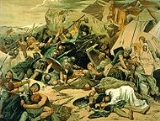
Battle of Mons Lactarius

Encyclopedia
The Battle of Mons Lactarius (also known as Battle of the Vesuvius) took place in 552 or 553 in the course the Gothic War
waged on behalf of Justinian I
against the Ostrogoths in Italy
.
After the Battle of Taginae
, in which the Ostrogoth king Totila
was killed, the Byzantine
general Narses
captured Rome
and besieged Cumae
. Teia
, the new Ostrogothic king, gathered the remnants of the Ostrogothic army and marched to relieve the siege, but in October of 552 (or early 553) Narses ambushed him at Mons Lactarius (modern Monti Lattari
) in Campania
, near Mt. Vesuvius and Nuceria Alfaterna. The battle lasted two days, and Teia was killed in the fighting. Ostrogothic power in Italy was eliminated, and the remaining Ostrogoths went back north and (re)settled in south Austria. After the battle Italy was again invaded, this time by the Franks
, but they too were defeated and the peninsula was, for a time, reintegrated into the empire.
Gothic War (535–552)
The Gothic War between the Eastern Roman Empire and the Ostrogothic Kingdom of Italy was fought from 535 until 554 in Italy, Dalmatia, Sardinia, Sicily and Corsica. It is commonly divided into two phases. The first phase lasted from 535 to 540 and ended with the fall of Ravenna and the apparent...
waged on behalf of Justinian I
Justinian I
Justinian I ; , ; 483– 13 or 14 November 565), commonly known as Justinian the Great, was Byzantine Emperor from 527 to 565. During his reign, Justinian sought to revive the Empire's greatness and reconquer the lost western half of the classical Roman Empire.One of the most important figures of...
against the Ostrogoths in Italy
Italy
Italy , officially the Italian Republic languages]] under the European Charter for Regional or Minority Languages. In each of these, Italy's official name is as follows:;;;;;;;;), is a unitary parliamentary republic in South-Central Europe. To the north it borders France, Switzerland, Austria and...
.
After the Battle of Taginae
Battle of Taginae
At the Battle of Taginae in June/July 552, the forces of the Byzantine Empire under Narses broke the power of the Ostrogoths in Italy, and paved the way for the temporary Byzantine reconquest of the Italian Peninsula.From as early as 549 the Emperor Justinian I had planned to dispatch a major army...
, in which the Ostrogoth king Totila
Totila
Totila, original name Baduila was King of the Ostrogoths from 541 to 552 AD. A skilled military and political leader, Totila reversed the tide of Gothic War, recovering by 543 almost all the territories in Italy that the Eastern Roman Empire had captured from his Kingdom in 540.A relative of...
was killed, the Byzantine
Byzantine Empire
The Byzantine Empire was the Eastern Roman Empire during the periods of Late Antiquity and the Middle Ages, centred on the capital of Constantinople. Known simply as the Roman Empire or Romania to its inhabitants and neighbours, the Empire was the direct continuation of the Ancient Roman State...
general Narses
Narses
Narses was, with Belisarius, one of the great generals in the service of the Byzantine Emperor Justinian I during the "Reconquest" that took place during Justinian's reign....
captured Rome
Rome
Rome is the capital of Italy and the country's largest and most populated city and comune, with over 2.7 million residents in . The city is located in the central-western portion of the Italian Peninsula, on the Tiber River within the Lazio region of Italy.Rome's history spans two and a half...
and besieged Cumae
Cumae
Cumae is an ancient Greek settlement lying to the northwest of Naples in the Italian region of Campania. Cumae was the first Greek colony on the mainland of Italy , and the seat of the Cumaean Sibyl...
. Teia
Teia
Teia , also known as Teja, Theia, Thila, Thela, Teias, was the last Ostrogothic king in Italy.Apparently a military officer serving under Totila, Teia was chosen as successor and raised over a shield after Totila was slain in the Battle of Taginae in July 552...
, the new Ostrogothic king, gathered the remnants of the Ostrogothic army and marched to relieve the siege, but in October of 552 (or early 553) Narses ambushed him at Mons Lactarius (modern Monti Lattari
Monti Lattari
thumb|280px|View of the Monti Lattari from the Gulf of [[Salerno]].The Monti Lattari are a mountain range in Campania, southern Italy, which constitutes the backbone of the Sorrentine peninsula and of the Amalfi Coast.-Geography:...
) in Campania
Campania
Campania is a region in southern Italy. The region has a population of around 5.8 million people, making it the second-most-populous region of Italy; its total area of 13,590 km² makes it the most densely populated region in the country...
, near Mt. Vesuvius and Nuceria Alfaterna. The battle lasted two days, and Teia was killed in the fighting. Ostrogothic power in Italy was eliminated, and the remaining Ostrogoths went back north and (re)settled in south Austria. After the battle Italy was again invaded, this time by the Franks
Franks
The Franks were a confederation of Germanic tribes first attested in the third century AD as living north and east of the Lower Rhine River. From the third to fifth centuries some Franks raided Roman territory while other Franks joined the Roman troops in Gaul. Only the Salian Franks formed a...
, but they too were defeated and the peninsula was, for a time, reintegrated into the empire.