

Pozzuoli

Encyclopedia
Pozzuoli is a city and comune
of the province of Naples
, in the Italian
region of Campania
. It is the main city of the Phlegrean peninsula
.
of Dicaearchia . The Roman colony was established in 194 BC, and took the name Puteoli from the Latin putere (to stink), referring to the sulfuric smell in the area, most notably from Solfatara
. This is because Pozzuoli lies in the center of the Campi Flegrei
, a caldera
.
Puteoli was the great emporium for the Alexandria
n grain
ships, and other ships from all over the Roman world. It also was the main hub for goods exported from Campania
, including blown glass
, mosaics, wrought iron
, and marble
. The Roman naval
base at nearby Misenum housed the largest naval fleet in the ancient world. It was also the site of the Roman
Dictator
Sulla's country villa and the place where he died in 78 BC.
The local volcanic sand, pozzolana
(Latin: pulvis puteolanus, "dust of Puteoli") formed the basis for the first effective concrete, as it reacted chemically with water. Instead of just evaporating slowly off, the water would turn this sand/lime mix into a mortar strong enough to bind lumps of aggregate into a load-bearing unit. This made possible the cupola of the Pantheon, the first real dome.
The apostle Paul
landed here on his way to Rome
, from which it was 170 miles distant. Here he stayed for seven days (Acts 28:13, 14) and then began with his companions his journey by the Appian Way
to Rome.
In 37 AD Puteoli was the location for a political stunt by Emperor Gaius Caligula, who on becoming Emperor ordered a temporary floating bridge
to be built using trading vessels, stretching for over two miles from the town to the famous neighboring resort of Baiae
, across which he proceeded to ride his horse, in defiance of an astrologer
's prediction that he had "no more chance of becoming Emperor than of riding a horse across the Gulf of Baiae."
Saint Proculus (San Procolo) was martyred here with his companions in the fourth century, and is the city's patron saint
. The seven eagle heads on the coat-of-arms for the town of Pozzuoli are said to represent seven of these martyrs. November 16 was the official feast day for Saint Proculus. St. Proculus was affectionately nicknamed u pisciasotto ("the pants-pisser") because November 16 was often a day of rain
. The townspeople also celebrated his feast day on the second Sunday in May.http://www.icampiflegrei.it/Azienda%20Turismo/pozzuoli/articoli2003/novembre_eng.htm
From August 1982 to December 1984 the city experienced hundreds of tremors and bradyseismic activity which reached a peak on October 4, 1983 damaging 8,000 buildings in the city center and dislocating 36,000 people, many permanently. The events raised the sea bottom by almost 2 m, and rendered the Bay of Pozzuoli too shallow for large craft.

, on Naples metro line 2, and by the trains of "Cumana
" lines leaving from the station of Montesanto, in the city center.
Comune
In Italy, the comune is the basic administrative division, and may be properly approximated in casual speech by the English word township or municipality.-Importance and function:...
of the province of Naples
Province of Naples
The Province of Naples is a province in the Campania region of Italy. Its capital city is Naples, within the province there are 92 Comuni of the Province of Naples.-Demographics:...
, in the Italian
Italy
Italy , officially the Italian Republic languages]] under the European Charter for Regional or Minority Languages. In each of these, Italy's official name is as follows:;;;;;;;;), is a unitary parliamentary republic in South-Central Europe. To the north it borders France, Switzerland, Austria and...
region of Campania
Campania
Campania is a region in southern Italy. The region has a population of around 5.8 million people, making it the second-most-populous region of Italy; its total area of 13,590 km² makes it the most densely populated region in the country...
. It is the main city of the Phlegrean peninsula
Campi Flegrei
The Phlegraean Fields, also known as Campi Flegrei, , is a large wide caldera situated to the west of Naples, Italy. It was declared a regional park in 2003. Lying mostly underwater, the area comprises 24 craters and volcanic edifices. Hydrothermal activity can be observed at Lucrino, Agnano and...
.
History
Pozzuoli began as the Greek colonyColony
In politics and history, a colony is a territory under the immediate political control of a state. For colonies in antiquity, city-states would often found their own colonies. Some colonies were historically countries, while others were territories without definite statehood from their inception....
of Dicaearchia . The Roman colony was established in 194 BC, and took the name Puteoli from the Latin putere (to stink), referring to the sulfuric smell in the area, most notably from Solfatara
Solfatara (volcano)
Solfatara is a shallow volcanic crater at Pozzuoli, near Naples, part of the Campi Flegrei volcanic area. It is a dormant volcano, which still emits jets of steam with sulphurous fumes. The name comes from the Latin, Sulpha terra, "land of sulphur", or "sulfur earth"...
. This is because Pozzuoli lies in the center of the Campi Flegrei
Campi Flegrei
The Phlegraean Fields, also known as Campi Flegrei, , is a large wide caldera situated to the west of Naples, Italy. It was declared a regional park in 2003. Lying mostly underwater, the area comprises 24 craters and volcanic edifices. Hydrothermal activity can be observed at Lucrino, Agnano and...
, a caldera
Caldera
A caldera is a cauldron-like volcanic feature usually formed by the collapse of land following a volcanic eruption, such as the one at Yellowstone National Park in the US. They are sometimes confused with volcanic craters...
.
Puteoli was the great emporium for the Alexandria
Alexandria
Alexandria is the second-largest city of Egypt, with a population of 4.1 million, extending about along the coast of the Mediterranean Sea in the north central part of the country; it is also the largest city lying directly on the Mediterranean coast. It is Egypt's largest seaport, serving...
n grain
Cereal
Cereals are grasses cultivated for the edible components of their grain , composed of the endosperm, germ, and bran...
ships, and other ships from all over the Roman world. It also was the main hub for goods exported from Campania
Campania
Campania is a region in southern Italy. The region has a population of around 5.8 million people, making it the second-most-populous region of Italy; its total area of 13,590 km² makes it the most densely populated region in the country...
, including blown glass
Glass
Glass is an amorphous solid material. Glasses are typically brittle and optically transparent.The most familiar type of glass, used for centuries in windows and drinking vessels, is soda-lime glass, composed of about 75% silica plus Na2O, CaO, and several minor additives...
, mosaics, wrought iron
Iron
Iron is a chemical element with the symbol Fe and atomic number 26. It is a metal in the first transition series. It is the most common element forming the planet Earth as a whole, forming much of Earth's outer and inner core. It is the fourth most common element in the Earth's crust...
, and marble
Marble
Marble is a metamorphic rock composed of recrystallized carbonate minerals, most commonly calcite or dolomite.Geologists use the term "marble" to refer to metamorphosed limestone; however stonemasons use the term more broadly to encompass unmetamorphosed limestone.Marble is commonly used for...
. The Roman naval
Roman Navy
The Roman Navy comprised the naval forces of the Ancient Roman state. Although the navy was instrumental in the Roman conquest of the Mediterranean basin, it never enjoyed the prestige of the Roman legions...
base at nearby Misenum housed the largest naval fleet in the ancient world. It was also the site of the Roman
Roman Republic
The Roman Republic was the period of the ancient Roman civilization where the government operated as a republic. It began with the overthrow of the Roman monarchy, traditionally dated around 508 BC, and its replacement by a government headed by two consuls, elected annually by the citizens and...
Dictator
Dictator
A dictator is a ruler who assumes sole and absolute power but without hereditary ascension such as an absolute monarch. When other states call the head of state of a particular state a dictator, that state is called a dictatorship...
Sulla's country villa and the place where he died in 78 BC.
The local volcanic sand, pozzolana
Pozzolana
Pozzolana, also known as pozzolanic ash , is a fine, sandy volcanic ash. Pozzolanic ash was first discovered and dug in Italy, at Pozzuoli. It was later discovered at a number of other sites as well...
(Latin: pulvis puteolanus, "dust of Puteoli") formed the basis for the first effective concrete, as it reacted chemically with water. Instead of just evaporating slowly off, the water would turn this sand/lime mix into a mortar strong enough to bind lumps of aggregate into a load-bearing unit. This made possible the cupola of the Pantheon, the first real dome.
The apostle Paul
Paul of Tarsus
Paul the Apostle , also known as Saul of Tarsus, is described in the Christian New Testament as one of the most influential early Christian missionaries, with the writings ascribed to him by the church forming a considerable portion of the New Testament...
landed here on his way to Rome
Rome
Rome is the capital of Italy and the country's largest and most populated city and comune, with over 2.7 million residents in . The city is located in the central-western portion of the Italian Peninsula, on the Tiber River within the Lazio region of Italy.Rome's history spans two and a half...
, from which it was 170 miles distant. Here he stayed for seven days (Acts 28:13, 14) and then began with his companions his journey by the Appian Way
Appian Way
The Appian Way was one of the earliest and strategically most important Roman roads of the ancient republic. It connected Rome to Brindisi, Apulia, in southeast Italy...
to Rome.
In 37 AD Puteoli was the location for a political stunt by Emperor Gaius Caligula, who on becoming Emperor ordered a temporary floating bridge
Pontoon bridge
A pontoon bridge or floating bridge is a bridge that floats on water and in which barge- or boat-like pontoons support the bridge deck and its dynamic loads. While pontoon bridges are usually temporary structures, some are used for long periods of time...
to be built using trading vessels, stretching for over two miles from the town to the famous neighboring resort of Baiae
Baiae
Baiae , a frazione of the comune of Bacoli) in the Campania region of Italy was a Roman seaside resort on the Bay of Naples. It was said to have been named after Baius, who was supposedly buried there. Baiae was for several hundred years a fashionable resort, especially towards the end of the Roman...
, across which he proceeded to ride his horse, in defiance of an astrologer
Astrologer
An astrologer practices one or more forms of astrology. Typically an astrologer draws a horoscope for the time of an event, such as a person's birth, and interprets celestial points and their placements at the time of the event to better understand someone, determine the auspiciousness of an...
's prediction that he had "no more chance of becoming Emperor than of riding a horse across the Gulf of Baiae."
Saint Proculus (San Procolo) was martyred here with his companions in the fourth century, and is the city's patron saint
Patron saint
A patron saint is a saint who is regarded as the intercessor and advocate in heaven of a nation, place, craft, activity, class, clan, family, or person...
. The seven eagle heads on the coat-of-arms for the town of Pozzuoli are said to represent seven of these martyrs. November 16 was the official feast day for Saint Proculus. St. Proculus was affectionately nicknamed u pisciasotto ("the pants-pisser") because November 16 was often a day of rain
Rain
Rain is liquid precipitation, as opposed to non-liquid kinds of precipitation such as snow, hail and sleet. Rain requires the presence of a thick layer of the atmosphere to have temperatures above the melting point of water near and above the Earth's surface...
. The townspeople also celebrated his feast day on the second Sunday in May.http://www.icampiflegrei.it/Azienda%20Turismo/pozzuoli/articoli2003/novembre_eng.htm
From August 1982 to December 1984 the city experienced hundreds of tremors and bradyseismic activity which reached a peak on October 4, 1983 damaging 8,000 buildings in the city center and dislocating 36,000 people, many permanently. The events raised the sea bottom by almost 2 m, and rendered the Bay of Pozzuoli too shallow for large craft.
Main sights
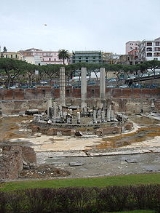
The town's attractions include:- The Macellum of PozzuoliMacellum of PozzuoliThe Macellum of Pozzuoli was the macellum or market building of the Roman colony of Puteoli, now known as Pozzuoli. When first excavated in the 18th century, the discovery of a statue of Serapis led to the building being mis-identified as the city's serapeum or Temple of Serapis.A band of borings...
, also known as the Temple of Serapis or serapeumSerapeumA serapeum is a temple or other religious institution dedicated to the syncretic Hellenistic-Egyptian god Serapis, who combined aspects of Osiris and Apis in a humanized form that was accepted by the Ptolemaic Greeks of Alexandria...
, is considered the city's symbol. The "temple" was actually a marketplace. Its name derives from the misinterpretation of its function after a statue of the god SerapisSerapisSerapis or Sarapis is a Graeco-Egyptian name of God. Serapis was devised during the 3rd century BC on the orders of Ptolemy I of Egypt as a means to unify the Greeks and Egyptians in his realm. The god was depicted as Greek in appearance, but with Egyptian trappings, and combined iconography...
was found in 1750 at this location. The Macellum includes three majestic columns in cipolin marble, which show erosion from marine LithophagaLithophagaLithophaga, the date mussels, are a genus of medium-sized marine bivalve molluscs in the family Mytilidae.The shells of species in this genus are long and narrow with parallel sides. The animals bore into stone or coral rock with the help of pallial gland secretions, hence the systematic name...
molluscs when, at an earlier time, the ground level was much lower due to BradyseismBradyseismBradyseism is the gradual uplift or descent of part of the Earth's surface caused by the filling or emptying of an underground magma chamber and/or hydrothermal activity, particularly in volcanic calderas...
, and sea-water could flow in. - Flavian Amphitheater (Amphitheatrum Flavium)Flavian Amphitheater (Pozzuoli)The Flavian Amphitheater , located in Pozzuoli, is the third largest Roman amphitheater in Italy. Only the Roman Colosseum and the Capuan Amphitheater are larger. It was likely built by the same architects who previously constructed the Roman Colosseum...
, the third largest Italian amphitheater after the ColosseumColosseumThe Colosseum, or the Coliseum, originally the Flavian Amphitheatre , is an elliptical amphitheatre in the centre of the city of Rome, Italy, the largest ever built in the Roman Empire...
and the Capuan Amphitheater. - SolfataraSolfatara (volcano)Solfatara is a shallow volcanic crater at Pozzuoli, near Naples, part of the Campi Flegrei volcanic area. It is a dormant volcano, which still emits jets of steam with sulphurous fumes. The name comes from the Latin, Sulpha terra, "land of sulphur", or "sulfur earth"...
(volcanic crater with active fumaroles) - Forum
- Sanctuary of San Gennaro (St. Januarius). With the Cathedral of NaplesCathedral of NaplesNaples Cathedral is a Roman Catholic cathedral, the main church of Naples, southern Italy, and the seat of the Archbishop of Naples. It is widely known as the Cattedrale di San Gennaro, in honour of Saint Januarius, the city's patron saint, but is actually dedicated to the Assumption of the...
, it is one of the two places in which the alleged miracle of the liquefaction of the saint's blood occurs. - Lake AvernusLake AvernusLake Avernus is a volcanic crater lake located in the Avernus crater in the Campania region of southern Italy, around northwest of Pozzuoli. It is near the volcanic field known as the Campi Flegrei and comprises part of the wider Campanian volcanic arc...
, in which VirgilVirgilPublius Vergilius Maro, usually called Virgil or Vergil in English , was an ancient Roman poet of the Augustan period. He is known for three major works of Latin literature, the Eclogues , the Georgics, and the epic Aeneid...
, in the 6th book of his AeneidAeneidThe Aeneid is a Latin epic poem, written by Virgil between 29 and 19 BC, that tells the legendary story of Aeneas, a Trojan who travelled to Italy, where he became the ancestor of the Romans. It is composed of roughly 10,000 lines in dactylic hexameter...
, placed the entrance to Hell. The name derives from GreekGreek languageGreek is an independent branch of the Indo-European family of languages. Native to the southern Balkans, it has the longest documented history of any Indo-European language, spanning 34 centuries of written records. Its writing system has been the Greek alphabet for the majority of its history;...
, and means "Without Birds", referring to the absence of birds due to the sulfur gas that sprung from it. Nearby are the Temple of Apollo, the Grotto of the Cumaean SibylCumaean SibylThe ageless Cumaean Sibyl was the priestess presiding over the Apollonian oracle at Cumae, a Greek colony located near Naples, Italy.The word sibyl comes from the ancient Greek word sibylla, meaning prophetess. There were many Sibyls in different locations throughout the ancient world...
and Cocceius' Grotto, a gallery carved by the Romans to connect Lucrino to Cumae. The latter was damaged during World War II and is no longer visitable. - Lake Lucrino, in the frazioneFrazioneA frazione , in Italy, is the name given in administrative law to a type of territorial subdivision of a comune; for other administrative divisions, see municipio, circoscrizione, quartiere...
of the same name. The lake was considered an infernal place, due to volcanic phenomena. It was a renowned resort in Roman times and included the villa of CiceroCiceroMarcus Tullius Cicero , was a Roman philosopher, statesman, lawyer, political theorist, and Roman constitutionalist. He came from a wealthy municipal family of the equestrian order, and is widely considered one of Rome's greatest orators and prose stylists.He introduced the Romans to the chief...
, which later held the remains of emperor HadrianHadrianHadrian , was Roman Emperor from 117 to 138. He is best known for building Hadrian's Wall, which marked the northern limit of Roman Britain. In Rome, he re-built the Pantheon and constructed the Temple of Venus and Roma. In addition to being emperor, Hadrian was a humanist and was philhellene in...
. Pliny the ElderPliny the ElderGaius Plinius Secundus , better known as Pliny the Elder, was a Roman author, naturalist, and natural philosopher, as well as naval and army commander of the early Roman Empire, and personal friend of the emperor Vespasian...
cites it in Naturalis historiaNaturalis historiaFor Naturalis historia, the natural history by Pliny the Elder see Natural History .For Historia naturalis palmarum by Carl Friedrich Philipp von Martius see Historia naturalis palmarum....
(ix, 25) as the home of a dolphin who had made friends with a child. According to Pliny, when the child fell ill and died, the dolphin died of broken heart also. The tale is considered the first known Urban legendUrban legendAn urban legend, urban myth, urban tale, or contemporary legend, is a form of modern folklore consisting of stories that may or may not have been believed by their tellers to be true...
.
Transportation
It is easily reached by train from NaplesNaples
Naples is a city in Southern Italy, situated on the country's west coast by the Gulf of Naples. Lying between two notable volcanic regions, Mount Vesuvius and the Phlegraean Fields, it is the capital of the region of Campania and of the province of Naples...
, on Naples metro line 2, and by the trains of "Cumana
Ferrovia Cumana
The Cumana Railway is a regional railway in Campania, southern Italy, connecting Naples by two separate routes with Torregaveta, near Cuma in the town of Bacoli . It passes through Pozzuoli and the volcanic Campi Flegrei area...
" lines leaving from the station of Montesanto, in the city center.
Neighboring communes
- BacoliBacoliBacoli is a comune in the Province of Naples in the Italian region Campania, located about 15 km west of Naples. As of 31 December 2004, it had a population of 27,402 and an area of 13.3 km².-History:...
- Giugliano in CampaniaGiugliano in CampaniaGiugliano in Campania is a city and comune in the province of Napoli, Campania, Italy. As of 2008, it had some 113,000 inhabitants and it is the most populated Italian city not provincial seat. It is part of Naples' metropolitan area.-History:In 5th-4th century BCE the territory of Giugliano was...
- Monte di ProcidaMonte di ProcidaMonte di Procida is a small comune in the Province of Naples in the Italian region of Campania, located about 15 km west of Naples, facing the island of Procida. Monte di Procida includes the small island of San Martino, which was occupied by the Germans during World War II...
- NaplesNaplesNaples is a city in Southern Italy, situated on the country's west coast by the Gulf of Naples. Lying between two notable volcanic regions, Mount Vesuvius and the Phlegraean Fields, it is the capital of the region of Campania and of the province of Naples...
- Quarto
Notable people
- JanuariusJanuariusJanuarius, Bishop of Naples, is a martyr saint of the Roman Catholic and the Eastern Orthodox Churches. While no contemporary sources on his life are preserved, later sources and legends claim that he died during the Diocletianic Persecution, which ended with Diocletian's retirement in...
, Patron Saint of Naples was executed at SolfataraSolfatara (volcano)Solfatara is a shallow volcanic crater at Pozzuoli, near Naples, part of the Campi Flegrei volcanic area. It is a dormant volcano, which still emits jets of steam with sulphurous fumes. The name comes from the Latin, Sulpha terra, "land of sulphur", or "sulfur earth"...
c.305 - JosephusJosephusTitus Flavius Josephus , also called Joseph ben Matityahu , was a 1st-century Romano-Jewish historian and hagiographer of priestly and royal ancestry who recorded Jewish history, with special emphasis on the 1st century AD and the First Jewish–Roman War, which resulted in the Destruction of...
landed here on his way to Rome. (The Life of Flavius Josephus; 3.16) - Sophia LorenSophia LorenSophia Loren, OMRI is an Italian actress.In 1962, Loren won the Academy Award for Best Actress for her role in Two Women, along with 21 awards, becoming the first actress to win an Academy Award for a non-English-speaking performance...
, film actress, grew up here - Gilbert, Count of MontpensierGilbert, Count of MontpensierGilbert de Bourbon, Count of Montpensier son of Louis de Bourbon and Gabrielle La Tour, Count of Montpensier and Dauphin d'Auvergne...
, Viceroy of Naples died here on 15 October 1496. - Saint Paul, the Apostle landed here on his way to Rome. (Acts 28:13)
- Giovanni Battista PergolesiGiovanni Battista PergolesiGiovanni Battista Pergolesi was an Italian composer, violinist and organist.-Biography:Born at Iesi, Pergolesi studied music there under a local musician, Francesco Santini, before going to Naples in 1725, where he studied under Gaetano Greco and Francesco Feo among others...
, Baroque composer, died here. - Lucius Cornelius SullaLucius Cornelius SullaLucius Cornelius Sulla Felix , known commonly as Sulla, was a Roman general and statesman. He had the rare distinction of holding the office of consul twice, as well as that of dictator...
, DictatorDictatorA dictator is a ruler who assumes sole and absolute power but without hereditary ascension such as an absolute monarch. When other states call the head of state of a particular state a dictator, that state is called a dictatorship...
of Rome, died at his villa here