

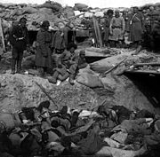
Siege of Port Arthur

Encyclopedia
The Siege of Port Arthur
, 1 August 1904 – 2 January 1905, the deep-water port and Russia
n naval base at the tip of the Liaotung Peninsula in Manchuria
, was the longest and most violent land battle of the Russo-Japanese War
.
Port Arthur was widely regarded as one of the most strongly fortified positions in the world at the time. However, during the First Sino-Japanese War
, General Nogi Maresuke had taken the city from the forces of Qing China
in only a few days. The ease of his victory during that previous conflict, and overconfidence by the Japanese General Staff
in Japan's ability to overcome improved fortifications made by the Russians, led to a much longer campaign, with much heavier losses than expected.
The Siege of Port Arthur saw the introduction of much technology used in subsequent wars of the 20th century (particularly in World War I
) including massive 11 inches (279.4 mm) mortars
capable of hurling 500 kilogram shells over 8 kilometres, as well as rapid-firing light howitzers, Maxim machine guns
, bolt-action magazine rifles, barbed wire
entanglements, electric fence
s, arc lamp
searchlights, tactical radio signalling (and, in response, the first military use of radio jamming
), hand grenade
s, trench warfare
, and the use of modified naval mine
s as land weapons.
was the lease of Port Arthur to Russia
by the weak Qing government of China
, after the Triple Intervention
(Russia, France
and Germany
) just three days after the Treaty of Shimonoseki
. The Treaty had confirmed Japan's possession and hegemony in this region, captured by her during the First Sino-Japanese War
. As the only ice-free port for Russia in the Far East, control of this territory was of vital strategic importance to Russian plans for further expansion of their empire in Asia.
The Russian forces
manning the defenses of Port Arthur under Major-General Baron
Anatoly Stoessel
consisted of almost 50,000 men and 506 guns (including the crews of the Russian warships in port). He also had the option of removing the guns from the fleet to bolster the land defenses. The total population of Port Arthur at the time was around 87,000, which meant that a very high proportion of the population were combatants.
Russian improvements to the defences of Port Arthur included a multi-perimeter layout with overlapping fields of fire and making the best possible use of the natural terrain. However, many of the redoubt
s and fortifications were still unfinished, as considerable resources were either in very short supply or had been diverted to improving the fortifications at Dalny, further north on the Liaodong Peninsula.
The outer defense perimeter of Port Arthur consisted of a line of hills, including Hsiaokushan and Takushan near the Ta-ho River in the east, and Namakoyama, Akasakayama, 174-Meter Hill, 203-Meter Hill and False Hill in the west. All of these hills were heavily fortified. Approximately 1.5 kilometers behind this defensive line was the original stone Chinese wall, which encircled the Old Town of Lushun from the south to the Lun-ho River at the northwest. The Russians had continued the line of the Chinese wall to the west and south, enclosing the approaches to the harbor and the New Town of Port Arthur with concrete forts, machine gun emplacements, and connecting trenches.
General Stoessel withdrew to Port Arthur on 30 July 1904. Facing the Russians was the Japanese Third Army, about 90,000 strong, backed by 474 artillery guns, under the command of General Baron
Nogi Maresuke.
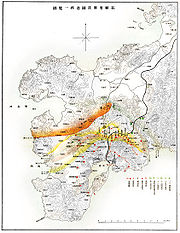
also participated in shore bombardment, while in the northeast the army prepared to attack the two semi-isolated hills protruding from the outer defense perimeter: 600 feet (182.9 m) high Takushan (Big Orphan Hill) and the smaller Hsuaokushan (Little Orphan Hill). These hills were not heavily fortified, but had steep slopes and were fronted by the Ta River, which had been dammed by the Russians to provide a stronger obstacle. The hills commanded a view over almost a kilometer of flat ground to the Japanese lines, and it was thus essential for the Japanese to take these hills to complete their encirclement of Port Arthur.
After pounding the two hills from 04:30 in the morning until 19:30 at night, General Nogi launched a frontal infantry
assault, which was hampered by heavy rain, poor visibility and dense clouds of smoke. The Japanese were able to advance only as far as the forward slopes of both hills, and many soldiers drowned in the Ta River. Even the night attacks resulted in unexpectedly high casualties, as the Russians used powerful searchlight
s to expose the attackers to artillery
and machine gun
cross-fire.
Undeterred, Nogi re-opened an artillery bombardment the following day, 8 August 1904, but his assault stalled again, this time due to heavy fire from the Russian fleet led by the cruiser Novik
. Nogi ordered his men to press on regardless of casualties. Despite some confusion in orders behind the Russian lines, which resulted in some units abandoning their posts, numerous Russian troops held on tenaciously, and the Japanese finally managed to overrun the Russian positions mostly through sheer superiority in numbers. Takushan was captured at 20:00 hours, and the following morning, 9 August 1904, Hsiaokushan also fell to the Japanese.
Gaining these two hills cost the Japanese 1280 killed and wounded. The Japanese Army complained bitterly to the Navy about the ease with which the Russians were able to obtain naval fire support, and in response the Japanese Navy brought in a battery of 12-pound guns, with a range sufficient to ensure that there would be no recurrence of a Russian naval sortie.
The loss of the two hills, when reported to the Tsar, caused him to consider the safety of the Russian Pacific Fleet trapped at Port Arthur, and he sent immediate orders to Admiral Wilgelm Vitgeft
, in command of the fleet after the death of Admiral Stepan Makarov
, to join the squadron at Vladivostok
. Vitgeft put to sea at 08:30 on 10 August 1904 and engaged the waiting Japanese under Admiral Togo Heihachiro
in what was to become known as the Battle of the Yellow Sea.
On 11 August 1904, the Japanese sent an offer of temporary cease-fire to Port Arthur, so the Russians could allow all non-combatants to leave under guarantee of safety. The offer was rejected, but the foreign military observers all decided to leave for safety on 14 August 1904.
from the Wolf Hills, which the Russians unsuccessfully attempted to shoot down. Nogi was reportedly very surprised at the lack of coordination of the Russian artillery efforts, and he decided to proceed with a direct frontal assault down the Wantai Ravine, which, if successful, would carry Japanese forces directly into the heart of the city. Given his previous high casualty rate and his lack of heavy artillery, the decision created controversy in his staff; however, Nogi was under orders to take Port Arthur as quickly as possible.
After sending a message to the garrison of Port Arthur demanding surrender (which was immediately refused), the Japanese began their assault at dawn on 19 August 1904. The main thrust was directed at 174 Meter Hill, with flanking and diversionary attacks along the line from Fort Sung-shu to the Chi-Kuan Battery. The Russian defensive positions on 174 Meter Hill itself were held by the 5th and 13th East Siberian Regiments, reinforced by sailors, under the command of Colonel Tretyakov
, a veteran of the Battle of Nanshan
.
Just as he had done at the Battle of Nanshan, Tretyakov, although having his first line of trenches overrun, tenaciously refused to retreat and held control of 174 Meter Hill despite severe and mounting casualties. On the following day, 20 August 1904, Tretyakov asked for reinforcements but, just as at Nanshan, none were forthcoming. With more than half of his men killed or wounded and with his command disintegrating as small groups of men fell back in confusion, Tretyakov had no choice but to withdraw, and 174 Meter Hill was thus overrun by the Japanese. The assault on 174 Meter Hill alone had cost the Japanese some 1,800 killed and wounded and the Russians over 1,000.
The assaults on the other sections of the Russian line had also cost the Japanese heavily, but with no results and no ground gained. When Nogi finally called off his attempt to penetrate the Wantai Ravine on 24 August 1904, he had only 174 Meter Hill and the West and East Pan-lung to show for his loss of more than 16,000 men. With all other positions remaining firmly under Russian control, Nogi at last decided to abandon frontal assaults in favor of a protracted siege
.
On 25 August 1904, the day after Nogi’s last assault had failed, Marshal Ōyama Iwao
engaged the Russians under General Aleksey Kuropatkin
at the Battle of Liaoyang
.
to bring down the walls. By now, Nogi had also been reinforced by additional artillery and 16,000 more troops from Japan, which partially compensated for the casualties sustained in his first assaults. However, the major new development was the arrival of the first battery of huge 11-inch siege howitzer
s, replacing those lost when the transport Hitachi Maru, loaded with a battalion of the First Reserve Regiment of the Guards, was sunk by Russian cruisers on 15 June 1904. The massive 11-inch howitzers could throw a 227 kilogram shell over 9 kilometers, and Nogi at last had the firepower necessary to make a serious attempt against the Russian fortifications. The huge howitzer shells were nicknamed "roaring trains" by the Russian troops (for the sound they made just before impact), and during their period at Port Arthur over 35,000 of these shells were fired. The Krupp howitzers had originally been installed in shore batteries in forts overlooking Tokyo Bay
and Osaka Bay
, and had been intended for anti-ship operations.
While the Japanese set to work in the sapping
campaign, General Stoessel continued to spend most of his time writing complaining letters to the Tsar about lack of cooperation from his fellow officers in the navy. The garrison in Port Arthur was starting to experience serious outbreaks of scurvy
and dysentery
due to the lack of fresh food.
Nogi now shifted his attention to the Temple Redoubt and the Waterworks Redoubt (also known as the Erhlung Redoubt) to the east, and to 203 Meter Hill and Namakoyama to the west. Strangely, at this time neither Nogi nor Stoessel seem to have realized the strategic importance of 203 Meter Hill: its unobstructed views of the harbor would (if taken by the Japanese) have enabled them to control the harbor and to fire on the Russian fleet sheltering there. This fact was only brought to Nogi's attention when he was visited by General Kodama Gentaro, who immediately saw that the hill was the key to the whole Russian defense.
By mid-September the Japanese had dug over eight kilometers of trenches and were within 70 meters of the Waterworks Redoubt, which they attacked and captured on 19 September 1904. Thereafter they successfully took the Temple Redoubt, while another attacking force was sent against both Namakoyama and 203 Meter Hill. The former was taken that same day, but on 203 Meter Hill the Russian defenders cut down the dense columns of attacking troops with machine gun and cannon fire in swathes. The attack failed, and the Japanese were forced back, leaving the ground covered with their dead and wounded. The battle at 203 Meter Hill continued for several more days, with the Japanese gaining a foothold each day, only to be forced back each time by Russian counter-attacks. By the time General Nogi abandoned the attempt, he had lost over 3500 men. The Russians used the respite to begin strengthening the defenses on 203 Meter Hill yet further, while Nogi began a prolonged artillery bombardment of the town and those parts of the harbor within range of his guns.
Nogi attempted yet another mass “human wave” assault on 203 Meter Hill on 29 October 1904, which, if successful, was intended to be a present for the Meiji Emperor's
birthday. However, aside from seizing some minor fortifications, the attack failed after six days of hand-to-hand combat, leaving Nogi with the deaths of an additional 124 officers and 3611 soldiers to report to his Emperor instead of a victory.
The onset of winter did little to slow the intensity of the battle. Nogi received additional reinforcements from Japan, including 18 more Krupp 11 inches (279.4 mm) howitzers, which were manhandled from the railway by teams of 800 soldiers along an eight-mile (13 km) long narrow gauge track that had been laid expressly for that purpose. These howitzers were added to the 450 other guns already in place. One innovation of the campaign was the centralization of the Japanese fire control, with the artillery batteries connected to the field headquarters by miles of telephone
lines.
Now well aware that the Russian Baltic Fleet was on its way, the Japanese Imperial Headquarters fully understood the necessity of destroying what Russian ships were still serviceable at Port Arthur. It thus became essential that 203 Meter Hill be captured without further delay, and political pressure began to mount for Nogi’s replacement.
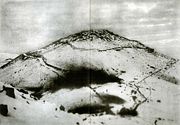
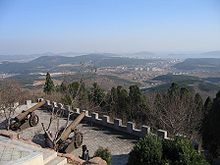 The Russians defenders entrenched on the summit of 203 Meter Hill were commanded by Colonel Tretyakov, and were organized into five companies of infantry with machine gun detachments, a company of engineers, a few sailors and a battery of artillery. The defenses of the hill itself, although having taken a pounding during the previous attacks, were still intact. As well as the natural strength of its elevated position with steep sides, it was protected by a massive redoubt and two keeps, and completely surrounded by electrified barbed wire entanglements. It was also connected to the neighboring strongholds on False Hill and Akasakayama by trenches. The name “203-Meter Hill” is actually a misnomer, as the hill consists of two peaks (203 meters and 210 meters high, and 140 meters apart) connected by a sharp ridge. On top of the 203 meter peak was the fortified Russian command post in reinforced concrete.
After his two costly set-backs in attempting to take 203 Meter Hill during October, Nogi had been saved from court-martial
only through the unprecedented personal intervention of Emperor Meiji
. However, Field Marshal Oyama Iwao
found the continuing unavailability of the 3rd Army's manpower to be intolerable, and sent General Kodama Gentaro to apply strong pressure on Nogi to take either drastic action, or to relieve him of command. Nogi thus had no alternative but to attempt one more all-out assault on 203 Meter Hill, this time regardless of the cost.
By this time, after weeks of tunneling, the Japanese sappers were underneath the main defense perimeter and on 26 November 1904, (coincidentally the same day that the Russian Baltic Fleet was entering the Indian Ocean
), Nogi ordered his forces to recommence their attack. Direct frontal assaults on both Fort Erhlung and Fort Sungshu were once again beaten back by the Russian defenders. Japanese casualties were officially 4,000 men, but unofficially perhaps twice as high. Russian General Roman Kondratenko
took the precaution of stationing sniper
s to shoot any of his front line troops attempting to abandon their positions.
At 08:30 on 28 November 1904, with massive artillery support, Japanese troops again attempted an assault up the sides of both Akasakayama and 203 Meter Hill. Over 1,000 of the 500 lb (226.8 kg) shells from the 11 inches (279.4 mm) howitzers were fired in a single day to support this attack. The Japanese reached as far as the Russian line of barbed wire entanglements by daybreak and held their ground throughout the following day, while their artillery kept the defenders busy by a continuous bombardment. Nonetheless, the Japanese forces suffered serious losses, as the Russian defenders were well positioned to use hand grenade
s and machine guns against the tightly packed mass of Japanese soldiers.
The battle continued throughout the following days with very heavy hand-to-hand combat. Finally, at 10:30 on 5 December 1904, after another massive artillery bombardment, the Japanese managed to overrun 203 Meter Hill, finding only a handful of defenders still alive on the summit. The Russians launched two counter-attacks to retake the hill, both of which failed, and by 17:00, 203 Meter Hill was securely under Japanese control.
For Japan, the cost of capturing this landmark was great, with over 8,000 dead and wounded in the final assault alone. For General Nogi, the cost of capturing 203 Meter Hill was made even more poignant when he received word that his last surviving son had been killed in action during the final assault on the hill. The Russians, who had no more than 1,500 men on the hill at any one time, lost over 6,000 killed and wounded.
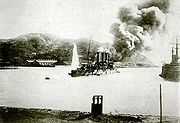
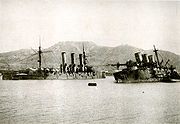 From the vantage point on 203 Meter Hill overlooking Port Arthur harbor, Nogi could now bombard the Russian fleet by relocating his heavy 11 inches (279.4 mm) howitzers with 500-kilogram armor-piercing shells on the summit. This done, he systematically started to sink the Russian ships within range.
On 5 December 1904, the battleship
Poltava
was destroyed, followed by the battleship Retvizan
on 7 December 1904, the battleships Pobeda and Peresvyet
and the cruisers Pallada
and Bayan
on 9 December 1904. The battleship Sevastopol
, although hit 5 times by 11 inches (279.4 mm) shells, managed to move out of range of the guns. Stung by the fact that the Russian Pacific Fleet had been sunk by the army and not by the Imperial Japanese Navy, and with a direct order from Tokyo that the Sevastopol was not to be allowed to escape, Admiral Togo sent in wave after wave of destroyer
s in six separate attacks on the sole remaining Russian battleship. After 3 weeks, the Sevastopol was still afloat, having survived 124 torpedo
es fired at her while sinking two Japanese destroyers and damaging six other vessels. The Japanese had meanwhile lost the cruiser Takasago
to a mine outside the harbor.
On the night of 2 January 1905, after Port Arthur surrendered, Captain Nikolai Essen
of the Sevastopol had the crippled battleship scuttled in 30 fathoms (54.9 m) of water by opening the sea cocks on one side, so that the ship would sink on its side and could not be raised and salvaged by the Japanese.
 Following the loss of the Pacific Fleet, the rationale for holding onto Port Arthur was questioned by Stoessel and Foch in a council on 8 December 1904, but the idea of surrender was rejected by the other senior officers. Japanese trench and tunnel warfare continued. With the death of General Kondratenko on 15 December 1904 at Fort Chikuan, Stoessel appointed the incompetent Foch in his place. On 18 December 1904, the Japanese exploded an 1800 kilogram mine under Fort Chikuan, which fell that night. On 28 December 1904, mines under Fort Erhlung were detonated, destroying that fort as well.
On 31 December 1904, a series of mines were exploded under Fort Sungshu, the sole surviving major fortress, which surrendered that day. On 1 January 1905, Wantai finally fell to the Japanese. On the same day, Stoessel and Foch sent a message to a surprised General Nogi, offering to surrender. None of the other senior Russian staff had been consulted, and notably Smirnov and Tretyakov were outraged. The surrender was accepted and signed on 5 January 1905 in the northern suburb of Shuishiying
.
With this, the Russian garrison was taken into captivity, and civilians were allowed to leave, but the Russian officers were given the choice of either going into POW camps with their men or being given parole
on the promise of taking no further part in the war.
The Japanese were astounded to find that a huge store of food and ammunition remained in Port Arthur, which implied that Stoessel had surrendered long before the fight was over. Stoessel, Foch and Smirnov were court-martial
ed on their return to St Petersburg.
As for Nogi, after leaving a garrison in Port Arthur, he led the surviving bulk of his army of 120,000 men north to join Marshal Oyama at the Battle of Mukden
.
The Japanese army casualties were later officially listed as 57,780 casualties (killed, wounded and missing), of whom 14,000 were killed. In addition 33,769 became sick during the siege (including 21,023 with beriberi
). The Japanese navy lost 16 ships in the course of the siege, including two battleships and four cruisers.
There were higher estimates of Japanese army casualties at the time such as 94,000-110,000 killed, wounded, and missing, though these were written without access to the Japanese Medical History of the War.
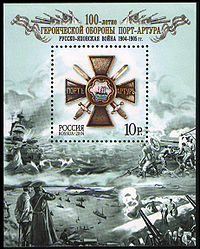 The capture of Port Arthur and the subsequent Japanese victories at the Battle of Mukden
and the Tsushima
contributed to U.S. President Theodore Roosevelt
's efforts to arbitrate a peace agreement, which resulted in the Treaty of Portsmouth
, ending the Russo-Japanese War. The losing of the war in 1905 also led to major internal de-stabilisation within Imperial Russia, (see: Russian revolution of 1905
) including Bloody Sunday
and prompted constitutional reform
including the introduction of the Duma
.
drama film
called Port Arthur was released. Directed by Toshio Masuda
, it starred Tatsuya Nakadai
(Nogi Maresuke), Tetsuro Tamba
(Kodama Gentaro), and Toshirō Mifune
(Emperor Meiji
).
In 1983, the battle for Port Arthur was portrayed in the Reilly, Ace of Spies
episode "Prelude to War".
Lüshunkou
Lüshunkou is a district in the municipality of Dalian, Liaoning province, China. Also called Lüshun City or Lüshun Port, it was formerly known as both Port Arthur and Ryojun....
, 1 August 1904 – 2 January 1905, the deep-water port and Russia
Russia
Russia or , officially known as both Russia and the Russian Federation , is a country in northern Eurasia. It is a federal semi-presidential republic, comprising 83 federal subjects...
n naval base at the tip of the Liaotung Peninsula in Manchuria
Manchuria
Manchuria is a historical name given to a large geographic region in northeast Asia. Depending on the definition of its extent, Manchuria usually falls entirely within the People's Republic of China, or is sometimes divided between China and Russia. The region is commonly referred to as Northeast...
, was the longest and most violent land battle of the Russo-Japanese War
Russo-Japanese War
The Russo-Japanese War was "the first great war of the 20th century." It grew out of rival imperial ambitions of the Russian Empire and Japanese Empire over Manchuria and Korea...
.
Port Arthur was widely regarded as one of the most strongly fortified positions in the world at the time. However, during the First Sino-Japanese War
First Sino-Japanese War
The First Sino-Japanese War was fought between Qing Dynasty China and Meiji Japan, primarily over control of Korea...
, General Nogi Maresuke had taken the city from the forces of Qing China
Qing Dynasty
The Qing Dynasty was the last dynasty of China, ruling from 1644 to 1912 with a brief, abortive restoration in 1917. It was preceded by the Ming Dynasty and followed by the Republic of China....
in only a few days. The ease of his victory during that previous conflict, and overconfidence by the Japanese General Staff
General Staff
A military staff, often referred to as General Staff, Army Staff, Navy Staff or Air Staff within the individual services, is a group of officers and enlisted personnel that provides a bi-directional flow of information between a commanding officer and subordinate military units...
in Japan's ability to overcome improved fortifications made by the Russians, led to a much longer campaign, with much heavier losses than expected.
The Siege of Port Arthur saw the introduction of much technology used in subsequent wars of the 20th century (particularly in World War I
World War I
World War I , which was predominantly called the World War or the Great War from its occurrence until 1939, and the First World War or World War I thereafter, was a major war centred in Europe that began on 28 July 1914 and lasted until 11 November 1918...
) including massive 11 inches (279.4 mm) mortars
Mortar (weapon)
A mortar is an indirect fire weapon that fires explosive projectiles known as bombs at low velocities, short ranges, and high-arcing ballistic trajectories. It is typically muzzle-loading and has a barrel length less than 15 times its caliber....
capable of hurling 500 kilogram shells over 8 kilometres, as well as rapid-firing light howitzers, Maxim machine guns
Maxim gun
The Maxim gun was the first self-powered machine gun, invented by the American-born British inventor Sir Hiram Maxim in 1884. It has been called "the weapon most associated with [British] imperial conquest".-Functionality:...
, bolt-action magazine rifles, barbed wire
Barbed wire
Barbed wire, also known as barb wire , is a type of fencing wire constructed with sharp edges or points arranged at intervals along the strand. It is used to construct inexpensive fences and is used atop walls surrounding secured property...
entanglements, electric fence
Electric fence
An electric fence is a barrier that uses electric shocks to deter animals or people from crossing a boundary. The voltage of the shock may have effects ranging from uncomfortable, to painful or even lethal...
s, arc lamp
Arc lamp
"Arc lamp" or "arc light" is the general term for a class of lamps that produce light by an electric arc . The lamp consists of two electrodes, first made from carbon but typically made today of tungsten, which are separated by a gas...
searchlights, tactical radio signalling (and, in response, the first military use of radio jamming
Radio jamming
Radio jamming is the transmission of radio signals that disrupt communications by decreasing the signal to noise ratio. Unintentional jamming occurs when an operator transmits on a busy frequency without first checking whether it is in use, or without being able to hear stations using the frequency...
), hand grenade
Hand grenade
A hand grenade is any small bomb that can be thrown by hand. Hand grenades are classified into three categories, explosive grenades, chemical and gas grenades. Explosive grenades are the most commonly used in modern warfare, and are designed to detonate after impact or after a set amount of time...
s, trench warfare
Trench warfare
Trench warfare is a form of occupied fighting lines, consisting largely of trenches, in which troops are largely immune to the enemy's small arms fire and are substantially sheltered from artillery...
, and the use of modified naval mine
Naval mine
A naval mine is a self-contained explosive device placed in water to destroy surface ships or submarines. Unlike depth charges, mines are deposited and left to wait until they are triggered by the approach of, or contact with, an enemy vessel...
s as land weapons.
Background
A major cause of the Russo-Japanese WarRusso-Japanese War
The Russo-Japanese War was "the first great war of the 20th century." It grew out of rival imperial ambitions of the Russian Empire and Japanese Empire over Manchuria and Korea...
was the lease of Port Arthur to Russia
Russia
Russia or , officially known as both Russia and the Russian Federation , is a country in northern Eurasia. It is a federal semi-presidential republic, comprising 83 federal subjects...
by the weak Qing government of China
China
Chinese civilization may refer to:* China for more general discussion of the country.* Chinese culture* Greater China, the transnational community of ethnic Chinese.* History of China* Sinosphere, the area historically affected by Chinese culture...
, after the Triple Intervention
Triple Intervention
The was a diplomatic intervention by Russia, Germany, and France on 23 April 1895 over the terms of the Treaty of Shimonoseki signed between Japan and Qing dynasty China that ended the First Sino-Japanese War.-Treaty of Shimonoseki:...
(Russia, France
France
The French Republic , The French Republic , The French Republic , (commonly known as France , is a unitary semi-presidential republic in Western Europe with several overseas territories and islands located on other continents and in the Indian, Pacific, and Atlantic oceans. Metropolitan France...
and Germany
Germany
Germany , officially the Federal Republic of Germany , is a federal parliamentary republic in Europe. The country consists of 16 states while the capital and largest city is Berlin. Germany covers an area of 357,021 km2 and has a largely temperate seasonal climate...
) just three days after the Treaty of Shimonoseki
Treaty of Shimonoseki
The Treaty of Shimonoseki , known as the Treaty of Maguan in China, was signed at the Shunpanrō hall on April 17, 1895, between the Empire of Japan and Qing Empire of China, ending the First Sino-Japanese War. The peace conference took place from March 20 to April 17, 1895...
. The Treaty had confirmed Japan's possession and hegemony in this region, captured by her during the First Sino-Japanese War
First Sino-Japanese War
The First Sino-Japanese War was fought between Qing Dynasty China and Meiji Japan, primarily over control of Korea...
. As the only ice-free port for Russia in the Far East, control of this territory was of vital strategic importance to Russian plans for further expansion of their empire in Asia.
The Russian forces
Imperial Russian Army
The Imperial Russian Army was the land armed force of the Russian Empire, active from around 1721 to the Russian Revolution of 1917. In the early 1850s, the Russian army consisted of around 938,731 regular soldiers and 245,850 irregulars . Until the time of military reform of Dmitry Milyutin in...
manning the defenses of Port Arthur under Major-General Baron
Baron
Baron is a title of nobility. The word baron comes from Old French baron, itself from Old High German and Latin baro meaning " man, warrior"; it merged with cognate Old English beorn meaning "nobleman"...
Anatoly Stoessel
Anatoly Stoessel
Anatoly Mikhaylovich Stessel , last name also romanized Stoessel was a Russian baron, military leader, and general responsible for the fall of Port Arthur to the Japanese on January 2, 1905.- Biography :...
consisted of almost 50,000 men and 506 guns (including the crews of the Russian warships in port). He also had the option of removing the guns from the fleet to bolster the land defenses. The total population of Port Arthur at the time was around 87,000, which meant that a very high proportion of the population were combatants.
Russian improvements to the defences of Port Arthur included a multi-perimeter layout with overlapping fields of fire and making the best possible use of the natural terrain. However, many of the redoubt
Redoubt
A redoubt is a fort or fort system usually consisting of an enclosed defensive emplacement outside a larger fort, usually relying on earthworks, though others are constructed of stone or brick. It is meant to protect soldiers outside the main defensive line and can be a permanent structure or a...
s and fortifications were still unfinished, as considerable resources were either in very short supply or had been diverted to improving the fortifications at Dalny, further north on the Liaodong Peninsula.
The outer defense perimeter of Port Arthur consisted of a line of hills, including Hsiaokushan and Takushan near the Ta-ho River in the east, and Namakoyama, Akasakayama, 174-Meter Hill, 203-Meter Hill and False Hill in the west. All of these hills were heavily fortified. Approximately 1.5 kilometers behind this defensive line was the original stone Chinese wall, which encircled the Old Town of Lushun from the south to the Lun-ho River at the northwest. The Russians had continued the line of the Chinese wall to the west and south, enclosing the approaches to the harbor and the New Town of Port Arthur with concrete forts, machine gun emplacements, and connecting trenches.
General Stoessel withdrew to Port Arthur on 30 July 1904. Facing the Russians was the Japanese Third Army, about 90,000 strong, backed by 474 artillery guns, under the command of General Baron
Baron
Baron is a title of nobility. The word baron comes from Old French baron, itself from Old High German and Latin baro meaning " man, warrior"; it merged with cognate Old English beorn meaning "nobleman"...
Nogi Maresuke.
The Battles
Battle of the Orphan Hills
The shelling of Port Arthur began on 7 August 1904 by a pair of land-based 4.7 inches (119.4 mm) guns, and was carried on intermittently until 19 August 1904. The Japanese fleetImperial Japanese Navy
The Imperial Japanese Navy was the navy of the Empire of Japan from 1869 until 1947, when it was dissolved following Japan's constitutional renunciation of the use of force as a means of settling international disputes...
also participated in shore bombardment, while in the northeast the army prepared to attack the two semi-isolated hills protruding from the outer defense perimeter: 600 feet (182.9 m) high Takushan (Big Orphan Hill) and the smaller Hsuaokushan (Little Orphan Hill). These hills were not heavily fortified, but had steep slopes and were fronted by the Ta River, which had been dammed by the Russians to provide a stronger obstacle. The hills commanded a view over almost a kilometer of flat ground to the Japanese lines, and it was thus essential for the Japanese to take these hills to complete their encirclement of Port Arthur.
After pounding the two hills from 04:30 in the morning until 19:30 at night, General Nogi launched a frontal infantry
Infantry
Infantrymen are soldiers who are specifically trained for the role of fighting on foot to engage the enemy face to face and have historically borne the brunt of the casualties of combat in wars. As the oldest branch of combat arms, they are the backbone of armies...
assault, which was hampered by heavy rain, poor visibility and dense clouds of smoke. The Japanese were able to advance only as far as the forward slopes of both hills, and many soldiers drowned in the Ta River. Even the night attacks resulted in unexpectedly high casualties, as the Russians used powerful searchlight
Searchlight
A searchlight is an apparatus that combines a bright light source with some form of curved reflector or other optics to project a powerful beam of light of approximately parallel rays in a particular direction, usually constructed so that it can be swiveled about.-Military use:The Royal Navy used...
s to expose the attackers to artillery
Artillery
Originally applied to any group of infantry primarily armed with projectile weapons, artillery has over time become limited in meaning to refer only to those engines of war that operate by projection of munitions far beyond the range of effect of personal weapons...
and machine gun
Machine gun
A machine gun is a fully automatic mounted or portable firearm, usually designed to fire rounds in quick succession from an ammunition belt or large-capacity magazine, typically at a rate of several hundred rounds per minute....
cross-fire.
Undeterred, Nogi re-opened an artillery bombardment the following day, 8 August 1904, but his assault stalled again, this time due to heavy fire from the Russian fleet led by the cruiser Novik
Russian cruiser Novik (1900)
Novík was a protected cruiser in the Imperial Russian Navy, built by Schichau shipyards in Elbing near Danzig, Germany.-Background:Novik was a very fast ship for the time, but smaller than most contemporary cruisers, and perhaps a forerunner of later light cruisers...
. Nogi ordered his men to press on regardless of casualties. Despite some confusion in orders behind the Russian lines, which resulted in some units abandoning their posts, numerous Russian troops held on tenaciously, and the Japanese finally managed to overrun the Russian positions mostly through sheer superiority in numbers. Takushan was captured at 20:00 hours, and the following morning, 9 August 1904, Hsiaokushan also fell to the Japanese.
Gaining these two hills cost the Japanese 1280 killed and wounded. The Japanese Army complained bitterly to the Navy about the ease with which the Russians were able to obtain naval fire support, and in response the Japanese Navy brought in a battery of 12-pound guns, with a range sufficient to ensure that there would be no recurrence of a Russian naval sortie.
The loss of the two hills, when reported to the Tsar, caused him to consider the safety of the Russian Pacific Fleet trapped at Port Arthur, and he sent immediate orders to Admiral Wilgelm Vitgeft
Wilgelm Vitgeft
Wilgelm Karlovich Vitgeft , sometimes written Wilhelm and Withöft was an admiral in the Imperial Russian Navy, noted for his service in the Russo-Japanese War of 1904-1905.-Biography:...
, in command of the fleet after the death of Admiral Stepan Makarov
Stepan Makarov
Stepan Osipovich Makarov was a Ukrainian - born Russian vice-admiral, a highly accomplished and decorated commander of the Imperial Russian Navy, an oceanographer, awarded by the Russian Academy of Sciences, and author of several books. Makarov also designed a small number of ships...
, to join the squadron at Vladivostok
Vladivostok
The city is located in the southern extremity of Muravyov-Amursky Peninsula, which is about 30 km long and approximately 12 km wide.The highest point is Mount Kholodilnik, the height of which is 257 m...
. Vitgeft put to sea at 08:30 on 10 August 1904 and engaged the waiting Japanese under Admiral Togo Heihachiro
Togo Heihachiro
Fleet Admiral Marquis was a Fleet Admiral in the Imperial Japanese Navy and one of Japan's greatest naval heroes. He was termed by Western journalists as "the Nelson of the East".-Early life:...
in what was to become known as the Battle of the Yellow Sea.
On 11 August 1904, the Japanese sent an offer of temporary cease-fire to Port Arthur, so the Russians could allow all non-combatants to leave under guarantee of safety. The offer was rejected, but the foreign military observers all decided to leave for safety on 14 August 1904.
Battle of 174 Meter Hill
At noon on 13 August 1904, General Nogi launched a photo reconnaissance balloonHot air balloon
The hot air balloon is the oldest successful human-carrying flight technology. It is in a class of aircraft known as balloon aircraft. On November 21, 1783, in Paris, France, the first untethered manned flight was made by Jean-François Pilâtre de Rozier and François Laurent d'Arlandes in a hot air...
from the Wolf Hills, which the Russians unsuccessfully attempted to shoot down. Nogi was reportedly very surprised at the lack of coordination of the Russian artillery efforts, and he decided to proceed with a direct frontal assault down the Wantai Ravine, which, if successful, would carry Japanese forces directly into the heart of the city. Given his previous high casualty rate and his lack of heavy artillery, the decision created controversy in his staff; however, Nogi was under orders to take Port Arthur as quickly as possible.
After sending a message to the garrison of Port Arthur demanding surrender (which was immediately refused), the Japanese began their assault at dawn on 19 August 1904. The main thrust was directed at 174 Meter Hill, with flanking and diversionary attacks along the line from Fort Sung-shu to the Chi-Kuan Battery. The Russian defensive positions on 174 Meter Hill itself were held by the 5th and 13th East Siberian Regiments, reinforced by sailors, under the command of Colonel Tretyakov
Nikolai Tretyakov
Nikolai A. Tretyakov - 5 February 1917) was a military engineer and general in the Imperial Russian Army, noted for his heroic role in the Siege of Port Arthur during the Russian-Japanese War.-Biography:...
, a veteran of the Battle of Nanshan
Battle of Nanshan
The was one of many vicious land battles of the Russo-Japanese War. It took place on 25 May 1904 across a two-mile wide defense line across the narrowest part of the Liáodōng Peninsula, covering the approaches to Port Arthur and on the 116-meter high Nanshan Hill, the present-day Jinzhou District,...
.
Just as he had done at the Battle of Nanshan, Tretyakov, although having his first line of trenches overrun, tenaciously refused to retreat and held control of 174 Meter Hill despite severe and mounting casualties. On the following day, 20 August 1904, Tretyakov asked for reinforcements but, just as at Nanshan, none were forthcoming. With more than half of his men killed or wounded and with his command disintegrating as small groups of men fell back in confusion, Tretyakov had no choice but to withdraw, and 174 Meter Hill was thus overrun by the Japanese. The assault on 174 Meter Hill alone had cost the Japanese some 1,800 killed and wounded and the Russians over 1,000.
The assaults on the other sections of the Russian line had also cost the Japanese heavily, but with no results and no ground gained. When Nogi finally called off his attempt to penetrate the Wantai Ravine on 24 August 1904, he had only 174 Meter Hill and the West and East Pan-lung to show for his loss of more than 16,000 men. With all other positions remaining firmly under Russian control, Nogi at last decided to abandon frontal assaults in favor of a protracted siege
Siege
A siege is a military blockade of a city or fortress with the intent of conquering by attrition or assault. The term derives from sedere, Latin for "to sit". Generally speaking, siege warfare is a form of constant, low intensity conflict characterized by one party holding a strong, static...
.
On 25 August 1904, the day after Nogi’s last assault had failed, Marshal Ōyama Iwao
Oyama Iwao
|-...
engaged the Russians under General Aleksey Kuropatkin
Aleksey Kuropatkin
Alexei Nikolayevich Kuropatkin was the Russian Imperial Minister of War who is often held responsible for major Russian drawbacks in the Russian-Japanese War, notably the Battle of Mukden and the Battle of Liaoyang.-Early years:Kuropatkin was born in 1848 in what is now Pskov, in the Russian...
at the Battle of Liaoyang
Battle of Liaoyang
The Battle of Liaoyang was one of the major land battles of the Russo-Japanese War....
.
The siege
Having failed in his attempts to penetrate the Port Arthur fortifications by direct assault, Nogi now ordered sappers to construct trenches and tunnels under the Russian forts in order to explode minesLand mine
A land mine is usually a weight-triggered explosive device which is intended to damage a target—either human or inanimate—by means of a blast and/or fragment impact....
to bring down the walls. By now, Nogi had also been reinforced by additional artillery and 16,000 more troops from Japan, which partially compensated for the casualties sustained in his first assaults. However, the major new development was the arrival of the first battery of huge 11-inch siege howitzer
Howitzer
A howitzer is a type of artillery piece characterized by a relatively short barrel and the use of comparatively small propellant charges to propel projectiles at relatively high trajectories, with a steep angle of descent...
s, replacing those lost when the transport Hitachi Maru, loaded with a battalion of the First Reserve Regiment of the Guards, was sunk by Russian cruisers on 15 June 1904. The massive 11-inch howitzers could throw a 227 kilogram shell over 9 kilometers, and Nogi at last had the firepower necessary to make a serious attempt against the Russian fortifications. The huge howitzer shells were nicknamed "roaring trains" by the Russian troops (for the sound they made just before impact), and during their period at Port Arthur over 35,000 of these shells were fired. The Krupp howitzers had originally been installed in shore batteries in forts overlooking Tokyo Bay
Tokyo Bay
is a bay in the southern Kantō region of Japan. Its old name was .-Geography:Tokyo Bay is surrounded by the Bōsō Peninsula to the east and the Miura Peninsula to the west. In a narrow sense, Tokyo Bay is the area north of the straight line formed by the on the Miura Peninsula on one end and on...
and Osaka Bay
Osaka Bay
Osaka Bay is a bay in western Japan. As an eastern part of the Inland Sea, it is separated from the Pacific Ocean by the Kii Channel and from the neighbor western part of the Inland Sea by the Akashi Strait...
, and had been intended for anti-ship operations.
While the Japanese set to work in the sapping
Sapper
A sapper, pioneer or combat engineer is a combatant soldier who performs a wide variety of combat engineering duties, typically including, but not limited to, bridge-building, laying or clearing minefields, demolitions, field defences, general construction and building, as well as road and airfield...
campaign, General Stoessel continued to spend most of his time writing complaining letters to the Tsar about lack of cooperation from his fellow officers in the navy. The garrison in Port Arthur was starting to experience serious outbreaks of scurvy
Scurvy
Scurvy is a disease resulting from a deficiency of vitamin C, which is required for the synthesis of collagen in humans. The chemical name for vitamin C, ascorbic acid, is derived from the Latin name of scurvy, scorbutus, which also provides the adjective scorbutic...
and dysentery
Dysentery
Dysentery is an inflammatory disorder of the intestine, especially of the colon, that results in severe diarrhea containing mucus and/or blood in the faeces with fever and abdominal pain. If left untreated, dysentery can be fatal.There are differences between dysentery and normal bloody diarrhoea...
due to the lack of fresh food.
Nogi now shifted his attention to the Temple Redoubt and the Waterworks Redoubt (also known as the Erhlung Redoubt) to the east, and to 203 Meter Hill and Namakoyama to the west. Strangely, at this time neither Nogi nor Stoessel seem to have realized the strategic importance of 203 Meter Hill: its unobstructed views of the harbor would (if taken by the Japanese) have enabled them to control the harbor and to fire on the Russian fleet sheltering there. This fact was only brought to Nogi's attention when he was visited by General Kodama Gentaro, who immediately saw that the hill was the key to the whole Russian defense.
By mid-September the Japanese had dug over eight kilometers of trenches and were within 70 meters of the Waterworks Redoubt, which they attacked and captured on 19 September 1904. Thereafter they successfully took the Temple Redoubt, while another attacking force was sent against both Namakoyama and 203 Meter Hill. The former was taken that same day, but on 203 Meter Hill the Russian defenders cut down the dense columns of attacking troops with machine gun and cannon fire in swathes. The attack failed, and the Japanese were forced back, leaving the ground covered with their dead and wounded. The battle at 203 Meter Hill continued for several more days, with the Japanese gaining a foothold each day, only to be forced back each time by Russian counter-attacks. By the time General Nogi abandoned the attempt, he had lost over 3500 men. The Russians used the respite to begin strengthening the defenses on 203 Meter Hill yet further, while Nogi began a prolonged artillery bombardment of the town and those parts of the harbor within range of his guns.
Nogi attempted yet another mass “human wave” assault on 203 Meter Hill on 29 October 1904, which, if successful, was intended to be a present for the Meiji Emperor's
Emperor Meiji
The or was the 122nd emperor of Japan according to the traditional order of succession, reigning from 3 February 1867 until his death...
birthday. However, aside from seizing some minor fortifications, the attack failed after six days of hand-to-hand combat, leaving Nogi with the deaths of an additional 124 officers and 3611 soldiers to report to his Emperor instead of a victory.
The onset of winter did little to slow the intensity of the battle. Nogi received additional reinforcements from Japan, including 18 more Krupp 11 inches (279.4 mm) howitzers, which were manhandled from the railway by teams of 800 soldiers along an eight-mile (13 km) long narrow gauge track that had been laid expressly for that purpose. These howitzers were added to the 450 other guns already in place. One innovation of the campaign was the centralization of the Japanese fire control, with the artillery batteries connected to the field headquarters by miles of telephone
Telephone
The telephone , colloquially referred to as a phone, is a telecommunications device that transmits and receives sounds, usually the human voice. Telephones are a point-to-point communication system whose most basic function is to allow two people separated by large distances to talk to each other...
lines.
Now well aware that the Russian Baltic Fleet was on its way, the Japanese Imperial Headquarters fully understood the necessity of destroying what Russian ships were still serviceable at Port Arthur. It thus became essential that 203 Meter Hill be captured without further delay, and political pressure began to mount for Nogi’s replacement.
Battle of 203 Meter Hill
After his two costly set-backs in attempting to take 203 Meter Hill during October, Nogi had been saved from court-martial
Court-martial
A court-martial is a military court. A court-martial is empowered to determine the guilt of members of the armed forces subject to military law, and, if the defendant is found guilty, to decide upon punishment.Most militaries maintain a court-martial system to try cases in which a breach of...
only through the unprecedented personal intervention of Emperor Meiji
Emperor Meiji
The or was the 122nd emperor of Japan according to the traditional order of succession, reigning from 3 February 1867 until his death...
. However, Field Marshal Oyama Iwao
Oyama Iwao
|-...
found the continuing unavailability of the 3rd Army's manpower to be intolerable, and sent General Kodama Gentaro to apply strong pressure on Nogi to take either drastic action, or to relieve him of command. Nogi thus had no alternative but to attempt one more all-out assault on 203 Meter Hill, this time regardless of the cost.
By this time, after weeks of tunneling, the Japanese sappers were underneath the main defense perimeter and on 26 November 1904, (coincidentally the same day that the Russian Baltic Fleet was entering the Indian Ocean
Indian Ocean
The Indian Ocean is the third largest of the world's oceanic divisions, covering approximately 20% of the water on the Earth's surface. It is bounded on the north by the Indian Subcontinent and Arabian Peninsula ; on the west by eastern Africa; on the east by Indochina, the Sunda Islands, and...
), Nogi ordered his forces to recommence their attack. Direct frontal assaults on both Fort Erhlung and Fort Sungshu were once again beaten back by the Russian defenders. Japanese casualties were officially 4,000 men, but unofficially perhaps twice as high. Russian General Roman Kondratenko
Roman Kondratenko
Roman Isidorovich Kondratenko was a general in the Imperial Russian Army famous for his devout defense of Port Arthur during the Russo-Japanese War of 1904-1905.- Biography :...
took the precaution of stationing sniper
Sniper
A sniper is a marksman who shoots targets from concealed positions or distances exceeding the capabilities of regular personnel. Snipers typically have specialized training and distinct high-precision rifles....
s to shoot any of his front line troops attempting to abandon their positions.
At 08:30 on 28 November 1904, with massive artillery support, Japanese troops again attempted an assault up the sides of both Akasakayama and 203 Meter Hill. Over 1,000 of the 500 lb (226.8 kg) shells from the 11 inches (279.4 mm) howitzers were fired in a single day to support this attack. The Japanese reached as far as the Russian line of barbed wire entanglements by daybreak and held their ground throughout the following day, while their artillery kept the defenders busy by a continuous bombardment. Nonetheless, the Japanese forces suffered serious losses, as the Russian defenders were well positioned to use hand grenade
Hand grenade
A hand grenade is any small bomb that can be thrown by hand. Hand grenades are classified into three categories, explosive grenades, chemical and gas grenades. Explosive grenades are the most commonly used in modern warfare, and are designed to detonate after impact or after a set amount of time...
s and machine guns against the tightly packed mass of Japanese soldiers.
The battle continued throughout the following days with very heavy hand-to-hand combat. Finally, at 10:30 on 5 December 1904, after another massive artillery bombardment, the Japanese managed to overrun 203 Meter Hill, finding only a handful of defenders still alive on the summit. The Russians launched two counter-attacks to retake the hill, both of which failed, and by 17:00, 203 Meter Hill was securely under Japanese control.
For Japan, the cost of capturing this landmark was great, with over 8,000 dead and wounded in the final assault alone. For General Nogi, the cost of capturing 203 Meter Hill was made even more poignant when he received word that his last surviving son had been killed in action during the final assault on the hill. The Russians, who had no more than 1,500 men on the hill at any one time, lost over 6,000 killed and wounded.
Destruction of the Russian Pacific Fleet
On 5 December 1904, the battleship
Battleship
A battleship is a large armored warship with a main battery consisting of heavy caliber guns. Battleships were larger, better armed and armored than cruisers and destroyers. As the largest armed ships in a fleet, battleships were used to attain command of the sea and represented the apex of a...
Poltava
Russian battleship Poltava
Two battleships of the Imperial Russian Navy have been named Poltava, after the Battle of Poltava:*Poltava was a Petropavlovsk class battleship launched in 1894. She was captured by the Japanese in 1905 and became the Japanese battleship Tango. She was returned to Russia in 1916 and renamed Chesma...
was destroyed, followed by the battleship Retvizan
Russian battleship Retvizan
Retvizan was a Russian pre-dreadnought battleship built before the Russo-Japanese War of 1904–05 for the Imperial Russian Navy in the United States. She was built by the William Cramp and Sons Ship & Engine Building Company of Philadelphia, although the armament was made at the Obukhov works in...
on 7 December 1904, the battleships Pobeda and Peresvyet
Peresviet class
The Peresvet-class were pre-dreadnought battleships of the Imperial Russian Navy. All three ships were lost by the Russians in the Russo-Japanese war. One ship was sunk at the Battle of Tsushima and two were captured after being sunk during the Siege of Port Arthur.-Design:These ships were inspired...
and the cruisers Pallada
Russian cruiser Pallada (1899)
The RUS Pallada was the lead ship in the of protected cruisers in the Imperial Russian Navy. It was built in Admiralty Shipyard, Saint Petersburg, Russia...
and Bayan
Russian cruiser Bayan
The cruiser Bayan was the lead ship in the of armored cruisers in the Imperial Russian Navy. It was built in Toulon, France by the Compagnie des Forges et Chantiers de la Méditerranée à la Seine...
on 9 December 1904. The battleship Sevastopol
Russian battleship Sevastopol (1895)
Sevastopol was the last of three ships in the Petropavlovsk class of pre-dreadnought battleships built for the Imperial Russian Navy in the 1890s...
, although hit 5 times by 11 inches (279.4 mm) shells, managed to move out of range of the guns. Stung by the fact that the Russian Pacific Fleet had been sunk by the army and not by the Imperial Japanese Navy, and with a direct order from Tokyo that the Sevastopol was not to be allowed to escape, Admiral Togo sent in wave after wave of destroyer
Destroyer
In naval terminology, a destroyer is a fast and maneuverable yet long-endurance warship intended to escort larger vessels in a fleet, convoy or battle group and defend them against smaller, powerful, short-range attackers. Destroyers, originally called torpedo-boat destroyers in 1892, evolved from...
s in six separate attacks on the sole remaining Russian battleship. After 3 weeks, the Sevastopol was still afloat, having survived 124 torpedo
Torpedo
The modern torpedo is a self-propelled missile weapon with an explosive warhead, launched above or below the water surface, propelled underwater towards a target, and designed to detonate either on contact with it or in proximity to it.The term torpedo was originally employed for...
es fired at her while sinking two Japanese destroyers and damaging six other vessels. The Japanese had meanwhile lost the cruiser Takasago
Japanese cruiser Takasago
was a 2nd class protected cruiser of the Imperial Japanese Navy, designed and built by the Armstrong Whitworth shipyards in Elswick, in the United Kingdom...
to a mine outside the harbor.
On the night of 2 January 1905, after Port Arthur surrendered, Captain Nikolai Essen
Nikolai Essen
Nikolai Ottovich Essen was a Russian naval commander and admiral from the Baltic German Essen family. For more than two centuries his ancestors had served in the Navy, and seven had been awarded the Order of St...
of the Sevastopol had the crippled battleship scuttled in 30 fathoms (54.9 m) of water by opening the sea cocks on one side, so that the ship would sink on its side and could not be raised and salvaged by the Japanese.
The surrender
On 31 December 1904, a series of mines were exploded under Fort Sungshu, the sole surviving major fortress, which surrendered that day. On 1 January 1905, Wantai finally fell to the Japanese. On the same day, Stoessel and Foch sent a message to a surprised General Nogi, offering to surrender. None of the other senior Russian staff had been consulted, and notably Smirnov and Tretyakov were outraged. The surrender was accepted and signed on 5 January 1905 in the northern suburb of Shuishiying
Shuishiying
Shuishiying were the camp sites or office buildings of the Naval forces during the later days of the Qing Dynasty in China.The most famous Shuishiying was in Lushunkou District, Dalian, Liaoning Province, China, where the cease fire treaty of the Battle of Lushun was signed between Anatoly...
.
With this, the Russian garrison was taken into captivity, and civilians were allowed to leave, but the Russian officers were given the choice of either going into POW camps with their men or being given parole
Parole
Parole may have different meanings depending on the field and judiciary system. All of the meanings originated from the French parole . Following its use in late-resurrected Anglo-French chivalric practice, the term became associated with the release of prisoners based on prisoners giving their...
on the promise of taking no further part in the war.
The Japanese were astounded to find that a huge store of food and ammunition remained in Port Arthur, which implied that Stoessel had surrendered long before the fight was over. Stoessel, Foch and Smirnov were court-martial
Court-martial
A court-martial is a military court. A court-martial is empowered to determine the guilt of members of the armed forces subject to military law, and, if the defendant is found guilty, to decide upon punishment.Most militaries maintain a court-martial system to try cases in which a breach of...
ed on their return to St Petersburg.
As for Nogi, after leaving a garrison in Port Arthur, he led the surviving bulk of his army of 120,000 men north to join Marshal Oyama at the Battle of Mukden
Battle of Mukden
One of the largest land battles to be fought before World War I, the , the last major land battle of the Russo-Japanese War, was fought from 20 February to 10 March 1905 between Japan and Russia near Mukden in Manchuria...
.
Losses
Russian land forces in the course of the siege suffered 31,306 casualties, of whom at least 6,000 were killed. Lower figures such as 15,000 killed, wounded, and missing are sometimes claimed. At the end of the siege, the Japanese captured a further 878 army officers and 23,491 other ranks; 15,000 of those captured were wounded. The Japanese also captured 546 guns and 82,000 artillery shells. In addition the Russians lost their entire fleet based at Port Arthur, which was either sunk or interned. The Japanese captured 8,956 seamen.The Japanese army casualties were later officially listed as 57,780 casualties (killed, wounded and missing), of whom 14,000 were killed. In addition 33,769 became sick during the siege (including 21,023 with beriberi
Beriberi
Beriberi is a nervous system ailment caused by a thiamine deficiency in the diet. Thiamine is involved in the breakdown of energy molecules such as glucose and is also found on the membranes of neurons...
). The Japanese navy lost 16 ships in the course of the siege, including two battleships and four cruisers.
There were higher estimates of Japanese army casualties at the time such as 94,000-110,000 killed, wounded, and missing, though these were written without access to the Japanese Medical History of the War.
Aftermath
Battle of Mukden
One of the largest land battles to be fought before World War I, the , the last major land battle of the Russo-Japanese War, was fought from 20 February to 10 March 1905 between Japan and Russia near Mukden in Manchuria...
and the Tsushima
Battle of Tsushima
The Battle of Tsushima , commonly known as the “Sea of Japan Naval Battle” in Japan and the “Battle of Tsushima Strait”, was the major naval battle fought between Russia and Japan during the Russo-Japanese War...
contributed to U.S. President Theodore Roosevelt
Theodore Roosevelt
Theodore "Teddy" Roosevelt was the 26th President of the United States . He is noted for his exuberant personality, range of interests and achievements, and his leadership of the Progressive Movement, as well as his "cowboy" persona and robust masculinity...
's efforts to arbitrate a peace agreement, which resulted in the Treaty of Portsmouth
Treaty of Portsmouth
The Treaty of Portsmouth formally ended the 1904-05 Russo-Japanese War. It was signed on September 5, 1905 after negotiations at the Portsmouth Naval Shipyard in Kittery, Maine in the USA.-Negotiations:...
, ending the Russo-Japanese War. The losing of the war in 1905 also led to major internal de-stabilisation within Imperial Russia, (see: Russian revolution of 1905
Russian Revolution of 1905
The 1905 Russian Revolution was a wave of mass political and social unrest that spread through vast areas of the Russian Empire. Some of it was directed against the government, while some was undirected. It included worker strikes, peasant unrest, and military mutinies...
) including Bloody Sunday
Bloody Sunday (1905)
Bloody Sunday was a massacre on in St. Petersburg, Russia, where unarmed, peaceful demonstrators marching to present a petition to Tsar Nicholas II were gunned down by the Imperial Guard while approaching the city center and the Winter Palace from several gathering points. The shooting did not...
and prompted constitutional reform
October Manifesto
The October Manifesto was issued on 17 October, 1905 by Tsar Nicholas II of Russia under the influence of Count Sergei Witte as a response to the Russian Revolution of 1905....
including the introduction of the Duma
Duma
A Duma is any of various representative assemblies in modern Russia and Russian history. The State Duma in the Russian Empire and Russian Federation corresponds to the lower house of the parliament. Simply it is a form of Russian governmental institution, that was formed during the reign of the...
.
In Popular culture
In 1980, a Japanese warWar film
War films are a film genre concerned with warfare, usually about naval, air or land battles, sometimes focusing instead on prisoners of war, covert operations, military training or other related subjects. At times war films focus on daily military or civilian life in wartime without depicting battles...
drama film
Drama film
A drama film is a film genre that depends mostly on in-depth development of realistic characters dealing with emotional themes. Dramatic themes such as alcoholism, drug addiction, infidelity, moral dilemmas, racial prejudice, religious intolerance, poverty, class divisions, violence against women...
called Port Arthur was released. Directed by Toshio Masuda
Toshio Masuda
is a Japanese film director. He developed a reputation as a consistent box office hit-maker. Over the course of five decades, 16 of his films made the yearly top ten lists at the Japanese box office—a second place record in the industry. Between 1958 and 1968 he directed 52 films for the Nikkatsu...
, it starred Tatsuya Nakadai
Tatsuya Nakadai
is a Japanese leading film actor.He became a star after he was discovered working as a Tokyo shop clerk by filmmaker Masaki Kobayashi during the early 1950s...
(Nogi Maresuke), Tetsuro Tamba
Tetsuro Tamba
was a Japanese actor.-Biography:Tamba is perhaps best known by Western audiences for his role as Tiger Tanaka in the 1967 James Bond film You Only Live Twice . By then, he had among other roles appeared in two films by director Masaki Kobayashi: Harakiri and Kwaidan...
(Kodama Gentaro), and Toshirō Mifune
Toshiro Mifune
Toshirō Mifune was a Japanese actor who appeared in almost 170 feature films. He is best known for his 16-film collaboration with filmmaker Akira Kurosawa, from 1948 to 1965, in works such as Rashomon, Seven Samurai, Throne of Blood, and Yojimbo...
(Emperor Meiji
Emperor Meiji
The or was the 122nd emperor of Japan according to the traditional order of succession, reigning from 3 February 1867 until his death...
).
In 1983, the battle for Port Arthur was portrayed in the Reilly, Ace of Spies
Reilly, Ace of Spies
Reilly, Ace of Spies is a 1983 television miniseries dramatizing the life of Sidney Reilly, a Russian Jew who became one of the greatest spies to ever work for the British. Among his exploits in the early 20th century were the infiltration of the German General Staff in 1917 and a near-overthrow of...
episode "Prelude to War".