

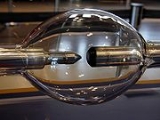
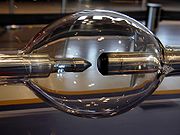
Arc lamp

Encyclopedia
Electric arc
An electric arc is an electrical breakdown of a gas which produces an ongoing plasma discharge, resulting from a current flowing through normally nonconductive media such as air. A synonym is arc discharge. An arc discharge is characterized by a lower voltage than a glow discharge, and relies on...
(also called a voltaic arc). The lamp consists of two electrode
Electrode
An electrode is an electrical conductor used to make contact with a nonmetallic part of a circuit...
s, first made from carbon but typically made today of tungsten
Tungsten
Tungsten , also known as wolfram , is a chemical element with the chemical symbol W and atomic number 74.A hard, rare metal under standard conditions when uncombined, tungsten is found naturally on Earth only in chemical compounds. It was identified as a new element in 1781, and first isolated as...
, which are separated by a gas. The type of lamp is often named by the gas contained in the bulb; including neon
Neon
Neon is the chemical element that has the symbol Ne and an atomic number of 10. Although a very common element in the universe, it is rare on Earth. A colorless, inert noble gas under standard conditions, neon gives a distinct reddish-orange glow when used in either low-voltage neon glow lamps or...
, argon
Argon
Argon is a chemical element represented by the symbol Ar. Argon has atomic number 18 and is the third element in group 18 of the periodic table . Argon is the third most common gas in the Earth's atmosphere, at 0.93%, making it more common than carbon dioxide...
, xenon
Xenon
Xenon is a chemical element with the symbol Xe and atomic number 54. The element name is pronounced or . A colorless, heavy, odorless noble gas, xenon occurs in the Earth's atmosphere in trace amounts...
, krypton
Krypton
Krypton is a chemical element with the symbol Kr and atomic number 36. It is a member of Group 18 and Period 4 elements. A colorless, odorless, tasteless noble gas, krypton occurs in trace amounts in the atmosphere, is isolated by fractionally distilling liquified air, and is often used with other...
, sodium
Sodium
Sodium is a chemical element with the symbol Na and atomic number 11. It is a soft, silvery-white, highly reactive metal and is a member of the alkali metals; its only stable isotope is 23Na. It is an abundant element that exists in numerous minerals, most commonly as sodium chloride...
, metal halide, and mercury
Mercury (element)
Mercury is a chemical element with the symbol Hg and atomic number 80. It is also known as quicksilver or hydrargyrum...
, or by the type of electrode as in carbon
Carbon
Carbon is the chemical element with symbol C and atomic number 6. As a member of group 14 on the periodic table, it is nonmetallic and tetravalent—making four electrons available to form covalent chemical bonds...
-arc lamps. The common fluorescent lamp
Fluorescent lamp
A fluorescent lamp or fluorescent tube is a gas-discharge lamp that uses electricity to excite mercury vapor. The excited mercury atoms produce short-wave ultraviolet light that then causes a phosphor to fluoresce, producing visible light. A fluorescent lamp converts electrical power into useful...
is actually a low-pressure mercury arc lamp.
Operation
The electric arc in an arc lamp consists of gas, which is initially ionIon
An ion is an atom or molecule in which the total number of electrons is not equal to the total number of protons, giving it a net positive or negative electrical charge. The name was given by physicist Michael Faraday for the substances that allow a current to pass between electrodes in a...
ized by a high voltage and therefore becomes electrically conductive. To start an arc lamp, a very high voltage is pulsed across the lamp to "ignite" or "strike" the arc across the gas. This requires an electrical circuit with an igniter and a ballast
Electrical ballast
An electrical ballast is a device intended to limit the amount of current in an electric circuit. A familiar and widely used example is the inductive ballast used in fluorescent lamps, to limit the current through the tube, which would otherwise rise to destructive levels due to the tube's...
. The ballast is wired in series with the lamp and performs two functions.
First, when the power is first switched on, the igniter/starter (which is wired in parallel across the lamp) sets up a small current through the ballast and starter. This creates a small magnetic field within the ballast windings. A moment later the starter interrupts the current flow from the ballast, which has a high inductance and therefore tries to maintain the current flow (the ballast opposes any change in current through it); it cannot, as there is no longer a 'circuit'. As a result, a high voltage appears across the ballast momentarily - to which the lamp is connected, therefore the lamp receives this high voltage across it which 'strikes' the arc within the tube/lamp. The circuit will repeat this action until the lamp is ionized enough to sustain the arc.
When the lamp sustains the arc, the ballast performs its second function, to limit the current to that needed to operate the lamp. The lamp, ballast and igniter are rated matched to each other; these parts must be replaced with the same rating as the failed component or the lamp will not work.
The colour of the light emitted by the lamp changes as its electrical characteristics change with temperature and time. Lightning
Lightning
Lightning is an atmospheric electrostatic discharge accompanied by thunder, which typically occurs during thunderstorms, and sometimes during volcanic eruptions or dust storms...
is a similar principle where the atmosphere is ionized by the high potential difference (voltage) between earth and storm clouds.
The temperature of the arc in an arc lamp can reach several thousand degrees Celsius. The outer glass envelope can reach 500 degrees Celsius, therefore before servicing one must ensure the bulb has cooled sufficiently to handle. Often, if these type of lamps are turned off or lose their power supply, one cannot restrike the lamp again for several minutes (called cold restrike lamps). However, some lamps (mainly fluorescent tubes/energy saving lamps) can be restruck as soon as they are turned off (called hot restrike lamps).
Carbon arc lamp
Carbon
Carbon is the chemical element with symbol C and atomic number 6. As a member of group 14 on the periodic table, it is nonmetallic and tetravalent—making four electrons available to form covalent chemical bonds...
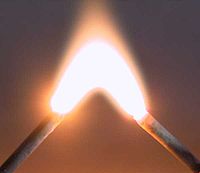
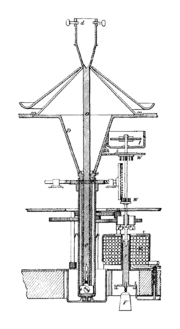
arc lamp only. In a carbon arc lamp, the electrodes are carbon rods in free air. To ignite the lamp, the rods are touched together, thus allowing a relatively low voltage to strike the arc. The rods are then slowly drawn apart, and electric current heats and maintains an arc across the gap. The tips of the carbon rods are heated to incandescence, creating light. The rods are slowly burnt away in use, and the distance between them needs to be regularly adjusted in order to maintain the arc. Many ingenious mechanisms were invented to effect this automatically, mostly based on solenoids. In the simplest form (which was soon superseded by more smoothly acting devices) the electrodes are mounted vertically. The current supplying the arc is passed in series through a solenoid attached to the top electrode. If the points of the electrodes are touching (as in start up) the resistance falls, the current increases and the increased pull from the solenoid draws the points apart. If the arc starts to fail the current drops and the points close up again.
History
The concept of carbon-arc lighting was first demonstrated by Sir Humphry DavyHumphry Davy
Sir Humphry Davy, 1st Baronet FRS MRIA was a British chemist and inventor. He is probably best remembered today for his discoveries of several alkali and alkaline earth metals, as well as contributions to the discoveries of the elemental nature of chlorine and iodine...
in the early 19th century (1802, 1805, 1807 and 1809 are all mentioned), using charcoal sticks and a 2000-cell battery
Battery (electricity)
An electrical battery is one or more electrochemical cells that convert stored chemical energy into electrical energy. Since the invention of the first battery in 1800 by Alessandro Volta and especially since the technically improved Daniell cell in 1836, batteries have become a common power...
to create an arc across a 4 inches (101.6 mm) gap. He mounted his electrodes horizontally and noted that, because of the strong convection flow of air, the arc formed the shape of an arch. He coined the term "arch lamp", which was contracted to "arc lamp" when the devices came into common usage.
The Carbon-Arc Lighting Industry in the U.S.
In the United States, there were attempts to produce arc lamps commercially after 1850 but the lack of a constant electricity supply thwarted efforts. Thus electrical engineers began focusing on the problem of improving Faraday'sMichael Faraday
Michael Faraday, FRS was an English chemist and physicist who contributed to the fields of electromagnetism and electrochemistry....
dynamo
Electrical generator
In electricity generation, an electric generator is a device that converts mechanical energy to electrical energy. A generator forces electric charge to flow through an external electrical circuit. It is analogous to a water pump, which causes water to flow...
. The concept was improved upon by a number of people including William Staite and Charles F. Brush
Charles F. Brush
Charles Francis Brush was a U.S. inventor, entrepreneur and philanthropist.-Biography:Born in Euclid Township, Ohio, Brush was raised on a farm about 10 miles from downtown Cleveland...
. It was not until the 1870s that lamps such as the Yablochkov candle
Yablochkov candle
A Yablochkov candle is a type of electric carbon arc lamp, invented in 1876 by Pavel Yablochkov.-Design:A Yablochkov candle consists of a sandwich of two long carbon blocks, approximately 6 by 12 millimetres in cross-section, separated by a block of inert material such as plaster of paris or kaolin...
were more commonly seen. In 1877, the Franklin Institute
Franklin Institute
The Franklin Institute is a museum in Philadelphia, Pennsylvania, and one of the oldest centers of science education and development in the United States, dating to 1824. The Institute also houses the Benjamin Franklin National Memorial.-History:On February 5, 1824, Samuel Vaughn Merrick and...
conducted a comparative test of dynamo systems. The one developed by Brush performed best, and Brush immediately applied his improved dynamo to arc-lighting an early application being Public Square
Public Square
Public Square is the central plaza in downtown Cleveland, Ohio, United States. It takes up four city blocks; Superior Avenue and Ontario Street cross through it. Cleveland's three tallest buildings, Key Tower, 200 Public Square and the Terminal Tower, face the square...
in Cleveland, Ohio
Cleveland, Ohio
Cleveland is a city in the U.S. state of Ohio and is the county seat of Cuyahoga County, the most populous county in the state. The city is located in northeastern Ohio on the southern shore of Lake Erie, approximately west of the Pennsylvania border...
, on April 29, 1879. In 1880, Brush established the Brush Electric Company
Brush Electrical Machines
Brush Electrical Machines is a manufacturer of large generators for gas turbine and steam turbine drive applications, based at Loughborough in Leicestershire, United Kingdom....
.
The harsh and brilliant light was found most suitable for public areas, such as Cleveland's Public Square, being around 200 times more powerful than contemporary filament lamps
Incandescent light bulb
The incandescent light bulb, incandescent lamp or incandescent light globe makes light by heating a metal filament wire to a high temperature until it glows. The hot filament is protected from air by a glass bulb that is filled with inert gas or evacuated. In a halogen lamp, a chemical process...
.
The usage of Brush electric arc lights spread quickly. Scientific American reported in 1881 that the system was being used in:
- 800 lights in rolling mills, steel works, shops, etc.
- 1,240 lights in woolen, cotton, linen, silk, and other factories
- 425 lights in large stores, hotels, churches, etc.
- 250 lights in parks, docks, and summer resorts
- 275 lights in railroad depots and shops
- 130 lights in mines, smelting works, etc.
- 380 lights in factories and establishments of various kinds
- 1,500 lights in lighting stations, for city lighting, etc.
- 1,200 lights in England and other foreign countries.
- A total of over 6,000 lights which are actually sold
There were three major advances in the 1880s:
- The arcs were enclosed in a small tube to slow the carbon consumption (increasing the life span to around 100 hours).
- Flame arc lamps were introduced where the carbon rods had metal salts (usually magnesium, strontium, barium, or calcium fluorides) added to increase light output and produce different colours.
- František KřižíkFrantišek KrižíkFrantišek Křižík was a Czech inventor, electrical engineer and entrepreneur. The main belt asteroid 5719 Křižík was named in his honor....
invented a mechanism to allow the automatic adjustment of the electrodes.
In the U.S., patent protection of arc-lighting systems and improved dynamos proved difficult and as a result the arc-lighting industry became highly competitive. Brush's principal competition was from the team of Elihu Thomson
Elihu Thomson
Elihu Thomson was an American engineer and inventor who was instrumental in the founding of major electrical companies in the United States, the United Kingdom and France.-Early life:...
and Edwin J. Houston
Edwin J. Houston
Edwin J. Houston was an American electrical inventor. He graduated from New York Central High School in 1864...
. These two had formed the American Electric Company in 1880, but it was soon bought up by Charles A. Coffin
Charles A. Coffin
Charles Albert Coffin was the cofounder and first President of General Electric corporation. He was born in Somerset, Massachusetts to Albert Coffin and his wife Anstrus Varney. He married Caroline Russell of Holbrook, Massachusetts and had three children.He moved to join his uncle Charles E...
, moved to Lynn, Massachusetts
Lynn, Massachusetts
Lynn is a city in Essex County, Massachusetts, United States. The population was 89,050 at the 2000 census. An old industrial center, Lynn is home to Lynn Beach and Lynn Heritage State Park and is about north of downtown Boston.-17th century:...
, and renamed the Thomson-Houston Electric Company
Thomson-Houston Electric Company
The Thomson-Houston Electric Company was a manufacturing company which was one of the precursors of the General Electric Company.The Thomson-Houston Electric Company was formed in 1883 in the United States when a group of Lynn, Massachusetts investors led by Charles A...
. Thomson remained, though, the principal inventive genius behind the company patenting improvements to the lighting system. Under the leadership of Thomson-Houston's patent attorney, Frederick P. Fish, the company protected its new patent rights. Coffin's management also led the company towards an aggressive policy of buy-outs and mergers with competitors. Both strategies reduced competition in the electrical lighting manufacturing industry. By 1890, the Thomson-Houston company was the dominant electrical manufacturing company in the U.S. Nikola Tesla
Nikola Tesla
Nikola Tesla was a Serbian-American inventor, mechanical engineer, and electrical engineer...
received U.S. Patent 447920, "Method of Operating Arc-Lamps" (March 10, 1891), that describes a 10,000 cycles per second alternator to suppress the disagreeable sound of power-frequency harmonics produced by arc lamps operating on frequencies within the range of human hearing.
Around the turn of the century arc-lighting systems were in decline, but Thomson-Houston controlled key patents to urban lighting systems. This control slowed the expansion of incandescent lighting systems being developed by Thomas Edison's
Thomas Edison
Thomas Alva Edison was an American inventor and businessman. He developed many devices that greatly influenced life around the world, including the phonograph, the motion picture camera, and a long-lasting, practical electric light bulb. In addition, he created the world’s first industrial...
Edison General Electric Company. Conversely, Edison's control of direct current distribution and generating machinery patents blocked further expansion of Thomson-Houston. The roadblock to expansion was removed when the two companies merged in 1892 to form the General Electric Company.
Arc lamps were used in some early motion-picture studios to illuminate interior shots. One problem was that they produce such a high level of ultra-violet light that many actors needed to wear sunglasses
Sunglasses
Sunglasses or sun glasses are a form of protective eyewear designed primarily to prevent bright sunlight and high-energy visible light from damaging or discomforting the eyes. They can sometimes also function as a visual aid, as variously termed spectacles or glasses exist, featuring lenses that...
when off camera to relieve sore eyes resulting from the ultra-violet light. The problem was solved by adding a sheet of ordinary window glass in front of the lamp, blocking the ultra-violet. By the dawn of the "talkies", arc lamps had been replaced in film studios with other types of lights. In 1915, Elmer Ambrose Sperry
Elmer Ambrose Sperry
Elmer Ambrose Sperry was a prolific inventor and entrepreneur, most famous as co-inventor, with Herman Anschütz-Kaempfe of the gyrocompass.Sperry was born at Cincinnatus, New York, United States of America...
began manufacturing his invention of a high-intensity carbon arc searchlight
Searchlight
A searchlight is an apparatus that combines a bright light source with some form of curved reflector or other optics to project a powerful beam of light of approximately parallel rays in a particular direction, usually constructed so that it can be swiveled about.-Military use:The Royal Navy used...
. These were used aboard warships of all navies during the 20th century for signaling and illuminating enemies. In the 1920s, carbon arc lamps were sold as family health products, a substitute for natural sunlight.
Arc lamps were soon superseded by more efficient and longer-lasting filament lamps in most roles, remaining in only certain niche applications such as cinema
Movie theater
A movie theater, cinema, movie house, picture theater, film theater is a venue, usually a building, for viewing motion pictures ....
projection
Movie projector
A movie projector is an opto-mechanical device for displaying moving pictures by projecting them on a projection screen. Most of the optical and mechanical elements, except for the illumination and sound devices, are present in movie cameras.-Physiology:...
, followspot
Followspot
A followspot, sometimes known as a spot light, is a powerful stage lighting instrument which projects a bright beam of light onto a performance space. Followspots are controlled by a spotlight operator who follows actors around the stage...
s, and searchlights, but even in these applications conventional carbon arc lamps are being pushed into obsolescence by xenon arc lamp
Xenon arc lamp
A xenon arc lamp is a specialized type of gas discharge lamp, an electric light that produces light by passing electricity through ionized xenon gas at high pressure to produce a bright white light that closely mimics natural sunlight...
s.
See also
- Electric lightElectric lightElectric lights are a convenient and economic form of artificial lighting which provide increased comfort, safety and efficiency. Most electric lighting is powered by centrally-generated electric power, but lighting may also be powered by mobile or standby electric generators or battery systems...
- Léon FoucaultLéon FoucaultJean Bernard Léon Foucault was a French physicist best known for the invention of the Foucault pendulum, a device demonstrating the effect of the Earth's rotation...
- GraphiteGraphiteThe mineral graphite is one of the allotropes of carbon. It was named by Abraham Gottlob Werner in 1789 from the Ancient Greek γράφω , "to draw/write", for its use in pencils, where it is commonly called lead . Unlike diamond , graphite is an electrical conductor, a semimetal...
- František KřižíkFrantišek KrižíkFrantišek Křižík was a Czech inventor, electrical engineer and entrepreneur. The main belt asteroid 5719 Křižík was named in his honor....
- Large Format Slide ProjectorLarge Format Slide ProjectorA large-format slide projector is a kind of slide projector which has a very powerful light source...
- Light bulb
- List of light sources
- Manual metal arc welding
- Movie projectorMovie projectorA movie projector is an opto-mechanical device for displaying moving pictures by projecting them on a projection screen. Most of the optical and mechanical elements, except for the illumination and sound devices, are present in movie cameras.-Physiology:...
- Walther NernstWalther NernstWalther Hermann Nernst FRS was a German physical chemist and physicist who is known for his theories behind the calculation of chemical affinity as embodied in the third law of thermodynamics, for which he won the 1920 Nobel Prize in chemistry...
- PhotolithographyPhotolithographyPhotolithography is a process used in microfabrication to selectively remove parts of a thin film or the bulk of a substrate. It uses light to transfer a geometric pattern from a photomask to a light-sensitive chemical "photoresist", or simply "resist," on the substrate...
- PraseodymiumPraseodymiumPraseodymium is a chemical element that has the symbol Pr and atomic number 59. Praseodymium is a soft, silvery, malleable and ductile metal in the lanthanide group. It is too reactive to be found in native form, and when artificially prepared, it slowly develops a green oxide coating.The element...
- Stage lightingStage lightingModern stage lighting is a flexible tool in the production of theatre, dance, opera and other performance arts. Several different types of stage lighting instruments are used in the pursuit of the various principles or goals of lighting. Stage lighting has grown considerably in recent years...
- Timeline of lighting technologyTimeline of lighting technologyTimeline of lighting technology- Antiquity :* 70,000 BCE A hollow rock, shell, or other natural found object was filled with moss or a similar material that was soaked in animal fat and then ignited.* c. 4500 BCE oil lamps...
- Tesla patents
- Yablochkov candleYablochkov candleA Yablochkov candle is a type of electric carbon arc lamp, invented in 1876 by Pavel Yablochkov.-Design:A Yablochkov candle consists of a sandwich of two long carbon blocks, approximately 6 by 12 millimetres in cross-section, separated by a block of inert material such as plaster of paris or kaolin...
- Pavel YablochkovPavel YablochkovPavel Nikolayevich Yablochkov was a Russian electrical engineer, the inventor of the Yablochkov candle and businessman.-Biography:...
External links
- Arc Lamp - Interactive Java Tutorial National High Magnetic Field Laboratory