

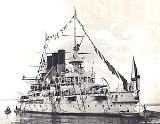
Russian battleship Retvizan

Encyclopedia
Retvizan was a Russian pre-dreadnought battleship built before the Russo-Japanese War
Russo-Japanese War
The Russo-Japanese War was "the first great war of the 20th century." It grew out of rival imperial ambitions of the Russian Empire and Japanese Empire over Manchuria and Korea...
of 1904–05 for the Imperial Russian Navy
Imperial Russian Navy
The Imperial Russian Navy refers to the Tsarist fleets prior to the February Revolution.-First Romanovs:Under Tsar Mikhail Feodorovich, construction of the first three-masted ship, actually built within Russia, was completed in 1636. It was built in Balakhna by Danish shipbuilders from Holstein...
in the United States
United States
The United States of America is a federal constitutional republic comprising fifty states and a federal district...
. She was built by the William Cramp and Sons
William Cramp and Sons
thumb | upright | 1899 advertisement for William Cramp & Sons William Cramp & Sons Shipbuilding Company of Philadelphia was founded in 1825 by William Cramp, and was the preeminent U.S. iron shipbuilder in the 19th century. The American Ship & Commerce Corporation bought the yard in 1919 but closed...
Ship & Engine Building Company of Philadelphia, although the armament was made at the Obukhov works in Saint Petersburg
Saint Petersburg
Saint Petersburg is a city and a federal subject of Russia located on the Neva River at the head of the Gulf of Finland on the Baltic Sea...
and shipped to America for installation. Retvizan was named after the Swedish ship of the line
Ship of the line
A ship of the line was a type of naval warship constructed from the 17th through the mid-19th century to take part in the naval tactic known as the line of battle, in which two columns of opposing warships would manoeuvre to bring the greatest weight of broadside guns to bear...
Rättvisan (meaning The Justice) which was captured by the Russians at the Battle of Viborg Bay in 1790.
Retvizan was torpedoed during the Japanese surprise attack on Port Arthur
Lüshunkou
Lüshunkou is a district in the municipality of Dalian, Liaoning province, China. Also called Lüshun City or Lüshun Port, it was formerly known as both Port Arthur and Ryojun....
during the night of 8–9 February 1904 and grounded in the harbor entrance when she attempted to take refuge inside as her draft had significantly deepened from all of the water she had taken aboard after the torpedo hit. She was eventually refloated and repaired by mid-June. She joined the rest of the 1st Pacific Squadron when they attempted to reach Vladivostok
Vladivostok
The city is located in the southern extremity of Muravyov-Amursky Peninsula, which is about 30 km long and approximately 12 km wide.The highest point is Mount Kholodilnik, the height of which is 257 m...
though the Japanese blockade on 10 August. The Japanese battle fleet engaged them in the Battle of the Yellow Sea
Battle of the Yellow Sea
The Battle of the Yellow Sea was a major naval engagement of the Russo-Japanese War, fought on 10 August 1904. In the Russian Navy, it was referred to as the Battle of 10 August. The battle foiled an attempt by the Russian fleet at Port Arthur to break out and form up with counterparts from...
and forced most of the Russian ships to return to Port Arthur after killing the squadron commander and damaging his flagship
Flagship
A flagship is a vessel used by the commanding officer of a group of naval ships, reflecting the custom of its commander, characteristically a flag officer, flying a distinguishing flag...
. She was sunk by Japanese howitzer
Howitzer
A howitzer is a type of artillery piece characterized by a relatively short barrel and the use of comparatively small propellant charges to propel projectiles at relatively high trajectories, with a steep angle of descent...
s in December after the Japanese had gained control of the heights around the harbor.
The Japanese raised her after the surrender of Port Arthur in January 1905 and repaired her. She was commissioned in the Imperial Japanese Navy
Imperial Japanese Navy
The Imperial Japanese Navy was the navy of the Empire of Japan from 1869 until 1947, when it was dissolved following Japan's constitutional renunciation of the use of force as a means of settling international disputes...
as in 1908. In Sasebo
Sasebo, Nagasaki
is a city located in Nagasaki Prefecture, Japan. As of 2011, the city has an estimated population of 259,800 and the density of 609 persons per km². The total area is 426.47 km². The locality is famed for its scenic beauty. The city includes a part of Saikai National Park...
when the Japanese declared war on Germany
German Empire
The German Empire refers to Germany during the "Second Reich" period from the unification of Germany and proclamation of Wilhelm I as German Emperor on 18 January 1871, to 1918, when it became a federal republic after defeat in World War I and the abdication of the Emperor, Wilhelm II.The German...
in 1914 she was sent to reinforce the weak British squadron in British Columbia
British Columbia
British Columbia is the westernmost of Canada's provinces and is known for its natural beauty, as reflected in its Latin motto, Splendor sine occasu . Its name was chosen by Queen Victoria in 1858...
, but was diverted to Hawaii
Hawaii
Hawaii is the newest of the 50 U.S. states , and is the only U.S. state made up entirely of islands. It is the northernmost island group in Polynesia, occupying most of an archipelago in the central Pacific Ocean, southwest of the continental United States, southeast of Japan, and northeast of...
when reports of the arrival of a German gunboat there were received. She was sent to search for other German ships after the Americans interned the German ship in November, but did not encounter any. After World War I
World War I
World War I , which was predominantly called the World War or the Great War from its occurrence until 1939, and the First World War or World War I thereafter, was a major war centred in Europe that began on 28 July 1914 and lasted until 11 November 1918...
she supported the Japanese intervention
Siberian Intervention
The ', or the Siberian Expedition, of 1918–1922 was the dispatch of troops of the Entente powers to the Russian Maritime Provinces as part of a larger effort by the western powers and Japan to support White Russian forces against the Bolshevik Red Army during the Russian Civil War...
in the Russian Civil War
Russian Civil War
The Russian Civil War was a multi-party war that occurred within the former Russian Empire after the Russian provisional government collapsed to the Soviets, under the domination of the Bolshevik party. Soviet forces first assumed power in Petrograd The Russian Civil War (1917–1923) was a...
, but was disarmed in 1922 in accordance with the Washington Naval Treaty
Washington Naval Treaty
The Washington Naval Treaty, also known as the Five-Power Treaty, was an attempt to cap and limit, and "prevent 'further' costly escalation" of the naval arms race that had begun after World War I between various International powers, each of which had significant naval fleets. The treaty was...
. She was sunk as a gunnery target in 1924.
Background
Charles Henry Cramp, the owner and son of the founder of William Cramp and SonsWilliam Cramp and Sons
thumb | upright | 1899 advertisement for William Cramp & Sons William Cramp & Sons Shipbuilding Company of Philadelphia was founded in 1825 by William Cramp, and was the preeminent U.S. iron shipbuilder in the 19th century. The American Ship & Commerce Corporation bought the yard in 1919 but closed...
, had a relationship with the Imperial Russian Navy
Imperial Russian Navy
The Imperial Russian Navy refers to the Tsarist fleets prior to the February Revolution.-First Romanovs:Under Tsar Mikhail Feodorovich, construction of the first three-masted ship, actually built within Russia, was completed in 1636. It was built in Balakhna by Danish shipbuilders from Holstein...
dating back to the late 1870s when his firm built the auxiliary cruisers Afrika, Azia
Russian cruiser Asia (1878)
The Asia was a cruiser of the Imperial Russian Navy. The ship was one of three merchantmen purchased in the United States by the Russian government in 1878 to be transformed into cruisers; the State of California became the Europa, the Saratoga became the Afrika, and the Columbus became the...
, Evropa and Zabiiaka. Cramp also repaired several Russian warships visiting America in 1893 and he cultivated his contacts in the Russian Navy throughout the 1890s. Before the end of the decade the Russians had become wary of the Japanese after their victory during the First Sino-Japanese War
First Sino-Japanese War
The First Sino-Japanese War was fought between Qing Dynasty China and Meiji Japan, primarily over control of Korea...
as it was apparent that their ambitions were on a collision course. Russian forces in the Far East needed strengthening to cope with the emergence of Japan as a naval power. At that time the Russian Navy was undergoing rapid expansion and domestic Russian shipyards were not able to meet the demand.
Design
Preliminary design work on a battleship intended to equal the latest Japanese ships was begun over the winter of 1897–98 by the Naval Technical Committee although the displacement was limited to 12000 long tons (12,193 t) for economic reasons. The basic design was that of the with its speed increased to 18 knots using only two shafts and its steaming range increased to 5000 nmi (9,260 km) at 10 kn (12.2 mph; 19.6 km/h). The Naval Ministry intended to conduct an international design competition with the ships being built abroad as the Baltic shipyards were at full capacity already.Cramp's contacts kept him informed of the Russians' intentions and he sailed to Saint Petersburg to offer his services and design expertise in March 1898. Initially Cramp offered American designs to the Russians included an updated version of the as it was a relatively close match for the Russian specification, but the Russians preferred their own designs. Both sides compromised and the final design was based on the Russian battleship . The new ship had four fewer 6 inches (15 cm) guns, but twice the coal capacity for improved range and a longer, slightly narrower, hull for more speed. The contract was signed on 23 April 1898 for a price of $4,360,000. The protected cruiser
Protected cruiser
The protected cruiser is a type of naval cruiser of the late 19th century, so known because its armoured deck offered protection for vital machine spaces from shrapnel caused by exploding shells above...
was ordered at the same time for $2,138,000.
General characteristics
Retvizan was 382 in 3 in (116.51 m) long at the waterline and 386 in 8 in (117.86 m) long overall. She had a beamBeam (nautical)
The beam of a ship is its width at the widest point. Generally speaking, the wider the beam of a ship , the more initial stability it has, at expense of reserve stability in the event of a capsize, where more energy is required to right the vessel from its inverted position...
of 72 in 2 in (22 m) and a draft
Draft (hull)
The draft of a ship's hull is the vertical distance between the waterline and the bottom of the hull , with the thickness of the hull included; in the case of not being included the draft outline would be obtained...
of 25 feet (7.6 m). She displaced 12780 long tons (12,985 t) at load. Her hull was subdivided by fourteen transverse and one centerline longitudinal watertight bulkhead (only in the engine room). It had a complete double bottom
Double bottom
A double bottom is a ship hull design and construction method where the bottom of the ship has two complete layers of watertight hull surface: one outer layer forming the normal hull of the ship, and a second inner hull which is somewhat higher in the ship, perhaps a few feet, which forms a...
that extended up the side to the lower edge of the armor deck. She had a metacentric height
Metacentric height
The metacentric height is a measurement of the static stability of a floating body. It is calculated as the distance between the centre of gravity of a ship and its metacentre . A larger metacentric height implies greater stability against overturning...
of 3 in 2 in (0.9652 m).
Propulsion
Retvizan had two 3-cylinder vertical triple-expansion steam engines with a total designed output of 16000 ihp. Twenty-four Niclausse-type boilers provided steam to the engines at a working pressure of 18 atm (1,824 kPa; 265 psi). The Russian Navy preferred to use Belleville water-tube boilerWater-tube boiler
A water tube boiler is a type of boiler in which water circulates in tubes heated externally by the fire. Fuel is burned inside the furnace, creating hot gas which heats water in the steam-generating tubes...
s, but Cramp pressed for 24 Niclausse-type boilers, not least because he was the American agent for them, and was supported by the General Admiral
General Admiral
General admiral was a Danish, Dutch, German, Russian, Portuguese, Spanish and Swedish naval rank. Its historic origin is a title high military or naval dignitaries of early modern Europe sometimes held, for example the commander-in-chief of the Dutch Republic's navy .-Third Reich:In the German...
Grand Duke Alexei Alexandrovich
Grand Duke Alexei Alexandrovich of Russia
Grand Duke Alexei Alexandrovich of Russia was the sixth child and the fourth son of Alexander II of Russia and his first wife Maria Alexandrovna . Destined to a naval career, Alexei Alexandrovich started his military training at the age of 7...
. On sea trial
Sea trial
A sea trial is the testing phase of a watercraft . It is also referred to as a "shakedown cruise" by many naval personnel. It is usually the last phase of construction and takes place on open water, and can last from a few hours to many days.Sea trials are conducted to measure a vessel’s...
s, the engines produced 17111 ihp and a top speed of 17.99 knots, just under the contract speed of 18 knots. Not surprisingly, Cramp claimed that she reached 18.01 knots to avoid contractual penalties. Following Retvizans arrival in Russia, the propeller pitch was adjusted and she exceeded 18 knots. She carried a normal load of 1016 long tons (1,032.3 t) of coal that provided a range of 4900 nautical miles (9,074.8 km) at a speed of 10 knots (5.4 m/s) and a maximum load of 2000 long tons (2,032.1 t) that gave 8000 nautical miles (14,816 km) at the same speed.
Armament
The armament was supplied by the Russians and shipped to America for installation. The main armament consisted of two pairs of 12-inchRussian 12 inch 40 caliber naval gun
The 12 inch 40 caliber naval gun was the standard main weapon of the pre-dreadnought battleships of the Imperial Russian Navy. Sixty-eight guns of the first production run were built in 1895–1906 by the Obukhov Works in Saint Petersburg...
40-caliber
Caliber (artillery)
In artillery, caliber or calibredifference in British English and American English spelling is the internal diameter of a gun barrel, or by extension a relative measure of the length....
guns mounted in French-style center-pivot twin turret
Turret
In architecture, a turret is a small tower that projects vertically from the wall of a building such as a medieval castle. Turrets were used to provide a projecting defensive position allowing covering fire to the adjacent wall in the days of military fortification...
s fore and aft. These guns had a maximum elevation of 15° and could depress to -5°. 77 rounds per gun were carried. They fired a 731.3 pounds (331.7 kg) shell at a muzzle velocity
Muzzle velocity
Muzzle velocity is the speed a projectile has at the moment it leaves the muzzle of the gun. Muzzle velocities range from approximately to in black powder muskets , to more than in modern rifles with high-performance cartridges such as the .220 Swift and .204 Ruger, all the way to for tank guns...
of 2598 ft/s (791.9 m/s) to a range of 12010 yards (10,981.9 m) at an elevation of 10°.
Eight of the twelve 6-inch Canet Pattern
Canet guns
The Canet guns were a series of weapon systems developed by the French engineer Gustave Canet , who was design engineer for Schneider et Cie of Le Creusot.-320 mm naval guns:...
1892 45-caliber guns were mounted in casemate
Casemate
A casemate, sometimes rendered casement, is a fortified gun emplacement or armored structure from which guns are fired. originally a vaulted chamber in a fortress.-Origin of the term:...
s on the main deck while four were mounted on the upper deck. The guns could elevate to a maximum of 20° and depress to -5°. They fired shells that weighed 91.27 lb (41.4 kg) with a muzzle velocity of 2600 ft/s (792.5 m/s). They had a maximum range of 12600 yards (11,521.4 m) when fired at maximum elevation. They could fire three to five rounds per minute and were provided with 200 rounds per gun.
The anti-torpedo boat
Torpedo boat
A torpedo boat is a relatively small and fast naval vessel designed to carry torpedoes into battle. The first designs rammed enemy ships with explosive spar torpedoes, and later designs launched self-propelled Whitehead torpedoes. They were created to counter battleships and other large, slow and...
armament consisted of twenty 75 millimetres (3 in) Canet Pattern 1892 50-caliber guns. Fourteen of these were in embrasures on the main deck and six were mounted on the upper deck, between the six-inch casemates. Each gun was provided with 325 rounds. The gun fired 10.8 pounds (4.9 kg) shells to a range of about 8600 yards (7,864 m) at its maximum elevation of 21° with a muzzle velocity of 2700 ft/s (823 m/s). The rate of fire was between twelve and fifteen rounds per minute.
A total of twenty-four 47 millimetres (1.9 in) Hotchkiss gun
Hotchkiss gun
The Hotchkiss gun can refer to different products of the Hotchkiss arms company starting in the late 19th century. It usually refers to the 1.65-inch light mountain gun; there was also a 3-inch Hotchkiss gun...
s were carried; four in each fighting top
Top (sailing ship)
On a traditional square rigged ship, the top is the platform at the upper end of each mast. This is not the masthead "crow's nest" of the popular imagination – above the mainmast is the main-topmast, main-topgallant-mast and main-royal-mast, so that the top is actually about 1/4 to 1/3 of the way...
and eight at each end of the superstructure. They fired a 3.3 pounds (1.5 kg) shell at a muzzle velocity of 1476 ft/s (449.9 m/s) at a rate of 20 rounds per minute to a range of 2020 yards (1,847.1 m). Six 37 millimetres (1.5 in) Hotchkiss guns were mounted in the bridge wings. They fired a 1.1 pound (0.498951607 kg) shell at a muzzle velocity of 1450 ft/s (442 m/s) at a rate of 20 rounds per minute to a range of 3038 yards (2,777.9 m).
Retvizan carried six 15 inches (381 mm) torpedo tube
Torpedo tube
A torpedo tube is a device for launching torpedoes. There are two main types of torpedo tube: underwater tubes fitted to submarines and some surface ships, and deck-mounted units installed aboard surface vessels...
s. Four were above water, one each in the bow and stern and the aft pair of broadside
Broadside
A broadside is the side of a ship; the battery of cannon on one side of a warship; or their simultaneous fire in naval warfare.-Age of Sail:...
tubes. The forward broadside tubes were underwater. 17 torpedoes were carried. She was designed to carry two second-class torpedo boats equipped with single torpedo tube
Torpedo tube
A torpedo tube is a device for launching torpedoes. There are two main types of torpedo tube: underwater tubes fitted to submarines and some surface ships, and deck-mounted units installed aboard surface vessels...
s in the bow and a small quick-firing gun. 45 mines
Naval mine
A naval mine is a self-contained explosive device placed in water to destroy surface ships or submarines. Unlike depth charges, mines are deposited and left to wait until they are triggered by the approach of, or contact with, an enemy vessel...
could also be carried.
Armor
The total weight of the Krupp armorKrupp armour
Krupp armour was a type of steel armour used in the construction of capital ships starting shortly before the end of the 19th century. It was developed by Germany's Krupp Arms Works in 1893 and quickly replaced Harvey armour as the primary method of protecting naval ships.The initial manufacturing...
was 3300 LT (3,353 t) or 25.8% of the displacement. The armor was mostly made in the United States, although a contract was let for deck armor from Russia on 6 January 1899. The main waterline belt
Belt armor
Belt armor is a layer of heavy metal armor plated on to or within outer hulls of warships, typically on battleships, battlecruisers and cruisers, and on aircraft carriers converted from those types of ships....
had a maximum thickness of 9 inches (23 cm) and tapered to 5 inches (13 cm) thick at its lower edge. It was 256 feet (78 m) long and 7 feet (2.1 m) high, of which about 3 foot (0.9144 m) of this was above the design waterline. The upper belt was 6 inches thick and was as long as the main belt. It was 7 inch high. Armor plates 2 inches (5 cm) thick protected the ends of the ship to a height equal to that of the main and upper belts combined. Bulkhead
Bulkhead (partition)
A bulkhead is an upright wall within the hull of a ship or within the fuselage of an airplane. Other kinds of partition elements within a ship are decks and deckheads.-Etymology:...
s 7 inches (17.8 cm) thick provided transverse protection for the ship's vitals. The lower casemate armor was 5 inches (13 cm) thick and armor screens 1.5 inches (4 cm) thick separated each gun. Similarly the upper casemate armor consisted of five inches of armor plate with semicircular 1.5-inch armor bulkheads enclosing the guns.
The face and sides of the turret
Turret
In architecture, a turret is a small tower that projects vertically from the wall of a building such as a medieval castle. Turrets were used to provide a projecting defensive position allowing covering fire to the adjacent wall in the days of military fortification...
s were 9 inches (229 mm) thick with 2-inch roofs. Their barbette
Barbette
A barbette is a protective circular armour feature around a cannon or heavy artillery gun. The name comes from the French phrase en barbette referring to the practice of firing a field gun over a parapet rather than through an opening . The former gives better angles of fire but less protection...
s were 8 inches (20 cm) thick above the upper deck, but reduced to 4 inches (102 mm) below it. The conning tower
Conning tower
A conning tower is a raised platform on a ship or submarine, often armored, from which an officer can con the vessel; i.e., give directions to the helmsman. It is usually located as high on the ship as practical, to give the conning team good visibility....
and its communication tube had 10 inches (25 cm) walls. The armor deck inside the central citadel was level with the top of the main belt and sloped down to meet the lower edge of the main belt. It was two inches thick on the flat and 2.5 inches (6 cm) on the slope. Fore and aft of the citadel the deck thickened to 3 inches (8 cm) to the ends of the ship and reinforced the ram bow.
Influence
The s built for the US Navy were designed by Charles Cramp and based on the Retvizan. They had a lower quarterdeck, two more 6-inch guns and a slightly thicker belt.Construction
Retvizan was ordered on 2 May 1898 for delivery in thirty months. The detailed sketch design was forwarded at the end of 1898 to Saint Petersburg for approval and work commenced on the ship around that time, although she was not officially laid down until 29 July 1899. Construction was delayed by a strike at the shipyard that began in August 1899 and continued until the strike collapsed in early 1900. Other delays were caused by differences between American and Russian shipbuilding techniques and the insistence of the Naval Ministry on approving any design changes even though a Russian commission had been sent to Philadelphia to supervise her construction.Her armament arrived in Philadelphia missing electrical cables and with incomplete documentation which required Cramp's electricians to piece things together themselves, for which Cramp charged an extra $50,000. She was launched 23 October 1900 and ran her acceptance trials in October 1901. While successful they revealed a fair amount of incomplete work that Cramp had to finish before he received his last payment. More work needed to be done on her armament, but it had to wait until she arrived in Russia. Retvizan was accepted on 23 March 1902, under the command of Captain Eduard Schensnovich
Eduard Schensnovich
Eduard Nikolayevich Schensnovich Eduárd Nikoláevič Ščensnóvič, occasionally transliterated as was an admiral in the Imperial Russian Navy.- Biography :...
who commanded her throughout her Russian service.
Service
Retvizan sailed for the Baltic SeaBaltic Sea
The Baltic Sea is a brackish mediterranean sea located in Northern Europe, from 53°N to 66°N latitude and from 20°E to 26°E longitude. It is bounded by the Scandinavian Peninsula, the mainland of Europe, and the Danish islands. It drains into the Kattegat by way of the Øresund, the Great Belt and...
on 13 May 1902 and stopped to re-coal in Cherbourg, France
France
The French Republic , The French Republic , The French Republic , (commonly known as France , is a unitary semi-presidential republic in Western Europe with several overseas territories and islands located on other continents and in the Indian, Pacific, and Atlantic oceans. Metropolitan France...
enroute. After leaving Cherbourg a boiler tube burst on 14 June, scalding six stokers, three of them fatally. After her arrival she was fitted with radio equipment and took part in a Naval Review in Reval
Tallinn
Tallinn is the capital and largest city of Estonia. It occupies an area of with a population of 414,940. It is situated on the northern coast of the country, on the banks of the Gulf of Finland, south of Helsinki, east of Stockholm and west of Saint Petersburg. Tallinn's Old Town is in the list...
staged for the State visit of Kaiser Wilhelm II in August. Later that month she tested an experimental system for coaling at sea; it was deemed successful, but her equipment was removed before she sailed for the Pacific. Retvizan departed on 13 November 1902 for the Far East in company with the battleship and the cruisers , and . She arrived at Port Arthur (now Lüshunkou
Lüshunkou
Lüshunkou is a district in the municipality of Dalian, Liaoning province, China. Also called Lüshun City or Lüshun Port, it was formerly known as both Port Arthur and Ryojun....
), China on 4 May 1903 accompanied by only Pallada.
Battle of Port Arthur 8–9 February 1904
During the Battle of Port ArthurBattle of Port Arthur
The Battle of Port Arthur was the starting battle of the Russo-Japanese War...
, the Retvizan had been torpedoed during the initial Japanese surprise attack on the Russian fleet in Port Arthur
Battle of Port Arthur
The Battle of Port Arthur was the starting battle of the Russo-Japanese War...
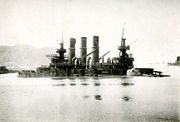
on the night of 8–9 February 1904. She was hit on the port side forward which blew a 220 square feet (20 m²) hole in her side. Five men in the torpedo flat were killed and the electrical power was knocked out. The ship took on enough water to give her a list of 11°, although this was reduced to 5° by counter-flooding. A sail was used to cover the hole and steam was raised so she could head for the harbor. However, the total 2200 long tons (2,235 t) of water she had taken aboard had increased her draft enough to cause her to ground in the harbor entrance. She was not refloated until 8 March, but she played an important role in defeating a Japanese attempt to seal the entrance with block ships on 23–24 February. Repairs began immediately after she was towed into the harbor and were completed on 3 June although no docks were available and a cofferdam
Cofferdam
A cofferdam is a temporary enclosure built within, or in pairs across, a body of water and constructed to allow the enclosed area to be pumped out, creating a dry work environment for the major work to proceed...
had to be built. She sailed with the rest of the Russian squadron on 23 June in an abortive attempt to reach Vladivostok
Vladivostok
The city is located in the southern extremity of Muravyov-Amursky Peninsula, which is about 30 km long and approximately 12 km wide.The highest point is Mount Kholodilnik, the height of which is 257 m...
. Vice Admiral
Vice Admiral
Vice admiral is a senior naval rank of a three-star flag officer, which is equivalent to lieutenant general in the other uniformed services. A vice admiral is typically senior to a rear admiral and junior to an admiral...
Vitgeft
Wilgelm Vitgeft
Wilgelm Karlovich Vitgeft , sometimes written Wilhelm and Withöft was an admiral in the Imperial Russian Navy, noted for his service in the Russo-Japanese War of 1904-1905.-Biography:...
returned to Port Arthur
Lüshunkou
Lüshunkou is a district in the municipality of Dalian, Liaoning province, China. Also called Lüshun City or Lüshun Port, it was formerly known as both Port Arthur and Ryojun....
when he encountered the Japanese fleet shortly before sunset as he did not wish to engage the numerically superior Japanese in a night battle.
Captain (naval)
Captain is the name most often given in English-speaking navies to the rank corresponding to command of the largest ships. The NATO rank code is OF-5, equivalent to an army full colonel....
Schensnovich was slightly wounded, a barge adjacent to the ship was sunk and she was holed below the waterline. She took on a 1° list from 400 tons of water, which was corrected by counter-flooding. The holes were patched, although the water was not pumped out, and she sailed the next day in another attempt to reach Vladivostok. This sortie resulted in the Battle of the Yellow Sea
Battle of the Yellow Sea
The Battle of the Yellow Sea was a major naval engagement of the Russo-Japanese War, fought on 10 August 1904. In the Russian Navy, it was referred to as the Battle of 10 August. The battle foiled an attempt by the Russian fleet at Port Arthur to break out and form up with counterparts from...
, where she was hit by 18 shells and suffered 6 dead and 43 wounded.
Battle of the Yellow Sea 10 August 1904
At approximately 1840 hours on 10 August during the final phase of the Battle of the Yellow Sea, the Russian flagshipFlagship
A flagship is a vessel used by the commanding officer of a group of naval ships, reflecting the custom of its commander, characteristically a flag officer, flying a distinguishing flag...
was hit by 12-inch shells which killed Admiral Vitgeft and his immediate staff. The Russian battleship turned out of control, disrupting the Russian formation with its uncontrolled movements. As Admiral Togo's pre-dreadnoughts continued to pound the Tsesarevich with their 12-inch fire, Captain Eduard Schensnovich
Eduard Schensnovich
Eduard Nikolayevich Schensnovich Eduárd Nikoláevič Ščensnóvič, occasionally transliterated as was an admiral in the Imperial Russian Navy.- Biography :...
, commander of the Retzivan, boldly charged Togo's battleline. The Japanese battleline immediately shifted their fire onto the charging Retzivan, firing so many shells that they were unable to adjust their fire due to the tremendous number of shell splashes engulfing the Russian battleship. As the Russian squadron was now disorganized, and Togo's battleships were running low on main gun ammunition, coupled with some disabled 12-guns, he turned the battle over to his cruiser
Cruiser
A cruiser is a type of warship. The term has been in use for several hundreds of years, and has had different meanings throughout this period...
s and destroyer
Destroyer
In naval terminology, a destroyer is a fast and maneuverable yet long-endurance warship intended to escort larger vessels in a fleet, convoy or battle group and defend them against smaller, powerful, short-range attackers. Destroyers, originally called torpedo-boat destroyers in 1892, evolved from...
s, and began his turn away. Retzivan had effectively ended the duel between the opposing battleship fleets, and had saved the Russian flagship from destruction. During the battle, Retvizan had received 18 hits from both 8 and 12-inch guns, and suffered 6 sailors killed and another 42 men wounded, including Captain Schensnovich.
Retvizan, along with most of the rest of the squadron, returned to Port Arthur after Admiral Vitgeft had been killed by Japanese shells. During the battle she lacked two six-inch, two 47-mm and six 37-mm guns which had been landed to reinforce the landward defenses of the port. She was subsequently besieged in Port Arthur
Siege of Port Arthur
The Siege of Port Arthur , 1 August 1904 – 2 January 1905, the deep-water port and Russian naval base at the tip of the Liaotung Peninsula in Manchuria, was the longest and most violent land battle of the Russo-Japanese War....
and sunk at her moorings by thirteen 28 centimetres (11 in) howitzer shells on 6 December 1904. Captain Schensnovich signed the capitulation of Port Arthur for the Imperial Russian Navy on 2 January 1905.
Japanese service
Retvizan was later raised by the Japanese on 22 September 1905 and repaired at SaseboSasebo Naval Arsenal
was one of four principal naval shipyards owned and operated by the Imperial Japanese Navy. -History:The Sasebo Naval District was established at Sasebo, Nagasaki in 1886, as the third of the naval districts responsible for the defense of the Japanese home islands. After the establishment of the...
between January 1906 and November 1908. Her fighting top
Top (sailing ship)
On a traditional square rigged ship, the top is the platform at the upper end of each mast. This is not the masthead "crow's nest" of the popular imagination – above the mainmast is the main-topmast, main-topgallant-mast and main-royal-mast, so that the top is actually about 1/4 to 1/3 of the way...
s were removed, her light weapons were replaced by Japanese weapons and her Niclausse boilers were replaced by Miyabara boilers. Renamed Hizen, she served in the Imperial Japanese Navy
Imperial Japanese Navy
The Imperial Japanese Navy was the navy of the Empire of Japan from 1869 until 1947, when it was dissolved following Japan's constitutional renunciation of the use of force as a means of settling international disputes...
during World War I
World War I
World War I , which was predominantly called the World War or the Great War from its occurrence until 1939, and the First World War or World War I thereafter, was a major war centred in Europe that began on 28 July 1914 and lasted until 11 November 1918...
. She was dispatched to Esquimalt, British Columbia
British Columbia
British Columbia is the westernmost of Canada's provinces and is known for its natural beauty, as reflected in its Latin motto, Splendor sine occasu . Its name was chosen by Queen Victoria in 1858...
in October 1914 to reinforce the weak British squadron there, although she was diverted to Honolulu, Hawaii
Hawaii
Hawaii is the newest of the 50 U.S. states , and is the only U.S. state made up entirely of islands. It is the northernmost island group in Polynesia, occupying most of an archipelago in the central Pacific Ocean, southwest of the continental United States, southeast of Japan, and northeast of...
before the end of the month to watch the German gunboat after it arrived on 15 October. She watched the port in company with the armored cruiser
Armored cruiser
The armored cruiser was a type of warship of the late 19th and early 20th centuries. Like other types of cruiser, the armored cruiser was a long-range, independent warship, capable of defeating any ship apart from a battleship, and fast enough to outrun any battleships it encountered.The first...
until Geier was interned on 8 November by the Americans. Afterwards she and Asama headed south in search of the German squadron, but never located them. Hizen supported the Japanese intervention
Allied Intervention in the Russian Civil War
The Allied intervention was a multi-national military expedition launched in 1918 during World War I which continued into the Russian Civil War. Its operations included forces from 14 nations and were conducted over a vast territory...
in the Russian Civil War
Russian Civil War
The Russian Civil War was a multi-party war that occurred within the former Russian Empire after the Russian provisional government collapsed to the Soviets, under the domination of the Bolshevik party. Soviet forces first assumed power in Petrograd The Russian Civil War (1917–1923) was a...
. On 1 September 1921 she was reclassified as a 1st class coast defense ship and disarmed in April 1922 in accordance with the Washington Naval Treaty
Washington Naval Treaty
The Washington Naval Treaty, also known as the Five-Power Treaty, was an attempt to cap and limit, and "prevent 'further' costly escalation" of the naval arms race that had begun after World War I between various International powers, each of which had significant naval fleets. The treaty was...
. She was stricken on 20 September 1923 and sunk as a target ship
Target ship
A target ship is a vessel — typically an obsolete or captured warship — used for naval gunnery practice or for weapons testing.-Rationale:Sinking redundant warships is an effective way of testing new weapons and warships in as realistic a manner as possible. Whilst practice torpedoes are fired...
in the Bungo Channel
Bungo Channel
The is a strait separating the Japanese islands of Kyūshū and Shikoku. It connects the Pacific Ocean and Seto Inland Sea. The narrowest part of this channel is the Hōyo Strait....
on 12 July 1924.
External links
- - article in Russian Language
- - article in English aimed at model builders
- - Cramp's shipyard founded by William Cramp, (Philadelphia: William Cramp and Sons Ship and Engine Company, 1902)
Further reading
- Bethlehem Steel Company, 1904 Ordnance Material Catalog, (Bethlehem, Pa.: The Company, 1904)
- С. А. Балакин, Эскадренный броненосец «Ретвизан» (Коллекция, Яуза, Эксмо, 2005 г.) ISBN 5-699-12917-0
- Э. Н. Щенснович, Плавание эскадренного броненосца Ретвизан. 1902—1904 (Альманах `Цитадель`, Галея Принт, 1999 г.) ISBN 5-8172-0012-0