

Shapinsay

Encyclopedia
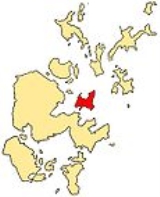
Shapinsay is one of the Orkney Islands off the north coast of mainland Scotland. There is one village on the island, Balfour
, from which roll-on/roll-off car ferries sail to Kirkwall
on the Orkney Mainland. Balfour Castle
, built in the Scottish Baronial style
, is one of the island's most prominent features, a reminder of the Balfour family's domination of Shapinsay during the 18th and 19th centuries; the Balfours transformed life on the island by introducing new agricultural techniques. Other landmarks include a standing stone
, an Iron Age
broch
, a souterrain
and a salt-water shower.
With an area of 29.5 square kilometres (11.4 sq mi), Shapinsay is the eighth largest island in the Orkney archipelago. It is low-lying and fertile, consequently most of the area is given over to farming. Shapinsay has two nature reserve
s and is notable for its bird life.
As of the 2001 census, Shapinsay has a population of 300. The economy of the island is primarily based on agriculture with the exception of a few small businesses that are largely tourism-related. Plans for the construction of a wind turbine
are under consideration.
for island, but the first two syllables are more difficult to interpret. Haswell-Smith (2004) suggests the root may be hjalpandis-øy (helpful island) owing to the presence of a good harbour, although anchorages are plentiful in the archipelago
. The first written record dates from 1375 in a reference to Scalpandisay, which may suggest a derivation from Judge's island. Another suggestion is Hyalpandi's island, although no one of that name is known to be associated with Shapinsay.
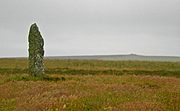 Standing stones provide evidence of the island's human occupation since Neolithic
times. According to Tacitus
, the Roman general Agricola
subdued the inhabitants of the Orkney Islands, and a local legend holds that he landed on Shapinsay. During the 18th century, a croft named Grukalty was renamed Agricola (which is also Latin for "farmer"). Roman coins have been found on Shapinsay, but they may have been brought to the island by traders.
Shapinsay is briefly mentioned in the Norse sagas
. The Saga of Haakon Haakonsson
states that Haakon IV of Norway
anchored in Elwick Bay before sailing south to eventual defeat at the Battle of Largs
.
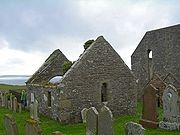 The 18th century saw the beginnings of change to agriculture
on Shapinsay, courtesy of the Balfour family. The family owned the estate of Sound, which covered the western part of the island. Sound had passed from the Tulloch family to the Buchanan family in the 17th century. In 1674, Arthur Buchanan built the house of Sound, where Balfour Castle
now stands. His granddaughter married James Fea, who is best known for his role in the capture of the Orkney Pirate John Gow
. Fea was a supporter of the Jacobite Rebellion, and the house was burned by Hanoverian
troops in revenge. The estate was acquired by Andrew Ross, Stewart Depute in Orkney of the Earl of Morton
. Ross's heirs, the Lindsay brothers, sold the estate to Thomas Balfour in 1782. Balfour had previously rented the Bu of Burray
, a large manor farm on another Orkney island, but had insufficient wealth to acquire the estate even though his wife had inherited a legacy on the death of her aristocratic brother. To raise the necessary funds, Balfour had to sell his military commission and borrow from his brother, John, who was prospering in India with the East India Company. Once installed on the island, he built a new house, Cliffdale, and founded the village of Shoreside, now known as Balfour
. He also reformed the local agriculture, enclosing fields and constructing farm buildings.
William Irving was born c. 1740 in the small hamlet
of Quholm
in the northeast of the island. He became a sailor before emigrating to New York in 1763. One of his sons was Washington Irving
, author of Rip van Winkle
and the first American author to gain international recognition.
Marjory Meason, a native of Shapinsay, was the last person to be executed in Orkney, in 1728. She was a young servant, hanged in Kirkwall for the murder of a child. The execution is recorded as requiring 24 armed men, not including officers, and costing £15 8s.
During this period, burning kelp
was a mainstay of the island economy. More than 3048 tonnes (3,000 LT) of burned seaweed were produced per annum to make soda ash, bringing in £20,000 for the inhabitants. Thomas Balfour's income from the kelp industry brought him four times the income that farming did.
 The 19th century saw more radical change in Shapinsay. Thomas Balfour's grandson, David Balfour, transformed the island after inheriting the family estate, which by 1846 encompassed the whole of Shapinsay. Most of the land was divided into fields of 4 hectares (10 acre), a feature that is still apparent today. Tenants were required to enclose
and drain the land or pay for the estate to do it in the form of a surcharge added to their rents. In 1846, 303 hectares (1.17 sq mi) on Shapinsay consisted of arable land. By 1860, that had trebled to more than 890.3 hectares (3.44 sq mi). New crops and breeds of cattle and sheep were also introduced. Balfour's reforms were described as "the fountain and source of Orkney Improvement."
Balfour also gave the island its most noticeable landmark when he recruited an Edinburgh
architect, David Bryce
, to transform Cliffdale House into the Scottish Baronial Balfour Castle. Other buildings he added to the island include the porter's lodge (now a public house
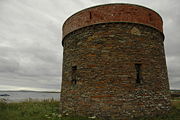
called The Gatehouse), a water mill, a school, and a gasworks that remained operational until the 1920s. The gasworks is in the form of a round tower with a corbelled parapet of red brick and carved stones—including one possibly removed from Noltland Castle
on Westray
, which is inscribed with the year 1725. The structure appears to be fortified, in accordance with Balfour's intention to give the village a medieval appearance. David Balfour was also responsible for the construction of Mill Dam
, a wetland which was once the water supply
for the mill and is now an RSPB
nature reserve.
Fishing for herring
and cod
also grew in importance during the 19th century. Herring fishing was expanding generally in Scotland at that time, with fishing stations being set up in remote areas. Herring fishing began in 1814 on Stronsay
and soon spread throughout the Orkney Islands. By the middle of the century, Shapinsay had 50 herring boats. Cod became important largely because the Napoleonic Wars
forced English fishing boats to fish further north. Local fishermen, who had been catching fish using lines from small boats for centuries, also began trawling
for cod. However, this was largely a part-time venture, unlike in Shetland, where many inhabitants made a living from fishing. A saying originating from this time states, "a Shetlander is a fisherman with a croft, while an Orcadian is a farmer with a boat." Consequently, fishermen from outside the Orkney Islands earned a large share of the profits. Helliar Holm's beaches were used to dry both herring and cod after they had been salted. With the end of the Napoleonic Wars, which led to cheaper sources of soda ash becoming available from continental Europe, the kelp industry collapsed by 1830. This collapse helped fuel agricultural reform, as crofters accustomed to earning a second income had to now earn more from farming.
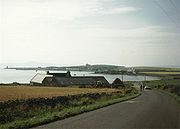 The Balfour estate sold its farms on Shapinsay between 1924 and 1928. This was a common occurrence in Orkney at the time as wealthy landowners moved to more lucrative forms of investment. Farms were generally sold to the sitting tenant or to their neighbours who wished to expand.
The 20th century saw many changes in farming on Shapinsay. Mechanised implements came to the island, particularly after the Second World War. In common with the rest of Orkney, the amount of land given over to growing grass increased. The growing of grain (with the exception of barley
) and turnip
s steadily declined as these were replaced as winter fodder for livestock by silage
, usually harvested by mechanical forage harvester
s.
Orkney was a strategic site during both World Wars, and Shapinsay was no exception. In 1917, during the First World War, the 836 tonnes (823 LT) Swiftsure was hit by a mine 4 kilometres (2.5 mi) east of Haco's Ness and sank in 19 metres (62 ft) of water with the loss of a single life. The site of the wreck was not discovered until 1997.
During the Second World War, gun batteries were built on the island. A twin six pounder
emplacement at Galtness Battery on the coast at Salt Ness protected the Wide Firth from German torpedo boats. A Castle Battery was operational from 1941–43, as was an anti-aircraft battery. Mains electricity
arrived on Shapinsay in the 1970s, when an underwater cable was laid from Kirkwall.
The trend towards more intensive farming began to be partially reversed by the end of the century as more environmentally friendly practices were encouraged by government and European Union
grants. For example, Richard Zawadzki, owner of Balfour Mains (the largest farm on the island), ceased to breed livestock (instead keeping animals bred elsewhere) and grows less grain (some barley is still grown on the farm). Instead, some of the land is now managed under a Habitat Creation Scheme, which aims to encourage natural vegetation, wild flowers and nesting birds by limiting grazing and reducing the use of chemical fertilisers.
Tourism started to become important in the latter half of the century; the first restaurant to incorporate bed and breakfast
facilities opened in 1980.
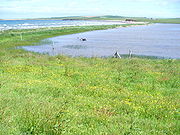 With an area of 2948 hectares (11 sq mi), Shapinsay is the 8th largest Orkney island and the 29th largest Scottish island. The highest point of Ward Hill is 64 metres (210 ft) above sea level. The east coast is composed of low cliffs and has several sea caves, including the picturesque geo
at the extreme northern tip known as Geo of Ork
. Elwick Bay is a sheltered anchorage on the south coast, facing the Orkney mainland; the island's largest settlement, Balfour, is at the western end of the bay.
The island has several ayres
, or storm beach
es, which form narrow spits of shingle
or sand cutting across the landward and seaward ends of shallow bays. They can sometimes cut off a body of water from the sea, forming shallow freshwater loch
s known as oyces. Examples include Vasa Loch
and Lairo Water.
There are several small islands in the vicinity including Broad Shoal, Grass Holm and Skerry of Vasa. Helliar Holm
is a tidal islet
at the eastern entrance to the main harbour at Balfour; it has a small lighthouse
and a ruined broch
. The String, a stretch of water that lies between Helliar Holm and the mainland, has strong tidal currents.
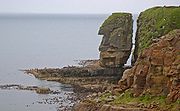 In common with most of the Orkney isles, Shapinsay has a bedrock
formed from Old Red Sandstone
, which is approximately 400 million years old and was laid down in the Devonian
period. These thick deposits accumulated as earlier Silurian
rocks, uplifted by the formation of Pangaea
, eroded and then deposited into river deltas. The freshwater Orcadian Lakes
existed on the edges of these eroding
mountains, stretching from Shetland to the southern Moray Firth
. The composition of Shapinsay is mostly of the Rousay
flagstone group from the Lower Middle Devonian, with some Eday flagstone in the southeast formed in wetter conditions during the later Upper Devonian. The latter is regarded as a better quality building material than the former. At Haco's Ness in the south east corner of the island is a small outcrop of amygdaloidal diabase
. The island is overlain with a fertile layer of boulder clay formed during the Pleistocene
glaciations.
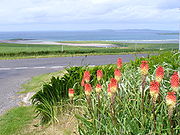 The island's bird life is particularly rich in waders such as curlew
and redshank
, found at The Ouse
and Veantro Bay
, and gull and tern
colonies on the rockier shores and cliffs. Pintail
, shovellers and whooper swan
s are regular summer visitors, and there are also breeding populations of shelduck
s, hen harrier
s and bonxies
. There is an introduced population of red-legged partridge
s. Otters
can be seen at the Ouse, Lairo Water and Vasa Loch, and at various places around the coast along with common seals and Atlantic grey seals
. There are plans to build a hide to allow visitors to observe seals without disturbing them. Shapinsay and Hoy
are the only two larger Orkney islands that lack the Orkney vole
(Microtus arvalis orcadensis). Wildflowers abound in the summer, and the lichen
Melaspilea interjecta, which is endemic to Scotland, is found in only three locations, including Shapinsay. In addition to the RSPB reserve at Mill Dam
there is a Scottish Wildlife Trust
reserve at East Hill in the southeast.
The highest recorded population for Shapinsay is 974, in 1881. Since then, the population of the island has steadily declined; less than a third of that number was recorded in the 2001 census. The rate of absolute population loss was lower in the last decades of the 20th century than it had been in the first half of that century. As of 2001, Shapinsay had a population of 300, a decline of 6.8% from the 1991 population of 322. This is greater than the population decline for Orkney overall in the same period, which was 1.9%. However, the loss in population on Shapinsay was less than that experienced by most Orkney islands, most of which experienced declines of more than 10%. The number of persons per hectare on Shapinsay was 0.1, similar to the 0.2 persons per hectare in Orkney.
Of the island's 300 inhabitants, 283 were born in the United Kingdom (227 in Scotland and 56 in England). Seventeen were born outside the United Kingdom (four elsewhere in Europe, four in Asia, four in North America, one in South America and four in Oceania). By age group, 85 of the inhabitants were under 30 years of age, 134 were aged between 30 and 59, and 71 were age 60 and over.
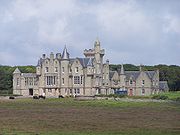 Balfour Castle dominates views of the southwest of the island and can be seen from the tower of St. Magnus Cathedral in Kirkwall. The castle library features a secret passage hidden behind a false set of bookshelves. The Balfours escaped unwelcome visitors through this passageway, which leads to the conservatory door, enabling the butler to truthfully tell visitors that the Balfours were not in the house. Another feature of the castle is the stags' heads with gaslights at the tips of their antlers, although these are no longer used as working lights. The castle grounds feature deciduous woodland (now rare in Orkney) and 2 acres (8,093.7 m²) of walled gardens.
Other buildings constructed by David Balfour include the Dishan Tower, known locally as The Douche. This is a saltwater shower building with a dovecote
on top. A local landmark due to its high visibility when approaching the island by sea, the building is now in a serious state of disrepair, with roofing slates missing and the dovecote in danger of collapsing. The Shapinsay Heritage Trust has applied to the Heritage Lottery Fund
for funds to repair the tower, and a survey is planned to determine what work will be needed.
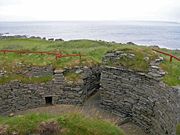 A more ancient dwelling on Shapinsay is the Iron Age Broch of Burroughston
. Only the interior of this partially buried building has been excavated, allowing visitors to look down into the broch from the surrounding mound. The surviving drystone walls rise to about three metres (10 ft) and are more than four metres (13 ft) thick in some places.
The broch shows more evidence of David Balfour's influence on Shapinsay. He arranged for the site to be excavated by the archaeologists George Petrie and Sir William Dryden in 1861. The site was neglected after the excavation, slowly filling up with vegetation and rubble before being cleared in 1994.
Shapinsay Heritage Centre is located in Balfour's former smithy, along with a craft shop and a cafe. The castle's former gatehouse is now the village public house.
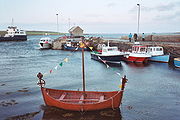
provides transport for pedestrians and vehicles, proximity to Kirkwall
permitting closer contacts with the Orkney Mainland than is possible for most of the other North Isles. There are six crossings per day, the journey lasting about 25 minutes, which allows for a moderate amount of commuting. Between 1893 and 1964, the island was served by the steamer Iona. Since 1964, the Klydon and then the Clytus have operated the service; the current ferry is the MV Shapinsay. The Orkney Islands Council has considered building a tunnel to the Orkney Mainland. Balfour Castle
is now run as a hotel by the family of Captain Tadeusz Zawadzki, a Polish
cavalry officer.
 The Shapinsay development trust
is working on the island's community plan, including plans to build a wind turbine. As of August 2007, a feasibility study has been carried out and, in December 2006, the trust held a "Renewable Energy Awareness Day" on the island. A study on the impact the turbine will have on the island's bird life is under way, and meteorological and visual impact studies are planned. According to the development trust, the turbine could earn more than £5 million during its 25-year lifetime.
Small businesses on Shapinsay include a jam and chutney
manufacturer, which uses traditional methods, and a studio offering residential arts courses such as stained glass
crafting.
. This centre uses the internet, email and video-conferencing to allow students in Shapinsay to study without leaving the island.
In December 2006, the pupils staged a joint Christmas show with a school in Grinder, Norway
, 875 kilometres (544 mi) from Shapinsay. The schools used the internet to collaborate, supported by BT Group
(BT), which upgraded the school's broadband connection. The finale of the show involved the Norwegian pupils singing Away in a Manger in English while the Shapinsay pupils responded with En Stjerne Skinner I Natt in Norwegian. This multilingual collaboration was somewhat easier for the Grinder pupils, who are taught English from the age of six. This collaboration was part of an ongoing relationship between the schools, whose children exchange letters and cards. Shapinsay school's headteacher has visited the Norwegian school, and there are plans for a reciprocal visit in 2008.
Shapinsay Community School has gained a Silver Award under the international Eco-Schools
programme. School pupils have carried out an energy audit, helped to plant more than 600 trees close to the school and carried out energy saving campaigns. Shapinsay pupils have also won an award from the Scottish Crofters Commission for producing a booklet on crofting
on the island.
, has a presence on Shapinsay. He was originally based on the historical figure Kolbein Hrúga, who built Cubbie Roo's Castle in 1150 on the isle of Wyre
, which is possibly the oldest castle
in Scotland, and was mentioned in the Orkneyinga Saga
. However, the figure Cubbie Roo has departed far from his historical origins and has become a giant in the fashion that Finn MacCool (legendary builder of the Giant's Causeway
) has in Ireland. He is said to have lived on the island of Wyre and used Orkney's islands as stepping stones. Many large stones on Orkney islands, including Shapinsay, are said to have been thrown or left there by the giant. Cubbie Roo's Burn is a waterway on Shapinsay that flows through a channel called Trolldgeo. Cubbie Roo's Lade is a pile of stones on the shore near Rothiesholm Head, the westmost point of Stronsay
. This is supposedly the beginning of a bridge between the two islands that the giant had failed to complete. The name derives from the Old Norse trolla-hlad, meaning "giant's causeway".
In 1905, The Orcadian newspaper reported that a strange creature had been seen off the coast of Shapinsay. It was reportedly the size of a horse, with a spotted body covered in scales. Opinion on the creature's origin was divided, with some islanders believing it to be a sea serpent
, while others opined that it was merely a large seal.
Balfour, Orkney
Balfour is a village on the island of Shapinsay, Orkney. The village is situated on Elwick Bay, which was used as an anchorage by Haakon IV of Norway before sailing south to eventual defeat at the Battle of Largs. Today, the village still possesses a harbour, with mock defensive walls constructed...
, from which roll-on/roll-off car ferries sail to Kirkwall
Kirkwall
Kirkwall is the biggest town and capital of Orkney, off the coast of northern mainland Scotland. The town is first mentioned in Orkneyinga saga in the year 1046 when it is recorded as the residence of Rögnvald Brusason the Earl of Orkney, who was killed by his uncle Thorfinn the Mighty...
on the Orkney Mainland. Balfour Castle
Balfour Castle
Balfour Castle is a historic building on the southwest of Shapinsay, Orkney Islands. Though built around an older structure that dates at least from the 18th century, the present castle was built in 1847, commissioned by Colonel David Balfour, and designed by Edinburgh architect David...
, built in the Scottish Baronial style
Scottish baronial style
The Scottish Baronial style is part of the Gothic Revival architecture style, using stylistic elements and forms from castles, tower houses and mansions of the Gothic architecture period in Scotland, such as Craigievar Castle and Newark Castle, Port Glasgow. The revival style was popular from the...
, is one of the island's most prominent features, a reminder of the Balfour family's domination of Shapinsay during the 18th and 19th centuries; the Balfours transformed life on the island by introducing new agricultural techniques. Other landmarks include a standing stone
Standing stone
Standing stones, orthostats, liths, or more commonly megaliths are solitary stones set vertically in the ground and come in many different varieties....
, an Iron Age
Iron Age
The Iron Age is the archaeological period generally occurring after the Bronze Age, marked by the prevalent use of iron. The early period of the age is characterized by the widespread use of iron or steel. The adoption of such material coincided with other changes in society, including differing...
broch
Broch
A broch is an Iron Age drystone hollow-walled structure of a type found only in Scotland. Brochs include some of the most sophisticated examples of drystone architecture ever created, and belong to the classification "complex Atlantic Roundhouse" devised by Scottish archaeologists in the 1980s....
, a souterrain
Souterrain
Souterrain is a name given by archaeologists to a type of underground structure associated mainly with the Atlantic Iron Age. These structures appear to have been brought northwards from Gaul during the late Iron Age. Regional names include earth houses, fogous and Pictish houses...
and a salt-water shower.
With an area of 29.5 square kilometres (11.4 sq mi), Shapinsay is the eighth largest island in the Orkney archipelago. It is low-lying and fertile, consequently most of the area is given over to farming. Shapinsay has two nature reserve
Nature reserve
A nature reserve is a protected area of importance for wildlife, flora, fauna or features of geological or other special interest, which is reserved and managed for conservation and to provide special opportunities for study or research...
s and is notable for its bird life.
As of the 2001 census, Shapinsay has a population of 300. The economy of the island is primarily based on agriculture with the exception of a few small businesses that are largely tourism-related. Plans for the construction of a wind turbine
Wind turbine
A wind turbine is a device that converts kinetic energy from the wind into mechanical energy. If the mechanical energy is used to produce electricity, the device may be called a wind generator or wind charger. If the mechanical energy is used to drive machinery, such as for grinding grain or...
are under consideration.
Etymology
Unlike most of the larger Orkney islands, the derivation of the name 'Shapinsay' is not obvious. The final 'ay' is from the Old NorseOld Norse
Old Norse is a North Germanic language that was spoken by inhabitants of Scandinavia and inhabitants of their overseas settlements during the Viking Age, until about 1300....
for island, but the first two syllables are more difficult to interpret. Haswell-Smith (2004) suggests the root may be hjalpandis-øy (helpful island) owing to the presence of a good harbour, although anchorages are plentiful in the archipelago
Archipelago
An archipelago , sometimes called an island group, is a chain or cluster of islands. The word archipelago is derived from the Greek ἄρχι- – arkhi- and πέλαγος – pélagos through the Italian arcipelago...
. The first written record dates from 1375 in a reference to Scalpandisay, which may suggest a derivation from Judge's island. Another suggestion is Hyalpandi's island, although no one of that name is known to be associated with Shapinsay.
Early history
Neolithic
The Neolithic Age, Era, or Period, or New Stone Age, was a period in the development of human technology, beginning about 9500 BC in some parts of the Middle East, and later in other parts of the world. It is traditionally considered as the last part of the Stone Age...
times. According to Tacitus
Tacitus
Publius Cornelius Tacitus was a senator and a historian of the Roman Empire. The surviving portions of his two major works—the Annals and the Histories—examine the reigns of the Roman Emperors Tiberius, Claudius, Nero and those who reigned in the Year of the Four Emperors...
, the Roman general Agricola
Gnaeus Julius Agricola
Gnaeus Julius Agricola was a Roman general responsible for much of the Roman conquest of Britain. His biography, the De vita et moribus Iulii Agricolae, was the first published work of his son-in-law, the historian Tacitus, and is the source for most of what is known about him.Born to a noted...
subdued the inhabitants of the Orkney Islands, and a local legend holds that he landed on Shapinsay. During the 18th century, a croft named Grukalty was renamed Agricola (which is also Latin for "farmer"). Roman coins have been found on Shapinsay, but they may have been brought to the island by traders.
Shapinsay is briefly mentioned in the Norse sagas
Saga
Sagas, are stories in Old Norse about ancient Scandinavian and Germanic history, etc.Saga may also refer to:Business*Saga DAB radio, a British radio station*Saga Airlines, a Turkish airline*Saga Falabella, a department store chain in Peru...
. The Saga of Haakon Haakonsson
Hákonar saga Hákonarsonar
Hákonar saga Hákonarsonar is an Old Norse kings' saga, telling the story of the life and reign of King Haakon Haakonarson of Norway. The saga was written by the Icelandic historian and chieftain Sturla Þórðarson, in the 1260s...
states that Haakon IV of Norway
Haakon IV of Norway
Haakon Haakonarson , also called Haakon the Old, was king of Norway from 1217 to 1263. Under his rule, medieval Norway reached its peak....
anchored in Elwick Bay before sailing south to eventual defeat at the Battle of Largs
Battle of Largs
The Battle of Largs was an engagement fought between the armies of Norway and Scotland near the present-day town of Largs in North Ayrshire on the Firth of Clyde in Scotland on 2 October 1263. It was the most important military engagement of the Scottish-Norwegian War. The Norwegian forces were...
.
18th century
British Agricultural Revolution
British Agricultural Revolution describes a period of development in Britain between the 17th century and the end of the 19th century, which saw an epoch-making increase in agricultural productivity and net output. This in turn supported unprecedented population growth, freeing up a significant...
on Shapinsay, courtesy of the Balfour family. The family owned the estate of Sound, which covered the western part of the island. Sound had passed from the Tulloch family to the Buchanan family in the 17th century. In 1674, Arthur Buchanan built the house of Sound, where Balfour Castle
Balfour Castle
Balfour Castle is a historic building on the southwest of Shapinsay, Orkney Islands. Though built around an older structure that dates at least from the 18th century, the present castle was built in 1847, commissioned by Colonel David Balfour, and designed by Edinburgh architect David...
now stands. His granddaughter married James Fea, who is best known for his role in the capture of the Orkney Pirate John Gow
John Gow
John Gow was a notorious pirate whose short career was immortalized by Charles Johnson in A General History of the Pyrates. Little is known of his life, except from an account by Daniel Defoe, which is often considered unreliable, the report on his execution, and an account by Mr...
. Fea was a supporter of the Jacobite Rebellion, and the house was burned by Hanoverian
Electorate of Hanover
The Electorate of Brunswick-Lüneburg was the ninth Electorate of the Holy Roman Empire of the German Nation...
troops in revenge. The estate was acquired by Andrew Ross, Stewart Depute in Orkney of the Earl of Morton
James Douglas, 14th Earl of Morton
James Douglas, 14th Earl of Morton KT FRS was a Scottish astronomer and representative peer who was President of the Philosophical Society of Edinburgh from its foundation in 1737 until his death...
. Ross's heirs, the Lindsay brothers, sold the estate to Thomas Balfour in 1782. Balfour had previously rented the Bu of Burray
Burray
Burray is one of the Orkney Islands in Scotland. It lies to the east of Scapa Flow and is one of a chain of islands linked by the Churchill Barriers.-Geography and geology:...
, a large manor farm on another Orkney island, but had insufficient wealth to acquire the estate even though his wife had inherited a legacy on the death of her aristocratic brother. To raise the necessary funds, Balfour had to sell his military commission and borrow from his brother, John, who was prospering in India with the East India Company. Once installed on the island, he built a new house, Cliffdale, and founded the village of Shoreside, now known as Balfour
Balfour, Orkney
Balfour is a village on the island of Shapinsay, Orkney. The village is situated on Elwick Bay, which was used as an anchorage by Haakon IV of Norway before sailing south to eventual defeat at the Battle of Largs. Today, the village still possesses a harbour, with mock defensive walls constructed...
. He also reformed the local agriculture, enclosing fields and constructing farm buildings.
William Irving was born c. 1740 in the small hamlet
Hamlet (place)
A hamlet is usually a rural settlement which is too small to be considered a village, though sometimes the word is used for a different sort of community. Historically, when a hamlet became large enough to justify building a church, it was then classified as a village...
of Quholm
Quholm
Quholm is a hamlet in the northeast of Shapinsay, in the islands of Orkney, Scotland. William Irving, the father of Washington Irving, noted American author, was born in Quholm. Innsker Beach is situated very close by at the northwest edge of Quholm...
in the northeast of the island. He became a sailor before emigrating to New York in 1763. One of his sons was Washington Irving
Washington Irving
Washington Irving was an American author, essayist, biographer and historian of the early 19th century. He was best known for his short stories "The Legend of Sleepy Hollow" and "Rip Van Winkle", both of which appear in his book The Sketch Book of Geoffrey Crayon, Gent. His historical works...
, author of Rip van Winkle
Rip Van Winkle
"Rip Van Winkle" is a short story by the American author Washington Irving published in 1819, as well as the name of the story's fictional protagonist. Written while Irving was living in Birmingham, England, it was part of a collection entitled The Sketch Book of Geoffrey Crayon...
and the first American author to gain international recognition.
Marjory Meason, a native of Shapinsay, was the last person to be executed in Orkney, in 1728. She was a young servant, hanged in Kirkwall for the murder of a child. The execution is recorded as requiring 24 armed men, not including officers, and costing £15 8s.
During this period, burning kelp
Kelp
Kelps are large seaweeds belonging to the brown algae in the order Laminariales. There are about 30 different genera....
was a mainstay of the island economy. More than 3048 tonnes (3,000 LT) of burned seaweed were produced per annum to make soda ash, bringing in £20,000 for the inhabitants. Thomas Balfour's income from the kelp industry brought him four times the income that farming did.
19th century
Enclosure
Enclosure or inclosure is the process which ends traditional rights such as mowing meadows for hay, or grazing livestock on common land. Once enclosed, these uses of the land become restricted to the owner, and it ceases to be common land. In England and Wales the term is also used for the...
and drain the land or pay for the estate to do it in the form of a surcharge added to their rents. In 1846, 303 hectares (1.17 sq mi) on Shapinsay consisted of arable land. By 1860, that had trebled to more than 890.3 hectares (3.44 sq mi). New crops and breeds of cattle and sheep were also introduced. Balfour's reforms were described as "the fountain and source of Orkney Improvement."
Balfour also gave the island its most noticeable landmark when he recruited an Edinburgh
Edinburgh
Edinburgh is the capital city of Scotland, the second largest city in Scotland, and the eighth most populous in the United Kingdom. The City of Edinburgh Council governs one of Scotland's 32 local government council areas. The council area includes urban Edinburgh and a rural area...
architect, David Bryce
David Bryce
David Bryce FRSE FRIBA RSA was a Scottish architect. Born in Edinburgh, he was educated at the Royal High School and joined the office of architect William Burn in 1825, aged 22. By 1841, Bryce had risen to be Burn's partner...
, to transform Cliffdale House into the Scottish Baronial Balfour Castle. Other buildings he added to the island include the porter's lodge (now a public house
Public house
A public house, informally known as a pub, is a drinking establishment fundamental to the culture of Britain, Ireland, Australia and New Zealand. There are approximately 53,500 public houses in the United Kingdom. This number has been declining every year, so that nearly half of the smaller...
called The Gatehouse), a water mill, a school, and a gasworks that remained operational until the 1920s. The gasworks is in the form of a round tower with a corbelled parapet of red brick and carved stones—including one possibly removed from Noltland Castle
Noltland Castle
Noltland Castle is located on the island of Westray in the Orkney Islands of Scotland. It dates mainly to the later 16th century, although it was never fully completed...
on Westray
Westray
Westray is one of the Orkney Islands in Scotland, with a population of around 550 people. Its main village is Pierowall, with a heritage centre, the ruined Lady Kirk and ferries to Papa Westray.-Geography and geology:...
, which is inscribed with the year 1725. The structure appears to be fortified, in accordance with Balfour's intention to give the village a medieval appearance. David Balfour was also responsible for the construction of Mill Dam
Mill Dam, Shapinsay
Mill Dam, Shapinsay is a wetland in western Shapinsay, in Orkney, Scotland.This water body was not shown on the 1840 survey map of the island, since it is a man-made creation from a damming in the 1880s. Mill Dam is fed by a stream flowing from the north that rises on the western lobe of Shapinsay...
, a wetland which was once the water supply
Water supply
Water supply is the provision of water by public utilities, commercial organisations, community endeavours or by individuals, usually via a system of pumps and pipes...
for the mill and is now an RSPB
Royal Society for the Protection of Birds
Bird Notes and News was first published in April 1903.The title changed to 'Bird Notes' in 1947. In the 1950s, there were four copies per year . Each volume covered two years, spread over three calendar years...
nature reserve.
Fishing for herring
Herring
Herring is an oily fish of the genus Clupea, found in the shallow, temperate waters of the North Pacific and the North Atlantic oceans, including the Baltic Sea. Three species of Clupea are recognized. The main taxa, the Atlantic herring and the Pacific herring may each be divided into subspecies...
and cod
Cod
Cod is the common name for genus Gadus, belonging to the family Gadidae, and is also used in the common name for various other fishes. Cod is a popular food with a mild flavor, low fat content and a dense, flaky white flesh. Cod livers are processed to make cod liver oil, an important source of...
also grew in importance during the 19th century. Herring fishing was expanding generally in Scotland at that time, with fishing stations being set up in remote areas. Herring fishing began in 1814 on Stronsay
Stronsay
Stronsay is an island in Orkney, off the north coast of Scotland. The main village is Whitehall, home to a heritage centre. It is in size, and at its highest point....
and soon spread throughout the Orkney Islands. By the middle of the century, Shapinsay had 50 herring boats. Cod became important largely because the Napoleonic Wars
Napoleonic Wars
The Napoleonic Wars were a series of wars declared against Napoleon's French Empire by opposing coalitions that ran from 1803 to 1815. As a continuation of the wars sparked by the French Revolution of 1789, they revolutionised European armies and played out on an unprecedented scale, mainly due to...
forced English fishing boats to fish further north. Local fishermen, who had been catching fish using lines from small boats for centuries, also began trawling
Trawling
Trawling is a method of fishing that involves pulling a fishing net through the water behind one or more boats. The net that is used for trawling is called a trawl....
for cod. However, this was largely a part-time venture, unlike in Shetland, where many inhabitants made a living from fishing. A saying originating from this time states, "a Shetlander is a fisherman with a croft, while an Orcadian is a farmer with a boat." Consequently, fishermen from outside the Orkney Islands earned a large share of the profits. Helliar Holm's beaches were used to dry both herring and cod after they had been salted. With the end of the Napoleonic Wars, which led to cheaper sources of soda ash becoming available from continental Europe, the kelp industry collapsed by 1830. This collapse helped fuel agricultural reform, as crofters accustomed to earning a second income had to now earn more from farming.
20th century
The 20th century saw many changes in farming on Shapinsay. Mechanised implements came to the island, particularly after the Second World War. In common with the rest of Orkney, the amount of land given over to growing grass increased. The growing of grain (with the exception of barley
Barley
Barley is a major cereal grain, a member of the grass family. It serves as a major animal fodder, as a base malt for beer and certain distilled beverages, and as a component of various health foods...
) and turnip
Turnip
The turnip or white turnip is a root vegetable commonly grown in temperate climates worldwide for its white, bulbous taproot. Small, tender varieties are grown for human consumption, while larger varieties are grown as feed for livestock...
s steadily declined as these were replaced as winter fodder for livestock by silage
Silage
Silage is fermented, high-moisture fodder that can be fed to ruminants or used as a biofuel feedstock for anaerobic digesters. It is fermented and stored in a process called ensiling or silaging, and is usually made from grass crops, including corn , sorghum or other cereals, using the entire...
, usually harvested by mechanical forage harvester
Forage harvester
A forage harvester is a farm implement that harvests forage plants to make silage. Silage is grass, corn or other plant that has been chopped into small pieces, and compacted together in a storage silo, silage bunker, or in silage bags. The silage is then fermented to provide feed for livestock...
s.
Orkney was a strategic site during both World Wars, and Shapinsay was no exception. In 1917, during the First World War, the 836 tonnes (823 LT) Swiftsure was hit by a mine 4 kilometres (2.5 mi) east of Haco's Ness and sank in 19 metres (62 ft) of water with the loss of a single life. The site of the wreck was not discovered until 1997.
During the Second World War, gun batteries were built on the island. A twin six pounder
Ordnance QF 6 pounder
The Ordnance Quick-Firing 6-pounder 7 cwt, or just 6 pounder, was a British 57 mm gun, their primary anti-tank gun during the middle of World War II, as well as the main armament for a number of armoured fighting vehicles...
emplacement at Galtness Battery on the coast at Salt Ness protected the Wide Firth from German torpedo boats. A Castle Battery was operational from 1941–43, as was an anti-aircraft battery. Mains electricity
Mains electricity
Mains is the general-purpose alternating current electric power supply. In the US, electric power is referred to by several names including household power, household electricity, powerline, domestic power, wall power, line power, AC power, city power, street power, and grid power...
arrived on Shapinsay in the 1970s, when an underwater cable was laid from Kirkwall.
The trend towards more intensive farming began to be partially reversed by the end of the century as more environmentally friendly practices were encouraged by government and European Union
European Union
The European Union is an economic and political union of 27 independent member states which are located primarily in Europe. The EU traces its origins from the European Coal and Steel Community and the European Economic Community , formed by six countries in 1958...
grants. For example, Richard Zawadzki, owner of Balfour Mains (the largest farm on the island), ceased to breed livestock (instead keeping animals bred elsewhere) and grows less grain (some barley is still grown on the farm). Instead, some of the land is now managed under a Habitat Creation Scheme, which aims to encourage natural vegetation, wild flowers and nesting birds by limiting grazing and reducing the use of chemical fertilisers.
Tourism started to become important in the latter half of the century; the first restaurant to incorporate bed and breakfast
Bed and breakfast
A bed and breakfast is a small lodging establishment that offers overnight accommodation and breakfast, but usually does not offer other meals. Since the 1980s, the meaning of the term has also extended to include accommodations that are also known as "self-catering" establishments...
facilities opened in 1980.
Geography
Geo (landscape)
A geo or gio is an inlet, a gully or a narrow and deep cleft in the face of a cliff. Geos are common on the coastline of the Shetland and Orkney islands. They are created by the wave driven erosion of cliffs along faults and bedding planes in the rock. Geos may have sea caves at their heads...
at the extreme northern tip known as Geo of Ork
Geo of Ork
The Geo of Ork is a narrow and deep cleft in the cliff face of the northernmost point on the island of Shapinsay in the Orkney islands. The term geo or gya derives from Old Norse gjá. This landform was created by the wave driven erosion of cliffs along faults or bedding planes in the rock...
. Elwick Bay is a sheltered anchorage on the south coast, facing the Orkney mainland; the island's largest settlement, Balfour, is at the western end of the bay.
The island has several ayres
Ayre (landform)
An ayre is a name often applied to shingle beaches in Orkney and Shetland. The term is derived from the Old Norse wordfor a shingle beach - "eyrr" - and may be applied to ordinary beaches, to cliff-foot beaches to spits, bars and tombolos, but only if formed of shingle. It is sometimes wrongly...
, or storm beach
Storm beach
A storm beach is a beach affected by particularly fierce waves, usually with a very long fetch. The resultant landform is often a very steep beach composed of rounded cobbles, shingle and occasionally sand...
es, which form narrow spits of shingle
Shingle beach
A shingle beach is a beach which is armoured with pebbles or small- to medium-sized cobbles. Typically, the stone composition may grade from characteristic sizes ranging from two to 200 mm diameter....
or sand cutting across the landward and seaward ends of shallow bays. They can sometimes cut off a body of water from the sea, forming shallow freshwater loch
Loch
Loch is the Irish and Scottish Gaelic word for a lake or a sea inlet. It has been anglicised as lough, although this is pronounced the same way as loch. Some lochs could also be called a firth, fjord, estuary, strait or bay...
s known as oyces. Examples include Vasa Loch
Vasa Loch
Vasa Loch is a brackish lagoon in southwestern Shapinsay, Orkney Islands. This water body has been shown on early maps of the island in a very similar shape and size to its current geometry, separated from the North Sea by a narrow strip of raised beach. Vasa Loch is fed by small rivulets and...
and Lairo Water.
There are several small islands in the vicinity including Broad Shoal, Grass Holm and Skerry of Vasa. Helliar Holm
Helliar Holm
Helliar Holm is an uninhabited island off the coast of Shapinsay in the Orkney Islands, Scotland. It is home to a lighthouse, which was built in 1893 and automated in 1967...
is a tidal islet
Islet
An islet is a very small island.- Types :As suggested by its origin as islette, an Old French diminutive of "isle", use of the term implies small size, but little attention is given to drawing an upper limit on its applicability....
at the eastern entrance to the main harbour at Balfour; it has a small lighthouse
Lighthouse
A lighthouse is a tower, building, or other type of structure designed to emit light from a system of lamps and lenses or, in older times, from a fire, and used as an aid to navigation for maritime pilots at sea or on inland waterways....
and a ruined broch
Broch
A broch is an Iron Age drystone hollow-walled structure of a type found only in Scotland. Brochs include some of the most sophisticated examples of drystone architecture ever created, and belong to the classification "complex Atlantic Roundhouse" devised by Scottish archaeologists in the 1980s....
. The String, a stretch of water that lies between Helliar Holm and the mainland, has strong tidal currents.
Geology
Bedrock
In stratigraphy, bedrock is the native consolidated rock underlying the surface of a terrestrial planet, usually the Earth. Above the bedrock is usually an area of broken and weathered unconsolidated rock in the basal subsoil...
formed from Old Red Sandstone
Old Red Sandstone
The Old Red Sandstone is a British rock formation of considerable importance to early paleontology. For convenience the short version of the term, 'ORS' is often used in literature on the subject.-Sedimentology:...
, which is approximately 400 million years old and was laid down in the Devonian
Devonian
The Devonian is a geologic period and system of the Paleozoic Era spanning from the end of the Silurian Period, about 416.0 ± 2.8 Mya , to the beginning of the Carboniferous Period, about 359.2 ± 2.5 Mya...
period. These thick deposits accumulated as earlier Silurian
Silurian
The Silurian is a geologic period and system that extends from the end of the Ordovician Period, about 443.7 ± 1.5 Mya , to the beginning of the Devonian Period, about 416.0 ± 2.8 Mya . As with other geologic periods, the rock beds that define the period's start and end are well identified, but the...
rocks, uplifted by the formation of Pangaea
Pangaea
Pangaea, Pangæa, or Pangea is hypothesized as a supercontinent that existed during the Paleozoic and Mesozoic eras about 250 million years ago, before the component continents were separated into their current configuration....
, eroded and then deposited into river deltas. The freshwater Orcadian Lakes
Orcadian Lakes
The Orcadian Lakes are a series of lakes which existed during the Devonian period in the region which is now northern Scotland, Orkney and Shetland. The sedimentary rocks they left behind have been studied since the 1830's...
existed on the edges of these eroding
Erosion
Erosion is when materials are removed from the surface and changed into something else. It only works by hydraulic actions and transport of solids in the natural environment, and leads to the deposition of these materials elsewhere...
mountains, stretching from Shetland to the southern Moray Firth
Moray Firth
The Moray Firth is a roughly triangular inlet of the North Sea, north and east of Inverness, which is in the Highland council area of north of Scotland...
. The composition of Shapinsay is mostly of the Rousay
Rousay
Rousay is a small, hilly island about north of Orkney's Mainland, off the north coast of Scotland, and has been nicknamed "the Egypt of the north", due to its tremendous archaeological diversity and importance....
flagstone group from the Lower Middle Devonian, with some Eday flagstone in the southeast formed in wetter conditions during the later Upper Devonian. The latter is regarded as a better quality building material than the former. At Haco's Ness in the south east corner of the island is a small outcrop of amygdaloidal diabase
Diabase
Diabase or dolerite is a mafic, holocrystalline, subvolcanic rock equivalent to volcanic basalt or plutonic gabbro. In North American usage, the term diabase refers to the fresh rock, whilst elsewhere the term dolerite is used for the fresh rock and diabase refers to altered material...
. The island is overlain with a fertile layer of boulder clay formed during the Pleistocene
Pleistocene
The Pleistocene is the epoch from 2,588,000 to 11,700 years BP that spans the world's recent period of repeated glaciations. The name pleistocene is derived from the Greek and ....
glaciations.
Flora and fauna
Curlew
The curlews , genus Numenius, are a group of eight species of birds, characterised by long, slender, downcurved bills and mottled brown plumage. They are one of the most ancient lineages of scolopacid waders, together with the godwits which look similar but have straight bills...
and redshank
Common Redshank
The Common Redshank or simply Redshank is an Eurasian wader in the large family Scolopacidae.- Description and systematics :...
, found at The Ouse
The Ouse
The Ouse is a tidal estuary in northern Shapinsay, Orkney Islands. This water body has been shown on early maps of the island in a very similar shape to its current geometry. The Ouse is fed by small rivulets and upland springs that rise on the western part of the island's northeast spur. pH levels...
and Veantro Bay
Veantro Bay
Veantro Bay is a bay on the northwest coast of Shapinsay in the Orkney Islands, Scotland.At the head of the bay is a large stone, thought to be associated with Viking settlement of Shapinsay, known as the Odin's Stone...
, and gull and tern
Tern
Terns are seabirds in the family Sternidae, previously considered a subfamily of the gull family Laridae . They form a lineage with the gulls and skimmers which in turn is related to skuas and auks...
colonies on the rockier shores and cliffs. Pintail
Northern Pintail
The Pintail or Northern Pintail is a widely occurring duck which breeds in the northern areas of Europe, Asia and North America. It is strongly migratory and winters south of its breeding range to the equator...
, shovellers and whooper swan
Whooper Swan
The Whooper Swan , Cygnus cygnus, is a large Northern Hemisphere swan. It is the Eurasian counterpart of the North American Trumpeter Swan. An old name for the Whooper Swan is Elk; it is so called in Francis Willughby and John Ray's Ornithology of 1676.-Description:The Whooper Swan is similar in...
s are regular summer visitors, and there are also breeding populations of shelduck
Shelduck
The shelducks, genus Tadorna, are a group of large birds in the Tadorninae subfamily of the Anatidae, the biological family that includes the ducks and most duck-like waterfowl such as the geese and swans....
s, hen harrier
Hen Harrier
The Hen Harrier or Northern Harrier is a bird of prey. It breeds throughout the northern parts of the northern hemisphere in Canada and the northernmost USA, and in northern Eurasia. This species is polytypic, with two subspecies. Marsh Hawk is a historical name for the American form.It migrates...
s and bonxies
Arctic Skua
The Parasitic Jaeger, also known as the Arctic Skua or Parasitic Skua, is a seabird in the skua family Stercorariidae....
. There is an introduced population of red-legged partridge
Red-legged Partridge
The Red-legged Partridge is a gamebird in the pheasant family Phasianidae of the order Galliformes, gallinaceous birds. It is sometimes known as French Partridge, to distinguish it from the Grey or English Partridge....
s. Otters
European Otter
The European Otter , also known as the Eurasian otter, Eurasian river otter, common otter and Old World otter, is a European and Asian member of the Lutrinae or otter subfamily, and is typical of freshwater otters....
can be seen at the Ouse, Lairo Water and Vasa Loch, and at various places around the coast along with common seals and Atlantic grey seals
Grey Seal
The grey seal is found on both shores of the North Atlantic Ocean. It is a large seal of the family Phocidae or "true seals". It is the only species classified in the genus Halichoerus...
. There are plans to build a hide to allow visitors to observe seals without disturbing them. Shapinsay and Hoy
Hoy
Hoy is an island in Orkney, Scotland. With an area of it is the second largest in the archipelago after the Mainland. It is connected by a causeway called The Ayre to South Walls...
are the only two larger Orkney islands that lack the Orkney vole
Orkney vole
The Orkney vole is a population of the common vole found in the Orkney Islands, off the northern coast of Scotland, United Kingdom. Orkney voles are larger than voles from other populations of the common vole...
(Microtus arvalis orcadensis). Wildflowers abound in the summer, and the lichen
Lichen
Lichens are composite organisms consisting of a symbiotic organism composed of a fungus with a photosynthetic partner , usually either a green alga or cyanobacterium...
Melaspilea interjecta, which is endemic to Scotland, is found in only three locations, including Shapinsay. In addition to the RSPB reserve at Mill Dam
Mill Dam, Shapinsay
Mill Dam, Shapinsay is a wetland in western Shapinsay, in Orkney, Scotland.This water body was not shown on the 1840 survey map of the island, since it is a man-made creation from a damming in the 1880s. Mill Dam is fed by a stream flowing from the north that rises on the western lobe of Shapinsay...
there is a Scottish Wildlife Trust
Scottish Wildlife Trust
The Scottish Wildlife Trust is a registered charity dedicated to conserving the wildlife and natural environment of Scotland.-Description:The Scottish Wildlife Trust has over 32,800 members...
reserve at East Hill in the southeast.
Demography
| Year | Pop. | Year | Pop. |
|---|---|---|---|
| 1798 | 730 | 1911 | 718 |
| 1841 | 935 | 1921 | 624 |
| 1851 | 899 | 1931 | 584 |
| 1861 | 973 | 1951 | 487 |
| 1871 | 949 | 1961 | 346 |
| 1881 | 974 | 1981 | 345 |
| 1891 | 903 | 1991 | 322 |
| 1901 | 769 | 2001 | 300 |
The highest recorded population for Shapinsay is 974, in 1881. Since then, the population of the island has steadily declined; less than a third of that number was recorded in the 2001 census. The rate of absolute population loss was lower in the last decades of the 20th century than it had been in the first half of that century. As of 2001, Shapinsay had a population of 300, a decline of 6.8% from the 1991 population of 322. This is greater than the population decline for Orkney overall in the same period, which was 1.9%. However, the loss in population on Shapinsay was less than that experienced by most Orkney islands, most of which experienced declines of more than 10%. The number of persons per hectare on Shapinsay was 0.1, similar to the 0.2 persons per hectare in Orkney.
Of the island's 300 inhabitants, 283 were born in the United Kingdom (227 in Scotland and 56 in England). Seventeen were born outside the United Kingdom (four elsewhere in Europe, four in Asia, four in North America, one in South America and four in Oceania). By age group, 85 of the inhabitants were under 30 years of age, 134 were aged between 30 and 59, and 71 were age 60 and over.
Notable buildings
Other buildings constructed by David Balfour include the Dishan Tower, known locally as The Douche. This is a saltwater shower building with a dovecote
Dovecote
A dovecote or dovecot is a structure intended to house pigeons or doves. Dovecotes may be square or circular free-standing structures or built into the end of a house or barn. They generally contain pigeonholes for the birds to nest. Pigeons and doves were an important food source historically in...
on top. A local landmark due to its high visibility when approaching the island by sea, the building is now in a serious state of disrepair, with roofing slates missing and the dovecote in danger of collapsing. The Shapinsay Heritage Trust has applied to the Heritage Lottery Fund
Heritage Lottery Fund
The Heritage Lottery Fund is a fund established in the United Kingdom under the National Lottery etc. Act 1993. The Fund opened for applications in 1994. It uses money raised through the National Lottery to transform and sustain the UK’s heritage...
for funds to repair the tower, and a survey is planned to determine what work will be needed.
Burroughston Broch
Burroughston Broch is an Iron Age archaeological site on the island of Shapinsay within the Orkney Islands of Scotland. The site overlooks the North Sea on the northeast part of Shapinsay. Slightly to the south lies Linton Bay. Excavated in the mid 19th century, Burroughston Broch has its earth...
. Only the interior of this partially buried building has been excavated, allowing visitors to look down into the broch from the surrounding mound. The surviving drystone walls rise to about three metres (10 ft) and are more than four metres (13 ft) thick in some places.
The broch shows more evidence of David Balfour's influence on Shapinsay. He arranged for the site to be excavated by the archaeologists George Petrie and Sir William Dryden in 1861. The site was neglected after the excavation, slowly filling up with vegetation and rubble before being cleared in 1994.
Shapinsay Heritage Centre is located in Balfour's former smithy, along with a craft shop and a cafe. The castle's former gatehouse is now the village public house.
Economy
In common with the other Orkney islands, Shapinsay is fertile agricultural land, with farms specialising in beef and lamb which export thousands of cattle and sheep annually. Orkney FerriesOrkney Ferries
Orkney Ferries is a company operating inter-island ferry services in Orkney, to the north of mainland Scotland.-History:The company is owned by the Orkney Islands Council and was established in 1960 as the Orkney Islands Shipping Company....
provides transport for pedestrians and vehicles, proximity to Kirkwall
Kirkwall
Kirkwall is the biggest town and capital of Orkney, off the coast of northern mainland Scotland. The town is first mentioned in Orkneyinga saga in the year 1046 when it is recorded as the residence of Rögnvald Brusason the Earl of Orkney, who was killed by his uncle Thorfinn the Mighty...
permitting closer contacts with the Orkney Mainland than is possible for most of the other North Isles. There are six crossings per day, the journey lasting about 25 minutes, which allows for a moderate amount of commuting. Between 1893 and 1964, the island was served by the steamer Iona. Since 1964, the Klydon and then the Clytus have operated the service; the current ferry is the MV Shapinsay. The Orkney Islands Council has considered building a tunnel to the Orkney Mainland. Balfour Castle
Balfour Castle
Balfour Castle is a historic building on the southwest of Shapinsay, Orkney Islands. Though built around an older structure that dates at least from the 18th century, the present castle was built in 1847, commissioned by Colonel David Balfour, and designed by Edinburgh architect David...
is now run as a hotel by the family of Captain Tadeusz Zawadzki, a Polish
Poland
Poland , officially the Republic of Poland , is a country in Central Europe bordered by Germany to the west; the Czech Republic and Slovakia to the south; Ukraine, Belarus and Lithuania to the east; and the Baltic Sea and Kaliningrad Oblast, a Russian exclave, to the north...
cavalry officer.
Development trust
Development Trusts are organisations which operate in the United Kingdom that are:*community based, owned and led*engaged in the economic, environmental and social regeneration of a defined area or community...
is working on the island's community plan, including plans to build a wind turbine. As of August 2007, a feasibility study has been carried out and, in December 2006, the trust held a "Renewable Energy Awareness Day" on the island. A study on the impact the turbine will have on the island's bird life is under way, and meteorological and visual impact studies are planned. According to the development trust, the turbine could earn more than £5 million during its 25-year lifetime.
Small businesses on Shapinsay include a jam and chutney
Chutney
Chutney is a a condiment used in South Asian cuisine that usually contains a spice and vegetable mix.Chutneys are wet or dry, having a coarse to fine texture. The Anglo-Indian loan word refers to fresh and pickled preparations indiscriminately, with preserves often sweetened. At least several...
manufacturer, which uses traditional methods, and a studio offering residential arts courses such as stained glass
Stained glass
The term stained glass can refer to coloured glass as a material or to works produced from it. Throughout its thousand-year history, the term has been applied almost exclusively to the windows of churches and other significant buildings...
crafting.
Education and culture
Shapinsay has a primary school with 26 pupils, as of the 2006–07 academic year. Before 1995, the island also had a secondary school but lost this because of falling enrolment and improved transport links with Kirkwall, to where Shapinsay secondary pupils now travel. The school doubles as a community centre and is host to a learning centre supported by the UHI Millennium InstituteUHI Millennium Institute
The University of the Highlands and Islands is a federation of 13 colleges and research institutions in the Highlands and Islands of Scotland delivering higher education. Its executive office is in Inverness.-History:...
. This centre uses the internet, email and video-conferencing to allow students in Shapinsay to study without leaving the island.
In December 2006, the pupils staged a joint Christmas show with a school in Grinder, Norway
Norway
Norway , officially the Kingdom of Norway, is a Nordic unitary constitutional monarchy whose territory comprises the western portion of the Scandinavian Peninsula, Jan Mayen, and the Arctic archipelago of Svalbard and Bouvet Island. Norway has a total area of and a population of about 4.9 million...
, 875 kilometres (544 mi) from Shapinsay. The schools used the internet to collaborate, supported by BT Group
BT Group
BT Group plc is a global telecommunications services company headquartered in London, United Kingdom. It is one of the largest telecommunications services companies in the world and has operations in more than 170 countries. Through its BT Global Services division it is a major supplier of...
(BT), which upgraded the school's broadband connection. The finale of the show involved the Norwegian pupils singing Away in a Manger in English while the Shapinsay pupils responded with En Stjerne Skinner I Natt in Norwegian. This multilingual collaboration was somewhat easier for the Grinder pupils, who are taught English from the age of six. This collaboration was part of an ongoing relationship between the schools, whose children exchange letters and cards. Shapinsay school's headteacher has visited the Norwegian school, and there are plans for a reciprocal visit in 2008.
Shapinsay Community School has gained a Silver Award under the international Eco-Schools
Eco-Schools
Eco-Schools is an international program of environmental and sustainable developmental education for schools. Foundation for Environmental Education is the founder of the programme and Eco-Schools is just one out of their five programmes....
programme. School pupils have carried out an energy audit, helped to plant more than 600 trees close to the school and carried out energy saving campaigns. Shapinsay pupils have also won an award from the Scottish Crofters Commission for producing a booklet on crofting
Crofting
Crofting is a form of land tenure and small-scale food production unique to the Scottish Highlands, the Islands of Scotland, and formerly on the Isle of Man....
on the island.
Folklore
Cubbie Roo, the best known Orcadian giantGiant (mythology)
The mythology and legends of many different cultures include monsters of human appearance but prodigious size and strength. "Giant" is the English word commonly used for such beings, derived from one of the most famed examples: the gigantes of Greek mythology.In various Indo-European mythologies,...
, has a presence on Shapinsay. He was originally based on the historical figure Kolbein Hrúga, who built Cubbie Roo's Castle in 1150 on the isle of Wyre
Wyre, Orkney
Wyre, also formerly spelt Weir, is one of the Orkney Islands, lying south-east of Rousay. It is and at its highest point. It is one of the smallest inhabited islands in the archipelago....
, which is possibly the oldest castle
Castle
A castle is a type of fortified structure built in Europe and the Middle East during the Middle Ages by European nobility. Scholars debate the scope of the word castle, but usually consider it to be the private fortified residence of a lord or noble...
in Scotland, and was mentioned in the Orkneyinga Saga
Orkneyinga saga
The Orkneyinga saga is a historical narrative of the history of the Orkney Islands, from their capture by the Norwegian king in the ninth century onwards until about 1200...
. However, the figure Cubbie Roo has departed far from his historical origins and has become a giant in the fashion that Finn MacCool (legendary builder of the Giant's Causeway
Giant's Causeway
The Giant's Causeway is an area of about 40,000 interlocking basalt columns, the result of an ancient volcanic eruption. It is located in County Antrim on the northeast coast of Northern Ireland, about three miles northeast of the town of Bushmills...
) has in Ireland. He is said to have lived on the island of Wyre and used Orkney's islands as stepping stones. Many large stones on Orkney islands, including Shapinsay, are said to have been thrown or left there by the giant. Cubbie Roo's Burn is a waterway on Shapinsay that flows through a channel called Trolldgeo. Cubbie Roo's Lade is a pile of stones on the shore near Rothiesholm Head, the westmost point of Stronsay
Stronsay
Stronsay is an island in Orkney, off the north coast of Scotland. The main village is Whitehall, home to a heritage centre. It is in size, and at its highest point....
. This is supposedly the beginning of a bridge between the two islands that the giant had failed to complete. The name derives from the Old Norse trolla-hlad, meaning "giant's causeway".
In 1905, The Orcadian newspaper reported that a strange creature had been seen off the coast of Shapinsay. It was reportedly the size of a horse, with a spotted body covered in scales. Opinion on the creature's origin was divided, with some islanders believing it to be a sea serpent
Sea serpent
A sea serpent or sea dragon is a type of sea monster either wholly or partly serpentine.Sightings of sea serpents have been reported for hundreds of years, and continue to be claimed today. Cryptozoologist Bruce Champagne identified more than 1,200 purported sea serpent sightings...
, while others opined that it was merely a large seal.
Further reading
- Haswell-Smith, Hamish (2004) The Scottish Islands. Edinburgh. Canongate. ISBN 978-0-86241-579-2. Pages 364–7.
- Omand, Donald (ed.) (2003) The Orkney Book. Edinburgh. Birlinn. ISBN 1-84158-254-9
- Tait, Charles (2006). "North Isles–Shapinsay" (pdf). Orkney Guide Book. Kirkwall. Charles Tait Photographic. ISBN 978-0-9517859-1-1. Pages 498–507.