

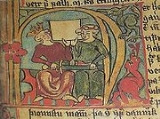
Haakon IV of Norway

Encyclopedia
Haakon Haakonarson (Old Norse
: Hákon Hákonarson; Norwegian
: Håkon Håkonsson), also called Haakon the Old, was king of Norway
from 1217 to 1263. Under his rule, medieval Norway reached its peak.
. She claimed he was the illegitimate son of Håkon III of Norway, the leader of the birkebeiner
faction in the ongoing civil war against the bagler
. Håkon III had visited Varteig, in what is now Østfold
county, the previous year. He was dead by the time Håkon was born, but Inga's claim was supported by several of Håkon III's followers, and the birkebeiner recognized Håkon as a king's son.
The civil war era
in Norwegian history
lasted from 1130 to 1240. During this period there were several interlocked conflicts of varying scale and intensity. The background for these conflicts were the unclear Norwegian succession laws, social conditions and the struggle between different aristocratic parties and between Church and King. There were opposing factions, firstly known by varying names or no names at all, but finally condensed into the two parties birkebeiner
and bagler
. The rallying point regularly was a royal son, who was set up as the figurehead of the party in question, to oppose the rule
of king from the contesting party. Håkon's putative father Håkon III had already sought some reconciliation with the Bagler party and with exiled bishops. His death was early and poisoning was suspected. He was not married. After his death, the bagler started another rising leading to the de facto division of the country into a bagler kingdom in the south-east, and a birkebeiner kingdom in the west and north.
Håkon was born in territory which was controlled by the Bagler
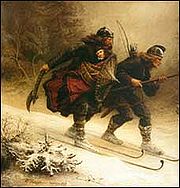
faction, and his mother's claim that he was a birkebeiner royal son placed them both in a very dangerous position. When in 1206 the Bagler tried to take advantage of the situation and started hunting Håkon, a group of Birkebeiner warriors fled with the child, heading for King Inge II of Norway
, the birkebeiner king in Nidaros (now Trondheim
). On their way they came into a blizzard, and only the two mightiest warriors, Torstein Skevla and Skjervald Skrukka, continued on ski
s, carrying the child in their arms. They managed to bring the heir to safety. This event still is commemorated in one of Norway's most important annual skiing event, the Birkebeiner ski race
.
 The rescued child was placed under the protection of King Inge Bårdsson
. After King Inge's death in 1217 he, at the age of 13, was chosen king. Håkon was chosen against the candidacy of Inge's half-brother, earl Skule Bårdsson
. Skule, however, as earl, retained the real royal power. In connection with the dispute over the royal election, Håkon's mother Inga had to prove his parentage through a trial by ordeal
in Bergen in 1218. The church at first refused to recognize him, partly on the ground of illegitimacy.
In 1223 a great meeting of all the bishop
s, earl
s, lendmenn
and other prominent men was held in Bergen to finally decide on Håkon's right to the throne. The other candidates to the throne were Guttorm Ingesson, the 11-year-old illegitimate son of King Inge Bårdsson; Knut Haakonson, legitimate son of earl Haakon the Crazy
, who resided in Västergötland, Sweden, with his mother Kristin; earl Skule, who based his claim on being the closest living relative - a legitimate brother - of king Inge; and Sigurd Ribbung
, who was at the time a captive of earl Skule. Haakon was confirmed as king of Norway, as a direct heir of King Håkon Sverresson
, king Inge's predecessor. A most important factor in his victory was the fact that the church now took Håkon's side, despite his illegitimate birth. However, the Pope's dispensation for his coronation was not gained until 1247.
In 1217, Philip Simonsson
, the last Bagler king, died. Speedy political and military manoeuvering by Skule Bårdsson led to reconciliation between the birkebeiner and bagler, and the reunification of the kingdom. However, some discontented elements among the bagler found a new royal pretender, Sigurd Ribbung
and launched a new rising in the eastern parts of the country. This was finally quashed in 1227, leaving Håkon more or less uncontested monarch.
In the earlier part of Håkon's reign much of the royal power was in the hands of Skule Bårdsson. From the start of his reign, it was decided that Skule should rule one third of the kingdom, as earl, and Skule helped put down the rising of Sigurd Ribbung. But the relationship between Skule and Håkon became more and more strained as Håkon came of age, and asserted his power. As an attempt to reconcile the two, in 1225 Håkon married Skule's daughter Margrét Skúladóttir. In 1239 the conflict between the two erupted into open warfare, when Skule had himself proclaimed king in Nidaros
. The rebellion ended in 1240 when Skule was put to death. The rebellion also led to the death of Snorri Sturluson
. Skule's other son-in-law, the one-time claimant Knut Håkonsson, did not join the revolt, but remained loyal to king Håkon. This rebellion is generally taken to mark the end of Norway's age of civil wars.
had known for many years. This was the start of what has traditionally been known as the golden age of the Norwegian medieval kingdom. In 1240, a group of Bjarmians told Håkon that they were refugees from the Mongols. He gave them land in Malangen
. In 1247 Håkon finally achieved recognition by the pope, who sent Cardinal William of Sabina to Bergen to crown him. Abroad, Håkon mounted a campaign against the Danish province of Halland
in 1256. In 1261 the Norse community in Greenland
agreed to submit to the Norwegian king, and in 1262, Håkon achieved one of his long-standing ambitions when Iceland
, racked by internal conflict and prompted by Håkon's Icelandic clients, did the same. The kingdom of Norway was now the largest it has ever been. In 1263 a dispute with the Scottish king concerning the Hebrides
, a Norwegian possession, induced Håkon to undertake an expedition to the west of Scotland. Alexander III of Scotland
had conquered the Hebrides the previous year. Håkon retook the islands with his formidable leidang
fleet, and launched some forays onto the Scottish mainland as well. A division of his army seems to have repulsed a large Scottish force at Largs
(though the later Scottish accounts claim this battle as a victory). Negotiations between the Scots and the Norwegians took place, which were purposely prolonged by the Scots, as Håkon's position would grow more difficult the longer he had to keep his fleet together so far away from home. An Irish delegation approached Håkon with an offer to provide for his fleet through the winter, if Håkon would help them against the English. Håkon seems to have been favourable to this proposition, but his men refused. Eventually the fleet retreated to the Orkney Islands
for the winter.
While Håkon was wintering in the Orkney Islands
and staying in the Bishop's Palace, Kirkwall
, he fell ill, and died on 16 December 1263. A great part of his fleet had been scattered and destroyed by storms. Håkon was buried for the winter in St. Magnus Cathedral in Kirkwall
. When spring came he was exhumed and his body taken back to Norway, where he was buried in the old cathedral in his capital, Bergen. This cathedral was demolished in 1531, the site is today marked by a memorial.
On his deathbed Håkon declared that he only knew of one son who was still alive, Magnus
, who subsequently succeeded him as king.
historians. The historian Halvdan Koht
is typical of this view. Håkon has often been compared with Skule Bårdsson, his last rival, with modern historians taking sides in this 700-year-old conflict. He is also inevitably compared with his grandfather, King Sverre
, and most historians tend to conclude that he wasn't quite the dynamic and charismatic leader that Sverre was. Recently, the historian Sverre Bagge and others have emphasized the fact that much of what we know about both Håkon and Sverre comes from their respective official biographies. Therefore what we might know about their individual character and personality is only what the authors of these have chosen to reveal to us, and therefore depends heavily on these authors' motivation in writing a biography. A comparison between Håkon and Sverre on these grounds seems arbitrary and unfair.
What remains clear is that Håkon was born in a war-torn society plagued by armed gangs and warlords, and died the undisputed ruler of a large and internationally respected kingdom. Håkon received embassies and exchanged gifts with rulers as far afield as Tunis
, Novgorod and Castile
. At his court, chivalric romances and Biblical stories were translated into the old Norse
language, notably the translations linked to the cleric Brother Robert
, and Håkon presided over several large-scale construction projects in stone, a novelty in Norway at that time. The great hall which he had built at his palace in Bergen (Håkonshallen) can still be seen today.
Our main source of information concerning Håkon is Hákonar saga Hákonarsonar
(Håkon Håkonsson's saga) which was written in the 1260s, only a few years after his death. It was commissioned by his son Magnus
, and written by the Icelandic writer and politician Sturla Þórðarson
, nephew of the famous historian Snorri Sturluson
.
A literary treatment of Håkon's struggle with Skule can be found in Henrik Ibsen
's play The Pretenders
(1863).
By his wife Margrét Skúladóttir:
The appointment of co-rulers was meant to ensure the peaceful succession in case the king should die - as long as Håkon was still alive he was still the undisputed ruler of the kingdom.
Old Norse
Old Norse is a North Germanic language that was spoken by inhabitants of Scandinavia and inhabitants of their overseas settlements during the Viking Age, until about 1300....
: Hákon Hákonarson; Norwegian
Norwegian language
Norwegian is a North Germanic language spoken primarily in Norway, where it is the official language. Together with Swedish and Danish, Norwegian forms a continuum of more or less mutually intelligible local and regional variants .These Scandinavian languages together with the Faroese language...
: Håkon Håkonsson), also called Haakon the Old, was king of Norway
Norway
Norway , officially the Kingdom of Norway, is a Nordic unitary constitutional monarchy whose territory comprises the western portion of the Scandinavian Peninsula, Jan Mayen, and the Arctic archipelago of Svalbard and Bouvet Island. Norway has a total area of and a population of about 4.9 million...
from 1217 to 1263. Under his rule, medieval Norway reached its peak.
Background and childhood
Håkon's mother was Inga of VarteigVarteig
Varteig is a village in Sarpsborg and was formerly a municipality in Østfold County, Norway.Varteig is located north of Sarpsborg and east of Glomma. Varteig was part of the Tune municipality until 1861. It was designated to be a municipality by a split from Tune in 1861. At that time Varteig had...
. She claimed he was the illegitimate son of Håkon III of Norway, the leader of the birkebeiner
Birkebeiner
The Birkebein Party or Birkebeinar was the name for a rebellious party in Norway, formed in 1174 around the pretender to the Norwegian throne, Eystein Meyla...
faction in the ongoing civil war against the bagler
Bagler
The Bagli Party or Bagler was a faction or party during the Norwegian Civil Wars. The Bagler faction was made up principally of the Norwegian aristocracy, clergy and merchants....
. Håkon III had visited Varteig, in what is now Østfold
Østfold
is a county in southeastern Norway, bordering Akershus and southwestern Sweden , while Buskerud and Vestfold is on the other side of the bay. The seat of the county administration is Sarpsborg, and Fredrikstad is the largest city.Many manufacturing facilities are situated here. Moss and...
county, the previous year. He was dead by the time Håkon was born, but Inga's claim was supported by several of Håkon III's followers, and the birkebeiner recognized Håkon as a king's son.
The civil war era
Civil war era in Norway
The Civil war era of Norwegian history is a term used for the period in the history of Norway between 1130 and 1240. During this time, a series of civil wars were fought between rival kings and pretenders to the throne of Norway. The reasons for the wars is one of the most debated topics in...
in Norwegian history
History of Norway
The history of human settlement in what is present day Norway goes back at least 11,000 years, to the late Paleolithic. Archaeological finds in the county of Møre og Romsdal have been dated to 9,200 BC and are probably the remains of settlers from Doggerland, an area now submerged in the North Sea,...
lasted from 1130 to 1240. During this period there were several interlocked conflicts of varying scale and intensity. The background for these conflicts were the unclear Norwegian succession laws, social conditions and the struggle between different aristocratic parties and between Church and King. There were opposing factions, firstly known by varying names or no names at all, but finally condensed into the two parties birkebeiner
Birkebeiner
The Birkebein Party or Birkebeinar was the name for a rebellious party in Norway, formed in 1174 around the pretender to the Norwegian throne, Eystein Meyla...
and bagler
Bagler
The Bagli Party or Bagler was a faction or party during the Norwegian Civil Wars. The Bagler faction was made up principally of the Norwegian aristocracy, clergy and merchants....
. The rallying point regularly was a royal son, who was set up as the figurehead of the party in question, to oppose the rule
of king from the contesting party. Håkon's putative father Håkon III had already sought some reconciliation with the Bagler party and with exiled bishops. His death was early and poisoning was suspected. He was not married. After his death, the bagler started another rising leading to the de facto division of the country into a bagler kingdom in the south-east, and a birkebeiner kingdom in the west and north.
Håkon was born in territory which was controlled by the Bagler
Bagler
The Bagli Party or Bagler was a faction or party during the Norwegian Civil Wars. The Bagler faction was made up principally of the Norwegian aristocracy, clergy and merchants....
faction, and his mother's claim that he was a birkebeiner royal son placed them both in a very dangerous position. When in 1206 the Bagler tried to take advantage of the situation and started hunting Håkon, a group of Birkebeiner warriors fled with the child, heading for King Inge II of Norway
Inge II of Norway
align=right|Inge Baardson was king of Norway from 1204 to 1217. His reign was within the later stages of the period known in Norwegian history as the age of civil wars. Inge was the king of the birkebeiner faction...
, the birkebeiner king in Nidaros (now Trondheim
Trondheim
Trondheim , historically, Nidaros and Trondhjem, is a city and municipality in Sør-Trøndelag county, Norway. With a population of 173,486, it is the third most populous municipality and city in the country, although the fourth largest metropolitan area. It is the administrative centre of...
). On their way they came into a blizzard, and only the two mightiest warriors, Torstein Skevla and Skjervald Skrukka, continued on ski
Ski
A ski is a long, flat device worn on the foot, usually attached through a boot, designed to help the wearer slide smoothly over snow. Originally intended as an aid to travel in snowy regions, they are now mainly used for recreational and sporting purposes...
s, carrying the child in their arms. They managed to bring the heir to safety. This event still is commemorated in one of Norway's most important annual skiing event, the Birkebeiner ski race
Birkebeinerrennet
Birkebeinerrennet is a long-distance cross-country ski marathon held annually in Norway. It is Norway's race in the Worldloppet Ski Federation....
.
Early reign
Inge II of Norway
align=right|Inge Baardson was king of Norway from 1204 to 1217. His reign was within the later stages of the period known in Norwegian history as the age of civil wars. Inge was the king of the birkebeiner faction...
. After King Inge's death in 1217 he, at the age of 13, was chosen king. Håkon was chosen against the candidacy of Inge's half-brother, earl Skule Bårdsson
Skule Bårdsson
Skule Baardsson or Duke Skule was a Norwegian nobleman and claimant to the royal throne against his son-in-law, King Haakon Haakonsson. Henrik Ibsen's play Kongs-Emnerne is about the dispute between Duke Skule and King Haakon.-Biography:Skule Baardsson was born around 1189...
. Skule, however, as earl, retained the real royal power. In connection with the dispute over the royal election, Håkon's mother Inga had to prove his parentage through a trial by ordeal
Trial by ordeal
Trial by ordeal is a judicial practice by which the guilt or innocence of the accused is determined by subjecting them to an unpleasant, usually dangerous experience...
in Bergen in 1218. The church at first refused to recognize him, partly on the ground of illegitimacy.
In 1223 a great meeting of all the bishop
Bishop
A bishop is an ordained or consecrated member of the Christian clergy who is generally entrusted with a position of authority and oversight. Within the Catholic Church, Eastern Orthodox, Oriental Orthodox Churches, in the Assyrian Church of the East, in the Independent Catholic Churches, and in the...
s, earl
Earl
An earl is a member of the nobility. The title is Anglo-Saxon, akin to the Scandinavian form jarl, and meant "chieftain", particularly a chieftain set to rule a territory in a king's stead. In Scandinavia, it became obsolete in the Middle Ages and was replaced with duke...
s, lendmenn
Lendmann
Lendmann , was a title in medieval Norway. Lendmann was the highest rank attainable in the hird of the Norwegian king, and a lendmann stood beneath only earls and kings...
and other prominent men was held in Bergen to finally decide on Håkon's right to the throne. The other candidates to the throne were Guttorm Ingesson, the 11-year-old illegitimate son of King Inge Bårdsson; Knut Haakonson, legitimate son of earl Haakon the Crazy
Haakon the Crazy
Håkon the Crazy was a Norwegian earl and Birkebeiner chieftain during the civil war era in Norway. He was born no later than the 1170s and died in 1214...
, who resided in Västergötland, Sweden, with his mother Kristin; earl Skule, who based his claim on being the closest living relative - a legitimate brother - of king Inge; and Sigurd Ribbung
Sigurd Ribbung
Sigurd Erlingsson Ribbung was a Norwegian nobleman and pretender to the throne of Norway during the civil war era in Norway.-Biography:...
, who was at the time a captive of earl Skule. Haakon was confirmed as king of Norway, as a direct heir of King Håkon Sverresson
Haakon III of Norway
Håkon III was king of Norway from 1202 to 1204.-Biography:...
, king Inge's predecessor. A most important factor in his victory was the fact that the church now took Håkon's side, despite his illegitimate birth. However, the Pope's dispensation for his coronation was not gained until 1247.
In 1217, Philip Simonsson
Philip Simonsson
Philip Simonsson was a Norwegian aristocrat and from 1207 to 1217 was the Bagler party pretender to the throne of Norway during the civil war era in Norway. -Background:...
, the last Bagler king, died. Speedy political and military manoeuvering by Skule Bårdsson led to reconciliation between the birkebeiner and bagler, and the reunification of the kingdom. However, some discontented elements among the bagler found a new royal pretender, Sigurd Ribbung
Sigurd Ribbung
Sigurd Erlingsson Ribbung was a Norwegian nobleman and pretender to the throne of Norway during the civil war era in Norway.-Biography:...
and launched a new rising in the eastern parts of the country. This was finally quashed in 1227, leaving Håkon more or less uncontested monarch.
In the earlier part of Håkon's reign much of the royal power was in the hands of Skule Bårdsson. From the start of his reign, it was decided that Skule should rule one third of the kingdom, as earl, and Skule helped put down the rising of Sigurd Ribbung. But the relationship between Skule and Håkon became more and more strained as Håkon came of age, and asserted his power. As an attempt to reconcile the two, in 1225 Håkon married Skule's daughter Margrét Skúladóttir. In 1239 the conflict between the two erupted into open warfare, when Skule had himself proclaimed king in Nidaros
Nidaros
Nidaros or Niðarós was during the Middle Ages, the old name of Trondheim, Norway . Until the Reformation, Nidaros remained the centre of the spiritual life of the country...
. The rebellion ended in 1240 when Skule was put to death. The rebellion also led to the death of Snorri Sturluson
Snorri Sturluson
Snorri Sturluson was an Icelandic historian, poet, and politician. He was twice elected lawspeaker at the Icelandic parliament, the Althing...
. Skule's other son-in-law, the one-time claimant Knut Håkonsson, did not join the revolt, but remained loyal to king Håkon. This rebellion is generally taken to mark the end of Norway's age of civil wars.
Later reign
From this time onward Håkon’s reign was marked by internal peace and more prosperity than NorwayNorway
Norway , officially the Kingdom of Norway, is a Nordic unitary constitutional monarchy whose territory comprises the western portion of the Scandinavian Peninsula, Jan Mayen, and the Arctic archipelago of Svalbard and Bouvet Island. Norway has a total area of and a population of about 4.9 million...
had known for many years. This was the start of what has traditionally been known as the golden age of the Norwegian medieval kingdom. In 1240, a group of Bjarmians told Håkon that they were refugees from the Mongols. He gave them land in Malangen
Malangen
Malangen is a fjord and a former municipality in Troms county in Norway. The fjord is located between the islands of Kvaløya and Senja and the area today is divided between the municipalities of Balsfjord, Lenvik, Tromsø, and Målselv...
. In 1247 Håkon finally achieved recognition by the pope, who sent Cardinal William of Sabina to Bergen to crown him. Abroad, Håkon mounted a campaign against the Danish province of Halland
Halland
' is one of the traditional provinces of Sweden , on the western coast of Sweden. It borders Västergötland, Småland, Scania and the sea of Kattegat.-Administration:...
in 1256. In 1261 the Norse community in Greenland
Greenland
Greenland is an autonomous country within the Kingdom of Denmark, located between the Arctic and Atlantic Oceans, east of the Canadian Arctic Archipelago. Though physiographically a part of the continent of North America, Greenland has been politically and culturally associated with Europe for...
agreed to submit to the Norwegian king, and in 1262, Håkon achieved one of his long-standing ambitions when Iceland
Iceland
Iceland , described as the Republic of Iceland, is a Nordic and European island country in the North Atlantic Ocean, on the Mid-Atlantic Ridge. Iceland also refers to the main island of the country, which contains almost all the population and almost all the land area. The country has a population...
, racked by internal conflict and prompted by Håkon's Icelandic clients, did the same. The kingdom of Norway was now the largest it has ever been. In 1263 a dispute with the Scottish king concerning the Hebrides
Hebrides
The Hebrides comprise a widespread and diverse archipelago off the west coast of Scotland. There are two main groups: the Inner and Outer Hebrides. These islands have a long history of occupation dating back to the Mesolithic and the culture of the residents has been affected by the successive...
, a Norwegian possession, induced Håkon to undertake an expedition to the west of Scotland. Alexander III of Scotland
Alexander III of Scotland
Alexander III was King of Scots from 1249 to his death.-Life:...
had conquered the Hebrides the previous year. Håkon retook the islands with his formidable leidang
Leidang
The institution known as leiðangr , leidang , leding, , ledung , expeditio or sometimes lething , was a public levy of free farmers typical for medieval Scandinavians. It was a form of conscription to organise coastal fleets for seasonal excursions and in defence of the realm...
fleet, and launched some forays onto the Scottish mainland as well. A division of his army seems to have repulsed a large Scottish force at Largs
Battle of Largs
The Battle of Largs was an engagement fought between the armies of Norway and Scotland near the present-day town of Largs in North Ayrshire on the Firth of Clyde in Scotland on 2 October 1263. It was the most important military engagement of the Scottish-Norwegian War. The Norwegian forces were...
(though the later Scottish accounts claim this battle as a victory). Negotiations between the Scots and the Norwegians took place, which were purposely prolonged by the Scots, as Håkon's position would grow more difficult the longer he had to keep his fleet together so far away from home. An Irish delegation approached Håkon with an offer to provide for his fleet through the winter, if Håkon would help them against the English. Håkon seems to have been favourable to this proposition, but his men refused. Eventually the fleet retreated to the Orkney Islands
Orkney Islands
Orkney also known as the Orkney Islands , is an archipelago in northern Scotland, situated north of the coast of Caithness...
for the winter.
While Håkon was wintering in the Orkney Islands
Orkney Islands
Orkney also known as the Orkney Islands , is an archipelago in northern Scotland, situated north of the coast of Caithness...
and staying in the Bishop's Palace, Kirkwall
Bishop's Palace, Kirkwall
The Bishop's Palace, Kirkwall was built at the same time as the adjacent St Magnus Cathedral in the centre of Kirkwall, Orkney, Scotland, was being constructed, and housed the cathedral's first bishop, William the Old of the Norwegian Catholic church who took his authority from the Archbishop of...
, he fell ill, and died on 16 December 1263. A great part of his fleet had been scattered and destroyed by storms. Håkon was buried for the winter in St. Magnus Cathedral in Kirkwall
Kirkwall
Kirkwall is the biggest town and capital of Orkney, off the coast of northern mainland Scotland. The town is first mentioned in Orkneyinga saga in the year 1046 when it is recorded as the residence of Rögnvald Brusason the Earl of Orkney, who was killed by his uncle Thorfinn the Mighty...
. When spring came he was exhumed and his body taken back to Norway, where he was buried in the old cathedral in his capital, Bergen. This cathedral was demolished in 1531, the site is today marked by a memorial.
On his deathbed Håkon declared that he only knew of one son who was still alive, Magnus
Magnus VI of Norway
Magnus VI Lagabøte or Magnus Håkonsson , was king of Norway from 1263 until 1280.-Early life:...
, who subsequently succeeded him as king.
Views on Håkon's reign
Norwegian historians have held strongly differing views on Håkon Håkonsson's reign. In the 19th century, the dominant view was of Håkon as the mighty king, who ended the civil wars and ruled over the largest Norwegian empire ever. The historian P. A. Munch represents this view. In the 1920s came a reaction. Håkon was now seen by many as an insignificant and average man, who happened to be king at a time of greatness for the Norwegian kingdom. This has often been stated by MarxistHistorical materialism
Historical materialism is a methodological approach to the study of society, economics, and history, first articulated by Karl Marx as "the materialist conception of history". Historical materialism looks for the causes of developments and changes in human society in the means by which humans...
historians. The historian Halvdan Koht
Halvdan Koht
Halvdan Koht was a Norwegian historian and politician representing the Labour Party.As a politician he served as the Norwegian Minister of Foreign Affairs from 1935 to 1941. He was never elected as a member of the Parliament of Norway, but was a member of Bærum municipal council in 1917–1919 and...
is typical of this view. Håkon has often been compared with Skule Bårdsson, his last rival, with modern historians taking sides in this 700-year-old conflict. He is also inevitably compared with his grandfather, King Sverre
Sverre of Norway
Sverre Sigurdsson was king of Norway from 1177 to 1202. He married Margareta Eriksdotter, the daughter of the Swedish king Eric the Saint, by whom he had the daughter Kristina Sverresdotter....
, and most historians tend to conclude that he wasn't quite the dynamic and charismatic leader that Sverre was. Recently, the historian Sverre Bagge and others have emphasized the fact that much of what we know about both Håkon and Sverre comes from their respective official biographies. Therefore what we might know about their individual character and personality is only what the authors of these have chosen to reveal to us, and therefore depends heavily on these authors' motivation in writing a biography. A comparison between Håkon and Sverre on these grounds seems arbitrary and unfair.
What remains clear is that Håkon was born in a war-torn society plagued by armed gangs and warlords, and died the undisputed ruler of a large and internationally respected kingdom. Håkon received embassies and exchanged gifts with rulers as far afield as Tunis
Tunisia
Tunisia , officially the Tunisian RepublicThe long name of Tunisia in other languages used in the country is: , is the northernmost country in Africa. It is a Maghreb country and is bordered by Algeria to the west, Libya to the southeast, and the Mediterranean Sea to the north and east. Its area...
, Novgorod and Castile
Kingdom of Castile
Kingdom of Castile was one of the medieval kingdoms of the Iberian Peninsula. It emerged as a political autonomous entity in the 9th century. It was called County of Castile and was held in vassalage from the Kingdom of León. Its name comes from the host of castles constructed in the region...
. At his court, chivalric romances and Biblical stories were translated into the old Norse
Old Norse
Old Norse is a North Germanic language that was spoken by inhabitants of Scandinavia and inhabitants of their overseas settlements during the Viking Age, until about 1300....
language, notably the translations linked to the cleric Brother Robert
Brother Robert
Brother Robert was a cleric working in Norway who adapted several French literary works into Old Norse during the reign of King Haakon IV of Norway . The most important of these, Tristrams saga ok Ísöndar, based on Thomas of Britain's Tristan, is notable as the only example of Thomas' "courtly...
, and Håkon presided over several large-scale construction projects in stone, a novelty in Norway at that time. The great hall which he had built at his palace in Bergen (Håkonshallen) can still be seen today.
Our main source of information concerning Håkon is Hákonar saga Hákonarsonar
Hákonar saga Hákonarsonar
Hákonar saga Hákonarsonar is an Old Norse kings' saga, telling the story of the life and reign of King Haakon Haakonarson of Norway. The saga was written by the Icelandic historian and chieftain Sturla Þórðarson, in the 1260s...
(Håkon Håkonsson's saga) which was written in the 1260s, only a few years after his death. It was commissioned by his son Magnus
Magnus VI of Norway
Magnus VI Lagabøte or Magnus Håkonsson , was king of Norway from 1263 until 1280.-Early life:...
, and written by the Icelandic writer and politician Sturla Þórðarson
Sturla Þórðarson
Sturla Þórðarson was an Icelandic politician/chieftain and writer of sagas and contemporary history during the 13th century.Sturla was the son of Þórður Sturluson and his mistress Þóra. He was a nephew and pupil of the famous saga-writer Snorri Sturluson...
, nephew of the famous historian Snorri Sturluson
Snorri Sturluson
Snorri Sturluson was an Icelandic historian, poet, and politician. He was twice elected lawspeaker at the Icelandic parliament, the Althing...
.
A literary treatment of Håkon's struggle with Skule can be found in Henrik Ibsen
Henrik Ibsen
Henrik Ibsen was a major 19th-century Norwegian playwright, theatre director, and poet. He is often referred to as "the father of prose drama" and is one of the founders of Modernism in the theatre...
's play The Pretenders
The Pretenders (play)
The Pretenders is a dramatic play by Norwegian playwright Henrik Ibsen.-Play overview:The Pretenders was written in bursts during 1863, but Ibsen claims to have had sources and the idea back in 1858. A five-act play in prose set in the thirteenth-century. The play opened at the old Christiania...
(1863).
Descendants
By his mistress, Kanga the Young:- Sigurd (Sigurðr) (<1225–1254)
- Cecilia (<1225–1248). She married Gregorius Andresson, a nephew of the last bagler king Filippus Simonsson. Widowed, she later married king Harald (Haraldr), King of Mann and the Isles, a vassalVassalA vassal or feudatory is a person who has entered into a mutual obligation to a lord or monarch in the context of the feudal system in medieval Europe. The obligations often included military support and mutual protection, in exchange for certain privileges, usually including the grant of land held...
of King Håkon, in Bergen. They both drowned on the return voyage to the British Isles. - Torrun Håkonsdatter Kane
By his wife Margrét Skúladóttir:
- Olav (Óláfr) (1226–29). Died in infancy.
- Håkon (Hákon) (Håkon the Young) (1232–1257). Married Rikitsa Birgersdóttir, daughter of the Swedish earl Birger. Was appointed king and co-ruler by his father in 1239, he died before his father.
- ChristinaPrincess Kristina of NorwayChristina Haakonsdotter of Norway , sometimes spelled Kristina or Kristín, was a daughter of King Håkon IV of Norway and his wife, Margrete Skuledotter. As part of an alliance she was betrothed to Infante Philip of Castile, brother of King Alfonso X of Castile...
(Kristín) (1234–62). Married the Spanish prince, Felipe, brother of King Alfonso X of CastileAlfonso X of CastileAlfonso X was a Castilian monarch who ruled as the King of Castile, León and Galicia from 1252 until his death...
in 1258. She died childless. Her story is subject of Espido Freire's novel La flor del Norte (The Northern Flower) - MagnusMagnus VI of NorwayMagnus VI Lagabøte or Magnus Håkonsson , was king of Norway from 1263 until 1280.-Early life:...
(Magnús) (1238–1280). Was appointed king and co-ruler following the death of Håkon the Young. Crowned king in 1261 on the occasion of his wedding to the Danish princess IngeborgIngeborg of Denmark, Queen of NorwayIngeborg Eriksdotter was a Danish princess. She was married to King Magnus VI of Norway and was Queen consort of Norway. Later as Queen dowager, she played an important part in politics during the minority of her son King Eirik II of Norway.-Biography:Ingeborg was born the daughter of Eric IV of...
.
The appointment of co-rulers was meant to ensure the peaceful succession in case the king should die - as long as Håkon was still alive he was still the undisputed ruler of the kingdom.