

Silage

Encyclopedia
Fermentation (food)
Fermentation in food processing typically is the conversion of carbohydrates to alcohols and carbon dioxide or organic acids using yeasts, bacteria, or a combination thereof, under anaerobic conditions. Fermentation in simple terms is the chemical conversion of sugars into ethanol...
, high-moisture fodder
Fodder
Fodder or animal feed is any agricultural foodstuff used specifically to feed domesticated livestock such as cattle, goats, sheep, horses, chickens and pigs. Most animal feed is from plants but some is of animal origin...
that can be fed to ruminant
Ruminant
A ruminant is a mammal of the order Artiodactyla that digests plant-based food by initially softening it within the animal's first compartment of the stomach, principally through bacterial actions, then regurgitating the semi-digested mass, now known as cud, and chewing it again...
s (cud
Cud
Cud is a portion of food that returns from a ruminant's stomach in the mouth to be chewed for the second time. More accurately, it is a bolus of semi-degraded food regurgitated from the reticulorumen of a ruminant. Cud is produced during the physical digestive process of rumination, or "chewing the...
-chewing animals like cattle
Cattle
Cattle are the most common type of large domesticated ungulates. They are a prominent modern member of the subfamily Bovinae, are the most widespread species of the genus Bos, and are most commonly classified collectively as Bos primigenius...
and sheep) or used as a biofuel
Biofuel
Biofuel is a type of fuel whose energy is derived from biological carbon fixation. Biofuels include fuels derived from biomass conversion, as well as solid biomass, liquid fuels and various biogases...
feedstock for anaerobic digesters. It is fermented and stored in a process called ensiling
Ensilage
Ensilage or silaging is the process of preserving green food for livestock in an undried condition in airtight conditions, either in a storage silo , or in plastic wrapping. The fodder which is the result of the process is called silage....
or silaging, and is usually made from grass
Grass
Grasses, or more technically graminoids, are monocotyledonous, usually herbaceous plants with narrow leaves growing from the base. They include the "true grasses", of the Poaceae family, as well as the sedges and the rushes . The true grasses include cereals, bamboo and the grasses of lawns ...
crops, including corn (maize
Maize
Maize known in many English-speaking countries as corn or mielie/mealie, is a grain domesticated by indigenous peoples in Mesoamerica in prehistoric times. The leafy stalk produces ears which contain seeds called kernels. Though technically a grain, maize kernels are used in cooking as a vegetable...
), sorghum
Sorghum
Sorghum is a genus of numerous species of grasses, one of which is raised for grain and many of which are used as fodder plants either cultivated or as part of pasture. The plants are cultivated in warmer climates worldwide. Species are native to tropical and subtropical regions of all continents...
or other cereal
Cereal
Cereals are grasses cultivated for the edible components of their grain , composed of the endosperm, germ, and bran...
s, using the entire green plant (not just the grain). Silage can be made from many field crops, and special terms may be used depending on type (oatlage for oats, haylage for alfalfa
Alfalfa
Alfalfa is a flowering plant in the pea family Fabaceae cultivated as an important forage crop in the US, Canada, Argentina, France, Australia, the Middle East, South Africa, and many other countries. It is known as lucerne in the UK, France, Australia, South Africa and New Zealand, and known as...
– but see below for the different British use of the term haylage).
Silage is made either by placing cut green vegetation in a silo
Silo
A silo is a structure for storing bulk materials.Silo may also refer to:* Silo , a 3D modeling software* Silo , a defunct chain of retail electronics stores* SILO , used in Linux...
, by piling it in a large heap covered with plastic sheet, or by wrapping large bales in plastic film.
Making silage
Silage must be made from plant material with a suitable moisture content, about 50% to 60%, depending on the means of storage, the degree of compression, and the amount of water that will be lost in storage. For corn (maize), harvest begins when the whole-plant moisture is at a suitable level. For pasture-type crops, the grass is mowed and allowed to wilt for a day or so until the moisture content drops to a suitable level.The plant material is collected, chopped into pieces about 0.5 in (1.3 cm) long and packed. In the early days of mechanized agriculture, stalks were cut and collected manually using a knife and horsedrawn wagon, and fed into a stationary machine called a "silo filler" that chopped the stalks and blew them up a narrow tube to the top of a tower silo. Current technology uses mechanical forage harvester
Forage harvester
A forage harvester is a farm implement that harvests forage plants to make silage. Silage is grass, corn or other plant that has been chopped into small pieces, and compacted together in a storage silo, silage bunker, or in silage bags. The silage is then fermented to provide feed for livestock...
s that collect and chop the plant material, and deposit it in trucks or wagons. These forage harvesters can be either tractor
Tractor
A tractor is a vehicle specifically designed to deliver a high tractive effort at slow speeds, for the purposes of hauling a trailer or machinery used in agriculture or construction...
-drawn or self-propelled. Harvesters blow the silage into the wagon via a chute at the rear or side of the machine. Silage may also be emptied into a bagger, which puts the silage into a large plastic bag that is laid out on the ground.
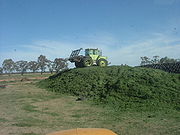
In New Zealand and Northern Europe, the silo or "pit" is often a bunker built into the side of a bank, usually made out of concrete or old wooden railroad ties (railway sleepers). The chopped grass can then be dumped in at the top, to be drawn from the bottom in winter. This requires considerable effort to compress the stack in the silo to cure it properly. Again the pit is covered with plastic sheet and weighed down with tire weights.
In an alternative method the cut vegetation is baled, making balage (North America) or Silage bales (UK). The grass or other forage is cut and partly dried until it contains 30–40% moisture (much drier than bulk silage, but too damp to be stored as dry hay). It is then made into large bales which are wrapped tightly in plastic to exclude air. The plastic may wrap the whole of each cylindrical or cuboid bale, or be wrapped around only the curved sides of a cylindrical bale, leaving the ends uncovered. In this case, the bales are placed tightly end to end on the ground, making a long continuous "sausage" of silage, often at the side of a field. The wrapping may be performed by a bale wrapper
Bale wrapper
A bale wrapper is a farm implement for wrapping bales in plastic, for them to turn into silage.The wrapper has a loading arm, much like a bale handler, at the side, that scoops up a bale and places it on the wrapping table. The wrapping table usually consists of two rollers, and four belts which...
, while the baled silage is handled using a bale handler or a front-loader, either impaling the bale on a flap, or by using a special grab. The flaps do not hole the bales.
In the UK baled silage is most often made in round bales 4 feet by 4 feet approx, individually wrapped with 4 to 6 layers of "bale wrap plastic" (black, white or green 25 micrometre stretch film). The dry matter can vary a lot but can be from about 20% dry matter upwards. The continuous "sausage" referred to above is made with a special machine which wraps the bales as they are pushed through a rotating hoop which applies the bale wrap to the outside of the bales (round or square) in a continuous wrap. The machine places the bales on the ground after wrapping by moving forward slowly during the wrapping process (search for "tube liner" various makes).
Haylage is a name for high dry matter silage of around 45% to 75%. Horse haylage is usually 55% to 75% dry matter, made in small bales or larger bales.
Handling of wrapped bales is most often with some type of gripper that squeezes the plastic covered bale between two metal parts to avoid puncturing the plastic. Simple fixed versions are available for round bales which are made of two shaped pipes or tubes spaced apart to slide under the sides of the bale but when lifted will not let it slip through. Often used on the tractor rear 3 point linkage they incorporate a trip tipping mechanism which can flip the bales over on to the flat side/end for storage on the thickest plastic layers.
Fermentation
Before starting the anaerobic stage there is an aerobic phase in which the trapped oxygen is consumed. After finishing that oxygen, the anaerobic phase starts. Silage undergoes anaerobicAnaerobic respiration
Anaerobic respiration is a form of respiration using electron acceptors other than oxygen. Although oxygen is not used as the final electron acceptor, the process still uses a respiratory electron transport chain; it is respiration without oxygen...
fermentation, which starts about 48 hours after the silo is filled. In the past, the fermentation was conducted by indigenous microorganisms, but, today, some bulk silage is inoculated with specific microorganisms to speed fermentation or improve the resulting silage. The process converts sugars to acids and exhausts any oxygen present in the crop material. Fermentation is essentially complete after about two weeks. Silage inoculants contain one or more strains of lactic acid bacteria
Lactic acid bacteria
The lactic acid bacteria comprise a clade of Gram-positive, low-GC, acid-tolerant, generally non-sporulating, non-respiring rod or cocci that are associated by their common metabolic and physiological characteristics. These bacteria, usually found in decomposing plants and lactic products, produce...
, and the most common is Lactobacillus plantarum
Lactobacillus plantarum
Lactobacillus plantarum is a widespread member of the genus Lactobacillus, commonly found in many fermented food products as well as anaerobic plant matter. It is also present in saliva . It has the ability to liquefy gelatin. L...
. Other bacteria used in inoculants include Lactobacillus buchneri
Lactobacillus buchneri
Lactobacillus buchneri is a heterofermentative bacteria that produces lactic acid and acetic acid during Fermentation . It is used as a bacterial inoculant to improve the aerobic stability of silage.-References:...
, Enterococcus faecium
Enterococcus faecium
Enterococcus faecium is a Gram-positive, alpha hemolytic or nonhemolytic bacterium in the genus Enterococcus. It can be commensal in the human intestine, but it may also be pathogenic, causing diseases such as neonatal meningitis.Vancomycin-resistant E. faecium is often referred to as VRE.Some...
and Pediococcus
Pediococcus
Pediococcus is a genus of Gram-positive lactic acid bacteria, placed within the family of Lactobacillaceae. They usually occur in pairs or tetrads, and divide along two planes of symmetry, as do the other lactic acid cocci genera Aerococcus and Tetragenococcus. They are purely homofermentative...
species.
Pollution and waste
The fermentation process of silo or pit silage releases liquid. Silo effluent contains nitric acidNitric acid
Nitric acid , also known as aqua fortis and spirit of nitre, is a highly corrosive and toxic strong acid.Colorless when pure, older samples tend to acquire a yellow cast due to the accumulation of oxides of nitrogen. If the solution contains more than 86% nitric acid, it is referred to as fuming...
(HNO3), which is corrosive. It can also contaminate water courses unless collected and treated – the high nutrient content can lead to eutrophication
Eutrophication
Eutrophication or more precisely hypertrophication, is the movement of a body of water′s trophic status in the direction of increasing plant biomass, by the addition of artificial or natural substances, such as nitrates and phosphates, through fertilizers or sewage, to an aquatic system...
(growth of bacteria
Bacteria
Bacteria are a large domain of prokaryotic microorganisms. Typically a few micrometres in length, bacteria have a wide range of shapes, ranging from spheres to rods and spirals...
l or algal blooms).
Plastic sheeting used for sealing pit or baled silage needs proper disposal, and in some areas there are recycling schemes for it.
Storing silage
Silage must be firmly packed to minimize the oxygen content, or it will spoil.Silage goes through four major stages in a silo:
- Presealing, which, after the first few days after filling a silo, enables some respiration and some dry matter (DM) loss, but stops
- Fermentation, which occurs over a few weeks; pH drops; there is more DM loss, but hemicellulose is broken down; aerobic respiration stops
- Infiltration, which enables some oxygen infiltration, allowing for limited microbial respiration; available carbohydrates (CHOs) are lost as heat and gas
- Emptying, which exposes surface, causing additional loss; rate of loss increases.
.jpg)
Anaerobic digestion

Anaerobic digestion
Anaerobic digestion is a series of processes in which microorganisms break down biodegradable material in the absence of oxygen. It is used for industrial or domestic purposes to manage waste and/or to release energy....
. Here silage can be fed into anaerobic digesters to produce biogas that, in turn, can be used to generate electricity
Electricity
Electricity is a general term encompassing a variety of phenomena resulting from the presence and flow of electric charge. These include many easily recognizable phenomena, such as lightning, static electricity, and the flow of electrical current in an electrical wire...
and heat
Heat
In physics and thermodynamics, heat is energy transferred from one body, region, or thermodynamic system to another due to thermal contact or thermal radiation when the systems are at different temperatures. It is often described as one of the fundamental processes of energy transfer between...
.
Safety
Silos are hazardous, and deaths occur in the process of filling and maintaining them. There is a risk of injury by machinery or from falls. When a silo is filled, fine dust particles in the air can become explosive because of their large aggregate surface area. Also, fermentation presents respiratory hazards. The ensiling process produces "silo gas" during the early stages of the fermentation process. Silage gas contains nitric oxideNitric oxide
Nitric oxide, also known as nitrogen monoxide, is a diatomic molecule with chemical formula NO. It is a free radical and is an important intermediate in the chemical industry...
(NO), which will react with oxygen (O2) in the air to form nitrogen dioxide
Nitrogen dioxide
Nitrogen dioxide is the chemical compound with the formula it is one of several nitrogen oxides. is an intermediate in the industrial synthesis of nitric acid, millions of tons of which are produced each year. This reddish-brown toxic gas has a characteristic sharp, biting odor and is a prominent...
(NO2), which is toxic. Lack of oxygen inside the silo can cause asphyxiation. Molds that grow when air reaches cured silage can cause toxic organic dust syndrome. Silage bales are heavy, and can fall, roll or overbalance machinery. Collapsing silage from large bunker silos has caused deaths. Silage itself poses no special danger.
Nutrition
The ensiled product retains a much larger proportion of its nutrients than if the crop had been dried and stored as hayHay
Hay is grass, legumes or other herbaceous plants that have been cut, dried, and stored for use as animal fodder, particularly for grazing livestock such as cattle, horses, goats, and sheep. Hay is also fed to pets such as rabbits and guinea pigs...
or stover
Stover
Stover is the leaves and stalks of corn , sorghum or soybean plants that are left in a field after harvest. It can be directly grazed by cattle or dried for use as fodder. It is similar to straw, the residue left after any cereal grain or grass has been harvested at maturity for its seed...
.
Bulk silage is commonly fed to dairy cattle
Dairy cattle
Dairy cattle are cattle cows bred for the ability to produce large quantities of milk, from which dairy products are made. Dairy cows generally are of the species Bos taurus....
, while baled silage tends to be used for beef cattle
Beef cattle
Beef cattle are cattle raised for meat production . The meat of cattle is known as beef. When raised in a feedlot cattle are known as feeder cattle. Many such feeder cattle are born in cow-calf operations specifically designed to produce beef calves...
, sheep and horse
Horse
The horse is one of two extant subspecies of Equus ferus, or the wild horse. It is a single-hooved mammal belonging to the taxonomic family Equidae. The horse has evolved over the past 45 to 55 million years from a small multi-toed creature into the large, single-toed animal of today...
s.
Since silage goes through a fermentation process, energy is used by fermentative bacteria to produce volatile fatty acids
Volatile fatty acids
Volatile fatty acids are fatty acids with a carbon chain of six carbons or fewer. They are now usually referred to as short-chain fatty acids .They can be created through fermentation in the intestine.Examples include:* Acetic acid...
(VFA), such as acetate
Acetate
An acetate is a derivative of acetic acid. This term includes salts and esters, as well as the anion found in solution. Most of the approximately 5 billion kilograms of acetic acid produced annually in industry are used in the production of acetates, which usually take the form of polymers. In...
, propionate
Propionate
The propanoate or propionate ion is C2H5COO− .A propanoic or propionic compound is a salt or ester of propanoic acid....
, lactate
Lactic acid
Lactic acid, also known as milk acid, is a chemical compound that plays a role in various biochemical processes and was first isolated in 1780 by the Swedish chemist Carl Wilhelm Scheele. Lactic acid is a carboxylic acid with the chemical formula C3H6O3...
, and butyrate
Butyric acid
Butyric acid , also known under the systematic name butanoic acid, is a carboxylic acid with the structural formula CH3CH2CH2-COOH. Salts and esters of butyric acid are known as butyrates or butanoates...
, which preserve the forage. The result is that the silage is lower in energy than the original forage, since the fermentative bacteria
Bacteria
Bacteria are a large domain of prokaryotic microorganisms. Typically a few micrometres in length, bacteria have a wide range of shapes, ranging from spheres to rods and spirals...
use some of the carbohydrates to produce VFA. Thus, the ensiling process preserves forages, but does not improve the quality or the nutrient value. Although it does not increase the nutrient level of the plant matter ensiled, it does increase the digestibility and utilization of nutrient by ruminants.