

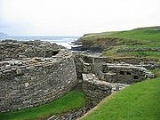
Rousay

Encyclopedia
Rousay is a small, hilly island about 3 km (1.9 mi) north of Orkney's
Mainland
, off the north coast of Scotland
, and has been nicknamed "the Egypt
of the north", due to its tremendous archaeological
diversity and importance.
It is separated from mainland Orkney by the Eynhallow
Sound, and, like its neighbours Egilsay
and Wyre
, can be reached by a ro-ro ferry (MV Eynhallow) from Tingwall
, on the mainland of Orkney, which takes 20–25 minutes. This service is operated by Orkney Ferries
, and can take up to 95 passengers (reduced to 50 in winter), and 10 cars. The ferry links the islands of Rousay, Egilsay, and Wyre with each other, and with the mainland of Orkney.
Rousay is a 'Site of Special Scientific Interest
' with notable cliff formations and wildflower colonies, and has an RSPB bird reserve. The hilliest Orkney island after Hoy
, it offers good views of neighbouring islands from Blotchnifiold 249 metres (817 ft), and Keirfea or Knitchen (both over 229 metres (751.3 ft)).
Summertime brings visitors drawn by its natural beauty and wildlife, including Rousay's seals
and otters
, and by its archaeological remains, especially the cluster of important sites connected by a footpath near the western shore.
settlement at Rinyo
, Bronze Age
burnt mound
s, Iron Age
crannog
s and broch
s (the highest density anywhere in Scotland: three within 500 metres (547 yd) of coastline), Viking
boat burials, remains of a medieval church and the stately home
at Trumland
.
 Over 100 archaeological sites have been identified, but only a small fraction of them have been excavated and researched. The best known and most spectacular of the island's archaeological sites is the complex of Midhowe broch
and Midhowe Chambered Cairn
. Blackhammer Chambered Cairn
, Taversoe Tuick, and Yarso are also important tombs on the island.
Rousay placenames reflect its Norse
heritage. 'Hrólfs-øy' or 'Hrolfsey' was based on the male name 'Hrolf' (Rolf). Hugh Marwick's
work has shown the name developing from 'Rollesay' in the 14th century, through 'Rolsay' in the 15th, and 'Rowsay' in the early 16th, with the spelling 'Rousay' first recorded in 1549.
 Most Rousay people have always earned their living from farming and/or fishing. In the 19th century, records show there were also tradespeople supplying the needs of a rural community: blacksmiths and joiners, shoemakers and shopkeepers, with women doing dressmaking and straw plaiting. Throughout the century, Rousay's landlords demanded high rents from crofters
, many of whom were made homeless in a series of clearances along the western coast, ordered by landowner George William Traill in the 1820s and 1830s.
Traill's nephew General Sir Frederick Traill-Burroughs
inherited much of the island and bought more. Traill-Burroughs built a large house at Trumland
, designed by David Bryce
of Edinburgh. From 1870-1883, there were a large number of improvements; the building of Trumland pier, island schools, a public market, the first steamship service, a post office, and the first resident doctor. He was known locally as 'the little general' as he was a man of short stature and the poet Edwin Muir
recalled in a memoir of his childhood seeing the little general walking around his estates.
Rousay's population in the mid-19th century was over 900, but emigration following land clearances reduced that to 627 by 1900, and half a century later it had fallen to 342. Depopulation accelerated, and in the next twenty years the number fell to 181, its lowest ever. From the 1970s onward new families started to settle on Rousay: most came from the south, especially from England
. The population is now over 200.
, is the usual school, however, in recent years, Stromness Academy, Stromness
, has been the secondary school of choice for many of the pupils.
Many of the pupils, both primary and secondary, are entitled to free school transport on the island.
spent several years on the island, and in 1999 published a collection of her poems about Rousay, Parable Island.
Robert C. Marwick is a local author whose publications include From My Rousay Schoolbag; Rousay Roots (1995); In Dreams We Moor (2000) ISBN: 1-899851-04-6. Marwick was born on the farm of Innister, in the Wasbister district of Rousay.
The astronomer, musician and writer, John Vetterlein first came to Rousay in 1970 and has lived on the island full-time since 1995. He established the small publishing house Spring Ast LIX in 1997, whose publications include: Braes Woodland Diary - the First Ten Years by Ann Chapman.
The actor Graham Fellows
owns a disused church on the Orkney island, which he intends to turn into an "artists refuge".
The late artist Margaret Gardiner
spent a large part of her life on Rousay and founded, in 1979 the Pier Art Gallery
in Stromness
.
Orkney Islands
Orkney also known as the Orkney Islands , is an archipelago in northern Scotland, situated north of the coast of Caithness...
Mainland
The Mainland, Orkney
The Mainland is the main island of Orkney, Scotland. Both of Orkney's burghs, Kirkwall and Stromness, lie on the island, which is also the heart of Orkney's ferry and air connections....
, off the north coast of Scotland
Scotland
Scotland is a country that is part of the United Kingdom. Occupying the northern third of the island of Great Britain, it shares a border with England to the south and is bounded by the North Sea to the east, the Atlantic Ocean to the north and west, and the North Channel and Irish Sea to the...
, and has been nicknamed "the Egypt
Egypt
Egypt , officially the Arab Republic of Egypt, Arabic: , is a country mainly in North Africa, with the Sinai Peninsula forming a land bridge in Southwest Asia. Egypt is thus a transcontinental country, and a major power in Africa, the Mediterranean Basin, the Middle East and the Muslim world...
of the north", due to its tremendous archaeological
Archaeology
Archaeology, or archeology , is the study of human society, primarily through the recovery and analysis of the material culture and environmental data that they have left behind, which includes artifacts, architecture, biofacts and cultural landscapes...
diversity and importance.
It is separated from mainland Orkney by the Eynhallow
Eynhallow
Eynhallow is a small, presently uninhabited island, part of the Orkney Islands, off the north coast of Scotland.-Geography:Eynhallow lies in Eynhallow Sound between Mainland, Orkney and Rousay. It is in area....
Sound, and, like its neighbours Egilsay
Egilsay
Egilsay is one of the Orkney Islands in Scotland, lying east of Rousay. The island is largely farmland and is known for its corncrakes.-St. Magnus Church:...
and Wyre
Wyre, Orkney
Wyre, also formerly spelt Weir, is one of the Orkney Islands, lying south-east of Rousay. It is and at its highest point. It is one of the smallest inhabited islands in the archipelago....
, can be reached by a ro-ro ferry (MV Eynhallow) from Tingwall
Tingwall
Tingwall may refer to:*Tingwall, Orkney*Tingwall, Shetland*Tingwall Airport, Shetland Islands...
, on the mainland of Orkney, which takes 20–25 minutes. This service is operated by Orkney Ferries
Orkney Ferries
Orkney Ferries is a company operating inter-island ferry services in Orkney, to the north of mainland Scotland.-History:The company is owned by the Orkney Islands Council and was established in 1960 as the Orkney Islands Shipping Company....
, and can take up to 95 passengers (reduced to 50 in winter), and 10 cars. The ferry links the islands of Rousay, Egilsay, and Wyre with each other, and with the mainland of Orkney.
Geography and natural history
In the 2001 census, it had a population of 212 people. Most employment opportunities are in farming, fishing or fish-farming; there are also craft businesses and some seasonal tourism-related work. There is one circular road round the island, about 23 kilometres (14.3 mi) long, and most arable land lies in the few hundred yards between this and the coastline. With an area of 4860 hectares (18.8 sq mi), it is the fifth largest of the Orkney Islands.Rousay is a 'Site of Special Scientific Interest
Site of Special Scientific Interest
A Site of Special Scientific Interest is a conservation designation denoting a protected area in the United Kingdom. SSSIs are the basic building block of site-based nature conservation legislation and most other legal nature/geological conservation designations in Great Britain are based upon...
' with notable cliff formations and wildflower colonies, and has an RSPB bird reserve. The hilliest Orkney island after Hoy
Hoy
Hoy is an island in Orkney, Scotland. With an area of it is the second largest in the archipelago after the Mainland. It is connected by a causeway called The Ayre to South Walls...
, it offers good views of neighbouring islands from Blotchnifiold 249 metres (817 ft), and Keirfea or Knitchen (both over 229 metres (751.3 ft)).
Summertime brings visitors drawn by its natural beauty and wildlife, including Rousay's seals
Grey Seal
The grey seal is found on both shores of the North Atlantic Ocean. It is a large seal of the family Phocidae or "true seals". It is the only species classified in the genus Halichoerus...
and otters
European Otter
The European Otter , also known as the Eurasian otter, Eurasian river otter, common otter and Old World otter, is a European and Asian member of the Lutrinae or otter subfamily, and is typical of freshwater otters....
, and by its archaeological remains, especially the cluster of important sites connected by a footpath near the western shore.
History
The island has evidence from every stage in the history of Orkney, with a NeolithicNeolithic
The Neolithic Age, Era, or Period, or New Stone Age, was a period in the development of human technology, beginning about 9500 BC in some parts of the Middle East, and later in other parts of the world. It is traditionally considered as the last part of the Stone Age...
settlement at Rinyo
Rinyo
Rinyo was a Neolithic settlement on the island of Rousay in Orkney, Scotland. The site was discovered in the winter of 1837-38 on the lands of Bigland Farm in the north east of the island at . It was excavated in 1938 and 1946 by Vere Gordon Childe, and by W. G. Grant...
, Bronze Age
Bronze Age
The Bronze Age is a period characterized by the use of copper and its alloy bronze as the chief hard materials in the manufacture of some implements and weapons. Chronologically, it stands between the Stone Age and Iron Age...
burnt mound
Burnt mound
A burnt mound is an archaeological feature consisting of a mound of shattered stones and charcoal, normally with an adjacent hearth and trough. The trough could be rock-cut, wood-lined or clay-lined to ensure it was watertight...
s, Iron Age
Iron Age
The Iron Age is the archaeological period generally occurring after the Bronze Age, marked by the prevalent use of iron. The early period of the age is characterized by the widespread use of iron or steel. The adoption of such material coincided with other changes in society, including differing...
crannog
Crannog
A crannog is typically a partially or entirely artificial island, usually built in lakes, rivers and estuarine waters of Scotland and Ireland. Crannogs were used as dwellings over five millennia from the European Neolithic Period, to as late as the 17th/early 18th century although in Scotland,...
s and broch
Broch
A broch is an Iron Age drystone hollow-walled structure of a type found only in Scotland. Brochs include some of the most sophisticated examples of drystone architecture ever created, and belong to the classification "complex Atlantic Roundhouse" devised by Scottish archaeologists in the 1980s....
s (the highest density anywhere in Scotland: three within 500 metres (547 yd) of coastline), Viking
Viking
The term Viking is customarily used to refer to the Norse explorers, warriors, merchants, and pirates who raided, traded, explored and settled in wide areas of Europe, Asia and the North Atlantic islands from the late 8th to the mid-11th century.These Norsemen used their famed longships to...
boat burials, remains of a medieval church and the stately home
Stately home
A stately home is a "great country house". It is thus a palatial great house or in some cases an updated castle, located in the British Isles, mostly built between the mid-16th century and the early part of the 20th century, as well as converted abbeys and other church property...
at Trumland
Trumland
Trumland is a Category B listed house and associated estate on Rousay, in Orkney, Scotland, built in its present form in 1875. Designed by David Bryce, the house was commissioned by Sir F W Traill-Burroughs in 1870, as a new family home for himself on his return from India.Overlooking the sound...
.
Broch
A broch is an Iron Age drystone hollow-walled structure of a type found only in Scotland. Brochs include some of the most sophisticated examples of drystone architecture ever created, and belong to the classification "complex Atlantic Roundhouse" devised by Scottish archaeologists in the 1980s....
and Midhowe Chambered Cairn
Midhowe Chambered Cairn
Midhowe is a large Neolithic chambered cairn located on the south shore of the island of Rousay, Orkney, Scotland. The name "Midhowe" comes from the spectacular Bronze Age broch that lies just west of the tomb...
. Blackhammer Chambered Cairn
Blackhammer Chambered Cairn
Blackhammer Chambered Cairn is a Neolithic cairn based on the island of Rousay, in the islands of Orkney. It is in the care of Historic Scotland. It is thought to date from around 3000 BC. The structure is a typical stalled cairn, with an interior divided into seven compartments by pairs of upright...
, Taversoe Tuick, and Yarso are also important tombs on the island.
Rousay placenames reflect its Norse
Norsemen
Norsemen is used to refer to the group of people as a whole who spoke what is now called the Old Norse language belonging to the North Germanic branch of Indo-European languages, especially Norwegian, Icelandic, Faroese, Swedish and Danish in their earlier forms.The meaning of Norseman was "people...
heritage. 'Hrólfs-øy' or 'Hrolfsey' was based on the male name 'Hrolf' (Rolf). Hugh Marwick's
Hugh Marwick
Dr Hugh Marwick was an Orcadian scholar noted for his research on the Orkney Norn....
work has shown the name developing from 'Rollesay' in the 14th century, through 'Rolsay' in the 15th, and 'Rowsay' in the early 16th, with the spelling 'Rousay' first recorded in 1549.
Croft (land)
A croft is a fenced or enclosed area of land, usually small and arable with a crofter's dwelling thereon. A crofter is one who has tenure and use of the land, typically as a tenant farmer.- Etymology :...
, many of whom were made homeless in a series of clearances along the western coast, ordered by landowner George William Traill in the 1820s and 1830s.
Traill's nephew General Sir Frederick Traill-Burroughs
Frederick Traill-Burroughs
Lt-General Sir Frederick William Traill-Burroughs KCB CMG was a British army officer.-Early life:He was born in 1831, the eldest of five children, to General Frederick William Burroughs and Caroline de Peyron, at Fatehgarh on the banks of the Ganges not far from Cawnpore, India.-Military...
inherited much of the island and bought more. Traill-Burroughs built a large house at Trumland
Trumland
Trumland is a Category B listed house and associated estate on Rousay, in Orkney, Scotland, built in its present form in 1875. Designed by David Bryce, the house was commissioned by Sir F W Traill-Burroughs in 1870, as a new family home for himself on his return from India.Overlooking the sound...
, designed by David Bryce
David Bryce
David Bryce FRSE FRIBA RSA was a Scottish architect. Born in Edinburgh, he was educated at the Royal High School and joined the office of architect William Burn in 1825, aged 22. By 1841, Bryce had risen to be Burn's partner...
of Edinburgh. From 1870-1883, there were a large number of improvements; the building of Trumland pier, island schools, a public market, the first steamship service, a post office, and the first resident doctor. He was known locally as 'the little general' as he was a man of short stature and the poet Edwin Muir
Edwin Muir
Edwin Muir was an Orcadian poet, novelist and translator born on a farm in Deerness on the Orkney Islands. He was remembered for his deeply felt and vivid poetry in plain language with few stylistic preoccupations....
recalled in a memoir of his childhood seeing the little general walking around his estates.
Rousay's population in the mid-19th century was over 900, but emigration following land clearances reduced that to 627 by 1900, and half a century later it had fallen to 342. Depopulation accelerated, and in the next twenty years the number fell to 181, its lowest ever. From the 1970s onward new families started to settle on Rousay: most came from the south, especially from England
England
England is a country that is part of the United Kingdom. It shares land borders with Scotland to the north and Wales to the west; the Irish Sea is to the north west, the Celtic Sea to the south west, with the North Sea to the east and the English Channel to the south separating it from continental...
. The population is now over 200.
Local education
There is a primary school, which provides education for boys and girls aged 3 to 12, and has a school roll of 24. Once a child completes his/her primary education, they must then move up to secondary school. Kirkwall Grammar School, KirkwallKirkwall
Kirkwall is the biggest town and capital of Orkney, off the coast of northern mainland Scotland. The town is first mentioned in Orkneyinga saga in the year 1046 when it is recorded as the residence of Rögnvald Brusason the Earl of Orkney, who was killed by his uncle Thorfinn the Mighty...
, is the usual school, however, in recent years, Stromness Academy, Stromness
Stromness
Stromness is the second-biggest town in Orkney, Scotland. It is in the south-west of Mainland Orkney. It is also a parish, with the town of Stromness as its capital.-Etymology:...
, has been the secondary school of choice for many of the pupils.
Many of the pupils, both primary and secondary, are entitled to free school transport on the island.
Residents
The poet Pauline StainerPauline Stainer
Pauline Stainer is an acclaimed English poet. She was born in the industrial district of Burslem, Stoke-on-Trent. She later left the city to attend St Anne's College, Oxford, where she took a degree in English...
spent several years on the island, and in 1999 published a collection of her poems about Rousay, Parable Island.
Robert C. Marwick is a local author whose publications include From My Rousay Schoolbag; Rousay Roots (1995); In Dreams We Moor (2000) ISBN: 1-899851-04-6. Marwick was born on the farm of Innister, in the Wasbister district of Rousay.
The astronomer, musician and writer, John Vetterlein first came to Rousay in 1970 and has lived on the island full-time since 1995. He established the small publishing house Spring Ast LIX in 1997, whose publications include: Braes Woodland Diary - the First Ten Years by Ann Chapman.
The actor Graham Fellows
Graham Fellows
Graham David Fellows is an English comedy actor and musician, best known for creating the characters of John Shuttleworth and Jilted John.-Early life:...
owns a disused church on the Orkney island, which he intends to turn into an "artists refuge".
The late artist Margaret Gardiner
Margaret Gardiner (artist)
Margaret Gardiner was a radical modern British artist and resident of Hampstead, London, from 1932, where she was also a left wing political activist. She was also for a time the partner of Professor John Desmond Bernal the eminent scientist and political activist...
spent a large part of her life on Rousay and founded, in 1979 the Pier Art Gallery
Pier Art Gallery
The Pier Art Gallery in Stromness, Orkney, was opened to the public in 1979. The art collector Margaret Gardiner first visited Orkney in the 1950s and converted the old quayside building to house her collection of modern paintings and sculpture. It began as a personal collection of her friends'...
in Stromness
Stromness
Stromness is the second-biggest town in Orkney, Scotland. It is in the south-west of Mainland Orkney. It is also a parish, with the town of Stromness as its capital.-Etymology:...
.