
Home      Discussion      Topics      Dictionary      Almanac
Signup       Login
Common Redshank

Common Redshank

Overview
Discussion
Ask a question about 'Common Redshank'
Start a new discussion about 'Common Redshank'
Answer questions from other users
Full Discussion Forum
 
Unanswered Questions
Encyclopedia
For the plant
Plant
Plants are living organisms belonging to the kingdom Plantae. Precise definitions of the kingdom vary, but as the term is used here, plants include familiar organisms such as trees, flowers, herbs, bushes, grasses, vines, ferns, mosses, and green algae. The group is also called green plants or...

 called "Redshank", see
Persicaria maculosa.

The Common Redshank or simply Redshank (Tringa totanus) is an Eurasia
Eurasia
Eurasia is a continent or supercontinent comprising the traditional continents of Europe and Asia ; covering about 52,990,000 km2 or about 10.6% of the Earth's surface located primarily in the eastern and northern hemispheres...

n wader
Wader
Waders, called shorebirds in North America , are members of the order Charadriiformes, excluding the more marine web-footed seabird groups. The latter are the skuas , gulls , terns , skimmers , and auks...

 in the large family
Family (biology)
In biological classification, family is* a taxonomic rank. Other well-known ranks are life, domain, kingdom, phylum, class, order, genus, and species, with family fitting between order and genus. As for the other well-known ranks, there is the option of an immediately lower rank, indicated by the...

 Scolopacidae
Scolopacidae
The sandpipers are a large family, Scolopacidae, of waders or shorebirds. They include many species called sandpipers, as well as those called by names such as curlew and snipe. The majority of these species eat small invertebrates picked out of the mud or soil...

.

Description and systematics


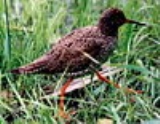
Common Redshanks in breeding plumage
Plumage
Plumage refers both to the layer of feathers that cover a bird and the pattern, colour, and arrangement of those feathers. The pattern and colours of plumage vary between species and subspecies and can also vary between different age classes, sexes, and season. Within species there can also be a...

 are a marbled brown color, slightly lighter below. In winter plumage they become somewhat lighter-toned and less patterned, being rather plain greyish-brown above and whitish below. They have red legs and a black-tipped red bill, and show white up the back and on the wings in flight.

The Spotted Redshank
Spotted Redshank
The Spotted Redshank, Tringa erythropus, is a wader in the large bird family Scolopacidae. It breeds across northern Scandinavia and northern Asia and migrates south to the Mediterranean, the southern British Isles, France, tropical Africa, and tropical Asia for the winter...

 (T. erythropus), which breeds in the Arctic
Arctic
The Arctic is a region located at the northern-most part of the Earth. The Arctic consists of the Arctic Ocean and parts of Canada, Russia, Greenland, the United States, Norway, Sweden, Finland, and Iceland. The Arctic region consists of a vast, ice-covered ocean, surrounded by treeless permafrost...

, has a longer bill
Beak
The beak, bill or rostrum is an external anatomical structure of birds which is used for eating and for grooming, manipulating objects, killing prey, fighting, probing for food, courtship and feeding young...

 and legs; it is almost entirely black in breeding plumage and very pale in winter. It is not a particularly close relative of the Common Redshank, but rather belongs to a high-latitude
Latitude
In geography, the latitude of a location on the Earth is the angular distance of that location south or north of the Equator. The latitude is an angle, and is usually measured in degrees . The equator has a latitude of 0°, the North pole has a latitude of 90° north , and the South pole has a...

 lineage of largish shanks. T. totanus on the other hand is closely related to the Marsh Sandpiper
Marsh Sandpiper
The Marsh Sandpiper, Tringa stagnatilis, is a small wader. It is a rather small shank, and breeds in open grassy steppe and taiga wetlands from easternmost Europe to central Asia....

 (T. stagnatilis), and closer still to the small Wood Sandpiper
Wood Sandpiper
The Wood Sandpiper, Tringa glareola, is a small wader. This Eurasian species is the smallest of the shanks, which are mid-sized long-legged waders of the family Scolopacidae.- Description and systematics :...

 (T. glareola). The ancestors of the latter and the Common Redshank seem to have diverged around the Miocene
Miocene
The Miocene is a geological epoch of the Neogene Period and extends from about . The Miocene was named by Sir Charles Lyell. Its name comes from the Greek words and and means "less recent" because it has 18% fewer modern sea invertebrates than the Pliocene. The Miocene follows the Oligocene...

-Pliocene
Pliocene
The Pliocene Epoch is the period in the geologic timescale that extends from 5.332 million to 2.588 million years before present. It is the second and youngest epoch of the Neogene Period in the Cenozoic Era. The Pliocene follows the Miocene Epoch and is followed by the Pleistocene Epoch...

 boundary, about 5-6 million years ago. These three subarctic
Subarctic
The Subarctic is a region in the Northern Hemisphere immediately south of the true Arctic and covering much of Alaska, Canada, the north of Scandinavia, Siberia, and northern Mongolia...

- to temperate
Temperate
In geography, temperate or tepid latitudes of the globe lie between the tropics and the polar circles. The changes in these regions between summer and winter are generally relatively moderate, rather than extreme hot or cold...

-region species
Species
In biology, a species is one of the basic units of biological classification and a taxonomic rank. A species is often defined as a group of organisms capable of interbreeding and producing fertile offspring. While in many cases this definition is adequate, more precise or differing measures are...

 form a group of smallish shanks with have red or yellowish legs, and in breeding plumage are generally a subdued light brown above with some darker mottling, and have somewhat diffuse small brownish spots on the breast and neck.

Ecology


It is a widespread breeding bird
Bird
Birds are feathered, winged, bipedal, endothermic , egg-laying, vertebrate animals. Around 10,000 living species and 188 families makes them the most speciose class of tetrapod vertebrates. They inhabit ecosystems across the globe, from the Arctic to the Antarctic. Extant birds range in size from...

 across temperate
Temperate
In geography, temperate or tepid latitudes of the globe lie between the tropics and the polar circles. The changes in these regions between summer and winter are generally relatively moderate, rather than extreme hot or cold...

 Eurasia
Eurasia
Eurasia is a continent or supercontinent comprising the traditional continents of Europe and Asia ; covering about 52,990,000 km2 or about 10.6% of the Earth's surface located primarily in the eastern and northern hemispheres...

. It is a migratory
Bird migration
Bird migration is the regular seasonal journey undertaken by many species of birds. Bird movements include those made in response to changes in food availability, habitat or weather. Sometimes, journeys are not termed "true migration" because they are irregular or in only one direction...

 species, wintering on coasts around the Mediterranean, on the Atlantic coast of Europe from Great Britain
Great Britain
Great Britain or Britain is an island situated to the northwest of Continental Europe. It is the ninth largest island in the world, and the largest European island, as well as the largest of the British Isles...

 southwards, and in South Asia
South Asia
South Asia, also known as Southern Asia, is the southern region of the Asian continent, which comprises the sub-Himalayan countries and, for some authorities , also includes the adjoining countries to the west and the east...

. They are uncommon vagrants
Vagrancy (biology)
Vagrancy is a phenomenon in biology whereby individual animals appear well outside their normal range; individual animals which exhibit vagrancy are known as vagrants. The term accidental is sometimes also used...

 outside these areas; on Palau
Palau
Palau , officially the Republic of Palau , is an island nation in the Pacific Ocean, east of the Philippines and south of Tokyo. In 1978, after three decades as being part of the United Nations trusteeship, Palau chose independence instead of becoming part of the Federated States of Micronesia, a...

 in Micronesia
Micronesia
Micronesia is a subregion of Oceania, comprising thousands of small islands in the western Pacific Ocean. It is distinct from Melanesia to the south, and Polynesia to the east. The Philippines lie to the west, and Indonesia to the southwest....

 for example, the species was recorded in the mid-1970s and in 2000.
They are wary and noisy birds which will alert everything else with their loud piping call. Like most wade
Wade
- Places :* Wade, California* Wade, Maine* Wade, Mississippi* Wade, North Carolina* Wade Township, Clinton County, Illinois* Wade Township, Jasper County, Illinois* Wade County, Choctaw Nation, former political subdivision-Surname:...

rs, they feed on small invertebrate
Invertebrate
An invertebrate is an animal without a backbone. The group includes 97% of all animal species – all animals except those in the chordate subphylum Vertebrata .Invertebrates form a paraphyletic group...

s. Redshanks will nest in any wetland, from damp meadows to saltmarsh, often at high densities. They lay 3-5 eggs.

The Common Redshank is one of the species to which the Agreement on the Conservation of African-Eurasian Migratory Waterbirds (AEWA
AEWA
The Agreement on the Conservation of African-Eurasian Migratory Waterbirds is the largest of its kind developed so far under the Bonn Convention. It was concluded on 16 June 1995 at The Hague, the Netherlands and entered into force on 1 November 1999 after the required number of at least fourteen...

) applies.

It is widely distributed and quite plentiful in some regions, and thus not considered a threatened species
Threatened species
Threatened species are any speciesg animals, plants, fungi, etc.) which are vulnerable to endangerment in the near future.The World Conservation Union is the foremost authority on threatened species, and treats threatened species not as a single category, but as a group of three categories,...

 by the IUCN.

External links