

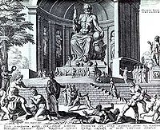
Statue of Zeus at Olympia

Overview
Phidias
Phidias or the great Pheidias , was a Greek sculptor, painter and architect, who lived in the 5th century BC, and is commonly regarded as one of the greatest of all sculptors of Classical Greece: Phidias' Statue of Zeus at Olympia was one of the Seven Wonders of the Ancient World...
, circa 432 BC on the site where it was erected in the Temple of Zeus
Temple of Zeus
The Temple of Zeus at Olympia was an ancient Greek temple in Olympia, Greece, dedicated to the chief of the gods, Zeus. It was the very model of the fully developed classical Greek temple of the Doric order...
, Olympia, Greece
Olympia, Greece
Olympia , a sanctuary of ancient Greece in Elis, is known for having been the site of the Olympic Games in classical times, comparable in importance to the Pythian Games held in Delphi. Both games were held every Olympiad , the Olympic Games dating back possibly further than 776 BC...
. It was one of the Seven Wonders of the Ancient World
Seven Wonders of the Ancient World
The Seven Wonders of the World refers to remarkable constructions of classical antiquity listed by various authors in guidebooks popular among the ancient Hellenic tourists, particularly in the 1st and 2nd centuries BC...
.
The seated statue, some 12 meters (43 feet) tall, occupied half of the width of the aisle of the temple built to house it. "It seems that if Zeus
Zeus
In the ancient Greek religion, Zeus was the "Father of Gods and men" who ruled the Olympians of Mount Olympus as a father ruled the family. He was the god of sky and thunder in Greek mythology. His Roman counterpart is Jupiter and his Etruscan counterpart is Tinia.Zeus was the child of Cronus...
were to stand up," the geographer Strabo
Strabo
Strabo, also written Strabon was a Greek historian, geographer and philosopher.-Life:Strabo was born to an affluent family from Amaseia in Pontus , a city which he said was situated the approximate equivalent of 75 km from the Black Sea...
noted early in the 1st century BC, "he would unroof the temple." The Zeus was a chryselephantine sculpture, made of ivory and gold-plated bronze.
Unanswered Questions

