


Old Summer Palace

Encyclopedia
Beijing
Beijing , also known as Peking , is the capital of the People's Republic of China and one of the most populous cities in the world, with a population of 19,612,368 as of 2010. The city is the country's political, cultural, and educational center, and home to the headquarters for most of China's...
. It is located 8 kilometres (5 mi) northwest of the walls of the Imperial City, built in the 18th and early 19th century, where the emperors of the Qing Dynasty
Qing Dynasty
The Qing Dynasty was the last dynasty of China, ruling from 1644 to 1912 with a brief, abortive restoration in 1917. It was preceded by the Ming Dynasty and followed by the Republic of China....
resided and handled government affairs (the Forbidden City
Forbidden City
The Forbidden City was the Chinese imperial palace from the Ming Dynasty to the end of the Qing Dynasty. It is located in the middle of Beijing, China, and now houses the Palace Museum...
was used for formal ceremonies).
Known for its extensive collection of garden and building architectures and other works of art (a popular name in China was the "Garden of Gardens").
In 1860 during the Second Opium War
Second Opium War
The Second Opium War, the Second Anglo-Chinese War, the Second China War, the Arrow War, or the Anglo-French expedition to China, was a war pitting the British Empire and the Second French Empire against the Qing Dynasty of China, lasting from 1856 to 1860...
, two British envoys, a journalist for The Times
The Times
The Times is a British daily national newspaper, first published in London in 1785 under the title The Daily Universal Register . The Times and its sister paper The Sunday Times are published by Times Newspapers Limited, a subsidiary since 1981 of News International...
and their small escort of British and Indian troopers met with the Royal Prince to negotiate. Instead they were confined and tortured, resulting in twenty deaths,. The British High Commissioner to China, Lord Elgin
James Bruce, 8th Earl of Elgin
Sir James Bruce, 8th Earl of Elgin and 12th Earl of Kincardine, KT, GCB, PC , was a British colonial administrator and diplomat...
, retaliated by ordering the destruction of the palace, which was then carried out by French and British troops.
The Old Summer Palace is located just outside the west gate of Tsinghua University
Tsinghua University
Tsinghua University , colloquially known in Chinese as Qinghua, is a university in Beijing, China. The school is one of the nine universities of the C9 League. It was established in 1911 under the name "Tsinghua Xuetang" or "Tsinghua College" and was renamed the "Tsinghua School" one year later...
, north of Peking University
Peking University
Peking University , colloquially known in Chinese as Beida , is a major research university located in Beijing, China, and a member of the C9 League. It is the first established modern national university of China. It was founded as Imperial University of Peking in 1898 as a replacement of the...
, and east of the Summer Palace
Summer Palace
The Summer Palace is a palace in Beijing, China. The Summer Palace is mainly dominated by Longevity Hill and the Kunming Lake. It covers an expanse of 2.9 square kilometers, three quarters of which is water....
. The postal address is: 28 Qinghua West Road, Beijing, 100084.
History
Initial construction began in 1707, during the reign of the Kangxi EmperorKangxi Emperor
The Kangxi Emperor ; Manchu: elhe taifin hūwangdi ; Mongolian: Энх-Амгалан хаан, 4 May 1654 –20 December 1722) was the fourth emperor of the Qing Dynasty, the first to be born on Chinese soil south of the Pass and the second Qing emperor to rule over China proper, from 1661 to 1722.Kangxi's...
and was on a much smaller scale. It was intended as a gift for the emperor's fourth son, later Emperor Yongzheng. In 1725, under the Yongzheng emperor, the Imperial Gardens were greatly expanded. Yongzheng introduced the waterworks of the gardens which created some of the lakes, streams and ponds which greatly complemented the rolling hills and grounds. Yongzheng also named 28 scenic spots within the garden.
By the Qianlong emperor's reign, the second expansion was well underway. Qianlong personally took interest and directed the expansion works. Qianlong also increased the number of scenic spots in the gardens to 50.
By the middle of the 19th century, the Imperial Gardens had undergone expansion in one form or another for over 150 years.
Overview of the site
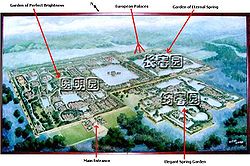
The Imperial Gardens were made up of three gardens: the Garden of Perfect Brightness proper, the Garden of Eternal Spring , and the Elegant Spring Garden ; together they covered an area of 3.5 square kilometres (864.9 acre). They were almost 5 times the size of the Forbidden City, and 8 times the size of the Vatican CityVatican City
Vatican City , or Vatican City State, in Italian officially Stato della Città del Vaticano , which translates literally as State of the City of the Vatican, is a landlocked sovereign city-state whose territory consists of a walled enclave within the city of Rome, Italy. It has an area of...
. On the grounds stood hundreds of structures such as halls, pavilions, temples, galleries, gardens, lakes, etc. Several famous landscapes of southern China had been reproduced in the Imperial Gardens, hundreds of masterpieces of Chinese art and antiquities were stored in the halls, making the Imperial Gardens one of the largest collections in the world. Some unique copies of literary work and compilations were also stored inside the Imperial Gardens.
The Old Summer Palace is often associated with the European-style palaces (Xi Yang Lou) built of stone. The designers of these structures, the Jesuits Giuseppe Castiglione and Michel Benoist
Michel Benoist
Michel Benoist October 23, 1774 in Beijing, China of a stroke) was a Jesuit scientist, who stood in the service of the ChineseQianlong Emperor for thirty years and is most noted for the waterworks he constructed for the emperor.-Education:...
, were employed by the Qianlong emperor
Qianlong Emperor
The Qianlong Emperor was the sixth emperor of the Manchu-led Qing Dynasty, and the fourth Qing emperor to rule over China proper. The fourth son of the Yongzheng Emperor, he reigned officially from 11 October 1735 to 8 February 1796...
to satisfy his taste for exotic buildings and objects. Sometimes, visitors unfamiliar with the former layout of the Old Summer Palace are misled to believe that it consisted primarily of European-style palaces. In fact, the area of the Imperial Gardens at the back of the Eternal Spring garden where the European-style buildings were located was small compared to the overall area of the gardens. More than 95% of the Imperial Gardens were made up of essentially Chinese-style buildings. There were also a few buildings in Tibetan and Mongol styles, reflecting the diversity of the Qing Empire.
Titsingh mission at Yuanmingyuan
A Dutch embassy would turn out to be the last occasion in which any European appeared before the Chinese Court within the context of traditional Chinese imperial foreign relations.Representing Dutch and Dutch East India Company
Dutch East India Company
The Dutch East India Company was a chartered company established in 1602, when the States-General of the Netherlands granted it a 21-year monopoly to carry out colonial activities in Asia...
interests, Isaac Titsingh
Isaac Titsingh
Isaac Titsingh FRS was a Dutch surgeon, scholar, merchant-trader and ambassador.During a long career in East Asia, Titsingh was a senior official of the Dutch East India Company . He represented the European trading company in exclusive official contact with Tokugawa Japan...
traveled to Beijing
Beijing
Beijing , also known as Peking , is the capital of the People's Republic of China and one of the most populous cities in the world, with a population of 19,612,368 as of 2010. The city is the country's political, cultural, and educational center, and home to the headquarters for most of China's...
in 1794-95 for celebrations of the sixtieth anniversary of the Qianlong Emperor's reign. The Titsingh delegation also included the Dutch-American Andreas Everardus van Braam Houckgeest
Andreas Everardus van Braam Houckgeest
Andreas Everardus van Braam Houckgeest Dutch-American merchant who is mostly known for his participation in the last Dutch embassy to China under the tributary system.- Early career :...
and the French Chrétien-Louis-Joseph de Guignes
Chrétien-Louis-Joseph de Guignes
Chrétien-Louis-Joseph de Guignes was a French merchant-trader, ambassador and scholar. He was the son of French academician and sinologue, Joseph de Guignes...
. Both published complementary accounts of the mission. Titsingh himself died before he could publish his version of events.
The members of the Titsingh mission were the last European diplomats to savor the mid-winter splendor of the vast Summer Palace before its destruction by the Lord Elgin's troops during the punitive Second Opium War in 1860.
Destruction of the Summer Palace

Beijing
Beijing , also known as Peking , is the capital of the People's Republic of China and one of the most populous cities in the world, with a population of 19,612,368 as of 2010. The city is the country's political, cultural, and educational center, and home to the headquarters for most of China's...
).
On September 29, two envoys, Henry Loch
Henry Loch, 1st Baron Loch
Henry Brougham Loch, 1st Baron Loch GCB, GCMG was a Scottish soldier and colonial administrator.-Military service:He was the son of James Loch, Member of Parliament, of Drylaw, Midlothian...
and Harry Parkes
Harry Smith Parkes
Sir Harry Smith Parkes was a 19th century British diplomat who worked mainly in China and Japan...
went ahead of the main force under a flag of truce to negotiate with the Prince I at Tungchow. After a day of talks, they and their small escort of British and Indian troopers (including two British envoys and a journalist for The Times
The Times
The Times is a British daily national newspaper, first published in London in 1785 under the title The Daily Universal Register . The Times and its sister paper The Sunday Times are published by Times Newspapers Limited, a subsidiary since 1981 of News International...
) were suddenly surrounded and taken prisoner. They were taken to the Board of Punishments in Beijing where they were confined and tortured. Parkes and Loch were returned after two weeks, with fourteen other survivors. Twenty British, French and Indian captives died. Their bodies were barely recognizable.
Xianfeng Emperor
The Xianfeng Emperor , born Aisin-Gioro I Ju, was the ninth Emperor of the Qing Dynasty, and the seventh Qing emperor to rule over China, from 1850 to 1861.-Family and his early years:...
having fled. Although the French commander Montauban assured the British commander Grant that "nothing had been touched", there was extensive looting by both French and British. There was no significant resistance to the looting, even though many Imperial soldiers were in the surrounding country.
On October 18, the British High Commissioner to China Lord Elgin
James Bruce, 8th Earl of Elgin
Sir James Bruce, 8th Earl of Elgin and 12th Earl of Kincardine, KT, GCB, PC , was a British colonial administrator and diplomat...
retaliated to the torture and executions by ordering the destruction of the palace. Destroying the Old Summer Palace was also thought to be a way of discouraging the Chinese Empire from using kidnapping as a bargaining tool.
It took 3,500 British troops to set the entire place ablaze, taking a total of three days to burn. After the gate to the palace was locked, more than 300 eunuchs, maids, and workers in the palace were unable to escape and burned to death. Only 13 royal buildings survived intact, most of them in the remote areas or by the lake side. The palace was sacked again in 1900 during the Eight-Nation Alliance
Eight-Nation Alliance
The Eight-Nation Alliance was an alliance of Austria-Hungary, France, Germany, Italy, Japan, Russia, the United Kingdom, and the United States whose military forces intervened in China to suppress the anti-foreign Boxers and relieve the siege of the diplomatic legations in Beijing .- Events :The...
invasion, and was completely ruined.
Charles George Gordon
Charles George Gordon
Major-General Charles George Gordon, CB , known as "Chinese" Gordon, Gordon Pasha, and Gordon of Khartoum, was a British army officer and administrator....
, then a 27-year-old captain in the Royal Engineers
Royal Engineers
The Corps of Royal Engineers, usually just called the Royal Engineers , and commonly known as the Sappers, is one of the corps of the British Army....
who later made his name in the Sudan, was part of the 1860 force and wrote:
One consolation for the Chinese was that the British and French looters preferred porcelain (much of which still graces English and French country houses) while neglecting bronze vessels prized locally for cooking and burial in tombs. Many such treasures dated back to the Shang
Shang Dynasty
The Shang Dynasty or Yin Dynasty was, according to traditional sources, the second Chinese dynasty, after the Xia. They ruled in the northeastern regions of the area known as "China proper" in the Yellow River valley...
, Zhou
Zhou Dynasty
The Zhou Dynasty was a Chinese dynasty that followed the Shang Dynasty and preceded the Qin Dynasty. Although the Zhou Dynasty lasted longer than any other dynasty in Chinese history, the actual political and military control of China by the Ji family lasted only until 771 BC, a period known as...
and Han
Han Dynasty
The Han Dynasty was the second imperial dynasty of China, preceded by the Qin Dynasty and succeeded by the Three Kingdoms . It was founded by the rebel leader Liu Bang, known posthumously as Emperor Gaozu of Han. It was briefly interrupted by the Xin Dynasty of the former regent Wang Mang...
dynasties and were up to 3,600 years old. A specific exception was the looting of the Haiyantang Zodiac fountain with its twelve bronze
Bronze
Bronze is a metal alloy consisting primarily of copper, usually with tin as the main additive. It is hard and brittle, and it was particularly significant in antiquity, so much so that the Bronze Age was named after the metal...
animal heads.
Once the Summer Palace had been reduced to ruins, a sign was raised with an inscription in Chinese stating "This is the reward for perfidy and cruelty". The burning of the palace was the last act of the war.
Like the Forbidden City, no ordinary Chinese citizen had ever been allowed into the Summer Palace, as it was used exclusively by the Imperial family. (See Personal narrative of occurrences during Lord Elgin's second embassy to China, 1860 by Henry Loch, 1869). The burning of the Gardens of Perfect Brightness is still a very sensitive issue in China today.
According to Prof. Wang Dou Cheng of the People's University in Beijing
Renmin University of China
Renmin University of China; RUC, also known as People's University of China , colloquially Renda , is a major research university in Haidian District, Beijing, China. Its campus neighbors those of Peking University and Tsinghua University....
, not all of the palace was destroyed in the original burning; over time, however, the ruins were further scavenged by Chinese treasure hunters, including during the Cultural Revolution.
Criticism of the destruction
For most Chinese, and foreigners alike, the act of burning the palace was and is perceived as barbaric and criminal. Some contemporary Frenchmen, such as Victor HugoVictor Hugo
Victor-Marie Hugo was a Frenchpoet, playwright, novelist, essayist, visual artist, statesman, human rights activist and exponent of the Romantic movement in France....
, disapproved of the action; in his "Expédition de Chine", Hugo described the looting as, "'Two robbers breaking into a museum, devastating, looting and burning, leaving laughing hand-in-hand with their bags full of treasures; one of the robbers is called France and the other Britain." In his letter Hugo hoped that one day France would feel guilty and return what it had plundered from China.
The events have been made into film a number of times in China. The most famous one being Huo shao yuan ming yuan (火燒圓明園; also known as Burning of the Imperial Palace, or The Burning of Yuan Ming Yuan), directed by Richard Li Han Hsiang
Li Han Hsiang
Richard Li Han Hsiang was a Chinese film director. Li directed more than 70 films in his career beginning in the 1950s and lasting till the 1990s....
(李翰祥, born 7 March 1926 in Jinxi, China; died 17 December 1996 in Beijing, China) in 1983. It was a joint production between Mainland China
Mainland China
Mainland China, the Chinese mainland or simply the mainland, is a geopolitical term that refers to the area under the jurisdiction of the People's Republic of China . According to the Taipei-based Mainland Affairs Council, the term excludes the PRC Special Administrative Regions of Hong Kong and...
and Hong Kong
Hong Kong
Hong Kong is one of two Special Administrative Regions of the People's Republic of China , the other being Macau. A city-state situated on China's south coast and enclosed by the Pearl River Delta and South China Sea, it is renowned for its expansive skyline and deep natural harbour...
which was under British rule at that time. The movie was released in Germany in 1990 as Das Imperium brennt.
A novelization of both the destruction of the Summer Palace and the Taiping Rebellion
Taiping Rebellion
The Taiping Rebellion was a widespread civil war in southern China from 1850 to 1864, led by heterodox Christian convert Hong Xiuquan, who, having received visions, maintained that he was the younger brother of Jesus Christ, against the ruling Manchu-led Qing Dynasty...
was published in 1985. Called "Flashman and the Dragon" by George MacDonald Fraser
George MacDonald Fraser
George MacDonald Fraser, OBE was an English-born author of Scottish descent, who wrote both historical novels and non-fiction books, as well as several screenplays.-Early life and military career:...
, it was one of that author's densely-researched historical novels. It presents the European view, with some criticism.
Aftermath
Puyi
Puyi , of the Manchu Aisin Gioro clan, was the last Emperor of China, and the twelfth and final ruler of the Qing Dynasty. He ruled as the Xuantong Emperor from 1908 until his abdication on 12 February 1912. From 1 to 12 July 1917 he was briefly restored to the throne as a nominal emperor by the...
, Puyi, was expelled by a republican army. Empress Dowager Cixi
Empress Dowager Cixi
Empress Dowager Cixi1 , of the Manchu Yehenara clan, was a powerful and charismatic figure who became the de facto ruler of the Manchu Qing Dynasty in China for 47 years from 1861 to her death in 1908....
built the Summer Palace
Summer Palace
The Summer Palace is a palace in Beijing, China. The Summer Palace is mainly dominated by Longevity Hill and the Kunming Lake. It covers an expanse of 2.9 square kilometers, three quarters of which is water....
(頤和園 - "The Garden of Nurtured Harmony") near the Old Summer Palace, but on a much smaller scale than the Old Summer Palace.
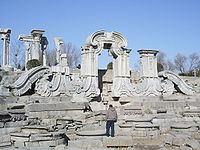
Only the European-style palaces survived the fire since, unlike the Chinese-style structures, they were made of stone. A few ruined stones of these European buildings still stand on the site today; this has misled some visitors to believe wrongly that the Old Summer Palace was made up only of European-style buildings.
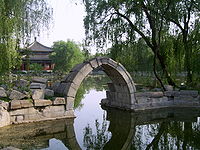
A few Chinese-style buildings in the outlying Elegant Spring Garden also survived the fire. The Chinese imperial court restored these buildings and tried to rebuild the whole complex of the Imperial Gardens, but was unable to raise the money and resources due to the difficult situation of China at the time. In 1900, many of the buildings had survived or had been restored were burnt for good by the expeditionary forces sent to quell the Boxer Rebellion
Boxer Rebellion
The Boxer Rebellion, also called the Boxer Uprising by some historians or the Righteous Harmony Society Movement in northern China, was a proto-nationalist movement by the "Righteous Harmony Society" , or "Righteous Fists of Harmony" or "Society of Righteous and Harmonious Fists" , in China between...
.
Most of the site was left abandoned and used by local farmers as agricultural land. Only in the 1980s was the site reclaimed by the Chinese government and turned into an historical site, a "Ruins Park." The park led to debates of the 1990s surrounding restoration and development issues and a more recent environmental controversy brought a new political life to the park as it became a symbol of China's "national wound."
Future
There are currently several plans in China for rebuilding the Imperial Gardens, but such moves have been opposed on the grounds that they will destroy an important relic of modern Chinese history. In addition, any rebuilding would be a colossal undertaking, and no rebuilding of above-the-ground structures has been approved. However, the lakes and waterways in the eastern half of the gardens have been dug up again and refilled with water, while hills around the lakes have been cleared of brushwood, recreating long-forgotten vistas. Several temples located inside the Old Summer Palace grounds has also been refurbished and rebuilt.In February 2005, work was undertaken to reduce water loss from the lakes and canals in the Yuan Ming Yuan by covering a total of 1.33 square kilometers of their beds with a membrane to reduce seepage. The park administration has argued that prevention of water loss saves the park money, since water would have to be added to the lakes only once per year instead of three times. However, opponents of the project such as Professor Zhengchun Zhang of Lanzhou University
Lanzhou University
Lanzhou University, founded in 1909, is a university located in Lanzhou, Gansu Province, China. It provides programs for undergraduate, graduate students on four campuses--three in Lanzhou city centre and one in Yuzhong , which is about 30 miles away from the main campus. Total enrollment is...
fear that the measure will destroy the ecology of the park, which depends on the water seepage from the lakes and the connection between the lakes and the underground water system. It is also feared that reduced seepage from the lakes will disturb Beijing's underground water system which is already suffering from depletion. There are also concerns about the gardens, which are a designated heritage site of the city of Beijing, changing their natural appearance. This issue, when brought into the sight of the general public several weeks later, immediately caused an uproar from the press and became one of the hottest debates on the Internet
Internet
The Internet is a global system of interconnected computer networks that use the standard Internet protocol suite to serve billions of users worldwide...
in China due to the still-painful memory of foreign humiliation epitomized in the destruction of this "Garden of Gardens (萬園之園)". The Beijing Environmental Protection Bureau (BEPB) recently conducted an assessment of the environmental impact of the measure.
A partial copy of the palace, the "New Yuan Ming Palace" (圓明新園), was built in 1997 in the southern city of Zhuhai
Zhuhai
Zhuhai is a prefecture-level city on the southern coast of Guangdong province in the People's Republic of China. Located in the Pearl River Delta, Zhuhai borders Jiangmen to the northwest, Zhongshan to the north, and Macau to the south. Zhuhai was one of the original Special Economic Zones...
, in Guangdong
Guangdong
Guangdong is a province on the South China Sea coast of the People's Republic of China. The province was previously often written with the alternative English name Kwangtung Province...
province, as an amusement park of 1.39 km², including an 80,000 m² lake.
To this day many relics which were taken from the gardens remain in foreign museums and private collections. Although the Chinese government has tried to recover them, only a few statuettes from The Eternal Spring garden of the Yongzheng Emperor
Yongzheng Emperor
The Yongzheng Emperor , born Yinzhen , was the fifth emperor of the Manchu Qing Dynasty and the third Qing emperor from 1722 to 1735. A hard-working ruler, Yongzheng's main goal was to create an effective government at minimal expense. Like his father, the Kangxi Emperor, Yongzheng used military...
have actually been returned; these are displayed in the National Museum.
External links
Official site- China Daily story on coating of the lake beds
- Erik Ringmar, Liberal Barbarism and the Destruction of the Palace of the Emperor of China collection of original sources pertaining to the Yuanmingyuan.
- 1860 : Yuanmingyuan great catastrophe, Bernard Briese
- China's view of Europe - A Changing Perspective?, Perry W. Ma