
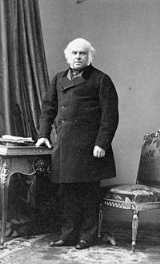
Sir James Bruce, 8th Earl of Elgin and 12th Earl of Kincardine,
KTThe Most Ancient and Most Noble Order of the Thistle is an order of chivalry associated with Scotland. The current version of the Order was founded in 1687 by King James VII of Scotland who asserted that he was reviving an earlier Order...
,
GCBThe Most Honourable Order of the Bath is a British order of chivalry founded by George I on 18 May 1725. The name derives from the elaborate mediæval ceremony for creating a knight, which involved bathing as one of its elements. The knights so created were known as Knights of the Bath...
,
PCHer Majesty's Most Honourable Privy Council, usually known simply as the Privy Council, is a formal body of advisers to the Sovereign in the United Kingdom...
(20 July 1811 – 20 November 1863), was a British colonial administrator and diplomat. He was the
Governor General of the Province of CanadaThe Governor General of Canada is the federal viceregal representative of the Canadian monarch, Queen Elizabeth II...
, a High Commissioner in charge of opening trades with China and Japan, and Viceroy of India.
Early life and education
Lord Elgin was the son of the
7th Earl of Elgin and 11th Earl of KincardineThomas Bruce, 7th Earl of Elgin and 11th Earl of Kincardine was a Scottish nobleman and diplomat, known for the removal of marble sculptures from the Parthenon in Athens. Elgin was the second son of Charles Bruce, 5th Earl of Elgin and his wife Martha Whyte...
and his second wife. Elgin's wife, Lady Mary Lambton, was a daughter of the
1st Earl of DurhamJohn George Lambton, 1st Earl of Durham GCB, PC , also known as "Radical Jack" and commonly referred to in history texts simply as Lord Durham, was a British Whig statesman, colonial administrator, Governor General and high commissioner of British North America...
, a prominent author of the
Report on the Affairs of British North America (1839)The Report on the Affairs of British North America, commonly known as The Durham Report, is an important document in the history of Quebec, Ontario, Canada and the British Empire....
, and niece of the Colonial Secretary the
3rd Earl GreyHenry George Grey, 3rd Earl Grey , known as Viscount Howick from 1807 until 1845, was an English statesman.-Background:Grey was the eldest son of Prime Minister Charles Grey, 2nd Earl Grey, by his wife the Hon...
.
He shared his birthday 20 July with his father. He had seven brothers and sisters and four half-sisters and one half-brother from his father's first marriage. Lord Elgin's father was reportedly improverished by the purchase of the
Elgin MarblesThe Parthenon Marbles, forming a part of the collection known as the Elgin Marbles , are a collection of classical Greek marble sculptures , inscriptions and architectural members that originally were part of the Parthenon and other buildings on the Acropolis of Athens...
. His father had acquired them at great expense, but sold them to the British government for much less.
James Bruce was educated at Eton College and
Christ Church, OxfordChrist Church or house of Christ, and thus sometimes known as The House), is one of the largest constituent colleges of the University of Oxford in England...
, graduated with a first in Classics in 1832. While at Oxford he became friends with
William Ewart GladstoneWilliam Ewart Gladstone FRS FSS was a British Liberal statesman. In a career lasting over sixty years, he served as Prime Minister four separate times , more than any other person. Gladstone was also Britain's oldest Prime Minister, 84 years old when he resigned for the last time...
.
Career
He was elected at the
1841 general election-Seats summary:-Whig MPs who lost their seats:*Viscount Morpeth - Chief Secretary for Ireland*Sir George Strickland, Bt*Sir Henry Barron, 1st Baronet-References:*F. W. S. Craig, British Electoral Facts: 1832-1987...
as a Member of Parliament for
SouthamptonSouthampton was a parliamentary constituency which was represented in the British House of Commons. Centred on the town of Southampton, it returned two Members of Parliament from 1295 until it was abolished for the 1950 general election....
, but the election was declared void on petition. He did not stand in the resulting
by-electionA by-election is an election held to fill a political office that has become vacant between regularly scheduled elections....
.
Jamaica
James Bruce became Governor of
JamaicaJamaica is an island nation of the Greater Antilles, in length, up to in width and 10,990 square kilometres in area. It is situated in the Caribbean Sea, about south of Cuba, and west of Hispaniola, the island harbouring the nation-states Haiti and the Dominican Republic...
in 1842, and in 1847 was appointed
Governor General of CanadaThe Governor General of Canada is the federal viceregal representative of the Canadian monarch, Queen Elizabeth II...
.
Canada
Under Lord Elgin, the first real attempts began at establishing
responsible governmentResponsible government is a conception of a system of government that embodies the principle of parliamentary accountability which is the foundation of the Westminster system of parliamentary democracy...
in Canada. In 1848, the moderate reformers of both Canada East and Canada West,
Louis-Hippolyte LafontaineSir Louis-Hippolyte Lafontaine , 1st Baronet, KCMG was the first Canadian to become Prime Minister of the United Province of Canada and the first head of a responsible government in Canada. He was born in Boucherville, Lower Canada in 1807...
and
Robert BaldwinRobert Baldwin was born at York . He, along with his political partner Louis-Hippolyte Lafontaine, led the first responsible ministry in Canada, regarded by some as the first truly Canadian government....
, won their elections, and Lord Elgin asked them to form a government together. Lord Elgin became the first Governor General to remove himself from the affairs of the legislature, leading to the essentially symbolic role that the Governor-General has since had with regards to the political affairs of the country. As Governor-General, he wrestled with the costs of receiving high levels of
immigrationImmigration is the act of foreigners passing or coming into a country for the purpose of permanent residence...
in the Canadas, a major issue in the constant debate about immigration during the 19th century.
In 1849 the Baldwin-Lafontaine government passed the
Rebellion Losses BillThe Rebellion Losses Bill was a controversial law enacted by the legislature of the Province of Canada in 1849...
, compensating French Canadians for losses suffered during the
Rebellions of 1837The Rebellions of 1837 were a pair of Canadian armed uprisings that occurred in 1837 and 1838 in response to frustrations in political reform. A key shared goal was the allowance of responsible government, which was eventually achieved in the incident's aftermath.-Rebellions:The rebellions started...
. Lord Elgin signed the bill despite heated
ToryToryism is a traditionalist and conservative political philosophy which grew out of the Cavalier faction in the Wars of the Three Kingdoms. It is a prominent ideology in the politics of the United Kingdom, but also features in parts of The Commonwealth, particularly in Canada...
opposition and his own personal misgivings, sparking riots in
QuebecQuebec or is a province in east-central Canada. It is the only Canadian province with a predominantly French-speaking population and the only one whose sole official language is French at the provincial level....
, during which Elgin himself was assaulted by an
EnglishEnglish is a West Germanic language that arose in the Anglo-Saxon kingdoms of England and spread into what was to become south-east Scotland under the influence of the Anglian medieval kingdom of Northumbria...
-speaking mob and the Parliament buildings were burned down. The French-speaking minority in the Canadian legislature also unsuccessfully tried to have him removed from his post.
In 1849, the
Stony Monday RiotThe Stony Monday Riot took place in Bytown , Ontario on Monday September 17, 1849.In April 1849, Lord Elgin had signed the Rebellion Losses Bill, compensating Lower Canadians for losses suffered during the Rebellions of 1837-38. The bill was unpopular with Tories because it compensated those who...
took place in
BytownBytown is the former name of Ottawa, Canada's capital city. It was founded on on September 26, 1826, incorporated as a town on January 1, 1850, and superseded by the incorporation of the City of Ottawa on January 1, 1855. The founding was marked by a sod turning, and a letter from Governor General...
on Monday September 17. Tories and Reformists clashed over the planned visit of Lord Elgin, one man was killed and many sustained injuries. Two days later, the two political factions, armed with cannons, muskets and pistols faced off on the Sappers Bridge. Although the conflict was defused in time by the military, a general support for the Crown's representative, triumphed in Bytown (renamed Ottawa by Queen Victoria in 1854). In 1854, Lord Elgin negotiated the
Reciprocity TreatyThe Canadian American Reciprocity Treaty, also known as the Elgin-Marcy Treaty, was a trade treaty between the colonies of British North America and the United States. It covered raw materials and was in effect from 1854 to 1865...
with the
United StatesThe United States of America is a federal constitutional republic comprising fifty states and a federal district...
in an attempt to stimulate the Canadian economy. Later that year, he signed the law that abolished the
seigneurial systemThe seigneurial system of New France was the semi-feudal system of land distribution used in the North American colonies of New France.-Introduction to New France:...
in Quebec, and then resigned as Governor-General.
China and Japan
In 1857 he became High Commissioner to
ChinaChinese civilization may refer to:* China for more general discussion of the country.* Chinese culture* Greater China, the transnational community of ethnic Chinese.* History of China* Sinosphere, the area historically affected by Chinese culture...
and travelled to China and Japan in 1858-59, where he led the bombing of
CantonGuangzhou , known historically as Canton or Kwangchow, is the capital and largest city of the Guangdong province in the People's Republic of China. Located in southern China on the Pearl River, about north-northwest of Hong Kong, Guangzhou is a key national transportation hub and trading port...
and oversaw the end of the
Second Opium WarThe Second Opium War, the Second Anglo-Chinese War, the Second China War, the Arrow War, or the Anglo-French expedition to China, was a war pitting the British Empire and the Second French Empire against the Qing Dynasty of China, lasting from 1856 to 1860...
by signing the Treaties of Tianjin on 26 June 1858.
In June 1860 he returned to China to assist with further attacks that were initially led by his brother. On October 18, 1860, Elgin, not having received the Chinese surrender and wishing to spare Beijing itself, ordered the complete destruction of the
Yuan Ming Yuan (or
Old Summer PalaceThe Old Summer Palace, known in China as Yuan Ming Yuan , and originally called the Imperial Gardens, was a complex of palaces and gardens in Beijing...
) outside
BeijingBeijing , also known as Peking , is the capital of the People's Republic of China and one of the most populous cities in the world, with a population of 19,612,368 as of 2010. The city is the country's political, cultural, and educational center, and home to the headquarters for most of China's...
in retaliation for the imprisonment, torture, and execution of almost twenty European and Indian prisoners (including two British envoys and a journalist for
The Times). The Old Summer Palace was a complex of palaces and gardens eight kilometres northwest of the walls of Beijing; it had been built during the 18th and early 19th centuries and was where the emperors of the Qing Dynasty resided and handled government affairs. An alternative account says that Elgin had initially considered the destruction of the
Forbidden CityThe Forbidden City was the Chinese imperial palace from the Ming Dynasty to the end of the Qing Dynasty. It is located in the middle of Beijing, China, and now houses the Palace Museum...
, but fearing that it might interfere with the signing of the Convention of Beijing, which was where it was being negotiated, he opted for the destruction of the Old Summer Palace in its stead.
The Old Summer Palace was fired by 3,500 British troops and burned for three days; this act is still considered a painful vandalism and great shame in China. Elgin and his troops also managed to loot many treasures from the Yuan Ming Yuan imperial gardens and took them to Britain. Attacks on the
Summer PalaceThe Summer Palace is a palace in Beijing, China. The Summer Palace is mainly dominated by Longevity Hill and the Kunming Lake. It covers an expanse of 2.9 square kilometers, three quarters of which is water....
, were also made but the extent of destruction was not as great as to Yuan Ming Yuan. On 24 October 1860 Elgin signed the Convention of Beijing, which stipulated that China was to cede part of Kowloon Peninsula and
Hong KongHong Kong is one of two Special Administrative Regions of the People's Republic of China , the other being Macau. A city-state situated on China's south coast and enclosed by the Pearl River Delta and South China Sea, it is renowned for its expansive skyline and deep natural harbour...
in perpetuity to Britain.
In between Elgin's two trips to China he had visited Japan and signed in August 1858 a
Treaty of Amity and CommerceThe was signed on August 26, 1858 by Lord Elgin and the then representatives of the Japanese government . This was an unequal treaty, that gave Japan semi-colonial status.The concessions which Japan made were threefold:...
whose negotiation was much eased by the recent Harris Treaty between Japan and the United States. Elgin was ambivalent about the British policy on forcing opium on the people in the Far East. It was not without internal struggle that he carried out the duty laid on him by Britain. In a letter to his wife, in regard to the bombing of Canton he wrote,
"I never felt so ashamed of myself in my life."
India
He became Viceroy of India in 1861, and was the first to use
Peterhoff, ShimlaPeterhoff is a building in Shimla which has housed at least seven Viceroy and Governor Generals of India during the British Raj. Its first occupant was James Bruce, 8th Earl of Elgin, whose father had secured the Elgin Marbles from the Parthenon, and whose family had been connected with the old...
as the official residence of the Viceroy. He died in 1863 of a heart attack while crossing a swinging rope and wood bridge over the river Chandra, on the lap between Kullu and Lahul.. He was buried in the churchyard of
St. John in the WildernessSt. John in the Wilderness is an Anglican church dedicated to Saint John built in 1852, located near Dharamsala, India, on the way to McLeod Ganj, at Forsyth Gunj...
in Dharamshala.
Legacy
The towns of
KincardineThe Municipality of Kincardine is located on the shores of Lake Huron in the County of Bruce in the province of Ontario, Canada. It has a population of 12,000, and covers an area of 580 square kilometres...
,
Port ElginPort Elgin is a community in the Ontario municipality of Saugeen Shores. Close to MacGregor Point Provincial Park in Bruce County, the community has several beaches on Lake Huron....
and
Bruce MinesBruce Mines is a town in the Canadian province of Ontario, located on the north shore of Lake Huron in the Algoma District along Highway 17. The town of Bruce Mines has a population of 584 residents. The current mayor of Bruce Mines is Gordon Post.- History :...
and the counties of
BruceBruce County is a county in western Ontario, Canada, and includes the Bruce Peninsula. As of 2006, the population was 65,349. The area was . The county seat is Walkerton, Ontario. It is located at ....
and
ElginElgin County is a county and census division of the Canadian province of Ontario with a current population of approximately 46,000. The county seat is St. Thomas.It consists of:*Town of Aylmer*Municipality of Bayham*Municipality of Central Elgin...
in
OntarioOntario is a province of Canada, located in east-central Canada. It is Canada's most populous province and second largest in total area. It is home to the nation's most populous city, Toronto, and the nation's capital, Ottawa....
are named after him, as is the community of
Elgin, New BrunswickElgin is a Canadian rural community in Albert County, New Brunswick.It is situated in the western part of the county, approximately 14 kilometres south of Petitcodiac on Highway 905....
. Numerous Elgin Roads and Elgin Streets in Canada, India and
Hong KongElgin Street is located in Central, Hong Kong. It was named after James Bruce, 8th Earl of Elgin. One of the earliest streets in Hong Kong, it was also known as "Mud Street" by the locals, as the street became very muddy in rainy days in the old days....
are also named in his honour, as is the
Lord Elgin HotelThe Lord Elgin Hotel is a prominent hotel in downtown Ottawa, Canada with 355 guest rooms, located at 100 Elgin Street at Laurier Avenue, across from Confederation Park...
in
OttawaOttawa is the capital of Canada, the second largest city in the Province of Ontario, and the fourth largest city in the country. The city is located on the south bank of the Ottawa River in the eastern portion of Southern Ontario...
.
See also
- List of Lieutenant Governors of Ontario
- List of Lieutenant Governors of Quebec
- Anglo-Japanese relations
The history of the relationship between Britain and Japan began in 1600 with the arrival of William Adams on the shores of Kyūshū at Usuki in Ōita Prefecture...
- Anglo-Chinese relations
British–Chinese relations , also known as Sino-British relations and Anglo-Chinese relations, refers to the interstate relations between China and the United Kingdom. Although on opposing sides of the Cold War, both countries were allies during World War II, and are members of the UN...
Sources
- Wrong, George M. The Earl of Elgin. Toronto : G.N. Morang, 1906. Also digitized by Canadian Institute for Historical Microreproductions 2003.
- Morison, John Lyle. The eighth Earl of Elgin : a chapter in nineteenth-century imperial history. London : Hodder and Stoughton, 1928.
- Narrative of the Earl of Elgin's mission to China and Japan, 1857-8-9 (2 volumes), Laurence Oliphant, 1859 (reprinted by Oxford University Press, 1970) {No ISBN}
- Checkland, S.G. The Elgins 1766-1917 : a tale of aristocrats, proconsuls and their wives. Aberdeen : Aberdeen University Press, 1988. ISBN 0-08-036395-4.
- Harris, David. Van Slyke, Lyman P. (2000). Of Battle and Beauty: Felice Beato's Photographs of China. University of California Press. ISBN 0899511007.
- John Newsinger, 'Elgin in China,' The New Left Review, 15 May/June, 2002. pp. 119–40.
- James L. Hevia, English Lessons: The Pedagogy of Imperialism in Nineteenth-Century China (Durham: Duke University Press, 2003)
- Moving Here, Staying Here: The Canadian Immigrant Experience at Library and Archives Canada - A letter from Lord Elgin, Governor General of the Canadas, to the Colonial Office
External links
- Biography at the Dictionary of Canadian Biography Online
- Erik Ringmar, "Liberal Barbarism and the Oriental Sublime: The European Destruction of the Emperor’s Summer Palace,” Millennium, 34:3, 2006. pp. 917–33.
- Lord Elgin, “Second Mission to China, 1860,” from Extracts from the Letters of James, Earl of Elgin to Mary Louisa, Countess of Elgin, 1847-1862 (London, 1864)