

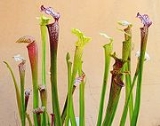
Sarracenia

Encyclopedia
Genus
In biology, a genus is a low-level taxonomic rank used in the biological classification of living and fossil organisms, which is an example of definition by genus and differentia...
comprising 8 to 11 species of North America
North America
North America is a continent wholly within the Northern Hemisphere and almost wholly within the Western Hemisphere. It is also considered a northern subcontinent of the Americas...
n pitcher plant
Pitcher plant
Pitcher plants are carnivorous plants whose prey-trapping mechanism features a deep cavity filled with liquid known as a pitfall trap. It has been widely assumed that the various sorts of pitfall trap evolved from rolled leaves, with selection pressure favouring more deeply cupped leaves over...
s. The genus belongs to the family Sarraceniaceae
Sarraceniaceae
Sarraceniaceae is a family of pitcher plants , belonging to order Ericales .The family comprises three extant genera: Sarracenia , Darlingtonia , and Heliamphora . The extinct Archaeamphora longicervia may also belong to this family...
, which also contain the closely allied genera Darlingtonia and Heliamphora
Heliamphora
The genus Heliamphora contains 23 species of pitcher plants endemic to South America. The species are collectively known as sun pitchers, based on the mistaken notion that the heli of Heliamphora is from the Greek helios, meaning "sun"...
.
Sarracenia is a genus of carnivorous plant
Carnivorous plant
Carnivorous plants are plants that derive some or most of their nutrients from trapping and consuming animals or protozoans, typically insects and other arthropods. Carnivorous plants appear adapted to grow in places where the soil is thin or poor in nutrients, especially nitrogen, such as acidic...
s indigenous to the eastern seaboard
Eastern seaboard
An Eastern seaboard can mean any easternmost part of a continent, or its countries, states and/or cities.Eastern seaboard may also refer to:* East Coast of Australia* East Coast of the United States* Eastern Seaboard of Thailand-See also:...
, Texas
Texas
Texas is the second largest U.S. state by both area and population, and the largest state by area in the contiguous United States.The name, based on the Caddo word "Tejas" meaning "friends" or "allies", was applied by the Spanish to the Caddo themselves and to the region of their settlement in...
, the Great Lakes
Great Lakes
The Great Lakes are a collection of freshwater lakes located in northeastern North America, on the Canada – United States border. Consisting of Lakes Superior, Michigan, Huron, Erie, and Ontario, they form the largest group of freshwater lakes on Earth by total surface, coming in second by volume...
area and southeastern Canada
Canada
Canada is a North American country consisting of ten provinces and three territories. Located in the northern part of the continent, it extends from the Atlantic Ocean in the east to the Pacific Ocean in the west, and northward into the Arctic Ocean...
, with most species occurring only in the south-east United States
United States
The United States of America is a federal constitutional republic comprising fifty states and a federal district...
(only S. purpurea
Sarracenia purpurea
Sarracenia purpurea, commonly known as the purple pitcher plant, northern pitcher plant, or side-saddle flower, is a carnivorous plant in the family Sarraceniaceae...
occurs in cold-temperate regions). The plant's leaves have evolved
Evolution
Evolution is any change across successive generations in the heritable characteristics of biological populations. Evolutionary processes give rise to diversity at every level of biological organisation, including species, individual organisms and molecules such as DNA and proteins.Life on Earth...
into a funnel in order to trap insect
Insect
Insects are a class of living creatures within the arthropods that have a chitinous exoskeleton, a three-part body , three pairs of jointed legs, compound eyes, and two antennae...
s, digesting their prey with protease
Protease
A protease is any enzyme that conducts proteolysis, that is, begins protein catabolism by hydrolysis of the peptide bonds that link amino acids together in the polypeptide chain forming the protein....
s and other enzymes.
The insects are attracted by a nectar-like secretion on the lip of pitchers, as well as a combination of color and scent. Slippery footing at the pitchers' rim, aided in at least one species by a narcotic drug lacing the nectar, causes insects to fall inside, where they die and are digested by the plant as a nutrient source.
Morphology
Sarracenia are herbaceousHerbaceous
A herbaceous plant is a plant that has leaves and stems that die down at the end of the growing season to the soil level. They have no persistent woody stem above ground...
perennial plant
Perennial plant
A perennial plant or simply perennial is a plant that lives for more than two years. The term is often used to differentiate a plant from shorter lived annuals and biennials. The term is sometimes misused by commercial gardeners or horticulturalists to describe only herbaceous perennials...
s that grow from a subterranean rhizome
Rhizome
In botany and dendrology, a rhizome is a characteristically horizontal stem of a plant that is usually found underground, often sending out roots and shoots from its nodes...
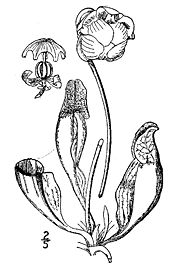
, with many tubular pitcher-shaped leaves radiating out from the growing point, and then turning upwards with their trap openings facing the center of the crown. The trap is a vertical tube with a 'hood' (the operculum
Operculum (botany)
An operculum, in botany, is a term generally used to describe a structure within a plant, moss, or fungus acting as a cap, flap, or lid. In plants, it may also be called a bud cap.Examples of structures identified as opercula include:...
) extending over its entrance; and below it the top of the tube usually has a rolled lip (the peristome
Peristome
The word peristome is derived from the Greek peri, meaning 'around' or 'about', and stoma, 'mouth'. It is a term used to describe various anatomical features that surround an opening to an organ or structure. The term is used in plants and invertebrate animals, such as in describing the shells of...
) which secretes nectar and scents. The hood itself frequently produces nectar too, but in lesser quantities.
The inside of the pitcher tube, regardless of species, can be divided into three to five distinguishable zones: zone 1 is the operculum (or hood), zone 2 is the peristome and rest of the trap entrance, while zones 3 and 4 (which in some species are combined) and 5 (only present in S. purpurea) are further divisions of the actual tube. Each of these zones has a specific function, with corresponding morphophysiological characteristics.
- Zone 1: Operculum. In most species the operculum covers at least part of the pitcher opening, thereby preventing rain from excessively filling the pitcher, which would result in the loss of prey. The operculum also serves to guide prey to the pitcher opening, using a combination of color, scent, and downward-pointing hairs to guide insects toward the trap entrance. Some species, specifically S. minorSarracenia minorSarracenia minor, also known as the Hooded pitcher plant, is a perennial, terrestrial, rhizomatous, herbaceous, carnivorous plant in the genus Sarracenia. Like all the Sarracenia, it is native to the New World.-Etymology:...
and S. psittacinaSarracenia psittacinaSarracenia psittacina, also known as the parrot pitcher plant, is a carnivorous plant in the genus Sarracenia. Like all the Sarracenia, it is native to North America, in the Southeastern United States....
, have opercula that hang low over the pitcher entrance. These are also studded with chlorophyllChlorophyllChlorophyll is a green pigment found in almost all plants, algae, and cyanobacteria. Its name is derived from the Greek words χλωρος, chloros and φύλλον, phyllon . Chlorophyll is an extremely important biomolecule, critical in photosynthesis, which allows plants to obtain energy from light...
-free patches, translucent "windows" which confuse prey into attempting to fly through the operculum, thereby causing them to cascade down the pitcher tube. (A similar, more well developed mechanism is found in the closely related Darlingtonia californicaDarlingtonia californicaDarlingtonia californica , also called the California Pitcher plant, Cobra Lily, or Cobra Plant, is a carnivorous plant, the sole member of the genus Darlingtonia in the family Sarraceniaceae. It is native to Northern California and Oregon, growing in bogs and seeps with cold running water...
).
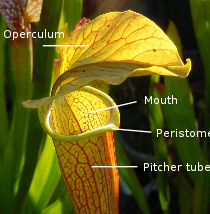
- Zone 2: Peristome and trap entrance. This zone is composed mainly of the peristome, which produces copious amounts of nectar, luring insect prey to land or crawl onto the perilous footing surrounding the pitcher trap. This zone also includes the waxy upper portion of the pitcher tube. Footing on this zone is especially treacherous, as the waxy deposits on surface of this zone cause unwary insects to lose their footing and tumble into the pitcher depths.
- Zone 3: Located below Zone 2, this zone features a leaf surface with non-existent footing, as well as a coating of ultra-fine, downward pointing hairs. Insects that have made it this far lose any chance of escape. It is also studded with digestive glandGlandA gland is an organ in an animal's body that synthesizes a substance for release of substances such as hormones or breast milk, often into the bloodstream or into cavities inside the body or its outer surface .- Types :...
s, which secrete digestive enzymeEnzymeEnzymes are proteins that catalyze chemical reactions. In enzymatic reactions, the molecules at the beginning of the process, called substrates, are converted into different molecules, called products. Almost all chemical reactions in a biological cell need enzymes in order to occur at rates...
s into the digestive fluid.
- Zone 4: This is the final zone in most species. It is filled with digestive fluids, and readily absorbs nutrients released from the insects by the work of the digestive enzymes and bacteriaBacteriaBacteria are a large domain of prokaryotic microorganisms. Typically a few micrometres in length, bacteria have a wide range of shapes, ranging from spheres to rods and spirals...
in the pitcher fluid. Along with more digestive glands, this zone features a thick coating of coarse downward pointing hairs, which makes escape from the digestive fluids impossible.
- Zone 5: This zone, located below Zone 4 and found only in S. purpurea, is smooth, glabrous, lacks glands, and does not serve as an absorptive zone. Its function is unknown.
Carnivorous mechanism
All Sarracenia trap insects and other prey without the use of moving parts. Their traps are static and are based on a combination of lures (including color, scent, and nectar) and inescapability – typically the entrances to the traps are one-way by virtue of the highly adapted features listed above.Most species use a combination of scent, drugged nectar, waxy deposits (to clog insect feet) and gravity to topple insect prey into their pitcher. Coniine
Coniine
Coniine is a poisonous alkaloid found in poison hemlock and the yellow pitcher plant, and contributes to hemlock's fetid smell. It is a neurotoxin which disrupts the peripheral nervous system. It is toxic to humans and all classes of livestock; less than 0.2g is fatal to humans, with death caused...
, an alkaloid
Alkaloid
Alkaloids are a group of naturally occurring chemical compounds that contain mostly basic nitrogen atoms. This group also includes some related compounds with neutral and even weakly acidic properties. Also some synthetic compounds of similar structure are attributed to alkaloids...
drug narcotic to insects, has been discovered in the nectar-like secretions of at least S. flava
Sarracenia flava
Sarracenia flava, the Yellow pitcher plant, is a carnivorous plant in the family Sarraceniaceae. Like all the Sarraceniaceae, it is native to the New World. Its range extends from southern Alabama, through Florida and Georgia, to the coastal plains of southern Virginia, North Carolina and South...
. Once inside, the insect finds the footing very slippery with a waxy surface covering the walls of the pitcher. Further down the tube, downward-pointing hairs make retreat impossible, and in the lowest region of the tube, a pool of liquid containing digestive enzymes and wetting agents quickly drowns the prey and begins digestion. The exoskeletons are usually not digested, and over the course of the summer fill up the pitcher tube.
Only S. purpurea normally contains significant amounts of rainwater in its tubular pitchers. It is a myth that all species contain water. In fact, the hoods of the other species help to keep out rain water in addition to keeping flying prey from escaping.
S. psittacina, the parrot pitcher, uses a lobster-pot
Lobster trap
Not to be confused with Lobster-tailed potA lobster trap or lobster pot is a portable trap that traps lobsters or crayfish and is used in lobster fishing. A lobster trap can hold several lobsters. Lobster traps are constructed of wire and wood. An opening permits the lobster to enter a tunnel of...
style trap that will admit prey (including tadpole
Tadpole
A tadpole or polliwog is the wholly aquatic larval stage in the life cycle of an amphibian, particularly that of a frog or toad.- Appellation :...
s and small fish during floods) but not allow it to find its way out; and sharp inward-pointing hairs force the victim gradually down to the base of the pitcher where it is digested.
Flowers and seeds
Pollination
Pollination is the process by which pollen is transferred in plants, thereby enabling fertilisation and sexual reproduction. Pollen grains transport the male gametes to where the female gamete are contained within the carpel; in gymnosperms the pollen is directly applied to the ovule itself...
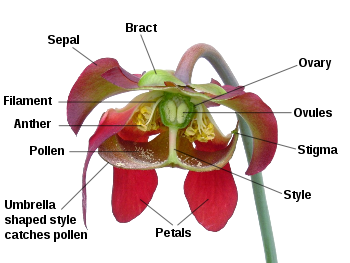
s. The flowers, which depending on species are 3-10 centimeters in diameter, are dramatic and have an elaborate design which prevents self-pollination. It consists of five sepal
Sepal
A sepal is a part of the flower of angiosperms . Collectively the sepals form the calyx, which is the outermost whorl of parts that form a flower. Usually green, sepals have the typical function of protecting the petals when the flower is in bud...
s superintended by three bract
Bract
In botany, a bract is a modified or specialized leaf, especially one associated with a reproductive structure such as a flower, inflorescence axis, or cone scale. Bracts are often different from foliage leaves. They may be smaller, larger, or of a different color, shape, or texture...
s, numerous anthers, and an umbrella
Umbrella
An umbrella or parasol is a canopy designed to protect against rain or sunlight. The term parasol usually refers to an item designed to protect from the sun; umbrella refers to a device more suited to protect from rain...
-like five-pointed style, over which five long yellow or red petal
Petal
Petals are modified leaves that surround the reproductive parts of flowers. They often are brightly colored or unusually shaped to attract pollinators. Together, all of the petals of a flower are called a corolla. Petals are usually accompanied by another set of special leaves called sepals lying...
s dangle. The whole flower is held upside-down, so that the umbrella-like style catches the pollen
Pollen
Pollen is a fine to coarse powder containing the microgametophytes of seed plants, which produce the male gametes . Pollen grains have a hard coat that protects the sperm cells during the process of their movement from the stamens to the pistil of flowering plants or from the male cone to the...
dropped by the anthers. The stigmas are located at the tips of the umbrella-like style. The primary pollinators are bee
Bee
Bees are flying insects closely related to wasps and ants, and are known for their role in pollination and for producing honey and beeswax. Bees are a monophyletic lineage within the superfamily Apoidea, presently classified by the unranked taxon name Anthophila...
s. Bees searching for nectar must force their way past one of the stigmas to enter the chamber formed by the style. Inside, they will inevitably come in contact with a lot of pollen, both from the hanging anthers and from the pollen collected by the style. Upon exiting, the bees must force their way under one of the flap-like petals. This keeps them away from the stigma, avoiding self-pollination. The next flower visited receives on its stigmata some of the first flower's pollen, and the cycle continues.
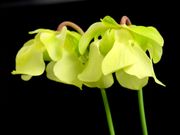
The flowers of almost all species are scented. The scent varies, but is often strong and sometimes unpleasant. S. flava has an especially strong odor resembling cat urine
Urine
Urine is a typically sterile liquid by-product of the body that is secreted by the kidneys through a process called urination and excreted through the urethra. Cellular metabolism generates numerous by-products, many rich in nitrogen, that require elimination from the bloodstream...
.
Flowers generally last about two weeks. At the end of the flowering period, the petals drop and the ovary, if pollinated, begins to swell. The seed forms in five lobes, with one lobe producing significantly smaller numbers of seeds than the other lobes. On average, 300-600 seed are produced, depending on species and pollination success. Seed takes five months to mature, at which point the seed pod turns brown and splits open, scattering seed. The seeds are 1.5–2 mm in length and have a rough, waxy coat which makes it hydrophobic, possibly for seed dispersal by flowing water. Sarracenia seed requires a stratification period to germinate in large numbers. Plants grown from seed start producing functioning traps almost immediately, although they differ in morphology from adult traps for the first year or so, being simpler in structure. Plants require 3–5 years to reach maturity from seed.
Growth cycle
Pitcher production begins at the end of the flowering period in spring, and lasts until late autumn. At the end of autumn, the pitchers begin to wither and the plants produce non-carnivorous leaves called phyllodia, which play a role in the economics of carnivory in these species. Since the supply of insects during winter is decreased, and the onset of cold weather slows plant metabolismMetabolism
Metabolism is the set of chemical reactions that happen in the cells of living organisms to sustain life. These processes allow organisms to grow and reproduce, maintain their structures, and respond to their environments. Metabolism is usually divided into two categories...
and other processes, putting energy into producing carnivorous leaves would be uneconomical for the plant.
Range and habitat
United States
The United States of America is a federal constitutional republic comprising fifty states and a federal district...
. One species, S. purpurea, continues north and west well into Canada
Canada
Canada is a North American country consisting of ten provinces and three territories. Located in the northern part of the continent, it extends from the Atlantic Ocean in the east to the Pacific Ocean in the west, and northward into the Arctic Ocean...
. The typical habitat is warm-temperate; all Sarracenia are perennial
Perennial plant
A perennial plant or simply perennial is a plant that lives for more than two years. The term is often used to differentiate a plant from shorter lived annuals and biennials. The term is sometimes misused by commercial gardeners or horticulturalists to describe only herbaceous perennials...
and require a distinct summer and winter. A few subspecies or varieties (S. rubra subsp. alabamensis, S. rubra subsp. jonesii, and S. purpurea var. montana) can be found more inland in mountains (e.g. the Appalachian mountains
Appalachian Mountains
The Appalachian Mountains #Whether the stressed vowel is or ,#Whether the "ch" is pronounced as a fricative or an affricate , and#Whether the final vowel is the monophthong or the diphthong .), often called the Appalachians, are a system of mountains in eastern North America. The Appalachians...
).
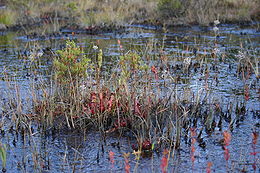
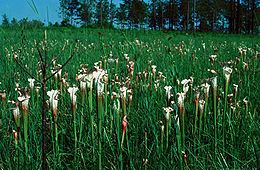
Sarracenia tend to inhabit permanently wet fen
Fen
A fen is a type of wetland fed by mineral-rich surface water or groundwater. Fens are characterised by their water chemistry, which is neutral or alkaline, with relatively high dissolved mineral levels but few other plant nutrients...
s, swamps, and grassy plains. These habitats tend to be acidic (low pH) with soil made up of sand and Sphagnum
Sphagnum
Sphagnum is a genus of between 151 and 350 species of mosses commonly called peat moss, due to its prevalence in peat bogs and mires. A distinction is made between sphagnum moss, the live moss growing on top of a peat bog on one hand, and sphagnum peat moss or sphagnum peat on the other, the...
moss
Moss
Mosses are small, soft plants that are typically 1–10 cm tall, though some species are much larger. They commonly grow close together in clumps or mats in damp or shady locations. They do not have flowers or seeds, and their simple leaves cover the thin wiry stems...
. Frequently, the soil will be poor in nutrients, particularly nitrate
Nitrate
The nitrate ion is a polyatomic ion with the molecular formula NO and a molecular mass of 62.0049 g/mol. It is the conjugate base of nitric acid, consisting of one central nitrogen atom surrounded by three identically-bonded oxygen atoms in a trigonal planar arrangement. The nitrate ion carries a...
s, and often continuously leached
Leaching (pedology)
In pedology, leaching is the loss of mineral and organic solutes due to percolation. It is a mechanism of soil formation. It is distinct from the soil forming process of eluviation, which is the loss of mineral and organic colloids. Leached and elluviated materials tend to be lost from topsoil and...
by moving water or made unavailable to the plant roots by the low pH. The plants gain their advantage from their ability to extract nutrients from insect prey in this mineral-poor environment. The plants prefer strong, direct sunlight with no shade.
In several cases, carnivorous plant enthusiasts have introduced S. purpurea into suitable habitats outside of its natural range, where it has naturalized. Some of these populations are decades old; the oldest known occurrence in the Swiss Jura mountains
Jura mountains
The Jura Mountains are a small mountain range located north of the Alps, separating the Rhine and Rhone rivers and forming part of the watershed of each...
is around one hundred years old. Besides Switzerland
Switzerland
Switzerland name of one of the Swiss cantons. ; ; ; or ), in its full name the Swiss Confederation , is a federal republic consisting of 26 cantons, with Bern as the seat of the federal authorities. The country is situated in Western Europe,Or Central Europe depending on the definition....
, such naturalized populations can be found in Ireland
Ireland
Ireland is an island to the northwest of continental Europe. It is the third-largest island in Europe and the twentieth-largest island on Earth...
, England
England
England is a country that is part of the United Kingdom. It shares land borders with Scotland to the north and Wales to the west; the Irish Sea is to the north west, the Celtic Sea to the south west, with the North Sea to the east and the English Channel to the south separating it from continental...
(Lake District), Germany (Bavaria
Bavaria
Bavaria, formally the Free State of Bavaria is a state of Germany, located in the southeast of Germany. With an area of , it is the largest state by area, forming almost 20% of the total land area of Germany...
, Lusatia
Lusatia
Lusatia is a historical region in Central Europe. It stretches from the Bóbr and Kwisa rivers in the east to the Elbe valley in the west, today located within the German states of Saxony and Brandenburg as well as in the Lower Silesian and Lubusz voivodeships of western Poland...
) and in Mendocino County along the California
California
California is a state located on the West Coast of the United States. It is by far the most populous U.S. state, and the third-largest by land area...
coast.
Environmental status
Sarracenia are threatened in the wild by development and the drainage of their habitatHabitat (ecology)
A habitat is an ecological or environmental area that is inhabited by a particular species of animal, plant or other type of organism...
. Estimates indicated that 97.5% of Sarracenia habitat has already been destroyed in the southeastern U.S., the home of all but one subspecies of Sarracenia. Currently the biggest threats to surviving populations are urban development, drainage of habitat for forestry
Forestry
Forestry is the interdisciplinary profession embracing the science, art, and craft of creating, managing, using, and conserving forests and associated resources in a sustainable manner to meet desired goals, needs, and values for human benefit. Forestry is practiced in plantations and natural stands...
, runoff of herbicide
Herbicide
Herbicides, also commonly known as weedkillers, are pesticides used to kill unwanted plants. Selective herbicides kill specific targets while leaving the desired crop relatively unharmed. Some of these act by interfering with the growth of the weed and are often synthetic "imitations" of plant...
s from agriculture
Agriculture
Agriculture is the cultivation of animals, plants, fungi and other life forms for food, fiber, and other products used to sustain life. Agriculture was the key implement in the rise of sedentary human civilization, whereby farming of domesticated species created food surpluses that nurtured the...
, fire suppression, cut pitcher trade for floristry
Floristry
Floristry is the general term used to describe production, commerce and trade in flowers. It encompasses flower care and handling, floral design or flower arranging, merchandising, and display and flower delivery. Wholesale florists sell bulk flowers and related supplies to professionals in the trade...
, and plant trade. The latter two threaten survival of Sarracenia not only through depletion of healthy population, but also because of the damaging effects (soil compaction and altered moisture levels) of repeated foot and vehicular traffic that comes with harvesting. The Fish and Wildlife Service estimates that approximately 1.6 million pitchers were cut for the domestic market in 1991.
Legislation
Legislation is law which has been promulgated by a legislature or other governing body, or the process of making it...
exists. Several southeastern states, such as Florida
Florida
Florida is a state in the southeastern United States, located on the nation's Atlantic and Gulf coasts. It is bordered to the west by the Gulf of Mexico, to the north by Alabama and Georgia and to the east by the Atlantic Ocean. With a population of 18,801,310 as measured by the 2010 census, it...
, Georgia
Georgia (U.S. state)
Georgia is a state located in the southeastern United States. It was established in 1732, the last of the original Thirteen Colonies. The state is named after King George II of Great Britain. Georgia was the fourth state to ratify the United States Constitution, on January 2, 1788...
, and South Carolina
South Carolina
South Carolina is a state in the Deep South of the United States that borders Georgia to the south, North Carolina to the north, and the Atlantic Ocean to the east. Originally part of the Province of Carolina, the Province of South Carolina was one of the 13 colonies that declared independence...
have conservation
Habitat conservation
Habitat conservation is a land management practice that seeks to conserve, protect and restore, habitat areas for wild plants and animals, especially conservation reliant species, and prevent their extinction, fragmentation or reduction in range...
laws which protect Sarracenia. However, most of the remaining wetlands in the southeastern U.S. are privately owned. Plants on this land are not protected by state legislation. The key states of Alabama
Alabama
Alabama is a state located in the southeastern region of the United States. It is bordered by Tennessee to the north, Georgia to the east, Florida and the Gulf of Mexico to the south, and Mississippi to the west. Alabama ranks 30th in total land area and ranks second in the size of its inland...
and Mississippi
Mississippi
Mississippi is a U.S. state located in the Southern United States. Jackson is the state capital and largest city. The name of the state derives from the Mississippi River, which flows along its western boundary, whose name comes from the Ojibwe word misi-ziibi...
have no such legislation at all, so that even plants on public land have no protection. Three Sarracenia have been listed as "Federally Endangered" under the USA Endangered Species Act
Endangered Species Act
The Endangered Species Act of 1973 is one of the dozens of United States environmental laws passed in the 1970s. Signed into law by President Richard Nixon on December 28, 1973, it was designed to protect critically imperiled species from extinction as a "consequence of economic growth and...
(1973) — S. rubra
Sarracenia rubra
Sarracenia rubra, also known as the Sweet pitcher plant, is a carnivorous plant in the genus Sarracenia. Like all the Sarracenia, it is native to the New World...
subsp. alabamensis (S. alabamensis) in Alabama
Alabama
Alabama is a state located in the southeastern region of the United States. It is bordered by Tennessee to the north, Georgia to the east, Florida and the Gulf of Mexico to the south, and Mississippi to the west. Alabama ranks 30th in total land area and ranks second in the size of its inland...
, S. rubra subsp. jonesii (S. jonesii) in North
North Carolina
North Carolina is a state located in the southeastern United States. The state borders South Carolina and Georgia to the south, Tennessee to the west and Virginia to the north. North Carolina contains 100 counties. Its capital is Raleigh, and its largest city is Charlotte...
and South Carolina
South Carolina
South Carolina is a state in the Deep South of the United States that borders Georgia to the south, North Carolina to the north, and the Atlantic Ocean to the east. Originally part of the Province of Carolina, the Province of South Carolina was one of the 13 colonies that declared independence...
, and S. oreophila
Sarracenia oreophila
Sarracenia oreophila, also known as the Green Pitcher Plant, is a carnivorous plant in the genus Sarracenia. It has highly modified leaves in the form of pitchers that act as pitfall traps for prey...
in Alabama
Alabama
Alabama is a state located in the southeastern region of the United States. It is bordered by Tennessee to the north, Georgia to the east, Florida and the Gulf of Mexico to the south, and Mississippi to the west. Alabama ranks 30th in total land area and ranks second in the size of its inland...
, Georgia
Georgia (U.S. state)
Georgia is a state located in the southeastern United States. It was established in 1732, the last of the original Thirteen Colonies. The state is named after King George II of Great Britain. Georgia was the fourth state to ratify the United States Constitution, on January 2, 1788...
, and North Carolina
North Carolina
North Carolina is a state located in the southeastern United States. The state borders South Carolina and Georgia to the south, Tennessee to the west and Virginia to the north. North Carolina contains 100 counties. Its capital is Raleigh, and its largest city is Charlotte...
. These taxa are also on CITES Appendix I, giving them international protection by making export of wild-collected plants illegal. The other species, while appearing on CITES Appendix II, have little federal protection.
Some efforts have been made to curb the existing threats to plants. In 2003 the International Carnivorous Plant Society
International Carnivorous Plant Society
The International Carnivorous Plant Society is a non-profit organization founded in 1972. It is the International Cultivar Registration Authority for carnivorous plants...
ran a trial distribution program in which young S. rubra subsp. alabamanensis plants were grown from seed collected from 3 of the 12 known S. alabamanensis sites, and were distributed to members in an attempt to increase availability of this plant in cultivation, with the hopes of thereby decreasing the poaching that was endangering the survival of this taxa in the wild.
In 1995, the non-profit organization
Non-profit organization
Nonprofit organization is neither a legal nor technical definition but generally refers to an organization that uses surplus revenues to achieve its goals, rather than distributing them as profit or dividends...
Meadowview Biological Research Station
Meadowview Biological Research Station
Meadowview Biological Research Station is a non-profit 501 organization dedicated to preserving and restoring rare wetland plants, habitats and associated ecosystems on the coastal plain of Maryland and Virginia...
was created to preserve and restore pitcher plant bogs and associated ecosystems in Maryland
Maryland
Maryland is a U.S. state located in the Mid Atlantic region of the United States, bordering Virginia, West Virginia, and the District of Columbia to its south and west; Pennsylvania to its north; and Delaware to its east...
and Virginia
Virginia
The Commonwealth of Virginia , is a U.S. state on the Atlantic Coast of the Southern United States. Virginia is nicknamed the "Old Dominion" and sometimes the "Mother of Presidents" after the eight U.S. presidents born there...
.
In 2004, a number of concerned plant enthusiasts founded the North American Sarracenia Conservancy (NASC), which aims to "serve as a living record of the taxonomic, morphological and genetic diversity of the genus Sarracenia for purposes of conservation and cultivation." The NASC is a grassroots Nebraska nonprofit organization working to build a genetic Sarracenia bank by overseeing the maintenance of genetic strains from all remaining wild populations in cultivation, with the eventual aim of being able to supply these strains for re-introduction in suitable habitats. A similar but centralized collection exists in the UK, with 2000+ clones representing all species (many with location data) and numerous hybrids currently being housed by Sarracenia expert Mike King. This UK collection is part of the NCCPG National Plant Collection
NCCPG National Plant Collection
The NCCPG National Plant Collection scheme is the main conservation vehicle whereby the National Council for the Conservation of Plants and Gardens can accomplish its mission: to conserve, grow, propagate, document and make available the resource of garden plants that exists in the United...
scheme. While none of these efforts curb the biggest threats - urban development and habitat destruction - they aim to help reduce plant poaching while at the same time making these plants available to future generations.
Classification
Sarraceniaceae
Sarraceniaceae is a family of pitcher plants , belonging to order Ericales .The family comprises three extant genera: Sarracenia , Darlingtonia , and Heliamphora . The extinct Archaeamphora longicervia may also belong to this family...
, which also contain the closely allied genera Darlingtonia
Darlingtonia californica
Darlingtonia californica , also called the California Pitcher plant, Cobra Lily, or Cobra Plant, is a carnivorous plant, the sole member of the genus Darlingtonia in the family Sarraceniaceae. It is native to Northern California and Oregon, growing in bogs and seeps with cold running water...
and Heliamphora
Heliamphora
The genus Heliamphora contains 23 species of pitcher plants endemic to South America. The species are collectively known as sun pitchers, based on the mistaken notion that the heli of Heliamphora is from the Greek helios, meaning "sun"...
. Under the Cronquist system
Cronquist system
The Cronquist system is a taxonomic classification system of flowering plants. It was developed by Arthur Cronquist in his texts An Integrated System of Classification of Flowering Plants and The Evolution and Classification of Flowering Plants .Cronquist's system places flowering plants into two...
, this family was put in the order Nepenthales
Nepenthales
Nepenthales is a botanical name for an order of flowering plants. The name was used by the Cronquist system for an order in subclass Dilleniidae, which in the 1981 version of this system included:* order Nepenthales*: family Droseraceae...
along with Nepenthaceae and Droseraceae
Droseraceae
Droseraceae is the botanical name for a family of flowering plants. The family is also known under its common name, the sundew family.It consists of carnivorous plants: besides the sundews, the genus Drosera, it also contains the even more-famous Venus fly trap Dionaea muscipula...
. The APG II system
APG II system
The APG II system of plant classification is the second, now obsolete, version of a modern, mostly molecular-based, system of plant taxonomy that was published in April 2003 by the Angiosperm Phylogeny Group. It was a revision of the first APG system, published in 1998, and was superseded in 2009...
, however, assigns Sarraceniaceae to the order Ericales
Ericales
The Ericales are a large and diverse order of dicotyledons, including for example tea, persimmon, blueberry, Brazil nut, and azalea. The order includes trees and bushes, lianas and herbaceous plants. Together with ordinary autophytic plants, the Ericales include chlorophyll-deficient...
and the other two families to the order Caryophyllales
Caryophyllales
Caryophyllales is an order of flowering plants that includes the cacti, carnations, amaranths, ice plants, and many carnivorous plants. Many members are succulent, having fleshy stems or leaves.-Description:...
.
Typically anywhere from 8 to 11 species of Sarracenia are generally recognized, depending on individual opinions on the biological species concept and which among many subspecies
Subspecies
Subspecies in biological classification, is either a taxonomic rank subordinate to species, ora taxonomic unit in that rank . A subspecies cannot be recognized in isolation: a species will either be recognized as having no subspecies at all or two or more, never just one...
and varieties should be elevated to species status, a common lumping and splitting
Lumpers and splitters
Lumping and splitting refers to a well-known problem in any discipline which has to place individual examples into rigorously defined categories. The lumper/splitter problem occurs when there is the need to create classifications and assign examples to them, for example schools of literature,...
problem in demarcation. Some authorities split the described subspecific taxa of S. rubra into 3 to 5 species. Similarly, S. rosea is not always recognized as a species distinct from S. purpurea. The most commonly recognized species include:
- Sarracenia alabamensisSarracenia alabamensisSarracenia alabamensis, also known as the Cane-brake pitcher plant, is a carnivorous plant in the genus Sarracenia. Like all the Sarracenia, it is native to the New World. S. alabamensis subsp. alabamensis is found only in central Alabama, while subsp. wherryi is found in southwestern Alabama,...
Case & R.B.Case - Sarracenia alataSarracenia alataSarracenia alata, also known as the Pale pitcher plant or Pale trumpet, is a carnivorous plant in the genus Sarracenia. Like all the Sarracenia, it is native to the New World and grows in permanently wet and open wetlands typically classified as longleaf pine savannas...
(Alph.Wood) Alph.Wood : Pale pitcher plant - Sarracenia flavaSarracenia flavaSarracenia flava, the Yellow pitcher plant, is a carnivorous plant in the family Sarraceniaceae. Like all the Sarraceniaceae, it is native to the New World. Its range extends from southern Alabama, through Florida and Georgia, to the coastal plains of southern Virginia, North Carolina and South...
L. : Yellow pitcher plant - Sarracenia jonesii Wherry
- Sarracenia leucophyllaSarracenia leucophyllaSarracenia leucophylla, also known as the white pitcher plant, is a carnivorous plant in the genus Sarracenia. Like all the Sarracenia, it is native to the New World and inhabits moist and low-nutrient longleaf pine savannas along the United States Gulf Coast, generally west of the Apalachicola...
Raf. : White pitcher plant - Sarracenia minorSarracenia minorSarracenia minor, also known as the Hooded pitcher plant, is a perennial, terrestrial, rhizomatous, herbaceous, carnivorous plant in the genus Sarracenia. Like all the Sarracenia, it is native to the New World.-Etymology:...
Walt. : Hooded pitcher plant - Sarracenia oreophilaSarracenia oreophilaSarracenia oreophila, also known as the Green Pitcher Plant, is a carnivorous plant in the genus Sarracenia. It has highly modified leaves in the form of pitchers that act as pitfall traps for prey...
(Kearney) Wherry : Green pitcher plant - Sarracenia psittacinaSarracenia psittacinaSarracenia psittacina, also known as the parrot pitcher plant, is a carnivorous plant in the genus Sarracenia. Like all the Sarracenia, it is native to North America, in the Southeastern United States....
Michx. : Parrot pitcher plant - Sarracenia purpureaSarracenia purpureaSarracenia purpurea, commonly known as the purple pitcher plant, northern pitcher plant, or side-saddle flower, is a carnivorous plant in the family Sarraceniaceae...
L. : Purple pitcher plant - Sarracenia roseaSarracenia roseaSarracenia rosea is a species of pitcher plant in the genus Sarracenia and is sometimes known as Burke's Southern Pitcher Plant. It was previously classified as a variety of S. purpurea subsp. venosa . The proposition for the plant to be named a new species arose in 1999...
Naczi, Case & R.B.Case - Sarracenia rubraSarracenia rubraSarracenia rubra, also known as the Sweet pitcher plant, is a carnivorous plant in the genus Sarracenia. Like all the Sarracenia, it is native to the New World...
Walt. : Sweet pitcher plant
Currently, S. rubra can be described as having five subspecies, though it is sometimes argued that the subspecies should be elevated to species rank in recognition of the species complex
Cryptic species complex
In biology, a cryptic species complex is a group of species which satisfy the biological definition of species—that is, they are reproductively isolated from each other—but whose morphology is very similar ....
that they are a part of. This division would yield S. alabamensis, S. gulfensis, S. jonesii, S. rubra sensu stricto, and S. wherryi. Others have argued that only some of these demand recognition at the species rank.
McPherson & Schnell (2011)
Stewart McPhersonStewart McPherson (geographer)
Stewart R. McPherson is a British geographer.He studied at the University of Durham in England, the University of Tübingen in Germany and Yale University in the United States....
and Donald Schnell carried out a comprehensive taxonomic revision of the genus in their 2011 monograph, Sarraceniaceae of North America. They recognized the following taxa:
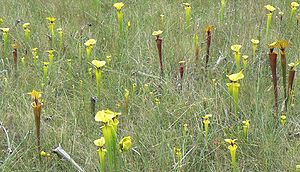
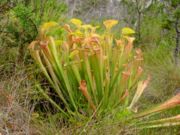
- Sarracenia alataSarracenia alataSarracenia alata, also known as the Pale pitcher plant or Pale trumpet, is a carnivorous plant in the genus Sarracenia. Like all the Sarracenia, it is native to the New World and grows in permanently wet and open wetlands typically classified as longleaf pine savannas...
- S. alata var. alata(autonymAutonym (botany)In botanical nomenclature, autonyms are automatically created names, as regulated by the International Code of Botanical Nomenclature . Autonyms are cited without an author. Relevant provisions are in articles 6.8, 22.1-3 and 26.1-3....
) - S. alata var. atrorubraS.McPhersonStewart McPherson (geographer)Stewart R. McPherson is a British geographer.He studied at the University of Durham in England, the University of Tübingen in Germany and Yale University in the United States....
& D.E.Schnell - S. alata var. cupreaS.McPherson & D.E.Schnell
- S. alata var. nigropurpureaP.D'AmatoPeter D'AmatoPeter D'Amato is an American author, businessman, and carnivorous plant authority. He is the owner of California Carnivores, the largest nursery of carnivorous plants in the world, and the author of The Savage Garden , a book on the cultivation of insectivorous plants...
ex S.McPherson & D.E.Schnell - S. alata var. ornataS.McPherson & D.E.Schnell
- S. alata var. rubrioperculataS.McPherson & D.E.Schnell
- S. alata f. viridescensS.McPherson & D.E.Schnell
- S. alata var. alata(autonym
- Sarracenia flavaSarracenia flavaSarracenia flava, the Yellow pitcher plant, is a carnivorous plant in the family Sarraceniaceae. Like all the Sarraceniaceae, it is native to the New World. Its range extends from southern Alabama, through Florida and Georgia, to the coastal plains of southern Virginia, North Carolina and South...
- S. flava var. flava(autonymAutonym (botany)In botanical nomenclature, autonyms are automatically created names, as regulated by the International Code of Botanical Nomenclature . Autonyms are cited without an author. Relevant provisions are in articles 6.8, 22.1-3 and 26.1-3....
) - S. flava var. atropurpurea(Hort. W.Bull ex Mast.) Hort. W.Bull ex W.Robinson
- S. flava var. cupreaD.E.Schnell
- S. flava var. maximaHort. W.Bull ex Mast.
- S. flava var. ornataHort. Bull ex W.Robinson
- S. flava var. rubricorporaD.E.Schnell
- S. flava var. rugelii(Shuttlew. ex A.DC.) Mast.
- S. flava f. viridescensS.McPherson & D.E.Schnell
- S. flava var. flava(autonym
- Sarracenia leucophyllaSarracenia leucophyllaSarracenia leucophylla, also known as the white pitcher plant, is a carnivorous plant in the genus Sarracenia. Like all the Sarracenia, it is native to the New World and inhabits moist and low-nutrient longleaf pine savannas along the United States Gulf Coast, generally west of the Apalachicola...
- S. leucophylla var. leucophylla(autonymAutonym (botany)In botanical nomenclature, autonyms are automatically created names, as regulated by the International Code of Botanical Nomenclature . Autonyms are cited without an author. Relevant provisions are in articles 6.8, 22.1-3 and 26.1-3....
) - S. leucophylla var. alba(Hort. T.Baines ex R.Hogg & T.Moore) J.Pietropaolo & P.Pietropaolo ex S.McPherson & D.E.Schnell
- S. leucophylla f. viridescensS.McPherson & D.E.Schnell
- S. leucophylla var. leucophylla(autonym
- Sarracenia minorSarracenia minorSarracenia minor, also known as the Hooded pitcher plant, is a perennial, terrestrial, rhizomatous, herbaceous, carnivorous plant in the genus Sarracenia. Like all the Sarracenia, it is native to the New World.-Etymology:...
- S. minor var. minor(autonymAutonym (botany)In botanical nomenclature, autonyms are automatically created names, as regulated by the International Code of Botanical Nomenclature . Autonyms are cited without an author. Relevant provisions are in articles 6.8, 22.1-3 and 26.1-3....
)- S. minor var. minor f. viridescensS.McPherson & D.E.Schnell
- S. minor var. okefenokeensisD.E.Schnell
- S. minor var. minor(autonym
- Sarracenia oreophilaSarracenia oreophilaSarracenia oreophila, also known as the Green Pitcher Plant, is a carnivorous plant in the genus Sarracenia. It has highly modified leaves in the form of pitchers that act as pitfall traps for prey...
- S. oreophila var. oreophila(autonymAutonym (botany)In botanical nomenclature, autonyms are automatically created names, as regulated by the International Code of Botanical Nomenclature . Autonyms are cited without an author. Relevant provisions are in articles 6.8, 22.1-3 and 26.1-3....
) - S. oreophila var. ornataS.McPherson & D.E.Schnell
- S. oreophila var. oreophila(autonym
- Sarracenia psittacinaSarracenia psittacinaSarracenia psittacina, also known as the parrot pitcher plant, is a carnivorous plant in the genus Sarracenia. Like all the Sarracenia, it is native to North America, in the Southeastern United States....
- S. psittacina var. psittacina(autonymAutonym (botany)In botanical nomenclature, autonyms are automatically created names, as regulated by the International Code of Botanical Nomenclature . Autonyms are cited without an author. Relevant provisions are in articles 6.8, 22.1-3 and 26.1-3....
)- S. psittacina var. psittacina f. viridescensS.McPherson & D.E.Schnell
- S. psittacina var. okefenokeensisS.McPherson & D.E.Schnell
- S. psittacina var. okefenokeensis f. luteoviridisS.McPherson & D.E.Schnell
- S. psittacina var. psittacina(autonym
- Sarracenia purpureaSarracenia purpureaSarracenia purpurea, commonly known as the purple pitcher plant, northern pitcher plant, or side-saddle flower, is a carnivorous plant in the family Sarraceniaceae...
- S. purpurea subsp. purpurea(autonymAutonym (botany)In botanical nomenclature, autonyms are automatically created names, as regulated by the International Code of Botanical Nomenclature . Autonyms are cited without an author. Relevant provisions are in articles 6.8, 22.1-3 and 26.1-3....
)- S. purpurea subsp. purpurea f. heterophylla(Eaton) Fern.
- S. purpurea subsp. venosa(Raf.) Wherry
- S. purpurea subsp. venosa var. venosa(autonymAutonym (botany)In botanical nomenclature, autonyms are automatically created names, as regulated by the International Code of Botanical Nomenclature . Autonyms are cited without an author. Relevant provisions are in articles 6.8, 22.1-3 and 26.1-3....
)- S. purpurea subsp. venosa var. venosa f. pallidifloraS.McPherson & D.E.Schnell
- S. purpurea subsp. venosa var. burkiiD.E.Schnell
- S. purpurea subsp. venosa var. burkii f. luteolaR.L.Hanrahan & J.Miller
- S. purpurea subsp. venosa var. montanaD.E.Schnell & R.O.Determann
- S. purpurea subsp. venosa var. venosa(autonym
- S. purpurea subsp. purpurea(autonym
- Sarracenia rubraSarracenia rubraSarracenia rubra, also known as the Sweet pitcher plant, is a carnivorous plant in the genus Sarracenia. Like all the Sarracenia, it is native to the New World...
- S. rubra subsp. rubra(autonymAutonym (botany)In botanical nomenclature, autonyms are automatically created names, as regulated by the International Code of Botanical Nomenclature . Autonyms are cited without an author. Relevant provisions are in articles 6.8, 22.1-3 and 26.1-3....
) - S. rubra subsp. alabamensis(Case & R.B.Case) S.McPherson & D.E.Schnell
- S. rubra subsp. gulfensisD.E.Schnell
- S. rubra subsp. gulfensis f. luteoviridisS.McPherson & D.E.Schnell
- S. rubra subsp. jonesii(Wherry) Wherry
- S. rubra subsp. jonesii f. viridescensS.McPherson & D.E.Schnell
- S. rubra subsp. wherryi(Case & R.B.Case) D.E.Schnell
- S. rubra "Incompletely diagnosed taxon from Georgia and South Carolina"(undescribedUndescribed taxonIn taxonomy, an undescribed taxon is a taxon that has been discovered, but not yet formally described and named. The various Nomenclature Codes specify the requirements for a new taxon to be validly described and named. Until such a description has been published, the taxon has no formal or...
)
- S. rubra subsp. rubra(autonym
Hybrids
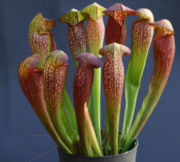
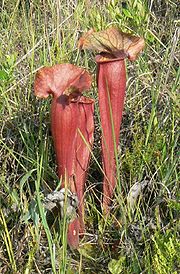
Some of the more common named hybrids include:
- Sarracenia × catesbaei = S. flava × S. purpurea
- Sarracenia × moorei = S. flava × S. leucophylla
- Sarracenia × popei = S. flava × S. rubra
- Sarracenia × harperi = S. flava × S. minor
- Sarracenia × alava = S. flava × S. alata
- Sarracenia × mitchelliana = S. purpurea × S. leucophylla
- Sarracenia × exornata = S. purpurea × S. alata
- Sarracenia × chelsonii = S. purpurea × S. rubra
- Sarracenia × swaniana = S. purpurea × S. minor
- Sarracenia × courtii = S. purpurea × S. psittacina
- Sarracenia × pureophila = S. purpurea × S. oreophila
- Sarracenia × readii = S. leucophylla × S. rubra
- Sarracenia × farnhamii = S. leucophylla × S. rubra
- Sarracenia × excellens = S. leucophylla × S. minor
- Sarracenia × areolata = S. leucophylla × S. alata
- Sarracenia × wrigleyana = S. leucophylla × S. psittacina
- Sarracenia × ahlesii = S. alata × S. rubra
- Sarracenia × rehderi = S. rubra × S. minor
- Sarracenia × gilpini = S. rubra × S. psittacina
- Sarracenia × formosa = S. minor × S. psittacina
- Sarracenia × mineophila = S. minor × S. oreophila
- Sarracenia × psittata = S. psittacina × S. alata
Botanical history
Christopher Columbus
Christopher Columbus was an explorer, colonizer, and navigator, born in the Republic of Genoa, in northwestern Italy. Under the auspices of the Catholic Monarchs of Spain, he completed four voyages across the Atlantic Ocean that led to general European awareness of the American continents in the...
' discovery of the New World
New World
The New World is one of the names used for the Western Hemisphere, specifically America and sometimes Oceania . The term originated in the late 15th century, when America had been recently discovered by European explorers, expanding the geographical horizon of the people of the European middle...
. L'Obel
Matthias de Lobel
Mathias de l'Obel, Mathias de Lobel or Matthaeus Lobelius was born in Lille, Nord-Pas de Calais, France, and died at Highgate, London, England after serving as a physician to William, Prince of Orange and James I of England.Lobel studied medicine in Leuven and Montpellier...
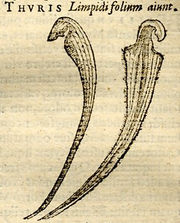
included an illustration of S. minor
Sarracenia minor
Sarracenia minor, also known as the Hooded pitcher plant, is a perennial, terrestrial, rhizomatous, herbaceous, carnivorous plant in the genus Sarracenia. Like all the Sarracenia, it is native to the New World.-Etymology:...
in his Stirpium Adversaria Nova in 1576. The first description and plate of a Sarracenia to show up in botanical literature was published by Carolus Clusius, who received a partial dried specimen of what was later determined to be S. purpurea subsp. purpurea, publishing it under the name Limonium peregrinum. The exact origins of this specimen remains unknown, as few explorers are known to have collected plant specimens from the range of this subspecies before that time. Cheek and Young suggest that the most likely source is Cartier's
Jacques Cartier
Jacques Cartier was a French explorer of Breton origin who claimed what is now Canada for France. He was the first European to describe and map the Gulf of Saint Lawrence and the shores of the Saint Lawrence River, which he named "The Country of Canadas", after the Iroquois names for the two big...
expeditions to what is now Quebec between 1534 and 1541. The fragile flowerless specimen that made its way to Clusius 60 years later was enough to excite his interest, but not enough for him to place it among related plants; his closest guess was the wholly unrelated Sea Lavender genus.
The name Sarracenia was first employed by Michel Sarrazin
Michel Sarrazin
Michel Sarrazin was an early Canadian scientist and naturalist.Born in Nuits-sous-Beaune in the province of Burgundy, Sarrazin arrived in New France in 1685. In 1686, he was made surgeon-major of the colonial regular troops and he continued in that position until 1692 when he was succeeded by...
, the Father of Canadian Botany who in the late 17th century sent live specimens of S. purpurea to the Parisian botanist Joseph Pitton de Tournefort
Joseph Pitton de Tournefort
Joseph Pitton de Tournefort was a French botanist, notable as the first to make a clear definition of the concept of genus for plants.- Biography :...
, who thereupon described the species. Linnaeus
Carolus Linnaeus
Carl Linnaeus , also known after his ennoblement as , was a Swedish botanist, physician, and zoologist, who laid the foundations for the modern scheme of binomial nomenclature. He is known as the father of modern taxonomy, and is also considered one of the fathers of modern ecology...
adopted this name when he published his Species Plantarum
Species Plantarum
Species Plantarum was first published in 1753, as a two-volume work by Carl Linnaeus. Its prime importance is perhaps that it is the primary starting point of plant nomenclature as it exists today. This means that the first names to be considered validly published in botany are those that appear...
(1753), using it for the two known species at the time: S. purpurea and S. flava. The first successful flowering in culture occurred in 1773. In 1793 William Bartram
William Bartram
William Bartram was an American naturalist. The son of Ann and John Bartram, William Bartram and his twin sister Elizabeth were born in Kingsessing, Pennsylvania, near Philadelphia. As a boy, he accompanied his father on many of his travels, to the Catskill Mountains, the New Jersey Pine Barrens,...
noted in his book about his travels in the southeast U.S. that numerous insects were caught in the pitchers of these plants, but doubted that any benefit could be derived from them. It was not until 1887 that research by Dr. Joseph H. Melichamp proved the carnivorous nature of this genus. This finding was supported by a study by J.S. Hepburn, E.Q. St. John and F.M. Jones in 1920. Extended field surveys and laboratory studies by Dr. Edgar Wherry in the 1930s greatly increased the knowledge of this genus, which has further been extended by the more recent works of Dr. C. Ritchie Bell (1949–52), Dr. Donald E. Schnell (1970–2002) and Mr. Frederick W. Case (1970s and the treatment in Flora of North America to be published in 2008).
Cultivation
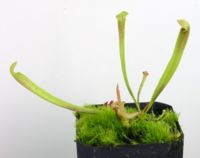
Sarracenia leucophylla
Sarracenia leucophylla, also known as the white pitcher plant, is a carnivorous plant in the genus Sarracenia. Like all the Sarracenia, it is native to the New World and inhabits moist and low-nutrient longleaf pine savannas along the United States Gulf Coast, generally west of the Apalachicola...
are becoming common in garden centers in North America and Europe.
Sarracenia require constantly moist-wet, nutrient free acidic soil. This is most often achieved with a potting mix consisting of peat moss mixed with sand or perlite
Perlite
Perlite is an amorphous volcanic glass that has a relatively high water content, typically formed by the hydration of obsidian. It occurs naturally and has the unusual property of greatly expanding when heated sufficiently...
. As their roots are sensitive to nutrients and minerals, only pure water, such as distilled, rain, or reverse osmosis
Reverse osmosis
Reverse osmosis is a membrane technical filtration method that removes many types of large molecules and ions from solutions by applying pressure to the solution when it is on one side of a selective membrane. The result is that the solute is retained on the pressurized side of the membrane and...
water, can be used to water them. Sarracenia prefer sunny conditions during their growing season but require a dormancy period, with decreased light and temperatures, of a few months in the winter.
Propagation
Sarracenia do not self-pollinate and therefore require hand pollination or access to natural pollinators such as bees. Sarracenia pollen remains potent for several weeks when refrigerated, and so is stored by cultivators and used to pollinate later-flowering species. Given that all Sarracenia hybrids are fertile and will hybridize further, this characteristic allows cultivators to produce a limitless number of variants through hybridization.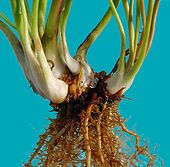
Mature Sarracenia are commonly propagated by division. Their rhizomes extend and produce new crowns of pitchers over the course of a few growing seasons, and cultivators divide and separate the rhizomes during the plant's winter dormancy or early in the growing season. This technique is also used to separate sections of rhizomes which have no pitchers: when re-potted, the section usually generates a new crown of pitchers. A further technique is employed to encourage new crowns to appear which does not involve division of the rhizome: small notches up to 5 mm deep are cut into the top of the rhizome, whereupon a new crown frequently develops at the site of the notch.
Further reading
- Schnell, Donald E. 2002. Carnivorous Plants of the United States and Canada. Portland. ISBN 0-88192-540-3
- D’Amato, Peter. 1998. The Savage Garden. Berkeley. ISBN 0-89815-915-6