
All Topics  
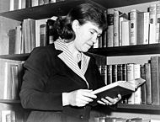
Margaret Mead

 
Margaret Mead

   Email Print
   Bookmark   Link


Margaret Mead


Margaret Mead (December 16, 1901, Philadelphia – November 15, 1978, New York City
New York City

The City of New York is the List of United States cities by population in the United States, while the New York metropolitan area ranks among the List of urban areas by population....
) was an American
United States

The United States of America is a Federal government constitutional republic comprising U.S. state and a federal district. The country is situated mostly in central North America, where its Contiguous United States and Washington, D.C., the Capital districts and territories, lie between the Pacific Ocean and Atlantic Oceans, Borders of the U...
 cultural anthropologist
Cultural anthropology

Cultural anthropology is one of four fields of anthropology as it developed in the United States. It is the branch of anthropology that has developed and promoted "culture" as a meaningful scientific concept, studied cultural variation among humans, and examined the impact of global economic and political processes on local cultural realiti...
, who was frequently a featured writer and speaker in the mass media throughout the 1960s and 1970s.

She was both a popularizer of the insights of anthropology into modern American and Western culture
Western culture

File:Clash of Civilizations map.pngWestern culture are terms which are used to refer to cultures of European origin. This terminology originated as a way of describing what was different about the Graeco-Roman culture and its descendants, in contrast to the older neighboring civilizations of the Middle East, which in many ways continued...
, and also a respected, if controversial, academic anthropologist. Her reports about the purportedly healthy attitude towards sex in South Pacific and Southeast Asian traditional cultures amply informed the 1960s sexual revolution
Sexual revolution

The sexual revolution encompasses the well-documented changes in social thought and codes of behaviour related to sexuality throughout the Western world that continues to evolve....
.


Discussion
Ask a question about 'Margaret Mead'
Start a new discussion about 'Margaret Mead'
Answer questions from other users
Full Discussion Forum


Quotations


To cherish the life of the world.

Epitaph


Encyclopedia


Margaret Mead (December 16, 1901, Philadelphia – November 15, 1978, New York City
New York City

The City of New York is the List of United States cities by population in the United States, while the New York metropolitan area ranks among the List of urban areas by population....
) was an American
United States

The United States of America is a Federal government constitutional republic comprising U.S. state and a federal district. The country is situated mostly in central North America, where its Contiguous United States and Washington, D.C., the Capital districts and territories, lie between the Pacific Ocean and Atlantic Oceans, Borders of the U...
 cultural anthropologist
Cultural anthropology

Cultural anthropology is one of four fields of anthropology as it developed in the United States. It is the branch of anthropology that has developed and promoted "culture" as a meaningful scientific concept, studied cultural variation among humans, and examined the impact of global economic and political processes on local cultural realiti...
, who was frequently a featured writer and speaker in the mass media throughout the 1960s and 1970s.

She was both a popularizer of the insights of anthropology into modern American and Western culture
Western culture

File:Clash of Civilizations map.pngWestern culture are terms which are used to refer to cultures of European origin. This terminology originated as a way of describing what was different about the Graeco-Roman culture and its descendants, in contrast to the older neighboring civilizations of the Middle East, which in many ways continued...
, and also a respected, if controversial, academic anthropologist. Her reports about the purportedly healthy attitude towards sex in South Pacific and Southeast Asian traditional cultures amply informed the 1960s sexual revolution
Sexual revolution

The sexual revolution encompasses the well-documented changes in social thought and codes of behaviour related to sexuality throughout the Western world that continues to evolve....
. Mead was a champion of broadened sexual mores within a context of traditional western religious life.

A committed Anglican Christian, she took a considerable part in the drafting of the 1979 American Episcopal Book of Common Prayer
Book of Common Prayer

The Book of Common Prayer is the common title of a number of prayer books of the Church of England and used throughout the Anglican Communion. The first book, published in 1549 , in the reign of Edward VI of England, was a product of the English Reformation following the break with Roman Catholic Church....
.

She was a recognizable figure in academia, usually wearing a distinctive cape and carrying a tall, forked walking stick.

Biography


Birth, early family life and education

Mead was the first of five children, born into a Quaker family, raised in Doylestown, Pennsylvania
Doylestown, Pennsylvania

Doylestown is a borough in Bucks County, Pennsylvania, Pennsylvania, 34 miles north of Philadelphia, Pennsylvania. At the turn of the century in 1900, 3,034 people lived in the borough of Doylestown, and in 1910, 3,304 people lived there....
 by her finance professor father at the University at Pennsylvania, Edward Sherwood Mead, and mother, Emily Fogg Mead, a sociologist who studied Italian immigrants. Her family moved frequently, so her early education alternated between home-schooling and traditional schools. Margaret studied one year, 1919 at DePauw University
DePauw University

DePauw University in Greencastle, Indiana, USA, is a private, national Liberal arts colleges in the United States with an enrollment of approximately 2,400 students....
, then transferred to Barnard College
Barnard College

Barnard College is a Women's colleges in the United States Liberal arts colleges in the United States founded in 1889. Barnard is affiliated with Columbia University, but Barnard maintains an independent campus in the Morningside Heights, Manhattan neighborhood in the borough of Manhattan, in New York City, and separate faculty, administrati...
 where she earned her Bachelor's Degree in 1923.

She studied with Professor Franz Boas
Franz Boas

Franz Boas was a Germans-United States anthropologist and a pioneer of modern anthropology who has been called the "Father of American Anthropology"....
 and Dr. Ruth Benedict
Ruth Benedict

Ruth Benedict was an United States anthropologist.She was born in New York City, and attended Vassar College, graduating in 1909. She entered graduate studies at Columbia University in 1919, studying under Franz Boas, receiving her Doctor of Philosophy and joining the faculty in 1923....
 at Columbia University
Columbia University

Columbia University in the City of New York , is a private university in the United States and a member of the Ivy League. Columbia's main campus lies in the Morningside Heights, Manhattan neighborhood in the borough of Manhattan, in New York City....
 before earning her Master's in 1924. Mead set out in 1925 to do fieldwork in Polynesia
Polynesia

Polynesia is a subregion of Oceania, comprising a large grouping of over 1,000 islands scattered over the central and southern Pacific Ocean....
. In 1926, she joined the American Museum of Natural History
American Museum of Natural History

The American Museum of Natural History , located on the Upper West Side, Manhattan, New York, USA, is one of the largest and most celebrated museums in the world....
, New York City
New York City

The City of New York is the List of United States cities by population in the United States, while the New York metropolitan area ranks among the List of urban areas by population....
, as assistant curator. She received her Ph.D. from Columbia University
Columbia University

Columbia University in the City of New York , is a private university in the United States and a member of the Ivy League. Columbia's main campus lies in the Morningside Heights, Manhattan neighborhood in the borough of Manhattan, in New York City....
 in 1929.

Personal life

Margaret Mead was married three times. Her first marriage, from 1923 to 1928, was to Luther Cressman
Luther Cressman

Luther Sheeleigh Cressman was an United States anthropologist. He is known as the father of Oregon anthropology.Cressman was born outside of Pottstown, Pennsylvania, the son of a physician....
, a theological student during his marriage to Mead, and later an anthropologist himself. Mead dismissively characterized her marriage to Cressman as "my student marriage" in Blackberry Winter, a sobriquet with which Cressman took vigorous issue. She was then married to New Zealander Reo Fortune
Reo Fortune

Reo Franklin Fortune was a New Zealand social anthropologist, lecturer in social anthropology at the Cambridge University, specialist in Melanesian language and culture....
, a Cambridge
University of Cambridge

The University of Cambridge , located in Cambridge, England, is the List of oldest universities in continuous operation university in the Anglosphere....
 graduate, from 1928 to 1935; Fortune was also an anthropologist — his Sorcerors of Dobu remains the locus classicus of eastern Papuan anthropology — but he is best known for his Fortunate number
Fortunate number

A Fortunate number, named after Reo Fortune, for a given positive integer n is the smallest integer m > 1 such that p'n# + m is a prime number, where the primorial p'n# is the product of the first n prime numbers....
 theory. Her marriage to Fortune was described by her as a more passionate one, embarked upon when she was told that she could not have children and abandoned when she was given hope by another physician that childbearing might indeed be possible.

Her third and longest-lasting marriage (from 1936 to 1950) was to British anthropologist Gregory Bateson
Gregory Bateson

Gregory Bateson was a United Kingdom anthropology, social sciences, linguistics, semiotics and cybernetics whose work intersected that of many other fields....
, also a Cambridge graduate, with whom she had a daughter, Mary Catherine Bateson
Mary Catherine Bateson

Mary Catherine Bateson is a United States writer and cultural anthropologist.She is the daughter of Margaret Mead and Gregory Bateson. Since 1960, she has been married to Barkev Kassarjian, a professor of business management at Babson College....
 who would also become an anthropologist. Early in his career, Dr. Benjamin Spock
Benjamin Spock

Benjamin McLane Spock was an United States pediatrics whose book The Common Sense Book of Baby and Child Care, published in 1946, is one of the biggest best-sellers of all time....
 was her pediatrician for the baby. Mead's experiences observing how babies were raised in other cultures, and her implementation of some of the same techniques such as breastfeeding
Breastfeeding

Breastfeeding is the feeding of an infant or young child with breast milk directly from human breasts rather than from a baby bottle or other container....
 on demand according to the baby's need rather than a schedule, were influential on Spock's subsequent writings on child-rearing. She readily acknowledged that Bateson was the one she loved most of her three husbands, possibly in part because he was the father of her only child. She was devastated when he left her, and she remained his loving friend to her life's end, keeping his photograph by her bedside wherever she travelled, including beside her hospital deathbed.

Mead also had an exceptionally close relationship with Ruth Benedict
Ruth Benedict

Ruth Benedict was an United States anthropologist.She was born in New York City, and attended Vassar College, graduating in 1909. She entered graduate studies at Columbia University in 1919, studying under Franz Boas, receiving her Doctor of Philosophy and joining the faculty in 1923....
. Mead's daughter, Mary Catherine Bateson, in her memoir of her parents With a Daughter's Eye, implies that the relationship between Benedict and Mead contained an erotic element. While Margaret Mead never openly identified herself as lesbian or bisexual, the details of her relationship with Benedict have led others to identify her thus; in her writings she proposed that it is to be expected that an individual's sexual orientation may evolve throughout life.

She spent her last years in a close personal and professional collaboration with anthropologist Rhoda Metraux
Rhoda Metraux

Dr. Rhoda Bubendey Metraux , was a prominent anthropologist in the area of cross-cultural studies, specializing in Haitian voodoo and the Iatmul of New Guinea....
, with whom she lived from 1955 until her death in 1978. Letters between the two published in 2006 with the permission of Mead's daughter clearly express a romantic relationship.

Mead's granddaughter, Sevanne Margaret Kassarjian, is a stage and television actress who works professionally under the name Sevanne Martin, Martin having been the intended name for her prematurely born elder brother, who lived only long enough to be christened.

Both of Mead's surviving sisters were married to famous men. Elizabeth Mead (1909-1983), an artist and teacher, married cartoonist William Steig
William Steig

William Steig was a prolific United States cartoonist, sculptor and, later in life, an author of popular children's literature. Most notable for creating Shrek, which turned into the popular movie series....
, and Priscilla Mead (1911-1959) married author Leo Rosten
Leo Rosten

Leo Calvin Rosten was born in L?dz, Russian Empire and died in New York City. He was a teacher, academic and humorist best remembered for his stories about the night-school "prodigy" Hyman Kaplan ....
. Both of these marriages produced children, but ended in divorce. Mead also had a brother, Richard Mead (1904-1975), a professor of business.

Mead's sister Katharine (1906-1907) died at the age of nine months. This was a traumatic event for Mead, who had named this baby, and thoughts of her lost sister permeated her daydreams for many years.

Career and later life

During World War II
World War II

World War II, or the Second World War , was a global military conflict which involved a Participants in World War II, including all of the great powers, organised into two opposing military alliances: the Allies of World War II and the Axis powers....
, Mead served as executive secretary of the National Research Council
United States National Research Council

The National Research Council of the United States is the working arm of the United States National Academy of Sciences and the United States National Academy of Engineering, carrying out most of the studies done in their names....
's Committee on Food Habits. She served as curator of ethnology
Ethnology

Ethnology is the branch of anthropology that compares and analyzes the origins, distribution, technology, religion, language, and social structure of the ethnicity, Race , and/or national divisions of humanity....
 at the American Museum of Natural History from 1946 to 1969. She taught at Columbia University as adjunct professor from 1954 to 1978. She was a professor of anthropology and chair of Division of Social Sciences at Fordham University
Fordham University

'Fordham University' is a private university university in the United States, with three campuses located in and around New York City. It was founded by the Roman Catholic Archdiocese of New York in 1841 as St....
's Lincoln Center campus from 1968 to 1970, founding their anthropology department. Following the example of her instructor Ruth Benedict, Mead concentrated her studies on problems of child rearing, personality, and culture. She held various positions in the American Association for the Advancement of Science
American Association for the Advancement of Science

The American Association for the Advancement of Science is an international non-profit organization with the stated goals of promoting cooperation between scientists, defending scientific freedom, encouraging scientific responsibility, and supporting science education and science outreach for the betterment of all humanity....
, notably president in 1975 and chair of the executive committee of the board of directors in 1976.

Mead was featured on two Folkways Records
Folkways Records

Folkways Records is a record label that documents folk and world music. It is owned by the Smithsonian Institution....
 albums. The first, released in 1959, An Interview With Margaret Mead, explored the topics of morals and anthropology. In 1971, Mead was again featured on, But the Women Rose, Vol.2: Voices of Women in American History, a compilation album of female leaders.

In later life, Mead was a mentor to many young anthropologists and sociologists, including Jean Houston
Jean Houston

Jean Houston, Ph.D. has been a leading figure in the cross-cultural study of New Thought spirituality and ritual processes. A prolific author of books, her PBS Special A Passion for the Possible has been widely viewed....
.

Mead died of pancreatic cancer
Pancreatic cancer

Pancreatic cancer is a cancer of the pancreas. Each year in the United States, about 37,680 individuals are diagnosed with this condition and 34,290 die from the disease each year....
 on November 15, 1978.

Shortly after her death when she was, obviously, no longer able to respond, Mead's youthful work in Samoa was resoundingly attacked by Derek Freeman
Derek Freeman

John Derek Freeman was a New Zealand anthropologist best known for his work in attempting to refute the claims of Margaret Mead in her study of Samoan society, as described in her 1928 ethnography Coming of Age in Samoa....
, an anthropologist at the Australian National University
Australian National University

The Australian National University, commonly abbreviated to ANU, is a Public university research university located in Canberra, Australia, the Federal capital city....
. The controversy that ensued has never comprehensively been resolved -- Freeman himself is now also dead -- but Mary Catherine Bateson sprang to her mother's defence, only indirectly a response to Freeman, with With a Daughter's Eye, a memoir of both her parents, in which she compellingly discusses, inter alia, her mother's work with a view to dispelling critics' attacks.

Work


Coming of Age in Samoa

In the foreword to Coming of Age in Samoa, Mead's advisor, Franz Boas
Franz Boas

Franz Boas was a Germans-United States anthropologist and a pioneer of modern anthropology who has been called the "Father of American Anthropology"....
, wrote of its significance that

Courtesy, modesty, good manners, conformity to definite ethical standards are universal, but what constitutes courtesy, modesty, very good manners, and definite ethical standards is not universal. It is instructive to know that standards differ in the most unexpected ways.


Boas went on to point out that at the time of publication, many Americans had begun to discuss the problems faced by young people (particularly women) as they pass through adolescence
Adolescence

Adolescence is a transitional stage of physical and mental Human development that occurs between childhood and adulthood. This transition involves biological , social, and psychological changes, though the biological or physiological ones are the easiest to measure objectively....
 as "unavoidable periods of adjustment." Boas felt that a study of the problems faced by adolescents in another culture would be illuminating.

And so, as Mead herself described the goal of her research: "I have tried to answer the question which sent me to Samoa
Samoa

Samoa , officially the Independent State of Samoa , is a country governing the western part of the Samoan Islands archipelago in the South Pacific Ocean....
: Are the disturbances which vex our adolescents due to the nature of adolescence itself or to the civilization? Under different conditions does adolescence present a different picture?" To answer this question, she conducted her study among a small group of Samoa
Samoa

Samoa , officially the Independent State of Samoa , is a country governing the western part of the Samoan Islands archipelago in the South Pacific Ocean....
ns — a village of 600 people on the island of Ta‘u — in which she got to know, lived with, observed, and interviewed (through an interpreter) 68 young women between the ages of 9 and 20. She concluded that the passage from childhood to adulthood (adolescence) in Samoa was a smooth transition and not marked by the emotional or psychological distress, anxiety, or confusion seen in the United States.

As Boas and Mead expected, this book upset many Westerners when it first appeared in 1928. Many American readers felt shocked by her observation that young Samoan women deferred marriage for many years while enjoying casual sex
Casual sex

For the 1988 comedy film starring Lea Thompson, see "Casual Sex?".Casual sex refers to certain types of human sexual behavior outside the context of a romantic relationship....
 but eventually married, settled down, and successfully reared their own children.

In 1983, five years after Mead had died, anthropologist Derek Freeman
Derek Freeman

John Derek Freeman was a New Zealand anthropologist best known for his work in attempting to refute the claims of Margaret Mead in her study of Samoan society, as described in her 1928 ethnography Coming of Age in Samoa....
 published Margaret Mead and Samoa: The Making and Unmaking of an Anthropological Myth, in which he challenged Mead's major findings about sexuality in Samoan society, claiming evidence that her informants had misled her. After years of discussion, many anthropologists concluded that the truth would probably never be known, although most published accounts of the debate have also raised serious questions about Freeman's critique. His obituary concludes that "many anthropologists have agreed to disagree over the findings of one of the science's founding mothers, acknowledging both Mead's pioneering research and the fact that she may have been mistaken on details."

Research in other societies

Another extremely influential book by Mead was Sex and Temperament in Three Primitive Societies. This became a major cornerstone of the women's liberation movement, since it claimed that females are dominant in the Tchambuli (now spelled Chambri
Chambri

Chambri are an ethnic group in the Chambri Lakes region in the East Sepik province of Papua New Guinea.The social structures of Chambri society have often been a subject in the study of gender roles....
) Lake region of the Sepik basin of Papua New Guinea
Papua New Guinea

Papua New Guinea , officially the Independent State of Papua New Guinea, is a country in Oceania, occupying the eastern half of the island of New Guinea and numerous offshore islands ....
 (in the western Pacific) without causing any special problems. The lack of male dominance may have been the result of the Australian administration's outlawing of warfare. According to contemporary research, males are dominant throughout Melanesia (although some believe that female witches have special powers). Others have argued that there is still much cultural variation throughout Melanesia, and especially in the large island of New Guinea
New Guinea

New Guinea, located just north of Australia, is the List of islands by area, having become separated from the Australian mainland when the area now known as the Torres Strait flooded after the last glacial period....
. Moreover, anthropologists often overlook the significance of networks of political influence among females. The formal male-dominated institutions typical of some high-population density areas were not, for example, present in the same way in Oksapmin, West Sepik Province, a more sparsely populated area. Cultural patterns there were different from, say, Mt. Hagen. They were closer to those described by Mead.

Mead stated that the Arapesh people, also in the Sepik, were pacifists, although she noted that they do on occasion engage in warfare. Meanwhile, her observations about the sharing of garden plots amongst the Arapesh, the egalitarian emphasis in child-rearing, and her documentation of predominantly peaceful relations among relatives hold up. These descriptions are very different from the "big-man" displays of dominance that were documented in more stratified New Guinea cultures — e.g., by Andrew Strathern. They are, indeed, as she wrote, a cultural pattern.

In brief, her comparative study revealed a full range of contrasting gender roles:
  • "Among the Arapesh, both men and women were peaceful in temperament and neither men nor women made war.
  • "Among the Mundugumor, the opposite was true: both men and women were warlike in temperament.
  • "And the Tchambuli were different from both. The men 'primped' and spent their time decorating themselves while the women worked and were the practical ones — the opposite of how it seemed in early 20th century America."


Mead also researched the European shtetl
Shtetl

A shtetl was typically a small town with a large Jewish population in pre-The Holocaust Central Europe and Eastern Europe. Shtetls were mainly found in the areas which constituted the 19th century Pale of Settlement in the Russian Empire, the Congress Poland, Galicia , and Romania....
, financed by the American Jewish Committee
American Jewish Committee

The American Jewish Committee was "founded in 1906 with the aim of rallying all sections of American Jewry to defend the rights of Jews all over the world....
. Although her interviews at Columbia University
Columbia University

Columbia University in the City of New York , is a private university in the United States and a member of the Ivy League. Columbia's main campus lies in the Morningside Heights, Manhattan neighborhood in the borough of Manhattan, in New York City....
 with 128 European-born Jews disclosed a wide variety of family structures and experiences, the publications resulting from this study and the many citations in the popular media resulted in the Jewish mother stereotype
Jewish mother stereotype

The Jewish mother or wife stereotype is a common stereotype and stock character used by Jewish comedians, usually when discussing their mothers....
, intensely loving but controlling to the point of smothering, and engendering enormous guilt in her children through the enormous suffering she professed to undertake for their sakes.

She also was a co-founder and supporter of "The Parapsychological Association ", for the advancement of parapsychology and psychical research.

Death

Margaret Mead is buried at Trinity Episcopal Church in Buckingham, PA.

See also

  • Elsie Clews Parsons
    Elsie Clews Parsons

    Elsie Clews Parsons was an United States anthropologist, sociologist, folklorist, and feminist who studied Indigenous peoples of the Americas tribes?such as the Pueblo people and Hopi?in Arizona, New Mexico, and Mexico....
  • Tim Asch
    Tim Asch

    Timothy Asch , was a noted anthropologist, photographer, and Documentary film. Along with John Marshall and Robert Gardner, Asch played an important role in the development of visual anthropology....
  • Visual anthropology
    Visual anthropology

    Visual anthropology is a subfield of cultural anthropology that developed out of the study and production of ethnography photography, film and, since the mid-1990s, new media....
  • Zora Neale Hurston
    Zora Neale Hurston

    Zora Neale Hurston was an United States folkloristics and author during the time of the Harlem Renaissance. Of Hurston's four novels and more than 50 published short stories, plays, and essays, she is best known for her 1937 novel Their Eyes Were Watching God....


Publications

As a sole author
  • Coming of Age in Samoa
    Coming of Age in Samoa

    Coming of Age in Samoa is a book by Margaret Mead based upon youth in Samoa and lightly relating to youth in United States, first published in 1928....
     (1928) ISBN 0-688-05033-6
  • Growing Up in New Guinea (1930) ISBN 0-688-17811-1
  • The Changing Culture of an Indian Tribe (1932)
  • Sex and Temperament in Three Primitive Societies (1935)
  • And Keep Your Powder Dry: An Anthropologist Looks at America (1942)
  • Male and Female
    Male and Female (book)

    Male and Female is a 1949 study of tribe men and women on seven Pacific islands by anthropologist Margaret Mead....
     (1949) ISBN 0-688-14676-7
  • New Lives for Old: Cultural Transformation in Manus, 1928-1953 (1956)
  • People and Places (1959; a book for young readers)
  • Continuities in Cultural Evolution (1964)
  • Culture and Commitment (1970)
  • Blackberry Winter (1972; a biographical account of her early years) ISBN 0-317-60065-6


As editor or co-author
  • Cultural Patterns and Technical Change, ed. (1953)
  • Primitive Heritage: An Anthropological Anthology, ed. with Nicholas Calas (1953)
  • An Anthropologist at Work, ed. (1959, repr. 1966; a volume of Ruth Benedict
    Ruth Benedict

    Ruth Benedict was an United States anthropologist.She was born in New York City, and attended Vassar College, graduating in 1909. She entered graduate studies at Columbia University in 1919, studying under Franz Boas, receiving her Doctor of Philosophy and joining the faculty in 1923....
    's writings)
  • "The Study of Culture At A Distance" Edited with Rhoda Metraux, 1953
  • "Themes in French Culture" Co-authored with Rhoda Metraux, 1954
  • A Rap on Race
    A Rap on Race

    A Rap on Race is a non-fiction book co-authored by James Baldwin and Margaret Mead. It consists of a conversation on a tape recorder, transcribed into a book....
    , Co-authored with James Baldwin
    James Baldwin (writer)

    James Arthur Baldwin was an United States novelist, writer, playwright, poet, essayist and civil rights activist.Most of Baldwin's work deals with racism and human sexuality issues in the mid-20th century in the United States....
    , 1971
  • "A Way of Seeing" Co-authored with Rhoda Metraux, 1975


Further reading

  • Gregory Acciaioli, ed. 1983 "Fact and Context in Etnography: The Samoa Controversy" Canberra Anthropology (special issue) 6(1): 1-97.
  • George Appell, 1984 "Freeman's Refutation of Mead's Coming of Age in Samoa: The Implications for Anthropological Inquiry" Eastern Anthropology 37: 183-214.
  • Mary Catherine Bateson
    Mary Catherine Bateson

    Mary Catherine Bateson is a United States writer and cultural anthropologist.She is the daughter of Margaret Mead and Gregory Bateson. Since 1960, she has been married to Barkev Kassarjian, a professor of business management at Babson College....
    , With a Daughter's Eye. 1984 ISBN 0-688-03962-6 , (2003 ppb ISBN 0-06-097573-3)
  • Ivan Brady, 1991 "The Samoa Reader: Last Word or Lost Horizon?" Current Anthropology 32: 263-282.
  • Hiram Caton
    Hiram Caton

    Hiram Caton was Professor of Politics & History at Griffith University, Brisbane, Australia, until his retirement. He is an ethics and AIDS denialist, a Fellow of the Australian Institute of Biology , an officer of the International Society for Human Ethology, and a founding member of the Association for Politics and the Life Sciences....
    , Editor (1990). "The Samoa Reader: Anthropologists Take Stock". University Press of America. ISBN 0-8191-7720-2.
  • Richard Feinberg 1988 "Margaret Mead and Samoa: Coming of Age in Fact and Fiction" American Anthropologist 90: 656-663
  • Leonora Foerstel and Angela Gilliam (eds) (1992). Confronting the Margaret Mead Legacy: Scholarship, Empire and the South Pacific. Philadelphia: Temple University Press
  • Derek Freeman
    Derek Freeman

    John Derek Freeman was a New Zealand anthropologist best known for his work in attempting to refute the claims of Margaret Mead in her study of Samoan society, as described in her 1928 ethnography Coming of Age in Samoa....
     (1983). Margaret Mead and Samoa. Cambridge, London: Harvard University Press. ISBN 0-674-54830-2.
  • Derek Freeman
    Derek Freeman

    John Derek Freeman was a New Zealand anthropologist best known for his work in attempting to refute the claims of Margaret Mead in her study of Samoan society, as described in her 1928 ethnography Coming of Age in Samoa....
     (1999).
    The Fateful Hoaxing of Margaret Mead: A Historical Analysis of Her Samoan Research. Boulder, Colorado: Westview Press. ISBN 0-8133-3693-7.
  • Hilary Lapsley (1999) Margaret Mead and Ruth Benedict: The Kinship of Women University of Massachusetts Press. ISBN 1-55849-181-3
  • Lowell D. Holmes (1987) Quest for the Real Samoa: the Mead/Freeman Controversy and Beyond. South Hadley: Bergin and Garvey
  • Howard, Jane (1984) Margaret Mead: A Life. New York: Simon and Schuster.
  • Eleanor Leacock 1988 "Anthropologists in Search of a Culture: Margaret Mead, Derek Freeman and All the Rest of Us" in Central Issues in Anthropology 8(1): 3-20.
  • Robert Levy 1984 "Mead, Freeman, and Samoa: The Problem of Seeing Things as They Are" Ethos 12: 85-92
  • Jeannette Mageo 1988 Malosi: A Psychological Exploration of Mead's and Freeman's Work and of Samoan Aggression" Pacific Studies 11(2): 25-65
  • Mac Marshall 1993 "The Wizard from Oz Meets the Wicked Witch of the East: Freeman, Mead, and Ethnographic Authority" in American Ethnologist20(3): 604-617.
  • Bonnie Nardi
    Bonnie Nardi

    Bonnie Nardi is best known as the lead author of Information Ecologies: Using Technology with Heart, Nardi & O'Day, . She is widely known among librarians - especially research, reference and digital librarians - for Chapter 7 of Information Ecologies, which focused on librarians as keystone species in information ecologies....
     1984 "The Height of Her Powers: Margaret Mead's Samoa"
    Feminist Studies 10: 323-337.
  • Allan Patience and Josephy Smith 1987 "Derek Freeman in Samoa: The Making and Unmaking of a Biobehavioral Myth" American Anthropologist 88: 157-162.
  • David B. Paxman 1988 "Freeman, Mead, and the Eighteenth-Century Controversy over Polynesian Society" Pacific Studies 1(3): 1-19
  • Roger Sandall 2001 The Culture Cult: Designer Tribalism and Other Essays ISBN 0-8133-3863-8
  • Nancy Scheper-Hughes 1984 "The Margaret Mead Controversy: Culture, Biology, and Anthropological Inquiry" in Human Organization 43(1): 85-93.
  • Paul Shankman 1996 "The History of Samoan Sexual Conduct and the Mead-Freeman Controversy" in American Anthropologist98(3): 555-567.
  • Brad Shore 1982 Sala'ilua: A Samoan Mystery New York: Columbia University Press.
  • R.E. Young and S. Juan 1985 "Freeman's Margaret Mead Myth: The Ideological Virginity of Anthropologists Australian and New Zealand Journal of Sociology 21: 64-81.
  • Mary E. Virginia, "DISCovering U.S. History", Benedict, Ruth (1887-1948), Online Edition, (ed Detroit: Gale), 2003


External links

  • Talk at UC Berkeley, 1962 (online audio file)
  • - ethnographic institute founded by Mead, with resources relating to Mead's work