

Themis

Encyclopedia
Themis is an ancient Greek Titan
Greek mythology
Greek mythology is the body of myths and legends belonging to the ancient Greeks, concerning their gods and heroes, the nature of the world, and the origins and significance of their own cult and ritual practices. They were a part of religion in ancient Greece...
ess. She is described as "of good counsel", and is the embodiment of divine order, law, and custom. Themis means "divine law" rather than human ordinance, literally "that which is put in place", from the verb τίθημι, títhēmi, "to put". To the ancient Greeks she was originally the organizer of the "communal affairs of humans, particularly assemblies". Moses Finley remarked of themis, as the word was used by Homer
Homer
In the Western classical tradition Homer , is the author of the Iliad and the Odyssey, and is revered as the greatest ancient Greek epic poet. These epics lie at the beginning of the Western canon of literature, and have had an enormous influence on the history of literature.When he lived is...
in the 8th century, to evoke the social order of the 10th- and 9th-century Greek Dark Ages
Greek Dark Ages
The Greek Dark Age or Ages also known as Geometric or Homeric Age are terms which have regularly been used to refer to the period of Greek history from the presumed Dorian invasion and end of the Mycenaean Palatial civilization around 1200 BC, to the first signs of the Greek city-states in the 9th...
:
Themis is untranslatable. A gift of the gods and a mark of civilized existence, sometimes it means right custom, proper procedure, social order, and sometimes merely the will of the gods (as revealed by an omenOmenAn omen is a phenomenon that is believed to foretell the future, often signifying the advent of change...
, for example) with little of the idea of right.
Finley adds, "There was themis—custom, tradition, folk-ways, mores
Mores
Mores, in sociology, are any given society's particular norms, virtues, or values. The word mores is a plurale tantum term borrowed from Latin, which has been used in the English language since the 1890s....
, whatever we may call it, the enormous power of 'it is (or is not) done'. The world of Odysseus
Odysseus
Odysseus or Ulysses was a legendary Greek king of Ithaca and the hero of Homer's epic poem the Odyssey. Odysseus also plays a key role in Homer's Iliad and other works in the Epic Cycle....
had a highly developed sense of what was fitting and proper."
Mythology
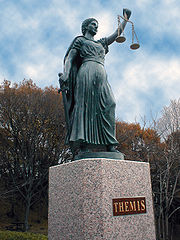
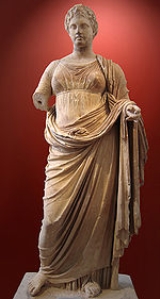
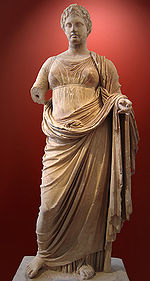
Some classical representations of Themis (illustration, left) did not show her blindfolded (because of her talent for prophecy, she had no need to be blinded) nor was she holding a sword (because she represented common consent, not coercion). The sword is also believed to represent the ability Themis had from cutting fact from fiction, to her there was no middle ground. Themis built the Oracle at Delphi and was herself oracular. According to another legend, Themis received the Oracle at Delphi from Gaia
Gaia (mythology)
Gaia was the primordial Earth-goddess in ancient Greek religion. Gaia was the great mother of all: the heavenly gods and Titans were descended from her union with Uranus , the sea-gods from her union with Pontus , the Giants from her mating with Tartarus and mortal creatures were sprung or born...
and later gave it to Phoebe
Phoebe (mythology)
In Greek mythology "radiant" Phoebe , was one of the original Titans, who were one set of sons and daughters of Uranus and Gaia. She was traditionally associated with the moon , as in Michael Drayton's Endimion and Phœbe, , the first extended treatment of the Endymion myth in English...
.
When Themis is disregarded, Nemesis
Nemesis (mythology)
In Greek mythology, Nemesis , also called Rhamnousia/Rhamnusia at her sanctuary at Rhamnous, north of Marathon, was the spirit of divine retribution against those who succumb to hubris . The Greeks personified vengeful fate as a remorseless goddess: the goddess of revenge...
brings just and wrathful retribution, thus Themis shared the Nemesion temple at Rhamnous
Rhamnous
The site of Rhamnous , the remote northernmost deme of Attica, lies 39 km NE of Athens and 12.4 km NNE of Marathon, Greece overlooking the Euboean Strait. Rhamnous was strategically significant enough to be fortified and receive an Athenian garrison of ephebes...
. Themis is not wrathful: she, "of the lovely cheeks", was the first to offer Hera
Hera
Hera was the wife and one of three sisters of Zeus in the Olympian pantheon of Greek mythology and religion. Her chief function was as the goddess of women and marriage. Her counterpart in the religion of ancient Rome was Juno. The cow and the peacock were sacred to her...
a cup when she returned to Olympus distraught over threats from Zeus (Iliad
Iliad
The Iliad is an epic poem in dactylic hexameters, traditionally attributed to Homer. Set during the Trojan War, the ten-year siege of the city of Troy by a coalition of Greek states, it tells of the battles and events during the weeks of a quarrel between King Agamemnon and the warrior Achilles...
xv. 88).
Themis presided over the proper relation between man and woman, the basis of the rightly ordered family (the family was seen as the pillar of the deme
Deme
In Ancient Greece, a deme or demos was a subdivision of Attica, the region of Greece surrounding Athens. Demes as simple subdivisions of land in the countryside seem to have existed in the 6th century BC and earlier, but did not acquire particular significance until the reforms of Cleisthenes in...
), and judges were often referred to as "themistopóloi" (the servants of Themis). Such was the basis for order upon Olympus too. Even Hera
Hera
Hera was the wife and one of three sisters of Zeus in the Olympian pantheon of Greek mythology and religion. Her chief function was as the goddess of women and marriage. Her counterpart in the religion of ancient Rome was Juno. The cow and the peacock were sacred to her...
addressed her as "Lady Themis." The name of Themis might be substituted for Adrasteia
Adrasteia
In Greek mythology, Adrasteia was a nymph who was charged by Rhea with nurturing the infant Zeus, in secret in the Dictaean cave, to protect him from his father Cronus .-Zeus:Adrasteia and her sister Ida, the nymph of Mount Ida, who also...
in telling of the birth of Zeus on Crete.
Themis was present at Delos
Delos
The island of Delos , isolated in the centre of the roughly circular ring of islands called the Cyclades, near Mykonos, is one of the most important mythological, historical and archaeological sites in Greece...
to witness the birth of Apollo. According to Ovid
Ovid
Publius Ovidius Naso , known as Ovid in the English-speaking world, was a Roman poet who is best known as the author of the three major collections of erotic poetry: Heroides, Amores, and Ars Amatoria...
, it was Themis rather than Zeus
Zeus
In the ancient Greek religion, Zeus was the "Father of Gods and men" who ruled the Olympians of Mount Olympus as a father ruled the family. He was the god of sky and thunder in Greek mythology. His Roman counterpart is Jupiter and his Etruscan counterpart is Tinia.Zeus was the child of Cronus...
who told Deucalion
Deucalion
In Greek mythology Deucalion was a son of Prometheus and Pronoia. The anger of Zeus was ignited by the hubris of the Pelasgians, and he decided to put an end to the Bronze Age. Lycaon, the king of Arcadia, had sacrificed a boy to Zeus, who was appalled by this savage offering...
to throw the bones of "his Mother
Gaia (mythology)
Gaia was the primordial Earth-goddess in ancient Greek religion. Gaia was the great mother of all: the heavenly gods and Titans were descended from her union with Uranus , the sea-gods from her union with Pontus , the Giants from her mating with Tartarus and mortal creatures were sprung or born...
" over his shoulder to create a new race of humankind after the Deluge.
Hesiod's description and contrast to Dike
In Greek mythologyGreek mythology
Greek mythology is the body of myths and legends belonging to the ancient Greeks, concerning their gods and heroes, the nature of the world, and the origins and significance of their own cult and ritual practices. They were a part of religion in ancient Greece...
, Hesiod
Hesiod
Hesiod was a Greek oral poet generally thought by scholars to have been active between 750 and 650 BC, around the same time as Homer. His is the first European poetry in which the poet regards himself as a topic, an individual with a distinctive role to play. Ancient authors credited him and...
mentions Themis among the six sons and six daughters of Gaia
Gaia (mythology)
Gaia was the primordial Earth-goddess in ancient Greek religion. Gaia was the great mother of all: the heavenly gods and Titans were descended from her union with Uranus , the sea-gods from her union with Pontus , the Giants from her mating with Tartarus and mortal creatures were sprung or born...
and Uranus
Uranus (mythology)
Uranus , was the primal Greek god personifying the sky. His equivalent in Roman mythology was Caelus. In Ancient Greek literature, according to Hesiod in his Theogony, Uranus or Father Sky was the son and husband of Gaia, Mother Earth...
(Earth and Sky). Among these Titans
Titan (mythology)
In Greek mythology, the Titans were a race of powerful deities, descendants of Gaia and Uranus, that ruled during the legendary Golden Age....
of primordial myth, few were venerated at specific sanctuaries in classical times.
Themis occurred in Hesiod's Theogony as the first recorded appearance of Justice as a divine personage. Drawing not only on the socio-religious consciousness of his time but also on many of the earlier cult-religions, Hesiod described the forces of the universe as cosmic divinities. Hesiod portrayed temporal justice, Dike
Dike (mythology)
In ancient Greek culture, Dikē was the spirit of moral order and fair judgement based on immemorial custom, in the sense of socially enforced norms and conventional rules. According to Hesiod In ancient Greek culture, Dikē (Greek: Δίκη, English translation: "justice") was the spirit of moral...
, as the daughter of Zeus
Zeus
In the ancient Greek religion, Zeus was the "Father of Gods and men" who ruled the Olympians of Mount Olympus as a father ruled the family. He was the god of sky and thunder in Greek mythology. His Roman counterpart is Jupiter and his Etruscan counterpart is Tinia.Zeus was the child of Cronus...
and Themis.
Dike executed the law of judgments and sentencing and, together with her mother Themis, carried out the final decisions of Moira. For Hesiod, Justice is at the center of religious and moral life, who, independently of Zeus, is the embodiment of divine will. This personification of Dike will stand in contrast to justice viewed as custom or law, and as retribution or sentence.
Horai: the Hours
With Zeus she more certainly bore the Horae, those embodiments of the right moment – the rightness of Order unfolding in Time – and Astraea.Second Generation
- Dike (Justice)
- EireneEirene (Greek goddess)Eirene, or Irene |Pax]]), one of the Horae, was the personification of peace, and was depicted in art as a beautiful young woman carrying a cornucopia, sceptre and a torch or rhyton. She is said sometimes to be the daughter of Zeus and Themis....
(Peace) - EunomiaEunomia (goddess)Eunomia was a minor Greek goddess of law and legislation, and one of the daughters of Themis and Zeus.-Mythology:...
(Order of Law)
Moirae: the Fates
Followers of Zeus claimed that it was with him that Themis produced the Three Fates. A fragment of PindarPindar
Pindar , was an Ancient Greek lyric poet. Of the canonical nine lyric poets of ancient Greece, his work is the best preserved. Quintilian described him as "by far the greatest of the nine lyric poets, in virtue of his inspired magnificence, the beauty of his thoughts and figures, the rich...
, however, tells that the Moirae were already present at the nuptials of Zeus and Themis; that in fact the Moirae rose with Themis from the springs of Okeanos the encircling World-Ocean and accompanied her up the bright sun-path to meet Zeus at Mount Olympus
Mount Olympus
Mount Olympus is the highest mountain in Greece, located on the border between Thessaly and Macedonia, about 100 kilometres away from Thessaloniki, Greece's second largest city. Mount Olympus has 52 peaks. The highest peak Mytikas, meaning "nose", rises to 2,917 metres...
.
- AtroposAtroposAtropos or Aisa , in Greek mythology, was one of the three Moirae, goddesses of fate and destiny. Her Roman equivalent was Morta.Atropos or Aisa was the oldest of the Three Fates, and was known as the "inflexible" or "inevitable." It was Atropos who chose the mechanism of death and ended the life...
(the Inevitable) - ClothoClothoClotho is one of the Three Fates or Moirae, in ancient Greek mythology. Her Roman equivalent is Nona. Clotho was responsible for spinning the thread of human life. She also made major decisions, such as when a person was born, thus in effect controlling people's lives...
(the Weaver) - LachesisLachesis (mythology)In Greek mythology, Lachesis was the second of the Three Fates, or Moirae, also known as the Triple Moon Goddesses or the Lunar Dieties. Each phase of the moon representing each of the fates - Clotho, Lachesis and Atropos...
(the Lot-caster)
Justitia
A RomanRoman mythology
Roman mythology is the body of traditional stories pertaining to ancient Rome's legendary origins and religious system, as represented in the literature and visual arts of the Romans...
equivalent of one aspect of Hellenic Themis, as the personification of the divine rightness of law, was Iustitia (Anglicized as Justitia). Her origins are in civic abstractions of a Roman mindset, rather than archaic mythology, so drawing comparisons is not fruitful. Portrayed as an impassive woman, holding scales and a double-edged sword (sometimes a cornucopia
Cornucopia
The cornucopia or horn of plenty is a symbol of abundance and nourishment, commonly a large horn-shaped container overflowing with produce, flowers, nuts, other edibles, or wealth in some form...
), and since the 16th century usually shown blindfolded, the sculpted figure outside a courthouse is typically Justitia or Lady Justice
Lady Justice
Lady Justice |Dike]]) is an allegorical personification of the moral force in judicial systems.-Depiction:The personification of justice balancing the scales of truth and fairness dates back to the Goddess Maat, and later Isis, of ancient Egypt. The Hellenic deities Themis and Dike were later...
, not Themis. In the Law Courts at Vancouver, British Columbia, however, the statue is explicitly of Themis.