

Jig

Encyclopedia
Folk dance
The term folk dance describes dances that share some or all of the following attributes:*They are dances performed at social functions by people with little or no professional training, often to traditional music or music based on traditional music....
, as well as the accompanying dance tune
Tune (folk music)
In folk music, a tune is a short instrumental piece, a melody, often with repeating sections, and usually played a number of times. The most common form for tunes in folk music is AABB, also known as binary form....
, originating in England in the 16th century and today most associated with Irish dance
Irish dance
Irish dancing or Irish dance is a group of traditional dance forms originating in Ireland which can broadly be divided into social dance and performance dances. Irish social dances can be divided further into céilí and set dancing...
music and Scottish country dance
Scottish country dance
A Scottish country dance is a form of social dance involving groups of mixed couples of dancers tracing progressive patterns according to a predetermined choreography...
music. Jigs were originally in 2/4 time, but have been adapted to a variety of time signature
Time signature
The time signature is a notational convention used in Western musical notation to specify how many beats are in each measure and which note value constitutes one beat....
s, by which they are often classified into groups, including light jigs, slip jigs, single jigs, and treble jigs.
Origins
The term jig was probably derived from the FrenchFrench language
French is a Romance language spoken as a first language in France, the Romandy region in Switzerland, Wallonia and Brussels in Belgium, Monaco, the regions of Quebec and Acadia in Canada, and by various communities elsewhere. Second-language speakers of French are distributed throughout many parts...
giguer, meaning 'to jump' or the Italian
Italian language
Italian is a Romance language spoken mainly in Europe: Italy, Switzerland, San Marino, Vatican City, by minorities in Malta, Monaco, Croatia, Slovenia, France, Libya, Eritrea, and Somalia, and by immigrant communities in the Americas and Australia...
giga. It was known as a dance in sixteenth-century England, often in 2/4 time, and the term was used for a dancing entertainment in sixteenth century plays. Later the dance began to be associated with music particularly in 6/8 time, and with slip jigs 9/8 time.
Ireland and Scotland
During the seventeenth century the dance was adopted in Ireland and Scotland, where it was widely adapted, and with which countries they are now most often associated. The jig is second only to the reelReel (dance)
The reel is a folk dance type as well as the accompanying dance tune type. In Scottish country dancing, the reel is one of the four traditional dances, the others being the jig, the strathspey and the waltz, and is also the name of a dance figure ....
in traditional Irish dance; it is popular but somewhat less common in Scottish country dance music. It is transcribed in compound meter, being 6/8 time. The most common structure of a jig is two eight-bar parts, performing two different steps, each once on the right foot, and one on the left foot. As with most other types of dance tunes
Tune (folk music)
In folk music, a tune is a short instrumental piece, a melody, often with repeating sections, and usually played a number of times. The most common form for tunes in folk music is AABB, also known as binary form....
in Irish music
Music of Ireland
Irish Music is the generic term for music that has been created in various genres on the island of Ireland.The indigenous music of the island is termed Irish traditional music. It has remained vibrant through the 20th, and into the 21st century, despite globalizing cultural forces...
, at a session or a dance it is common for two or more jigs to be strung together in a set, flowing on without interruption.
Light jigs
A light jig is the fastest of all the jigs, danced in ghilliesGhillies (dance)
Ghillies are specially designed shoes used for several types of dance. They are soft shoes, similar to ballet shoes. They are used by women in Irish dance, by men in Scottish country dance, and by men and women in Highland dance....
, and are performed in 6/8 time. The performer's feet rarely leave the ground for long, as the step is fast, typically performed at a speed around 116 at feis
Féis
A Feis or Fèis is a traditional Gaelic arts and culture festival. The plural forms are feiseanna and fèisean .-History:In Ancient Ireland communities placed great importance on local festivals, where Gaels could come together in song, dance, music, theatre and sport...
eanna. There are several light jig steps, varying with each dance school, but one step is almost standard in all light jigs. This step is known as the rising step, or the rise and grind. This is the right side version of it: Put your weight on your left foot and lift your right foot off the ground. Hop on your left foot once. Hop on your left foot again, bringing your right foot back behind your left foot and then shift your weight onto your right foot, leaving your left foot in the air. Dancers use the phrase "hop, hop back" for these three movements, and there is a slight pause between the hop, and hop back. The next movement is a hop on your right foot. Then you shift your weight on your feet , left-right-left-right. The phrase for this whole movement is: "hop, hop back, hop back 2-3-4." To do the step on the left foot, reverse the left and right directions.
Slip jigs
Slip jigSlip jig
Slip jig refers to both a style within Irish music, and the Irish dance to music in slip-jig time. The slip jig is in 9/8 time, traditionally with accents on 5 of the 9 beats — two pairs of crotchet/quaver followed by a dotted crotchet note.The slip jig is one the four most common Irish...
s are in 9/8 time. Because of the longer measures, they are longer than the reel
Reel (dance)
The reel is a folk dance type as well as the accompanying dance tune type. In Scottish country dancing, the reel is one of the four traditional dances, the others being the jig, the strathspey and the waltz, and is also the name of a dance figure ....
and the light jig, with the same number of bars to the music. The dance is performed high on the toes, and is often considered the "ballet of Irish dance" because of its graceful movements that seem to slip the performers across the floor. Slip jigs are performed at a speed of 113 at feiseanna.
Single jigs
Single jigs are the least common of the jigs, performed in ghillies, in a 6/8 or less commonly a 12/8 time. Musically, the Single Jig tends to follow the pattern of a quarter note followed by an eighth note (twice per 6/8 bar), whereas the Double Jig follows the pattern of having three eighth notes.(twice per 6/8 bar).Not to be confused with slides
Slide (tune type)
In Irish traditional music, a slide is a tune type in 12/8 akin to, and often confused with, a single jig. Slides originated the Sliabh Luachra region of southwestern Ireland....
.
Hop jigs
The term Hop Jig is the subject of some confusion, as some people use it for a single jig,while others use this term to refer to a tune in 9/8 time (e.g., Francis O'Neill
Francis O'Neill
Francis O'Neill was an Irish-born American police officer and collector of Irish traditional music.O'Neill was born in Tralibane, near Bantry, County Cork. At an early age he heard the music of local musicians, among them Peter Hagarty, Cormac Murphy and Timothy Dowling. At the age of 16, he...
).
Among the latter,
some do not distinguish it from a slip jig
Slip jig
Slip jig refers to both a style within Irish music, and the Irish dance to music in slip-jig time. The slip jig is in 9/8 time, traditionally with accents on 5 of the 9 beats — two pairs of crotchet/quaver followed by a dotted crotchet note.The slip jig is one the four most common Irish...
, while some reserve the term to
a slip-jig variant that has special characteristics, in particular an emphasis on
1/4 - 1/8 pairs.
Treble jigs
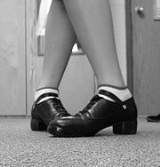
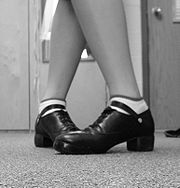
Treble jigs (also called the Hard or Heavy jig) are performed in hard shoes, and also to a 6/8 time meter. They are characterized by stomps, trebles, and clicks. Many set dances are performed in treble jig time, a few being Drunken Gauger, Blackthorne Stick, The Three Sea Captains, and St. Patrick's Day. Two types of treble jigs are performed at feiseanna: the traditional and non-traditional (slow) treble jigs. Beginners will do a treble jig at traditional speed (92 bpm), while more advanced dancers will dance the non-traditional (slow) treble jig at 73 bpm.External links
See Also
- GigueGigueThe gigue or giga is a lively baroque dance originating from the British jig. It was imported into France in the mid-17th century and usually appears at the end of a suite...
- Reel (dance)Reel (dance)The reel is a folk dance type as well as the accompanying dance tune type. In Scottish country dancing, the reel is one of the four traditional dances, the others being the jig, the strathspey and the waltz, and is also the name of a dance figure ....
- HornpipeHornpipeThe term hornpipe refers to any of several dance forms played and danced in Britain and elsewhere from the late 17th century until the present day. It is said that hornpipe as a dance began around the 16th century on English sailing vessels...
- PolkaPolkaThe polka is a Central European dance and also a genre of dance music familiar throughout Europe and the Americas. It originated in the middle of the 19th century in Bohemia...
- MazurkaMazurkaThe mazurka is a Polish folk dance in triple meter, usually at a lively tempo, and with accent on the third or second beat.-History:The folk origins of the mazurek are two other Polish musical forms—the slow machine...
- Slide (tune type)Slide (tune type)In Irish traditional music, a slide is a tune type in 12/8 akin to, and often confused with, a single jig. Slides originated the Sliabh Luachra region of southwestern Ireland....
- Irish stepdanceIrish stepdanceIrish stepdance is a type of performance dance originated in Ireland from traditional Irish dance, characterised by solo dancers who dance with hands by their sides and upper body stiff, making quick, intricate movements of the feet, often with a troupe. Irish stepdancing was popularized by the...