


Rationing

Encyclopedia
Rationing is the controlled distribution of scarce resources, goods, or services. Rationing controls the size of the ration, one's allotted portion of the resources being distributed on a particular day or at a particular time.
, rationing is an artificial restriction of demand. It is done to keep price below the equilibrium (market-clearing
) price determined by the process of supply and demand
in an unfettered market
. Thus, rationing can be complementary to price controls. An example of rationing in the face of rising prices took place in the Netherlands
, where there was rationing of gasoline in the 1973 energy crisis.
A reason for setting the price lower than would clear the market may be that there is a shortage, which would drive the market price very high. High prices, especially in the case of necessities, are undesirable with regard to those who cannot afford them. Traditionalist economists argue, however, that high prices act to reduce waste of the scarce resource while also providing incentive to produce more (this approach requires assuming no horizontal inequality
).
In wartime, it is usually extremely important for a government to ensure that everybody has access to a bare minimum of supplies, as everybody must co-operate to beat the enemy and it is in nobody's interest that some should starve or go naked.
Rationing using coupons is only one kind of non-price rationing. For example, scarce
products can be rationed using queues. This is seen, for example, at amusement park
s, where one pays a price to get in and then need not pay any price to go on the rides. Similarly, in the absence of road pricing
, access to roads is rationed in a first come, first served
queueing process, leading to congestion
.
Authorities which introduce rationing often have to deal with the rationed goods being sold illegally on the black market.
s for polio victims forced physicians to ration these machines. Dialysis machines
for patients in kidney failure were rationed between 1962 and 1967. More recently, Tia Powell
led a New York State Workgroup that set up guidelines for rationing ventilators during a flu pandemic. Jacob Appel
, a bioethicist, recently described the effects of rationing ventilators bluntly: "Some unfortunate individuals will have to be removed from life support so that others may live."
Among those who have argued in favor of health-care rationing are moral philosopher Peter Singer
and former Oregon governor John Kitzhaber
.
Triage
is the rationing of medical care in an emergency situation.
and banking of credit rationing describes the situation when a bank limits the supply
of loans, although it has enough funds to loan out, and the supply of loans has not yet equalled the demand
of prospective borrowers. Changing the price of the loans (interest rate) does not equilibrate the demand and supply of the loans. The bank finds that raising the interest rate beyond a certain level actually reduces its profitability.
, especially the navy
, to make supplies or rations last for a defined duration, such as a voyage.
and other necessities for which there is a shortage, including materials needed for the war effort such as rubber
tire
s, leather
shoe
s, clothing
and gasoline
.
Civilian rationing was first used in Germany
during the First World War. The author of the system was Latvian economist
Kārlis Balodis
. Towards the end of the First World War
, panic buying
in the United Kingdom
prompted rationing of first sugar
, then meat
, for the rest of the war. Most belligerents applied rationing to their home front during World War II
.
Civilian peace time rationing of food may also occur, especially after natural disasters, during contingencies, or after failed governmental economic policies regarding production or distribution, the latter happening especially in highly centralized planned economies. Examples include the United Kingdom
for almost a decade after the end of World War II, North Korea
, China
during the 1970s and 1980s, Communist Romania
during the 1980s, the Soviet Union
in 1990-1991, and Cuba
today. This led to rationing in the Soviet Union
, in Communist Romania, in North Korea and in Cuba
, and austerity in Israel
.
. Although synthetic rubber
had been invented in the years preceding the war, it had been unable to compete with natural rubber commercially, so the USA did not have enough manufacturing capacity at the start of the war to make synthetic rubber. Throughout the war, rationing of gasoline was motivated by a desire to conserve rubber as much as by a desire to conserve gasoline.
A national speed limit of 35 miles per hour was imposed to save fuel and rubber for tires. Depending on need, civilians were issued one of a number of classifications of gasoline cards, entitling them to a quantity of gasoline each week. When purchasing gasoline, one had to present a gas card and a vehicle sticker in addition to payment. Books of ration stamps were issued for other commodities and were valid only for a set period, to forestall hoarding.
Civilians first received ration books on 4 May 1942. To get a classification and rationing stamps, one had to appear before a local War Price and Rationing Board which reported to the U.S. Office of Price Administration
. Each person in a household received a ration book, including babies and small children who qualified for canned milk not available to others. To receive a gasoline ration card, a person had to certify a need for gasoline and ownership of no more than five tires. All tires in excess of five per driver were confiscated by the government, because of rubber shortages. An A sticker on a car was the lowest priority of gasoline rationing and entitled the car owner to 3 to 4 gallons of gasoline per week. B stickers were issued to workers in the military industry, entitling their holder up to 8 gallons of gasoline per week. C stickers were granted to persons deemed very essential to the war effort, such as doctors. T rations were made available for truckers. Lastly, X stickers on cars entitled the holder to unlimited supplies and were the highest priority in the system. Ministers of Religion, police, firemen, and civil defense
workers were in this category. A scandal erupted when 200 Congress
men received these X stickers.
Tires were the first item to be rationed in January 1942 after supplies of natural rubber were interrupted. Automobile
factories stopped manufacturing civilian models by early February 1942 and converted to producing tanks, aircraft, weapons, and other military products, with the United States government as the only customer. Sugar
was the first consumer commodity rationed, with all sales ended on 27 April 1942 and resumed on 5 May with a ration of one half pound per person per week, half of normal consumption. Bakeries, ice cream makers, and other commercial users received rations of about 70% of normal usage. Coffee
was rationed nationally on 29 November 1942 to one pound every five weeks, about half of normal consumption, in part because of German U-boat
attacks on shipping from Brazil. Typewriter
s, gasoline
, bicycle
s, footwear
, Silk, Nylon, fuel oil
, stove
s, meat
, lard
, shortening
and oils, cheese
, butter
, margarine
, processed foods (canned, bottled, and frozen), dried fruit
s, canned milk
, firewood
and coal
, jams, jellies, and fruit butter
were rationed by November 1943.
Medicines such as penicillin
were rationed by a triage
committee at each hospital.
Many levels of rationing went into effect. Some items, such as sugar, were distributed evenly based on the number of people in a household. Other items, like gasoline or fuel oil, were rationed only to those who could justify a need. Restaurant owners and other merchants were accorded more availability, but had to collect ration stamps to restock their supplies. In exchange for used ration stamps, ration boards delivered certificates to restaurants and merchants to authorize procurement of more products.
The work of issuing ration books and exchanging used stamps for certificates was handled by some 5,500 local ration boards of mostly volunteer workers selected by local officials.
Each ration stamp had a generic drawing of an airplane, gun, tank, aircraft carrier, ear of wheat, fruit, etc. and a serial number. Some stamps also had alphabetic lettering. The kind and amount of rationed commodities were not specified on most of the stamps and were not defined until later when local newspapers published, for example, that beginning on a specified date, one airplane stamp was required (in addition to cash) to buy one pair of shoes and one stamp number 30 from ration book four was required to buy five pounds of sugar. The commodity amounts changed from time to time depending on availability. Red stamps were used to ration meat and butter, and blue stamps were used to ration processed foods.
To enable making change for ration stamps, the government issued "red point" tokens to be given in change for red stamps, and "blue point" tokens in change for blue stamps. The red and blue tokens were about the size of dimes (16 mm) and were made of thin compressed wood fiber material, because metals were in short supply.
As a result of the rationing, all forms of Automobile racing, including Indianapolis, was banned. Sightseeing driving was banned as well.
Rationing was ended in 1946.http://www.u-s-history.com/pages/h1674.html
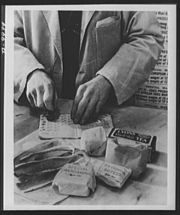 The British Ministry of Food refined the rationing process in the early 1940s to ensure the population did not starve when food imports were severely restricted and local production limited due to the large number of men fighting the war. Rationing was in some respects more strict after the war than during it—two major foodstuffs that were never rationed during the war, bread and potatoes, went on ration after it (bread from 1946 to 1948, and potatoes for a time from 1947). Tea was still on ration until 1952. In 1953 rationing of sugar and eggs ended, and in 1954, all rationing finally ended when cheese and meats came off ration.
, called Ration Stamps. These were redeemable stamps or coupons. Every family was issued a set number of each kind of stamp based on the size of the family, ages of children and income. This allowed the Allies and mainly America to supply huge amounts of food to the troops and later provided a surplus to aid in the rebuilding of Europe with aid to Germany after food supplies were destroyed.
or terror attack
. The Federal Emergency Management Agency
(FEMA) has established guidelines for civilians on rationing food and water supplies when replacements are not available. According to FEMA standards, every person should have a minimum of one quart per day of water, and more for children, nursing mothers, and the ill.
schemes under which emissions credits are allocated to adult individuals on a (broadly) equal per capita
basis, within national carbon budgets
. Individuals then surrender these credits when buying fuel or electricity. Individuals wanting or needing to emit at a level above that permitted by their initial allocation would be able to engage in emissions trading and purchase additional credits. Conversely, those individuals who emit at a level below that permitted by their initial allocation have the opportunity to sell their surplus credits. Thus, individual trading under Personal Carbon Trading is similar to the trading of companies under EU ETS.
Personal carbon trading is sometimes confused with carbon offset
ting due to the similar notion of paying for emissions allowances, but is a quite different concept designed to be mandatory and to guarantee that nations achieve their domestic carbon emissions targets (rather than attempting to do so via international trading or offsetting).
In economics
In economicsEconomics
Economics is the social science that analyzes the production, distribution, and consumption of goods and services. The term economics comes from the Ancient Greek from + , hence "rules of the house"...
, rationing is an artificial restriction of demand. It is done to keep price below the equilibrium (market-clearing
Market clearing
In economics, market clearing refers to either# a simplifying assumption made by the new classical school that markets always go to where the quantity supplied equals the quantity demanded; or# the process of getting there via price adjustment....
) price determined by the process of supply and demand
Supply and demand
Supply and demand is an economic model of price determination in a market. It concludes that in a competitive market, the unit price for a particular good will vary until it settles at a point where the quantity demanded by consumers will equal the quantity supplied by producers , resulting in an...
in an unfettered market
Free market
A free market is a competitive market where prices are determined by supply and demand. However, the term is also commonly used for markets in which economic intervention and regulation by the state is limited to tax collection, and enforcement of private ownership and contracts...
. Thus, rationing can be complementary to price controls. An example of rationing in the face of rising prices took place in the Netherlands
Netherlands
The Netherlands is a constituent country of the Kingdom of the Netherlands, located mainly in North-West Europe and with several islands in the Caribbean. Mainland Netherlands borders the North Sea to the north and west, Belgium to the south, and Germany to the east, and shares maritime borders...
, where there was rationing of gasoline in the 1973 energy crisis.
A reason for setting the price lower than would clear the market may be that there is a shortage, which would drive the market price very high. High prices, especially in the case of necessities, are undesirable with regard to those who cannot afford them. Traditionalist economists argue, however, that high prices act to reduce waste of the scarce resource while also providing incentive to produce more (this approach requires assuming no horizontal inequality
Horizontal inequality
Horizontal inequality is the inequality — economical, social or other — that does not follow from a difference in an inherent quality such as intelligence, attractiveness or skills for people or profitability for corporations. In sociology, this is particularly applicable to forced inequality...
).
In wartime, it is usually extremely important for a government to ensure that everybody has access to a bare minimum of supplies, as everybody must co-operate to beat the enemy and it is in nobody's interest that some should starve or go naked.
Rationing using coupons is only one kind of non-price rationing. For example, scarce
Scarcity
Scarcity is the fundamental economic problem of having humans who have unlimited wants and needs in a world of limited resources. It states that society has insufficient productive resources to fulfill all human wants and needs. Alternatively, scarcity implies that not all of society's goals can be...
products can be rationed using queues. This is seen, for example, at amusement park
Amusement park
thumb|Cinderella Castle in [[Magic Kingdom]], [[Disney World]]Amusement and theme parks are terms for a group of entertainment attractions and rides and other events in a location for the enjoyment of large numbers of people...
s, where one pays a price to get in and then need not pay any price to go on the rides. Similarly, in the absence of road pricing
Road pricing
Road pricing is an economic concept regarding the various direct charges applied for the use of roads. The road charges includes fuel taxes, licence fees, parking taxes, tolls, and congestion charges, including those which may vary by time of day, by the specific road, or by the specific vehicle...
, access to roads is rationed in a first come, first served
First Come, First Served
First Come, First Served is the third studio album by American emcee Keith Thornton, better known as Kool Keith. Released in 1999, it is his first release under the alias Dr. Dooom.- Production :...
queueing process, leading to congestion
Traffic congestion
Traffic congestion is a condition on road networks that occurs as use increases, and is characterized by slower speeds, longer trip times, and increased vehicular queueing. The most common example is the physical use of roads by vehicles. When traffic demand is great enough that the interaction...
.
Authorities which introduce rationing often have to deal with the rationed goods being sold illegally on the black market.
Health care rationing
Shortages of organs for donation force the rationing of hearts, livers, lungs and kidneys in the United States. During the 1940s, a limited supply of iron lungIron lung
A negative pressure ventilator is a form of medical ventilator that enables a person to breathe when normal muscle control has been lost or the work of breathing exceeds the person's ability....
s for polio victims forced physicians to ration these machines. Dialysis machines
Dialysis
In medicine, dialysis is a process for removing waste and excess water from the blood, and is primarily used to provide an artificial replacement for lost kidney function in people with renal failure...
for patients in kidney failure were rationed between 1962 and 1967. More recently, Tia Powell
Tia Powell
Tia Powell is an American psychiatrist and bioethicist. She is Director of the Montefiore-Einstein Center for Bioethics and a Professor of Clinical Epidemiology and Clinical Psychiatry at Albert Einstein College of Medicine in The Bronx, New York...
led a New York State Workgroup that set up guidelines for rationing ventilators during a flu pandemic. Jacob Appel
Jacob M. Appel
Jacob M. Appel is an American author, bioethicist and social critic. He is best known for his short stories, his work as a playwright, and his writing in the fields of reproductive ethics, organ donation, neuroethics and euthanasia....
, a bioethicist, recently described the effects of rationing ventilators bluntly: "Some unfortunate individuals will have to be removed from life support so that others may live."
Among those who have argued in favor of health-care rationing are moral philosopher Peter Singer
Peter Singer
Peter Albert David Singer is an Australian philosopher who is the Ira W. DeCamp Professor of Bioethics at Princeton University and Laureate Professor at the Centre for Applied Philosophy and Public Ethics at the University of Melbourne...
and former Oregon governor John Kitzhaber
John Kitzhaber
John Albert Kitzhaber is the 37th Governor of Oregon. He served as the 35th Governor of Oregon from 1995 to 2003 and became the first person to be elected to the office three times when he was re-elected to a non-consecutive third term in 2010...
.
Triage
Triage
Triage or ) is the process of determining the priority of patients' treatments based on the severity of their condition. This rations patient treatment efficiently when resources are insufficient for all to be treated immediately. The term comes from the French verb trier, meaning to separate,...
is the rationing of medical care in an emergency situation.
Credit rationing
The concept in economicsEconomics
Economics is the social science that analyzes the production, distribution, and consumption of goods and services. The term economics comes from the Ancient Greek from + , hence "rules of the house"...
and banking of credit rationing describes the situation when a bank limits the supply
Supply (economics)
In economics, supply is the amount of some product producers are willing and able to sell at a given price all other factors being held constant. Usually, supply is plotted as a supply curve showing the relationship of price to the amount of product businesses are willing to sell.In economics the...
of loans, although it has enough funds to loan out, and the supply of loans has not yet equalled the demand
Demand
- Economics :*Demand , the desire to own something and the ability to pay for it*Demand curve, a graphic representation of a demand schedule*Demand deposit, the money in checking accounts...
of prospective borrowers. Changing the price of the loans (interest rate) does not equilibrate the demand and supply of the loans. The bank finds that raising the interest rate beyond a certain level actually reduces its profitability.
Military rationing
Rationing has long been used in the militaryMilitary
A military is an organization authorized by its greater society to use lethal force, usually including use of weapons, in defending its country by combating actual or perceived threats. The military may have additional functions of use to its greater society, such as advancing a political agenda e.g...
, especially the navy
Navy
A navy is the branch of a nation's armed forces principally designated for naval and amphibious warfare; namely, lake- or ocean-borne combat operations and related functions...
, to make supplies or rations last for a defined duration, such as a voyage.
Civilian rationing
Rationing is often instituted during wartime for civilians as well. For example, each person may be given "ration coupons" allowing him or her to purchase a certain amount of a product each month. Rationing often includes foodFood
Food is any substance consumed to provide nutritional support for the body. It is usually of plant or animal origin, and contains essential nutrients, such as carbohydrates, fats, proteins, vitamins, or minerals...
and other necessities for which there is a shortage, including materials needed for the war effort such as rubber
Rubber
Natural rubber, also called India rubber or caoutchouc, is an elastomer that was originally derived from latex, a milky colloid produced by some plants. The plants would be ‘tapped’, that is, an incision made into the bark of the tree and the sticky, milk colored latex sap collected and refined...
tire
Tire
A tire or tyre is a ring-shaped covering that fits around a wheel rim to protect it and enable better vehicle performance by providing a flexible cushion that absorbs shock while keeping the wheel in close contact with the ground...
s, leather
Leather
Leather is a durable and flexible material created via the tanning of putrescible animal rawhide and skin, primarily cattlehide. It can be produced through different manufacturing processes, ranging from cottage industry to heavy industry.-Forms:...
shoe
Shoe
A shoe is an item of footwear intended to protect and comfort the human foot while doing various activities. Shoes are also used as an item of decoration. The design of shoes has varied enormously through time and from culture to culture, with appearance originally being tied to function...
s, clothing
Clothing
Clothing refers to any covering for the human body that is worn. The wearing of clothing is exclusively a human characteristic and is a feature of nearly all human societies...
and gasoline
Gasoline
Gasoline , or petrol , is a toxic, translucent, petroleum-derived liquid that is primarily used as a fuel in internal combustion engines. It consists mostly of organic compounds obtained by the fractional distillation of petroleum, enhanced with a variety of additives. Some gasolines also contain...
.
Civilian rationing was first used in Germany
Germany
Germany , officially the Federal Republic of Germany , is a federal parliamentary republic in Europe. The country consists of 16 states while the capital and largest city is Berlin. Germany covers an area of 357,021 km2 and has a largely temperate seasonal climate...
during the First World War. The author of the system was Latvian economist
Economist
An economist is a professional in the social science discipline of economics. The individual may also study, develop, and apply theories and concepts from economics and write about economic policy...
Kārlis Balodis
Kārlis Balodis
Kārlis Balodis was a notable Latvian economist, financist, statistician and demographist. Most notably, he is the author of civilian rationing, which was first used in Germany during the First World War...
. Towards the end of the First World War
World War I
World War I , which was predominantly called the World War or the Great War from its occurrence until 1939, and the First World War or World War I thereafter, was a major war centred in Europe that began on 28 July 1914 and lasted until 11 November 1918...
, panic buying
Panic buying
Panic buying is an imprecise common use term to describe the act of people buying unusually large amounts of a product in anticipation of or after a disaster or perceived disaster, or in anticipation of a large price increase or shortage, as can occur before a blizzard or hurricane or government...
in the United Kingdom
United Kingdom
The United Kingdom of Great Britain and Northern IrelandIn the United Kingdom and Dependencies, other languages have been officially recognised as legitimate autochthonous languages under the European Charter for Regional or Minority Languages...
prompted rationing of first sugar
Sugar
Sugar is a class of edible crystalline carbohydrates, mainly sucrose, lactose, and fructose, characterized by a sweet flavor.Sucrose in its refined form primarily comes from sugar cane and sugar beet...
, then meat
Meat
Meat is animal flesh that is used as food. Most often, this means the skeletal muscle and associated fat and other tissues, but it may also describe other edible tissues such as organs and offal...
, for the rest of the war. Most belligerents applied rationing to their home front during World War II
Home front during World War II
The home front covers the activities of the civilians in a nation at war. World War II was a total war; homeland production became even more invaluable to both the Allied and Axis powers. Life on the home front during World War II was a significant part of the war effort for all participants and...
.
Civilian peace time rationing of food may also occur, especially after natural disasters, during contingencies, or after failed governmental economic policies regarding production or distribution, the latter happening especially in highly centralized planned economies. Examples include the United Kingdom
United Kingdom
The United Kingdom of Great Britain and Northern IrelandIn the United Kingdom and Dependencies, other languages have been officially recognised as legitimate autochthonous languages under the European Charter for Regional or Minority Languages...
for almost a decade after the end of World War II, North Korea
North Korea
The Democratic People’s Republic of Korea , , is a country in East Asia, occupying the northern half of the Korean Peninsula. Its capital and largest city is Pyongyang. The Korean Demilitarized Zone serves as the buffer zone between North Korea and South Korea...
, China
China
Chinese civilization may refer to:* China for more general discussion of the country.* Chinese culture* Greater China, the transnational community of ethnic Chinese.* History of China* Sinosphere, the area historically affected by Chinese culture...
during the 1970s and 1980s, Communist Romania
Communist Romania
Communist Romania was the period in Romanian history when that country was a Soviet-aligned communist state in the Eastern Bloc, with the dominant role of Romanian Communist Party enshrined in its successive constitutions...
during the 1980s, the Soviet Union
Soviet Union
The Soviet Union , officially the Union of Soviet Socialist Republics , was a constitutionally socialist state that existed in Eurasia between 1922 and 1991....
in 1990-1991, and Cuba
Cuba
The Republic of Cuba is an island nation in the Caribbean. The nation of Cuba consists of the main island of Cuba, the Isla de la Juventud, and several archipelagos. Havana is the largest city in Cuba and the country's capital. Santiago de Cuba is the second largest city...
today. This led to rationing in the Soviet Union
Rationing in the Soviet Union
Rationing in the Soviet Union was introduced several times, in periods of economical hardships.-1929–1935:In 1929, the elimination of limited market economy that existed in the USSR between 1921 and 1929 resulted in food shortages and spontaneous introduction of food rationing in most Soviet...
, in Communist Romania, in North Korea and in Cuba
Rationing in Cuba
Rationing in Cuba refers to the system of food distribution known in Cuba as the Libreta de Abastecimiento . The system establishes the rations each person is allowed to buy through that system, and the frequency of supplies....
, and austerity in Israel
Austerity in Israel
From 1949 to 1959, the state of Israel was, to a varying extent, under a regime of austerity , during which rationing and similar measures were enforced.-Rationale:...
.
United States
In 1942, a wartime rationing system was established in the United States. Of concern for all parts of the country was a shortage of rubber for tires since the Japanese quickly conquered the rubber-producing regions of Southeast AsiaSoutheast Asia
Southeast Asia, South-East Asia, South East Asia or Southeastern Asia is a subregion of Asia, consisting of the countries that are geographically south of China, east of India, west of New Guinea and north of Australia. The region lies on the intersection of geological plates, with heavy seismic...
. Although synthetic rubber
Synthetic rubber
Synthetic rubber is is any type of artificial elastomer, invariably a polymer. An elastomer is a material with the mechanical property that it can undergo much more elastic deformation under stress than most materials and still return to its previous size without permanent deformation...
had been invented in the years preceding the war, it had been unable to compete with natural rubber commercially, so the USA did not have enough manufacturing capacity at the start of the war to make synthetic rubber. Throughout the war, rationing of gasoline was motivated by a desire to conserve rubber as much as by a desire to conserve gasoline.
A national speed limit of 35 miles per hour was imposed to save fuel and rubber for tires. Depending on need, civilians were issued one of a number of classifications of gasoline cards, entitling them to a quantity of gasoline each week. When purchasing gasoline, one had to present a gas card and a vehicle sticker in addition to payment. Books of ration stamps were issued for other commodities and were valid only for a set period, to forestall hoarding.
Civilians first received ration books on 4 May 1942. To get a classification and rationing stamps, one had to appear before a local War Price and Rationing Board which reported to the U.S. Office of Price Administration
Office of Price Administration
The Office of Price Administration was established within the Office for Emergency Management of the United States government by Executive Order 8875 on August 28, 1941. The functions of the OPA was originally to control money and rents after the outbreak of World War II.President Franklin D...
. Each person in a household received a ration book, including babies and small children who qualified for canned milk not available to others. To receive a gasoline ration card, a person had to certify a need for gasoline and ownership of no more than five tires. All tires in excess of five per driver were confiscated by the government, because of rubber shortages. An A sticker on a car was the lowest priority of gasoline rationing and entitled the car owner to 3 to 4 gallons of gasoline per week. B stickers were issued to workers in the military industry, entitling their holder up to 8 gallons of gasoline per week. C stickers were granted to persons deemed very essential to the war effort, such as doctors. T rations were made available for truckers. Lastly, X stickers on cars entitled the holder to unlimited supplies and were the highest priority in the system. Ministers of Religion, police, firemen, and civil defense
Civil defense
Civil defense, civil defence or civil protection is an effort to protect the citizens of a state from military attack. It uses the principles of emergency operations: prevention, mitigation, preparation, response, or emergency evacuation, and recovery...
workers were in this category. A scandal erupted when 200 Congress
United States Congress
The United States Congress is the bicameral legislature of the federal government of the United States, consisting of the Senate and the House of Representatives. The Congress meets in the United States Capitol in Washington, D.C....
men received these X stickers.
Tires were the first item to be rationed in January 1942 after supplies of natural rubber were interrupted. Automobile
Automobile
An automobile, autocar, motor car or car is a wheeled motor vehicle used for transporting passengers, which also carries its own engine or motor...
factories stopped manufacturing civilian models by early February 1942 and converted to producing tanks, aircraft, weapons, and other military products, with the United States government as the only customer. Sugar
Sugar
Sugar is a class of edible crystalline carbohydrates, mainly sucrose, lactose, and fructose, characterized by a sweet flavor.Sucrose in its refined form primarily comes from sugar cane and sugar beet...
was the first consumer commodity rationed, with all sales ended on 27 April 1942 and resumed on 5 May with a ration of one half pound per person per week, half of normal consumption. Bakeries, ice cream makers, and other commercial users received rations of about 70% of normal usage. Coffee
Coffee
Coffee is a brewed beverage with a dark,init brooo acidic flavor prepared from the roasted seeds of the coffee plant, colloquially called coffee beans. The beans are found in coffee cherries, which grow on trees cultivated in over 70 countries, primarily in equatorial Latin America, Southeast Asia,...
was rationed nationally on 29 November 1942 to one pound every five weeks, about half of normal consumption, in part because of German U-boat
U-boat
U-boat is the anglicized version of the German word U-Boot , itself an abbreviation of Unterseeboot , and refers to military submarines operated by Germany, particularly in World War I and World War II...
attacks on shipping from Brazil. Typewriter
Typewriter
A typewriter is a mechanical or electromechanical device with keys that, when pressed, cause characters to be printed on a medium, usually paper. Typically one character is printed per keypress, and the machine prints the characters by making ink impressions of type elements similar to the pieces...
s, gasoline
Gasoline
Gasoline , or petrol , is a toxic, translucent, petroleum-derived liquid that is primarily used as a fuel in internal combustion engines. It consists mostly of organic compounds obtained by the fractional distillation of petroleum, enhanced with a variety of additives. Some gasolines also contain...
, bicycle
Bicycle
A bicycle, also known as a bike, pushbike or cycle, is a human-powered, pedal-driven, single-track vehicle, having two wheels attached to a frame, one behind the other. A person who rides a bicycle is called a cyclist, or bicyclist....
s, footwear
Footwear
Footwear consists of garments worn on the feet, for fashion, protection against the environment, and adornment. Being barefoot is commonly associated with poverty, but some cultures chose not to wear footwear at least in some situations....
, Silk, Nylon, fuel oil
Fuel oil
Fuel oil is a fraction obtained from petroleum distillation, either as a distillate or a residue. Broadly speaking, fuel oil is any liquid petroleum product that is burned in a furnace or boiler for the generation of heat or used in an engine for the generation of power, except oils having a flash...
, stove
Stove
A stove is an enclosed heated space. The term is commonly taken to mean an enclosed space in which fuel is burned to provide heating, either to heat the space in which the stove is situated or to heat the stove itself, and items placed on it...
s, meat
Meat
Meat is animal flesh that is used as food. Most often, this means the skeletal muscle and associated fat and other tissues, but it may also describe other edible tissues such as organs and offal...
, lard
Lard
Lard is pig fat in both its rendered and unrendered forms. Lard was commonly used in many cuisines as a cooking fat or shortening, or as a spread similar to butter. Its use in contemporary cuisine has diminished because of health concerns posed by its saturated-fat content and its often negative...
, shortening
Shortening
Shortening is any fat that is solid at room temperature and used to make crumbly pastry. The reason it is called shortening is because it prevents cross-linkage between gluten molecules. Cross linking is what causes doughs to be sticky. Seeing as cake is not meant to be sticky, shortening is used...
and oils, cheese
Cheese
Cheese is a generic term for a diverse group of milk-based food products. Cheese is produced throughout the world in wide-ranging flavors, textures, and forms....
, butter
Butter
Butter is a dairy product made by churning fresh or fermented cream or milk. It is generally used as a spread and a condiment, as well as in cooking applications, such as baking, sauce making, and pan frying...
, margarine
Margarine
Margarine , as a generic term, can indicate any of a wide range of butter substitutes, typically composed of vegetable oils. In many parts of the world, the market share of margarine and spreads has overtaken that of butter...
, processed foods (canned, bottled, and frozen), dried fruit
Dried fruit
Dried fruit is fruit where the majority of the original water content has been removed either naturally, through sun drying, or through the use of specialized dryers or dehydrators. Dried fruit has a long tradition of use dating back to the fourth millennium BC in Mesopotamia, and is prized...
s, canned milk
Milk
Milk is a white liquid produced by the mammary glands of mammals. It is the primary source of nutrition for young mammals before they are able to digest other types of food. Early-lactation milk contains colostrum, which carries the mother's antibodies to the baby and can reduce the risk of many...
, firewood
Firewood
Firewood is any wood-like material that is gathered and used for fuel. Generally, firewood is not highly processed and is in some sort of recognizable log or branch form....
and coal
Coal
Coal is a combustible black or brownish-black sedimentary rock usually occurring in rock strata in layers or veins called coal beds or coal seams. The harder forms, such as anthracite coal, can be regarded as metamorphic rock because of later exposure to elevated temperature and pressure...
, jams, jellies, and fruit butter
Fruit butter
A fruit butter is a sweet spread made of fruit cooked to a paste, then lightly sweetened. It falls into the same category as jelly and jam. Apple butter is a common example....
were rationed by November 1943.
Medicines such as penicillin
Penicillin
Penicillin is a group of antibiotics derived from Penicillium fungi. They include penicillin G, procaine penicillin, benzathine penicillin, and penicillin V....
were rationed by a triage
Triage
Triage or ) is the process of determining the priority of patients' treatments based on the severity of their condition. This rations patient treatment efficiently when resources are insufficient for all to be treated immediately. The term comes from the French verb trier, meaning to separate,...
committee at each hospital.
Many levels of rationing went into effect. Some items, such as sugar, were distributed evenly based on the number of people in a household. Other items, like gasoline or fuel oil, were rationed only to those who could justify a need. Restaurant owners and other merchants were accorded more availability, but had to collect ration stamps to restock their supplies. In exchange for used ration stamps, ration boards delivered certificates to restaurants and merchants to authorize procurement of more products.
The work of issuing ration books and exchanging used stamps for certificates was handled by some 5,500 local ration boards of mostly volunteer workers selected by local officials.
Each ration stamp had a generic drawing of an airplane, gun, tank, aircraft carrier, ear of wheat, fruit, etc. and a serial number. Some stamps also had alphabetic lettering. The kind and amount of rationed commodities were not specified on most of the stamps and were not defined until later when local newspapers published, for example, that beginning on a specified date, one airplane stamp was required (in addition to cash) to buy one pair of shoes and one stamp number 30 from ration book four was required to buy five pounds of sugar. The commodity amounts changed from time to time depending on availability. Red stamps were used to ration meat and butter, and blue stamps were used to ration processed foods.
To enable making change for ration stamps, the government issued "red point" tokens to be given in change for red stamps, and "blue point" tokens in change for blue stamps. The red and blue tokens were about the size of dimes (16 mm) and were made of thin compressed wood fiber material, because metals were in short supply.
As a result of the rationing, all forms of Automobile racing, including Indianapolis, was banned. Sightseeing driving was banned as well.
Rationing was ended in 1946.http://www.u-s-history.com/pages/h1674.html
United Kingdom
Europe
Another form of rationing that was employed during World War IIWorld War II
World War II, or the Second World War , was a global conflict lasting from 1939 to 1945, involving most of the world's nations—including all of the great powers—eventually forming two opposing military alliances: the Allies and the Axis...
, called Ration Stamps. These were redeemable stamps or coupons. Every family was issued a set number of each kind of stamp based on the size of the family, ages of children and income. This allowed the Allies and mainly America to supply huge amounts of food to the troops and later provided a surplus to aid in the rebuilding of Europe with aid to Germany after food supplies were destroyed.
Emergency rationing
Rationing of food and water may become necessary during an emergency, such as a natural disasterNatural disaster
A natural disaster is the effect of a natural hazard . It leads to financial, environmental or human losses...
or terror attack
Terrorism
Terrorism is the systematic use of terror, especially as a means of coercion. In the international community, however, terrorism has no universally agreed, legally binding, criminal law definition...
. The Federal Emergency Management Agency
Federal Emergency Management Agency
The Federal Emergency Management Agency is an agency of the United States Department of Homeland Security, initially created by Presidential Reorganization Plan No. 1 of 1978 and implemented by two Executive Orders...
(FEMA) has established guidelines for civilians on rationing food and water supplies when replacements are not available. According to FEMA standards, every person should have a minimum of one quart per day of water, and more for children, nursing mothers, and the ill.
Carbon rationing
Personal carbon trading refers to proposed emissions tradingEmissions trading
Emissions trading is a market-based approach used to control pollution by providing economic incentives for achieving reductions in the emissions of pollutants....
schemes under which emissions credits are allocated to adult individuals on a (broadly) equal per capita
Per capita
Per capita is a Latin prepositional phrase: per and capita . The phrase thus means "by heads" or "for each head", i.e. per individual or per person...
basis, within national carbon budgets
United Kingdom Climate Change Bill
The Climate Change Act 2008 is an Act of the Parliament of the United Kingdom. The Act makes it the duty of the Secretary of State to ensure that the net UK carbon account for all six Kyoto greenhouse gases for the year 2050 is at least 80% lower than the 1990 baseline, toward avoiding dangerous...
. Individuals then surrender these credits when buying fuel or electricity. Individuals wanting or needing to emit at a level above that permitted by their initial allocation would be able to engage in emissions trading and purchase additional credits. Conversely, those individuals who emit at a level below that permitted by their initial allocation have the opportunity to sell their surplus credits. Thus, individual trading under Personal Carbon Trading is similar to the trading of companies under EU ETS.
Personal carbon trading is sometimes confused with carbon offset
Carbon offset
A carbon offset is a reduction in emissions of carbon dioxide or greenhouse gases made in order to compensate for or to offset an emission made elsewhere....
ting due to the similar notion of paying for emissions allowances, but is a quite different concept designed to be mandatory and to guarantee that nations achieve their domestic carbon emissions targets (rather than attempting to do so via international trading or offsetting).
See also
- 10-in-1 food parcel10-in-1 food parcelThe 10-in-1 food parcel, commonly known as the 10-in-1 ration was a field ration prepared for soldiers of the United States Army, intended to provide one meal for 10 men.-Development:...
- 2007 Gas Rationing Plan in Iran2007 Gas Rationing Plan in Iran2007 Gasoline Rationing Plan in Iran was launched by president Mahmoud Ahmadinejad's cabinet to reduce that country's fuel consumption. Although Iran is one of the world's largest producers of petroleum, rapid increases in demand and limited refining capacity has forced the country to import about...
- Combat Ration One ManCombat Ration One ManThe Combat Ration One Man, or CR1M is a self-contained, individual field ration in lightweight packaging procured by the Australian military for its members for use in combat or other field conditions where organised food facilities are not available....
- Juntas de Abastecimientos y PreciosJuntas de Abastecimientos y PreciosJuntas de Abastecimientos y Precios fueron unidades administrativas locales en Chile creadas a finales de 1972. Estas juntas utilizaron cartolas de abastecimiento, supuestamente con el fin de aliviar la escasez de alimentos y la especulación que había en ese entonces, también se encargaban de...
, rationing in Chile under AllendeChile under AllendeSalvador Allende was the president of Chile from 1970 until 1973, and head of the Popular Unity government; he was the first Marxist ever to be elected to the national presidency of a democracy... - MREMREThe Meal, Ready-to-Eat — commonly known as the MRE — is a self-contained, individual field ration in lightweight packaging bought by the United States military for its service members for use in combat or other field conditions where organized food facilities are not available...
- Rationing in the United Kingdom
- Road space rationingRoad space rationingRoad space rationing is a travel demand management strategy aimed to reduce the negative externalities generated by peak urban travel demand in excess of available supply or road capacity, through artificially restricting demand by rationing the scarce common good road capacity, especially...
(Vehicle travel restriction based on license plate number) - Salt listsSalt listsDuring the American Civil War, the Union blockade interrupted the normal sources of salt for the Confederate states. Georgia, Alabama and other southern states began a rationing process to ensure fair distribution...
- Siege of LeningradSiege of LeningradThe Siege of Leningrad, also known as the Leningrad Blockade was a prolonged military operation resulting from the failure of the German Army Group North to capture Leningrad, now known as Saint Petersburg, in the Eastern Front theatre of World War II. It started on 8 September 1941, when the last...
- United States military ration
- Carbon rationing
External links
- Are You Ready?: An In-depth Guide to Citizen Preparedness - FEMA
- short descriptions of WWI rationing - Spartacus Educational
- a short description of WWII rationing - Memories of the 1940s
- Ration Coupons on the Home Front, 1942-1945 - Duke University Libraries Digital Collections
- WWII Rationing on the U.S. homefront, illustrated - Ames Historical Society
- Links to 1940s newspaper clippings on rationing, primarily WWII War Ration Books - Genealogy Today
- Tax Rationing
- Recipe for Victory:Food and Cooking in Wartime
- war time rationing in UK