


Loon

Encyclopedia
The loons or divers (UK/Ireland) are a group of aquatic birds found in many parts of North America
and northern Eurasia
(Europe, Asia and debatably Africa). All living species of loons are members of the genus
(Gavia), family
(Gaviidae) and order
(Gaviiformes).
or small goose
, resembles these birds in shape when swimming. Like ducks and geese but unlike coot
s (which are Rallidae
) and grebe
s (Podicipedidae), the loon's toes are connected by webbing
. The bird may be confused with cormorant
s (Phalacrocoracidae), not too distant relatives of divers and like them are heavy set birds whose bellies – unlike those of ducks and geese – are submerged when swimming. Flying loons resemble a plump goose with a seagull's wings, relatively small in proportion to the bulky body. The bird holds its head pointing slightly upwards during swimming, but less so than cormorants do. In flight the head droops more than in similar aquatic birds.
Male and female loons have identical plumage. Plumage
is largely patterned black-and-white in summer, with grey on the head and neck in some species. All have a white belly. This resembles many sea-ducks (Merginae) – notably the smaller goldeneyes (Bucephala) – but is distinct from most cormorants which rarely have white feathers, and if so usually as large rounded patches rather than delicate patterns. All species of divers have a spear-shaped bill.
Males are larger on average, but relative size is only apparent when the male and female are together.
In winter plumage is dark gray above, with some indistinct lighter mottling on the wings, and a white chin, throat and underside. The species can then be distinguished by certain features, such as size and colour of head, neck, back and bill, but often reliable identification of wintering divers is difficult even for experts – particularly as the smaller immature birds look similar to winter-plumage adults, making size an unreliable means of identification.
Gaviiformes are among the few groups of birds in which the young moult
into a second coat of down feather
s after shedding the first one, rather than growing juvenile feathers with downy tips that wear off as is typical in many birds. This trait is also found in tubenoses (Procellariiformes
) and penguin
s (Sphenisciformes), both relatives of the loons.
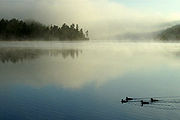 Loons are excellent swimmers, using their feet to propel themselves above and under water while their wings provide assistance. Because their feet are far back on the body, loons are poorly adapted to moving on land, and usually avoid going onto land, except when nesting.
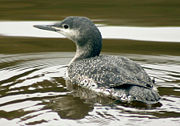
All loons are decent fliers, though the larger species have some difficulty taking off and thus must swim into the wind to pick up enough velocity to become airborne. Only the Red-throated Diver
(G. stellata) can take off from land. Once airborne, their considerable stamina allows them to migrate long distances southwards in winter, where they reside in coastal waters. Loons can live as long as 30 years.
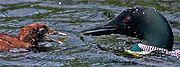 Loons find their prey by sight. They eat mainly fish
, supplemented with amphibian
s, crustacean
s and similar mid-sized aquatic fauna
. Specifically, they have been noted to feed on crayfish
, frogs, snails, salamanders and leeches. They prefer clear lakes because they can more easily see their prey through the water. The loon uses its pointy bill to stab or grasp prey. They eat vertebrate
prey headfirst to facilitate swallowing, and swallow all their prey whole.
To help digestion, loons swallow small pebbles from the bottoms of lakes. Similar to grit
eaten by chicken
s, these gastrolith
s may assist the loon's gizzard
in crushing the hard parts of the loon's food such as the exoskeleton
s of crustaceans and the bones of frogs and salamanders. The gastroliths may also be involved in stomach cleaning as an aid to regurgitation of indigestible food parts.
Loons may inadvertently ingest small lead pellets, released by anglers and hunters, that will contribute to lead poisoning and the loon's eventual death. Jurisdictions that have banned the use of lead shot and sinkers include but are not limited to Maine
, New Hampshire
, Vermont
, some areas of Massachusetts
, Yellowstone National Park
, Great Britain
, Canada
, Michigan
, and Denmark
.
 Gaviidae nest during the summer on freshwater lakes and/or large ponds. Smaller bodies of water (up to 0.5 km²) will usually only have one pair. Larger lakes may have more than one pair, with each pair occupying a bay or section of the lake.
Loons build their nests close to the water, preferring sites that are completely surrounded by water such as islands or emergent vegetation. Loons use a variety of materials to build their nests including aquatic vegetation, pine needles, leaves, grass, moss and mud. Both male and female build the nest and incubate jointly for 28 days. If the eggs are lost, the pair may re-nest, usually in a different location.
Despite the roughly equal participation of the sexes in nest building and incubation, analysis has shown clearly that males alone select the location of the nest. This pattern has the important consequence that male loons, but not females, establish significant site-familiarity with their territories that allows them to produce more chicks there over time. Sex-biased site-familiarity might explain, in part, why resident males fight so hard to defend their territories.
Most clutches consist of two eggs, which are laid in May or June, depending upon latitude. Loon chicks are precocial
, able to swim and dive right away, but will often ride on their parents' back during their first 2 weeks to rest, conserve heat, and avoid predators.
Chicks are fed mainly by their parents for about six weeks but gradually begin to feed themselves over time. By 11 or 12 weeks, chicks gather almost all of their own food and have learned to fly.
Biologist
s, especially from Chapman University
, have extensively studied the mating behavior of the Common Loon (G. immer). Contrary to popular belief, pairs seldom mate for life
. Indeed, a typical adult loon is likely to have several mates during its lifetime because of territorial takeover. Each breeding pair must frequently defend its territory against "floater
s" (territory-less adults) trying to evict at least one owner and seize the breeding site. Territories that have produced chicks in the past year are especially prone to takeovers, because nonbreeding loons use chicks as cues to indicate high-quality territories. One-third of all territorial evictions among males result in the death of the owner; in contrast, female loons usually survive. Birds that are displaced from a territory but survive usually try to remate and (re)claim a breeding territory later in life.
The scientific name Gavia was the Latin
term for the Smew
(Mergellus albellus). This small sea-duck is quite unrelated to loons and just happens to be another black-and-white seabird which swims and dives for fish. It is not likely that the ancient Romans had much knowledge of loons, as these are limited to more northern latitude
s and since the end of the last glacial period seem to have occurred only as rare winter migrants in the Mediterranean region.
The term gavia was transferred from the ducks to the loons only in the 18th century. Earlier naturalist
s referred to the loons as mergus (the Latin term for diving seabirds of all sorts) or colymbus, which became the genus name used in the first modern scientific description of a Gavia species (by Carl Linnaeus) in 1758. Unfortunately, confusion about whether Linnaeus' "wastebin genus" Colymbus referred to loons or grebes abounded, with North American ornithologists using the genus name for grebes and European ones, following Nicholas Aylward Vigors
and Richard Bowdler Sharpe
, for divers. The International Commission on Zoological Nomenclature
tried to settle this issue in 1956 by declaring Colymbus a suppressed name unfit for further use and establishing Gavia, created by Johann Reinhold Forster
in 1788, as the valid genus name for the loons. However, the situation was not completely resolved even then, and the following year the ICZN had to act again to prevent Louis Jean Pierre Vieillot
's 1818 almost-forgotten family name Urinatoridae from overruling the much younger Gaviidae. Nowadays, even though some eminent ornithologists such as Pierce Brodkorb
tried to keep the debate alive at first, the ICZN's solution has been found very satisfactory.
Basal lineage
Black-throated lineage
Black-headed lineage
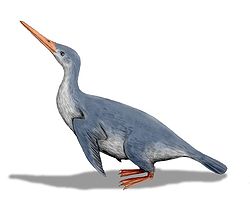 The loons were formerly often considered to be the most ancient of the northern hemisphere bird families; this idea grew basically out of the perceived similarity of shape and (probably) habits between loons and the entirely unrelated extinct Cretaceous
order Hesperornithiformes
. In particular Enaliornis
, which was apparently an ancestral and plesiomorphic member of that order, was sometimes used to support claims of Albian
(Early Cretaceous
) Gaviiformes.
More recently, it has become clear that the Anseriformes
(waterfowl) and the Galliformes
are the most ancient groups of modern birds. It is possible, though not at all well-supported, that these were distinct by the end of the Albian
100 million years ago (Ma). Loons belong to a more modern radiation. They were once believed to be related to grebes, which are also foot-propelled diving birds, and both species were once classified together under the order Colymbiformes
. However, as recently as the 1930s, it was determined that the two groups are not that closely related at all and are merely the product of convergent evolution
and adapted in a similar way to a similar ecological niche
. The similarity is so strong that even the most modern cladistic analyses of general anatomical features are easily misled into grouping loons and grebes.
The Sibley-Ahlquist taxonomy
still allied the loons with the grebes in its massively paraphyletic "Ciconiiformes", and it is almost certain that the relationships of loons lie with some of the orders placed therein. Namely, other recent authors have considered loons to share a rather close relationship with seabird
s such as penguin
s (Sphenisciformes), tubenoses (Procellariiformes
), wader
s (Charadriiformes) – and perhaps the newly-discovered clade
Mirandornithes
which unites grebes (Podicipediformes) and their closest living relatives, the flamingos (Phoenicopteriformes). It is perhaps notable that some early penguins had skulls and beaks that were in many aspects similar to those of the known living and fossil Gaviiformes.
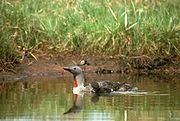 In prehistoric times, the loons had a more southerly distribution than today, and their fossils have been found in places such as California
, Florida
and Italy
. The conflicting molecular data regarding their relationships is not much resolved by the fossil
record; though they seem to have originated at the end of the Late Cretaceous
like their presumed relatives, modern loons are only known with certainty since the Eocene
. By that time almost all modern bird orders are at least strongly suspected to have existed – if not known from unequivocally identified specimens – anyway.
Colymboides
, the oldest unequivocal gaviiform genus known as of 2009, is widely known from early Priabonian
– about 37 million years ago (Ma) in the Late Eocene – to Early Miocene
(late Burdigalian
, less than 20 Ma) limnic and marine
rocks of western Eurasia
north of the Alpide belt
, between the Atlantic and the former Turgai Sea
. It is usually placed in the Gaviidae already, but usually in a subfamily Colymboidinae, with the modern-type loons making up the Gaviinae. But the Colymboides material is generally quite distinct from modern loons, and may actually belong in a now-extinct family of primitive gaviiforms. Furthermore, the supposed genus could well be paraphyletic, so that for example Dyspetornis – which is now contained therein – might have to be separated again. A leg of an undescribed small diver was found in the Late Oligocene deposits at Enspel
(Germany
); it too may or may not belong to Colymboides. Of the crown genus
Gavia, nearly ten prehistoric species have been named to date, and about as many undescribed ones await further study. The genus is known from the Early Miocene onwards, and the oldest members them are rather small (some are smaller than the Red-throated Diver
). Throughout the late Neogene
, the genus by and large follows Cope's Rule
.
List of fossil Gavia
"Gavia" portisi from the Late Pliocene of Orciano Pisano
(Italy
) is known from a cervical vertebra that may or may not have been from a loon. If so, it was from a bird slightly smaller than Common Loon. Older authors were quite sure the bone was indeed from a Gavia and even considered G. concinna a possibly junior synonym of it. This is now regarded as rather unlikely due to the quite distinct range and age. Interestingly, the Early Pliocene Gavia skull from Empoli
(Italy) was referred to G. concinna, and thus could conceivably have been of "G." portisi if that was indeed a diver. The holotype
vertebra may now be lost, which would make "G." portisi a nomen dubium
.
In addition, there are some older fossils that are sometimes assigned to the Gaviiformes. From the Late Cretaceous
, the genera Lonchodytes
(Lance Formation
, Wyoming) and Neogaeornis
(Quinriquina Formation, Chile
) have been described; both are usually allied with orders which are considered related to loons. In particular the latter is still sometimes explicitly proposed as a primitive loon as they both were initially, but other authors consider Neogaeornis a hesperornithiform
; note however that neither Gaviiformes nor Hesperornithiformes are known from the Southern Hemisphere
or anywhere near it. Lonchodytes was more certainly quite close to loons, but probably closer still to some of the loons' relatives. Of similarly doubtful validity and surrounded by considerable dispute is the supposed Late Cretaceous loon Polarornis
(Seymour Island
, Antarctica). Eupterornis from the Paleocene
of Châlons-sur-Vesle
(France
) has some features reminiscent of loons, but others seem more similar to Charadriiformes
such as gulls (Laridae). A piece of a carpometacarpus
supposedly from Oligocene
rocks near Lusk, Wyoming
was described as Gaviella pusilla, but this handbone also shows some similarities to the plotopterids which were flightless wing-propelled divers and if these are apomorphic would make an unconvincing member of the Gaviidae (though it still could be a small-winged gaviiform in an – as of yet undescribed – family "Gaviellidae"): while the carpometacarpus in Gavia is somewhat convergent
to that of wing-propelled divers, enabling the wings to be used as rudders for quick underwater turns, Colymboides still had an unspecialized plesiomorphic hand. Parascaniornis, sometimes allied to the loons by early authors, was eventually determined to be a junior synonym of the hesperornithiform Baptornis
. A supposed mid-Eocene
diver fossil form Geiseltal
(Germany
) was erroneously assigned to Gavia.
North America
North America is a continent wholly within the Northern Hemisphere and almost wholly within the Western Hemisphere. It is also considered a northern subcontinent of the Americas...
and northern Eurasia
Eurasia
Eurasia is a continent or supercontinent comprising the traditional continents of Europe and Asia ; covering about 52,990,000 km2 or about 10.6% of the Earth's surface located primarily in the eastern and northern hemispheres...
(Europe, Asia and debatably Africa). All living species of loons are members of the genus
Genus
In biology, a genus is a low-level taxonomic rank used in the biological classification of living and fossil organisms, which is an example of definition by genus and differentia...
(Gavia), family
Family (biology)
In biological classification, family is* a taxonomic rank. Other well-known ranks are life, domain, kingdom, phylum, class, order, genus, and species, with family fitting between order and genus. As for the other well-known ranks, there is the option of an immediately lower rank, indicated by the...
(Gaviidae) and order
Order (biology)
In scientific classification used in biology, the order is# a taxonomic rank used in the classification of organisms. Other well-known ranks are life, domain, kingdom, phylum, class, family, genus, and species, with order fitting in between class and family...
(Gaviiformes).
Description
The loon, the size of a large duckDuck
Duck is the common name for a large number of species in the Anatidae family of birds, which also includes swans and geese. The ducks are divided among several subfamilies in the Anatidae family; they do not represent a monophyletic group but a form taxon, since swans and geese are not considered...
or small goose
Goose
The word goose is the English name for a group of waterfowl, belonging to the family Anatidae. This family also includes swans, most of which are larger than true geese, and ducks, which are smaller....
, resembles these birds in shape when swimming. Like ducks and geese but unlike coot
Coot
Coots are medium-sized water birds that are members of the rail family Rallidae. They constitute the genus Fulica. Coots have predominantly black plumage, and, unlike many of the rails, they are usually easy to see, often swimming in open water...
s (which are Rallidae
Rallidae
The rails, or Rallidae, are a large cosmopolitan family of small to medium-sized birds. The family exhibits considerable diversity and the family also includes the crakes, coots, and gallinules...
) and grebe
Grebe
A grebe is a member of the Podicipediformes order, a widely distributed order of freshwater diving birds, some of which visit the sea when migrating and in winter...
s (Podicipedidae), the loon's toes are connected by webbing
Webbed toes
Webbed toes is the common name for syndactyly affecting the feet. It is characterised by the fusion of two or more digits of the feet. This is normal in many birds, such as ducks; amphibians, such as frogs; and mammals, such as kangaroos...
. The bird may be confused with cormorant
Cormorant
The bird family Phalacrocoracidae is represented by some 40 species of cormorants and shags. Several different classifications of the family have been proposed recently, and the number of genera is disputed.- Names :...
s (Phalacrocoracidae), not too distant relatives of divers and like them are heavy set birds whose bellies – unlike those of ducks and geese – are submerged when swimming. Flying loons resemble a plump goose with a seagull's wings, relatively small in proportion to the bulky body. The bird holds its head pointing slightly upwards during swimming, but less so than cormorants do. In flight the head droops more than in similar aquatic birds.
Male and female loons have identical plumage. Plumage
Plumage
Plumage refers both to the layer of feathers that cover a bird and the pattern, colour, and arrangement of those feathers. The pattern and colours of plumage vary between species and subspecies and can also vary between different age classes, sexes, and season. Within species there can also be a...
is largely patterned black-and-white in summer, with grey on the head and neck in some species. All have a white belly. This resembles many sea-ducks (Merginae) – notably the smaller goldeneyes (Bucephala) – but is distinct from most cormorants which rarely have white feathers, and if so usually as large rounded patches rather than delicate patterns. All species of divers have a spear-shaped bill.
Males are larger on average, but relative size is only apparent when the male and female are together.
In winter plumage is dark gray above, with some indistinct lighter mottling on the wings, and a white chin, throat and underside. The species can then be distinguished by certain features, such as size and colour of head, neck, back and bill, but often reliable identification of wintering divers is difficult even for experts – particularly as the smaller immature birds look similar to winter-plumage adults, making size an unreliable means of identification.
Gaviiformes are among the few groups of birds in which the young moult
Moult
In biology, moulting or molting , also known as sloughing, shedding, or for some species, ecdysis, is the manner in which an animal routinely casts off a part of its body , either at specific times of year, or at specific points in its life cycle.Moulting can involve the epidermis , pelage...
into a second coat of down feather
Down feather
The down of birds is a layer of fine feathers found under the tougher exterior feathers. Very young birds are clad only in down. Powder down is a specialized type of down found only in a few groups of birds. Down is a fine thermal insulator and padding, used in goods such as jackets, bedding,...
s after shedding the first one, rather than growing juvenile feathers with downy tips that wear off as is typical in many birds. This trait is also found in tubenoses (Procellariiformes
Procellariiformes
Procellariiformes is an order of seabirds that comprises four families: the albatrosses, petrels and shearwaters, storm petrels, and diving petrels...
) and penguin
Penguin
Penguins are a group of aquatic, flightless birds living almost exclusively in the southern hemisphere, especially in Antarctica. Highly adapted for life in the water, penguins have countershaded dark and white plumage, and their wings have become flippers...
s (Sphenisciformes), both relatives of the loons.
Ecology
All loons are decent fliers, though the larger species have some difficulty taking off and thus must swim into the wind to pick up enough velocity to become airborne. Only the Red-throated Diver
Red-throated Diver
The Red-throated Loon or Red-throated Diver is a migratory aquatic bird found in the northern hemisphere. It breeds primarily in Arctic regions, and winters in northern coastal waters. It is the most widely distributed member of the loon or diver family. Ranging from in length, the Red-throated...
(G. stellata) can take off from land. Once airborne, their considerable stamina allows them to migrate long distances southwards in winter, where they reside in coastal waters. Loons can live as long as 30 years.
Food and feeding
Fish
Fish are a paraphyletic group of organisms that consist of all gill-bearing aquatic vertebrate animals that lack limbs with digits. Included in this definition are the living hagfish, lampreys, and cartilaginous and bony fish, as well as various extinct related groups...
, supplemented with amphibian
Amphibian
Amphibians , are a class of vertebrate animals including animals such as toads, frogs, caecilians, and salamanders. They are characterized as non-amniote ectothermic tetrapods...
s, crustacean
Crustacean
Crustaceans form a very large group of arthropods, usually treated as a subphylum, which includes such familiar animals as crabs, lobsters, crayfish, shrimp, krill and barnacles. The 50,000 described species range in size from Stygotantulus stocki at , to the Japanese spider crab with a leg span...
s and similar mid-sized aquatic fauna
Fauna
Fauna or faunæ is all of the animal life of any particular region or time. The corresponding term for plants is flora.Zoologists and paleontologists use fauna to refer to a typical collection of animals found in a specific time or place, e.g. the "Sonoran Desert fauna" or the "Burgess shale fauna"...
. Specifically, they have been noted to feed on crayfish
Crayfish
Crayfish, crawfish, or crawdads – members of the superfamilies Astacoidea and Parastacoidea – are freshwater crustaceans resembling small lobsters, to which they are related...
, frogs, snails, salamanders and leeches. They prefer clear lakes because they can more easily see their prey through the water. The loon uses its pointy bill to stab or grasp prey. They eat vertebrate
Vertebrate
Vertebrates are animals that are members of the subphylum Vertebrata . Vertebrates are the largest group of chordates, with currently about 58,000 species described. Vertebrates include the jawless fishes, bony fishes, sharks and rays, amphibians, reptiles, mammals, and birds...
prey headfirst to facilitate swallowing, and swallow all their prey whole.
To help digestion, loons swallow small pebbles from the bottoms of lakes. Similar to grit
Grit
Grit may refer to:* GRIT , also known as Arhgap32 or PX-RICS* Grit , a U.S. periodical founded as a newspaper in 1882* Grit , by Celtic fusion musician Martyn Bennett* Grit , by Norwegian rock band Madrugada...
eaten by chicken
Chicken
The chicken is a domesticated fowl, a subspecies of the Red Junglefowl. As one of the most common and widespread domestic animals, and with a population of more than 24 billion in 2003, there are more chickens in the world than any other species of bird...
s, these gastrolith
Gastrolith
A gastrolith, also called a stomach stone or gizzard stones, is a rock held inside a gastrointestinal tract. Gastroliths are retained in the muscular gizzard and used to grind food in animals lacking suitable grinding teeth. The grain size depends upon the size of the animal and the gastrolith's...
s may assist the loon's gizzard
Gizzard
The gizzard, also referred to as the ventriculus, gastric mill, and gigerium, is an organ found in the digestive tract of some animals, including birds, reptiles, earthworms and some fish. This specialized stomach constructed of thick, muscular walls is used for grinding up food; often rocks are...
in crushing the hard parts of the loon's food such as the exoskeleton
Exoskeleton
An exoskeleton is the external skeleton that supports and protects an animal's body, in contrast to the internal skeleton of, for example, a human. In popular usage, some of the larger kinds of exoskeletons are known as "shells". Examples of exoskeleton animals include insects such as grasshoppers...
s of crustaceans and the bones of frogs and salamanders. The gastroliths may also be involved in stomach cleaning as an aid to regurgitation of indigestible food parts.
Loons may inadvertently ingest small lead pellets, released by anglers and hunters, that will contribute to lead poisoning and the loon's eventual death. Jurisdictions that have banned the use of lead shot and sinkers include but are not limited to Maine
Maine
Maine is a state in the New England region of the northeastern United States, bordered by the Atlantic Ocean to the east and south, New Hampshire to the west, and the Canadian provinces of Quebec to the northwest and New Brunswick to the northeast. Maine is both the northernmost and easternmost...
, New Hampshire
New Hampshire
New Hampshire is a state in the New England region of the northeastern United States of America. The state was named after the southern English county of Hampshire. It is bordered by Massachusetts to the south, Vermont to the west, Maine and the Atlantic Ocean to the east, and the Canadian...
, Vermont
Vermont
Vermont is a state in the New England region of the northeastern United States of America. The state ranks 43rd in land area, , and 45th in total area. Its population according to the 2010 census, 630,337, is the second smallest in the country, larger only than Wyoming. It is the only New England...
, some areas of Massachusetts
Massachusetts
The Commonwealth of Massachusetts is a state in the New England region of the northeastern United States of America. It is bordered by Rhode Island and Connecticut to the south, New York to the west, and Vermont and New Hampshire to the north; at its east lies the Atlantic Ocean. As of the 2010...
, Yellowstone National Park
Yellowstone National Park
Yellowstone National Park, established by the U.S. Congress and signed into law by President Ulysses S. Grant on March 1, 1872, is a national park located primarily in the U.S. state of Wyoming, although it also extends into Montana and Idaho...
, Great Britain
Great Britain
Great Britain or Britain is an island situated to the northwest of Continental Europe. It is the ninth largest island in the world, and the largest European island, as well as the largest of the British Isles...
, Canada
Canada
Canada is a North American country consisting of ten provinces and three territories. Located in the northern part of the continent, it extends from the Atlantic Ocean in the east to the Pacific Ocean in the west, and northward into the Arctic Ocean...
, Michigan
Michigan
Michigan is a U.S. state located in the Great Lakes Region of the United States of America. The name Michigan is the French form of the Ojibwa word mishigamaa, meaning "large water" or "large lake"....
, and Denmark
Denmark
Denmark is a Scandinavian country in Northern Europe. The countries of Denmark and Greenland, as well as the Faroe Islands, constitute the Kingdom of Denmark . It is the southernmost of the Nordic countries, southwest of Sweden and south of Norway, and bordered to the south by Germany. Denmark...
.
Reproduction
Loons build their nests close to the water, preferring sites that are completely surrounded by water such as islands or emergent vegetation. Loons use a variety of materials to build their nests including aquatic vegetation, pine needles, leaves, grass, moss and mud. Both male and female build the nest and incubate jointly for 28 days. If the eggs are lost, the pair may re-nest, usually in a different location.
Despite the roughly equal participation of the sexes in nest building and incubation, analysis has shown clearly that males alone select the location of the nest. This pattern has the important consequence that male loons, but not females, establish significant site-familiarity with their territories that allows them to produce more chicks there over time. Sex-biased site-familiarity might explain, in part, why resident males fight so hard to defend their territories.
Most clutches consist of two eggs, which are laid in May or June, depending upon latitude. Loon chicks are precocial
Precocial
In biology, the term precocial refers to species in which the young are relatively mature and mobile from the moment of birth or hatching. The opposite developmental strategy is called "altricial," where the young are born or hatched helpless. Extremely precocial species may be called...
, able to swim and dive right away, but will often ride on their parents' back during their first 2 weeks to rest, conserve heat, and avoid predators.
Chicks are fed mainly by their parents for about six weeks but gradually begin to feed themselves over time. By 11 or 12 weeks, chicks gather almost all of their own food and have learned to fly.
Biologist
Biologist
A biologist is a scientist devoted to and producing results in biology through the study of life. Typically biologists study organisms and their relationship to their environment. Biologists involved in basic research attempt to discover underlying mechanisms that govern how organisms work...
s, especially from Chapman University
Chapman University
Chapman University is a private, non-profit university located in Orange, California affiliated with the Christian Church . Known for its blend of liberal arts and professional programs, Chapman University encompasses seven schools and colleges: Lawrence and Kristina Dodge College of Film and Media...
, have extensively studied the mating behavior of the Common Loon (G. immer). Contrary to popular belief, pairs seldom mate for life
Monogamy
Monogamy /Gr. μονός+γάμος - one+marriage/ a form of marriage in which an individual has only one spouse at any one time. In current usage monogamy often refers to having one sexual partner irrespective of marriage or reproduction...
. Indeed, a typical adult loon is likely to have several mates during its lifetime because of territorial takeover. Each breeding pair must frequently defend its territory against "floater
Floater (disambiguation)
A floater is a shadow-like shape that appears singly or together with several others in the field of vision of some individuals.Floater may also mean:*Floater , a band based in Portland, Oregon*The Floaters, an R&B singing group of the 1970s...
s" (territory-less adults) trying to evict at least one owner and seize the breeding site. Territories that have produced chicks in the past year are especially prone to takeovers, because nonbreeding loons use chicks as cues to indicate high-quality territories. One-third of all territorial evictions among males result in the death of the owner; in contrast, female loons usually survive. Birds that are displaced from a territory but survive usually try to remate and (re)claim a breeding territory later in life.
Etymology and taxonomy
The European Anglophone name "diver" comes from the bird's habit of catching fish by swimming calmly along the surface and then abruptly plunging into the water. The North American name "loon" likely comes from either the Old English word lumme, meaning lummox or awkward person, or the Scandinavian word lum meaning lame or clumsy. Either way, the name refers to the loon’s poor ability to walk on land. The scientific name Gavia refers to seabirds in general.The scientific name Gavia was the Latin
Latin
Latin is an Italic language originally spoken in Latium and Ancient Rome. It, along with most European languages, is a descendant of the ancient Proto-Indo-European language. Although it is considered a dead language, a number of scholars and members of the Christian clergy speak it fluently, and...
term for the Smew
Smew
The Smew is a small duck, which is somewhat intermediate between the typical mergansers and the goldeneyes . It is the only member of the genus Mergellus; sometimes included in Mergus, this genus is distinct and might actually be a bit closer to the goldeneyes...
(Mergellus albellus). This small sea-duck is quite unrelated to loons and just happens to be another black-and-white seabird which swims and dives for fish. It is not likely that the ancient Romans had much knowledge of loons, as these are limited to more northern latitude
Latitude
In geography, the latitude of a location on the Earth is the angular distance of that location south or north of the Equator. The latitude is an angle, and is usually measured in degrees . The equator has a latitude of 0°, the North pole has a latitude of 90° north , and the South pole has a...
s and since the end of the last glacial period seem to have occurred only as rare winter migrants in the Mediterranean region.
The term gavia was transferred from the ducks to the loons only in the 18th century. Earlier naturalist
Naturalist
Naturalist may refer to:* Practitioner of natural history* Conservationist* Advocate of naturalism * Naturalist , autobiography-See also:* The American Naturalist, periodical* Naturalism...
s referred to the loons as mergus (the Latin term for diving seabirds of all sorts) or colymbus, which became the genus name used in the first modern scientific description of a Gavia species (by Carl Linnaeus) in 1758. Unfortunately, confusion about whether Linnaeus' "wastebin genus" Colymbus referred to loons or grebes abounded, with North American ornithologists using the genus name for grebes and European ones, following Nicholas Aylward Vigors
Nicholas Aylward Vigors
Nicholas Aylward Vigors was an Irish zoologist and politician.Vigors was born at Old Leighlin, County Carlow. He studied at Trinity College, Oxford. He served in the army during the Peninsular War from 1809 to 1811. He then returned to Oxford, graduating with a B.A. in 1815 and in 1817 with an...
and Richard Bowdler Sharpe
Richard Bowdler Sharpe
Richard Bowdler Sharpe was an English zoologist.-Biography:Sharpe was born in London and studied at Brighton College, The King's School, Peterborough and Loughborough Grammar School. At the age of sixteen he went to work for Smith & Sons in London...
, for divers. The International Commission on Zoological Nomenclature
International Commission on Zoological Nomenclature
The International Commission on Zoological Nomenclature is an organization dedicated to "achieving stability and sense in the scientific naming of animals". Founded in 1895, it currently comprises 28 members from 20 countries, mainly practicing zoological taxonomists...
tried to settle this issue in 1956 by declaring Colymbus a suppressed name unfit for further use and establishing Gavia, created by Johann Reinhold Forster
Johann Reinhold Forster
Johann Reinhold Forster was a German Lutheran pastor and naturalist of partial Scottish descent who made contributions to the early ornithology of Europe and North America...
in 1788, as the valid genus name for the loons. However, the situation was not completely resolved even then, and the following year the ICZN had to act again to prevent Louis Jean Pierre Vieillot
Louis Jean Pierre Vieillot
Louis Jean Pierre Vieillot was a French ornithologist.Vieillot described a large number of birds for the first time, especially those he encountered during the time he spent in the West Indies and North America, and 26 genera established by him are still in use...
's 1818 almost-forgotten family name Urinatoridae from overruling the much younger Gaviidae. Nowadays, even though some eminent ornithologists such as Pierce Brodkorb
Pierce Brodkorb
Pierce Brodkorb , also stated as William Pierce Brodkorb, was an American ornithologist and paleontologist....
tried to keep the debate alive at first, the ICZN's solution has been found very satisfactory.
Systematics and evolution
All living species are placed in the genus Gavia. Phylogenetically, the 5 living species can be arranged as follows:Basal lineage
- Red-throated Loon or Red-throated Diver, Gavia stellata
Black-throated lineage
- Black-throated Loon, Arctic Loon, or Black-throated Diver, Gavia arctica
- Pacific Loon or Pacific Diver, Gavia pacifica (formerly in G. arctica)
Black-headed lineage
- Great Northern Loon, Common Loon, or Great Northern Diver, Gavia immer
- Yellow-billed LoonYellow-billed LoonThe Yellow-billed Loon , also known as the White-billed Diver, is the largest member of the loon or diver family. Breeding adults have a black head, white underparts and chequered black-and-white mantle. Non-breeding plumage is drabber with the chin and foreneck white...
or White-billed Diver, Gavia adamsii
Relationships
Cretaceous
The Cretaceous , derived from the Latin "creta" , usually abbreviated K for its German translation Kreide , is a geologic period and system from circa to million years ago. In the geologic timescale, the Cretaceous follows the Jurassic period and is followed by the Paleogene period of the...
order Hesperornithiformes
Hesperornithiformes
Hesperornithes is an extinct and highly specialized clade of Cretaceous toothed birds. Hesperornithine birds, apparently limited to former aquatic habitats in the Northern Hemisphere, include genera such as Hesperornis, Parahesperornis, Baptornis, Enaliornis, and probably Potamornis, all...
. In particular Enaliornis
Enaliornis
Enaliornis is a genus of hesperornithine bird which lived in the late Early Cretaceous, making it the oldest known hesperornithine. Fossils have been found near Cambridge, England...
, which was apparently an ancestral and plesiomorphic member of that order, was sometimes used to support claims of Albian
Albian
The Albian is both an age of the geologic timescale and a stage in the stratigraphic column. It is the youngest or uppermost subdivision of the Early/Lower Cretaceous epoch/series. Its approximate time range is 112.0 ± 1.0 Ma to 99.6 ± 0.9 Ma...
(Early Cretaceous
Early Cretaceous
The Early Cretaceous or the Lower Cretaceous , is the earlier or lower of the two major divisions of the Cretaceous...
) Gaviiformes.
More recently, it has become clear that the Anseriformes
Anseriformes
The order Anseriformes contains about 150 living species of birds in three extant families: the Anhimidae , Anseranatidae , and the Anatidae, which includes over 140 species of waterfowl, among them the ducks, geese, and swans.All species in the order are highly adapted for an aquatic existence at...
(waterfowl) and the Galliformes
Galliformes
Galliformes are an order of heavy-bodied ground-feeding domestic or game bird, containing turkey, grouse, chicken, New and Old World Quail, ptarmigan, partridge, pheasant, and the Cracidae. Common names are gamefowl or gamebirds, landfowl, gallinaceous birds or galliforms...
are the most ancient groups of modern birds. It is possible, though not at all well-supported, that these were distinct by the end of the Albian
Albian
The Albian is both an age of the geologic timescale and a stage in the stratigraphic column. It is the youngest or uppermost subdivision of the Early/Lower Cretaceous epoch/series. Its approximate time range is 112.0 ± 1.0 Ma to 99.6 ± 0.9 Ma...
100 million years ago (Ma). Loons belong to a more modern radiation. They were once believed to be related to grebes, which are also foot-propelled diving birds, and both species were once classified together under the order Colymbiformes
Colymbiformes
Colymbiformes is a disused order of birds that was once used to classify grebes and loons. Scientific study has revealed that these two types of waterbirds are not so closely related; they have been reclassified in the orders Podicipediformes and Gaviiformes, respectively.-References:*....
. However, as recently as the 1930s, it was determined that the two groups are not that closely related at all and are merely the product of convergent evolution
Convergent evolution
Convergent evolution describes the acquisition of the same biological trait in unrelated lineages.The wing is a classic example of convergent evolution in action. Although their last common ancestor did not have wings, both birds and bats do, and are capable of powered flight. The wings are...
and adapted in a similar way to a similar ecological niche
Ecological niche
In ecology, a niche is a term describing the relational position of a species or population in its ecosystem to each other; e.g. a dolphin could potentially be in another ecological niche from one that travels in a different pod if the members of these pods utilize significantly different food...
. The similarity is so strong that even the most modern cladistic analyses of general anatomical features are easily misled into grouping loons and grebes.
The Sibley-Ahlquist taxonomy
Sibley-Ahlquist taxonomy
The Sibley-Ahlquist taxonomy is a bird taxonomy proposed by Charles Sibley and Jon Edward Ahlquist. It is based on DNA-DNA hybridization studies conducted in the late 1970s and throughout the 1980s....
still allied the loons with the grebes in its massively paraphyletic "Ciconiiformes", and it is almost certain that the relationships of loons lie with some of the orders placed therein. Namely, other recent authors have considered loons to share a rather close relationship with seabird
Seabird
Seabirds are birds that have adapted to life within the marine environment. While seabirds vary greatly in lifestyle, behaviour and physiology, they often exhibit striking convergent evolution, as the same environmental problems and feeding niches have resulted in similar adaptations...
s such as penguin
Penguin
Penguins are a group of aquatic, flightless birds living almost exclusively in the southern hemisphere, especially in Antarctica. Highly adapted for life in the water, penguins have countershaded dark and white plumage, and their wings have become flippers...
s (Sphenisciformes), tubenoses (Procellariiformes
Procellariiformes
Procellariiformes is an order of seabirds that comprises four families: the albatrosses, petrels and shearwaters, storm petrels, and diving petrels...
), wader
Wader
Waders, called shorebirds in North America , are members of the order Charadriiformes, excluding the more marine web-footed seabird groups. The latter are the skuas , gulls , terns , skimmers , and auks...
s (Charadriiformes) – and perhaps the newly-discovered clade
Clade
A clade is a group consisting of a species and all its descendants. In the terms of biological systematics, a clade is a single "branch" on the "tree of life". The idea that such a "natural group" of organisms should be grouped together and given a taxonomic name is central to biological...
Mirandornithes
Mirandornithes
Mirandornithes is a clade that consists of flamingos and grebes. The relationships of both groups have been problematic. Flamingos had been placed with numerous branches within Neognathae, such as ducks and storks. The grebes had been placed with the loons. However recent studies seem to confirm...
which unites grebes (Podicipediformes) and their closest living relatives, the flamingos (Phoenicopteriformes). It is perhaps notable that some early penguins had skulls and beaks that were in many aspects similar to those of the known living and fossil Gaviiformes.
Fossil record
California
California is a state located on the West Coast of the United States. It is by far the most populous U.S. state, and the third-largest by land area...
, Florida
Florida
Florida is a state in the southeastern United States, located on the nation's Atlantic and Gulf coasts. It is bordered to the west by the Gulf of Mexico, to the north by Alabama and Georgia and to the east by the Atlantic Ocean. With a population of 18,801,310 as measured by the 2010 census, it...
and Italy
Italy
Italy , officially the Italian Republic languages]] under the European Charter for Regional or Minority Languages. In each of these, Italy's official name is as follows:;;;;;;;;), is a unitary parliamentary republic in South-Central Europe. To the north it borders France, Switzerland, Austria and...
. The conflicting molecular data regarding their relationships is not much resolved by the fossil
Fossil
Fossils are the preserved remains or traces of animals , plants, and other organisms from the remote past...
record; though they seem to have originated at the end of the Late Cretaceous
Late Cretaceous
The Late Cretaceous is the younger of two epochs into which the Cretaceous period is divided in the geologic timescale. Rock strata from this epoch form the Upper Cretaceous series...
like their presumed relatives, modern loons are only known with certainty since the Eocene
Eocene
The Eocene Epoch, lasting from about 56 to 34 million years ago , is a major division of the geologic timescale and the second epoch of the Paleogene Period in the Cenozoic Era. The Eocene spans the time from the end of the Palaeocene Epoch to the beginning of the Oligocene Epoch. The start of the...
. By that time almost all modern bird orders are at least strongly suspected to have existed – if not known from unequivocally identified specimens – anyway.
Colymboides
Colymboides
The genus Colymboides contains two species of early loon dating from the late Oligocene or early Miocene. They are considered to be the earliest known unambiguous gaviiform fossils...
, the oldest unequivocal gaviiform genus known as of 2009, is widely known from early Priabonian
Priabonian
The Priabonian is, in the ICS's geologic timescale, the latest age or the upper stage of the Eocene epoch or series. It spans the time between and...
– about 37 million years ago (Ma) in the Late Eocene – to Early Miocene
Early Miocene
The Early Miocene is a sub-epoch of the Miocene Epoch made up of two stages: the Aquitanian and Burdigalian stages....
(late Burdigalian
Burdigalian
The Burdigalian is, in the geologic timescale, an age or stage in the early Miocene. It spans the time between 20.43 ± 0.05 Ma and 15.97 ± 0.05 Ma...
, less than 20 Ma) limnic and marine
Ocean
An ocean is a major body of saline water, and a principal component of the hydrosphere. Approximately 71% of the Earth's surface is covered by ocean, a continuous body of water that is customarily divided into several principal oceans and smaller seas.More than half of this area is over 3,000...
rocks of western Eurasia
Eurasia
Eurasia is a continent or supercontinent comprising the traditional continents of Europe and Asia ; covering about 52,990,000 km2 or about 10.6% of the Earth's surface located primarily in the eastern and northern hemispheres...
north of the Alpide belt
Alpide belt
The Alpide belt is a mountain range which extends along the southern margin of Eurasia. Stretching from Java to Sumatra through the Himalayas, the Mediterranean, and out into the Atlantic, it includes the Alps, the Carpathians, the mountains of Asia Minor and Iran, the Hindu Kush, the Himalayas,...
, between the Atlantic and the former Turgai Sea
Turgai Sea
The Turgai Sea or Turgai Strait, also known as the West Siberian Sea, was a large shallow body of salt water of the Mesozoic and Cenozoic Eras...
. It is usually placed in the Gaviidae already, but usually in a subfamily Colymboidinae, with the modern-type loons making up the Gaviinae. But the Colymboides material is generally quite distinct from modern loons, and may actually belong in a now-extinct family of primitive gaviiforms. Furthermore, the supposed genus could well be paraphyletic, so that for example Dyspetornis – which is now contained therein – might have to be separated again. A leg of an undescribed small diver was found in the Late Oligocene deposits at Enspel
Enspel
Enspel is an Ortsgemeinde – a community belonging to a Verbandsgemeinde – in the Westerwaldkreis in Rhineland-Palatinate, Germany.-Location:...
(Germany
Germany
Germany , officially the Federal Republic of Germany , is a federal parliamentary republic in Europe. The country consists of 16 states while the capital and largest city is Berlin. Germany covers an area of 357,021 km2 and has a largely temperate seasonal climate...
); it too may or may not belong to Colymboides. Of the crown genus
Crown group
A crown group is a group consisting of living representatives, their ancestors back to the most recent common ancestor of that group, and all of that ancestor's descendants. The name was given by Willi Hennig, the formulator of phylogenetic systematics, as a way of classifying living organisms...
Gavia, nearly ten prehistoric species have been named to date, and about as many undescribed ones await further study. The genus is known from the Early Miocene onwards, and the oldest members them are rather small (some are smaller than the Red-throated Diver
Red-throated Diver
The Red-throated Loon or Red-throated Diver is a migratory aquatic bird found in the northern hemisphere. It breeds primarily in Arctic regions, and winters in northern coastal waters. It is the most widely distributed member of the loon or diver family. Ranging from in length, the Red-throated...
). Throughout the late Neogene
Neogene
The Neogene is a geologic period and system in the International Commission on Stratigraphy Geologic Timescale starting 23.03 ± 0.05 million years ago and ending 2.588 million years ago...
, the genus by and large follows Cope's Rule
Cope's rule
Cope's rule states that population lineages tend to increase in body size over evolutionary time. While the rule has been demonstrated in many instances, it does not hold true at all taxonomic levels, or in all clades...
.
List of fossil Gavia
- Gavia sp. (Early-Middle Miocene of E USA)
- Gavia egeriana Švec, 1982 (Early Miocene of Czechoslovakia ?and Cheswold, Delaware, USA –? Yorktown Early Pliocene of Lee Creek Mine, South Carolina, USA)
- Gavia schultzi Mlíkovský, 1998 (Middle Miocene of Sankt Margarethen, Austria)
- Gavia sp. (Calvert Middle Miocene ?or Pleistocene of Maryland, USA) – same as Gavia cf. immer below?
- Gavia spp. (Middle Miocene of Steinheim, Germany) – three species
- Gavia brodkorbi Howard, 1978 (Late Miocene of Orange County, USA)
- Gavia moldavica Kessler, 1984 (Late Miocene of Chişinău, Moldova)
- Gavia paradoxa Umanska, 1981 (Late Miocene of Čebotarevka, Ukraine)
- Gavia concinna WetmoreAlexander WetmoreFrank Alexander Wetmore was an American ornithologist and avian paleontologist.-Life:Wetmore studied at the University of Kansas...
, 1940 (Late Miocene/Early Pliocene of W and E USA) - Gavia fortis Olson & RasmussenPamela C. RasmussenProfessor Pamela Cecile Rasmussen is a prominent American ornithologist and expert on Asian birds. She was formerly a research associate at the Smithsonian Institution in Washington D.C., and is based at the Michigan State University...
, 2001 (Yorktown Early Pliocene of Lee Creek Mine, South Carolina, USA) - Gavia sp. (Early Pliocene of Empoli, Italy)
- Gavia sp. (Early Pliocene of Kerč Peninsula, Ukraine)
- Gavia palaeodytes Wetmore, 1943 (Bone Valley Early/Middle Pliocene of Pierce, Florida, USA)
- Gavia howardae BrodkorbPierce BrodkorbPierce Brodkorb , also stated as William Pierce Brodkorb, was an American ornithologist and paleontologist....
, 1953 (Yorktown Early Pliocene of Lee Creek Mine, South Carolina, USA – San Diego Middle Pliocene of San Diego, California, USA) - Gavia cf. concinna (San Diego Middle/Late Pliocene of San Diego, California, USA) – two species?
- Gavia sp. (Early Pleistocene of Kairy, Ukraine)
- Gavia cf. immer (Pleistocene of California and Florida, USA) – possibly a G. immer paleosubspecies
"Gavia" portisi from the Late Pliocene of Orciano Pisano
Orciano Pisano
Orciano Pisano is a comune in the Province of Pisa in the Italian region Tuscany, located about 70 km southwest of Florence and about 25 km southeast of Pisa, in the Pisan Hills....
(Italy
Italy
Italy , officially the Italian Republic languages]] under the European Charter for Regional or Minority Languages. In each of these, Italy's official name is as follows:;;;;;;;;), is a unitary parliamentary republic in South-Central Europe. To the north it borders France, Switzerland, Austria and...
) is known from a cervical vertebra that may or may not have been from a loon. If so, it was from a bird slightly smaller than Common Loon. Older authors were quite sure the bone was indeed from a Gavia and even considered G. concinna a possibly junior synonym of it. This is now regarded as rather unlikely due to the quite distinct range and age. Interestingly, the Early Pliocene Gavia skull from Empoli
Empoli
Empoli is a town and comune in Tuscany, Italy, about 20 km southwest of Florence, to the south of the Arno in a plain formed by the latter river. The plain has been usable for agriculture since Roman times. The commune's territory becomes a hilly one as it departs from the river...
(Italy) was referred to G. concinna, and thus could conceivably have been of "G." portisi if that was indeed a diver. The holotype
Holotype
A holotype is a single physical example of an organism, known to have been used when the species was formally described. It is either the single such physical example or one of several such, but explicitly designated as the holotype...
vertebra may now be lost, which would make "G." portisi a nomen dubium
Nomen dubium
In zoological nomenclature, a nomen dubium is a scientific name that is of unknown or doubtful application...
.
In addition, there are some older fossils that are sometimes assigned to the Gaviiformes. From the Late Cretaceous
Late Cretaceous
The Late Cretaceous is the younger of two epochs into which the Cretaceous period is divided in the geologic timescale. Rock strata from this epoch form the Upper Cretaceous series...
, the genera Lonchodytes
Lonchodytes
Lonchodytes is a Late Cretaceous genus of aquatic bird, which lived along the shores of the Western Interior Seaway. It lived probably during the Maastrichtian, 70 million years ago , and was found in Lance Creek Formation rocks in Wyoming though it seems still somewhat unclear if it did fossilize...
(Lance Formation
Lance Formation
The Lance Formation is a division of Late Cretaceous rocks in the western United States. Named after Lance Creek, Wyoming, the microvertebrate fossils and dinosaurs represent important components of the latest Mesozoic vertebrate faunas...
, Wyoming) and Neogaeornis
Neogaeornis
Neogaeornis is a controversial prehistoric genus of diving bird. The single known species, Neogaeornis wetzeli, was described from fossils found in the Campanian to Maastrichtian Quiriquina Formation of Chile. It lived about 70-67 million years ago...
(Quinriquina Formation, Chile
Chile
Chile ,officially the Republic of Chile , is a country in South America occupying a long, narrow coastal strip between the Andes mountains to the east and the Pacific Ocean to the west. It borders Peru to the north, Bolivia to the northeast, Argentina to the east, and the Drake Passage in the far...
) have been described; both are usually allied with orders which are considered related to loons. In particular the latter is still sometimes explicitly proposed as a primitive loon as they both were initially, but other authors consider Neogaeornis a hesperornithiform
Hesperornithiformes
Hesperornithes is an extinct and highly specialized clade of Cretaceous toothed birds. Hesperornithine birds, apparently limited to former aquatic habitats in the Northern Hemisphere, include genera such as Hesperornis, Parahesperornis, Baptornis, Enaliornis, and probably Potamornis, all...
; note however that neither Gaviiformes nor Hesperornithiformes are known from the Southern Hemisphere
Southern Hemisphere
The Southern Hemisphere is the part of Earth that lies south of the equator. The word hemisphere literally means 'half ball' or "half sphere"...
or anywhere near it. Lonchodytes was more certainly quite close to loons, but probably closer still to some of the loons' relatives. Of similarly doubtful validity and surrounded by considerable dispute is the supposed Late Cretaceous loon Polarornis
Polarornis
Polarornis is a genus of prehistoric bird, possibly a loon. It contains a single species Polarornis gregorii known from incomplete remains of one individual found on Seymour Island, Antarctica, in rocks which are dated to the Late Cretaceous .The discovery of Polarornis gregorii was first announced...
(Seymour Island
Seymour Island
Seymour Island is an island in the chain of 16 major islands around the tip of the Graham Land on the Antarctic Peninsula. Graham Land is closer to continental land mass than any other part of that Antarctica. It lies within the section of the island chain that resides off the west side of the...
, Antarctica). Eupterornis from the Paleocene
Paleocene
The Paleocene or Palaeocene, the "early recent", is a geologic epoch that lasted from about . It is the first epoch of the Palaeogene Period in the modern Cenozoic Era...
of Châlons-sur-Vesle
Châlons-sur-Vesle
Châlons-sur-Vesle is a commune in the Marne department in north-eastern France.-See also:*Communes of the Marne department...
(France
France
The French Republic , The French Republic , The French Republic , (commonly known as France , is a unitary semi-presidential republic in Western Europe with several overseas territories and islands located on other continents and in the Indian, Pacific, and Atlantic oceans. Metropolitan France...
) has some features reminiscent of loons, but others seem more similar to Charadriiformes
Charadriiformes
Charadriiformes is a diverse order of small to medium-large birds. It includes about 350 species and has members in all parts of the world. Most Charadriiformes live near water and eat invertebrates or other small animals; however, some are pelagic , some occupy deserts and a few are found in thick...
such as gulls (Laridae). A piece of a carpometacarpus
Carpometacarpus
The carpometacarpus is the fusion of the carpal and metacarpal bone, essentially a single fused bone between the wrist and the knuckles. It is a smallish bone in most birds, generally flattened and with a large hole in the middle. In flightless birds, however, its shape may be slightly different,...
supposedly from Oligocene
Oligocene
The Oligocene is a geologic epoch of the Paleogene Period and extends from about 34 million to 23 million years before the present . As with other older geologic periods, the rock beds that define the period are well identified but the exact dates of the start and end of the period are slightly...
rocks near Lusk, Wyoming
Lusk, Wyoming
Lusk is a town in Niobrara County, Wyoming, United States. The population was 1,447 at the 2000 census. It is the county seat of Niobrara County. The town was laid out in June 1886 by engineers working on the Wyoming Central Railway. It was named after Frank S...
was described as Gaviella pusilla, but this handbone also shows some similarities to the plotopterids which were flightless wing-propelled divers and if these are apomorphic would make an unconvincing member of the Gaviidae (though it still could be a small-winged gaviiform in an – as of yet undescribed – family "Gaviellidae"): while the carpometacarpus in Gavia is somewhat convergent
Convergent evolution
Convergent evolution describes the acquisition of the same biological trait in unrelated lineages.The wing is a classic example of convergent evolution in action. Although their last common ancestor did not have wings, both birds and bats do, and are capable of powered flight. The wings are...
to that of wing-propelled divers, enabling the wings to be used as rudders for quick underwater turns, Colymboides still had an unspecialized plesiomorphic hand. Parascaniornis, sometimes allied to the loons by early authors, was eventually determined to be a junior synonym of the hesperornithiform Baptornis
Baptornis
Baptornis is an extinct genus of flightless aquatic bird from the Late Cretaceous, some 87-80 million years ago . The fossils of Baptornis advenus, the type species, were discovered in Kansas, which at its time was mostly covered by the Western Interior Seaway, a shallow shelf sea...
. A supposed mid-Eocene
Eocene
The Eocene Epoch, lasting from about 56 to 34 million years ago , is a major division of the geologic timescale and the second epoch of the Paleogene Period in the Cenozoic Era. The Eocene spans the time from the end of the Palaeocene Epoch to the beginning of the Oligocene Epoch. The start of the...
diver fossil form Geiseltal
Geiseltal
The Geisel valley is a valley in Saxony-Anhalt, Germany, situated west of Merseburg, Saalekreis district. It is named after the River Geisel which rises in Mücheln and is a tributary of the Saale, just under 25 km long....
(Germany
Germany
Germany , officially the Federal Republic of Germany , is a federal parliamentary republic in Europe. The country consists of 16 states while the capital and largest city is Berlin. Germany covers an area of 357,021 km2 and has a largely temperate seasonal climate...
) was erroneously assigned to Gavia.
In popular culture
- The Common Loon is the provincial bird of OntarioOntarioOntario is a province of Canada, located in east-central Canada. It is Canada's most populous province and second largest in total area. It is home to the nation's most populous city, Toronto, and the nation's capital, Ottawa....
and is depicted on the Canadian one-dollar coin, which has come to be known affectionately as the "loonieLoonieThe Canadian 1 dollar coin is a gold-coloured, bronze-plated, one-dollar coin introduced in 1987. It bears images of a common loon, a bird which is common and well known in Canada, on the reverse, and of Queen Elizabeth II on the obverse.The design for the coin was meant to be a voyageur theme,...
". - It is also the official state bird of MinnesotaMinnesotaMinnesota is a U.S. state located in the Midwestern United States. The twelfth largest state of the U.S., it is the twenty-first most populous, with 5.3 million residents. Minnesota was carved out of the eastern half of the Minnesota Territory and admitted to the Union as the thirty-second state...
. - Mercer, WisconsinMercer, WisconsinMercer is a town in southern Iron County, Wisconsin, United States. The population was 1,732 at the 2000 census. The census-designated place of Mercer and the unincorporated communities of Carter and Manitowish are located within the town....
promotes itself as the "Loon Capital of the World". - Shirley the Loon is a cartoon character from Tiny Toon AdventuresTiny Toon AdventuresSteven Spielberg Presents Tiny Toon Adventures, usually referred to as Tiny Toon Adventures or simply Tiny Toons, is an American animated television series created by Tom Ruegger and produced by Amblin Entertainment and Warner Bros. Animation. It began production as a result of Warner Bros....
. - In the 1951 film A Place in the Sun, a loon's call in the background is used to accentuate the "events" that occurs in the woods between the characters of Montgomery Clift, Elizabeth Taylor and Shelley Winters.
- In the 1981 film On Golden PondOn Golden PondOn Golden Pond is a 1979 play by Ernest Thompson. The plot focuses on aging couple Ethel and Norman Thayer, who spend each summer at their home on a lake called Golden Pond. During the year the story takes place, they are visited by daughter Chelsea with her fiancé and his son in tow...
, Billy (played by Doug McKeon) catches a dead loon while he and Norman (played by Henry FondaHenry FondaHenry Jaynes Fonda was an American film and stage actor.Fonda made his mark early as a Broadway actor. He also appeared in 1938 in plays performed in White Plains, New York, with Joan Tompkins...
) are fishing for the large trout "Walter." - The Insane Clown PosseInsane Clown PosseInsane Clown Posse is an American hip hop duo from Detroit, Michigan. The group is composed of Joseph Bruce and Joseph Utsler, who perform under the respective personas of the "wicked clowns" Violent J and Shaggy 2 Dope. Insane Clown Posse performs a style of hardcore hip hop known as horrorcore...
has a song titled "The Loons" on their album Ringmaster. - Henry David ThoreauHenry David ThoreauHenry David Thoreau was an American author, poet, philosopher, abolitionist, naturalist, tax resister, development critic, surveyor, historian, and leading transcendentalist...
describes a playful and inspiring acquaintance with a loon on WaldenWaldenWalden is an American book written by noted Transcendentalist Henry David Thoreau...
Pond.
External links
- Tree of Life Gaviidae
- Loon sounds
- Loon videos on the Internet Bird Collection
- Loon Preservation Committee
- Diving Birds of North America, by Paul Johnsgard
- Watch the National Film Board of CanadaNational Film Board of CanadaThe National Film Board of Canada is Canada's twelve-time Academy Award-winning public film producer and distributor. An agency of the Government of Canada, the NFB produces and distributes documentary, animation, alternative drama and digital media productions...
animated short Loon Dreaming