

Red-throated Diver

Encyclopedia
The Red-throated Loon or Red-throated Diver (Gavia stellata) is a migratory
aquatic bird found in the northern hemisphere. It breeds primarily in Arctic regions, and winters in northern coastal waters. It is the most widely distributed member of the loon
or diver family. Ranging from 55–67 cm (21.7–26.4 in) in length, the Red-throated Loon is the smallest and lightest of the world's loons. In winter, it is a nondescript bird, greyish above fading to white below. During the breeding season, it acquires the distinctive reddish throat patch which is the basis for its common name. Fish form the bulk of its diet, though amphibians, invertebrates and plant material are sometimes eaten as well. A monogamous species, the Red-throated Loon forms long-term pair bond
s. Both members of the pair help to build the nest, incubate the eggs (generally two per clutch
) and feed the hatched young.
The Red-throated Loon has a large global population and a significant global range, though some populations are declining. Oil spills, habitat degradation, pollution and fishing nets are among the major threats this species faces. Natural predators—including various gull
species, and both Red
and Arctic Fox
es, will take eggs and young. The species is protected by a number of international treaties.
in 1763, the Red-throated Loon is a monotypic species, with no distinctive subspecies despite its large Holarctic
range. Pontoppidan initially placed the species in the now-defunct genus Colymbus, which contained grebe
s as well as loons. By 1788, however, German naturalist Johann Reinhold Forster
realized that grebes and loons were different enough to warrant separate genera, and moved the Red-throated Loon (along with all other loon species) to its present genus. Its relationship to the four other loons is complex; although all belong to the same genus, it differs more than any of the others in terms of morphology
, behaviour, ecology and breeding biology, and may be the basal lineage of the genus. It is thought to have evolved
in the Palearctic
, and then to have expanded into the Nearctic
.
The genus name Gavia comes from the Latin
for "sea mew", as used by ancient Roman naturalist Pliny the Elder
. The specific epithet stellata is Latin for "set with stars" or "starry", and refers to the bird's speckled back in its non-breeding plumage
. "Diver" refers to the family's underwater method of hunting for prey, while "red-throated" is a straightforward reference to the bird's most distinctive breeding plumage feature. The word "loon" is thought to have derived from the Swedish lom, the Old Norse or Icelandic lómr, or the Old Dutch loen, all of which mean "lame" or "clumsy", and is a probable reference to the difficulty that all loons have in moving about on land.
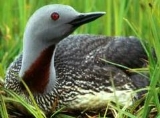
,and weighing 1–2.7 kg (2.2–6 lb). Like all loons, it is long-bodied and short-necked, with its legs set far back on its body. The sexes are similar in appearance, although males tend to be slightly larger and heavier than females. In breeding plumage, the adult has a dark grey head and neck (with narrow black and white stripes on the back of the neck), a triangular red throat patch, white underparts and a dark grey-brown mantle
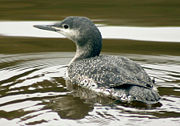
. It is the only loon with an all-dark back in breeding plumage. The non-breeding plumage is drabber with the chin, foreneck and much of the face white, the top of the head and back of the neck grey, and considerable white speckling on the dark mantle.
Its bill is thin, straight and sharp, and the bird often holds it at an uptilted angle. Though the colour of the bill changes from black in summer to pale grey in winter, the timing of the colour change does not necessarily correspond to that of the bird's overall plumage change. The nostrils are narrow slits located near the base of the bill, and the iris
is reddish. One of the bird's North American folk name
s is pegging-awl loon, a reference to its sharply pointed bill, which resembles a sailmaker's awl
(a tool also known as a "pegging awl" in New England
).
Like the other members of its genus, the Red-throated Loon is well-adapted to its aquatic environment
: its dense bone
s help it to submerge, its legs—in their set-back position—provide excellent propulsion and its body is long and streamlined. Even its sharply pointed bill may help its underwater streamlining. Its feet are large, its front three toes are fully webbed, and its tarsus
is flattened, which reduces drag and allows the leg to move easily through the water.
When it first emerges from its egg, the young Red-throated Loon is covered with fine soft down feather
s. Primarily dark brown to dark grey above, it is slightly paler on the sides of its head and neck, as well as on its throat, chest, and flanks, with a pale grey lower breast and belly. Within weeks, this first down is replaced by a second, paler set of down feathers, which are in turn replaced by developing juvenile feathers. The juvenile's plumage is similar to that of the adult, though with a few distinguishing features. It has a darker forehead and neck, with heavy speckling on the sides of the neck and the throat. Its back is browner and less speckled, and its underparts are tinged with brown. Its eyes are reddish-brown, and its beak is a pale grey. Though some young birds hold this plumage until mid-winter, many quickly become virtually indistinguishable from adults—except for their paler bills.
In flight, the Red-throated Loon has a distinctive profile; its small feet do not project far past the end of its body, its head and neck droop below the horizontal (giving the flying bird a distinctly hunchbacked shape) and its thin wings are angled back. It has a quicker, deeper wingbeat than do other loons.
-like cackles, at roughly five calls per second. Its warning call, if disturbed by humans or onshore predators, is a short croaking bark. A low-pitched moaning call, used primarily as a contact call between mates and between parents and young, but also during copulation, is made with the bill closed. The species also has a short wailing call, which descends slightly in pitch
and lasts about a second; due to strong harmonic
s surrounding the primary pitch, this meowing call is more musical than its other calls. Another call—a harsh, pulsed cooing that rises and falls in pitch, and is typically repeated up to 10 times in a row—is used in territorial encounters and pair-bonding, and by parent birds encouraging their young to move on land between bodies of water. Known as the "long call", it is often given in duet, which is unusual among the loons; the female's contribution is longer and softer than her mate's.
Young have a shrill closed-bill call, which they use in begging and to contact their parents. They also have a long call used in response to (and similar to that of) the long call of adults.
. It shows more white on the head and neck than does the Black-throated Loon, and—provided it is not sitting low in the water—tends to show more white on the flanks as well. If it is sitting lower in the water, so that the white on the flanks is reduced to a patch on the rear flank (thus resembling the pattern of the Black-throated Loon), that patch tends to be less clearly defined than the comparative patch on the Black-throated.
regions of northern Eurasia
and North America (generally north of 50°N latitude), and winters in northern coastal waters, sometimes in groups of considerable size. More than 4,400 spend the winter in a loose concentration on the eastern part of the German Bight
, for example. Unlike other loons, it regularly uses very small freshwater lakes as breeding sites.
In North America, it winters regularly along both coasts, ranging as far south as the Baja California Peninsula
and the Gulf of California
in northwestern Mexico; it has been recorded as a vagrant
in the interior Mexican state of Hidalgo. Some of its folk names in northeastern North America—including cape race, cape brace, cape drake and cape racer, as well as corruptions such as scapegrace—originated from its abundance around Cape Race, Newfoundland
. In Europe, it breeds in Iceland, northern Scotland, northwestern Ireland, Scandinavia and northern Russia, and winters along the coast as far south as parts of Spain; it also regularly occurs along major inland waterways, including the Mediterranean
, Aegean
and Black Sea
s, as well as large rivers, lakes and reservoirs. It has occurred as a vagrant as far south as Morocco
, Tunisia
and The Gambia
. In Asia, it breeds in the northern stretches of Siberia
, and winters along the Pacific coast as far south as China
, Japan
and Taiwan
. It has occurred as a vagrant in Mongolia
.
The Red-throated Loon is a diurnal migrant
, which travels singly or in loose groups, often high above the water. In eastern North America (and possibly elsewhere), it tends to migrate near the coast rather than farther offshore; Siberian populations travel for hundreds of miles over land en route to their southern European wintering grounds. It is a strong flier, and has been clocked at speeds between 75 and 78 km/h (46.6 and 48.5 mph). Like all members of its family, the Red-throated Loon goes through a simultaneous wing moult
, losing all its flight feather
s at once and becoming flightless for a period of 3–4 weeks. However, unlike other loons—which undergo this moult in late winter—the Red-throated Loon loses its ability to fly sometime between late summer and late autumn.
, though it sometimes feeds on molluscs, crustacean
s, frog
s, aquatic invertebrate
s, insect
s, fish spawn
or even plant material. It seizes rather than spears its prey, which is generally captured underwater. Though it normally dives and swims using only its feet for propulsion, it may use its wings as well if it needs to turn or accelerate quickly. Pursuit dives range from 2–9 m (6.6–29.5 ft) in depth, with an average underwater time of about a minute. Its fish diet increases the Red-throated Loon's vulnerability to persistent organic pollutant
s and heavy metals, both of which bioaccumulate
, thus potentially causing greater problems for long-lived species (such as the loon) at or near the top of the food chain
. Its main diet has also led to several of the loon's British folk names, including "sprat borer" and "spratoon".
For the first few days after hatching, young Red-throated Loons are fed aquatic insects and small crustaceans by both parents. After 3–4 days, the parents switch to fish small enough for the young birds to swallow whole. By four weeks of age, the young can eat the same food—of the same size—as their parents do. Young birds may be fed for some time after fledging; adults have been seen feeding fish to juveniles at sea and on inland lakes in the United Kingdom, hundreds of kilometers from any breeding areas.
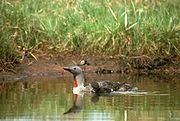 The Red-throated Loon is a monogamous species which forms long-term pair bonds. Both sexes build the nest
, which is a shallow scrape (or occasionally a platform of mud and vegetation) lined with vegetation and sometimes a few feathers, and placed within a half-metre (18 in) of the edge of a small pond. The female lays two eggs
(though clutches
of 1–3 have been recorded); they are incubated
for 24–29 days, primarily by the female. The eggs, which are greenish or olive-brownish spotted with black, measure 75 by 46 mm (3 by 1.8 in) and have a mass of 83 g (2.9 oz), of which 8 percent is shell. Incubation is begun as soon as the first egg is laid, so they hatch asynchronously. If a clutch is lost (to predation or flooding, for example) before the young hatch, the Red-throated Loon usually lays a second clutch, generally in a new nest. The young birds are precocial
upon hatching: downy and mobile with open eyes. Both parents feed them small aquatic invertebrates initially, then small fish for 38–48 days. Parents will perform distraction display
s to lure predators away from the nest and young. Ornithologist
s disagree as to whether adults carry young on their backs while swimming with some maintaining that they do and others the opposite.
In the wild, the oldest known Red-throated Loon lived for more than two decades; it was found, oiled and dead, on a beach in Sweden 23 years and 7 months after it had been ringed
(banded).
, on the other hand, the population increased by some 16 percent between 1994 and 2006, according to surveys done by the Royal Society for the Protection of Birds
and Scottish Natural Heritage
. In 2002, Wetlands International
estimated a global population of 490,000 to 1,500,000 individuals; global population trends have not been quantified.
The Red-throated Loon is one of the species
to which the Agreement on the Conservation of African-Eurasian Migratory Waterbirds (AEWA) applies; in the Americas
, it is protected by the Migratory Bird Treaty Act of 1918
. Oil spill
s, habitat degradation, and fishing net
s are among the main threats this species faces. Because it tends to migrate close to shore—generally within 20 kilometres (12.4 mi) of land—it may be detrimentally affected by the construction of near-shore wind farm
s; studies indicate a high level of avoidance of wind farm areas, though deaths due to direct strikes with the turbines appear to be uncommon. High levels of mercury
in the environment have led to reproductive failures in some areas, including parts of Sweden. Studies in Sweden have also shown that they may be adversely impacted by the acidification of lakes, as the fish on which they prey are susceptible to low pH
. On the breeding grounds, Arctic
and Red Fox
es are major predators of eggs, while Great Skua
s, Arctic Skua
s and various species of Larus
gulls (including Great Black-backed Gull
s and Glaucous Gull
s) are predators of both eggs and young.
The species is known to serve as host for at least 51 species of parasites
, most of which are roundworms
(nematodes), flatworms (digeneans) and tapeworms (cestodes) carried internally; a single species of louse
is its only known external parasite. It is also known to sometimes carry significant populations of diatom
s (microscopic phytoplankton) on its contour feathers. The Red-throated Loon is susceptible to avian influenza and Type E botulism
, and is regularly killed by the ingestion of neurotoxin
s produced by "red tide
" algal blooms. During a 2007 bloom
, large numbers of the birds also died of hypothermia
, after their plumages became matted by a protein byproduct of the algae
, which reduced the insulating properties of their feathers.
 Used as a food source since prehistoric times, the Red-throated Loon is still hunted by indigenous peoples
in some parts of the world today. Eggs as well as birds are taken, sometimes in significant numbers; during one study on northern Canada
's Igloolik Island, 73 percent of all Red-throated Loon eggs laid within the 10 km2 (3.9 mi2) study site over two breeding seasons were collected by indigenous inhabitants of the island. In some parts of Russia, Red-throated Loon skins were traditionally used to make caps and various clothing decorations, including collars. The species was also central to the creation mythologies of indigenous groups throughout the Holarctic. According to the myth—which varies only slightly between versions, despite the sometimes-vast distances that separated the groups who believed it—the loon was asked by a great shaman to bring up earth from the bottom of the sea. That earth was then used to build the world's dry land.
As recently as the 1800s, the behaviour of the Red-throated Loon was used to forecast the weather; according to the conventional wisdom of the time, birds flying inland or giving short cries predicted good weather, while those flying out to sea or giving long, wailing cries predicted rain. In the Orkney and Shetland islands of Scotland
, the species is still known as the "rain goose" in deference to its supposed weather-predicting capabilities. The people of Faroe Islands
believed that if the Red-throated Loon miaowed like a cat, then rain was imminent, while a call of gaa-gaa-gaa or turkatrae-turkatrae predicted fine weather.
Bhutan, Japan and the Union of the Comoros have issued stamps featuring the Red-throated Loon.
Bird migration
Bird migration is the regular seasonal journey undertaken by many species of birds. Bird movements include those made in response to changes in food availability, habitat or weather. Sometimes, journeys are not termed "true migration" because they are irregular or in only one direction...
aquatic bird found in the northern hemisphere. It breeds primarily in Arctic regions, and winters in northern coastal waters. It is the most widely distributed member of the loon
Loon
The loons or divers are a group of aquatic birds found in many parts of North America and northern Eurasia...
or diver family. Ranging from 55–67 cm (21.7–26.4 in) in length, the Red-throated Loon is the smallest and lightest of the world's loons. In winter, it is a nondescript bird, greyish above fading to white below. During the breeding season, it acquires the distinctive reddish throat patch which is the basis for its common name. Fish form the bulk of its diet, though amphibians, invertebrates and plant material are sometimes eaten as well. A monogamous species, the Red-throated Loon forms long-term pair bond
Pair bond
In biology, a pair bond is the strong affinity that develops in some species between the males and females in a pair, potentially leading to breeding. Pair-bonding is a term coined in the 1940s that is frequently used in sociobiology and evolutionary psychology circles...
s. Both members of the pair help to build the nest, incubate the eggs (generally two per clutch
Clutch (eggs)
A clutch of eggs refers to all the eggs produced by birds or reptiles, often at a single time, particularly those laid in a nest.In birds, destruction of a clutch by predators, , results in double-clutching...
) and feed the hatched young.
The Red-throated Loon has a large global population and a significant global range, though some populations are declining. Oil spills, habitat degradation, pollution and fishing nets are among the major threats this species faces. Natural predators—including various gull
Gull
Gulls are birds in the family Laridae. They are most closely related to the terns and only distantly related to auks, skimmers, and more distantly to the waders...
species, and both Red
Red Fox
The red fox is the largest of the true foxes, as well as being the most geographically spread member of the Carnivora, being distributed across the entire northern hemisphere from the Arctic Circle to North Africa, Central America, and the steppes of Asia...
and Arctic Fox
Arctic fox
The arctic fox , also known as the white fox, polar fox or snow fox, is a small fox native to Arctic regions of the Northern Hemisphere and is common throughout the Arctic tundra biome. The Greek word alopex, means a fox and Vulpes is the Latin version...
es, will take eggs and young. The species is protected by a number of international treaties.
Taxonomy and etymology
First described by Danish naturalist Erik PontoppidanErik Pontoppidan
Erik Pontoppidan was a Danish author, bishop, historian and antiquary, born in Aarhus August 24, 1698; died in Copenhagen December 20, 1764. He was educated in Fredericia , after which he was a private tutor in Norway, and then studied in Holland, and in London and Oxford, England...
in 1763, the Red-throated Loon is a monotypic species, with no distinctive subspecies despite its large Holarctic
Holarctic
The Holarctic ecozone refers to the habitats found throughout the northern continents of the world as a whole. This region is divided into the Palearctic, consisting of Northern Africa and all of Eurasia, with the exception of Southeast Asia and the Indian subcontinent, and the Nearctic,...
range. Pontoppidan initially placed the species in the now-defunct genus Colymbus, which contained grebe
Grebe
A grebe is a member of the Podicipediformes order, a widely distributed order of freshwater diving birds, some of which visit the sea when migrating and in winter...
s as well as loons. By 1788, however, German naturalist Johann Reinhold Forster
Johann Reinhold Forster
Johann Reinhold Forster was a German Lutheran pastor and naturalist of partial Scottish descent who made contributions to the early ornithology of Europe and North America...
realized that grebes and loons were different enough to warrant separate genera, and moved the Red-throated Loon (along with all other loon species) to its present genus. Its relationship to the four other loons is complex; although all belong to the same genus, it differs more than any of the others in terms of morphology
Morphology (biology)
In biology, morphology is a branch of bioscience dealing with the study of the form and structure of organisms and their specific structural features....
, behaviour, ecology and breeding biology, and may be the basal lineage of the genus. It is thought to have evolved
Evolution
Evolution is any change across successive generations in the heritable characteristics of biological populations. Evolutionary processes give rise to diversity at every level of biological organisation, including species, individual organisms and molecules such as DNA and proteins.Life on Earth...
in the Palearctic
Palearctic
The Palearctic or Palaearctic is one of the eight ecozones dividing the Earth's surface.Physically, the Palearctic is the largest ecozone...
, and then to have expanded into the Nearctic
Nearctic
The Nearctic is one of the eight terrestrial ecozones dividing the Earth's land surface.The Nearctic ecozone covers most of North America, including Greenland and the highlands of Mexico...
.
The genus name Gavia comes from the Latin
Latin
Latin is an Italic language originally spoken in Latium and Ancient Rome. It, along with most European languages, is a descendant of the ancient Proto-Indo-European language. Although it is considered a dead language, a number of scholars and members of the Christian clergy speak it fluently, and...
for "sea mew", as used by ancient Roman naturalist Pliny the Elder
Pliny the Elder
Gaius Plinius Secundus , better known as Pliny the Elder, was a Roman author, naturalist, and natural philosopher, as well as naval and army commander of the early Roman Empire, and personal friend of the emperor Vespasian...
. The specific epithet stellata is Latin for "set with stars" or "starry", and refers to the bird's speckled back in its non-breeding plumage
Plumage
Plumage refers both to the layer of feathers that cover a bird and the pattern, colour, and arrangement of those feathers. The pattern and colours of plumage vary between species and subspecies and can also vary between different age classes, sexes, and season. Within species there can also be a...
. "Diver" refers to the family's underwater method of hunting for prey, while "red-throated" is a straightforward reference to the bird's most distinctive breeding plumage feature. The word "loon" is thought to have derived from the Swedish lom, the Old Norse or Icelandic lómr, or the Old Dutch loen, all of which mean "lame" or "clumsy", and is a probable reference to the difficulty that all loons have in moving about on land.
Description
The Red-throated Loon is the smallest and lightest of the world's loon species, ranging from 53 to 69 cm (20.9 to 27.2 in) in length with a 91–120 cm (35.8–47.2 in) wingspanWingspan
The wingspan of an airplane or a bird, is the distance from one wingtip to the other wingtip. For example, the Boeing 777 has a wingspan of about ; and a Wandering Albatross caught in 1965 had a wingspan of , the official record for a living bird.The term wingspan, more technically extent, is...
,and weighing 1–2.7 kg (2.2–6 lb). Like all loons, it is long-bodied and short-necked, with its legs set far back on its body. The sexes are similar in appearance, although males tend to be slightly larger and heavier than females. In breeding plumage, the adult has a dark grey head and neck (with narrow black and white stripes on the back of the neck), a triangular red throat patch, white underparts and a dark grey-brown mantle
Bird anatomy
Bird anatomy, or the physiological structure of birds' bodies, shows many unique adaptations, mostly aiding flight. Birds have a light skeletal system and light but powerful musculature which, along with circulatory and respiratory systems capable of very high metabolic rates and oxygen supply,...
. It is the only loon with an all-dark back in breeding plumage. The non-breeding plumage is drabber with the chin, foreneck and much of the face white, the top of the head and back of the neck grey, and considerable white speckling on the dark mantle.
Its bill is thin, straight and sharp, and the bird often holds it at an uptilted angle. Though the colour of the bill changes from black in summer to pale grey in winter, the timing of the colour change does not necessarily correspond to that of the bird's overall plumage change. The nostrils are narrow slits located near the base of the bill, and the iris
Iris (anatomy)
The iris is a thin, circular structure in the eye, responsible for controlling the diameter and size of the pupils and thus the amount of light reaching the retina. "Eye color" is the color of the iris, which can be green, blue, or brown. In some cases it can be hazel , grey, violet, or even pink...
is reddish. One of the bird's North American folk name
Common name
A common name of a taxon or organism is a name in general use within a community; it is often contrasted with the scientific name for the same organism...
s is pegging-awl loon, a reference to its sharply pointed bill, which resembles a sailmaker's awl
Stitching awl
A stitching awl is a simple tool with which holes can be punctured in a variety of materials, or existing holes can be enlarged. It is also used for sewing heavy materials, such as leather or canvas. It is a thin, tapered metal shaft, coming to a sharp point, either straight or slightly bent....
(a tool also known as a "pegging awl" in New England
New England
New England is a region in the northeastern corner of the United States consisting of the six states of Maine, New Hampshire, Vermont, Massachusetts, Rhode Island, and Connecticut...
).
Like the other members of its genus, the Red-throated Loon is well-adapted to its aquatic environment
Aquatic ecosystem
An aquatic ecosystem is an ecosystem in a body of water. Communities of organisms that are dependent on each other and on their environment live in aquatic ecosystems. The two main types of aquatic ecosystems are marine ecosystems and freshwater ecosystems....
: its dense bone
Bone
Bones are rigid organs that constitute part of the endoskeleton of vertebrates. They support, and protect the various organs of the body, produce red and white blood cells and store minerals. Bone tissue is a type of dense connective tissue...
s help it to submerge, its legs—in their set-back position—provide excellent propulsion and its body is long and streamlined. Even its sharply pointed bill may help its underwater streamlining. Its feet are large, its front three toes are fully webbed, and its tarsus
Tarsus (skeleton)
In tetrapods, the tarsus is a cluster of articulating bones in each foot situated between the lower end of tibia and fibula of the lower leg and the metatarsus. In the foot the tarsus articulates with the bones of the metatarsus, which in turn articulate with the bones of the individual toes...
is flattened, which reduces drag and allows the leg to move easily through the water.
When it first emerges from its egg, the young Red-throated Loon is covered with fine soft down feather
Down feather
The down of birds is a layer of fine feathers found under the tougher exterior feathers. Very young birds are clad only in down. Powder down is a specialized type of down found only in a few groups of birds. Down is a fine thermal insulator and padding, used in goods such as jackets, bedding,...
s. Primarily dark brown to dark grey above, it is slightly paler on the sides of its head and neck, as well as on its throat, chest, and flanks, with a pale grey lower breast and belly. Within weeks, this first down is replaced by a second, paler set of down feathers, which are in turn replaced by developing juvenile feathers. The juvenile's plumage is similar to that of the adult, though with a few distinguishing features. It has a darker forehead and neck, with heavy speckling on the sides of the neck and the throat. Its back is browner and less speckled, and its underparts are tinged with brown. Its eyes are reddish-brown, and its beak is a pale grey. Though some young birds hold this plumage until mid-winter, many quickly become virtually indistinguishable from adults—except for their paler bills.
In flight, the Red-throated Loon has a distinctive profile; its small feet do not project far past the end of its body, its head and neck droop below the horizontal (giving the flying bird a distinctly hunchbacked shape) and its thin wings are angled back. It has a quicker, deeper wingbeat than do other loons.
Voice
The adult Red-throated Loon has a number of vocalisations, which are used in different circumstances. In flight, when passing conspecifics or circling its own pond, it gives a series of rapid yet rhythmic gooseGoose
The word goose is the English name for a group of waterfowl, belonging to the family Anatidae. This family also includes swans, most of which are larger than true geese, and ducks, which are smaller....
-like cackles, at roughly five calls per second. Its warning call, if disturbed by humans or onshore predators, is a short croaking bark. A low-pitched moaning call, used primarily as a contact call between mates and between parents and young, but also during copulation, is made with the bill closed. The species also has a short wailing call, which descends slightly in pitch
Pitch (music)
Pitch is an auditory perceptual property that allows the ordering of sounds on a frequency-related scale.Pitches are compared as "higher" and "lower" in the sense associated with musical melodies,...
and lasts about a second; due to strong harmonic
Harmonic
A harmonic of a wave is a component frequency of the signal that is an integer multiple of the fundamental frequency, i.e. if the fundamental frequency is f, the harmonics have frequencies 2f, 3f, 4f, . . . etc. The harmonics have the property that they are all periodic at the fundamental...
s surrounding the primary pitch, this meowing call is more musical than its other calls. Another call—a harsh, pulsed cooing that rises and falls in pitch, and is typically repeated up to 10 times in a row—is used in territorial encounters and pair-bonding, and by parent birds encouraging their young to move on land between bodies of water. Known as the "long call", it is often given in duet, which is unusual among the loons; the female's contribution is longer and softer than her mate's.
Young have a shrill closed-bill call, which they use in begging and to contact their parents. They also have a long call used in response to (and similar to that of) the long call of adults.
Similar species
At medium to close range, an adult Red-throated Loon in either breeding or non-breeding plumage is usually easily recognised. However, in certain light conditions, at certain times in its moulting cycle or at greater distances, it may be mistaken for another species—most commonly the Black-throated Loon, but also occasionally the Great Crested GrebeGreat Crested Grebe
The Great Crested Grebe is a member of the grebe family of water birds.- Description :The Great Crested Grebe is long with a wingspan. It is an excellent swimmer and diver, and pursues its fish prey underwater. The adults are unmistakable in summer with head and neck decorations...
. It shows more white on the head and neck than does the Black-throated Loon, and—provided it is not sitting low in the water—tends to show more white on the flanks as well. If it is sitting lower in the water, so that the white on the flanks is reduced to a patch on the rear flank (thus resembling the pattern of the Black-throated Loon), that patch tends to be less clearly defined than the comparative patch on the Black-throated.
Habitat and distribution
The Red-throated Loon breeds primarily in the ArcticArctic
The Arctic is a region located at the northern-most part of the Earth. The Arctic consists of the Arctic Ocean and parts of Canada, Russia, Greenland, the United States, Norway, Sweden, Finland, and Iceland. The Arctic region consists of a vast, ice-covered ocean, surrounded by treeless permafrost...
regions of northern Eurasia
Eurasia
Eurasia is a continent or supercontinent comprising the traditional continents of Europe and Asia ; covering about 52,990,000 km2 or about 10.6% of the Earth's surface located primarily in the eastern and northern hemispheres...
and North America (generally north of 50°N latitude), and winters in northern coastal waters, sometimes in groups of considerable size. More than 4,400 spend the winter in a loose concentration on the eastern part of the German Bight
German Bight
German Bight is the southeastern bight of the North Sea bounded by the Netherlands and Germany to the south, and Denmark and Germany to the east . To the north and west it is limited by the Dogger Bank. The Bight contains the Frisian and Danish Islands. The Wadden Sea is approximately ten to...
, for example. Unlike other loons, it regularly uses very small freshwater lakes as breeding sites.
In North America, it winters regularly along both coasts, ranging as far south as the Baja California Peninsula
Baja California Peninsula
The Baja California peninsula , is a peninsula in northwestern Mexico. Its land mass separates the Pacific Ocean from the Gulf of California. The Peninsula extends from Mexicali, Baja California in the north to Cabo San Lucas, Baja California Sur in the south.The total area of the Baja California...
and the Gulf of California
Gulf of California
The Gulf of California is a body of water that separates the Baja California Peninsula from the Mexican mainland...
in northwestern Mexico; it has been recorded as a vagrant
Vagrancy (biology)
Vagrancy is a phenomenon in biology whereby individual animals appear well outside their normal range; individual animals which exhibit vagrancy are known as vagrants. The term accidental is sometimes also used...
in the interior Mexican state of Hidalgo. Some of its folk names in northeastern North America—including cape race, cape brace, cape drake and cape racer, as well as corruptions such as scapegrace—originated from its abundance around Cape Race, Newfoundland
Cape Race
Cape Race is a point of land located at the southeastern tip of the Avalon Peninsula on the island of Newfoundland, Canada. Its name is thought to come from the original Portuguese name for this cape, "Raso", or "bare"...
. In Europe, it breeds in Iceland, northern Scotland, northwestern Ireland, Scandinavia and northern Russia, and winters along the coast as far south as parts of Spain; it also regularly occurs along major inland waterways, including the Mediterranean
Mediterranean Sea
The Mediterranean Sea is a sea connected to the Atlantic Ocean surrounded by the Mediterranean region and almost completely enclosed by land: on the north by Anatolia and Europe, on the south by North Africa, and on the east by the Levant...
, Aegean
Aegean Sea
The Aegean Sea[p] is an elongated embayment of the Mediterranean Sea located between the southern Balkan and Anatolian peninsulas, i.e., between the mainlands of Greece and Turkey. In the north, it is connected to the Marmara Sea and Black Sea by the Dardanelles and Bosporus...
and Black Sea
Black Sea
The Black Sea is bounded by Europe, Anatolia and the Caucasus and is ultimately connected to the Atlantic Ocean via the Mediterranean and the Aegean seas and various straits. The Bosphorus strait connects it to the Sea of Marmara, and the strait of the Dardanelles connects that sea to the Aegean...
s, as well as large rivers, lakes and reservoirs. It has occurred as a vagrant as far south as Morocco
Morocco
Morocco , officially the Kingdom of Morocco , is a country located in North Africa. It has a population of more than 32 million and an area of 710,850 km², and also primarily administers the disputed region of the Western Sahara...
, Tunisia
Tunisia
Tunisia , officially the Tunisian RepublicThe long name of Tunisia in other languages used in the country is: , is the northernmost country in Africa. It is a Maghreb country and is bordered by Algeria to the west, Libya to the southeast, and the Mediterranean Sea to the north and east. Its area...
and The Gambia
The Gambia
The Republic of The Gambia, commonly referred to as The Gambia, or Gambia , is a country in West Africa. Gambia is the smallest country on mainland Africa, surrounded by Senegal except for a short coastline on the Atlantic Ocean in the west....
. In Asia, it breeds in the northern stretches of Siberia
Siberia
Siberia is an extensive region constituting almost all of Northern Asia. Comprising the central and eastern portion of the Russian Federation, it was part of the Soviet Union from its beginning, as its predecessor states, the Tsardom of Russia and the Russian Empire, conquered it during the 16th...
, and winters along the Pacific coast as far south as China
China
Chinese civilization may refer to:* China for more general discussion of the country.* Chinese culture* Greater China, the transnational community of ethnic Chinese.* History of China* Sinosphere, the area historically affected by Chinese culture...
, Japan
Japan
Japan is an island nation in East Asia. Located in the Pacific Ocean, it lies to the east of the Sea of Japan, China, North Korea, South Korea and Russia, stretching from the Sea of Okhotsk in the north to the East China Sea and Taiwan in the south...
and Taiwan
Taiwan
Taiwan , also known, especially in the past, as Formosa , is the largest island of the same-named island group of East Asia in the western Pacific Ocean and located off the southeastern coast of mainland China. The island forms over 99% of the current territory of the Republic of China following...
. It has occurred as a vagrant in Mongolia
Mongolia
Mongolia is a landlocked country in East and Central Asia. It is bordered by Russia to the north and China to the south, east and west. Although Mongolia does not share a border with Kazakhstan, its western-most point is only from Kazakhstan's eastern tip. Ulan Bator, the capital and largest...
.
Behaviour
Because its feet are located so far back on its body, the Red-throated Loon is not capable of walking on land; however, it can use its feet to shove itself forward on its breast. Young use this method of covering ground when moving from their breeding pools to larger bodies of water, including rivers and the sea. It is the only species of loon able to take off directly from land. If frightened, it may submerge until only its head or bill shows above the surface of the water.The Red-throated Loon is a diurnal migrant
Bird migration
Bird migration is the regular seasonal journey undertaken by many species of birds. Bird movements include those made in response to changes in food availability, habitat or weather. Sometimes, journeys are not termed "true migration" because they are irregular or in only one direction...
, which travels singly or in loose groups, often high above the water. In eastern North America (and possibly elsewhere), it tends to migrate near the coast rather than farther offshore; Siberian populations travel for hundreds of miles over land en route to their southern European wintering grounds. It is a strong flier, and has been clocked at speeds between 75 and 78 km/h (46.6 and 48.5 mph). Like all members of its family, the Red-throated Loon goes through a simultaneous wing moult
Moult
In biology, moulting or molting , also known as sloughing, shedding, or for some species, ecdysis, is the manner in which an animal routinely casts off a part of its body , either at specific times of year, or at specific points in its life cycle.Moulting can involve the epidermis , pelage...
, losing all its flight feather
Flight feather
Flight feathers are the long, stiff, asymmetrically shaped, but symmetrically paired feathers on the wings or tail of a bird; those on the wings are called remiges while those on the tail are called rectrices . Their primary function is to aid in the generation of both thrust and lift, thereby...
s at once and becoming flightless for a period of 3–4 weeks. However, unlike other loons—which undergo this moult in late winter—the Red-throated Loon loses its ability to fly sometime between late summer and late autumn.
Food and feeding
Like all members of its family, the Red-throated Loon is primarily a fish-eaterFish
Fish are a paraphyletic group of organisms that consist of all gill-bearing aquatic vertebrate animals that lack limbs with digits. Included in this definition are the living hagfish, lampreys, and cartilaginous and bony fish, as well as various extinct related groups...
, though it sometimes feeds on molluscs, crustacean
Crustacean
Crustaceans form a very large group of arthropods, usually treated as a subphylum, which includes such familiar animals as crabs, lobsters, crayfish, shrimp, krill and barnacles. The 50,000 described species range in size from Stygotantulus stocki at , to the Japanese spider crab with a leg span...
s, frog
Frog
Frogs are amphibians in the order Anura , formerly referred to as Salientia . Most frogs are characterized by a short body, webbed digits , protruding eyes and the absence of a tail...
s, aquatic invertebrate
Invertebrate
An invertebrate is an animal without a backbone. The group includes 97% of all animal species – all animals except those in the chordate subphylum Vertebrata .Invertebrates form a paraphyletic group...
s, insect
Insect
Insects are a class of living creatures within the arthropods that have a chitinous exoskeleton, a three-part body , three pairs of jointed legs, compound eyes, and two antennae...
s, fish spawn
Spawn (biology)
Spawn refers to the eggs and sperm released or deposited, usually into water, by aquatic animals. As a verb, spawn refers to the process of releasing the eggs and sperm, also called spawning...
or even plant material. It seizes rather than spears its prey, which is generally captured underwater. Though it normally dives and swims using only its feet for propulsion, it may use its wings as well if it needs to turn or accelerate quickly. Pursuit dives range from 2–9 m (6.6–29.5 ft) in depth, with an average underwater time of about a minute. Its fish diet increases the Red-throated Loon's vulnerability to persistent organic pollutant
Persistent organic pollutant
thumb|right|275px|State parties to the Stockholm Convention on Persistent Organic PollutantsPersistent organic pollutants are organic compounds that are resistant to environmental degradation through chemical, biological, and photolytic processes...
s and heavy metals, both of which bioaccumulate
Bioaccumulation
Bioaccumulation refers to the accumulation of substances, such as pesticides, or other organic chemicals in an organism. Bioaccumulation occurs when an organism absorbs a toxic substance at a rate greater than that at which the substance is lost...
, thus potentially causing greater problems for long-lived species (such as the loon) at or near the top of the food chain
Food chain
A food web depicts feeding connections in an ecological community. Ecologists can broadly lump all life forms into one of two categories called trophic levels: 1) the autotrophs, and 2) the heterotrophs...
. Its main diet has also led to several of the loon's British folk names, including "sprat borer" and "spratoon".
For the first few days after hatching, young Red-throated Loons are fed aquatic insects and small crustaceans by both parents. After 3–4 days, the parents switch to fish small enough for the young birds to swallow whole. By four weeks of age, the young can eat the same food—of the same size—as their parents do. Young birds may be fed for some time after fledging; adults have been seen feeding fish to juveniles at sea and on inland lakes in the United Kingdom, hundreds of kilometers from any breeding areas.
Breeding and survival
Bird nest
A bird nest is the spot in which a bird lays and incubates its eggs and raises its young. Although the term popularly refers to a specific structure made by the bird itself—such as the grassy cup nest of the American Robin or Eurasian Blackbird, or the elaborately woven hanging nest of the...
, which is a shallow scrape (or occasionally a platform of mud and vegetation) lined with vegetation and sometimes a few feathers, and placed within a half-metre (18 in) of the edge of a small pond. The female lays two eggs
Egg (biology)
An egg is an organic vessel in which an embryo first begins to develop. In most birds, reptiles, insects, molluscs, fish, and monotremes, an egg is the zygote, resulting from fertilization of the ovum, which is expelled from the body and permitted to develop outside the body until the developing...
(though clutches
Clutch (eggs)
A clutch of eggs refers to all the eggs produced by birds or reptiles, often at a single time, particularly those laid in a nest.In birds, destruction of a clutch by predators, , results in double-clutching...
of 1–3 have been recorded); they are incubated
Avian incubation
Incubation refers to the process by which certain oviparous animals hatch their eggs, and to the development of the embryo within the egg. The most vital factor of incubation is the constant temperature required for its development over a specific period. Especially in domestic fowl, the act of...
for 24–29 days, primarily by the female. The eggs, which are greenish or olive-brownish spotted with black, measure 75 by 46 mm (3 by 1.8 in) and have a mass of 83 g (2.9 oz), of which 8 percent is shell. Incubation is begun as soon as the first egg is laid, so they hatch asynchronously. If a clutch is lost (to predation or flooding, for example) before the young hatch, the Red-throated Loon usually lays a second clutch, generally in a new nest. The young birds are precocial
Precocial
In biology, the term precocial refers to species in which the young are relatively mature and mobile from the moment of birth or hatching. The opposite developmental strategy is called "altricial," where the young are born or hatched helpless. Extremely precocial species may be called...
upon hatching: downy and mobile with open eyes. Both parents feed them small aquatic invertebrates initially, then small fish for 38–48 days. Parents will perform distraction display
Distraction display
Distraction displays, also known as deflection display, diversionary display or paratrepsis, are anti-predator behaviours used to attract the attention of an enemy away from an object, typically the nest or young, that is being protected. They are particularly well known in birds but noted also in...
s to lure predators away from the nest and young. Ornithologist
Ornithology
Ornithology is a branch of zoology that concerns the study of birds. Several aspects of ornithology differ from related disciplines, due partly to the high visibility and the aesthetic appeal of birds...
s disagree as to whether adults carry young on their backs while swimming with some maintaining that they do and others the opposite.
In the wild, the oldest known Red-throated Loon lived for more than two decades; it was found, oiled and dead, on a beach in Sweden 23 years and 7 months after it had been ringed
Bird ringing
Bird ringing or bird banding is a technique used in the study of wild birds, by attaching a small, individually numbered, metal or plastic tag to their legs or wings, so that various aspects of the bird's life can be studied by the ability to re-find the same individual later...
(banded).
Conservation status and threats
Although the Red-throated Loon is not a globally threatened species, as it has a large population and a significant range, there are populations which appear to be declining. Numbers counted in U.S. Fish and Wildlife Service surveys in Alaska show a 53 percent population decline between 1971 and 1993, for example, and counts have dropped in continental Europe as well. In ScotlandScotland
Scotland is a country that is part of the United Kingdom. Occupying the northern third of the island of Great Britain, it shares a border with England to the south and is bounded by the North Sea to the east, the Atlantic Ocean to the north and west, and the North Channel and Irish Sea to the...
, on the other hand, the population increased by some 16 percent between 1994 and 2006, according to surveys done by the Royal Society for the Protection of Birds
Royal Society for the Protection of Birds
Bird Notes and News was first published in April 1903.The title changed to 'Bird Notes' in 1947. In the 1950s, there were four copies per year . Each volume covered two years, spread over three calendar years...
and Scottish Natural Heritage
Scottish Natural Heritage
Scottish Natural Heritage is a Scottish public body. It is responsible for Scotland's natural heritage, especially its natural, genetic and scenic diversity. It advises the Scottish Government and acts as a government agent in the delivery of conservation designations, i.e...
. In 2002, Wetlands International
Wetlands International
Wetlands International is a global organisation that works to sustain and restore wetlands and their resources for people and biodiversity. It is an independent, not-for-profit, global organisation, supported by government and NGO membership from around the world...
estimated a global population of 490,000 to 1,500,000 individuals; global population trends have not been quantified.
The Red-throated Loon is one of the species
Species
In biology, a species is one of the basic units of biological classification and a taxonomic rank. A species is often defined as a group of organisms capable of interbreeding and producing fertile offspring. While in many cases this definition is adequate, more precise or differing measures are...
to which the Agreement on the Conservation of African-Eurasian Migratory Waterbirds (AEWA) applies; in the Americas
Americas
The Americas, or America , are lands in the Western hemisphere, also known as the New World. In English, the plural form the Americas is often used to refer to the landmasses of North America and South America with their associated islands and regions, while the singular form America is primarily...
, it is protected by the Migratory Bird Treaty Act of 1918
Migratory Bird Treaty Act of 1918
The Migratory Bird Treaty Act of 1918 , codified at , is a United States federal law, at first enacted in 1916 in order to implement the convention for the protection of migratory birds between the United States and Great Britain...
. Oil spill
Oil spill
An oil spill is the release of a liquid petroleum hydrocarbon into the environment, especially marine areas, due to human activity, and is a form of pollution. The term is mostly used to describe marine oil spills, where oil is released into the ocean or coastal waters...
s, habitat degradation, and fishing net
Fishing net
A fishing net or fishnet is a net that is used for fishing. Fishing nets are meshes usually formed by knotting a relatively thin thread. Modern nets are usually made of artificial polyamides like nylon, although nets of organic polyamides such as wool or silk thread were common until recently and...
s are among the main threats this species faces. Because it tends to migrate close to shore—generally within 20 kilometres (12.4 mi) of land—it may be detrimentally affected by the construction of near-shore wind farm
Wind farm
A wind farm is a group of wind turbines in the same location used to produce electric power. A large wind farm may consist of several hundred individual wind turbines, and cover an extended area of hundreds of square miles, but the land between the turbines may be used for agricultural or other...
s; studies indicate a high level of avoidance of wind farm areas, though deaths due to direct strikes with the turbines appear to be uncommon. High levels of mercury
Mercury (element)
Mercury is a chemical element with the symbol Hg and atomic number 80. It is also known as quicksilver or hydrargyrum...
in the environment have led to reproductive failures in some areas, including parts of Sweden. Studies in Sweden have also shown that they may be adversely impacted by the acidification of lakes, as the fish on which they prey are susceptible to low pH
PH
In chemistry, pH is a measure of the acidity or basicity of an aqueous solution. Pure water is said to be neutral, with a pH close to 7.0 at . Solutions with a pH less than 7 are said to be acidic and solutions with a pH greater than 7 are basic or alkaline...
. On the breeding grounds, Arctic
Arctic fox
The arctic fox , also known as the white fox, polar fox or snow fox, is a small fox native to Arctic regions of the Northern Hemisphere and is common throughout the Arctic tundra biome. The Greek word alopex, means a fox and Vulpes is the Latin version...
and Red Fox
Red Fox
The red fox is the largest of the true foxes, as well as being the most geographically spread member of the Carnivora, being distributed across the entire northern hemisphere from the Arctic Circle to North Africa, Central America, and the steppes of Asia...
es are major predators of eggs, while Great Skua
Great Skua
The Great Skua, Stercorarius skua, is a large seabird in the skua family Stercorariidae. In Britain, it is sometimes known by the name Bonxie, a Shetland name of unknown origin.-Description:...
s, Arctic Skua
Arctic Skua
The Parasitic Jaeger, also known as the Arctic Skua or Parasitic Skua, is a seabird in the skua family Stercorariidae....
s and various species of Larus
Larus
Larus is a large genus of gulls with worldwide distribution . Many of its species are abundant and well-known birds in their ranges...
gulls (including Great Black-backed Gull
Great Black-backed Gull
The Great Black-backed Gull is the largest gull in the world, which breeds on the European and North American coasts and islands of the North Atlantic...
s and Glaucous Gull
Glaucous Gull
The Glaucous Gull is a large gull which breeds in the Arctic regions of the northern hemisphere and the Atlantic coasts of Europe. It is migratory, wintering from in the North Atlantic and North Pacific oceans as far south as the British Isles and northernmost states of the USA, also on the Great...
s) are predators of both eggs and young.
The species is known to serve as host for at least 51 species of parasites
Parasitism
Parasitism is a type of symbiotic relationship between organisms of different species where one organism, the parasite, benefits at the expense of the other, the host. Traditionally parasite referred to organisms with lifestages that needed more than one host . These are now called macroparasites...
, most of which are roundworms
Nematode
The nematodes or roundworms are the most diverse phylum of pseudocoelomates, and one of the most diverse of all animals. Nematode species are very difficult to distinguish; over 28,000 have been described, of which over 16,000 are parasitic. It has been estimated that the total number of nematode...
(nematodes), flatworms (digeneans) and tapeworms (cestodes) carried internally; a single species of louse
Louse
Lice is the common name for over 3,000 species of wingless insects of the order Phthiraptera; three of which are classified as human disease agents...
is its only known external parasite. It is also known to sometimes carry significant populations of diatom
Diatom
Diatoms are a major group of algae, and are one of the most common types of phytoplankton. Most diatoms are unicellular, although they can exist as colonies in the shape of filaments or ribbons , fans , zigzags , or stellate colonies . Diatoms are producers within the food chain...
s (microscopic phytoplankton) on its contour feathers. The Red-throated Loon is susceptible to avian influenza and Type E botulism
Botulism
Botulism also known as botulinus intoxication is a rare but serious paralytic illness caused by botulinum toxin which is metabolic waste produced under anaerobic conditions by the bacterium Clostridium botulinum, and affecting a wide range of mammals, birds and fish...
, and is regularly killed by the ingestion of neurotoxin
Neurotoxin
A neurotoxin is a toxin that acts specifically on nerve cells , usually by interacting with membrane proteins such as ion channels. Some sources are more general, and define the effect of neurotoxins as occurring at nerve tissue...
s produced by "red tide
Red tide
Red tide is a common name for a phenomenon also known as an algal bloom , an event in which estuarine, marine, or fresh water algae accumulate rapidly in the water column and results in discoloration of the surface water. It is usually found in coastal areas...
" algal blooms. During a 2007 bloom
Algal bloom
An algal bloom is a rapid increase or accumulation in the population of algae in an aquatic system. Algal blooms may occur in freshwater as well as marine environments. Typically, only one or a small number of phytoplankton species are involved, and some blooms may be recognized by discoloration...
, large numbers of the birds also died of hypothermia
Hypothermia
Hypothermia is a condition in which core temperature drops below the required temperature for normal metabolism and body functions which is defined as . Body temperature is usually maintained near a constant level of through biologic homeostasis or thermoregulation...
, after their plumages became matted by a protein byproduct of the algae
Algae
Algae are a large and diverse group of simple, typically autotrophic organisms, ranging from unicellular to multicellular forms, such as the giant kelps that grow to 65 meters in length. They are photosynthetic like plants, and "simple" because their tissues are not organized into the many...
, which reduced the insulating properties of their feathers.
In human culture
Indigenous peoples
Indigenous peoples are ethnic groups that are defined as indigenous according to one of the various definitions of the term, there is no universally accepted definition but most of which carry connotations of being the "original inhabitants" of a territory....
in some parts of the world today. Eggs as well as birds are taken, sometimes in significant numbers; during one study on northern Canada
Canada
Canada is a North American country consisting of ten provinces and three territories. Located in the northern part of the continent, it extends from the Atlantic Ocean in the east to the Pacific Ocean in the west, and northward into the Arctic Ocean...
's Igloolik Island, 73 percent of all Red-throated Loon eggs laid within the 10 km2 (3.9 mi2) study site over two breeding seasons were collected by indigenous inhabitants of the island. In some parts of Russia, Red-throated Loon skins were traditionally used to make caps and various clothing decorations, including collars. The species was also central to the creation mythologies of indigenous groups throughout the Holarctic. According to the myth—which varies only slightly between versions, despite the sometimes-vast distances that separated the groups who believed it—the loon was asked by a great shaman to bring up earth from the bottom of the sea. That earth was then used to build the world's dry land.
As recently as the 1800s, the behaviour of the Red-throated Loon was used to forecast the weather; according to the conventional wisdom of the time, birds flying inland or giving short cries predicted good weather, while those flying out to sea or giving long, wailing cries predicted rain. In the Orkney and Shetland islands of Scotland
Scotland
Scotland is a country that is part of the United Kingdom. Occupying the northern third of the island of Great Britain, it shares a border with England to the south and is bounded by the North Sea to the east, the Atlantic Ocean to the north and west, and the North Channel and Irish Sea to the...
, the species is still known as the "rain goose" in deference to its supposed weather-predicting capabilities. The people of Faroe Islands
Faroe Islands
The Faroe Islands are an island group situated between the Norwegian Sea and the North Atlantic Ocean, approximately halfway between Scotland and Iceland. The Faroe Islands are a self-governing territory within the Kingdom of Denmark, along with Denmark proper and Greenland...
believed that if the Red-throated Loon miaowed like a cat, then rain was imminent, while a call of gaa-gaa-gaa or turkatrae-turkatrae predicted fine weather.
Bhutan, Japan and the Union of the Comoros have issued stamps featuring the Red-throated Loon.
External links
- Red-throated Loon photos on Philadelphia's Academy of Natural SciencesAcademy of Natural SciencesThe Academy of Natural Sciences of Drexel University, formerly Academy of Natural Sciences of Philadelphia, is the oldest natural science research institution and museum in the New World...
's Visual Resources for Ornithology website - Red-throated Loon videos on Handbook of Birds of the World's Internet Bird Collection website
- Red-throated Loon sound recordings on xeno-canto.org's website