
Empoli

Encyclopedia
Empoli (ˈempoli) is a town and comune
in Tuscany
, Italy
, about 20 km southwest of Florence
, to the south of the Arno in a plain formed by the latter river. The plain has been usable for agriculture since Roman
times. The commune's territory becomes a hilly one as it departs from the river. Empoli is on the main railway line from Florence to Pisa
, and is the point of divergence of a line to Siena
.
Empoli has an enduring tradition as an agricultural centre. It has given its name to a local variety of artichoke
.
times, and continued to exist until 4th century AD. The river acted as a communication way for the trade of agricultural products, together with the local amphora
e. In the Tabula Peutingeriana
of the 4th century Empoli is called in portu ("in the port") as a river port on the Roman road Via Quinctia, which led from Fiesole
and Florence
to Pisa
. Empoli was also on the Via Salaiola, connecting to Volterra
's salt ponds.
Since the 8th century Empoli consolidated as a town around the castle, known as Emporium or Empolis. In 1119 it was absorbed into the Guidi
counts possessions. In 1182 it went under Florentine
rule. In 1260, after the Battle of Montaperti
, Empoli was the seat of a famous council in which Farinata degli Uberti
opposed the destruction of Florence.
Later Empoli became an important fortress, and was therefore repeatedly sacked and attacked. In 1530 its fall marked the end of the independence of the Florentine Republic.
In the frazione (hamlet) of Pontorme is the house of the painter Pontormo
.
, which is currently playing in Serie B
.
, Austria
Aubervilliers
, France
Besançon
, France Toledo
, Spain
Namur
, Belgium
Empoli (ˈempoli) is a town and comune
in Tuscany
, Italy
, about 20 km southwest of Florence
, to the south of the Arno in a plain formed by the latter river. The plain has been usable for agriculture since Roman
times. The commune's territory becomes a hilly one as it departs from the river. Empoli is on the main railway line from Florence to Pisa
, and is the point of divergence of a line to Siena
.
Empoli has an enduring tradition as an agricultural centre. It has given its name to a local variety of artichoke
.
times, and continued to exist until 4th century AD. The river acted as a communication way for the trade of agricultural products, together with the local amphora
e. In the Tabula Peutingeriana
of the 4th century Empoli is called in portu ("in the port") as a river port on the Roman road Via Quinctia, which led from Fiesole
and Florence
to Pisa
. Empoli was also on the Via Salaiola, connecting to Volterra
's salt ponds.
Since the 8th century Empoli consolidated as a town around the castle, known as Emporium or Empolis. In 1119 it was absorbed into the Guidi
counts possessions. In 1182 it went under Florentine
rule. In 1260, after the Battle of Montaperti
, Empoli was the seat of a famous council in which Farinata degli Uberti
opposed the destruction of Florence.
Later Empoli became an important fortress, and was therefore repeatedly sacked and attacked. In 1530 its fall marked the end of the independence of the Florentine Republic.
In the frazione (hamlet) of Pontorme is the house of the painter Pontormo
.
, which is currently playing in Serie B
.
, Austria
Aubervilliers
, France
Besançon
, France Toledo
, Spain
Namur
, Belgium
Empoli (ˈempoli) is a town and comune
in Tuscany
, Italy
, about 20 km southwest of Florence
, to the south of the Arno in a plain formed by the latter river. The plain has been usable for agriculture since Roman
times. The commune's territory becomes a hilly one as it departs from the river. Empoli is on the main railway line from Florence to Pisa
, and is the point of divergence of a line to Siena
.
Empoli has an enduring tradition as an agricultural centre. It has given its name to a local variety of artichoke
.
times, and continued to exist until 4th century AD. The river acted as a communication way for the trade of agricultural products, together with the local amphora
e. In the Tabula Peutingeriana
of the 4th century Empoli is called in portu ("in the port") as a river port on the Roman road Via Quinctia, which led from Fiesole
and Florence
to Pisa
. Empoli was also on the Via Salaiola, connecting to Volterra
's salt ponds.
Since the 8th century Empoli consolidated as a town around the castle, known as Emporium or Empolis. In 1119 it was absorbed into the Guidi
counts possessions. In 1182 it went under Florentine
rule. In 1260, after the Battle of Montaperti
, Empoli was the seat of a famous council in which Farinata degli Uberti
opposed the destruction of Florence.
Later Empoli became an important fortress, and was therefore repeatedly sacked and attacked. In 1530 its fall marked the end of the independence of the Florentine Republic.
In the frazione (hamlet) of Pontorme is the house of the painter Pontormo
.
, which is currently playing in Serie B
.
, Austria
Aubervilliers
, France
Besançon
, France Toledo
, Spain
Namur
, Belgium

Comune
In Italy, the comune is the basic administrative division, and may be properly approximated in casual speech by the English word township or municipality.-Importance and function:...
in Tuscany
Tuscany
Tuscany is a region in Italy. It has an area of about 23,000 square kilometres and a population of about 3.75 million inhabitants. The regional capital is Florence ....
, Italy
Italy
Italy , officially the Italian Republic languages]] under the European Charter for Regional or Minority Languages. In each of these, Italy's official name is as follows:;;;;;;;;), is a unitary parliamentary republic in South-Central Europe. To the north it borders France, Switzerland, Austria and...
, about 20 km southwest of Florence
Florence
Florence is the capital city of the Italian region of Tuscany and of the province of Florence. It is the most populous city in Tuscany, with approximately 370,000 inhabitants, expanding to over 1.5 million in the metropolitan area....
, to the south of the Arno in a plain formed by the latter river. The plain has been usable for agriculture since Roman
Ancient Rome
Ancient Rome was a thriving civilization that grew on the Italian Peninsula as early as the 8th century BC. Located along the Mediterranean Sea and centered on the city of Rome, it expanded to one of the largest empires in the ancient world....
times. The commune's territory becomes a hilly one as it departs from the river. Empoli is on the main railway line from Florence to Pisa
Pisa
Pisa is a city in Tuscany, Central Italy, on the right bank of the mouth of the River Arno on the Tyrrhenian Sea. It is the capital city of the Province of Pisa...
, and is the point of divergence of a line to Siena
Siena
Siena is a city in Tuscany, Italy. It is the capital of the province of Siena.The historic centre of Siena has been declared by UNESCO a World Heritage Site. It is one of the nation's most visited tourist attractions, with over 163,000 international arrivals in 2008...
.
Empoli has an enduring tradition as an agricultural centre. It has given its name to a local variety of artichoke
Artichoke
-Plants:* Globe artichoke, a partially edible perennial thistle originating in southern Europe around the Mediterranean* Jerusalem artichoke, a species of sunflower with an edible tuber...
.
History
Archaeological finds have revealed that Empoli was already settled in the early Roman EmpireRoman Empire
The Roman Empire was the post-Republican period of the ancient Roman civilization, characterised by an autocratic form of government and large territorial holdings in Europe and around the Mediterranean....
times, and continued to exist until 4th century AD. The river acted as a communication way for the trade of agricultural products, together with the local amphora
Amphora
An amphora is a type of vase-shaped, usually ceramic container with two handles and a long neck narrower than the body...
e. In the Tabula Peutingeriana
Tabula Peutingeriana
The Tabula Peutingeriana is an itinerarium showing the cursus publicus, the road network in the Roman Empire. The original map of which this is a unique copy was last revised in the fourth or early fifth century. It covers Europe, parts of Asia and North Africa...
of the 4th century Empoli is called in portu ("in the port") as a river port on the Roman road Via Quinctia, which led from Fiesole
Fiesole
Fiesole is a town and comune of the province of Florence in the Italian region of Tuscany, on a famously scenic height above Florence, 8 km NE of that city...
and Florence
Florence
Florence is the capital city of the Italian region of Tuscany and of the province of Florence. It is the most populous city in Tuscany, with approximately 370,000 inhabitants, expanding to over 1.5 million in the metropolitan area....
to Pisa
Pisa
Pisa is a city in Tuscany, Central Italy, on the right bank of the mouth of the River Arno on the Tyrrhenian Sea. It is the capital city of the Province of Pisa...
. Empoli was also on the Via Salaiola, connecting to Volterra
Volterra
Volterra, known to the ancient Etruscans as Velathri, to the Romans as Volaterrae, is a town and comune in the Tuscany region of Italy.-History:...
's salt ponds.
Since the 8th century Empoli consolidated as a town around the castle, known as Emporium or Empolis. In 1119 it was absorbed into the Guidi
Guidi
Guidi is an Italian surname shared by several notable people:* Domenico Guidi , Italian sculptor* Carlo Alessandro Guidi , Italian lyric poet* Ignazio Guidi , Italian orientalist...
counts possessions. In 1182 it went under Florentine
Florence
Florence is the capital city of the Italian region of Tuscany and of the province of Florence. It is the most populous city in Tuscany, with approximately 370,000 inhabitants, expanding to over 1.5 million in the metropolitan area....
rule. In 1260, after the Battle of Montaperti
Battle of Montaperti
The Battle of Montaperti was fought on September 4, 1260, between Florence and Siena in Tuscany as part of the conflict between the Guelphs and Ghibellines...
, Empoli was the seat of a famous council in which Farinata degli Uberti
Farinata degli Uberti
Farinata degli Uberti , real name Manente degli Uberti, was an Italian aristocrat and military leader, considered by some to be a heretic, who appears in Dante Alighieri's Inferno and is mentioned in C.S...
opposed the destruction of Florence.
Later Empoli became an important fortress, and was therefore repeatedly sacked and attacked. In 1530 its fall marked the end of the independence of the Florentine Republic.
Main sights
- The Piazza Farinata degli Uberti, also known as Piazza dei Leoni ("Lions Square"), is marked in its centre by a fountain by Luigi PampaloniLuigi PampaloniLuigi Pampaloni was an Italian sculptor....
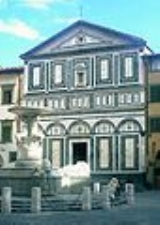
(1827). Here lies the Collegiata di Sant'Andrea, the main city's monument. The church probably existed as early as the 5th century AD, and is mentioned in papal bull of 1059. It was rebuilt in the 11th century by the pievano Rolando, by permission of the Countess Emilia dei Conti Guidi. At the mid of the following century a Romanesque arcaded façade was added: it was decorated with bi-chrome marble stones, in a style inspired by the basilica of San MiniatoBasilica di San Miniato al MonteSan Miniato al Monte is a basilica in Florence, central Italy, standing atop one of the highest points in the city. It has been described as one of the finest Romanesque structures in Tuscany and one of the most beautiful churches in Italy. There is an adjoining Olivetan monastery, seen to the...
in FlorenceFlorenceFlorence is the capital city of the Italian region of Tuscany and of the province of Florence. It is the most populous city in Tuscany, with approximately 370,000 inhabitants, expanding to over 1.5 million in the metropolitan area....
. The green stones were from PratoPratoPrato is a city and comune in Tuscany, Italy, the capital of the Province of Prato. The city is situated at the foot of Monte Retaia , the last peak in the Calvana chain. The lowest altitude in the comune is 32 m, near the Cascine di Tavola, and the highest is the peak of Monte Cantagrillo...
, the white ones are from CarraraCarraraCarrara is a city and comune in the province of Massa-Carrara , notable for the white or blue-grey marble quarried there. It is on the Carrione River, some west-northwest of Florence....
: today the lower part of the original decoration remains. In 1735 the architect Ferdinando RuggieriFerdinando RuggieriFerdinando Ruggeri was an Italian architect....
extensively modified the façade and the interior structure, including the ceiling. It houses noteworthy artworks including paintings by Francesco BotticiniFrancesco BotticiniFrancesco di Giovanni Botticini was an Italian Early Renaissance painter. He studied under Cosimo Rosselli and Andrea del Verrocchio. He was born in Florence in 1446 and is mostly remembered for his painting entitled "Assumption of the Virgin"; he died in 1498...
, a terracotta by Luca della RobbiaLuca della RobbiaLuca della Robbia was an Italian sculptor from Florence, noted for his terra-cotta roundels.Luca Della Robbia developed a pottery glaze that made his creations more durable in the outdoors and thus suitable for use on the exterior of buildings. His work is noted for its charm rather than the drama...
, an altarpiece (1785) by Zanobi del RossoZanobi del RossoZanobi del Rosso was an Italian architect. He designed the Kaffeehaus in the Boboli Gardens.- References :...
and a triptychTriptychA triptych , from tri-= "three" + ptysso= "to fold") is a work of art which is divided into three sections, or three carved panels which are hinged together and can be folded shut or displayed open. It is therefore a type of polyptych, the term for all multi-panel works...
by Lorenzo di BicciLorenzo di BicciLorenzo di Bicci was an Italian painter of the Florentine school, traditional in outlook. He is believed to have learned his trade from his father, about whom little other than his name, Bicci, is known. By 1370, Lorenzo was a member of the Guild of Saint Luke, the painters' guild of Florence...
portraying the Madonna in Throne with Saints. - The Palazzo Ghibellino is the former palace of the Guidi counts. It was probably erected in the 11th century. In 1260 it was the seat of the Ghibelline parliament where the fate of the Florence's GuelphGuelphs and GhibellinesThe Guelphs and Ghibellines were factions supporting the Pope and the Holy Roman Emperor, respectively, in central and northern Italy. During the 12th and 13th centuries, the split between these two parties was a particularly important aspect of the internal policy of the Italian city-states...
s was decided. In the 16th century the palace was restored, leaving little of the original structure, though. - The Palazzo Pretorio was the Town Hall in the Middle Ages. Currently it houses several activities, including an auditoriumAuditoriumAn auditorium is a room built to enable an audience to hear and watch performances at venues such as theatres. For movie theaters, the number of auditoriums is expressed as the number of screens.- Etymology :...
.
In the frazione (hamlet) of Pontorme is the house of the painter Pontormo
Pontormo
Jacopo Carucci , usually known as Jacopo da Pontormo, Jacopo Pontormo or simply Pontormo, was an Italian Mannerist painter and portraitist from the Florentine school. His work represents a profound stylistic shift from the calm perspectival regularity that characterized the art of the Florentine...
.
Notable people
- Farinata degli Uberti, real name Manente degli UbertiFarinata degli UbertiFarinata degli Uberti , real name Manente degli Uberti, was an Italian aristocrat and military leader, considered by some to be a heretic, who appears in Dante Alighieri's Inferno and is mentioned in C.S...
(1212–1264), politician leader [anti-Papal] - Giovanni da Empoli (1483–1518), navigator
- Jacopo Carrucci, better known as PontormoPontormoJacopo Carucci , usually known as Jacopo da Pontormo, Jacopo Pontormo or simply Pontormo, was an Italian Mannerist painter and portraitist from the Florentine school. His work represents a profound stylistic shift from the calm perspectival regularity that characterized the art of the Florentine...
(1494–1556), painter - Jacopo da EmpoliJacopo da Empolithumb|250px|Martyrdom of St. Sebastian, [[San Lorenzo di Firenze|San Lorenzo]], [[Florence]].Jacopo da Empoli was an Italian late-mannerist painter....
(1551–1640), painter - Alessandro MarchettiAlessandro MarchettiAlessandro Marchetti may refer to:* Alessandro Marchetti * Alessandro Marchetti...
(1633–1714), mathematician and writer - Giuseppe del Papa (1648–1735), doctor and philosopher
- Ippolito Neri (1652–1708), doctor and poet
- Renato Fucini (1843–1921), writer
- Giuliano Vanghetti (1861–1940), orthopaedist
- Ferruccio BusoniFerruccio BusoniFerruccio Busoni was an Italian composer, pianist, editor, writer, piano and composition teacher, and conductor.-Biography:...
(1866–1924), musician - Alberto Castellani (1884–1932), Eastern countries scholar
- Mentore MagginiMentore MagginiMentore Maggini was an Italian astronomer.He was director of the Collurania Observatory and is best known for his maps of Mars and the work on binary stars.A crater on Mars was named in his honor....
(1890–1941), astronomer - Remo Scappini (1908–1994), politician and anti-Fascist militant
- Carlo Rovini (1932–1988), poet and writer
- Mario Panzani (1921–Present), painter and sculpturer
Sport
Empoli's main football/soccer team is Empoli F.C.Empoli F.C.
Empoli Football Club is an Italian association football club located in Empoli, Tuscany, founded in 1920 and played its first official match in 1921.In recent years, the club has all too often been bouncing between Italy's two top divisions...
, which is currently playing in Serie B
Serie B
Serie B, currently named Serie bwin due to sponsorship reasons, is the second-highest division in the Italian football league system after the Serie A. It is contested by 22 teams and organized by the Lega Serie B since July 2010, after the split of Lega Calcio that previously took care of both the...
.
Twinnings
Sankt Georgen an der GusenSankt Georgen an der Gusen
Sankt Georgen an der Gusen is a small market town in Upper Austria, Austria, between the municipalities of Luftenberg and Langenstein...
, Austria
Austria
Austria , officially the Republic of Austria , is a landlocked country of roughly 8.4 million people in Central Europe. It is bordered by the Czech Republic and Germany to the north, Slovakia and Hungary to the east, Slovenia and Italy to the south, and Switzerland and Liechtenstein to the...
Aubervilliers
Aubervilliers
Aubervilliers is a commune in the northeastern suburbs of Paris, France. It is located from the center of Paris.-Name:In medieval times the name Aubervilliers was recorded as Alberti Villare, meaning "estate of Adalbert"...
, France
France
The French Republic , The French Republic , The French Republic , (commonly known as France , is a unitary semi-presidential republic in Western Europe with several overseas territories and islands located on other continents and in the Indian, Pacific, and Atlantic oceans. Metropolitan France...
Besançon
Besançon
Besançon , is the capital and principal city of the Franche-Comté region in eastern France. It had a population of about 237,000 inhabitants in the metropolitan area in 2008...
, France Toledo
Toledo, Spain
Toledo's Alcázar became renowned in the 19th and 20th centuries as a military academy. At the outbreak of the Spanish Civil War in 1936 its garrison was famously besieged by Republican forces.-Economy:...
, Spain
Spain
Spain , officially the Kingdom of Spain languages]] under the European Charter for Regional or Minority Languages. In each of these, Spain's official name is as follows:;;;;;;), is a country and member state of the European Union located in southwestern Europe on the Iberian Peninsula...
Namur
Namur (city)
Namur is a city and municipality in Wallonia, in southern Belgium. It is both the capital of the province of Namur and of Wallonia....
, Belgium
Belgium
Belgium , officially the Kingdom of Belgium, is a federal state in Western Europe. It is a founding member of the European Union and hosts the EU's headquarters, and those of several other major international organisations such as NATO.Belgium is also a member of, or affiliated to, many...
Empoli (ˈempoli) is a town and comune
Comune
In Italy, the comune is the basic administrative division, and may be properly approximated in casual speech by the English word township or municipality.-Importance and function:...
in Tuscany
Tuscany
Tuscany is a region in Italy. It has an area of about 23,000 square kilometres and a population of about 3.75 million inhabitants. The regional capital is Florence ....
, Italy
Italy
Italy , officially the Italian Republic languages]] under the European Charter for Regional or Minority Languages. In each of these, Italy's official name is as follows:;;;;;;;;), is a unitary parliamentary republic in South-Central Europe. To the north it borders France, Switzerland, Austria and...
, about 20 km southwest of Florence
Florence
Florence is the capital city of the Italian region of Tuscany and of the province of Florence. It is the most populous city in Tuscany, with approximately 370,000 inhabitants, expanding to over 1.5 million in the metropolitan area....
, to the south of the Arno in a plain formed by the latter river. The plain has been usable for agriculture since Roman
Ancient Rome
Ancient Rome was a thriving civilization that grew on the Italian Peninsula as early as the 8th century BC. Located along the Mediterranean Sea and centered on the city of Rome, it expanded to one of the largest empires in the ancient world....
times. The commune's territory becomes a hilly one as it departs from the river. Empoli is on the main railway line from Florence to Pisa
Pisa
Pisa is a city in Tuscany, Central Italy, on the right bank of the mouth of the River Arno on the Tyrrhenian Sea. It is the capital city of the Province of Pisa...
, and is the point of divergence of a line to Siena
Siena
Siena is a city in Tuscany, Italy. It is the capital of the province of Siena.The historic centre of Siena has been declared by UNESCO a World Heritage Site. It is one of the nation's most visited tourist attractions, with over 163,000 international arrivals in 2008...
.
Empoli has an enduring tradition as an agricultural centre. It has given its name to a local variety of artichoke
Artichoke
-Plants:* Globe artichoke, a partially edible perennial thistle originating in southern Europe around the Mediterranean* Jerusalem artichoke, a species of sunflower with an edible tuber...
.
History
Archaeological finds have revealed that Empoli was already settled in the early Roman EmpireRoman Empire
The Roman Empire was the post-Republican period of the ancient Roman civilization, characterised by an autocratic form of government and large territorial holdings in Europe and around the Mediterranean....
times, and continued to exist until 4th century AD. The river acted as a communication way for the trade of agricultural products, together with the local amphora
Amphora
An amphora is a type of vase-shaped, usually ceramic container with two handles and a long neck narrower than the body...
e. In the Tabula Peutingeriana
Tabula Peutingeriana
The Tabula Peutingeriana is an itinerarium showing the cursus publicus, the road network in the Roman Empire. The original map of which this is a unique copy was last revised in the fourth or early fifth century. It covers Europe, parts of Asia and North Africa...
of the 4th century Empoli is called in portu ("in the port") as a river port on the Roman road Via Quinctia, which led from Fiesole
Fiesole
Fiesole is a town and comune of the province of Florence in the Italian region of Tuscany, on a famously scenic height above Florence, 8 km NE of that city...
and Florence
Florence
Florence is the capital city of the Italian region of Tuscany and of the province of Florence. It is the most populous city in Tuscany, with approximately 370,000 inhabitants, expanding to over 1.5 million in the metropolitan area....
to Pisa
Pisa
Pisa is a city in Tuscany, Central Italy, on the right bank of the mouth of the River Arno on the Tyrrhenian Sea. It is the capital city of the Province of Pisa...
. Empoli was also on the Via Salaiola, connecting to Volterra
Volterra
Volterra, known to the ancient Etruscans as Velathri, to the Romans as Volaterrae, is a town and comune in the Tuscany region of Italy.-History:...
's salt ponds.
Since the 8th century Empoli consolidated as a town around the castle, known as Emporium or Empolis. In 1119 it was absorbed into the Guidi
Guidi
Guidi is an Italian surname shared by several notable people:* Domenico Guidi , Italian sculptor* Carlo Alessandro Guidi , Italian lyric poet* Ignazio Guidi , Italian orientalist...
counts possessions. In 1182 it went under Florentine
Florence
Florence is the capital city of the Italian region of Tuscany and of the province of Florence. It is the most populous city in Tuscany, with approximately 370,000 inhabitants, expanding to over 1.5 million in the metropolitan area....
rule. In 1260, after the Battle of Montaperti
Battle of Montaperti
The Battle of Montaperti was fought on September 4, 1260, between Florence and Siena in Tuscany as part of the conflict between the Guelphs and Ghibellines...
, Empoli was the seat of a famous council in which Farinata degli Uberti
Farinata degli Uberti
Farinata degli Uberti , real name Manente degli Uberti, was an Italian aristocrat and military leader, considered by some to be a heretic, who appears in Dante Alighieri's Inferno and is mentioned in C.S...
opposed the destruction of Florence.
Later Empoli became an important fortress, and was therefore repeatedly sacked and attacked. In 1530 its fall marked the end of the independence of the Florentine Republic.
Main sights
- The Piazza Farinata degli Uberti, also known as Piazza dei Leoni ("Lions Square"), is marked in its centre by a fountain by Luigi PampaloniLuigi PampaloniLuigi Pampaloni was an Italian sculptor....
(1827). Here lies the Collegiata di Sant'Andrea, the main city's monument. The church probably existed as early as the 5th century AD, and is mentioned in papal bull of 1059. It was rebuilt in the 11th century by the pievano Rolando, by permission of the Countess Emilia dei Conti Guidi. At the mid of the following century a Romanesque arcaded façade was added: it was decorated with bi-chrome marble stones, in a style inspired by the basilica of San MiniatoBasilica di San Miniato al MonteSan Miniato al Monte is a basilica in Florence, central Italy, standing atop one of the highest points in the city. It has been described as one of the finest Romanesque structures in Tuscany and one of the most beautiful churches in Italy. There is an adjoining Olivetan monastery, seen to the...
in FlorenceFlorenceFlorence is the capital city of the Italian region of Tuscany and of the province of Florence. It is the most populous city in Tuscany, with approximately 370,000 inhabitants, expanding to over 1.5 million in the metropolitan area....
. The green stones were from PratoPratoPrato is a city and comune in Tuscany, Italy, the capital of the Province of Prato. The city is situated at the foot of Monte Retaia , the last peak in the Calvana chain. The lowest altitude in the comune is 32 m, near the Cascine di Tavola, and the highest is the peak of Monte Cantagrillo...
, the white ones are from CarraraCarraraCarrara is a city and comune in the province of Massa-Carrara , notable for the white or blue-grey marble quarried there. It is on the Carrione River, some west-northwest of Florence....
: today the lower part of the original decoration remains. In 1735 the architect Ferdinando RuggieriFerdinando RuggieriFerdinando Ruggeri was an Italian architect....
extensively modified the façade and the interior structure, including the ceiling. It houses noteworthy artworks including paintings by Francesco BotticiniFrancesco BotticiniFrancesco di Giovanni Botticini was an Italian Early Renaissance painter. He studied under Cosimo Rosselli and Andrea del Verrocchio. He was born in Florence in 1446 and is mostly remembered for his painting entitled "Assumption of the Virgin"; he died in 1498...
, a terracotta by Luca della RobbiaLuca della RobbiaLuca della Robbia was an Italian sculptor from Florence, noted for his terra-cotta roundels.Luca Della Robbia developed a pottery glaze that made his creations more durable in the outdoors and thus suitable for use on the exterior of buildings. His work is noted for its charm rather than the drama...
, an altarpiece (1785) by Zanobi del RossoZanobi del RossoZanobi del Rosso was an Italian architect. He designed the Kaffeehaus in the Boboli Gardens.- References :...
and a triptychTriptychA triptych , from tri-= "three" + ptysso= "to fold") is a work of art which is divided into three sections, or three carved panels which are hinged together and can be folded shut or displayed open. It is therefore a type of polyptych, the term for all multi-panel works...
by Lorenzo di BicciLorenzo di BicciLorenzo di Bicci was an Italian painter of the Florentine school, traditional in outlook. He is believed to have learned his trade from his father, about whom little other than his name, Bicci, is known. By 1370, Lorenzo was a member of the Guild of Saint Luke, the painters' guild of Florence...
portraying the Madonna in Throne with Saints. - The Palazzo Ghibellino is the former palace of the Guidi counts. It was probably erected in the 11th century. In 1260 it was the seat of the Ghibelline parliament where the fate of the Florence's GuelphGuelphs and GhibellinesThe Guelphs and Ghibellines were factions supporting the Pope and the Holy Roman Emperor, respectively, in central and northern Italy. During the 12th and 13th centuries, the split between these two parties was a particularly important aspect of the internal policy of the Italian city-states...
s was decided. In the 16th century the palace was restored, leaving little of the original structure, though. - The Palazzo Pretorio was the Town Hall in the Middle Ages. Currently it houses several activities, including an auditoriumAuditoriumAn auditorium is a room built to enable an audience to hear and watch performances at venues such as theatres. For movie theaters, the number of auditoriums is expressed as the number of screens.- Etymology :...
.
In the frazione (hamlet) of Pontorme is the house of the painter Pontormo
Pontormo
Jacopo Carucci , usually known as Jacopo da Pontormo, Jacopo Pontormo or simply Pontormo, was an Italian Mannerist painter and portraitist from the Florentine school. His work represents a profound stylistic shift from the calm perspectival regularity that characterized the art of the Florentine...
.
Notable people
- Farinata degli Uberti, real name Manente degli UbertiFarinata degli UbertiFarinata degli Uberti , real name Manente degli Uberti, was an Italian aristocrat and military leader, considered by some to be a heretic, who appears in Dante Alighieri's Inferno and is mentioned in C.S...
(1212–1264), politician leader [anti-Papal] - Giovanni da Empoli (1483–1518), navigator
- Jacopo Carrucci, better known as PontormoPontormoJacopo Carucci , usually known as Jacopo da Pontormo, Jacopo Pontormo or simply Pontormo, was an Italian Mannerist painter and portraitist from the Florentine school. His work represents a profound stylistic shift from the calm perspectival regularity that characterized the art of the Florentine...
(1494–1556), painter - Jacopo da EmpoliJacopo da Empolithumb|250px|Martyrdom of St. Sebastian, [[San Lorenzo di Firenze|San Lorenzo]], [[Florence]].Jacopo da Empoli was an Italian late-mannerist painter....
(1551–1640), painter - Alessandro MarchettiAlessandro MarchettiAlessandro Marchetti may refer to:* Alessandro Marchetti * Alessandro Marchetti...
(1633–1714), mathematician and writer - Giuseppe del Papa (1648–1735), doctor and philosopher
- Ippolito Neri (1652–1708), doctor and poet
- Renato Fucini (1843–1921), writer
- Giuliano Vanghetti (1861–1940), orthopaedist
- Ferruccio BusoniFerruccio BusoniFerruccio Busoni was an Italian composer, pianist, editor, writer, piano and composition teacher, and conductor.-Biography:...
(1866–1924), musician - Alberto Castellani (1884–1932), Eastern countries scholar
- Mentore MagginiMentore MagginiMentore Maggini was an Italian astronomer.He was director of the Collurania Observatory and is best known for his maps of Mars and the work on binary stars.A crater on Mars was named in his honor....
(1890–1941), astronomer - Remo Scappini (1908–1994), politician and anti-Fascist militant
- Carlo Rovini (1932–1988), poet and writer
- Mario Panzani (1921–Present), painter and sculpturer
Sport
Empoli's main football/soccer team is Empoli F.C.Empoli F.C.
Empoli Football Club is an Italian association football club located in Empoli, Tuscany, founded in 1920 and played its first official match in 1921.In recent years, the club has all too often been bouncing between Italy's two top divisions...
, which is currently playing in Serie B
Serie B
Serie B, currently named Serie bwin due to sponsorship reasons, is the second-highest division in the Italian football league system after the Serie A. It is contested by 22 teams and organized by the Lega Serie B since July 2010, after the split of Lega Calcio that previously took care of both the...
.
Twinnings
Sankt Georgen an der GusenSankt Georgen an der Gusen
Sankt Georgen an der Gusen is a small market town in Upper Austria, Austria, between the municipalities of Luftenberg and Langenstein...
, Austria
Austria
Austria , officially the Republic of Austria , is a landlocked country of roughly 8.4 million people in Central Europe. It is bordered by the Czech Republic and Germany to the north, Slovakia and Hungary to the east, Slovenia and Italy to the south, and Switzerland and Liechtenstein to the...
Aubervilliers
Aubervilliers
Aubervilliers is a commune in the northeastern suburbs of Paris, France. It is located from the center of Paris.-Name:In medieval times the name Aubervilliers was recorded as Alberti Villare, meaning "estate of Adalbert"...
, France
France
The French Republic , The French Republic , The French Republic , (commonly known as France , is a unitary semi-presidential republic in Western Europe with several overseas territories and islands located on other continents and in the Indian, Pacific, and Atlantic oceans. Metropolitan France...
Besançon
Besançon
Besançon , is the capital and principal city of the Franche-Comté region in eastern France. It had a population of about 237,000 inhabitants in the metropolitan area in 2008...
, France Toledo
Toledo, Spain
Toledo's Alcázar became renowned in the 19th and 20th centuries as a military academy. At the outbreak of the Spanish Civil War in 1936 its garrison was famously besieged by Republican forces.-Economy:...
, Spain
Spain
Spain , officially the Kingdom of Spain languages]] under the European Charter for Regional or Minority Languages. In each of these, Spain's official name is as follows:;;;;;;), is a country and member state of the European Union located in southwestern Europe on the Iberian Peninsula...
Namur
Namur (city)
Namur is a city and municipality in Wallonia, in southern Belgium. It is both the capital of the province of Namur and of Wallonia....
, Belgium
Belgium
Belgium , officially the Kingdom of Belgium, is a federal state in Western Europe. It is a founding member of the European Union and hosts the EU's headquarters, and those of several other major international organisations such as NATO.Belgium is also a member of, or affiliated to, many...
Empoli (ˈempoli) is a town and comune
Comune
In Italy, the comune is the basic administrative division, and may be properly approximated in casual speech by the English word township or municipality.-Importance and function:...
in Tuscany
Tuscany
Tuscany is a region in Italy. It has an area of about 23,000 square kilometres and a population of about 3.75 million inhabitants. The regional capital is Florence ....
, Italy
Italy
Italy , officially the Italian Republic languages]] under the European Charter for Regional or Minority Languages. In each of these, Italy's official name is as follows:;;;;;;;;), is a unitary parliamentary republic in South-Central Europe. To the north it borders France, Switzerland, Austria and...
, about 20 km southwest of Florence
Florence
Florence is the capital city of the Italian region of Tuscany and of the province of Florence. It is the most populous city in Tuscany, with approximately 370,000 inhabitants, expanding to over 1.5 million in the metropolitan area....
, to the south of the Arno in a plain formed by the latter river. The plain has been usable for agriculture since Roman
Ancient Rome
Ancient Rome was a thriving civilization that grew on the Italian Peninsula as early as the 8th century BC. Located along the Mediterranean Sea and centered on the city of Rome, it expanded to one of the largest empires in the ancient world....
times. The commune's territory becomes a hilly one as it departs from the river. Empoli is on the main railway line from Florence to Pisa
Pisa
Pisa is a city in Tuscany, Central Italy, on the right bank of the mouth of the River Arno on the Tyrrhenian Sea. It is the capital city of the Province of Pisa...
, and is the point of divergence of a line to Siena
Siena
Siena is a city in Tuscany, Italy. It is the capital of the province of Siena.The historic centre of Siena has been declared by UNESCO a World Heritage Site. It is one of the nation's most visited tourist attractions, with over 163,000 international arrivals in 2008...
.
Empoli has an enduring tradition as an agricultural centre. It has given its name to a local variety of artichoke
Artichoke
-Plants:* Globe artichoke, a partially edible perennial thistle originating in southern Europe around the Mediterranean* Jerusalem artichoke, a species of sunflower with an edible tuber...
.
History
Archaeological finds have revealed that Empoli was already settled in the early Roman EmpireRoman Empire
The Roman Empire was the post-Republican period of the ancient Roman civilization, characterised by an autocratic form of government and large territorial holdings in Europe and around the Mediterranean....
times, and continued to exist until 4th century AD. The river acted as a communication way for the trade of agricultural products, together with the local amphora
Amphora
An amphora is a type of vase-shaped, usually ceramic container with two handles and a long neck narrower than the body...
e. In the Tabula Peutingeriana
Tabula Peutingeriana
The Tabula Peutingeriana is an itinerarium showing the cursus publicus, the road network in the Roman Empire. The original map of which this is a unique copy was last revised in the fourth or early fifth century. It covers Europe, parts of Asia and North Africa...
of the 4th century Empoli is called in portu ("in the port") as a river port on the Roman road Via Quinctia, which led from Fiesole
Fiesole
Fiesole is a town and comune of the province of Florence in the Italian region of Tuscany, on a famously scenic height above Florence, 8 km NE of that city...
and Florence
Florence
Florence is the capital city of the Italian region of Tuscany and of the province of Florence. It is the most populous city in Tuscany, with approximately 370,000 inhabitants, expanding to over 1.5 million in the metropolitan area....
to Pisa
Pisa
Pisa is a city in Tuscany, Central Italy, on the right bank of the mouth of the River Arno on the Tyrrhenian Sea. It is the capital city of the Province of Pisa...
. Empoli was also on the Via Salaiola, connecting to Volterra
Volterra
Volterra, known to the ancient Etruscans as Velathri, to the Romans as Volaterrae, is a town and comune in the Tuscany region of Italy.-History:...
's salt ponds.
Since the 8th century Empoli consolidated as a town around the castle, known as Emporium or Empolis. In 1119 it was absorbed into the Guidi
Guidi
Guidi is an Italian surname shared by several notable people:* Domenico Guidi , Italian sculptor* Carlo Alessandro Guidi , Italian lyric poet* Ignazio Guidi , Italian orientalist...
counts possessions. In 1182 it went under Florentine
Florence
Florence is the capital city of the Italian region of Tuscany and of the province of Florence. It is the most populous city in Tuscany, with approximately 370,000 inhabitants, expanding to over 1.5 million in the metropolitan area....
rule. In 1260, after the Battle of Montaperti
Battle of Montaperti
The Battle of Montaperti was fought on September 4, 1260, between Florence and Siena in Tuscany as part of the conflict between the Guelphs and Ghibellines...
, Empoli was the seat of a famous council in which Farinata degli Uberti
Farinata degli Uberti
Farinata degli Uberti , real name Manente degli Uberti, was an Italian aristocrat and military leader, considered by some to be a heretic, who appears in Dante Alighieri's Inferno and is mentioned in C.S...
opposed the destruction of Florence.
Later Empoli became an important fortress, and was therefore repeatedly sacked and attacked. In 1530 its fall marked the end of the independence of the Florentine Republic.
Main sights
- The Piazza Farinata degli Uberti, also known as Piazza dei Leoni ("Lions Square"), is marked in its centre by a fountain by Luigi PampaloniLuigi PampaloniLuigi Pampaloni was an Italian sculptor....
(1827). Here lies the Collegiata di Sant'Andrea, the main city's monument. The church probably existed as early as the 5th century AD, and is mentioned in papal bull of 1059. It was rebuilt in the 11th century by the pievano Rolando, by permission of the Countess Emilia dei Conti Guidi. At the mid of the following century a Romanesque arcaded façade was added: it was decorated with bi-chrome marble stones, in a style inspired by the basilica of San MiniatoBasilica di San Miniato al MonteSan Miniato al Monte is a basilica in Florence, central Italy, standing atop one of the highest points in the city. It has been described as one of the finest Romanesque structures in Tuscany and one of the most beautiful churches in Italy. There is an adjoining Olivetan monastery, seen to the...
in FlorenceFlorenceFlorence is the capital city of the Italian region of Tuscany and of the province of Florence. It is the most populous city in Tuscany, with approximately 370,000 inhabitants, expanding to over 1.5 million in the metropolitan area....
. The green stones were from PratoPratoPrato is a city and comune in Tuscany, Italy, the capital of the Province of Prato. The city is situated at the foot of Monte Retaia , the last peak in the Calvana chain. The lowest altitude in the comune is 32 m, near the Cascine di Tavola, and the highest is the peak of Monte Cantagrillo...
, the white ones are from CarraraCarraraCarrara is a city and comune in the province of Massa-Carrara , notable for the white or blue-grey marble quarried there. It is on the Carrione River, some west-northwest of Florence....
: today the lower part of the original decoration remains. In 1735 the architect Ferdinando RuggieriFerdinando RuggieriFerdinando Ruggeri was an Italian architect....
extensively modified the façade and the interior structure, including the ceiling. It houses noteworthy artworks including paintings by Francesco BotticiniFrancesco BotticiniFrancesco di Giovanni Botticini was an Italian Early Renaissance painter. He studied under Cosimo Rosselli and Andrea del Verrocchio. He was born in Florence in 1446 and is mostly remembered for his painting entitled "Assumption of the Virgin"; he died in 1498...
, a terracotta by Luca della RobbiaLuca della RobbiaLuca della Robbia was an Italian sculptor from Florence, noted for his terra-cotta roundels.Luca Della Robbia developed a pottery glaze that made his creations more durable in the outdoors and thus suitable for use on the exterior of buildings. His work is noted for its charm rather than the drama...
, an altarpiece (1785) by Zanobi del RossoZanobi del RossoZanobi del Rosso was an Italian architect. He designed the Kaffeehaus in the Boboli Gardens.- References :...
and a triptychTriptychA triptych , from tri-= "three" + ptysso= "to fold") is a work of art which is divided into three sections, or three carved panels which are hinged together and can be folded shut or displayed open. It is therefore a type of polyptych, the term for all multi-panel works...
by Lorenzo di BicciLorenzo di BicciLorenzo di Bicci was an Italian painter of the Florentine school, traditional in outlook. He is believed to have learned his trade from his father, about whom little other than his name, Bicci, is known. By 1370, Lorenzo was a member of the Guild of Saint Luke, the painters' guild of Florence...
portraying the Madonna in Throne with Saints. - The Palazzo Ghibellino is the former palace of the Guidi counts. It was probably erected in the 11th century. In 1260 it was the seat of the Ghibelline parliament where the fate of the Florence's GuelphGuelphs and GhibellinesThe Guelphs and Ghibellines were factions supporting the Pope and the Holy Roman Emperor, respectively, in central and northern Italy. During the 12th and 13th centuries, the split between these two parties was a particularly important aspect of the internal policy of the Italian city-states...
s was decided. In the 16th century the palace was restored, leaving little of the original structure, though. - The Palazzo Pretorio was the Town Hall in the Middle Ages. Currently it houses several activities, including an auditoriumAuditoriumAn auditorium is a room built to enable an audience to hear and watch performances at venues such as theatres. For movie theaters, the number of auditoriums is expressed as the number of screens.- Etymology :...
.
In the frazione (hamlet) of Pontorme is the house of the painter Pontormo
Pontormo
Jacopo Carucci , usually known as Jacopo da Pontormo, Jacopo Pontormo or simply Pontormo, was an Italian Mannerist painter and portraitist from the Florentine school. His work represents a profound stylistic shift from the calm perspectival regularity that characterized the art of the Florentine...
.
Notable people
- Farinata degli Uberti, real name Manente degli UbertiFarinata degli UbertiFarinata degli Uberti , real name Manente degli Uberti, was an Italian aristocrat and military leader, considered by some to be a heretic, who appears in Dante Alighieri's Inferno and is mentioned in C.S...
(1212–1264), politician leader [anti-Papal] - Giovanni da Empoli (1483–1518), navigator
- Jacopo Carrucci, better known as PontormoPontormoJacopo Carucci , usually known as Jacopo da Pontormo, Jacopo Pontormo or simply Pontormo, was an Italian Mannerist painter and portraitist from the Florentine school. His work represents a profound stylistic shift from the calm perspectival regularity that characterized the art of the Florentine...
(1494–1556), painter - Jacopo da EmpoliJacopo da Empolithumb|250px|Martyrdom of St. Sebastian, [[San Lorenzo di Firenze|San Lorenzo]], [[Florence]].Jacopo da Empoli was an Italian late-mannerist painter....
(1551–1640), painter - Alessandro MarchettiAlessandro MarchettiAlessandro Marchetti may refer to:* Alessandro Marchetti * Alessandro Marchetti...
(1633–1714), mathematician and writer - Giuseppe del Papa (1648–1735), doctor and philosopher
- Ippolito Neri (1652–1708), doctor and poet
- Renato Fucini (1843–1921), writer
- Giuliano Vanghetti (1861–1940), orthopaedist
- Ferruccio BusoniFerruccio BusoniFerruccio Busoni was an Italian composer, pianist, editor, writer, piano and composition teacher, and conductor.-Biography:...
(1866–1924), musician - Alberto Castellani (1884–1932), Eastern countries scholar
- Mentore MagginiMentore MagginiMentore Maggini was an Italian astronomer.He was director of the Collurania Observatory and is best known for his maps of Mars and the work on binary stars.A crater on Mars was named in his honor....
(1890–1941), astronomer - Remo Scappini (1908–1994), politician and anti-Fascist militant
- Carlo Rovini (1932–1988), poet and writer
- Mario Panzani (1921–Present), painter and sculpturer
Sport
Empoli's main football/soccer team is Empoli F.C.Empoli F.C.
Empoli Football Club is an Italian association football club located in Empoli, Tuscany, founded in 1920 and played its first official match in 1921.In recent years, the club has all too often been bouncing between Italy's two top divisions...
, which is currently playing in Serie B
Serie B
Serie B, currently named Serie bwin due to sponsorship reasons, is the second-highest division in the Italian football league system after the Serie A. It is contested by 22 teams and organized by the Lega Serie B since July 2010, after the split of Lega Calcio that previously took care of both the...
.
Twinnings
Sankt Georgen an der GusenSankt Georgen an der Gusen
Sankt Georgen an der Gusen is a small market town in Upper Austria, Austria, between the municipalities of Luftenberg and Langenstein...
, Austria
Austria
Austria , officially the Republic of Austria , is a landlocked country of roughly 8.4 million people in Central Europe. It is bordered by the Czech Republic and Germany to the north, Slovakia and Hungary to the east, Slovenia and Italy to the south, and Switzerland and Liechtenstein to the...
Aubervilliers
Aubervilliers
Aubervilliers is a commune in the northeastern suburbs of Paris, France. It is located from the center of Paris.-Name:In medieval times the name Aubervilliers was recorded as Alberti Villare, meaning "estate of Adalbert"...
, France
France
The French Republic , The French Republic , The French Republic , (commonly known as France , is a unitary semi-presidential republic in Western Europe with several overseas territories and islands located on other continents and in the Indian, Pacific, and Atlantic oceans. Metropolitan France...
Besançon
Besançon
Besançon , is the capital and principal city of the Franche-Comté region in eastern France. It had a population of about 237,000 inhabitants in the metropolitan area in 2008...
, France Toledo
Toledo, Spain
Toledo's Alcázar became renowned in the 19th and 20th centuries as a military academy. At the outbreak of the Spanish Civil War in 1936 its garrison was famously besieged by Republican forces.-Economy:...
, Spain
Spain
Spain , officially the Kingdom of Spain languages]] under the European Charter for Regional or Minority Languages. In each of these, Spain's official name is as follows:;;;;;;), is a country and member state of the European Union located in southwestern Europe on the Iberian Peninsula...
Namur
Namur (city)
Namur is a city and municipality in Wallonia, in southern Belgium. It is both the capital of the province of Namur and of Wallonia....
, Belgium
Belgium
Belgium , officially the Kingdom of Belgium, is a federal state in Western Europe. It is a founding member of the European Union and hosts the EU's headquarters, and those of several other major international organisations such as NATO.Belgium is also a member of, or affiliated to, many...