
All Topics  
Cormorant

 
Cormorant

   Email Print
   Bookmark   Link


Cormorant


The bird
Bird

Birds are wing, Bipedalismal, endothermic , vertebrate animals that lay egg . There are around 10,000 living species, making them the most numerous tetrapod vertebrates....
 family
Family (biology)

In biological classification, family is a taxonomic rank. Exact details of formal nomenclature depend on the Nomenclature Codes which applies....
 Phalacrocoracidae is represented by some 40 species
Species

In biology, a species is one of the basic units of biological classification and a taxonomic rank. A species is often defined as a group of organisms capable of interbreeding and producing fertile offspring....
 of cormorants and shags. Several different classifications of the family have been proposed recently, and the number of genera
Genus

A genus is a low-level taxonomic rank used in the classification of living and fossil organisms. The taxonomic ranks are domain , kingdom , phylum, class , order , family , genus, and species....
 is disputed.

e is no consistent distinction between cormorants and shags. The names "cormorant" and "shag" were originally the common names of the two species of the family found in Great Britain
Great Britain

Great Britain is an island lying to the northwest of Continental Europe. It is the List of islands by area, and the largest in Europe. With a population of 58.9 million people it is List of islands by population....
, Phalacrocorax carbo (now referred to by ornithologists as the Great Cormorant
Great Cormorant

The Great Cormorant , known as the Great Black Cormorant across the Northern Hemisphere, the Black Cormorant in Australia and the Black Shag further south in New Zealand, is a widespread member of the cormorant family of seabirds....
) and P.


Discussion
Ask a question about 'Cormorant'
Start a new discussion about 'Cormorant'
Answer questions from other users
Full Discussion Forum


Encyclopedia


The bird
Bird

Birds are wing, Bipedalismal, endothermic , vertebrate animals that lay egg . There are around 10,000 living species, making them the most numerous tetrapod vertebrates....
 family
Family (biology)

In biological classification, family is a taxonomic rank. Exact details of formal nomenclature depend on the Nomenclature Codes which applies....
 Phalacrocoracidae is represented by some 40 species
Species

In biology, a species is one of the basic units of biological classification and a taxonomic rank. A species is often defined as a group of organisms capable of interbreeding and producing fertile offspring....
 of cormorants and shags. Several different classifications of the family have been proposed recently, and the number of genera
Genus

A genus is a low-level taxonomic rank used in the classification of living and fossil organisms. The taxonomic ranks are domain , kingdom , phylum, class , order , family , genus, and species....
 is disputed.

Names

There is no consistent distinction between cormorants and shags. The names "cormorant" and "shag" were originally the common names of the two species of the family found in Great Britain
Great Britain

Great Britain is an island lying to the northwest of Continental Europe. It is the List of islands by area, and the largest in Europe. With a population of 58.9 million people it is List of islands by population....
, Phalacrocorax carbo (now referred to by ornithologists as the Great Cormorant
Great Cormorant

The Great Cormorant , known as the Great Black Cormorant across the Northern Hemisphere, the Black Cormorant in Australia and the Black Shag further south in New Zealand, is a widespread member of the cormorant family of seabirds....
) and P. aristotelis (the Common Shag
Common Shag

The European Shag or Common Shag is a species of cormorant. It breeds around the rocky coasts of western and southernEurope, southwest Asia and north Africa, mainly bird migration in its breeding range except for northernmost birds....
). "Shag" refers to the bird's crest, which the British forms of the Great Cormorant lack. As other species were discovered by English-speaking
English language

English is a West Germanic language that originated in Anglo-Saxon England and has lingua franca status in many parts of the world as a result of the military, economic, scientific, political and cultural influence of the British Empire in the 18th, 19th and early 20th centuries and that of the United States from the mid 20th century onwa...
 sailors and explorers elsewhere in the world, some were called cormorants and some shags, depending on whether they had crests or not. Sometimes the same species is called a cormorant in one part of the world and a shag in another, e.g., the Great Cormorant is called the Black Shag in New Zealand
New Zealand

New Zealand is an island country in the south-western Pacific Ocean comprising two main landmasses , and numerous Islands of New Zealand, most notably Stewart Island/Rakiura and the Chatham Islands....
 (the birds found in Australasia
Australasia

Australasia is a region of Oceania: New Zealand, Australia, Papua New Guinea, and neighbouring islands in the Pacific Ocean. The term was coined by Charles de Brosses in Histoire des navigations aux terres australes ....
 have a crest that is absent in Europe
Europe

Europe is, conventionally, one of the world's seven continents. Comprising the westernmost peninsula of Eurasia, Europe is generally divided from Asia to its east by the water divide of the Ural Mountains, the Ural , the Caspian Sea, and by the Caucasus Mountains to the southeast....
an members of the species). Van Tets
Gerard Frederick van Tets

Gerard Frederick van Tets , sometimes stated as Jerry van Tets, was an English ornithologist and paleontologist.Gerard Frederick van Tets was born in London at 19 January 1929....
 (1976) proposed to divide the family into two genera
Genus

A genus is a low-level taxonomic rank used in the classification of living and fossil organisms. The taxonomic ranks are domain , kingdom , phylum, class , order , family , genus, and species....
 and attach the name "Cormorant" to one and "Shag" to the other, but this flies in the face of common usage and has not been widely adopted.

The scientific genus
Genus

A genus is a low-level taxonomic rank used in the classification of living and fossil organisms. The taxonomic ranks are domain , kingdom , phylum, class , order , family , genus, and species....
 name is latin
Latin

Latin is an Italic language, historically spoken in Latium and Ancient Rome. Through the Military history of the Roman Empire, Latin spread throughout the Mediterranean and a large part of Europe....
ized Ancient Greek
Ancient Greek

Ancient Greek is the historical stage in the development of the Greek language spanning across the Archaic Greece , Classical Greece , and Hellenistic civilization periods of ancient Greece and the classical antiquity....
, from fa?a???? (phalakros, "bald") and ???a? (korax, "raven"). This is often thought to refer to the creamy white patch on the cheeks of adult Great Cormorant
Great Cormorant

The Great Cormorant , known as the Great Black Cormorant across the Northern Hemisphere, the Black Cormorant in Australia and the Black Shag further south in New Zealand, is a widespread member of the cormorant family of seabirds....
s, or the ornamental white head plumes prominent in Mediterranean birds of this species, but is certainly not a unifying characteristic of cormorants. "Cormorant" is a contraction
Contraction (grammar)

In current English usage, contraction is shortening of a word, syllable, or word group by omission of internal letters.In traditional grammar, contraction can denote the formation of a new word from one word or a group of words, for example, by elision....
 derived from Latin corvus marinus, "sea raven". Indeed, "sea raven" or analogous terms were the usual terms for cormorants in Germanic languages
Germanic languages

The Germanic languages are a group of related languages that constitute a branch of the Indo-European languages language family. The common ancestor of all the languages in this branch is Proto-Germanic, spoken in approximately the mid-1st millennium BC in Pre-Roman Iron Age....
 until after the Middle Ages
Middle Ages

File:Karl 1 mit papst gelasius gregor1 sacramentar v karl d kahlen.jpgThe Middle Ages of European history are a period in history which lasted for roughly a millennium, commonly dated from the fall of the Roman Empire in the 5th century to the beginning of the Early Modern Period in the 16th century, marked by the division of Western Christi...
. The French explorer André Thévet
André Thévet

Andr? de Thevet was a France Franciscan priest, explorer, cosmographer and writer who travelled to Brazil in the 16th century. He described the country, its aboriginal inhabitants and the historical episodes involved in the France Antarctique, a French settlement in Rio de Janeiro, in his book Singularities of France Antarctique....
 commented in 1558 that "...the beak [is] similar to that of a cormorant or other corvid," which demonstrates that the erroneous belief that the birds were related to ravens lasted at least to the 16th century.

Characteristics

Cormorants and shags are medium-to-large seabird
Seabird

Seabirds are birds that have adaptation to life within the marine environment. While seabirds vary greatly in lifestyle, behavior and physiology, they often exhibit striking convergent evolution, as the same environmental problems and feeding ecological niche have resulted in similar adaptations....
s. They range in size from the Pygmy Cormorant
Pygmy Cormorant

The Pygmy Cormorant is a member of the cormorant family of seabirds. It breeds in southeastern Europe and southwestern Asia. It is partially bird migration, with northern populations wintering further south, mostly within in its breeding range....
 (Phalacrocorax pygmaeus), at as little as 45 cm (18 in) and 340 g (12 oz), to the Flightless Cormorant
Flightless Cormorant

The Flightless Cormorant , also known as the Galapagos Cormorant, is a cormorant native to the Galapagos Islands, and an example of the highly unusual fauna there....
 (Phalacrocorax harrisi), at a maximum size 100 cm (40 in) and 5 kg (11 lb). The recently-extinct Spectacled Cormorant
Spectacled Cormorant

The Spectacled Cormorant or Pallas's Cormorant is an Extinction marine bird of the cormorant family of seabirds that inhabited Bering Island and possibly other places in the Komandorski Islands....
 (Phalacrocorax perspicillatus) was rather larger, at an average size of 6.3 kg (14 lb). The majority, including nearly all Northern Hemisphere species, have mainly dark plumage
Feather

Feathers are one of the epidermal growths that form the distinctive outer covering, or plumage, on birds. They are considered the most complex integumentary structures found in vertebrates....
, but some Southern Hemisphere species are black and white, and a few (e.g. the Spotted Shag
Spotted Shag

The Spotted Shag or Parekareka, Phalacrocorax punctatus, is a species of cormorant Endemism to New Zealand. Originally classified as Phalacrocorax punctatus, it is sufficiently different in appearance from typical members of that genus that to be for a time placed in a separate genus, Stictocarbo, along with another similar...
 of New Zealand
New Zealand

New Zealand is an island country in the south-western Pacific Ocean comprising two main landmasses , and numerous Islands of New Zealand, most notably Stewart Island/Rakiura and the Chatham Islands....
) are quite colourful. Many species have areas of coloured skin on the face (the lore
Lore

Lore may refer to:* Lore, all the facts and traditions about a particular subject that have been accumulated over time through education or experience....
s and the gular skin
Gular skin

Gular skin is a term used in ornithology for an area of featherless skin on birds, that joins the lower mandible of the bill, to the bird's neck....
) which can be bright blue, orange, red or yellow, typically becoming more brightly coloured in the breeding season. The bill is long, thin, and sharply hooked. Their feet have webbing between all four toes, as in their relatives.

They are coastal rather than oceanic birds, and some have colonised inland waters - indeed, the original ancestor of cormorants seems to have been a fresh-water bird, judging from the habitat of the most ancient lineage. They range around the world, except for the central Pacific islands.

All are fish
Fish

A fish is any marine biology vertebrate animal that is typically ectothermic , covered with scale , and equipped with two sets of paired fins and several unpaired fins....
-eaters, dining on small eel
Eel

True eels are an order of fish, which consists of four suborders, 19 Family s, 110 genera and approximately 600 species. Most eels are predators....
s, fish, and even water snake
Snake

Snakes are elongate legless carnivore reptiles of the suborder Serpentes that can be distinguished from legless lizards by their lack of eyelids and external ears....
s. They dive from the surface, though many species make a characteristic half-jump as they dive, presumably to give themselves a more streamlined entry into the water. Under water they propel themselves with their feet. Some cormorant species have been found, using depth gauge
Depth gauge

A depth gauge is a pressure gauge that displays the equivalent depth in water. It is a piece of diving equipment often used by Scuba diving.Most modern diving depth gauges' have an electronics mechanism and digital display....
s, to dive to depths of as much as 45 metres.

After fishing, cormorants go ashore, and are frequently seen holding their wings out in the sun. All cormorants have preen gland secretions that are used ostensibly to keep the feathers waterproof. Some sources state that cormorants have waterproof feathers while others say that they have water permeable feathers. Still others suggests that the outer plumage absorbs water but does not permit it to penetrate the layer of air next to the skin. The wing drying action is seen even in the flightless cormorant but commonly in the Antarctic shags and red-legged cormorants. Alternate functions suggested for the spread-wing posture include that it aids thermoregulation, digestion, balances the bird or indicates presence of fish. A detailed study of the Great Cormorant concludes that it is without doubt to dry the plumage.

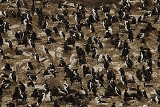
Cormorants are colonial nesters, using trees, rocky islets, or cliffs. The egg
Egg (biology)

In most birds and reptiles, an egg is the zygote, resulting from fertilization of the ovum. To enable incubation the egg is usually kept within a favourable temperature range as it nourishes and protects the growing embryo....
s are a chalky-blue colour. There is usually one brood a year. The young are fed through regurgitation
Regurgitation (digestion)

File:Flesh fly concentrating food.jpgRegurgitation is the controlled flow of stomach contents back into the esophagus and mouth.Regurgitation is used by a number of species to feed their young....
. They typically have deep, ungainly bills, showing a greater resemblance to those of the pelican
Pelican

A pelican is a large water bird with a distinctive pouch under the beak, belonging to the bird Family Pelecanidae.Along with the darters, cormorants, gannets, boobys, frigatebirds, and tropicbirds, pelicans make up the order Pelecaniformes....
s', to which they are related, than is obvious in the adults.

Systematics

The cormorants are a group traditionally placed within the Pelecaniformes
Pelecaniformes

The Pelecaniformes are an order of medium-sized and large waterbirds found worldwide. They are distinguished from other birds by the possession of feet with all four toes webbed ....
 or, in the Sibley-Ahlquist taxonomy
Sibley-Ahlquist taxonomy

The Sibley-Ahlquist taxonomy is a radical bird taxonomy proposed by Charles Sibley and Jon Edward Ahlquist. It is based on DNA-DNA hybridization studies conducted in the late 1970s and throughout the 1980s....
, the expanded Ciconiiformes
Ciconiiformes

Traditionally, the order Ciconiiformes has included a variety of large, long-legged wading birds with large bills: storks, herons, egrets, ibises, spoonbills, and several others....
. This latter group is certainly not a natural one, and even after the tropicbird
Tropicbird

Tropicbirds are a family , Phaethontidae, of tropical pelagic seabirds now classified in their own order Phaethontiformes. Their relationship to other living birds is unclear, and they appear to have no close relatives....
s have been recognized as quite distinct, the remaining Pelecaniformes seem not to be entirely monophyletic. Their relationships and delimitation - apart from being part of a "higher waterfowl" clade
Clade

A clade is a term used in modern alpha taxonomy, the scientific classification of living and fossil organisms, to describe a monophyletic group, defined as a group consisting of a single common ancestor and all its descendants.The term "monophyletic group" is used in this article in the conventional sense of "an a...
 which is similar but not identical to Sibley and Ahlquist's "pan-Ciconiiformes" - remain mostly unresolved.

Notwithstanding, all evidence agrees that the cormorants and shags are closer to the darter
Darter

The darters or snake-birds are birds in the family Anhingidae. There are four living species, one of which is near-threatened. The darters are frequently referred to as snake-birds because of their long thin neck, which gives a snake-like appearance when they swim with their bodies submerged....
s and Sulidae
Sulidae

The bird family Sulidae comprises the gannets and booby. Both groups are medium-large coastal seabirds that plunge-dive for fish. The species in this family are often considered congeneric, placing all in the genus Sula....
 (gannets and boobies), and perhaps the pelican
Pelican

A pelican is a large water bird with a distinctive pouch under the beak, belonging to the bird Family Pelecanidae.Along with the darters, cormorants, gannets, boobys, frigatebirds, and tropicbirds, pelicans make up the order Pelecaniformes....
s and/or even penguin
Penguin

Penguins are a group of Aquatic animal, flightless bird birds living almost exclusively in the Southern Hemisphere. Highly adapted for life in the water, penguins have countershading dark and white plumage, and their wings have become Flipper ....
s, than to all other living birds. In recent years, three preferred treatments have emerged: either to leave all living cormorants in a single genus, Phalacrocorax, or to split off a few species like the Imperial Shag
Imperial Shag

The Imperial Shag, Phalacrocorax atriceps, is a black and white cormorant native to many subantarctic islands, the Antarctic Peninsula and southern South America, primarily in rocky coastal regions, but locally also at large inland lakes....
 complex (in Leucocarbo) and perhaps the Flightless Cormorant
Flightless Cormorant

The Flightless Cormorant , also known as the Galapagos Cormorant, is a cormorant native to the Galapagos Islands, and an example of the highly unusual fauna there....
. Alternatively, the genus may be disassembled altogether and in the most extreme case be reduced to the Great
Great Cormorant

The Great Cormorant , known as the Great Black Cormorant across the Northern Hemisphere, the Black Cormorant in Australia and the Black Shag further south in New Zealand, is a widespread member of the cormorant family of seabirds....
, White-breasted
White-breasted Cormorant

The White-breasted Cormorant, a member of the cormorant family Phalacrocoracidae, is usually treated as a subspecies of Great Cormorant, in which case it is referred to as Phalacrocorax carbo lucidus....
 and Temminck's Cormorants.

Pending a thorough review of the Recent and prehistoric cormorants, the single-genus approach is followed here for three reasons: First, it is preferable to tentatively assigning genera without a robust hypothesis. Second, it makes it easier to deal with the fossil forms, the systematic treatment of which has been no less controversial than that of living cormorants and shags. Third, this scheme is also used by the IUCN, making it easier to incorporate data on status and conservation. In accordance with the treatment there, the Imperial Shag complex is here left unsplit too, but the King Shag complex is split up.

Several evolution
Evolution

In biology, evolution is change in the heritability trait of a population of organisms from one generation to the next. These changes are caused by a combination of three main processes: variation, reproduction, and selection....
ary groups are still recognizable. However, combining the available evidence suggests that there has also been a great deal of convergent evolution
Convergent evolution

Convergent evolution describes the acquisition of the same biological trait in unrelated lineages.The wing is a classic example of convergent evolution in action....
; for example the "cliff shags" are a convergent paraphyletic group. The proposed division into Phalacrocorax sensu stricto (or subfamily Phalacrocoracinae) "cormorants" and Leucocarbo sensu lato (or Leucocarboninae) "shags" does indeed have some degree of merit - though not as originally intended - but fails to account for basal lineages and the fact that the entire family cannot be clearly divided at present beyond the superspecies
Superspecies

Superspecies is a group of at least two more or less distinctive species with approximately parapatric distributions. Not all cryptic species complexes are superspecies, and vice versa, but many are....
 or species-complex level. The resolution provided by the mtDNA 12S rRNA and ATPase
ATPase

ATPases are a class of enzymes that catalysis the decomposition of adenosine triphosphate into adenosine diphosphate and a free phosphate ion....
 subunits 6 and 8 sequence
DNA sequence

A DNA sequence or genetic sequence is a succession of letters representing the primary structure of a real or hypothetical DNA molecule or strand, with the capacity to carry information as described by the central dogma of molecular biology....
 data is not sufficient to properly resolve several groups to satisfaction; in addition, many species remain unsampled, the fossil record has not been integrated in the data, and the effects of hybridization - known in some Pacific species especially - on the DNA sequence data are unstudied.

Species in HBW sequence


This sequence follows the Handbook of Birds of the World.
  • Double-crested Cormorant
    Double-crested Cormorant

    The Double-crested Cormorant is a member of the cormorant family of seabirds. It occurs along inland waterways as well as in coastal areas, and is widely distributed across North America, from the Aleutian Islands in Alaska down to Florida and Mexico....
     or White-crested Cormorant, Phalacrocorax auritus
  • Neotropic Cormorant
    Neotropic Cormorant

    The Neotropic Cormorant or Olivaceous Cormorant, Phalacrocorax olivaceus or Phalacrocorax brasilianus, is a medium-sized cormorant found throughout the American tropics and subtropics, from the middle Rio Grande and the Gulf coast and Californian coasts of the USA south through Mexico and Central America to southern South Americ...
     or Olivaceous Cormorant, Phalacrocorax brasilianus (or Phalacrocorax olivaceus)
  • Little Black Cormorant
    Little Black Cormorant

    The Little Black Cormorant, Phalacrocorax sulcirostris, is a member of the cormorant family of seabirds. It is common in smaller rivers and lakes throughout most areas of Australia and northern New Zealand....
    , Phalacrocorax sulcirostris
  • Great Cormorant
    Great Cormorant

    The Great Cormorant , known as the Great Black Cormorant across the Northern Hemisphere, the Black Cormorant in Australia and the Black Shag further south in New Zealand, is a widespread member of the cormorant family of seabirds....
     or Black Shag, Phalacrocorax carbo
  • White-breasted Cormorant
    White-breasted Cormorant

    The White-breasted Cormorant, a member of the cormorant family Phalacrocoracidae, is usually treated as a subspecies of Great Cormorant, in which case it is referred to as Phalacrocorax carbo lucidus....
    , Phalacrocorax lucidus
  • Indian Cormorant
    Indian Cormorant

    The Indian Cormorant is a member of the cormorant family of seabirds. It breeds in tropical Asia from Oman, Yemen, Pakistan, India, Sri Lanka into Southeast Asia....
    , Phalacrocorax fuscicollis
  • Cape Cormorant
    Cape Cormorant

    The Cape Cormorant or Cape Shag, Phalacrocorax capensis, is a bird endemic to the southwestern coasts of Africa.It breeds from Namibia south to southern Cape Province....
    , Phalacrocorax capensis
  • Socotra Cormorant
    Socotra Cormorant

    The Socotra Cormorant, Phalacrocorax nigrogularis, is a cormorant that is endemic to the Persian Gulf and the south-east coast of the Arabian Peninsula....
    , Phalacrocorax nigrogularis
  • Wahlberg's Cormorant or Bank Cormorant, Phalacrocorax neglectus
  • Temminck's Cormorant or Japanese Cormorant, Phalacrocorax capillatus
  • Brandt's Cormorant
    Brandt's Cormorant

    The Brandt's Cormorant is a strictly marine bird of the cormorant family of seabirds that inhabits the Pacific coast of North America. It ranges, in the summer, from Alaska to the Gulf of California, but the population north of Vancouver Island bird migration south during the winter....
    , Phalacrocorax penicillatus
  • Spectacled Cormorant
    Spectacled Cormorant

    The Spectacled Cormorant or Pallas's Cormorant is an Extinction marine bird of the cormorant family of seabirds that inhabited Bering Island and possibly other places in the Komandorski Islands....
    , Phalacrocorax perspicillatus - extinct (c.1850)
  • Common Shag
    Common Shag

    The European Shag or Common Shag is a species of cormorant. It breeds around the rocky coasts of western and southernEurope, southwest Asia and north Africa, mainly bird migration in its breeding range except for northernmost birds....
    , Phalacrocorax aristotelis
  • Pelagic Cormorant
    Pelagic Cormorant

    The Pelagic Cormorant ,also known as Baird's Cormorant, is a small member of the cormorant family found on the coasts of the northern Pacific....
     or Baird's Cormorant, Phalacrocorax pelagicus
  • Red-faced Cormorant
    Red-faced Cormorant

    The Red-faced Cormorant, Red-faced Shag or Violet Shag, Phalacrocorax urile is a species of cormorant that is found in the far north of the Pacific Ocean and Bering Sea, from the eastern tip of Hokkaido in Japan, via the Kuril Islands, the southern tip of the Kamchatka Peninsula and the Aleutian Islands to the Alaska Peninsula...
    , Phalacrocorax urile
  • Rock Shag
    Rock Shag

    The Rock Shag or Magellanic cormorant is a marine cormorant found around the southernmost coasts of South America. Its breeding range is from around Valdivia, Chile, Chile, south to Cape Horn and Tierra del Fuego, and north to Punta Tombo in Argentina....
    , Phalacrocorax magellanicus
  • Guanay Cormorant
    Guanay Cormorant

    The Guanay Cormorant or Guanay Shag,Phalacrocorax bougainvillii, is a member of the cormorant family found in South America. It is a resident bird living on the Pacific coast of Peru and northern Chile....
    , Phalacrocorax bougainvillii
  • Pied Cormorant
    Pied Cormorant

    The Pied Cormorant , or Phalacrocorax varius, is a medium-sized member of the cormorant family. It is found around the coasts of Australasia....
     or Yellow-faced Cormorant, Phalacrocorax varius
  • Black-faced Cormorant
    Black-faced Cormorant

    File:Phalacrocorax fuscescens Roosting.jpgThe Black-faced Cormorant , also known as the Black-faced Shag, is a medium-sized member of the cormorant family....
    , Phalacrocorax fuscescens
  • King Shag
    King Shag

    The King Shag , also known as New Zealand King Shag or Rough-faced Shag, is a rare bird endemic to New Zealand.Description ...
     or Rough-faced Shag, Phalacrocorax carunculatus
  • Stewart Island Shag
    Stewart Island Shag

    The Stewart Island Shag also known as Bronzed Shag or Stewart Shag, is a species of Shag endemic to the southernmost parts of the South Island of New Zealand, from the Otago Peninsula south to the Foveaux Strait, and to Stewart Island/Rakiura, from which it takes its name....
    , Phalacrocorax chalconotus
  • Chatham Shag, Phalacrocorax onslowi
  • Auckland Shag
    Auckland Shag

    The Auckland Shag or Auckland Islands Shag is a species of cormorant from New Zealand. The species is endemism to the Auckland Islands archipelago....
    , Phalacrocorax colensoi
  • Campbell Shag, Phalacrocorax campbelli
  • Bounty Shag, Phalacrocorax ranfurlyi
  • Imperial Shag
    Imperial Shag

    The Imperial Shag, Phalacrocorax atriceps, is a black and white cormorant native to many subantarctic islands, the Antarctic Peninsula and southern South America, primarily in rocky coastal regions, but locally also at large inland lakes....
     or Blue-eyed Shag, Phalacrocorax atriceps
    • White-bellied Shag, Phalacrocorax atriceps albiventer
  • Antarctic Shag, Phalacrocorax bransfieldensis
  • South Georgia Shag, Phalacrocorax georgianus
  • Heard Shag
    Heard Shag

    The Heard Shag , Heard Island Shag or Heard Island Cormorant, is a marine cormorant native to the Australian territory comprising the Heard Island and McDonald Islands in the Southern Ocean, about 4100 km south-west of Perth, Western Australia, Western Australia....
    , Phalacrocorax nivalis
  • Crozet Shag, Phalacrocorax melanogenis
  • Kerguelen Shag
    Kerguelen Shag

    The Kerguelen Shag is a species of cormorant endemic to the Kerguelen Islands. Many authorities consider it a subspecies of the Imperial Shag....
    , Phalacrocorax verrucosus
  • Macquarie Shag
    Macquarie Shag

    The Macquarie Shag , Macquarie Island Shag or Macquarie Island Cormorant, is a marine cormorant native to Australian Macquarie Island in the Southern Ocean, about halfway between Australia and Antarctica....
    , Phalacrocorax purpurascens
  • Red-footed Shag, Phalacrocorax gaimardi
  • Spotted Shag
    Spotted Shag

    The Spotted Shag or Parekareka, Phalacrocorax punctatus, is a species of cormorant Endemism to New Zealand. Originally classified as Phalacrocorax punctatus, it is sufficiently different in appearance from typical members of that genus that to be for a time placed in a separate genus, Stictocarbo, along with another similar...
     Phalacrocorax punctatus
  • Pitt Cormorant or Featherstone's Shag Phalacrocorax featherstoni
  • Little Pied Cormorant
    Little Pied Cormorant

    The Little Pied Cormorant, Little Shag or Kawaupaka is a common Australasian waterbird, found around the coasts, islands, Estuary, and inland waters of Australia, New Guinea, New Zealand, Malaysia, and Indonesia, and around the islands of the south-western Pacific and the sub-Antarctic....
    , Phalacrocorax melanoleucos
  • Long-tailed Cormorant
    Long-tailed Cormorant

    The Long-tailed Cormorant or Reed Cormorant, is a member of the cormorant family. It breeds in much of Africa south of the Sahara, and Madagascar....
    , Phalacrocorax africanus
  • Crowned Cormorant
    Crowned Cormorant

    The Crowned Cormorant, Phalacrocorax coronatus, is a small cormorant that is endemic to Namibia and the western seaboard of South Africa. It is a marine species, found on islands, coasts and estuaries usually within 10 km of land....
    , Phalacrocorax coronatus
  • Little Cormorant
    Little Cormorant

    The Little Cormorant is a member of the cormorant family of seabirds. It breeds in tropical south Asia from southern Pakistan through India and Sri Lanka east to Indonesia....
    , Phalacrocorax niger
  • Pygmy Cormorant
    Pygmy Cormorant

    The Pygmy Cormorant is a member of the cormorant family of seabirds. It breeds in southeastern Europe and southwestern Asia. It is partially bird migration, with northern populations wintering further south, mostly within in its breeding range....
    , Phalacrocorax pygmaeus
  • Flightless Cormorant
    Flightless Cormorant

    The Flightless Cormorant , also known as the Galapagos Cormorant, is a cormorant native to the Galapagos Islands, and an example of the highly unusual fauna there....
    , Phalacrocorax harrisi


Species in phylogenetic sequence

This list attempts to follow a phylogenetic order. If the distinction into subfamilies would be upheld, the "blue-eyed" and related species would probably be the Leucocarboninae, and the groups that follow them the Phalacrocoracinae. The first two lineages (and possibly the Flightless Cormorant) are basal and cannot be assigned to either subfamily.

Basal lineage 1: "Microcormorants", proposed genus Microcarbo or Halietor ("Phalacrocoracinae"); the former genus name would be valid.
Small, short-billed subtropical to tropical marine and freshwater species from the Old World
Old World

The Old World consists of those parts of Earth known to Europeans, Asians, and Africans in the 15th century....
 and Australia
Australia

Australia, officially the Commonwealth of Australia, is a country in the southern hemisphere comprising the Australia of the world's smallest continent, the major island of Tasmania, and numerous list of islands of Australia in the Indian Ocean and Pacific Oceans....
. They have black feet and almost all lack significant white feathers. They often have a diminutive frontal tuft.
  • Little Pied Cormorant
    Little Pied Cormorant

    The Little Pied Cormorant, Little Shag or Kawaupaka is a common Australasian waterbird, found around the coasts, islands, Estuary, and inland waters of Australia, New Guinea, New Zealand, Malaysia, and Indonesia, and around the islands of the south-western Pacific and the sub-Antarctic....
    , Phalacrocorax melanoleucos
  • Long-tailed Cormorant
    Long-tailed Cormorant

    The Long-tailed Cormorant or Reed Cormorant, is a member of the cormorant family. It breeds in much of Africa south of the Sahara, and Madagascar....
    , Phalacrocorax africanus
  • Crowned Cormorant
    Crowned Cormorant

    The Crowned Cormorant, Phalacrocorax coronatus, is a small cormorant that is endemic to Namibia and the western seaboard of South Africa. It is a marine species, found on islands, coasts and estuaries usually within 10 km of land....
    , Phalacrocorax coronatus
  • Little Cormorant
    Little Cormorant

    The Little Cormorant is a member of the cormorant family of seabirds. It breeds in tropical south Asia from southern Pakistan through India and Sri Lanka east to Indonesia....
    , Phalacrocorax niger
  • Pygmy Cormorant
    Pygmy Cormorant

    The Pygmy Cormorant is a member of the cormorant family of seabirds. It breeds in southeastern Europe and southwestern Asia. It is partially bird migration, with northern populations wintering further south, mostly within in its breeding range....
    , Phalacrocorax pygmaeus


Basal lineage 2: Red-footed Shag. Included in Leucocarbo or Stictocarbo ("Leucocarboninae")
Pacific coast of South America
South America

South America is the southern continent of the Americas, situated entirely in the Western Hemisphere and mostly in the Southern Hemisphere, with a relatively small portion in the Northern Hemisphere....
. This species apparently has no close living relatives. It has a highly apomorphic color pattern: naked red base of bill, red feet, and a white neck spot, and it is crestless. It seems to be convergent in some aspects with the punctatus superspecies. What seems sure by now is that this species must be placed in a distinct monotypic
Monotypic

In biology, a monotype is a alpha taxonomy group with only one biological type:In botany, a monotype is a taxon that has only one species: Ginkgo is a monotypic genus, while Ginkgoaceae is a monotypic family ....
 genus Poikilocarbo in almost any case, if any species are split from Phalacrocorax at all.
  • Red-footed Shag, Phalacrocorax gaimardi


Phalacrocorax Auritus 007
Blue-eyed shags and relatives: variously placed in Euleucocarbo, Hypoleucos, Leucocarbo, Notocarbo and Stictocarbo ("Leucocarboninae")
This reasonably well-supported marine clade
Clade

A clade is a term used in modern alpha taxonomy, the scientific classification of living and fossil organisms, to describe a monophyletic group, defined as a group consisting of a single common ancestor and all its descendants.The term "monophyletic group" is used in this article in the conventional sense of "an a...
 contains 3 lineages:
  1. One containing American species which are black-footed, black-plumaged, and have yellow skin at the base of the bill as well as white display crests behind the eyes in breeding plumage. They occur in marine and freshwater habitats. If considered a genus, they would get the name Dilophalieus.
  2. The Rock Shag
    Rock Shag

    The Rock Shag or Magellanic cormorant is a marine cormorant found around the southernmost coasts of South America. Its breeding range is from around Valdivia, Chile, Chile, south to Cape Horn and Tierra del Fuego, and north to Punta Tombo in Argentina....
     from southern South America with red skin at the bill base, pink feet, a frontal crest, and an apomorphic white ear-spot
  3. A group of numerous close-knit forms from southern Pacific and subantarctic
    Subantarctic

    The Subantarctic is a region in the Southern Hemisphere immediately north of Antarctica and covering the many islands of the southern parts of the Indian Ocean, Atlantic Ocean and Pacific Ocean, which are north of the Antarctic Convergence....
     waters which are white below with pink feet but otherwise quite varying in appearance. It contains the King and Imperial complexes and the Guanay Cormorant. Almost all have some amount of white on the upperwing coverts, frontal crests, and blue eye-rings. The crested shags with yellow warts in front of the eyes belong to this group. The genus name Leucocarbo would apply to either this group, or the entire clade.
  • Double-crested Cormorant
    Double-crested Cormorant

    The Double-crested Cormorant is a member of the cormorant family of seabirds. It occurs along inland waterways as well as in coastal areas, and is widely distributed across North America, from the Aleutian Islands in Alaska down to Florida and Mexico....
     or White-crested Cormorant, Phalacrocorax auritus
  • Neotropic Cormorant
    Neotropic Cormorant

    The Neotropic Cormorant or Olivaceous Cormorant, Phalacrocorax olivaceus or Phalacrocorax brasilianus, is a medium-sized cormorant found throughout the American tropics and subtropics, from the middle Rio Grande and the Gulf coast and Californian coasts of the USA south through Mexico and Central America to southern South Americ...
     or Olivaceous Cormorant, Phalacrocorax brasilianus
  • Rock Shag
    Rock Shag

    The Rock Shag or Magellanic cormorant is a marine cormorant found around the southernmost coasts of South America. Its breeding range is from around Valdivia, Chile, Chile, south to Cape Horn and Tierra del Fuego, and north to Punta Tombo in Argentina....
    , Phalacrocorax magellanicus


Phalacrocorax Bougainvillii1
* Imperial Shag
Imperial Shag

The Imperial Shag, Phalacrocorax atriceps, is a black and white cormorant native to many subantarctic islands, the Antarctic Peninsula and southern South America, primarily in rocky coastal regions, but locally also at large inland lakes....
 or Blue-eyed Shag, Phalacrocorax atriceps
    • White-bellied Shag, Phalacrocorax (atriceps) albiventer
    • Antarctic Shag, Phalacrocorax (atriceps) bransfieldensis
    • South Georgian Shag, Phalacrocorax (atriceps) georgianus
    • Heard Shag
      Heard Shag

      The Heard Shag , Heard Island Shag or Heard Island Cormorant, is a marine cormorant native to the Australian territory comprising the Heard Island and McDonald Islands in the Southern Ocean, about 4100 km south-west of Perth, Western Australia, Western Australia....
      , Phalacrocorax (atriceps) nivalis
    • Crozet Shag, Phalacrocorax (atriceps) melanogenis
    • Kerguelen Shag
      Kerguelen Shag

      The Kerguelen Shag is a species of cormorant endemic to the Kerguelen Islands. Many authorities consider it a subspecies of the Imperial Shag....
      , Phalacrocorax (atriceps) verrucosus
    • Macquarie Shag
      Macquarie Shag

      The Macquarie Shag , Macquarie Island Shag or Macquarie Island Cormorant, is a marine cormorant native to Australian Macquarie Island in the Southern Ocean, about halfway between Australia and Antarctica....
      , Phalacrocorax (atriceps) purpurascens
  • Guanay Cormorant
    Guanay Cormorant

    The Guanay Cormorant or Guanay Shag,Phalacrocorax bougainvillii, is a member of the cormorant family found in South America. It is a resident bird living on the Pacific coast of Peru and northern Chile....
    , Phalacrocorax bougainvillii
  • King Shag
    King Shag

    The King Shag , also known as New Zealand King Shag or Rough-faced Shag, is a rare bird endemic to New Zealand.Description ...
     or Rough-faced Shag, Phalacrocorax carunculatus
  • Stewart Island Shag
    Stewart Island Shag

    The Stewart Island Shag also known as Bronzed Shag or Stewart Shag, is a species of Shag endemic to the southernmost parts of the South Island of New Zealand, from the Otago Peninsula south to the Foveaux Strait, and to Stewart Island/Rakiura, from which it takes its name....
    , Phalacrocorax chalconotus
  • Chatham Shag, Phalacrocorax onslowi
  • Auckland Shag
    Auckland Shag

    The Auckland Shag or Auckland Islands Shag is a species of cormorant from New Zealand. The species is endemism to the Auckland Islands archipelago....
    , Phalacrocorax colensoi
  • Campbell Shag, Phalacrocorax campbelli
  • Bounty Shag, Phalacrocorax ranfurlyi


Brandt's Cormorant Alcatraz
North Pacific shags: spread between Compsohalieus ("Phalacrocoracinae") and Stictocarbo ("Leucocarboninae"). If a distinct genus, the former name would apply
A well-supported marine group ranging from the Bering Strait
Bering Strait

The Bering Strait is a sea strait between Cape Dezhnev, Chukotka Autonomous Okrug, the easternmost point of the Asian continent and Cape Prince of Wales, Alaska, the westernmost point of the North American continent, with latitude of about 65? 40' north, slightly south of the polar circle....
 to California
California

California is a U.S. state on the West Coast of the United States of the United States, along the Pacific Ocean. It is bordered by Oregon to the north, Nevada to the east, Arizona to the southeast, and to the south the Mexico state of Baja California....
. They are black-footed and have white ornamental plumes strewn about the head and neck in breeding plumage. They tend to have prominent double crests.
  • Brandt's Cormorant
    Brandt's Cormorant

    The Brandt's Cormorant is a strictly marine bird of the cormorant family of seabirds that inhabits the Pacific coast of North America. It ranges, in the summer, from Alaska to the Gulf of California, but the population north of Vancouver Island bird migration south during the winter....
    , Phalacrocorax penicillatus
  • Spectacled Cormorant
    Spectacled Cormorant

    The Spectacled Cormorant or Pallas's Cormorant is an Extinction marine bird of the cormorant family of seabirds that inhabited Bering Island and possibly other places in the Komandorski Islands....
    , Phalacrocorax perspicillatus - extinct (c.1850)
  • Pelagic Cormorant
    Pelagic Cormorant

    The Pelagic Cormorant ,also known as Baird's Cormorant, is a small member of the cormorant family found on the coasts of the northern Pacific....
     or Baird's Cormorant, Phalacrocorax pelagicus
  • Red-faced Cormorant
    Red-faced Cormorant

    The Red-faced Cormorant, Red-faced Shag or Violet Shag, Phalacrocorax urile is a species of cormorant that is found in the far north of the Pacific Ocean and Bering Sea, from the eastern tip of Hokkaido in Japan, via the Kuril Islands, the southern tip of the Kamchatka Peninsula and the Aleutian Islands to the Alaska Peninsula...
    , Phalacrocorax urile


Common Shag lineage: formerly in Compsohalieus ("Phalacrocoracinae") and Stictocarbo ("Leucocarboninae")
Black-footed smallish marine shags of Europe and southern Africa. Wahlberg's Cormorant is very tentatively placed here; it seems anatomically more similar to the P. fuscscens, but the more informative characters - the combination of frontal crest and lack of extensive naked skin at bill base in mid-sized Old World species - seem to place it here. If this is correct, they are probably very distantly related due to biogeography
Biogeography

Biogeography is the study of the distribution of biodiversity over space and time. It aims to reveal where organisms live, and at what abundance....
.
  • Common Shag
    Common Shag

    The European Shag or Common Shag is a species of cormorant. It breeds around the rocky coasts of western and southernEurope, southwest Asia and north Africa, mainly bird migration in its breeding range except for northernmost birds....
    , Phalacrocorax aristotelis
  • Wahlberg's Cormorant or Bank Cormorant, Phalacrocorax neglectus - tentatively placed here


Indian Ocean group: spread between Hypoleucos and Leucocarbo ("Leucocarboninae") and Compsohalieus ("Phalacrocoracinae"). Hypoleucos would be the correct genus name if they were split off.
Littleblackcormorant
:A group of black-footed species occurring in tropical coastal or inland habitat
Habitat

The term habitat has a number of meanings:* Habitat , a place where a species lives and grows** Human habitat, a place where humans live, work or play...
 between the Persian Gulf
Persian Gulf

The Persian Gulf, in the Southwest Asian region, is an extension of the Indian Ocean located between Iran and the Arabian Peninsula. Historically and commonly known as the Persian Gulf, this body of water is sometimes Persian Gulf naming dispute referred to as the Arabian Gulf by certain Arab countries or simply The Gulf, although nei...
 and Australia. Most species are tentatively assigned here, based on the combination of range, crestlessness, size, general lack of naked skin ornaments and the presence of some amount of white feathering in the ear region at least in breeding plumage. This clade is not too well supported, but this may be because the two presumed members included in recent research are quite dissimilar; the three unstudied ones are very similar to one or the other.
  • Little Black Cormorant
    Little Black Cormorant

    The Little Black Cormorant, Phalacrocorax sulcirostris, is a member of the cormorant family of seabirds. It is common in smaller rivers and lakes throughout most areas of Australia and northern New Zealand....
    , Phalacrocorax sulcirostris
  • Indian Cormorant
    Indian Cormorant

    The Indian Cormorant is a member of the cormorant family of seabirds. It breeds in tropical Asia from Oman, Yemen, Pakistan, India, Sri Lanka into Southeast Asia....
    , Phalacrocorax fuscicollis - tentatively placed here
  • Socotran Cormorant, Phalacrocorax nigrogularis - tentatively placed here
  • Pied Cormorant
    Pied Cormorant

    The Pied Cormorant , or Phalacrocorax varius, is a medium-sized member of the cormorant family. It is found around the coasts of Australasia....
     or Yellow-faced Cormorant, Phalacrocorax varius
  • Black-faced Cormorant
    Black-faced Cormorant

    File:Phalacrocorax fuscescens Roosting.jpgThe Black-faced Cormorant , also known as the Black-faced Shag, is a medium-sized member of the cormorant family....
    , Phalacrocorax fuscescens - tentatively placed here


Spotted group: placed in Stictocarbo ("Leucocarboninae"); indeed, they would be the only members of this possibly distinct genus
A superspecies of the New Zealand
New Zealand

New Zealand is an island country in the south-western Pacific Ocean comprising two main landmasses , and numerous Islands of New Zealand, most notably Stewart Island/Rakiura and the Chatham Islands....
 region. Peculiarly apomorphic, with yellowish legs, prominent double crests, white ornamental plumes on the neck, a grey belly and spotted wings.
  • Spotted Shag
    Spotted Shag

    The Spotted Shag or Parekareka, Phalacrocorax punctatus, is a species of cormorant Endemism to New Zealand. Originally classified as Phalacrocorax punctatus, it is sufficiently different in appearance from typical members of that genus that to be for a time placed in a separate genus, Stictocarbo, along with another similar...
     Phalacrocorax punctatus
  • Pitt Cormorant or Featherstone's Shag Phalacrocorax featherstoni


Cape Cormorant: sometimes placed in Leucocarbo ("Leucocarboninae")
Highly plesiomorphic among its relatives; a species from the southern coasts of Africa. It is apparently close to the common ancestor of the next group and, perhaps apart from the all-black plumage, looks almost identical to that long-extinct bird.
  • Cape Cormorant
    Cape Cormorant

    The Cape Cormorant or Cape Shag, Phalacrocorax capensis, is a bird endemic to the southwestern coasts of Africa.It breeds from Namibia south to southern Cape Province....
    , Phalacrocorax capensis


True cormorants: these would be retained in Phalacrocorax no matter how the cormorants and shags are split up
They occur from the western Atlantic through the Old World into Australia, usually but not always in marine and temperate to subtropical habitat. They are characteristic, being large, with white cheek and thigh patches, ornamental plumes in the neck, a yellow naked bill base, black feet, and a shaggy nape crest.
  • Great Cormorant
    Great Cormorant

    The Great Cormorant , known as the Great Black Cormorant across the Northern Hemisphere, the Black Cormorant in Australia and the Black Shag further south in New Zealand, is a widespread member of the cormorant family of seabirds....
    , Phalacrocorax carbo
  • White-breasted Cormorant
    White-breasted Cormorant

    The White-breasted Cormorant, a member of the cormorant family Phalacrocoracidae, is usually treated as a subspecies of Great Cormorant, in which case it is referred to as Phalacrocorax carbo lucidus....
    , Phalacrocorax lucidus
  • Temminck's Cormorant or Japanese Cormorant, Phalacrocorax capillatus


Incertae sedis: Occasionally placed in the monotypic
Monotypic

In biology, a monotype is a alpha taxonomy group with only one biological type:In botany, a monotype is a taxon that has only one species: Ginkgo is a monotypic genus, while Ginkgoaceae is a monotypic family ....
 genus Nannopterum, alternatively Compsohalieus ("Phalacrocoracinae") or Leucocarbo ("Leucocarboninae")
The relationships of this species remain unresolved. Confined to the Galapagos Islands
Galápagos Islands

Gal?pagos Islands are an archipelago of Island#Volcanic islands distributed around the equator in the Pacific Ocean, 972 km west of continental Ecuador....
, its wings have been reduced by evolution
Evolution

In biology, evolution is change in the heritability trait of a population of organisms from one generation to the next. These changes are caused by a combination of three main processes: variation, reproduction, and selection....
 to tiny size. It is extremely apomorphic due to its flightlessness, and its plumage is entirely nondescript. It might be a derivative of the North Pacific lineage, or even the only cormorant somewhat closer to the Red-footed Shag.
  • Flightless Cormorant
    Flightless Cormorant

    The Flightless Cormorant , also known as the Galapagos Cormorant, is a cormorant native to the Galapagos Islands, and an example of the highly unusual fauna there....
    , Phalacrocorax harrisi


Evolution and fossil record

Cormorants seem to be a very ancient group, with similar ancestors reaching all the way back to the time of the dinosaurs. In fact, the very earliest known modern bird, Gansus yumenensis, had essentially the same structure, although it was not a cormorant per se. The details of the evolution of the cormorant are mostly unknown. Even the technique of using the distribution and relationships of a species to figure out where it came from, biogeography
Biogeography

Biogeography is the study of the distribution of biodiversity over space and time. It aims to reveal where organisms live, and at what abundance....
, usually very informative, does not give very specific data for this probably rather ancient and widespread group. However, the closest living relatives of the cormorants and shags are the other families of the suborder Sulae—darter
Darter

The darters or snake-birds are birds in the family Anhingidae. There are four living species, one of which is near-threatened. The darters are frequently referred to as snake-birds because of their long thin neck, which gives a snake-like appearance when they swim with their bodies submerged....
s and gannets and boobies
Sulidae

The bird family Sulidae comprises the gannets and booby. Both groups are medium-large coastal seabirds that plunge-dive for fish. The species in this family are often considered congeneric, placing all in the genus Sula....
—which have a primarily Gondwana
Gondwana

Gondwana , originally Gondwanaland is the name given to a southern precursor-supercontinent and then as a remnant separated from Laurasia 180- during the breakup of the Pangaea supercontinent that existed about 500 to 200 Annum ago into two large segments.
n distribution. Hence, at least the modern diversity of Sulae probably originated in the southern hemisphere
Southern Hemisphere

The Southern Hemisphere is the half of a planet that is south of the equator?the word sphere literally means 'half ball'. It is also that half of the celestial sphere south of the celestial equator....
.

While the leucocarbonines are almost certainly of southern Pacific origin—possibly even the Antarctic which, at the time when cormorants evolved. was not yet ice-covered—all that can be said about the phalacrocoracines is that they are most diverse in the regions bordering the Indian Ocean, but generally occur over a large area.

Similarly, the origin of the family is shrouded in uncertainties. Some Late Cretaceous
Late Cretaceous

Late Cretaceous refers to the second half of the Cretaceous Period , named after the famous white chalk cliffs of southern England, which date from this time....
 fossils have been proposed to belong with the Phalacrocoracidae:
A scapula
Scapula

In anatomy, the scapula, omo, or shoulder blade, is the bone that connects the humerus with the clavicle .The scapula forms the posterior part of the shoulder girdle....
 from the Campanian
Campanian

The Campanian is a faunal stage on the geologic time scale occurring from 83.5 ? 0.7 annum to 70.6 ? 0.6 Ma .It is the middle stage of the Late Cretaceous epoch ....
-Maastrichtian
Maastrichtian

The Maastrichtian is the last faunal stage of the Cretaceous geologic period, and therefore of the Mesozoic geologic era. It spanned from 70.6 ? 0.6 annum to 65.5 ? 0.3 Ma ....
 boundary, about 70 mya (million years ago), was found in the Nemegt Formation
Nemegt Formation

The Nemegt Formation is a geological Deposition dating from the Late Cretaceous Sedimentary rock from the Gobi Desert of Mongolia. It overlies and sometimes forms folds with the Barun Goyot Formation....
 in Mongolia
Mongolia

Mongolia is a landlocked country in East Asia and Central Asia. It borders Russia to the north and People's Republic of China to the south, east and west....
; it is now in the PIN collection. It is from a bird roughly the size of a Spectacled Cormorant
Spectacled Cormorant

The Spectacled Cormorant or Pallas's Cormorant is an Extinction marine bird of the cormorant family of seabirds that inhabited Bering Island and possibly other places in the Komandorski Islands....
, and quite similar to the corresponding bone in Phalacrocorax. A Maastrichtian
Maastrichtian

The Maastrichtian is the last faunal stage of the Cretaceous geologic period, and therefore of the Mesozoic geologic era. It spanned from 70.6 ? 0.6 annum to 65.5 ? 0.3 Ma ....
 (Late Cretaceous
Late Cretaceous

Late Cretaceous refers to the second half of the Cretaceous Period , named after the famous white chalk cliffs of southern England, which date from this time....
, c.66 mya) right femur
Femur

The femur, or thigh bone, is the most proximal bone of the leg in vertebrates capable of walking or jumping, such as most land mammals, birds, many reptiles such as lizards, and amphibians such as frogs....
, AMNH FR 25272 from the Lance Formation
Lance Formation

The Lance Formation is a division of Late Cretaceous rocks in the western United States. Named after Lance Creek, Wyoming, the microvertebrate fossils and dinosaurs represent important components of the latest Mesozoic vertebrate faunas....
 near Lance Creek, Wyoming
Lance Creek, Wyoming

Lance Creek is a census-designated place in Niobrara County, Wyoming, Wyoming, United States. The population was 51 at the United States Census, 2000....
, is sometimes suggested to be the second-oldest record of the Phalacrocoracidae; this was from a rather smaller bird, about the size of a Long-tailed Cormorant
Long-tailed Cormorant

The Long-tailed Cormorant or Reed Cormorant, is a member of the cormorant family. It breeds in much of Africa south of the Sahara, and Madagascar....
.

As the Early Oligocene "Sula" ronzoni cannot be assigned to any of the suloid families—cormorants and shags, darters, and gannets and boobies—with certainty, the best interpretation is that the Phalacrocoracidae diverged from their closest ancestors in the Early Oligocene, perhaps some 30 million years ago, and that the Cretaceous fossils represent ancestral suloids, "pelecaniforms" or "higher waterbirds"; at least the last lineage is generally believed to have been already distinct and undergoing evolutionary radiation
Evolutionary radiation

An evolutionary radiation is an increase in taxonomy diversity or Morphology disparity, due to adaptation change or the opening of ecospace. Radiations may affect one clade or many, and be rapid or gradual; where they are rapid, and driven by a single lineage's adaptation to their environment, they are termed adaptive radiations....
 at the end of the Cretaceous. What can be said with near certainty is that AMNH FR 25272 is from a diving bird that used its feet for underwater locomotion; as this is liable to result in some degree of convergent evolution
Convergent evolution

Convergent evolution describes the acquisition of the same biological trait in unrelated lineages.The wing is a classic example of convergent evolution in action....
 and the bone is missing undisputable neornithine features, it is not entirely certain that the bone is correctly referred to this group.

During the late Paleogene
Paleogene

The Paleogene is a geologic period that began 65.5 ? 0.3 and ended 23.03 ? 0.05 million years ago and comprises the first part of the Cenozoic era....
, when the family presumably originated, much of Eurasia was covered by shallow seas, as the Indian Plate finally attached to the mainland. Lacking a detailed study, it may well be that the first "modern" cormorants were small species from eastern, south-eastern or southern Asia, possibly living in freshwater habitat, that dispersed due to tectonic
Tectonics

Tectonics is a field of study within geology concerned generally with the structures within the lithosphere of the Earth and particularly with the forces and movements that have operated in a region to create these structures....
 events. Such a scenario would account for the present-day distribution of cormorants and shags and is not contradicted by the fossil record; as remarked above, a thorough review of the problem is not yet available.

One distinct genus of prehistoric cormorants is generally accepted today, if Phalacrocorax is used for all living species:
  • Nectornis (Late Oligocene?/Early Miocene of C Europe - Middle Miocene of Bes-Konak, Turkey) - includes Oligocorax miocaenus


Oligocorax appears to be paraphyletic - the European species have been separated in Nectornis, and the North American ones are placed in the expanded Phalacrocorax. A Late Oligocene fossil cormoran foot from Enspel
Enspel

Enspel is an Ortsgemeinde ? a community belonging to a Verbandsgemeinde ? in the Westerwaldkreis in Rhineland-Palatinate, Germany....
 (Germany), sometimes placed herein, would then be referable to Nectornis if it proves not to be too distinct. All these early European species might belong to the basal group of "microcormorants", as they conform with them in size and seem to have inhabited the same habitat: subtropical coastal or inland waters.

The supposed Late Pliocene/Early Pleistocene
Early Pleistocene

Early Pleistocene is a subdivision of the Pleistocene epoch of the Geologic time scale. The beginning of the stage is defined at 1.806 ? 0.005 annum ....
 "Valenticarbo
Valenticarbo

'Valenticarbo' is a supposed genus of extinct bird that lived during the Late Pliocene or Early Pleistocene of South Asia. It contains only the type species, V....
"
is a nomen dubium
Nomen dubium

In ICZN, a nomen dubium is a scientific name that is of unknown or doubtful application. Note that in the ICBN and ICNB the phrase "nomen dubium" has no status....
 and given its recent age probably not a separate genus.

The remaining species are, in accordance with the scheme used in this article, all placed in the modern genus Phalacrocorax:
  • Phalacrocorax marinavis (Oligocene ?-? Early Miocene of Oregon, USA) - formerly Oligocorax
  • Phalacrocorax littoralis (Late Oligocene/Early Miocene of St-Gérand-le-Puy, France) - formerly Oligocorax, might belong into Nectornis
  • Phalacrocorax intermedius (Early - Middle Miocene of C Europe) - includes P. praecarbo, Ardea/P. brunhuberi and Botaurites avitus
  • Phalacrocorax macropus (Early Miocene ?-? Pliocene of NW USA)
  • Phalacrocorax ibericus (Late Miocene of Valles de Fuentiduena, Spain)
  • Phalacrocorax lautus (Late Miocene of Golboçica, Moldavia)
  • Phalacrocorax serdicensis (Late Miocene of Hrabarsko, Bulgaria)
  • Phalacrocorax femoralis (Modelo Late Miocene/Early Pliocene of WC North America) - formerly Miocorax
  • Phalacrocorax sp. (Late Miocene/Early Pliocene of Lee Creek Mine, USA)
  • Phalacrocorax longipes (Late Miocene - Early Pliocene of the Ukraine) - formerly Pliocarbo
  • Phalacrocorax goletensis (Early Pliocene ?-? Early Pleistocene of Mexico)
  • Phalacrocorax wetmorei (Bone Valley Early Pliocene of Florida)
  • Phalacrocorax sp. (Bone Valley Early Pliocene of Polk County, Florida, USA)
  • Phalacrocorax leptopus (Juntura Early/Middle Pliocene of Juntura
    Juntura, Oregon

    Juntura is an unincorporated area in Malheur County, Oregon, Oregon, United States on U.S. Route 20 . The word juntura is Spanish language for "juncture", and the community was named for its proximity to the confluence of the Malheur River with its North Fork Malheur River....
    , Malheur County
    Malheur County, Oregon

    Malheur County is a List of counties in Oregon located in the southeast corner of the U.S. state of Oregon. The Oregon Geographic Names for Malheur River, which flows through it....
    , Oregon
    Oregon

    Oregon is a U.S. state in the Pacific Northwest region of the United States. The area was inhabited by many indigenous tribes before the arrival of traders, explorers and settlers....
    , USA)
  • Phalacrocorax idahensis (Middle Pliocene ?-? Pleistocene of Idaho, USA)
  • Phalacrocorax destefanii (Late Pliocene of Italy) - formerly Paracorax
  • Phalacrocorax filyawi (Pinecrest Late Pliocene of Florida, USA) - may be P. idahensis
  • Phalacrocorax kumeyaay (San Diego Late Pliocene of California)
  • Phalacrocorax macer (Late Pliocene of Idaho, USA)
  • Phalacrocorax mongoliensis (Late Pliocene of W Mongolia)
  • Phalacrocorax rogersi (Late Pliocene -? Early Pleistocene of California, USA)
  • Phalacrocorax kennelli (San Diego Pliocene of California)
  • Phalacrocorax sp. "Wildhalm" (Pliocene) - may be same as P. longipes
  • Phalacrocorax chapalensis (Late Pliocene/Early Pleistocene of Jalisco, Mexico
  • Phalacrocorax gregorii (Late Pleistocene of Australia) - possibly not a valid species
  • Phalacrocorax vetustus (Late Pleistocene of Australia) - formerly Australocorax, possibly not a valid species
  • Phalacrocorax reliquus
  • Phalacrocorax sp. (Sarasota County, Florida) - may be P. filawyi/idahensis


The former "Phalacrocorax" (or "Oligocorax") mediterraneus is now considered to belong to the bathornithid Paracrax antiqua. "P." subvolans was actually a darter
Darter

The darters or snake-birds are birds in the family Anhingidae. There are four living species, one of which is near-threatened. The darters are frequently referred to as snake-birds because of their long thin neck, which gives a snake-like appearance when they swim with their bodies submerged....
 (Anhinga).

Cormorant fishing


Humans have historically exploited cormorants' fishing skills, in China
China

China is a Culture of China, an ancient civilization, and, depending on perspective, a national or multinational entity extending over a large area in East Asia....
, Japan
Japan

Japan is an island country in East Asia. Located in the Pacific Ocean, it lies to the east of the Sea of Japan, People's Republic of China, North Korea, South Korea and Russia, stretching from the Sea of Okhotsk in the north to the East China Sea and Taiwan in the south....
, and Macedonia
Republic of Macedonia

The Republic of Macedonia , , often referred to simply as Macedonia, is a landlocked country on the Balkans in southeastern Europe. It is bordered by Serbia to the north, Bulgaria to the east, Greece to the south and Albania to the west....
, where they have been trained by fishermen. A snare is tied near the base of the bird's throat, which allows the bird only to swallow small fish. When the bird captures and tries to swallow a large fish, the fish is caught in the bird's throat. When the bird returns to the fisherman's raft, the fisherman helps the bird to remove the fish from its throat. The method is not as common today, since more efficient methods of catching fish have been developed.

In Japan, cormorant fishing is called ukai. Traditional forms of ukai can be seen on the Nagara River
Nagara River

The has its source in the city of Gujo, Gifu, Gifu Prefecture, and its mouth in the city of Kuwana, Mie, Mie Prefecture, Japan. Along with the Kiso River and Ibi River, the Nagara River is one of the Kiso Three Rivers of the Nobi Plain....
 in the city of Gifu
Gifu, Gifu

is a cities of Japan located in the south-central portion of Gifu Prefecture, Japan, and serves as the prefectural capital. The city has played an important role in Japan's history because of its location in the middle of the country....
, Gifu Prefecture
Gifu Prefecture

is a Prefectures of Japan located in the Chubu region list of regions in Japan of central Japan. Its capital is the city of Gifu, Gifu. Located in the center of Japan, it has long played an important part as the crossroads of Japan, connecting the east to the west through such routes as the Nakasendo....
, where cormorant fishing
Cormorant Fishing on the Nagara River

has played a vital role in the history of the city of Gifu, Gifu, Gifu Prefecture, Japan. Throughout its long history, it evolved from a means to live, to a profitable industry, to a major tourist draw....
 has continued uninterrupted for 1300 years, or in the city of Inuyama, Aichi
Aichi Prefecture

is a Prefectures of Japan of Japan located in the Tokai region of the Chubu region. The capital is Nagoya. It is the focus of the Chukyo Metropolitan Area....
. In Guilin
Guilin

Guilin is a city in People's Republic of China, situated in the northeast of the Guangxi Zhuang Autonomous Region on the west bank of the Lijiang River....
, China, cormorant birds are famous for fishing on the shallow Lijiang River
Lijiang River

The Li River or Li Jiang is a river in Guangxi Province, China. The Li River originates in the Mao'er Mountains in Xing'an county and flows through Guilin, Yangshuo and Pingle, down into the Xijiang River, the western tributary of the Pearl River in Wuzhou, its course of 437 kilometers is flanked by green hills....
.

In Gifu, the Japanese Cormorant
Japanese Cormorant

The Japanese Cormorant , also known as Temminck's Cormorant, is a cormorant native to East Asia. It lives from Taiwan north through Korea and Japan to the Russian Far East....
 (P. capillatus) is used; Chinese fishermen often employ Great Cormorant
Great Cormorant

The Great Cormorant , known as the Great Black Cormorant across the Northern Hemisphere, the Black Cormorant in Australia and the Black Shag further south in New Zealand, is a widespread member of the cormorant family of seabirds....
s (P. carbo).

Cormorants in human culture

  • The Moche
    Moche

    The 'Moche' civilization flourished in northern Peru from about 100 C.E. to 800 C.E., during the Cultural periods of Peru. While still the subject of some debate, many scholars contend that the Moche were not politically organized as a monolithic empire or state but rather as a group of autonomous polities that shared a common elite cu...
     people of ancient Peru
    Peru

    Peru , officially the Republic of Peru , is a country in western South America. It is bordered on the north by Ecuador and Colombia, on the east by Brazil, on the southeast by Bolivia, on the south by Chile, and on the west by the Pacific Ocean....
     worshipped nature. They placed emphasis on animals and even depicted cormorants in their art.
  • Cormorants feature quite commonly in heraldry
    Heraldry

    Heraldry is the profession, study, or art of devising, granting, and blazoning Coat of arms and ruling on questions of rank or protocol, as exercised by an officer of arms....
     and medieval ornamentation, usually in their "wing-drying" pose, which was seen as representing the Christian
    Christian

    A Christian is a person who adheres to Christianity, a Monotheism#Christian view religion centered on the life and teachings of Jesus and interpreted by Christians to have been prophesied in the Hebrew Bible/Old Testament....
     cross. For example, the Norwegian municipalities of Rřst
    Rřst

    R?st is a Municipalities of Norway in Nordland Counties of Norway, Norway. It is part of the Lofoten Districts of Norway. The administrative centre of the municipality is the village of R?st....
    , Loppa
    Loppa

    Loppa is a Municipalities of Norway in Finnmark Counties of Norway, Norway. The administrative centre of the municipality is the village of ?ksfjord....
     and Skjervřy
    Skjervřy

    Skjerv?y is a Municipalities of Norway in Troms Counties of Norway, Norway. The administrative centre of the municipality is the village of Skjerv?y, where most of the inhabitants live....
     have cormorants in their coat-of-arms. The species depicted in heraldry is most likely to be the Great Cormorant
    Great Cormorant

    The Great Cormorant , known as the Great Black Cormorant across the Northern Hemisphere, the Black Cormorant in Australia and the Black Shag further south in New Zealand, is a widespread member of the cormorant family of seabirds....
    , the most familiar species in Europe.
  • In 1853, a woman wearing a dress made of cormorant feathers was found on San Nicolas Island
    San Nicolas Island

    San Nicolas Island is the most remote of California's Channel Islands . It is part of Ventura County. The 14,562 acre island is currently controlled by the United States Navy and is used as a weapons testing and training facility....
    , off the southern coast of California
    California

    California is a U.S. state on the West Coast of the United States of the United States, along the Pacific Ocean. It is bordered by Oregon to the north, Nevada to the east, Arizona to the southeast, and to the south the Mexico state of Baja California....
    . She had sewn the feather dress together using whale sinews. She is known as the Lone Woman of San Nicolas and was later baptized "Juana Maria
    Juana Maria

    Juana Maria , better known to history as "The Lone Woman of San Nicolas" , was a Native Americans in the United States woman who was the last surviving member of her tribe, the Nicole?o....
    " (her original name is lost). The woman had lived alone on the island for 18 years before being rescued.
  • Christopher Isherwood
    Christopher Isherwood

    Christopher William Bradshaw Isherwood was an Anglo-American novelist....
     in his comic verse The Common Cormorant was evidently unclear on the differences between cormorants and shags, and his information about the birds' nesting habits should not be relied on either.
  • In addition to those mentioned above, the bird has inspired numerous writers, including Amy Clampitt
    Amy Clampitt

    Amy Clampitt was an American poet and author....
    , who wrote a poem called "The Cormorant in its Element". Which species she was referring to is not obvious, since all members of the family share the characteristic behavioural and morphological features that the poem celebrates. The combination of "slim head [...] vermilion-strapped" and "big black feet" perhaps points at the Pelagic Cormorant
    Pelagic Cormorant

    The Pelagic Cormorant ,also known as Baird's Cormorant, is a small member of the cormorant family found on the coasts of the northern Pacific....
    , which is the only species occurring in the temperate U.S. with these features.
  • The cormorant is mentioned in Leviticus
    Leviticus

    Leviticus is third book of the Torah , the name given in Judaism to the first five books of the Hebrew Bible .Leviticus contains laws and priestly rituals, but in a wider sense is about the working out of Covenant set out in Genesis and Exodus - what is seen in the Torah as the consequences of entering into a special relationship with God...
     11:17, Deuteronomy
    Deuteronomy

    Deuteronomy is the fifth book of the Hebrew Bible and of the Old Testament. In form it is a set of three sermons delivered by Moses reviewing the previous forty years of wandering in the wilderness; its central element is a detailed law-code by which the Children of Israel are to live in the Promised Land....
     14:17, Isiah 34:11 as an "abomination" of birds not to be eaten, containing the Lord's vengeance, and Zephaniah
    Zephaniah

    Zephaniah or Tzfanya is the name of several people in the Bible Old Testament and Judaism Tanakh. He is also called Sophonias as in the New Catholic Encyclopaedia and in Easton's [Bible] Dictionary....
     2:14, as the desolation resulting from that vengeance.
  • The cormorant as a symbol of deception and greed is described in Milton's Paradise Lost, sitting on the Tree of Life
    Tree of life

    The concept of a many-branched tree illustrating the idea that all life on earth is related has been used in tree of life , religion, philosophy, mythology and other areas....
    , as an image of Satan entering Paradise in disguise before tempting Eve.
  • There is a cormorant portrayed in the first of the fictional paintings by Jane Eyre
    Jane Eyre

    Jane Eyre is a famous and influential novel by English writer Charlotte Bront?. It was published in London, England in 1847 by Smith, Elder & Co....
     in Charlotte Bronte
    Charlotte Brontë

    Charlotte Bront? was a United Kingdom novelist, the eldest of the three famous Bront? sisters whose novels have become standards of English literature....
    's novel, representing Blanche Ingram.
  • The mythical Liver Bird symbol of Liverpool is commonly thought to be a cross between an eagle and a comorant.


Footnotes


External links

on the Internet Bird Collection