

List of extinct animals of Europe

Encyclopedia
The list of extinct animals in Europe features the animals that have become extinct
on the European continent
and some in other dependent territories of European countries. While most of the animals in the recent Holocene
have a human-caused extinction, Pleistocene
extinctions and early Holocene extinctions are contested. Some see them as human-caused while others as a product of climate change.
Pleistocene

subspecies:
Not extinct:
 The following animals became locally extinct
in Europe, but survive on other continents.
Extinction
In biology and ecology, extinction is the end of an organism or of a group of organisms , normally a species. The moment of extinction is generally considered to be the death of the last individual of the species, although the capacity to breed and recover may have been lost before this point...
on the European continent
Europe
Europe is, by convention, one of the world's seven continents. Comprising the westernmost peninsula of Eurasia, Europe is generally 'divided' from Asia to its east by the watershed divides of the Ural and Caucasus Mountains, the Ural River, the Caspian and Black Seas, and the waterways connecting...
and some in other dependent territories of European countries. While most of the animals in the recent Holocene
Holocene
The Holocene is a geological epoch which began at the end of the Pleistocene and continues to the present. The Holocene is part of the Quaternary period. Its name comes from the Greek words and , meaning "entirely recent"...
have a human-caused extinction, Pleistocene
Pleistocene
The Pleistocene is the epoch from 2,588,000 to 11,700 years BP that spans the world's recent period of repeated glaciations. The name pleistocene is derived from the Greek and ....
extinctions and early Holocene extinctions are contested. Some see them as human-caused while others as a product of climate change.
PleistocenePleistoceneThe Pleistocene is the epoch from 2,588,000 to 11,700 years BP that spans the world's recent period of repeated glaciations. The name pleistocene is derived from the Greek and ....
extinctions
- Cave BearCave BearThe cave bear was a species of bear that lived in Europe during the Pleistocene and became extinct at the beginning of the Last Glacial Maximum about 27,500 years ago....
, Ursus spelaeus - Cave HyenaCave HyenaThe Cave Hyena is an extinct subspecies of spotted hyena native to Eurasia, ranging from Northern China to Spain and into the British Isles...
, Crocuta crocuta spelaea - European cave lion, Panthera leo spelaea
- Cretan Dwarf HippopotamusCretan Dwarf HippopotamusHippopotamus creutzburgi is an extinct species of hippopotamus which lived on the island of Crete. Hippopopotamus colonized Crete probably 800,000 years ago and lived there during the Middle Pleistocene....
, Hippopotamus creutzburgi (CreteCreteCrete is the largest and most populous of the Greek islands, the fifth largest island in the Mediterranean Sea, and one of the thirteen administrative regions of Greece. It forms a significant part of the economy and cultural heritage of Greece while retaining its own local cultural traits...
, GreeceGreeceGreece , officially the Hellenic Republic , and historically Hellas or the Republic of Greece in English, is a country in southeastern Europe....
) - Cyprus Dwarf HippopotamusCyprus Dwarf HippopotamusThe Cyprus Dwarf Hippopotamus or Cypriot Pygmy Hippopotamus is an extinct species of hippopotamus that inhabited the island of Cyprus until the early Holocene....
, Hippopotamus minor (CyprusCyprusCyprus , officially the Republic of Cyprus , is a Eurasian island country, member of the European Union, in the Eastern Mediterranean, east of Greece, south of Turkey, west of Syria and north of Egypt. It is the third largest island in the Mediterranean Sea.The earliest known human activity on the...
) - DinofelisDinofelisDinofelis is a genus of sabre-toothed cats belonging to the tribe Metailurini. They were widespread in Europe, Asia, Africa and North America at least 5 million to about 1.2 million years ago...
, Dinofelis diastemata - Dwarf Elephants in the MediterraneanDwarf elephantDwarf elephants are prehistoric members of the order Proboscidea, that, through the process of allopatric speciation, evolved to a fraction of the size of their immediate ancestors...
, Elephas (Palaeoloxodon) sp. (Several species on different islands.) - ElasmotheriumElasmotheriumElasmotherium is an extinct genus of giant rhinoceros endemic to Eurasia during the Late Pliocene through the Pleistocene, documented from 2.6 mya to as late as 50,000 years ago, possibly later, in the Late Pleistocene, an approximate span of slightly less than 2.6 million years. Three species...
, Elasmotherium sibiricum - European HippopotamusEuropean HippopotamusHippopotamus antiquus, sometimes called the European Hippopotamus, was a species of hippopotamus that ranged across Europe, becoming extinct some time before the last ice age at the end of the Pleistocene epoch. H. antiquus ranged from the Iberian Peninsula to the British Isles to the Rhine River...
, Hippopotamus antiquus - European AssEuropean AssThe European Ass is an extinct equine from the middle and late Pleistocene of Eurasia. It appeared first in the fossil report 300,000 years before present and did not disappear until Holocene times...
, Equus hydruntinus - NeanderthalNeanderthalThe Neanderthal is an extinct member of the Homo genus known from Pleistocene specimens found in Europe and parts of western and central Asia...
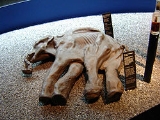
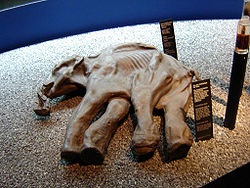
, Homo neanderthalensis - Woolly MammothWoolly mammothThe woolly mammoth , also called the tundra mammoth, is a species of mammoth. This animal is known from bones and frozen carcasses from northern North America and northern Eurasia with the best preserved carcasses in Siberia...
, Mammuthus primigenius - Maltese HippopotamusMaltese HippopotamusHippopotamus melitensis is an extinct hippopotamus. It arrived after the Messinian salinity crisis and lived during the Pleistocene on Malta. The absence of predators led to the dwarfing of the hippos...
, Hippopotamus melitensis (MaltaMaltaMalta , officially known as the Republic of Malta , is a Southern European country consisting of an archipelago situated in the centre of the Mediterranean, south of Sicily, east of Tunisia and north of Libya, with Gibraltar to the west and Alexandria to the east.Malta covers just over in...
) - Sardinian DholeSardinian DholeThe Sardinian Dhole Cynotherium sardous was an endemic insular canid, that occurred on the Italian island of Sardinia and the French island of Corsica . It became extinct when humans began to settle on the island.When this canid became confined to the island, it faced a menu consisting of small and...
, Cynotherium sardous (SardiniaSardiniaSardinia is the second-largest island in the Mediterranean Sea . It is an autonomous region of Italy, and the nearest land masses are the French island of Corsica, the Italian Peninsula, Sicily, Tunisia and the Spanish Balearic Islands.The name Sardinia is from the pre-Roman noun *sard[],...
) - Sardinian Dwarf Mammoth, Mammuthus lamarmorae (SardiniaSardiniaSardinia is the second-largest island in the Mediterranean Sea . It is an autonomous region of Italy, and the nearest land masses are the French island of Corsica, the Italian Peninsula, Sicily, Tunisia and the Spanish Balearic Islands.The name Sardinia is from the pre-Roman noun *sard[],...
, ItalyItalyItaly , officially the Italian Republic languages]] under the European Charter for Regional or Minority Languages. In each of these, Italy's official name is as follows:;;;;;;;;), is a unitary parliamentary republic in South-Central Europe. To the north it borders France, Switzerland, Austria and...
) - Sicilian HippopotamusSicilian HippopotamusHippopotamus pentlandi is an extinct hippopotamus. It arrived after the Messinian salinity crisis and lived during the Pleistocene on Sicily...
, Hippopotamus pentlandi (SicilySicilySicily is a region of Italy, and is the largest island in the Mediterranean Sea. Along with the surrounding minor islands, it constitutes an autonomous region of Italy, the Regione Autonoma Siciliana Sicily has a rich and unique culture, especially with regard to the arts, music, literature,...
, ItalyItalyItaly , officially the Italian Republic languages]] under the European Charter for Regional or Minority Languages. In each of these, Italy's official name is as follows:;;;;;;;;), is a unitary parliamentary republic in South-Central Europe. To the north it borders France, Switzerland, Austria and...
) - Narrow-nosed Rhinoceros, Dicerorhinus hemitoechus
- Tenerife Giant RatTenerife Giant RatThe Tenerife Giant Rat is an extinct species of rat endemic to the island of Tenerife, the largest of the Canary Islands, Spain. Many remains have been found during archeological digs. Most remains are from the Pleistocene...
, Canariomys bravoi (TenerifeTenerifeTenerife is the largest and most populous island of the seven Canary Islands, it is also the most populated island of Spain, with a land area of 2,034.38 km² and 906,854 inhabitants, 43% of the total population of the Canary Islands. About five million tourists visit Tenerife each year, the...
, Canary IslandsCanary IslandsThe Canary Islands , also known as the Canaries , is a Spanish archipelago located just off the northwest coast of mainland Africa, 100 km west of the border between Morocco and the Western Sahara. The Canaries are a Spanish autonomous community and an outermost region of the European Union...
, SpainSpainSpain , officially the Kingdom of Spain languages]] under the European Charter for Regional or Minority Languages. In each of these, Spain's official name is as follows:;;;;;;), is a country and member state of the European Union located in southwestern Europe on the Iberian Peninsula...
) - Merck' s rhinoceros, Dicerorhinus kirchbergensis
- Woolly RhinocerosWoolly RhinocerosThe woolly rhinoceros is an extinct species of rhinoceros that was common throughout Europe and Asia during the Pleistocene epoch and survived the last glacial period. The genus name Coelodonta means "cavity tooth"...
, Coelodonta antiquitatis
Mammals
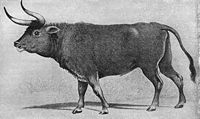
- Eurasian Aurochs, Bos primigenius primigenius (1627, PolandPolandPoland , officially the Republic of Poland , is a country in Central Europe bordered by Germany to the west; the Czech Republic and Slovakia to the south; Ukraine, Belarus and Lithuania to the east; and the Baltic Sea and Kaliningrad Oblast, a Russian exclave, to the north...
) - Balearic Giant Shrew, Nesiotites hidalgo (Majorca, MinorcaMinorcaMin Orca or Menorca is one of the Balearic Islands located in the Mediterranean Sea belonging to Spain. It takes its name from being smaller than the nearby island of Majorca....
, SpainSpainSpain , officially the Kingdom of Spain languages]] under the European Charter for Regional or Minority Languages. In each of these, Spain's official name is as follows:;;;;;;), is a country and member state of the European Union located in southwestern Europe on the Iberian Peninsula...
) - Balearic Islands Cave Goat, Myotragus balearicus (Balearic IslandsBalearic IslandsThe Balearic Islands are an archipelago of Spain in the western Mediterranean Sea, near the eastern coast of the Iberian Peninsula.The four largest islands are: Majorca, Minorca, Ibiza and Formentera. The archipelago forms an autonomous community and a province of Spain with Palma as the capital...
) - Caspian TigerCaspian TigerThe Caspian tiger, also known as the Turan tiger and Hyrcanian tiger, is an extinct tiger subspecies that has been recorded in the wild until the early 1970s, and used to inhabit the sparse forest habitats and riverine corridors west and south of the Caspian Sea, from Turkey, Iran and west through...
, Panthera tigris virgata (1960s, GeorgiaGeorgia (country)Georgia is a sovereign state in the Caucasus region of Eurasia. Located at the crossroads of Western Asia and Eastern Europe, it is bounded to the west by the Black Sea, to the north by Russia, to the southwest by Turkey, to the south by Armenia, and to the southeast by Azerbaijan. The capital of...
, ArmeniaArmeniaArmenia , officially the Republic of Armenia , is a landlocked mountainous country in the Caucasus region of Eurasia...
, AzerbaijanAzerbaijanAzerbaijan , officially the Republic of Azerbaijan is the largest country in the Caucasus region of Eurasia. Located at the crossroads of Western Asia and Eastern Europe, it is bounded by the Caspian Sea to the east, Russia to the north, Georgia to the northwest, Armenia to the west, and Iran to...
, southwest RussiaRussiaRussia or , officially known as both Russia and the Russian Federation , is a country in northern Eurasia. It is a federal semi-presidential republic, comprising 83 federal subjects...
, CrimeaCrimeaCrimea , or the Autonomous Republic of Crimea , is a sub-national unit, an autonomous republic, of Ukraine. It is located on the northern coast of the Black Sea, occupying a peninsula of the same name...
(possible)) - Caucasian MooseCaucasian MooseThe Caucasian Moose was a subspecies of moose found in the Caucasus Mountains of Eastern Europe. It is widely believed to be extinct....
, Alces alces caucasicus (1810, Caucasus MountainsCaucasus MountainsThe Caucasus Mountains is a mountain system in Eurasia between the Black Sea and the Caspian Sea in the Caucasus region .The Caucasus Mountains includes:* the Greater Caucasus Mountain Range and* the Lesser Caucasus Mountains....
) - Caucasian WisentCaucasian WisentThe Caucasian Wisent was a subspecies of Wisent that inhabited the Caucasus Mountains of Eastern Europe.It was hunted by the Caspian Tiger and the Asiatic Lion in the Caucasus, as well as other predators such as wolves and bears.-Decline and extinction:In the 17th century, the Caucasian wisent...
, Bison bonasus caucasicus (1927, Caucasus Mountains) - Carpathian WisentCarpathian WisentThe Carpathian wisent was a subspecies of European bison that inhabited the Carpathian Mountains, Moldavia, and Transylvania. It may also have lived in modern-day Ukraine and Hungary....
, Bison bonasus hungarorum (1790, Carpathian MountainsCarpathian MountainsThe Carpathian Mountains or Carpathians are a range of mountains forming an arc roughly long across Central and Eastern Europe, making them the second-longest mountain range in Europe...
) - Cretan Dwarf MegacerineCretan Dwarf MegacerineThe Cretan Dwarf Megacerine, scientifically known as Candiacervus cretensis, or Megaloceros cretensis, is an extinct species of deer from the late Pleistocene of the island of Crete, Greece. In life, it would have been about high at the withers....
, Candiacervus cretensis (CreteCreteCrete is the largest and most populous of the Greek islands, the fifth largest island in the Mediterranean Sea, and one of the thirteen administrative regions of Greece. It forms a significant part of the economy and cultural heritage of Greece while retaining its own local cultural traits...
, GreeceGreeceGreece , officially the Hellenic Republic , and historically Hellas or the Republic of Greece in English, is a country in southeastern Europe....
) - European AssEuropean AssThe European Ass is an extinct equine from the middle and late Pleistocene of Eurasia. It appeared first in the fossil report 300,000 years before present and did not disappear until Holocene times...
or Encebra, Equus hydruntinus (15th century, Spain) - European LionEuropean lionEuropean lion could be an extinct subspecies of lion that inhabited southern Europe until historic times. This population is generally considered part of the Asiatic lion , but others consider it a separate subspecies, the European lion...
, Panthera leo europaea (100 AD, Greece) - Irish ElkIrish ElkThe Irish Elk or Giant Deer , was a species of Megaloceros and one of the largest deer that ever lived. Its range extended across Eurasia, from Ireland to east of Lake Baikal, during the Late Pleistocene. The latest known remains of the species have been carbon dated to about 7,700 years ago...
, Megaloceros giganteus (c.5000 BC, Ural MountainsUral MountainsThe Ural Mountains , or simply the Urals, are a mountain range that runs approximately from north to south through western Russia, from the coast of the Arctic Ocean to the Ural River and northwestern Kazakhstan. Their eastern side is usually considered the natural boundary between Europe and Asia...
) - Majorcan Giant DormouseMajorcan Giant DormouseThe Majorcan Giant Dormouse, scientifically known as Hypnomys morphaeus or Eliomys morpheus , is an extinct animal from Europe. It is considered an example of island gigantism. The closest extant relative is considered to be the garden dormouse, genus Eliomys. It is believed to have had an...
, Hypnomys morphaeus (Majorca, Spain) - Majorcan HareMajorcan HareThe Majorcan Hare is a subspecies of the Granada Hare, from Majorca, Spain. It was described only in 1992. Many sources claim it went extinct, but this might not be true as other sources say it survives....
, Lepus granatensis solisi (1980s, Majorca, Spain) - Minorcan Giant DormouseMinorcan Giant DormouseThe Minorcan Giant Dormouse, Hypnomys mahonensis, is an extinct species of dormouse from the Pleistocene and Holocene of The Minorcan Giant Dormouse, Hypnomys mahonensis, is an extinct species of dormouse from the Pleistocene and Holocene of The Minorcan Giant Dormouse, Hypnomys mahonensis, is an...
, Hypnomys mahonensis (Minorca, Spain) - Portuguese IbexPortuguese IbexThe Portuguese Ibex Capra pyrenaica lusitanica was a subspecies of mountain goat that inhabited the north mountainous zones of Portugal, Galicia, Asturias and western Cantabria. In size and colouration it was much like the Spanish animals, though inclining towards brown rather than black markings...
, Capra pyrenaica lusitanica (1892, PortugalPortugalPortugal , officially the Portuguese Republic is a country situated in southwestern Europe on the Iberian Peninsula. Portugal is the westernmost country of Europe, and is bordered by the Atlantic Ocean to the West and South and by Spain to the North and East. The Atlantic archipelagos of the...
) - Pyrenean IbexPyrenean IbexThe Pyrenean Ibex is an ibex, one of the two extinct subspecies of Spanish Ibex. The subspecies once ranged across the Pyrenees in France and Spain and the surrounding area, including the Basque Country, Navarre, north Aragon and north Catalonia. A few hundred years ago they were numerous, but by...
, Capra pyrenaica pyrenaica (2000 and 2009, Spain) - Sardinian Giant Shrew, Nesiotites similis (SardiniaSardiniaSardinia is the second-largest island in the Mediterranean Sea . It is an autonomous region of Italy, and the nearest land masses are the French island of Corsica, the Italian Peninsula, Sicily, Tunisia and the Spanish Balearic Islands.The name Sardinia is from the pre-Roman noun *sard[],...
, ItalyItalyItaly , officially the Italian Republic languages]] under the European Charter for Regional or Minority Languages. In each of these, Italy's official name is as follows:;;;;;;;;), is a unitary parliamentary republic in South-Central Europe. To the north it borders France, Switzerland, Austria and...
) - Sardinian LynxSardinian LynxThe Sardinian Lynx is an extinct subspecies of the Eurasian Lynx that once could be found on the Italian island of Sardinia.In 1908, Pasquale Mola described a lynx from Nuoro as Lynx sardiniae. The length of the Sardinian Lynx was 1 m; the height 35 cm and the tail 33 cm. The cheeks were...
, Lynx lynx sardiniae (Sardinia, Italy) - Sardinian PikaSardinian PikaThe Sardinian Pika was a primitive lagomorph native to the Mediterranean islands of Sardinia and Corsica until its extinction around the year 1800...
, Prolagus sardus (1800, Sardinia, Italy) - St Kilda House MouseSt Kilda House MouseThe St Kilda House Mouse was a subspecies of the house mouse found only on the islands of the St Kilda archipelago of northwest Scotland....
, Mus musculus muralis - TarpanTarpanTarpan is an extinct subspecies of wild horse. The last individual of this subspecies died in captivity in Russia in 1909....
, Equus ferus ferus (1880, Poland)
Birds
- Great AukGreat AukThe Great Auk, Pinguinus impennis, formerly of the genus Alca, was a large, flightless alcid that became extinct in the mid-19th century. It was the only modern species in the genus Pinguinus, a group of birds that formerly included one other species of flightless giant auk from the Atlantic Ocean...
, Pinguinus impennis (1844, IcelandIcelandIceland , described as the Republic of Iceland, is a Nordic and European island country in the North Atlantic Ocean, on the Mid-Atlantic Ridge. Iceland also refers to the main island of the country, which contains almost all the population and almost all the land area. The country has a population...
) - Ibiza RailIbiza RailThe Ibiza Rail is a new species of rail, described from a late Pleistocene to Holocene cave deposit at Es Pouàs, on the island of Ibiza. Ibiza is in the Pityuses group of the Spanish Balearic Islands in the Mediterranean Sea...
, Rallus eivissensis (c. 5000 BC, IbizaIbizaIbiza or Eivissa is a Spanish island in the Mediterranean Sea 79 km off the coast of the city of Valencia in Spain. It is the third largest of the Balearic Islands, an autonomous community of Spain. With Formentera, it is one of the two Pine Islands or Pityuses. Its largest cities are Ibiza...
, SpainSpainSpain , officially the Kingdom of Spain languages]] under the European Charter for Regional or Minority Languages. In each of these, Spain's official name is as follows:;;;;;;), is a country and member state of the European Union located in southwestern Europe on the Iberian Peninsula...
) - Pied RavenPied RavenThe Pied Raven was a colour morph of the North Atlantic subspecies of the Common Raven which was only found on the Faroe Islands and has disappeared since the mid twentieth century. It had large areas of white feathering, most frequently on the head, the wings and the belly, and its beak was light...
, Corvus corax varius morpha leucophaeus (1948, Faroe IslandsFaroe IslandsThe Faroe Islands are an island group situated between the Norwegian Sea and the North Atlantic Ocean, approximately halfway between Scotland and Iceland. The Faroe Islands are a self-governing territory within the Kingdom of Denmark, along with Denmark proper and Greenland...
)
Reptiles
- Ratas Island LizardRatas Island LizardThe Ratas Island Lizard once lived on a rocky island in the bay of Mahon, Minorca . But the island, which was its habitat, was destroyed when Port Mahon was rebuilt. The last sign of this subspecies was in 1950 and it seems to be extinct. Four specimens of this European reptile are conserved in...
, Podarcis lilfordi rodriquezi (1950, MinorcaMinorcaMin Orca or Menorca is one of the Balearic Islands located in the Mediterranean Sea belonging to Spain. It takes its name from being smaller than the nearby island of Majorca....
, SpainSpainSpain , officially the Kingdom of Spain languages]] under the European Charter for Regional or Minority Languages. In each of these, Spain's official name is as follows:;;;;;;), is a country and member state of the European Union located in southwestern Europe on the Iberian Peninsula...
) - Santo Stefano LizardSanto Stefano LizardThe Santo Stefano lizard lived on Santo Stefano Island a small island near Ventotene in the Tyrrhenian sea off the west coast of Italy, and part of the Pontine Islands. It became extinct in 1965, probably caused by feral cats and a snake species...
, Podarcis sicula sanctistephani (1965, Santo Stefano IslandSanto Stefano IslandSanto Stefano is an island in the Tyrrhenian Sea off the west coast of Italy, and part of the Pontine Islands. It has a circular shape, is less than 400 metres in diameter, and is located 2 kilometres east from the nearby island of Ventotene....
, ItalyItalyItaly , officially the Italian Republic languages]] under the European Charter for Regional or Minority Languages. In each of these, Italy's official name is as follows:;;;;;;;;), is a unitary parliamentary republic in South-Central Europe. To the north it borders France, Switzerland, Austria and...
)
Fish
- Coregonus feraCoregonus feraCoregonus fera, commonly called the true fera is a presumed extinct freshwater fish from Lake Geneva in Switzerland and France.-Description:...
(1950) - Coregonus gutturosus (1960 or 1992)
- Coregonus hiemalis (1920 or 1950)
- Coregonus oxyrhynchus
- Coregonus restrictus (1900)
- Coregonus vandesius vandesius (1970)
- Chondrostoma scodrenseChondrostoma scodrenseChondrostoma scodrense was a ray-finned fish that is classified as extinct by the IUCN Red List of Threatened Species.Its habitat in the late 19th century included Lake Scutari and its surroundings in Albania and Montenegro. Although its unique characteristics were identified around 100 years...
Insects
- Tobias' caddisflyTobias' caddisflyTobias' caddisfly was a caddisfly which lived on the River Rhine between Mainz and Cologne. It was last seen in 1938 and was described in 1977 by Austrian entomologist Hans Malicky on the basis of material he found in earlier collections. Very little is known about the species and no larvae were...
, Hydropsyche tobiasi (1938, GermanyGermanyGermany , officially the Federal Republic of Germany , is a federal parliamentary republic in Europe. The country consists of 16 states while the capital and largest city is Berlin. Germany covers an area of 357,021 km2 and has a largely temperate seasonal climate...
) - Maculinea alcon arenariaMaculinea alcon arenariaThe Dutch Alcon Blue was a subspecies of the Alcon Blue butterfly Phengaris alcon. There is not much known about this subspecies, but it has always been very rare. It was endemic to the Netherlands, where two populations were known. One in Meijendel , and in the Meije...
(1979, NetherlandsNetherlandsThe Netherlands is a constituent country of the Kingdom of the Netherlands, located mainly in North-West Europe and with several islands in the Caribbean. Mainland Netherlands borders the North Sea to the north and west, Belgium to the south, and Germany to the east, and shares maritime borders...
) - Perrin's cave beetlePerrin's cave beetlePerrin's cave beetle is an extinct freshwater beetle from France. It and Siettitia ayenionensis are the only two species in the genus Siettitia....
, Siettitia balsetensis (FranceFranceThe French Republic , The French Republic , The French Republic , (commonly known as France , is a unitary semi-presidential republic in Western Europe with several overseas territories and islands located on other continents and in the Indian, Pacific, and Atlantic oceans. Metropolitan France...
) - Thetidia smaragdaria maritima, British subspecies of the Essex EmeraldEssex EmeraldThe Essex Emerald is a moth of the Geometridae family . It is distributed throughout the Palearctic region with records from many European countries. The British subspecies Thetidia smaragdaria maritima was last seen in 1991 and is now feared to be extinct. In 2004 the first record from Sweden was...
, 1991, United KingdomUnited KingdomThe United Kingdom of Great Britain and Northern IrelandIn the United Kingdom and Dependencies, other languages have been officially recognised as legitimate autochthonous languages under the European Charter for Regional or Minority Languages... - Lycaena dispar dispar, the British subspecies of the Large CopperLarge CopperThe Large Copper is a butterfly of the family Lycaenidae.The insect has a wide range occurring throughout the Northern Palearctic ecozone north to the middle taiga zone .-Subspecies:...
, 1851, United Kingdom - Maculinea arion eutyphron, the British subspecies of the Large BlueLarge blue butterflyThe Large Blue is a blue butterfly, that is resident in Europe and some parts of Asia. The butterfly was became extinct in the United Kingdom in 1979, but has since been reintroduced by conservationists...
, 1979, United Kingdom - Plebejus argus masseyi, a British subspecies of the Silver-studded BlueSilver-studded BlueThe Silver-studded Blue is a butterfly in the family Lycaenidae.-Appearance, behavior and distribution:So named due to the silvery blue metallic spots on the underside hind wings. The upperside are a rich, deep iridescent blue in the males with a black border and the characteristic Lycid white...
, United Kingdom - Maculinea teleius burdigalensis, French subspecies of the Scarce Large BlueScarce Large BlueThe Scarce Large Blue is a species of butterfly in the Lycaenidae family. It is found in Austria, Belgium, Croatia, Czech Republic, France, Georgia, Germany, Hungary, Italy, Japan, Kazakhstan, Mongolia, Poland, Russia, Serbia and Montenegro, Spain, Switzerland, and Ukraine.The larva of this...
, France
Molluscs
22 species and 3 subspecies of gastropods are extinct in Europe since the year 1500. No species of bivalves are known to be extinct in Europe since 1500.- Belgrandia varicaBelgrandia varicaBelgrandia varica is an extinct species of minute freshwater snail with an operculum, aquatic gastropod molluscs or micromolluscs in the family Hydrobiidae.Belgrandia varica is considered to be extinct.- Distribution :...
(J. Paget, 1854), already said CR on IUCN Red List http://www.iucnredlist.org/apps/redlist/details/155668/0 - Belgrandiella boetersi (P. Reischutz & Falkner, 1998) = Belgrandiella intermediaBelgrandiella intermedia†Belgrandiella intermedia was a species of very small freshwater snail, an aquatic gastropod mollusc in the family Hydrobiidae.The International Union for the Conservation of Nature and Natural Resources has listed the species as extinct since 1996.-Range of distribution:This species was...
(AustriaAustriaAustria , officially the Republic of Austria , is a landlocked country of roughly 8.4 million people in Central Europe. It is bordered by the Czech Republic and Germany to the north, Slovakia and Hungary to the east, Slovenia and Italy to the south, and Switzerland and Liechtenstein to the...
) - Bythiospeum pfeifferiBythiospeum pfeifferiBythiospeum pfeifferi is an extinct species of very small freshwater snail that have an operculum, aquatic gastropod mollusk in the family Hydrobiidae....
(Clessin, 1890) - Discula lyellianaDiscula lyellianaDiscula lyelliana is an extinct species of air-breathing land snail, a terrestrial pulmonate gastropod mollusk in the family Hygromiidae, the hairy snails and their allies....
(R. T. Lowe, 1852) - Discula tetricaDiscula tetricaDiscula tetrica is an extinct species of air-breathing land snail, a terrestrial pulmonate gastropod mollusk in the family Hygromiidae, the hairy snails and their allies.This species was endemic to Bugio, Madeira, Portugal....
(R. T. Lowe, 1862) - Discus engonatusDiscus engonatusDiscus engonatus is an extinct species of air-breathing land snail, a terrestrial pulmonate gastropod mollusk in the family Discidae, the disk snails....
(Shuttleworth, 1852) - Discus retextusDiscus retextusDiscus retextus is an extinct species of air-breathing land snail, a terrestrial pulmonate gastropod mollusk in the family Discidae, the disk snails.Discus retextus is considered to be extinct.- Distribution :...
(Shuttleworth, 1852) - Discus textilisDiscus textilisDiscus textilis is an extinct species of air-breathing land snail, a terrestrial pulmonate gastropod mollusk in the family Discidae, the disk snails.Discus textilis is considered to be extinct.- Distribution :...
(Shuttleworth, 1852) - Geomitra delphinuloidesGeomitra delphinuloidesGeomitra delphinuloides is an extinct species of air-breathing land snails, terrestrial pulmonate gastropod mollusks in the family Hygromiidae, the hairy snails and their allies....
(R. T. Lowe 1860) - Geomitra grabhamiGeomitra grabhamiGeomitra grabhami is an extinct species of air-breathing land snail, terrestrial pulmonate gastropod mollusks in the family Hygromiidae, the hairy snails and their allies.Geomitra grabhami is considered to be extinct.- Distribution :...
(Wollaston, 1878) - Graecoanatolica macedonicaGraecoanatolica macedonica†Graecoanatolica macedonica is an extinct species of small freshwater snail, an aquatic gastropod mollusk in the family Hybrobiidae.-Distribution:...
Radoman & Stankovic, 1979 - (Lake Dorjan, MacedoniaRepublic of MacedoniaMacedonia , officially the Republic of Macedonia , is a country located in the central Balkan peninsula in Southeast Europe. It is one of the successor states of the former Yugoslavia, from which it declared independence in 1991...
, GreeceGreeceGreece , officially the Hellenic Republic , and historically Hellas or the Republic of Greece in English, is a country in southeastern Europe....
) - Gyralina hausdorfiGyralina hausdorfiGyralina hausdorfi is an extinct species of air-breathing land snail, a terrestrial pulmonate gastropod mollusk in the family Pristilomatidae.Gyralina hausdorfi is considered to be extinct....
Riedel, 1990 - Janulus pompyliusJanulus pompyliusJanulus pompylius was a species of air-breathing land snail, a terrestrial pulmonate gastropod mollusk in the family Gastrodontidae. This species is now considered to be extinct.- Distribution :...
(Shuttleworth, 1852) - Keraea garachicoensisKeraea garachicoensisKeraea garachicoensis is an extinct species of air-breathing land snail, a terrestrial pulmonate gastropod mollusk in the family Discidae or Endodontidae.Keraea garachicoensis is considered to be extinct.- Distribution :...
(Wollaston, 1878) - Leiostyla abbreviataLeiostyla abbreviataLeiostyla abbreviata is an extinct species of small air-breathing land snail, a terrestrial pulmonate gastropod mollusk in the family Lauriidae...
(R. T. Lowe, 1852) - Leiostyla gibbaLeiostyla gibbaLeiostyla gibba is an extinct species of small air-breathing land snail, a terrestrial pulmonate gastropod mollusk in the family Lauriidae.It is mentioned in annexes II and IV of Habitats Directive.It is sometimes referred as madeiran land snail....
(R. T. Lowe, 1852) - Leiostyla lamellosaLeiostyla lamellosaLeiostyla lamellosa is an extinct species of small air-breathing land snail, a terrestrial pulmonate gastropod mollusk in the family Lauriidae.This species is mentioned in annexes II and IV of the Habitats Directive.-Distribution:...
(R. T. Lowe, 1852) - Ohridohauffenia drimicaOhridohauffenia drimicaOhridohauffenia drimica was a species of very small freshwater snail with an operculum, an aquatic gastropod mollusk in the family Hydrobiidae, the river snails. This species is now extinct.-Distribution:...
(Radoman, 1964) - (MacedoniaRepublic of MacedoniaMacedonia , officially the Republic of Macedonia , is a country located in the central Balkan peninsula in Southeast Europe. It is one of the successor states of the former Yugoslavia, from which it declared independence in 1991...
) - Parmacella gervaisiiParmacella gervaisiiParmacella gervaisii is an extinct species of air-breathing land snail, a terrestrial pulmonate gastropod mollusk in the family Parmacellidae.Parmacella gervaisii is considered to be extinct.- Distribution :...
Moquin-Tandon, 1850 - Pseudocampylaea loweiiPseudocampylaea loweiiPseudocampylaea loweii is an extinct species of air-breathing land snail, a terretrial pulmonate gastropod mollusk in the family Hygromiidae, the hairy snails and their allies.-Distribution:This species was endemic to Madeira, Portugal....
(A. Ferussac, 1835) - Zonites santoriniensisZonites santoriniensisZonites santoriniensis is an extinct species of air-breathing land snail, a terrestrial pulmonate gastropod mollusk in the family Zonitidae.Zonites santoriniensis is considered to be extinct.- Distribution :...
Riedel & Norris, 1987 - Zonites siphnicusZonites siphnicusZonites siphnicus is an extinct species of air-breathing land snail, a terrestrial pulmonate gastropod mollusk in the family Zonitidae.Zonites siphnicus is considered to be extinct.- Distribution :...
Fuchs & Käufel, 1936
subspecies:
- Caseolus calvusCaseolus calvusCaseolus calvus is a species of small air-breathing land snail, terrestrial pulmonate gastropod mollusks in the family Hygromiidae, the hairy snails and their allies.- Subspecies :* Caseolus calvus calvus...
galeatus (R. T. Lowe, 1862) - Leptaxis simiaLeptaxis simiaCaseolus calvus is a species of small air-breathing land snail, terrestrial pulmonate gastropod mollusks in the family Hygromiidae, the hairy snails and their allies.- Subspecies :* Leptaxis simia simia...
hyaena (R. T. Lowe, 1852) - Zonites emboliumZonites emboliumZonites embolium is a species of air-breathing land snail, a terrestrial pulmonate gastropod mollusk in the family Zonitidae.The subspecies Zonites embolium elevatus Riedel & Mylonas, 1997, that was endemic to Dodecanese Islands, is considered to be extinct.- External links :*...
elevatus Riedel & Mylonas, 1997
Not extinct:
- Bythinella intermediaBythinella intermediaBythinella intermedia is a recently extinct species of very small freshwater snail, an aquatic gastropod mollusk in the family Amnicolidae.This species used to be endemic to Austria....
was listed in Austria as extinct in the 2010 IUCN Red List, but it is an synonym for Bythinella austriacaBythinella austriacaBythinella austriaca is a species of very small freshwater snail with an operculum, an aquatic gastropod mollusk in the family Amnicolidae.- Distribution :The distribution of this species is Carpathian ....
, which is an extant species.
Local European extinctions
Local extinction
Local extinction, also known as extirpation, is the condition of a species which ceases to exist in the chosen geographic area of study, though it still exists elsewhere...
in Europe, but survive on other continents.
- Anatolian LeopardAnatolian leopardThe Anatolian leopard , also called the Asia Minor leopard is a leopard subspecies native to southwestern Turkey. Its continued existence is uncertain.- Distribution and habitat:...
, Panthera pardus tulliana (Island of SamosSamos IslandSamos is a Greek island in the eastern Aegean Sea, south of Chios, north of Patmos and the Dodecanese, and off the coast of Asia Minor, from which it is separated by the -wide Mycale Strait. It is also a separate regional unit of the North Aegean region, and the only municipality of the regional...
, GreeceGreeceGreece , officially the Hellenic Republic , and historically Hellas or the Republic of Greece in English, is a country in southeastern Europe....
, 19th century) - Asiatic LionAsiatic LionThe Asiatic lion also known as the Indian lion, Persian lion and Eurasian Lion is a subspecies of lion. The only place in the wild where the lion is found is in the Gir Forest of Gujarat, India...
, Panthera leo persica (10th century, Caucasus mountainsCaucasus MountainsThe Caucasus Mountains is a mountain system in Eurasia between the Black Sea and the Caspian Sea in the Caucasus region .The Caucasus Mountains includes:* the Greater Caucasus Mountain Range and* the Lesser Caucasus Mountains....
) - CheetahCheetahThe cheetah is a large-sized feline inhabiting most of Africa and parts of the Middle East. The cheetah is the only extant member of the genus Acinonyx, most notable for modifications in the species' paws...
, Acinonyx jubatus (15th century, ArmeniaArmeniaArmenia , officially the Republic of Armenia , is a landlocked mountainous country in the Caucasus region of Eurasia...
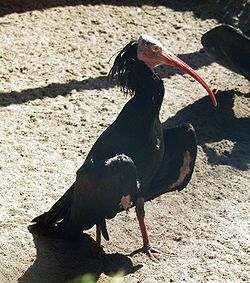
) - Northern Bald IbisNorthern Bald IbisThe Northern Bald Ibis, Hermit Ibis, or Waldrapp is a migratory bird found in barren, semi-desert or rocky habitats, often close to running water. This 70–80 cm glossy black ibis, which, unlike other members of the ibis family, is non-wading, has an unfeathered red face and head, and a long,...
, Geronticus eremita (16th century) - Reintroduced in Southern Spain (2004) and AustriaAustriaAustria , officially the Republic of Austria , is a landlocked country of roughly 8.4 million people in Central Europe. It is bordered by the Czech Republic and Germany to the north, Slovakia and Hungary to the east, Slovenia and Italy to the south, and Switzerland and Liechtenstein to the...
(2005) - Western European Lion, Panthera leo europaea (ca. AD 120, Sicili)
Rediscovered
- Bavarian pine voleBavarian pine voleThe Bavarian pine vole is a vole from the Austrian, Italian, and Bavarian Alps of Europe. It lived in moist meadows at elevations of 600-1,000 metres...
, Microtus bavaricus (2000, AustriaAustriaAustria , officially the Republic of Austria , is a landlocked country of roughly 8.4 million people in Central Europe. It is bordered by the Czech Republic and Germany to the north, Slovakia and Hungary to the east, Slovenia and Italy to the south, and Switzerland and Liechtenstein to the...
), - Telestes turskyiTelestes turskyiTelestes turskyi is a species of cyprinid restricted to lake Buško Blato in Bosnia and Herzegovina and Čikola River, a tributary of the Krka in Croatia. This species was thought to be extinct, but was found in May 2002 by J. Freyhof and N. Bogutskaya...
(a cyprinidCyprinidThe family Cyprinidae, from the Ancient Greek kyprînos , consists of the carps, the true minnows, and their relatives . Commonly called the carp family or the minnow family, its members are also known as cyprinids...
fish) (2002, CroatiaCroatiaCroatia , officially the Republic of Croatia , is a unitary democratic parliamentary republic in Europe at the crossroads of the Mitteleuropa, the Balkans, and the Mediterranean. Its capital and largest city is Zagreb. The country is divided into 20 counties and the city of Zagreb. Croatia covers ...
), - La Palma Giant LizardLa Palma Giant LizardThe La Palma Giant Lizard is a giant lacertid historically living in the island of La Palma ; its habitat ranged from sea level up to altitudes of 800 m....
, Gallotia auaritae (2007, La PalmaLa PalmaLa Palma is the most north-westerly of the Canary Islands. La Palma has an area of 706 km2 making it the fifth largest of the seven main Canary Islands...
in the Canary IslandsCanary IslandsThe Canary Islands , also known as the Canaries , is a Spanish archipelago located just off the northwest coast of mainland Africa, 100 km west of the border between Morocco and the Western Sahara. The Canaries are a Spanish autonomous community and an outermost region of the European Union...
), - Gray whaleGray WhaleThe gray whale, Eschrichtius robustus, is a baleen whale that migrates between feeding and breeding grounds yearly. It reaches a length of about , a weight of , and lives 50–70 years. The common name of the whale comes from the gray patches and white mottling on its dark skin. Gray whales were...
, Eschrichtius robustus (May 8, 2010, in the Mediterranean SeaMediterranean SeaThe Mediterranean Sea is a sea connected to the Atlantic Ocean surrounded by the Mediterranean region and almost completely enclosed by land: on the north by Anatolia and Europe, on the south by North Africa, and on the east by the Levant...
).
See also
- List of extinct animals of Britain
- List of extinct and endangered animals of Lithuania
- List of extinct animals of the Netherlands
- List of extinct animals of Catalonia
- List of extinct animals of Caucasus
- List of extinct animals
- List of extinct animals of Asia
- List of extinct animals of Africa
- List of extinct animals of South America
- List of extinct birds
- Dwarf elephantDwarf elephantDwarf elephants are prehistoric members of the order Proboscidea, that, through the process of allopatric speciation, evolved to a fraction of the size of their immediate ancestors...
- List of extinct and endangered species of Italy