


Latin literature

Encyclopedia
Latin
literature includes the essays, histories, poems, plays, and other writings of the ancient Romans. In many ways, it seems to be a continuation of Greek literature
, using many of the same forms. But Latin literature also mirrored the life and history of ancient Rome
.
, effective speaking often determined who would be elected or what bills would pass. After Rome became an empire
, the ability to impress and persuade people by the spoken word lost much of its importance. But training in rhetoric continued to flourish and to affect styles of writing. A large part of rhetoric consists of the ability to present a familiar idea in a striking new manner that attracts attention. Latin authors became masters of this art of variety.
and Tacitus
. Or it can have wide, sweeping phrases, as in the works of Livy
and the speeches of Cicero
.
Latin lacks the rich poetic vocabulary that marks Greek poetry. Some earlier Latin poets tried to make up for this deficiency by creating new compound words, as the Greeks had done. But Roman writers seldom invented words. Except in epic poetry, they tended to use a familiar vocabulary, giving it poetic value by imaginative combinations of words and by rich sound effects. Rome's leading poets had great technical skill in the choice and arrangement of language. They also had an intimate knowledge of the Greek poets, whose themes appear in almost all Roman literature.
Latin moves with impressive dignity in the writings of Lucretius
, Cicero
, or Virgil
. It reflects the seriousness and sense of responsibility that characterized the ruling class of Rome during the great years of the republic. But the Romans could also relax and allow what Horace
called the "Italian vinegar" in their systems to pour forth in wit and satire.
Some translators paraphrase — that is, they try to keep the beauty and spirit of the original work without providing the exact meaning of each phrase. During the 1600s and 1700s, a number of English poets translated much Latin poetry by paraphrasing. Perhaps the outstanding example was John Dryden
's English version of the poems of Virgil, published in 1697.
Other translators provide literal translations, trying to imitate exactly the writings of Latin authors. But these translations lose much of the beauty and style that made the originals works of art. The chief value of literal translations lies in helping students read Latin more easily.
, a Greek who had been brought to Rome as a prisoner of war in 272 BC. Andronicus also translated Homer's Greek epic the Odyssey into an old type of Latin verse called Saturnian. The first Latin poet to write on a Roman theme was Gnaeus Naevius
during the 200s BC. He composed an epic poem about the first Punic War
, in which he had fought. Naevius's dramas were mainly reworkings of Greek originals, but he also created tragedies based on Roman myths and history.
Other epic poets followed Naevius. Quintus Ennius wrote a historical epic, the Annals (soon after 200 BC), describing Roman history from the founding of Rome to his own time. He adopted Greek dactylic hexameter, which became the standard verse form for Roman epics. He also became famous for his tragic dramas. In this field, his most distinguished successors were Marcus Pacuvius and Lucius Accius
. These three writers rarely used episodes from Roman history. Instead, they wrote Latin versions of tragic themes that the Greeks had already handled. But even when they copied the Greeks, they did not translate slavishly. Only fragments of their plays have survived.
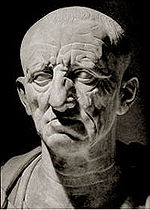 We know much more about early Latin comedy, because we have 20 complete plays by Plautus
and 6 by Terence
. These men modeled their comedies on Greek plays known as New Comedy. But they treated the plots and wording of the originals freely. Plautus scattered songs through his plays and increased the humor with puns and wisecracks, plus comic actions by the actors. Terence's plays were more polite in tone, dealing with domestic situations. His works provided the chief inspiration for French and English comedies of the 1600s, and even for modern American comedy.
The prose of the period is best known through On Agriculture (160 BC) by Cato the Elder
. Cato also wrote the first Latin history of Rome and of other Italian cities. He was the first Roman statesman to put his political speeches in writing as a means of influencing public opinion.
Early Latin literature ended with Gaius Lucilius
, who created a new kind of poetry in his 30 books of Satires (100s BC). He wrote in an easy, conversational tone about books, food, friends, and current events. In the early AD 100s, Juvenal
perfected the biting form of satire that has influenced many later writers.
and ended with the death of Ovid
.
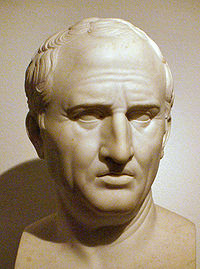
has traditionally been considered the master of Latin prose. The writing he produced from about 80 BC until his death in 43 BC exceeds that of any Latin author whose work survives in terms of quantity and variety of genre and subject matter, as well as possessing unsurpassed stylistic excellence. Cicero's many works can be divided into four groups: (1) letters, (2) rhetorical treatises, (3) philosophical works, and (4) orations. His letters provide detailed information about an important period in Roman history and offer a vivid picture of the public and private life among the Roman governing class. Cicero's works on oratory are our most valuable Latin sources for ancient theories on education and rhetoric. His philosophical works were the basis of moral philosophy during the Middle Ages. His speeches inspired many European political leaders and the founders of the United States.
 Julius Caesar
and Sallust
were outstanding historical writers of Cicero's time. Caesar wrote commentaries on the Gallic and civil wars in a straightforward style to justify his actions as a general. Sallust adopted an abrupt, pointed style in his historical works. He wrote brilliant descriptions of people and their motives.
The birth of lyric poetry in Latin occurred during the same period. The short love lyrics of Catullus
have never been surpassed in emotional intensity. Catullus also wrote masterful poems that attacked his enemies. In his longer poems, he suggested beautiful images in rich, delicate language.
In contrast, the poet Lucretius
interpreted the ideas of the Greek philosopher Epicurus. Lucretius's work De Rerum Natura (55 BC) contains many majestic passages. It is a triumph of poetic genius over unpoetic matter.
The most learned writer of the period was Varro
. He wrote about a remarkable variety of subjects, from religion to poetry. But only his writings on agriculture and the Latin language survive in their complete form.
took a personal interest in the literary works produced during his years of power from 27 BC to AD 14. This period is sometimes called the Golden Age of Latin Literature. Virgil
published his pastoral Eclogues; the Georgics, perhaps the most beautiful poem ever written about country life; and the Aeneid, an epic poem describing the events that led to the creation of Rome. Virgil told how the Trojan hero Aeneas became the ancestor of the Roman people. Virgil also provided divine justification for Roman rule over the world. Although Virgil died before he could put the finishing touches on his poem, it was soon recognized as the greatest work of Latin literature. Critics still agree on this judgment.
Virgil's friend Horace
wrote Epodes, Odes, Satires, and Epistles. The perfection of the Odes in content, form, and style has charmed readers for hundreds of years. The Satires and Epistles discuss ethical and literary problems in an urbane, witty manner. Horace's Art of Poetry, probably published as a separate work, greatly influenced later poetic theories. It stated the basic rules of classical writing as the Romans understood and used them. After Virgil died, Horace was Rome's leading poet.
The Latin elegy reached its highest development in the works of Tibullus
, Propertius, and Ovid
. Most of this poetry is concerned with love. Ovid also wrote the Fasti, which describes Roman festivals and their legendary origins. Ovid's greatest work, the Metamorphoses weaves various myths into a fast-paced, fascinating story. Ovid was a witty writer who excelled in creating lively and passionate characters. The Metamorphoses was the best-known source of Roman mythology throughout the Middle Ages and the Renaissance. It inspired many poets, painters, and composers.
In prose, Livy
produced a history of the Roman people in 142 books. Only 35 survive, but they are a major source of information on Rome.
from 54 to 68, the Stoic philosopher Seneca
wrote a number of dialogues and letters on such moral themes as mercy and generosity. In his Natural Questions, Seneca analyzed earthquakes, floods, and storms. Seneca's tragedies greatly influenced the growth of tragic drama in Europe. His nephew Lucan wrote the Pharsalia (about 60), an epic poem describing the civil war between Caesar and Pompey
. The Satyricon (about 60) by Petronius
was the first Latin novel. Only fragments of the complete work survive. It describes the adventures of various low-class characters in absurd, extravagant, and dangerous situations, often in the world of petty crime.
Epic poems included the Argonautica of Gaius Valerius Flaccus
, the Thebaid of Statius
, and the Punica of Silius Italicus
. At the hands of Martial
, the epigram achieved the stinging quality still associated with it. Juvenal
brilliantly satirized vice.
The historian Tacitus
painted an unforgettably dark picture of the early empire in his Histories and Annals, both written in the early 100s. His contemporary Suetonius
wrote biographies of the 12 Roman rulers from Julius Caesar
through Domitian
. The letters of Pliny the Younger
described Roman life of the period. Quintilian
composed the most complete work on ancient education that we possess. Important works from the 100s include the Attic Nights of Aulus Gellius
, a collection of anecdotes and reports of literary discussions among his friends; and the letters of the orator Marcus Cornelius Fronto
to Marcus Aurelius. The most famous work of the period was Metamorphoses, also called The Golden Ass, by Apuleius
. This novel concerns a young man who is accidentally changed into a donkey. The story is filled with colorful tales of love and witchcraft.
in history, Quintus Aurelius Symmachus
in oratory, and Ausonius
and Rutilius Claudius Namatianus
in poetry all wrote with great talent. The Mosella by Ausonius demonstrated a modernism of feeling that indicates the end of classical literature as such.
At the same time, other men laid the foundations of Christian Latin literature during the 300s and 400s. They included the church fathers Augustine of Hippo
, Jerome
, and Ambrose
, and the first great Christian poet, Prudentius
.
Latin
Latin is an Italic language originally spoken in Latium and Ancient Rome. It, along with most European languages, is a descendant of the ancient Proto-Indo-European language. Although it is considered a dead language, a number of scholars and members of the Christian clergy speak it fluently, and...
literature includes the essays, histories, poems, plays, and other writings of the ancient Romans. In many ways, it seems to be a continuation of Greek literature
Greek literature
Greek literature refers to writings composed in areas of Greek influence, typically though not necessarily in one of the Greek dialects, throughout the whole period in which the Greek-speaking people have existed.-Ancient Greek literature :...
, using many of the same forms. But Latin literature also mirrored the life and history of ancient Rome
Ancient Rome
Ancient Rome was a thriving civilization that grew on the Italian Peninsula as early as the 8th century BC. Located along the Mediterranean Sea and centered on the city of Rome, it expanded to one of the largest empires in the ancient world....
.
Characteristics of Latin literature
Much Latin writing reflects the Romans' interest in rhetoric, the art of speaking and persuading. Public speaking had great importance for educated Romans because most of them wanted successful political careers. When Rome was a republicRoman Republic
The Roman Republic was the period of the ancient Roman civilization where the government operated as a republic. It began with the overthrow of the Roman monarchy, traditionally dated around 508 BC, and its replacement by a government headed by two consuls, elected annually by the citizens and...
, effective speaking often determined who would be elected or what bills would pass. After Rome became an empire
Roman Empire
The Roman Empire was the post-Republican period of the ancient Roman civilization, characterised by an autocratic form of government and large territorial holdings in Europe and around the Mediterranean....
, the ability to impress and persuade people by the spoken word lost much of its importance. But training in rhetoric continued to flourish and to affect styles of writing. A large part of rhetoric consists of the ability to present a familiar idea in a striking new manner that attracts attention. Latin authors became masters of this art of variety.
Language and form
Latin is a highly inflected language, with many grammatical forms for various words. As a result, it can be used with a pithiness and brevity unknown in English. It also lends itself to elaboration, because its tight syntax holds even the longest and most complex sentence together as a logical unit. Latin can be used with striking conciseness, as in the works of SallustSallust
Gaius Sallustius Crispus, generally known simply as Sallust , a Roman historian, belonged to a well-known plebeian family, and was born at Amiternum in the country of the Sabines...
and Tacitus
Tacitus
Publius Cornelius Tacitus was a senator and a historian of the Roman Empire. The surviving portions of his two major works—the Annals and the Histories—examine the reigns of the Roman Emperors Tiberius, Claudius, Nero and those who reigned in the Year of the Four Emperors...
. Or it can have wide, sweeping phrases, as in the works of Livy
Livy
Titus Livius — known as Livy in English — was a Roman historian who wrote a monumental history of Rome and the Roman people. Ab Urbe Condita Libri, "Chapters from the Foundation of the City," covering the period from the earliest legends of Rome well before the traditional foundation in 753 BC...
and the speeches of Cicero
Cicero
Marcus Tullius Cicero , was a Roman philosopher, statesman, lawyer, political theorist, and Roman constitutionalist. He came from a wealthy municipal family of the equestrian order, and is widely considered one of Rome's greatest orators and prose stylists.He introduced the Romans to the chief...
.
Latin lacks the rich poetic vocabulary that marks Greek poetry. Some earlier Latin poets tried to make up for this deficiency by creating new compound words, as the Greeks had done. But Roman writers seldom invented words. Except in epic poetry, they tended to use a familiar vocabulary, giving it poetic value by imaginative combinations of words and by rich sound effects. Rome's leading poets had great technical skill in the choice and arrangement of language. They also had an intimate knowledge of the Greek poets, whose themes appear in almost all Roman literature.
Latin moves with impressive dignity in the writings of Lucretius
Lucretius
Titus Lucretius Carus was a Roman poet and philosopher. His only known work is an epic philosophical poem laying out the beliefs of Epicureanism, De rerum natura, translated into English as On the Nature of Things or "On the Nature of the Universe".Virtually no details have come down concerning...
, Cicero
Cicero
Marcus Tullius Cicero , was a Roman philosopher, statesman, lawyer, political theorist, and Roman constitutionalist. He came from a wealthy municipal family of the equestrian order, and is widely considered one of Rome's greatest orators and prose stylists.He introduced the Romans to the chief...
, or Virgil
Virgil
Publius Vergilius Maro, usually called Virgil or Vergil in English , was an ancient Roman poet of the Augustan period. He is known for three major works of Latin literature, the Eclogues , the Georgics, and the epic Aeneid...
. It reflects the seriousness and sense of responsibility that characterized the ruling class of Rome during the great years of the republic. But the Romans could also relax and allow what Horace
Horace
Quintus Horatius Flaccus , known in the English-speaking world as Horace, was the leading Roman lyric poet during the time of Augustus.-Life:...
called the "Italian vinegar" in their systems to pour forth in wit and satire.
Latin in translation
The best Latin literature has been translated into most major languages. Until the 1900s, the majority of educated people in the West knew at least some Latin. Today, fewer people are familiar with the language, but an increasing number enjoy Latin literature through translations.Some translators paraphrase — that is, they try to keep the beauty and spirit of the original work without providing the exact meaning of each phrase. During the 1600s and 1700s, a number of English poets translated much Latin poetry by paraphrasing. Perhaps the outstanding example was John Dryden
John Dryden
John Dryden was an influential English poet, literary critic, translator, and playwright who dominated the literary life of Restoration England to such a point that the period came to be known in literary circles as the Age of Dryden.Walter Scott called him "Glorious John." He was made Poet...
's English version of the poems of Virgil, published in 1697.
Other translators provide literal translations, trying to imitate exactly the writings of Latin authors. But these translations lose much of the beauty and style that made the originals works of art. The chief value of literal translations lies in helping students read Latin more easily.
Early Latin literature
Formal Latin literature began in 240 BC, when a Roman audience saw a Latin version of a Greek play. The adaptor was Livius AndronicusLivius Andronicus
Lucius Livius Andronicus , not to be confused with the later historian Livy, was a Greco-Roman dramatist and epic poet of the Old Latin period. He began as an educator in the service of a noble family at Rome by translating Greek works into Latin, including Homer’s Odyssey. They were meant at...
, a Greek who had been brought to Rome as a prisoner of war in 272 BC. Andronicus also translated Homer's Greek epic the Odyssey into an old type of Latin verse called Saturnian. The first Latin poet to write on a Roman theme was Gnaeus Naevius
Gnaeus Naevius
Gnaeus Naevius was a Roman epic poet and dramatist of the Old Latin period. He had a notable literary career at Rome until his satiric comments delivered in comedy angered the Metelli family, one of whom was consul. After a sojourn in prison he recanted and was set free by the tribunes...
during the 200s BC. He composed an epic poem about the first Punic War
First Punic War
The First Punic War was the first of three wars fought between Ancient Carthage and the Roman Republic. For 23 years, the two powers struggled for supremacy in the western Mediterranean Sea, primarily on the Mediterranean island of Sicily and its surrounding waters but also to a lesser extent in...
, in which he had fought. Naevius's dramas were mainly reworkings of Greek originals, but he also created tragedies based on Roman myths and history.
Other epic poets followed Naevius. Quintus Ennius wrote a historical epic, the Annals (soon after 200 BC), describing Roman history from the founding of Rome to his own time. He adopted Greek dactylic hexameter, which became the standard verse form for Roman epics. He also became famous for his tragic dramas. In this field, his most distinguished successors were Marcus Pacuvius and Lucius Accius
Lucius Accius
Lucius Accius , or Lucius Attius, was a Roman tragic poet and literary scholar. The son of a freedman, Accius was born at Pisaurum in Umbria, in 170 BC...
. These three writers rarely used episodes from Roman history. Instead, they wrote Latin versions of tragic themes that the Greeks had already handled. But even when they copied the Greeks, they did not translate slavishly. Only fragments of their plays have survived.
Plautus
Titus Maccius Plautus , commonly known as "Plautus", was a Roman playwright of the Old Latin period. His comedies are the earliest surviving intact works in Latin literature. He wrote Palliata comoedia, the genre devised by the innovator of Latin literature, Livius Andronicus...
and 6 by Terence
Terence
Publius Terentius Afer , better known in English as Terence, was a playwright of the Roman Republic, of North African descent. His comedies were performed for the first time around 170–160 BC. Terentius Lucanus, a Roman senator, brought Terence to Rome as a slave, educated him and later on,...
. These men modeled their comedies on Greek plays known as New Comedy. But they treated the plots and wording of the originals freely. Plautus scattered songs through his plays and increased the humor with puns and wisecracks, plus comic actions by the actors. Terence's plays were more polite in tone, dealing with domestic situations. His works provided the chief inspiration for French and English comedies of the 1600s, and even for modern American comedy.
The prose of the period is best known through On Agriculture (160 BC) by Cato the Elder
Cato the Elder
Marcus Porcius Cato was a Roman statesman, commonly referred to as Censorius , Sapiens , Priscus , or Major, Cato the Elder, or Cato the Censor, to distinguish him from his great-grandson, Cato the Younger.He came of an ancient Plebeian family who all were noted for some...
. Cato also wrote the first Latin history of Rome and of other Italian cities. He was the first Roman statesman to put his political speeches in writing as a means of influencing public opinion.
Early Latin literature ended with Gaius Lucilius
Gaius Lucilius
Gaius Lucilius , the earliest Roman satirist, of whose writings only fragments remain, was a Roman citizen of the equestrian class, born at Suessa Aurunca in Campania.-The Problem of his birthdate:...
, who created a new kind of poetry in his 30 books of Satires (100s BC). He wrote in an easy, conversational tone about books, food, friends, and current events. In the early AD 100s, Juvenal
Juvenal
The Satires are a collection of satirical poems by the Latin author Juvenal written in the late 1st and early 2nd centuries AD.Juvenal is credited with sixteen known poems divided among five books; all are in the Roman genre of satire, which, at its most basic in the time of the author, comprised a...
perfected the biting form of satire that has influenced many later writers.
The Golden Age
Latin literature was at its height from 81 BC to AD 17. This period began with the first known speech of CiceroCicero
Marcus Tullius Cicero , was a Roman philosopher, statesman, lawyer, political theorist, and Roman constitutionalist. He came from a wealthy municipal family of the equestrian order, and is widely considered one of Rome's greatest orators and prose stylists.He introduced the Romans to the chief...
and ended with the death of Ovid
Ovid
Publius Ovidius Naso , known as Ovid in the English-speaking world, was a Roman poet who is best known as the author of the three major collections of erotic poetry: Heroides, Amores, and Ars Amatoria...
.
The age of Cicero
CiceroCicero
Marcus Tullius Cicero , was a Roman philosopher, statesman, lawyer, political theorist, and Roman constitutionalist. He came from a wealthy municipal family of the equestrian order, and is widely considered one of Rome's greatest orators and prose stylists.He introduced the Romans to the chief...
has traditionally been considered the master of Latin prose. The writing he produced from about 80 BC until his death in 43 BC exceeds that of any Latin author whose work survives in terms of quantity and variety of genre and subject matter, as well as possessing unsurpassed stylistic excellence. Cicero's many works can be divided into four groups: (1) letters, (2) rhetorical treatises, (3) philosophical works, and (4) orations. His letters provide detailed information about an important period in Roman history and offer a vivid picture of the public and private life among the Roman governing class. Cicero's works on oratory are our most valuable Latin sources for ancient theories on education and rhetoric. His philosophical works were the basis of moral philosophy during the Middle Ages. His speeches inspired many European political leaders and the founders of the United States.
Julius Caesar
Gaius Julius Caesar was a Roman general and statesman and a distinguished writer of Latin prose. He played a critical role in the gradual transformation of the Roman Republic into the Roman Empire....
and Sallust
Sallust
Gaius Sallustius Crispus, generally known simply as Sallust , a Roman historian, belonged to a well-known plebeian family, and was born at Amiternum in the country of the Sabines...
were outstanding historical writers of Cicero's time. Caesar wrote commentaries on the Gallic and civil wars in a straightforward style to justify his actions as a general. Sallust adopted an abrupt, pointed style in his historical works. He wrote brilliant descriptions of people and their motives.
The birth of lyric poetry in Latin occurred during the same period. The short love lyrics of Catullus
Catullus
Gaius Valerius Catullus was a Latin poet of the Republican period. His surviving works are still read widely, and continue to influence poetry and other forms of art.-Biography:...
have never been surpassed in emotional intensity. Catullus also wrote masterful poems that attacked his enemies. In his longer poems, he suggested beautiful images in rich, delicate language.
In contrast, the poet Lucretius
Lucretius
Titus Lucretius Carus was a Roman poet and philosopher. His only known work is an epic philosophical poem laying out the beliefs of Epicureanism, De rerum natura, translated into English as On the Nature of Things or "On the Nature of the Universe".Virtually no details have come down concerning...
interpreted the ideas of the Greek philosopher Epicurus. Lucretius's work De Rerum Natura (55 BC) contains many majestic passages. It is a triumph of poetic genius over unpoetic matter.
The most learned writer of the period was Varro
Varro
Varro was a Roman cognomen carried by:*Marcus Terentius Varro, sometimes known as Varro Reatinus, the scholar*Publius Terentius Varro or Varro Atacinus, the poet*Gaius Terentius Varro, the consul defeated at the battle of Cannae...
. He wrote about a remarkable variety of subjects, from religion to poetry. But only his writings on agriculture and the Latin language survive in their complete form.
The Augustan Age
The emperor AugustusAugustus
Augustus ;23 September 63 BC – 19 August AD 14) is considered the first emperor of the Roman Empire, which he ruled alone from 27 BC until his death in 14 AD.The dates of his rule are contemporary dates; Augustus lived under two calendars, the Roman Republican until 45 BC, and the Julian...
took a personal interest in the literary works produced during his years of power from 27 BC to AD 14. This period is sometimes called the Golden Age of Latin Literature. Virgil
Virgil
Publius Vergilius Maro, usually called Virgil or Vergil in English , was an ancient Roman poet of the Augustan period. He is known for three major works of Latin literature, the Eclogues , the Georgics, and the epic Aeneid...
published his pastoral Eclogues; the Georgics, perhaps the most beautiful poem ever written about country life; and the Aeneid, an epic poem describing the events that led to the creation of Rome. Virgil told how the Trojan hero Aeneas became the ancestor of the Roman people. Virgil also provided divine justification for Roman rule over the world. Although Virgil died before he could put the finishing touches on his poem, it was soon recognized as the greatest work of Latin literature. Critics still agree on this judgment.
Virgil's friend Horace
Horace
Quintus Horatius Flaccus , known in the English-speaking world as Horace, was the leading Roman lyric poet during the time of Augustus.-Life:...
wrote Epodes, Odes, Satires, and Epistles. The perfection of the Odes in content, form, and style has charmed readers for hundreds of years. The Satires and Epistles discuss ethical and literary problems in an urbane, witty manner. Horace's Art of Poetry, probably published as a separate work, greatly influenced later poetic theories. It stated the basic rules of classical writing as the Romans understood and used them. After Virgil died, Horace was Rome's leading poet.
The Latin elegy reached its highest development in the works of Tibullus
Tibullus
Albius Tibullus was a Latin poet and writer of elegies.Little is known about his life. His first and second books of poetry are extant; many other texts attributed to Tibullus are of questionable origins. There are only a few references to him in later writers and a short Life of doubtful authority...
, Propertius, and Ovid
Ovid
Publius Ovidius Naso , known as Ovid in the English-speaking world, was a Roman poet who is best known as the author of the three major collections of erotic poetry: Heroides, Amores, and Ars Amatoria...
. Most of this poetry is concerned with love. Ovid also wrote the Fasti, which describes Roman festivals and their legendary origins. Ovid's greatest work, the Metamorphoses weaves various myths into a fast-paced, fascinating story. Ovid was a witty writer who excelled in creating lively and passionate characters. The Metamorphoses was the best-known source of Roman mythology throughout the Middle Ages and the Renaissance. It inspired many poets, painters, and composers.
In prose, Livy
Livy
Titus Livius — known as Livy in English — was a Roman historian who wrote a monumental history of Rome and the Roman people. Ab Urbe Condita Libri, "Chapters from the Foundation of the City," covering the period from the earliest legends of Rome well before the traditional foundation in 753 BC...
produced a history of the Roman people in 142 books. Only 35 survive, but they are a major source of information on Rome.
The Imperial Period
From the death of Augustus in AD 14 until about 200, Roman authors emphasized style and tried new and startling ways of expression. During the reign of NeroNero
Nero , was Roman Emperor from 54 to 68, and the last in the Julio-Claudian dynasty. Nero was adopted by his great-uncle Claudius to become his heir and successor, and succeeded to the throne in 54 following Claudius' death....
from 54 to 68, the Stoic philosopher Seneca
Seneca
-People:*Lucius Annaeus Seneca, Seneca the Younger aka Seneca , son of Seneca the Elder, Roman philosopher and playwright, tutor and advisor of Nero*Seneca the Elder , Roman orator and writer...
wrote a number of dialogues and letters on such moral themes as mercy and generosity. In his Natural Questions, Seneca analyzed earthquakes, floods, and storms. Seneca's tragedies greatly influenced the growth of tragic drama in Europe. His nephew Lucan wrote the Pharsalia (about 60), an epic poem describing the civil war between Caesar and Pompey
Pompey
Gnaeus Pompeius Magnus, also known as Pompey or Pompey the Great , was a military and political leader of the late Roman Republic...
. The Satyricon (about 60) by Petronius
Petronius
Gaius Petronius Arbiter was a Roman courtier during the reign of Nero. He is generally believed to be the author of the Satyricon, a satirical novel believed to have been written during the Neronian age.-Life:...
was the first Latin novel. Only fragments of the complete work survive. It describes the adventures of various low-class characters in absurd, extravagant, and dangerous situations, often in the world of petty crime.
Epic poems included the Argonautica of Gaius Valerius Flaccus
Gaius Valerius Flaccus
Gaius Valerius Flaccus was a Roman poet who flourished in the "Silver Age" under the emperors Vespasian and Titus and wrote a Latin Argonautica that owes a great deal to Apollonius of Rhodes' more famous epic....
, the Thebaid of Statius
Statius
Publius Papinius Statius was a Roman poet of the 1st century CE . Besides his poetry in Latin, which include an epic poem, the Thebaid, a collection of occasional poetry, the Silvae, and the unfinished epic, the Achilleid, he is best known for his appearance as a major character in the Purgatory...
, and the Punica of Silius Italicus
Silius Italicus
Silius Italicus, in full Tiberius Catius Asconius Silius Italicus , was a Roman consul, orator, and Latin epic poet of the 1st century CE,...
. At the hands of Martial
Martial
Marcus Valerius Martialis , was a Latin poet from Hispania best known for his twelve books of Epigrams, published in Rome between AD 86 and 103, during the reigns of the emperors Domitian, Nerva and Trajan...
, the epigram achieved the stinging quality still associated with it. Juvenal
Juvenal
The Satires are a collection of satirical poems by the Latin author Juvenal written in the late 1st and early 2nd centuries AD.Juvenal is credited with sixteen known poems divided among five books; all are in the Roman genre of satire, which, at its most basic in the time of the author, comprised a...
brilliantly satirized vice.
The historian Tacitus
Tacitus
Publius Cornelius Tacitus was a senator and a historian of the Roman Empire. The surviving portions of his two major works—the Annals and the Histories—examine the reigns of the Roman Emperors Tiberius, Claudius, Nero and those who reigned in the Year of the Four Emperors...
painted an unforgettably dark picture of the early empire in his Histories and Annals, both written in the early 100s. His contemporary Suetonius
Suetonius
Gaius Suetonius Tranquillus, commonly known as Suetonius , was a Roman historian belonging to the equestrian order in the early Imperial era....
wrote biographies of the 12 Roman rulers from Julius Caesar
Julius Caesar
Gaius Julius Caesar was a Roman general and statesman and a distinguished writer of Latin prose. He played a critical role in the gradual transformation of the Roman Republic into the Roman Empire....
through Domitian
Domitian
Domitian was Roman Emperor from 81 to 96. Domitian was the third and last emperor of the Flavian dynasty.Domitian's youth and early career were largely spent in the shadow of his brother Titus, who gained military renown during the First Jewish-Roman War...
. The letters of Pliny the Younger
Pliny the Younger
Gaius Plinius Caecilius Secundus, born Gaius Caecilius or Gaius Caecilius Cilo , better known as Pliny the Younger, was a lawyer, author, and magistrate of Ancient Rome. Pliny's uncle, Pliny the Elder, helped raise and educate him...
described Roman life of the period. Quintilian
Quintilian
Marcus Fabius Quintilianus was a Roman rhetorician from Hispania, widely referred to in medieval schools of rhetoric and in Renaissance writing...
composed the most complete work on ancient education that we possess. Important works from the 100s include the Attic Nights of Aulus Gellius
Aulus Gellius
Aulus Gellius , was a Latin author and grammarian, who was probably born and certainly brought up in Rome. He was educated in Athens, after which he returned to Rome, where he held a judicial office...
, a collection of anecdotes and reports of literary discussions among his friends; and the letters of the orator Marcus Cornelius Fronto
Marcus Cornelius Fronto
Marcus Cornelius Fronto , Roman grammarian, rhetorician and advocate, was born at Cirta in Numidia. He also was suffect consul of 142.- Life :Fronto, who was born a Roman citizen c...
to Marcus Aurelius. The most famous work of the period was Metamorphoses, also called The Golden Ass, by Apuleius
Apuleius
Apuleius was a Latin prose writer. He was a Berber, from Madaurus . He studied Platonist philosophy in Athens; travelled to Italy, Asia Minor and Egypt; and was an initiate in several cults or mysteries. The most famous incident in his life was when he was accused of using magic to gain the...
. This novel concerns a young man who is accidentally changed into a donkey. The story is filled with colorful tales of love and witchcraft.
Later periods
Pagan Latin literature showed a final burst of vitality in the late 200s and 400s. Ammianus MarcellinusAmmianus Marcellinus
Ammianus Marcellinus was a fourth-century Roman historian. He wrote the penultimate major historical account surviving from Antiquity...
in history, Quintus Aurelius Symmachus
Quintus Aurelius Symmachus
Quintus Aurelius Symmachus was a Roman statesman, orator, and man of letters. He held the offices of governor of Africa in 373, urban prefect of Rome in 384 and 385, and consul in 391...
in oratory, and Ausonius
Ausonius
Decimius Magnus Ausonius was a Latin poet and rhetorician, born at Burdigala .-Biography:Decimius Magnus Ausonius was born in Bordeaux in ca. 310. His father was a noted physician of Greek ancestry and his mother was descended on both sides from long-established aristocratic Gallo-Roman families...
and Rutilius Claudius Namatianus
Rutilius Claudius Namatianus
Rutilius Claudius Namatianus was a Roman Imperial poet, notable as the author of a Latin poem, De Reditu Suo, in elegiac metre, describing a coastal voyage from Rome to Gaul in 416...
in poetry all wrote with great talent. The Mosella by Ausonius demonstrated a modernism of feeling that indicates the end of classical literature as such.
At the same time, other men laid the foundations of Christian Latin literature during the 300s and 400s. They included the church fathers Augustine of Hippo
Augustine of Hippo
Augustine of Hippo , also known as Augustine, St. Augustine, St. Austin, St. Augoustinos, Blessed Augustine, or St. Augustine the Blessed, was Bishop of Hippo Regius . He was a Latin-speaking philosopher and theologian who lived in the Roman Africa Province...
, Jerome
Jerome
Saint Jerome was a Roman Christian priest, confessor, theologian and historian, and who became a Doctor of the Church. He was the son of Eusebius, of the city of Stridon, which was on the border of Dalmatia and Pannonia...
, and Ambrose
Ambrose
Aurelius Ambrosius, better known in English as Saint Ambrose , was a bishop of Milan who became one of the most influential ecclesiastical figures of the 4th century. He was one of the four original doctors of the Church.-Political career:Ambrose was born into a Roman Christian family between about...
, and the first great Christian poet, Prudentius
Prudentius
Aurelius Prudentius Clemens was a Roman Christian poet, born in the Roman province of Tarraconensis in 348. He probably died in Spain, as well, some time after 405, possibly around 413...
.
See also
- Medieval LatinMedieval LatinMedieval Latin was the form of Latin used in the Middle Ages, primarily as a medium of scholarly exchange and as the liturgical language of the medieval Roman Catholic Church, but also as a language of science, literature, law, and administration. Despite the clerical origin of many of its authors,...
- Renaissance Latin
- New LatinNew LatinThe term New Latin, or Neo-Latin, is used to describe the Latin language used in original works created between c. 1500 and c. 1900. Among other uses, Latin during this period was employed in scholarly and scientific publications...
- Contemporary Latin