

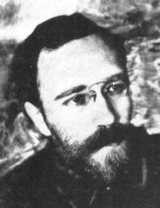
Lev Kamenev

Encyclopedia
Lev Borisovich Kamenev , born Rozenfeld , was a Bolshevik
revolutionary
and a prominent Soviet
politician
. He was briefly head of state
of the new republic
in 1917, and from 1923-24 the acting Premier in the last year of Lenin's life.
, the son of a Jewish railway worker and a Russian Orthodox mother. His father had grown rich building the Baku
-Batumi
railway. His father's wealth funded a good education for Lev. He went to the boy's Gymnasium
in Tiflis, Georgia
(now Tbilisi
) and attended Moscow University, but his education was interrupted by an arrest in 1902. From that point on, he was a professional revolutionary, working in St. Petersburg, Moscow and Tiflis. Kamenev married a fellow Marxist (and Leon Trotsky
's sister), Olga Kameneva
, in the early 1900s and the couple had two sons.
He joined the Communists in 1901 and supported Lenin.
A brief trip abroad in 1902 introduced Kamenev to Russian social democratic leaders living in exile, including Vladimir Ilyich Ulyanov Lenin, whose adherent and close associate he became. He also visited Paris and met the Iskra group. After attending the 3rd Congress
of the RSDLP Party
in London in March 1905, Kamenev went back to Russia to participate in the Russian Revolution of 1905
in St. Petersburg in October–December. He went back to London to attend the 5th RSDLP Party Congress
, where he was elected to the party's Central Committee and the Bolshevik Center, in May 1907, but was arrested upon his return to Russia. Kamenev was released from prison in 1908 and the Kamenevs went abroad later in the year to help Lenin edit Bolshevik magazine Proletariy. After Lenin's split with another senior Bolshevik leader, Alexander Bogdanov
, in mid-1908, Kamenev and Grigory Zinoviev
became Lenin's main assistants abroad. They helped him expel Bogdanov and his Otzovist (Recallist) followers from the Bolshevik faction of the RSDLP in mid-1909.
In January 1910 Leninists, followers of Bogdanov and various Menshevik
factions held a meeting of the party's Central Committee in Paris and tried to re-unite the party. Kamenev and Zinoviev were dubious about the idea, but were willing to give it a try under pressure from "conciliator" Bolsheviks like Victor Nogin. Lenin was adamantly opposed to any re-unification, but was outvoted within the Bolshevik leadership. The meeting reached a tentative agreement and one of its provisions made Trotsky's Vienna-based Pravda
a party-financed 'central organ'. Kamenev, Trotsky's brother-in-law, was added to the editorial board from the Bolsheviks, but the unification attempts failed in August 1910 when Kamenev resigned from the board amid mutual recriminations.
After the failure of the reunification attempt, Kamenev continued working in Proletariy and taught at the Bolshevik party school at Longjumeau near Paris that was created as a Leninist alternative to Bogdanov's Capri
-based party school. In January 1912, Kamenev helped Lenin and Zinoviev to convince the Prague Conference of Bolshevik delegates to split from the Mensheviks and Otzovists. In January 1914, he was sent to St. Petersburg to direct the work of the Bolshevik version of Pravda and the Bolshevik faction of the Duma
. Kamenev was arrested after the outbreak of World War I
and put on trial, where he distanced himself from Lenin's anti-war stance. Kamenev was exiled to Siberia
in early 1915 and spent two years there until he was freed by the February Revolution
of 1917.
Before leaving Siberia, Kamenev actually proposed sending a telegraph thanking the Tsar's brother Mikhail for refusing the throne. He was so embarrassed he denied ever sending it.
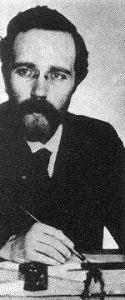 On March 25, 1917 Kamenev returned to St. Petersburg (the name was changed to Petrograd in 1914) from Siberian exile. Kamenev and Central Committee members Joseph Stalin
and Matvei Muranov
took control of the revived Bolshevik Pravda and moved it to the Right, with Kamenev formulating a policy of conditional support of the newly formed Russian Provisional Government
and a reconciliation with the Mensheviks. After Lenin's return to Russia on 3 April 1917, Kamenev briefly resisted Lenin's anti-government April Theses, but soon fell in line and supported Lenin until September.
Kamenev and Zinoviev had a falling out with Lenin over their opposition to Soviet seizure of power in October 1917 On 10 October 1917 (Old Style
), Kamenev and Zinoviev were the only two Central Committee members to vote against an armed revolt. Their publication of an open letter opposed to the use of force enraged Lenin, who demanded their expulsion from the party. However, when the Bolshevik-led Military Revolutionary Committee
headed by Adolph Joffe
and the Petrograd Soviet
, led by Trotsky, staged an uprising, Kamenev and Zinoviev went along. At the Second All-Russian Congress of Soviets
Kamenev was elected Congress Chairman and Chairman of the permanent All-Russian Central Executive Committee. The latter position was equivalent to the head of state under the Soviet system.
On November 10, 1917, three days after the Soviet seizure of power during the October Revolution, the executive committee of the national railroad labor union, Vikzhel, threatened a national strike unless the Bolsheviks shared power with other socialist parties and dropped the uprising's leaders, Lenin and Trotsky, from the government. Zinoviev, Kamenev and their allies in the Bolshevik Central Committee argued that the Bolsheviks had no choice but to start negotiations since a railroad strike would cripple their government's ability to fight the forces that were still loyal to the overthrown Provisional Government. Although Zinoviev and Kamenev briefly had the support of a Central Committee majority and negotiations were started, a quick collapse of the anti-Bolshevik forces outside Petrograd allowed Lenin and Trotsky to convince the Central Committee to abandon the negotiating process. In response, Zinoviev, Kamenev, Alexei Rykov
, Vladimir Milyutin
and Victor Nogin resigned from the Central Committee on 4 November 1917 (Old Style) and Kamenev resigned from his Central Executive Committee post. The following day Lenin wrote a proclamation calling Zinoviev and Kamenev "deserters" and never forgot their behavior, eventually making an ambiguous reference to their "October episode" in his Testament
.
, soured after 1920 and for the next 15 years he was a friend and close ally of Grigory Zinoviev, a more ambitious man than Kamenev.
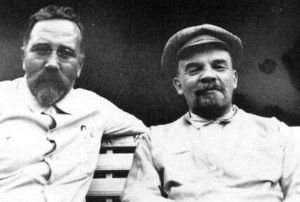 During Lenin's illness, Kamenev was the acting Council of People's Commissars and Politburo chairman. Together with Zinoviev and Joseph Stalin
, he formed a ruling 'triumvirate' (or 'troika') in the Communist Party
, and played a key role in the marginalization of Trotsky. The triumvirate carefully managed the intra-party debate and delegate selection process in the fall of 1923 during the runup to the XIIIth Party Conference
and secured a vast majority of the seats. The Conference, held in January 1924 immediately prior to Lenin's death, denounced Trotsky and "Trotskyism".
After Trotsky's defeat at the XIIIth Conference, tensions between Zinoviev and Kamenev on the one hand and Stalin on the other hand became more pronounced and threatened to end their fragile alliance. Nevertheless, Zinoviev and especially Kamenev helped Stalin retain his position as General Secretary of the Central Committee
at the XIIIth Party Congress in May–June 1924 during the first Lenin's Testament
controversy. After the Congress, Stalin began making veiled public remarks apparently aimed at Kamenev and Zinoviev, which all but destroyed the troika.
However, in October 1924, Trotsky published The Lessons of October, an extensive summary of the events of 1917. In the article, Trotsky described Zinoviev and Kamenev's opposition to the Bolshevik seizure of power in 1917, something that the two would have preferred left unmentioned. This started a new round of intra-party struggle with Zinoviev and Kamenev once again allied with Stalin against Trotsky. They and their supporters accused Trotsky of various mistakes and worse during the Russian Civil War
and damaged his military reputation so much that he was forced to resign as People's Commissar of Army and Fleet Affairs and Chairman of the Revolutionary Military Council
in January 1925. Zinoviev demanded Trotsky's expulsion from the Communist Party, but Stalin refused to go along and skillfully played the role of a moderate.
editor Nikolai Bukharin
and the Soviet prime minister Alexei Rykov. Zinoviev and Kamenev allied with Lenin's widow, Nadezhda Krupskaya and Grigori Sokolnikov, the People's Commissar for Finance and a candidate Politburo member. Their alliance became known as the New Opposition.
The struggle became open at the September 1925 meeting of the Central Committee and came to a head at the XIVth Party Congress in December 1925, when Kamenev publicly demanded removal of Stalin from the position of the General Secretary. With only the Leningrad delegation (controlled by Zinoviev) behind them, Zinoviev and Kamenev found themselves in a tiny minority and were soundly defeated while Trotsky remained silent during the Congress. Zinoviev was re-elected to the Politburo, but Kamenev was demoted from a full member to a non-voting member and Sokolnikov was dropped altogether, while Stalin had more of his allies elected to the Politburo.
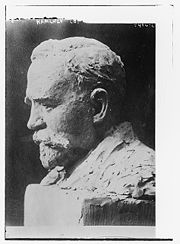 Kamenev's first marriage began to disintegrate starting with Kamenev's reputed affair with the British
sculptress
Clare Frewen Sheridan
in 1920. In the late 1920s he left Olga Kameneva for Tatiana Glebova, with whom he had a son, Vladimir Glebov (1929–1994).
. During a new period of intra-Party fighting between the July 1926 meeting of the Central Committee and the XVth Party Conference in October 1926, the Opposition was defeated and Kamenev lost his Politburo seat at the Conference.
Kamenev remained in opposition to Stalin throughout 1926 and 1927, resulting in his expulsion from the Central Committee in October 1927. After the expulsion of Zinoviev and Trotsky from the Communist Party on 12 November 1927, Kamenev remained the Opposition's chief spokesman within the Party and represented its position at the XVth Party Congress in December 1927. The Congress declared Opposition views incompatible with membership in the Communist Party and expelled Kamenev and dozens of leading oppositionists from the Party, which paved the way for mass expulsions of rank and file oppositionists as well as internal exile of opposition leaders in early 1928.
Zinoviev and Kamenev remained politically inactive until October 1932, when they were expelled from the Communist Party for failure to inform on oppositionist party members during the Ryutin Affair
. After once again admitting their supposed mistakes, they were readmitted in December 1933. They were forced to make self-flagellating speeches at the XVIIth Party Congress in January 1934 when Stalin was parading his erstwhile political opponents, now defeated and outwardly contrite.
After the murder of Sergei Kirov on 1 December 1934 led to Stalin's Great Purges, Grigory Zinoviev
, Kamenev and their closest associates were once again expelled from the Communist Party and arrested in December 1934. In this time he wrote a letter to Stalin. "At a time when my soul is filled with nothing but love for the party and its leadership, when, having lived through hesitations and doubts, I can boldly say that I learned to highly trust the Central Committee's every step and every decision you, Comrade Stalin, make," Kamenev wrote. "I have been arrested for my ties to people that are strange and disgusting to me.". They were tried in January 1935 and were forced to admit "moral complicity" in Kirov's assassination. Zinoviev was sentenced to ten years in prison and Kamenev to five. Kamenev was charged separately in early 1935 in connection with the Kremlin Case and, although he refused to confess, was sentenced to ten years in prison.
In August 1936, after months of careful preparations and rehearsals in Soviet secret police prisons, Zinoviev, Kamenev and 14 others, mostly Old Bolshevik
s, were put on trial again. This time the charges including forming a terrorist organization that supposedly killed Kirov and tried to kill Joseph Stalin and other leaders of the Soviet government. This Trial of the Sixteen (or the trial of the "Trotskyite-Zinovievite Terrorist Center") was the first Moscow Show Trial
and set the stage for subsequent show trials where Old Bolsheviks confessed to increasingly elaborate and monstrous crimes, including espionage, poisoning, sabotage, and so on. Like other defendants, Kamenev was found guilty and shot on 25 August 1936.
The execution of Zinoviev, Kamenev and their associates was notable because no Old Bolsheviks, much less prominent ones, had been put to death by Stalin's government until then.
Kamenev, Zinoviev and his co-defendants were formally cleared of all charges by the Soviet government in 1988 during perestroika
.
officer A.L. Kamenev, was executed on 15 July 1939, at the age of 33. His first wife, Olga, was shot on 11 September 1941 on Stalin's orders, in the Medvedev forest outside Oryol
, together with Christian Rakovsky
, Maria Spiridonova
and 160 other prominent political prisoners. Only his youngest son, Vladimir Glebov, survived Stalin's prisons and labor camps.
Bolshevik
The Bolsheviks, originally also Bolshevists , derived from bol'shinstvo, "majority") were a faction of the Marxist Russian Social Democratic Labour Party which split apart from the Menshevik faction at the Second Party Congress in 1903....
revolutionary
Revolutionary
A revolutionary is a person who either actively participates in, or advocates revolution. Also, when used as an adjective, the term revolutionary refers to something that has a major, sudden impact on society or on some aspect of human endeavor.-Definition:...
and a prominent Soviet
Soviet Union
The Soviet Union , officially the Union of Soviet Socialist Republics , was a constitutionally socialist state that existed in Eurasia between 1922 and 1991....
politician
Politician
A politician, political leader, or political figure is an individual who is involved in influencing public policy and decision making...
. He was briefly head of state
Head of State
A head of state is the individual that serves as the chief public representative of a monarchy, republic, federation, commonwealth or other kind of state. His or her role generally includes legitimizing the state and exercising the political powers, functions, and duties granted to the head of...
of the new republic
Soviet Russia
Soviet Russia usually refers to the Russian Soviet Federative Socialist Republic, one of the fifteen republics of the Soviet Union. It may also denote:* Soviet Russia , magazine of the Friends of Soviet Russia in the United States...
in 1917, and from 1923-24 the acting Premier in the last year of Lenin's life.
Early life and career
Kamenev was born in MoscowMoscow
Moscow is the capital, the most populous city, and the most populous federal subject of Russia. The city is a major political, economic, cultural, scientific, religious, financial, educational, and transportation centre of Russia and the continent...
, the son of a Jewish railway worker and a Russian Orthodox mother. His father had grown rich building the Baku
Baku
Baku , sometimes spelled as Baki or Bakou, is the capital and largest city of Azerbaijan, as well as the largest city on the Caspian Sea and of the Caucasus region. It is located on the southern shore of the Absheron Peninsula, which projects into the Caspian Sea. The city consists of two principal...
-Batumi
Batumi
Batumi is a seaside city on the Black Sea coast and capital of Adjara, an autonomous republic in southwest Georgia. Sometimes considered Georgia's second capital, with a population of 121,806 , Batumi serves as an important port and a commercial center. It is situated in a subtropical zone, rich in...
railway. His father's wealth funded a good education for Lev. He went to the boy's Gymnasium
Gymnasium (school)
A gymnasium is a type of school providing secondary education in some parts of Europe, comparable to English grammar schools or sixth form colleges and U.S. college preparatory high schools. The word γυμνάσιον was used in Ancient Greece, meaning a locality for both physical and intellectual...
in Tiflis, Georgia
Georgia (country)
Georgia is a sovereign state in the Caucasus region of Eurasia. Located at the crossroads of Western Asia and Eastern Europe, it is bounded to the west by the Black Sea, to the north by Russia, to the southwest by Turkey, to the south by Armenia, and to the southeast by Azerbaijan. The capital of...
(now Tbilisi
Tbilisi
Tbilisi is the capital and the largest city of Georgia, lying on the banks of the Mt'k'vari River. The name is derived from an early Georgian form T'pilisi and it was officially known as Tiflis until 1936...
) and attended Moscow University, but his education was interrupted by an arrest in 1902. From that point on, he was a professional revolutionary, working in St. Petersburg, Moscow and Tiflis. Kamenev married a fellow Marxist (and Leon Trotsky
Leon Trotsky
Leon Trotsky , born Lev Davidovich Bronshtein, was a Russian Marxist revolutionary and theorist, Soviet politician, and the founder and first leader of the Red Army....
's sister), Olga Kameneva
Olga Kameneva
Olga Davidovna Kameneva was a Russian Bolshevik revolutionary and a Soviet politician. She was the sister of Leon Trotsky and the first wife of Lev Kamenev.-Childhood and Revolutionary Career :...
, in the early 1900s and the couple had two sons.
He joined the Communists in 1901 and supported Lenin.
A brief trip abroad in 1902 introduced Kamenev to Russian social democratic leaders living in exile, including Vladimir Ilyich Ulyanov Lenin, whose adherent and close associate he became. He also visited Paris and met the Iskra group. After attending the 3rd Congress
3rd Congress of the Russian Social Democratic Labour Party
The 3rd Congress of the Russian Social Democratic Labour Party was held during 12-27 April [25 Apr - 10 May ] 1905 in London, UK. It was the congress of the Bolsheviks only with a handful of Mensheviks. The meeting was so secretive we do not know the name of the hall they used.Besides the routine...
of the RSDLP Party
Russian Social Democratic Labour Party
The Russian Social Democratic Labour Party , also known as Russian Social Democratic Workers' Party or Russian Social Democratic Party, was a revolutionary socialist Russian political party formed in 1898 in Minsk to unite the various revolutionary organizations into one party...
in London in March 1905, Kamenev went back to Russia to participate in the Russian Revolution of 1905
Russian Revolution of 1905
The 1905 Russian Revolution was a wave of mass political and social unrest that spread through vast areas of the Russian Empire. Some of it was directed against the government, while some was undirected. It included worker strikes, peasant unrest, and military mutinies...
in St. Petersburg in October–December. He went back to London to attend the 5th RSDLP Party Congress
5th Congress of the Russian Social Democratic Labour Party
The 5th Congress of the Russian Social Democratic Labour Party was held in London between May 13 and June 1, 1907. The congress was the largest in attendance of the congresses of the unified RSDLP. Thirty-five session of the congress were held in the Brotherhood Church in Hackney, during which...
, where he was elected to the party's Central Committee and the Bolshevik Center, in May 1907, but was arrested upon his return to Russia. Kamenev was released from prison in 1908 and the Kamenevs went abroad later in the year to help Lenin edit Bolshevik magazine Proletariy. After Lenin's split with another senior Bolshevik leader, Alexander Bogdanov
Alexander Bogdanov
Alexander Aleksandrovich Bogdanov –7 April 1928, Moscow) was a Russian physician, philosopher, science fiction writer, and revolutionary of Belarusian ethnicity....
, in mid-1908, Kamenev and Grigory Zinoviev
Grigory Zinoviev
Grigory Yevseevich Zinoviev , born Ovsei-Gershon Aronovich Radomyslsky Apfelbaum , was a Bolshevik revolutionary and a Soviet Communist politician...
became Lenin's main assistants abroad. They helped him expel Bogdanov and his Otzovist (Recallist) followers from the Bolshevik faction of the RSDLP in mid-1909.
In January 1910 Leninists, followers of Bogdanov and various Menshevik
Menshevik
The Mensheviks were a faction of the Russian revolutionary movement that emerged in 1904 after a dispute between Vladimir Lenin and Julius Martov, both members of the Russian Social-Democratic Labour Party. The dispute originated at the Second Congress of that party, ostensibly over minor issues...
factions held a meeting of the party's Central Committee in Paris and tried to re-unite the party. Kamenev and Zinoviev were dubious about the idea, but were willing to give it a try under pressure from "conciliator" Bolsheviks like Victor Nogin. Lenin was adamantly opposed to any re-unification, but was outvoted within the Bolshevik leadership. The meeting reached a tentative agreement and one of its provisions made Trotsky's Vienna-based Pravda
Pravda
Pravda was a leading newspaper of the Soviet Union and an official organ of the Central Committee of the Communist Party between 1912 and 1991....
a party-financed 'central organ'. Kamenev, Trotsky's brother-in-law, was added to the editorial board from the Bolsheviks, but the unification attempts failed in August 1910 when Kamenev resigned from the board amid mutual recriminations.
After the failure of the reunification attempt, Kamenev continued working in Proletariy and taught at the Bolshevik party school at Longjumeau near Paris that was created as a Leninist alternative to Bogdanov's Capri
Capri
Capri is an Italian island in the Tyrrhenian Sea off the Sorrentine Peninsula, on the south side of the Gulf of Naples, in the Campania region of Southern Italy...
-based party school. In January 1912, Kamenev helped Lenin and Zinoviev to convince the Prague Conference of Bolshevik delegates to split from the Mensheviks and Otzovists. In January 1914, he was sent to St. Petersburg to direct the work of the Bolshevik version of Pravda and the Bolshevik faction of the Duma
Duma
A Duma is any of various representative assemblies in modern Russia and Russian history. The State Duma in the Russian Empire and Russian Federation corresponds to the lower house of the parliament. Simply it is a form of Russian governmental institution, that was formed during the reign of the...
. Kamenev was arrested after the outbreak of World War I
World War I
World War I , which was predominantly called the World War or the Great War from its occurrence until 1939, and the First World War or World War I thereafter, was a major war centred in Europe that began on 28 July 1914 and lasted until 11 November 1918...
and put on trial, where he distanced himself from Lenin's anti-war stance. Kamenev was exiled to Siberia
Siberia
Siberia is an extensive region constituting almost all of Northern Asia. Comprising the central and eastern portion of the Russian Federation, it was part of the Soviet Union from its beginning, as its predecessor states, the Tsardom of Russia and the Russian Empire, conquered it during the 16th...
in early 1915 and spent two years there until he was freed by the February Revolution
February Revolution
The February Revolution of 1917 was the first of two revolutions in Russia in 1917. Centered around the then capital Petrograd in March . Its immediate result was the abdication of Tsar Nicholas II, the end of the Romanov dynasty, and the end of the Russian Empire...
of 1917.
Before leaving Siberia, Kamenev actually proposed sending a telegraph thanking the Tsar's brother Mikhail for refusing the throne. He was so embarrassed he denied ever sending it.
Joseph Stalin
Joseph Vissarionovich Stalin was the Premier of the Soviet Union from 6 May 1941 to 5 March 1953. He was among the Bolshevik revolutionaries who brought about the October Revolution and had held the position of first General Secretary of the Communist Party of the Soviet Union's Central Committee...
and Matvei Muranov
Matvei Muranov
Matvei Konstantinovich Muranov was a Ukrainian-born Bolshevik revolutionary and a Soviet politician.-Revolutionary beginnings:Born in a peasant family in Rybtsy near Poltava, Muranov moved to Kharkov in 1900 and worked as a railroad worker...
took control of the revived Bolshevik Pravda and moved it to the Right, with Kamenev formulating a policy of conditional support of the newly formed Russian Provisional Government
Russian Provisional Government
The Russian Provisional Government was the short-lived administrative body which sought to govern Russia immediately following the abdication of Tsar Nicholas II . On September 14, the State Duma of the Russian Empire was officially dissolved by the newly created Directorate, and the country was...
and a reconciliation with the Mensheviks. After Lenin's return to Russia on 3 April 1917, Kamenev briefly resisted Lenin's anti-government April Theses, but soon fell in line and supported Lenin until September.
Kamenev and Zinoviev had a falling out with Lenin over their opposition to Soviet seizure of power in October 1917 On 10 October 1917 (Old Style
Old Style and New Style dates
Old Style and New Style are used in English language historical studies either to indicate that the start of the Julian year has been adjusted to start on 1 January even though documents written at the time use a different start of year ; or to indicate that a date conforms to the Julian...
), Kamenev and Zinoviev were the only two Central Committee members to vote against an armed revolt. Their publication of an open letter opposed to the use of force enraged Lenin, who demanded their expulsion from the party. However, when the Bolshevik-led Military Revolutionary Committee
Military Revolutionary Committee
The Military Revolutionary Committee also known as the Milrevcom was the name for military organs under the soviets during the period of the Russian Revolution and Russian Civil War. The most notable ones were those of the Petrograd Soviet, the Moscow Soviet, and at Stavka.These committees were...
headed by Adolph Joffe
Adolph Joffe
Adolph Abramovich Joffe was a Communist revolutionary, a Bolshevik politician and a Soviet diplomat of Karaim descent.-Revolutionary career:...
and the Petrograd Soviet
Petrograd Soviet
The Petrograd Soviet of Workers' and Soldiers' Deputies , usually called the Petrograd Soviet , was the soviet in Petrograd , Russia, established in March 1917 after the February Revolution as the representative body of the city's workers.The Petrograd Soviet became important during the Russian...
, led by Trotsky, staged an uprising, Kamenev and Zinoviev went along. At the Second All-Russian Congress of Soviets
Congress of Soviets
The Congress of Soviets was the supreme governing body of the Russian Soviet Federative Socialist Republic and several other Soviet republics from 1917–36 and again from 1989-91. After the creation of the Soviet Union, the Congress of Soviets of the Soviet Union functioned as its legislative branch...
Kamenev was elected Congress Chairman and Chairman of the permanent All-Russian Central Executive Committee. The latter position was equivalent to the head of state under the Soviet system.
On November 10, 1917, three days after the Soviet seizure of power during the October Revolution, the executive committee of the national railroad labor union, Vikzhel, threatened a national strike unless the Bolsheviks shared power with other socialist parties and dropped the uprising's leaders, Lenin and Trotsky, from the government. Zinoviev, Kamenev and their allies in the Bolshevik Central Committee argued that the Bolsheviks had no choice but to start negotiations since a railroad strike would cripple their government's ability to fight the forces that were still loyal to the overthrown Provisional Government. Although Zinoviev and Kamenev briefly had the support of a Central Committee majority and negotiations were started, a quick collapse of the anti-Bolshevik forces outside Petrograd allowed Lenin and Trotsky to convince the Central Committee to abandon the negotiating process. In response, Zinoviev, Kamenev, Alexei Rykov
Alexei Rykov
Aleksei Ivanovich Rykov was a Russian Bolshevik revolutionary and a Soviet politician most prominent as Premier of Russia and the Soviet Union from 1924–29 and 1924–30 respectively....
, Vladimir Milyutin
Vladimir Milyutin
Vladimir Pavlovich Milyutin was a Bolshevik leader who was appointed People's Commissar of Agriculture in 1917....
and Victor Nogin resigned from the Central Committee on 4 November 1917 (Old Style) and Kamenev resigned from his Central Executive Committee post. The following day Lenin wrote a proclamation calling Zinoviev and Kamenev "deserters" and never forgot their behavior, eventually making an ambiguous reference to their "October episode" in his Testament
Lenin's Testament
Lenin's Testament is the name given to a document written by Vladimir Lenin in the last weeks of 1922 and the first week of 1923. In the testament, Lenin proposed changes to the structure of the Soviet governing bodies...
.
Opposition against Trotsky
In 1918, Kamenev became chairman of the Moscow Soviet and soon thereafter Lenin's Deputy Chairman of the Council of People's Commissars (government) and the Council of Labor and Defense. In March, 1919, Kamenev was elected a full member of the first Politburo. His personal relationship with his brother-in-law Trotsky, which was good in the aftermath of the 1917 revolution and during the Russian Civil WarRussian Civil War
The Russian Civil War was a multi-party war that occurred within the former Russian Empire after the Russian provisional government collapsed to the Soviets, under the domination of the Bolshevik party. Soviet forces first assumed power in Petrograd The Russian Civil War (1917–1923) was a...
, soured after 1920 and for the next 15 years he was a friend and close ally of Grigory Zinoviev, a more ambitious man than Kamenev.
Joseph Stalin
Joseph Vissarionovich Stalin was the Premier of the Soviet Union from 6 May 1941 to 5 March 1953. He was among the Bolshevik revolutionaries who brought about the October Revolution and had held the position of first General Secretary of the Communist Party of the Soviet Union's Central Committee...
, he formed a ruling 'triumvirate' (or 'troika') in the Communist Party
Communist Party of the Soviet Union
The Communist Party of the Soviet Union was the only legal, ruling political party in the Soviet Union and one of the largest communist organizations in the world...
, and played a key role in the marginalization of Trotsky. The triumvirate carefully managed the intra-party debate and delegate selection process in the fall of 1923 during the runup to the XIIIth Party Conference
13th Congress of the Russian Communist Party (b)
The 13th Congress of the Russian Communist Party was held during 23-31 May 1924 in Moscow. This congress was the Russian Communist Party ' first to take place after the death of Vladimir Lenin, and represents a transition between the Lenin and Joseph Stalin regimes...
and secured a vast majority of the seats. The Conference, held in January 1924 immediately prior to Lenin's death, denounced Trotsky and "Trotskyism".
After Trotsky's defeat at the XIIIth Conference, tensions between Zinoviev and Kamenev on the one hand and Stalin on the other hand became more pronounced and threatened to end their fragile alliance. Nevertheless, Zinoviev and especially Kamenev helped Stalin retain his position as General Secretary of the Central Committee
General Secretary of the Communist Party of the Soviet Union
General Secretary of the Central Committee of the Communist Party of the Soviet Union was the title given to the leader of the Communist Party of the Soviet Union. With some exceptions, the office was synonymous with leader of the Soviet Union...
at the XIIIth Party Congress in May–June 1924 during the first Lenin's Testament
Lenin's Testament
Lenin's Testament is the name given to a document written by Vladimir Lenin in the last weeks of 1922 and the first week of 1923. In the testament, Lenin proposed changes to the structure of the Soviet governing bodies...
controversy. After the Congress, Stalin began making veiled public remarks apparently aimed at Kamenev and Zinoviev, which all but destroyed the troika.
However, in October 1924, Trotsky published The Lessons of October, an extensive summary of the events of 1917. In the article, Trotsky described Zinoviev and Kamenev's opposition to the Bolshevik seizure of power in 1917, something that the two would have preferred left unmentioned. This started a new round of intra-party struggle with Zinoviev and Kamenev once again allied with Stalin against Trotsky. They and their supporters accused Trotsky of various mistakes and worse during the Russian Civil War
Russian Civil War
The Russian Civil War was a multi-party war that occurred within the former Russian Empire after the Russian provisional government collapsed to the Soviets, under the domination of the Bolshevik party. Soviet forces first assumed power in Petrograd The Russian Civil War (1917–1923) was a...
and damaged his military reputation so much that he was forced to resign as People's Commissar of Army and Fleet Affairs and Chairman of the Revolutionary Military Council
Revolutionary Military Council
Revolutionary Military Council of the Republic or Revvoyensoviet Revolutionary Military Council of the Republic or Revvoyensoviet Revolutionary Military Council of the Republic or Revvoyensoviet (Революционный Военный Совет, Revolyutsionny Voyenny Sovyet; Реввоенсовет, Revvoyensovyet; also...
in January 1925. Zinoviev demanded Trotsky's expulsion from the Communist Party, but Stalin refused to go along and skillfully played the role of a moderate.
Break with Stalin (1925)
With Trotsky on the sidelines, the Zinoviev-Kamenev-Stalin triumvirate finally began to crumble in early 1925. The two sides spent most of the year lining up support behind the scenes. Stalin struck an alliance with the Communist Party theoretician and PravdaPravda
Pravda was a leading newspaper of the Soviet Union and an official organ of the Central Committee of the Communist Party between 1912 and 1991....
editor Nikolai Bukharin
Nikolai Bukharin
Nikolai Ivanovich Bukharin , was a Russian Marxist, Bolshevik revolutionary, and Soviet politician. He was a member of the Politburo and Central Committee , chairman of the Communist International , and the editor in chief of Pravda , the journal Bolshevik , Izvestia , and the Great Soviet...
and the Soviet prime minister Alexei Rykov. Zinoviev and Kamenev allied with Lenin's widow, Nadezhda Krupskaya and Grigori Sokolnikov, the People's Commissar for Finance and a candidate Politburo member. Their alliance became known as the New Opposition.
The struggle became open at the September 1925 meeting of the Central Committee and came to a head at the XIVth Party Congress in December 1925, when Kamenev publicly demanded removal of Stalin from the position of the General Secretary. With only the Leningrad delegation (controlled by Zinoviev) behind them, Zinoviev and Kamenev found themselves in a tiny minority and were soundly defeated while Trotsky remained silent during the Congress. Zinoviev was re-elected to the Politburo, but Kamenev was demoted from a full member to a non-voting member and Sokolnikov was dropped altogether, while Stalin had more of his allies elected to the Politburo.
Great Britain
Great Britain or Britain is an island situated to the northwest of Continental Europe. It is the ninth largest island in the world, and the largest European island, as well as the largest of the British Isles...
sculptress
Sculpture
Sculpture is three-dimensional artwork created by shaping or combining hard materials—typically stone such as marble—or metal, glass, or wood. Softer materials can also be used, such as clay, textiles, plastics, polymers and softer metals...
Clare Frewen Sheridan
Clare Frewen Sheridan
Clare Sheridan , was an English sculptress and writer who is known primarily for creating busts for famous sitters, and writing diaries recounting her worldly travels...
in 1920. In the late 1920s he left Olga Kameneva for Tatiana Glebova, with whom he had a son, Vladimir Glebov (1929–1994).
Opposition against Stalin (1926-1927)
During a lull in the intra-party fighting in the spring of 1926, Zinoviev, Kamenev and their supporters gravitated closer to Trotsky's supporters and the two groups soon formed an alliance, which also incorporated some smaller opposition groups within the Communist Party. The alliance became known as the United OppositionUnited Opposition
The United Opposition was a group formed in the All-Union Communist Party in 1926 by Leon Trotsky, Lev Kamenev and Grigory Zinoviev in opposition to Joseph Stalin...
. During a new period of intra-Party fighting between the July 1926 meeting of the Central Committee and the XVth Party Conference in October 1926, the Opposition was defeated and Kamenev lost his Politburo seat at the Conference.
Kamenev remained in opposition to Stalin throughout 1926 and 1927, resulting in his expulsion from the Central Committee in October 1927. After the expulsion of Zinoviev and Trotsky from the Communist Party on 12 November 1927, Kamenev remained the Opposition's chief spokesman within the Party and represented its position at the XVth Party Congress in December 1927. The Congress declared Opposition views incompatible with membership in the Communist Party and expelled Kamenev and dozens of leading oppositionists from the Party, which paved the way for mass expulsions of rank and file oppositionists as well as internal exile of opposition leaders in early 1928.
Submission to Stalin and death
While Trotsky remained firm in his opposition to Stalin after his expulsion from the Party and subsequent exile, Zinoviev and Kamenev capitulated almost immediately and called on their supporters to follow suit. They wrote open letters acknowledging their mistakes and were readmitted to the Communist Party after a six month cooling off period. They never regained their Central Committee seats, but they were given mid-level positions within the Soviet bureaucracy. Kamenev and, indirectly, Zinoviev, were courted by Bukharin, then at the beginning of his short and ill-fated struggle with Stalin, in the summer of 1928, something that was soon reported to Joseph Stalin and used against Bukharin as proof of his factionalism.Zinoviev and Kamenev remained politically inactive until October 1932, when they were expelled from the Communist Party for failure to inform on oppositionist party members during the Ryutin Affair
Ryutin Affair
The Ryutin Affair was one of the last attempts to oppose the Soviet leader Joseph Stalin within the Soviet Communist Party.Martemyan Ryutin was an Old Bolshevik and a secretary of the Moscow City Communist Party Committee in the 1920s...
. After once again admitting their supposed mistakes, they were readmitted in December 1933. They were forced to make self-flagellating speeches at the XVIIth Party Congress in January 1934 when Stalin was parading his erstwhile political opponents, now defeated and outwardly contrite.
After the murder of Sergei Kirov on 1 December 1934 led to Stalin's Great Purges, Grigory Zinoviev
Grigory Zinoviev
Grigory Yevseevich Zinoviev , born Ovsei-Gershon Aronovich Radomyslsky Apfelbaum , was a Bolshevik revolutionary and a Soviet Communist politician...
, Kamenev and their closest associates were once again expelled from the Communist Party and arrested in December 1934. In this time he wrote a letter to Stalin. "At a time when my soul is filled with nothing but love for the party and its leadership, when, having lived through hesitations and doubts, I can boldly say that I learned to highly trust the Central Committee's every step and every decision you, Comrade Stalin, make," Kamenev wrote. "I have been arrested for my ties to people that are strange and disgusting to me.". They were tried in January 1935 and were forced to admit "moral complicity" in Kirov's assassination. Zinoviev was sentenced to ten years in prison and Kamenev to five. Kamenev was charged separately in early 1935 in connection with the Kremlin Case and, although he refused to confess, was sentenced to ten years in prison.
In August 1936, after months of careful preparations and rehearsals in Soviet secret police prisons, Zinoviev, Kamenev and 14 others, mostly Old Bolshevik
Old Bolshevik
Old Bolshevik , also Old Bolshevik Guard or Old Party Guard, was an unofficial designation for those who were members of the Bolshevik party before the Russian Revolution of 1917, many of whom were either tried and executed by the NKVD during Stalin era purges or died under suspicious...
s, were put on trial again. This time the charges including forming a terrorist organization that supposedly killed Kirov and tried to kill Joseph Stalin and other leaders of the Soviet government. This Trial of the Sixteen (or the trial of the "Trotskyite-Zinovievite Terrorist Center") was the first Moscow Show Trial
Moscow Trials
The Moscow Trials were a series of show trials conducted in the Soviet Union and orchestrated by Joseph Stalin during the Great Purge of the 1930s. The victims included most of the surviving Old Bolsheviks, as well as the leadership of the Soviet secret police...
and set the stage for subsequent show trials where Old Bolsheviks confessed to increasingly elaborate and monstrous crimes, including espionage, poisoning, sabotage, and so on. Like other defendants, Kamenev was found guilty and shot on 25 August 1936.
The execution of Zinoviev, Kamenev and their associates was notable because no Old Bolsheviks, much less prominent ones, had been put to death by Stalin's government until then.
Kamenev, Zinoviev and his co-defendants were formally cleared of all charges by the Soviet government in 1988 during perestroika
Perestroika
Perestroika was a political movement within the Communist Party of the Soviet Union during 1980s, widely associated with the Soviet leader Mikhail Gorbachev...
.
Fate of the family
After Kamenev's execution, his relatives suffered a similar fate. Kamenev's second son, Yu. L. Kamenev, was executed on 30 January 1938, at the age of 17. His eldest son, air forceAir force
An air force, also known in some countries as an air army, is in the broadest sense, the national military organization that primarily conducts aerial warfare. More specifically, it is the branch of a nation's armed services that is responsible for aerial warfare as distinct from an army, navy or...
officer A.L. Kamenev, was executed on 15 July 1939, at the age of 33. His first wife, Olga, was shot on 11 September 1941 on Stalin's orders, in the Medvedev forest outside Oryol
Oryol
Oryol or Orel is a city and the administrative center of Oryol Oblast, Russia, located on the Oka River, approximately south-southwest of Moscow...
, together with Christian Rakovsky
Christian Rakovsky
Christian Rakovsky was a Bulgarian socialist revolutionary, a Bolshevik politician and Soviet diplomat; he was also noted as a journalist, physician, and essayist...
, Maria Spiridonova
Maria Spiridonova
Maria Alexandrovna Spiridonova was a figure in Russian revolutionary circles at the beginning of the 20th century.- Biography :She joined the Socialist-Revolutionary Party during her training to become a nurse....
and 160 other prominent political prisoners. Only his youngest son, Vladimir Glebov, survived Stalin's prisons and labor camps.
External links
- Examination of Kamenev during his trial, 20 August 1936.
- Leon Trotsky on Kamenev and Grigory Zinoviev