|
|
|
|
Stavropol
|
| |
|
| |
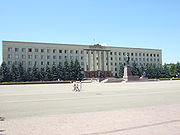
Stavropol is a city located in south-western Russia and is the administrative center of Stavropol Krai. Population: 355,900 (2005 est.);
ropol was founded in 1777 following the Russo-Turkish War of 1768–1774 as a military encampment and designated as a city in 1785. Prince Grigory Potemkin, who founded Stavropol as one of ten fortresses built between Azov and Mozdok at the request of Catherine II of Russia, played a leading role in the creation of the city.

Discussion
Ask a question about 'Stavropol'
Start a new discussion about 'Stavropol'
Answer questions from other users
|
Encyclopedia
Stavropol is a city located in south-western Russia and is the administrative center of Stavropol Krai. Population: 355,900 (2005 est.);
History
Stavropol was founded in 1777 following the Russo-Turkish War of 1768–1774 as a military encampment and designated as a city in 1785. Prince Grigory Potemkin, who founded Stavropol as one of ten fortresses built between Azov and Mozdok at the request of Catherine II of Russia, played a leading role in the creation of the city. Don Cossacks, particularly those from the Khopersky regiment, settled the area in and around the cities of Stavropol and Georgievsk with a mission to defend borders of the Empire.
The name "Stavropol" is a Russian rendition of a fictitious Greek name, Stauropolis (historically the name of an unrelated archbishopric in Caria, a Roman province in present Anatolia), meaning "The city of the Cross". According to a legend soldiers found a huge cross made out of stone when they were building the fortress in the future city location.
Alexander I in 1809, invited several Armenian families to settle by the fortress, in order to encourage trade in the region.
Stavropol's strategic location aided in the Russian Empire's conquest of the Caucasus. By the early 19th century the city grew into a busy trade center of the Northern Caucasus. In 1843 an Episcopal see of the Russian Orthodox Church was established in Stavropol and in 1847 the city became the administrative center of the gubernia (governorate) with the same name.
Well-known Russians who have visited or resided in Stavropol include: Generals Suvorov, Alexey Yermolov and Nikolay Raevsky, the poets Alexander Pushkin and Mikhail Lermontov, who were in political disfavor, the surgeon Nikolay Pirogov, Alexander Griboedov, Leo Tolstoy, and the national poet of Ossetia, Kosta Khetagurov.
During the Russian Civil War the city changed hands several times and finally was captured by the Red Army from the Volunteer Army of general Anton Denikin on January 29, 1920. The city was renamed Voroshilovsk on the 5th of May, 1935, after Kliment Voroshilov, but returned to its original name in 1943. The Great Patriotic War took a heavy toll on the city and between August 3, 1942 and January 21, 1943 Stavropol was occupied by the Germans. Since 1946 natural gas has been extracted near the city; later on, a pipeline to Moscow was built to supply it. The first and only executive president of the Soviet Union, Mikhail Gorbachev, was born in Stavropol Krai (region) and spent several years working in the city of Stavropol as the head of the Krai's administration.
Modern city
Stavropol has a theater and a football team called Dynamo Stavropol.
The main educational institutions of the town are: Stavropol State University, North-Caucasus State Technical University, Agrarian University and Stavropol State Medical Academy.
The area of Russia in which Stavropol resides is very mountainous, placing the city in the midst of the northern Caucasus mountain range. The city has one the biggest and best city parks in Russia.
Stavropol's economy focuses on the production of automobiles, furniture, and construction equipment and materials. The city relies on air transport (Shpakovskoye airport), rail, and highway connections to other Russian cities.
Stavropol's population includes a significant number of refugees escaping the strife or instability of the Russian border regions and Caucasus nations to the south.
Sister cities
External links
|
| |
|
|