

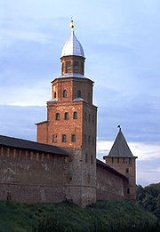
Veliky Novgorod

Encyclopedia
Veliky Novgorod is one of Russia's most historic cities and the administrative center of Novgorod Oblast
. It is situated on the M10 federal highway
connecting Moscow
and St. Petersburg
. The city lies along the Volkhov River
just below its outflow from Lake Ilmen
. Population:
, founded in the 9th or 10th century.
The Sofia First Chronicle
first mentions it in 859; the Novgorod First Chronicle
mentions it first under the year 862 when it was allegedly already a major station on the trade route from the Baltics to Byzantium.
Archaeological excavations in the middle to late 20th century, however, have found cultural layers dating back only to the late 10th century, the time of the Christianization of Rus and a century after it was allegedly founded, suggesting that the chronicle entries mentioning Novgorod in the 850s or 860s are later interpolations.
 The Varangian name of the city Holmgård (Holmgarðr or Holmgarðir) is mentioned in Norse Saga
s as existing at a yet earlier stage, but historical facts cannot here be disentangled from legend. Originally, Holmgård referred only to the stronghold southeast of the present-day city, Riurikovo Gorodishche (named in comparatively modern time after Varangian chieftain Rurik
, who supposedly made it his "capital" around 860). Archeological data suggests that the Gorodishche, the residence of the Knyaz
(prince), dates from the middle of 9th century, whereas the town itself dates only from the end of the 10th century, hence the name Novgorod, "new city", from Proto-Slavic Новъ and Градъ (Nov and Grad), although German and Scandinavian historiography suggests the Old Norse term Nýgarðr, or the Old High German
term Naugard. First mention of this Nordic or Germanic etymology to the name of the city of Novgorod (and that of other cities within the territory of the then Kievan Rus'
) occurs in the 10th-century policy manual De Administrando Imperio
by Byzantine
emperor Constantine VII
.
Slightly predating the chronology of the legend of Rurik (which dates the first Norse arrival in the region around 858-860), an earlier record for the Scandinavian settlement of the region is found in the Annales Bertiniani
(written up until 882) where a Rus delegation is mentioned as having visited Constantinople
in 838, and, intending to return to the Rus' Khaganate
via the Baltic Sea
, were questioned by Frankish Emperor Louis the Pious
at Ingelheim am Rhein
, where they said that although their origin was Swedish, they had settled in Northern Russia under a leader who they designated as chacanus (the Latin form of Khagan
, a title they had likely borrowed from contact with the Avars
).
, captured Kiev
and founded the state of Kievan Rus'
. Novgorod's size as well as its political, economic, and cultural influence made it the second city in Kievan Rus'. According to a custom, the elder son and heir of the ruling Kievan monarch was sent to rule Novgorod even as a minor. When the ruling monarch had no such son, Novgorod was governed by posadnik
s, such as legendary Gostomysl
, Dobrynya
, Konstantin
, and Ostromir
.
In Norse saga
s the city is mentioned as the capital of Gardariki. Four Viking
kings — Olaf I of Norway
, Olaf II of Norway
, Magnus I of Norway
, and Harald Hardrada — sought refuge in Novgorod from enemies at home. No more than a few decades after the death and subsequent canonization
of Olaf II of Norway, in 1028, the city's community had erected a church in his memory, Saint Olaf's Church in Novgorod
.
Of all their princes, Novgorodians cherished most the memory of Yaroslav the Wise
, who had sat as prince while his father, Vladimir the Great
, was prince in Kiev. Yaroslav promulgated the first written code of laws (later incorporated into Russkaya Pravda
) among the Eastern Slavs and is said to have granted the city a number of freedoms or privileges, which they often referred to in later centuries as precedents in their relations with other princes. His son, Vladimir
, sponsored construction of the great St. Sophia Cathedral
, more accurately translated as The Cathedral of Holy Wisdom, which stands to this day.
. The city was able to invite and dismiss a number of princes over the next two centuries, but the princely office was never abolished and powerful princes, such as Alexander Nevsky
, could assert their will in the city irrespective of the Novgorodians' wishes. The city state controlled most of Europe's North-East, from lands east of today's Estonia
to the Ural Mountains
, making it one of the largest states in medieval Europe, although much of the territory north and east of Lakes Ladoga
and Onega
were sparsely populated and never organized politically.
 One of the most important local figures in Novgorod was the Posadnik
or mayor, an official elected by the public assembly (called the Veche
) from among the city's boyarstvo or aristocracy
. The tysyatsky
, or "thousandman," originally the head of the town militia but later a commercial and judicial official, was also elected by the veche. The Archbishop of Novgorod
was also an important local official and shared power with the boyars. They were elected by the veche or by the drawing of lots; after their election, they were sent to the metropolitan for consecration.
While a basic outline of the various officials and the veche can be drawn up, the city-state's exact political constitution remains unknown. The boyars and the archbishop ruled the city together, although where one official's power ended and another's began is uncertain. The prince, although his power was reduced beginning in about the mid-twelfth century, was represented by his namestnik or lieutenant, and still played important roles as a military commander, legislator, and jurist. The exact composition of the veche, too, is uncertain, with some scholars such as Vasily Kliuchevsky claiming it was democratic in nature, while later scholars, such as Valentin Ianin and Aleksandr Khoroshev, see it as a "sham democracy" controlled by the ruling elite.
In the 13th century, Novgorod, while not a member of the Hanseatic League
, was the easternmost kontor
, or entrepot, of the league, being the source of enormous quantities of luxury (sable, ermine, fox, marmot) and non-luxury furs (squirrel-pelts).
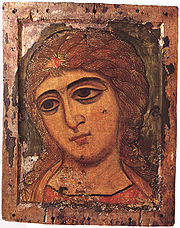
Throughout the Middle Ages, the city thrived culturally. A large number of birch bark letters
have been unearthed in excavations, perhaps suggesting widespread literacy, although this is uncertain (some scholars suggest that a clerical or scribal elite wrote them on behalf of a largely illiterate populace). It was in Novgorod that the oldest Slavic book
written north of Macedonia and the oldest inscription in a Finnic language
were unearthed. Some of the most ancient Russian chronicles
were written in the archbishops' scriptorium and the archbishops also promoted iconography and patronized church construction. The Novgorod merchant Sadko
became a popular hero of Russian folklore
.
Novgorod was never conquered by the Mongols during the Mongol invasion of Rus
. The Mongol army turned back about 100 km from the city, not because of the city's strength, but probably because the Mongol commanders did not want to get bogged down in the marshlands surrounding the city. However, the grand princes of Moscow, who acted as the tax-collectors for the khans of the Golden Horde, did collect tribute (dan) in Novgorod, most notably Yury Danilovich
and his brother, Ivan Kalita.
region for grain. The main cities in this area, Moscow
and Tver
, used this dependence to gain control over Novgorod. Eventually Ivan III
annexed the city to Grand Duchy of Moscow
in 1478. Novgorod remained the third largest Russian city (with 5300 homesteads and 25-30 thousand inhabitants in 1550s), however, until the famine of 1560s and Ivan the Terrible
sacking the city and slaughtering
thousands of its inhabitants in 1570. The city's merchant elite and nobility were deported to Moscow, Yaroslavl
, and elsewhere.
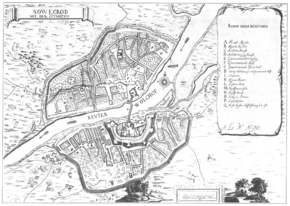 During the Time of Troubles
, Novgorodians eagerly submitted to Swedish
troops led by Jacob De la Gardie
in summer of 1611. The city was restituted to Russia only six years later, by the Treaty of Stolbovo
and regained a measure of its former prosperity by the end of the century, when such ambitious buildings as the Cathedral of the Sign and the Vyazhischi Monastery were constructed. The most famous of Russian patriarchs, Nikon
, occupied the metropolitan see of Novgorod between 1648 and 1652.
In 1727, Novgorod was made an administrative centre of the Novgorod Governorate
of the Russian Empire
, which was detached from Saint Petersburg Governorate
(see Administrative divisions of Russia in 1727-1728
). This administrative division existed until 1927. Between 1927 and 1944 the city was a part of Leningrad Oblast
, and then became an administrative center of the newly formed Novgorod Oblast
.
During World War II
, on August 15, 1941, the city was occupied by the German Army. Its historic monuments were systematically annihilated. When the Red Army
liberated the city on January 19, 1944, out of 2,536 stone buildings, fewer than forty were still standing. After the war, the downtown was gradually restored according to a plan worked out by Alexey Shchusev
. In 1992, its chief monuments have been declared the World Heritage Site
. In 1999, the city was officially renamed Veliky Novgorod (literally, Great Novgorod), thus partly reverting to its medieval title "Lord Novgorod the Great".
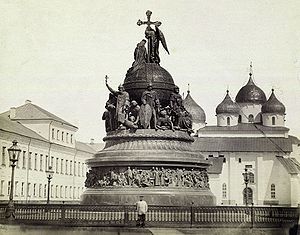 No other Russian or Ukrainian city can compete with Novgorod in the variety and age of its medieval monuments. The foremost among these is the St Sophia Cathedral
, built between 1045 and 1050 under the patronage of Vladimir Yaroslavich, the son of Yaroslav the Wise (Vladimir is buried in the cathedral along with his mother, Anna.) It is the best preserved of 11th century churches, probably the oldest structure still in use in Russia and the first one to represent original features of Russian architecture (austere stone walls, five helmet-like cupolas). Its frescoes were painted in the 12th century originally on the orders of Bishop Nikita (died 1108) (the "porches" or side chapels were painted in 1144 under Archbishop Nifont) and renovated several times over the centuries, most recently in the nineteenth century. The cathedral features famous bronze gates, which now hang in the west entrance, allegedly made in Magdeburg
in 1156 (other sources see them originating in Plock in Poland) and reportedly snatched by Novgorodians from the Swedish town of Sigtuna
in 1187. More recent scholarship has determined that the gates probably were purchased in the mid-fifteenth century, apparently at the behest of Archbishop Evfimii II (1429–1458), a lover of Western art and architectural styles.
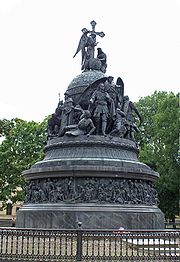
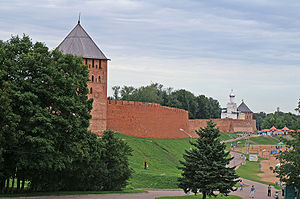
The Novgorod Kremlin
, traditionally known as the Detinets, also contains the oldest palace in Russia (the so-called Chamber of the Facets, 1433), which served as the main meeting hall of the archbishops; the oldest Russian bell tower (mid-15th cent.), and the oldest Russian clock tower (1673). The Palace of Facets, the bell tower, and the clock tower were originally built on the orders of Archbishop Evfimii II, although the clock tower collapsed in the seventeenth century and had to be rebuilt and much of the palace of Evfimii II is no longer extant. Among later structures, the most remarkable are a royal palace (1771) and a bronze monument to the Millennium of Russia
, representing the most important figures from the country's history (unveiled in 1862).
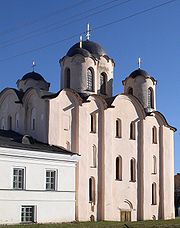 Outside the kremlin walls, there are three large churches constructed during the reign of Mstislav the Great. St Nicholas Cathedral (1113–23), containing frescoes of Mstislav's family, graces Yaroslav's Court
(formerly the chief square of Novgorod). The Yuriev Monastery
(one of the oldest in Russia, 1030) contains a tall, three-domed cathedral from 1119 (built by Mstislav's son, Vsevolod. and Kyurik, the head of the monastery. A similar three-domed cathedral (1117), probably designed by the same masters, stands in the Antoniev Monastery
, built on the orders of Antony, the founder of that monastery.
There are now some fifty still-extant medieval and early modern churches scattered throughout the city and its environs. Some of them were blown up by the Nazis and subsequently restored. The most ancient pattern is represented by those dedicated to Sts Peter and Pavel (on the Swallow's Hill, 1185–92), to Annunciation (in Myachino, 1179), to Assumption (on Volotovo Field, 1180s) and to St Paraskeva-Piatnitsa (at Yaroslav's Court, 1207). The greatest masterpiece of early Novgorod architecture is the Savior church at Nereditsa (1198).
In the 13th century, tiny churches of the three-paddled design were in vogue. These are represented by a small chapel at the Peryn Monastery (1230s) and St Nicholas' on the Lipnya Islet (1292, also notable for its 14th-century frescoes). The next century saw development of two original church designs, one of them culminating in St Theodor's church (1360–61, fine frescoes from 1380s), and another one leading to the Saviour church on Ilyina street (1374, painted in 1378 by Feofan Grek). The Saviour' church in Kovalevo (1345) was originally frescoed by Serbian masters, but the church was destroyed during the war. While the church has since been rebuilt, the frescoes have not been restored.
During the last century of republican government, some new churches were consecrated to Sts. Peter and Paul (on Slavna, 1367; in Kozhevniki, 1406), to Christ's Nativity (at the Cemetery, 1387), to St John the Apostle's (1384), to the Twelve Apostles (1455), to St Demetrius (1467), to St Simeon (1462), and other saints. Generally, they are not thought so innovative as the churches from the previous epoch. Several 12th-century shrines (i.e., in Opoki) were demolished brick by brick and then reconstructed exactly as they used to be, several of them in the mid fifteenth century, again under Archbishop Yevfimy II, perhaps one of the greatest patrons of architecture in medieval Novgorod.
Novgorod's conquest by Ivan III
in 1478 decisively changed the character of local architecture. Large commissions were thenceforth executed by Muscovite masters and patterned after cathedrals of Moscow Kremlin
: e.g., the Saviour Cathedral of Khutyn Monastery
(1515), the Cathedral of the Mother of God of the Sign (1688), the St. Nicholas Cathedral of Vyaschizhy Monastery (1685). Nevertheless, the styles of some parochial churches were still in keeping with local traditions: e.g., the churches of Myrrh-bearing Women(1510) and of Sts Boris and Gleb (1586).
In Vitoslavlitsy, along the Volkhov River
and the Myachino Lake, close to the Yuriev Monastery
, a picturesque museum of wooden architecture was established in 1964. Over 20 wooden buildings (churches, houses and mills) dating from the 14th to the 19th century were transported there from all around the Novgorod region.
(531 km) and St. Petersburg
(189 km) by the federal highway M10
. There are public buses to Saint Petersburg
and other destinations.
The city has direct railway passenger connections with Moscow
(Leningradsky Rail Terminal, by night trains), St. Petersburg (Moscow Rail Terminal and Vitebsk Rail Terminal
, by suburban trains), Minsk
(Belarus
) (Minsk Passazhirsky railway station, by night trains) and major cities of northwestern Russia such as Pskov
and Murmansk
.
 The city's airports Yurievo and Krechevitsy
do not serve any regular flights since the middle 1990s. The nearest international airport is St. Petersburg's Pulkovo
, some 180 km north of the city.
es. The trolleybus network, which currently consists of five routes, started operation in 1995 and is the first trolley system opened in Russia after the fall of the Soviet Union
.
with:
, 3799 Novgorod
, discovered by Soviet astronomer Nikolai Stepanovich Chernykh
in 1979, is named after the city.
Novgorod Oblast
Novgorod Oblast is a federal subject of Russia , located between Moscow and Saint Petersburg. Its administrative center is the city of Veliky Novgorod. Some of the oldest Russian cities, including Veliky Novgorod and Staraya Russa, are located there...
. It is situated on the M10 federal highway
Russian Route M10
The M10 is a federal highway in Russia connecting the country's two largest cities, Moscow and Saint Petersburg, and continuing to the border with Finland...
connecting Moscow
Moscow
Moscow is the capital, the most populous city, and the most populous federal subject of Russia. The city is a major political, economic, cultural, scientific, religious, financial, educational, and transportation centre of Russia and the continent...
and St. Petersburg
Saint Petersburg
Saint Petersburg is a city and a federal subject of Russia located on the Neva River at the head of the Gulf of Finland on the Baltic Sea...
. The city lies along the Volkhov River
Volkhov River
Volkhov is a river in Novgorod Oblast and Leningrad Oblast in northwestern Russia.-Geography:The Volkhov flows out of Lake Ilmen north into Lake Ladoga, the largest lake of Europe. It is the second largest tributary of Lake Ladoga. It is navigable over its whole length. Discharge is highly...
just below its outflow from Lake Ilmen
Lake Ilmen
Ilmen is a historically important lake in the Novgorod Oblast of Russia, formerly a vital part of the Trade route from the Varangians to the Greeks. The city of Novgorod lies six kilometers below the lake's outflow....
. Population:
Early developments
Novgorod is among the oldest cities of RussiaRussia
Russia or , officially known as both Russia and the Russian Federation , is a country in northern Eurasia. It is a federal semi-presidential republic, comprising 83 federal subjects...
, founded in the 9th or 10th century.
The Sofia First Chronicle
Sofia First Chronicle
The Sofia First Chronicle is a Russian chronicle associated with the St. Sophia Cathedral, Novgorod, Russia. Its copies exist in two versions: Early Redaction , which ends by 1418 and Later Redaction , with sporadic additions up to 1471, and up to 1508 in one of the copies.Together with the...
first mentions it in 859; the Novgorod First Chronicle
Novgorod First Chronicle
The Novgorod First Chronicle or The Chronicle of Novgorod, 1016-1471 is the most ancient extant chronicle of the Novgorod Republic. It reflects a tradition different from the Kievan Primary Chronicle...
mentions it first under the year 862 when it was allegedly already a major station on the trade route from the Baltics to Byzantium.
Archaeological excavations in the middle to late 20th century, however, have found cultural layers dating back only to the late 10th century, the time of the Christianization of Rus and a century after it was allegedly founded, suggesting that the chronicle entries mentioning Novgorod in the 850s or 860s are later interpolations.
Norse saga
The sagas are stories about ancient Scandinavian and Germanic history, about early Viking voyages, the battles that took place during the voyages, about migration to Iceland and of feuds between Icelandic families...
s as existing at a yet earlier stage, but historical facts cannot here be disentangled from legend. Originally, Holmgård referred only to the stronghold southeast of the present-day city, Riurikovo Gorodishche (named in comparatively modern time after Varangian chieftain Rurik
Rurik
Rurik, or Riurik , was a semilegendary 9th-century Varangian who founded the Rurik dynasty which ruled Kievan Rus and later some of its successor states, most notably the Tsardom of Russia, until 1598....
, who supposedly made it his "capital" around 860). Archeological data suggests that the Gorodishche, the residence of the Knyaz
Knyaz
Kniaz, knyaz or knez is a Slavic title found in most Slavic languages, denoting a royal nobility rank. It is usually translated into English as either Prince or less commonly as Duke....
(prince), dates from the middle of 9th century, whereas the town itself dates only from the end of the 10th century, hence the name Novgorod, "new city", from Proto-Slavic Новъ and Градъ (Nov and Grad), although German and Scandinavian historiography suggests the Old Norse term Nýgarðr, or the Old High German
Old High German
The term Old High German refers to the earliest stage of the German language and it conventionally covers the period from around 500 to 1050. Coherent written texts do not appear until the second half of the 8th century, and some treat the period before 750 as 'prehistoric' and date the start of...
term Naugard. First mention of this Nordic or Germanic etymology to the name of the city of Novgorod (and that of other cities within the territory of the then Kievan Rus'
Kievan Rus'
Kievan Rus was a medieval polity in Eastern Europe, from the late 9th to the mid 13th century, when it disintegrated under the pressure of the Mongol invasion of 1237–1240....
) occurs in the 10th-century policy manual De Administrando Imperio
De Administrando Imperio
De Administrando Imperio is the Latin title of a Greek work written by the 10th-century Eastern Roman Emperor Constantine VII. The Greek title of the work is...
by Byzantine
Byzantine Empire
The Byzantine Empire was the Eastern Roman Empire during the periods of Late Antiquity and the Middle Ages, centred on the capital of Constantinople. Known simply as the Roman Empire or Romania to its inhabitants and neighbours, the Empire was the direct continuation of the Ancient Roman State...
emperor Constantine VII
Constantine VII
Constantine VII Porphyrogennetos or Porphyrogenitus, "the Purple-born" was the fourth Emperor of the Macedonian dynasty of the Byzantine Empire, reigning from 913 to 959...
.
Slightly predating the chronology of the legend of Rurik (which dates the first Norse arrival in the region around 858-860), an earlier record for the Scandinavian settlement of the region is found in the Annales Bertiniani
Annales Bertiniani
Annales Bertiniani, or The Annals of St. Bertin, are late Carolingian, Frankish annals that were found in the monastery of St. Bertin, after which they are named. Their account is taken to cover the period 830-82, thus continuing the Royal Frankish Annals , from which, however, it has circulated...
(written up until 882) where a Rus delegation is mentioned as having visited Constantinople
Constantinople
Constantinople was the capital of the Roman, Eastern Roman, Byzantine, Latin, and Ottoman Empires. Throughout most of the Middle Ages, Constantinople was Europe's largest and wealthiest city.-Names:...
in 838, and, intending to return to the Rus' Khaganate
Rus' Khaganate
Rus' khaganate is a historiographical term for the formative phase of the Rus state in the 9th century AD....
via the Baltic Sea
Baltic Sea
The Baltic Sea is a brackish mediterranean sea located in Northern Europe, from 53°N to 66°N latitude and from 20°E to 26°E longitude. It is bounded by the Scandinavian Peninsula, the mainland of Europe, and the Danish islands. It drains into the Kattegat by way of the Øresund, the Great Belt and...
, were questioned by Frankish Emperor Louis the Pious
Louis the Pious
Louis the Pious , also called the Fair, and the Debonaire, was the King of Aquitaine from 781. He was also King of the Franks and co-Emperor with his father, Charlemagne, from 813...
at Ingelheim am Rhein
Ingelheim am Rhein
Ingelheim am Rhein is a town in the Mainz-Bingen district in Rhineland-Palatinate, Germany on the Rhine’s west bank. The town calls itself the Rotweinstadt and since 1996 it has been Mainz-Bingen’s district seat....
, where they said that although their origin was Swedish, they had settled in Northern Russia under a leader who they designated as chacanus (the Latin form of Khagan
Khagan
Khagan or qagan , alternatively spelled kagan, khaghan, qaghan, or chagan, is a title of imperial rank in the Mongolian and Turkic languages equal to the status of emperor and someone who rules a khaganate...
, a title they had likely borrowed from contact with the Avars
Eurasian Avars
The Eurasian Avars or Ancient Avars were a highly organized nomadic confederacy of mixed origins. They were ruled by a khagan, who was surrounded by a tight-knit entourage of nomad warriors, an organization characteristic of Turko-Mongol groups...
).
Princely state within Kievan Rus'
In 882, Rurik's successor, Oleg of NovgorodOleg of Novgorod
Oleg of Novgorod was a Varangian prince who ruled all or part of the Rus' people during the early 10th century....
, captured Kiev
Kiev
Kiev or Kyiv is the capital and the largest city of Ukraine, located in the north central part of the country on the Dnieper River. The population as of the 2001 census was 2,611,300. However, higher numbers have been cited in the press....
and founded the state of Kievan Rus'
Kievan Rus'
Kievan Rus was a medieval polity in Eastern Europe, from the late 9th to the mid 13th century, when it disintegrated under the pressure of the Mongol invasion of 1237–1240....
. Novgorod's size as well as its political, economic, and cultural influence made it the second city in Kievan Rus'. According to a custom, the elder son and heir of the ruling Kievan monarch was sent to rule Novgorod even as a minor. When the ruling monarch had no such son, Novgorod was governed by posadnik
Posadnik
Posadnik was the mayor in some East Slavic cities or towns. Most notably, the posadnik was the mayor of Novgorod and Pskov...
s, such as legendary Gostomysl
Gostomysl
Gostomysl is a legendary 9th-century posadnik of Novgorod who was introduced into the historiography by Vasily Tatishchev, an 18th-century historian. Gostomysl's rule is associated with the confederation of Northern tribes, which was formed to counter the Varangian threat in the mid-9th century...
, Dobrynya
Dobrynya
Dobrynya was Vladimir the Great's maternal uncle and tutor who was later transformed into the invincible bogatyr Dobrynya Nikitich in the Russian folklore....
, Konstantin
Konstantin Dobrynich
Konstantin Dobrynich was an 11th-century posadnik of Novgorod. According to the Novgorod chronicles, he was the son of Dobrynya and wielded great influence at the court of his own cousin, Yaroslav the Wise....
, and Ostromir
Ostromir
Ostromir was a statesman, voivod and posadnik of Novgorod in 1054-1057 and probably for some decades previous....
.
In Norse saga
Norse saga
The sagas are stories about ancient Scandinavian and Germanic history, about early Viking voyages, the battles that took place during the voyages, about migration to Iceland and of feuds between Icelandic families...
s the city is mentioned as the capital of Gardariki. Four Viking
Viking
The term Viking is customarily used to refer to the Norse explorers, warriors, merchants, and pirates who raided, traded, explored and settled in wide areas of Europe, Asia and the North Atlantic islands from the late 8th to the mid-11th century.These Norsemen used their famed longships to...
kings — Olaf I of Norway
Olaf I of Norway
Olaf Tryggvason was King of Norway from 995 to 1000. He was the son of Tryggvi Olafsson, king of Viken , and, according to later sagas, the great-grandson of Harald Fairhair, first King of Norway.Olaf played an important part in the often forcible, on pain of torture or death, conversion of the...
, Olaf II of Norway
Olaf II of Norway
Olaf II Haraldsson was King of Norway from 1015 to 1028. He was posthumously given the title Rex Perpetuus Norvegiae and canonised in Nidaros by Bishop Grimkell, one year after his death in the Battle of Stiklestad on 29 July 1030. Enshrined in Nidaros Cathedral...
, Magnus I of Norway
Magnus I of Norway
Magnus I , known as the Good or the Noble, was the King of Norway from 1035 to 1047 and the King of Denmark from 1042 to 1047. He was an illegitimate son of king Olaf II of Norway, but fled with his mother in 1028 when his father was dethroned. In 1035 he returned to Norway and was crowned king at...
, and Harald Hardrada — sought refuge in Novgorod from enemies at home. No more than a few decades after the death and subsequent canonization
Canonization
Canonization is the act by which a Christian church declares a deceased person to be a saint, upon which declaration the person is included in the canon, or list, of recognized saints. Originally, individuals were recognized as saints without any formal process...
of Olaf II of Norway, in 1028, the city's community had erected a church in his memory, Saint Olaf's Church in Novgorod
Saint Olaf's Church in Novgorod
Saint Olaf's Church in Novgorod was a church for Varangians which existed from the 11th century until the 14th century in the Russian city of Novgorod....
.
Of all their princes, Novgorodians cherished most the memory of Yaroslav the Wise
Yaroslav I the Wise
Yaroslav I, Grand Prince of Rus, known as Yaroslav the Wise Yaroslav I, Grand Prince of Rus, known as Yaroslav the Wise Yaroslav I, Grand Prince of Rus, known as Yaroslav the Wise (Old Norse: Jarizleifr; ; Old East Slavic and Russian: Ярослав Мудрый; Ukrainian: Ярослав Мудрий; c...
, who had sat as prince while his father, Vladimir the Great
Vladimir I of Kiev
Vladimir Sviatoslavich the Great Old East Slavic: Володимѣръ Свѧтославичь Old Norse as Valdamarr Sveinaldsson, , Vladimir, , Volodymyr, was a grand prince of Kiev, ruler of Kievan Rus' in .Vladimir's father was the prince Sviatoslav of the Rurik dynasty...
, was prince in Kiev. Yaroslav promulgated the first written code of laws (later incorporated into Russkaya Pravda
Russkaya Pravda
Russkaya Pravda was the legal code of Kievan Rus' and the subsequent Rus' principalities during the times of feudal division.In spite of great influence of Byzantine legislation on the contemporary world, and in...
) among the Eastern Slavs and is said to have granted the city a number of freedoms or privileges, which they often referred to in later centuries as precedents in their relations with other princes. His son, Vladimir
Vladimir of Novgorod
Vladimir Yaroslavich reigned as prince of Novgorod from 1036 until his death. He was the eldest son of Yaroslav I the Wise of Kiev by Ingigerd, daughter of king Olof Skötkonung of Sweden....
, sponsored construction of the great St. Sophia Cathedral
Saint Sophia Cathedral in Novgorod
The Cathedral of St. Sophia in the Kremlin in Veliky Novgorod is the cathedral church of the Archbishop of Novgorod and the mother church of the Novgorodian Eparchy.-History:...
, more accurately translated as The Cathedral of Holy Wisdom, which stands to this day.
Novgorod Republic
In 1136, the Novgorodians dismissed their prince Vsevolod Mstislavich. This date is seen as the traditional beginning of the Novgorod RepublicNovgorod Republic
The Novgorod Republic was a large medieval Russian state which stretched from the Baltic Sea to the Ural Mountains between the 12th and 15th centuries, centred on the city of Novgorod...
. The city was able to invite and dismiss a number of princes over the next two centuries, but the princely office was never abolished and powerful princes, such as Alexander Nevsky
Alexander Nevsky
Alexander Nevsky was the Prince of Novgorod and Grand Prince of Vladimir during some of the most trying times in the city's history. Commonly regarded as the key figure of medieval Rus, Alexander was the grandson of Vsevolod the Big Nest and rose to legendary status on account of his military...
, could assert their will in the city irrespective of the Novgorodians' wishes. The city state controlled most of Europe's North-East, from lands east of today's Estonia
Estonia
Estonia , officially the Republic of Estonia , is a state in the Baltic region of Northern Europe. It is bordered to the north by the Gulf of Finland, to the west by the Baltic Sea, to the south by Latvia , and to the east by Lake Peipsi and the Russian Federation . Across the Baltic Sea lies...
to the Ural Mountains
Ural Mountains
The Ural Mountains , or simply the Urals, are a mountain range that runs approximately from north to south through western Russia, from the coast of the Arctic Ocean to the Ural River and northwestern Kazakhstan. Their eastern side is usually considered the natural boundary between Europe and Asia...
, making it one of the largest states in medieval Europe, although much of the territory north and east of Lakes Ladoga
Lake Ladoga
Lake Ladoga is a freshwater lake located in the Republic of Karelia and Leningrad Oblast in northwestern Russia, not far from Saint Petersburg. It is the largest lake in Europe, and the 14th largest lake by area in the world.-Geography:...
and Onega
Lake Onega
Lake Onega is a lake in the north-west European part of Russia, located on the territory of Republic of Karelia, Leningrad Oblast and Vologda Oblast. It belongs to the basin of Baltic Sea, Atlantic Ocean, and is the second largest lake in Europe after Lake Ladoga...
were sparsely populated and never organized politically.
Posadnik
Posadnik was the mayor in some East Slavic cities or towns. Most notably, the posadnik was the mayor of Novgorod and Pskov...
or mayor, an official elected by the public assembly (called the Veche
Novgorod veche
According to the traditional scholarship, the veche was the highest legislature and judicial authority in the Republic of Novgorod until 1478, when Novgorod the Great was brought under the direct control of Grand Prince Ivan III ....
) from among the city's boyarstvo or aristocracy
Aristocracy
Aristocracy , is a form of government in which a few elite citizens rule. The term derives from the Greek aristokratia, meaning "rule of the best". In origin in Ancient Greece, it was conceived of as rule by the best qualified citizens, and contrasted with monarchy...
. The tysyatsky
Tysyatsky
Tysyatsky was a military leader in Ancient Rus, who commanded a people's volunteer army called тысяча...
, or "thousandman," originally the head of the town militia but later a commercial and judicial official, was also elected by the veche. The Archbishop of Novgorod
Archbishop of Novgorod
The Archbishop of Novgorod is the head of the eparchy of Novgorod the Great and is one of the oldest offices in the Russian Orthodox Church. The archbishops have, in fact, been among the most important figures in medieval Russian history and culture and their successors continued to play...
was also an important local official and shared power with the boyars. They were elected by the veche or by the drawing of lots; after their election, they were sent to the metropolitan for consecration.
While a basic outline of the various officials and the veche can be drawn up, the city-state's exact political constitution remains unknown. The boyars and the archbishop ruled the city together, although where one official's power ended and another's began is uncertain. The prince, although his power was reduced beginning in about the mid-twelfth century, was represented by his namestnik or lieutenant, and still played important roles as a military commander, legislator, and jurist. The exact composition of the veche, too, is uncertain, with some scholars such as Vasily Kliuchevsky claiming it was democratic in nature, while later scholars, such as Valentin Ianin and Aleksandr Khoroshev, see it as a "sham democracy" controlled by the ruling elite.
In the 13th century, Novgorod, while not a member of the Hanseatic League
Hanseatic League
The Hanseatic League was an economic alliance of trading cities and their merchant guilds that dominated trade along the coast of Northern Europe...
, was the easternmost kontor
Kontor
A kontor was a foreign trading post of the Hanseatic League. The word kontor means office in Norwegian and other Scandinavian languages....
, or entrepot, of the league, being the source of enormous quantities of luxury (sable, ermine, fox, marmot) and non-luxury furs (squirrel-pelts).
Throughout the Middle Ages, the city thrived culturally. A large number of birch bark letters
Birch bark document
A birch bark document is a document written on pieces of birch bark. Such documents existed in several cultures. For instance, some Gandharan Buddhist texts have been found written on birch bark and preserved in clay jars....
have been unearthed in excavations, perhaps suggesting widespread literacy, although this is uncertain (some scholars suggest that a clerical or scribal elite wrote them on behalf of a largely illiterate populace). It was in Novgorod that the oldest Slavic book
Novgorod Codex
The Novgorod Codex is the oldest book of Rus’, unearthed on July 13, 2000 in Novgorod. It is a palimpsest consisting of three bound wooden tablets containing four pages filled with wax, on which its former owner wrote down dozens, probably hundreds of texts during two or three decades, each time...
written north of Macedonia and the oldest inscription in a Finnic language
Birch bark letter no. 292
The Birch bark letter given the document number 292 is the oldest known document in any Finnic language. The document is dated to the beginning of the 13th century...
were unearthed. Some of the most ancient Russian chronicles
Novgorod First Chronicle
The Novgorod First Chronicle or The Chronicle of Novgorod, 1016-1471 is the most ancient extant chronicle of the Novgorod Republic. It reflects a tradition different from the Kievan Primary Chronicle...
were written in the archbishops' scriptorium and the archbishops also promoted iconography and patronized church construction. The Novgorod merchant Sadko
Sadko
Sadko is a Russian medieval epic . The title character is an adventurer, merchant and gusli musician from Novgorod.-Synopsis:Sadko played the gusli on the shores of a lake. The Sea Tsar enjoyed his music, and offered to help him...
became a popular hero of Russian folklore
Folklore
Folklore consists of legends, music, oral history, proverbs, jokes, popular beliefs, fairy tales and customs that are the traditions of a culture, subculture, or group. It is also the set of practices through which those expressive genres are shared. The study of folklore is sometimes called...
.
Novgorod was never conquered by the Mongols during the Mongol invasion of Rus
Mongol invasion of Rus
The Mongol invasion of Russia was resumed on 21 December 1237 marking the resumption of the Mongol invasion of Europe, during which the Mongols attacked the medieval powers of Poland, Kiev, Hungary, and miscellaneous tribes of less organized peoples...
. The Mongol army turned back about 100 km from the city, not because of the city's strength, but probably because the Mongol commanders did not want to get bogged down in the marshlands surrounding the city. However, the grand princes of Moscow, who acted as the tax-collectors for the khans of the Golden Horde, did collect tribute (dan) in Novgorod, most notably Yury Danilovich
Yury of Moscow
Yuriy Danilovich, also known as Georgiy Danilovich was Prince of Moscow and Grand Prince of Vladimir ....
and his brother, Ivan Kalita.
United Russian state
The city's downfall was a result of its inability to feed its large population, making it dependent on the Vladimir-SuzdalVladimir-Suzdal
The Vladimir-Suzdal Principality or Vladimir-Suzdal Rus’ was one of the major principalities which succeeded Kievan Rus' in the late 12th century and lasted until the late 14th century. For a long time the Principality was a vassal of the Mongolian Golden Horde...
region for grain. The main cities in this area, Moscow
Moscow
Moscow is the capital, the most populous city, and the most populous federal subject of Russia. The city is a major political, economic, cultural, scientific, religious, financial, educational, and transportation centre of Russia and the continent...
and Tver
Tver
Tver is a city and the administrative center of Tver Oblast, Russia. Population: 403,726 ; 408,903 ;...
, used this dependence to gain control over Novgorod. Eventually Ivan III
Ivan III of Russia
Ivan III Vasilyevich , also known as Ivan the Great, was a Grand Prince of Moscow and "Grand Prince of all Rus"...
annexed the city to Grand Duchy of Moscow
Grand Duchy of Moscow
The Grand Duchy of Moscow or Grand Principality of Moscow, also known in English simply as Muscovy , was a late medieval Rus' principality centered on Moscow, and the predecessor state of the early modern Tsardom of Russia....
in 1478. Novgorod remained the third largest Russian city (with 5300 homesteads and 25-30 thousand inhabitants in 1550s), however, until the famine of 1560s and Ivan the Terrible
Ivan IV of Russia
Ivan IV Vasilyevich , known in English as Ivan the Terrible , was Grand Prince of Moscow from 1533 until his death. His long reign saw the conquest of the Khanates of Kazan, Astrakhan, and Siberia, transforming Russia into a multiethnic and multiconfessional state spanning almost one billion acres,...
sacking the city and slaughtering
Massacre of Novgorod
The Massacre of Novgorod was an attack launched by Tsar Ivan IV’s oprichniki on the city of Novgorod, Russia in 1570. The sheer number of casualties combined with the extreme level of violent cruelty makes this campaign possibly the most vicious in the brutal legacy of the oprichnina.-Paranoia,...
thousands of its inhabitants in 1570. The city's merchant elite and nobility were deported to Moscow, Yaroslavl
Yaroslavl
Yaroslavl is a city and the administrative center of Yaroslavl Oblast, Russia, located northeast of Moscow. The historical part of the city, a World Heritage Site, is located at the confluence of the Volga and the Kotorosl Rivers. It is one of the Golden Ring cities, a group of historic cities...
, and elsewhere.
Time of Troubles
The Time of Troubles was a period of Russian history comprising the years of interregnum between the death of the last Russian Tsar of the Rurik Dynasty, Feodor Ivanovich, in 1598, and the establishment of the Romanov Dynasty in 1613. In 1601-1603, Russia suffered a famine that killed one-third...
, Novgorodians eagerly submitted to Swedish
Sweden
Sweden , officially the Kingdom of Sweden , is a Nordic country on the Scandinavian Peninsula in Northern Europe. Sweden borders with Norway and Finland and is connected to Denmark by a bridge-tunnel across the Öresund....
troops led by Jacob De la Gardie
Jacob De la Gardie
Field Marshal and Count Jacob Pontusson De la Gardie was a statesman and a soldier of the Swedish Empire....
in summer of 1611. The city was restituted to Russia only six years later, by the Treaty of Stolbovo
Treaty of Stolbovo
The Treaty of Stolbovo is a peace treaty of 1617 that ended the Ingrian War, fought between Sweden and Russia.After nearly two months of negotiations, representatives from Sweden and Russia met at the village of Stolbova, south of Lake Ladoga, on 27 February 1617.From the outset, Sweden had gone...
and regained a measure of its former prosperity by the end of the century, when such ambitious buildings as the Cathedral of the Sign and the Vyazhischi Monastery were constructed. The most famous of Russian patriarchs, Nikon
Patriarch Nikon
Nikon , born Nikita Minin , was the seventh patriarch of the Russian Orthodox Church...
, occupied the metropolitan see of Novgorod between 1648 and 1652.
In 1727, Novgorod was made an administrative centre of the Novgorod Governorate
Novgorod Governorate
Novgorod Governorate , or Government of Novgorod, was a governorate of the Russian Empire.The governorate was established in 1727 from Belozersk, Novgorod, Pskov, Tver, and Velikiye Luki Provinces of the St. Petersburg Governorate and existed until 1927, when its territory was included into...
of the Russian Empire
Russian Empire
The Russian Empire was a state that existed from 1721 until the Russian Revolution of 1917. It was the successor to the Tsardom of Russia and the predecessor of the Soviet Union...
, which was detached from Saint Petersburg Governorate
Saint Petersburg Governorate
Saint Petersburg Governorate , or Government of Saint Petersburg, was an administrative division of the Russian Empire, which existed in 1708–1927....
(see Administrative divisions of Russia in 1727-1728
Administrative divisions of Russia in 1727-1728
-Major events:The administrative reform of 1727 was carried out soon after Peter the Great's death, when it became apparent that previous reform was not working as planned. The fast pace of the reforms came into contradiction with the traditional ways of doing things. Newly created bureaucracy...
). This administrative division existed until 1927. Between 1927 and 1944 the city was a part of Leningrad Oblast
Leningrad Oblast
Leningrad Oblast is a federal subject of Russia . It was established on August 1, 1927, although it was not until 1946 that the oblast's borders had been mostly settled in their present position...
, and then became an administrative center of the newly formed Novgorod Oblast
Novgorod Oblast
Novgorod Oblast is a federal subject of Russia , located between Moscow and Saint Petersburg. Its administrative center is the city of Veliky Novgorod. Some of the oldest Russian cities, including Veliky Novgorod and Staraya Russa, are located there...
.
During World War II
World War II
World War II, or the Second World War , was a global conflict lasting from 1939 to 1945, involving most of the world's nations—including all of the great powers—eventually forming two opposing military alliances: the Allies and the Axis...
, on August 15, 1941, the city was occupied by the German Army. Its historic monuments were systematically annihilated. When the Red Army
Red Army
The Workers' and Peasants' Red Army started out as the Soviet Union's revolutionary communist combat groups during the Russian Civil War of 1918-1922. It grew into the national army of the Soviet Union. By the 1930s the Red Army was among the largest armies in history.The "Red Army" name refers to...
liberated the city on January 19, 1944, out of 2,536 stone buildings, fewer than forty were still standing. After the war, the downtown was gradually restored according to a plan worked out by Alexey Shchusev
Alexey Shchusev
Alexey Viktorovich Shchusev ), 1873, Chişinău—24 May 1949, Moscow) was an acclaimed Russian and Soviet architect whose works may be regarded as a bridge connecting Revivalist architecture of Imperial Russia with Stalin's Empire Style....
. In 1992, its chief monuments have been declared the World Heritage Site
World Heritage Site
A UNESCO World Heritage Site is a place that is listed by the UNESCO as of special cultural or physical significance...
. In 1999, the city was officially renamed Veliky Novgorod (literally, Great Novgorod), thus partly reverting to its medieval title "Lord Novgorod the Great".
Sights
Saint Sophia Cathedral in Novgorod
The Cathedral of St. Sophia in the Kremlin in Veliky Novgorod is the cathedral church of the Archbishop of Novgorod and the mother church of the Novgorodian Eparchy.-History:...
, built between 1045 and 1050 under the patronage of Vladimir Yaroslavich, the son of Yaroslav the Wise (Vladimir is buried in the cathedral along with his mother, Anna.) It is the best preserved of 11th century churches, probably the oldest structure still in use in Russia and the first one to represent original features of Russian architecture (austere stone walls, five helmet-like cupolas). Its frescoes were painted in the 12th century originally on the orders of Bishop Nikita (died 1108) (the "porches" or side chapels were painted in 1144 under Archbishop Nifont) and renovated several times over the centuries, most recently in the nineteenth century. The cathedral features famous bronze gates, which now hang in the west entrance, allegedly made in Magdeburg
Magdeburg
Magdeburg , is the largest city and the capital city of the Bundesland of Saxony-Anhalt, Germany. Magdeburg is situated on the Elbe River and was one of the most important medieval cities of Europe....
in 1156 (other sources see them originating in Plock in Poland) and reportedly snatched by Novgorodians from the Swedish town of Sigtuna
Sigtuna
Sigtuna is a locality situated in Sigtuna Municipality, Stockholm County, Sweden with 18 inhabitants in 2005. It is the namesake of the municipality even though the seat is in Märsta....
in 1187. More recent scholarship has determined that the gates probably were purchased in the mid-fifteenth century, apparently at the behest of Archbishop Evfimii II (1429–1458), a lover of Western art and architectural styles.
The Novgorod Kremlin
Novgorod Kremlin
Novgorod Kremlin stands on the left bank of the Volkhov River about two miles north of where it empties out of Lake Ilmen.-History:...
, traditionally known as the Detinets, also contains the oldest palace in Russia (the so-called Chamber of the Facets, 1433), which served as the main meeting hall of the archbishops; the oldest Russian bell tower (mid-15th cent.), and the oldest Russian clock tower (1673). The Palace of Facets, the bell tower, and the clock tower were originally built on the orders of Archbishop Evfimii II, although the clock tower collapsed in the seventeenth century and had to be rebuilt and much of the palace of Evfimii II is no longer extant. Among later structures, the most remarkable are a royal palace (1771) and a bronze monument to the Millennium of Russia
Millennium of Russia
The Millennium of Russia is a famous bronze monument in the Novgorod Kremlin. It was erected in 1862 to celebrate the millennium of Rurik's arrival to Novgorod, an event traditionally taken as a starting point of Russian history.A competition to design the monument was held in 1859...
, representing the most important figures from the country's history (unveiled in 1862).
Yaroslav's Court
Yaroslav's Court was the princely compound in the city of Novgorod the Great. Today it is roughly the area around the Trade Mart, the Church of St. Nicholas, the Church of St. Procopius, and the Church of the Myrrh-bearing Women. The Trade Mart renovated and heavily modified in the sixteenth and...
(formerly the chief square of Novgorod). The Yuriev Monastery
Yuriev Monastery
The St. George's Monastery is one of Russia's oldest monasteries. It stands south of Novgorod on the left bank of the Volkhov River near where it flows out of Lake Ilmen. The monastery used to be the most important in the medieval Novgorod Republic...
(one of the oldest in Russia, 1030) contains a tall, three-domed cathedral from 1119 (built by Mstislav's son, Vsevolod. and Kyurik, the head of the monastery. A similar three-domed cathedral (1117), probably designed by the same masters, stands in the Antoniev Monastery
Antoniev Monastery
The Antoniev Monastery rivalled Yuriev Monastery as the most important monastery of medieval Novgorod the Great. It stands along the right bank of the Volkhov River north of the city centre and forms part of the Historic Monuments of Novgorod and Surroundings, a World Heritage Site...
, built on the orders of Antony, the founder of that monastery.
There are now some fifty still-extant medieval and early modern churches scattered throughout the city and its environs. Some of them were blown up by the Nazis and subsequently restored. The most ancient pattern is represented by those dedicated to Sts Peter and Pavel (on the Swallow's Hill, 1185–92), to Annunciation (in Myachino, 1179), to Assumption (on Volotovo Field, 1180s) and to St Paraskeva-Piatnitsa (at Yaroslav's Court, 1207). The greatest masterpiece of early Novgorod architecture is the Savior church at Nereditsa (1198).
In the 13th century, tiny churches of the three-paddled design were in vogue. These are represented by a small chapel at the Peryn Monastery (1230s) and St Nicholas' on the Lipnya Islet (1292, also notable for its 14th-century frescoes). The next century saw development of two original church designs, one of them culminating in St Theodor's church (1360–61, fine frescoes from 1380s), and another one leading to the Saviour church on Ilyina street (1374, painted in 1378 by Feofan Grek). The Saviour' church in Kovalevo (1345) was originally frescoed by Serbian masters, but the church was destroyed during the war. While the church has since been rebuilt, the frescoes have not been restored.
During the last century of republican government, some new churches were consecrated to Sts. Peter and Paul (on Slavna, 1367; in Kozhevniki, 1406), to Christ's Nativity (at the Cemetery, 1387), to St John the Apostle's (1384), to the Twelve Apostles (1455), to St Demetrius (1467), to St Simeon (1462), and other saints. Generally, they are not thought so innovative as the churches from the previous epoch. Several 12th-century shrines (i.e., in Opoki) were demolished brick by brick and then reconstructed exactly as they used to be, several of them in the mid fifteenth century, again under Archbishop Yevfimy II, perhaps one of the greatest patrons of architecture in medieval Novgorod.
Novgorod's conquest by Ivan III
Ivan III of Russia
Ivan III Vasilyevich , also known as Ivan the Great, was a Grand Prince of Moscow and "Grand Prince of all Rus"...
in 1478 decisively changed the character of local architecture. Large commissions were thenceforth executed by Muscovite masters and patterned after cathedrals of Moscow Kremlin
Moscow Kremlin
The Moscow Kremlin , sometimes referred to as simply The Kremlin, is a historic fortified complex at the heart of Moscow, overlooking the Moskva River , Saint Basil's Cathedral and Red Square and the Alexander Garden...
: e.g., the Saviour Cathedral of Khutyn Monastery
Khutyn Monastery
Khutyn Monastery of Saviour's Transfiguration and of St. Varlaam used to be the holiest monastery of the medieval Novgorod Republic. The monastery is situated on the right bank of the Volkhov River some 10 km north northeast of Velikiy Novgorod, in the village of Khutyn, whose name is perhaps...
(1515), the Cathedral of the Mother of God of the Sign (1688), the St. Nicholas Cathedral of Vyaschizhy Monastery (1685). Nevertheless, the styles of some parochial churches were still in keeping with local traditions: e.g., the churches of Myrrh-bearing Women(1510) and of Sts Boris and Gleb (1586).
In Vitoslavlitsy, along the Volkhov River
Volkhov River
Volkhov is a river in Novgorod Oblast and Leningrad Oblast in northwestern Russia.-Geography:The Volkhov flows out of Lake Ilmen north into Lake Ladoga, the largest lake of Europe. It is the second largest tributary of Lake Ladoga. It is navigable over its whole length. Discharge is highly...
and the Myachino Lake, close to the Yuriev Monastery
Yuriev Monastery
The St. George's Monastery is one of Russia's oldest monasteries. It stands south of Novgorod on the left bank of the Volkhov River near where it flows out of Lake Ilmen. The monastery used to be the most important in the medieval Novgorod Republic...
, a picturesque museum of wooden architecture was established in 1964. Over 20 wooden buildings (churches, houses and mills) dating from the 14th to the 19th century were transported there from all around the Novgorod region.
Intercity transport
Novgorod has connections to MoscowMoscow
Moscow is the capital, the most populous city, and the most populous federal subject of Russia. The city is a major political, economic, cultural, scientific, religious, financial, educational, and transportation centre of Russia and the continent...
(531 km) and St. Petersburg
Saint Petersburg
Saint Petersburg is a city and a federal subject of Russia located on the Neva River at the head of the Gulf of Finland on the Baltic Sea...
(189 km) by the federal highway M10
Russian Route M10
The M10 is a federal highway in Russia connecting the country's two largest cities, Moscow and Saint Petersburg, and continuing to the border with Finland...
. There are public buses to Saint Petersburg
Saint Petersburg
Saint Petersburg is a city and a federal subject of Russia located on the Neva River at the head of the Gulf of Finland on the Baltic Sea...
and other destinations.
The city has direct railway passenger connections with Moscow
Moscow
Moscow is the capital, the most populous city, and the most populous federal subject of Russia. The city is a major political, economic, cultural, scientific, religious, financial, educational, and transportation centre of Russia and the continent...
(Leningradsky Rail Terminal, by night trains), St. Petersburg (Moscow Rail Terminal and Vitebsk Rail Terminal
Vitebsk Rail Terminal
Vitebsk Rail Terminal is a terminus in Saint Petersburg, Russia. Formerly known as the Tsarskoe Selo Station, it was the first railway station to be built in Saint Petersburg and the whole of the Russian Empire.- Early history :...
, by suburban trains), Minsk
Minsk
- Ecological situation :The ecological situation is monitored by Republican Center of Radioactive and Environmental Control .During 2003–2008 the overall weight of contaminants increased from 186,000 to 247,400 tons. The change of gas as industrial fuel to mazut for financial reasons has worsened...
(Belarus
Belarus
Belarus , officially the Republic of Belarus, is a landlocked country in Eastern Europe, bordered clockwise by Russia to the northeast, Ukraine to the south, Poland to the west, and Lithuania and Latvia to the northwest. Its capital is Minsk; other major cities include Brest, Grodno , Gomel ,...
) (Minsk Passazhirsky railway station, by night trains) and major cities of northwestern Russia such as Pskov
Pskov
Pskov is an ancient city and the administrative center of Pskov Oblast, Russia, located in the northwest of Russia about east from the Estonian border, on the Velikaya River. Population: -Early history:...
and Murmansk
Murmansk
Murmansk is a city and the administrative center of Murmansk Oblast, Russia. It serves as a seaport and is located in the extreme northwest part of Russia, on the Kola Bay, from the Barents Sea on the northern shore of the Kola Peninsula, not far from Russia's borders with Norway and Finland...
.
Krechevitsy Airport
Krechevitsy is an air base located 11 km northeast of Veliky Novgorod, Russia. It contains 30 large revetments in a sprawling taxiway pattern, suitable for large transports. It was home to 110 VTAP , of the 61st Air Army, flying Ilyushin Il-76 aircraft...
do not serve any regular flights since the middle 1990s. The nearest international airport is St. Petersburg's Pulkovo
Pulkovo Airport
Pulkovo Airport is an international airport serving Saint Petersburg, Russia. It consists of two terminals, Pulkovo-1 and Pulkovo-2 , which are located about and south of the city centre, respectively. The airport serves as a hub for Rossiya Airlines , and as focus city for Nordavia...
, some 180 km north of the city.
Local transport
The local transport consists of a network of buses and trolleybusTrolleybus
A trolleybus is an electric bus that draws its electricity from overhead wires using spring-loaded trolley poles. Two wires and poles are required to complete the electrical circuit...
es. The trolleybus network, which currently consists of five routes, started operation in 1995 and is the first trolley system opened in Russia after the fall of the Soviet Union
Soviet Union
The Soviet Union , officially the Union of Soviet Socialist Republics , was a constitutionally socialist state that existed in Eurasia between 1922 and 1991....
.
Twin towns/sister cities/partner towns
Veliky Novgorod is twinnedTown twinning
Twin towns and sister cities are two of many terms used to describe the cooperative agreements between towns, cities, and even counties in geographically and politically distinct areas to promote cultural and commercial ties.- Terminology :...
with:
| Uusikaupunki Uusikaupunki Uusikaupunki , is a town and municipality of Finland.It is located in the Finland Proper region. The municipality has a population of and covers an area of of which is inland water. The population density is .The municipality is unilingually Finnish... , Finland Finland Finland , officially the Republic of Finland, is a Nordic country situated in the Fennoscandian region of Northern Europe. It is bordered by Sweden in the west, Norway in the north and Russia in the east, while Estonia lies to its south across the Gulf of Finland.Around 5.4 million people reside... Moss Moss, Norway is a coastal city and a municipality in Østfold county, Norway. The administrative centre of the municipality is the town of Moss. The city of Moss was established as a municipality on 1 January 1838... , Norway Norway Norway , officially the Kingdom of Norway, is a Nordic unitary constitutional monarchy whose territory comprises the western portion of the Scandinavian Peninsula, Jan Mayen, and the Arctic archipelago of Svalbard and Bouvet Island. Norway has a total area of and a population of about 4.9 million... Nanterre Nanterre Nanterre is a commune in the western suburbs of Paris, France. It is located west of the center of Paris.Nanterre is the capital of the Hauts-de-Seine department as well as the seat of the Arrondissement of Nanterre.... (suburb Île-de-France (région) Île-de-France is the wealthiest and most populated of the twenty-two administrative regions of France, composed mostly of the Paris metropolitan area.... of Paris Paris Paris is the capital and largest city in France, situated on the river Seine, in northern France, at the heart of the Île-de-France region... ), France France The French Republic , The French Republic , The French Republic , (commonly known as France , is a unitary semi-presidential republic in Western Europe with several overseas territories and islands located on other continents and in the Indian, Pacific, and Atlantic oceans. Metropolitan France... |
Watford Watford Watford is a town and borough in Hertfordshire, England, situated northwest of central London and within the bounds of the M25 motorway. The borough is separated from Greater London to the south by the urbanised parish of Watford Rural in the Three Rivers District.Watford was created as an urban... , Hertfordshire Hertfordshire Hertfordshire is a ceremonial and non-metropolitan county in the East region of England. The county town is Hertford.The county is one of the Home Counties and lies inland, bordered by Greater London , Buckinghamshire , Bedfordshire , Cambridgeshire and... , England England England is a country that is part of the United Kingdom. It shares land borders with Scotland to the north and Wales to the west; the Irish Sea is to the north west, the Celtic Sea to the south west, with the North Sea to the east and the English Channel to the south separating it from continental... Bielefeld Bielefeld Bielefeld is an independent city in the Ostwestfalen-Lippe Region in the north-east of North Rhine-Westphalia, Germany. With a population of 323,000, it is also the most populous city in the Regierungsbezirk Detmold... , North Rhine-Westphalia North Rhine-Westphalia North Rhine-Westphalia is the most populous state of Germany, with four of the country's ten largest cities. The state was formed in 1946 as a merger of the northern Rhineland and Westphalia, both formerly part of Prussia. Its capital is Düsseldorf. The state is currently run by a coalition of the... , Germany Germany Germany , officially the Federal Republic of Germany , is a federal parliamentary republic in Europe. The country consists of 16 states while the capital and largest city is Berlin. Germany covers an area of 357,021 km2 and has a largely temperate seasonal climate... Rochester Rochester, New York Rochester is a city in Monroe County, New York, south of Lake Ontario in the United States. Known as The World's Image Centre, it was also once known as The Flour City, and more recently as The Flower City... , New York New York New York is a state in the Northeastern region of the United States. It is the nation's third most populous state. New York is bordered by New Jersey and Pennsylvania to the south, and by Connecticut, Massachusetts and Vermont to the east... , United States United States The United States of America is a federal constitutional republic comprising fifty states and a federal district... |
Zibo Zibo Zibo is a prefecture-level city in central Shandong province, People's Republic of China. It borders the provincial capital of Jinan to the west, Laiwu and Tai'an to the southwest, Linyi to the south, Weifang to the east, Dongying to the northeast, and Binzhou the north.Located in the middle part... , Shandong Shandong ' is a Province located on the eastern coast of the People's Republic of China. Shandong has played a major role in Chinese history from the beginning of Chinese civilization along the lower reaches of the Yellow River and served as a pivotal cultural and religious site for Taoism, Chinese... , China People's Republic of China China , officially the People's Republic of China , is the most populous country in the world, with over 1.3 billion citizens. Located in East Asia, the country covers approximately 9.6 million square kilometres... Strasbourg Strasbourg Strasbourg is the capital and principal city of the Alsace region in eastern France and is the official seat of the European Parliament. Located close to the border with Germany, it is the capital of the Bas-Rhin département. The city and the region of Alsace are historically German-speaking,... , Alsace Alsace Alsace is the fifth-smallest of the 27 regions of France in land area , and the smallest in metropolitan France. It is also the seventh-most densely populated region in France and third most densely populated region in metropolitan France, with ca. 220 inhabitants per km²... , France France The French Republic , The French Republic , The French Republic , (commonly known as France , is a unitary semi-presidential republic in Western Europe with several overseas territories and islands located on other continents and in the Indian, Pacific, and Atlantic oceans. Metropolitan France... Kohtla-Järve Kohtla-Järve Kohtla-Järve is a city and municipality in north-eastern Estonia, founded in 1924 and incorporated as a town in 1946. The city is highly industrial, and is both a processor of oil shales and is a large producer of various petroleum products. The city is also very diverse ethnically: it contains... , Estonia Estonia Estonia , officially the Republic of Estonia , is a state in the Baltic region of Northern Europe. It is bordered to the north by the Gulf of Finland, to the west by the Baltic Sea, to the south by Latvia , and to the east by Lake Peipsi and the Russian Federation . Across the Baltic Sea lies... |
Honors
A minor planetMinor planet
An asteroid group or minor-planet group is a population of minor planets that have a share broadly similar orbits. Members are generally unrelated to each other, unlike in an asteroid family, which often results from the break-up of a single asteroid...
, 3799 Novgorod
3799 Novgorod
3799 Novgorod is a main-belt asteroid discovered on September 22, 1979 by N. Chernykh at Nauchnyj.It is named after the one time Russian capital, Veliky Novgorod- External links :*...
, discovered by Soviet astronomer Nikolai Stepanovich Chernykh
Nikolai Stepanovich Chernykh
Nikolay Stepanovich Chernykh was a Soviet and Russian astronomer.Chernykh was born in the city of Usman' in Voronezh Oblast...
in 1979, is named after the city.
External links
- Novgorod the Great site
- Veliky Novgorod for tourists
- The Faceted Palace of the Kremlin in Novgorod the Great site
- Novgorod - monuments of ancient architecture
- Novgorod the Great for the businessman
- Photos tagged with
novgorodon Flickr, photos likely of Novgorod the Great - Photos tagged with
Novgorodon Panaramio, Photos of Veliky Novgorod on Panaramio