


Supreme Court of Israel

Encyclopedia
The Supreme Court is at the head of the court system and highest judicial instance in Israel
. The Supreme Court sits in Jerusalem.
The area of its jurisdiction is all of Israel and the Israeli-occupied territories
. A ruling of the Supreme Court is binding upon every court, other than the Supreme Court itself. This is the principle of binding precedent (stare decisis
) in Israel. The Supreme Court can sit as an appellate court
and a court of first instance
.
The Court has ruled on numerous issues relating to the Israeli-Palestinian conflict
, the rights of Arab citizens of Israel
, and on discrimination between Jewish groups in Israel. It is unique in that its rulings can intervene in Israel Defense Forces
military operations.
upon the nomination of the Judicial Selection Committee
. The Selection Committee is composed of nine members: Three Supreme Court Justices (including the President of the Supreme Court), two cabinet ministers (one of them being the Minister of Justice), two Knesset
members, and two representatives of the Israel Bar Association
. The committee is chaired by the Minister of Justice.
The three organs of state—the legislative, executive, and judicial branches of government—as well as the bar association are represented in the Judges’ Nominations Committee. Thus, the shaping of the judicial body, through the manner of judicial appointment, is carried out by all the authorities together.
, served in a judicial capacity or other legal function in the service of the State of Israel or other service as designated in regulations in this regard, or has taught law at a university or a higher school of learning as designated in regulations in this regard. An "eminent jurist" can also be appointed to the Supreme Court.
. Usually, 12 Justices serve in the Supreme Court. At the present time there are 14 Supreme Court Justices.
At the head of the Supreme Court and at the head of the judicial system as a whole stands the President of the Supreme Court, and at his or her side, the Deputy President. A judge's term ends when he or she reaches 70 years of age, resigns, dies, is appointed to another position that disqualifies him or her, or is removed from office.
On August 23, 2009, three new appointments to the Court were announced:
Magistrate Court Judge Yigal Mersel serves as Registrar for the Court.
, the Supreme Court considers cases on appeal (both criminal and civil) on judgments and other decisions of the District Courts. It also considers appeals on judicial and quasi-judicial
decisions of various kinds, such as matters relating to the legality of Knesset elections and disciplinary rulings of the Bar Association.
such as injunction
, mandamus
and Habeas Corpus
, as well as through declaratory judgment
s.
, and on appeals on interim rulings of District Courts, or on judgments given by a single District Court judge on appeal, and on a judgment or decision of the Magistrates’ Courts.
The Supreme Court sits as a panel of five justices or more in a ‘further hearing’ on a matter in which the Supreme Court sat with a panel of three justices. The Supreme Court may sit as a panel of a larger uneven number of justices than three in matters that involve fundamental legal questions and constitutional issues of particular importance.
. A ruling to hold a retrial may be made where the Court finds that evidence provided in the case was based upon lies or was forged; where new facts or evidence
are discovered that are likely to alter the decision in the case in favor of the accused; where another has meanwhile been convicted of carrying out the same offense and it appears from the circumstances revealed in the trial of that other person that the original party convicted of the offense did not commit it; or, where there is a real concern for miscarriage of justice
in the conviction. In practice, a ruling to hold a retrial is very rarely made.
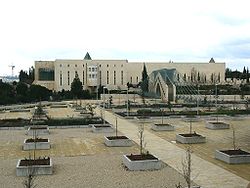 The building was donated to Israel by Dorothy de Rothschild
. Outside the President's Chamber is displayed the letter Ms Rothschild wrote to Prime Minister Shimon Peres expressing her intention to donate a new building for the Supreme Court.
It was designed by Ram Karmi
and Ada Karmi-Melamede and opened in 1992. According to the critic Ran Shechori, the building is a "serious attempt to come to grips with the local building tradition". He writes that,
Paul Goldberger
of The New York Times
calls it "Israel's finest public building," achieving "a remarkable and exhilarating balance between the concerns of daily life and the symbolism of the ages." He notes the complexity of the design with its interrelated geometric patterns:
The building is a blend of enclosed and open spaces; old and new; lines and circles. Approaching the Supreme Court library, one enters the pyramid area, a large space that serves as a turning point before the entrance to the courtrooms. This serene space acts as the inner "gate house" of the Supreme Court building. The Pyramid was inspired by the Tomb of Zechariah
and Tomb of Absalom in the Kidron Valley
in Jerusalem. Natural light enters round windows at the apex of the pyramid, forming circles of sunlight on the inside walls and on the floor.
Israel
The State of Israel is a parliamentary republic located in the Middle East, along the eastern shore of the Mediterranean Sea...
. The Supreme Court sits in Jerusalem.
The area of its jurisdiction is all of Israel and the Israeli-occupied territories
Israeli-occupied territories
The Israeli-occupied territories are the territories which have been designated as occupied territory by the United Nations and other international organizations, governments and others to refer to the territory seized by Israel during the Six-Day War of 1967 from Egypt, Jordan, and Syria...
. A ruling of the Supreme Court is binding upon every court, other than the Supreme Court itself. This is the principle of binding precedent (stare decisis
Stare decisis
Stare decisis is a legal principle by which judges are obliged to respect the precedents established by prior decisions...
) in Israel. The Supreme Court can sit as an appellate court
Appellate court
An appellate court, commonly called an appeals court or court of appeals or appeal court , is any court of law that is empowered to hear an appeal of a trial court or other lower tribunal...
and a court of first instance
Court of first instance
A court of first instance is a trial court of original or primary jurisdiction.Specific courts called the Court of First Instance include:* European Court of First Instance, of the European Union* Court of First Instance...
.
The Court has ruled on numerous issues relating to the Israeli-Palestinian conflict
Israeli-Palestinian conflict
The Israeli–Palestinian conflict is the ongoing conflict between Israelis and Palestinians. The conflict is wide-ranging, and the term is also used in reference to the earlier phases of the same conflict, between Jewish and Zionist yishuv and the Arab population living in Palestine under Ottoman or...
, the rights of Arab citizens of Israel
Arab citizens of Israel
Arab citizens of Israel refers to citizens of Israel who are not Jewish, and whose cultural and linguistic heritage or ethnic identity is Arab....
, and on discrimination between Jewish groups in Israel. It is unique in that its rulings can intervene in Israel Defense Forces
Israel Defense Forces
The Israel Defense Forces , commonly known in Israel by the Hebrew acronym Tzahal , are the military forces of the State of Israel. They consist of the ground forces, air force and navy. It is the sole military wing of the Israeli security forces, and has no civilian jurisdiction within Israel...
military operations.
Appointment
Supreme Court Justices are appointed by the PresidentPresident of Israel
The President of the State of Israel is the head of state of Israel. The position is largely an apolitical ceremonial figurehead role, with the real executive power lying in the hands of the Prime Minister. The current president is Shimon Peres who took office on 15 July 2007...
upon the nomination of the Judicial Selection Committee
Judicial Selection Committee (Israel)
The Israeli Judicial Committee is the body that nominates Judges for Israeli courts. After their selection the judges are appointed by the President.The committee was established in 1953, following the enactment of the Judges Bill...
. The Selection Committee is composed of nine members: Three Supreme Court Justices (including the President of the Supreme Court), two cabinet ministers (one of them being the Minister of Justice), two Knesset
Knesset
The Knesset is the unicameral legislature of Israel, located in Givat Ram, Jerusalem.-Role in Israeli Government :The legislative branch of the Israeli government, the Knesset passes all laws, elects the President and Prime Minister , approves the cabinet, and supervises the work of the government...
members, and two representatives of the Israel Bar Association
Israel Bar Association
The Israel Bar Association is the bar association for all Israeli lawyers.The Israel Bar is organized as a corporation, with a Central Committee, a National Assembly and five districts. Membership is mandatory for lawyers licensed in Israel. The top positions are filled by elections held every...
. The committee is chaired by the Minister of Justice.
The three organs of state—the legislative, executive, and judicial branches of government—as well as the bar association are represented in the Judges’ Nominations Committee. Thus, the shaping of the judicial body, through the manner of judicial appointment, is carried out by all the authorities together.
Qualifications
The following are qualified to be appointed a Justice of the Supreme Court: a person who has held office as a judge of a District Court for a period of five years, or a person who is inscribed, or entitled to be inscribed, in the roll of advocates, and has for not less than ten years –continuously or intermittently, and of which five years at least in Israel – been engaged in the profession of an advocateAdvocate
An advocate is a term for a professional lawyer used in several different legal systems. These include Scotland, South Africa, India, Scandinavian jurisdictions, Israel, and the British Crown dependencies of Jersey, Guernsey and the Isle of Man...
, served in a judicial capacity or other legal function in the service of the State of Israel or other service as designated in regulations in this regard, or has taught law at a university or a higher school of learning as designated in regulations in this regard. An "eminent jurist" can also be appointed to the Supreme Court.
Justices
The number of Supreme Court justices is determined by a resolution of the KnessetKnesset
The Knesset is the unicameral legislature of Israel, located in Givat Ram, Jerusalem.-Role in Israeli Government :The legislative branch of the Israeli government, the Knesset passes all laws, elects the President and Prime Minister , approves the cabinet, and supervises the work of the government...
. Usually, 12 Justices serve in the Supreme Court. At the present time there are 14 Supreme Court Justices.
At the head of the Supreme Court and at the head of the judicial system as a whole stands the President of the Supreme Court, and at his or her side, the Deputy President. A judge's term ends when he or she reaches 70 years of age, resigns, dies, is appointed to another position that disqualifies him or her, or is removed from office.
Current justices
As of January 2009, the Supreme Court Justices were:- Dorit BeinischDorit BeinischDorit Beinisch is the president of the Supreme Court of Israel. She was appointed to the position on September 14, 2006, after the retirement of Aharon Barak. She is the first woman to serve as president of the Supreme Court.-Biography:...
, president - Eliezer RivlinEliezer RivlinEliezer Rivlin is an Israeli judge. Eliezer Rivlin is the deputy-president of the Supreme Court of Israel and was chairman of the Central Elections Committee for the 2009 Legislative elections....
- Ayala ProcacciaAyala ProcacciaAyala Procaccia is a Justice of the Supreme Court of Israel, since 2001. Before being elected to the Supreme Court, she served as a judge in the Jerusalem Magistrates’ Court until 1993 and in the Jerusalem District Court from 1993 to 2001.-Biography:...
- Edmund Levi
- Asher Dan GrunisAsher Dan GrunisAsher Grunis is a Justice of the Supreme Court of Israel, appointed to the Court in 2003.Born in Israel, Grunis served in the Israeli army , earned an LL.B. degree from the Hebrew University in Jerusalem and was admitted to the Israeli bar in 1969...
- Miriam Naor
- Edna ArbelEdna ArbelEdna Arbel is a justice on Israel's Supreme Court. She has held this post since May 2004. She is a native of Jerusalem.- Professional background :...
- Elyakim RubinsteinElyakim RubinsteinElyakim Rubinstein was the Attorney General of Israel from 1997 to 2004 and is currently serving as a Judge on the Supreme Court of Israel.Rubinstein, a lifelong Israeli diplomat and civil servant, has had an influential role in that country's internal and external politics, most notably in...
- Salim Joubran
- Esther Hayut
- Hanan Melzar
- Yoram DanzigerYoram DanzigerYoram Danziger is a Justice of the Supreme Court of Israel, appointed to the Court in 2007. Formerly he was managing partner and co-founder of a Ramat Gan-based law firm founded in 1984 named Danziger, Klagsbald & Co....
On August 23, 2009, three new appointments to the Court were announced:
- Uzi Fogelman
- Yitzchak Amit
- Neal HendelNeal HendelNeal Hendel is a judge on the Supreme Court of Israel.Born in the United States and a graduate of the Yeshiva of Flatbush, Hendel graduated New York University in 1973 with a B.A. in sociology and Jewish studies and later studied Talmud Yeshiva University with Rabbi Joseph B. Soloveitchik...
Magistrate Court Judge Yigal Mersel serves as Registrar for the Court.
Presidents
Below is a list of presidents of the Supreme Court:- Moshe SmoiraMoshe SmoiraMoshe Smoira was an Israeli jurist and the first President of the Supreme Court of Israel.-Biography:Smoira was born in 1888 in Königsberg, in the German Empire to Leiser and Perel, Hasidic immigrants from Russia. He studied Hebrew and became a Zionist...
(1948–54) - Yitzhak OlshanYitzhak OlshanYitzhak Olshan was an Israeli jurist and the second President of the Supreme Court of Israel.-Biography:Olshan was born in Kaunas in the Russian Empire in 1895 and immigrated to Ottoman Palestine in 1912. He joined the Hagana and the Jewish Legion. He studied law and oriental studies at the...
(1954–65) - Shimon AgranatShimon AgranatShimon Agranat was the President of the Supreme Court of Israel from 1965 until 1976.-Biography:Agranat was born to a Zionist family in Louisville, Kentucky in 1906. He attended the University of Chicago and later its law school. Agranat emigrated to Mandate Palestine in 1930 and settled in...
(1965–76) - Yoel ZussmanYoel ZussmanYoel Zussman also spelled Yoel Sussman was an Israeli jurist and the fourth President of the Supreme Court of Israel.-Biography:Zussman was born in 1910 in Kraków, Austria-Hungary . He received his LLB from the University of London and his PhD from Heidelberg University. He immigrated to the...
(1976–80) - Moshe LandauMoshe LandauMoshe Landau was an Israeli jurist. He was the fifth President of the Supreme Court of Israel.-Biography:Landau was born in Danzig, Germany to Dr. Isaac Landau and Betty née Eisenstädt...
(1980–82) - Yitzhak KahanYitzhak KahanYitzhak Kahan was President of the Supreme Court of Israel from 1982 until 1983. He was the Chairman of the Commission of Inquiry into the Events at the Refugee Camps in Beirut also known as the Kahan Commission, which was established to investigate the Sabra and Shatila massacre.Born in Brody,...
(1982–83) - Meir ShamgarMeir ShamgarMeir Shamgar was President of the Israeli Supreme Court from 1983 until 1995.-Biography:Shamgar was born Meir Sterenberg in the Free City of Danzig to Eliezer and Dina Sterenberg.He emigrated to Palestine in 1939.He was arrested by the British in 1944 for anti-British activity and being...
(1983–95) - Aharon BarakAharon BarakAharon Barak is a Professor of Law at the Interdisciplinary Center in Herzliya and a lecturer in law at the Hebrew University of Jerusalem, the Yale Law School, and the University of Toronto Faculty of Law....
(1995–2006) - Dorit BeinischDorit BeinischDorit Beinisch is the president of the Supreme Court of Israel. She was appointed to the position on September 14, 2006, after the retirement of Aharon Barak. She is the first woman to serve as president of the Supreme Court.-Biography:...
(2006–present)
Appellate court
As an appellate courtAppellate court
An appellate court, commonly called an appeals court or court of appeals or appeal court , is any court of law that is empowered to hear an appeal of a trial court or other lower tribunal...
, the Supreme Court considers cases on appeal (both criminal and civil) on judgments and other decisions of the District Courts. It also considers appeals on judicial and quasi-judicial
Quasi-judicial body
A quasi-judicial body is an individual or organization which has powers resembling those of a court of law or judge and is able to remedy a situation or impose legal penalties on a person or organization.-Powers:...
decisions of various kinds, such as matters relating to the legality of Knesset elections and disciplinary rulings of the Bar Association.
High Court of Justice
As the High Court of Justice , the Supreme Court rules as a court of first instance, primarily in matters regarding the legality of decisions of State authorities: Government decisions, those of local authorities and other bodies and persons performing public functions under the law, and direct challenges to the constitutionality of laws enacted by the Knesset. The court has broad discretionary authority to rule on matters in which it considers it necessary to grant relief in the interests of justice, and which are not within the jurisdiction of another court or tribunal. The High Court of Justice grants relief through ordersCourt order
A court order is an official proclamation by a judge that defines the legal relationships between the parties to a hearing, a trial, an appeal or other court proceedings. Such ruling requires or authorizes the carrying out of certain steps by one or more parties to a case...
such as injunction
Injunction
An injunction is an equitable remedy in the form of a court order that requires a party to do or refrain from doing certain acts. A party that fails to comply with an injunction faces criminal or civil penalties and may have to pay damages or accept sanctions...
, mandamus
Mandamus
A writ of mandamus or mandamus , or sometimes mandate, is the name of one of the prerogative writs in the common law, and is "issued by a superior court to compel a lower court or a government officer to perform mandatory or purely ministerial duties correctly".Mandamus is a judicial remedy which...
and Habeas Corpus
Habeas corpus
is a writ, or legal action, through which a prisoner can be released from unlawful detention. The remedy can be sought by the prisoner or by another person coming to his aid. Habeas corpus originated in the English legal system, but it is now available in many nations...
, as well as through declaratory judgment
Declaratory judgment
A declaratory judgment is a judgment of a court in a civil case which declares the rights, duties, or obligations of one or more parties in a dispute. A declaratory judgment is legally binding, but it does not order any action by a party. In this way, the declaratory judgment is like an action to...
s.
Further hearing
The Supreme Court can also sit at a “further hearing” on its own judgment. In a matter on which the Supreme Court has ruled–whether as a court of appeals or as the High Court of Justice–with a panel of three or more justices, it may rule at a further hearing with a panel of a larger number of justices. A further hearing may be held if the Supreme Court makes a ruling inconsistent with a previous ruling or if the Court deems that the importance, difficulty or novelty of a ruling of the Court justifies such hearing.Composition
The Supreme Court, both as an appellate court and the High Court of Justice, is normally constituted of a panel of three Justices. A Supreme Court Justice may rule singly on interim orders, temporary orders or petitions for an order nisiDecree nisi
A decree nisi is a court order that does not have any force until such time that a particular condition is met, such as a subsequent petition to the court or the passage of a specified period of time....
, and on appeals on interim rulings of District Courts, or on judgments given by a single District Court judge on appeal, and on a judgment or decision of the Magistrates’ Courts.
The Supreme Court sits as a panel of five justices or more in a ‘further hearing’ on a matter in which the Supreme Court sat with a panel of three justices. The Supreme Court may sit as a panel of a larger uneven number of justices than three in matters that involve fundamental legal questions and constitutional issues of particular importance.
Presiding judge
In a case on which the President of the Supreme Court sits, the President is the Presiding Judge; in a case on which the Deputy President sits and the President does not sit, the Deputy President is the Presiding Judge; in any other case, the Judge with the greatest length of service is the Presiding Judge. The length of service, for this purpose, is calculated from the date of the appointment of the Judge to the Supreme Court.Retrial
A special power, unique to the Supreme Court, is the power to order a “retrial” on a criminal matter in which the defendant has been convicted by a final judgmentJudgment
A judgment , in a legal context, is synonymous with the formal decision made by a court following a lawsuit. At the same time the court may also make a range of court orders, such as imposing a sentence upon a guilty defendant in a criminal matter, or providing a remedy for the plaintiff in a civil...
. A ruling to hold a retrial may be made where the Court finds that evidence provided in the case was based upon lies or was forged; where new facts or evidence
Evidence
Evidence in its broadest sense includes everything that is used to determine or demonstrate the truth of an assertion. Giving or procuring evidence is the process of using those things that are either presumed to be true, or were themselves proven via evidence, to demonstrate an assertion's truth...
are discovered that are likely to alter the decision in the case in favor of the accused; where another has meanwhile been convicted of carrying out the same offense and it appears from the circumstances revealed in the trial of that other person that the original party convicted of the offense did not commit it; or, where there is a real concern for miscarriage of justice
Miscarriage of justice
A miscarriage of justice primarily is the conviction and punishment of a person for a crime they did not commit. The term can also apply to errors in the other direction—"errors of impunity", and to civil cases. Most criminal justice systems have some means to overturn, or "quash", a wrongful...
in the conviction. In practice, a ruling to hold a retrial is very rarely made.
Intervention
In the 1980s and the 1990s, the Supreme Court established its role as a protector of human rights, intervening to secure freedom of speech and freedom to demonstrate, reduce military censorship, limit use of certain military methods and promote equality between various sectors of the population.Supreme Court building
Dorothy de Rothschild
Dorothy de Rothschild was an English philanthropist and activist for Jewish affairs who married into the Rothschild international financial dynasty....
. Outside the President's Chamber is displayed the letter Ms Rothschild wrote to Prime Minister Shimon Peres expressing her intention to donate a new building for the Supreme Court.
It was designed by Ram Karmi
Ram Karmi
Ram Karmi is a leading Israeli architect. He is head of the Tel Aviv-based Ram Karmi Architects company, and is known for his Brutalist style.-Biography:Ram Karmi was born in Jerusalem, and grew up in Tel Aviv...
and Ada Karmi-Melamede and opened in 1992. According to the critic Ran Shechori, the building is a "serious attempt to come to grips with the local building tradition". He writes that,
It makes rich and wide-ranging references to the whole lexicon of Eretz-Israel building over the centuries, starting with Herodian structures, through the Hellenistic tomb of Absalom, the Crusaders, Greek Orthodox monasteries, and up to the British Mandate period. This outpouring is organized in a complex, almost baroque structure, built out of contrasts light-shade, narrow-wide, open-closed, stone-plaster, straight-round, and a profusion of existential experiences.
Paul Goldberger
Paul Goldberger
Paul Goldberger is the Architecture Critic for The New Yorker, where since 1997 he has written the magazine's celebrated "Sky Line" column. He also holds the Joseph Urban Chair in Design and Architecture at The New School in New York City...
of The New York Times
The New York Times
The New York Times is an American daily newspaper founded and continuously published in New York City since 1851. The New York Times has won 106 Pulitzer Prizes, the most of any news organization...
calls it "Israel's finest public building," achieving "a remarkable and exhilarating balance between the concerns of daily life and the symbolism of the ages." He notes the complexity of the design with its interrelated geometric patterns:
There is no clear front door and no simple pattern to the organization. The building cannot be described solely as long, or solely as rounded or as being arranged around a series of courtyards, though from certain angles, like the elephant described by the blind man, it could be thought to be any one of these. The structure, in fact, consists of three main sections: a square library wing within which is set a round courtyard containing a copper-clad pyramid, a rectangular administrative wing containing judges' chambers arrayed around a cloistered courtyard and a wing containing five courtrooms, all of which extend like fingers from a great main hall.
The building is a blend of enclosed and open spaces; old and new; lines and circles. Approaching the Supreme Court library, one enters the pyramid area, a large space that serves as a turning point before the entrance to the courtrooms. This serene space acts as the inner "gate house" of the Supreme Court building. The Pyramid was inspired by the Tomb of Zechariah
Tomb of Zechariah
The Tomb of Zechariah is an ancient stone monument adjacent to the Bnei Hazir tomb.-Architectural description:The monument is a monolith -- it is completely carved out of the solid rock and does not contain a burial chamber. The lowest part of the monument is a crepidoma, a base made of three steps...
and Tomb of Absalom in the Kidron Valley
Kidron Valley
The Kidron Valley is the valley on the eastern side of The Old City of Jerusalem which features significantly in the Bible...
in Jerusalem. Natural light enters round windows at the apex of the pyramid, forming circles of sunlight on the inside walls and on the floor.