

Urkesh

Encyclopedia
Tell
A tell or tel, is a type of archaeological mound created by human occupation and abandonment of a geographical site over many centuries. A classic tell looks like a low, truncated cone with a flat top and sloping sides.-Archaeology:A tell is a hill created by different civilizations living and...
, or settlement mound, located in the foothills of the Taurus Mountains
Taurus Mountains
Taurus Mountains are a mountain complex in southern Turkey, dividing the Mediterranean coastal region of southern Turkey from the central Anatolian Plateau. The system extends along a curve from Lake Eğirdir in the west to the upper reaches of the Euphrates and Tigris rivers in the east...
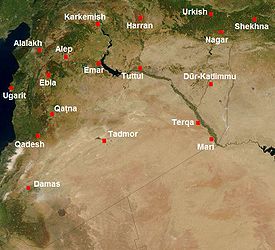
in Al-Hasakah Governorate, northeastern Syria
Syria
Syria , officially the Syrian Arab Republic , is a country in Western Asia, bordering Lebanon and the Mediterranean Sea to the West, Turkey to the north, Iraq to the east, Jordan to the south, and Israel to the southwest....
. It was founded during the fourth millennium BC possibly by the Hurrians
Hurrians
The Hurrians were a people of the Ancient Near East who lived in Northern Mesopotamia and adjacent regions during the Bronze Age.The largest and most influential Hurrian nation was the kingdom of Mitanni. The population of the Hittite Empire in Anatolia to a large part consisted of Hurrians, and...
on a site which appears to have been inhabited previously for a few centuries.
History
Urkesh was an ally of the Akkadian Empire through what is believed to have been a dynastic marriage tradition. Tar'am-Agade the daughter of the Akkadian king, Naram-SinNaram-Sin
Naram-Sin , reigned ca. 2254–2218 BCE, short chronology, was the third successor and grandson of King Sargon of Akkad. Under Naram-Sin the Akkadian Empire reached its zenith...
, is believed to have been married to the king of Urkesh. During the early second millennium BC the city passed into the hands of the rulers of Mari
Mari, Syria
Mari was an ancient Sumerian and Amorite city, located 11 kilometers north-west of the modern town of Abu Kamal on the western bank of Euphrates river, some 120 km southeast of Deir ez-Zor, Syria...
, a city a few hundred miles to the south. The king of Urkesh became a vassal (and apparently an appointed puppet) of Mari. The people of Urkesh evidently resented this, as the royal archives
Text corpus
In linguistics, a corpus or text corpus is a large and structured set of texts...
at Mari provide evidence of their strong resistance; in one letter, the king of Mari tells his Urkesh counterpart that "I did not know that the sons of your city hate you on my account. But you are mine, even if the city of Urkesh is not." In the middle of the millennium, Tell Mozan was the location of a Mitanni
Mitanni
Mitanni or Hanigalbat was a loosely organized Hurrian-speaking state in northern Syria and south-east Anatolia from ca. 1500 BC–1300 BC...
religious site. The city appears to have been largely abandoned circa 1350 BC, although the reason for this is unknown to archaeologists at this time.
The genealogy and identity of Urkesh's rulers is largely unknown, but the following names have been identified as being those of the city-state's kings. The first three known kings (only two of whom are known by name) bore the Hurrian title endan:
- Tupkish endan (c. 2250 BC)
- Tish-atal endan (date unknown)
- Shatar-mat (date unknown)
- Atal-shen (date unknown)
- Ann-atal (c. 2050 BC)
- Te'irru (c. 1800 BC)
Archaeology
The entire site covers around 135 hectares (333.6 acre), mostly made up of the outer city. The high mound covers about 18 hectares (44.5 acre) and rises to a height of 25 metres (82 ft), with 5 sub-mounds. The high mound is surrounded by a mudbrick city wall that was roughly 8 metres (26.2 ft) wide and 7 metres (23 ft) high.Important excavated structures include the royal palace of Tupkish, an associated necromantic underground structure (Abi), a monumental temple terrace with a plaza in front and a temple at the top, residential areas, burial areas, and the inner and outer city walls.
Soundings at the site were first made by Max Mallowan
Max Mallowan
Sir Max Edgar Lucien Mallowan, CBE was a prominent British archaeologist, specialising in ancient Middle Eastern history, and the second husband of Dame Agatha Christie.-Life and work:...
during his survey of the area. Agatha Christie
Agatha Christie
Dame Agatha Christie DBE was a British crime writer of novels, short stories, and plays. She also wrote romances under the name Mary Westmacott, but she is best remembered for her 66 detective novels and 14 short story collections , and her successful West End plays.According to...
, his wife, wrote that they chose not to continue at the site because it seemed to have Roman material. No trace of Roman occupation levels have been found in later excavations, however. Mallowan went on to excavate Chagar Bazar
Chagar Bazar
Chagar Bazar is an ancient site in northern Syria, about 35 kilometers north of Al-Hasakah, occupied from the sixth to the second millennium BC. It is situated by the small river Dara, a tributary to the Khabur River. Alternative spellings are Tell Chagar Bazar, or Šagir Bazar.-History:Chagar...
, another site to the south of Mozan/Urkesh. Excavations at Tell Mozan began in 1984 and have been conducted for at least 17 seasons up to the present time. The work has been led by Giorgio Buccellati of UCLA and Marilyn Kelly-Buccellati of the California State University
California State University
The California State University is a public university system in the state of California. It is one of three public higher education systems in the state, the other two being the University of California system and the California Community College system. It is incorporated as The Trustees of the...
. The 2007 season was primarily dedicated to working on publication material, primarily excavation units A16, J1, J3 and J4. A small sounding was done in J1 to clarify the transition between Mittani and Khabur. The excavations have been assisted at various times by other groups including the German Archaeological Institute
German Archaeological Institute
The German Archaeological Institute is an institution of research within the field of archaeology , and a "scientific corporation", with parentage of the federal Foreign Office of Germany-Origin:...
.
The excavations at Tell Mozan are known for the project's interest in pursuing the uses of technology in an archaeological context. The main focus is on the 'Global Record', a method of documentation that combines journal entries into a hypertext based output. This system marries the advantages of both the database and prose type approaches, in that elements are individually linked across both stratigraphy and typology, and yet remain tied in a more synthetic whole through the narrative of the archaeological record. Another focal point of research at the site is the application of conservation.
The mud brick architecture which comprises the majority of the structures found to date has been preserved over the years though an innovative system. This system protects the monument while still allowing a detailed inspection of the primary document as originally unearthed. The same system affords an overview of the architectural volumes as perceived by the ancients. A sizeable lab in the field research facility allows the conservators to give the best possible on-site care while interacting with the excavations. An extensive storage facility has been established where more than 10,000 objects and samples of non-museographic quality are available for further study. A detailed catalog indexes these finds.
Special emphasis is placed on documenting the concrete types of contact which are observed in the ground. This is done with great detail at the level of each individual feature. From this evidence is automatically derived a complete depositional history of all elements in contact. The strata are conceived as segments of this continuum in which a single depositional moment can be reconstructed. The phases are periods that are culturally identifiable on the basis of typological and functional analysis. Horizons are the broad chronological subdivisions based on comparative material and as they can be linked to the general historical understanding.
One of the most important fixed points of reference for chronology are impressions on door sealings of the seal of Tar'am-Agade, the daughter of Naram-Sin, which because of stratigraphy can be firmly linked to phase 3 of the AP palace occupation.
Finds from the excavations at Tell Mozan are on display in the Deir ez-Zor Museum
Deir ez-Zor Museum
The Deir ez-Zor Museum is a museum devoted to the archaeology and history of northeastern Syria, an area more commonly known as the Jezirah, or Upper Mesopotamia. The museum is located in Deir ez-Zor, the capital of Deir ez-Zor Governorate, Syria. It was founded in 1974 and housed in a gallery of...
.
Further reading
- Giorgio Buccellati and Marilyn Kelly Buccellati, Urkesh/Mozan Studies 3: Urkesh and the Hurrians : A Volume in Honor of Lloyd Cotsen, Undena, 1998, ISBN 0890035016
- Rick Hauser, READING FIGURINES: Animal Representations in Terra Cotta from Royal Building AK at Urkesh (Tell Mozan), Undena, 2006, ISBN 0979893712
- Peter M. M. G. Akkermans and Glenn M. Schwartz, The Archaeology of Syria: From Complex Hunter-Gatherers to Early Urban Societies (c.16,000-300 BC), Cambridge University Press, 2004, ISBN 0521796660
- Giorgio Buccellati, A Lu E School Tablet from the Service Quarter of the Royal Palace AP at Urkesh, Journal of Cuneiform Studies, vol. 55, pp. 45-48, 2003
External links
- Urkesh excavations (official website)
- Archaeobotany at Tell Mozan (Tübingen University)
- 86th Faculty Research Lecture: The Discovery of Ancient Urkesh and the Question of Meaning in Archaeology - Giorgio Buccellati, April 27, 1999 - UCLA webcast (utilizes RealPlayer)