


History of Medieval Serbia

Encyclopedia
Тhe medieval history of Serbia begins in the 5th century AD with the Slavic invasion of the Balkans, and lasts until the Ottoman occupation of 1540.
rule (527–565), when eventually up to 100,000 Slavs raided Thessalonica. The Western Balkans was settled with Sclaveni (Sklavenoi), the east with Antes.
The Sklavenoi plunder Thrace in 545. In 551, the Slavs crossed Niš
initially headed for Thessalonica, but ended up in Dalmatia
. During the 6th and 7th century CE, Slavic tribes made eight attempts to take Niš and in the final attack in 615 the Slavs took the city.
Menander Protector
mentions a King of the Sklavenoi, Daurentius
(577-579) that slayed an Avar envoy of Khagan Bayan I. The Avars asked the Slavs to accept the suzerainty of the Avars, he however declined and is reported as saying: "Others do not conquer our land, we conquer theirs [...] so it shall always be for us".
In 577 some 100,000 Slavs poured into Thrace
and Illyricum
, pillaging cities and settling down.
By the 580s, as the Slav communities on the Danube became larger and more organised, and as the Avars exerted their influence, raids became larger and resulted in permanent settlement. In 586 AD, as many as 100,000 Slav warriors raided Thessaloniki. By 581, many Slavic tribes had settled the land around Thessaloniki, though never taking the city itself, creating a Macedonian Sclavinia. As John of Ephesus tells us in 581: "the accursed people of the Slavs set out and plundered all of Greece, the regions surrounding Thessalonica, and Thrace, taking many towns and castles, laying waste, burning, pillaging, and seizing the whole country."
Archaeological evidence in Serbia and Macedonia conclude that the White Serbs may have reached the Balkans earlier than thought, between 550-600, as much findings; fibulae and pottery found at Roman forts point at Serb characteristics and thus could have been either part of the Byzantine foedorati or a fraction of the early invading Slavs who upon organizing in their refuge of the Dinarides, formed the ethnogenesis of Serbs and were pardoned by the Byzantine Empire after acknowledging their suzerainty.
According to Constantine Porphyrogenitus, a Byzantine
Emperor
who ruled during the 10th century, the Serbs migrated from White Serbia and initially settled around the region of Thessaloniki
. Not to their liking, they instead settled a region farther south- a large proportion of what had been the Roman province of Illyricum. On the Adriatic coast, these Serbs formed four coastal principalities known as Neretva, Zahumlje
, Konavli and Trebinje
and Duklja
. Inland (to the east of the Dinaric Alps
) lay a large territory stretching north as far as the Sava River
, and included the region of Bosnia. It retained the old name of Serbia, often called Baptised Serbia by the Byzantines, because it was Christianized (unlike the still pagan White Serbs in northern Europe).
Constantine's work, De Administrando Imperio
, has attracted intense academic debate. On the one hand, some scholars hold it to be a true account of the situation, thus concluding that Neretvians, Zachlumians, Dukljians, Travunians and southeastern Bosnians are descendants of Serbs that took on new tribal names, and due to geographical and political factors developed an often independent history from Raska
, the region of Serbia proper that became synonymous with the name Serbia from the 12th century onwards. Others argue that Constantine's account may have merely been a reflection of the political situation during his time (i.e. the 10th century) - whereby his liege Časlav Klonimirović
wielded command over the various Slavic lands south of the Cetina
and Vrbas rivers. Moreover, although possible, there is little archaeological evidence supporting a long-distance Serb migration from White Serbia, and indeed little evidence that a political entity known as White Serbia actually existed. There were a few South Slavic tribes in the Middle Ages that had contemporary name-sakes amongst Western and Eastern Slavic tribes, such as the Croats, Severians and Abodrites. We do not know whether it actually represented a shared identity. Florin Curta suggests that the Serbs might have been a clan of Slavic-speaking warriors, who formed within the Balkans, and slowly extended their power, and hence their name, over a greater territory.
The early history of Serbia is characterised by one of fluctuating borders and shifting centres of rule. For much of this period, there were several Serb states existing at any one time. Daniele Farlati
used the term Serbia Primorje (Serbia by the sea) when referring to the coastal provinces, whilst he called the interior part Serbia Zagorje. The two most prominent Serb states were Duklja (or Zeta) and Raška; they provided the territorial nucleus for a succession of Serb kingdoms that in the 13th century were consolidated under the Nemanjić dynasty. Centred in Raška, the Nemanjićs ushered a golden period in Serbian history, whereby it became a dominant Balkan power. Henceforth the name Serbia became synonymous with the state of Raška.
Medieval Greek and Latin historiographers call the Serbians "Triballi
". This does not necessarily indicate a relation of Serbians with the ancient tribe with the same name. Laonikos Chalkokondyles (1430–1490) says that at his time the Triballian land is around the area where river Morava meets Istrus (Danube) river ("... per regionem Triballorum. Ea autem region est, quam alluit Morabas fluvius, et in Istrum effunditur.").
, a form of territorial organization learned from the native Illyrians, being roughly equivalent to a county. Each župa consisted of several villages, linked by clan (i.e. extended family) relationships.
An embryonic Serbian state formed in the 9th century. At this time, the Bulgarian Khanate
was expanding westward, and had already installed Bulgar despots over the Slavic tribes which inhabited what is present-day northern Serbia - the Srem
region and eastern Slavonia
. At the same time, it pushed into Macedonia from the south, effectively encircling the Serbs. As a response to this, with Byzantine support, a few Serbian zhupa united defensively under the lead of Knez (‘Prince’) Vlastimir- the founder of the Vlastimirovic dynasty. The extent and location of this early Serb principality is not known with certainty, but it probably lay in present day southern Serbia and southeastern Bosnia "in the difficult country between the Rivers Drina and Ibar". In between the Serb principality and the Adriatic coastline existed three minor 'principalities', Travunia
, Zachlumia
and Pagania. At this time Duklja
did not exist as a political entity, as its eastern parts were part of Vlastimir's realm whilst the coastal cities were ruled by Byzantine governors. To the north, the Croats
were beginning to consolidate into a Principality, whilst to the east loomed the Bulgarian Empire. Archaeological evidence shows that the fort of Ras, marked the early Serb-Bulgarian border.
The Bulgarian invasion came sometime in the 840s, but was repelled by Knez Vlastimir. Vlastimir gave his daughter's hand to the son of the Zhupan of Travunia, Balaes. This established a long-lasting allegiance. Travunia henceforth acknowledged Serbia's authority, and was incorporated in Serbia as a semi-independent principality. Vlastimir's sons- Mutimir, Gojnik and Stojmir- defeated another Bulgarian attack c.853, capturing Khan Boris’ son, Vladimir, and twelve leading boljars. They escorted Vladimir to Ras, at the Serb-Bulgarian border, exchanged gifts and concluded a peace treaty. However, this early princedom was far from a consolidated, centralized state, and the various zhupans retained considerable independence. Rather than practising primogeniture
, Slavic rulers practiced staresina, where rule fell upon the eldest person in the extended family (rather than the son of the King). The realm would then be split between the surviving brothers, sons, nephews and cousins. Such tradition repeatedly caused succession strife.
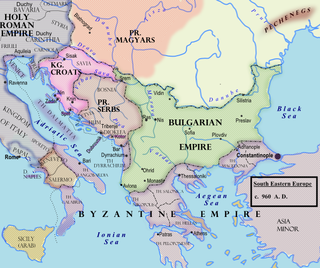 Sometime after defeating the Bulgarians, Mutimir ousted his brothers (who fled to Bulgaria). He kept Gojnik's son Peter in his court, but he managed to escape to Croatia. Mutimir ruled until 890, being succeeded by his son Prvoslav. However, Prvoslav was overthrown by Petar Gojnikovic, who had returned from his exile in Croatia c. 892. The name Peter is Christian; suggesting that Christianity had started to permeate into Serbia, undoubtedly through Serbia's contacts with the Bulgarians and Byzantines. Peter secured himself on the throne (after fending off a challenge from Klonimir, son of Stojmir) and was recognised by Tsar Symeon
of Bulgaria. An alliance was signed between the two states. Already having Travunia's loyalty, Peter began to expand his state north and west. He annexed the Bosna River valley, and then moved west securing allegiance from the Pagans - who were fiercely independent, pirateering Slavs. However, Peter's expansion into Dalmatia brought him into conflict with Prince Michael of Zahumlje. Michael had also grown powerful, ruling not only Zachlumia, but exerting his influence over Travunia and Dioklea. Porphyrogenitus explains that Michael's roots were different from Vlastimirovici, and was unwilling to yield authority to Peter.
Although allied to Symeon, Peter became increasingly disgruntled by the fact that he was essentially subordinate to him. Peter's expansion toward the coast facilitated contacts with the Byzantines, by way of the strategos of Dyrrachium. Searching for allies against Bulgaria, the Byzantines showered Peter with gold and promises of greater independence if he would join their alliance- a convincing strategy. Peter might have been planning an attack on Bulgaria with the Magyars, showing that his realm had stretched north to the Sava river. However, Michael of Zahumlje fore-warned Symeon of this plan, since Michael was an enemy of Peter, and a loyal vassal of Symeon. What followed was multiple Bulgarian interventions and a succession of Serb rulers. Symeon attacked Serbia (in 917) and deposed Peter, placing Pavel Branovic
(a grandson of Mutimir) as Prince of Serbia, subordinate to Symeon (although some scholars suggest that Symeon took control over Serbi directly at this time). Unhappy with this, the Byzantines then sent Zaharije Prvoslaviljevic in 920 to oust Pavel, but he failed and was sent to Bulgaria as prisoner. The Byzantines then succeeded in turning Prince Pavel to their side. In turn, the Bulgarians started indoctrinating Zaharije. Zaharije invaded Serbia with a Bulgarian force, and ousted his cousin Pavel in 922. However, he too turned to Byzantium. A punitive force sent by the Bulgarians was defeated. Zaharije sent the heads of the Bulgarian generals to Emperor Romanus as a sign of his loyalty to the Byzantines. Thus we see a continuous cycle of dynastic strife amongst Vlastimir's successors, stirred on by the Byzantine and Bulgarians, who were effectively using the Serbs as pawns. Whilst Bulgarian help was more effective, Byzantine help seemed preferable.
Simeon made peace with the Byzantines to settle affairs with Serbia once and for all. Frustrated by the traitorous smaller neighbor militarily, the Bulgarians decided to finish the things once and for all. In 924, he sent a large army accompanied by Časlav
, son of Klonimir. The army forced Zaharije to flee to Croatia. The Serbian zhupans were then summoned to recognize Čáslav as the new Prince. When they came, however, they were all imprisoned and taken to Bulgaria, as too was Čáslav. Much of Serbia was ravaged, and many people fled to Croatia, Bulgaria and Constantinople. Simeon made Serbia into a Bulgarian province, so that Bulgaria now bordered Croatia and Zahumlje. He then resolved to attack Croatia, because it was a Byzantine ally and had sheltered the Serbian Prince. At the battle of the Bosnian highlands, Croatia's King Tomislav defeated the Bulgarians, whilst Prince Michael of Zahumlje maintained neutrality. During the fall of central Serbia, Michael was the pre-eminent Serb prince, having been awarded the honorary title of Patriakos by the Byzantine Emperor, and may have ruled over Zachlumia, Travunia and Dioklea.
The Bulgarian subjugation of Serbia was for only three years. After Symeon died, Časlav Klonimirović (927 - c. 960s) led Serb refugees back to Serbia. He secured the allegiance of the Dalmatian duchies and expelled Bulgarian rule from central Serbia. After Tomislav's death, Croatia was in near anarchy as his sons vied for sole rule, so Čáslav was able to extend his rule north to the Vrbas river (gaining the allegiance of the chiefs of the various Bosnian zhupa). During this apogee of Serbian power, Christianity and culture penetrated Serbia as the Serb prince lived in peaceful and cordial relations with the Byzantines.
However, strong as it had grown to be, Serbia's power (as other early Slavic states) was only as strong as its ruler. There was no centralized rule, but was a more a confederacy of Slavic principalities. The existence of the unified Grand Principality was dependent on the allegiance of the lesser princes to Časlav. When he died defending Bosnia against Magyar incursions (sometime between 950–960), the coalition disintegrated. The various zhupans and princes previously loyal to Časlav undoubtedly tried to carve out their own realms, falling into conflict with each other. We do not know the details, and we do not know the names of any rulers- perhaps because no one was prominent enough to be noted. We do know that in the 990s, Jovan Vladimir
rose as the most powerful Serbian noble, carving out a principality centered on the coast of modern Montenegro. This state became known as Duklja, after the ancient Roman town of Doclea. However, by 997, it had been conquered and made subject to Bulgaria
again by tsar Samuel. When the Byzantines finally defeated the Bulgarians, they regained control over most of the Balkans for the first time in four centuries. Serbian lands were governed by a strategos presiding over the Theme of Sirmium. However, local Serbian princes continued to reign as suzerains to the Byzantines
, maintaining total autonomy over their lands, such as the zhupanate of Rascia
while only nominally being Byzantine vassals. Forts were maintained in Belgrade, Sirmium, Nis and Branicevo. These were, for the most part, in the hands of local nobility, which often revolted against Byzantine rule.
had arisen. The dynasty began by prince Stefan Vojislav created a powerful and influential state that took all Serbian lands from under the Byzantine rule. During this time, we know very little about the events in Serbia Zagorje (inland), because Byzantine attention was focused primarily on the coastal Serbs. Duklja
was also the first Serbian kingdom, which gained international recognition. Prince Mihajlo received the king's crown from the Pope
in 1077. His successor king Bodin enlarged the domain, but the Kingdom of Duklja didn't last for a long time. Byzantine Empire
conquers Duklja
in 1101.
, the son of Vukan, ruled Serbia when the Byzantines invaded Duklja, and Rascia would be next in line, but with diplomatic ties with the Kingdom of Hungary
, Serbia retained its indepence. Uroš II
initially fought the Byzantines, but after a defeat soon gives oaths of servitude to the Emperor. Desa, the brother of Uroš II and an initial Byzantine ally, turned to Hungarian support, but was deposed in 1163, when Stefan Tihomir of a cadet line (which would become Nemanjić dynasty), was put on the throne by the Emperor.
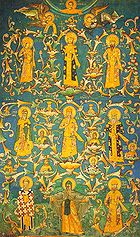
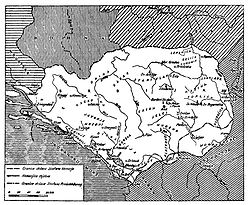 Stefan Nemanja was succeeded by his middle son Stefan, whilst his first-born son Vukan was given the rule of the Zeta region (present-day Montenegro). Stefan Nemanja's youngest son Rastko became a monk and took the name Sava, turning all his efforts to spread religion among his people. Since the Roman Catholic Church
already had ambitions to spread its influence to the Balkans as well, Stefan used these propitious circumstances to obtain his crown from the Pope, thereby becoming the first Serbian king, in 1217. In Byzantium, his brother Sava managed to secure autocephaly
(independence) for the Serbian Church and became the first Serbian archbishop
in 1219. In the same year Sava
published the first constitution
in Serbia
— St. Sava's Nomocanon . This legal act was well developed. St. Sava's Nomocanon was the compilation of Civil law
, based on Roman Law
and Canon law
, based on Ecumenical Councils and its basic purpose was to organize functioning of the young Serbian kingdom and the Serbian church
. Thus the Serbs acquired both forms of independence: political and religious.
The next generation of Serbian rulers — the sons of Stefan Prvovenčani — Radoslav, Vladislav and Uroš I, marked a period of stagnation of the state structure. All three kings were more or less dependent on some of the neighbouring states — Byzantium
, Bulgaria
or Hungary. The ties with the Hungarians played a decisive role in the fact that Uroš I was succeeded by his son Dragutin whose wife was a Hungarian princess. Later on, when Dragutin abdicated in favor of his younger brother Milutin (in 1282), the Hungarian king Ladislaus IV gave him lands in northeastern Bosnia
, the region of Mačva
, and the city of Belgrade
, whilst he managed to conquer and annex lands in northeastern Serbia
. Thus, some of these territories became part of the Serbian state for the first time. His new state was named Kingdom of Srem. In that time the name Srem was a designation for two territories: Upper Srem (present day Srem) and Lower Srem (present day Mačva). Kingdom of Srem under the rule of Stefan Dragutin was actually Lower Srem, but some historical sources mention that Stefan Dragutin also ruled over Upper Srem and Slavonia
. After Dragutin died (in 1316), the new ruler of the Kingdom of Srem became his son, king Vladislav II, who ruled this state until 1325.
Under the rule of Dragutin's younger brother — King Milutin, Serbia grew stronger despite having to occasionally fight wars on three different fronts. King Milutin was an apt diplomat much inclined to the use of a customary medieval diplomatic and dynastic marriages. He was married five times, with Hungarian, Bulgarian and Byzantine princesses. He is also famous for building churches, some of which are the finest examples of Medieval Serbian architecture: the Gračanica monastery
in Kosovo, the Cathedral in Hilandar monastery on Mount Athos
, the St. Archangel Church in Jerusalem etc.
Because of his endowments, King Milutin has been proclaimed a saint, in spite of his tumultuous life.
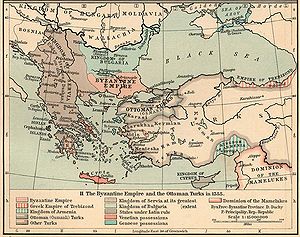 Milutin was succeeded on the throne by his son Stefan, later dubbed Stefan Dečanski. Spreading the kingdom to the east by winning the town of Nis and the surrounding counties, and to the south by acquiring territories on Macedonia, Stefan Dečanski was worthy of his father and built the Visoki Dečani monastery
in Metohija — the most monumental example of Serbian Medieval architecture — that earned him his nickname. Stefan Dečanski defeated the Bulgarians
in Battle of Velbužd
in 1330.
In 1333 the Republic of Dubrovnik
bought the Pelješac
peninsula from the Serbian king Stefan Dušan.
Medieval Serbia reached its apex in the middle of the 14th century, during the rule of Tsar Dušan. In that time Dušan's Code
was enacted in 1349 and added in 1354. The Code was based on Roman
-Byzantine law
. The legal transplanting is notable with the articles 171 and 172 of Dušan's Code, which regulated the juridical independence. They were taken from the Byzantine code Basilika
(book VII, 1, 16-17). Tsar Dušan opened new trade routes and strengthened the state's economy. Serbia flourished, becoming one of the most developed countries and cultures in Europe
. Medieval Serbia had a high political, economic, and cultural reputation in Europe.
Taking advantage of the Byzantine civil war of 1341–1347
, Dušan doubled the size of his kingdom seizing territories to the south, southeast and east at the expense of Byzantium and conquered almost the entire territory of today's Greece, except the Peloponnese
and the islands. After he conquered the city of Serres
, he was crowned the Emperor of Serbs and Greeks by the first Serbian Patriarch in 1346. He was attempting to become the successor of the Byzantine Emperors. Before his sudden death, Stefan Dušan tried to organize a Crusade with the Pope against the threatening Turks. He died in December 1355 at the age 47.
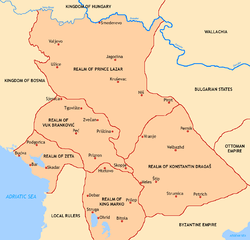
 Tsar Stefan Dušan was succeeded by his son Uroš, called the Weak, a term that might also apply to the state of the kingdom, as it slowly slid into feudal anarchy. This is a period marked by the rise of a new threat: the Ottoman Turk sultanate
, which gradually spread from Asia to Europe and conquered Byzantium first, and then the other Balkan states. Serbia was divided between the feudal lords. The most powerful was Vukašin Mrnjavčević
, who was the right hand of Stefan Uroš, but he died in the Battle of Maritsa
in his campaign to drive the Turks out of Europe. Tsar Uroš died several months later, and with his death, the Nemanjić dynasty was over. However, a new figure emerged - Lazar Hrebeljanović, who managed to unite most of Serbia with war and diplomacy. He could not unite all of Serbia, because some of the regional feudal lords were significantly powerful, and yet he had to fight the greater threat, the Ottoman Empire. The first raids on Lazar's territory began in 1381, but the real invasion came in 1389. Lazar gathered every soldier he could, leading Serbian army to face the Turks.
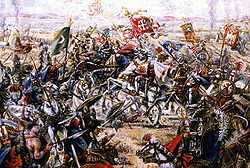
On 28 July 1389 the two armies met at Kosovo, in what became known as the Battle of Kosovo
. The attack began with the Serbs penetrating the first 2 lines of the Turkish army, and completely destroyed the right flank, under the command of the sultan's son, Yakub. At one point in the battle, a Serbian knight Miloš Obilić
managed to assassinate the Ottoman sultan, Murad I
. His son, Bayezid I
, took command of the army and managed to defeat the Serbs and to capture Prince Lazar and execute him. The losses are unknown, but it is said that the Serbian-led army fought to the last man. After the Battle of Kosovo
there was no army among the Balkan states capable of halting the advancing Ottoman Empire and the first victim was the Bulgarian Tarnovo state, which fell four years later. Serbia however managed to recuperate under despot Stefan Lazarević
, surviving for 70 more years, experiencing a cultural and political renaissance, but after Stefan Lazarević's death, his successors from the House of Branković
did not manage to stop the Ottoman advance. Serbia finally fell under the Ottomans in 1459, and remained under their occupation until 1804, when Serbia finally managed to regain its sovereignty from the Ottomans.
Slavic invasion
The Slavs invaded Balkans during Justinian IJustinian I
Justinian I ; , ; 483– 13 or 14 November 565), commonly known as Justinian the Great, was Byzantine Emperor from 527 to 565. During his reign, Justinian sought to revive the Empire's greatness and reconquer the lost western half of the classical Roman Empire.One of the most important figures of...
rule (527–565), when eventually up to 100,000 Slavs raided Thessalonica. The Western Balkans was settled with Sclaveni (Sklavenoi), the east with Antes.
The Sklavenoi plunder Thrace in 545. In 551, the Slavs crossed Niš
Niš
Niš is the largest city of southern Serbia and third-largest city in Serbia . According to the data from 2011, the city of Niš has a population of 177,972 inhabitants, while the city municipality has a population of 257,867. The city covers an area of about 597 km2, including the urban area,...
initially headed for Thessalonica, but ended up in Dalmatia
Dalmatia
Dalmatia is a historical region on the eastern coast of the Adriatic Sea. It stretches from the island of Rab in the northwest to the Bay of Kotor in the southeast. The hinterland, the Dalmatian Zagora, ranges from fifty kilometers in width in the north to just a few kilometers in the south....
. During the 6th and 7th century CE, Slavic tribes made eight attempts to take Niš and in the final attack in 615 the Slavs took the city.
Menander Protector
Menander Protector
Menander Protector , Byzantine historian, was born in Constantinople in the middle of the 6th century AD. The little that is known of his life is contained in the account of himself quoted by Suidas. He at first took up the study of law, but abandoned it for a life of pleasure...
mentions a King of the Sklavenoi, Daurentius
Daurentius
Daurentius or Dauritas was a 6th-century South Slavic chieftain and warlord.His realm was situated in the basin of the Zala river, roughly in the territory of the old Roman province of Pannonia Prima, in present-day Hungary....
(577-579) that slayed an Avar envoy of Khagan Bayan I. The Avars asked the Slavs to accept the suzerainty of the Avars, he however declined and is reported as saying: "Others do not conquer our land, we conquer theirs [...] so it shall always be for us".
In 577 some 100,000 Slavs poured into Thrace
Thrace
Thrace is a historical and geographic area in southeast Europe. As a geographical concept, Thrace designates a region bounded by the Balkan Mountains on the north, Rhodope Mountains and the Aegean Sea on the south, and by the Black Sea and the Sea of Marmara on the east...
and Illyricum
Illyricum (Roman province)
The Roman province of Illyricum or Illyris Romana or Illyris Barbara or Illyria Barbara replaced most of the region of Illyria. It stretched from the Drilon river in modern north Albania to Istria in the west and to the Sava river in the north. Salona functioned as its capital...
, pillaging cities and settling down.
By the 580s, as the Slav communities on the Danube became larger and more organised, and as the Avars exerted their influence, raids became larger and resulted in permanent settlement. In 586 AD, as many as 100,000 Slav warriors raided Thessaloniki. By 581, many Slavic tribes had settled the land around Thessaloniki, though never taking the city itself, creating a Macedonian Sclavinia. As John of Ephesus tells us in 581: "the accursed people of the Slavs set out and plundered all of Greece, the regions surrounding Thessalonica, and Thrace, taking many towns and castles, laying waste, burning, pillaging, and seizing the whole country."
Archaeological evidence in Serbia and Macedonia conclude that the White Serbs may have reached the Balkans earlier than thought, between 550-600, as much findings; fibulae and pottery found at Roman forts point at Serb characteristics and thus could have been either part of the Byzantine foedorati or a fraction of the early invading Slavs who upon organizing in their refuge of the Dinarides, formed the ethnogenesis of Serbs and were pardoned by the Byzantine Empire after acknowledging their suzerainty.
According to Constantine Porphyrogenitus, a Byzantine
Byzantine Empire
The Byzantine Empire was the Eastern Roman Empire during the periods of Late Antiquity and the Middle Ages, centred on the capital of Constantinople. Known simply as the Roman Empire or Romania to its inhabitants and neighbours, the Empire was the direct continuation of the Ancient Roman State...
Emperor
Emperor
An emperor is a monarch, usually the sovereign ruler of an empire or another type of imperial realm. Empress, the female equivalent, may indicate an emperor's wife or a woman who rules in her own right...
who ruled during the 10th century, the Serbs migrated from White Serbia and initially settled around the region of Thessaloniki
Thessaloniki
Thessaloniki , historically also known as Thessalonica, Salonika or Salonica, is the second-largest city in Greece and the capital of the region of Central Macedonia as well as the capital of the Decentralized Administration of Macedonia and Thrace...
. Not to their liking, they instead settled a region farther south- a large proportion of what had been the Roman province of Illyricum. On the Adriatic coast, these Serbs formed four coastal principalities known as Neretva, Zahumlje
Zahumlje
Zachlumia or Zahumlje was a medieval principality located in modern-day regions of Herzegovina and southern Dalmatia...
, Konavli and Trebinje
Travunia
Travunia was a medieval region, administrative unit and principality, which was part of Medieval Serbia , and in its last years, the Bosnian Kingdom . The county became hereditary in a number of noble houses, often kin to the ruling dynasty. The region came under Ottoman rule in 1482...
and Duklja
Duklja
Doclea or Duklja was a medieval state with hereditary lands roughly encompassing the territories of present-day southeastern Montenegro, from Kotor on the west to the river Bojana on the east and to the sources of Zeta and Morača rivers on the north....
. Inland (to the east of the Dinaric Alps
Dinaric Alps
The Dinaric Alps or Dinarides form a mountain chain in Southern Europe, spanning areas of Slovenia, Croatia, Bosnia and Herzegovina, Serbia, Kosovo, Albania and Montenegro....
) lay a large territory stretching north as far as the Sava River
Sava River
The Sava is a river in Southeast Europe, a right side tributary of the Danube river at Belgrade. Counting from Zelenci, the source of Sava Dolinka, it is long and drains of surface area. It flows through Slovenia, Croatia, along the northern border of Bosnia and Herzegovina, and through Serbia....
, and included the region of Bosnia. It retained the old name of Serbia, often called Baptised Serbia by the Byzantines, because it was Christianized (unlike the still pagan White Serbs in northern Europe).
Constantine's work, De Administrando Imperio
De Administrando Imperio
De Administrando Imperio is the Latin title of a Greek work written by the 10th-century Eastern Roman Emperor Constantine VII. The Greek title of the work is...
, has attracted intense academic debate. On the one hand, some scholars hold it to be a true account of the situation, thus concluding that Neretvians, Zachlumians, Dukljians, Travunians and southeastern Bosnians are descendants of Serbs that took on new tribal names, and due to geographical and political factors developed an often independent history from Raska
Raška (state)
Principality of Serbia or Serbian Principality was an early medieval state of the Serbs ruled by the Vlastimirović dynasty, that existed from ca 768 to 969 in Southeastern Europe. It was established through an unification of several provincial chiefs under the supreme rule of a certain Višeslav,...
, the region of Serbia proper that became synonymous with the name Serbia from the 12th century onwards. Others argue that Constantine's account may have merely been a reflection of the political situation during his time (i.e. the 10th century) - whereby his liege Časlav Klonimirović
Caslav Klonimirovic
Časlav Klonimirović or Časlav of Serbia was Prince of the Serbs from ca. 927 until his death in 960. He significantly expanded the Serbian Principality when he managed to unite several Slavic tribes, stretching his realm over the shores of the Adriatic Sea, the Sava river and the Morava valley...
wielded command over the various Slavic lands south of the Cetina
Cetina
Cetina is a river in southern Croatia. It has a length of and its basin covers an area of . Cetina descends from an altitude of 385 m at its source to the sea level when it flows into the Adriatic Sea. It is the most water-rich river in Dalmatia....
and Vrbas rivers. Moreover, although possible, there is little archaeological evidence supporting a long-distance Serb migration from White Serbia, and indeed little evidence that a political entity known as White Serbia actually existed. There were a few South Slavic tribes in the Middle Ages that had contemporary name-sakes amongst Western and Eastern Slavic tribes, such as the Croats, Severians and Abodrites. We do not know whether it actually represented a shared identity. Florin Curta suggests that the Serbs might have been a clan of Slavic-speaking warriors, who formed within the Balkans, and slowly extended their power, and hence their name, over a greater territory.
The early history of Serbia is characterised by one of fluctuating borders and shifting centres of rule. For much of this period, there were several Serb states existing at any one time. Daniele Farlati
Daniele Farlati
Daniele Farlati was an ecclesiastical historian.Farlati was born in San Daniele del Friuli in the present Italian province of Udine. After having studied in Gorizia he entered, in 1707, the Society of Jesus in Bologna...
used the term Serbia Primorje (Serbia by the sea) when referring to the coastal provinces, whilst he called the interior part Serbia Zagorje. The two most prominent Serb states were Duklja (or Zeta) and Raška; they provided the territorial nucleus for a succession of Serb kingdoms that in the 13th century were consolidated under the Nemanjić dynasty. Centred in Raška, the Nemanjićs ushered a golden period in Serbian history, whereby it became a dominant Balkan power. Henceforth the name Serbia became synonymous with the state of Raška.
Medieval Greek and Latin historiographers call the Serbians "Triballi
Triballi
The Triballi were an ancient tribe whose dominion was around the plains of southern modern Serbia and west Bulgaria, at the Angrus and Brongus and the Iskur River, roughly centered where Serbia and Bulgaria are joined....
". This does not necessarily indicate a relation of Serbians with the ancient tribe with the same name. Laonikos Chalkokondyles (1430–1490) says that at his time the Triballian land is around the area where river Morava meets Istrus (Danube) river ("... per regionem Triballorum. Ea autem region est, quam alluit Morabas fluvius, et in Istrum effunditur.").
First Serbian Principality
Upon their initial arrival, the Slavs formed no uniform political organization, but rather remained divided into many tribes of various sizes, referred to as Sklaviniai by the Byzantines. These groups were led by native chiefs. Perhaps the tribes were organized into župaŽupa
A Župa is a Slavic term, used historically among the Southern and Western branches of the Slavs, originally denoting various territorial and other sub-units, usually a small administrative division, especially a gathering of several villages...
, a form of territorial organization learned from the native Illyrians, being roughly equivalent to a county. Each župa consisted of several villages, linked by clan (i.e. extended family) relationships.
An embryonic Serbian state formed in the 9th century. At this time, the Bulgarian Khanate
First Bulgarian Empire
The First Bulgarian Empire was a medieval Bulgarian state founded in the north-eastern Balkans in c. 680 by the Bulgars, uniting with seven South Slavic tribes...
was expanding westward, and had already installed Bulgar despots over the Slavic tribes which inhabited what is present-day northern Serbia - the Srem
Srem
Śrem is a town on the Warta river in central Poland. It has been situated in the Greater Poland Voivodeship since 1999; from 1975 to 1998 it was part of the Poznań Voivodeship...
region and eastern Slavonia
Slavonia
Slavonia is a geographical and historical region in eastern Croatia...
. At the same time, it pushed into Macedonia from the south, effectively encircling the Serbs. As a response to this, with Byzantine support, a few Serbian zhupa united defensively under the lead of Knez (‘Prince’) Vlastimir- the founder of the Vlastimirovic dynasty. The extent and location of this early Serb principality is not known with certainty, but it probably lay in present day southern Serbia and southeastern Bosnia "in the difficult country between the Rivers Drina and Ibar". In between the Serb principality and the Adriatic coastline existed three minor 'principalities', Travunia
Travunia
Travunia was a medieval region, administrative unit and principality, which was part of Medieval Serbia , and in its last years, the Bosnian Kingdom . The county became hereditary in a number of noble houses, often kin to the ruling dynasty. The region came under Ottoman rule in 1482...
, Zachlumia
Zachlumia
Zachlumia or Zahumlje was a medieval principality located in modern-day regions of Herzegovina and southern Dalmatia...
and Pagania. At this time Duklja
Duklja
Doclea or Duklja was a medieval state with hereditary lands roughly encompassing the territories of present-day southeastern Montenegro, from Kotor on the west to the river Bojana on the east and to the sources of Zeta and Morača rivers on the north....
did not exist as a political entity, as its eastern parts were part of Vlastimir's realm whilst the coastal cities were ruled by Byzantine governors. To the north, the Croats
Croats
Croats are a South Slavic ethnic group mostly living in Croatia, Bosnia and Herzegovina and nearby countries. There are around 4 million Croats living inside Croatia and up to 4.5 million throughout the rest of the world. Responding to political, social and economic pressure, many Croats have...
were beginning to consolidate into a Principality, whilst to the east loomed the Bulgarian Empire. Archaeological evidence shows that the fort of Ras, marked the early Serb-Bulgarian border.
The Bulgarian invasion came sometime in the 840s, but was repelled by Knez Vlastimir. Vlastimir gave his daughter's hand to the son of the Zhupan of Travunia, Balaes. This established a long-lasting allegiance. Travunia henceforth acknowledged Serbia's authority, and was incorporated in Serbia as a semi-independent principality. Vlastimir's sons- Mutimir, Gojnik and Stojmir- defeated another Bulgarian attack c.853, capturing Khan Boris’ son, Vladimir, and twelve leading boljars. They escorted Vladimir to Ras, at the Serb-Bulgarian border, exchanged gifts and concluded a peace treaty. However, this early princedom was far from a consolidated, centralized state, and the various zhupans retained considerable independence. Rather than practising primogeniture
Primogeniture
Primogeniture is the right, by law or custom, of the firstborn to inherit the entire estate, to the exclusion of younger siblings . Historically, the term implied male primogeniture, to the exclusion of females...
, Slavic rulers practiced staresina, where rule fell upon the eldest person in the extended family (rather than the son of the King). The realm would then be split between the surviving brothers, sons, nephews and cousins. Such tradition repeatedly caused succession strife.
Simeon I of Bulgaria
Simeon I the Great ruled over Bulgaria from 893 to 927, during the First Bulgarian Empire. Simeon's successful campaigns against the Byzantines, Magyars and Serbs led Bulgaria to its greatest territorial expansion ever, making it the most powerful state in contemporary Eastern Europe...
of Bulgaria. An alliance was signed between the two states. Already having Travunia's loyalty, Peter began to expand his state north and west. He annexed the Bosna River valley, and then moved west securing allegiance from the Pagans - who were fiercely independent, pirateering Slavs. However, Peter's expansion into Dalmatia brought him into conflict with Prince Michael of Zahumlje. Michael had also grown powerful, ruling not only Zachlumia, but exerting his influence over Travunia and Dioklea. Porphyrogenitus explains that Michael's roots were different from Vlastimirovici, and was unwilling to yield authority to Peter.
Although allied to Symeon, Peter became increasingly disgruntled by the fact that he was essentially subordinate to him. Peter's expansion toward the coast facilitated contacts with the Byzantines, by way of the strategos of Dyrrachium. Searching for allies against Bulgaria, the Byzantines showered Peter with gold and promises of greater independence if he would join their alliance- a convincing strategy. Peter might have been planning an attack on Bulgaria with the Magyars, showing that his realm had stretched north to the Sava river. However, Michael of Zahumlje fore-warned Symeon of this plan, since Michael was an enemy of Peter, and a loyal vassal of Symeon. What followed was multiple Bulgarian interventions and a succession of Serb rulers. Symeon attacked Serbia (in 917) and deposed Peter, placing Pavel Branovic
Pavle Branović
Pavle Branović or Pavle of Serbia was Prince of the Serbs from 917 to 921. He was put on the throne by the Bulgarian Tsar Symeon I of Bulgaria, who had murdered the previous Prince Petar, who had become a Byzantine ally. Pavle ruled for 4 years, before being defeated by Prince Zaharija, his...
(a grandson of Mutimir) as Prince of Serbia, subordinate to Symeon (although some scholars suggest that Symeon took control over Serbi directly at this time). Unhappy with this, the Byzantines then sent Zaharije Prvoslaviljevic in 920 to oust Pavel, but he failed and was sent to Bulgaria as prisoner. The Byzantines then succeeded in turning Prince Pavel to their side. In turn, the Bulgarians started indoctrinating Zaharije. Zaharije invaded Serbia with a Bulgarian force, and ousted his cousin Pavel in 922. However, he too turned to Byzantium. A punitive force sent by the Bulgarians was defeated. Zaharije sent the heads of the Bulgarian generals to Emperor Romanus as a sign of his loyalty to the Byzantines. Thus we see a continuous cycle of dynastic strife amongst Vlastimir's successors, stirred on by the Byzantine and Bulgarians, who were effectively using the Serbs as pawns. Whilst Bulgarian help was more effective, Byzantine help seemed preferable.
Simeon made peace with the Byzantines to settle affairs with Serbia once and for all. Frustrated by the traitorous smaller neighbor militarily, the Bulgarians decided to finish the things once and for all. In 924, he sent a large army accompanied by Časlav
Caslav Klonimirovic
Časlav Klonimirović or Časlav of Serbia was Prince of the Serbs from ca. 927 until his death in 960. He significantly expanded the Serbian Principality when he managed to unite several Slavic tribes, stretching his realm over the shores of the Adriatic Sea, the Sava river and the Morava valley...
, son of Klonimir. The army forced Zaharije to flee to Croatia. The Serbian zhupans were then summoned to recognize Čáslav as the new Prince. When they came, however, they were all imprisoned and taken to Bulgaria, as too was Čáslav. Much of Serbia was ravaged, and many people fled to Croatia, Bulgaria and Constantinople. Simeon made Serbia into a Bulgarian province, so that Bulgaria now bordered Croatia and Zahumlje. He then resolved to attack Croatia, because it was a Byzantine ally and had sheltered the Serbian Prince. At the battle of the Bosnian highlands, Croatia's King Tomislav defeated the Bulgarians, whilst Prince Michael of Zahumlje maintained neutrality. During the fall of central Serbia, Michael was the pre-eminent Serb prince, having been awarded the honorary title of Patriakos by the Byzantine Emperor, and may have ruled over Zachlumia, Travunia and Dioklea.
The Bulgarian subjugation of Serbia was for only three years. After Symeon died, Časlav Klonimirović (927 - c. 960s) led Serb refugees back to Serbia. He secured the allegiance of the Dalmatian duchies and expelled Bulgarian rule from central Serbia. After Tomislav's death, Croatia was in near anarchy as his sons vied for sole rule, so Čáslav was able to extend his rule north to the Vrbas river (gaining the allegiance of the chiefs of the various Bosnian zhupa). During this apogee of Serbian power, Christianity and culture penetrated Serbia as the Serb prince lived in peaceful and cordial relations with the Byzantines.
However, strong as it had grown to be, Serbia's power (as other early Slavic states) was only as strong as its ruler. There was no centralized rule, but was a more a confederacy of Slavic principalities. The existence of the unified Grand Principality was dependent on the allegiance of the lesser princes to Časlav. When he died defending Bosnia against Magyar incursions (sometime between 950–960), the coalition disintegrated. The various zhupans and princes previously loyal to Časlav undoubtedly tried to carve out their own realms, falling into conflict with each other. We do not know the details, and we do not know the names of any rulers- perhaps because no one was prominent enough to be noted. We do know that in the 990s, Jovan Vladimir
Jovan Vladimir
Jovan Vladimir or John Vladimir was ruler of Duklja, the most powerful Serbian principality of the time, from around 1000 to 1016. He ruled during the protracted war between the Byzantine Empire and the First Bulgarian Empire...
rose as the most powerful Serbian noble, carving out a principality centered on the coast of modern Montenegro. This state became known as Duklja, after the ancient Roman town of Doclea. However, by 997, it had been conquered and made subject to Bulgaria
First Bulgarian Empire
The First Bulgarian Empire was a medieval Bulgarian state founded in the north-eastern Balkans in c. 680 by the Bulgars, uniting with seven South Slavic tribes...
again by tsar Samuel. When the Byzantines finally defeated the Bulgarians, they regained control over most of the Balkans for the first time in four centuries. Serbian lands were governed by a strategos presiding over the Theme of Sirmium. However, local Serbian princes continued to reign as suzerains to the Byzantines
Byzantine Empire
The Byzantine Empire was the Eastern Roman Empire during the periods of Late Antiquity and the Middle Ages, centred on the capital of Constantinople. Known simply as the Roman Empire or Romania to its inhabitants and neighbours, the Empire was the direct continuation of the Ancient Roman State...
, maintaining total autonomy over their lands, such as the zhupanate of Rascia
Rascia
Rascia was a medieval region that served as the principal province of the Serbian realm. It was an administrative division under the direct rule of the monarch and sometimes as an appanage. The term has been used to refer to various Serbian states throughout the Middle Ages...
while only nominally being Byzantine vassals. Forts were maintained in Belgrade, Sirmium, Nis and Branicevo. These were, for the most part, in the hands of local nobility, which often revolted against Byzantine rule.
Emergance and fall of Duklja under the Vojislavljević
For the next 150 years, the mantle of leadership of the Serbs passed to the coastal areas, where the principality of DukljaDuklja
Doclea or Duklja was a medieval state with hereditary lands roughly encompassing the territories of present-day southeastern Montenegro, from Kotor on the west to the river Bojana on the east and to the sources of Zeta and Morača rivers on the north....
had arisen. The dynasty began by prince Stefan Vojislav created a powerful and influential state that took all Serbian lands from under the Byzantine rule. During this time, we know very little about the events in Serbia Zagorje (inland), because Byzantine attention was focused primarily on the coastal Serbs. Duklja
Duklja
Doclea or Duklja was a medieval state with hereditary lands roughly encompassing the territories of present-day southeastern Montenegro, from Kotor on the west to the river Bojana on the east and to the sources of Zeta and Morača rivers on the north....
was also the first Serbian kingdom, which gained international recognition. Prince Mihajlo received the king's crown from the Pope
Pope
The Pope is the Bishop of Rome, a position that makes him the leader of the worldwide Catholic Church . In the Catholic Church, the Pope is regarded as the successor of Saint Peter, the Apostle...
in 1077. His successor king Bodin enlarged the domain, but the Kingdom of Duklja didn't last for a long time. Byzantine Empire
Byzantine Empire
The Byzantine Empire was the Eastern Roman Empire during the periods of Late Antiquity and the Middle Ages, centred on the capital of Constantinople. Known simply as the Roman Empire or Romania to its inhabitants and neighbours, the Empire was the direct continuation of the Ancient Roman State...
conquers Duklja
Duklja
Doclea or Duklja was a medieval state with hereditary lands roughly encompassing the territories of present-day southeastern Montenegro, from Kotor on the west to the river Bojana on the east and to the sources of Zeta and Morača rivers on the north....
in 1101.
Vukanović dynasty of Rascia
The Serbian Grand Principality, also known as Rascia, was founded in 1090, and ended with the elevation to Kingdom in 1217. During the reign of Constantine Bodin, the King of Duklja, Vukan was appointed to rule Rascia as a vassal, and when Bodin was captured by the Byzantines, Vukan became independent and took the title of Grand Prince. When Bodin had died, Rascia became the strongest entity, in which the Serbian realm would be seated, in hands of the Vukanović dynasty. Uroš IUroš I of Rascia
Uroš I Vukanović was the Grand Prince of the Grand Principality of Serbia from ca 1112 to 1145.-Origin:Uroš I was the son of Marko, the brother of Grand Prince Vukan, who had swore an oath of loyalty to Constantine Bodin, the Grand Prince of Duklja, becoming his vassals...
, the son of Vukan, ruled Serbia when the Byzantines invaded Duklja, and Rascia would be next in line, but with diplomatic ties with the Kingdom of Hungary
Kingdom of Hungary
The Kingdom of Hungary comprised present-day Hungary, Slovakia and Croatia , Transylvania , Carpatho Ruthenia , Vojvodina , Burgenland , and other smaller territories surrounding present-day Hungary's borders...
, Serbia retained its indepence. Uroš II
Uroš II Prvoslav
Uroš II, also known as Primislav was Serbian Grand Prince from ca. 1145 to 1162, with brief interruptions as ruler by Desa, his brother. His rule was characterized by a period of power struggle, not only of the Serbian throne between the brothers, but between the Byzantine Empire and Hungarian...
initially fought the Byzantines, but after a defeat soon gives oaths of servitude to the Emperor. Desa, the brother of Uroš II and an initial Byzantine ally, turned to Hungarian support, but was deposed in 1163, when Stefan Tihomir of a cadet line (which would become Nemanjić dynasty), was put on the throne by the Emperor.
Nemanjić dynasty
Roman Catholic Church
The Catholic Church, also known as the Roman Catholic Church, is the world's largest Christian church, with over a billion members. Led by the Pope, it defines its mission as spreading the gospel of Jesus Christ, administering the sacraments and exercising charity...
already had ambitions to spread its influence to the Balkans as well, Stefan used these propitious circumstances to obtain his crown from the Pope, thereby becoming the first Serbian king, in 1217. In Byzantium, his brother Sava managed to secure autocephaly
Autocephaly
Autocephaly , in hierarchical Christian churches and especially Eastern Orthodox and Oriental Orthodox churches, is the status of a hierarchical church whose head bishop does not report to any higher-ranking bishop...
(independence) for the Serbian Church and became the first Serbian archbishop
Archbishop
An archbishop is a bishop of higher rank, but not of higher sacramental order above that of the three orders of deacon, priest , and bishop...
in 1219. In the same year Sava
Saint Sava
Saint Sava was a Serbian Prince and Orthodox monk, the first Archbishop of the autocephalous Serbian Church, the founder of Serbian law and literature, and a diplomat. Sava was born Rastko Nemanjić , the youngest son of Serbian Grand Župan Stefan Nemanja , and ruled the appanage of Hum briefly in...
published the first constitution
Constitution
A constitution is a set of fundamental principles or established precedents according to which a state or other organization is governed. These rules together make up, i.e. constitute, what the entity is...
in Serbia
Serbia
Serbia , officially the Republic of Serbia , is a landlocked country located at the crossroads of Central and Southeast Europe, covering the southern part of the Carpathian basin and the central part of the Balkans...
— St. Sava's Nomocanon . This legal act was well developed. St. Sava's Nomocanon was the compilation of Civil law
Civil law (legal system)
Civil law is a legal system inspired by Roman law and whose primary feature is that laws are codified into collections, as compared to common law systems that gives great precedential weight to common law on the principle that it is unfair to treat similar facts differently on different...
, based on Roman Law
Roman law
Roman law is the legal system of ancient Rome, and the legal developments which occurred before the 7th century AD — when the Roman–Byzantine state adopted Greek as the language of government. The development of Roman law comprises more than a thousand years of jurisprudence — from the Twelve...
and Canon law
Canon law
Canon law is the body of laws & regulations made or adopted by ecclesiastical authority, for the government of the Christian organization and its members. It is the internal ecclesiastical law governing the Catholic Church , the Eastern and Oriental Orthodox churches, and the Anglican Communion of...
, based on Ecumenical Councils and its basic purpose was to organize functioning of the young Serbian kingdom and the Serbian church
Serbian Orthodox Church
The Serbian Orthodox Church is one of the autocephalous Orthodox Christian churches, ranking sixth in order of seniority after Constantinople, Alexandria, Antioch, Jerusalem, and Russia...
. Thus the Serbs acquired both forms of independence: political and religious.
The next generation of Serbian rulers — the sons of Stefan Prvovenčani — Radoslav, Vladislav and Uroš I, marked a period of stagnation of the state structure. All three kings were more or less dependent on some of the neighbouring states — Byzantium
Byzantium
Byzantium was an ancient Greek city, founded by Greek colonists from Megara in 667 BC and named after their king Byzas . The name Byzantium is a Latinization of the original name Byzantion...
, Bulgaria
Bulgaria
Bulgaria , officially the Republic of Bulgaria , is a parliamentary democracy within a unitary constitutional republic in Southeast Europe. The country borders Romania to the north, Serbia and Macedonia to the west, Greece and Turkey to the south, as well as the Black Sea to the east...
or Hungary. The ties with the Hungarians played a decisive role in the fact that Uroš I was succeeded by his son Dragutin whose wife was a Hungarian princess. Later on, when Dragutin abdicated in favor of his younger brother Milutin (in 1282), the Hungarian king Ladislaus IV gave him lands in northeastern Bosnia
Bosnia (region)
Bosnia is a eponomous region of Bosnia and Herzegovina. It lies mainly in the Dinaric Alps, ranging to the southern borders of the Pannonian plain, with the rivers Sava and Drina marking its northern and eastern borders. The other eponomous region, the southern, other half of the country is...
, the region of Mačva
Macva
Mačva is a geographical region in Serbia, mostly situated in the northwest of Central Serbia. It is located in a fertile plain between the Sava and Drina rivers. The chief town of this region is Šabac. The modern Mačva District of Serbia is named after the region, although the region of Mačva...
, and the city of Belgrade
Belgrade
Belgrade is the capital and largest city of Serbia. It is located at the confluence of the Sava and Danube rivers, where the Pannonian Plain meets the Balkans. According to official results of Census 2011, the city has a population of 1,639,121. It is one of the 15 largest cities in Europe...
, whilst he managed to conquer and annex lands in northeastern Serbia
Serbia
Serbia , officially the Republic of Serbia , is a landlocked country located at the crossroads of Central and Southeast Europe, covering the southern part of the Carpathian basin and the central part of the Balkans...
. Thus, some of these territories became part of the Serbian state for the first time. His new state was named Kingdom of Srem. In that time the name Srem was a designation for two territories: Upper Srem (present day Srem) and Lower Srem (present day Mačva). Kingdom of Srem under the rule of Stefan Dragutin was actually Lower Srem, but some historical sources mention that Stefan Dragutin also ruled over Upper Srem and Slavonia
Slavonia
Slavonia is a geographical and historical region in eastern Croatia...
. After Dragutin died (in 1316), the new ruler of the Kingdom of Srem became his son, king Vladislav II, who ruled this state until 1325.
Under the rule of Dragutin's younger brother — King Milutin, Serbia grew stronger despite having to occasionally fight wars on three different fronts. King Milutin was an apt diplomat much inclined to the use of a customary medieval diplomatic and dynastic marriages. He was married five times, with Hungarian, Bulgarian and Byzantine princesses. He is also famous for building churches, some of which are the finest examples of Medieval Serbian architecture: the Gračanica monastery
Gracanica monastery
Gračanica is a Serbian Orthodox monastery located in Kosovo. It was founded by the Serbian king Stefan Milutin in 1321. Gračanica Monastery was declared Monument of Culture of Exceptional Importance in 1990, and it is protected by Republic of Serbia, and on 13 July 2006 it was placed on UNESCO's...
in Kosovo, the Cathedral in Hilandar monastery on Mount Athos
Mount Athos
Mount Athos is a mountain and peninsula in Macedonia, Greece. A World Heritage Site, it is home to 20 Eastern Orthodox monasteries and forms a self-governed monastic state within the sovereignty of the Hellenic Republic. Spiritually, Mount Athos comes under the direct jurisdiction of the...
, the St. Archangel Church in Jerusalem etc.
Because of his endowments, King Milutin has been proclaimed a saint, in spite of his tumultuous life.
Late Middle Ages
Visoki Decani monastery
Visoki Dečani is a major Serbian Orthodox Christian monastery located in Kosovo, south of the town of Peć. The monastic katholikon is the largest medieval church in the Balkans containing the most extensive preserved fresco decoration.- History :The monastery was established in a chestnut grove...
in Metohija — the most monumental example of Serbian Medieval architecture — that earned him his nickname. Stefan Dečanski defeated the Bulgarians
Bulgarians
The Bulgarians are a South Slavic nation and ethnic group native to Bulgaria and neighbouring regions. Emigration has resulted in immigrant communities in a number of other countries.-History and ethnogenesis:...
in Battle of Velbužd
Battle of Velbužd
The Battle of Velbazhd is a battle which took place between Bulgarian and Serbian armies on 28 July 1330, near the town of Velbazhd ....
in 1330.
In 1333 the Republic of Dubrovnik
Republic of Ragusa
The Republic of Ragusa or Republic of Dubrovnik was a maritime republic centered on the city of Dubrovnik in Dalmatia , that existed from 1358 to 1808...
bought the Pelješac
Pelješac
Pelješac is a peninsula in southern Dalmatia in Croatia. The peninsula is part of the Dubrovnik-Neretva County and is the second largest peninsula in Croatia...
peninsula from the Serbian king Stefan Dušan.
Medieval Serbia reached its apex in the middle of the 14th century, during the rule of Tsar Dušan. In that time Dušan's Code
Dušan's Code
Dušan's Code was enacted by Tsar Dušan in two state congresses: in May 21, 1349 in Skopje and amended in 1354 in Serres. It regulated all social spheres, so it can be considered a medieval Serbian constitution. The Code included 201 articles. The original manuscript is not preserved, but around...
was enacted in 1349 and added in 1354. The Code was based on Roman
Roman law
Roman law is the legal system of ancient Rome, and the legal developments which occurred before the 7th century AD — when the Roman–Byzantine state adopted Greek as the language of government. The development of Roman law comprises more than a thousand years of jurisprudence — from the Twelve...
-Byzantine law
Byzantine law
Byzantine Law was essentially a continuation of Roman Law with Christian influence, however, this is not to doubt its later influence on the western practice of jurisprudence...
. The legal transplanting is notable with the articles 171 and 172 of Dušan's Code, which regulated the juridical independence. They were taken from the Byzantine code Basilika
Basilika
The term Basilika or 'Basilica' refers to a code of laws issued by the Eastern Roman emperor Leo VI the Wise . Written entirely in Greek, the 'Basilica', in 60 books, adapt the 6th-century Justinian code to the conditions of the 9th- and 10th-century Empire, and include laws issued by Leo VI and...
(book VII, 1, 16-17). Tsar Dušan opened new trade routes and strengthened the state's economy. Serbia flourished, becoming one of the most developed countries and cultures in Europe
Europe
Europe is, by convention, one of the world's seven continents. Comprising the westernmost peninsula of Eurasia, Europe is generally 'divided' from Asia to its east by the watershed divides of the Ural and Caucasus Mountains, the Ural River, the Caspian and Black Seas, and the waterways connecting...
. Medieval Serbia had a high political, economic, and cultural reputation in Europe.
Taking advantage of the Byzantine civil war of 1341–1347
Byzantine civil war of 1341–1347
The Byzantine civil war of 1341–1347 was a conflict between supporters of designated regent John VI Kantakouzenos and guardians acting for John V Palaiologos, Emperor Andronikos III's nine-year-old son, in the persons of the Empress-dowager Anna of Savoy, the Patriarch of Constantinople John XIV...
, Dušan doubled the size of his kingdom seizing territories to the south, southeast and east at the expense of Byzantium and conquered almost the entire territory of today's Greece, except the Peloponnese
Peloponnese
The Peloponnese, Peloponnesos or Peloponnesus , is a large peninsula , located in a region of southern Greece, forming the part of the country south of the Gulf of Corinth...
and the islands. After he conquered the city of Serres
Serres
Serres is a city in Greece, seat of the Serres prefecture.Serres may also refer to:Places:* Serres, Germany, a part of Wiernsheim in Baden-WürttembergIn France:* Serres, Aude in the Aude département...
, he was crowned the Emperor of Serbs and Greeks by the first Serbian Patriarch in 1346. He was attempting to become the successor of the Byzantine Emperors. Before his sudden death, Stefan Dušan tried to organize a Crusade with the Pope against the threatening Turks. He died in December 1355 at the age 47.
Decline and Ottoman conquest
Ottoman Empire
The Ottoman EmpireIt was usually referred to as the "Ottoman Empire", the "Turkish Empire", the "Ottoman Caliphate" or more commonly "Turkey" by its contemporaries...
, which gradually spread from Asia to Europe and conquered Byzantium first, and then the other Balkan states. Serbia was divided between the feudal lords. The most powerful was Vukašin Mrnjavčević
Vukašin Mrnjavcevic
Vukašin Mrnjavčević was a Serbian ruler in modern-day central and northwestern Macedonia, who ruled from 1365 to 1371. According to 17th-century Ragusan historian Mavro Orbin, his father was a minor noble named Mrnjava from Zachlumia, whose sons Vukašin and Uglješa were born in Livno in western...
, who was the right hand of Stefan Uroš, but he died in the Battle of Maritsa
Battle of Maritsa
The Battle of Maritsa, or Battle of Chernomen, took place at the Maritsa River near the village of Chernomen on September 26, 1371 between the forces of the Ottoman sultan Murad I's lieutenant Lala Şâhin Paşa and the...
in his campaign to drive the Turks out of Europe. Tsar Uroš died several months later, and with his death, the Nemanjić dynasty was over. However, a new figure emerged - Lazar Hrebeljanović, who managed to unite most of Serbia with war and diplomacy. He could not unite all of Serbia, because some of the regional feudal lords were significantly powerful, and yet he had to fight the greater threat, the Ottoman Empire. The first raids on Lazar's territory began in 1381, but the real invasion came in 1389. Lazar gathered every soldier he could, leading Serbian army to face the Turks.
On 28 July 1389 the two armies met at Kosovo, in what became known as the Battle of Kosovo
Battle of Kosovo
The Battle of Kosovo took place on St. Vitus' Day, June 15, 1389, between the army led by Serbian Prince Lazar Hrebeljanović, and the invading army of the Ottoman Empire under the leadership of Sultan Murad I...
. The attack began with the Serbs penetrating the first 2 lines of the Turkish army, and completely destroyed the right flank, under the command of the sultan's son, Yakub. At one point in the battle, a Serbian knight Miloš Obilić
Miloš Obilic
Miloš Obilić was a medieval Serbian knight in the service of Prince Lazar, during the invasion of the Ottoman Empire. He is not mentioned in contemporary sources, but he features prominently in later accounts of the Serbian defeat at the Battle of Kosovo as the legendary assassin of the Ottoman...
managed to assassinate the Ottoman sultan, Murad I
Murad I
Murad I was the Sultan of the Ottoman Empire, from 1361 to 1389...
. His son, Bayezid I
Bayezid I
Bayezid I was the Sultan of the Ottoman Empire, from 1389 to 1402. He was the son of Murad I and Valide Sultan Gülçiçek Hatun.-Biography:Bayezid was born in Edirne and spent his youth in Bursa, where he received a high-level education...
, took command of the army and managed to defeat the Serbs and to capture Prince Lazar and execute him. The losses are unknown, but it is said that the Serbian-led army fought to the last man. After the Battle of Kosovo
Battle of Kosovo
The Battle of Kosovo took place on St. Vitus' Day, June 15, 1389, between the army led by Serbian Prince Lazar Hrebeljanović, and the invading army of the Ottoman Empire under the leadership of Sultan Murad I...
there was no army among the Balkan states capable of halting the advancing Ottoman Empire and the first victim was the Bulgarian Tarnovo state, which fell four years later. Serbia however managed to recuperate under despot Stefan Lazarević
Stefan Lazarevic
Stefan Lazarević known also as Stevan the Tall was a Serbian Despot, ruler of the Serbian Despotate between 1389 and 1427. He was the son and heir to Prince Lazar, who died at the Battle of Kosovo against the Turks in 1389, and Princess Milica from the subordinate branch of the Nemanjić dynasty...
, surviving for 70 more years, experiencing a cultural and political renaissance, but after Stefan Lazarević's death, his successors from the House of Branković
House of Brankovic
House of Branković or Brankovići was a noble Serbian medieval dynasty. The family descent via female line through marriage from the Royal House of Nemanjić. The families rise to prominence during the time of disintegration of Serbian Empire under the last ruler of House of Nemanjić...
did not manage to stop the Ottoman advance. Serbia finally fell under the Ottomans in 1459, and remained under their occupation until 1804, when Serbia finally managed to regain its sovereignty from the Ottomans.
External links
- http://members.tripod.com/cafehome/serbdom-eng.htm#Ninoslav