
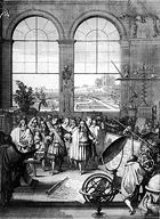
The
French Academy of Sciences (
French:
Académie des sciences) is a
learned societyA learned society is an organization that exists to promote an academic discipline/profession, as well a group of disciplines. Membership may be open to all, may require possession of some qualification, or may be an honor conferred by election, as is the case with the oldest learned societies,...
, founded in 1666 by
Louis XIVLouis XIV , known as Louis the Great or the Sun King , was a Bourbon monarch who ruled as King of France and Navarre. His reign, from 1643 to his death in 1715, began at the age of four and lasted seventy-two years, three months, and eighteen days...
at the suggestion of
Jean-Baptiste ColbertJean-Baptiste Colbert was a French politician who served as the Minister of Finances of France from 1665 to 1683 under the rule of King Louis XIV. His relentless hard work and thrift made him an esteemed minister. He achieved a reputation for his work of improving the state of French manufacturing...
, to encourage and protect the spirit of
FrenchThe French are a nation that share a common French culture and speak the French language as a mother tongue. Historically, the French population are descended from peoples of Celtic, Latin and Germanic origin, and are today a mixture of several ethnic groups...
scientific researchScientific method refers to a body of techniques for investigating phenomena, acquiring new knowledge, or correcting and integrating previous knowledge. To be termed scientific, a method of inquiry must be based on gathering empirical and measurable evidence subject to specific principles of...
. It was at the forefront of scientific developments in
EuropeEurope is, by convention, one of the world's seven continents. Comprising the westernmost peninsula of Eurasia, Europe is generally 'divided' from Asia to its east by the watershed divides of the Ural and Caucasus Mountains, the Ural River, the Caspian and Black Seas, and the waterways connecting...
in the 17th and 18th centuries.
It is one of the earliest
academies of sciencesAn Academy of Sciences is a national academy or another learned society dedicated to sciences.In non-English speaking countries, the range of academic fields of the members of a national Academy of Science often includes fields which would not normally be classed as "science" in English...
.
History
The Academy of Sciences owes its origin to Colbert's plan to create a general academy. He chose a small group of scholars who met on 22 December 1666 in the King's library, and thereafter held twice-weekly working meetings there. The first 30 years of the Academy's existence were relatively informal, since no statutes had as yet been laid down for the institution. In contrast to
its British counterpartThe Royal Society of London for Improving Natural Knowledge, known simply as the Royal Society, is a learned society for science, and is possibly the oldest such society in existence. Founded in November 1660, it was granted a Royal Charter by King Charles II as the "Royal Society of London"...
, the Academy was founded as an organ of government. The Academy was expected to remain apolitical, and to avoid discussion of religious and social issues (Conner, 2005, p. 385).
On 20 January 1699, Louis XIV gave the Company its first rules. The Academy received the name of
Royal Academy of Sciences and was installed in the
LouvreThe Musée du Louvre – in English, the Louvre Museum or simply the Louvre – is one of the world's largest museums, the most visited art museum in the world and a historic monument. A central landmark of Paris, it is located on the Right Bank of the Seine in the 1st arrondissement...
in
ParisParis is the capital and largest city in France, situated on the river Seine, in northern France, at the heart of the Île-de-France region...
. On 8 August 1793, the
National ConventionDuring the French Revolution, the National Convention or Convention, in France, comprised the constitutional and legislative assembly which sat from 20 September 1792 to 26 October 1795 . It held executive power in France during the first years of the French First Republic...
abolished all the academies. On 22 August 1795, a
National Institute of Sciences and Arts was put in place, bringing together the old academies of the sciences, literature and arts, among them the
Académie françaiseL'Académie française , also called the French Academy, is the pre-eminent French learned body on matters pertaining to the French language. The Académie was officially established in 1635 by Cardinal Richelieu, the chief minister to King Louis XIII. Suppressed in 1793 during the French Revolution,...
and the Académie des sciences. Almost all the old members of the previously abolished Académie were formally re-elected and retook their ancient seats. Among the exceptions was
Dominique, comte de CassiniThis article is about the French astronomer. For his Italian-born great-grandfather, see Giovanni Domenico Cassini.Jean-Dominique, comte de Cassini was a French astronomer, son of César-François Cassini de Thury....
, who refused to take his seat. Membership in the Academy was not restricted to scientists: in 1798 Napoleon Bonaparte was elected a member of the Academy and three years later a president in connection with his Egyptian expedition, which had a scientific component. In 1816, the again renamed
Royal Academy of Sciences became autonomous, while forming part of the Institute of France; the head of State became its patron. In the
Second RepublicThe French Second Republic was the republican government of France between the 1848 Revolution and the coup by Louis-Napoléon Bonaparte which initiated the Second Empire. It officially adopted the motto Liberté, Égalité, Fraternité...
, the name returned to Académie des sciences. During this period, the Academy was funded by and accountable to the
Ministry of Public InstructionThe Ministry of National Education, Youth, and Sport , or simply "Minister of National Education," as the title has changed no small number of times in the course of the Fifth Republic) is the French government cabinet member charged with running France's public educational system and with the...
.
The Academy came to control French patent laws in the course of the eighteenth century, acting as the liaison of artisans' knowledge to the public domain. As a result,
academicianThe title Academician denotes a Full Member of an art, literary, or scientific academy.In many countries, it is an honorary title. There also exists a lower-rank title, variously translated Corresponding Member or Associate Member, .-Eastern Europe and China:"Academician" may also be a functional...
s dominated technological activities in France (Conner, 2005, p. 385).
The Academy proceedings were published under the name "Comptes rendus de l'Académie des sciences" (1835–1965). The publications can be found on site of the
French National LibraryThe is the National Library of France, located in Paris. It is intended to be the repository of all that is published in France. The current president of the library is Bruno Racine.-History:...
in pdf format.
For three centuries women were not allowed as members of the Academy, excluding two-time
Nobel PrizeThe Nobel Prizes are annual international awards bestowed by Scandinavian committees in recognition of cultural and scientific advances. The will of the Swedish chemist Alfred Nobel, the inventor of dynamite, established the prizes in 1895...
winner
Marie CurieMarie Skłodowska-Curie was a physicist and chemist famous for her pioneering research on radioactivity. She was the first person honored with two Nobel Prizes—in physics and chemistry...
, Nobel winner
Irène Joliot-CurieIrène Joliot-Curie was a French scientist, the daughter of Marie Skłodowska-Curie and Pierre Curie and the wife of Frédéric Joliot-Curie. Jointly with her husband, Joliot-Curie was awarded the Nobel Prize for chemistry in 1935 for their discovery of artificial radioactivity. This made the Curies...
, mathematician
Sophie GermainMarie-Sophie Germain was a French mathematician, physicist, and philosopher. Despite initial opposition from her parents and difficulties presented by a gender-biased society, she gained education from books in her father's library and from correspondence with famous mathematicians such as...
, and many other deserving female scientists. The first woman admitted as a correspondent member was a student of Curie's,
Marguerite PereyMarguerite Catherine Perey was a French physicist. In 1939, Perey discovered the element francium by purifying samples of lanthanum that contained actinium. She was a student of Marie Curie...
, in 1962. The first female full member was
Yvonne Choquet-BruhatYvonne Choquet-Bruhat is a French mathematician and physicist. She was the first woman to be elected to the Académie des Sciences Française and is a Grand Officier of the Légion d'honneur....
in 1979.
The Academy today
Today the Academy is one of five academies comprising the
Institut de FranceThe Institut de France is a French learned society, grouping five académies, the most famous of which is the Académie française.The institute, located in Paris, manages approximately 1,000 foundations, as well as museums and chateaux open for visit. It also awards prizes and subsidies, which...
. Its members are elected for life. Currently there are 150 full members, 300 corresponding members, and 120 foreign associates. They are divided into two scientific groups: the
MathematicalMathematics is the study of quantity, space, structure, and change. Mathematicians seek out patterns and formulate new conjectures. Mathematicians resolve the truth or falsity of conjectures by mathematical proofs, which are arguments sufficient to convince other mathematicians of their validity...
and
PhysicalPhysics is a natural science that involves the study of matter and its motion through spacetime, along with related concepts such as energy and force. More broadly, it is the general analysis of nature, conducted in order to understand how the universe behaves.Physics is one of the oldest academic...
sciences and their applications and the
ChemicalChemistry is the science of matter, especially its chemical reactions, but also its composition, structure and properties. Chemistry is concerned with atoms and their interactions with other atoms, and particularly with the properties of chemical bonds....
,
BiologicalBiology is a natural science concerned with the study of life and living organisms, including their structure, function, growth, origin, evolution, distribution, and taxonomy. Biology is a vast subject containing many subdivisions, topics, and disciplines...
,
GeologicalGeology is the science comprising the study of solid Earth, the rocks of which it is composed, and the processes by which it evolves. Geology gives insight into the history of the Earth, as it provides the primary evidence for plate tectonics, the evolutionary history of life, and past climates...
and
MedicalMedicine is the science and art of healing. It encompasses a variety of health care practices evolved to maintain and restore health by the prevention and treatment of illness....
sciences and their applications.
Medals, awards and prizes
Each year, the Academy of Sciences distributes about 80 prizes. These include:
- the Grande Médaille
The Grande Médaille of the French Academy of Sciences, established in 1997, is awarded annually to a researcher who has contributed decisively to the development of science...
, awarded annually, in rotation, in the relevant disciplines of each division of the Academy, to a French or foreign scholar who has contributed to the development of science in a decisive way.
- the Lalande Prize
The Lalande Prize was an award for scientific advances in astronomy, given from 1802 through 1970 by the French Academy of Sciences.The prize was named for, and endowed by, astronomer Jérôme Lalande in 1801...
, awarded from 1802 through 1970, for outstanding achievement in astronomy
- the Richard Lounsbery Award, jointly with the National Academy of Sciences
The National Academy of Sciences is a corporation in the United States whose members serve pro bono as "advisers to the nation on science, engineering, and medicine." As a national academy, new members of the organization are elected annually by current members, based on their distinguished and...
- the Prix Jacques Herbrand
Jacques Herbrand was a French mathematician who was born in Paris, France and died in La Bérarde, Isère, France. Although he died at only 23 years of age, he was already considered one of "the greatest mathematicians of the younger generation" by his professors Helmut Hasse, and Richard Courant.He...
– for physics
People of the Academy
The following are incomplete lists of the officers of the Academy. See also :Category:Officers of the French Academy of Sciences.
For a list of the Academy's members past and present, see :Category:Members of the French Academy of Sciences
Presidents
- 1801–1814 Napoleon Bonaparte
- 1952–1962 Albert Caquot
Albert Caquot was considered as the "best living French engineer" during half a century. He received the “Croix de guerre 1914-1918” and was Grand-croix of the Légion d’Honneur...
- Currently Jean Salençon
Treasurers
- -1788 Georges-Louis Leclerc, Comte de Buffon
Georges-Louis Leclerc, Comte de Buffon was a French naturalist, mathematician, cosmologist, and encyclopedic author.His works influenced the next two generations of naturalists, including Jean-Baptiste Lamarck and Georges Cuvier...
- 1788–1791 Mathieu Tillet
Mathieu Tillet was a French botanist, agronomist, metallurgist and administrator.-Life:He was the son of the goldsmith Gabriel Tillet and began studying metals at his father's workshop. In 1740 he was appointed Director of the Mint at Troyes. Ten years later he published his first book, about alloys...
Permanent secretaries
- December 1666 – April 1668 Jean-Baptiste Du Hamel
Jean-Baptiste Du Hamel, Duhamel or du Hamel was a notable French cleric and natural philosopher of the late seventeenth century, and the first secretary of the Academie Royale des Sciences...
- April 1668 – December 1669 Jean Gallois
-Life:He was abbot of the priory of Cuers and a royal librarian.. He was named to the Académie des sciences in 1669 and elected a member of the Académie française in 1672. Also a member of the Académie des Inscriptions, he became its permanent secretary...
- January 1670 – January 1697 Jean-Baptiste Du Hamel
Jean-Baptiste Du Hamel, Duhamel or du Hamel was a notable French cleric and natural philosopher of the late seventeenth century, and the first secretary of the Academie Royale des Sciences...
- January 1697 – December 1740 Bernard le Bovier de Fontenelle
Bernard Le Bovier de Fontenelle , also called Bernard Le Bouyer de Fontenelle, was a French author.Fontenelle was born in Rouen, France and died in Paris just one month before his 100th birthday. His mother was the sister of great French dramatists Pierre and Thomas Corneille...
(nominated by the king in January 1699)
- January 1741 – August 1743 Jean-Jacques Dortous de Mairan
- September 1743 – July 1776 Jean-Paul Grandjean de Fouchy
- August 1777 – August 1793 Nicolas Caritat, marquis de Condorcet
Marie Jean Antoine Nicolas de Caritat, marquis de Condorcet , known as Nicolas de Condorcet, was a French philosopher, mathematician, and early political scientist whose Condorcet method in voting tally selects the candidate who would beat each of the other candidates in a run-off election...
Mathematical Sciences and then Mathematical Sciences and Physics
- 1801–1822 Jean Baptiste Joseph Delambre
- 1822–1830 Joseph Fourier
Jean Baptiste Joseph Fourier was a French mathematician and physicist best known for initiating the investigation of Fourier series and their applications to problems of heat transfer and vibrations. The Fourier transform and Fourier's Law are also named in his honour...
- 1830–1853 François Arago
François Jean Dominique Arago , known simply as François Arago , was a French mathematician, physicist, astronomer and politician.-Early life and work:...
- 1853–1874 Léonce Élie de Beaumont
- 1874–1900 Joseph Bertrand
- 1900–1917 Gaston Darboux
- 1917–1942 Émile Picard
- 1942–1975 Louis de Broglie
- 1975–1996 Paul Germain
- Currently: Jean Dercourt
Physical Sciences
- 1795–1803 Bernard Germain de Lacépède
- 1803–1832 Georges Cuvier
Georges Chrétien Léopold Dagobert Cuvier or Jean Léopold Nicolas Frédéric Cuvier , known as Georges Cuvier, was a French naturalist and zoologist...
- 1832–1833 Pierre-Louis Dulong
- 1833–1868 Pierre Flourens
- 1868–1884 Jean-Baptiste Dumas
Jean Baptiste André Dumas was a French chemist, best known for his works on organic analysis and synthesis, as well as the determination of atomic weights and molecular weights by measuring vapor densities...
- 1884–1886 Jules Jamin
Jules Célestin Jamin was a French physicist. He was professor of physics at École Polytechnique from 1852 to 1881 and received the Rumford Medal in 1858 for his work on light...
- 1886–1887 Alfred Vulpian
Edmé Félix Alfred Vulpian was a French physician and neurologist. He was the co-discoverer of Vulpian-Bernard spinal muscular atrophy and the Vulpian-Heidenhain-Sherrington phenomenon....
- 1887–1889 Louis Pasteur
Louis Pasteur was a French chemist and microbiologist born in Dole. He is remembered for his remarkable breakthroughs in the causes and preventions of diseases. His discoveries reduced mortality from puerperal fever, and he created the first vaccine for rabies and anthrax. His experiments...
- 1889–1907 Marcelin Berthelot
- 1907 Albert de Lapparent
- 1908 Henri Becquerel
Antoine Henri Becquerel was a French physicist, Nobel laureate, and the discoverer of radioactivity along with Marie Curie and Pierre Curie, for which all three won the 1903 Nobel Prize in Physics.-Early life:...
- 1908–1914 Philippe van Thieghem
- 1914–1948 Alfred Lacroix
Chemistry and Biology
- 1948–1986 Robert Courrier
- 1986–1991 Alfred Jost
Alfred Jost was a French endocrinologist, famous for his discovery of the Mullerian inhibitor, now called anti-Mullerian hormone or Mullerian inhibiting substance...
- 1991–2001 François Gros
- 2001–2006 Nicole Le Douarin
- Currently Jean-François Bach
External links
-
English-language version