

Tropopause

Encyclopedia
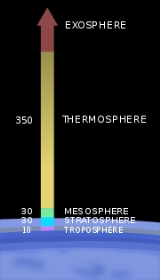
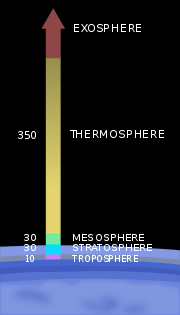
The tropopause is the atmospheric
boundary between the troposphere
and the stratosphere
.
 Going upward from the surface, it is the point where air ceases to cool with height, and becomes almost completely dry. More formally, the tropopause is the region of the atmosphere where the environmental lapse rate
changes from positive, as it behaves in the troposphere, to the stratospheric negative one. Following is the exact definition used by the World Meteorological Organization
:
, and is the one in which most weather
phenomena take place. The troposphere extends upwards from right above the boundary layer
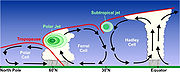
, and ranges its height from an average of 11 km (6.8 mi; 36,089.2 ft) at the poles to 17 km (10.6 mi; 55,774.3 ft) at the Equator
. In the absence of inversion
s and not considering moisture
, the temperature lapse rate for this layer is 6.5°C per kilometer, on average. A measurement of both the tropospheric and the stratospheric lapse rates helps identifying the location of the tropopause, since temperature increases with height in the stratosphere, and hence the lapse rate becomes negative. The tropopause location coincides with the point at which the lapse rate reverses its sign.
Given that the tropopause responds to the average temperature of the entire layer that lies underneath it, it is at its peak levels over the Equator, and reaches minimum heights over the poles. On account of this, the coolest layer in the atmosphere lies at about 17 km over the equator. Due to the variation in starting height, the tropopause extremes are referred to as the equatorial tropopause and the polar tropopause.
Alternatively, a dynamic definition of the tropopause, the dynamic tropopause, is used with the aid of potential vorticity
, which is defined as the product of the isentropic density
, i.e. the density that arises from using potential temperature as the vertical coordinate, and the absolute vorticity. given that this quantity attains quite different values for the troposphere and the stratosphere. Instead of using the vertical temperature gradient as the defining variable, the dynamic tropopause surface is expressed in potential vorticity units (PVU), with the tropopause layer typically lying within the 1.5–2 PVU surface in the Northern Hemisphere
, although no universal values exist. Given that the absolute vorticity is positive (negative) in the Northern (Southern
) hemisphere, the threshold value should be taken as positive (negative) north (south) of the equator. Theoretically, to define a global tropopause in this way, the two surfaces arising from the positive and negative thresholds need to be matched near the equator using another type of surface such as a constant potential temperature surface. Nevertheless, the dynamic tropopause is useless at equatorial latitudes because both the absolute vorticity is close to zero —consequently making potential vorticity to vanish— and the isentropes are almost vertical.
It is also possible to define the tropopause in terms of chemical composition. For example, the lower stratosphere has much higher ozone
concentrations than the upper troposphere, but much lower water vapor
concentrations, so appropriate cutoffs can be used.
s, for example, particularly those of tropical origin, will overshoot
into the lower stratosphere and undergo a brief (hour-order) low-frequency vertical oscillation
. Such oscillation sets up a low-frequency atmospheric gravity wave capable of affecting both atmospheric and oceanic currents in the region.
Most commercial aircraft are flown below the tropopause or "trop" if at all possible to take advantage of the troposphere's temperature lapse rate. Jet engines are more efficient at lower temperatures.
Earth's atmosphere
The atmosphere of Earth is a layer of gases surrounding the planet Earth that is retained by Earth's gravity. The atmosphere protects life on Earth by absorbing ultraviolet solar radiation, warming the surface through heat retention , and reducing temperature extremes between day and night...
boundary between the troposphere
Troposphere
The troposphere is the lowest portion of Earth's atmosphere. It contains approximately 80% of the atmosphere's mass and 99% of its water vapor and aerosols....
and the stratosphere
Stratosphere
The stratosphere is the second major layer of Earth's atmosphere, just above the troposphere, and below the mesosphere. It is stratified in temperature, with warmer layers higher up and cooler layers farther down. This is in contrast to the troposphere near the Earth's surface, which is cooler...
.
Definition
Lapse rate
The lapse rate is defined as the rate of decrease with height for an atmospheric variable. The variable involved is temperature unless specified otherwise. The terminology arises from the word lapse in the sense of a decrease or decline; thus, the lapse rate is the rate of decrease with height and...
changes from positive, as it behaves in the troposphere, to the stratospheric negative one. Following is the exact definition used by the World Meteorological Organization
World Meteorological Organization
The World Meteorological Organization is an intergovernmental organization with a membership of 189 Member States and Territories. It originated from the International Meteorological Organization , which was founded in 1873...
:
Location
The troposphere is one of the lowest layers of the Earth's atmosphere; it locates right above the planetary boundary layerPlanetary boundary layer
The planetary boundary layer , also known as the atmospheric boundary layer , is the lowest part of the atmosphere and its behavior is directly influenced by its contact with a planetary surface. On Earth it usually responds to changes in surface forcing in an hour or less...
, and is the one in which most weather
Weather
Weather is the state of the atmosphere, to the degree that it is hot or cold, wet or dry, calm or stormy, clear or cloudy. Most weather phenomena occur in the troposphere, just below the stratosphere. Weather refers, generally, to day-to-day temperature and precipitation activity, whereas climate...
phenomena take place. The troposphere extends upwards from right above the boundary layer
Planetary boundary layer
The planetary boundary layer , also known as the atmospheric boundary layer , is the lowest part of the atmosphere and its behavior is directly influenced by its contact with a planetary surface. On Earth it usually responds to changes in surface forcing in an hour or less...
, and ranges its height from an average of 11 km (6.8 mi; 36,089.2 ft) at the poles to 17 km (10.6 mi; 55,774.3 ft) at the Equator
Equator
An equator is the intersection of a sphere's surface with the plane perpendicular to the sphere's axis of rotation and containing the sphere's center of mass....
. In the absence of inversion
Inversion (meteorology)
In meteorology, an inversion is a deviation from the normal change of an atmospheric property with altitude. It almost always refers to a temperature inversion, i.e...
s and not considering moisture
Moisture
Humidity is the amount of moisture the air can hold before it rains. Moisture refers to the presence of a liquid, especially water, often in trace amounts...
, the temperature lapse rate for this layer is 6.5°C per kilometer, on average. A measurement of both the tropospheric and the stratospheric lapse rates helps identifying the location of the tropopause, since temperature increases with height in the stratosphere, and hence the lapse rate becomes negative. The tropopause location coincides with the point at which the lapse rate reverses its sign.
Given that the tropopause responds to the average temperature of the entire layer that lies underneath it, it is at its peak levels over the Equator, and reaches minimum heights over the poles. On account of this, the coolest layer in the atmosphere lies at about 17 km over the equator. Due to the variation in starting height, the tropopause extremes are referred to as the equatorial tropopause and the polar tropopause.
Alternatively, a dynamic definition of the tropopause, the dynamic tropopause, is used with the aid of potential vorticity
Potential vorticity
Potential vorticity is a quantity which is proportional to the dot product of vorticity and stratification that, following a parcel of air or water, can only be changed by diabatic or frictional processes...
, which is defined as the product of the isentropic density
Density
The mass density or density of a material is defined as its mass per unit volume. The symbol most often used for density is ρ . In some cases , density is also defined as its weight per unit volume; although, this quantity is more properly called specific weight...
, i.e. the density that arises from using potential temperature as the vertical coordinate, and the absolute vorticity. given that this quantity attains quite different values for the troposphere and the stratosphere. Instead of using the vertical temperature gradient as the defining variable, the dynamic tropopause surface is expressed in potential vorticity units (PVU), with the tropopause layer typically lying within the 1.5–2 PVU surface in the Northern Hemisphere
Northern Hemisphere
The Northern Hemisphere is the half of a planet that is north of its equator—the word hemisphere literally means “half sphere”. It is also that half of the celestial sphere north of the celestial equator...
, although no universal values exist. Given that the absolute vorticity is positive (negative) in the Northern (Southern
Southern Hemisphere
The Southern Hemisphere is the part of Earth that lies south of the equator. The word hemisphere literally means 'half ball' or "half sphere"...
) hemisphere, the threshold value should be taken as positive (negative) north (south) of the equator. Theoretically, to define a global tropopause in this way, the two surfaces arising from the positive and negative thresholds need to be matched near the equator using another type of surface such as a constant potential temperature surface. Nevertheless, the dynamic tropopause is useless at equatorial latitudes because both the absolute vorticity is close to zero —consequently making potential vorticity to vanish— and the isentropes are almost vertical.
It is also possible to define the tropopause in terms of chemical composition. For example, the lower stratosphere has much higher ozone
Ozone
Ozone , or trioxygen, is a triatomic molecule, consisting of three oxygen atoms. It is an allotrope of oxygen that is much less stable than the diatomic allotrope...
concentrations than the upper troposphere, but much lower water vapor
Water vapor
Water vapor or water vapour , also aqueous vapor, is the gas phase of water. It is one state of water within the hydrosphere. Water vapor can be produced from the evaporation or boiling of liquid water or from the sublimation of ice. Under typical atmospheric conditions, water vapor is continuously...
concentrations, so appropriate cutoffs can be used.
Phenomena
The tropopause is not a "hard" boundary. Vigorous thunderstormThunderstorm
A thunderstorm, also known as an electrical storm, a lightning storm, thundershower or simply a storm is a form of weather characterized by the presence of lightning and its acoustic effect on the Earth's atmosphere known as thunder. The meteorologically assigned cloud type associated with the...
s, for example, particularly those of tropical origin, will overshoot
Convective overshoot
Convective overshoot is a phenomenon of convection carrying material beyond an unstable region of the atmosphere into a stratified, stable region...
into the lower stratosphere and undergo a brief (hour-order) low-frequency vertical oscillation
Oscillation
Oscillation is the repetitive variation, typically in time, of some measure about a central value or between two or more different states. Familiar examples include a swinging pendulum and AC power. The term vibration is sometimes used more narrowly to mean a mechanical oscillation but sometimes...
. Such oscillation sets up a low-frequency atmospheric gravity wave capable of affecting both atmospheric and oceanic currents in the region.
Most commercial aircraft are flown below the tropopause or "trop" if at all possible to take advantage of the troposphere's temperature lapse rate. Jet engines are more efficient at lower temperatures.
See also
- Jet streamJet streamJet streams are fast flowing, narrow air currents found in the atmospheres of some planets, including Earth. The main jet streams are located near the tropopause, the transition between the troposphere and the stratosphere . The major jet streams on Earth are westerly winds...
- Maximum parcel levelMaximum parcel levelThe maximum parcel level is the highest level in the atmosphere that a moist convectively rising air parcel will reach after ascending through the free convective layer and reaching the equilibrium level , near the tropopause...
- Table of global climate system componentsTable of Global Climate System Components-Notes on usage:* This table is a reference tool for rapidly locating Wikipedia articles on global climate system components NASA- identifies the five components of earth's climate system as: Atmosphere, hydrosphere, cryosphere, lithosphere, and biosphere....