

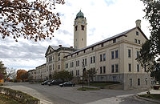
Fort Leavenworth

Encyclopedia
Fort Leavenworth is a United States Army
facility located in Leavenworth County, Kansas
, immediately north of the city of Leavenworth
in the upper northeast portion of the state. It is the oldest active United States Army post west of Washington, D.C.
and has been in operation for over 180 years. Fort Leavenworth has been historically known as the "Intellectual Center of the Army."
During the country's westward
expansion
, Fort Leavenworth was a forward destination for thousands of soldiers, surveyors, immigrants, American Indians, preachers and settlers who passed through. The garrison
supports the United States Army Training and Doctrine Command
(TRADOC) by managing and maintaining the home of the United States Army Combined Arms Center (CAC). CAC's mission involves leader development, collective training, Army doctrine and battle command (current and future).
Fort Leavenworth is home to the Military Corrections Complex, consisting of the United States Disciplinary Barracks
, the Department of Defense
's only maximum security prison, and the Midwest Joint Regional Correctional Facility
. In addition, the Fort Leavenworth Garrison supports numerous tenant organizations that directly and indirectly relate to the functions of the CAC, including the United States Army Command and General Staff College and the Foreign Military Studies Office
.
The fort occupies 5,600 ac (2,300 ha) and 7,000,000 ft² (70,000 m²) of space in 1,000 buildings and 1,500 quarters.
reporting via IMCOM West to the Installation Management Command. The fort claims to be the "intellectual center" of the Army because much of its mission involves training.
Major tenants include:
, which was the farthest west fort in Louisiana (New France)
. Its commandant was François Coulon de Villiers
, a brother to Louis Coulon de Villiers
who was the only military commander to force George Washington
to surrender (after revenging the murder of half brother Joseph Coulon de Jumonville
while in Washington's custody that was to set off the French and Indian War
).
The French abandoned the fort after ceding its territory to Louisiana (New Spain)
at the conclusion of the French and Indian War.
Early American explorers on the Missouri River to visit the area of Fort de Cavagnal include Lewis and Clark on June 26–29, 1804 and Stephen Harriman Long
in 1819.
The fort location had been chosen then because of its proximity to a large Kansa
tribe village.
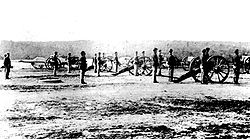 Colonel Henry Leavenworth
, with the officers and men of the 3rd Infantry Regiment from Jefferson Barracks at St. Louis, Missouri
, established Fort Leavenworth in 1827 to be a forward base protecting the Santa Fe Trail
.
Leavenworth's instructions had been the following:
Leavenworth was to report that spot around the confluence on the east side of the Missouri River (near present day Farley, Missouri
) would be prone to flooding and on May 8, 1827 recommended the location 20 miles (32.2 km) upstream on the west bank in the bluffs above the river.
The first army installation in Cantonment
Leavenworth (its original name) was located on Scott Avenue, south of the Post Chapel with initial strength of 14 officers and 174 enlisted men.
The Cantonment almost immediately increased in importance as it became the eastern terminus for the Santa Fe Trail
and Oregon Trail
. After Indian Removal Act
of 1830 attempted to remove all Indians west of the Missouri-Kansas border, the fort which is west of the border assumed even more importance. In 1832, it was renamed "Fort Leavenworth."
Between 1832 and 1834, the Rookery was built as bachelor officer quarters. The Rookery is the oldest building in Kansas and would be the office of the first territorial governor and thus the first capitol in Kansas from 1854 to 1855 when the capitol was moved to Pawnee, Kansas
.
In 1836, William Clark at the fort presided over the transfer of Indian land directly across the Missouri River
from the fort to the U.S. government in the Platte Purchase
which involved the entire northwest corner of Missouri.
In 1839, Col. Stephen W. Kearny
marched against the Cherokee
s with 20 companies of dragoon
s, the largest U.S. mounted force ever assembled. Throughout the Mexican-American War, Fort Leavenworth was the outfitting post for the Army of the West
.
In 1854, Kansas Territory
Governor Andrew Reeder set up executive offices on post and lived for a short time in the quarters now known as "The Rookery".
During the 1850s, troops from Ft. Leavenworth were mobilized to control the "Mormon Problem" in what became known as the Utah War
.
, Camp Lincoln was established on post as a reception and training station for Kansas volunteers. In 1864, news of the approach of Confederate General Sterling Price
prompted construction of Fort Sully, a series of earthworks for artillery emplacements on Hancock Hill, overlooking what is now the Fort Leavenworth National Cemetery
. (See Fort Sully (Fort Leavenworth)
). However, Price's forces never reached Fort Leavenworth, having met defeat at Westport
, which is now part of Kansas City
. During its long history, the post was never subject to enemy attack.
For three decades following the war, the Army's chief mission was control of the American Indian
tribes on the Western plains. Between 1865 and 1891, the Army had more than 1,000 combat engagements with Apache
, Modoc, Cheyenne
, Ute
, Nez Perce, Comanche
, Kiowa
, Kickapoo and other tribes.
The Fort Leavenworth National Cemetery
is one of the national cemeteries established by Abraham Lincoln
on July 17, 1862. Veterans since the War of 1812
have been laid to rest in the cemetery. One veteran of the War of 1812 is the cemetery's most famous occupant, Brigadier General Henry Leavenworth, who gave his name to the fort, the cemetery, and the town and county they are located in. Others buried in the cemetery include 10 Medal of Honor
recipients, seven Confederate
prisoners of war
as well as soldiers killed in Operation Desert Storm, Operation Iraqi Freedom and Operation Enduring Freedom. Although there is no longer space for new burial sites, burials frequently take place for those who already have family members interred in the cemetery.
In 1866, the U.S. Congress authorized the formation of four black regiments, which were the 24th
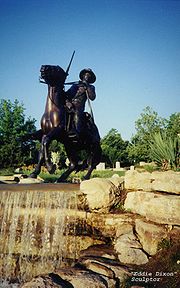
and 25th Infantry Regiments and the 9th and 10th Cavalry Regiments. The 10th Cavalry Regiment was formed at Fort Leavenworth under the command of Col. Benjamin H. Grierson. Today, a monument stands at Fort Leavenworth in tribute to the "Buffalo Soldier
" of the 9th and 10th Cavalry Regiments.
The United States Disciplinary Barracks
, now a maximum-security military prison
, was established in 1875.
The fort's first Catholic church was built in 1871 and was later replaced by St. Ignatius Chapel in 1889. St. Ignatius Chapel was destroyed by fire in December 2001. The first Protestant chapel, Memorial Chapel, was built by prison labor in 1878 of stone quarried on post. The round window behind the chapel's front altar was intentionally installed slightly askew by an inmate who was angry at his work boss. This chapel has brass cannon embedded in the walls at the sides of the church, and photos of many of the officers involved in the early history of the fort, including some of the Custer family.
In 1881, Gen. William T. Sherman established the School of Application for Cavalry and Infantry. That school evolved into the U.S. Army Command and General Staff College
.
The Western Branch National Military Home ("old soldiers' home
"), now called the Veterans Medical Center, or Dwight D. Eisenhower Medical Center Historic District was established in 1885 as part of the National Home for Disabled Volunteer Soldiers
system. The soldier home is closely associated with the nearby cemetery that became the Fort Leavenworth National Cemetery
in 1973.
was the first opportunity to evaluate the impact of Sherman's school. Graduates excelled in planning complex American Expeditionary Forces operations. By the end of the war, they dominated staffs throughout the AEF.
In the years between the World Wars, graduates included such officers as Dwight D. Eisenhower
, Omar N. Bradley and George S. Patton
. During World War II
, some 19,000 officers completed various courses at Fort Leavenworth. By the end of 1943, commanders and staffs of 26 infantry, airborne and cavalry divisions had trained as teams at the school.
General Michael Joe Costello
of the army of the newly formed Irish Free State
attended Fort Leavenworth from 1926 to 1927, passing with such distinction that he was recommended for the United States Army War College.
In 1946, the school was given its current name. In 1959, the college moved to the newly built J. Franklin Bell
Hall on Arsenal Hill. In 1985, the Harold K. Johnson wing was added to house the Combined Arms and Services Staff School (CAS3). Classes for the School of Advanced Military Studies and the School for Command Preparation, as well as the Combined Arms Research Library
, are located in Eisenhower Hall which was dedicated in 1994.
It was declared a National Historic Landmark
in 1960.
Until the early 1970s, a battery of four Nike-Hercules Missile
s were deployed at Bell Point on a hill on the west side of the fort.
The base is served by the Sherman Army Airfield
which has a 5905 feet (1,799.8 m) runway and operates under a joint agreement with the city of Leavenworth, Kansas that permits civilian aircraft to use it all hours. The airfield was inundated by the Missouri River in levee breaches during the Great Flood of 1951
, the Great Flood of 1993
, and the Great Flood of 2011.
A number of historic preservation investigations have been conducted over the past few decades at Fort Leavenworth. In 1970, for example, two historic sites were listed on the National Register of Historic Places
(NRHP): the Main Parade Ground and the Santa Fe Trail Ruts.
During 2006, this historic military site became part of a new Freedom's Frontier National Heritage Area
.
United States Army
The United States Army is the main branch of the United States Armed Forces responsible for land-based military operations. It is the largest and oldest established branch of the U.S. military, and is one of seven U.S. uniformed services...
facility located in Leavenworth County, Kansas
Leavenworth County, Kansas
Leavenworth County is a county located in Northeast Kansas, in the Central United States. As of the 2010 census, the county population was 76,227. Its county seat and most populous city is Leavenworth...
, immediately north of the city of Leavenworth
Leavenworth, Kansas
Leavenworth is the largest city and county seat of Leavenworth County, in the U.S. state of Kansas and within the Kansas City, Missouri Metropolitan Area. Located in the northeast portion of the state, it is on the west bank of the Missouri River. As of the 2010 census, the city population was...
in the upper northeast portion of the state. It is the oldest active United States Army post west of Washington, D.C.
Washington, D.C.
Washington, D.C., formally the District of Columbia and commonly referred to as Washington, "the District", or simply D.C., is the capital of the United States. On July 16, 1790, the United States Congress approved the creation of a permanent national capital as permitted by the U.S. Constitution....
and has been in operation for over 180 years. Fort Leavenworth has been historically known as the "Intellectual Center of the Army."
During the country's westward
Western United States
.The Western United States, commonly referred to as the American West or simply "the West," traditionally refers to the region comprising the westernmost states of the United States. Because the U.S. expanded westward after its founding, the meaning of the West has evolved over time...
expansion
Manifest Destiny
Manifest Destiny was the 19th century American belief that the United States was destined to expand across the continent. It was used by Democrat-Republicans in the 1840s to justify the war with Mexico; the concept was denounced by Whigs, and fell into disuse after the mid-19th century.Advocates of...
, Fort Leavenworth was a forward destination for thousands of soldiers, surveyors, immigrants, American Indians, preachers and settlers who passed through. The garrison
Garrison
Garrison is the collective term for a body of troops stationed in a particular location, originally to guard it, but now often simply using it as a home base....
supports the United States Army Training and Doctrine Command
United States Army Training and Doctrine Command
Established 1 July 1973, the United States Army Training and Doctrine Command is an army command of the United States Army headquartered at Fort Eustis, Virginia. It is charged with overseeing training of Army forces, the development of operational doctrine, and the development and procurement of...
(TRADOC) by managing and maintaining the home of the United States Army Combined Arms Center (CAC). CAC's mission involves leader development, collective training, Army doctrine and battle command (current and future).
Fort Leavenworth is home to the Military Corrections Complex, consisting of the United States Disciplinary Barracks
United States Disciplinary Barracks
The United States Disciplinary Barracks is a military prison located on Fort Leavenworth, a United States Army post in Kansas....
, the Department of Defense
United States Department of Defense
The United States Department of Defense is the U.S...
's only maximum security prison, and the Midwest Joint Regional Correctional Facility
Midwest Joint Regional Correctional Facility
The Midwest Joint Regional Correctional Facility is a military prison at at 830 Sabalu Road, Fort Leavenworth, Kansas which opened in 2010.The prison on has a design specification of 512 beds with 43 in special housing and the rest in general housing and dormitory. The prison handles inmates...
. In addition, the Fort Leavenworth Garrison supports numerous tenant organizations that directly and indirectly relate to the functions of the CAC, including the United States Army Command and General Staff College and the Foreign Military Studies Office
Foreign Military Studies Office
The Foreign Military Studies Office, or FMSO, is a research and analysis center for the United States Army that is part of the United States Army Combined Arms Center at Fort Leavenworth. It manages the Joint Reserve Intelligence Center there.-Mission:...
.
The fort occupies 5,600 ac (2,300 ha) and 7,000,000 ft² (70,000 m²) of space in 1,000 buildings and 1,500 quarters.
Tenants and organization
The garrison commander is a colonelColonel
Colonel , abbreviated Col or COL, is a military rank of a senior commissioned officer. It or a corresponding rank exists in most armies and in many air forces; the naval equivalent rank is generally "Captain". It is also used in some police forces and other paramilitary rank structures...
reporting via IMCOM West to the Installation Management Command. The fort claims to be the "intellectual center" of the Army because much of its mission involves training.
Major tenants include:
- United States Army Combined Arms Center (CAC) which among its various responsibilities is the United States Army Command and General Staff College, which includes a degrees granting graduate schoolGraduate schoolA graduate school is a school that awards advanced academic degrees with the general requirement that students must have earned a previous undergraduate degree...
for U.S. and allied soldiers and officers. The school trains almost all of the army's majorsMajor (United States)In the United States Army, Air Force, and Marine Corps, major is a field grade military officer rank just above the rank of captain and just below the rank of lieutenant colonel...
. All modern five-star army generalsGeneral of the Army (United States)General of the Army is a five-star general officer and is the second highest possible rank in the United States Army. A special rank of General of the Armies, which ranks above General of the Army, does exist but has only been conferred twice in the history of the Army...
have passed through the college including George MarshallGeorge MarshallGeorge Catlett Marshall was an American military leader, Chief of Staff of the Army, Secretary of State, and the third Secretary of Defense...
, Douglas MacArthurDouglas MacArthurGeneral of the Army Douglas MacArthur was an American general and field marshal of the Philippine Army. He was a Chief of Staff of the United States Army during the 1930s and played a prominent role in the Pacific theater during World War II. He received the Medal of Honor for his service in the...
, Dwight Eisenhower, Henry “Hap” Arnold, and Omar BradleyOmar BradleyOmar Nelson Bradley was a senior U.S. Army field commander in North Africa and Europe during World War II, and a General of the Army in the United States Army...
. Since 1978 it has been commanded by a lieutenant generalLieutenant GeneralLieutenant General is a military rank used in many countries. The rank traces its origins to the Middle Ages where the title of Lieutenant General was held by the second in command on the battlefield, who was normally subordinate to a Captain General....
(3 stars). In 2007, its commander was David PetraeusDavid PetraeusDavid Howell Petraeus is the current Director of the Central Intelligence Agency, sworn in on September 6, 2011. Prior to his assuming the directorship of the CIA, Petraeus was a four-star general serving over 37 years in the United States Army. His last assignments in the Army were as commander...
. It reports to the United States Army Training and Doctrine CommandUnited States Army Training and Doctrine CommandEstablished 1 July 1973, the United States Army Training and Doctrine Command is an army command of the United States Army headquartered at Fort Eustis, Virginia. It is charged with overseeing training of Army forces, the development of operational doctrine, and the development and procurement of...
(TRADOC). - United States Disciplinary BarracksUnited States Disciplinary BarracksThe United States Disciplinary Barracks is a military prison located on Fort Leavenworth, a United States Army post in Kansas....
, which is the only maximum security prison for military personnel of all branches. Since a 2007 reorganization, its commander is a colonel who reports to the United States Army Corrections CommandUnited States Army Corrections CommandThe United States Army Corrections Command exercises command and control and operational oversight for policy, programming, resourcing, and support of Army Corrections System facilities and TDA elements worldwide....
. - Midwest Joint Regional Correctional FacilityMidwest Joint Regional Correctional FacilityThe Midwest Joint Regional Correctional Facility is a military prison at at 830 Sabalu Road, Fort Leavenworth, Kansas which opened in 2010.The prison on has a design specification of 512 beds with 43 in special housing and the rest in general housing and dormitory. The prison handles inmates...
, a low security prison. reports to the United States Army Corrections CommandUnited States Army Corrections CommandThe United States Army Corrections Command exercises command and control and operational oversight for policy, programming, resourcing, and support of Army Corrections System facilities and TDA elements worldwide....
. - Foreign Military Studies OfficeForeign Military Studies OfficeThe Foreign Military Studies Office, or FMSO, is a research and analysis center for the United States Army that is part of the United States Army Combined Arms Center at Fort Leavenworth. It manages the Joint Reserve Intelligence Center there.-Mission:...
(which reports to TRADOC) - Munson Army Health Center (base hospital)
- University of Foreign Military and Cultural Studies (which includes teaching Red TeamRed TeamA red team is a group of penetration testers that assess the security of an organization, which is often unaware of the existence of the team or the exact assignment. Red teams provide a more realistic picture of the security readiness than exercises, role playing, or announced assessments...
s among its courses) - Sherman Army AirfieldSherman Army AirfieldSherman Army Airfield is an airport located at Fort Leavenworth, Kansas, in Leavenworth County, Kansas. Although the airport is within the confines of a United States Army Base, it has agreement with the city of Leavenworth, Kansas to permit civilian use at all hours.It derives its codes from Fort...
- the base airport (which reports to the garrison) - Fort Leavenworth National CemeteryFort Leavenworth National CemeteryFort Leavenworth National Cemetery is a United States National Cemetery located on Fort Leavenworth, a United States Army installation north of Leavenworth, Kansas. It was officially established in 1862, but was used as a burial ground as early as 1844. The cemetery is the resting place of eight...
- TRADOC Analysis Center (which reports to TRADOC)
- Headquarters of the National Guard's 35th Infantry Division (Mechanized)
- Battle Command Training Center is the focal point for National Guard of the United States division and brigade staff training and development.
- Army/ACE Registry Transcript Systems (handles transcripts for all its training)
18th century
The fort is 10 miles north of the 18th century French Fort de CavagnalFort de Cavagnal
Fort de Cavagnal was a French fort on the Missouri River somewhere between Kansas City, Missouri and Fort Leavenworth, Kansas from 1744 until about 1760....
, which was the farthest west fort in Louisiana (New France)
Louisiana (New France)
Louisiana or French Louisiana was an administrative district of New France. Under French control from 1682–1763 and 1800–03, the area was named in honor of Louis XIV, by French explorer René-Robert Cavelier, Sieur de la Salle...
. Its commandant was François Coulon de Villiers
François Coulon de Villiers
François Coulon de Villiers was a French military officer from an influential military family in the French and Indian War and then an influential officer in the New Spain community of New Orleans.- Overview :...
, a brother to Louis Coulon de Villiers
Louis Coulon de Villiers
Sieur Louis Coulon de Villiers was a French Canadian military officer during the French and Indian War . Perhaps his greatest claim to fame is the fact that he is the only military opponent to force George Washington to surrender.Coulon was born into a prominent French Canadian family...
who was the only military commander to force George Washington
George Washington
George Washington was the dominant military and political leader of the new United States of America from 1775 to 1799. He led the American victory over Great Britain in the American Revolutionary War as commander-in-chief of the Continental Army from 1775 to 1783, and presided over the writing of...
to surrender (after revenging the murder of half brother Joseph Coulon de Jumonville
Joseph Coulon de Jumonville
Joseph Coulon de Villiers, Sieur de Jumonville was a French Canadian military officer. His defeat and killing at the Battle of Jumonville Glen by forces led by George Washington was one of the sparks igniting the Seven Years' War.- Early life :Jumonville was born in the seigneury of Verchères, New...
while in Washington's custody that was to set off the French and Indian War
French and Indian War
The French and Indian War is the common American name for the war between Great Britain and France in North America from 1754 to 1763. In 1756, the war erupted into the world-wide conflict known as the Seven Years' War and thus came to be regarded as the North American theater of that war...
).
The French abandoned the fort after ceding its territory to Louisiana (New Spain)
Louisiana (New Spain)
Louisiana was the name of an administrative district of the Viceroyalty of New Spain from 1764 to 1803 that represented territory west of the Mississippi River basin, plus New Orleans...
at the conclusion of the French and Indian War.
Early American explorers on the Missouri River to visit the area of Fort de Cavagnal include Lewis and Clark on June 26–29, 1804 and Stephen Harriman Long
Stephen Harriman Long
Stephen Harriman Long was a U.S. army explorer, topographical engineer, and railway engineer. As an inventor, he is noted for his developments in the design of steam locomotives. He was also one of the most prolific explorers of the early 1800s, although his career as an explorer was relatively...
in 1819.
The fort location had been chosen then because of its proximity to a large Kansa
Kaw (tribe)
The Kaw Nation are an American Indian people of the central Midwestern United States. The tribe known as Kaw have also been known as the "People of the South wind", "People of water", Kansa, Kaza, Kosa, and Kasa. Their tribal language is Kansa, classified as a Siouan language.The toponym "Kansas"...
tribe village.
19th century
Henry Leavenworth
Henry Leavenworth was an American soldier active in the War of 1812 and early military expeditions against the Plains Indians...
, with the officers and men of the 3rd Infantry Regiment from Jefferson Barracks at St. Louis, Missouri
St. Louis, Missouri
St. Louis is an independent city on the eastern border of Missouri, United States. With a population of 319,294, it was the 58th-largest U.S. city at the 2010 U.S. Census. The Greater St...
, established Fort Leavenworth in 1827 to be a forward base protecting the Santa Fe Trail
Santa Fe Trail
The Santa Fe Trail was a 19th-century transportation route through central North America that connected Missouri with Santa Fe, New Mexico. Pioneered in 1822 by William Becknell, it served as a vital commercial and military highway until the introduction of the railroad to Santa Fe in 1880...
.
Leavenworth's instructions had been the following:
- Colonel Leavenworth of the 3d Infantry, with four companies of his regiment will ascend the Missouri and when he reaches a point on its left band near the mouth of Little Platte RiverPlatte River (Missouri)The Platte River is a tributary of the Missouri River, about long, in southwestern Iowa and northwestern Missouri in the United States. It is sometimes known as the Little Platte River to distinguish it from the larger Platte River, also a tributary of the Missouri, in nearby Nebraska; the Platte...
and within a range of twenty miles above or below its confluence, he will select such position as in his judgment is best calculated for the site of a permanent cantonment. The spot being chosen, he will then construct with the troops of his command comfortable, though temporary quarters sufficient for the accommodation of four companies. This movement will be made as early as the convenience of the service will permit.
Leavenworth was to report that spot around the confluence on the east side of the Missouri River (near present day Farley, Missouri
Farley, Missouri
Farley is a village in Platte County, Missouri, U.S., along the Platte River. The population was 226 at the 2000 census.-Geography:Farley is located at .According to the United States Census Bureau, the village has a total area of , all of it land....
) would be prone to flooding and on May 8, 1827 recommended the location 20 miles (32.2 km) upstream on the west bank in the bluffs above the river.
The first army installation in Cantonment
Cantonment
A cantonment is a temporary or semi-permanent military or police quarters. The word cantonment is derived from the French word canton meaning corner or district, as is the name of the Cantons of Switzerland. In South Asia, the term cantonment also describes permanent military stations...
Leavenworth (its original name) was located on Scott Avenue, south of the Post Chapel with initial strength of 14 officers and 174 enlisted men.
The Cantonment almost immediately increased in importance as it became the eastern terminus for the Santa Fe Trail
Santa Fe Trail
The Santa Fe Trail was a 19th-century transportation route through central North America that connected Missouri with Santa Fe, New Mexico. Pioneered in 1822 by William Becknell, it served as a vital commercial and military highway until the introduction of the railroad to Santa Fe in 1880...
and Oregon Trail
Oregon Trail
The Oregon Trail is a historic east-west wagon route that connected the Missouri River to valleys in Oregon and locations in between.After 1840 steam-powered riverboats and steamboats traversing up and down the Ohio, Mississippi and Missouri rivers sped settlement and development in the flat...
. After Indian Removal Act
Indian Removal Act
The Indian Removal Act was signed into law by President Andrew Jackson on May 28, 1830.The Removal Act was strongly supported in the South, where states were eager to gain access to lands inhabited by the Five Civilized Tribes. In particular, Georgia, the largest state at that time, was involved in...
of 1830 attempted to remove all Indians west of the Missouri-Kansas border, the fort which is west of the border assumed even more importance. In 1832, it was renamed "Fort Leavenworth."
Between 1832 and 1834, the Rookery was built as bachelor officer quarters. The Rookery is the oldest building in Kansas and would be the office of the first territorial governor and thus the first capitol in Kansas from 1854 to 1855 when the capitol was moved to Pawnee, Kansas
Pawnee, Kansas
Pawnee is a ghost town in Geary County, Kansas, United States, which served as the first official capital of the Kansas Territory in 1855. Pawnee was the territorial capital for exactly five days – from July 2 to July 6, 1855 – before pro-slavery legislators voted to move the capital to Shawnee...
.
In 1836, William Clark at the fort presided over the transfer of Indian land directly across the Missouri River
Missouri River
The Missouri River flows through the central United States, and is a tributary of the Mississippi River. It is the longest river in North America and drains the third largest area, though only the thirteenth largest by discharge. The Missouri's watershed encompasses most of the American Great...
from the fort to the U.S. government in the Platte Purchase
Platte Purchase
The Platte Purchase was a land acquisition in 1836 by the United States government from Native American tribes all of which was east bank lands along the Missouri River that added to the northwest corner of the state of Missouri. The area acquired is almost as large as the states of Delaware and...
which involved the entire northwest corner of Missouri.
In 1839, Col. Stephen W. Kearny
Stephen W. Kearny
Stephen Watts Kearny surname also appears as Kearney in some historic sources; August 30, 1794 October 31, 1848), was one of the foremost antebellum frontier officers of the United States Army. He is remembered for his significant contributions in the Mexican-American War, especially the conquest...
marched against the Cherokee
Cherokee
The Cherokee are a Native American people historically settled in the Southeastern United States . Linguistically, they are part of the Iroquoian language family...
s with 20 companies of dragoon
Dragoon
The word dragoon originally meant mounted infantry, who were trained in horse riding as well as infantry fighting skills. However, usage altered over time and during the 18th century, dragoons evolved into conventional light cavalry units and personnel...
s, the largest U.S. mounted force ever assembled. Throughout the Mexican-American War, Fort Leavenworth was the outfitting post for the Army of the West
Army of the West (1846)
The Army of the West was the name of the United States force commanded by Stephen W. Kearny during the Mexican-American War, which played a prominent role in the conquest of New Mexico and California....
.
In 1854, Kansas Territory
Kansas Territory
The Territory of Kansas was an organized incorporated territory of the United States that existed from May 30, 1854, until January 29, 1861, when the eastern portion of the territory was admitted to the Union as the State of Kansas....
Governor Andrew Reeder set up executive offices on post and lived for a short time in the quarters now known as "The Rookery".
During the 1850s, troops from Ft. Leavenworth were mobilized to control the "Mormon Problem" in what became known as the Utah War
Utah War
The Utah War, also known as the Utah Expedition, Buchanan's Blunder, the Mormon War, or the Mormon Rebellion was an armed confrontation between LDS settlers in the Utah Territory and the armed forces of the United States government. The confrontation lasted from May 1857 until July 1858...
.
Civil war
At the outbreak of the Civil WarAmerican Civil War
The American Civil War was a civil war fought in the United States of America. In response to the election of Abraham Lincoln as President of the United States, 11 southern slave states declared their secession from the United States and formed the Confederate States of America ; the other 25...
, Camp Lincoln was established on post as a reception and training station for Kansas volunteers. In 1864, news of the approach of Confederate General Sterling Price
Sterling Price
Sterling Price was a lawyer, planter, and politician from the U.S. state of Missouri, who served as the 11th Governor of the state from 1853 to 1857. He also served as a United States Army brigadier general during the Mexican-American War, and a Confederate Army major general in the American Civil...
prompted construction of Fort Sully, a series of earthworks for artillery emplacements on Hancock Hill, overlooking what is now the Fort Leavenworth National Cemetery
Fort Leavenworth National Cemetery
Fort Leavenworth National Cemetery is a United States National Cemetery located on Fort Leavenworth, a United States Army installation north of Leavenworth, Kansas. It was officially established in 1862, but was used as a burial ground as early as 1844. The cemetery is the resting place of eight...
. (See Fort Sully (Fort Leavenworth)
Fort Sully (Fort Leavenworth)
Fort Sully was built on the plateau of Hancock Hill, the highest hill just west of Fort Leavenworth, in September and October 1864. Its purpose was to boost the defenses of Fort Leavenworth in case Confederate forces under Maj. Gen. Sterling Price attempted to overrun the area...
). However, Price's forces never reached Fort Leavenworth, having met defeat at Westport
Battle of Westport
The Battle of Westport, sometimes referred to as the "Gettysburg of the West," was fought on October 23, 1864, in modern Kansas City, Missouri, during the American Civil War. Union forces under Major General Samuel R. Curtis decisively defeated an outnumbered Confederate force under Major General...
, which is now part of Kansas City
Kansas City, Missouri
Kansas City, Missouri is the largest city in the U.S. state of Missouri and is the anchor city of the Kansas City Metropolitan Area, the second largest metropolitan area in Missouri. It encompasses in parts of Jackson, Clay, Cass, and Platte counties...
. During its long history, the post was never subject to enemy attack.
For three decades following the war, the Army's chief mission was control of the American Indian
Native Americans in the United States
Native Americans in the United States are the indigenous peoples in North America within the boundaries of the present-day continental United States, parts of Alaska, and the island state of Hawaii. They are composed of numerous, distinct tribes, states, and ethnic groups, many of which survive as...
tribes on the Western plains. Between 1865 and 1891, the Army had more than 1,000 combat engagements with Apache
Apache
Apache is the collective term for several culturally related groups of Native Americans in the United States originally from the Southwest United States. These indigenous peoples of North America speak a Southern Athabaskan language, which is related linguistically to the languages of Athabaskan...
, Modoc, Cheyenne
Cheyenne
Cheyenne are a Native American people of the Great Plains, who are of the Algonquian language family. The Cheyenne Nation is composed of two united tribes, the Só'taeo'o and the Tsétsêhéstâhese .The Cheyenne are thought to have branched off other tribes of Algonquian stock inhabiting lands...
, Ute
Ute Tribe
The Ute are an American Indian people now living primarily in Utah and Colorado. There are three Ute tribal reservations: Uintah-Ouray in northeastern Utah ; Southern Ute in Colorado ; and Ute Mountain which primarily lies in Colorado, but extends to Utah and New Mexico . The name of the state of...
, Nez Perce, Comanche
Comanche
The Comanche are a Native American ethnic group whose historic range consisted of present-day eastern New Mexico, southern Colorado, northeastern Arizona, southern Kansas, all of Oklahoma, and most of northwest Texas. Historically, the Comanches were hunter-gatherers, with a typical Plains Indian...
, Kiowa
Kiowa
The Kiowa are a nation of American Indians and indigenous people of the Great Plains. They migrated from the northern plains to the southern plains in the late 17th century. In 1867, the Kiowa moved to a reservation in southwestern Oklahoma...
, Kickapoo and other tribes.
The Fort Leavenworth National Cemetery
Fort Leavenworth National Cemetery
Fort Leavenworth National Cemetery is a United States National Cemetery located on Fort Leavenworth, a United States Army installation north of Leavenworth, Kansas. It was officially established in 1862, but was used as a burial ground as early as 1844. The cemetery is the resting place of eight...
is one of the national cemeteries established by Abraham Lincoln
Abraham Lincoln
Abraham Lincoln was the 16th President of the United States, serving from March 1861 until his assassination in April 1865. He successfully led his country through a great constitutional, military and moral crisis – the American Civil War – preserving the Union, while ending slavery, and...
on July 17, 1862. Veterans since the War of 1812
War of 1812
The War of 1812 was a military conflict fought between the forces of the United States of America and those of the British Empire. The Americans declared war in 1812 for several reasons, including trade restrictions because of Britain's ongoing war with France, impressment of American merchant...
have been laid to rest in the cemetery. One veteran of the War of 1812 is the cemetery's most famous occupant, Brigadier General Henry Leavenworth, who gave his name to the fort, the cemetery, and the town and county they are located in. Others buried in the cemetery include 10 Medal of Honor
Medal of Honor
The Medal of Honor is the highest military decoration awarded by the United States government. It is bestowed by the President, in the name of Congress, upon members of the United States Armed Forces who distinguish themselves through "conspicuous gallantry and intrepidity at the risk of his or her...
recipients, seven Confederate
Confederate States of America
The Confederate States of America was a government set up from 1861 to 1865 by 11 Southern slave states of the United States of America that had declared their secession from the U.S...
prisoners of war
Prisoner of war
A prisoner of war or enemy prisoner of war is a person, whether civilian or combatant, who is held in custody by an enemy power during or immediately after an armed conflict...
as well as soldiers killed in Operation Desert Storm, Operation Iraqi Freedom and Operation Enduring Freedom. Although there is no longer space for new burial sites, burials frequently take place for those who already have family members interred in the cemetery.
In 1866, the U.S. Congress authorized the formation of four black regiments, which were the 24th
24th Infantry Regiment (United States)
The 24th Infantry Regiment was a unit of the United States Army, active from 1869 until 1951, and again from 1995 until 2006. The regiment is notable for having a colorfully checkered history, with a record of mostly meritorious service and valorous combat performance interspersed with episodes of...
and 25th Infantry Regiments and the 9th and 10th Cavalry Regiments. The 10th Cavalry Regiment was formed at Fort Leavenworth under the command of Col. Benjamin H. Grierson. Today, a monument stands at Fort Leavenworth in tribute to the "Buffalo Soldier
Buffalo Soldier
Buffalo Soldiers originally were members of the U.S. 10th Cavalry Regiment of the United States Army, formed on September 21, 1866 at Fort Leavenworth, Kansas....
" of the 9th and 10th Cavalry Regiments.
The United States Disciplinary Barracks
United States Disciplinary Barracks
The United States Disciplinary Barracks is a military prison located on Fort Leavenworth, a United States Army post in Kansas....
, now a maximum-security military prison
Military prison
A military prison is a prison operated by the military. Military prisons are used variously to house prisoners of war, enemy combatants, those whose freedom is deemed a national security risk by the military or national authorities, and members of the military found guilty of a serious crime...
, was established in 1875.
The fort's first Catholic church was built in 1871 and was later replaced by St. Ignatius Chapel in 1889. St. Ignatius Chapel was destroyed by fire in December 2001. The first Protestant chapel, Memorial Chapel, was built by prison labor in 1878 of stone quarried on post. The round window behind the chapel's front altar was intentionally installed slightly askew by an inmate who was angry at his work boss. This chapel has brass cannon embedded in the walls at the sides of the church, and photos of many of the officers involved in the early history of the fort, including some of the Custer family.
In 1881, Gen. William T. Sherman established the School of Application for Cavalry and Infantry. That school evolved into the U.S. Army Command and General Staff College
Command and General Staff College
The United States Army Command and General Staff College at Fort Leavenworth, Kansas is a graduate school for United States Army and sister service officers, interagency representatives, and international military officers. The college was established in 1881 by William Tecumseh Sherman as a...
.
The Western Branch National Military Home ("old soldiers' home
Old soldiers' home
An old soldiers' home is a military veteran's retirement home, nursing home, or hospital, or sometimes even an institution for the care of the widows and orphans of a nation's soldiers, sailors, and marines, etc.-United States:...
"), now called the Veterans Medical Center, or Dwight D. Eisenhower Medical Center Historic District was established in 1885 as part of the National Home for Disabled Volunteer Soldiers
National Home for Disabled Volunteer Soldiers
The National Asylum for Disabled Volunteer Soldiers was established on March 3, 1865, in the United States by Congress to provide care for volunteer soldiers who had been disabled through loss of limb, wounds, disease, or injury during service in the Union forces in the Civil War...
system. The soldier home is closely associated with the nearby cemetery that became the Fort Leavenworth National Cemetery
Fort Leavenworth National Cemetery
Fort Leavenworth National Cemetery is a United States National Cemetery located on Fort Leavenworth, a United States Army installation north of Leavenworth, Kansas. It was officially established in 1862, but was used as a burial ground as early as 1844. The cemetery is the resting place of eight...
in 1973.
20th century
World War IWorld War I
World War I , which was predominantly called the World War or the Great War from its occurrence until 1939, and the First World War or World War I thereafter, was a major war centred in Europe that began on 28 July 1914 and lasted until 11 November 1918...
was the first opportunity to evaluate the impact of Sherman's school. Graduates excelled in planning complex American Expeditionary Forces operations. By the end of the war, they dominated staffs throughout the AEF.
In the years between the World Wars, graduates included such officers as Dwight D. Eisenhower
Dwight D. Eisenhower
Dwight David "Ike" Eisenhower was the 34th President of the United States, from 1953 until 1961. He was a five-star general in the United States Army...
, Omar N. Bradley and George S. Patton
George S. Patton
George Smith Patton, Jr. was a United States Army officer best known for his leadership while commanding corps and armies as a general during World War II. He was also well known for his eccentricity and controversial outspokenness.Patton was commissioned in the U.S. Army after his graduation from...
. During World War II
World War II
World War II, or the Second World War , was a global conflict lasting from 1939 to 1945, involving most of the world's nations—including all of the great powers—eventually forming two opposing military alliances: the Allies and the Axis...
, some 19,000 officers completed various courses at Fort Leavenworth. By the end of 1943, commanders and staffs of 26 infantry, airborne and cavalry divisions had trained as teams at the school.
General Michael Joe Costello
Michael Joe Costello
Michael Joseph Costello was an Irish military leader.-Biography:Costello was born on 4 July 1904 in Cloughjordan, County Tipperary. His godfather was Thomas MacDonagh, who signed the Proclamation of the Irish Republic in 1916...
of the army of the newly formed Irish Free State
Irish Free State
The Irish Free State was the state established as a Dominion on 6 December 1922 under the Anglo-Irish Treaty, signed by the British government and Irish representatives exactly twelve months beforehand...
attended Fort Leavenworth from 1926 to 1927, passing with such distinction that he was recommended for the United States Army War College.
In 1946, the school was given its current name. In 1959, the college moved to the newly built J. Franklin Bell
J. Franklin Bell
James Franklin Bell was Chief of Staff of the United States Army from 1906 to 1910.Bell was a major-general in the Regular United States Army, commanding the Department of the East, with headquarters at Governors Island, New York at the time of his death in 1919...
Hall on Arsenal Hill. In 1985, the Harold K. Johnson wing was added to house the Combined Arms and Services Staff School (CAS3). Classes for the School of Advanced Military Studies and the School for Command Preparation, as well as the Combined Arms Research Library
Combined Arms Research Library
The Combined Arms Research Library at Fort Leavenworth, Kansas is a United States Army library which supports the United States Army Command and General Staff College. Its collection of over 300,000 books covers all aspects of military science: joint and combined operations; tactics and doctrinal...
, are located in Eisenhower Hall which was dedicated in 1994.
It was declared a National Historic Landmark
National Historic Landmark
A National Historic Landmark is a building, site, structure, object, or district, that is officially recognized by the United States government for its historical significance...
in 1960.
Until the early 1970s, a battery of four Nike-Hercules Missile
Nike-Hercules Missile
The MIM-14 Nike-Hercules , was a solid fuel propelled two-stage surface-to-air missile, used by US and NATO armed forces for high- and medium-altitude air defense...
s were deployed at Bell Point on a hill on the west side of the fort.
The base is served by the Sherman Army Airfield
Sherman Army Airfield
Sherman Army Airfield is an airport located at Fort Leavenworth, Kansas, in Leavenworth County, Kansas. Although the airport is within the confines of a United States Army Base, it has agreement with the city of Leavenworth, Kansas to permit civilian use at all hours.It derives its codes from Fort...
which has a 5905 feet (1,799.8 m) runway and operates under a joint agreement with the city of Leavenworth, Kansas that permits civilian aircraft to use it all hours. The airfield was inundated by the Missouri River in levee breaches during the Great Flood of 1951
Great Flood of 1951
In mid-July 1951, heavy rains led to a great rise of water in the Kansas River and other surrounding areas. Flooding resulted in the Kansas, Neosho, Marais Des Cygnes, and Verdigris river basins. The damage in June and July 1951 exceeded $935 million dollars in an area covering eastern Kansas and...
, the Great Flood of 1993
Great Flood of 1993
The Great Mississippi and Missouri Rivers Flood of 1993 occurred in the American Midwest, along the Mississippi and Missouri rivers and their tributaries, from April to October 1993. The flood was among the most costly and devastating to ever occur in the United States, with $15 billion in damages...
, and the Great Flood of 2011.
Freedom's Frontier Heritage Area
Fort Leavenworth is considered one of the most significant historic military installations in the Department of the Army, as well as to the nation. The fort's 5,634 ac (2,279 ha) contain a 213 ac (86.1 ha) National Historic Landmark District (NHLD), which was established in 1974.A number of historic preservation investigations have been conducted over the past few decades at Fort Leavenworth. In 1970, for example, two historic sites were listed on the National Register of Historic Places
National Register of Historic Places
The National Register of Historic Places is the United States government's official list of districts, sites, buildings, structures, and objects deemed worthy of preservation...
(NRHP): the Main Parade Ground and the Santa Fe Trail Ruts.
During 2006, this historic military site became part of a new Freedom's Frontier National Heritage Area
Freedom's Frontier National Heritage Area
Freedom's Frontier National Heritage Area is a federally designated U.S. National Heritage Area located in eastern Kansas and Western Missouri, principally in the region of the Missouri-Kansas Border War from 1854 to 1858. FFNHA was authorized on October 12, 2006, with the passage of the National...
.
- Fort Leavenworth is located on the Frontier Military Scenic Byway (U.S. Route 69U.S. Route 69U.S. Route 69 is a north–south United States highway. When it was first created, it was only long, but it has since been expanded into a Minnesota to Texas cross-country route. The highway's southern terminus is in Port Arthur, Texas at an intersection with State Highway 87...
and K-7K-7 (Kansas highway)K-7 is a state highway in the U.S. state of Kansas. It is mostly a small country highway winding its way through the Osage Questas and Glaciated Regions of eastern Kansas, although a portion of the highway passes through the Kansas City metropolitan area. Significant portions of the highway overlap...
corridor), which was originally a military road connecting to Fort Scott National Historic SiteFort Scott National Historic SiteFort Scott National Historic Site is a historical area under the control of the United States National Park Service in Bourbon County, Kansas, United States. Named after Mexican-American War General Winfield Scott, during the middle of the 19th century it served as a military base for army action...
and Fort GibsonFort GibsonFort Gibson, now located in Oklahoma and designated Fort Gibson Historical Site, guarded the American frontier in Indian Territory from 1824 until 1890...
.
External links
- Freedom's Frontier
- Frontier Army Museum
- Fort Leavenworth Home Page
- Guide for visitors to Fort Leavenworth
- The Fort Leavenworth Lamp Online - Fort Leavenworth's Newspaper
- U.S. Army Combined Arms Center
- U.S. Army Disciplinary Barracks, Fort Leavenworth, Kansas
- TRADOC Schools
- TRADOC Website
- Fort Leavenworth History Collection Combined Arms Research Library Digital Library