


Comanche

Encyclopedia
The Comanche are a Native American
ethnic group whose historic range (the Comancheria
) consisted of present-day eastern New Mexico
, southern Colorado
, northeastern Arizona
, southern Kansas
, all of Oklahoma
, and most of northwest Texas
. Historically, the Comanches were hunter-gatherer
s, with a typical Plains Indian culture, including the horse. There may have been as many as 45,000 Comanches in the late 18th century.
Today, the Comanche Nation consists of 14,700 members (2010 enrollment figures), about half of whom live in Oklahoma. The remainder are concentrated in Texas, California, and New Mexico. The tribe is headquartered in Lawton, Oklahoma
. The Comanche Nation Homecoming Powwow is held annually in Walters, Oklahoma
in mid-July. The Comanche speak the Comanche language
, a Numic
language of the Uto-Aztecan
family, sometimes classified as a Shoshone
dialect.
people living along the upper Platte River
in Wyoming
. This coincided with their acquisition of the horse
, which allowed them greater mobility in their search for better hunting grounds.
Their original migration
took them to the southern Great Plains
, into a sweep of territory extending from the Arkansas River
to central Texas. During that time, their population increased dramatically because of the abundance of buffalo
, an influx of Shoshone migrants, and the adoption of significant numbers of women and children taken captive from rival groups. The Comanche never formed a single cohesive tribal unit
but were divided into almost a dozen autonomous groups, called bands. These groups shared the same language and culture, and rarely fought each other.
In 1680 the Comanche acquired horses from the Pueblo Indians after the Pueblo Revolt
.
The horse was a key element in the emergence of a distinctive Comanche culture. Some scholars have suggested the Comanche broke away from the Shoshone and moved southward to search for additional sources of horses among the settlers of New Spain
to the south (rather than search for new herds of buffalo.) The Comanche may have been the first group of Plains
natives to fully incorporate the horse into their culture and to have introduced the animal to the other Plains peoples.
By the mid-19th century, the Comanche were supplying horses to French and American traders and settlers and later to migrants passing through their territory on the way to the California Gold Rush
. The Comanche had stolen many of the horses from other tribes and settlers; they earned their reputation as formidable horse, and later, cattle thieves. Their stealing of livestock from Spanish and American settlers, as well as the other Plains tribes, often led to war.
The Comanche also had access to vast numbers of feral horses, which numbered approximately 2,000,000 in and around Comancheria. In the late 18th and early 19th centuries, the Comanche lifestyle required about one horse per person. With a population of about 30,000 to 40,000 and in possession of herds many times that number, the Comanche had a surplus of about 90,000 to 120,000 horses.
They were formidable opponents who developed strategies for using traditional weapons for fighting on horseback. Warfare was a major part of Comanche life. Comanche raids into Mexico
traditionally took place during the full moon, when the Comanche could see to ride at night. This led to the term "Comanche Moon," during which the Comanche raided for horses, captives, and weapons. The majority of Comanche raids into Mexico were in the state of Chihuahua and neighboring northern states.
Following as example of such political and kinship-based division, one should mention the Yaparʉhka, who formed their own identity as a separate division. Because of cultural and linguistic differences from other Comanche bands, they became the “(Yap)Root-Eaters”, in contrast to the Kʉhtsʉtʉhka (“Buffalo-Eaters”). The Yaparʉhka division was composed of several residential local groups such as the Ketahtoh Tʉ, Motso Tʉ and Pibianigwai.
In contrast to the neighboring Cheyenne
and Arapaho
to the north, the Comanches never developed a political idea of forming a nation or tribe. Comanches recognized each other as Nʉmʉnʉ and seldom fought against each other; however, this did not mean that the Kwaarʉ Nʉʉ pursued the same policy against the Spanish and Indian settlements in New Mexico as did the Kʉhtsʉtʉhka. As a consequence, later, just as the Comanche society was breaking down, the once respected and feared Penatʉka Nʉʉ provided U.S. Army Indian Scouts
for the Americans and Texans against their still fighting and free-roaming Comanche kin.
The band
was the primary social unit of the Comanches. A typical band might number about one hundred people. Bands were part of larger divisions, or tribes. Before the 1750s, there were three Comanche divisions: Yamparikas, Jupes, and Kotsotekas. In the 1750s and 1760s, a number of Kotsoteka bands split off and moved to the southeast. This resulted in a large division between the original group, the western Comanches, and the break away Kotsotekas, the eastern Comanches. The western Comanches lived in the region of the upper Arkansas River
, Canadian River
, and Red River
, and the Llano Estacado
. The eastern Comanches lived on the Edwards Plateau
and the Texas plains of the upper Brazos River
and Colorado River
., and east to the Cross Timbers
.
Over time, these divisions were altered in various ways. In the early 19th century, the Jupes vanished from history, probably merging into the other divisions. Many Yamparikas moved southeast, joining the eastern Comanches and becoming known as the Tenewas. Many Kiowa
s and Plains Apache
(or Naishans) moved to northern Comancheria and became closely associated with the Yamparikas. A group of Arapaho
s, known as the Chariticas, moved into Comancheria and joined Comanche society. New divisions arose, such as the Nokonas, closely linked with the Tenewas; and the Kwahadas, who emerged as a new faction on the southern Llano Estacado. The western-eastern distinction changed in the 19th century. Observers began to call them northern and southern Comanches. One of the southernmost groups became known as the Penatekas.
All these division names were spelled in many different ways by Spanish and English writers, and spelling differences continue today. Large-scale groupings became unstable and unclear during the 19th century. The Comanche society was slowly overwhelmed and ultimately subjugated to the United States.
In addition there are further smaller bands:
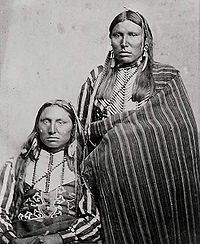
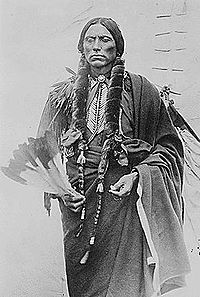 The Comanche maintained an ambiguous relationship with Europeans and later settlers attempting to colonize their territory. The Comanche were valued as trading partners but were feared for their raids. Similarly, they were, at one time or another, at war with virtually every other Native American group living in the Great Plains, leaving opportunities for political maneuvering by European colonial powers and the United States. At one point, Sam Houston
, president of the newly created Republic of Texas
, almost succeeded in reaching a peace treaty
with the Comanche. His efforts were thwarted when the Texas legislature
refused to create an official boundary between Texas and the Comancheria
.
While the Comanche managed to maintain their independence and increase their territory, by the mid-19th century they faced annihilation because of a wave of epidemics due to Eurasia
n diseases to which they had no immunity, such as smallpox and measles
. Outbreaks of smallpox
(1817, 1848) and cholera
(1849) took a major toll on the Comanche, whose population dropped from an estimated 20,000 in mid-century to just a few thousand by the 1870s.
The US began efforts in the late 1860s to move the Comanche into reservations, with the Treaty of Medicine Lodge (1867), which offered churches, schools, and annuities in return for a vast tract of land totaling over 60000 square miles (155,399.3 km²). The government promised to stop the buffalo
hunters who were decimating the great herds of the Plains, provided that the Comanche, along with the Apaches, Kiowa
s, Cheyenne
, and Arapaho
s, move to a reservation totaling less than 5000 square miles (12,949.9 km²) of land. However, the government did not prevent slaughtering of the herds. The Comanche under Isa-tai
(White Eagle) retaliated by attacking a group of hunters in the Texas Panhandle in the Second Battle of Adobe Walls
(1874). The attack was a disaster for the Comanche, and the US army was called in to drive the remaining Comanche in the area into the reservation. Within just ten years, the buffalo were on the verge of extinction, effectively ending the Comanche way of life as hunters. In 1875, the last free band of Comanches, led by Quahada warrior Quanah Parker
, surrendered and moved to the Fort Sill
reservation in Oklahoma.
Unhappy with life on the reservation, 170 warriors and their families, led by Black Horse, left the reservation in late 1876 for the Llano Estacado
. Attacks on buffalo hunters' camps led to the Buffalo Hunters' War
of 1877.
October 6-21, 1892, further reduced their reservation to 480000 acres (1,942.5 km²) at a cost of $1.25 per acre ($308.88/km²), with an allotment of 160 acre (0.6474976 km²) per person per tribe to be held in trust. New allotments were made in 1906 to all children born after the agreement, and the remaining land was opened to white settlement. With this new arrangement, the era of the Comanche reservation came to an abrupt end
. This treaty was not affiliated with any level of government. Meusebach brokered the treaty in order to settle the lands on the Fisher-Miller Land Grant, from which were formed the ten counties of Concho, Kimble
, Llano
, Mason
, McCulloch
, Menard, Schleicher, San Saba
, Sutton and Tom Green. In contrast to many treaties of its day, this treaty was very brief and simple, with all parties agreeing to a mutual cooperation and a sharing of the land. The treaty was agreed to at a meeting in San Saba County, Texas
, and signed by all parties on May 9, 1847 in Fredericksburg, Texas
. The treaty was never broken. Popular and misleading myth is that the treaty "is unbroken to this day". The treaty was very specifically between the Peneteka band and the German Immigration Company. No other band or tribe was involved. The German Immigration Company was dissolved by Meusebach himself shortly after it had served its purpose. By 1875 the Comanches had been relocated to reservations. Five years later, artist Friedrich Richard Petri
and his family moved to to the settlement of Pedernales
, near Fredericksburg. Petri's sketches and watercolors gave witness to the friendly relationships between the Germans and various local Native American tribes.
. The treaty was never officially ratified by any level of government and was binding only on the part of the Native Americans.
s, only to escape and be rescued by the Comanches. Lehmann became the adoptive son of Quanah Parker
. On August 26, 1901, Quanah Parker provided a legal affidavit
verifying Lehman's life as his adopted son 1877–1878. On May 29, 1908, the United States Congress
authorized the United States Secretary of the Interior
to allot Lehmann, as an adopted member of the Comanche nation, one hundred and sixty acres of Oklahoma land, near Grandfield
.
campaigned vigorously for better deals for his people, meeting with Washington politicians frequently; and helped manage land for the tribe. Parker became wealthy as a cattleman. Parker also campaigned for the Comanches' permission to practice the Native American Church
religious rites, such as the usage of peyote
, which was condemned by European-Americans. Before the first Oklahoma legislature, Quanah testified:
During World War II
, many Comanche left the traditional tribal lands in Oklahoma in search of financial opportunities in the cities of California and the Southwest
. About half the Comanche population still lives in Oklahoma, centered around the town of Lawton.

, or a brush lodge if it was summer. One or more of the older women assisted as midwives
. If a woman went into labor while the band was on the move, she simply paused along the trail and gave birth to her child. After a few hours of rest, she would take the baby and catch up with the group again. Men were not allowed inside the tipi during or immediately after the delivery.
First, the midwives softened the earthen floor
of the tipi and dug two holes. One of the holes was for heating water and the other for the afterbirth
. One or two stakes were driven into the ground near the expectant mother's bedding for her to grip during the pain of labor. After the birth, the midwives hung the umbilical cord
on a hackberry tree. The people believed that if the umbilical cord was not disturbed before it rotted, the baby would live a long and prosperous life.
The newborn was swaddled
and remained with its mother in the tipi for a few days. The baby was placed in a cradleboard
, and the mother went back to work. She could easily carry the cradleboard on her back, or prop it against a tree where the baby could watch her while she collected seeds or roots. Cradleboards consisted of a flat board to which a basket was attached. The latter was made from rawhide straps, or a leather sheath that laced up the front. With soft, dry moss as a diaper, the young one was safely tucked into the leather pocket. During cold weather, the baby was wrapped in blankets, and then placed in the cradleboard. The baby remained in the cradleboard for about ten months; then it was allowed to crawl around.
Both girls and boys were welcomed into the band, but boys were favored. If the baby was a boy, one of the midwives informed the father or grandfather, "It's your close friend". Families might paint a flap on the tipi to tell the rest of the tribe that they had been strengthened with another warrior. Sometimes a man named his child, but mostly the father asked a medicine man
(or another man of distinction) to do so. He did this in hope of his child living a long and productive life. During the public naming ceremony, the medicine man lit his pipe and offered smoke to the heavens, earth, and each of the four directions. He prayed that the child would remain happy and healthy. He then lifted the child to symbolize its growing up and announced the child's name four times. He held the child a little higher each time he said the name. It was believed that the child's name foretold its future; even a weak or sick child could grow up to be a great warrior, hunter, and raider if given a name suggesting courage and strength. Boys were often named after their grandfather, uncle, or other relative. Girls were usually named after one of their father's relatives, but the name was selected by the mother. As children grew up they also acquired nicknames at different points in their lives, to express some aspect of their lives.
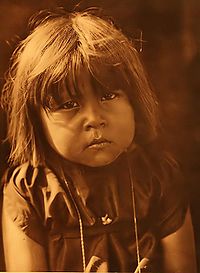 The Comanche looked upon their children as their most precious gift. Children were rarely punished. Sometimes, though, an older sister or other relative was called upon to discipline a child, or the parents arranged for a boogey man to scare the child. Occasionally, old people donned sheets and frightened disobedient boys and girls. Children were also told about Big Cannibal Owl (Pia Mupitsi) who lived in a cave on the south side of the Wichita Mountains
and ate bad children at night.
Children learned from example, by observing and listening to their parents and others in the band. As soon as she was old enough to walk, a girl followed her mother about the camp and played at the daily tasks of cooking and making clothing. She was also very close to her mother's sisters, who were called not aunt but pia, meaning mother. She was given a little deerskin doll, which she took with her everywhere. She learned to make all the clothing for the doll.
A boy identified not only with his father but with his father's family, as well as with the bravest warriors in the band. He learned to ride a horse before he could walk. By the time he was four or five, he was expected to be able to skillfully handle a horse. When he was five or six, he was given a small bow
and arrows. Often a boy was taught to ride and shoot by his grandfather, since his father and other warriors were on raids and hunts. His grandfather also taught him about his own boyhood and the history and legends of the Comanche.
As the boy grew older, he joined the other boys to hunt birds. He eventually ranged farther from camp looking for better game to kill. Encouraged to be skillful hunters, boys learned the signs of the prairie
as they learned to patiently and quietly stalk game. They became more self-reliant, yet, by playing together as a group, also formed the strong bonds and cooperative spirit that they would need when they hunted and raided.
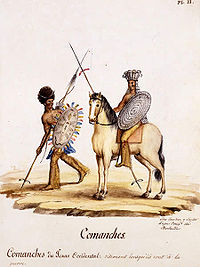 Boys were highly respected because they would become warriors and might die young in battle. As he approached manhood, a boy went on his first buffalo hunt. If he made a kill, his father honored him with a feast. Only after he had proven himself on a buffalo hunt was a young man allowed to go to war.
When he was ready to become a warrior, at about age fifteen or sixteen, a young man first "made his medicine" by going on a vision quest
(a rite of passage
). Following this quest, his father gave the young man a good horse to ride into battle and another mount for the trail. If he had proved himself as a warrior, a Give Away Dance might be held in his honor. As drummers faced east, the honored boy and other young men danced. His parents, along with his other relatives and the people in the band, threw presents at his feet – especially blankets and horses symbolized by sticks. Anyone might snatch one of the gifts for themselves, although those with many possessions refrained; they did not want to appear greedy. People often gave away all their belongings during these dances, providing for others in the band but leaving themselves with nothing.
Girls learned to gather healthy berries, nuts, and roots. They carried water and collected wood, and when about twelve years old learned to cook meals, make tipis, sew clothing, prepare hides, and perform other tasks essential to becoming a wife and mother. They were then considered ready to be married.
. Christian Missionaries convinced Comanche people to bury their dead in coffins in graveyards, which is the practice today.
for transportation. Later they acquired horses from other tribes and from the Spaniards. Since horses are faster, easier to control and able to carry more, this helped with their hunting and warfare and made moving camp easier. Being herbivores, horses were also easier to feed than dogs, since meat was a valuable resource.
during their migration to the Great Plains, both men and women shared the responsibility of gathering and providing food. When the Comanche reached the plains, hunting came to predominate. Hunting was considered a male activity and was a principal source of prestige. For meat, the Comanche hunted buffalo, elk, black bear, pronghorn, and deer. When game was scarce, the men hunted wild mustangs, sometimes eating their own ponies. In later years the Comanche raided Texas ranches and stole longhorn cattle. They did not eat fish or fowl, unless starving, when they would eat virtually any creature they could catch, including armadillos, skunks, rats, lizards, frogs, and grasshoppers. Buffalo meat and other game was prepared and cooked by the women. The women also gathered wild fruits, seeds, nuts, berries, roots, and tubers — including plums, grapes, juniper berries, persimmons, mulberries, acorns, pecans, wild onions, radishes, and the fruit of the prickly pear cactus. The Comanche also acquired maize
, dried pumpkin, and tobacco through trade and raids. Most meats were roasted over a fire or boiled. To boil fresh or dried meat and vegetables, women dug a pit in the ground, which they lined with animal skins or buffalo stomach and filled with water to make a kind of cooking pot. They placed heated stones in the water until it boiled and had cooked their stew. After they came into contact with the Spanish, the Comanche traded for copper pots and iron kettles, which made cooking easier.
Women used berries and nuts, as well as honey and tallow
, to flavor buffalo meat. They stored the tallow in intestine casings or rawhide pouches called parfleche
s. They especially liked to make a sweet mush of buffalo marrow mixed with crushed mesquite beans.
The Comanches sometimes ate raw meat, especially raw liver flavored with gall
. They also drank the milk from the slashed udders of buffalo, deer, and elk. Among their delicacies was the curdled milk from the stomachs of suckling buffalo calves. They also enjoyed buffalo tripe, or stomachs.
Comanche people generally had a light meal in the morning and a large evening meal. During the day they ate whenever they were hungry or when it was convenient. Like other Plains Indians
, the Comanche were very hospitable people. They prepared meals whenever a visitor arrived in camp, which led to outsiders' belief that the Comanches ate at all hours of the day or night. Before calling a public event, the chief took a morsel of food, held it to the sky, and then buried it as a peace offering to the Great Spirit. Many families offered thanks as they sat down to eat their meals in their tipis.
Comanche children ate pemmican
, but this was primarily a tasty, high-energy food reserved for war parties. Carried in a parfleche pouch, pemmican was eaten only when the men did not have time to hunt. Similarly, in camp, people ate pemmican only when other food was scarce. Traders ate pemmican sliced and dipped in honey, which they called Indian bread.
, the Brazos River
, and the Red River. The water of these rivers was often too dirty to drink, so the Comanches usually lived along the smaller, clear streams that flowed into them. These streams supported trees that the Comanche used to build shelters.
The Comanche sheathed their tipis with a covering made of buffalo hides sewn together. To prepare the buffalo hides, women first spread them on the ground, then scraped away the fat and flesh with blades made from bones or antlers, and left them in the sun. When the hides were dry, they scraped off the thick hair, and then soaked them in water. After several days, they vigorously rubbed the hides in a mixture of animal fat, brains, and liver to soften the hides. The hides were made even more supple by further rinsing and working back and forth over a rawhide thong. Finally, they were smoked over a fire, which gave the hides a light tan color. To finish the tipi covering, women laid the tanned hides side by side and stitched them together. As many as twenty-two hides could be used, but fourteen was the average. When finished, the hide covering was tied to a pole and raised, wrapped around the cone-shaped frame, and pinned together with pencil-sized wooden skewers. Two wing-shaped flaps at the top of the tipi were turned back to make an opening, which could be adjusted to keep out the moisture and held pockets of insulating air. With a fire pit in the center of the earthen floor, the tipis stayed warm in the winter. In the summer, the bottom edges of the tipis could be rolled up to let cool breezes in. Cooking was done outside during the hot weather. Tipis were very practical homes for itinerant people. Working together, women could quickly set them up or take them down. An entire Comanche band could be packed and chasing a buffalo herd within about twenty minutes. The Comanche women were the ones who did the most work with food processing and preparation.
, wolf, or coyote
skins) with knee-length buffalo-hide boots. Young boys usually went without clothes except in cold weather. When they reached the age of eight or nine, they began to wear the clothing of a Comanche adult. In the 19th century, men used woven cloth to replace the buckskin breechcloths, and the men began wearing loose-fitting buckskin shirts. The women decorated their shirts, leggings and moccasins with fringes made of deer-skin, animal fur, and human hair. They also decorated their shirts and leggings with patterns and shapes formed with beads and scraps of material. Comanche women wore long deerskin dresses. The dresses had a flared skirt and wide, long sleeves, and were trimmed with buckskin fringes along the sleeves and hem. Beads and pieces of metal were attached in geometric patterns. Comanche women wore buckskin moccasins with buffalo soles. In the winter they, too, wore warm buffalo robes and tall, fur-lined buffalo-hide boots.
Unlike the boys, young girls did not go without clothes. As soon as they were able to walk, they were dressed in breechcloths. By the age of twelve or thirteen, they adopted the clothes of Comanche women.
quill brushes, greased it and parted it in the center from the forehead to the back of the neck. They painted the scalp along the parting with yellow, red, or white clay (or other colors). They wore their hair in two long braids tied with leather thongs or colored cloth, and sometimes wrapped with beaver
fur. They also braided a strand of hair from the top of their head. This slender braid, called a scalp lock, was decorated with colored scraps of cloth and beads, and a single feather. Comanche men rarely wore anything on their heads. Only after they moved onto a reservation late in the 19th century did Comanche men begin to wear the typical Plains headdress. If the winter was severely cold, they might wear a brimless, woolly buffalo hide hat. When they went to war, some warriors wore a headdress made from a buffalo's scalp. Warriors cut away most of the hide and flesh from a buffalo head, leaving only a portion of the woolly hair and the horns. This type of woolly, horned buffalo hat was worn only by the Comanche. Comanche women did not let their hair grow as long as the men did. Young women might wear their hair long and braided, but women parted their hair in the middle and kept it short. Like the men, they painted their scalp along the parting with bright paint.
ed their face, arms, and chest with geometric designs, and painted their face and body. Traditionally they used paints made from berry juice and the colored clays of the Comancheria. Later, traders supplied them with vermilion (red pigment) and bright grease paints. Comanche men also wore bands of leather and strips of metal on their arms. Except for black, which was the color for war, there was no standard color or pattern for face and body painting: it was a matter of individual preference. For example, one Comanche might paint one side of his face white and the other side red; another might paint one side of his body green and the other side with green and black stripes. One Comanche might always paint himself in a particular way, while another might change the colors and designs when so inclined. Some designs had special meaning to the individual, and special colors and designs might have been revealed in a dream. Comanche women might also tattoo their face or arms. They were fond of painting their bodies and were free to paint themselves however they pleased. A popular pattern among the women was to paint the insides of their ears a bright red and paint great orange and red circles on their cheeks. They usually painted red and yellow around their lips.
Removing the lining of the inner stomach, women made the paunch into a water bag. The lining was stretched over four sticks and then filled with water to make a pot for cooking soups and stews. With wood scarce on the plains, women relied on buffalo chips (dried dung) to fuel the fires that cooked meals and warmed the people through long winters.
Stiff rawhide was fashioned into saddles, stirrups and cinches, knife cases, buckets, and moccasin soles. Rawhide was also made into rattles and drums. Strips of rawhide were twisted into sturdy ropes. Scraped to resemble white parchment, rawhide skins were folded to make parfleches in which food, clothing, and other personal belongings were kept. Women also tanned hides
to make soft and supple buckskin, which was used for tipi covers, warm robes, blankets, cloths, and moccasins. They also relied upon buckskin for bedding, cradles, dolls, bags, pouches, quivers, and gun cases.
Sinew was used for bowstrings and sewing thread. Hooves were turned into glue and rattles. The horns were shaped into cups, spoons, and ladles, while the tail made a good whip, a fly-swatter, or a decoration for the tipi. Men made tools, scrapers, and needles from the bones, as well as a kind of pipe, and fashioned toys for their children. As warriors, however, men concentrated on making bows and arrows, lances, and shields. The thick neck skin of an old bull was ideal for war shields that deflected arrows as well as bullets. Since they spent most of each day on horseback, they also fashioned leather into saddles, stirrups, and other equipment for their mounts. Buffalo hair was used to fill saddle pads and was also used in rope and halters.
 The language spoken by the Comanche people, Comanche
(Numu tekwapu), is a Numic language
of the Uto-Aztecan language group
. It is closely related to the language of the Shoshone
, from which the Comanche diverged around 1700. The two languages remain closely related, but a few low-level sound changes inhibit mutual intelligibility. The earliest records of Comanche from 1786 clearly show a dialect of Shoshone, but by the beginning of the 20th century, these sound changes had modified the way Comanche sounded in subtle, but profound, ways. Although efforts are now being made to ensure its survival, most speakers of the language are elderly, and less than one percent of the Comanches can speak the language. In the late 19th century, Comanche children were placed in boarding schools where they were discouraged from speaking their native language and even severely punished for doing so. The second generation then grew up speaking English, because it was believed that it was better for them not to know Comanche. During World War II
, a group of seventeen young men referred to as "The Comanche Code Talkers
" were trained and used by the U.S. Army to send messages conveying sensitive information that could not be deciphered by the Germans.
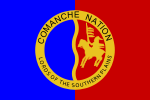 The headquarters of the Comanche Nation is Lawton, Oklahoma
and their tribal jurisdictional area is within Caddo
, Comanche
, Cotton
, Grady
, Jefferson
, Kiowa
, Stephens
, and Tillman Counties
. Michael Burgess is the current elected Tribal Chairman with the elections being held every three years. The Comanche Nation issues its own tribal vehicle tags. They operate ten tribal smoke shops, a bingo hall, the Comanche Nation Water Park, Comanche Nation Funeral Home, and four casinos. Specifically, the tribe owns Comanche Nation Games in Lawton, Comanche Red River Casino in Devol
, Comanche Spur Casino in Elgin
, Comanche Star Casino in Walters
, and Comanche Smokeshop and Game Center, also in Walters, Oklahoma.
In 2002, the tribe founded the Comanche Nation College
, a two-year tribal college in Lawton.
In July, Comanches from across the United States gather to celebrate their heritage and culture in Walters, Oklahoma
at the annual Comanche Homecoming powwow. The Comanche Nation Fair is held every September. The Comanche Little Ponies host two annual dances—one over New Year's and one in May.
Native Americans in the United States
Native Americans in the United States are the indigenous peoples in North America within the boundaries of the present-day continental United States, parts of Alaska, and the island state of Hawaii. They are composed of numerous, distinct tribes, states, and ethnic groups, many of which survive as...
ethnic group whose historic range (the Comancheria
Comancheria
The Comancheria is the name commonly given to the region of New Mexico, west Texas and nearby areas occupied by the Comanche before the 1860s.-Geography:...
) consisted of present-day eastern New Mexico
New Mexico
New Mexico is a state located in the southwest and western regions of the United States. New Mexico is also usually considered one of the Mountain States. With a population density of 16 per square mile, New Mexico is the sixth-most sparsely inhabited U.S...
, southern Colorado
Colorado
Colorado is a U.S. state that encompasses much of the Rocky Mountains as well as the northeastern portion of the Colorado Plateau and the western edge of the Great Plains...
, northeastern Arizona
Arizona
Arizona ; is a state located in the southwestern region of the United States. It is also part of the western United States and the mountain west. The capital and largest city is Phoenix...
, southern Kansas
Kansas
Kansas is a US state located in the Midwestern United States. It is named after the Kansas River which flows through it, which in turn was named after the Kansa Native American tribe, which inhabited the area. The tribe's name is often said to mean "people of the wind" or "people of the south...
, all of Oklahoma
Oklahoma
Oklahoma is a state located in the South Central region of the United States of America. With an estimated 3,751,351 residents as of the 2010 census and a land area of 68,667 square miles , Oklahoma is the 28th most populous and 20th-largest state...
, and most of northwest Texas
Texas
Texas is the second largest U.S. state by both area and population, and the largest state by area in the contiguous United States.The name, based on the Caddo word "Tejas" meaning "friends" or "allies", was applied by the Spanish to the Caddo themselves and to the region of their settlement in...
. Historically, the Comanches were hunter-gatherer
Hunter-gatherer
A hunter-gatherer or forage society is one in which most or all food is obtained from wild plants and animals, in contrast to agricultural societies which rely mainly on domesticated species. Hunting and gathering was the ancestral subsistence mode of Homo, and all modern humans were...
s, with a typical Plains Indian culture, including the horse. There may have been as many as 45,000 Comanches in the late 18th century.
Today, the Comanche Nation consists of 14,700 members (2010 enrollment figures), about half of whom live in Oklahoma. The remainder are concentrated in Texas, California, and New Mexico. The tribe is headquartered in Lawton, Oklahoma
Lawton, Oklahoma
The city of Lawton is the county seat of Comanche County, in the U.S. state of Oklahoma. Located in the southwestern region of Oklahoma approximately southwest of Oklahoma City, it is the principal city of the Lawton Oklahoma Metropolitan Statistical Area...
. The Comanche Nation Homecoming Powwow is held annually in Walters, Oklahoma
Walters, Oklahoma
Walters is a city in Cotton County, Oklahoma, United States. The population was 2,657 at the 2000 census. The city, nestled in between twin creeks, is the county seat of Cotton County...
in mid-July. The Comanche speak the Comanche language
Comanche language
Comanche is a Uto-Aztecan language spoken by the Comanche people, who split off from the Shoshone soon after they acquired horses in around 1705...
, a Numic
Numic languages
Numic is a branch of the Uto-Aztecan language family. It includes seven languages spoken by Native American peoples traditionally living in the Great Basin, Colorado River basin, and southern Great Plains. The word Numic comes from the cognate word in all Numic languages for "person." For...
language of the Uto-Aztecan
Uto-Aztecan languages
Uto-Aztecan or Uto-Aztekan is a Native American language family consisting of over 30 languages. Uto-Aztecan languages are found from the Great Basin of the Western United States , through western, central and southern Mexico Uto-Aztecan or Uto-Aztekan is a Native American language family...
family, sometimes classified as a Shoshone
Shoshone language
Shoshoni or Shoshone is a Native American language spoken by the Shoshone people. Principal dialects of Shoshoni include Western Shoshoni in Nevada, Gosiute in western Utah, Northern Shoshoni in southern Idaho and northern Utah, and Eastern Shoshoni in Wyoming.Shoshoni-speaking Native Americans...
dialect.
Formation
The Comanche emerged as a distinct group shortly before 1700, when they broke off from the ShoshoneShoshone
The Shoshone or Shoshoni are a Native American tribe in the United States with three large divisions: the Northern, the Western and the Eastern....
people living along the upper Platte River
Platte River
The Platte River is a major river in the state of Nebraska and is about long. Measured to its farthest source via its tributary the North Platte River, it flows for over . The Platte River is a tributary of the Missouri River, which in turn is a tributary of the Mississippi River which flows to...
in Wyoming
Wyoming
Wyoming is a state in the mountain region of the Western United States. The western two thirds of the state is covered mostly with the mountain ranges and rangelands in the foothills of the Eastern Rocky Mountains, while the eastern third of the state is high elevation prairie known as the High...
. This coincided with their acquisition of the horse
Horse
The horse is one of two extant subspecies of Equus ferus, or the wild horse. It is a single-hooved mammal belonging to the taxonomic family Equidae. The horse has evolved over the past 45 to 55 million years from a small multi-toed creature into the large, single-toed animal of today...
, which allowed them greater mobility in their search for better hunting grounds.
Their original migration
Human migration
Human migration is physical movement by humans from one area to another, sometimes over long distances or in large groups. Historically this movement was nomadic, often causing significant conflict with the indigenous population and their displacement or cultural assimilation. Only a few nomadic...
took them to the southern Great Plains
Great Plains
The Great Plains are a broad expanse of flat land, much of it covered in prairie, steppe and grassland, which lies west of the Mississippi River and east of the Rocky Mountains in the United States and Canada. This area covers parts of the U.S...
, into a sweep of territory extending from the Arkansas River
Arkansas River
The Arkansas River is a major tributary of the Mississippi River. The Arkansas generally flows to the east and southeast as it traverses the U.S. states of Colorado, Kansas, Oklahoma, and Arkansas. The river's initial basin starts in the Western United States in Colorado, specifically the Arkansas...
to central Texas. During that time, their population increased dramatically because of the abundance of buffalo
American Bison
The American bison , also commonly known as the American buffalo, is a North American species of bison that once roamed the grasslands of North America in massive herds...
, an influx of Shoshone migrants, and the adoption of significant numbers of women and children taken captive from rival groups. The Comanche never formed a single cohesive tribal unit
Tribe
A tribe, viewed historically or developmentally, consists of a social group existing before the development of, or outside of, states.Many anthropologists use the term tribal society to refer to societies organized largely on the basis of kinship, especially corporate descent groups .Some theorists...
but were divided into almost a dozen autonomous groups, called bands. These groups shared the same language and culture, and rarely fought each other.
In 1680 the Comanche acquired horses from the Pueblo Indians after the Pueblo Revolt
Pueblo Revolt
The Pueblo Revolt of 1680, or Popé's Rebellion, was an uprising of several pueblos of the Pueblo people against Spanish colonization of the Americas in the province of Santa Fe de Nuevo México.-Background:...
.
The horse was a key element in the emergence of a distinctive Comanche culture. Some scholars have suggested the Comanche broke away from the Shoshone and moved southward to search for additional sources of horses among the settlers of New Spain
New Spain
New Spain, formally called the Viceroyalty of New Spain , was a viceroyalty of the Spanish colonial empire, comprising primarily territories in what was known then as 'América Septentrional' or North America. Its capital was Mexico City, formerly Tenochtitlan, capital of the Aztec Empire...
to the south (rather than search for new herds of buffalo.) The Comanche may have been the first group of Plains
Great Plains
The Great Plains are a broad expanse of flat land, much of it covered in prairie, steppe and grassland, which lies west of the Mississippi River and east of the Rocky Mountains in the United States and Canada. This area covers parts of the U.S...
natives to fully incorporate the horse into their culture and to have introduced the animal to the other Plains peoples.
By the mid-19th century, the Comanche were supplying horses to French and American traders and settlers and later to migrants passing through their territory on the way to the California Gold Rush
California Gold Rush
The California Gold Rush began on January 24, 1848, when gold was found by James W. Marshall at Sutter's Mill in Coloma, California. The first to hear confirmed information of the gold rush were the people in Oregon, the Sandwich Islands , and Latin America, who were the first to start flocking to...
. The Comanche had stolen many of the horses from other tribes and settlers; they earned their reputation as formidable horse, and later, cattle thieves. Their stealing of livestock from Spanish and American settlers, as well as the other Plains tribes, often led to war.
The Comanche also had access to vast numbers of feral horses, which numbered approximately 2,000,000 in and around Comancheria. In the late 18th and early 19th centuries, the Comanche lifestyle required about one horse per person. With a population of about 30,000 to 40,000 and in possession of herds many times that number, the Comanche had a surplus of about 90,000 to 120,000 horses.
They were formidable opponents who developed strategies for using traditional weapons for fighting on horseback. Warfare was a major part of Comanche life. Comanche raids into Mexico
Mexico
The United Mexican States , commonly known as Mexico , is a federal constitutional republic in North America. It is bordered on the north by the United States; on the south and west by the Pacific Ocean; on the southeast by Guatemala, Belize, and the Caribbean Sea; and on the east by the Gulf of...
traditionally took place during the full moon, when the Comanche could see to ride at night. This led to the term "Comanche Moon," during which the Comanche raided for horses, captives, and weapons. The majority of Comanche raids into Mexico were in the state of Chihuahua and neighboring northern states.
Divisions
In Comanche society there were four levels of social-political integration:- patrilinear and patrilocal nuclear family
- extended family group (nʉmʉnahkahni - "the people who live together in a household", no size limits but nonrecognition beyond relatives two generations above or three below)
- residential local group (span. rancheria, comprised one or more nʉmʉnahkahni, one of which formed its core)
- division or band (sometimes called tribe, Spanish nación, rama - “branch”, several local groups linked by kinship, sodalities (political, medicine, and military) and common interest in hunting, gathering, war, peace, trade)
Following as example of such political and kinship-based division, one should mention the Yaparʉhka, who formed their own identity as a separate division. Because of cultural and linguistic differences from other Comanche bands, they became the “(Yap)Root-Eaters”, in contrast to the Kʉhtsʉtʉhka (“Buffalo-Eaters”). The Yaparʉhka division was composed of several residential local groups such as the Ketahtoh Tʉ, Motso Tʉ and Pibianigwai.
In contrast to the neighboring Cheyenne
Cheyenne
Cheyenne are a Native American people of the Great Plains, who are of the Algonquian language family. The Cheyenne Nation is composed of two united tribes, the Só'taeo'o and the Tsétsêhéstâhese .The Cheyenne are thought to have branched off other tribes of Algonquian stock inhabiting lands...
and Arapaho
Arapaho
The Arapaho are a tribe of Native Americans historically living on the eastern plains of Colorado and Wyoming. They were close allies of the Cheyenne tribe and loosely aligned with the Sioux. Arapaho is an Algonquian language closely related to Gros Ventre, whose people are seen as an early...
to the north, the Comanches never developed a political idea of forming a nation or tribe. Comanches recognized each other as Nʉmʉnʉ and seldom fought against each other; however, this did not mean that the Kwaarʉ Nʉʉ pursued the same policy against the Spanish and Indian settlements in New Mexico as did the Kʉhtsʉtʉhka. As a consequence, later, just as the Comanche society was breaking down, the once respected and feared Penatʉka Nʉʉ provided U.S. Army Indian Scouts
U.S. Army Indian Scouts
Native Americans have made up an integral part of U.S. military conflicts since America's beginning. Colonists recruited Indian allies during such instances as the Pequot War from 1634–1638, the Revolutionary War, as well as in War of 1812...
for the Americans and Texans against their still fighting and free-roaming Comanche kin.
The band
Band society
A band society is the simplest form of human society. A band generally consists of a small kin group, no larger than an extended family or clan; it has been defined as consisting of no more than 30 to 50 individuals.Bands have a loose organization...
was the primary social unit of the Comanches. A typical band might number about one hundred people. Bands were part of larger divisions, or tribes. Before the 1750s, there were three Comanche divisions: Yamparikas, Jupes, and Kotsotekas. In the 1750s and 1760s, a number of Kotsoteka bands split off and moved to the southeast. This resulted in a large division between the original group, the western Comanches, and the break away Kotsotekas, the eastern Comanches. The western Comanches lived in the region of the upper Arkansas River
Arkansas River
The Arkansas River is a major tributary of the Mississippi River. The Arkansas generally flows to the east and southeast as it traverses the U.S. states of Colorado, Kansas, Oklahoma, and Arkansas. The river's initial basin starts in the Western United States in Colorado, specifically the Arkansas...
, Canadian River
Canadian River
The Canadian River is the longest tributary of the Arkansas River. It is about long, starting in Colorado and traveling through New Mexico, the Texas Panhandle, and most of Oklahoma....
, and Red River
Red River (Mississippi watershed)
The Red River, or sometimes the Red River of the South, is a major tributary of the Mississippi and Atchafalaya Rivers in the southern United States of America. The river gains its name from the red-bed country of its watershed. It is one of several rivers with that name...
, and the Llano Estacado
Llano Estacado
Llano Estacado , commonly known as the Staked Plains, is a region in the Southwestern United States that encompasses parts of eastern New Mexico and northwestern Texas, including the South Plains and parts of the Texas Panhandle...
. The eastern Comanches lived on the Edwards Plateau
Edwards Plateau
The Edwards Plateau is a region of west-central Texas which is bounded by the Balcones Fault to the south and east, the Llano Uplift and the Llano Estacado to the north, and the Pecos River and Chihuahuan Desert to the west. San Angelo, Austin, San Antonio and Del Rio roughly outline the area...
and the Texas plains of the upper Brazos River
Brazos River
The Brazos River, called the Rio de los Brazos de Dios by early Spanish explorers , is the longest river in Texas and the 11th longest river in the United States at from its source at the head of Blackwater Draw, Curry County, New Mexico to its mouth at the Gulf of Mexico with a drainage...
and Colorado River
Colorado River (Texas)
The Colorado River is a river that runs through the U.S. state of Texas; it should not be confused with the much longer Colorado River which flows from Colorado into the Gulf of California....
., and east to the Cross Timbers
Cross Timbers
The term Cross Timbers is used to describe a strip of land in the United States that runs from southeastern Kansas across Central Oklahoma to Central Texas...
.
Over time, these divisions were altered in various ways. In the early 19th century, the Jupes vanished from history, probably merging into the other divisions. Many Yamparikas moved southeast, joining the eastern Comanches and becoming known as the Tenewas. Many Kiowa
Kiowa
The Kiowa are a nation of American Indians and indigenous people of the Great Plains. They migrated from the northern plains to the southern plains in the late 17th century. In 1867, the Kiowa moved to a reservation in southwestern Oklahoma...
s and Plains Apache
Plains Apache
The Plains Apache are a Southern Athabaskan group that traditionally live on the Southern Plains of North America and today are centered in Southwestern Oklahoma...
(or Naishans) moved to northern Comancheria and became closely associated with the Yamparikas. A group of Arapaho
Arapaho
The Arapaho are a tribe of Native Americans historically living on the eastern plains of Colorado and Wyoming. They were close allies of the Cheyenne tribe and loosely aligned with the Sioux. Arapaho is an Algonquian language closely related to Gros Ventre, whose people are seen as an early...
s, known as the Chariticas, moved into Comancheria and joined Comanche society. New divisions arose, such as the Nokonas, closely linked with the Tenewas; and the Kwahadas, who emerged as a new faction on the southern Llano Estacado. The western-eastern distinction changed in the 19th century. Observers began to call them northern and southern Comanches. One of the southernmost groups became known as the Penatekas.
All these division names were spelled in many different ways by Spanish and English writers, and spelling differences continue today. Large-scale groupings became unstable and unclear during the 19th century. The Comanche society was slowly overwhelmed and ultimately subjugated to the United States.
Various bands of the Comanche (Nʉmʉnʉ)
Naming practices of the Comanche were flexible, so some of these names are probably synonyms of others on the list. Joking and insulting synonyms were also commonly found in use among rival or allied bands.- Jupe (spelled in Spanish as Hupe, Hoipi, Hʉpenʉʉ — ‘Timber People’, an 18th century band, probably forerunners of the Nokoni Nʉʉ, Kwaaru Nʉʉ and of the Hois-Penatʉka Nʉʉ local group)
- Kʉhtsʉtʉʉka (Kotsoteka — ‘Buffalo-Eaters’)
- Kwaarʉ Nʉʉ/Kwahare (Kwahadi/Quohada — ‘Antelope-Eaters’, nicknamed Kwahihʉʉ Ki — ‘Sunshades on Their Backs’, because they lived on desert plains of the Llano EstacadoLlano EstacadoLlano Estacado , commonly known as the Staked Plains, is a region in the Southwestern United States that encompasses parts of eastern New Mexico and northwestern Texas, including the South Plains and parts of the Texas Panhandle...
) - Mʉtsahne (Motsai — ‘Undercut Bank’, annihilated in a battle with Mexicans in 1845)
- Nokoni Nʉʉ (Nokoni — ‘Movers’, ‘Returners’, also Noyʉhkanʉʉ, Nawyehkah — ‘Not Staying in one place’, later called Tʉtsʉ Noyʉkanʉʉ,Detsanayʉka — ‘Bad Campers’, ‘Poor Wanderer’)
- Nokoni Nʉʉ (major group, who had considerable influence on the decision making of the Tahnahwah und Tanimʉʉ)
- Tahnahwah (Tenawa, also Tenahwit — ‘Those Who Live Downstream’, southern splinter group of the Yaparʉhka, annihilated by the Mexicans in 1845)
- Tanimʉʉ (Tanima, also called Dahaʉi, Tevawish — ‘Liver-Eaters’)
- Pagatsʉ (Pa'káh'tsa — ‘Head of the Stream’, alsco called Pahnaixte — ‘Those Who Live Upstream’)
- Pekwi Tʉhka (‘Fish-Eaters’)
- Penatʉka Nʉʉ (Penateka, Pihnaatʉka, Penanʉʉ — ‘Honey-Eaters’, also called Pehnahterkʉh — ‘Quick-Stinger, Wasp, i.e. Raiders’)
- Penatʉka Nʉʉ (major local group)
- Hʉpenʉʉ (Hois — ‘Timber People’)
- Tayʉʉwit (Teyʉwit — ‘Hospitable Ones’)
- Kʉvahrahtpaht (‘Steep Climbers’)
- Taykahpwai (Tekapwai — ‘No Meat’)
- Pikaatamʉ (‘Buckskin Sewing People’)
- Saria Tʉhka (Chariticas, Sata Teichas — ‘Dog-Eaters’, once a group of ArapahoArapahoThe Arapaho are a tribe of Native Americans historically living on the eastern plains of Colorado and Wyoming. They were close allies of the Cheyenne tribe and loosely aligned with the Sioux. Arapaho is an Algonquian language closely related to Gros Ventre, whose people are seen as an early...
, who joined the Comanche) - Yaparʉhka (Yamparika, also Yapai Nʉʉ — ‘(Yap)Root-Eaters’, former called Widyʉ Nʉʉ, Widyʉ or Widyʉ Yapa — ‘Awl People’, later called Tʉtsahkʉnanʉʉ — ‘Sewing People’).
- Ketahtoh Tʉ (Ketatore — ‘Don't Wear Shoes’, also called Napwat Tʉ — ‘Wearing No Shoes’)
- Motso Tʉ (motso — ‘Beard’, not confused with the Mʉtsahne)
- Pibianigwai (‘Loud Talkers’, ‘Loud Askers’)
- Sʉhmʉhtʉhka (‘Eat Everything’)
- Titchahkaynah (‘Those Who Make Bags While Traveling’, once a separate group, later joined the Yaparʉhka)
- Wahkoh (‘Shell Ornament’)
- Waw'ai (Wohoi — ‘Lots of Maggots on the Penis’, also called Nahmahe'enah — ‘Something Together’, ‘Having (Sexual) Intercourse’, were supposed to have practiced incestIncestIncest is sexual intercourse between close relatives that is usually illegal in the jurisdiction where it takes place and/or is conventionally considered a taboo. The term may apply to sexual activities between: individuals of close "blood relationship"; members of the same household; step...
)
In addition there are further smaller bands:
- Hai'ne'na'ʉne (Hani Nʉmʉ — ‘Corn Eating People’, not to be confused with the indication Hanitaibo for the Penatʉka Nʉʉ)
- It'chit'a'bʉd'ah (Utsu'itʉ — ‘Cold People’, i.e. ‘Northern People’)
- Itehtah'o (‘Burnt Meat’, nicknamed by other Comanche, because they threw their surplus of meat out in the spring, were it dried and became black, looking like burnt meat)
- Naʉ'niem (No'na'ʉm — ‘Ridge People’, probably a former name for the Kwaarʉ Nʉʉ)
- Ohnonʉʉ (Ohnʉnʉnʉʉ, Onahʉnʉnʉʉ)
- Pahʉraix (‘Water Horse’, also called Parkeenaʉm or Paki Nʉmʉ — ‘Water People’, because they preferred settling along lakes, known to the Comanche as the best runners and players of LacrosseLacrosseLacrosse is a team sport of Native American origin played using a small rubber ball and a long-handled stick called a crosse or lacrosse stick, mainly played in the United States and Canada. It is a contact sport which requires padding. The head of the lacrosse stick is strung with loose mesh...
) - Pohoi (Pohoee — ‘Wild Sage’, once a group of Wind River ShoshoneShoshoneThe Shoshone or Shoshoni are a Native American tribe in the United States with three large divisions: the Northern, the Western and the Eastern....
who joined the Comanche) - Tʉtsanoo Yehkʉ (probably a variant spelling of Kʉhtsʉtʉʉka)
- Wianʉʉ (Wianʉ, Wia'ne — ‘Hill Wearing Away’)
Relationship with settlers
Sam Houston
Samuel Houston, known as Sam Houston , was a 19th-century American statesman, politician, and soldier. He was born in Timber Ridge in the Shenandoah Valley of Virginia, of Scots-Irish descent. Houston became a key figure in the history of Texas and was elected as the first and third President of...
, president of the newly created Republic of Texas
Republic of Texas
The Republic of Texas was an independent nation in North America, bordering the United States and Mexico, that existed from 1836 to 1846.Formed as a break-away republic from Mexico by the Texas Revolution, the state claimed borders that encompassed an area that included all of the present U.S...
, almost succeeded in reaching a peace treaty
Peace treaty
A peace treaty is an agreement between two or more hostile parties, usually countries or governments, that formally ends a state of war between the parties...
with the Comanche. His efforts were thwarted when the Texas legislature
Texas Legislature
The Legislature of the state of Texas is the state legislature of the U.S. state of Texas. The legislature is a bicameral body composed of a 31-member Senate and a 150-member House of Representatives. The Legislature meets at the Capitol in Austin...
refused to create an official boundary between Texas and the Comancheria
Comancheria
The Comancheria is the name commonly given to the region of New Mexico, west Texas and nearby areas occupied by the Comanche before the 1860s.-Geography:...
.
While the Comanche managed to maintain their independence and increase their territory, by the mid-19th century they faced annihilation because of a wave of epidemics due to Eurasia
Eurasia
Eurasia is a continent or supercontinent comprising the traditional continents of Europe and Asia ; covering about 52,990,000 km2 or about 10.6% of the Earth's surface located primarily in the eastern and northern hemispheres...
n diseases to which they had no immunity, such as smallpox and measles
Measles
Measles, also known as rubeola or morbilli, is an infection of the respiratory system caused by a virus, specifically a paramyxovirus of the genus Morbillivirus. Morbilliviruses, like other paramyxoviruses, are enveloped, single-stranded, negative-sense RNA viruses...
. Outbreaks of smallpox
Smallpox
Smallpox was an infectious disease unique to humans, caused by either of two virus variants, Variola major and Variola minor. The disease is also known by the Latin names Variola or Variola vera, which is a derivative of the Latin varius, meaning "spotted", or varus, meaning "pimple"...
(1817, 1848) and cholera
Cholera
Cholera is an infection of the small intestine that is caused by the bacterium Vibrio cholerae. The main symptoms are profuse watery diarrhea and vomiting. Transmission occurs primarily by drinking or eating water or food that has been contaminated by the diarrhea of an infected person or the feces...
(1849) took a major toll on the Comanche, whose population dropped from an estimated 20,000 in mid-century to just a few thousand by the 1870s.
The US began efforts in the late 1860s to move the Comanche into reservations, with the Treaty of Medicine Lodge (1867), which offered churches, schools, and annuities in return for a vast tract of land totaling over 60000 square miles (155,399.3 km²). The government promised to stop the buffalo
American Bison
The American bison , also commonly known as the American buffalo, is a North American species of bison that once roamed the grasslands of North America in massive herds...
hunters who were decimating the great herds of the Plains, provided that the Comanche, along with the Apaches, Kiowa
Kiowa
The Kiowa are a nation of American Indians and indigenous people of the Great Plains. They migrated from the northern plains to the southern plains in the late 17th century. In 1867, the Kiowa moved to a reservation in southwestern Oklahoma...
s, Cheyenne
Cheyenne
Cheyenne are a Native American people of the Great Plains, who are of the Algonquian language family. The Cheyenne Nation is composed of two united tribes, the Só'taeo'o and the Tsétsêhéstâhese .The Cheyenne are thought to have branched off other tribes of Algonquian stock inhabiting lands...
, and Arapaho
Arapaho
The Arapaho are a tribe of Native Americans historically living on the eastern plains of Colorado and Wyoming. They were close allies of the Cheyenne tribe and loosely aligned with the Sioux. Arapaho is an Algonquian language closely related to Gros Ventre, whose people are seen as an early...
s, move to a reservation totaling less than 5000 square miles (12,949.9 km²) of land. However, the government did not prevent slaughtering of the herds. The Comanche under Isa-tai
Isa-tai
Isa-tai was a Comanche warrior and medicine man of the Quahadi band. Originally named Quenatosavit , after the debacle at Adobe Walls he was known as Isa-tai which translates as "wolf's vulva" or "coyote vagina". Isa-tai gained enormous prominence for a brief period in 1873-74 as a prophet and...
(White Eagle) retaliated by attacking a group of hunters in the Texas Panhandle in the Second Battle of Adobe Walls
Second Battle of Adobe Walls
The Second Battle of Adobe Walls was fought on June 27, 1874 between Comanche forces and a group of twenty-eight U.S. bison hunters defending the settlement of Adobe Walls, Texas in what is now Hutchinson County, Texas.-Adobe Walls Settlement:...
(1874). The attack was a disaster for the Comanche, and the US army was called in to drive the remaining Comanche in the area into the reservation. Within just ten years, the buffalo were on the verge of extinction, effectively ending the Comanche way of life as hunters. In 1875, the last free band of Comanches, led by Quahada warrior Quanah Parker
Quanah Parker
Quanah Parker was a Comanche chief, a leader in the Native American Church, and the last leader of the powerful Quahadi band before they surrendered their battle of the Great Plains and went to a reservation in Indian Territory...
, surrendered and moved to the Fort Sill
Fort Sill
Fort Sill is a United States Army post near Lawton, Oklahoma, about 85 miles southwest of Oklahoma City.Today, Fort Sill remains the only active Army installation of all the forts on the South Plains built during the Indian Wars...
reservation in Oklahoma.
Unhappy with life on the reservation, 170 warriors and their families, led by Black Horse, left the reservation in late 1876 for the Llano Estacado
Llano Estacado
Llano Estacado , commonly known as the Staked Plains, is a region in the Southwestern United States that encompasses parts of eastern New Mexico and northwestern Texas, including the South Plains and parts of the Texas Panhandle...
. Attacks on buffalo hunters' camps led to the Buffalo Hunters' War
Buffalo Hunters' War
The Buffalo Hunters' War, or the Staked Plains War, occurred in 1877. Approximately 170 Comanche warriors and their families led by Black Horse left the Indian Territory in December, 1876, for the Llano Estacado of Texas...
of 1877.
Cherokee Commission
The Agreement with the Comanche, Kiowa and Apache signed with the Cherokee CommissionCherokee Commission
The Cherokee Commission, was a three-person bi-partisan body created by President Benjamin Harrison to operate under the direction of the Secretary of the Interior, as empowered by Section 14 of the Indian Appropriations Act of March 2, 1889. Section 15 of the same Act empowered the President to...
October 6-21, 1892, further reduced their reservation to 480000 acres (1,942.5 km²) at a cost of $1.25 per acre ($308.88/km²), with an allotment of 160 acre (0.6474976 km²) per person per tribe to be held in trust. New allotments were made in 1906 to all children born after the agreement, and the remaining land was opened to white settlement. With this new arrangement, the era of the Comanche reservation came to an abrupt end
Meusebach-Comanche treaty
The Peneteka band, agreed to a peace treaty with the German Immigration Company under John O. MeusebachJohn O. Meusebach
John O. Meusebach , born Baron Otfried Hans von Meusebach, was at first a Prussian bureaucrat, later an American farmer and politician who served in the Texas Senate, District 22.-Early years:John O...
. This treaty was not affiliated with any level of government. Meusebach brokered the treaty in order to settle the lands on the Fisher-Miller Land Grant, from which were formed the ten counties of Concho, Kimble
Kimble County, Texas
Kimble County is a county located on the Edwards Plateau in the U.S. state of Texas. In 2000, its population was 4,468. Its county seat is Junction. Kimble is named for George C. Kimble, who died at the Battle of the Alamo.-Geography:...
, Llano
Llano County, Texas
Llano County is a county located on the Edwards Plateau in the U.S. state of Texas. In 2010, its population was 19, 301. Its county seat is Llano, and the county is named for the Llano River....
, Mason
Mason County, Texas
Mason County is a county located on the Edwards Plateau in the U.S. state of Texas. In 2010, its population was 4, 012. Its county seat is Mason...
, McCulloch
McCulloch County, Texas
McCulloch County is a county located on the Edwards Plateau in the U.S. state of Texas. The geographical center of Texas lies within the county. In 2000, its population was 8,205. Its county seat is Brady. McCulloch is named for Benjamin McCulloch, a famous Texas Ranger and Confederate...
, Menard, Schleicher, San Saba
San Saba County, Texas
San Saba County is a county located on the Edwards Plateau in Western Central Texas. In 2010, its population was 6,131. Its county seat is San Saba. It is named for the San Saba River, which flows through the county.-History:...
, Sutton and Tom Green. In contrast to many treaties of its day, this treaty was very brief and simple, with all parties agreeing to a mutual cooperation and a sharing of the land. The treaty was agreed to at a meeting in San Saba County, Texas
San Saba County, Texas
San Saba County is a county located on the Edwards Plateau in Western Central Texas. In 2010, its population was 6,131. Its county seat is San Saba. It is named for the San Saba River, which flows through the county.-History:...
, and signed by all parties on May 9, 1847 in Fredericksburg, Texas
Fredericksburg, Texas
Fredericksburg is the seat of Gillespie County, in the U.S. state of Texas. As of the 2010 Census estimate, the city had a population of 10, 530...
. The treaty was never broken. Popular and misleading myth is that the treaty "is unbroken to this day". The treaty was very specifically between the Peneteka band and the German Immigration Company. No other band or tribe was involved. The German Immigration Company was dissolved by Meusebach himself shortly after it had served its purpose. By 1875 the Comanches had been relocated to reservations. Five years later, artist Friedrich Richard Petri
Friedrich Richard Petri
Friedrich Richard Petri was a German-born Texas painter who works recorded life in the original German immigrant settlements, and portrayed native American tribes in family settings.-Early life:...
and his family moved to to the settlement of Pedernales
Pedernales, Texas
Pedernales, Texas was an early settlement of German immigrants in Gillespie County, located southwest of Fredericksburg near what is now Texas State Highway 16...
, near Fredericksburg. Petri's sketches and watercolors gave witness to the friendly relationships between the Germans and various local Native American tribes.
Fort Martin Scott treaty
In 1850, another treaty was signed in San Saba, between the United States government and a number of local tribes, among which were the Comanches. This treaty was named for the nearest military fort, which was Fort Martin ScottFort Martin Scott
Fort Martin Scott is a restored United States Army outpost near Fredericksburg in the Texas Hill Country, United States, that was active from 1848 until 1853...
. The treaty was never officially ratified by any level of government and was binding only on the part of the Native Americans.
Captive Herman Lehmann
One of the most famous captives in Texas was a German lad named Herman Lehmann. He had been kidnapped by the ApacheApache
Apache is the collective term for several culturally related groups of Native Americans in the United States originally from the Southwest United States. These indigenous peoples of North America speak a Southern Athabaskan language, which is related linguistically to the languages of Athabaskan...
s, only to escape and be rescued by the Comanches. Lehmann became the adoptive son of Quanah Parker
Quanah Parker
Quanah Parker was a Comanche chief, a leader in the Native American Church, and the last leader of the powerful Quahadi band before they surrendered their battle of the Great Plains and went to a reservation in Indian Territory...
. On August 26, 1901, Quanah Parker provided a legal affidavit
Affidavit
An affidavit is a written sworn statement of fact voluntarily made by an affiant or deponent under an oath or affirmation administered by a person authorized to do so by law. Such statement is witnessed as to the authenticity of the affiant's signature by a taker of oaths, such as a notary public...
verifying Lehman's life as his adopted son 1877–1878. On May 29, 1908, the United States Congress
United States Congress
The United States Congress is the bicameral legislature of the federal government of the United States, consisting of the Senate and the House of Representatives. The Congress meets in the United States Capitol in Washington, D.C....
authorized the United States Secretary of the Interior
United States Secretary of the Interior
The United States Secretary of the Interior is the head of the United States Department of the Interior.The US Department of the Interior should not be confused with the concept of Ministries of the Interior as used in other countries...
to allot Lehmann, as an adopted member of the Comanche nation, one hundred and sixty acres of Oklahoma land, near Grandfield
Grandfield, Oklahoma
Grandfield is a city in Tillman County, Oklahoma, United States. The population was 1,038 at the 2010 census.-Geography:Grandfield is located at ....
.
Recent history
Entering the Western economy was a challenge for the Comanche in the late 19th and early 20th centuries, and back then many of them were defrauded of whatever remained of their land and possessions. Elected chief of the entire tribe by the United States government, Chief Quanah ParkerQuanah Parker
Quanah Parker was a Comanche chief, a leader in the Native American Church, and the last leader of the powerful Quahadi band before they surrendered their battle of the Great Plains and went to a reservation in Indian Territory...
campaigned vigorously for better deals for his people, meeting with Washington politicians frequently; and helped manage land for the tribe. Parker became wealthy as a cattleman. Parker also campaigned for the Comanches' permission to practice the Native American Church
Native American Church
Native American Church, a religious denomination which practices Peyotism or the Peyote religion, originated in the U.S. state of Oklahoma, and is the most widespread indigenous religion among Native Americans in the United States...
religious rites, such as the usage of peyote
Peyote
Lophophora williamsii , better known by its common name Peyote , is a small, spineless cactus with psychoactive alkaloids, particularly mescaline.It is native to southwestern Texas and Mexico...
, which was condemned by European-Americans. Before the first Oklahoma legislature, Quanah testified:
"I do not think this legislature should interfere with a man's religion, also these people should be allowed to retain this health restorer. These healthy gentleman before you use peoti and those that do not use it are not so healthy." [sic]
During World War II
World War II
World War II, or the Second World War , was a global conflict lasting from 1939 to 1945, involving most of the world's nations—including all of the great powers—eventually forming two opposing military alliances: the Allies and the Axis...
, many Comanche left the traditional tribal lands in Oklahoma in search of financial opportunities in the cities of California and the Southwest
Southwestern United States
The Southwestern United States is a region defined in different ways by different sources. Broad definitions include nearly a quarter of the United States, including Arizona, California, Colorado, Nevada, New Mexico, Oklahoma, Texas and Utah...
. About half the Comanche population still lives in Oklahoma, centered around the town of Lawton.
Social order
Comanche groups did not have a single acknowledged leader. Instead, a small number of generally recognized leaders acted as counsel and advisors to the group as a whole. These included the "peace chief," the members of the council, and the "war chief." The peace chief was usually an older individual, who could bring his experience to the task of advising. There was no formal inauguration or election to the position, it was one of general consensus. The council made decisions about where the band should hunt, whether they should war against their enemies, and whether to ally themselves with other bands. Any member could speak at council meetings, but the older men usually did most of the talking. In times of war, the band selected a war chief. To be chosen for this position, a man had to prove he was a brave fighter. He also had to have the respect of all the other warriors in the band. While the band was at war, the war chief was in charge, and all the warriors had to obey him. After the conflict was over, however, the war chief's authority ended. The Comanche men did most of the hunting and all of the fighting in the wars. They learned how to ride horses when they were young and were eager to prove themselves in battle. On the plains, Comanche women carried out the demanding tasks of cooking, skinning animals, setting up camp, rearing children, and transporting household goods.Childbirth
If a woman started labor while the band was in camp, she was moved to a tipiTipi
A tipi is a Lakota name for a conical tent traditionally made of animal skins and wooden poles used by the nomadic tribes and sedentary tribal dwellers of the Great Plains...
, or a brush lodge if it was summer. One or more of the older women assisted as midwives
Midwifery
Midwifery is a health care profession in which providers offer care to childbearing women during pregnancy, labour and birth, and during the postpartum period. They also help care for the newborn and assist the mother with breastfeeding....
. If a woman went into labor while the band was on the move, she simply paused along the trail and gave birth to her child. After a few hours of rest, she would take the baby and catch up with the group again. Men were not allowed inside the tipi during or immediately after the delivery.
First, the midwives softened the earthen floor
Earthen floor
An earthen floor, also called an adobe floor, is a floor made of dirt, raw earth, or other unworked ground materials. It is usually constructed, in modern times, with a mixture of sand, finely chopped straw and clay, mixed to a thickened consistency and spread with a trowel on a sub-surface such...
of the tipi and dug two holes. One of the holes was for heating water and the other for the afterbirth
Placenta
The placenta is an organ that connects the developing fetus to the uterine wall to allow nutrient uptake, waste elimination, and gas exchange via the mother's blood supply. "True" placentas are a defining characteristic of eutherian or "placental" mammals, but are also found in some snakes and...
. One or two stakes were driven into the ground near the expectant mother's bedding for her to grip during the pain of labor. After the birth, the midwives hung the umbilical cord
Umbilical cord
In placental mammals, the umbilical cord is the connecting cord from the developing embryo or fetus to the placenta...
on a hackberry tree. The people believed that if the umbilical cord was not disturbed before it rotted, the baby would live a long and prosperous life.
The newborn was swaddled
Swaddling
Swaddling is an age-old practice of wrapping infants in swaddling cloths, blankets or similar cloth so that movement of the limbs is tightly restricted. Swaddling bands were often used to further restrict the infant...
and remained with its mother in the tipi for a few days. The baby was placed in a cradleboard
Cradleboard
Cradleboards are traditional protective baby-carriers used by many indigenous cultures in North America. There are a variety of styles of cradleboard, reflecting the diverse artisan practises of indigenous cultures...
, and the mother went back to work. She could easily carry the cradleboard on her back, or prop it against a tree where the baby could watch her while she collected seeds or roots. Cradleboards consisted of a flat board to which a basket was attached. The latter was made from rawhide straps, or a leather sheath that laced up the front. With soft, dry moss as a diaper, the young one was safely tucked into the leather pocket. During cold weather, the baby was wrapped in blankets, and then placed in the cradleboard. The baby remained in the cradleboard for about ten months; then it was allowed to crawl around.
Both girls and boys were welcomed into the band, but boys were favored. If the baby was a boy, one of the midwives informed the father or grandfather, "It's your close friend". Families might paint a flap on the tipi to tell the rest of the tribe that they had been strengthened with another warrior. Sometimes a man named his child, but mostly the father asked a medicine man
Medicine man
"Medicine man" or "Medicine woman" are English terms used to describe traditional healers and spiritual leaders among Native American and other indigenous or aboriginal peoples...
(or another man of distinction) to do so. He did this in hope of his child living a long and productive life. During the public naming ceremony, the medicine man lit his pipe and offered smoke to the heavens, earth, and each of the four directions. He prayed that the child would remain happy and healthy. He then lifted the child to symbolize its growing up and announced the child's name four times. He held the child a little higher each time he said the name. It was believed that the child's name foretold its future; even a weak or sick child could grow up to be a great warrior, hunter, and raider if given a name suggesting courage and strength. Boys were often named after their grandfather, uncle, or other relative. Girls were usually named after one of their father's relatives, but the name was selected by the mother. As children grew up they also acquired nicknames at different points in their lives, to express some aspect of their lives.
Children
Wichita Mountains
The Wichita Mountains are located in the southwestern portion of the U.S. state of Oklahoma. The mountains are a northwest-southeast trending series of rocky promontories, many capped by 540 million-year old granite. These were exposed and rounded by weathering during the Permian Period...
and ate bad children at night.
Children learned from example, by observing and listening to their parents and others in the band. As soon as she was old enough to walk, a girl followed her mother about the camp and played at the daily tasks of cooking and making clothing. She was also very close to her mother's sisters, who were called not aunt but pia, meaning mother. She was given a little deerskin doll, which she took with her everywhere. She learned to make all the clothing for the doll.
A boy identified not only with his father but with his father's family, as well as with the bravest warriors in the band. He learned to ride a horse before he could walk. By the time he was four or five, he was expected to be able to skillfully handle a horse. When he was five or six, he was given a small bow
Bow (weapon)
The bow and arrow is a projectile weapon system that predates recorded history and is common to most cultures.-Description:A bow is a flexible arc that shoots aerodynamic projectiles by means of elastic energy. Essentially, the bow is a form of spring powered by a string or cord...
and arrows. Often a boy was taught to ride and shoot by his grandfather, since his father and other warriors were on raids and hunts. His grandfather also taught him about his own boyhood and the history and legends of the Comanche.
As the boy grew older, he joined the other boys to hunt birds. He eventually ranged farther from camp looking for better game to kill. Encouraged to be skillful hunters, boys learned the signs of the prairie
Prairie
Prairies are considered part of the temperate grasslands, savannas, and shrublands biome by ecologists, based on similar temperate climates, moderate rainfall, and grasses, herbs, and shrubs, rather than trees, as the dominant vegetation type...
as they learned to patiently and quietly stalk game. They became more self-reliant, yet, by playing together as a group, also formed the strong bonds and cooperative spirit that they would need when they hunted and raided.
When he was ready to become a warrior, at about age fifteen or sixteen, a young man first "made his medicine" by going on a vision quest
Vision quest
A vision quest is a rite of passage in some Native American cultures.In many Native American groups, the vision quest is a turning point in life taken before puberty to find oneself and the intended spiritual and life direction. When an older child is ready, he or she will go on a personal,...
(a rite of passage
Rite of passage
A rite of passage is a ritual event that marks a person's progress from one status to another. It is a universal phenomenon which can show anthropologists what social hierarchies, values and beliefs are important in specific cultures....
). Following this quest, his father gave the young man a good horse to ride into battle and another mount for the trail. If he had proved himself as a warrior, a Give Away Dance might be held in his honor. As drummers faced east, the honored boy and other young men danced. His parents, along with his other relatives and the people in the band, threw presents at his feet – especially blankets and horses symbolized by sticks. Anyone might snatch one of the gifts for themselves, although those with many possessions refrained; they did not want to appear greedy. People often gave away all their belongings during these dances, providing for others in the band but leaving themselves with nothing.
Girls learned to gather healthy berries, nuts, and roots. They carried water and collected wood, and when about twelve years old learned to cook meals, make tipis, sew clothing, prepare hides, and perform other tasks essential to becoming a wife and mother. They were then considered ready to be married.
Death
During the 19th century, the traditional Comanche burial custom was to wrap the deceased's body in a blanket and place it on a horse, behind a rider, who would then ride in search an appropriate burial place, such as a secure cave. After entombment, the rider covered the body with stones and returned to camp, where the mourners burned all the deceased's possessions. The primary mourner slashed his arms to express his grief. The Quahada band following this custom longer than other bands and buried their relatives in the Wichita MountainsWichita Mountains
The Wichita Mountains are located in the southwestern portion of the U.S. state of Oklahoma. The mountains are a northwest-southeast trending series of rocky promontories, many capped by 540 million-year old granite. These were exposed and rounded by weathering during the Permian Period...
. Christian Missionaries convinced Comanche people to bury their dead in coffins in graveyards, which is the practice today.
Transportation
When they lived with the Shoshone, the Comanche mainly used dog-drawn travoisTravois
A travois is a frame used by indigenous peoples, notably the Plains Indians of North America, to drag loads over land...
for transportation. Later they acquired horses from other tribes and from the Spaniards. Since horses are faster, easier to control and able to carry more, this helped with their hunting and warfare and made moving camp easier. Being herbivores, horses were also easier to feed than dogs, since meat was a valuable resource.
Food
The Comanche were initially hunter-gatherers. When they lived in the Rocky MountainsRocky Mountains
The Rocky Mountains are a major mountain range in western North America. The Rocky Mountains stretch more than from the northernmost part of British Columbia, in western Canada, to New Mexico, in the southwestern United States...
during their migration to the Great Plains, both men and women shared the responsibility of gathering and providing food. When the Comanche reached the plains, hunting came to predominate. Hunting was considered a male activity and was a principal source of prestige. For meat, the Comanche hunted buffalo, elk, black bear, pronghorn, and deer. When game was scarce, the men hunted wild mustangs, sometimes eating their own ponies. In later years the Comanche raided Texas ranches and stole longhorn cattle. They did not eat fish or fowl, unless starving, when they would eat virtually any creature they could catch, including armadillos, skunks, rats, lizards, frogs, and grasshoppers. Buffalo meat and other game was prepared and cooked by the women. The women also gathered wild fruits, seeds, nuts, berries, roots, and tubers — including plums, grapes, juniper berries, persimmons, mulberries, acorns, pecans, wild onions, radishes, and the fruit of the prickly pear cactus. The Comanche also acquired maize
Maize
Maize known in many English-speaking countries as corn or mielie/mealie, is a grain domesticated by indigenous peoples in Mesoamerica in prehistoric times. The leafy stalk produces ears which contain seeds called kernels. Though technically a grain, maize kernels are used in cooking as a vegetable...
, dried pumpkin, and tobacco through trade and raids. Most meats were roasted over a fire or boiled. To boil fresh or dried meat and vegetables, women dug a pit in the ground, which they lined with animal skins or buffalo stomach and filled with water to make a kind of cooking pot. They placed heated stones in the water until it boiled and had cooked their stew. After they came into contact with the Spanish, the Comanche traded for copper pots and iron kettles, which made cooking easier.
Women used berries and nuts, as well as honey and tallow
Tallow
Tallow is a rendered form of beef or mutton fat, processed from suet. It is solid at room temperature. Unlike suet, tallow can be stored for extended periods without the need for refrigeration to prevent decomposition, provided it is kept in an airtight container to prevent oxidation.In industry,...
, to flavor buffalo meat. They stored the tallow in intestine casings or rawhide pouches called parfleche
Parfleche
A parfleche is a Native American rawhide bag, typically used for holding dried meats and pemmican.The word was originally used by French fur traders...
s. They especially liked to make a sweet mush of buffalo marrow mixed with crushed mesquite beans.
The Comanches sometimes ate raw meat, especially raw liver flavored with gall
Bile
Bile or gall is a bitter-tasting, dark green to yellowish brown fluid, produced by the liver of most vertebrates, that aids the process of digestion of lipids in the small intestine. In many species, bile is stored in the gallbladder and upon eating is discharged into the duodenum...
. They also drank the milk from the slashed udders of buffalo, deer, and elk. Among their delicacies was the curdled milk from the stomachs of suckling buffalo calves. They also enjoyed buffalo tripe, or stomachs.
Comanche people generally had a light meal in the morning and a large evening meal. During the day they ate whenever they were hungry or when it was convenient. Like other Plains Indians
Plains Indians
The Plains Indians are the Indigenous peoples who live on the plains and rolling hills of the Great Plains of North America. Their colorful equestrian culture and resistance to White domination have made the Plains Indians an archetype in literature and art for American Indians everywhere.Plains...
, the Comanche were very hospitable people. They prepared meals whenever a visitor arrived in camp, which led to outsiders' belief that the Comanches ate at all hours of the day or night. Before calling a public event, the chief took a morsel of food, held it to the sky, and then buried it as a peace offering to the Great Spirit. Many families offered thanks as they sat down to eat their meals in their tipis.
Comanche children ate pemmican
Pemmican
Pemmican is a concentrated mixture of fat and protein used as a nutritious food. The word comes from the Cree word pimîhkân, which itself is derived from the word pimî, "fat, grease". It was invented by the native peoples of North America...
, but this was primarily a tasty, high-energy food reserved for war parties. Carried in a parfleche pouch, pemmican was eaten only when the men did not have time to hunt. Similarly, in camp, people ate pemmican only when other food was scarce. Traders ate pemmican sliced and dipped in honey, which they called Indian bread.
Habitation
Much of the area inhabited by the Comanches was flat and dry, with the exception of major rivers like the Cimarron River, the Pecos RiverPecos River
The headwaters of the Pecos River are located north of Pecos, New Mexico, United States, at an elevation of over 12,000 feet on the western slope of the Sangre de Cristo mountain range in Mora County. The river flows for through the eastern portion of that state and neighboring Texas before it...
, the Brazos River
Brazos River
The Brazos River, called the Rio de los Brazos de Dios by early Spanish explorers , is the longest river in Texas and the 11th longest river in the United States at from its source at the head of Blackwater Draw, Curry County, New Mexico to its mouth at the Gulf of Mexico with a drainage...
, and the Red River. The water of these rivers was often too dirty to drink, so the Comanches usually lived along the smaller, clear streams that flowed into them. These streams supported trees that the Comanche used to build shelters.
The Comanche sheathed their tipis with a covering made of buffalo hides sewn together. To prepare the buffalo hides, women first spread them on the ground, then scraped away the fat and flesh with blades made from bones or antlers, and left them in the sun. When the hides were dry, they scraped off the thick hair, and then soaked them in water. After several days, they vigorously rubbed the hides in a mixture of animal fat, brains, and liver to soften the hides. The hides were made even more supple by further rinsing and working back and forth over a rawhide thong. Finally, they were smoked over a fire, which gave the hides a light tan color. To finish the tipi covering, women laid the tanned hides side by side and stitched them together. As many as twenty-two hides could be used, but fourteen was the average. When finished, the hide covering was tied to a pole and raised, wrapped around the cone-shaped frame, and pinned together with pencil-sized wooden skewers. Two wing-shaped flaps at the top of the tipi were turned back to make an opening, which could be adjusted to keep out the moisture and held pockets of insulating air. With a fire pit in the center of the earthen floor, the tipis stayed warm in the winter. In the summer, the bottom edges of the tipis could be rolled up to let cool breezes in. Cooking was done outside during the hot weather. Tipis were very practical homes for itinerant people. Working together, women could quickly set them up or take them down. An entire Comanche band could be packed and chasing a buffalo herd within about twenty minutes. The Comanche women were the ones who did the most work with food processing and preparation.
Clothing
Comanche clothing was simple and easy to wear. Men wore a leather belt with a breechcloth — a long piece of buckskin that was brought up between the legs and looped over and under the belt at the front and back, and loose-fitting deerskin leggings. Moccasins had soles made from thick, tough buffalo hide with soft deerskin uppers. The Comanche men wore nothing on the upper body except in the winter, when they wore warm, heavy robes made from buffalo hides (or occasionally, bearAmerican black bear
The American black bear is a medium-sized bear native to North America. It is the continent's smallest and most common bear species. Black bears are omnivores, with their diets varying greatly depending on season and location. They typically live in largely forested areas, but do leave forests in...
, wolf, or coyote
Coyote
The coyote , also known as the American jackal or the prairie wolf, is a species of canine found throughout North and Central America, ranging from Panama in the south, north through Mexico, the United States and Canada...
skins) with knee-length buffalo-hide boots. Young boys usually went without clothes except in cold weather. When they reached the age of eight or nine, they began to wear the clothing of a Comanche adult. In the 19th century, men used woven cloth to replace the buckskin breechcloths, and the men began wearing loose-fitting buckskin shirts. The women decorated their shirts, leggings and moccasins with fringes made of deer-skin, animal fur, and human hair. They also decorated their shirts and leggings with patterns and shapes formed with beads and scraps of material. Comanche women wore long deerskin dresses. The dresses had a flared skirt and wide, long sleeves, and were trimmed with buckskin fringes along the sleeves and hem. Beads and pieces of metal were attached in geometric patterns. Comanche women wore buckskin moccasins with buffalo soles. In the winter they, too, wore warm buffalo robes and tall, fur-lined buffalo-hide boots.
Unlike the boys, young girls did not go without clothes. As soon as they were able to walk, they were dressed in breechcloths. By the age of twelve or thirteen, they adopted the clothes of Comanche women.
Hair and headgear
Comanche people took pride in their hair, which was worn long and rarely cut. They arranged their hair with porcupinePorcupine
Porcupines are rodents with a coat of sharp spines, or quills, that defend or camouflage them from predators. They are indigenous to the Americas, southern Asia, and Africa. Porcupines are the third largest of the rodents, behind the capybara and the beaver. Most porcupines are about long, with...
quill brushes, greased it and parted it in the center from the forehead to the back of the neck. They painted the scalp along the parting with yellow, red, or white clay (or other colors). They wore their hair in two long braids tied with leather thongs or colored cloth, and sometimes wrapped with beaver
Beaver
The beaver is a primarily nocturnal, large, semi-aquatic rodent. Castor includes two extant species, North American Beaver and Eurasian Beaver . Beavers are known for building dams, canals, and lodges . They are the second-largest rodent in the world...
fur. They also braided a strand of hair from the top of their head. This slender braid, called a scalp lock, was decorated with colored scraps of cloth and beads, and a single feather. Comanche men rarely wore anything on their heads. Only after they moved onto a reservation late in the 19th century did Comanche men begin to wear the typical Plains headdress. If the winter was severely cold, they might wear a brimless, woolly buffalo hide hat. When they went to war, some warriors wore a headdress made from a buffalo's scalp. Warriors cut away most of the hide and flesh from a buffalo head, leaving only a portion of the woolly hair and the horns. This type of woolly, horned buffalo hat was worn only by the Comanche. Comanche women did not let their hair grow as long as the men did. Young women might wear their hair long and braided, but women parted their hair in the middle and kept it short. Like the men, they painted their scalp along the parting with bright paint.
Body decoration
Comanche men usually had pierced ears with hanging earrings made from pieces of shell or loops of brass or silver wire. A female relative would pierce the outer edge of the ear with six or eight holes. The men also tattooTattoo
A tattoo is made by inserting indelible ink into the dermis layer of the skin to change the pigment. Tattoos on humans are a type of body modification, and tattoos on other animals are most commonly used for identification purposes...
ed their face, arms, and chest with geometric designs, and painted their face and body. Traditionally they used paints made from berry juice and the colored clays of the Comancheria. Later, traders supplied them with vermilion (red pigment) and bright grease paints. Comanche men also wore bands of leather and strips of metal on their arms. Except for black, which was the color for war, there was no standard color or pattern for face and body painting: it was a matter of individual preference. For example, one Comanche might paint one side of his face white and the other side red; another might paint one side of his body green and the other side with green and black stripes. One Comanche might always paint himself in a particular way, while another might change the colors and designs when so inclined. Some designs had special meaning to the individual, and special colors and designs might have been revealed in a dream. Comanche women might also tattoo their face or arms. They were fond of painting their bodies and were free to paint themselves however they pleased. A popular pattern among the women was to paint the insides of their ears a bright red and paint great orange and red circles on their cheeks. They usually painted red and yellow around their lips.
Arts and crafts
Because of their frequent traveling, Comanche Indians had to make sure that their household goods and other possessions were unbreakable. They did not use pottery that could easily be broken on long journeys. Basketry, weaving, wood carving, and metal working were also unknown among the Comanches. Instead, they depended upon the buffalo for most of their tools, household goods, and weapons. They made nearly 200 different articles from the horns, hide, and bones of the buffalo.Removing the lining of the inner stomach, women made the paunch into a water bag. The lining was stretched over four sticks and then filled with water to make a pot for cooking soups and stews. With wood scarce on the plains, women relied on buffalo chips (dried dung) to fuel the fires that cooked meals and warmed the people through long winters.
Stiff rawhide was fashioned into saddles, stirrups and cinches, knife cases, buckets, and moccasin soles. Rawhide was also made into rattles and drums. Strips of rawhide were twisted into sturdy ropes. Scraped to resemble white parchment, rawhide skins were folded to make parfleches in which food, clothing, and other personal belongings were kept. Women also tanned hides
Tanning
Tanning is the making of leather from the skins of animals which does not easily decompose. Traditionally, tanning used tannin, an acidic chemical compound from which the tanning process draws its name . Coloring may occur during tanning...
to make soft and supple buckskin, which was used for tipi covers, warm robes, blankets, cloths, and moccasins. They also relied upon buckskin for bedding, cradles, dolls, bags, pouches, quivers, and gun cases.
Sinew was used for bowstrings and sewing thread. Hooves were turned into glue and rattles. The horns were shaped into cups, spoons, and ladles, while the tail made a good whip, a fly-swatter, or a decoration for the tipi. Men made tools, scrapers, and needles from the bones, as well as a kind of pipe, and fashioned toys for their children. As warriors, however, men concentrated on making bows and arrows, lances, and shields. The thick neck skin of an old bull was ideal for war shields that deflected arrows as well as bullets. Since they spent most of each day on horseback, they also fashioned leather into saddles, stirrups, and other equipment for their mounts. Buffalo hair was used to fill saddle pads and was also used in rope and halters.
Language
Comanche language
Comanche is a Uto-Aztecan language spoken by the Comanche people, who split off from the Shoshone soon after they acquired horses in around 1705...
(N
Numic languages
Numic is a branch of the Uto-Aztecan language family. It includes seven languages spoken by Native American peoples traditionally living in the Great Basin, Colorado River basin, and southern Great Plains. The word Numic comes from the cognate word in all Numic languages for "person." For...
of the Uto-Aztecan language group
Uto-Aztecan languages
Uto-Aztecan or Uto-Aztekan is a Native American language family consisting of over 30 languages. Uto-Aztecan languages are found from the Great Basin of the Western United States , through western, central and southern Mexico Uto-Aztecan or Uto-Aztekan is a Native American language family...
. It is closely related to the language of the Shoshone
Shoshone language
Shoshoni or Shoshone is a Native American language spoken by the Shoshone people. Principal dialects of Shoshoni include Western Shoshoni in Nevada, Gosiute in western Utah, Northern Shoshoni in southern Idaho and northern Utah, and Eastern Shoshoni in Wyoming.Shoshoni-speaking Native Americans...
, from which the Comanche diverged around 1700. The two languages remain closely related, but a few low-level sound changes inhibit mutual intelligibility. The earliest records of Comanche from 1786 clearly show a dialect of Shoshone, but by the beginning of the 20th century, these sound changes had modified the way Comanche sounded in subtle, but profound, ways. Although efforts are now being made to ensure its survival, most speakers of the language are elderly, and less than one percent of the Comanches can speak the language. In the late 19th century, Comanche children were placed in boarding schools where they were discouraged from speaking their native language and even severely punished for doing so. The second generation then grew up speaking English, because it was believed that it was better for them not to know Comanche. During World War II
World War II
World War II, or the Second World War , was a global conflict lasting from 1939 to 1945, involving most of the world's nations—including all of the great powers—eventually forming two opposing military alliances: the Allies and the Axis...
, a group of seventeen young men referred to as "The Comanche Code Talkers
Code talker
Code talkers was a term used to describe people who talk using a coded language. It is frequently used to describe 400 Native American Marines who served in the United States Marine Corps whose primary job was the transmission of secret tactical messages...
" were trained and used by the U.S. Army to send messages conveying sensitive information that could not be deciphered by the Germans.
Comanche Nation today
Lawton, Oklahoma
The city of Lawton is the county seat of Comanche County, in the U.S. state of Oklahoma. Located in the southwestern region of Oklahoma approximately southwest of Oklahoma City, it is the principal city of the Lawton Oklahoma Metropolitan Statistical Area...
and their tribal jurisdictional area is within Caddo
Caddo County, Oklahoma
Caddo County is a county located in the U.S. state of Oklahoma. As of 2000, the population was 30,150. Its county seat is Anadarko. It is named after the Caddo tribe who were settled here on the 1870s...
, Comanche
Comanche County, Oklahoma
Comanche County is a county located in the U.S. state of Oklahoma. Built on former reservation lands of the Comanche, Kiowa, and Apache in Indian Territory, Comanche County was open for settlement on August 16, 1901 by lottery. The region has three cities and seven towns as well as the Fort Sill...
, Cotton
Cotton County, Oklahoma
Cotton County is a county located in the U.S. state of Oklahoma. As of 2000, the population was 6,614. Its county seat is Walters.When Oklahoma achieved statehood in 1907, the area which is now Cotton County fell within the boundaries of Comanche County...
, Grady
Grady County, Oklahoma
Grady County is a county located in the U.S. state of Oklahoma. As of 2006, the population was 50,490. Its county seat is Chickasha.Grady County is part of the Oklahoma City Metropolitan Statistical Area.-History:...
, Jefferson
Jefferson County, Oklahoma
Jefferson County is a county located in the U.S. state of Oklahoma. As of 2000, the population was 6,818. Its county seat is Waurika.-Geography:...
, Kiowa
Kiowa County, Oklahoma
Kiowa County is a county located in the U.S. state of Oklahoma. As of 2000, the population was 10,227. Its county seat is Hobart.-Geography:According to the U.S. Census Bureau, the county has a total area of . is land and is water....
, Stephens
Stephens County, Oklahoma
Stephens County is a county located in the U.S. state of Oklahoma. As of 2000, the population was 43,182. Its county seat is Duncan.-Geography:According to the U.S. Census Bureau, the county has a total area of 2,308 km²...
, and Tillman Counties
Tillman County, Oklahoma
Tillman County is a county located in the U.S. state of Oklahoma. As of 2000, the population was 9,287. The county seat is Frederick. .-Geography:According to the U.S...
. Michael Burgess is the current elected Tribal Chairman with the elections being held every three years. The Comanche Nation issues its own tribal vehicle tags. They operate ten tribal smoke shops, a bingo hall, the Comanche Nation Water Park, Comanche Nation Funeral Home, and four casinos. Specifically, the tribe owns Comanche Nation Games in Lawton, Comanche Red River Casino in Devol
Devol, Oklahoma
Devol is a town in Cotton County, Oklahoma, United States. The population was 150 at the 2000 census.-Geography:Devol is located at .According to the United States Census Bureau, the town has a total area of , all of it land....
, Comanche Spur Casino in Elgin
Elgin, Oklahoma
Elgin is a city in Comanche County, Oklahoma, United States. The population was 2,156 at the 2010 census. It is included in the Lawton, Oklahoma Metropolitan Statistical Area.-Geography:Elgin is located at ....
, Comanche Star Casino in Walters
Walters, Oklahoma
Walters is a city in Cotton County, Oklahoma, United States. The population was 2,657 at the 2000 census. The city, nestled in between twin creeks, is the county seat of Cotton County...
, and Comanche Smokeshop and Game Center, also in Walters, Oklahoma.
In 2002, the tribe founded the Comanche Nation College
Comanche Nation College
Comanche Nation College is a two-year, open admissions, American Indian tribal community college. It is located in Lawton, Oklahoma, the capital of the Comanche Nation. The school was chartered by the Comanche Nation Business Committee....
, a two-year tribal college in Lawton.
In July, Comanches from across the United States gather to celebrate their heritage and culture in Walters, Oklahoma
Walters, Oklahoma
Walters is a city in Cotton County, Oklahoma, United States. The population was 2,657 at the 2000 census. The city, nestled in between twin creeks, is the county seat of Cotton County...
at the annual Comanche Homecoming powwow. The Comanche Nation Fair is held every September. The Comanche Little Ponies host two annual dances—one over New Year's and one in May.
Notable Comanches
- Gil BirminghamGil BirminghamGil Birmingham is an American actor of Comanche ancestry, known for his portrayal of Billy Black in the The Twilight Saga film series.- Personal background :...
, actor, Into the WestInto the West (TV miniseries)Into the West is a 2005 miniseries produced by Steven Spielberg and Dreamworks, with six two-hour episodes . The series was first broadcast in the U.S. on Turner Network Television on six Fridays starting on June 10, 2005... - Blackbear BosinBlackbear BosinBlackbear Bosin was a Comanche-Kiowa sculptor and painter, also known as Tsate Kongia.-Background:Francis Blackbear Bosin was born June 5, 1921 in Cyril, Oklahoma near Anadarko. His parents were Frank Blackbear and Ada Tivis Bosin. His Kiowa name, Tsate Kongia, means "Blackbear" and belongs to his...
(1921–1980), Kiowa-Comanche sculptor and painter - Buffalo HumpBuffalo humpBuffalo Hump was a Native American War Chief of the Penateka band of the Comanche Indians...
(ca. 1795-1870), war chief of the Penteka band, led the Comanche in the Great Raid of 1840Great Raid of 1840The Great Raid of 1840 was the largest raid ever mounted by Native Americans on white cities in what is now the United States. It followed the Council House Fight, in which Republic of Texas officials attempted to capture and take prisoner 33 Comanche chiefs who had come to negotiate a peace... - Carne MuertoCarne MuertoCarne Muerto was a Native American War Chief of the Quahadi band of the Comanche Indians.He rose to fame first as a son of Santa Anna, and used that status to survive capture by John "Rip" Ford and his Texas Rangers...
(1832—1860s), chief of the Quahadi band - Charles ChibittyCharles ChibittyCharles Joyce Chibitty was a Comanche Numunu code talker, who spoke in his native language to relay messages for the United States Army during the European Theatre of World War II.-Life:...
(1921–2005), World War II Comanche code talker - LaDonna HarrisLaDonna HarrisLaDonna Vita Tabbytite Harris is a Comanche social activist from Oklahoma. She is the founder and president of Americans for Indian Opportunity.-Background:...
(b. 1931), political activist and founder of Americans for Indian Opportunity - Iron JacketIron JacketIron Jacket was a Native American War Chief and Chief of the Comanche Indians.Iron Jacket was a Comanche chieftain and medicine man whom the Comanche believed had the power to blow bullets aside with his breath...
(ca. 1785/1795—1858), war chief, medicine man; father of Peta Nocona and grandfather of Quanah Parker - Isa-taiIsa-taiIsa-tai was a Comanche warrior and medicine man of the Quahadi band. Originally named Quenatosavit , after the debacle at Adobe Walls he was known as Isa-tai which translates as "wolf's vulva" or "coyote vagina". Isa-tai gained enormous prominence for a brief period in 1873-74 as a prophet and...
(ca. 1840–ca. 1890), warrior and medicine man of the Quahadi band, who brought the Sun Dance to the Comanche - Tom Mauchahty-WareTom Mauchahty-WareTom Mauchahty-Ware is a Kiowa-Comanche musician. He is known for his work playing the Native American flute, and has been a successful Indian dancer, and has sung in a popular blues band. He is also a skilled traditional artist: painting, sculpting, making flutes, bead working, and feather working...
, Kiowa-Comanche musician - Sonny NevaquayaSonny NevaquayaSonny Nevaquaya is a Comanche Native American flute player and maker from Oklahoma. He began his professional career in 1993 when he recorded an album entitled Spirit of the Flute. His second album, Viva Kokopelli was released in 1996. He has also released an album in honor of his father, Doc...
, Native American fluteNative American fluteThe Native American flute has achieved some measure of fame for its distinctive sound, used in a variety of New Age and world music recordings. The instrument was originally very personal; its music was played without accompaniment in courtship, healing, meditation, and spiritual rituals. Now it...
-player - Peta NoconaPeta NoconaPeta Nocona was a chief of the Comanche band Noconi. He led his tribe during the extensive Indian Wars in Texas from the 1830s to 1860. He was the son of the Comanche chief Iron Jacket and father of chief Quanah Parker. His band Noconis, or Wanderers, or travellers were named after him...
(d. ca. 1864) chief of the Noconi band in Texas; father of Quanah Parker - Old OwlOld OwlOld Owl was a Native American Civil Chief of the Penateka band of the Comanche Indians. His name, Mo'pe-choko-pa, in Comanche literally meant "Old Owl."-Early life:...
(late 1790s–1849) chief of the Penateka band - Quanah ParkerQuanah ParkerQuanah Parker was a Comanche chief, a leader in the Native American Church, and the last leader of the powerful Quahadi band before they surrendered their battle of the Great Plains and went to a reservation in Indian Territory...
, chief, a founder of Native American ChurchNative American ChurchNative American Church, a religious denomination which practices Peyotism or the Peyote religion, originated in the U.S. state of Oklahoma, and is the most widespread indigenous religion among Native Americans in the United States...
, and successful rancher - White ParkerWhite ParkerWhite Parker was a son of Mah-Cheeta-Wookey and Quanah Parker, chief of the Comanches. He married Laura E. Clark , a daughter of Reverend and Mrs. M. A. Clark, a former Methodist missionary to the Comanches. They had at least three children – Patty Bertha, Cynthia Ann Joy, and Milton Quanah...
(1887–1956), son of Quanah Parker and Methodist missionary - Lotsee PattersonLotsee PattersonLotsee Patterson is a Comanche librarian, educator, and founder of the American Indian Library Association. She has written numerous articles on collection development, tribal libraries and Native American Librarianship....
(b. 1931), librarian, eduator, and founder of the American Indian Library Association - Mary Poafpybitty (1895–1984), medicine woman
- Santa AnnaSanta Anna (Comanche war chief)Santa Anna was a Native American War Chief of the Penateka band of the Comanche Indians.-In The Early Life:Santa Anna was a member of the same band of the Comanche as the more famous Buffalo Hump. He was an important chief, though probably less influential than Buffalo Hump during the 1830s and...
(1790s—1849), war chief - George "Comanche Boy" TahdooahnippahGeorge TahdooahnippahGeorge "Comanche Boy" Tahdooahnippah is an undefeated American Indian professional boxer in the Super Middleweight division and is the current World Boxing Council Continental America's middleweight and Native American Boxing Council Super Middleweight Champion.-Early life:Tahdooahnippah won the...
, professional boxer and NABC super middleweight champion - Ten BearsTen BearsChief Ten Bears - born Paruasemana , became the paraivo or chief of the Ketahto local group of Native Americans, and later the Principal Chief of the northern Yamparika or "Root Eater" division of the Numunuu Comanche, ca. 1850-60...
(Paruasemana, ca. 1790-1872), chief of the Ketahto and later the northern Yamparika band - TosawiTosawiTosawi was a Penateka Comanche chief. He was deemed "cooperative" by William Babcock Hazen...
, 19th century chief of the Penateka band - Rudy YoungbloodRudy YoungbloodRudy Youngblood is a Native American actor, musician, dancer and artist. He was born in Belton, Texas.-Acting career:...
, actor, starred in Apocalypto, not enrolled in the tribe
Further reading
- Thomas, Alfred Barnaby (1940) The Plains Indians and New Mexico, 1751-1778: A collection of documents illustrative of the history of the eastern frontier of New Mexico. University of New Mexico Press, Albuquerque, OCLC 3626655
- Wolff, Gerald W.Gerald W. WolffGerald W. Wolff is professor emeritus at the University of South Dakota, known for his specialization in the history of Native Americans, the American West, and national politics.-Background:...
, and Cash, Joseph W. (1976) The Comanche People Phoenix, Arizona: Indian Tribal Series. - Kenner, Charles (1969) A History of New Mexican-Plains Indian Relations. Norman: University of Oklahoma Press. OCLC 2141
- Fehrenbach, Theodore Reed (1974) The Comanches: The Destruction of a People. Knopf, New York, ISBN 0-394-48856-3; republished in 2003 under the title The Comanches: The History of a People. New York: Anchor Books. ISBN 1-4000-3049-8.
- John, Elizabeth A. H. (1975) Storms Brewed in Other Men's Worlds: The Confrontation of the Indian, Spanish, and French in the Southwest, 1540-1795. College Station: Texas A&M Press. ISBN 0-89096-000-3.
- Foster, Morris W. (1991) Being Comanche: A Social History of an American Indian Community. Tucson: University of Arizona Press. ISBN 0-8165-1367-8.
- Noyes, Stanley (1993) Los Comanches the horse people, 1751-1845. Albuquerque: University of New Mexico. ISBN 0-585-27380-4.
- Spady, James O'Neil (2009) "Reconsidering Empire: Current Interpretations of Native American Agency during Colonization." (review) Journal of Colonialism and Colonial History, Vol. 10, No. 2.
External links
- Comanche Nation, official website
- The Comanche Language and Cultural Preservation Committee
- Photographs of Comanche Indians hosted by the Portal to Texas History
- "Comanche" on the History Channel, accessed 26 August 2005
- The Texas Comanches, on Texas Indians]
- Comanche, Oklahoma Historical Society
- Comanche Lodge